




Abstract
To play a musical instrument in the way that one would sing is a goal that has been shared and documented by performers of Western classical music for several centuries. It is still common to hear performers in the 21st century encouraging each other to aspire to performance ideals that are linked to aspects of vocality. Taking voicelikeness not as an identifiable property of sound but rather as a social construction, this study investigates what an instrumental musician can do when they invoke the notion of voicelikeness, using discourse analysis to probe data from a single case study of a flute masterclass. We contend that, while the “truth” about any one instrumentalist’s claim to vocality may be impossible to verify, observing the ways in which such a claim is built up, shared, and defended can reveal the musical values that are being shaped and disseminated by musicians in a given set of circumstances. Applying a discourse approach to the analysis of an actual social encounter exposes how an instrumental musician can draw upon existing ideas about the voice to construct ideal musical practice. We conclude that stories of voicelikeness in discourse amongst instrumental musicians are not only about making a sound that is in some way vocal, they can also be used to transmit the norms of classical music performance from expert performer to developing performer.
Introduction
“The metaphor of voice,” writes Johnson, “underlines that all music, even the purely instrumental kind, refers back to a vocal origin, and that even the most apparently abstract kind of music thus implies a kind of utterance” (2009, p. 5). He describes a doctrine that has influenced instrumental musicians’ ways of understanding the performance of Western art music for centuries. Encouraging each other to aspire to performance ideals that are linked to aspects of vocality is a discursive practice that is still common amongst performers of mainstream classical instrumental music in the 21st century. Underlying it is the “perfection assumption” (Schubert & Wolfe, 2016) that positions the voice at the top of a hierarchy, as the ideal musical instrument. In this article, we use discourse excerpts from a single masterclass to explore how one expert flute player constructs voicelikeness in pursuit of excellence in performance.
One point of departure for this article is the work of the music psychologist Emery Schubert, who is particularly interested in the question of which instrument could be understood to be the closest to the human voice. With his physicist colleague, Joe Wolfe, he undertook a literature review (Schubert & Wolfe, 2016) that sought to “scrutinize the meaning of voicelikeness” (p. 249). They were “not able to identify a single musical instrument or even a class/family of instruments that was consistently, and throughout history linked to being voicelike” (2016, p. 258), and eventually suggested that voicelikeness may be “another way of saying something positive about an instrument” (p. 258). In 2019, Schubert published another article on the topic, which reported on further research that he had undertaken in pursuit of the question, “Which nonvocal musical instrument sounds like the human voice?” A total of 174 participants rated instruments according to how much they sounded like the human voice but, again, the results were inconclusive. Ultimately, Schubert speculated that “the idea of resembling or mimicking the human voice by a musical instrument might well be thought of as little more than a way of articulating musically expressive intention” (Schubert, 2019, p. 102).
In this paper we will not hypothesize that some instruments are more or less voicelike. Rather, we will respond to Schubert’s work by viewing his question from an alternative perspective, asking instead: “How and why is voicelikeness produced in discourse amongst instrumental musicians?” We view voicelikeness not as an identifiable property of sound but as a social construction: something that becomes possible through descriptions produced by particular people who co-create meaning in particular social contexts. In this enquiry we used discourse analysis to probe data from a single case study, enabling us to illustrate one example of an instrumental musician making sense of vocality in a way that supports a broader story about musicianship. The evidence gathered while carrying out this task suggests that vocality, for instrumental musicians, is about more than just sounding like a voice.
In the case study we use transcribed excerpts from a recording of a flute masterclass in which an expert musician constructs the idea of voicelikeness for a student. It is a complicated example in that the expert does not deal with voicelikeness as an isolated topic. Rather, he assumes that it is salient to flute players and describes it in ways that help to build the significance of the particular kind of sound that he wants the student to produce. The case study demonstrates that, while any one instrumentalist’s claim to vocality may be impossible to verify, observing the ways in which such a claim is built up, shared, and defended can tell us much more than whether or not an instrument is like a voice: it can reveal the musical values that are being shaped and disseminated by musicians in a given set of circumstances. Keeping in mind Kingsbury’s (1998) view that “conceptions of music are by nature products of social actors in social situations” (p. 179), we pay close attention to the performative aspects of an expert musician’s talk about voice. We propose that applying a discourse approach to the analysis of an actual social encounter exposes an instrumental musician’s use of ideas about voice as a vehicle for constructing ideal musical practice and perpetuating musical norms.
Vocality for instrumentalists
The practice of utilizing aspects of vocality to express instrumental performance ideals is evidenced clearly in pedagogical literature over several centuries (see Healy, 2018, Chapter 3). For example, Leopold Mozart (1719–1787) asserts in his violin treatise that “singing is at all times the aim of every instrumentalist” (1756/1985, p. 102); Sigismond Thalberg (1812–1871) reminds pianists that “the art of fine singing. . .always remains the same no matter what instrument it is practiced on” (1853, Preface); and the flautist Marcel Moyse (1889–1984) counsels: “Let us not expect anything of the instruments themselves. Rather let us imitate the good qualities of great singers. Let us try to speak, to sing, to communicate as they do” (Moyse, 1973, p. 6). Recent literature in instrumental pedagogy has continued to draw on this tradition (e.g., Wion, 2007; Downing, 2004; Graf, 2003; Concone, 1999) and the notion of applying vocal technique to instrumental playing remains a topic of interest among postgraduate researchers (e.g., Dyo, 2012; Root Pierce, 2013; Tiller, 2015; Worley, 2015). Vocality is an enduring theme within the discourse of instrumental music performance.
Vocality for instrumentalists has also been explored in contemporary musicological literature. Notably, 19th-century music and performance ideals have been the focus of several scholars who have considered the meaning of voice in instrumental contexts. Leading examples include Lydia Goehr (1998), whose examination of the dialogue between vocality and instrumentality is embedded in a detailed exploration of Richard Wagner’s position within the formalist-transcendentalist debate; David Milsom and Neal Peres Da Costa (2014), who have used treatises, musicians’ memoires, letters, early recordings, and piano rolls to question the idea of vocal expressiveness as it was applied to violin and piano playing in 19th-century performance practice; Mine Doğantan-Dack (2015), who has dealt with pianistic vocality in terms of its kinaesthetic and tactile qualities, formulating a set of hypotheses prompted by what she refers to as “normative pianistic cantabile practice” (p. 186); Lawrence Kramer (2012), who has highlighted the broader sociological factors that he believes led to an erosion of “the privilege of voice” (p. 232) in favour of the piano during the 19th century; and Jeanne Roudet (2014), who has examined the principles of bel canto as set out in Manuel García’s (1805–1906) vocal treatise and made connections to the “singing piano school” of Clara Schumann (1819–1896) and Frédéric Chopin (1810–1849). This body of work indicates the significance and diversity of vocality as a musicological concept. The present article seeks to contribute to this work by offering a different perspective—a discourse perspective—on how vocality is constructed by instrumentalists.
Questions about vocality and its possible meanings for instrumentalists have been raised in several other scholarly domains. In relation to jazz music contexts, ethnomusicologists such as Paul Berliner (1994), Lara Pellegrinelli (2005), and Tamar Sella (2015) have commented upon vocalist and instrumentalist identities as they develop within specific musical communities and have called attention to the ways in which these identities inform, contribute to, and resist one another. Arnie Cox’s (2016) mimetic hypothesis takes a cognitive approach to the question of how we listen and respond to music, positing that human beings are, to some extent, hard-wired to understand instrumental sounds in terms of vocal sounds. Daniel Leech-Wilkinson’s and Helen Prior’s (2014) work on heuristic devices, on the other hand, acknowledges that “there may be much to be learned from paying attention to the ways in which performers talk about being musically expressive” (p. 37), and explores the manner in which instrumentalists encode concepts such as voice with rich associations to instrumental technique in order to “make playing much easier to control” (p. 53). Leech-Wilkinson and Prior’s approach connects most closely with our own, in that it takes musicians’ talk as the material for analysis and acknowledges its centrality in the production of musical meaning.
Furthermore, voice itself has become a concept of considerable interest. The burgeoning area of voice studies has been brought into existence relatively recently by the contributions of numerous authors across several disciplines (e.g., Abbate, 1991; Frith, 1996; Jarman-Ivens, 2011; Dolar, 2006; Cavarero, 2005; Connor, 2000, 2014; Labelle, 2014; Chion, 2016; Kramer, 2014; Thomaidis & Macpherson, 2015) whose work reveals intricate, multiplicitous and complex constructions of vocality. Although further discussion of this growing body of work is beyond the scope of this article, it is important to mention it here because it is responsible for the present authors’ understanding of voice as a performative concept and a cultural construct (Dunn & Jones, 1994) rather than merely a physical entity.
Music, learning, and discourse
The masterclass is a pedagogical event frequently encountered by musicians in advanced musical training, typically in higher education settings. Masterclasses engender intense and highly focused learning environments (Atkinson et al., 2013) in which, in the presence of an audience, a student performer is observed, coached, and given spontaneous critical feedback on their musical performance by someone deemed “expert” in a specific skill area. In a particularly successful masterclass, learning occurs both for the student, for whom a certain, often very high, level of competence in their specialization is expected to have already been achieved, and for members of the audience (Haddon, 2014; Hanken, 2010, 2015, 2017), many of whom are also likely to be musicians at various stages of their development.
Various scholars have drawn upon masterclasses as a source of data in order to examine the unique learning conditions of the event. They have investigated students’ perspectives on masterclasses (Creech et al., 2009; Long et al., 2014) as well as masters’ perspectives (Hanken, 2010); offered practical guidelines for organizers and presenters of masterclasses (Hanken & Long, 2010); and formulated categories for different styles of teaching masterclasses (Long et al., 2011). Szczepek Reed et al. (2013) used conversation analysis to highlight the challenges faced by students in negotiating and coordinating restarts as responses to directives embedded in expert musicians’ masterclass talk, and Reed and Szczepek Reed (2014) went on to undertake further masterclass observations, identifying four ways in which learnables emerge through the specific interactional context that constitutes them. An additional perspective has been offered by the sociologist Paul Atkinson, whose microethnographic examinations of vocal masterclasses address the multimodal nature of masterclass pedagogy. He highlights the way that speech and musical performance are accompanied by a constant “dialogue of gesture” (Atkinson, 2013, p. 367) in the masterclass setting, positing that “the use of gesture and metaphor provides a practical bridge between tacit and explicit comprehension” (p. 368). This body of work examines the masterclass environment in detail and provides valuable context for our investigation of vocality as it is constructed during the course of one such event.
There is also a growing literature that uses various forms of discourse analysis to examine aspects of music education (Thompson, 2002; Talbot, 2013: Dobbs, 2008; Jocuns, 2007; Mantie, 2012; Jordhus-Lier, 2018; Ericsson & Lindgren, 2011). Much of this focuses on school-level education. For example, Thompson (2002) uses ideas about ideology and discourse from Critical Discourse Analysis in analysing the positioning of world music in school music lessons and Dobbs (2008) examines school music classroom discourse using Austin’s speech act theory to investigate the relationship between music discourses and community discourses. More interestingly, from the perspective of this paper, Shirley (2015) examines the relationship between adult music learners and their teachers. She finds discourses of teacher support and approval, and that the issue of control and power in student/teacher relationships appears frequently.
In their review of critical discourse analysis in education in general, Rogers et al. (2016) suggest that although foundational research recognized the ideological nature of educational practice, it was the publication of James Gee’s Social Linguistics and Literacies (1990) that brought critically oriented discourse analysis into education research. Gee’s approach, as set out in his How to do discourse analysis: A toolkit (2014a) has been a useful lens through which to analyse the excerpts from the masterclass presented in this article.
Methodology
The term discourse analysis has multiple meanings (Scollon & Wong Scollon, 2001, p. 538). “More theoretical framework than method” (Potter & Wetherell, 1987, p. 175), it “is best understood as a field of research rather than a single practice” (Taylor, 2001, p. 5) and serves as “an umbrella which covers a wide variety of actual research practices with quite different aims and theoretical backgrounds” (Burr, 1995, p. 163). There are many variations among the practices of discourse analysts, each strand emphasizing the priorities of its scholarly lineage. For the purposes of this project, we align our intentions with the following statement by Jonathan Potter, a proponent of what has become known as the discursive psychology strand of discourse analysis: I am taking a focus on discourse to mean that the concern is with talk and texts as parts of social practices. This is somewhat broader than the conversation analytic concern with talk-in-interaction, but rather more focused on the specifics of people’s practices than the Foucauldian notion of discourse as a set of statements that formulate objects and subjects. . . (Potter, 1996, p. 105)
Furthermore, in examining the construction of vocality, we follow the direction outlined by Maclure (2003). In formulating her aims for a “discourse-based educational research,” she set out to take “that which offers itself as common-sensical, obvious, natural, given or unquestionable, and [try] to unravel it a bit – to open it up to further questioning” (p. 9).
Discourse analysis “studies people in real-time interactions” and therefore “it is applied [research] in the sense that it is based within an empirical context” (Wiggins, 2017, p. 64). A publicly available video-recording of a music masterclass is a powerful, outward-facing statement of musical knowledge, and furthermore, an account which has “arisen in the natural course of events, rather than in the interaction between participants and researchers” (Alvesson & Sköldberg, 2009, p. 233–234). These qualities contribute to the richness of the masterclass as a source of data for discourse analysis.
Significantly, this case study is not “about” the masterclass as such: it does not present an analysis of a masterclass from beginning to end; it is not intended to give an account of the whole interaction. Because we are interested specifically in the construction of vocality by instrumentalists, we have chosen four excerpts from this masterclass that, together, provide insight into the way that this particular expert builds his idea of what voice should mean for the developing flute player, and show how he works, discursively, on its significance and credibility for his student and their audience. Taking this approach necessarily obscures most of the event from the reader’s view. This analysis is part of a larger study of masterclasses and other kinds of interactions in which instrumental musicians describe vocality and offer it as a solution to various musical problems (Healy, 2018). The purpose of providing readers of this article with a view through an extremely limited window into the chosen class is not to suggest that this view alone can show exactly what vocality “is” for instrumentalists. It simply allows us to demonstrate that this expert has seen vocality as a viable route through which to explain his vision of ideal musical practice in these social circumstances.
With this purpose in mind, the methodological approach to discourse analysis that we have taken in this article operates at the “meso-level” of discursive enquiry: it “falls between the fine grain and the big picture” (Oswick, 2012, p. 476). Taking excerpts from the masterclass text as the material for analysis, we concern ourselves with contextual and intertextual issues in a way that one would not expect to see within a “micro-level” conversation analysis approach. It is this moving “beyond the text. . .[to] consider aspects of the wider context” (Oswick, 2012, p. 474) that differentiates discursive approaches from forms of conversation analysis. However, we do not deal critically with what Gee terms “Big D discourses” (Gee, 2014a, pp. 181–189) in the way that a Foucauldian “macro-level” critical discourse approach might see fit. Our approach has enabled us to pay attention to the specificities of the expert musician’s method of constructing and defending a conception of vocality on one particular occasion, while also situating his discourse within some of the broader ideological discourse of musicology and music performance studies. The questions that we asked of the data were guided by Gee’s “Toolkit” (2014a). Gee explains that “the ‘tools’ approach . . . is meant to stress that speakers and writers are active designers and builders. They are making things, acting on others and on the world, and simultaneously reproducing social order, institutions, and cultures” (2014a, p. 195). He mentions that, although his tools and building tasks point the analyst toward multiple questions that they could ask of their data, ultimately, “any real discourse analysis only deals with some of the questions” (2014b, p. 141). For this enquiry, the “Making Strange Tool,” the “Doing and Not Just Saying Tool,” the “Why This Way and Not That Way Tool,” the “Context is Reflexive Tool,” the “Significance Building Tool,” the “Connections Building Tool,” the “Intertextuality Tool,” and the “Big C Conversation Tool” (2014a) provided fruitful avenues of enquiry.
In transcribing the masterclass, we did not note the precise lengths of pauses, or the overlap of words, in the manner more familiar to conversation analysts. However, we have included reference to significant non-verbal actions that contribute to the relationship between expert and developing performer. When making decisions about what to transcribe, our priority was readability, considering the intended audience of specialists in music, rather than linguistics, for this article (see Appendix I for a list of the transcription symbols used). In the transcribed excerpts and throughout this paper, we refer to the expert performer—the “master” of the class—as the EP, and to the developing performer who participated as a student in the class as the DP.
In the analysis, we draw upon several discourse analytic concepts that may not be familiar to all readers. We will explain them briefly here.
Intertextuality
Intertextuality is pervasive in discourse of all kinds. Kristeva argues, with reference to Mikhail Bakhtin, that “any text is constructed of a mosaic of quotations; any text is the absorption and transformation of another” (1980, p. 66). Hyatt and Meraud’s (2015) discussion of intertextuality in political discourse gives us further insight. Referring to it as a “mode of legitimation,” they suggest that intertextual reference occurs “where the speaker aligns their argumentation with that of other respected authorities to enhance the claim to authority and credibility” (p. 229). Furthermore, “sometimes intertextuality takes the form of citing the imagined voice of others . . . in order to construct a form of “straw man” argument, which the speaker then critiques to imply their argument is a credible reading of the situation” (Hyatt & Meraud, 2015, p. 229). Gee (2014a) suggests that the discourse analyst should pay attention to “echoes of any sort in one text to another” (p. 172), and should ask how intertextuality is being used by a speaker to engage in building significance, activities, identities, relationships, politics, connections, and sign systems and knowledge (pp. 94–98).
Big “C” conversations
Gee’s Big C Conversation Tool identifies “public debates, arguments, motifs, issues, or themes” (2014a, p. 189) as material with which a discourse analyst might engage in order to establish a more contextualized understanding of discourse in action. He notes that a “‘Conversation’ is composed of [a] myriad of interactional events taking place among specific people at specific times and places and within specific institutions” (pp. 189–190), and advises the analyst of any communication to “ask what issues, sides, debates, and claims the communication assumes hearers or readers know or what issues, sides, debates, and claims they need to know to understand the communication in terms of wider historical and social issues and debates” (p. 191).
Extreme case formulation
Extreme case formulation, as proposed by Pomerantz (1986), is “a common descriptive practice that involves using the extreme points on relevant descriptive dimensions” (Potter, 1996, p. 187). Edwards (2000) offers some categories: “‘superlative’ forms of adjectives (best, most, biggest, least, etc.); a collection of other semantically extreme adjectives (total, absolute, whole, etc.); and various adverbs (always, never, perfectly, completely, etc.), nouns (nothing, everybody, etc.), and phrases (as good as it gets, forever, brand new, etc.)” (p. 349). ECFs are often drawn upon when someone is “complaining, accusing, justifying, or defending” (Pomerantz, 1986, p. 219) and, significantly for this study in particular, they “can be taken to display a speaker’s investment rather than a description’s literal accuracy” (Edwards, 2000, p. 370). Relatedly, Potter (1996) describes processes of “extrematization and minimization,” and “normalization and abnormalization” to further explain how descriptions can be used to construct actions as being good or bad, more or less significant, or routine and expected as opposed to uncalled-for and inappropriate (see Potter, 1996, Chapter 7).
Stake and interest
Potter (1996) explains “the dilemma of stake” by suggesting that “anything that a person. . .says or does may be discounted as a product of stake or interest” (p. 110). He suggests that such a dilemma enters analysis not because researchers should interpret meaning in terms of people’s individual or group interests, but that “people treat one another in this way,” i.e., “they treat reports and descriptions as if they come from groups and individuals with interests, desires, ambitions and stake in some versions of what the world is like” (p. 110).
Introduction to the case study
The following discussion focuses on a section of a masterclass held in 2011 at the Royal Academy of Music, London, in which a female student flute player works on the Sonatine for flute and piano (1946) by Pierre Sancan (1916–2008) under the guidance of a well-known and widely admired male professional flute player who has an international reputation as both a soloist and an orchestral musician. A DVD or digital download of the recording of the entire class is available commercially (see Masterclass Media Foundation, 2011). During the masterclass, the expert works with three developing performers in succession. Our excerpts are drawn from his time with the second DP, whose segment of the class lasts for approximately 40 minutes [00:46:30–01:27:40]. The noted timings of the discourse excerpts are in respect of the overall class, rather than that particular DP’s segment. The discourse excerpts that we discuss are in chronological order, but they do not follow directly on from each other – additional activity including both playing and speaking takes place in between.
While examining several sections of the Sonatine in detail, the EP discusses various elements of flute playing including breathing, air support, head joint position, vibrato, intonation, resonance, control of dynamic variation, articulation, timbre, and embouchure. Throughout the 40 minutes, in relation to several of these elements, he returns again and again to his concept of “wasabi,” which we explore below. The EP frequently takes the DP’s flute out of her hands during the session and plays it to demonstrate something he has been talking about. The DP responds to the EP’s talk with facial expressions, some laughter, and by playing the flute, but she does not speak at any point.
Masterclass observations and analysis
The masterclass begins as follows: the DP and a pianist perform the Sonatine in its entirety [00:46:30–00:54:55], the audience applauds, and the master critique commences. As an initial response, the EP talks briefly about breathing, and the position of the DP’s instrument’s head joint, which he suggests is turned in too far and is therefore causing problems with tone quality and intonation. Subsequently, he directs the DP to the place in the piece to which he would like her to return and counts in her entry.
In Discourse Excerpt 1, the EP introduces what becomes a motif for the session: his theory of wasabi. Later in the masterclass it becomes clear that his comments about intonation, resonance, and tone colour, and the wasabi solution to problems in these areas are bound up in the widely cited idea of the voicelikeness of instruments in general, and the flute in particular.
boh-dah-di-dah, sorry. You’re too, you’re too flat.
((
((
You have to use more wasabi in your, in your flute playing.
((overt in-breath; right hand fingers touching top of nose, eyes wide)) ((sniff))
((sings)) Ahhhh. It’s a great thing to play in tune, I tell you, uh,
when you play forte then the sound is big, and huge
you don’t have to force anything.
It sounds big, and not too sharp: aww ((open hand near nose; very open mouth))
and when it’s piano: ahhh ((makes a fist with his hand still near to his nose))
You know you support the air exactly the same position
because you always think about the ((overt in-breath)) too much wasabi. ((sniff))
And, it helps. . .
since you’re centred, you play in tune with yourself, with your own body.
You know we have lots of cavities in the head that resonate while we are playing
and, the more they resonate, or the better you drive how the. . .
which ones are resonating,
the louder you can play with the same amount of air,
you can sound very loud or you can sound not loud
depending on whether it’s resonating or not.
And, emm, and by, using wasabi you. . .
((hand gestures pointing towards the top of his nose)) free up, the. . .
and you
and therefore all the notes are gonna be in tune.
Because it’s not the flutes that are out of tune or in tune
of course the scale, makes a difference, a slight difference this way or this other way
but it’s
it’s not the flute.
The EP draws attention to the DP’s inaccuracy of pitch and suggests that the solution to the problem of playing flat is that “You have to use more wasabi in your flute playing” (line 6). In general usage, the term “wasabi” refers to a distinctly spicy paste served with sushi, the pungency of which tends to “hit” the consumer between the eyes. However, in this masterclass, wasabi is a tool that has been crafted by this particular EP, and this is the occasion for neither its first nor its last appearance (see Carnegie Hall, 2014). The EP explains that his wasabi technique, which involves having a flute player imagine the specific sensation associated with eating wasabi, helps them control the resonance in their sound. In doing so, he argues, it becomes possible to play loudly, softly, and better in tune. Not only in tune with the piano, it would seem, but “in tune with yourself, with your own body” (line 16).
This account of how a flute player can “use wasabi” describes the EP’s special technique and its many benefits, but this is not the only action it performs. It also apportions blame for the pitch inaccuracy to the DP. Lines 27–29 make this clear: “. . . it’s not the flutes that are out of tune . . . it’s
((
((
It’s an eighth of a tone, difference. Sancan didn’t use any eighth tones in his music.
((
((
((
When you’re eating wasabi, too much, then you go:
((
unfocused sound))
haaw, haaw ((
Instead of doing hnng, hnng, hnng
((gestures with his hand toward the top of his nose; audience laughing continues))
you’re doing haaw, haaw, ((gestures towards his (too open) mouth))
it’s not the
So, and,
((plays excerpt from piece whilst gesturing with right hand to the top of his nose))
you still have to hold it here ((points to mouth)), yeah?
But hnng here ((points to top of nose)).
Think it’s between the
((sings a note with a purposeful ‘singer’ sound)) aaahhh
That point, somewhere here. Focus between the eyes.
Singers, actors, just to
((he mimes physically placing an object in front of his body with his hands))
they use this method,
to find
of your own body, and your own voice.
Same thing with the flute.
We can really
also, uh, despite supporting the air and always focusing,
Between the nose and the eyes. Hmm?
The DP is interrupted on account of ‘flatness’ again: this time the EP diagnoses that she is playing “an eighth of a tone” (line 4) below the required pitch. The specificity of this observation may or may not be a reflection of the EP’s ability to hear such a small interval; more relevant to the situation is the pointed accusation that it performs. He has already informed her (repeatedly) that it’s “too flat” (line 2), but the addition of detail here adds gravitas: it’s not just slightly flat, it is so far from the appropriate pitch that the EP can assign an intervallic relationship to the difference between right and wrong. This is an example of what Potter (1996) calls extrematization. Drawing on Anita Pomerantz’s (1986) notions of “extreme case formulation,” Potter points out how descriptions can be manipulated to make something seem severe or indeed, minimal in order to maximize its value in an argument (Potter, 1996, p. 188). The combination of “too flat, too flat” and “an eighth of a tone” echoes Pomerantz’s (1986) observation that “in justifying, speakers use Extreme Case Formulations to portray the circumstances that precipitated their actions as demanding their actions” (p. 228). Here, the offer of the wasabi solution is made necessary by the EP’s dramatic response to the DP’s pitch problem. Other ways in which the EP might have responded could have made the issue seem less important: he could have suggested that she “brighten” the tone, “support” the sound, direct the airstream higher or increase its velocity (Gee, 2014a, pp. 62–63). Instead, he focuses on the problem and magnifies it, thereby making way for the telling of the wasabi story—the DP has a big problem that needs a correspondingly grand solution.
In Discourse Excerpt 2 we acquire some more detailed instruction regarding the implementation of the EP’s wasabi technique. The DP must open not her mouth, but her nose (line 16) and “focus between the eyes” (line 23). Although it may not be possible for the DP to make an identifiable physical movement that would constitute “opening” the top of her nose, and although it may be difficult to ascertain how focusing between the eyes could effect audible changes in the DP’s flute sound, one reading of this piece of discourse is that the EP is using imagery to direct the DP’s attention away from her embouchure, which may have become tense. However, in Discourse Excerpt 2, he does not offer this idea as a supporting argument. The wasabi story continues, and it is at this stage that vocality—via the voices of some significant “others”—makes its entrance.
The EP constructs an argument that involves a variety of imagined voices, some of which he aligns his argument with, and some of which he uses as the object of critique. In Discourse Excerpt 2 he introduces some new voices that are important because they enable him to build legitimacy and significance (Gee, 2014a, p. 95) for his wasabi theory. These are the voices of “singers and actors” and their pedagogical communities, and later, the voices of other instrumentalists.
In lines 24–28, we are introduced to these corroborating voices: the EP tells us that singers and actors use the wasabi technique to “
To place the singing voice in the mask is to sing in a way that enables one to feel vibratory sensations in the face while producing vocal sound. Kayes, for instance, offers singers “internal anchoring devices” (2004, p. 79) to help them achieve this sensation. She notes that exercises of this kind should result in “a marked difference in resonance, probably due to an increase in harmonic energy” and that they “have been called variously ‘bringing the voice forward’, ‘placing the voice’, ‘inhalare la voce’. . .and ‘using the mask of the voice’.” However, and crucially: “none of them is about ‘placing’ your voice anywhere; they are simply about working the muscles of the vocal tract” (Kayes, 2004, p. 79). With regard to resonance, “what is actually happening and what the singer is feeling are two different things” (Bunch Dayme, 2009, p. 142); as Titze (2001) shows, although vibratory sensations can be felt in the face, “the resonance is likely to be a reinforcement between vocal fold vibration and supraglottal acoustic pressure, a nonlinear (feedback) phenomenon, rather than a facial resonance that ‘filters’ the sound and boosts certain frequencies” (p. 527). It is widely recognized that that this “sensation trap” (Chapman, 2011) has caused confusion amongst vocal pedagogues.
The celebrated tenor, vocal pedagogue, and voice scientist Richard Miller (1926–2009) expresses particular concern that instructions such as “place the voice” could “have the potential for inducing malfunction in singing, because they are imprecise” (Miller, 1986, p. 58), and outlines the “inherent dangers” in the misconceptions of the “singing in the masque” school of vocal pedagogy (Miller, 1996). He rather dryly describes something quite similar to the wasabi point as being a construction that is familiar to vocal pedagogues: “Included in ‘masque’ pedagogical orientation are systems that posit the existence of a sphincter unknown to anatomists, located at the bridge of the nose, by means of which tone can be controlled and ‘placed’” (1996, p. 83).
Returning to our flute masterclass, we are faced with a complex situation. Here is a musician whose outstanding level of expertise as a flute player is alluded to the world over, claiming to be offering the DP a way of improving her flute playing that not only has its origins in vocal, rather than flute technique, but in a method that has been critiqued heavily and often misunderstood by vocalists themselves. The flute EP gives no indication that his advice should be understood in metaphorical terms, rather, it is constructed with noticeable specificity in its physical detail. In order to make some sense of the EP’s offering we must invoke one of the key tenets of discourse analysis: that description is never just description but is always action-oriented, that words do things. With this in mind, we can ask, “What is the EP doing here?” and “How is he using vocality to do it?”
The EP provides no explanation of his decision suddenly to talk about vocal technique in a flute class, he simply does it. Although his social position in the masterclass already goes a long way toward making almost any kind of instruction—however vague or unusual— acceptable at least temporarily, what this may also tell us is that the EP is aware, and assumes that the DP is aware (or will at least behave as though she is aware) that there has been a long Conversation going on already about vocality amongst flute players. Musicians such as Peter-Lukas Graf (2003), John Wion (2007), Marcel Moyse (1973), Theobald Boehm (2001/1871), Johann George Tromlitz (1991/1791), and Johann Joachim Quantz (2001/1752) are all examples of contributors to this Conversation, and the EP’s swift and unremarked-upon shift of focus from flute technique to vocal technique communicates that, rather than bringing into being something innovative, he is merely making his own contribution to a pre-existing topic that is relevant to and available to be drawn upon in this context. Furthermore, referring to vocal technique in this way positions vocalists as the possessors of specialist knowledge; the technical advice of singers and actors is offered here as the kind of advice that should be understood—without further explanation being necessary—to be authoritative for a flute player.
In Discourse Excerpt 3 the EP takes more time to build the strength and significance of a connection (Gee, 2014a, pp. 96–97; pp. 132–133) between flute playing and singing, as he works toward the greater goal of rendering his wasabi narrative convincing. It is at this stage that we can see more clearly his rationale for referring to vocal technique: only flute players can really “sing” with their instruments.
((
Yeah. See, it’s the difference between,
((
((plays with an overly focused, thin sound))
or ((plays with a more resonant sound)).
Of course you can use the other one,
But
unlike any other wind instrument, is not
All the other instruments are closed by the, by the
it’s a very little, small hole, through which you blow the air into the instrument
with a lot of resistance and a lot of pressure
or your lips are even creating the frequency like on the brass instruments.
On the flute it’s
it’s the only one that, really uses e
Of course, all the instruments, even the cello, the violin they are gonna pretend
‘yeah, I’m singing on my instrument it’s beautiful, it’s like singing’
and you know, because everybody wants to sing.
Um. But,
we a-, most of us here, are flute players,
it
this thing, with this point here, I’m not kidding! It’s really something!
So, so, it makes you, go through the piece like a breeze.
While, if you have to think about the
the. . . euh. . . intonation all these technical issues,
you know just think wasabi, and, relax. Yeah? And it’s all going well.
It really makes it, makes your life so much easier, and
But just, for
because you’re not used to it.
At the beginning of this excerpt, the EP produces two different sounds on the DP’s flute. He then proceeds to argue that, whilst the first one can be used “sometimes,” it is the second, more resonant one that most accurately reflects the nature of a flute, which is operated by blowing air across, rather than into the embouchure hole. Gee’s Making Strange tool (2014a, pp. 25–27) provides a bridge to understanding this idea. Whereas an outsider to the world of music performance could be critical of such an argument, asking: “Why is it that one kind of sound made by a musician playing an instrument can be privileged over another kind of sound made by the same musician playing the same instrument?”; or “What does ‘nature’ mean in this context and why does it matter?”, for an insider, making and accepting these kinds of arguments is part of everyday professional practice. “Good” sound is what instrumentalists strive for years to produce. It is, of course, culturally and historically contingent, and what is relevant for a developing performer in this context is that good sound is achieved when those who currently have successful careers in performance say that it is being achieved. Orchestral jobs can be won or lost on having the right sound for a particular section, and instrumental performers are regularly reminded that no amount of technical prowess will cancel out the necessity for making a sound that is deemed beautiful by those who matter. What is particularly interesting about the EP’s division between a “sometimes” and an “almost always” flute sound, in this situation, is the argument that he uses to support these “facts” of flute playing, and to build an image of the natural: that playing the flute is like singing.
The EP goes to extraordinary lengths to make this statement a fact. Extreme case formulation emerges: not only is flute playing like singing, but now “it’s the only one that, really uses e
The EP is certainly not breaking new ground when he claims that his instrument is more voicelike than others; the declaration that an instrument is the closest instrument to the human voice has a long history of repetition amongst the instrumental performance community. A cursory online search of journalistic media in recent decades reveals that Alison Balsom has made vocal claims for the trumpet (Kellaway, 2012); Robin Eubanks for the trombone (Bernotas, 2001); Steven Isserlis for the cello (Isserlis, 2011); John Rutter for the violin (John Rutter Composes, 2015); Lawrence Power for the viola (Service, 2008); and Heinz Holliger for the oboe (Davis, 1981). Much earlier sources make parallel claims for the cor anglais (Barret, 1850, p. 2), the flute (Majer, 1732, p. 33), and the bassoon (Jancourt, 1847, p. 2), among others.
The expert performer in the masterclass takes this idea even further. He conjures up the voices of players of “all the instruments, even the cello, the violin” (line 16) and provides an imaginary direct quotation from this collective: “yeah, I’m singing on my instrument it’s beautiful, it’s like singing” (line 17). Here, with the contribution of active voicing (Wooffit, 1992) we can see Hyatt and Meraud’s (2015) “straw man argument” being constructed. The EP immediately dismisses the possibility that just any instrumentalist might be able to “sing” and assures his audience that whilst “everybody wants to sing” (line 18), it is only flute players who “use the same technique” (line 20).
Lines 22–27 are devoted to a reiteration of the manifold benefits of “thinking wasabi”: it eliminates technical problems, makes life easier, and makes the flute sound better. In Discourse Excerpt 4, we are introduced to one more advantage of wasabi: in as much as it facilitates a “natural” voice, it makes you sound like you.
The DP is playing the cadenza. The EP moves in close to the DP and puts his right hand near her forehead, then moves it away as though he is physically drawing out the sound from her face. The audience laughs. The DP plays along in good humour.
And
I’m just demonstrating on, on, on, on, DP’S NAME right now what, what you can do
but
And there’s not much you can do about your own sound but, only find it.
Eh, but once you’ve found it:
it sounds so much more
eh, so much better, sorry, that was good English. ((laughs))
And that, and the. . . all the intonation, dynamic control, err,
you know all these pitch issues when you’re playing err, dimi-
these problems disappear, or the, the or the boundaries are
that you never get in this trouble.
Ok, suddenly, playing the flute becomes easier.
And, again, it’s, I’m. . . the example is just only taken from
what they’re doing, in the theatre schools, in the acting schools and in the, in the,
and also the singers, that sing with a
you hear this right away with singers.
It’s the same thing with uh, with uh, flute playing.
Sometimes you want to go
((walks away from DP with his hands over his ears and a pained facial expression))
because it’s not natural because it’s forced
and when it’s just
and, and, just true;
when it’s
((long pause)) So, get some wasabi.
In the interaction preceding the start of Discourse Excerpt 4, it is possible for a listener to recognize that the EP’s physical gestures—his overtly performed reminders of the wasabi story—do effect audible change in the DP’s flute sound. The fact that change happens, however, is perhaps not as interesting as the way in which the EP then discursively constructs what this change means. He produces the powerful notion that one kind of sound can be “true” to this particular DP, and that she should avoid making other sounds that would be “forced” and “not natural.” This creates not just a musical but a moral imperative: not only would she be causing discomfort to her listeners if she were to use the wrong kind of sound (lines 20–22), but she would also be doing something dishonest. When the sound is right it is “beautiful,” “gorgeous,” “expressive,” “supple,” “true,” and even, “you” (lines 23–25).
By the end of the class, the EP has used a variety of discursive resources to convince the DP and the audience that this sound is the best sound, not necessarily just for Sancan’s Sonatine, but for flute playing generally. Not only that, but his inventive descriptions have translated the wasabi story into a common-sense strategy that this particular DP can use to find a sound that is personal to her. In this way, the EP has managed to fulfil the complex expectations of his role in the masterclass (Szczepek Reed, 2017, p. 179): he has authored himself as both “master performer” and “master teacher,” and the DP as someone who has learned something memorable and significant.
Two images of vocality
In the excerpts that we have examined, two different images of vocality were constructed by the EP. Initially, he put considerable effort into working up the objectivity of the voice by emphasizing the technical aspects of being a singer. His rationale for the performance of the wasabi narrative was that professional vocalists spend time teaching and learning this technique; and his rationale for drawing on vocal technique to advise on playing the flute was that the flute is the instrument closest to the human voice. Implicit in this reasoning is the (historically familiar) principle of voicelikeness being the ultimate goal for an instrumentalist, and the corresponding assumption that it would make sense for flute players to look to vocal technique to help them play in the best way possible. However, in Discourse Excerpt 4 we see that the end goal of using the wasabi technique is not only to be competent (i.e., to be able to play loudly, softly, and in tune) but to be authentic—and what this means is inherently individual: the sound must be unique to the performer. A different concept of voice is being produced here. Rather than offering singing as a technical discipline, the EP connects vocality with ideas about personal identity, beauty, and uniqueness, and he uses this imagery to place responsibility back on the DP. He has offered her singers’ techniques to emulate, but ultimately, these techniques serve the purpose of drawing out something that is inside the DP, something that she should take upon herself to produce: her natural, true voice and her own, authentic sound.
Normative sound qualities
The wasabi technique provided a route through which the pure, resonant, sanctioned flute sound that is expected of flute players who perform mainstream classical repertoire in the twenty-first century could be honed and encouraged. The voicelikeness argument enabled the EP, while appearing to value the DP’s individual musical qualities, to describe and mandate the kind of sound that the DP will need to make most often if she is to be recognized as a legitimate member of the professional community. The flute masterclass demonstrates what Gibbs (2018) refers to as “experience [being] made meaningful by emplotment” (p. 99), where the story is put together in order to have an explicit social function, acting as “a way to share wisdom and provide guidelines about how to behave” (p. 99). In this sense, vocality operates as a mechanism for perpetuating and privileging particular ways of making sound: the EP passes on the rules of normative practice by making certain ways of playing appear to be natural, and others to be less desirable.
Conclusions and wider implications
What we have observed in this article is that, for instrumentalists, being voicelike can mean more than simply making a sound that resembles a human voice. The EP in the example masterclass operationalized a range of vocality’s affordances to build up the concept of an ideal flute sound. By referring to the general model of “what singers and actors do,” he was able to use technical concepts of vocal production as well as other vocal connotations such as authenticity to build plausible representations of good flute playing. He constructed vocality in such a way as to make it an intrinsic part of an important story that was not just about flute technique, but also about musicianship and authentic musical performance.
Experienced musicians who genuinely wish to help developing performers gain traction in the professional world of performance take great effort to advise them on the kind of playing that they will need to be able to achieve in order to gain employment. It could be argued that what developing performers who aspire to a career in the performance of mainstream Western classical music need to know most urgently is not that there are endless ways in which they could craft a convincing performance of a given piece of music, but rather, which of those ways will enable them to demonstrate their understanding of what is appropriate and acceptable by today’s standards in terms of phrasing, tone colour, tempi, articulation, and dynamic range. Stories of voice are among those that provide heuristic routes to normativity: “short-cuts” to these appropriate ways of going about performance (Leech-Wilkinson & Prior, 2014). Even if such stories, on closer examination, might manifest as what Leech-Wilkinson refers to as “the oldest trick of poor parenting, ‘Play like this because I said so’” (2016, p. 332), when the “I” refers to a musician who has been recognized as a successful professional performer, then it is not surprising that the music performance community does not tend to question them. Leading developing musicians toward ways of performing music that will be accepted as stylish and employable in the relevant field is usually understood to be the role of an effective musical mentor.
Stories of vocality—such as the “my instrument is the instrument closest to the human voice” narrative in this example—can be vehicles for relaying normativity in ways that are entertaining, interesting, and engaging. In the masterclass excerpts analysed above, the expert performer’s notion of doing as a vocalist would do enables the developing flute player to produce a sound that is deemed beautiful by a gatekeeper to the profession. However, further, more detailed scholarly examinations of these kinds of discursive constructions in social contexts such as the masterclass may raise the question of whether musical experts’ somewhat covert articulation of what is and isn’t musically legitimate encroaches upon the space that remains for innovation and “virtuoso creativity” (Leech-Wilkinson, 2018, p. 560). Future research could investigate other situations in which developing instrumental musicians are encouraged to “sing,” and, perhaps more usefully, explore what would happen if developing performers were invited to think critically and independently about whose voices they may wish to emulate and why.
Footnotes
Appendix
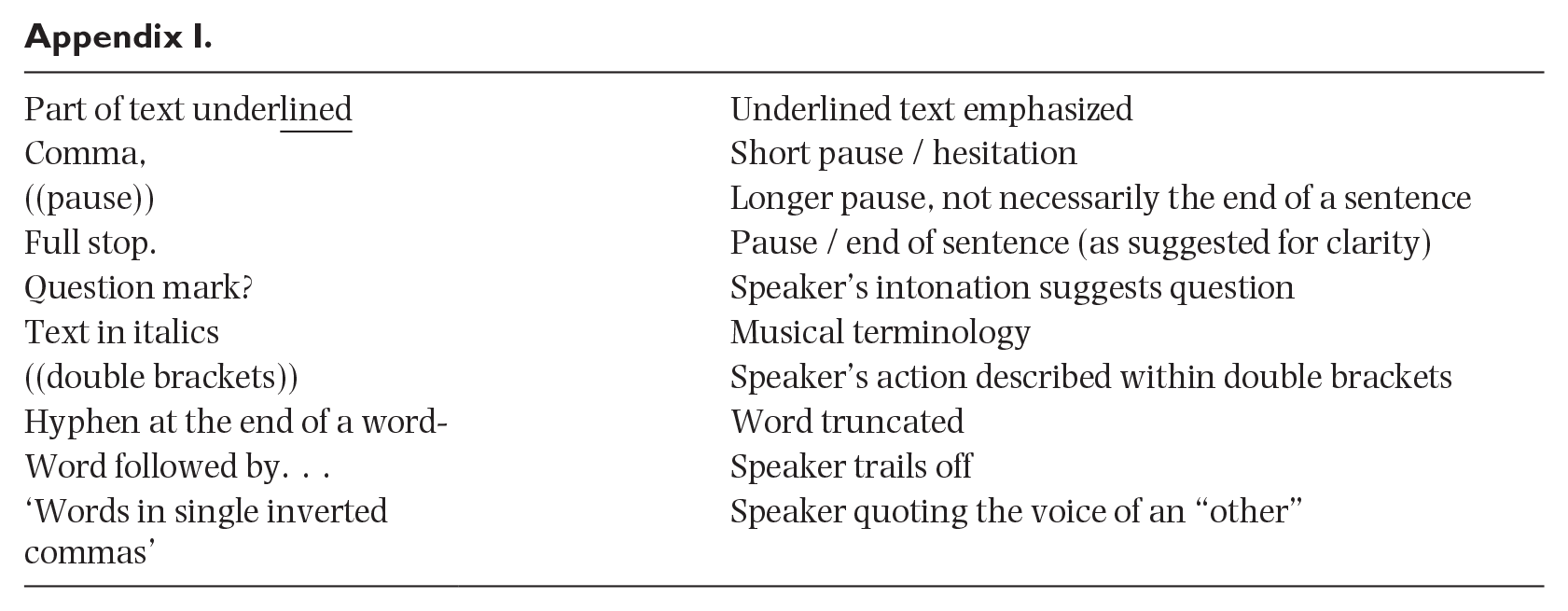
| Part of text under |
Underlined text emphasized |
| Comma, | Short pause / hesitation |
| ((pause)) | Longer pause, not necessarily the end of a sentence |
| Full stop. | Pause / end of sentence (as suggested for clarity) |
| Question mark? | Speaker’s intonation suggests question |
| Text in italics | Musical terminology |
| ((double brackets)) | Speaker’s action described within double brackets |
| Hyphen at the end of a word- | Word truncated |
| Word followed by. . . | Speaker trails off |
| ‘Words in single inverted commas’ |
Speaker quoting the voice of an “other” |
Acknowledgements
The authors would like to thank the two anonymous reviewers of this article, both of whom provided insightful responses to the text that contributed to its improvement. They also wish to acknowledge the significant contributions made by Dr David Milsom, who was principal supervisor of the University of Huddersfield doctoral project from which the material for this article derives. Additionally, they are very grateful to Professor Timothy Dornan. Several revisions were made to drafts of this article in response to his generous advice.
Declaration of conflicting interests
The author(s) declared no potential conflicts of interest with respect to the research, authorship, and/or publication of this article.
Funding
The author(s) received no financial support for the research, authorship, and/or publication of this article.
