




Abstract
Online asynchronous courses require close attention to course design to ensure there are strategies in place to foster social presence to build stronger senses of community and to motivate students to engage (content, peers and instructors). Judicious use of social media may serve this purpose. Since its inception, social media, Twitter in particular, has been employed in higher education courses for teaching and learning experiences with a notable impact on student engagement and social presence. This research examines students’ use of Twitter for assessment and interaction in the online asynchronous classroom from 2014 to 2018, to determine if there has been an increase in the length, amount or content within Tweets, and if students report stronger engagement and interaction following the use of Twitter for assessment. While results indicate such a connection exists, students were more focused on completing course requirements than creating connections or interacting with others, and were bothered by the constraints of the Tweet length.
Introduction
The use of social media platforms in the online asynchronous classroom for formal learning experiences has continually increased in recent years, specifically since the COVID-19 pandemic (Rohr et al., 2022; Kahn et al., 2021; Dunlap and Lowenthal, 2009b; Gammon and McGranahan, 2015; Junco et al., 2011). Although research indicates there is a divide regarding whether using social media in the classroom is beneficial (Gammon and McGranahan, 2015; Hsu and Ching, 2012; Sharma and Chintalapati, 2021; Tucker et al., 2021) or disadvantageous to learning (Manca and Ranieri, 2015, 2016; Tan et al., 2021; Tang and Hew, 2016), the uptake of social media in the classroom cannot be minimized.
Three point six billion people worldwide use social media as of 2020, and that figure is expected to climb to 4.41 billion by 2025 (Statista, 2021). The number of active Twitter users worldwide in 2019 was approximately 290.5 million, with projections estimating 340.2 million active users by 2024 (Statista, 2022). Though the primary purpose of social media is to facilitate social interactions in the virtual world, recently social media, and specifically Twitter, have become more commonplace in higher education and online learning. The benefits of social media in the online classroom range from increasing student interaction, improving engagement between students and with course material, and supporting learning outcomes, to positively impacting teacher and student professional development and networking (Carpenter and Krutka, 2014, 2015; Denker et al., 2018; Junco et al., 2011; Manca and Ranieri, 2016; Rohr, Costello & Hawkins, 2015, 2018; Rohr et al., 2022). The current research aims to examine the general uses of Twitter in the online, asynchronous post-secondary classroom, and explore the change in students tweeting behaviours over time, with a specific focus on students’ perceptions of Twitter’s usefulness in the classroom concerning interaction and engagement.
Literature review
Social media in higher education
Social media platforms allow users to be both consumers and producers of online information. These platforms are informal learning spaces that enable students to create and personalize their learning experiences through interactions and connections in what are called virtual/online learning communities (Tess, 2013; West et al., 2015). The most commonly used social media platforms in North America are Facebook, YouTube, Instagram and Twitter (Kunst, 2021), with the most users. Each of these platforms have their own specific aims, foci and encourage unique engagement from users.
Social media connects people around the world, enabling information sharing and the creation of virtual, online communities. Virtual learning communities (VLC’s), often known as online learning communities, refer to how students personalize their learning experience and curate their interests, interactions, and productions on social media through whom they choose to follow/tweet/communicate/interact with (Lemay and Doleck, 2020; West et al., 2015; Gannon-Leary and Fontainha, 2007). A VLC is a group of students who have similar educational goals, in which interactions between the students are mediated and cultivated online. VLCs typically use synchronous and asynchronous tools to support student learning and promote engagement between students (Miller et al., 2021). Further, VLCs provide opportunities to develop connections with peers and instructors, allow for peer support, and provide an outlet to share individual experiences (Miller et al., 2021). Social media platforms were not intentionally designed to support learning experiences; however, their focus on engagement and interaction may be beneficial in the classroom.
Balakrishnan and Lay (2016) studied the use of social media in relation to students’ learning styles (i.e. participatory, collaborative, and independent). They found that the popularity of social media can encourage learning and may offer options for creating online study groups, idea sharing, and interaction among students and instructors (Balakrishnan and Lay, 2016). The use of social media in the online classroom allows students to personalize their learning experience and community, contributing to learning for all community members.
Further, students use social media for informal and formal curriculum-based interactions (Hamid et al., 2015). They can track their own progress, be involved in an enjoyable and interactive learning environment, apply critical thinking, and interact with their peers and instructors (Hamid et al., 2015). Interestingly, these interactions are more student-student and student-content centred, rather than student-instructor centred (Smith, 2016). Further, Smith (2016) cautions that social media use in higher education be judicious to avoid hindering learning opportunities. In 2015, Manca and Ranieri (2015) found that social media was not being widely used in academic contexts for teaching, which was largely attributed to a general low level of instructor adoption explained by cultural resistance, pedagogical issues or institutional constraints. Since the global COVID-19 pandemic, the use of social media and online learning platforms have proliferated learning spaces (Lemay and Doleck, 2020), and despite some return to in-person activities, the prevalence of online learning supported by social media has increased.
Can Twitter support online learning?
In the academic context, Twitter has become a platform for educational professionals to develop their career, network with others, and implement technology in the classroom (Tang and Hew, 2016). Within a classroom, Twitter can is often used as a means for communication and assessment (Junco et al., 2011; Thoms and Eryilmaz, 2015), interaction, engagement, and discussion between students (Amry, 2018; Rohr et al., 2022), and to cultivate interactions with educators and professionals (Tang and Hew, 2016). Educators can use Twitter to increase students’ interactions with each other and the instructor(s), convey important deadlines, and communicate homework assignments (Feito and Brown, 2018), among numerous other activities. The use of Twitter with regards to assessment and improved learning outcomes is still in need of further exploration research, but promising findings have illustrated the benefits of Twitter when it comes to facilitating communication and interaction in online, asynchronous courses (Luo et al., 2019; Rohr et al., 2022; Tang and Hew, 2016).
Using Twitter to support virtual learning may be particularly effective in online, asynchronous, self-directed courses where educators and students typically do not have face-to-face interactions, as they would in an on-campus, in-person classroom. Twitter has been found to improve interaction, engagement and connections between students in the online asynchronous classroom (Junco et al., 2013; Rohr et al., 2018). Designing direct, frequent and meaningful interactions in online asynchronous learning environments is thought to be critical for improving interaction and engagement (Protosaltis and Baum, 2019).
Twitter is inherently designed as a social networking tool and presents opportunities for interaction and engagement outside formal classroom spaces. When implemented correctly, Twitter can be a beneficial tool for students to engage with their peers and share information (Junco et al., 2013; Rohr et al., 2022), but Gammon and McGranahan (2015) caution that social media should be introduced as a supplementary educational tool rather than an intentional or singular pedagogical practice. To properly incorporate social media into a learning environment, instructors need to clarify the pedagogical goals, familiarize themselves with the tools and operation of the chosen social media, provide students with specific instruction on expectations, procedures and chosen etiquette rules, ensure students understand the task at hand, and lead by example (Chawinga, 2016; Junco et al., 2013; Malik et al., 2019; Rohr and Costello, 2015). Twitter and social media allow users to form a community. This sense of community can have a positive impact on online learners, especially when considering opportunities for interaction between students in an online, asynchronous course are less when compared to the in-person on campus classroom.
The effect that Twitter has had on student engagement and academic performance was discussed by Junco et al. (2011). In their research, students were first taught how to use Twitter and then given optional and required assignments to complete on Twitter throughout the course. Overall, when used, Twitter was found to have a positive impact on students’ engagement in the course and their resultant grades, noticeably increasing both (Junco et al., 2011). Further work by Denker et al. (2018) suggests that students’ attitudes towards social media influences their willingness to participate in social media-based educational activities, and individual motivations towards using social media in the classroom have been found to influence student perceptions of its legitimacy, their overall participation and their adopted or continued use of social media following the academic requirements (Peters et al., 2022; Denker et al., 2018). When students post Tweets and connect with each other over course materials, they are creating a personalized virtual community, or networking with other learners (Hsu and Ching, 2012; Rohr et al., 2015; Shemberger and Wright, 2014). Students have noted enjoying the microblogging activities and feel connected both in- and out-of-class (Hsu and Ching, 2012).
Social presence generally refers to the visibility an individual has on a social media platform, which is often indicated by the amount they post or interact on that platform. Dunlap and Lowenthal (2009c) revealed that establishing a social presence through student and faculty interactions on Twitter was one of the least effective strategies for encouraging interaction and engagement of those used in the course. The authors explain that this may be because establishing social presence through Twitter is very time consuming and onerous for the instructor (Dunlap and Lowenthal, 2009b, 2009c). Lackovic et al. (2017) studied the use of Twitter as a means of professional development, an interest of many higher education students, especially those near graduation. They found that while the participation was very limited, students are more likely to use Twitter for learning purposes rather than social purposes or as a tool for developing careers (Lackovic et al., 2017). Carpenter and Krutka (2014) found that Twitter can facilitate the creation of relationships and cultures, and provides professional development opportunities for those who are willing to put effort into doing so.
Skepticism has always existed surrounding whether social media, but specifically Twitter, is beneficial in higher education, which has been pronounced in recent pandemic-era discussions. Concerns surround the informal nature of Tweets (Lin et al., 2013), like the addictive and often time-consuming nature of social media (Dunlap and Lowenthal, 2009a), and the potential for poor grammar and minimal participation due to the character limit (Grosseck and Holotescu, 2008). Although students have reported enjoying the social aspects of Twitter, they also acknowledge that the information available in Tweets often lacks substance due to the character constraints (Lin et al., 2013), which can be mitigated by thread-type posts. In 2017, Twitter increased its character limit from 140-characters to 280-characters (Rosen and Ihara, 2017; Twitter Inc., 2018) providing an opportunity for Tweets to potentially be more detailed, substantive and numerous. Early reactions from the public to the increase in Tweet length ranged from appreciation for more space to express thoughts to skepticism about negatively affecting the straight-to-the-point style of Twitter (Watson, 2017).
Recent research examining students’ perceptions of social media in higher education revealed that students believed Twitter helped them express their thoughts and interact with their peers, but that Twitter was not perceived as an education-based platform for obtaining classroom materials, or building communities (Manu et al., 2021), as its social functions were believed to outweigh its academic-focused uses. The authors concluded that the pedagogical value in Twitter lies in its potential to invite personal reflection on a topic (course-related or otherwise), and the intermeshing of ideas and perspectives of others. Further, Manu (2021) established that the potential for interaction, engagement, and uniting with other classmates were what motivated students to use social media in the classroom above all else.
The number of Twitter users worldwide has steadily increased, and is expected to rise to nearly 340.2 million by 2024 (Statista, 2022), with users aged 18–29 being the most numerous and active on the platform (Statista, 2021a), and those with higher levels of education being the most active (Statista, 2021b). Approximately 95% of all posts on Twitter come from the top 25% of users, meaning those who are active on Twitter tend to be very active, were found to be more engaged (McClain et al., 2021) and educated (Statista, 2021b). To our knowledge, there has been no new research published regarding the use of Twitter for improving interaction and engagement in asynchronous higher education classrooms since the pandemic, however, following COVID-19 lockdowns, many educators flocked to Twitter with questions about how to facilitate remote teaching and learning, and found a collaborative space where their questions could be answered, support could be provided, and interaction and engagement was cultivated during a time when physically prevented from in-person communication (Greenhow et al., 2021; Carpenter et al., 2021). Despite the absence of research, Twitter is still said to be the platform of choice for the higher education community (Gross, 2020).
Current research
Our previous work on the use of Twitter in higher education demonstrated that the use of Twitter in the online asynchronous classroom positively affected student learning, engagement and social presence (Rohr and Costello, 2015; Rohr et al., 2015; Rohr et al., 2022). Building on this work, this research examined students’ perceptions surrounding of the use of Twitter for assessment and interaction in the online asynchronous classroom from 2014 to 2018, to determine if there have been any changes in the length or content of Tweets, and if students report increased interaction and engagement following the use of Twitter for assessment. Based on the literature and past findings from Rohr et al. (2015) and Rohr and Costello (2015), it was hypothesized that there would be a decrease in the length of Tweets over the years (partly due to the character limit increase). An increase in interaction, engagement, and an increased level of perceived connectedness with other learners.
Methodology
This exploratory approach used surveys administered over multiple semesters to assess students’ perceptions surrounding Twitter’s usefulness in the online classroom, with particular attention to how it supports online learning. The methods employed follow the work of Rohr et al. (2015). The approach followed a quasi-experimental design and fostered reflection on the student experience with Twitter, both informing course design and elucidating the role of Twitter in higher education.
Participants
In the winter 2018 online offering of an entry level Human Kinetics and Recreation course, HKR 1000: Fitness and Wellness, 315 undergraduate students were required to participate in two separate Twitter events as part of the course evaluation. During the winter semesters of 2014 and 2016, 453 and 467 undergraduate students, respectively, had the same course requirements. All students were part of a convenience sample, attained through their registration in the 13-weeks online course. Although designated a first-year course, registration was open to all university students, regardless of year or program of study. There were no pre-requisite requirements to register for HKR 1000. Demographic information was not collected from the students and remuneration was not provided for either registering or completing any of the course evaluation components, including the two Twitter events. Failing to gather demographic information was intentional in 2018, given that the 2014 and 2016 data sets did not have this information and the intent was to support course development rather than strictly research purposes. Following the data collection period in 2016, it was decided that a survey should be implemented to further explain the data collected. Students in the winter 2018 semester were then asked to complete a survey on their experience using Twitter in the classroom.
The completion rate for the 2018 semester for Twitter event #1 was 80% (252 students) while 76.8% (242) of students completed the second Twitter event. In total, 121 responses were collected from the online survey, reflecting a 38% completion rate, an acceptable and valid response rate for surveys (Cohen et al., 2007). The completion rate for the 2016 semester for Twitter event #1 was 87% (397 students) and 88.6% (403 students) for the second Twitter event. The survey had not yet been developed in 2016, and therefore, there are no completion rates to report. As advised by the university ethics board, ethics approval was not required, as student responses were part of course evaluation feedback and the data conform to the secondary use of information not initially intended for research purposes.
Apparatus
The learning management system (LMS) BrightSpaceTM provided the online course delivery platform for the course. To increase the presence of Twitter within the online platform, a Tweet feeder widget was developed and embedded on the course homepage. This provided students and instructors with a supplementary record of the Tweets, which were visible when students logged on to the course homepage.
An online anonymous survey was presented to students during the final week of the semester in the winter 2018 semester, to assess any impact of the increased Twitter character limit on student engagement and social presence in the online classroom. This survey was completed voluntarily and grades were not assigned for completion. The instructor asked students were asked to complete the anonymous survey through the course site’s communication tools and the introduction to the survey itself reminded students that their responses were anonymous and in no way impacted their grades.
The survey contained 22 questions, in which topics varied in nature, with 14 multiple choice, three yes/no, four requiring short answers and one asking students to provide three words to describe their perception of Twitter as an assessment tool. All questions related to the student use of Twitter within the context of the course and focused on perceptions of use, engagement and interactions with course members. The scope of the questions ranged from gathering information on the frequency of Twitter use prior to enrolling in the course and participating in the Twitter events, the number of Twitter accounts students have, to more specific questions which focused on opinions or perceptions around the sense of community created via Twitter, how Twitter compares to other discussion platforms used in course delivery, and the potential impact of the character limit increase.
Procedures
As a component of the course evaluation scheme, students were required to participate in two separate Twitter events. For each event, students were given detailed instructions on what content to use when presenting their responses to a given question. The instructions, in simplest form, directed the students to tweet their response to the question posed. Both events asked students to tweet twice within a defined window of time, with one Tweet required to be an original Tweet, and the second a response or reply Tweet to another students’ post. The first Twitter event was scheduled during week six of the semester where students were asked to summarize their classmates’ wellness based on a set of aggregate results collected from a lab administered to all students from week 4. Specifically, the data set provided metrics about students’ health-related behaviours relating to their physical activity, sleep patterns, their participation in healthy and unhealthy behaviours, their mental and spiritual wellness, financial wellness, etc. The second Twitter event was scheduled during week 11 and focused on nutrition and healthy eating. Students were required to view a food-related video and, in conjunction with course materials, reflect on their nutritional requirements.
During week 13 of the winter 2018 semester, the final week of the semester, the online survey became available for students to complete. Course outcomes were not affected by the completion or non-completion of the survey and all responses were anonymous. The survey data was downloaded and prepared for anonymization and analysis after the semester marks had been released to students. The aggregate data and de-identified open-ended questions’ responses were shared with the team for analysis. At least two team members analyzed the same data, comparing results to determine inter-rater reliability; which was established. The aggregate data that supports the findings of this study are available from the corresponding author upon reasonable request.
Results
General Twitter use
Within the sample of students, 74% of students claimed to have a Twitter account prior to the start of the course. Of those students, 43% reported the infrequent use of Twitter, 31% reported using Twitter regularly for personal matters, 23% did not have a Twitter account prior to enrolling in the course and three percent used Twitter regularly for personal and course-related matters.
At the time of the survey, 45% of students indicated they had only one Twitter account, while 24% and 31% claimed to have two or three or more accounts, respectively. In response to the question “in how many other courses have you used Twitter at this university?” an overwhelming majority (93%) indicated they had never used Twitter in another university course, which is likely attributed to the fact that the majority of HKR1000 students are in their first year of study. Forty-two percent of all Tweets had one or more users mentioned; replying to and ‘mentioning’ users was a requirement of the Twitter event assignment, as creating connections and interactions between students was a goal of the assessment. One Tweet of the two required for each event had to mention a classmate, meaning we expected to see around half of Tweets ‘mentioning’ classmates.
Seventy-three percent of students reported they tweeted the minimum necessary number of times during the Twitter events (four Tweets), with 24% reporting they tweeted more than minimally required. Two percent reported they tweeted “a great deal more” than minimally required, and one percent of students indicated they did not participate in any events. Outside of the four Tweets required for the two Twitter events, only five percent of students indicated they used the course hashtag (#HKR1000) in their other Tweets.
Change in Twitter use over time
A total of 1,767 Tweets were posted across the two events in the Winter semester of 2018. 252 students completed event #1 and posted an average of 2.12 Tweets each, while 242 students completed event #2 with an average of 2.13 Tweets per student. Despite more students completing event one than event two, no significant differences in the average number of Tweets per person per event were found, in fact they were nearly identical. In the 2016 semester, 2042 Tweets were posted across the two events; 397 students posted an average of 2.36 Tweets each for the first event and 403 students completed the second event for an average of 2.73 Tweets per students, giving an average of 2.54 Tweets per student for the 2016 semester. In 2014, the average number of Tweets per student (395 in total) was 3.48 Tweets per student across both Twitter events. A general downward trend is evident beginning from 2014 to 2018 when comparing the average number of Tweets per student for similar course requirements (i.e. Twitter events). See Figure 1 for details.
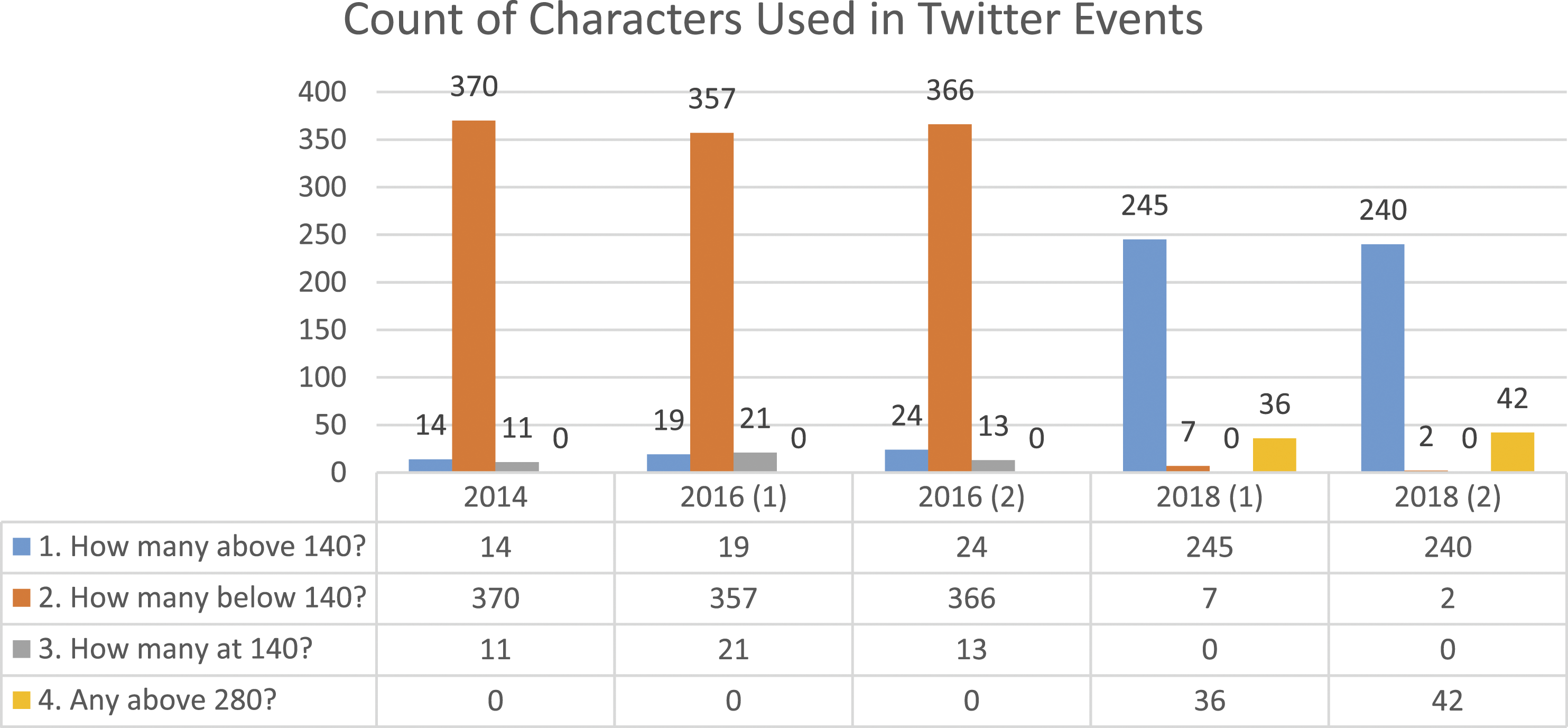
When comparing the length of Tweets over time as expected, in 2014 and 2016 the overwhelming majority (93.7%) of students posted Tweets that were less than 140 characters, and very few students posted Tweets that exceeded 140 total characters (3.5%). Accounting for the differences in sample size in the 2018 semester, the majority of students (85.9%) used more than 140 characters and were closer to the 280-limit than the previous 140 limit, with a notable few (12.2%) exceeding the 280-character limit still. See Figure 2 for details.
Twitter for completing course work
For evaluation purposes, students were required to complete two Tweets each during two separate Twitter events in winter 2018. It was with intent that the Twitter events were to be used as an assignment, and used to discuss the course content. As such, students were asked to reflect on their feelings about the Twitter events being tied to their assignments (like using Twitter to discuss lab results, as was the case for Twitter event 1). Responses indicated that 55% of students liked the coupling very much, 38% claimed the coupling did not matter to them because they had to complete them one way or the other, while seven percent reported they did not like the combination at all.
When asked “how do the Twitter event assignments compare to in-class assignments?“, 55% felt the Twitter events were less work than in-class assignments; 36% felt they were about the same about of work, six percent were uncertain, while the remaining three percent reported that the events were more work than in-class assignments. Similarly, of the responding students, 71% of students indicated they liked the Twitter events more than discussion forum activities typically used in other online courses. 10 percent of students preferred the use of discussion forums rather than Twitter event assignments, while eight percent had no preference. The remaining 11% reported to have no prior experience with discussion forums and therefore were unable to comment on the comparison. Sixty percent of students had no issues communicating their thoughts through Twitter; however, 34% felt somewhat challenged getting their ideas across.
Sense of community
As established, Twitter events were intentionally embedded within this large enrollment course with the hopes of increasing student engagement, interaction and sense of community. Although, only 26% of students replied in the affirmative to the question on whether Twitter helped bring them closer to their classmates. Of these students, “sense of community” was identified most frequently as a by-product of the Twitter events. One student commented “The Twitter event was a great way to keep up to date with the rest of the class, and the comment on a Tweet portion was an excellent way to engage”, while a second student summarized “Usually in online courses you do not talk to other people. This allowed us to.”
Specific to this course, students were asked how the use of Twitter contributed to their sense of belonging. Thirty-nine percent of students reported that they either felt ‘really connected”, or “connected” to a few students in their class or the class as a whole. However, 24% responded that Twitter was a means to an end, and a further 37% said they did not feel connected to anyone in the class. Students were asked to compare their experience in this course to other online courses they had taken and reflect on the sense of community. Forty-five percent reported feeling about the same degree of connectedness as other courses while 23% claimed feeling more connected. Although 11% of students claimed to feel less connected in this course, approximately 21% selected the “not-applicable” option for this question, meaning they likely have never taken an online course prior to this one or never considered the concept of connection to others at all.
Student experiences of using Twitter in the classroom
Students were asked to respond to an open-ended question and provide three words they would use to describe their experience using Twitter in this course. These responses were then independently coded by two researchers as either neutral, positive or negative. Fifty-two percent of these words were coded as positive; the most frequently included being “easy”, “fun” and “interesting”. Sixteen percent of the words were coded as negative; “annoying” and “unnecessary” being the most frequent words identified. The remaining 32% were coded as neutral. This content analysis enabled a high-level summary of the student experiences with Twitter and broadly captured their views categorically.
In response to the question “in what situation would you recommend the use of Twitter in courses in the future?“, a wide range of responses were received: “I recommend it to help students share their ideas and opinions with their classmates, as well as get feedback from each other on their opinions” and, “I would recommend it for all courses, but have it more frequently. In another course I did, we did Twitter posts on a biweekly basis. Helps to feel more connected to the course and other classmates”, to “never”, and “In no situation would I recommend it”.
Students’ perceptions of Twitter since the character limit increase
Students were asked to reflect on the recent increase in characters permissible for Tweets, which was an underlying motivation in completing this research. Although the number of Twitter characters doubled, 43% of the class were oblivious to the increase in character limit. Another 29% indicated that the increase did not make any significant difference to them. Twenty-three percent reported positive perceptions and agreed that it allowed them to express themselves better. Only five percent of students reported that they did not like the character limit increase. One student commented that the increase “made things worse as people tended to add unnecessary comments, making the Tweets too long”.
When asked to consider if and how the new character limit impacted their experience completing Twitter assignments in the course, over half (55%) of the students claimed the increase allowed them to better express their ideas on the topics being discussed in the course. Seven percent reported that the increase did not make any difference to their experience and three percent of students reported it made their experience completing the assignments worse, as people tended to add unnecessary comments now. Again, 35% were unaware of the character-limit limit increase, and therefore, were not able to comment on how it affected their experience completing the Twitter assignments.
In response to the question “how did the use of Twitter challenge communication of your learning in HKR 1000?“, many students (54%), based on their selection from the prompts provided, had no issue communicating their thoughts using Twitter. Twenty-one percent of students selected “I found using Twitter to be very good since the character increase from 140 to 280. It was very effective”, a further 21% selected “It was somewhat challenging getting my ideas across effectively using Twitter.” When asked to reflect on any issues experienced while using Twitter with the increased character limit, 19% of students indicated they had issues with the character limit currently, even though it has been increased 280. Seventy percent of students claimed to have no issues with the character limit.
Discussion
The aim of this project was to explore students’ perceptions of the usefulness of Twitter in the online classroom concerning interaction and engagement, across 4 years of using Twitter for assessment.
General Twitter use
When reporting students’ general Twitter use overall, 74% of students had a Twitter account prior to enrolling in HKR1000, and of those students, 31% regularly used Twitter for personal reasons, with the majority reporting that they have an account but did not use it frequently (43%). This value of 74% exceeds the industry reported value of 45% for 18–25 year olds in 2018 (Smith and Anderson, 2018) and 42% for 18–29 year olds in 2022 (Statista, 2021b). Of the students who had a Twitter account prior to enrolling in HKR1000, only seven percent had previously used Twitter in a university course. The overwhelming percentage of students who had never used Twitter in another university course (93%), is likely credited to the high number of first year students who were enrolled in HKR 1000, an entry-level course with no pre-requisite requirements and a popular elective for students from all disciplines. These students would have limited opportunity, if any, to take a course that utilizes Twitter, particularly when compared to students who are further along in their university careers. We did not collect data concerning what year of study students were in, which would have further clarified and explained these results.
Seventy-three percent of students reported completing the minimal number of Tweets required; four Tweets over the two events. Twenty-six percent of students indicated they completed more than the required number of Tweets, which could have been achieved by posting more than the two required Tweets during the scheduled events, or posting independent Tweets outside of the two, week-long events, while still using the course hashtag. It was expected that the overwhelming majority of students would adhere to the requirements and post only the minimal number of Tweets required, but it is promising to see that some students were willing to surpass the requirements of the assignment. Students’ individual motivations behind their Twitter use is an important factor in determining their participation (Denker et al., 2018; Liu et al., 2010; Peters et al., 2022; Whiting and Williams, 2013), in that each student will have different reasons and motivations that affect their participation on Twitter, and social media in general.
Twitter for completing course work
The use of Twitter events to complete course assignments while incorporating course concepts was intentionally designed to increase the engagement with and application of course materials. This was previously recommended by Rohr and Costello (2015), and was therefore, implemented in this phase of research. The Twitter events required students to comment on summary data results collected from a personal wellness survey administered to students in week four of the semester, and to a nutritional video posted that documents the effect of food on our health, both good and bad. Students were required to post an original Tweet and a response to another student’s Tweet, which directed them to be thoughtful about course material and, at minimum, review a few other student’s Tweets. This form of self-directed learning reflects students’ need to engage, participate, and be involved in course materials as an important means to optimize learning through social media (Kop, 2011) and the cultivation of personal or virtual learning communities or networks.
We asked students to comment on how they felt about Twitter being used to complete course assignments. Over half (55%) of students reported that they very much enjoyed using Twitter to complete course assignments. Thirty-eight percent reported that it did not matter to them as the assignments had to be completed regardless. The remaining seven percent reported that they did not like the coupling at all. Further study is needed to determine why some students did not like the coupling of using Twitter to complete course assignments as the data collected did not allow for such analysis. It may be that these students did not enjoy the Twitter platform itself, or again, it could be dictated and influenced by students’ individual motivations behind their social media use (Peters et al., 2022).
Students were asked to respond to how the Twitter events compared to assignments typically completed in-class or within the course learning management system, which for an online course would consist of using the internal discussion forum on BrightSpaceTM. The responses to this question were largely positive, with 71% of the class indicating that they preferred the Twitter events to traditional in-class assignments. The majority of the class (55%) felt that the Twitter events were less work overall and required less effort than typical in-class assignments. Thirty-six percent said they were the same amount of work, while only three percent of the class felt that the Twitter events were more work than in-class assignments. Sixty percent of students reported having no trouble communicating their ideas via Twitter, but interestingly, even despite the character limit increase, 38% of students still felt that it was challenging to convey their thoughts and ideas via Twitter. Research completed by Watson (2017) found a range of emotions related to the character limit increase, which echoes our findings. This range of responses indicates students’ individual motivations for participation and using Twitter, whether it is inside or outside of the classroom. Students’ individual motivations for using Twitter in relation to how that affects participation and sense of community could be explored further in the future.
Sense of community
Similar to Rohr et al. (2015), a minority of students in HKR 1000 in winter 2018 indicated Twitter was an effective tool, positively affecting student interaction and engagement. Thirty-nine percent of students felt connected to students in the class or the class as a whole, but the majority of students (61%) reported negative statements, in that Twitter was a means to an end or they did not feel connected to anyone in the class. Twenty-three percent of students indicated they felt more connected to students in HKR1000 when compared to other online courses in which they have been enrolled previously, with the remainder stating they felt the same or less connected than in past online courses.
Regardless of the absence of face-to-face meetings for this large enrollment class, over a third of the students claimed a “sense-of-community” existed, which the students directly attributed to the use of Twitter. This feeling of belonging or engagement is important for online, asynchronous learners, where opportunities for interaction and engagement are much fewer than those in an on-campus, in-person classroom (Schemberger and Wright, 2014). Social media platforms, such as Twitter, have been found to improve interaction and engagement in online-only classrooms, when implemented correctly (Junco et al., 2013). Further, social presence has been found to be a factor in improving interaction and engagement in the online classroom, in which the instructor leads by example and is active on the social media platform, helping to legitimize the platform being used in the course (Lowenthal and Dunlap, 2018). However, developing a social presence can be very time consuming for the instructor (Dunlap and Lowenthal, 2009b, 2009c), especially when they are responsible for multiple courses. This was the case for HKR1000, in which the instructor had many responsibilities and was not able to be as socially present as they would have liked to have been, which likely had an effect on the students’ perception of Twitter’s role in developing a sense of community. However, there were teaching assistants (TAs) regularly involved in the course through the course shell and via Twitter. Their involvement may have made up for the instructor’s as they often undertook some instructor-like activities in their TA roles. Whether this had a positive impact on students’ sense of community needs investigation. Future work may also explore whether this sense-of-community could be established and developed in other forms, such as discussion forums or other social media platforms.
Further, a factor that may be influencing negative perceptions is that Twitter is in the public sphere, and anyone with the hashtag can see what students posted, as their accounts have to be public to be seen by other students. Concerns may arise around privacy and the permanence of online information, or around the unwillingness to combine academic and personal lives. Students were allowed to use pseudonyms and could create a new Twitter account for their academic-related posts, which they could then delete afterwards if they wanted. We chose Twitter over course discussions specifically because of its permanence and its social functions, which could be exactly why some students are opposed to its use. Course discussion forums typically end when classes are over, so communities and interactions, if any, are contained in the inaccessible shell. Users on Twitter can follow each other and message to stay in touch, should they wish. We hope to explore motivations and reasoning behind negative feelings towards the use of Twitter for assessment in future work.
Changes in Twitter use
During the semester in which the data was collected (January-April 2018), students posted an average of 2.113 Tweets per event. When looking at post-per-student data from past semesters (3.481 in 2014 and 2.56 in 2016), the number of Tweets per student per event decreased by a factor of 1.647 over the 4 years of data collection. Additionally, we noted that the number of Tweets decreased by an average of 1.367 Tweets (3.481–2.113 = 1.367). When looking at these numbers, one may deduce that the use of Twitter over time has decreased. However, we expected to see an overall decrease in the number of Tweets due to the character limit increase, which happened in 2017, meaning students were able to capture their thoughts in one Tweet instead of two or more. Due to the high number of first year students enrolled in HKR1000, we predicted that many students would not be aware of the increase, and for students that were aware the limit had increased, that they would find the increase to be a benefit to their ability to express themselves on Twitter. While the decrease in average number of Tweets per student over the years may not be directly attributable to the character limit increase it is interesting to see that students now post fewer Tweets than before. This may be due to students now only needing to make one Tweet to convey their ideas, when before they needed to make multiple Tweets to compose their thoughts, as the character limit was more restricting.
We observed an increase in contributions from students, despite the decrease in the average number of Tweets per student over the years for which we collected data. When looking at the length of Tweets in 2015, 93.7% of Tweets were under 140 characters, with six-point-three percent of Tweets posted meeting the exact 140-character limit or exceeding it. When examining the number of characters used in subsequent years, 85.9% of students posted Tweets that were longer than 140 characters, with 12.2% of Tweets meeting or exceeding the 280-character limit. Upon first examination, there appear to be fewer Tweets per student, but when controlling for the difference in sample size, students were likely to make lengthier Tweets in later years, regardless of the character limit increase, when compared to before.
When students were asked “what do you think about the recent increase from 140-280 characters”, 43% were unaware of the increase, 29% responded they were unaffected, 23% reported that the increase allowed them to better express themselves on Twitter, and five percent said it made their experience worse, as “unnecessary comments” could now be included. These figures are potentially attributable to their feedback where 56% of respondents claimed to have limited experience with Twitter. It could also be attributable to the 26% of students who did not have a Twitter account prior to enrolling in HKR1000.
If students did not have a Twitter account prior to the character-limit increase, we assumed that they were likely unaware of the increase and perceived the 280 character-limit as normal. Alternatively, it is conceivable that although students know there is a character limit with Twitter, they may be oblivious to this restriction while completing their Tweet until the maximum space is attained. Future work will attempt to address this ambiguity.
In summary, the majority of students identified the purpose of Twitter as a discussion tool and proposed keeping the Twitter events the same in future course offerings. Student feedback recommended increasing the frequency of Twitter events within the course, which we believe would improve the likelihood of students developing meaningful interaction and engagement. The general opinion was that increased Twitter use would further increase the connection to the course content and other students. Students proposed one Tweet per week over a 13-weeks semester. Future offerings of this course will start to explore this recommendation through the inclusion of additional Twitter events, perhaps further increasing the engagement and sense of community.
Limitations and future research
Limitations of this research include the speed at which changes occur on social media, the public permanence of online information, not recording students’ year of study or other demographic details, the absence of survey questions related to individual motivations behind the use of social media, and the use of Twitter specifically. Social Media, and Twitter specifically, has changed so much between 2014 and 2018, and even since 2018, as have perceptions around the purpose and use of social media in the classroom. Many question whether Twitter still has a place or merit in the classroom, and we too are still determining this, as pros and cons vary widely. The COVID-19 pandemic illustrated the importance of online learning, and the necessity to sometimes supplement learning with social media, virtual platforms or digital technologies (Carpenter et al., 2021), but being aware of the purpose and intent behind its use in the classroom is vital.
Future research could explore the influence of students’ individual motivations behind Twitter use and the impact of year of study on perceptions, as was explored in Peters et al. (2022). Exploring the link between tweeting, motivation, engagement and student performance could also be undertaken. Another limitation is that only 38% of students completed the survey, which while being an acceptable percentage, is not representative of the whole class. Future research could work to increase the response rate in order to have a more representative sample. Average Tweets per Student over time. Count of characters used in Twitter events.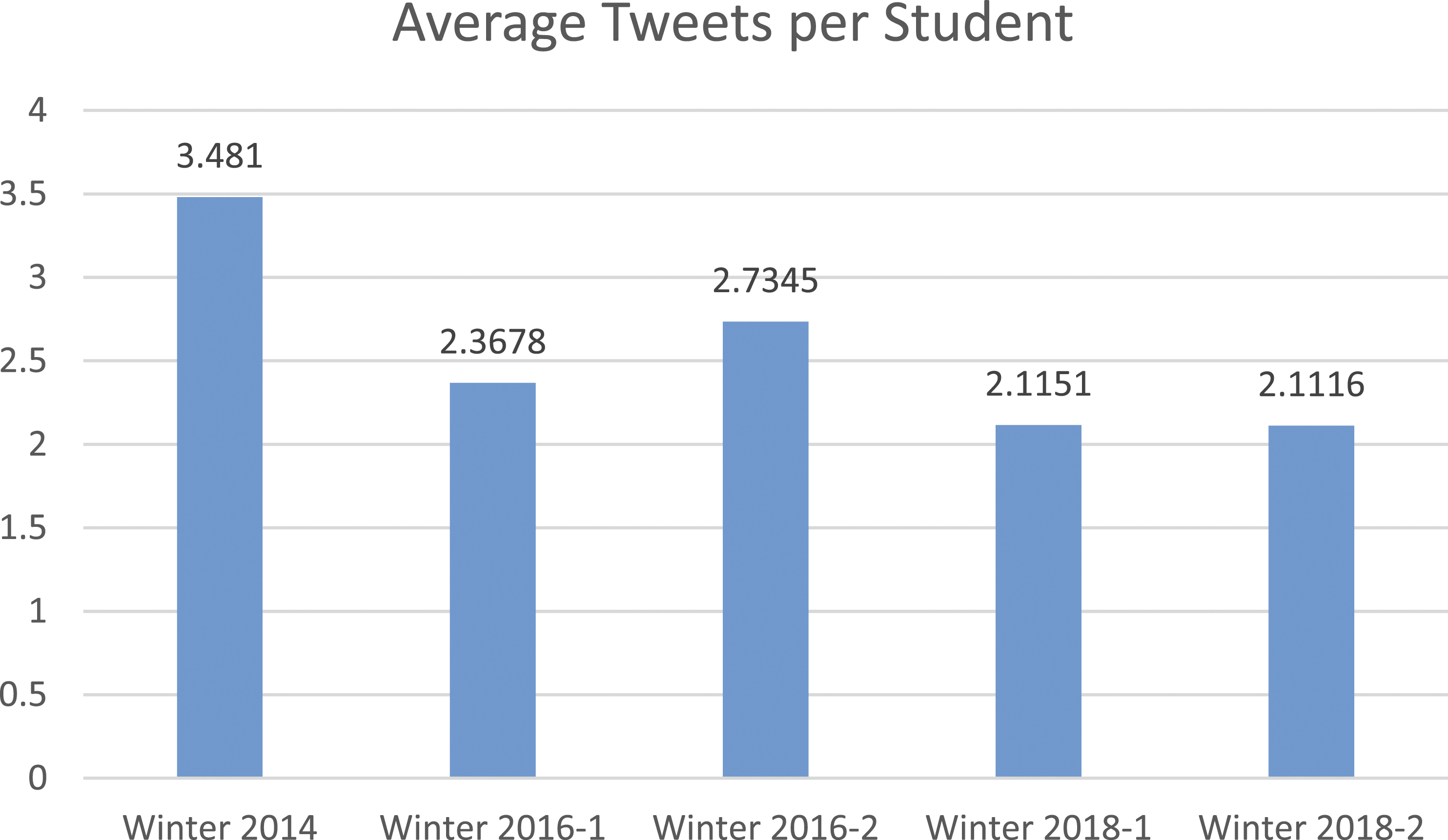
Conclusion
Research on the use of Twitter in online learning within higher education continues to expand. In this study, we looked at students’ use of Twitter for assessment and interaction in the online asynchronous classroom to determine if there has been an increase in the length, amount or substantive content within Tweets, and if students report stronger student engagement and interaction following the use of Twitter for assessment. Students reported a positive impact on engagement and sense of community. Findings indicate that Twitter offers students the opportunity to share their thoughts articulately, but that not all students agreed with this sentiment. Feedback from students suggested an increase in the frequency of Twitter events during the semester would be of interest and may improve their participation and perception of Twitter’s usefulness in the classroom.
Theoretically, this increased tweeting could lead to gains in a stronger sense of community and engagement (Dunlap and Lowenthal, 2009c; Junco et al., 2011, 2013; Lowenthal and Dunlap, 2018). Alternatively, it may be that a high frequency of Twitter events may lead to students feeling overwhelmed, particularly in a high enrollment class like HKR 1000. Recall that in the Winter 2018 semester over 300 students registered for and completed this course. Balancing Twitter event frequency, other assessments and course enrollment may require careful attention to ensure engagement and community are optimized. This requires further investigation. Questions remain whether Twitter or another social media tool is preferable for engagement and community building. However, our findings support media use and socially constructed course designs, such as coupling Twitter events to other course activities and assignments, as being welcome and effective for learning by students and instructors alike.
Footnotes
Declaration of conflicting interests
The author(s) declared no potential conflicts of interest with respect to the research, authorship, and/or publication of this article.
Funding
The author(s) received no financial support for the research, authorship, and/or publication of this article.
