




Abstract
Though scholars have identified a myriad of student characteristics and skills necessary to prepare individuals for online education, one notable gap in the literature is a focus on preparedness for online communication and interaction. To address this gap, the purpose of the present study was to explore what elements of interaction students identified being most and least prepared for when communicating with their instructor and peers in an online class. Participants responded to four open-ended questions on their perceptions of communication preparedness in the online classroom. Responses were open-coded and findings reveal that there is a lot of potential uncertainty surrounding communication and interaction within this context, as well as challenges for creating authentic connections within this space. Based on participant responses, practical implications for both online instructors and online students are offered.
Introduction
Online learning “requires different skills and talents than the classroom setting, from new communication patterns to more finely honed time management skills” (Bozarth et al., 2004: 88), and students differ in both the expectations and levels of preparedness they bring to the online classroom. Although previous work has considered a myriad of characteristics in an effort to distinguish how prepared students are for online learning success (Dray et al., 2011; Pillay et al., 2007), none have prioritized a focus on the communication processes essential and, in some cases, unique to the online learning experience. Given the inherently communicative nature of instruction and the value of interaction in learning (Mottet and Beebe, 2006; Palmer, 2017), as well as the practical value of being able to assess students’ readiness for online learning success (Liu and Kaye, 2016), the purpose of the current study was to provide an initial exploration into elements of communication and interaction that students felt most and least prepared for in their online courses. By furthering our knowledge of students’ perceptions of their own preparedness to engage with both peers and instructors, these insights will provide valuable information to course designers and educators as they create opportunities for and manage interactions with and among their students. This is particularly important as a way to address ways in which online courses can provide learning experiences comparable to face-to-face (FtF) learning experiences.
Literature review
As noted, communication is an essential component of the learning process in both FtF and online classroom contexts. In FtF classes, instructors have the benefit of having students in the same space at the same time, offering a wealth of opportunities and options for instructor-student and peer interaction. Moreover, instructors and the students can also utilize technology (e.g., email, social media, web-conferencing) to help facilitate communication and interaction outside of the classroom space (Frisby et al., 2016). In contrast, in online classes, instructors rely solely on technology (e.g., email, discussion boards, and chat features) to facilitate communication and interaction (Gutiérrez-Santiuste et al., 2016). While classes can be offered synchronously, this affordance is not always an option. Thus, two stark differences between FtF and online courses, time and space, may potentially impact the overall communication processes and elements that instructors and students use in these particular contexts.
Although these differences do exist between online and FtF learning, the number of students enrolling in online courses steadily grows (Allen and Seaman, 2016) for a variety of reasons, including access, increased flexibility, and the “any time, any place” nature of distance education (Rockinson-Szapkiw, 2012; Santally et al., 2012; Vlachopoulos and Makri, 2019). However, enrolling in an online course does not necessarily signal a preparedness for succeeding in an online course. These trends and potential student deficits highlight the importance of continuing to explore what contributes to successful online learning experiences, including elements of individuals’ preparation overall, as well as specifically for communicating and interacting in online educational spaces.
Currently, the online readiness and preparedness literature points to several factors contributing to the likelihood that students will be successful in an online course, including their traits and characteristics, comfort with technology, technical skills, motivation, locus of control, and self-efficacy (Dray et al., 2011; Pillay et al., 2007). The presence of characteristics such as these often provide a rationale for identifying a student as ready or prepared to take an online course (see Hung et al., 2010).
Moreover, educational designers (Rajabalee et al., 2012; Santally et al., 2012) have noted the importance of the instructor’s own awareness of their course design contributing to successful student experiences in online courses. Instructors need to be mindful of the potential for students to experience cognitive load with the content and design of the course; additionally, courses should be designed with simple navigation and ample opportunities to use mediated communication tools (Rajabalee et al., 2012; Santally et al., 2012). Further, van Rooij and Zirkle (2016) noted that, when developing an online course, all types of learners need to be considered. Thus, they suggest that online courses should be both pedagogically-sound and accessible. Interestingly, one potentially pertinent component missing from most, if not all, of these considerations is addressing students’ perceived preparedness to communicate and interact with their instructor and peers, elements that are key contributors to successful online education (Vlachopoulos and Makri, 2019).
Communication and interaction in the online environment
As we gain access to more technology, offer more course options online, and engage more faculty in online teaching (Allen and Seaman, 2016), the way we build and teach our online courses continues to evolve, including the opportunities for interacting with others within this space. Vlachopoulos and Makri (2019), in a review of literature relevant to online communication and interaction in distance education, emphasized that “it is vital to employ effective online communication models in order to empower [distance education] students and avoid negative experiences” (pp. 606–607). They go on to articulate the importance of interaction with instructors, peers, and course content in order to “achieve learning success” (p. 615), offering a framework of best practices pertinent to each area. Indeed, communication is central to the online learning experience, with past research indicating that online courses are more effective when they incorporate multiple communication and interaction strategies (Dixson, 2010) and highlighting the important role instructors play in actively creating and facilitating interaction in order to create a sense of community and a positive learning climate (Bernard et al., 2009; Glazer et al., 2013; Kaufmann et al., 2016).
From a communication perspective, in particular, scholars have examined how interaction can impact the teaching and learning processes within this unique context, including important classroom factors such as: building climate (relational communication; Kaufmann et al., 2016), incorporating immediacy (relational communication; Dixson et al., 2017; Hazel et al., 2014), fostering engagement (Cole et al., 2019), encouraging students’ willingness to talk (rhetorical communication; Kaufmann and Tatum, 2018), and avoiding instructor misbehaviors (instructor communication behaviors; Vallade and Kaufmann, 2018). But what happens when students do not possess the skills or knowledge necessary to take advantage of the learning and engagement opportunities provided to them within this mediated space?
Students in online courses have repeatedly reported their desire to communicate and engage with their instructor and peers (Chakraborty and Muyia Nafukho, 2014), stating that these interactions help them learn course material (Hew, 2016), combat feelings of learning isolation (Sit et al., 2005), support perceptions of positive climate (Kaufmann et al., 2016), and mitigate possible attrition from the course (Angelino et al., 2007). Previous research leaves no doubt regarding the vital role of communication and interaction in distance education, and scholars have offered helpful best practices for engaging students (see Vlachopoulos and Makri, 2019). However, the aim of the current investigation was to focus in on how prepared students are for the communication expectations and technologies in their online courses, with the aim of determining how we can best set students up for successful interaction and learning.
Student preparedness for online communication and interaction
Symeonides and Childs (2015) cautioned that students in online courses who struggle with communicating in this mediated space will have their interactions with their peers and instructor hampered, regardless of the inclusion of communication opportunities and tools. “Even though multiple communication options are available in online setups, they may not be used as extensively as they should be, simply because the usage is largely dependent on the learners’ own initiatives” (Bawa, 2016: 4). Students in online courses may be less likely to reach out and ask for help in instances that involve their communication and interaction (e.g., written communication on discussion boards, engagement with peers on group assignments), which could further distance these students from building class climate and rapport with their peers and instructors (Kaufmann and Vallade, 2020). But why is this the case? Are there specific communication skills that students lack in online courses that could be addressed through the provision of technology tutorials or resources or the clear communication of instructor expectations? Houtman et al. (2014) have suggested that scholars examine instruction of communication skills in online courses as an area ripe for investigation.
Whether or not students are prepared for these interactions within the mediated classroom, however, has not been thoroughly examined. Students in online classes may also be taught to develop and refine skills specific to this learning context (Abrami et al., 2011). For example, students learn from an early age to raise their hand when they have a question or comment in the traditional classroom. When students arrive to an online course, however, this is no longer an available option or channel for communication with an instructor. What channels are available for asking questions in the online classroom? How do students know what the norm or expectation for interaction is? As this example highlights, there may be instances where students feel underprepared for the communication processes that are particular to the online classroom. Further, once they are taught how to use the technology and engage in specific behaviors, they need to be able to practice them (Abrami et al., 2011). When students are prepared with the skills and competencies to take an online course, they are likely to have more of a successful, positive learning experience (Hung et al., 2010; Parkes et al., 2015).
However, though online courses thrive on the communication and interactions between and amongst the instructor and students (Woods, 2002) the majority of the online readiness and preparedness literature simply considers whether students feel ready or able to answer questions via email, engage on a discussion board, or are comfortable with their written communication (Hung et al., 2010), ignoring other potentially vital communication behaviors that are occurring (and necessary) in online courses. Some scholars, however, have noted issues related to students’ preparation for online interaction. For example, Parkes et al. (2015) explored student preparedness for the online environment and noted that students were not prepared to interact with their peers beyond responding to discussion posts and had especially low levels of preparedness for group communication. Moreover, Hung et al. (2010) noted these low levels of online communication preparedness and concluded that: … teachers of online courses need to encourage students, especially those with lower self-efficacy in online communication, to participate more extensively in the discussions, to bravely express their thoughts, to form better friendships, and to seek assistance when facing problems online (p. 1088). RQ1: What do students identify being (a) most and (b) least prepared for when communicating or interacting with their online course instructor and peers, respectively?
Methods and materials
In this qualitative study, open-ended surveys were used as the data collection method. In order to identify the communication expectations and abilities for which students perceived themselves to be prepared and unprepared, participants were provided the opportunity to elaborate on their communication experiences.
Participants
A total of 288 undergraduate students (110 male, 178 female) who were either currently enrolled in or had recently completed an online course, were recruited from a large Midwestern university. Participants ranged in age from 18 to 55 years (M = 20.43, SD = 4.89) and identified as first-year students (n = 96), sophomores (n = 47), juniors (n = 68), seniors (n = 74), transfer/uncertain of standing (n = 1) or did not specify their class standing (n = 2). Students reported a range of previous online course experience: currently enrolled in their first online course (9%), completed at least one online course (39%), completed between two to five online courses (43%), or completed six or more online courses (5%). Several participants (5%) did not report their previous online course completion.
Procedures
Following approval from the Institutional Review Board, participants were recruited from general education courses via a research recruitment pool between the fifth and sixteenth weeks of the semester. Participants were required to be over 18 and either currently enrolled in or have recently completed an online course. Participants were provided a cover letter and link to an online survey hosted by Qualtrics; after agreeing to participate, they were directed to the demographic and open-ended survey questions. Upon survey completion, participants earned minimal course credit.
Open-ended survey
The open-ended survey asked participants to provide their demographic information and respond to four open-ended questions about their preparedness for communication and interaction in an online class. More specifically, two of the open-ended questions asked students to identify what they perceived they were most prepared for when communicating and interacting with their online instructor, and what they perceived they were least prepared for when communicating and interacting with their online instructor. Next, they were asked two identical questions regarding their communication and interaction preparedness with their online course peers.
Data analysis
Participants’ open-ended responses resulted in a total of 36 single-spaced pages. Similar to previous research exploring student perceptions of the online classroom and communication behaviors (e.g., Vallade and Kaufmann, 2018), data were analyzed using the grounded theory approach (Corbin and Strauss, 2008). In order to analyze the findings, the two authors reviewed the data set for repeated keywords and phrases while engaging in open coding (Lindlof and Taylor, 2017). During this session, authors compared the data and discussed the descriptions and themes based on instructional communication research (Pidgeon and Henwood, 2004), resulting in four codebooks, one for each open-ended question. Next, we employed axial coding for identification of themes.
The authors independently coded 20% of each data set to calculate intercoder reliability, resulting in Cohen’s Kappa reliabilities ranging from .81 to .84. The authors coded the remaining data independently. The quotes used as exemplars below appear verbatim as written by the participants.
Results and discussion
The main goal of this study was to identify the elements of communication and interaction that students perceived they were most and least prepared for in an online class. Students currently enrolled in an online course or who recently completed an online course provided insight on their communication experience. Ultimately, our findings inform a deeper understanding of the communication norms and skills about which instructors can preemptively provide guidance at the start of the semester to better prepare individuals enrolled in online courses for success (Parkes et al., 2015).
Most prepared for communication and interaction with instructor and peers
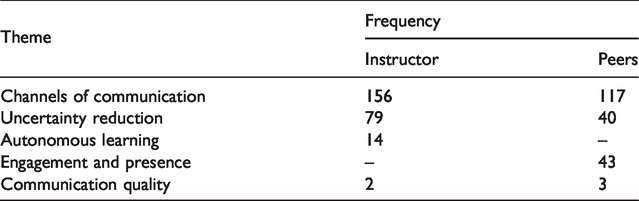
Based on student responses, four themes emerged that encompassed their perceptions of communication preparedness with an online course instructor: communication channels, uncertainty reduction, autonomous learning, and communication quality. Regarding preparedness with their online course peers, three of the same themes emerged, with the addition of the theme engagement and presence, which was unique to peer communication (see Table 1 for theme frequencies).
Frequencies for most prepared for communication and interaction with instructors and peers.
Communication channels
A majority of students reported that they were prepared to communicate with their online course instructor via the mediated channels provided to them. Email was the most common channel noted by students. This is not surprising, given the ubiquitous nature of email use between instructors and students in higher education, regardless of course delivery format. For example, one student stated they were “…most prepared to communicate with my online instructor through email,” and another said, “I was prepared to do a lot of emailing.” Additionally, students noted their preparedness to use the learning management system (LMS; e.g., Canvas) and discussion boards as a channel to communicate with their instructor. Students pointed out that they felt “most prepared for the communication back and forth between Canvas …,” “prepared to utilize my email and Canvas messaging,” and “most prepared for online discussions regarding articles we read and discussion posts in general that the professor participated in.” Students also commented on their communication preparedness regarding the use of multiple modes of communication with their instructor. One student noted they felt prepared to “communicate well throughout multiple different mediums as long as I kept up with reading messages.” Other students noted they were prepared for exclusively communicating via technology with the online instructor and what those interactions might encompass. Simply stated, one student said, “I was prepared for the lack of communication and face-to-face communication …” Other students remarked they were prepared for “… online live lectures” and “virtual office hours.”
Likewise, students noted that they were prepared to use email and discussion boards to communicate with their classmates. For example, students noted their preparedness to “… interact with students solely online, through email or online discussions” and for “being able to email them.” Additionally, students stated they felt prepared “… to make discussion board posts,” and “… when interacting with my classmates through discussions on posts.” Another student described feeling “… most prepared to communicate via email and text messaging.” Similar to instructor communication, students recognized that they would need to use multiple modes of communication with classmates and in some cases that they would need to engage with peers in FtF situations. One student noted, “… I had access to communicating with them through multiple outlets.”
A unique communication channel theme that was not mentioned in the instructor-student communication responses encompassed a preparedness to use communication apps and other technology with peers. One student noted that s/he was prepared to use “the GroupMe that was made between the students to help each other out with homework questions.”
Uncertainty reduction
Students also noted that they were prepared for communication and interaction with the instructor that reduced their uncertainty in the online course. More specifically, students commented on their preparedness for asking questions, reaching out for help or clarification, or requesting more information from their online instructor. For example, one student stated s/he felt most prepared for, “asking about grades, and assignments. Another student noted preparedness to “contact my professor with any questions.” Students also noted that they were prepared for responsive and helpful instructor communication. As one student said, “Communication with my instructor was very streamlined and easy to do. Whenever I had any questions about an assignment, I heard back from her promptly …” Students also acknowledged preparedness for knowing how to communicate with or reach the instructor. Students commented on how the “instructor was easily accessible to ask questions.” One student specifically noted that their “… instructor was/is easily accessible as needed. We can set-up a time to Zoom meeting or meet with her in person.” Moreover, students attributed their communication preparedness to previous online course or technology experiences. For example, students commented, “having experience of taking several online classes and understanding what is needed” and even more specific, “I had already gained a whole semester’s worth of experience using Canvas. Having that experience with Canvas and how it works made me feel prepared when having to communicate with the instructor.”
Similar to their responses on communication preparedness with their instructor, students also acknowledged their preparedness to ask questions and/or seek clarification from peers. Students reported feeling most prepared to “… ask them questions about anything regarding the class” and for “… being able to address questions to people that were in the online class.” Quite a few students attributed this preparedness due to existing friendships or acquaintances with classmates. For example, as one student commented, “I knew several people taking the class that I was friends with so I was not concerned about trying to communicate with them.” Others commented on being prepared for not knowing who their classmates were. One student pointed out, “I felt most prepared that I wouldn't really know who was in the course because it was online,” while another student stated, “I knew I would never actually have to talk to any of my classmates.” Interestingly, several students described a perceived comradery, indicating that they were prepared to have a shared experience and help each other out. More specifically, students commented that they were prepared because: “All the students were in the same situation and could communicate with each other” and “… It was nice to know that we were in the same boat.” One student explained, “When I would talk to classmates about the course, they were often very helpful with studying and completing worksheets together.” Finally, a few attributed the students’ preparedness for communicating and interacting with their peers to previous online course experiences (e.g., “Past interactions” and “… prior group work experience”).
Autonomous interaction
Specific to their communication with the instructor, students noted that they were prepared to have an independent, self-directed learning experience. More specifically, they commented on a preparedness to be responsible for checking the instructor’s written communication (e.g., the syllabus, rubrics, and assignment descriptions). One student remarked, “My online instructors for the most part have always had everything posted to the syllabus so I felt very prepared in that my instructor was communicating with me what was expected of me.” Other students noted their preparedness for minimal communication from the instructor or a total lack of directions and reminders from instructors. For example, one student noted “… independent responsibility to keep up with assignments throughout class.” Another student said, “I felt most prepared for doing a lot of things on my own…” A few students remarked that they were prepared for teaching the course content to themselves and directing their own learning. One student said, “I felt prepared to manage my time and teach myself the material rather than listen to an instructor in a classroom.” This particular theme was specific to instructor communication and did not emerge with peer communication preparedness.
Engagement and presence
Specific to their communication with peers, many students described their preparedness for limited opportunities to communicate and interact with classmates. For example, students explained, “I felt most prepared for the minimal interactions with my classmates…” and “I knew that I wouldn't see many of my classmates unless I attempted to contact them.” Students commented that they “…felt most prepared to form online study groups with classmates and talk about assignments” and “…to work with other students to successfully finish class assignments.” Other students commented about feeling most prepared for “…giving feedback to my classmates’ work.” Further, students felt most prepared “…to know someone behind a screen rather than in person” and “getting to know my classmates.” This particular theme was specific to peer communication and did not emerge with instructor communication preparedness.
Communication quality
A few students mentioned they were prepared to use professional communication with the instructor. One student stated s/he was prepared for “how to address the teacher in a proper manner.” Given the small number of students who mentioned their preparedness to communicate professionally, this finding highlights the need to address professionalism in mediated communication with students.
Few students also noted being prepared to handle issues with misunderstandings or disagreements with classmates (e.g., “I felt prepared for disagreements or misunderstandings”) and in one instance, a student noted their preparedness for using appropriate communication with classmates (e.g., “…communicate in a professional and cordial manner”).
Least prepared for communication and interaction with instructor and peers
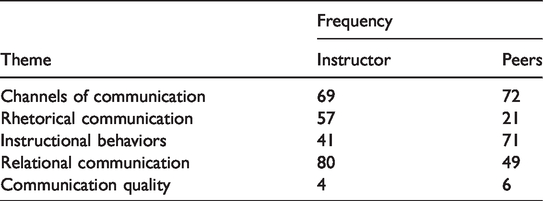
Based on open-ended responses, five themes emerged that encompassed student perceptions of communication preparedness with both their instructor and peers: communication channels, communication quality, instructional communication behaviors, relational communication, and communication clarity (see Table 2 for theme frequencies). The two themes discussed first were also represented in the most prepared responses.
Frequencies for least prepared for communication and interaction with instructors and peers.
Communication channels
While many students noted their preparedness to communicate in an online course, a large number of students also commented on their lack of preparedness for using various technology platforms, and absence of face-to-face interaction. As one student stated, “I was concerned with having issues taking the class online… I am not great with technology.” Others talked about being unprepared for “using new online sites for class and communication,” or having “online communication through video calls.” One student was unprepared for “being [able] to communicate by email only.” Another one student stated, “It is a little odd to never have seen or meet the instructor in person and only communicate through electronic means.” Other students identified feeling least prepared for the “lack of in-person communication,” and feeling unprepared because they “couldn’t talk to them in person.” For example, “I felt least prepared for asking him calculus questions in person.” Another student responded, “I was least prepared to actually go into their office and ask for help when I needed it. Others noted the required learning management system for online course content and communication as an area where they lacked preparedness, stating, “how to use the application [the course] was on” and “I’ve never used Canvas so any form of communication through that would be new to me.”
Students explained their lack of preparedness for using discussion boards to communicate with peers. One person noted feeling least prepared for “having to do those awkward discussion board posts because that is not how anyone actually discusses anything.” Another student indicated, “I never used discussion boards before and communicating through [them] provides more of a challenge because a discussion through a message board is more difficult to keep going than one in person.” Further, students explained that they felt they were not prepared for the lack of FtF interaction with their peers and for a lack of preparation for meeting or working with peers offline. For example, one student “felt least prepared for studying with students in person.” Another noted feeling unprepared for “several group projects that required us to meet in person.” As one student noted, “I couldn’t talk face to face with [classmates].” Lastly, students detailed their lack of preparedness for communicating with peers over different technology (e.g., video chatting) and the lack of options. One student felt “least prepared with communicating through video because I have never done that before.” Another example, as one student responded, “I felt least prepared while recording my face and introducing myself to my classmates.” One student described feeling “least prepared when we do not have a discussion board because otherwise none of us have interaction. We also do not have each other’s contact information, and do not see each other face to face…”
Communication quality
Students explained they lacked preparedness for using netiquette with their instructor in an online class. More specifically, preparedness for conducting oneself professionally in a mediated context. For example, two students explained feeling least prepared for “email etiquette with online instructors” and “formal writing to my instructor.”
Further, students noted feeling unprepared to manage ineffective or misinterpreted communication with their peers in online classes. One student noted, “I felt least prepared for communication disconnects with classmates,” while another said, “I felt least prepared for the negative interactions that could come through online mediums.” One student stated that s/he felt least prepared “on how to respond properly to things, I didn’t really understand the etiquette…”
Relational communication
Students commented on a general lack of preparedness for the level (or lack) of interpersonal or relational communication with their instructor. Students explained they were not prepared for the lack of immediacy, the slow response times and even absence of helpful responses from their instructors. Students also pointed out their uncertainty about and lack of familiarity with the instructor’s personality or teaching style. Students stated that they were unprepared to feel “that [their instructor] would not know me as personally,” as well as to “feel like there is a lack of connection” and to be “unable to have a face-to-face encounter and not able to have that connective, supportive aspect in learning and teaching.” Students further exemplified the lack of perceived immediacy, stating, “I felt least prepared for emailing her whenever I had a question. She was very standoffish and since we didn’t get to see her in person, I was intimidated” and “I couldn’t just ask the professor in person after or in class if I had a question. I had to wait for an email response, which if I needed help quickly was not ideal.” One student even stated it succinctly, as being unprepared for “having to initiate communication,” while another described feeling as though s/he had “to reach out more than necessary.” Lastly, students noted their lack of preparedness for not being able to get ahold of an instructor and how to initiate contact with an instructor. This might be specific to certain times of the day or week (e.g., “I was not prepared for the lack of communication during certain times like weekends”), steps to reaching an instructor (e.g., “having to communicate with a TA before reaching out to the actual professor”), or a total lack of availability (e.g., a “lack of office hours”).
Students also commented on a lack of preparedness for the level (or lack) of interpersonal or relational communication with their peers. Many commented on the lack of familiarity with peers’ backgrounds, personalities, or what might offend them. As one student noted, “There were hundreds of students that I could talk to. The trouble comes from knowing whether or not they’ll be friendly.” Another student felt least prepared for “the different personalities of the classmates, without getting to see them and being careful with words due to the nature of the interactions.”
Others reported a lack of preparedness for having to initiate contact with peers in an online class. Several students reported feeling least prepared “to reach out” to their classmates, while several others noted a lack of preparedness for the absence of opportunities to get to know and form relationships with classmates. As one student responded, “I did not grow relationships with my classmates due to lack of interactions.” Further, some explained they lacked preparedness for the high frequency of peer interaction in an online course. As one student noted, “I was not prepared to have more interaction with my classmates than my instructor.” Another described being unprepared for “not seeing them in person to get to know them better.” Interestingly, students also noted their concerns with a lack of preparedness for interacting with classmates whom they perceived to be different from themselves. As one student described: Sometimes I felt like I was not on the same learning level as the rest of them were, most of the people taking the class were older than I was, and had more experience with the world, and were more eloquent in their comments and were thoughtful …
Rhetorical communication
Students also expressed feeling less prepared to figure out the rhetorical (i.e., task-related or academic) communication that occurred in the online course. More specifically, students lacked preparedness for “how to really describe my questions” or explained how “asking questions over email sometimes requires more work.” Other students were unsure about contacting instructors for information or clarification regarding assignment requirements or their grades in a course. One student was unprepared for not “knowing the expectations for this class.” Another student explained, “I felt least prepared when there were sometimes vague instructions that did not necessarily call for an email, but that were still difficult to understand.” Moreover, students commented on their uncertainty about an instructor’s availability (e.g., office hours) or how to get in contact with them. One student felt unprepared “When I couldn’t find the instructors contact info on the syllabus.” Further, though some instructors might have office hours, these were not always clear to students. As one student said, “I wasn’t sure if meeting face-to-face was an option.” Another was unsure of “how to meet with the instructor in person.”
Students also described a lack of knowledge about how to get in touch with peers. For example, one student identified “how to actually contact them” as the element of communication with peers for which s/he was least prepared. Another noted a lack of preparation for “when I must communicate with a student and don’t know how to contact or reach them.” Students also noted feeling unprepared for the difficulty of using peers as sources of information and uncertainty reduction. For example, one student noted, “I wasn’t prepared for how much I needed classmates around in person to ask questions to and receive help from. I found that much more difficult with an online class.” Another noted that s/he struggled with information seeking because “I didn’t always want to be the one to ask the question first.”
Instructional behavior
Students also noted they were not prepared for the minimal or a total lack of key instructional behaviors such as feedback, instructor direction, reminders. One student explained, I felt least prepared in regard to assignment due dates. I have been used to going to class and getting reminded and told in person when things are due. It is more difficult to remember to check canvas when things are due and keep up to date.
Students also mentioned a lack of preparedness to communicate and interact with their peers as part of the learning experience. This theme involved students’ lack of preparedness for working in groups or collaborating with peers. Students reported feeling underprepared for “completing assignments together,” and “having a group project virtually without meeting face to face.” One student noted, “to reply to people’s comments that you don’t know is kinda awkward.” Similarly, students also explained they were not prepared to have peers who were not engaged in the course or assignments, were unresponsive to others, or who did not understand course material or assignment expectations. One student was unprepared for peers who “were not much help when I did not understand something or did not respond to me right away.”
No Interaction
Notably, there were many instances (n = 40) where students reported that there was no interaction or communication with classmates in their online course experience.
Practical implications for online communication and preparedness
Based on student responses, we have concluded three overarching takeaways that transcend multiple themes for both instructors and students regarding communication preparedness: communication logistics, uncertainty reduction, and engagement. These takeaways inform communication preparedness best practices that may be shared to help facilitate effective communication in online courses.
Practical implications for online course instructors
Online instructors are faced with a myriad of tasks, from troubleshooting technology issues to fostering communication at a level and in ways that FtF instructors may not experience (Van de Vord and Pogue, 2012). Based on the findings from this study, we offer the following suggestions for preparing and supporting students to maximize course engagement and learning success.
Provide students with technology resources
Create how-to videos and detailed written directions for use of LMS features and any other necessary communication technologies, using screenshots to provide visual instructions. Instructors can also require students to practice with the technology and provide clear mechanisms for them to ask questions (Renes and Strange, 2011). Additionally, provide contact information for the university’s IT help desk and/or LMS help center, if available.
Develop and explain a communication plan to your students
In the syllabus, be explicit about your availability to students (e.g., FtF and/or virtual office hours), as well as how students can get ahold of you (e.g., email, phone, video conference), and what they can expect in terms of response turnaround time (e.g., 24 hours, 48 hours). Reinforce this information in various parts of the LMS and remind students about your availability in weekly announcements (Aldrich et al., 2017). It is particularly important to make sure that you are prioritizing responses to students, and not taking an “out of sight, out of mind” approach to online classes. Failure to respond, or taking too long to respond, can negatively impact students’ learning and perception of you as the instructor (Vallade and Kaufmann, 2018). Additionally, instructors can provide clear directives for what appropriate email etiquette looks like and provide links to additional information and examples (Portwood-Stacer, 2016).
Set clear expectations for interaction with you and their peers.
Tell students upfront that they will be interacting with their peers; make expectations clear and build various communication opportunities into and throughout the course (Sellnow and Kaufmann, 2017). Be clear in the syllabus and the LMS: (a) how often they will be expected to interact with others, (b) the channels that are available or required for interaction, and (c) how this interaction will be assessed (e.g., frequency and quality of communication). If you are requiring students to communicate via a particular technology for an assignment, include links or embedded tutorials on how to use them to reduce uncertainty and allow students to focus on forming connections instead of worrying about the logistics of connecting.
Facilitate connection, not just interaction
Have students post introduction videos of themselves and encourage them to connect with peers (Aldrich et al., 2017). Further, be specific about programs they can use to record videos, and how you want them to submit (e.g., unlisted YouTube link or record directly in LMS). Provide links to LMS-specific tutorials regarding how to find contact information and/or reach out to peers through the LMS and encourage them to form informal study groups for support throughout the class. Finally, try to intersperse opportunities for students to connect in non-academic and academic ways, either by weaving opportunities for non-face-threatening self-disclosure into discussions related to course content, or creating assignments or activities purely with the purpose of allowing students to gain familiarity with one another.
Require peer collaboration
Incorporate group work, with the caveat that you will likely need to explicitly discuss how to work in a group within this context. For example, provide groups with both written and oral expectations for what good group communication involves and encourage students to develop a communication plan and group contract so everyone in the group knows what to expect when communicating about course assignments, including channels they will use to keep in contact with one another (Kaufmann and Frisby, 2013). Provide tutorials and resources for various means of group collaboration that are included in or supplemental to your LMS (e.g., video conferencing, group chat apps, Google docs), and make it clear how students can establish an initial connection (e.g., email addresses, through groups set up in LMS or specific LMS messaging features).
Be involved in the conversations that are taking place
Once the course has launched, online instructors need to actively foster and maintain communication and interaction by participating in and guiding discussions (Vlachopoulos and Makri, 2019). Online courses should not be “set it and forget it” endeavors for instructors (Vallade and Kaufmann, 2018), and, because students are often uncertain or lack confidence interacting in online classes, instructors need to be consistently present and set the tone for engagement. This also allows instructors to model expectations for students, helping to prepare them and increase their self-efficacy regarding their own communication and engagement.
Create informal check-ins
Provide opportunities (e.g., anonymous surveys, email, exit slips) where students can discuss their progress in the course, ideally with responses from the instructor (Yamagata-Lynch et al., 2015). Create spaces for students to ask questions and get clarification from the instructor and their peers, and seek feedback regarding the course (e.g., midterm check-in) with regard to the clarity of course organization, technology use, and instructional style. It is important to then respond to this feedback and make adaptations to the course (e.g., clarify expectations, adjust course organization), when necessary and possible. For example, instructors should include a survey within the first couple weeks of the course to obtain feedback on any points of confusion regarding the organization, expectations, or technologies of the course. Open this line of communication early to set the precedent for students’ comfort obtaining information from you as the instructor and be sure to close the loop by compiling resources and responses relevant to students’ questions or areas of confusion.
Practical implications for online students
In the present study, students’ descriptions, made it clear that, when taking an online course, students want and need to have a clear understanding of the expectations and manner in which communication will take place. As Reyna et al. (2018) state, “it is not about being able to create content online anymore; it is about effective communication to engage the audience in the digital space” (p. 47). Thus, in order to promote effective communication, we offer the following suggestions to share with students and encourage them to consider when preparing to take, or upon enrolling in, an online course.
First, tell students to reach out to the online instructor whenever they have a question. Emphasize that students should be aware which channel (e.g., email, phone) their instructor has identified as best for communicating with them and that they should contact them in advance of any assignment deadlines. Second, encourage students to find a peer group to communicate with while taking an online class, ideally within the first week(s) of class (e.g., discussion board during an introduction post). Some students take online courses with friends or acquaintances, which they report helps with the learning experience; encourage them to reach out to peers to form study groups and establish these connections. Next, reiterate to students that they need to log-on, be active, and engage in the course frequently (i.e., at least twice a week). Explain to them that they will get much more out of the experience and will be less likely to miss key information or deadlines. Post reminders that highlight the importance of carefully reviewing all information posted about the course (e.g., check your email, read announcements, and review assignment descriptions and rubrics). Lastly, have students think about the other people in their class. Remind them to pay attention and respond thoughtfully to what their instructor and peers have to say, and always remember that there are people on the other side of the screen.
Limitations and future research
Limitations for the current study included the data collection at one university; the reported perceptions of preparedness may be unique to the LMS and other specific communication technologies available at this particular university. We also acknowledge that there were students who choose not to partake in this survey; thus, their voices are not included. We suggest replicating this work to see the strength of the themes and for the emergence of possible other themes. Additionally, given the qualitative and exploratory nature of this study, we did not explicitly test for differences based on age, experience, communication ability, and student type (i.e., nontraditional vs. traditional) or other elements of readiness or preparedness. Details about the course such as whether it was required or elective, along with information on the type of content delivered, were also not collected. Thus, future research should consider collecting this additional data as well as collecting from multiple sites. Lastly, future research should development a measure for online communication preparedness, which would allow for predictive investigations of student success and provide a tool for assessing and addressing students’ preparedness for online interaction.
Conclusion
Song et al. (2004) stated, “as educators and students become more comfortable and adept at communicating and learning at a distance, it will remain imperative that the best practices associated with these learning environments continue to be explored” (p. 69). We agree. Communication between and among the instructor and students is vital for students’ learning experience (Vlachopoulos and Makri, 2019). In order for our online courses to be quality learning experiences, it is evident that scholars and instructors need to consider whether or not students are prepared to communicate in this context, as well as how we can best support them to facilitate meaningful interaction in the online classroom.
Footnotes
Declaration of Conflicting Interests
The author(s) declared no potential conflicts of interest with respect to the research, authorship, and/or publication of this article.
Funding
The author(s) received no financial support for the research, authorship, and/or publication of this article.
