




Abstract
The impact of the coronavirus disease 2019 (COVID-19) pandemic has traumatized the entire world. COVID-19 has prompted experts to rethink the suitable pedagogies of teaching–learning that will prove to be sustainable with the global health crises going on. Blended learning is one of the models proposed by various educationalists and research scholars that appears to be a viable and best-fit solution for educational institutes for at least a period of a few months postpandemic. This study investigates the readiness of in-service teachers considering them as learners toward blended learning and its six dimensions. The results indicated that there existed a correlation among the six dimensions of blended learning while considering the readiness of in-service teachers toward blended learning. In addition, the results indicated that both male and female teachers and teachers who have and have not attended/conducted webinars/lectures/Faculty Development Programs online have had no difference in their readiness toward blended learning.
Introduction
The year 2020 has brought unfamiliar and unseen testing times for the entire world due to the coronavirus disease 2019 (COVID-19) pandemic. The teaching community too has been severely impacted; be it from reopening of educational institutions to conducting lessons for students, there has been uncertainty in everything (BBC News, 2020; Reid, 2020). During this phase of the pandemic, the teacher community is trying hard to adapt themselves with the new dimensions of teaching–learning so that the loss caused is to the minimum and is coming up with strategies to best help their students and their institutions. All living organisms learn to adapt to their environment. This means that the way they look, the way they behave, how they are built, or their way of life makes them suited to survive and reproduce in their habitats. Teachers are themselves becoming learners and trying out new ways to adapt to the online form of teaching–learning during the pandemic of COVID-19, which has hit the world from November 2019 with a severity acing since January 2020 and is still existing throughout the globe. COVID-19 is a disease caused by a new strain of coronavirus. “CO” stands for corona, “VI” for virus, and “D” for disease. Formerly, this disease was referred to as “2019 novel coronavirus” or “2019-nCoV”.
Blended learning (BL) is a methodology that was introduced over a decade ago that is used in the field of education and combines (or blends) online learning with traditional place-based classroom methods (face-to-face learning). It requires the physical presence of both teacher and student, with some elements of student control over time, place, path or pace and also educational materials and technology for online interaction (Friesen, 2012). Although students must still attend physical schools with a teacher present, face-to-face classroom practices are combined with computer-mediated activities regarding content and delivery (Strauss, 2012) to enhance the teaching–learning experience and to encourage the students to explore more to the given content. BL is also used in professional development and training settings across the globe (Lothridge et al., 2013). It is highly context-dependent and therefore a universal conception of it is hard to come by (Moskal et al., 2013). Some reports have claimed that a lack of consensus on a hard definition of BL had led to difficulties in research on its effectiveness (Oliver & Trigwell, 2005). A well-cited 2013 study broadly defined BL as a mixture of online and in-person delivery where the online portion effectively replaces some of the face-to-face contact time rather than supplementing it (Graham et al., 2013).
Currently, enormous opportunities are provided by most of the apex educational institutions across India through webinars or workshops or Faculty Development Programs (FDPs) or refresher courses (that were previously conducted offline but are presently conducted online on various online platforms) for teachers (at all levels) who are a part of an educational family to equip and adapt themselves to new pedagogies of teaching and learning that would be useful postpandemic, once the institutes reopen. This phase, during the time of Lockdown 2020, has turned the tables on teachers by making the teachers the learners. Hence, the teachers who have attended or conducted these online training programs and webinars have not just experienced the use of online tools and softwares as teachers but also have had an experience of using these as students. The webinars, conferences, seminars, and training programs consisted of content that dealt with the availability of various applications, softwares, and video-conferencing platforms that teachers can use to impart education to their learners. The programs conducted were made available for all teachers irrespective of their location, language, age, and qualifications. Considering the role switch that has occurred, the present paper emphasizes the readiness of these in-service teachers (who have been learners) toward adopting the BL approach as one of the models that would be preferred in most of the educational institutes once they reopen postpandemic. In the Indian educational system, face-to-face lectures, workshops, seminars, FDPs, conferences, symposia, etc. for teachers were held by various educational institutes to train them for their professional careers and to help them enhance their knowledge on trends in education. Things may not be as they were before not just for students but also for teachers as learners who wish to attend these training programs. The prevailing pandemic has added fuel to fire by leaving no option than to adapt BL as one of the best-fit pedagogies to be adopted once things get back to normal. The BL approach for teachers would be implemented such that they could attend lectures or training courses online as per the content that is developed, keeping in mind the objective of the course that they are opting for, also, offline mode would be adopted for practical topics. This will motivate teachers to participate in these programs at a higher rate as they will not have to travel or visit the location throughout the course. This will also take into consideration the health and safety measures required to fight against the pandemic.
Being a working from home employee, especially in an Indian household, the role of females varies compared to that of males. The teaching profession, usually seen to be dominant in females, would have a different experience of BL, time to experiment with new technologies, and balancing home-related chores with that of work. Similarly, those teachers who have already attended or conducted webinars, conferences, and FDPs online would have a different attitude toward BL compared with those who have not. Hence, this paper places emphasis on the comparison of the genders and teachers who have and have not attended or conducted online training programs toward BL and its dimensions as one of the models that could be implemented in the post-COIVD-19 era for the sustainability of education. A lot of research studies especially abroad focus on flipped classroom and distance learning but very few Indian studies have focused on BL. Before implanting the blended learning model as the best-fit model post pandemic, it is important to understand the attitude of teachers toward adopting this approach. Understanding the attitude will enable the researchers, policy makers, and management to take a step forward in implementing this pedagogy, which is presumed to be the new normal postcrisis.
Review of Literature
BL, which is an integration of face-to-face and online instruction (Graham et al., 2013), was introduced over a decade ago across the globe. It has widely been adopted across educational institutions in India since the uncertainty of reopening the educational institutions for students during the time of the COVID-19 pandemic has increased. This study concentrates on the acceptance of this blended form of learning by the teachers at various types of educational institutions across India.
A number of articles and manuscripts have been assembled to understand the transformative and innovative research issues for BL that have been implemented and resolved till date. The general consensus shows that incorporating BL results in improvement in student success and satisfaction (Dziuban & Moskal, 2011; Dziuban et al., 2011; Means et al., 2013), as well as an improvement in the students’ sense of community when compared with face-to-face courses. The success and the positive attitude of teachers toward the BL mode of teaching–learning has been most successful where institutional support at design, planning, and implementation is given (Dringus & Seagull, 2015; Moskal et al., 2013; Picciano, 2009; Tynan et al., 2015). It also emphasizes the amount of hands-on experience an institution has provided to their teachers.
It is seen, even today, that the digital divide continues to be a challenge with novel educational technologies that was expected to end a decade ago (Fairlie, 2004; Jones et al., 2009). One of the major highlights of online technologies is that they can increase access to nontraditional and underserved students by bringing a host of educational resources and experiences to those who may have limited access to on-campus higher education.
The increasing availability of distance education has provided educational opportunities to millions (Allen et al., 2016; Lewis & Parsad, 2008). The number of enrolments on courses offered in India via the Massive Open Online Course (MOOC) is an example to support this statement. Additionally, an emphasis on open educational resources (OER) in recent years has resulted in significant cost reductions without diminishing student performance outcomes (Fischer et al., 2015; Hilton et al., 2016; Robinson et al., 2014). With the present scenario of the pandemic, it is only prudent to shift toward the blended mode of learning where the institutions should ensure that the teachers are well equipped and sufficiently trained to use these OERs and educational technology effectively.
Teacher education research articles have concentrated on the use of BL within the context of teacher education focused on educational technology (Demirer & Sahin, 2013), language learning (Motteram, 2006), preservice English teachers (Kurt, 2017), general preservice teaching skills (Alayyar et al., 2012; Heba & Nouby, 2008; Jahjouh, 2014; Yeh, 2010), in-service teachers (Owston et al., 2008), educational leadership (Namyssova et al., 2019; Ross et al., 2011), and general science courses particularly designed for preservice primary teachers using flipped classroom approaches (Jeong et al., 2018; Tomas et al., 2019).
Over a period of time, there has been a high growth in the adoption of BL in the field of education, but just a few research studies emphasise adoption problems associated with learners, academic staff, and management. It has also been observed that most of the research on BL done in India takes into consideration the attitude of either students pursuing their education from various institutes or prospective teachers toward BL. This study tries to explore a new dimension where in-service teachers are considered as learners where the fact is given importance that they themselves have to be constantly updated with recent trends that have been evolving, especially with the implementation of technology in education due to the current pandemic. This research is carried out considering BL as one of the models that will be best implemented in the field of education not only for students but also to train in-service teachers post-COVID-19 times.
Research Methodology, Sampling, and Tool
The present study adopted a descriptive survey method for collecting data. The sample was selected by a simple random technique. The total sample consisted of 313 teachers teaching in various educational institutes like schools, colleges, teacher education institutes, management schools, law colleges, etc. all over India. Data were collected by circulating Google forms during the COVID-19 pandemic. Out of the total in-service teachers 221 were females and 92 were males. A total of 288 teachers had attended/conducted webinars/lectures/FDPs online whereas 25 had not. The questionnaire for the present study was adapted from a study by Birbal et al. (2018) on learners’ readiness for BL. The instrument consisted of 34 items that measured learners' attitudes towards six different aspects of BL: learning flexibility (four items); online learning (eight items); study management (six items); technology (four items); classroom learning (five items); and online interaction (seven items). Learning flexibility reflected issues such as access to learning materials and freedom to decide where and when to study and at what pace. Online learning included items on how comfortable teachers felt about self-directed learning. Study management referred to how motivated teachers are to organize their time when studying online for their courses. Technology consisted of items that reflected teachers' familiarity with digital technologies and software. Online interaction refers to teachers’ ability to use web technologies to collaborate with other members of the learning community for assignments and to interact with the lecturer. Classroom learning focused on teachers' preferences for face-to-face interaction with other teachers and the lecturer during training programs and conferences, seminars, or symposia. Relevant descriptive and inferential analysis was done using Statistical Package for Social Scientists (SPSS-26) for hypothesis testing. Table 1 represents the sample size for the present study based on gender and webinars/workshops/FDPs attended/conducted by teachers or not.
Sample Size for the Present Study Based on Gender and Webinars/Workshops/FDPs Attended/Conducted by Teachers or Not.
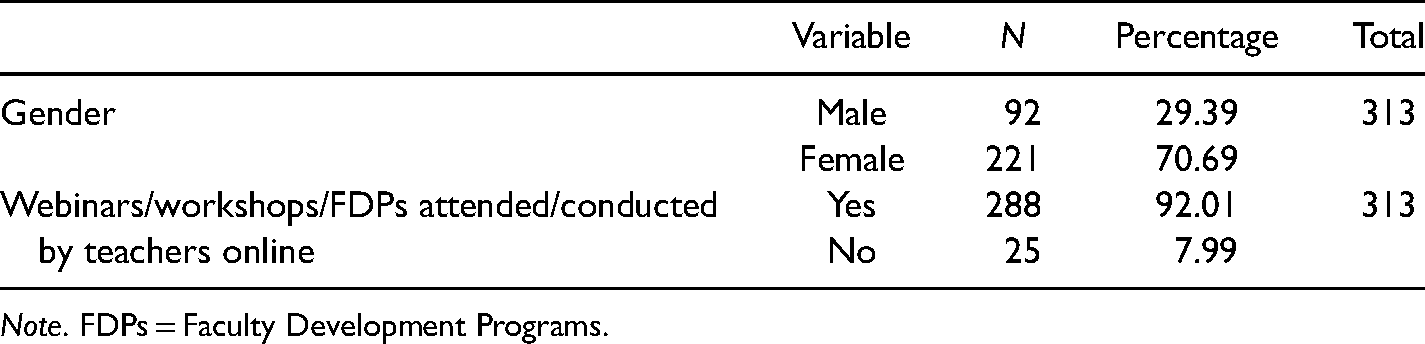
Note. FDPs = Faculty Development Programs.
Figure 1 shows a pie chart indicating that out of 313 in-service teachers 29.39% were males and 70.69% were females.
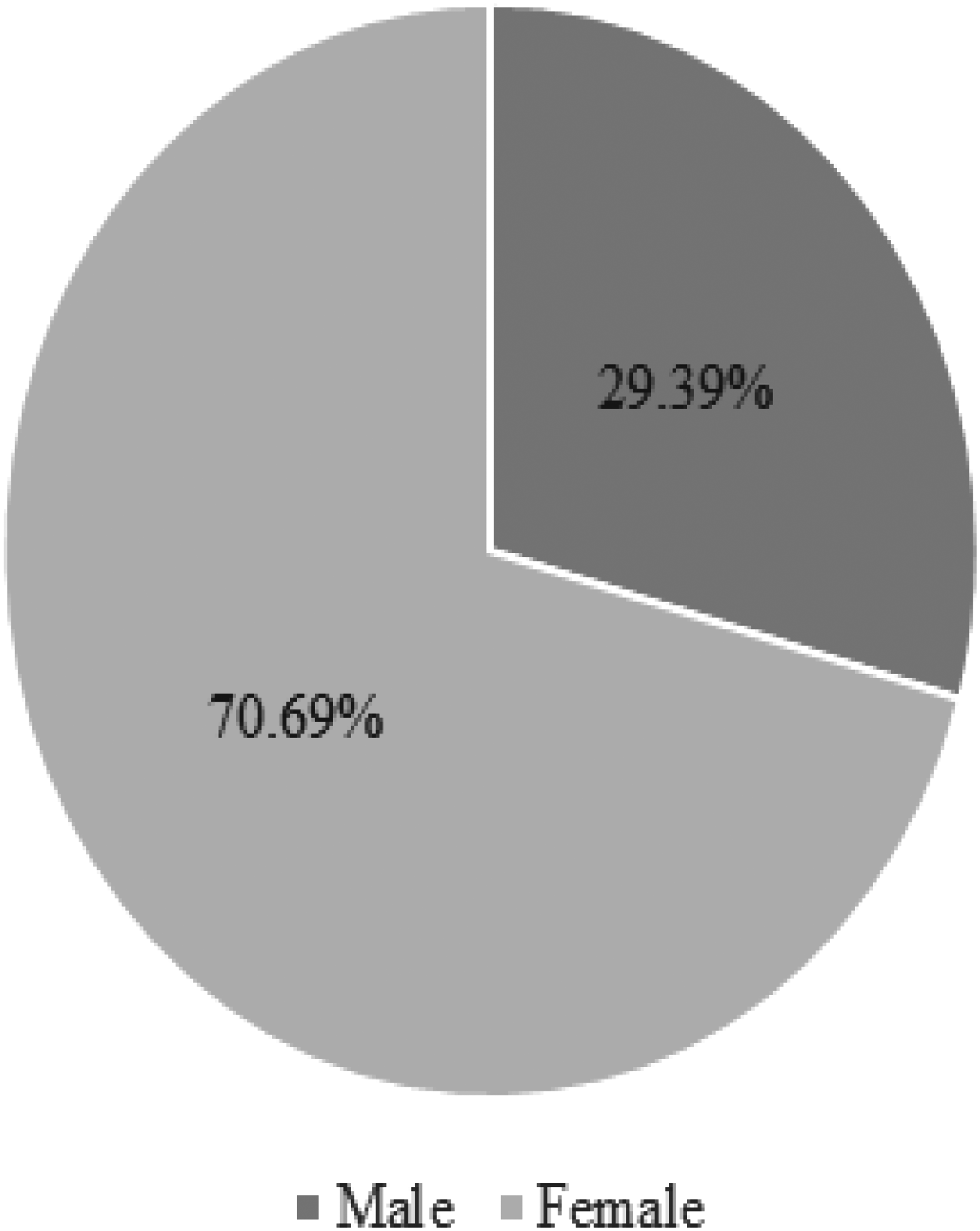
Pie chart representing male and female in-service teachers.
Figure 2 shows a pie chart indicating that out of 313 in-service teachers 92.01% have attended or conducted webinars/workshops/FDPs online whereas 7.99% teachers have not.
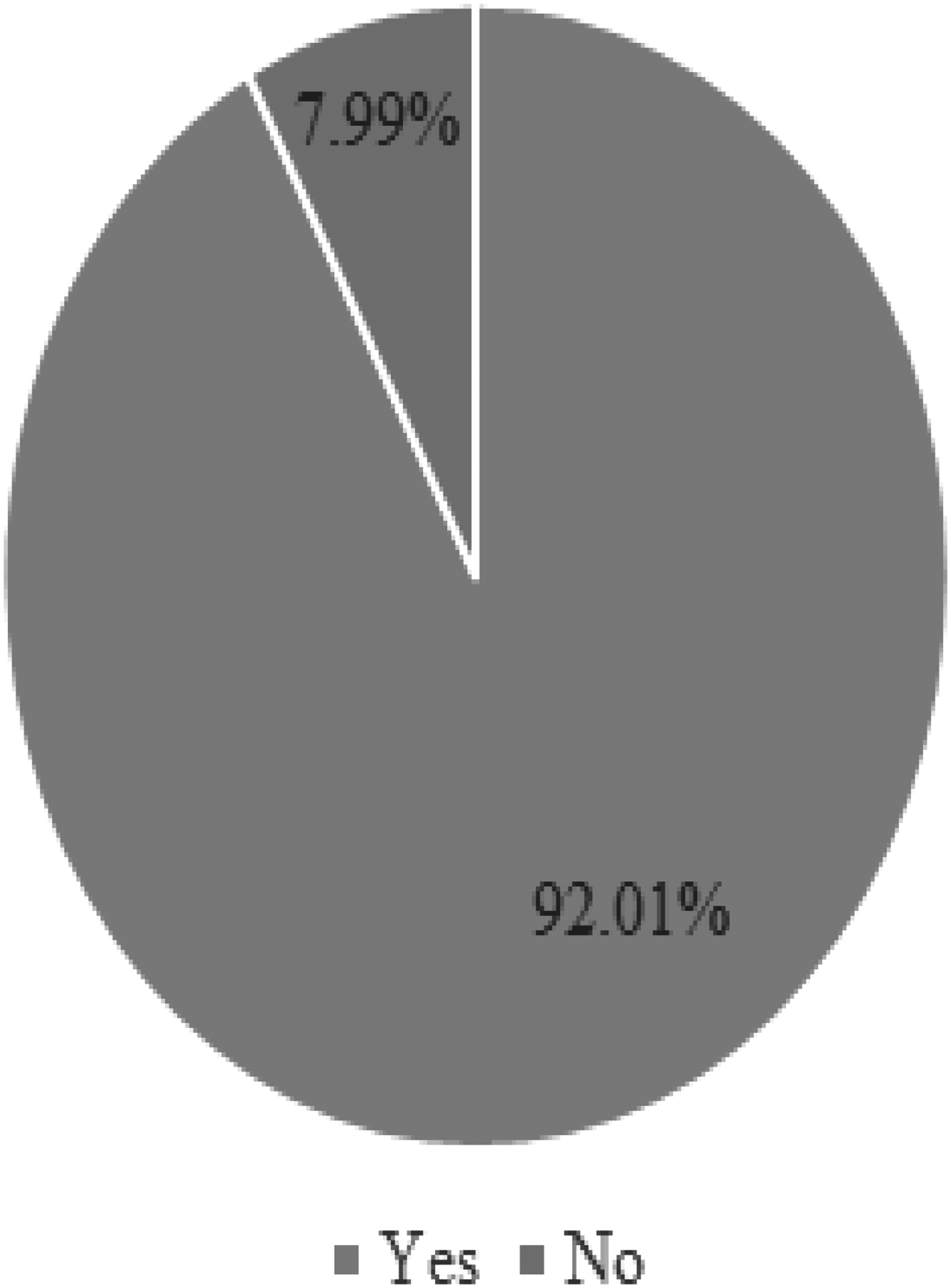
Webinars/workshops/Faculty Development Programs (FDPs) attended/conducted by teachers online or not.
Hypothesis Testing and Interpretation
learning flexibility, online learning, study management, technology, classroom learning, and online interaction.
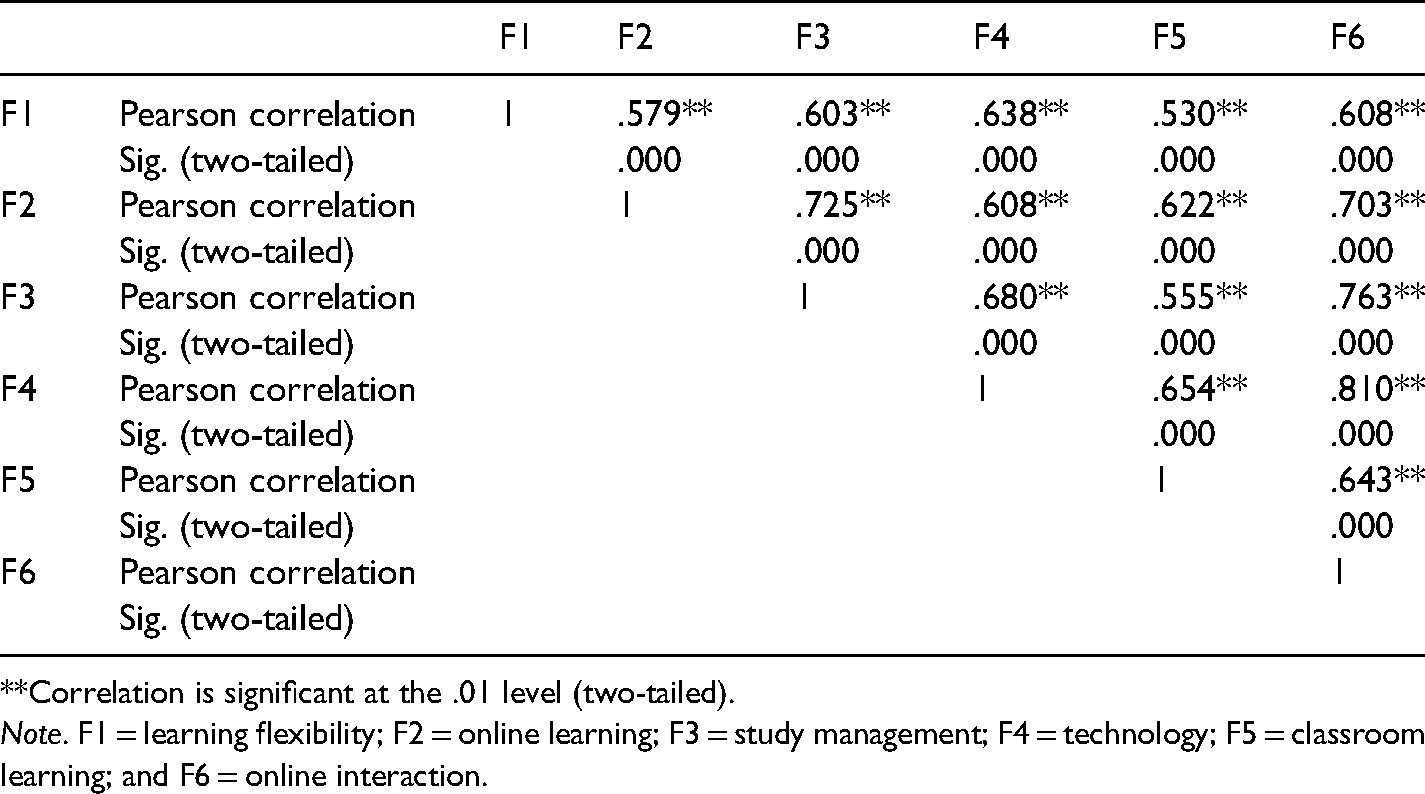
Pearson moment correlation was used to examine the interrelationship between the BL factors. Table 2 represents the Pearson moment correlational matrix among six dimensions of BL.
Pearson Moment Correlations: Relationship Among the Blended Learning Factors.
**Correlation is significant at the .01 level (two-tailed).
Note. F1 = learning flexibility; F2 = online learning; F3 = study management; F4 = technology; F5 = classroom learning; and F6 = online interaction.
Online interaction and use of technology had the strongest correlation (r = .81, p < .01) followed by study management and online interaction (r = .763, p < .01). There was a significant correlation that was found between learning flexibility and online learning (r = .579, p < .01), learning flexibility and study management (r = .603, p < .01), learning flexibility and technology (r = .638, p < .01), learning flexibility and classroom learning (r = .530, p < .01), learning flexibility and online interaction (r = .608, p < .01), online learning and study management (r = .725, p < .01), online learning and technology (r = .608, p < .01), online learning and classroom learning (r = .622, p < .01), online learning and online interaction (r = .703, p < .01), study management and technology (r = .680, p < .01), study management and classroom learning (r = .555, p < .01), technology and classroom learning (r = .654, p < .01), classroom learning and online interaction (r = .643, p < .01).
learning flexibility, online learning, study management, technology, classroom learning, and online interaction.
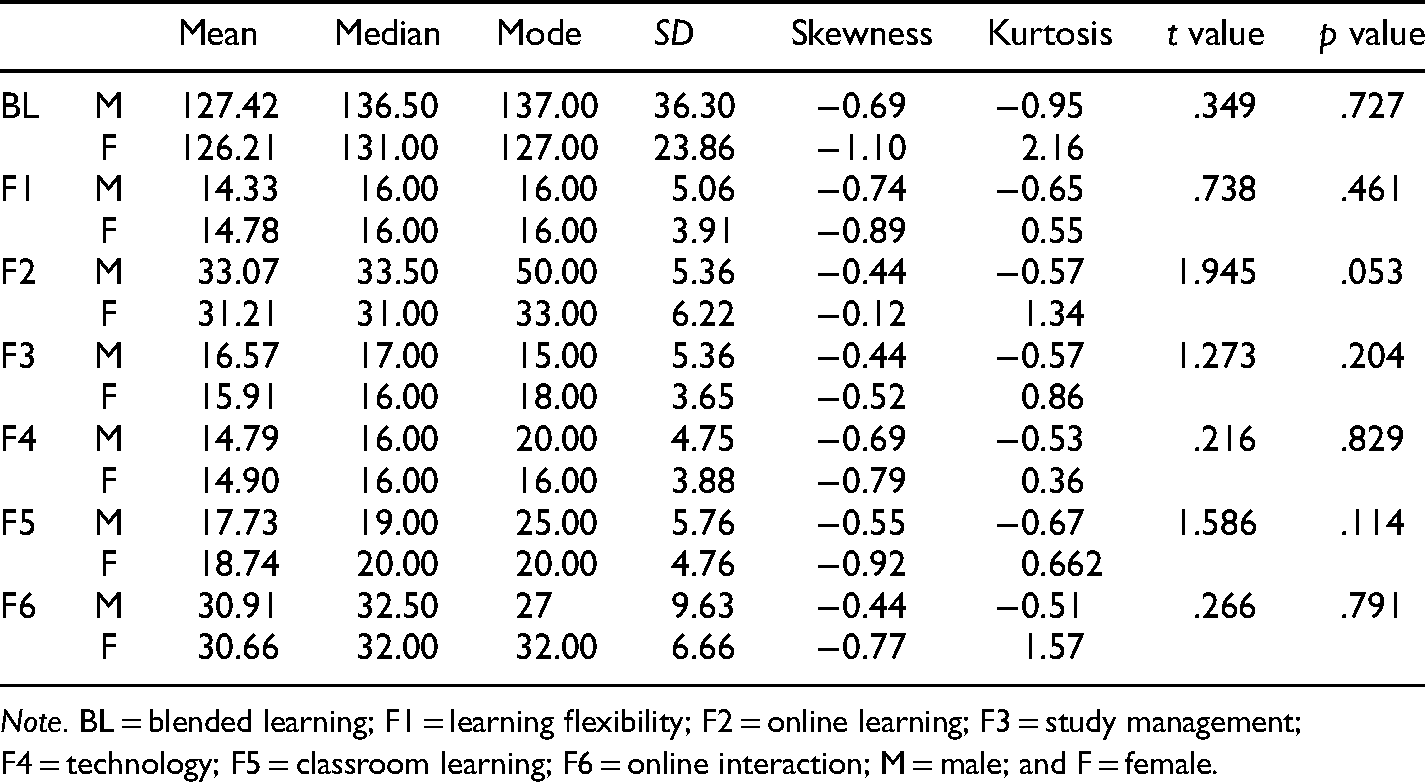
Descriptive statistics and the t test were used in order to find out the attitude of male and female in-service teachers from educational institutes toward BL and its dimensions. Table 3 represents the relevant descriptive statistics and the t test used to analyze the data to compare male and female in-service teachers’ attitudes toward BL and its dimensions.
Descriptive Statistics and t-Tests Results Comparing Male and Female In-service Teachers’ Attitudes Toward BL and Its Dimensions.
Note. BL = blended learning; F1 = learning flexibility; F2 = online learning; F3 = study management; F4 = technology; F5 = classroom learning; F6 = online interaction; M = male; and F = female.
The t value for male and female in-service teachers for BL and its dimensions was found to be not significant. Hence, the null hypothesis is accepted. There were no significant differences in the attitude of male and female in-service teachers on BL and on six different dimensions of BL.
learning flexibility, online learning, study management, technology, classroom learning, and online interaction.
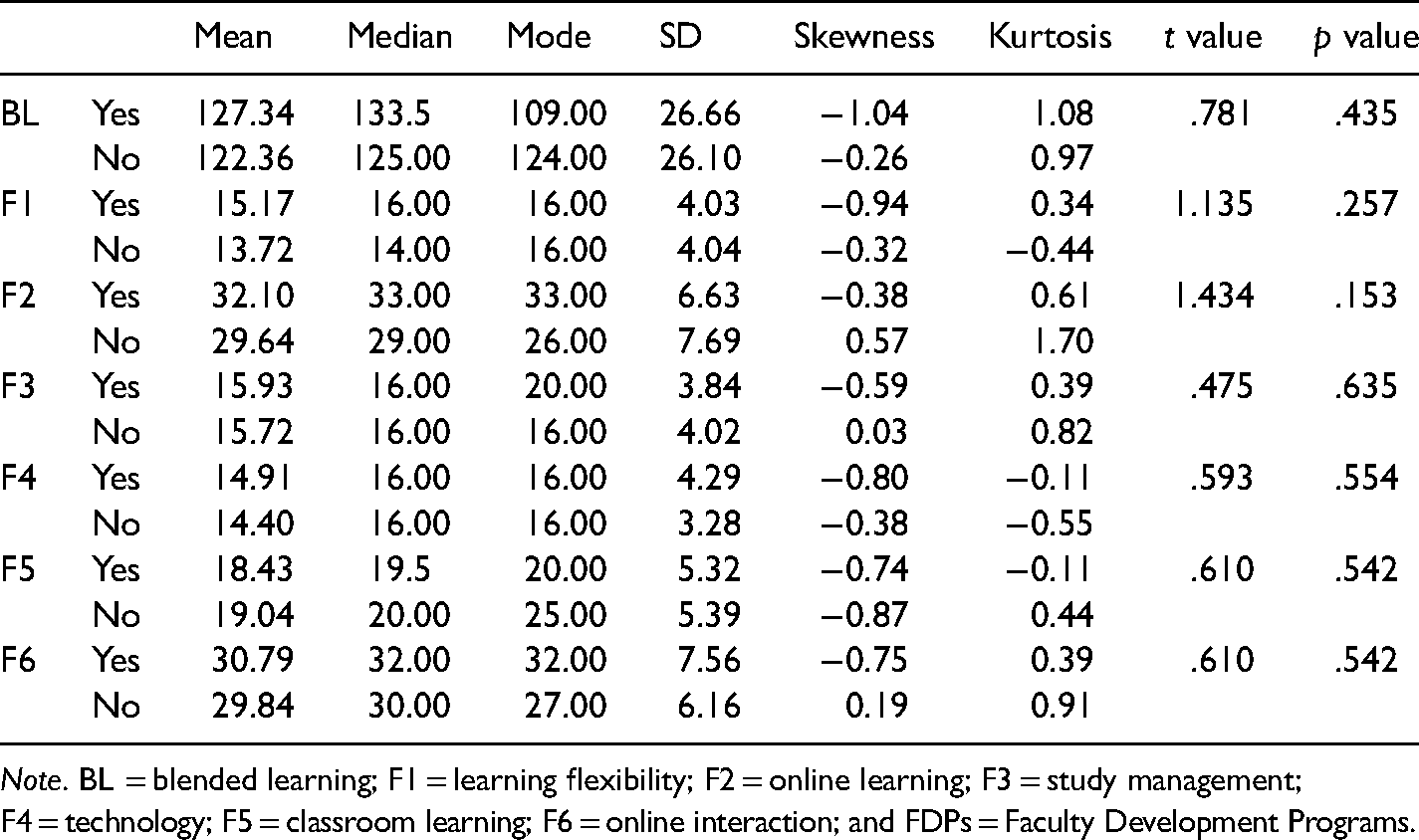
Descriptive statistics and the t test were used in order to find out the attitude of in-service teachers from educational institutes who have attended/conducted and who have not attended/conducted webinars/lectures/FDPs online toward BL and its dimensions. Table 4 represents the relevant descriptive statistics and the t test used to analyze the data in order to compare in-service teacher's attitude who have attended/conducted and who have not attended/conducted webinars/lectures/FDPs online toward BL and its dimensions.
Descriptive Statistics and t Test Results Comparing In-service Teachers’ Attitudes Who Have Attended/Conducted and Who Have Not Attended/Conducted Webinars/Lectures/FDPs Online Toward BL and its Dimensions.
Note. BL = blended learning; F1 = learning flexibility; F2 = online learning; F3 = study management; F4 = technology; F5 = classroom learning; F6 = online interaction; and FDPs = Faculty Development Programs.
The t value for in-service teachers who have attended/conducted and who have not attended/conducted webinars/lectures/FDPs online toward BL and its dimensions was found to be not significant. Hence, the null hypothesis is accepted. Therefore, there is no significant relationship between the attitude of in-service teachers who have attended/conducted and who have not attended/conducted webinars/lectures/FDPs online toward BL and its dimensions.
Discussions
Understanding the attitude of in-service teachers when they play the role of learners toward different learning aspects can be critical for assessing their adaptability to and eventual readiness toward BL. The findings from the present research show that in-service teachers who have a positive attitude toward online learning, study management, online interaction, and learning flexibility are more likely to adapt to BL. The more positive the attitude, the more adaptable the teachers will be and the more ready they are for using a BL approach in the postpandemic era for their professional growth where face-to-face learning and classroom interaction would be done only when necessary in order to maintain precautionary measures at least for a few months.
In addition, the present study reflected that gender has no effect on the readiness of teachers toward a BL approach. In other words, both male and female teachers are willing to adapt to this approach. Similar teachers who had attended and who had not attended or conducted webinars, workshops, and FDPs did not show any difference in their readiness toward BL. It is quite possible that those teachers who were unable to attend are also willing to adapt to this approach because they themselves are updated with the available online platforms or software that can be implemented for learning because of social media awareness or already existing knowledge.
Through this study, it is concluded that within a BL environment, the teachers will benefit from flexibility in time and place as well as accessibility as per their convenience. Their active participation (online and offline mode) will develop a conducive environment leading to better engagement and learning.
Advances in information technology (IT) such as development of web applications, mobile devices, and telecommunications have inevitably changed the design and delivery of the educational curriculum. From classroom learning to online learning has not been fully implemented in classrooms but implementation of the BL approach postpandemic will surely help in improving the learning delivery environment for lecturers and teachers who will be considered as learners while attending various training programs. Thus, although BL has been modeled as one of the methodologies for learning, a high level of familiarity to access technology has made using technology a non-issue from the perspective of the teachers as well as learners.
Conclusion
The impact of the pandemic has already been felt by all sectors of society including the education sector. It is an accepted fact that this impact will exist for a fairly long time. This pandemic is clearly a sign of changing times and thus requires the educational system to undergo a major revolution. BL is one of the approaches suggested by various educationalist and research scholars throughout the globe, which will provide the learners with powerful learning experience. The six factors of BL were considered for the present study. A significant positive correlation was observed among these factors as far as readiness of in-service teachers toward BL was considered. This indicates that learning flexibility, online learning, study management, technology, classroom learning, and online interaction are responsible for affecting the overall readiness of in-service teachers toward BL. Any difference in these factors would affect their attitude toward BL. The results are evidence that the BL approach has great acceptance from the in-service teachers. The present study reflected that gender and teachers who had attended and who had not attended or conducted webinars, workshops, and FDPs did not show any difference in their readiness toward adopting BL. In other words, both male and female teachers as well as those who are familiar and not familiar with online webinars/conferences/FDPs are willing to adapt to this approach. It is quite possible that those teachers who were unable to attend training programs online had a positive attitude because they themselves are updated with or have already experienced the available online platforms or software that can be implemented for teaching and learning. This research will help the curriculum developers to realize that the teachers are ready to implement this approach for their learning and the six factors are crucial to be considered as they affect the overall BL attitude. Introducing BL as an approach postpandemic will have a significant impact on the teachers’ professional career where more teachers would participate in the training programs and enhance their knowledge. In addition to that, it is an effective learning strategy and will open up room for teachers from various educational communities to connect with the world through the technological advances.
Footnotes
Authors’ Contributions
RS identified the tool and PM made the online form for collecting data. Both RS and PM distributed the tool for data collection. PM did data sorting and RS did data analysis. RS and PM collaboratively drafted the manuscript.
Declaration of Conflicting Interests
The author(s) declared no potential conflicts of interest with respect to the research, authorship, and/or publication of this article.
Funding
The author(s) received no financial support for the research, authorship, and/or publication of this article.
