




Abstract
The world has changed drastically in terms of telecommunication, running online businesses and daily life activities to keep social distancing and to perform the regular everyday tasks since the pandemic COVID-19. Governments have several times declared smart, partial or full lockdowns to deal with the health crisis situation, that has impacted the social activities, gatherings and has impacted the functionality of several professions, including education that are directly or indirectly impacted by the lockdowns. In the education environment the students in large numbers are expected to gather for lectures, labs and meet folks from industry and/or other sectors. The lockdown required the teachers to come up with alternative to meeting in person to online meetings and adapting to online-synchronous and asynchronous teaching styles. To meet the targets set for an academic year, a distinctive rise in e-learning has been observed where teaching and learning is undertaken remotely using digital platforms. This study aims to reveal the impact of computer-assisted teaching on the development of technostress among Pakistani teachers during the pandemic COVID-19. In addition, the role of teachers’ self-efficacy is evaluated and motivation to leave the teaching profession is investigated in the coming endemic climate. The researchers have opted to a quantitative approach with a cross-sectional survey to generalize the statistically obtained results and test hypotheses. A total of 242 teachers at different levels of education voluntarily participated in the research during the lockdown from March to April 2020, where all regular educational activities were suspended and online classes were introduced as an alternative way to meet educational goals. The findings revealed that Learning Teaching Process Oriented and Technical Issues Oriented are the main contributing factors towards the development of technology stress and motivation to leave the teaching profession. Moreover, teachers' perception of self-efficacy in using computers is negatively associated with technology stress. It is recommended that computer-based instructional coaching be designed for teachers prior to engaging them in digitally oriented online courses to improve their self-efficacy in using computers and to promote a well-developed digital infrastructure to avoid the development of technology stress and discouragement for tutelage.
Keywords
Introduction
Following the outbreak of a virus called COVID-19 in late 2019, which subsequently spread around the globe, and the world has entered a new era (Chinazzi et al., 2020). In addition to affecting human health, the Coronavirus disease 2019 pandemic affected global economics and social activities (Chang et al., 2021). All over the world, this pandemic forced governments to announce smart, partial or complete lockdowns to deal with the health crisis situation (Fahriza et al., 2020). Li and Lalani (2020) in their report on the World Economic Forum expressed that during the pandemic COVID-19, approximately 1.2 billion children were not in the classroom because schools were suspended around the globe and children started to take online classes at home or hybrid system rather than classroom environment (Xie et al., 2020). To overcome the educational shortfall and meet the targets set for an academic year, a distinctive rise in e-learning has been observed, where teaching and learning is done remotely and on digital platforms. The Higher Education Commission in Pakistan has directed universities to conduct online courses to make up for academic losses and meet the educational goals set for the academic year or semester (Today, 2020). Similarly, the administrations of schools and colleges have introduced online courses to avoid compromising education.
Digital integration into an academic setting has risen level of expectations for educators and teachers are expected to be digitally oriented, have a sound knowledge of technology use (Selwyn, 2014), and be enthusiastic about using new technologies in pedagogical practices (Kurt, 2017; Redecker, 2017). Technology has drastically changed numerous aspects of education, including teaching and learning (Park and Koh, 2017). Recently, there has been a growing body of literature that addresses the importance of ICT (Information and Communication Technology) as a tool to promote 21st century skills (Chang et al., 2021; Razak et al., 2019), but there is very limited research on teachers’ workload and stress during this digital transformation (Siddiqui et al., 2020b; Tynan et al., 2015). Nonetheless, the integration of ICT into the school curriculum has generated controversial discussion among intellectuals in both disciplines, ICT and education (Prasojo et al., 2017), especially in the context of increasing stress among teachers (Hwang and Cha, 2018; Krishnan, 2017).
Normally, implementation of technology in academic settings entails some adjustment issues due to the nature of the technology (expenditures, rapid development, electricity usage, diversified roles, etc.) and educators are one of the most influential professional groups affected by this revolution. (Çoklar et al., 2017; Revilla Muñoz et al., 2017). Altınay-Gazi and Altınay-Aksal (2017) have reported that the constant upgrading of technology triggers the development of stress known as technostress, especially when teachers lack the knowledge required to use the latest/updated devices. A review of the literature revealed that the buildup of technostress in teachers has pessimistic effects on teachers’ ventures, such as low intention and motivation to use technology, poor individual outcomes, dissatisfaction with work, fatigue, lack of concentration, low retention in the teaching profession, which not only affects the economic and financial outcomes of institutions (Ioannou and Papazafeiropoulou, 2017; Maier et al., 2015; Sarabadani et al., 2018; Suh et al., 2017), but also the overall performance of the organization (Ayyagari et al., 2011; Tarafdar et al., 2015). Furthermore, the elements that contribute to the acceleration of technostress include technology overload, techno-invasion, complexity in the use of technology, and technology related uncertainty (Ioannou and Papazafeiropoulou, 2017; Ragu-Nathan et al., 2008; Srivastava et al., 2015; Tarafdar et al., 2011; Tarafdar et al., 2015). One of the most significant reasons for teachers to leave coaching is increased workload due to technology integration, according to Roberts (2016). Teachers indicated that additional factors for increased workload are manual data entry into information systems, difficulties in managing information sources such as emails, VLEs (Virtual Learning Environments) and bulletins, especially when ICT structures are weak and teachers are given additional tasks alongside other routine assignments.
Literature has elaborated that technostress acts as a catalyst and motivator to leave the teaching profession. The current study was designed in a pandemic environment to identify the factors responsible for such inclinations. Another aspect that has been focused on by investigators working with mechanization in educational setup is teachers’ perception of technological self-efficacy which is proclaimed as a strong predictor for introducing technology in pedagogical iterations. Instructors’ self-efficacy is an important component of creating a positive learning environment for students and for enhancing their learning (Kazmi et al., 2021). McDonald and Siegall (1992) has defined technological self-efficacy as “the belief in one’s ability to successfully perform a technologically sophisticated new task”. Teachers’ technological self-efficacy has risen significantly in the past several decades (Skaalvik and Skaalvik, 2017), emphasizing the increasing interest in realizing under which circumstances, instructors are most likely to be effective in the integration of technology into their core tutoring practices. Researchers have reported that instructors with a high level of technological self-efficacy are better at managing everyday technologically oriented teaching tasks and are less prone to technostress conditions. Also, teachers with higher levels of technological self-efficacy contribute to solutions of difficulties caused by computer technology (Paul and Glassman, 2017), decreasing the extent of perceived technostress (Dong et al., 2019; Shu et al., 2011), and moderate negative effect of technostress on innovation (Tarafdar et al., 2014). In addition, if teachers have higher self-efficacy in technology integration, it probably also means that they have higher technological pedagogical content knowledge (Lo´pez-Vargas et al., 2017). Skaalvik and Skaalvik (2016) reported that among 523 Norwegian teachers, lower self-efficacy led to more stress and higher motivation to leave the profession. However, Klassen et al. (2013) found that stress is one of the causes of teachers’ low self-efficacy. Over the past 40 years, research has shown that teacher self-efficacy has a profound effect on everything from classroom climate to student performance (Zee and Koomen, 2016).
In the current research study, the relationship between technological self-efficacy and technological stress among the teachers is explored during pandemic circumstances.
This research is intended to explore the consequences of computer-assisted teaching remotely accomplished during COVID-19 endemic on the development of technostress among instructors of Pakistan. Furthermore, the role of technological self-efficacy in relation to technostress rise and motivation to leave the teaching profession is also studied in this context and pandemic circumstances. In this study, one of the influencing factors for the failure of technology integration in education is revealed. Hence, the aim of this study was to illustrates that how engaging teachers in online classes in hustle without providing them enough training during the pandemic, resulted in the development of stress that acted as a catalyst to burn out and leave teaching jobs. This paper will help educationists and administrators to understand how and why it is imperative to provide sufficient technology leadership skills through training and practices before engaging teachers in the virtual environment.
Using a literature review and formulated hypothesis, Figure 1 proposes a research model. Impact of teachers ‘perception of computer’s self efficacy on technostress and motivation to leave teaching profession (Developed by Author).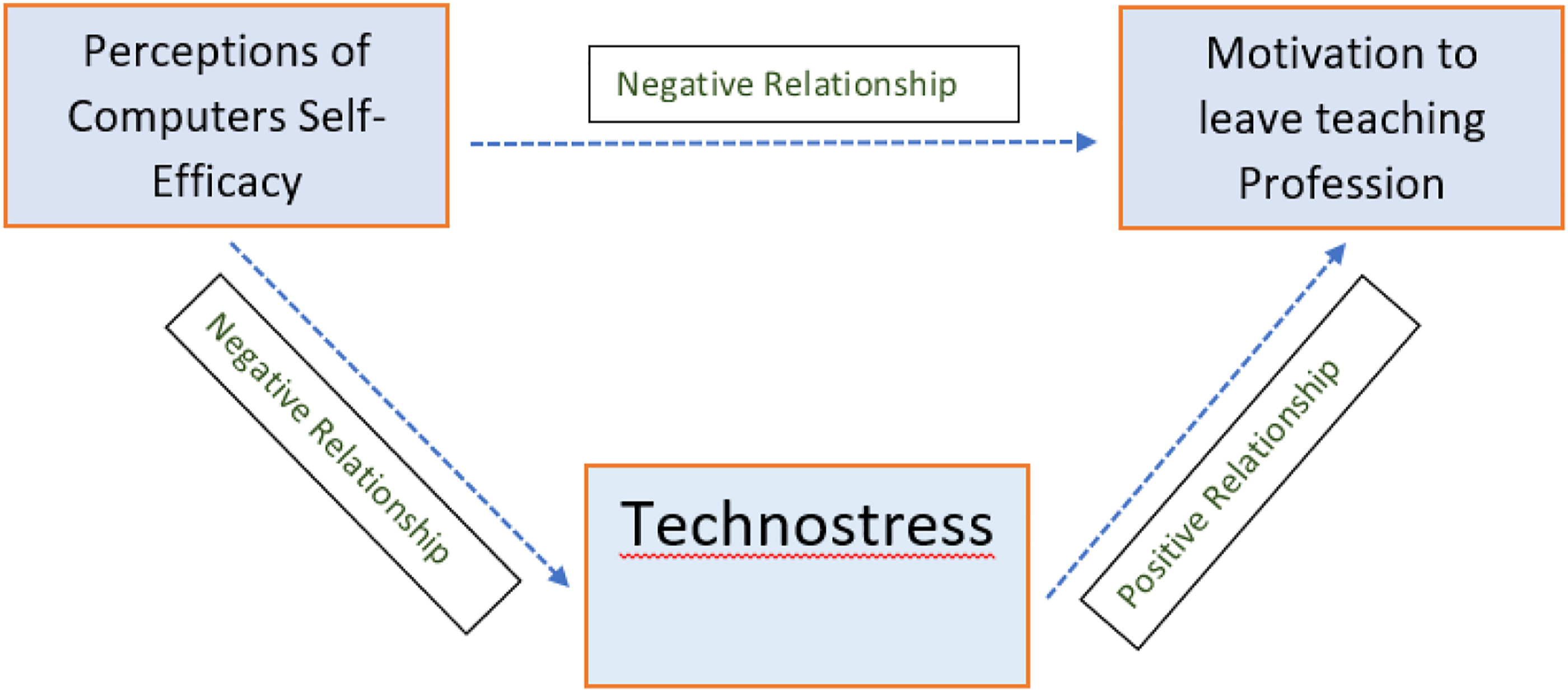
Hypothesis of the research problem
The researchers designed this study to test the following hypotheses:
The development of technostress among teachers due to technology integration in educational settings is positively associated to motivation to leave the teaching profession.
Teachers’ perceptions of computer self-efficacy is negatively associated to the development of technostress.
Teachers’ perceptions of computer self-efficacy is negatively associated to motivation to leave teaching profession due to the development of technology stress.
Literature review
Teachers’ attitude and beliefs about technology integration:
DiGregorio and Liston (2018) reported that most teachers believe that technology is an important component of education. However, Kim et al. (2013); Krause et al. (2017) expressed that teachers’ beliefs are highly subjective that differ from person to person, as well as from context to context. Sjöberg and Lilja (2019) administered a survey on the digital transformation of higher education and expressed that though teachers were hesitant yet positive to use technology in regular didactic practices in Sweden. Respondents emphasized the importance of organizational and societal facilitation for smooth integration of technology into educational settings. Also the reports suggest that if teachers are not adequately prepared to use technological tools (Ottestad et al., 2014; Ottenbreit-Leftwich et al., 2010), they fail to incorporate technology to a satisfactory level.
On the contrary, in the Saudi Arabian region, despite the availability of all the technological devices, negative attitudes of teachers and lack of motivation, insufficient training, and a lack of pedagogical knowledge are some of the factors that inhibit its use. Additionally, the belief that teaching is only about passing exams causes fear of technology, which prevents educators from integrating technology into their teachings (Alresheed and Leask, 2015).
Ferreira (2019) noted some of the hindrances included the lack of digital devices with an internet facility, difficulty in using software for teaching purposes, and a surprise or uninformed faculty inspection during the implementation of ICT in the classroom are some of the key reasons for the technology stress. Likewise, Izmirli and Kirmaci (2017) added that the exclusive decision of administrative units whether to engage faculty in the process of technology integration is another barrier to technology integration. The study also suggests there is no need to integrate technology into test-centered approaches, which are solely focused on students’ exam success. Several factors contributed to the failure of technology integration in Malaysian schools, as Awang et al. (2018) report. Despite huge investments in integration of virtual learning environments, only 80% of teachers are using ICT for less than 1 hour per week. A qualitative study of the same research investigated the fundamental themes behind this non-compliant behavior and suggested that increased teachers’ workload, the difference in the accessibility of devices in urban and rural areas, struggle with high competency to use technology are some of the stumbling blocks precluding integration. An investigation conducted in Negeri Sembilan Secondary Schools, however, found that teachers had an extremely positive attitude toward the acceptance and use of technology-based School Management Systems. (Leong et al., 2017).
Despite widespread accessibility to digital devices in private, personal settings, successful integration of technology into educational settings remains a gap that needs to be filled with the adequate training and accessibility of technology to the educators (Burden and Hopkins, 2016). In addition, educators consistently report using technology to complete conventional tasks (DiGregorio and Liston, 2018), and technology is not being used to support effective teaching strategies, but rather to complete routine assignments such as checking email, online communication, and surfing on the internet (Ertmer and Ottenbreit-Leftwich, 2013; Turel, 2014). Those teachers interested in using technology in pedagogical practices are only able to make PowerPoint presentations or use the Learning Management System (LMS) as a basic tool (Selwyn, 2014). Mndzebele and Dludlu (2018) noted that some educationists use technology to prepare tests, plan teaching schedules, or take pictures of lessons for use in lessons, and use scanners to copy images from books. In addition, students were rarely assigned tasks that helped them develop their surfing skills and use the internet.
As a result of the literature review, researchers of the current study conclude that successful integration of technology in educational settings requires teachers’ perceptions, administrators’ backing and educators’ motivation. This suggests that teachers’ competence and professionalism, in conjunction with their attitude and readiness for technology integration (Roumbanis et al., 2019), needs to be improved in order to not only overcome stress, but also to enhance technology use in education settings and for smooth integration.
Inconveniences in the life of teachers
Work-related stress is defined as physical and emotional reactions to the demands of a job that are unequal to an individual’s needs, abilities, and resources by Sauter et al. (1999). Often, teachers’ stress can be described as all of the experiences a teacher has that lead to unpleasant emotions resulting from various aspects of the teaching profession (Liu and Onwuegbuzie, 2012).
There are certain factors involved in the development of stress such as job demands (Hakanen et al., 2006) discipline issues among pupils, deadlines for work completion, poor student motivation, large classrooms, administrative conflicts, etc. (Skaalvik and Skaalvik, 2016).
In a study by Ali et al. (2017), the authors reported that workload constraints have the most impact on job performance, followed by new technology, unmet needs/wants, and the working environment. Additionally, the introduction of School Management Information Systems has not reduced the workload, rather teachers’ tasks have increased instead due to the additional responsibility for large manual data management by teachers.
Teachers’ stress can have devastating consequences both for the teachers and the quality of education. Elstad and Christophersen (2017) indicate a significant correlation between perceptions of student teachers’ digital competence and their self-efficacy for maintaining discipline. Hence, it can be concluded that as teachers’ self-efficacy increases, they can gain more control over discipline in digital environments. In addition, augmenting the technological self-efficacy can be effective in suppressing technology-related stress and for improving technology-based pedagogy.
Causes of stress, barriers to technology integration
Many researchers have investigated several barriers to technology integration that are among the causes of an increase in teachers’ stress despite the huge investment in technology integration. There are a variety of factors that hinder the integration of technology in primary schools in Hong Kong, according to Bai and Lo (2018). In the case of primary school teachers, 36 participants reported that, despite being forced to utilize technology into the classroom, there is an inadequacy of resources and skills preventing technology succession. Furthermore, teachers’ attitudes and beliefs, institutional barriers such as leadership, pressure assessment, incompatibility with institutions’ practices and expectations, were some of the other impediments pointed out by researchers. Fox and Henri (2005) observed that exam-oriented cultures limit teachers’ time to prepare for technology-based lessons. According to Razak et al. (2019), integrating ICT into Malaysian Primary Schools is challenging because the necessary funds for the acquisition of hardware and software, the establishment of telecommunication networks, and the repair and maintenance of infrastructure are often not available. Similarly, in Swaziland, the lack of digital proficiency, social influence, the inability to share digital content with learners, problems with Internet connectivity, and lack of possession of a personal computer are major obstacles (Mndzebele and Dludlu, 2018).
Kurga (2014) supported the fact as explained by Mndzebele and Dludlu (2018) that contextual factor has an effective influence on how technology is perceived and used by teachers in the community of practice associated with their subject. Educators face adaptation issues while using technology in academia due to its nature (rapid development, cost, electricity needs, change of roles, etc.) (Çoklar et al., 2017).
Similarly, Turel (2014) reported that the main barriers to technology integration in Turkish primary and secondary classrooms include the unavailability of relevant digital resources, computers and projectors, interactive whiteboards, head projectors, video players, printers, internet access in classrooms and other relevant technological devices for teaching. These limitations are seen in the education system of Pakistan, which hinders the overall performance, and ability of teachers on using technology independently. As a result, teachers fail to incorporate technology based teaching which trigger their stress level and demotivation towards their engagement in the teaching profession.
Self-efficacy as coping strategy to control stress
According to Zimmerman and Cleary (2006), self-efficacy is a belief on what a person can do and how well they can do it. McDonald and Siegall (1992) defined technological self-efficacy as “the belief in one’s ability to successfully perform a technologically demanding new task.” Bandura (2006) affirmed that people with low self-efficacy tend to reinforce potential problems, threats, and inadequacies. Self-efficacy varies from context to context and depends on perceptions of task complexity, availability of resources, dealing with obstacles, and time allotted for the task. Therefore, a teacher’s self-efficacy may be influenced by perceptions of stressors in the environment that can make it difficult to perform the required tasks (Skaalvik and Skaalvik, 2016). A review of research over the past 40 years has shown that the consequences of teacher self-efficacy are significant and can impact outcomes at multiple levels, from classroom climate to student learning (Zee and Koomen, 2016).
The review of the literature shows that there are many factors that contribute to the development of technology-related stress, where the unwillingness for adapting to the new technology need is a leading cause of technostress. Training programs can help overcome these stresses in adapting to the new technology solutions and enable teachers to use technology independently. In this study, researchers provide a literature review and analysis of factors that cause stress and evaluate the situations where teachers are abruptly required to use online teaching platforms without having sufficient knowledge and training. The lack of training is responsible for the accelerated technostress levels and cause the teachers to leave the teaching profession. Furthermore, the response of teachers with good technological knowledge to coping with technostress as opposed to untrained teachers is studied. This study adds to the knowledge of the pain, effort and suffering of teachers during the pandemic and the mistakes and shortcomings of moving to a virtual learning environment with inadequate preparation and planning.
Research methodology
Research model
The researchers have used the cross-sectional survey method for generalizing the statistically obtained results and testing hypotheses. A deterministic approach model is used to determine the impact of computer self-efficacy perceptions (independent variable) on the development of technostress (mediating variable) and motivation to leave the teaching profession (dependent variable) among teachers in Pakistan (refer to Figure 1). This research study was specifically designed to find out that during COVID-19 pandemic situation where online teaching and frequent use of technology was practiced to achieve the educational goals and complete the curriculum led to increase in technostress among teachers and motivation to leave the teaching profession.
Instrument
Several variables of the study were assessed using a self-reported questionnaire. The instrument was based on four sections:
Section A: demographics
Section B
• PCSE- The technical self-efficacy of teachers in regards to computer usage is measured by the Teachers’ Computer Self-Efficacy Perceptions Scale developed by Aşkar and Aysun (2001). In this questionnaire, 18 statements were used (7 reversed statements) with a 5-point Likert scale (Never, Rarely, Sometimes, Usually, Always) to measure perceptions of technology and computer self-efficacy among participants.
Section C
• MLTP- From the research paper by Skaalvik and Skaalvik (2016), the scale to measure tendency and motivation to leave the teaching profession consists of three statements on a five point Likert scale (Totally Disagree, Disagree, Neutral, Agree, Totally Agree). The items were: “I wish I had a different job to being a teacher”, “If I could choose over again I would not be a teacher” and “I often think of leaving the teaching profession”.
Section D
• TStress: The scale was adopted from Çoklar et al. (2017) based on 28 items and five sub-variables, and measured by a 5-point Likert scale (Totally Disagree, Disagree, Neutral, Agree, Totally Agree). Five subvariables are: Factor 1: Learning Teaching Process Oriented (LTPO)-7 items Factor 2: Professional Oriented (PO)- 6 items Factor 3: Technical Issue Oriented (TIO)-6 items Factor 4: Personal Oriented (PRO)- 5 items Factor 5: Social Oriented (SO)-4 items
Participants
Data was collected through an online questionnaire survey using Google forms. More than 400 forms were sent for data collection and to invite participants to join in the research. Researchers adhered to basic ethical principles and the APA’s ethical code as far as teachers were involved and voluntarily participated in the study. The purpose of the study and the right to withdraw were explained to them. An informed consent form was given to each participant prior to data collection, along with a detailed description of the research study and the researcher’s assurance that the data would be destroyed upon completion of the thesis.
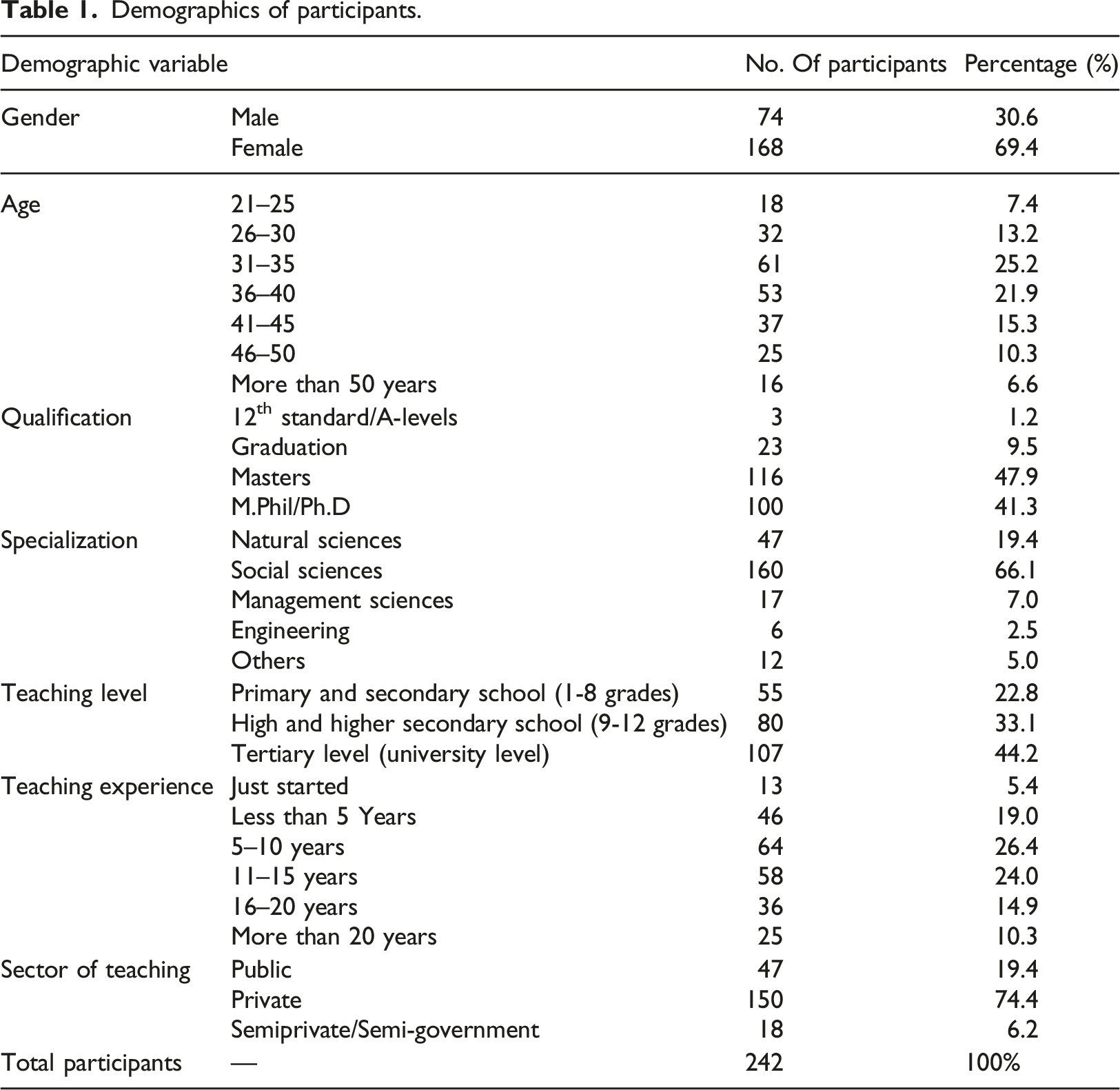
Demographics of participants.
Data analysis measurement tool
Data were analyzed through one-way ANOVA, pearson correlation, and regression using SPSS version 20. Mediation is checked and tested using AMOS version 22
Data analysis
SPSS version 20 and AMOS version 22 were the main software used during analysis and hypothesis testing. The self-reported questionnaire was analyzed using exploratory factor analysis using SPSS and confirmatory factor analysis using AMOS prior to the hypothesis verification tests. To determine if sample data is drawn from a normally distributed population (within a certain tolerance), a normality test is usually performed. Several statistical tests require normally distributed sample populations, such as the Student’s t-test and the one-way and two-way ANOVA. Normality can have serious effects in small samples but impact effectively diminishes when sample size reaches 30 according to Cohen et al. (2002) and 50 according to de Winter et al. (2009). This means that the sampling distribution of the mean must be normal if each sample contains a large number of observations (in this case, 242).
Factor loadings and reliability statistics.
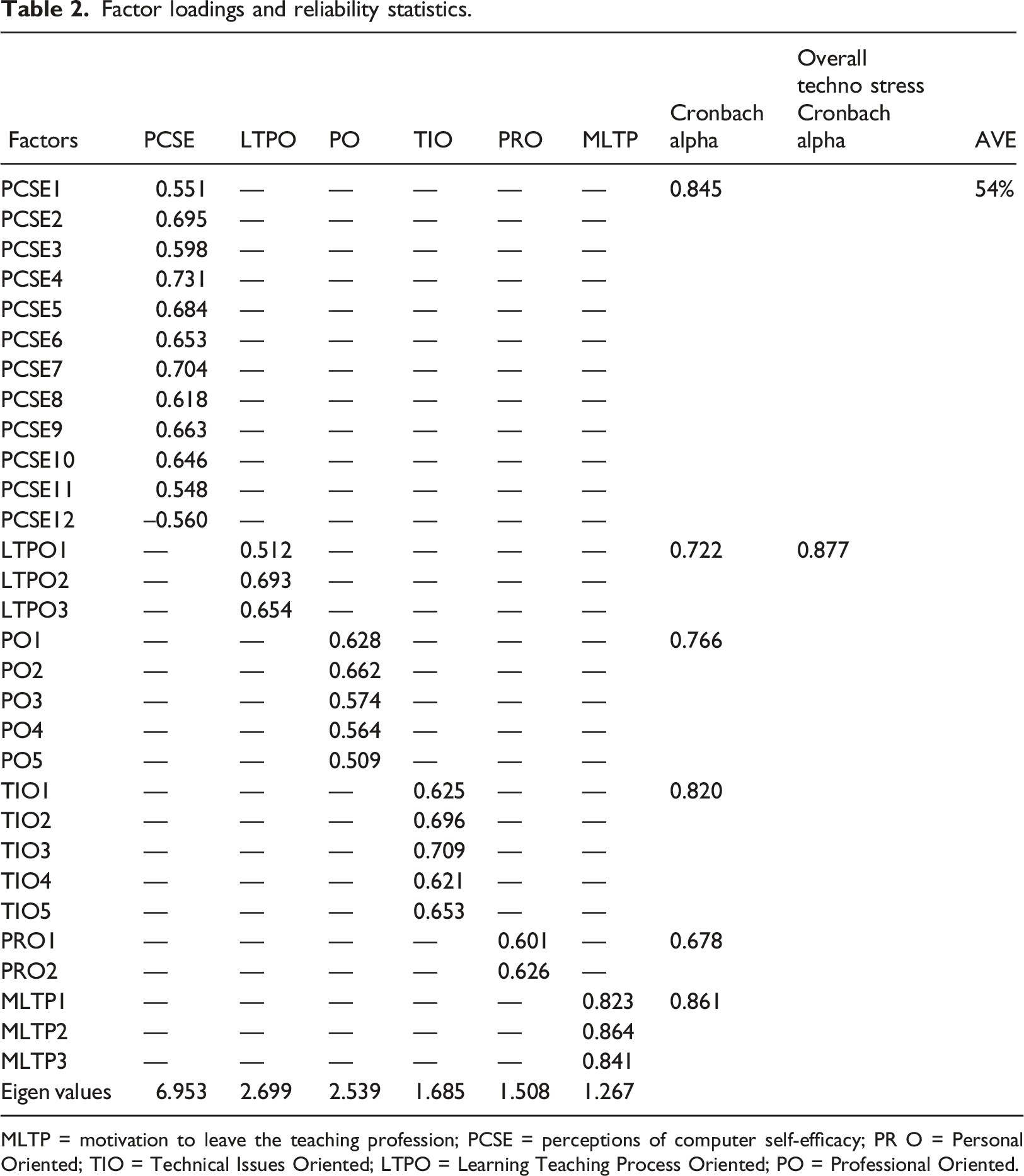
MLTP = motivation to leave the teaching profession; PCSE = perceptions of computer self-efficacy; PR O = Personal Oriented; TIO = Technical Issues Oriented; LTPO = Learning Teaching Process Oriented; PO = Professional Oriented.
The final questionnaire was based on 30 questions with 3 main factors. • Teachers’ Computer Self-Efficacy Perceptions (PCSE)-12 items • Technostress Scale (LTPO-3 items, PO-5 items, TIO-5 items, PRO-2 items) = 15 items *During Factor Analysis factor for social orientation was removed as factor loadings were not satisfying the construct. • Motivation to leave Teaching Profession = 3 items
Confirmatory factor analysis
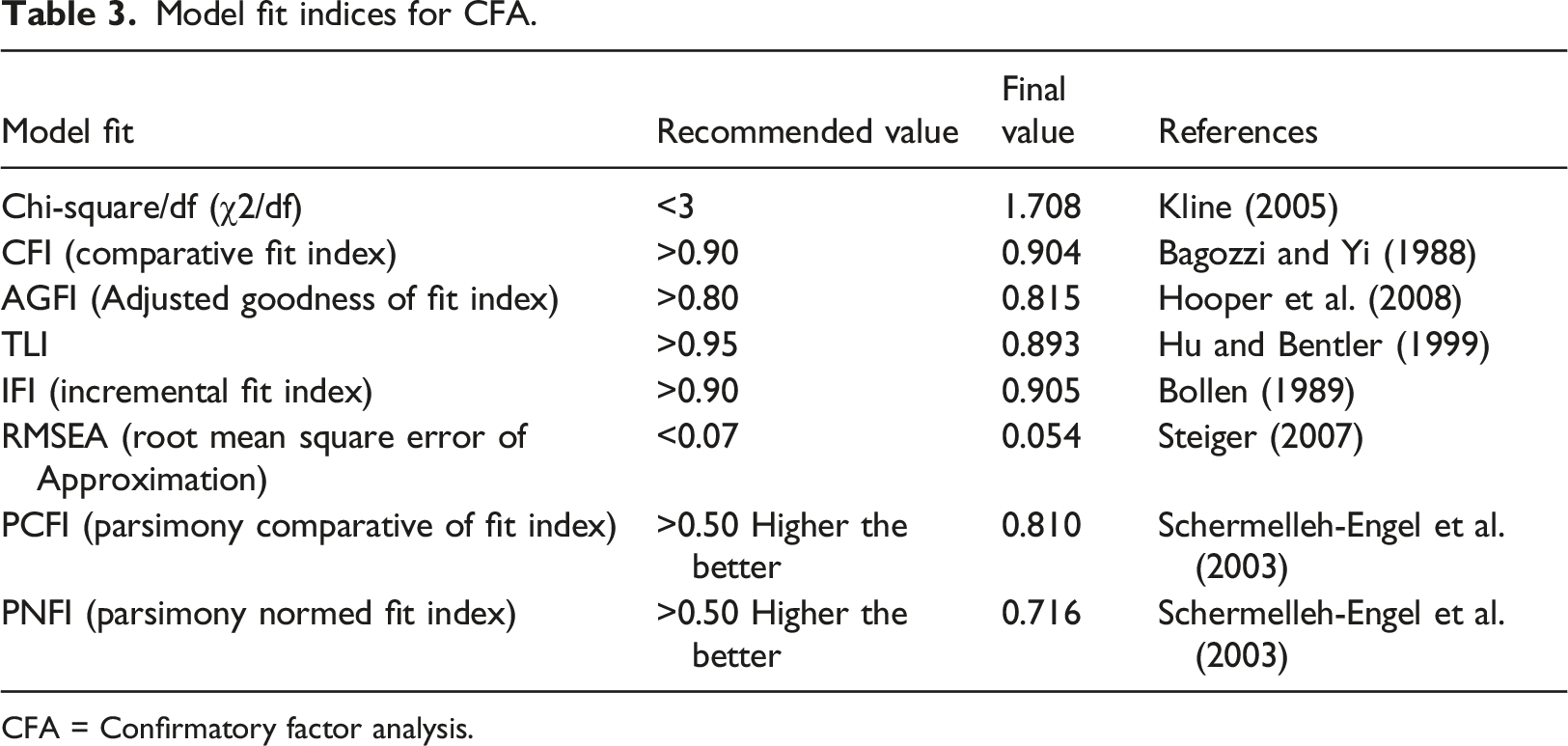
Confirmatory factor analysis is achieved with the help of AMOS version 22. Factor Loadings with higher values merged together to test for hypothesis (Refer to Figure 2). To make sure model is fit for hypothesis testing some of the model fit indices are mentioned in Table 3. Indicators of model fit show that the instrument meets model fitness criteria and has the potential to be used. Confirmatory factor analysis for instrument used in this research design. (Developed by the Author). Model fit indices for CFA. CFA = Confirmatory factor analysis.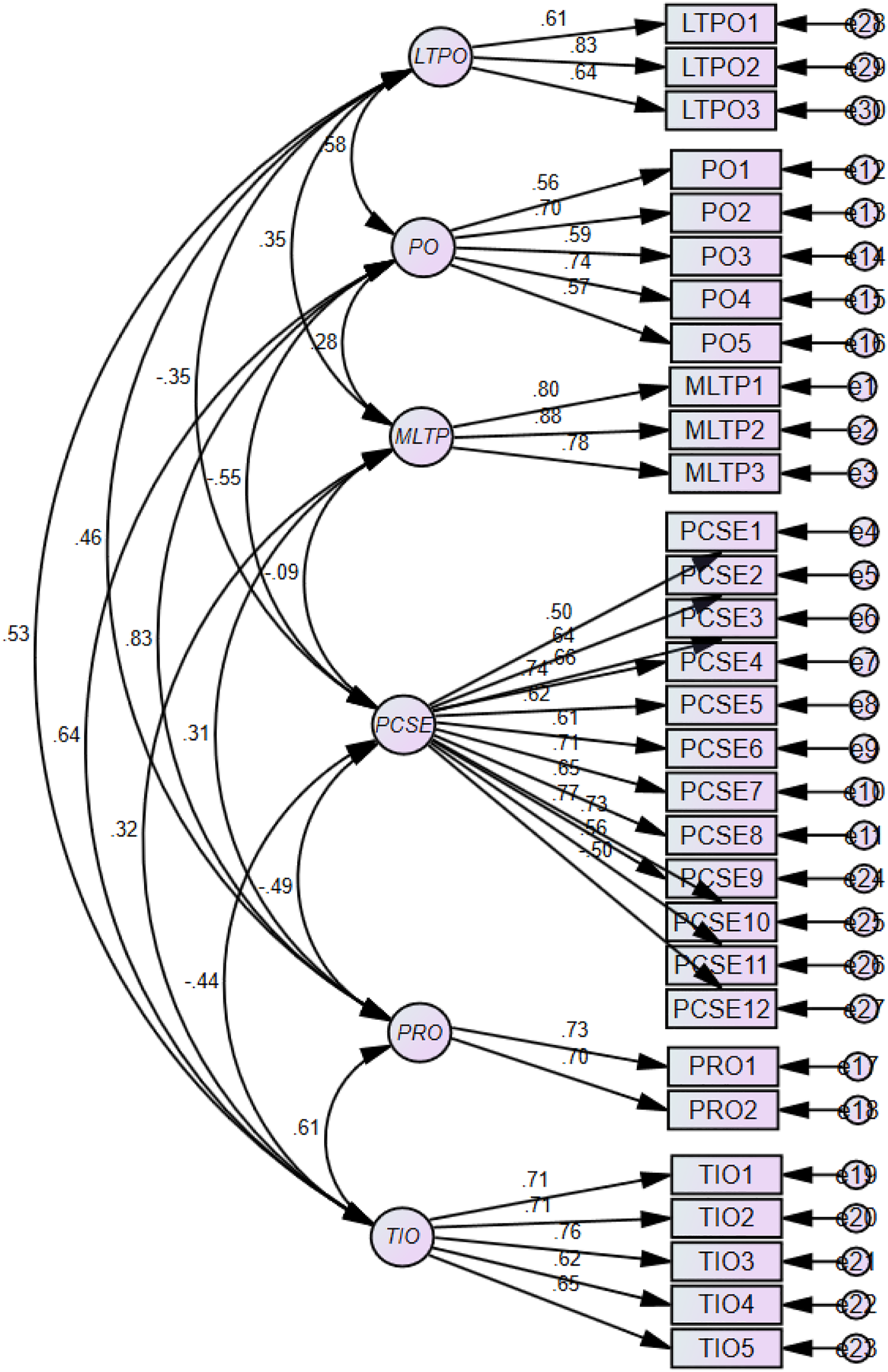
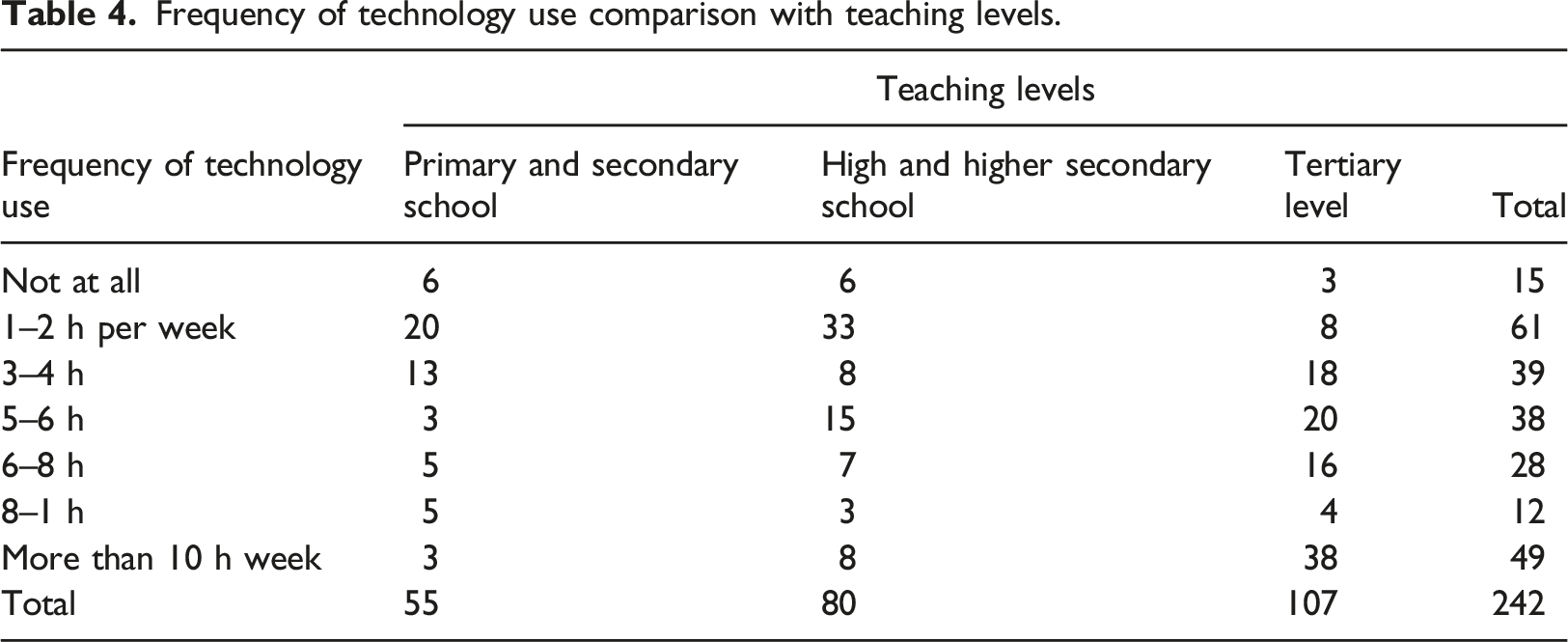
Frequency of technology use
Frequency of technology use comparison with teaching levels.
Pearson’s correlation.
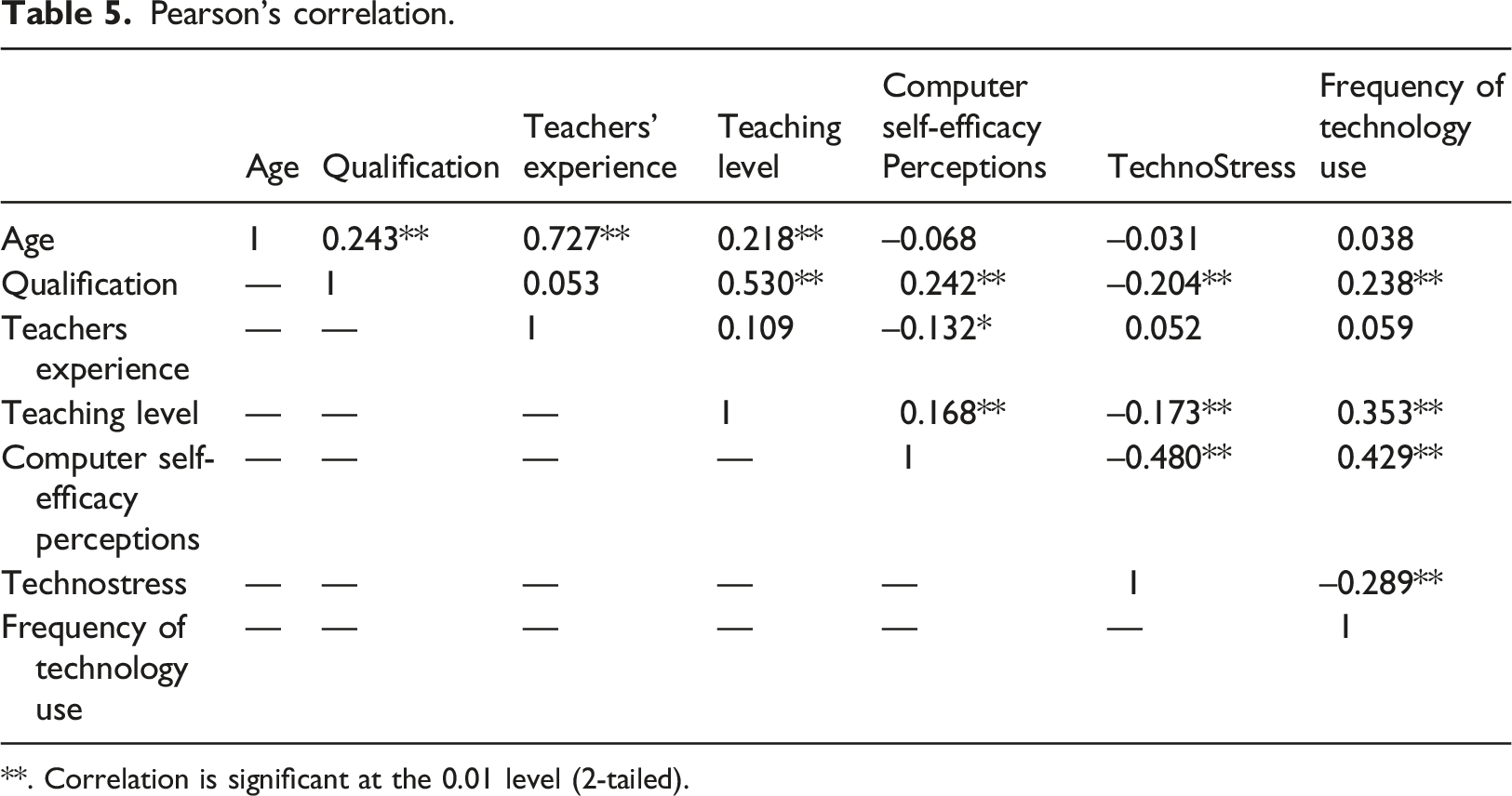
**. Correlation is significant at the 0.01 level (2-tailed).
Turel (2014) has reported that the frequency of technology use in the classroom at different levels of education varies significantly not only between different countries but also between different schools in the same country. Clearly, educational technology is used nowadays in all primary and secondary schools, as well as higher education institutions, in all developed countries and in many developing countries. In line with the findings of Turel (2014), a significant difference in technology use is observed. It is clear from Table 4 that the maximum time spent on digitally oriented devices for instructional purposes was 1–2 h per week and that high school teachers indulged in this frequency the most. University teachers, on the other hand, spent more than 10 h per week using technology oriented devices to make their teaching successful. From these differences, as explained by Siddiqui et al. (2020b), it can be concluded that technology integration is more likely to be observed at the tertiary level of education.
Pearson’s correlation clearly revealed that the frequency of technology use increases with the increase in qualification and level of teaching. It can be concluded that the use of technological devices is higher with more qualified teachers and higher level of teaching. Moreover, despite the efforts made during pandemic, more university teachers associated with online teaching as noted by Siddiqui et al. (2020a) and fewer school and high school teachers took this initiative. Turel (2014) reported that computer self-efficacy correlated positively with frequency of technology use, and the results of the current study also support Turel (2014) findings. The correlations also showed that technostress is negatively associated with frequency of use and perceptions of self-efficacy of computer. It can be concluded that higher self-efficacy in using computers reduces the likelihood of exacerbating technostress and that individuals with higher levels of technostress are more averse to using technology in their teaching. In line with Sarfo et al. (2017) study, another interesting finding of the current study revealed that as teaching experience increases, the perception of self-efficacy in using computers decreases, which is defined by Reed et al. (2005) as mental and physical abilities decrease with age, which in turn affects self-efficacy and ability to use computers. In addition, experienced teachers have been accustomed to using fewer computers in their classrooms for years and therefore see less ability to use computers and technology in their teaching. Lawrence and Tar (2018) also stated that some teachers refused to deviate from the old way of doing things. Instead, most teachers argued that the process of learning technology and integrating it into the classroom takes too much time, while others feel that technology could replace them, so they refuse to use technology in their teaching rather than lose their jobs and old ways of teaching. Therefore, they cannot develop sufficient skills and self-efficacy to use computers in their teaching.
Participants’ age and teaching experience did not significantly influence the frequency of technology use. Other important findings on technostress show the negative correlation with qualification and teaching level, which means that less qualified individuals combined with low teaching level have a higher risk of developing technostress.
Teachers’ perceptions of computer self-efficacy and technostress impact on motivation to leave the teaching profession
Regression weights.
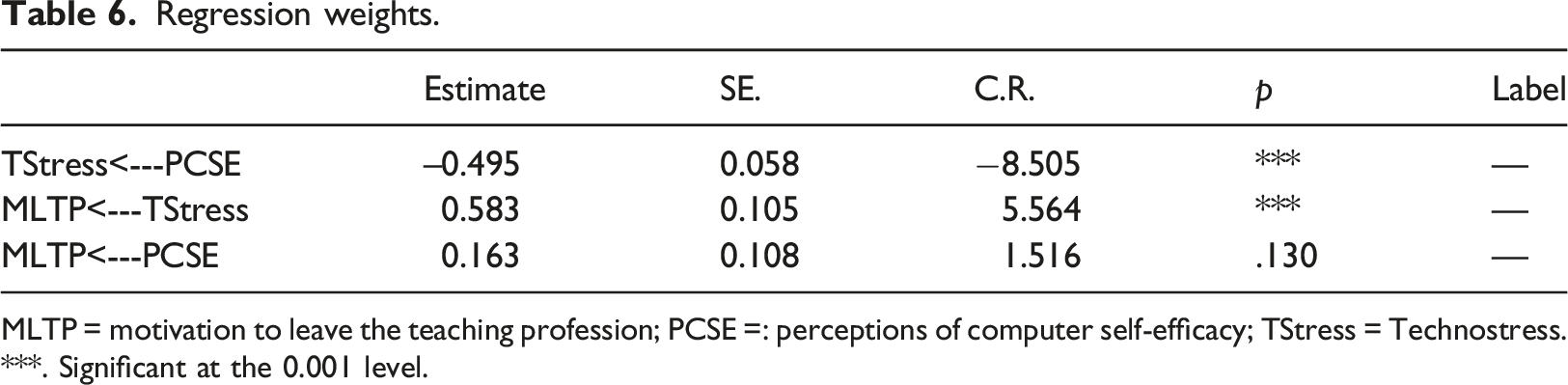
MLTP = motivation to leave the teaching profession; PCSE =: perceptions of computer self-efficacy; TStress = Technostress.
***. Significant at the 0.001 level.
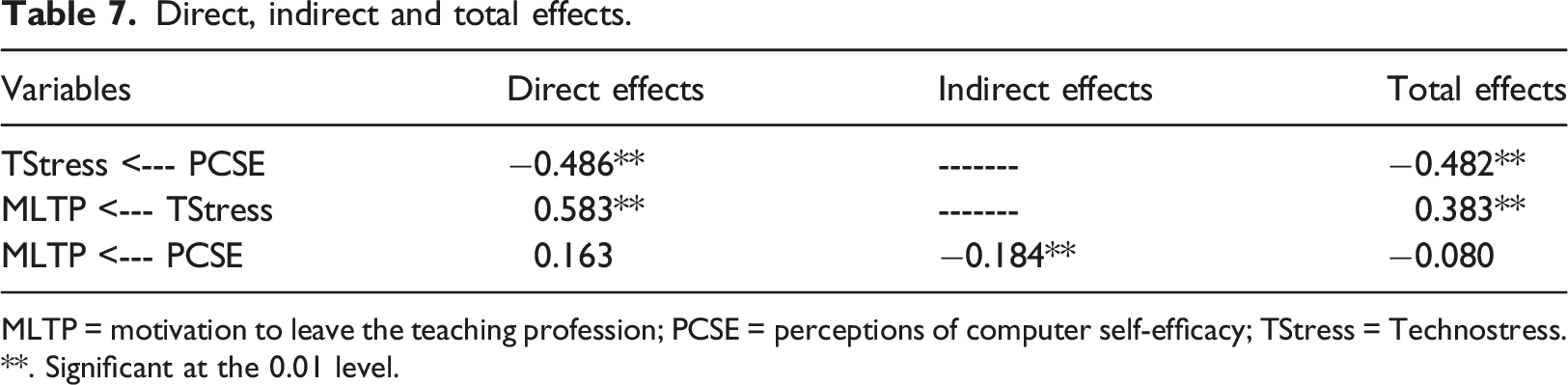
Direct, indirect and total effects.
MLTP = motivation to leave the teaching profession; PCSE = perceptions of computer self-efficacy; TStress = Technostress.
**. Significant at the 0.01 level.
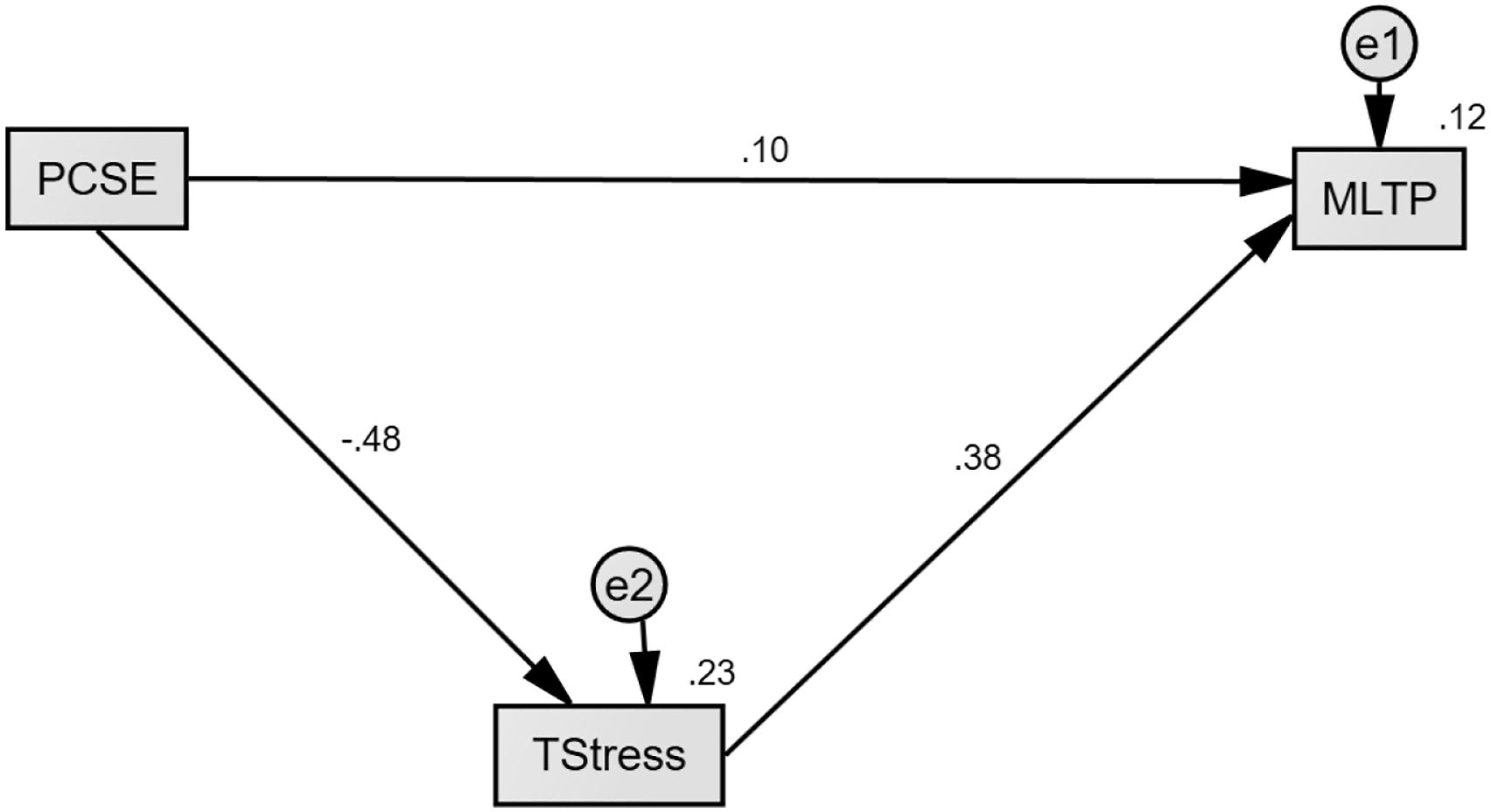
Impact of perceptions of computer self-efficacy (PCSE) on motivation to leave teaching profession (MLTP) through mediation of technostress (Tstress). (Developed by Author).
Andreou (2019) pointed out that perceptions of computer self-efficacy are negatively associated with technostress. The current study also confirms that teachers with higher levels of self-efficacy in using computers during the pandemic are less likely to develop technostress. To test the mediating effect of technostress between perceptions of computer self-efficacy and motivation to leave the teaching profession, a bootstrap of 5000 was conducted using AMOS version 22.
From Table 7, the standardized indirect (mediated) effect of perceptions of computer self-efficacy (PCSE) on motivation to leave the teaching profession (MLTP) is −0.184. This means that due to the indirect (mediated) effect of PCSE on MLTP, when PCSE increases by 1 standard deviation, MLTP decreases by 0.184 standard deviations. This effect is in addition to the direct (non-mediated) effect PCSE may have on MLTP. Thus, this is a case of complete mediation, where computer self-efficacy perceptions negatively and indirectly affects motivation to leave the teaching profession. To find out which technostress factor has a greater impact on motivation to leave the profession, a linear regression analysis was conducted using SPSS version 20 by using the model
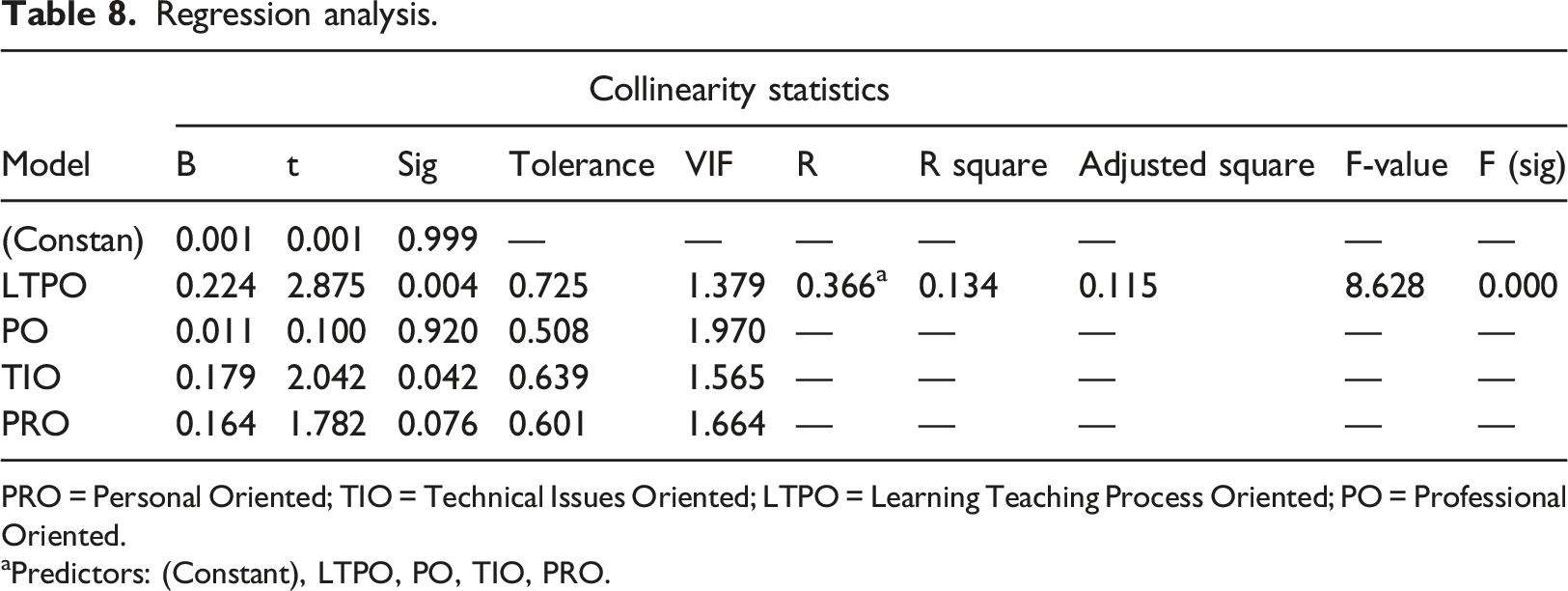
Regression analysis.
PRO = Personal Oriented; TIO = Technical Issues Oriented; LTPO = Learning Teaching Process Oriented; PO = Professional Oriented.
aPredictors: (Constant), LTPO, PO, TIO, PRO.
Dependent variable: motivation to leave teaching profession
An analysis of regression revealed that Learning Teaching Process Oriented (LTPO) and Technical Issues Oriented (TIO) are the two primary factors that contribute to stress and motivation towards leaving teaching as profession (as tSig< 0.05). Based on this analysis, it can be concluded that, if the two types of technostress factors can be overcome through training or preparation before engagement in a technologically enhanced teaching and learning environment, motivation to leave the teaching profession can be significantly reduced (Refer to Table 8).
Influences of specialization in teaching (natural sciences, social sciences etc.) on technology use
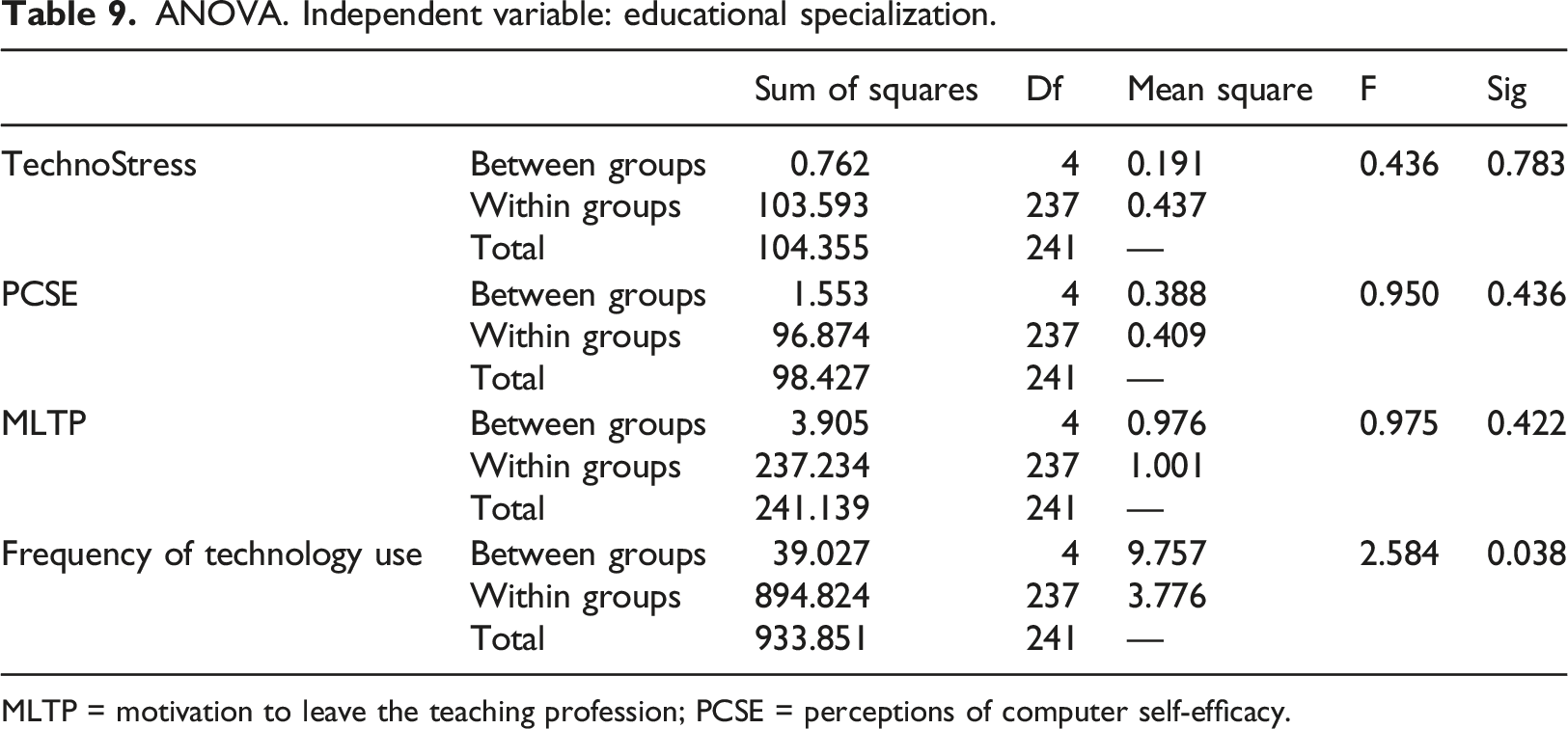
ANOVA. Independent variable: educational specialization.
MLTP = motivation to leave the teaching profession; PCSE = perceptions of computer self-efficacy.
The field of educational specialization (Natural Sciences, Social Sciences, Management Sciences, Engineering, Others) does not directly affect teachers’ perceptions of computer self-efficacy, motivation to leave the teaching profession, and technology stress, but significant differences were found in frequency of technology use. It is concluded that teachers who teach different subjects show significant differences in terms of frequency of technology use in the classroom. There are few studies on the influence of field of study on technology integration and it is recommended to learn more about these differences and the reasons for the different usage patterns.
Influences of sector (public, private and semi government) on technology use
ANOVA. Independent variable: sector of educational institute.
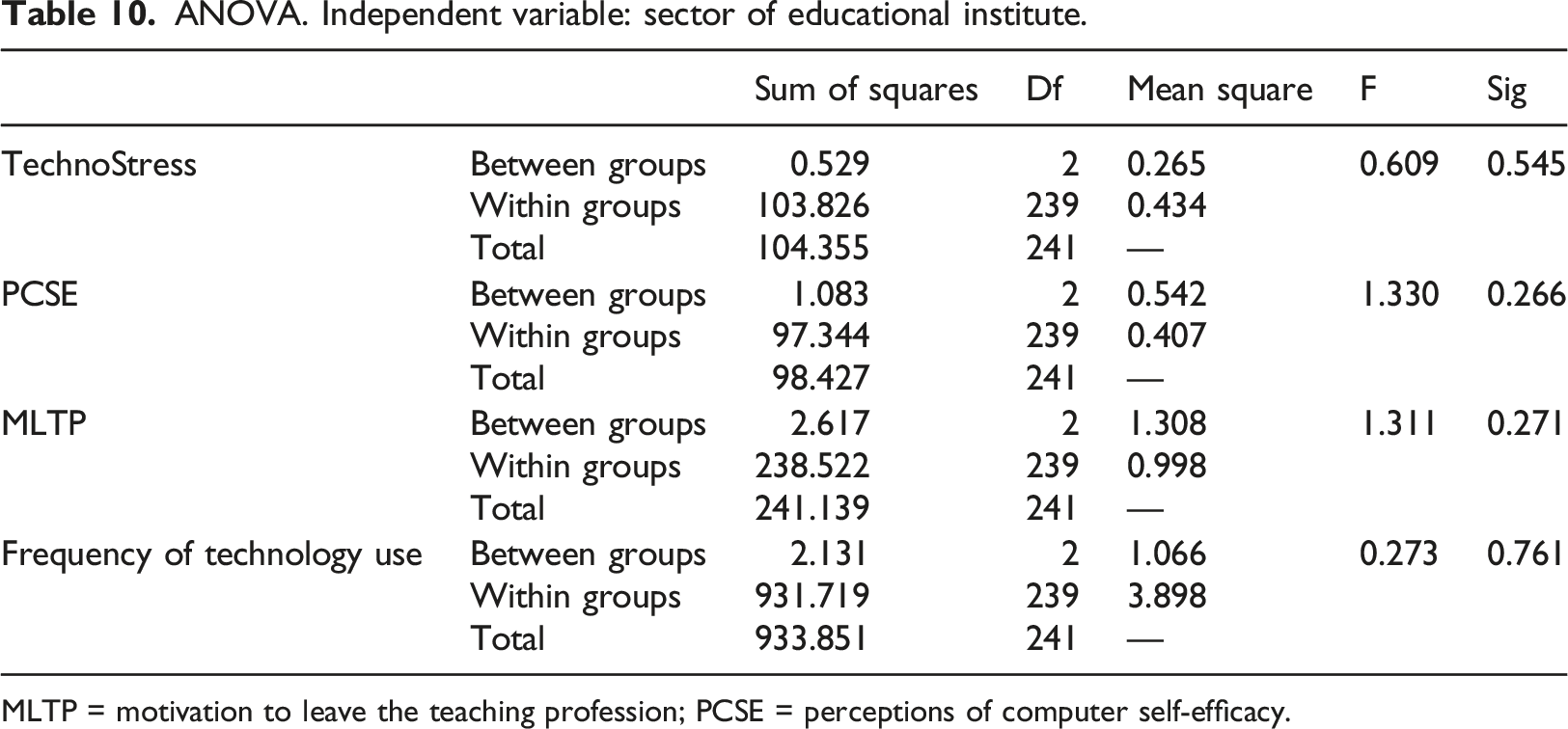
MLTP = motivation to leave the teaching profession; PCSE = perceptions of computer self-efficacy.
No significant differences were found, as all p values are higher than 5%. Authors conclude that in Pakistan, teachers working in public, private, and semi-private institutions use technology at a similar level, have similar computer-based skills, and experience technology stress in the same way, despite the large differences in cost and quality between public and private institutions as described by Barrera-Osorio et al. (2022). It is recommended that a more detailed research study be conducted to learn more about the differences or similarities between educators working in different educational sectors in Pakistan.
Discussion
This study sought to discover the direct impact of technological self-efficacy through teachers’ perceptions of computer self-efficacy on the boost up of technostress, and the mediator effect of technostress on motivation to leave the teaching profession. The findings of the current study are aligned with the research outcomes of Roberts (2016) who reported that technology stress and workload due to technology integration are the most common factors that influences teachers to quit this profession. In addition, as reported by Skaalvik and Skaalvik (2016) that the lower self-efficacy of teachers results in an amplification of stress and motivation to leave the coaching profession, the findings of the current study have revealed a similar pattern.
In a number of studies, it was reported that this stress not only negatively affects job retention, but also many other factors, such as teachers’ low intention and motivation to use technology, job commitment and poor individual outcomes. It further causes an increase in job dissatisfaction, fatigue, lack of concentration, and low retention in employment, which affects the economic and financial outcomes of institutions (Ioannou and Papazafeiropoulou, 2017; Maier et al., 2015; Sarabadani et al., 2018; Suh et al., 2017; Usman and Kabir, 2019), as well as the performance of the organization as a whole (Ayyagari et al., 2011; Tarafdar et al., 2015). Besides, lack of adequate digital resources, technology overload, techno-invasion, complexity in using technology, insecurities due to technology and techno uncertainty, constant upgrading of technology, and lack of knowledge about advancing technologies (Altınay-Gazi and Altınay-Aksal, 2017; Ferreira, 2019; Ioannou and Papazafeiropoulou, 2017; Ragu-Nathan et al., 2008; Srivastava et al., 2015; Tarafdar et al., 2011; Tarafdar et al., 2015) are some of the contributing constraints associated with the rise of technology stress. Ali et al. (2017) and Awang et al. (2018) argued that despite the introduction of School Management Information Systems, teacher workload actually increased due to the time required by teachers to enter large amounts of data manually, a factor contributing to a rise in technostress.
When integrating technology in the classroom, the concept of computer self-efficacy seems to be particularly relevant (Kass, 2014). The development of teachers’ computer self-efficacy is important in suppressing the rise of technostress and its negative consequences. There appears to be a strong correlation between teachers’ perceptions of digital competency and their self-efficacy for maintaining class discipline in online classrooms, as noted by Elstad and Christophersen (2017). It suggests that teachers need to be more competent, professional, and ready to integrate technology into their classrooms in order to not only overcome technostress, but also enhance technology use in classrooms (Roumbanis et al., 2019).
There is also evidence that in some regions, teachers are inadequately prepared for using technology in the classroom (Ottenbreit-Leftwich et al., 2010; Ottestad et al., 2014), so they fail to use it effectively. To effectively incorporate technology and reduce stress, teachers’ perceptions and skills must be shaped.
Recommendations
Technostress is the foremost stress in the teaching profession
Skaalvik and Skaalvik (2016) recommended seven potential stressors (or potentially stressful working conditions) among teachers at educational institutions. The potential stressors were: discipline problems, time pressure, low student motivation, conflict with colleagues, lack of supervisory support, value conflict, and student diversity. It is recommended to add technostress among the list as a potential cause of demotivation. Technostress leads to teachers leaving the profession, so more research needs to be conducted to identify its effects.
Introduction of high-speed networks IT support in educational setting
In a 2015 study, Nyembezi and Bayaga (2015) found a positive relationship between the effectiveness of the Internet for students’ learning and teachers’ willingness to interact with them. Similarly, the adoption of virtual learning environment has encouraged learning especially in terms of defying the barriers of time and location (Nor-Fadzleen and Halina, 2013; Siddiqui et al., 2021b). However, there are some reasons why internet use for learning does not meet students’ and teachers’ expectations, including poor internet facilities and dropped signals caused by excessive internet consumption. It is recommended that the use of digitally adapted classrooms should be preceded by organizations ensuring reliable internet access. According to the researchers of the current study, institutional administrations should create permanent positions for information technology (IT) professionals, as recommended by Suleimen (2019). Additionally, faculty training facilities focused on ICT in pedagogy should be made available regularly, and academic institutions should encourage a collegial learning environment to facilitate faculty members learning new skills through collaboration. Finally, it is recommended to reward those faculty members who are active and effective in their attempts to integrate ICT into teaching for encouragement and motivating others to participate.
Provisional of technological resources and training
Lack of digital resources, the inadequacy of digital skills among instructors and, negative attitudes are some of the major contributing factors towards the hindrance of technology integration (Bai and Lo, 2018; Mndzebele and Dludlu, 2018). Turel (2014) reported that people with access to computers at home and in institutions demonstrated higher computer usage and self-efficacy. The findings of the current study found a negative association of perceptions of computer self-efficacy with the buildup of technostress. It is recommended to switch traditional pedagogies of teachings towards online or blended learning (Siddiqui et al., 2020a) where teachers become responsible to integrate technological lessons and they will get an opportunity to practice with computers in order to enhance their self-efficacy. Furthermore, Technological Pedagogical Content Knowledge (TPCK/TPACK) is described as extensive knowledge and skills that teachers need to implement in curriculum design for the integration of communication technologies (Schmidt et al., 2009). The lack of TPACK has been identified as one major barrier to technology integration (Blackwell et al., 2016; Koh et al., 2017). Despite huge expenditure on improving or integrating technology in educational setups, improvement in students’ learning is seen when technology is applied with proper pedagogy. It is recommended to prepare teachers of all levels with the help of TPACK to combat the stress generated due to online teaching in an endemic scenario. COVID-19 is a lesson for institutes and teachers who should regularly practice online teaching in order to avoid any compromises in such circumstances in the future. As explained by Ferreira (2019); Divaharan and Ping (2010), researchers of the current study recommended creating a theoretically-driven ICT training program tied to curriculum learning objectives, and to hire educational technologists to provide techno-pedagogical support to faculty members practicing technology adoption in classrooms in schools, colleges and, universities. In this way, teachers’ self-efficacy in using computers is strengthened and technostress is reduced.
Reduction in teachers’ work load
Workload due to technology integration was cited by Roberts (2016) as a leading reason for teachers leaving this occupation. Chief components of the augmented workload are difficulties in managing several sources of information such as emails, VLE’s, and bulletins with poor ICT structure. In addition, training designed to enhance digital competence among teachers along with routine responsibilities contribute to increasing workload. Similarly, extensive manual data entry by teachers into information management systems has also increased the burden on teachers. This shows that technology integration is not used to make tasks easier, but to make them more complicated. Zhou (2019) introduced a Java Scripting and JSP (Java Server Pages) based software for administrators and teachers in educational institutions to reduce their workload and manage their routine tasks. The software is especially beneficial to teachers, who can manage their courses and records online. It is suggested that due to the increased load on teachers, technology like JSP can be used to support teachers in situations like pandemics or lockdowns. Zhou (2019) expressed that this technology is easy to handle and cost-effective so can be introduced in the local education system. Similarly, Iran and Kulkarni (2015) stated, emerging technologies, such as Web 2.0, have opened up opportunities for cost-effective approaches in education, making it accessible to both adults and youth. Adoption of such technologies can effectively reduce the workload of teachers at all levels of the educational systems. In addition, they provide opportunities for those who cannot accomplish their educational goals in formal learning setups. Moreover, it helps instructors to become technology savvy with an investment of limited finances.
On-campus classroom set-ups
Elstad and Christophersen (2017) reported that one of the reasons for low self-efficacy in using computers and an antecedent to technostress is teachers’ inadequate preparation for using technology in pedagogy. Moreover, this issue can be overcome by introducing on-campus classrooms to give teachers hands-on, first-hand experience and help them develop their digital literacy skills. Yang (2015) reported that optimistic students are naturally digital learners who become very creative and interactive without prior guidance. Moreover, it becomes difficult for incompetent teachers to succeed with such students. Therefore, educators need to “speak in the language of students” for better learning (Razak et al., 2019), and for this purpose, educators need to develop their technology literacy (Suleimen, 2019). Considering the underdevelopment of Pakistan, the use of technology should be cost effective to ensure that students have access to technology to develop and improve their skills as recommended by Bai and Lo (2018). Moreover, professional development and proper planning should be ensured before integrating and implementing technology-based teaching models.
Developing technological leadership skills
Leong et al. (2017); Bai and Lo (2018) found that one of the reasons for the lack of technology integration in educational institutions, apart from the huge investment, may be that many administrators of institutions are least responsible for technology, which is probably one of the factors contributing to the failure of technology use and the development of technostress among teachers. It is therefore recommended that the attitude of administrators be changed by providing them with sufficient technology leadership skills through training and practices. It is also suggested that leaders and teachers who are committed to technology integration should be rewarded or appreciated and help them build their professional identity (Suleimen, 2019). It is reported that increasing stress leads to a decline in job satisfaction and the administration should take some steps to establish guidelines or standards for stress management for teachers, especially if they are responsible for additional tasks such as implementing technology in the regular classroom during the pandemic.
Recommendations for future studies
Andreou (2019) studied the relationship of computer self-efficacy with technostress. In general, the results suggest that higher levels of technology self-efficacy among new knowledge workers are associated with lower levels of technostress. However, these results are not self-explanatory and research designs explaining mastery experiences in relation to techno-complexity and techno-insecurity should be explored in detail.
Most of the studies focus on the use of the internet as a positive reinforcement for improving skills. However, there is very little research on the negative consequences of Internet addiction and dependence among teachers who use the Internet for their regular work. Shapira et al. (2003) has defined Internet dependence as, “A behavioral addiction characterized by symptoms such as inability to restrict excessive use, continued use despite psychological, physical, and social damage and feelings of anxiety, aggression, and extreme irritability when Internet access is restricted”. Researches have revealed that dependent individuals have more health, work, psychosocial, family, and financial problems compared with non-dependent individuals (Jun and Choi, 2015; Siddiqui et al., 2021a).
A study should be conducted to investigate this internet addiction and dependency among individuals associated with the teaching profession. In the case of internet dependence being identified in teachers, it is suggested that psychological counseling be implemented for the prevention of internet dependence and its negative consequences.
Limitations of the research
One of the major limitations of the study is the small sample size and convenient sampling method, which is considered insufficient for generalizing the results to the entire population. Also, the study has adopted a cross-sectional research design and it is recommended that the study should be repeated with a longitudinal design to arrive at better conclusions. A self-report questionnaire was used for data collection as this is an efficient and economically cost-effective method, but is considered less ideal as the resulting data may be inaccurate due to recall problems. It is recommended that multiple measures be used for each construct to obtain more reliable results.
Footnotes
Acknowledgements
Without the help of their esteemed colleagues, the authors would not have been able to complete this study and produce this research paper. The authors would like to thank the reviewers who spent substantial time and expertise in improving this manuscript. They would also like to thank Ms Sandra Francis, Prof. Dr Fareena Saqib, Prof. Dr Altaf Hussain, and Mr Zahid Ahmed who contributed as language experts to improve the language of this paper. As a final note, the authors are extremely grateful to Ms Mahwish Siddiqui for her assistance in completing and improving this paper.
Declaration of Conflicting Interests
The author(s) declared no potential conflicts of interest with respect to the research, authorship, and/or publication of this article.
Funding
The author(s) received no financial support for the research, authorship, and/or publication of this article.
