




Abstract
Research is an essential tool for the creation and advancement of knowledge for socio-economic development. Whilst individuals pursue different kinds of education in order to match international standards, employers are keen to recruit employees with needed skills for a competitive edge. Due to the newly existing educational technologies, individuals have been left with insatiable desire to learn more skills, yet, with limited resources. The advent of Open Education (OE) has led to mass retention, use/re-use, redistribution, revision, and remix of open educational resources (OERs) thereby transforming the learning and research landscape in higher learning institutions. This paper analysed the contribution of OERs and social justice (SJ) on research productivity in higher education institutions. A scoping review was adopted for this study to gather extant literature from relevant available databases with the aim of obtaining as much evidence as possible to make a clearer and succinct conclusion. Existing literature provides evidence that OER and SJ principles positively influence production of research outputs in higher education institutions. The main challenges hindering universality of OERs include economic, technical, legal, social, and infrastructural requirements needed for availing OERs to the beneficiaries including learners, educators, learning institutions and governments. Currently, there are many open and free-to-use resources and websites existing on the internet. There is however, need for attitudinal change towards OERs among students, academics, and scholars among other stakeholders if its optimum uptake is to be realized.
Keywords
Introduction
Information, and by extension education, increasingly remains a key driver of improved socio-economic status that results in societal development (Naidoo, 2014). In realizing this, governments globally are heavily investing on their citizens’ education to enhance acquisition of knowledge and skills needed to compete and remain relevant in the global labor market. It is for this reason that most learners, job seekers and working middle-class are keen to pursue different kinds of education to acquire skills that match international standards. The desire to reach the upper working class status and to achieve career satisfaction by the middle-class constitutes a notable motivation for OERs consumers. This is particularly because this group of individuals mostly live in urban areas where broadband and service industries thrive at a cost they can afford (Atkins et al., 2007). They are also more knowledgeable about the OERs than their counterparts in lower-classes (Ritcher and McPherson, 2012). Employers on the other hand are specific on recruiting employees with skills that are amiable to job market competitiveness (Archer and Davison, 2008). Compounded by ground-breaking innovative technological innovations, individuals have often been left with insatiable desire to learn more skills, yet with scant resources.
Mohd et al. (2015) argued that while there is so much to learn, particularly in institutions of higher learning, resources such as human capital 1 and materials needed for educational purposes and development are in limited supply. Even those who are privileged to gain access in higher learning institutions often face challenges which hinder their capabilities for effective learning. This is largely attributed to the inability of both teachers and learners to access key learning resources such as electronic textbooks (e-textbooks) and other online materials, including reliable internet connectivity (Atenas et al., 2014). Teachers and learners also contend with skills’ gap and technical barriers for use and access to OERs, limited reward and time for development of OERs contents, inequitable access to bandwidth and connectivity, and unclear/restrictive institutional policies (Atenas et al., 2014; Schuwer et al., 2014). These circumstances explain why Harvard University’s Faculty of Arts and Sciences adopted a policy to make scholarly work and materials freely available online for students’, teachers’ and the public’s access (Schuwer et al., 2014).
The action by Harvard University set precedence in the United States on open educational resources (OERs) for other universities such as Massachusetts Institute of Technology (MIT) to begin its Open Courseware (OCW) initiative (Schuwer et al., 2014). These open access policies largely build on the OERs’ definition as propounded by UNESCO’s 2002 Forum on Open Courseware. The OERs is, therefore, described as “teaching, learning and research materials in any medium, digital or otherwise, that reside in the public domain or have been released under an open license that permits no-cost access, use, adaptation and redistribution by others with no or limited restrictions” (UNESCO, 2012). Open licensing is built within the existing framework of intellectual property rights as defined by relevant international conventions and respects the authorship of the work (UNESCO, 2012). While the OERs remain a preamble of educational social justice (SJ) (broadly understood as a universal access to some educational materials for learning in higher institutions), access remain a challenge particularly in low-income settings where there is limited or no internet connectivity (The William and Flora Hewlett Foundation, 2019). Therefore, this paper sought to understand the role and potential of OERs in the advancement of education and the place of SJ in higher educational research productivity.
The context of OERs
Digital technology has permeated all spheres of society and is therefore key to advancing and enabling the metamorphosis of education landscape, its outcomes, and sectors (Orr et al., 2015). Education is essential for development and being a social function, it nurtures future generations’ successes and growth at an individual, societal and regional levels by influencing how people live and govern their lives holistically (OECD, 2013; The William and Flora Hewlett Foundation, 2019). Dynamism is a feature of open educational resources (OERs), which support education systems to be more ‘future proof’ against wasting. Moreover, digital technology plays a key role in advancing education and improving learning and teaching processes (Orr et al., 2015). Thus, optimizing education system could yield the desired outcomes and provide a robust information. Moreover, at the center of education system must be communication technology with the potential to refocus all the aspects of the pedagogical fundamental (OECD, 2013). It should be tailored to fit and meet emerging educational challenges in an amenable educational atmosphere. This will help to avert past criticism of digital technology for being a technology-driven strategy that begins from the capabilities of technology instead of the requirements of the education environment (Commonwealth of Learning, 2015). Similarly, technology-led strategies are argued to have failed in embodying overall learning environment, but rather focus on micro-level learning and education experiences (Commonwealth of Learning, 2015, 2016). OERs stand to change this narrative by encompassing varied learning settings including, onsite, offsite/virtual as well as rural and urban-based learning.
OERs and social justice (SJ)
Different but interrelated definitions of OERs have been coined by different OERs stakeholders (Hylén, 2012; Mossley, 2013). Common to most conceptualizations is that OERs emphasize three tenets: re-use (re/distribution), access (restrictions removal), and free-use (costless).
In explaining OER, David Wiley identified the ‘5R Framework’: retain, revise, redistribute, remix, and reuse (Wiley, 2006; Wiley et al., 2014). According to proponents of OERs, open resources are approved in a manner that accords users the right to: ‘Retain’ online resources suggesting that users can make, own, and regulate material copies (either storing, duplicating, downloading, and managing); ‘Reuse’, referring to the use of materials in various ways from study groups, classrooms, in videos as well as posting on websites; ‘Revise’, which is a permission/license to alter, adapt, adjust and modify materials, including translation of materials in other languages to increase reach; ‘Remix, ’ that allows for incorporation of original or revised materials with another knowledge (new or old) to develop a stronger body of knowledge; as well as ‘Redistribute’, which makes available the material copies of original material, made revisions, or group modifications for instance through online posting of a resource for public use (Wiley et al., 2014; Wright, 2014).
Wiley’s framework infers that education is a ubiquitous social function that facilitates and drives societal change (Wiley, 2006). In this regard, OER seeks to avail requisite educational materials in any format (e.g. audio, video, multimedia or hypermedia; text – either print or digital; or various combinations of these) to willing user(s) (Wiley et al., 2014). As a result, OERs’ overarching objective is to provide educational resources at the most convenient place/location and cost – in terms of time to acquire such material, information or data and money, regardless of location of user(s) or resource capabilities of institutions or organizations that the users are affiliated to (Paskevicius, 2017). It is, therefore, not surprising to see increasing uptake of OERs by many academics and policy-makers. There is a widespread prioritization of open access journals and other open materials for reference in research output globally. For example, Turkey has actively embraced OERs in the development and enhancement of its current educational system. Evidence shows that Turkey has dramatically increased the number of programs/courses offered using the OERs’ model with a corresponding increase in uptake by students (Tisoglu et al., 2020). In Africa, the African Virtual University (AVU) has made efforts to eliminate ICT related access challenges in its ten (10) Open, Distance and eLearning (ODeL) centers in five (5) African countries (Zambia, Zimbabwe, Kenya, Ethiopia, and Senegal). The centers are physical hubs for development, organization, and distribution of knowledge (African Virtual University, 2011). Moreover, the centers helps teachers and learners to access, create, change or improve, remix and share OERs. In Asia, the Indian government has heavily invested in OERs and Open Access (OA) as a tool for the country’s human resource development. The government has developed various OERs platforms including Open Source Courseware Animations Repository (OSCAR), National Programme on Technology enhanced Learning (NPTEL), National Mission on Education through Information and Communication Technology (NMEICT) and E-grid for development and sharing of educational materials (Dutta, 2016). Such outcomes have enhanced the OERs’ potential to improve its universal recognition as well as impacts in the improvement of free knowledge sharing (Ozgur and Curtis, 2017).
Definitively, the term social justice (SJ) refers to the impartial and equitable re/distribution of responsibilities, power, and resources in society to all individuals, regardless of their ability, status, age, gender, ethnicity or race, religious or spiritual background, and sexual orientation (Van de Bos, 2003). This definition is underpinned by the wider call for collaboration, equity, cooperation, and equality (equal access and equal opportunity). This points to a striking link between OER and SJ, as the two, in context and definition calls for wider inclusivity and rich in a non-discriminatory design. It is an undisputed fact that in the absence of justice, greater socio-economic resources are lost (Sue, 2001). Nevertheless, SJ is a highly emotive and challenged term due to the view that it seldom captures or incorporates the plights or rights of minority groups. For instance, while SJ is deemed to mean well for the overall community (Hage and Kenny, 2009) particularly when championing for the wellbeing of the mass, it is perceived to be primarily inclined to the community over the individual’s wellbeing and rights. This is best exemplified by how SJ emphasizes on diversity and the rights of communities including respect of human rights in communities over those of the individual. In other words, this implies that while SJ is perceived to mean well for the larger group, mostly disadvantaged populations, it overshadows those of minorities, including the well-to-do in the society (McArthur, 2014; De Coninck et al., 2013). Moreover, access to resources (educational or not) and SJ issues are inextricably linked to overall individuals well-being (e.g. financial, relationships, political welfare), families, communities, and society (Hage, 2005; Hage and Kenny, 2009; Prilleltensky and Nelson, 2002).
SJ, nested within the human rights movement – the Universal Declaration of Human Rights (UDHR) – is equally regarded as ‘whole scale inclusion of justice among human rights … (and) includes not only procedural justice, but also distributive justice and fairness’ (Griffin, 2008). The overture of UDHR posits that human rights are the pillars of global justice, with many of its articles advocating for fairness that resonates with contemporary political societies (UN General Assembly, 1948). For instance, other than articles detailing procedural justice (e.g., article 10), article 7 of UDHR institutes that human right is equal to public protection against discrimination. Article 26 on the other hand, advances a number of equality and equity educational opportunities. This includes right to education for everyone (elementary and fundamental, equal higher access based on merit), parents’ prior right in determination of the type education to be accorded their children, and provision of education for wholesome development of individual personality and for improvement of respect for fundamental freedoms and human rights (UN General Assembly, 1948).
Other articles with clauses on equity and/or SJ include articles 21.2, 21.3, 23.2, and 23.3. The UDHR’s commitments to the above objectives is largely seen in the aim’s reinforcement in succeeding international and domestic human rights’ documents, including the International Covenant on Civil and Political Rights, the Convention on the Rights of Persons with Disabilities, and the International Covenant on Economic and Social and Cultural Rights, among other works by actors in the human rights advocacy groups and networks (Clapham, 2007; Garcea and Hibbert, 2011; Jetsckhe, 1999).
Evidence from the various definitions of OER and SJ presented in this document alludes to the view that OER cannot be divorced from SJ as the overriding aim of the two is equality in access to learning materials, regardless of an individual’s or institution’s/organization’s resource might, location, affiliation, and value. This reinforces this papers purpose of understanding the implications and or effects of OER and SJ on research productivity in higher education.
OER and SJ on research productivity in institutions of higher learning
As an academic practice, open education (OE) emphasizes the philosophy of openly and freely sharing the tools, methods, platforms, ideas, knowledge, materials and approaches used in teaching and learning in higher education. This encompasses the SJ ideals of fairness and equity in the education arena. It is true that quality, academic or non-academic, can be improved to a quantifiable degree through sharing improvements in techniques and resources. Open resource movement include open source developments in knowledge and open content, standards and software, technology, and encompasses open educational practice – OEP (Tuomi, 2013). The hallmark of OER is premised on the notion that opening one’s work to others increases its chances of improvement. This is particularly through constructive criticism, additions to the same body of knowledge, or re-inventions built on the same principle and concept so as to generate much better ideas, materials, and technologies with wider-user base and application (Means et al., 2013; Wiley, 2014). This is distinct from a closed environment, where use and inputs are limited or restricted. OER, thus, does not only benefits the user, but also the scholars/authors of materials since it is an important platform for improvement of work and adaptation, not just availing resources. Indeed, evidence reveal that real value is added to a body of knowledge when work/material or body of knowledge is subjected to improvement platforms (Koutropoulos and Zaharias, 2015; Tuomi, 2013).
Globally, the quality in higher education – academic and infrastructure – is progressively advancing mainly due to the institutional desires in promoting quality against constraints, efforts of various accrediting agencies formed by governments, and global competitions among institutions for admissions (Mukhopadhyay, 2005; Ranjan, 2014; Aithal and Suresh, 2015, 2016). Besides offering students’ centric quality education, generation of new knowledge and or ideas should be a key focus for higher education institutions. This can be aptly achieved by putting in place effective and efficient infrastructure for learning and teaching, particularly through application of effective and innovative pedagogy in training, and by developing skills aligned to industry. Education stakeholders (learners, teachers or lecturers and other staff) are attracted by compelling infrastructure, and institutions that invest more on up-scaling their infrastructure record high admissions with subsequent higher earnings, which further enhance institutional development (Aithal and Suresh, 2016).
Implementation of innovative, effective and efficient pedagogy in training enables students to understand concepts aimed at improving their creativity and analytical skills, which in turn, make them effective innovators. Other than the above aspects, involving students in research work at higher learning institutions through well-thought out evaluation policies, pedagogy, research oriented curriculum will result in new knowledge generation and in particular, research productivity through publications (Mukhopadhyay, 2005). Some of the ways in which higher learning institutions can sustain and cope with global competitions for students and revenue include increased investment in: (i) generating new knowledge through production of curriculum oriented research and publications to promote research productivity and thus global positioning and view, (ii) improving infrastructure for increased students’ admissions, and (iii) developing industry oriented up-to-date curriculum (Aithal and Suresh, 2016).
In the recent past, institutional ranking in higher educational institutions have gained popularity with such institutions investing more resources – human capital and financial – to enable them attain favorable national and global level ranking. Such rankings are premised on various criteria including accreditation with relevant bodies and or agencies, having minimum required infrastructure, independence in generation of new knowledge as institutional outputs, and existence of an innovative curriculum design (Aithal and Suresh, 2016). Production of new knowledge, as a measure of higher learning institutional productivity, is only possible when both lecturers and students are fully involved in research and research-related activities, and consequently, publishing of such knowledge for the consumption of industry and society. For this reason, productivity of an institution should be measured based on its research productivity. The number of research publications produced by faculty members individually, collaboratively, or by students determines the ability of an institution to inform and build new knowledge. The extent of research productivity of an institution also determines its national or global ranking in any given year. OERs and SJ have boosted research productivity since they has made resources that were initially unavailable due to cost-related barriers to be available and accessible to learners and lecturers (Commonwealth of Learning, 2016). It is therefore a fact that OERs and SJ play a key role in enhancing higher educations’ learning and research productivity (Commonwealth of Learning, 2016, 2017).
Benefits of OER to different stakeholders
In his seminal work, D’Antoni (2009) highlighted the likely advantages of OERs according to various stakeholders’ standpoints. The grouping can be used to decipher how OER affects the work of its stakeholders among them learners, institutions, educators, civil society organizations (CSOs), non-governmental organizations, governments, and international state actors. Table 1, provides a categorized benefit of OERs and OEPs for various users.
Possible benefits of OERs from different perspectives.
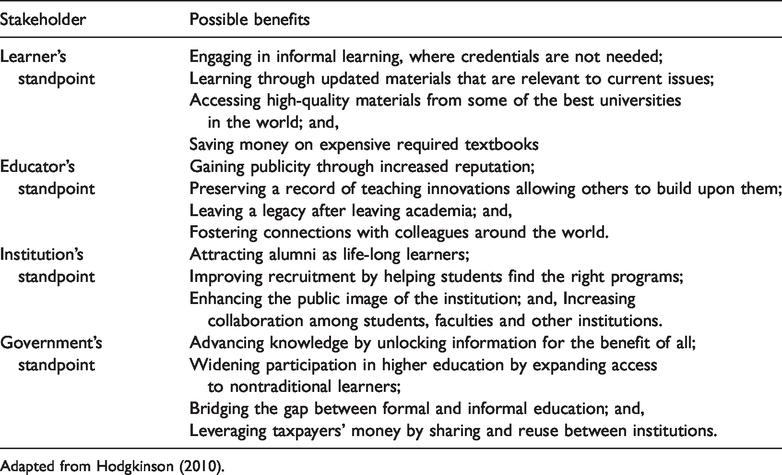
Adapted from Hodgkinson (2010).
Benefits of OERs aligned to address key educational challenges
OER was ideally instituted to help alleviate challenges pertaining to access to educational materials and to improve education and learning quality. Currently, OERs plays a key role in eliminating some of the challenges intrinsic in global education system. The challenges include but not limited to; learning and training costs, cost controls, sharing of high-quality educational materials, and reduction of obstacles to learning prospects, all of which if addressed, could potentially enhance provision of quality teaching and training (Hodgkinson, 2010). Provision of an all-encompassing and/or wholly packed educational system and resources is a huge challenge in most countries’ educational sectors, including the developed countries (Commonwealth of Learning, 2017). In light of this, OERs thus:
New learning approaches that are all-encompassing is a requisite requirement for the provision of vast knowledge base that transcends all spheres of knowledge to promote individual’s success and development in society. Learning methods that communally involve learners in the framing of their learning and learning materials is for individual development. This is because it responds to the learning needs of the students/learners, thereby gaining greater ownership and ascription than those that are predetermined and single-handedly developed without prior consideration of learner-needs and/or areas of interest (Commonwealth of Learning, 2017). Moreover, this approach encourages group support of and for other learners. The ease with which OER can be shared and adapted firms up this goal. (II)
The teaching fraternity’s levels of knowledge and skills is pegged on the extent to which they undergo and/or engage in periodic professional development in their respective disciplines, and is central for effective learning. OERs’ adaptability enables educators to access and revise OERs of interest and modify the same to meet their training contexts. This platform also offers an excellent avenue for improving one’s skills through partnerships and collaborations between and among educators, thereby globalizing education and improving quality of educational outcomes.
(III)
The increased levels of engagement in the global educational environment has made it difficult to effectively and efficiently share costs between governments’ budgets on education and individual private households in offsetting the costs of high-quality educational resources (Orr et al., 2015). Through OERs’ freedom for users to update and share resources, the high educational materials’ costs is reduced remarkably.
(IV)
The field of education is highly dynamic with new knowledge added to original body of knowledge on a daily basis. This means that existing knowledge should and must mirror new knowledge and ideas in the concerned disciplines, reflect novel or innovative theories and models to effectively enhance high-quality education and training. They must also be aligned to intended educational outcomes that meet the needs of varied audiences and/or consumers who access the existing educational materials. OERs’ adaptability offers a pathway for updating educational materials to respond to the changing educational subtleties.
(V)
It is undisputed fact that quality education resources are being developed and used in other institutions of learning, while the opposite holds in another institution, particularly in different geographical contexts. For instance, quality of education resources – human capital and material resources – in developed countries outweighs those in middle and low income countries. In-country, especially for middle and low income countries, educational resources in urban areas (infrastructure and educational resources in particular) are better than those in rural areas. The OERs’ free to share features is an opportunity to break physical boundaries and globalize education resulting in an equitable distribution of educational resources from the developed countries’ institutions to the middle and low income countries’ institutions. As a result, OERs has the possibility of bridging the gap between formal and informal learning thereby fostering lifelong learning.
(VI)
Quality learning for most learners remains more of a desire than a reality. Most learners are limited by educational requirements such as time, costs, place and pace of learning in the espoused learning institutions. OERs offers a solution to such disadvantaged lot of learners. The digital learning resources enable learners to learn even from the farthest corner of the globe by accessing educational materials, geographical location, time, costs, and pace notwithstanding.
Why is OER a special type of innovation in the field of education?
Against the backdrop of the above benefits, it is evident that OER is a unique innovation in the field of education and has the prospect of reforming features of educational delivery. Nevertheless, further advancement on OER is and will be determined by practices and people. Typically, dispersal of innovation progresses gradually over a given time period in five key users’ categories – innovators, initial takers or adopters, initial majority, late majority, and slackers – until when the market get saturated (Orr et al., 2015). Saturation of an innovation is determined by the market. When the market still adopts or seeks for more of a given innovation, saturation point has not been reached and the reverse holds. However, OER is special in that, it does not ascribe to this innovation pathway for two reasons. Firstly, gains of OER are determined by their use, which could be how they were initially used and/or how their use metamorphose based on their users, context and objectives (Wiley, 2006). Secondly, open resources are in existence yet not recognized as OER, which shows that OER-like materials are already in place though not deemed as such. For instance, a significant number of lecturers in higher education in the United Kingdom were found to be reusing contents already in existence, though the use was kept confidential and hidden from others (Pegler, 2014; Zourou, 2014; Pegler, 2011).
In addition, OER is perceived as a front-runner to social innovation. Definitively, social innovations are defined as novel concepts (models, products, and services) that concurrently satisfy social needs. Put differently, they are innovations that are relevant to societal wellbeing as well as enhancement of its capacity to execute and perform (Mtebe and Raisamo, 2014; Murray et al., 2010; The William and Flora Hewlett Foundation, 2013). This implies that the effects of OER are not only measured by their production and usage but also whether they have change effect on how educators and learners engage and collaborate.
The protracted lifecycles of OER further leads to iterative innovation process, which ensures that original educational application and resources are revised and improved as they transit to varied users. This innovation path can be instrumental in that in can be well infused into explicit contexts that ‘follows a bricolage approach (where the user plays with prevailing features of an organization), rather than breakthrough approach’ (Gundry et al., 2011). It is argued that successful iterative innovations mostly work on a challenge to be addressed rather than a solution provided (Andrews, 2013).
Notable OER initiatives
The growing global appreciation and recognition of OER and its potential to making education accessible have led to a number of initiatives aimed at increasing uptake of OER within and beyond academic spheres. Currently, a number of OERs are available online for access, modification, use and re-use to suit users’ courses or pursuits. Both students and lecturers can use the resources to develop, correct or firm-up their individual or group learning methods as well as reinforcing their knowledge skill-sets on areas of interest. Examples of OERs include but not limited to:
This is a product of the Open University – OU (UK) and is a platform that offers short courses and are self-regulated educational avenues adapted from the university’s regular programs. The platform’s courses are availed freely to any willing user and are not controlled by a tutor. This may however, mean that the courses may not be as comprehensive as formal courses/programs, though accessible to willing users at any time. This initiative has accumulated an all-inclusive list of offerings and courses, with additional new courses added regularly. OpenLearn is relevant to learners wishing to advance their skills or those seeking to undertake OU courses prior to enrolment in formal programs. (II)
The OER Impact Map built by the OER Research Hub intends to give an overview of the impact OER has had globally. It offers visual representation for both positive and negative impacts of OER. Emerging themes from all the disciplines posted on the platform is collected from users and mapped to determine impact. It is even possible to narrow down to specific city, region or country and monitor region specific impacts of OER. This platform could come in handy for researchers and policy-makers who want to understand the relevance of OER.
(III)
In full, the initiative is referred to as, the Open Educational Resources universitas (OERu), which is an educational platform providing varied university courses and programs as well as Massive Open Online Courses (MOOCs) type programs. There is a growing list of courses and academic partners offering credits that enable willing learners to pursue their studies further. Learners seeking further studies could find this platform useful.
(IV)
This platform was set up in tertiary institutions in Malawi, Tanzania, Nigeria, Sri Lanka and Canada to market and create awareness on OER and open education as an enabler of capacity building in research in the participating countries, and to enhance regional co-operation. It is coordinated by UNESCO and Commonwealth of Learning (CoL).
(V)Carnegie Mellon Open Learning Initiative, whose aim is to create high quality courses, advance learning and transform higher education (http://oli. cmu.edu).
(VI)Directory of Open Access Journals (DOAJ), which is a community-designed online directory that catalogs and offers access to high quality, open access, peer-reviewed journals. All DOAJ services are free of charge including being indexed in DOAJ. All data is also freely available (https://doaj.org/)
(VII)Community College Consortium for Open Educational Resources, which promotes the awareness and adoption of open educational policies, practices, and resources at community colleges and technical colleges (https://www. cccoer.org).
(VIII)Minnesota Open Textbook Library, which is a growing catalog of free, peer-reviewed, and openly-licensed textbooks (https://open. umn.edu/opentextbooks).
(IX)MIT OpenCourseWare, whose mission is to advance knowledge and educate students in service to the nation and the world (https://ocw.mit. edu/index.htm).
(X)OpenStax, which is a Rice University based non-profit platform that seeks to improve student access to education. It offers a total of 29 books for college and advanced placement courses (https://openstax.org).
(XI)Open Yale Courses, which provides materials and lectures on liberal arts’ disciplines to physical and biological sciences as taught by distinguished teachers and scholars at Yale University, to the public free of charge via the Internet (https://oyc.yale.edu).
(XII)Saylor Academy, which was launched in 2008 to provide free and open online textbooks and courses to all those who want to learn (https://www.saylor.org).
(XIII)Tidewater Community College, which offer zero courses (Z-courses). This means that there are no textbooks’ requirement, yet has the capability of providing learners with massive return on their learning investment (https://www.tcc.edu).
(XIV)The Open University (OU), which was established to offer university students with high-quality education to enable them attain their career and professional goals. Currently, a total of 12,500 students are enrolled on OU courses per year (http://www.open.ac.uk/)
(XV)Iversity, which is a platform that offers a structured course environment and incorporates multimedia instructional materials (https://iversity.org/).
(XVI)ALISON, which is an interactive global online learning community, furnished with high-quality learning materials with a subscription of about 2.5 million currently (http://alison.com/).
(XVII)Open Learning (OL), which was set to provide the latitude and the flexibility to create a learning community. It emphasizes exhibition of one’s creativity and discovery through education (https://www.openlearning.com/).
(XVIII)Coursera, which boasts of being an educational company that offers a platform for partners with high-end educational courses and programs to offer online courses for any willing learner for free (https://www.coursera.org/).
(XIX)Udacity, which was established to provide globally engaging, accessible, affordable, and very effective higher education. The platform is anchored to the belief that education is a basic human right, and seeks to empower students from all backgrounds in advancing their educational and career prospects (https://www.udacity.com/).
(XX)FutureLearn is a platform that was established to enable learners from around the world to access high quality learning and learning resources from wherever they are. The platform offers online courses, programs and degrees developed by leading universities, business schools and organisations (https://www.futurelearn.com/).
(XXI)edX is another platform that was established for institutions and students seeking to improve themselves through state of the art technologies, thorough course work, and innovative pedagogy. The platform’s goals are thus to; widen access to education for all, promote learning and teaching through research, and advance online and campus learning and teaching (https://www.edx.org/).
(XXII)EduKart, which is an Indian online education company that was established to offer high quality Online Distance Learning courses for degrees, international programs and certificates for students and working professionals for easy learning (http://www.edukart.com/).
The listed sources are some of the existing online sources. It is also evident that higher education institutions and OERs platforms are not only concerned with the development of OERs, but also its distribution with the goal of advancing educational outcomes, including research productivity through publications. This means that learning resources whose access were previously restricted are now in public domain free of charge. Researchers, both students and seasoned scholars, can now harness OERs in their learning and research work. Courses and teaching materials used in one university can now be used, reused and distributed by scholars and students in another part of the world, a situation reminiscent of ‘globalization of education’ (Misra, 2012). This has fostered attainment of high-quality education as materials otherwise used in world class universities are now available to universities in developing countries where university education is still in its advancing stages.
In the OER platform, online communities comprising of professionals from both developed and developing nations’ higher education are able to share their expertise, knowledge and even lessons learned from each other’s works and experiences. Research works shared online is open to scrutiny and constructive criticism by other experienced scholars, with the goal of enhancing scholars’ work. It is thus a platform for production of well-informed publication(s). The removal of costs to resources and materials that were previously inaccessible due to prohibitive cost implications has enabled university students, teachers, other academics to advance and produce more publications due to increased information in their research areas (Berti, 2018). It is documented that cost implications of textbooks among other learning materials from which learners can make reference are hindering learners’ efforts in producing research work. This has limited university lecturers to only assign students assignments from readily available and affordable materials due to high cost implications in accessing desired materials for students’ learning (Hage and Kenny, 2009). This means that respective faculty members do take into consideration the cost of learning materials for learners, the materials or books’ informational value notwithstanding. While this is a moral gesture and obligation, it has the propensity of limiting access to key information and data that may be available in costly materials.
With the advent of OERs, higher education stakeholders have been able to scale-up production of generic resources, a situation attributed to mass availability of needed educational or research materials online (Mossley, 2013). Costs of textbooks have been reduced and in some cases eliminated with the uptake of OERs, hence making higher education more affordable than before. Despite being essential learning materials, only a small percentage of students in higher education utilizes textbook resources assigned by lecturers or buy the essential materials (Berry et al., 2010). A survey with over 20,000 post-secondary students in Florida found that more than one-half of the students reported high cost of required textbooks as the reason for not purchasing them [textbooks] (Hilton, 2016). The fact that textbook costs are prohibitive in developed countries can only mean the situation is even worse in middle and low-income countries where lecturers’ resources are scarce, teacher-training programs are inadequate, or where access to formal classrooms is problematic (Berti, 2018). OERs’ underlying principle of learn-from-anywhere is thus a working solution, especially to students with familial or work responsibilities, to increase research productivity in higher education institutions.
Moreover, OERs has connected scholars from different developing countries (intracontinental and intercontinental), dubbed south-south scholars’ relations, scholars from developing countries with those from developed countries (south-north scholars’ relations), and scholars from pre-dominantly developed countries from same or different continents (north-north scholars) (Al-Rawashdeh, 2011; Karin, 2012; Ripley, 2014). This is because OERs has helped link scholars working on similar fields or projects in different geographical space globally, thereby offering a platform for collaboration in research and related publications. This has further contributed to increased research productivity by higher education faculty members. Evidence offered in this paper indicates that OERs has both direct and indirect positive contribution in total publications produced by higher education institutions.
Potential impact of OERs
Availability of online digital learning resources should never be construed to translate to existence of a given pedagogical concept. This speaks to OER which can either be big or small in scale, yet, used in varied learning environments (Weller, 2010). Evidence (Gordon, 2014; Toumi, 2013) infer that it is conceivable to undertake varied pedagogical models using OER particularly because of its features of reuse, open access, and repurposing that encourage distinct and shared learning approaches. In light of this, OER depicts the potential of its usability to modify, substitute, and augment the learning environment. Also, OER emphasizes the objective of altering the accessibility of learning materials to enable learners take active roles in shaping their own learning. It also has the potential to enable learners have low-cost access to learning resources (a course, video-based resource, or a book). However, it has been observed that in most cases, initiatives in OER publishing in adult education, particularly in tertiary education, is more often content-and-teacher-oriented (Coughlan et al., 2013; Falconer et al., 2013), which may inhibit their adoption for varied users in different levels of education. This is consistent with a Norwegian evaluation study that sought to understand extent of use of digital resources and found that it applies or work differently for different category of learners (Creelman and Reneland-Forsman, 2013).
Threats and demerits of OERs
Like any other educational resources, OERs contend with a number of threats that double up as its demerits. The threats and demerits include but not limited to:
Sustainability issues pertaining to OERs: because OERs creators do not receive payment for materials shared online, they may have little or no incentive to continue with this work, hence putting the sustainability of production of OERs’ contents in jeopardy; Quality concerns since OERs allow users to create account(s) and post materials, even without due verification of the accuracy and relevance of the material(s); Missing human interaction between students and teachers, which limits on teacher and students’ real-time engagements. This imply that there is no lecturer-student feedback mechanism that can synonymize credit classes. Teacher-student interactions make classes valuable and useful, particularly where and when there is need for clarification by students in areas of concern; and Intellectual copyright/property concerns: because OERs are supposed to be distributed openly, the ‘fair-use’ of the U.S Copyright Act exception ceases to apply. For this reason, all materials shared online must be checked to ensure that they do not violate copyright laws.
Increasing research productivity in higher institution with OER components
Research productivity in higher institutions can be promoted by advocating for well-grounded research practice for both students and faculty members. The following strategies, with OERs leaning calls suffice though not limited to:
Increased investment in critical infrastructure for ICT facilities, research centers, online information and database subscription through national library networks; Institutional support or encouragement of faculty members to make use of OERs to publish their papers in international open access journals to increase access and citations of their work; Development of platforms that increase institutional national and international-level collaborations in multi-disciplinary areas. This may ensure that faculty members have access to opportunities for exchanging their work and ideas for intra and inter institutional collaborative publications; and Provision of open access data and data analysis facilities as well as computation faculties to students and faculties.
Inherent challenges in actualizing OERs
Some of the salient challenges intrinsic to OERs uptake include but not limited to:
Infrastructural challenges: while uptake of OERs has been steady due to its advantages and opportunities to stakeholders, resource constraints pose a key challenge. Blessinger and Bliss (2016) indicate that most higher education institutions’ capacities are limited. This means that OERs is only available to a section of the society, with the vast majority of intended beneficiaries, left without access;
Technical skills’ gap challenges: Since OERs increase social equity in its provision of open access resources nearly anywhere and anytime, other technological tools and broadband needed to access OERs may not be available to all stakeholders. Moreover, stakeholders like students and lecturers may lack requisite skills needed to navigate existing technological platforms that host open access digital learning materials (Wiley et al., 2014). For this reason, it is imperative that institutions have standby experts or mechanisms in place to help students and faculty members navigate and transition towards OERs usage;
Economic challenges: it might be difficult and time-consuming trying to access high-quality OERs on the internet for educators among other experts, who despite their effort, may not get paid (Kanjilal, 2013). Similarly, lack of or limited resources to invest in software, hardware, broadband as well as challenges inherent in meeting the cost of creating OERs may discourage faculty members and institutions to embrace open education. To mitigate this challenge, fund raising to implement open education research and development of mechanisms for providing an income stream for OERs may be a worthy undertaking. Such fund raising options should target philanthropies and other international organizations that sponsor educational programs to generate income to support development and improvement of OER infrastructure. This is to ensure that such costs and income(s) are not drawn from or borne by users of OERs, hence aligning with the principles of SJ.
Social challenges: some faculty members may be reluctant to share intellectual property as well as using resources developed by others (Hodgkinson, 2010). Robust awareness among lecturers and higher education administrators on the benefits of OERs may help faculty members and scholars to comprehend the advantages of OERs to education stakeholders and support the open sharing policy. Other challenges in this category include lack of incentives to produce or revise OERs, preference given to research work over development of OERs, lack of clear path on quality assurance in open content, and lack of time to produce additional shareable resources; and lastly
Legal challenges: academics and or scholars may be unaware of the copyright issues and restrictive licenses that prohibit material modifications or alterations (Berti, 2018). It is therefore, imperative to capacity build key OERs stakeholders with professional development platforms to enable them gain deeper insight on how Creative Common Licenses and OERs work. In order to protect producers of OERs and to ensure responsible and efficient use of OERs, all authors, artists and any other OERs producers should be accorded creative commons attribution license to credit authors’ and artists’ literature and digital products. This will enable them to freely use and distribute such work and allow other people to develop relevant materials using their originally availed resource (Commonwealth of Learning, 2010; Creative Commons, 2018).
Inherent gap(s) in OERs
A striking gap insofar as OERs are concerned is the fact that OERs are predominantly in English and chiefly benefit English speaking education stakeholders. Users from other languages such as Portuguese, Dutch, and Africana among others are highly disadvantaged. This is despite the fact that many non-English speakers may desire to utilize and benefit from such free online materials (Zancanaro and Amiel, 2017).
Conclusions
The proponents of OERs and Open Educational Practices (OEPs) largely guided by SJ ideals are keen on changing the narrative around educational provision, its perception and understanding in contemporary world. Much work on educational transformation in the context of cost reduction has been undertaken including likelihood of changing universal educational landscape (Olcott, 2012). While evidence points to a positive impact of OERs and Open Education Practices (OEPs) on research productivity in higher education, there are salient challenges that ought to be addressed if OERs and OEPs are to have maximum impact in the educational sphere. The infrastructural, technical skills gap, economic, social and legal challenges that impede full actualization of OERs by stakeholders like learners, lecturers, academic institutions, research organizations and government bodies among others, must be addressed if universal operationalization of OERs is to be realized.
The fact that many open and free-to-use resources and websites are available on the internet means that optimization of OERs requires attitudinal change among users on web-based learning and usage. This position is echoed by previous studies calling for attitudinal and mindset change towards OERs, with calls for adoption of a flexible growth over fixed traditions (Blessinger and Bliss, 2016). However, the OERs has some gaps. Prominent among them is that OERs is overly biased towards English-based information. English speakers and learners are the main beneficiaries of OERs. Indeed, speakers of minority languages like Arabic, Africana, Portuguese and Dutch among others are largely left out despite OERs tenets of SJ. Because technology and e-learning is transforming education as seen by global appreciation technology, education stakeholders ought to figure out how OERs can incorporate other non-English languages in the development of their contents for the benefit of learners in higher education globally. While legislative support for OERs may potentially be useful as a means to protect OERs and its quality, this was not fully articulated in the present analysis. Future studies will benefit from evaluating the legislation modalities of OERs.
Implications of the study
Interrogating the challenges and opportunities of the OERs has prompted important implications for increased uptake and use of OERs among educational stakeholders and the general public:
Undertaking OERs awareness among students, academics, scholars, and policy-makers among other stakeholders on the existing OERs in terms of long-standing viability and quality; Institutions should put in place effective publication divisions to plan and support publication of books and journal papers on futuristic emerging areas. This will increase researchers’ consumption of online materials and by extension OERs; Establishment of appropriate infrastructure for ICT facilities, research centers, database subscription and online information through national library networks; and Infrastructural development through creation of institutional research funds to support research and publications and related activities.
Footnotes
Declaration of Conflicting Interests
The author(s) declared no potential conflicts of interest with respect to the research, authorship, and/or publication of this article.
Funding
The author(s) received no financial support for the research, authorship, and/or publication of this article.
