




Abstract
Digital technologies make possible new avenues for sharing and accessing literacy research and practices worldwide. Among the myriad of options available, web seminars have become popular online learning venues. The current investigation is part of Global Conversations in Literacy Research (GCLR), a longitudinal and qualitative study now in its fifth year. As a critical literacy project, GCLR investigates how a web seminar project uses developing technologies to disseminate innovative literacy research and present professional development that critically shapes literacy practices. With this in mind, the current study seeks to understand the following: (a) What kinds of knowledge sharing interactions (KSIs) occurred in GCLR web seminars focused on critical literacy? and (b) What types of community and social practices occur in web seminars? Data included synchronous chat transcripts from across seven web seminars, interviews with participants and speakers, and website analytics. Data analysis followed the constant comparative method and R, an open-access software that analyzes both qualitative and quantitative data. The study resulted in two findings: Three types of KSIs emerged: whole group, between individual, and smaller, nested affinity groups; and GCLR emerged as a distinct online community with unique social practices. KSIs generated and supported collaborative opportunities to exchange ideas, co-construct knowledge, offer practical classroom applications, and gain insight about important critical literacy issues. As an online networked space that brings together participants interested in critical literacy issues, GCLR represents an innovative type of situated practice with an aim to develop what we call online Networked Spaces of Praxis (oNSP).
Keywords
Today’s digital technologies (e.g., Blackboard Collaborate [BC], Facebook, Twitter, listservs) make possible new avenues for sharing and accessing literacy research and practices worldwide. Using these technologies, people from across the globe can surpass time and space to synchronously participate in teaching and learning opportunities previously limited to those found only in face-to-face (F2F) settings. Among the myriad of online learning options, webinars have become popular avenues for ongoing teacher professional development. Limited research exists, however, pertaining to knowledge sharing practices as they relate to web seminar spaces around literacy issues and concepts. We prefer the term web seminars (hereby known as seminars) rather than the more commonly known webinars. Seminars denote ongoing and interactive discussions to share and participate in knowledge building between and among speakers and participants, whereas we suggest webinars represent a delivery model during which knowledge is delivered from speaker to participants.
The majority of studies concerning online teaching and learning are situated within a classroom context (e.g., K-12 education, post-graduate studies, or graduate studies; Clark, 2006; Hew, 2009; Karchmer, Mallette, Kara-Soteriou, & Leu, 2005; Lukinbeal & Allen, 2007). The purpose, therefore, of the current qualitative study was to understand knowledge sharing and learning among participants in a web seminar whose goal is to provide open-access innovative critical literacy research and present teacher professional development that critically shapes literacy practices. Such a study has the potential to inform current understandings of wider participation and engagement with literacy research and practice on a global level through the use of digital technologies.
Background
This investigation is part of a longitudinal study begun in 2010 titled Global Conversations in Literacy Research (GCLR). Founded in 2010 by the first author, GCLR is a series of open access online web seminars featuring, annually, up to seven internationally distinguished literacy scholars. Offered through BC, those with Internet access across the world may participate by clicking the link located on the GCLR web page. As a critical literacy project, GCLR aims to provide an avenue for global audiences to communicate about possible solutions, innovative ideas, and better understandings concerning critical language and literacy research, theory, and practice. Such access provides a space for a diverse, international audience to consider, learn, and exchange ideas about significant literacy issues and practice, with the potential to change critical consciousness.
To date, website analytics captured by ClustrMap™ indicate that the GCLR website has recorded more than 38,000 visitors, 1 and nearly 78,000 views from 161 countries worldwide. Analytics generated from the launch of the GCLR YouTube channel in February 2012 have recorded approximately 30,000 views. These data suggest a strong global following, and desire for access to online spaces of critical literacy learning.
Context of the Current Study
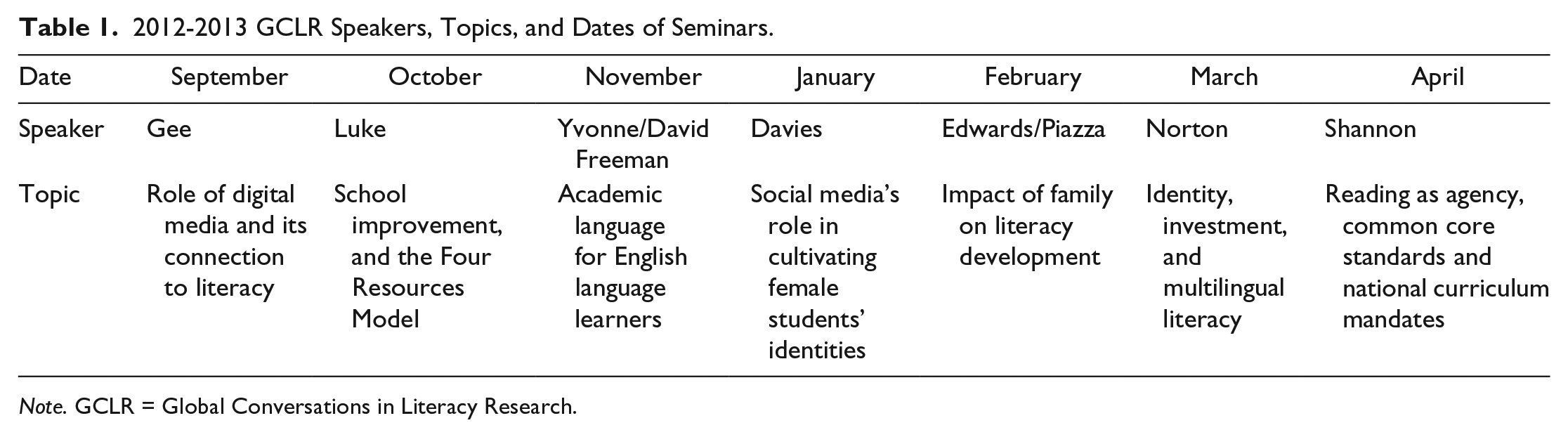
The current study occurred between September 2012 and April 2013 and involved data collected from seven web seminars hosted by a major urban research university located in the Southeastern United States. Up to five moderators assisted during each seminar, whose tasks involved greeting participants, technological assistance, chat monitoring and participation encouragement, aggregating analytics (e.g., countries, cities represented, participant numbers), speaker/project introduction, and question/answer with speakers. Table 1 represents seminar speakers, topics, and participant attendance.
2012-2013 GCLR Speakers, Topics, and Dates of Seminars.
Note. GCLR = Global Conversations in Literacy Research.
Although researchers are beginning to elucidate that new literacies encompass a progressive skillset, approach, and form of social interaction specific to the Internet and digital communication technologies (Coiro, Knobel, Lankshear, & Leu, 2008; Greenhow, 2011), the continual and rapid emergence of electronic-mediated communication calls for an innovative approach to study participant interactions in online spaces (Wenger, 2006, 2010). However, questions remain regarding the kind of knowledge shared and how participants used the space to share this knowledge. The current study sought to answer the following questions: (a) What kinds of knowledge sharing interactions (KSIs) occurred in GCLR web seminars focused on critical literacy? and (b) What types of community and social practices occur in web seminars? We define KSIs as verbal or written exchanges made across electronic communication using BC tools (e.g., group/private chat, microphone, hand clap, wand, paralinguistic discourse, etc.). Informed by Seo’s (2007) understanding of “meaningful interaction” in online discussions, for the purpose of this study, we define interaction as communication, written chat or spoken, that expresses an idea or asks a question related to a specific topic, and/or generates discussion between/among participants.
Theoretical Framework
This study is grounded in situated cognition (Brown, Collins, & Duguid, 1989; Gee, 2010; Lave, 1991) and critical literacy (Janks, 2010). Situated cognition posits that learning occurs through ongoing activity and interactions with others and is situated within social practice. Furthermore, as a socio-cognitive construct, knowledge and learning are understood as not residing entirely with the individual but rather is distributed among learners, spaces, symbols, and so on (Gunawardena et al., 2009). Gee (2010) further explains that the use of tools and technology (e.g., chat, video, audio, PowerPoint, etc.) to distribute knowledge affords social practices to occur that would be impossible without their use. Lammers, Curwood, and Magnifico (2012) suggest that theorists who espouse theories of social learning and Discourse might posit that “the ways in which technology seeps into literacy practices would depend heavily on the specific communities and the ways in which the new tools are or are not taken up” (p. 48). Therefore, as contexts and situations change, each presents an opportunity to develop new experiences, thereby adding to our knowledge base (Gee, 2010; Lave, 1991; Wenger, 2000).
As a critical literacy project, GCLR acknowledges the multiple and varied ways in which knowledge may be distributed, especially using online technologies, to cut across geographic and discourse boundaries. To this end, this study is also theoretically situated in critical literacy. Within the literature, critical literacy has been defined as both a theory and practice that understands literacy as a social practice with an aim to uncover inequitable economic, cultural, political, and institutional structures (Comber & Nixon, 1999; Freire & Macedo, 1987; Janks, 2000; Lankshear & McLaren, 1993; Street, 1995). Janks (2010) describes the relation between power and language through her four orientations of critical literacy in terms of “maintaining and reproducing relations of domination” (p. 21) inherent in discourses such as language, symbols, and the meaning assigned to them. Access concerns the dominance inherent in language/literacy, discourse, and symbols, how they are not valued or acknowledged, and who gets to decide. Diversity acknowledges various interpretations and “different ways of reading and writing the world in a range of modalities” and provides a means for “changing consciousness” (Janks, 2000, p. 177). Finally, in terms of design, Janks (2000) argues that people draw and select from the many resources to construct, interpret, and generate meanings. Janks (2014) argues that to “do critical literacy” is to read, see, and act differently in the world, and knowledge of how texts “recruit us into their version of the ‘truth’” (p. 1) helps to recognize how their designs encourage particular readings.
Freire (1970) understands the work of critical pedagogy as praxis, or “reflection and action upon the world in order to transform it” (p. 36). He argued that critical pedagogy recognizes that human beings exist in a cultural context that “mark them and which they also mark” (p. 90). Because they are “in a situation,” they critically reflect on this situation to the point where they are encouraged to act upon it and/or act differently. They “will become more the more they not only critically reflect upon their existence but critically act upon it” (p. 90). Edelsky (2006) positions teaching within a critical perspective as transformative work that aims to change, or transform teaching practices and the stance by which knowledge is understood and produced. Other scholars (Albers, Vasquez, & Harste, 2008; Janks, 2014; Lewison, Leland, & Harste, 2008; Shannon, 2013; Vasquez, 2004) have argued that critical literacy must include an understanding of multimodality and meaning making, digital technologies, and that teachers prepare students to engage critically and globally in social action to promote social justice.
In her review of critical literacy, Bishop (2014) notes that critical literacy has been historically theorized in classroom spaces with a purpose to disrupt relationships of power and domination in texts. However, Lankshear and McLaren (1993), more than 20 years ago, argued that literacy researchers must move critical literacy beyond “more than simply celebrat[ing] the infinite play of textual inscription or discover[ing] ‘double readings in literacy texts’” (p. 409). As a project grounded in critical literacy, GCLR understands the significance of designing an online space that supports social and collective engagement, transformation of ideas and practice, and the importance that tools and technologies play in this endeavor.
Review of the Literature
Much of the literature concerning learning in virtual spaces centers on two forms of situated social practice, communities of practice (CoPs) (Lave & Wenger, 1991; Wenger, 2000, 2006, 2010) and affinity spaces (Gee, 2004, 2009). Lave and Wenger first developed the term communities of practice in the early 1990s to describe “a group of people who share an interest in a domain of human endeavor and engage in a process of collective learning that creates bonds between them” (Wenger, 2006, p. 1). Over a decade later, Gee (2004, 2009) introduced the concept of affinity spaces to delineate a type of situated learning involving collaboration but without the necessary “community” attachment of those who participate within the space.
Since Lave and Wenger first introduced CoPs, other types of learning communities have evolved: (a) professional learning communities (PLCs) (Lee & Shaari, 2012; (b) communities of inquiry (CoIs) (Garrison, Anderson, & Archer, 2000; Wanstreet & Stein, 2011); (c) networks of practice (NoPs) (Brown & Duguid, 1991); and (d) knowledge-building community (KBC) (Sing & Khine, 2006). Although the aforementioned learning communities share common features, they also are characteristically and distinctly different. In agreement with Amin and Roberts (2008), we argue for the importance of introducing different types of situated practice when they become evident. In the next two sections, we delineate the foundational concepts between CoPs and affinity spaces as a way to distinguish and to introduce other significant characteristics of social practices, especially in online professional development spaces.
Description of CoPs
CoPs provide a venue for like-minded members to construct knowledge through ongoing social interactions within the particular community (Brooks, 2010; Wenger, 1996, 2000, 2006, 2010; Wenger, McDermott, & Snyder, 2002). Becoming a community member means being able to show competence in the community’s shared interest through participation. The community is the repository of the competences that are created through members’ shared understanding of their community, interaction with other members that establishes and enforces group norms, and common practices (Wenger, 2000). The feature that most clearly distinguishes CoPs from other learning communities is that “they are social structures providing an opportunity to build skills and relationships” (Brooks, 2010, p. 264) in which “practitioners can connect across organizational and geographic boundaries and focus on professional development rather than merely the application of expertise to meet a specific goal” (Wenger et al., 2002, p. 20).
Although researchers have differing opinions of what constitutes a CoP (Hur & Brush, 2009), three components generally comprise a CoP: (a) the domain, (b) a community, and (c) a common practice (Wenger, 2006; Wenger et al., 2002). First, the domain provides the community’s foundation by making known to members the mission and goals, or shared topic. The domain’s boundaries help members know which ideas are worth sharing and how to make their ideas known. Next, the community constructs the social aspect of the learning that occurs. An effective community is one whose members, through strongly formed relationships, feel comfortable enough to interact, sometimes exposing their lack of knowledge, without fear of redress from other members. The community is vital to knowledge sharing and relationship building. Finally, while the domain structures the community around an overarching topic, the practice consists of the knowledge that the community constructs/generates concerning this topic. The practice inquires about existing knowledge, as well as progressive innovations. Practice “denotes a set of socially defined ways of doing things in a specific domain: a set of common approaches and shared standards that create a basis for action, communication, problem solving, performance, and accountability” (Wenger et al., 2002, p. 38). Furthermore, community members grow in competence through a process of legitimate peripheral participation in which less experienced members learn from veteran members using an apprenticeship approach. Newer members remain on the community’s periphery, working their way toward the center to become seasoned members. Members also assume leadership roles as they progress toward becoming more competent members of the community (Lave, 1991; Wenger, 1996).
Wenger (2000) postulates that the main influence on knowledge sharing is the recognized competence within the community and members’ continuing life experiences that affects knowledge sharing in the way that each member shares his or her stories, experiences, and expertise with the community. Participants develop social identities in the community that may develop into community leadership roles. In CoPs, membership is place-based in that physical proximity heavily influences membership which then grows out of a shared interest in a particular topic (Li et al., 2009; Squire & Johnson, 2000).
Description of Affinity Spaces
A second type of situated learning is Gee’s (2004, 2009) concept of affinity spaces as a place or set of places where “people affiliate with others based primarily on shared activities, interests, and goals, not shared race, class, culture, ethnicity, or gender” (p. 67). Unlike other communal learning spaces (e.g., CoPs, PLCs, CoIs, NoPs, and KBCs), the common interest, or “content,” is the focus rather than a communal aspect (Gee, 2009, p. 10). Participants engage from multiple self-selected levels of expertise—established to new, highly experienced to novices, or full participators to “lurkers.” These varying levels do not hold principality in relation to who gets to participate in the space.
According to Lammers et al. (2012), in their early conception, entry into an affinity space occurred through a single, main portal, such as an online discussion board. In today’s affinity spaces, participants may access the space through a variety of portals, namely, social media sites, such as Twitter, blogs, Facebook, and others, through which they gain access to and interact with the content, thereby generating new knowledge. Cutting across numerous communication modes helps sustain participation in the space.
Gee (2009) describes the following kinds of knowledge that contribute to the content of an affinity space: individual/distributed, intensive/extensive, dispersed, and tacit. First, each participant enters the space possessing their current acquired, or individual knowledge; however, information may also enter the space from outside, networked sources (e.g., the Internet) and be distributed among participants. According to Gee (2009), distributed knowledge exists in other people, material on the site (or links to other sites), or in mediating devices (various tools, artifacts, and technologies) and “to which people can connect or ‘network’ their own individual knowledge” (p. 22). Some knowledge may be “intensive,” or more distinctly specialized, while other knowledge is “extensive,” or general (Gee, 2009, p. 22). Disbursed knowledge comes from sources outside the space, such as through links, multimodal texts, handbooks, and so on, and can be dispersed within the space. Finally, tacit knowledge results from experience, is often gained through participation within the affinity space, and is difficult to articulate to other users of the space. Moreover, while there are many ways to participate within the space, level of participation and experience can lead to status; however, as Gee (2009) points out, some participants may not want to achieve a particular status. Finally, affinity space leaders are more like designers, facilitators, resource managers, and do not hold positions of power. The principal difference between CoPs and affinity spaces is that CoPs are conceptualized around the central feature of community, and membership is assumed.
Gee (2009) identifies shortcomings of CoPs that he believes are better accounted for by his notion of affinity spaces. For instance, “community” implies official membership and/or feelings of belongingness that some of these spaces may not provide for all participants, and raises complex questions about how one establishes legitimate membership. Affinity spaces, on the contrary, are conceptualized around the key attributes of physical or virtual space and common interests, “In affinity spaces people ‘bond’ first and foremost to an endeavor or interest and, secondarily, if at all, to each other” (Gee, 2009, p. 19). That is, interest drives participation rather than relationship building.
For the current study, we drew both upon CoPs and affinity spaces to analyze data to explore interactions and practices within GCLR web seminar series. More specifically, we studied the interactions through a critical lens, one that offers insights into how conversation emerges in light of interrogation, transformation, and multiple perspectives in understanding different kinds of situated practice in online communities.
Method
This qualitative study, part of a longitudinal project, is situated within an interpretivist design (Schwandt, 2000) which acknowledges understanding as constructed through a recursive process of reflection and negotiation, and is dependent upon knowledge of the context—culture, history, norms, and so on—from which meaning is derived. Seven seminars between September 2012 and April 2013 were studied; seminars were 60 min in length. Approximately 1,460 participants, in total, attended seminars, and data were collected from those who participated in the chat including speakers, pre- or in-service teachers, teacher educators, doctoral students, and those interested in literacy.
Data collection primarily consisted of transcribed synchronous time-stamped chat discussions automatically generated by BC. Data also included speaker interviews and website analytics. Researchers followed these data collection procedures for each seminar: (a) research project was presented both at the beginning and end of each web seminar, (b) seminar chats were copied, (c) post-seminar research team discussions identified cross-seminar insights and themes, and (d) website analytics updates were recorded (e.g., number of views, geographic locations).
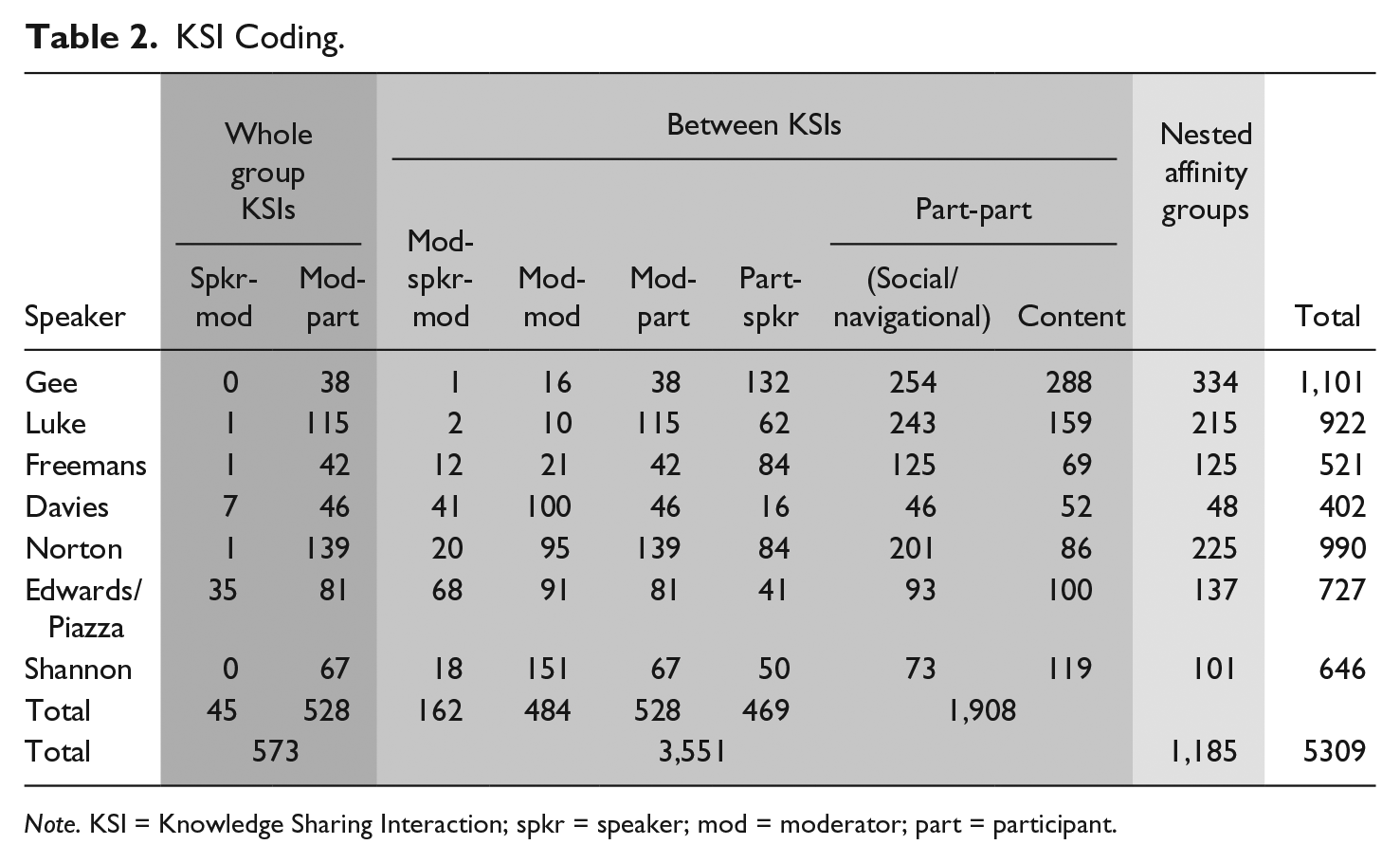
Data analysis followed the constant comparative method (Glaser & Strauss, 1967), an iterative process of coding data sets, generating themes, and clarifying understandings. We began by reading and re-reading the seven chat transcripts, one from each seminar, to gain a general understanding of the data contained therein. Next, we counted the total number of chat comments across the seven seminars (N = 5,309), and then began initial coding, independently assigning open codes to the chat transcripts using the open access online data analysis software R (R Core Team, 2013) that allows for analysis of both qualitative and quantitative data. Researchers together then exchanged and examined openly coded transcripts, noting similarities/differences, areas that needed clarification, and potential discrepancies. Researchers met bimonthly to discuss independent codings, to negotiate meanings, to collapse similar codes, and to eliminate less useful codes until we reached consensus on categories that we saw had emerged (Glaser & Strauss, 1967). From this initial coding, we generated a table of types and purposes of KSIs within and across the seminars; some KSIs appeared in more than one area as they represented two or more categories (e.g., participant-participant; participant-speaker). We also coded the purpose of the KSI (e.g., social/navigational or content; see Table 2).
KSI Coding.
Note. KSI = Knowledge Sharing Interaction; spkr = speaker; mod = moderator; part = participant.
We refined our assertions regarding KSIs to ensure that the data supported our interpretations (Bogdan & Biklen, 2007). To strengthen the study’s trustworthiness, we used independent coding, data saturation, and team member checks. Based on our analysis, we revised the conceptual framework based on categories that best fit the research literature and the overall conceptual scheme for the study (Creswell, 2007). As researchers closely connected to this study, we recognized the need for transparency. Although we have tried to remain cognizant of our roles as researchers, we nevertheless acknowledge the unintended and unconscious potential impact that our close association with this project may have had on our interpretations of the data and our findings.
Findings
Based on our analysis, two key findings emerged. First, web seminars generated three types of KSIs through which procedural, explicit, and tacit knowledge were shared and distributed throughout the GCLR space. Second, GCLR emerged as a distinct learning community with unique online community and social practices characteristics.
Seminars Generated Three Types of KSIs
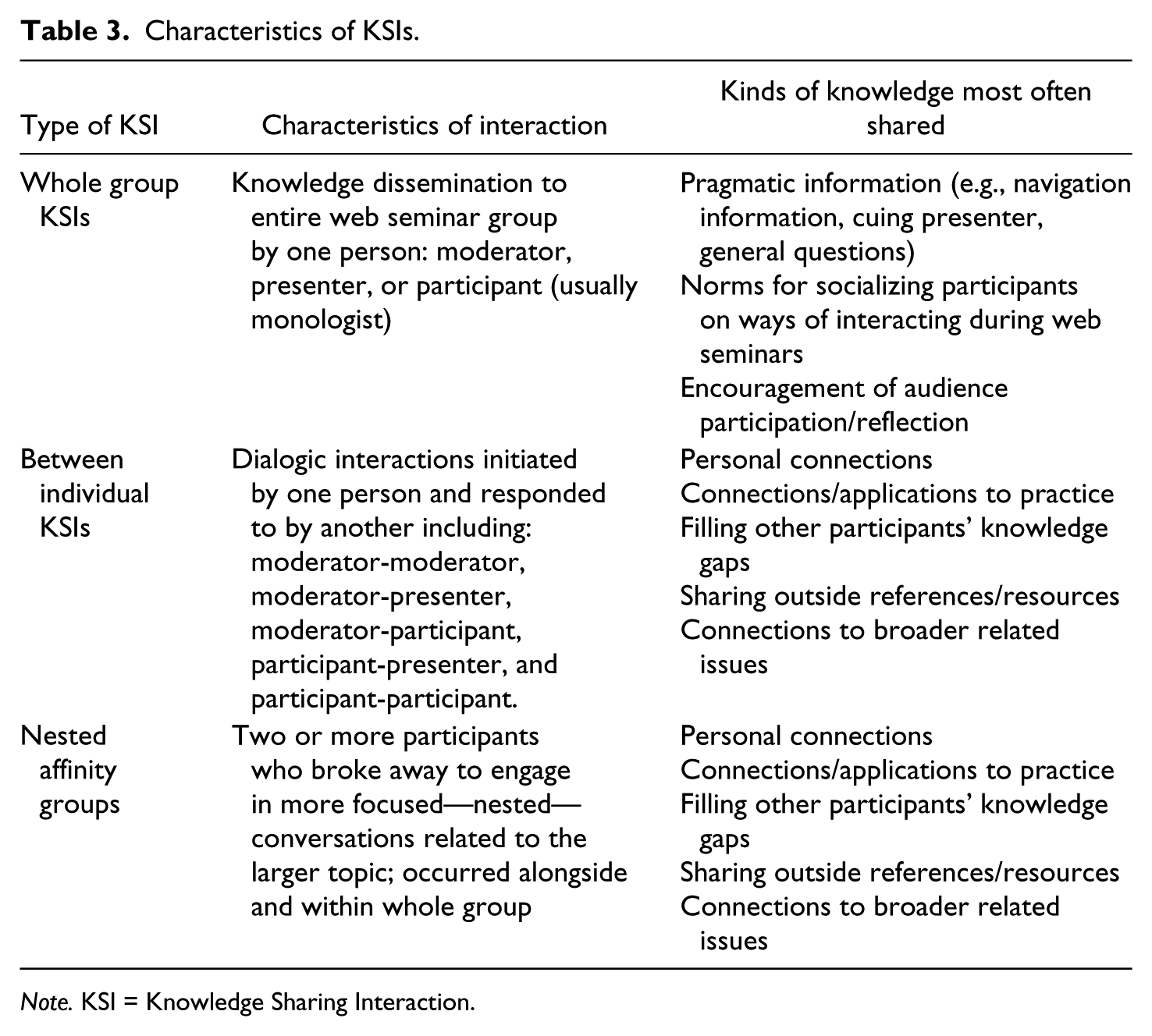
Findings indicate that knowledge sharing within GCLR occurred through three broad types of dialogic interactions: (a) whole group, (b) between individual, (c) and smaller, nested affinity groups (Table 3). KSIs occurred as moderators, participants, and speakers engaged in conversations with each other using chat, audio, video, and BC tools (e.g., wand, emoticons, polling). KSIs generated opportunities to exchange ideas, co-construct knowledge, offer practical classroom applications, and engage in critical discussions around broader literacy issues.
Characteristics of KSIs.
Note. KSI = Knowledge Sharing Interaction.
Whole group KSIs
Whole group KSIs took the shape of either the moderator or speaker explicitly distributing pragmatic information and/or knowledge to the entire seminar group to include other moderators, speakers, and participants. Across the seven seminars, of the 5,309 chat posts, approximately 11% (573) were moderator- or speaker-generated KSIs.
Whole group moderator-generated KSIs served three primary purposes. First, this type of KSI explicitly provided information that socialized participants into the web seminar venue. Through these one-directional KSIs, participants learned about the tools for interaction (e.g., virtual applauses, emoticons, chat, and wand), mission and goals of GCLR, length of seminars, and explicit requests for speaker questions and reflection on the seminar. Second, this type of KSI encouraged participants to feel a sense of “social presence” (Reio & Crim, 2006; Tu & McIsaac, 2002), and to engage in content-related social interaction with others. Moderators directly interacted with participants as they entered the virtual room (e.g., Nice to see you here!), and prompted social interaction through questions like “How many of you are familiar with [speaker’s] research?”), a poll feature (number of seminars attended), and viewing participants’ locations via a global map. Across seminars, moderators also invited participants to interact with the speaker through their content-related questions (e.g., “Please write your questions in the chat area; [speaker] will address them at the end of his or her talk.”), an invitation that participants took up: “It is interesting to hear the interpretation of the narrative from [Speaker] and because of the public nature of Facebook, I wonder about how audience is conceptualized?”
Moderators also invited participants to reflect on their learning or the seminar format at the end of the seminar in the chat area. Although approximately half of the participants in each seminar simply responded with “Thank you!” or “Informative,” the other half more clearly expressed their learning: “[T]his seminar covered a new perspective regarding literacy and technology so it was very helpful and brings forth very interesting points [how] education is affected by technology”; “Thank you for the information about the [Cummins Quadrants]. This information helps me to gauge where I should be targeting my teaching with proper teacher guidance and embedded context!”; “I enjoyed this forum. I have found it to be very insightful and engaging.” We found these questions and reflections to be significant in understanding to what extent, or if, the web seminar format worked, and what learning occurred and shared. Although we cannot claim transformations in practice, we noted that comments such as “it was very helpful,” “insightful,” “covered new perspectives,” and “helps me to gauge where I should be targeting my teaching” gestured toward critical reflection on participants’ practice, an initial but important move toward transformation (Janks, 2000).
Speaker-generated whole group KSIs were knowledge-disseminating interactions. In general, they were one directional, speaker(s) to the larger group, using PowerPoint and/or audio/video streaming. During the seminar, speakers presented content to participants, which prompted participants to raise questions and engage in real-time discussions about the topic. After their talk, speakers interacted with participants through their questions. For example, Dr. [Speaker], do you have innovative suggestions for how to provide a culturally responsive pedagogical model while implementing the mandated CC? My biggest concern is making sure I am still taking care of the individualization of each child I teach.
Speaker-generated KSIs, like moderator-generated KSIs, allowed participants to feel socially present, and enabled another layer of social interaction that encouraged knowledge sharing among the speaker, the participant who raised a question, and the whole group who were able to listen and respond to the speaker’s response.
Between individual KSIs
The largest percentage of interactions, approximately 67%, was between individual KSIs, initiated by one person and responded to by another (n = 3,551). We identified five types: (a) moderator-moderator, (b) moderator-speaker, (c) moderator-participant, (d) participant-speaker, and (e) participant-participant. We distinguish between individual KSIs from whole group KSIs by the D/discourse inherent in each. That is, between individual KSIs fostered D/discourse (Gee, 2004) exchanges about seminar format and critical literacy theory and pedagogy content, initiated by one person and received and responded to by another. Whereas, the discourse used in whole group KSIs was usually bound from one person to another (e.g., the moderator or speaker) to the entire group. We also found that the roles within each type of between individual KSI were reciprocal; that is, for example, in a participant-speaker KSI, either party could be an initiator or receiver of the exchange.
Of the five between individual KSIs, we observed that the moderator played an integral role in discourse exchanges with another moderator, the speaker, and/or the participants. Moderators interacted with individuals through BC talk tools or private chat about seminar tools and protocols for interacting, cued the speaker (e.g., to start the seminar), and/or responded to individual questions related to general seminar logistics. Much like in affinity spaces, the moderator’s role was one of facilitator who ensured the seminar’s organization and flow and helped promote positive interactions (Gee, 2009).
The second between individual KSI, participant-speaker/speaker-participant, most often occurred as the speaker delivered his or her presentation or when a participant posed a question in the chat box for the speaker to address during or after his or her talk: . . . In my classroom community, as we strengthen and build bonds over the course of the year, my English Language Learners are more confident and comfortable taking language risks. Does this contribute to identity as well?
Although time at the end of the presentation did not allow a speaker to answer all participant-generated questions, it did provide an opportunity for some speaker-participant interaction.
Of the seven seminars, five were presented by a single speaker and two featured two speakers. The two-speaker seminars afforded participants direct knowledge sharing; while one speaker presented, the other was able to respond directly to questions posed in the chat:
“Participating” is a culturally informed concept. I wonder how Valenzuela would conceptualize the term . . . .
[@P1] I would agree that families have very different ideas of what is considered relaxing.
By assuming a dual speaker/participant role, two-speaker seminars provided opportunities for more situated and egalitarian interactions between speakers and participants. In a post-seminar interview with two speakers, they stated that they had planned to conduct their seminar to include as much speaker-participant interaction as possible, to free up the other “to engage synchronously with participants.” Such speaker-participant interaction demonstrated a unique design that allowed access to richer knowledge co-construction (Janks, 2000).
Of the five between individual KSIs, participant-participant interactions were most evident and were of two types: social/navigational that related to seminar protocol, and content that related to concepts/issues raised in the talk. Participants new to GCLR asked interaction protocol questions like “Do we communicate by messaging? I’ve never participated in a webinar before,” or “Am I commenting too much? I don’t know what webinar etiquette is . . .” We interpret these last two examples as newcomer characteristics; participants not only learned seminar norms for communicating from more experienced others but also made apparent their interest in engaging in interactive discussions. Participants knowledgeable with seminar tools and protocols responded to newcomer questions alongside moderators making fluid the role of “leader” in the seminars.
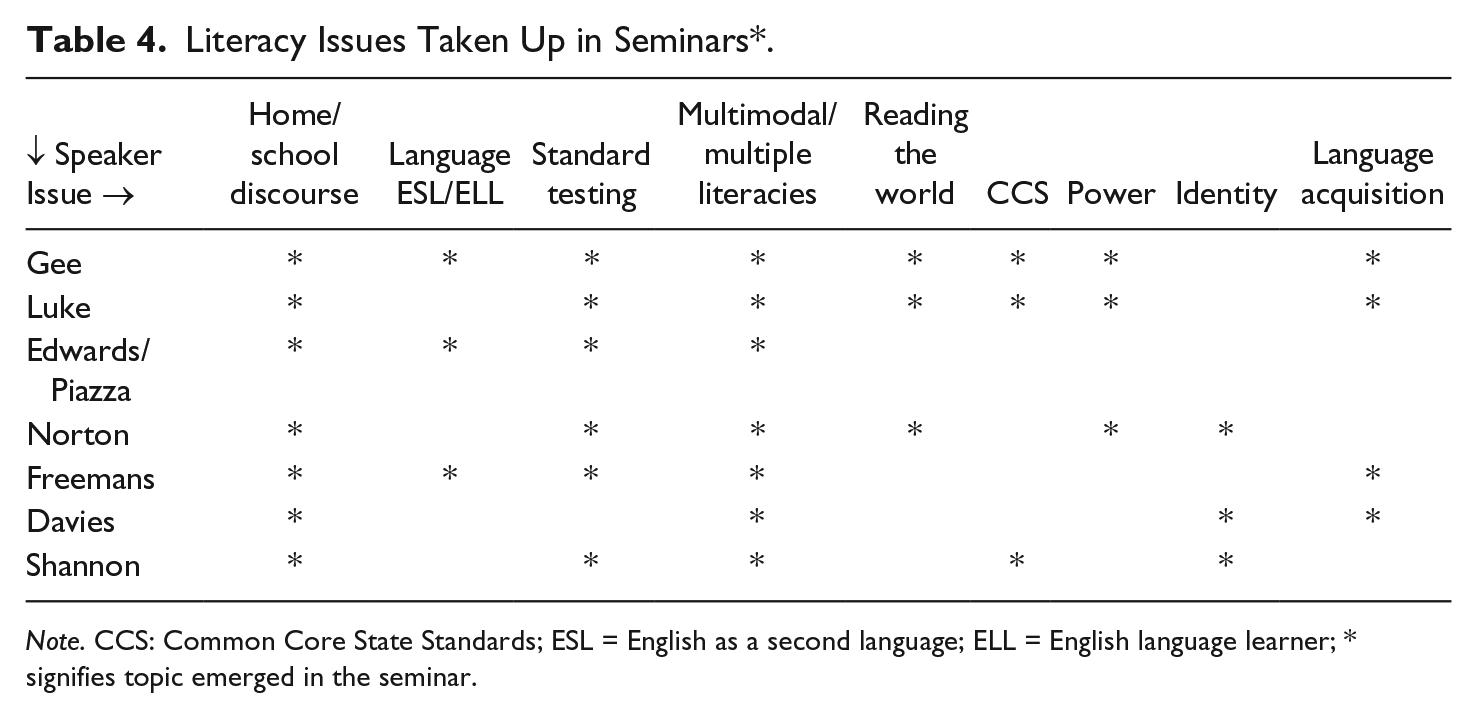
Across the seven web seminars, content KSIs took the shape of real-time comments/questions specific to a presenter’s point and responses to other participants’ comments/questions. However, we also found that participants took up a variety of broad literacy issues, regardless of seminar topic (Table 4).
Literacy Issues Taken Up in Seminars*.
Note. CCS: Common Core State Standards; ESL = English as a second language; ELL = English language learner; * signifies topic emerged in the seminar.
As seen in Table 4, in six of the seven seminars, questions/comments around standardized testing emerged, while across all seven, questions/comments on multimodality and multiples literacies emerged. In addition, we found that dominance across participants in terms of level of education did not determine participation, nor did participation determine who participated in terms of level of education. In the following excerpt, P1 and P2, both postsecondary students and P3 and P4, both recognized scholars in the field of literacy, engaged in a conversation about the role of culture on whether reading is viewed positively or negatively.
Hi (P4), is the sense of reading as a relaxation/recreational activity perhaps, at least in part, cultural?
(P1), I think that’s a good question. Perhaps it is more of a cultural difference for some families.
I think some parents still see reading as “work” because of their own experiences in school.
Hi [P1] . . . I wonder about that too. What are the messages that are transmitted about literacy. Literacy activities in the traditional sense of book reading may carry a different perception than of reading in a different modality. Thanks for your feedback.
In relative anonymity, participants engaged in issue-driven conversations often unaware of the educational levels of other participants. Although we recognize that power dynamics are evident in that the speaker sets the pace and tone of the seminar, we understand that participation in the chat did not lead to status, as it can in affinity spaces, nor did participants achieve position and leadership as in CoPs by moving from the outer boundary toward closer proximity with the “more knowledgeable others” through a process of legitimate peripheral participation (Lave & Wenger, 1991; Lee & Shaari, 2012; Li et al., 2009). Between individual KSIs thus emerged as democratic discourse exchanges—for example, expert (P3, P4) to novice (P1, P2). We suggest that the chat feature, use of pseudonyms (e.g., pc) or university class identifier (e.g., EDU 7700), and the relative anonymity of the seminar space allowed access to multiple and diverse viewpoints between and among participants and speakers.
Nested affinity spaces and groups
A third type of broad KSI emerged through nested affinity spaces, or spaces within the larger affinity space where two or more participants broke away to engage in more focused—nested—conversations related to the larger topic (Albers, Pace, & Brown, 2013). Across all seven seminars, we noted that 1,185 chat comments, or approximately 22%, were engaged in nested affinity conversations. Nested affinity discussions emerged across all seminars, lasted between 2 and 5 min, and were initiated when a participant asked a question or made a comment that related to a speaker’s point, which was then responded to by another or small group of others. For example, within the larger seminar on the Four Resources Model, two nested conversations emerged, one that worked to understand the difference between resources and stages (P1, P3, P4, P7), and one that discussed the Four Resources Model and new literacies/media (P2, P5, P6).
Freire argued that in order to transform the world, we write it and rewrite it. Allan Luke takes this up in saying we should not only deconstruct texts but also reconstruct them as we write ourselves. Does text Analyst/Critic capture this act of text/identity reconstruction?
Exactly my 5 year old engages critically with multimodal texts . . . conversations with teachers need to be ongoing to develop these understandings . . . teachers need to inquire into their practice to see the connections.
If these aren’t stages, then a child can be a text analyst before they’re a code breaker? Are students bouncing between the four areas?
they are resources . . . right?
(@P2), this is an interesting point you raise. We see babies operating iPads and that new Etch a Sketch type device that also incorporates the iPad.
is this “four resources model” applicable to other literacies?
Should realia be used more in the Code Breaker resource, or the Meaning Maker resource for ELL’s?
Yes, resources, but they look like consecutive stages to me. I suppose students are engaging in all four areas at different levls [sic] of difficulty, then?
*levels.
Kids though are meaning makers, text users and text analysts before they are code breakers so I don’t see a sequence. If anything it seems to me code breaker comes last.
And the other three occur simultaneously. Like all learning.
to the ladies reflecting on the model it seems to me that children unconsciously use these resources and they overlap depending on the purpose or task. Of course, the sequence of how this happens may not be clear unless you are very familiar with this model.
This stepping away from the large group chat and into a nested discussion appeared intentional. That is, participants, like P8, knew they were engaged in a focused discussion (“to the ladies reflecting on the model . . . .”). Nested affinity groups enabled participants to ask questions about the content of the speaker’s talk if they were uncertain (Does Text Analyst/Critic capture this act of text/identity reconstruction?), for clarification (“they are resources . . . right?”), to provide examples and share knowledge (“Exactly my 5 year old . . .”; “ . . . children unconsciously use these resources . . .”), and just to work out ideas (“Yes, resources, but they look like consecutive stages to me.”; “Of course, the sequence of how this happens may not be clear unless you are very familiar with this model.”).
We saw these nested affinity groups as critical and “on the spot” (Gee, 2004) moments of learning for those in conversation about an issue, initiated by a question, and responded to by others, and more tacitly, made visible the Discourses to which they align (e.g., “And the other three occur simultaneously. Like all learning.”). However, unlike Gee (2004), we saw that nested affinity discussions were generated by interest in race, culture, ethnicity, or gender. In a longer nested discussion of English learners (excerpted here), participants discussed issues of culture, language, and class:
Professors, do you believe it’s necessary for bilingual students to develop a strong foundation in literacy in their native/home/second language before receiving instruction in English?
What makes language “academic”?
Language that is used only related to a certain subject matter. Language that people don’t typically use in every day life. Like the language in textbooks.
Are ELLs the only types of students who lack academic English, or can we consider lower SES students to be in that category as well? Or, even students who speak pidgin and regional dialects?
A lot of English language learners engage in quite complex registers outside of school. One of my students (first language Spanish) teaches high school and one of her students is highly engaged, knowledgeable, and conversant in the cognitively complex language of horses (i.e., dressage). Her teachers, though, argue that she has “trouble” with academic language.
Although academic literacy with EL populations was the larger topic, participants splintered off to discuss language in the context of power (P2 and P3, who gets to define “academic language is and where it is used), race, and the belief that Spanish was a student’s “trouble” with academic language (P2), and that class may also be why students who are low socio-economic status (SES) and/or speak in regional dialects do not achieve academic language (P1). Nested affinity spaces allowed for focused groups to engage in interrogation of common assumptions around language as it relates to power, class, race, and ethnicity, and assert multiple positions and perspectives through personal experiences (P2: one of my students) grounded in their beliefs (P2: English language learners engage in quite complex registers). When, how, and to what extent these nested affinity groups engaged in conversation depended on the topic and the passion of the participants to sustain these conversations.
In sum, KSIs and social practices within GCLR embodied practices that represented a range of ways in which interactions occurred. The language used in the chat provides some evidence to suggest that critical reflection on one’s beliefs and practices—even within a confined and short 60 minute period—can occur. Furthermore, documenting dialogic and reflective knowledge sharing exchanges in an online and sustained project may, as Gee (2009) suggests, “become part of a bigger and smarter network of people, information, and mediating devices” (p. 23).
GCLR Emerged as an Online Community With Unique Social Practices
Although GCLR shares characteristics of CoPs and affinity spaces, we found five unique features that distinguished it from these two (Table 5): articulated mission and vision, nested affinity spaces, aim to affect positive change, use of social media, and an ongoing series of live and archived seminars. We discuss these five features through two areas: membership, mission, and aim to affect positive change, and set series of seminars and social media.
Characteristics of CoPs, Affinity Spaces, and oNSP.
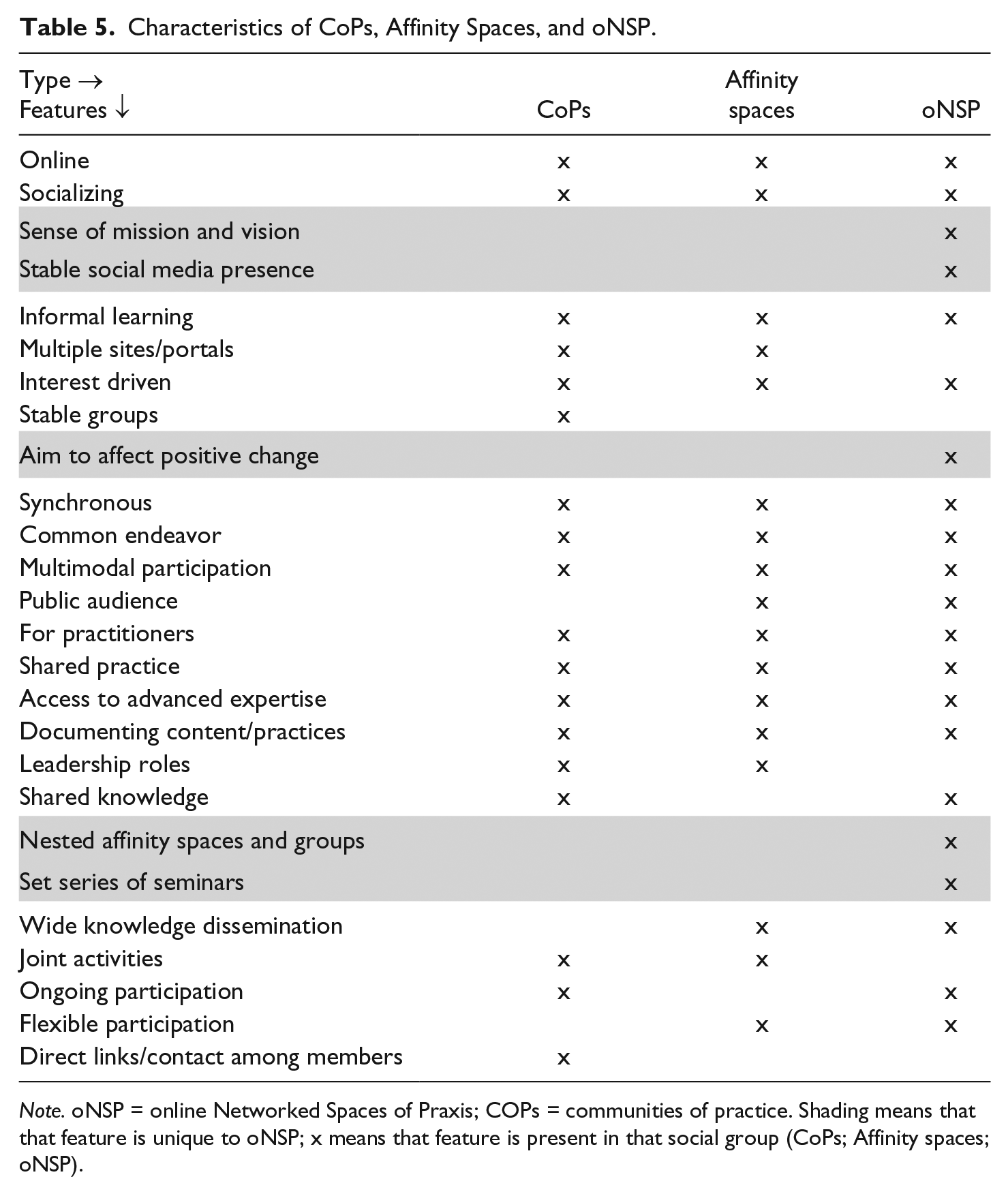
Note. oNSP = online Networked Spaces of Praxis; COPs = communities of practice. Shading means that that feature is unique to oNSP; x means that feature is present in that social group (CoPs; Affinity spaces; oNSP).
Membership, mission, and aim to affect positive change
Unlike the more stable and ongoing participation in CoPs, membership was fluid and attendance numbers varied across seminars (see Table 1). Attendance ranged from participants who regularly attended (“Another great webinar by GCLR”) to those who attended for the first time (“This was my first session, loved it. BRAVO!!!”). Across the seven seminars, participants from six continents attended. Unlike affinity groups in which membership is organized primarily around content (Gee, 2009), this project had (and continues to have) an articulated mission and vision that not only organizes members around content but content that is driven by theory with the intention for transformation of practice. Across seminars, we noted that in the chat, participants used specific phrases and terms that reflected critical literacy stances: “ . . . definitely has potential to change things for the better in education”; “I truly agree with being able to read the world before reading the words”; and “This web seminar is truly a move toward making learning more equitable!” Across chat transcripts, participants also noted how content informed practice: “I think that [Speaker’s] connection between literacy and social justice is inspiring. I can’t wait to get in the classroom tomorrow!”; “It was eye opening . . . I really want to share some of these ideas with the teachers that I work with.”; “I use Luke and Freebody’s 4 Resources Model as a base for the course so accessing past webinars like this will be helpful across semesters!” Unlike affinity groups, membership also included a sense of belonging: “I feel honoured I could be here with you all. Thank you [Speaker]!” Chat and interview data revealed that participants were “hooked” on the project, and saw these seminars as a “great way to spend Sunday evenings.”
Participants and speakers both recognized the significance of GCLR as an online critical project to effect change. In post-seminar interviews, all speakers noted the impact that this project can have on literacy theory and practice. They also suggested ideas for future speakers and publications, promoted GCLR on their own websites, tweeted it to their followers, and provided insight into marketing and publicity. One speaker saw GCLR as an “essential” space for disseminating critical literacy, another saw GCLR as promoting the “kinds of conversations we should be having,” and yet another stated, “It’s incredible to bring all these people together from all over the world on a Sunday night. It just speaks to the value of this work.”
Both in the chat and in interviews, comments made by participants tacitly and explicitly indicated critical reflection, change in practice, and a move toward social action. Participants used phrases and statements that gestured critical reflection: “These seminars keep pushing the boundaries of my literacy and literacy education understandings”; “I will look at Facebook (FB) in a totally different way now!”; “These ideas get me thinking both about my research and about planning my literacy methods courses.” Others considered how their learning would be important for others, “I will be sharing this information . . . .”; “I’m thinking of ways I can use what I’ve learnt with my adult class in Australia.” Others’ comments more closely gestured a move toward social action: “So where do we “as good people” go from here? What do we need to energize around?”; “I never thought about the climate change for ESL students. Living in Quebec is just a question of going to the neighbourhood school maybe across the street. I loved this.” Although we cannot claim actual transformation in participants’ teaching practices, these comments, among others, suggest to us that participants and speakers were interested in social action.
Set series of live/archived seminars and social media
Unlike CoPs and affinity spaces, GCLR sets its seminar series at least a month prior to its first seminar which is then publicized through email, Facebook, website, Twitter blasts, and physical and electronic word of mouth: “This is my first webinar. It was recommended by my university professor,” or “I’m on an email list and that’s how I heard about the seminar.” Participants chose the seminars they wish to attend across the series even when time zone differences were inconvenient. For example, a seminar that started at 7:00 p.m. USA/EST, was joined by New Zealand participants the next day at 11:00 a.m., while others listened to the live presentation in UTC+1, “I am joining from Denmark . . . ;” “Right now I’m in Saudi Arabia.”
Across seminars, participants positively articulated the importance of live synchronous interaction with internationally recognized literacy scholars and learning with others: “It’s great to hear from the horse’s mouth”; “Much appreciation to [Speaker]. I’ve read your work for a long time but it’s a pleasure to hear you speak “in person.” “Nice being able to see [Speaker] at the same time as the slide . . . better than other webinars:)”; and “I enjoyed learning about the different levels of context through which teachers can help emergent bilinguals develop academic language.”
As a set series of seminars, participants engaged in whole group and nested affinity discussions to share learning and respond to others.
CCSS is part of the corporate takeover of public education.
P1, I agree.
Whew. How do teachers act as critical analysts of that document (CCSS)?
Yes, but it’s interesting the conservative groups are resisting as well.
I see the tension in trying to grow it without cooptation or prepackaging it.
Those in public education are not fully aware of how fast this privatizing is coming.
CCSS is big brother.
They also shared learning by identifying professional resources and practical ideas through the chat: How do these notions connect to Heath’s Ways With Words?; “I think there is some disagreement with CCS and the Western Canon folks (Hirsch, Stotsky) as they don’t like the greater focus on informational text vs literature . . . see Stotsky’s latest book . . . interesting contradiction.
“I’ve had students create fictional stories about the word, and they love it.” They also valued the multiple perspectives shared in the chat, “I’m a big fb user, so it was interesting to see someone else’s viewpoints on it! thanks again:)”; “I think this is very cool. Sort of like a CELT rejuv with multiple outside speakers plus a chance to see how people outside our thought collective are thinking. Fascinating.”
Across individual seminars and most often at the end of a seminar, participants indicated interest archived seminars, “Really wish I could have access to the whole thing again.”; “Would love to have this available in a recording to review again! Wonderful information.” For others, open access to live seminars was pragmatic; it was cost effective: “You guys saved us a several thousand dollar plane ticket!”
Unlike CoPs and affinity spaces, social media also played a unique role, especially in terms of the growth and recognition of GCLR. Publicity blasts prior to a seminar reached more than 1,000 people which spiked website visits to a high of 936 visitors on the day of one speaker’s talk. Website analytics also showed that GCLR nearly doubled its visitors from 14,000 to 26,000 in 2012 to 2013 (average increase from 79 to 136 daily visits), and tripled the number of countries that accessed the website from 57 to 151. In late February 2012, GCLR added a Facebook page, Twitter account, and YouTube channel (approximately 4,500 views). We suggest that the use of social media uniquely provides access to yet another layer of participation: Tweets are re-tweeted, friend requests on Facebook are forwarded to others, and posts are sent to the GCLR website. For one speaker, the social media aspect of GCLR is a great idea . . . I think [studying] your social media would be an interesting way of seeing how people come together across nations, not just individually, and how participants might be connecting [to the seminar’s content] in ways that make them act differently or think differently.
In sum, these five features, we suggest, set GCLR apart from CoPs and affinity groups, and allow for praxis through its mission that provides space for shared discussions of theory, application and shared ideas for practice, and focused nested affinity spaces. Its design as a set series of seminars allows for planning for integration into coursework and/or Sunday evening professional discussions, while focus on social media positions GCLR as a global endeavor.
Discussion
With the plethora of literature on online learning and literacy, little has been written about sustained open access live web seminars with an aim to create critical spaces of interaction around literacy issues. Findings from this study have some compelling implications for theory and practice in online teacher professional development (PD), and for open access online literacy projects in terms of knowledge sharing and technologies that afford collaborative and generative professional development.
In 1995, Darling-Hammond and McLaughlin articulated three important criteria that afford strong knowledge sharing in teacher training. Teachers must (a) share what they know, (b) discuss and share what they want to learn, and (c) connect new concepts and strategies to their own unique contexts. Although their research was directed toward F2F PD, we suggest that these three are even more critical in online spaces where educators increasingly turn to online sources for information, pedagogical and teaching ideas, and professional support groups (Albers et al., 2015). In an age of Open Education Resources (OER), as Bouchard (2011) argues, new and emergent technologies are shaping and being shaped by how people interact and engage with others virtually, and position knowledge as fluid, multi-dimensional, and immediate. In that sense, organizations (e.g., National Council of Teachers of English, Literacy Research Association, American Educational Research Association) and institutions (e.g., universities, trade schools, K-12 schools) no longer “own” learning (Kop & Fournier, 2010), and OER are increasingly becoming educators’ choice to access and download resources for learning. With that being said, critical to this plethora of available information is the need to understand how knowledge sharing, learning, and community occur in online projects, like GCLR, to promote critical reflection and praxis.
First, data support our view that online PD spaces can be organized along dimensions other than membership or space and still allow for effective knowledge sharing through social interactions. By documenting KSIs more thoroughly, we argue that even in a limited time of 60 minutes, a group of participants interested in, or curious about, critical literacy can gather in a virtual environment to discuss issues relevant to the larger field of literacy but also situated within their local spaces. Engaging global audiences in literacy discussions across and through local “situations” (Freire, 1970) is important to knowledge sharing. Because educators, as Freire (1970) states, are in a situation, online and sustained forums like GCLR offer space to critically reflect, share knowledge, and be moved to act in their situations with their newfound and shared knowledge. They “will become more the more they critically reflect” (Freire, 1970, p. 90), and connect new concepts and strategies to their own unique contexts (Darling-Hammond & McLaughlin, 1995). In addition, KSIs not only determined how knowledge was shared but also constituted the vehicle through which participants acquired the norms for how to participate and interact within a web seminar space, or what Lave (1991) refers to as the historical, social, and cultural components of situated social practice. Blackboard Communicate tools (e.g., public/private chat, video, and audio) afforded participation and knowledge sharing through the chat which we argue enables critical discussions and opportunities for transforming thoughts and initiating ideas for action. That between individual KSIs thus emerged as democratic discourse exchanges suggests that seminars that are open access and membership fluid are not dependent on one’s educational status or knowledge of the discipline. Rather, participants engage in an idea, concept, or question with the experience they have and/or extend their knowledge based on the seminar’s content.
Second, identification of nested affinity spaces and how they are organized is significant when considering online spaces of praxis. Nested affinity groups shifted in composition across time (60 min) and in content (larger topic/focused topic). Nested affinity groups of two or more participants organized around an initiating question or comment raised by a participant in the chat and then taken up by others in a focused discussion. Nested affinity discussions were social, fluid, and “on-the-spot” (Gee, 2004) moments of critical reflection that allowed participants space to focus more deeply on a topic or question related to the larger seminar. Like Gee (2004), we found that participants in the whole group affiliated with others around an interest (e.g., topic, speaker), activities, or goals. However, unlike Gee who suggested that affinity groups do not affiliate around “race, class, culture, ethnicity, or gender” (p. 67), we found that nested affinity groups organized as a result of participants’ questions around these social markers and seminar topic. For example, in the nested discussion on academic language and ELs, one participant raised a question about bilingual students and learning English, which then shifted into a discussion on academic literacy. Within this nested discussion, participants brought up concepts such as “bilingual,” “native/home language,” “in” and “out of school,” “pidgin and regional dialects,” and “SES,” all of which encouraged interrogation and discussion around social markers. Furthermore, the use of declarative statements like, “A lot of English language learners engage in quite complex registers outside of school . . . .” or statements about challenges in learning academic language based on SES or regional and pidgin dialects makes visible participants’ beliefs about class, power, and language. Nested affinity discussions, we argue, allow for multiple subject positions (Davies & Harré, 1990) in which participants think about themselves within the larger topic, and break away to position themselves in the nested, more focused storyline, or issue, taken up in the discussion. Nested affinity spaces, then, we suggest, are critical literacy spaces nested within an affinity space that allows for disruption of common assumptions (e.g., ELs and academic literacy), interrogation of multiple viewpoints (language and class), and a focus on socio-political issues (language learning and power) (Lewison, Flint, & Van Sluys, 2002).
Third, as we have previously noted, GCLR shares characteristics with CoPs and affinity spaces; however, findings from this study indicated that neither the CoPs nor affinity spaces sufficiently explain the interaction and participation of GCLR audiences, and that unique social practices emerged through the use of BC as a delivery platform and its tools. Although BC has the capacity to host 1,000s of people synchronously, in this study, the seven seminars hosted between 60 and 360 participants. These numbers afforded space for whole, small, and between participant interactions. Although F2F spaces physically restrict interaction between participants who can often only whisper privately during a speaker’s talk, online spaces allow for synchronous conversations among members during a speaker’s talk. The chat feature makes visible audience members’ “whisperings” to the larger group, which affords large and/or nested group knowledge sharing and interaction. In so doing, a collectivity of critical thought—that Freire (1970) argues is necessary for praxis—can occur. In addition, we found that the design of the seminar that encourages interaction, specifically through the chat feature, resulted in a shift in large group organization and participation that was fluid. That is, at the start of the seminar, participants were organized around the seminar topic in large group. However, as the topic generated questions or comments in the chat, the organization of the large group shifted when some participants moved into nested affinity groups. These nested affinity groups then rejoined the large group, which, because of other questions, generated different nested affinity groups. The large group again was reorganized at the end to conclude the seminar. This fluid shift between large group and nested affinity groups, we suggest, is a unique social practice afforded by not only the online space design but also the project’s mission and vision to promote multiple and global discussions. With connections to CoPs and affinity spaces, we see GCLR through Stengers’s (2005) concept of ecology of practice as a tool for “thinking through what is happening” (p. 3), and those who have the tool after another will use it particularly as their own. With that in mind, we see the study of GCLR as an online space that has its particular own-ness.
GCLR as an online Networked Space of Praxis
What happens in society when the boundaries of linguistic experience are drastically transformed? How are social relations altered when language is no longer limited to face to face speech or to writing? What assumptions about the nature of society need to be revised when the already complex and ambiguous aspects of language are supplemented by electronic mediation? (Poster, cited in Lankshear & McLaren, 1993, p. 411)
When social practices around literacy shift as a result of electronic mediation, as Poster suggests, what does this mean in terms of assumptions around how literacy is learned? Who shares this knowledge? How does this knowledge then support critical reflection in professional development? We see these as important questions to take up. We position GCLR as a different—not new but somewhat innovative—type of space that allows for unique social practices in which critical literacy can be presented, enacted, and realized. Although we recognize scholarly contributions around online spaces (e.g., affordances in delivery platforms, social presence, networking), we position GCLR as contributing uniquely to this scholarship. With this in mind, we see GCLR as an oNSP (Figure 1): seminars that network global audiences through technologies with a vision to support the transformation of practice. Although we situate this project in critical literacy, other projects could organize differently around missions and visions to realize their own goals, thus we do not include “critical” in our description of this space.
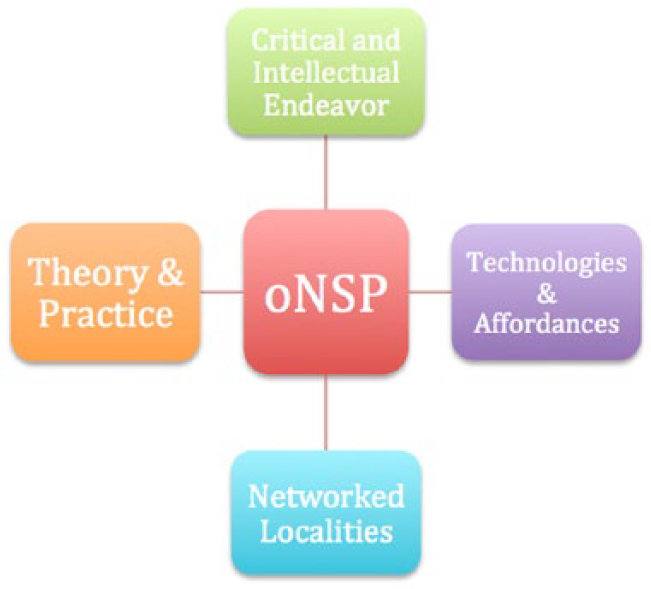
GCLR as an online networked space of praxis.
As an online open access set of seminars, GCLR uses BC’s delivery platform which affords participants, from anywhere in the world and who have Internet connections, synchronous engagement with others. F2F PD (e.g., conferences, workshops) can be very cost prohibitive (“You guys saved us a several thousand dollar plane ticket!”). Thus, as designed, GCLR as an oNSP provides access not only to recognized scholars and scholarship in the field but access to knowledge sharing, interaction with interested others, and potential for individual and/or collective transformation of theory and beliefs as it relates to teaching practices in literacy research and practice. Such access, Janks (2010) argues, positions participants to see how language and power operate, to understand how texts act on us to shape beliefs, and to counter and speak against hierarchies that restrict good teaching and learning, and practices.
As participants attend from across the globe, we are reminded of Cindi Katz’s (2008) comment about post-Katrina in which she stated, “Geography is always socially produced. And so every landscape can reveal sedimented and contentious histories of occupation . . . .” (p. 16). We see the potential of online spaces to not only network people from around the world but also position the local space in which they inhabit as significant and essential to their interactions and knowledge sharing. Gordon and de Souza e Silva (2011) introduced the concept of net locality, a concept that describes technological affordances that enable people to become aware of how local, state, national, and international politics and policies affect their local settings. Through delivery platforms like BC and its communication tools, GCLR as an oNSP mediates and recognizes the significance of how networked localities “shape one’s experience of space and social life” (p. 178). Thus, for example, how participants discuss language learning and class, or the Common Core State Standards (CCSS) as a “corporate takeover” situates these comments directly in the politics of the local situation (e.g., a school district, the United States) but are electronically communicated and mediated across global audiences. Although online spaces can be weighed down by “sedimented histories” of engagement (consider asynchronous online courses, or lecture-based online courses that often fracture small group discussions from large group), an oNSP signifies importance in nested affinity groups discussions alongside and within whole group discussions.
Finally, GCLR as an oNSP is foremost a critical and intellectual endeavor, for scholars, participants, and researchers alike, that enacts the principles that embody critical literacy. With a vision to shift perspectives around political mandates that deprofessionalize educators (Shannon, 2013; Shannon & Larson, 2016), GCLR as an oNSP is a real-time move toward social action, one that provides open access PD that contributes to disrupting commonplace assumptions about how literacy should be taught and learned, and presents seminars that offer multiple and international approaches, practices, and scholarship. The data do suggest that as an oNSP, GCLR is shifting the assumptions around who can participate in discussions of literacy research and practice, synchronously or asynchronously (e.g., archived seminars), how scholarship is presented, and how the interaction of ideas occurs (e.g., multiple modes: spatial, visual, aural, written). With English as the language of seminar delivery, Odo, Cho, Shin, Jung, and Albers (2014) find that synchronous participation for speakers of languages other than English was challenging. As such, archived seminars open up the opportunity for multiple viewings, with the ability to “stop and pause” or “rewind” to access content. Furthermore, we suggest that GCLR as an oNSP has the potential to transform how PD and scholarship are delivered. This project has participants who repeatedly attend seminars within and across years, has teacher educators who integrate seminars into their classes, has chat comments that reflect learning, and has archived seminars that are regularly downloaded.
Limitations to Study
Although we have presented the possibilities of research in online spaces of learning, specifically sustained web seminars, we acknowledge that there are limitations in this study. Although we acknowledge common features with CoPs and affinity spaces, the unique features that comprise GCLR open up intriguing possibilities for thinking about the dynamics of online spaces. Even though we present applicability of oNSP to online projects, we are reminded that that the dynamics we observe within GCLR may not readily apply to other web seminar projects. Furthermore, our data were collected from 1 year of seminars, but this is an ongoing project. It may be more informative to explore longitudinal data to establish whether the dynamics apparent in our data exist across all years in which GCLR has been operating.
Conclusion
Virtual and mobile technologies have become the everyday practices of people worldwide, and with increased networking capabilities, people from across the world can engage in learning in real time As of June, 2016, approximately 48.7% of the world’s population (7,340,093,980; Internet World Stats, 2016) use the Internet, and the BBC reported that half of the world’s population by the end of 2015 will be connected (“Internet Used by 3.2,” 2015). With access to mobile and Internet technologies, we must envision innovative designs that encourage us to think imaginatively about how literacy research and theory can be delivered, experienced, and disseminated, and how practice is affected by the relationships between and among those who engage in such designs. With GCLR as an oNSP, we believe we have begun this imaginative work, and hope that others will take up this call to further expand what is currently known about bringing together collective and global understandings of literacy and literacy learning. This study prompts others to advance the research in online open access projects that aim to serve global populations. A study of how participants interact in synchronous online projects, and access and use of OERs is warranted. However, more importantly to us is to what extent praxis can occur when knowledge sharing, interaction, theory, and practice among global audiences is valued and enacted.
Footnotes
Declaration of Conflicting Interests
The author(s) declared no potential conflicts of interest with respect to the research, authorship, and/or publication of this article.
Funding
The author(s) received financial support for the research, authorship, and/or publication of this article: The authors received partial funding for this research from the National Writing Project. They received no financial support for authorship and/or publication of this article.