




Abstract
This qualitative study explores the performance of teacher agency amidst national financial and professional deficits in education and sheds light on the growing utilization of Instagram in elementary school contexts. To better understand teachers’ use of this social media platform, we examined the Instagram accounts of 12 highly popular and influential pre-K–6 teachers (i.e., teacher influencers). Data sources comprised over 600 visual and textual posts, which included images, captions, hashtags, and emojis, produced over 3 months in the spring of 2019. Using qualitative coding procedures that were recursive and emphasized the emergent nature of interpretation through a critical literacies framework, we documented the neoliberal teachers’ use of Instagram as a method of participation in a virtual community of practice and as a way to produce, commodify, and possibly profit from posts presented as curricula. Findings suggest that teacher influencers primarily used Instagram as a form of commodification and commerce, as educational content was promoted to users as well as methods of purchase via personal websites, Teachers Pay Teachers and other digital stores. Overall, the teacher influencers’ Instagram use revealed a convergence of complex and multiple discourses involving curriculum, racialized and/or gendered identities, and neoliberal production.
Across the current educational landscape, schools continue to be underfunded and unions weakened—conditions often associated with a loss of compensation and benefits for teachers (Weiner, 2012; Will, 2019). Meanwhile, the emotional, intellectual, and physical demands on teachers are ever-growing. Teachers face classrooms filled with students who have diverse learning and emotional needs; simultaneously, the financial and professional support to meet such needs is deficient (Rodriguez, 2016; Schaefer et al., 2014; Smith and Davey, 2019; Will, 2018). Teachers have long addressed this inadequacy by reaching into their own pockets to buy supplies and even food for hungry students (Chokshi, 2018). In today’s digital climate, teachers have also begun to procure digital resources to meet students’ needs. For these educators, social media provides timely, cost-efficient support in the form of resources, curricula, and professional networking.
In exploring this nexus of teacher agency and financial and professional deficit, this study sheds light on the growing trend of utilizing social media in elementary school contexts, specifically, teachers’ use of Instagram to meet professional needs. We examined the Instagram accounts of 12 highly popular and influential pre-K–6 classroom teachers and documented a growing and underreported movement of educators using Instagram as a method of participation in a virtual community of practice (Dubé et al., 2006; Lave and Wenger, 1991; Wenger, 1996) and as a way to produce, commodify, and possibly profit from posts presented as curricula. Using a sociocultural and critical literacies framework, we explore the neoliberal contexts, affordances, and predicaments of teachers’ use of Instagram in answer to the questions, How do these teachers use Instagram, and to what end?
“Doing it for the ‘gram’”: Teachers and social media
Instagram, a photo- and video-sharing social networking platform, was launched in 2010. With over one billion active monthly users, it has subsequently become one of the largest, most popular social media networks, surpassing other applications such as Twitter and Snapchat (Newberry, 2019). Users upload photos and videos, along with captions and hashtags, to Instagram, where other users can view these posts, respond with comments, and “double tap” on a posted image to “like” it. Originally conceived as a way to connect family and friends, Instagram has skyrocketed to popularity largely due to its functionality as a platform for commerce, with products being integrated into visual experiences by users (Newberry, 2019). This burgeoning utilization of social media can be seen most clearly in the booming industry of “influencer marketing,” currently estimated to be worth $8 billion (Schomer, 2019). The most power is found in the hands of influencers, those users who, through their authoritative positioning, amass a wide following, wherein they have the power to affect the habits and buying decisions of others (Kilgour et al., 2015; Knightly, 2019). Though the term was nearly unknown prior to 2016, influencers now “fill every conceivable niche and sub-niche interest” (Schomer, 2019: 2), with nuanced distinctions being made between key influencers, micro-influencers, thought leaders, kidfluencers, and so on (Grin, 2019; Schomer, 2019; Solomon, 2019).
The educational domain has not been immune to these changing markets. National news conglomerates, such as NPR (National Public Radio) and Buzzfeed News, as well as smaller outlets, such as Education World, have reported a growing use of Instagram among educators. According to the 2018 Digital Marketing Trends in the Education Market report (Murphey, 2018), teachers across a wide range of experience levels and demographic identifiers report they use social media regularly, with nearly 82% of survey respondents identified as Instagram users (Oddone, 2019). As of this writing, the hashtag #TeachersOfInstagram has been charted at over 8.6 million posts, demonstrating the teacher presence on Instagram is booming. This niche group, commonly referred to as Teachergram, may be understood as a community of practice (Wenger, 1996), or an informal learning organization, that includes Teachergrammers, or Instagram users who consume teacher-created or education-related posts, and teacher influencers, users who produce aspirational content and curricular resources for educators. By “sharing photos of their classrooms and what goes on inside of it,” (Reinstein, 2018: 4) teacher influencers have been able to amass large numbers of followers who bridge digital and in-real-life (IRL) classroom contexts through the use of inspired or purchased teaching ideas, resources, and materials.
Despite the broad influence Instagram has had on curriculum and pedagogy, this area has been understudied. Scholarship exploring social media and education has predominantly focused on specific platforms, namely, Twitter (e.g., Brown, 2012; Carpenter, 2014; Carpenter et al., 2019a, 2019b; Krutka and Carpenter, 2016; Risser, 2013; Wright, 2010) and Facebook (Asterhan and Rosenberg, 2015; Fewkes and McCabe, 2012; Greenhow et al., 2020; Hew, 2011; Sanchez et al., 2014). These studies have highlighted the growing number of teachers using social media for professional development and community building and to garner resources for their classrooms. Research about teachers’ use of other popular platforms, such as Pinterest, YouTube, and Instagram, has been more limited despite their burgeoning popularity among teachers. In the last year, however, important studies regarding teacher use of Instagram have emerged. Carpenter et al. (2020) used a large-scale survey to investigate how and why teachers used Instagram. The framework of teacherpreneurship (Carpenter et al., 2019a, 2019b; Shelton and Archambault, 2018) was used to examine if and how Teachergrammers were motivated by individual financial gain. Notably, their study found the majority of participants reported using the platform for inspiration and learning, not for the marketing or selling of goods or services. These findings hint at the breadth of those who make up Teachergram.
In contrast, the present study examines a particular subset of Teachergram comprised of a sampling of teacher influencers. The reach of these influencers is substantial and the likelihood that their content is visible to the larger Teachergram community is high. Consequently, an analysis of the use of Instagram by these teacher influencers is critical. This niche group was investigated by Shelton et al. (2020) in a qualitative study of the Instagram content constructed by “edu-influencers” comprising a popular professional organization focused on delivering professional development and inspiration to teachers. The researchers identified four major themes within their posts: promotional content, soliciting engagement, motivational content, and advocating for a classroom approach. They noted, “entrepreneurship was central to Instagram edu-influencers’ activity. All edu-influencer participants promoted their own product(s) or services in some way” (Shelton et al., 2020: 547). The potential conflicts of interest arising from the entrepreneurship and profit-making of these major content providers complicates the more innocuous picture of Instagram use that was self-reported by Teachergrammers in Carpenter et al.’s (2020) investigation. While teachers may not consider their usage of Instagram to be commercial, the learning and inspiration they give or take through it often contributes to the financial gain/loss of some users.
As previous investigations have noted (Pittard, 2017; Shelton et al., 2020), social media must be understood as more than just a digital teacher’s lounge where resources are shared (Carpenter et al., 2019a, 2019b). In fact, on Instagram, teachers “buy, sell, borrow, and share” curricula that may be considered both “core” curricula as well as supplemental. Yet, few empirical studies (for exceptions, see Pittard, 2017, and Shelton et al., 2020) have explored the commodification being undertaken by teachers on social media. In many ways, this reticence illuminates the murky context of teacher agency, financial and professional deficit, and modern digital business practices.
Theoretical framework
The present study is guided by a critical sociocultural framework that situates learning in inter- and intra-actions and emphasizes issues of identity and agency as part of wider circulations of power (Lewis et al., 2007). Understanding that learning is mediated by concrete and symbolic tools, including spoken and written language, embodiment, and iconography, we consider how structured interaction between signs and tools constitute sign systems, which regulate and mediate social norms, mores, and cultural practices. In this way, sign systems are interwoven with identity and agency (Lewis et al., 2014).
Consequently, social media may be understood as a mode of transferring cultural values through digital communications, both visual and textual. Bouvier (2015) asserted that, as social media plays a large role in society’s communication processes, how language is taken up and deployed in these processes must be scrutinized. Shifting practices in the communication landscape inform participants not only of different “ideas and values” but how they may, or may not, be shared (Bouvier, 2015: 150). This is especially important because social media communicates ideas regarding culture, race, gender, class, ability, and beyond, which have the ability to disrupt or reify codes of power. By drawing on critical sociocultural theory, we center the concrete and symbolic factors that shape Instagram posts, including captions, images, and emojis, and users’ responses, including their reading and analysis of posts.
Neoliberalism and the commodification of teaching
Neoliberalism situates the market as the driving force behind social, political, and economic decisions. Under these conditions, nearly anything can be a profit-worthy investment, and this phenomenon extends to all institutions and spheres of public life (e.g., banking, healthcare, and education). Public goods are sold as private interests, as ideas of free trade, privatization, and deregulation coalesce in ways that often promulgate self-interest over societal needs (Giroux, 2005). Within neoliberalism, privatization and market demands are linked to democracy through the notion that choice allows people to determine outcomes. This allows economics to detach itself from social outcomes and ethics. People are situated as workers solely responsible for their own success, their destinies dependent on possessing skills or qualities tied directly to monetization (Giroux, 2015; Pittard, 2017). Although this system is espoused as democratic and meritocratic, vital to understanding this ideology is that it often consolidates power in the hands of those who already have political, social and/or economic capital. In fact, Giroux (2005) referred to neoliberalism as a “more virulent and brutal form of market capitalism” (2), as it reduces people to goods. While such a conception once only referred to the factory system, neoliberalism has extended its reach to various entities, including the schoolhouse.
Traditionally, curriculum sales were relegated to textbook publishers and a few other outlets; however, over the course of the last decade, teachers have taken to creating their own curricula for profit. Utilizing the popular digital education marketplace, Teachers Pay Teachers (TPT), or their own websites or blogs, teachers now sell lesson plans, curricular goods, and consulting services to other teachers and schools. Many of these goods and services relate to educational reforms that teachers must enact within their classrooms, for instance, Common Core state standards, high-stakes state testing preparation, and other state- or district-enacted policies that teachers may need assistance in implementing (Tienken and Orlich, 2013). It is difficult to ascertain the direct economic impact of this website, but company information asserted, “TPT is the world’s first and largest open marketplace where teachers share, sell, and buy original educational resources…In the last year alone, two in three U.S. teachers downloaded a teaching resource from TPT” (Crunchbase, 2019). In addition, TPT (2020) has reported that over one billion resources have been downloaded from the site. Notably, Koehler et al. (2020) found that TPT comprises over 200,000 individual educator stores and over $3.9 billion in transactions.
Teachers who utilize TPT to sell curricula receive a percentage of purchases, up to 80%, and the remainder goes to TPT. In 2018, TPT reported that returns to content creators totaled more than $ 50 million (Paytner, 2019). Although this is good news for the teacher content creators, the circumstances that their commodification relies on should not be overlooked. A major concern with teachers privatizing their labor is that it masks, and possibly contributes to, educational inequities—who has access to these goods, and at whose expense? For example, when unpaid or underpaid teachers monetize their labor in an attempt to make up for systemic inequities, their efforts inevitably circumnavigate larger problems of inequitable labor policies and conditions. Thus, the teachers’ roles as producers and consumers of educational goods align with neoliberal conceptualizations of cultural labor. In this context, addressing systemic issues of inequity and the undervaluing of educators is not congruent with the discursive space created by Teachergrammers.
Methods
This qualitative study explores the use of Instagram for personal and professional benefit by elementary teacher influencers. We construct a portraiture of 12 highly popular Instagram accounts and richly describe the use and influence of these accounts within the Teachergram community of practice (Wenger, 1996). We also spotlight the neoliberal contexts and implications of their substantial sway. Through a layered content and thematic analysis of Instagram posts, we document why and how these teacher influencers participate in social media and its implications on schooling and wider discourses of good teaching.
Data sources
To identify popular and influential teacher influencers on Instagram, we ran an internet search using keywords such as “Teachergrammer,” “teacher influencer,” and “Instagram,” and compiled a preliminary list of active influencers. This list was cross-referenced with relevant online media sources (e.g., recommendations from TeacherVision and BuzzFeed), popular education-related hashtags (e.g., #TeachersOfInstagram, #Teachergram), and tags and mentions linking to other teacher accounts on Instagram. Recursively, we continued our search by using the Search and Explore features of Instagram to identify other possible accounts.
In our study, we considered a large number of followers as essential to being a teacher influencer. Social media influencers may be categorized differently according to their number of followers. Nano influencers, typically with 1000–3000 followers, and micro influencers, typically with 3000–100,000 followers, are most often “everyday” people who have developed significant followings based on particular niche areas (Henderson, 2020). Macro influencers generally command hundreds of thousands, if not millions, of followers. While there are myriad users on Instagram who may be considered influencers at various levels, we narrowed our criteria to users identifying as pre-K–6 classroom teachers who had at least 50,000 followers. Our rationale for focusing on the accounts of classroom teachers (as opposed to those of companies, districts, and administrators) was to prioritize teachers’ agency in their use of social media, and we considered a minimum of 50,000 followers, considered as “mid-tier” micro influencer status (Agrawal, 2019) to be an indicator of the account’s power and presence on the platform.
Throughout this search, we attempted to find accounts that were representative of different grade levels as well as a diversity of backgrounds in terms of ethnicity, race, gender (or gender presentation), and/or sexual orientation, in order to draw attention to and acknowledge the content produced by diverse users. Despite this intentionality, the majority of Teachergrammers that matched our criteria presented themselves as White women, estimated to be 24–35 years old, a finding further discussed in the Implications section. Because much data analysis occurs simultaneously with data collection in qualitative research (Creswell, 2013; Smagorinsky, 2008), this challenge of finding diverse teacher influencers, along with the ease of finding White women influencers, revealed a critical aspect of Teachergram.
To narrow the scope of our study, we selected a total of 12 teacher influencer accounts for investigation. Though not intended to be exhaustive, this selection provides an overview of prominent elementary Teachergram accounts, as the accounts represent multiple grade levels and geographic locales as well as urban, rural, and suburban contexts, and also dominate the search results for elementary classroom content on Instagram.
Data sources for each account included user profiles and posts created over a 3-month period from April 1 to 1 July 2019, totaling nearly 600 individual posts that contained both visual (i.e., images) and graphic (i.e., captions, comments, and hashtags) representations of text. The number of posts varied according to the user, but all posts published within the time period were collected manually through web or mobile interfaces. Some user data, such as frequently used hashtags, most liked posts, and most commented posts, were gathered using Instagram APIs, such as GramWiki.
It is important to note that throughout the study, we grappled with the ethics and ramifications of researching Teachergrammers, who complicate delineations between text, personhood, and individuality (Franzke et al., 2020; Markham and Buchanan, 2012). Considering the explosive use of Instagram in educational spheres, we believe the social benefits of this study outweigh potentially ambiguous conceptions of privacy (Markham and Buchanan, 2012). However, to protect the Teachergrammers’ identities as best as possible, we included only accounts that were publicly searchable and available and reported our findings using generalized attributes and patterns of talk rather than verbatim discourse from specific accounts.
Data analysis
We performed three layers of qualitative data analysis. In the initial phase, we devised an evaluative coding instrument to record demographic and graphic information, including each influencer’s name, estimated age, race, ethnic, gender identity, location, and grade level. For accuracy in assigning race and gender categories, we relied on the textual information provided by the users and their own self-identifications rather than our own interpretations. In cases where this information was not explicit, we relied on a combination of textual and visual cues such as pronoun usage, photo representations, and public social media profiles (e.g., “About Me” pages on personal websites and links in profiles). Age ranges were gathered from publicly available information or closely approximated with information provided by the users (e.g., date of college graduation, years of experience).
It was also possible to approximate years of teaching experience from users’ profiles. Approximately half of the accounts included this information in their About Me sections on personal blogs or websites linked in their Instagram or TPT profiles, and several others included relevant information such as their year of graduation from college or graduate school programs. For a few users, biographical details were found through other publicly available sources (e.g., news article, media profile) not directly linked in their Instagram accounts.
We also recorded graphic (textual) data related to the influencers’ social media use, including number of followers, links to other social media accounts, number of posts produced, and average number of comments and likes on each post at the time of data collection. This was done by using information publicly available on the Instagram accounts and later through cross-referencing with GramWiki, a free third-party website that measures the popularity and reach of Instagram posts and accounts by calculating levels of engagement based on numbers of likes and comments. Collectively, this information was used to construct an initial portraiture of each teacher influencer.
We next focused on the users’ posted content, applying qualitative coding procedures (Saldaña, 2009) to allow themes and categories to emerge from multiple measures. During the initial coding cycle, we independently examined posts and jotted down notes for each image, including details about what was pictured or represented and observations on perspective, lighting, color, and/or focus, and for each post’s caption, identifying text or ideas, use of emojis, inclusion of links, and specific hashtags. The hashtags that were most frequently used by each account were also identified.
Using synchronous videoconferencing, we first analyzed one Instagram account, independently coding data from a single post, then talking to compare and contrast our preliminary observations. To establish reliability, this process was repeated and extended as we analyzed further posts from the same account until initial codes emerged. Our analysis was punctuated by talk, as we discussed emerging codes, clarified definitions, and asked questions, oftentimes related to our use of critical frameworks and our focus on neoliberalism. The remaining accounts were coded independently, with each researcher taking responsibility for coding half of the accounts included in the study. However, we engaged in recursive discussions and examinations of the data to triangulate the emerging themes and codes. Using the constant comparative method, we then identified emerging categories relevant to the teacher influencers’ discourses and the impact on curriculum, school (in)equities, and development of professional communities of practice. Major themes that emerged included teachers as White women, education as commodity, and social media as a personal, professional, and ideological tool.
Finally, drawing upon Gee (1999) and Lewison et al. (2014), we conducted a truncated critical discourse analysis to better identify and understand the emerging findings. Specifically, we examined the situated meanings, social languages, and cultural models within the discourses constructed by the teacher influencers and how they related to the lives of teachers and students. To illuminate these neoliberal discourses, we asked the following questions inspired by Lewison et al.’s (2014) exploration of critical literacy in classrooms: Utilizing the picture and caption, what is the initial surface-level reading of the post? How do the key words, as well as the emojis and hashtags, construct meanings? What story does the post tell? What might the post make a viewer think? Such questions allowed us to apply our critical framework in the analysis.
Overall, our iterative analyses revealed categories of use and intentionality: the teacher influencers consistently used Instagram as a source of income, to circulate ideological discourses, and as a community of practice exhibiting blurred professional and personal borders (Carpenter et al., 2019a, 2019b). In the following section, we present the demographic data of the Teachergrammers in the study to provide a rich description of these influencers in this growing medium of teacher collaboration and professional development.
Teacher influencer profiles
Teachergrammer accounts by demographic and graphic data.
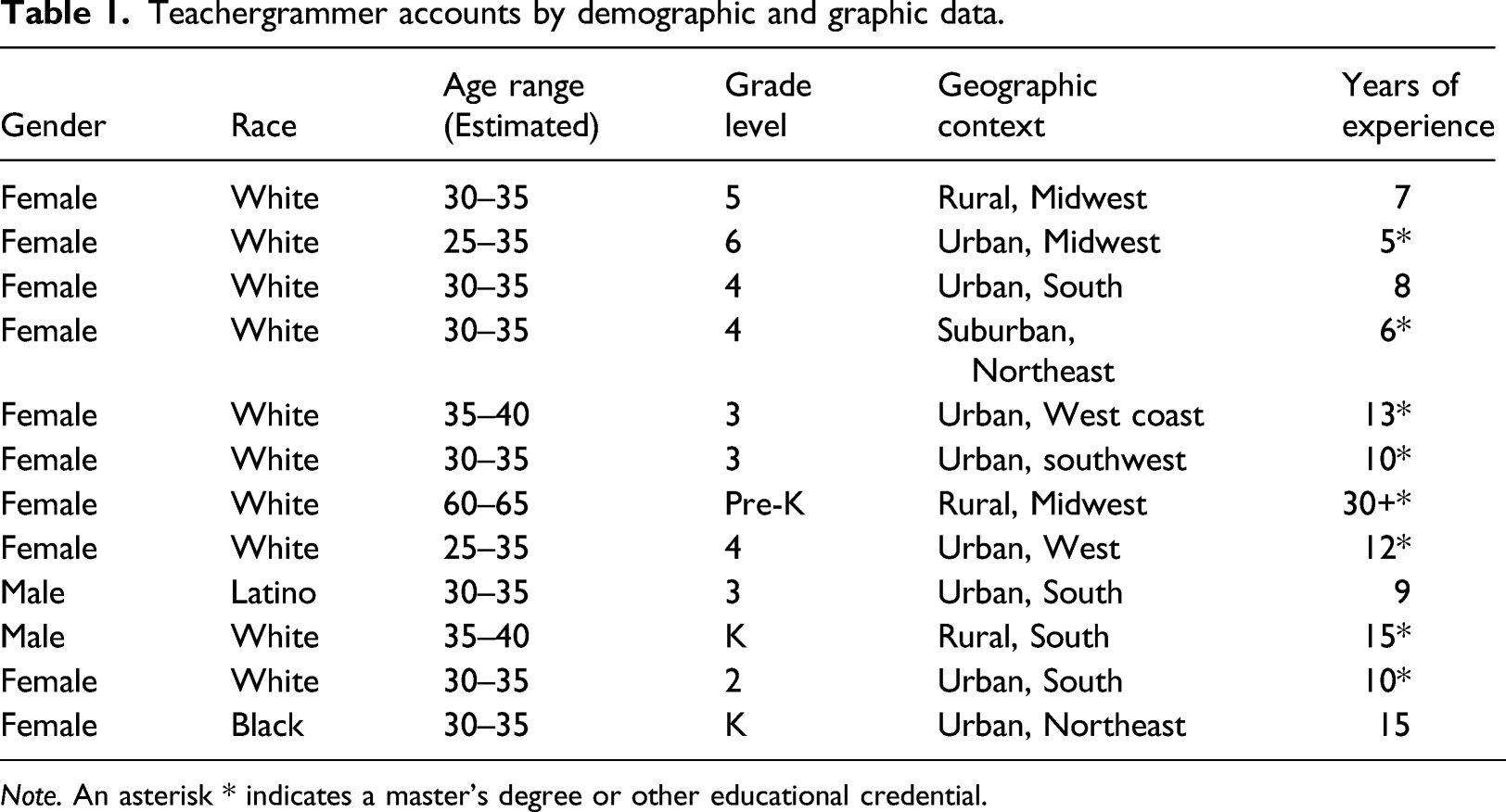
Note. An asterisk * indicates a master’s degree or other educational credential.
Overall, the demographic data indicated a homogeneity among the teacher influencers; this may be attributed to the fact that our search for accounts began with those most often recommended and publicized by media outlets. Though we originally intended to select a culturally diverse range of teacher voices to explore diverse Teachergrammers’ use of Instagram, our search yielded few accounts outside dominant demographics that met our criteria for teacher influencers (i.e., at least 50,000 followers and current pre-K–6 classroom teacher). More accounts meeting our criteria, particularly of having a significantly large following, were operated by White women. For example, of the nine accounts operated by White women, seven accounts had well over 100,000 followers—four having over 150,000—and the remaining two had an average of 72,000 followers. Such great numbers are not only indicative of the influencers’ popularity but also their power: their social media content is amplified, reaching significant numbers and groups of people and affording them unique personal, professional, and business opportunities.
Overall, the Teachergrammers with the most pronounced presence on Instagram were White women. Their social media presence extended beyond Instagram as well. All of the White, female users had at least two social media accounts outside of Instagram (e.g., on Twitter, YouTube, Facebook, Pinterest, and LinkedIn), and half had accounts on four or more platforms as well as personal blogs or websites, indicating they may influence greater numbers of people than their Instagram statistics suggest. Notable exceptions were the additions of one Black female and two male Teachergrammers, who represented multiple and intersectional marginalized cultural groups, including gay male primary teachers and Latinx male elementary teachers. These accounts, reflecting users identifying with minoritized populations, also indicated social media sway as they all linked to additional social media platforms, including personal websites, and other personal business ventures related to schooling. In total, ten of the influencers in this study also had TPT accounts that were used to sell their own curricular materials and resources.
Notably, the teacher influencers were representative of diverse schools (i.e., public, private, and public charter) and regions across the United States. The geographic locations of the teachers’ classrooms ranged from rural to urban localities on the West Coast, Midwestern, and Southern areas of the United States. The data selection process also yielded information about their grade levels and teaching experience. A wide range of elementary grade levels was represented among teacher influencers (see Table 1), and all had at least 5 years of teaching experience, with the average being closer to 12 years. One account was an outlier in the data, as the user described herself as having over 30 years of classroom experience.
Generally, the influencers’ languaging around years of experience allowed them to legitimize their expertise and leverage subsequent recommendations. Some users provided additional information regarding higher education degrees and certifications. In eight accounts, users described holding either a master’s degree in an education-related field or supplementary certifications such as for working with English language learners (see Table 1). Consequently, influencers presented themselves as seasoned, well-qualified teachers.
In summary, teacher influencers possessed remarkably similar demographic backgrounds. Exceptions included three users representing marginalized backgrounds and one user who diverged from the others in age and teaching experience. Other similarities among the influencers were noted as well. For example, a majority were married with children, and many had similar interests in pop culture, humor, and hobbies. We attempted to record possible examples of nuanced differences in their political, religious, and cultural affiliations, but this was difficult, as such affiliations were not explicitly or consistently stated across users. The jottings and observations we were able to make served to distinguish individuals within the oft-homogenized group of White women.
Findings
How is Instagram used?
The results of the layered content and thematic analyses revealed professional, personal, and ideological utilization of Instagram by the teacher influencers, with emerging subthemes in these categories. However, our results indicated the overriding utility was as a means of commerce.
Instagram as a professional resource
The primary content constructed and posted by the teacher influencers was education-related, and largely focused on classroom décor, curricular resources, and professional development. Classroom décor and aesthetic was a common subject among the Instagram posts, and for several of the influencers, their most liked posts were from this category. Posts highlighted and described elements of the physical classroom, such as bulletin boards, storage and organizing systems, and classroom libraries. Typically, the posts were highly stylized and featured bright, ornate displays of die cut paper letters and artwork displaying a variety of colors, fonts, and letter sizes. Often, the physical elements were tied to thematic or seasonal units. Additionally, these displays were often trendy in nature, with connections to popular culture and products, or wordplay incorporating slang, puns, and memes.
These posts, which give glimpses into the teacher influencers’ classrooms, offer inspiration that is not only accessible to followers but also available for purchase (Rozen, 2018). Through external links to sites such as TPT or personal websites, influencers directed followers on what materials, templates, and/or products to buy to emulate the featured décor. The abovementioned llama bulletin board materials were advertised for purchase through the influencer’s TPT store and included several hashtags personalized for that user that linked to similar resources. Similarly, other curricular materials and ideas, including literacy center activities, arts and crafts, writing units, educational games, and graphic organizers were showcased. Most curricular resources consisted of downloadable and printable files (e.g., lesson and unit plans, fonts, clipart images, and templates) personally created by the user and bundled for sale on a third-party website or created by a secondary source and marketed by the user. In the latter case, users promoted resources from friends, affiliates, and corporate sponsors. In some posts, particularly those that were sponsored or labeled with the hashtag #Ad or #Advertisement, users featured commercial products. While some products were explicitly tied to curriculum (e.g., picture books), others were promoted implicitly as products for teachers (e.g., coffee mugs, label makers, storage carts, and markers). Taking together these various goods, we found that the teacher influencers used Instagram as a means of commerce.
The affiliations between Instagram accounts and commerce chiefly emerged in two ways. First, influencers commercialized their relationships with followers by using their accounts to market goods through both overt and subtle mechanisms. It was common for users to add a caption about the product or activity featured in a post, along with hashtags and a directive to visit a corresponding TPT site or personal website. Language was both informal and unambiguous, and phrases such as “Hey, check it out!” and “Don’t forget to click!” were common. More understated and hidden means of marketing were also used. Often, the hashtags in a post constructed a discourse about teaching, classrooms, or a featured product. For example, commonly used hashtags were #TeachersFollowTeachers, #TeachersSupportTeachers, #HappyClassroom, and #TeacherHack. Such hashtags attempted to communicate solidarity among teachers and attribute positive qualities, such as happiness and usefulness, to featured products. Captions also frequently attempted to generate interest and communicate solidarity with questions (e.g., “Who else uses [blank]?”), informal personal statements (e.g., “I’m so obsessed with these [blank]”), or curriculum-related suggestions (e.g., “Use [blank] as a center activity”).
Second, commerce was conducted through virtual relationships cultivated through the teacher influencers’ Instagram accounts. Teacher influencers promoted social media accounts held by friends, business affiliates, and others by linking to their YouTube channels, TPT accounts, teacher blogs and websites, and Teachergram accounts. For example, several captioned posts had iterations of “[Blank] just started her teacher Instagram account, go show her some love!!” Through these collaborative moves, influencers directed traffic to other sites and boosted their credibility among other influencers. Influencers also posted content expressly intended to increase user engagement with their accounts or their number of followers. For example, all accounts had posted giveaways in which followers earned the chance to win a prize by doing a specific action in relation to the post, most often, following, tagging, liking, or commenting.
Additionally, corporate sponsorships permeated Teachergram content. These were often visible in advertisements clearly marked with the hashtags #Ad or #Sponsored, or a caption labeling the content as sponsored. At times, sponsorships were embedded more subtly, for example, as clothing worn by the Teachergrammer or products used by students in the post. Ten of the twelve accounts featured branded content ads, in which companies were tagged within the image or text, or links and special referral codes were included in a post, Instagram story, or bio, so that followers could purchase products (e.g., electronics, containers, clothing, vacations, hair and makeup products, and seasonal items). Very often near the end of a post, only the short hashtag #Ad divulged it was in fact a paid endorsement.
Not all posts were outwardly marked as sponsored, rendering it difficult to ascertain if a post was sincerely reflective of the influencer’s objective thoughts or if the influencer had received some sort of compensation for it. For example, one influencer frequently recommended trade books for purchase or use in the classroom, many of which were published by Scholastic. The user publicly acknowledged a business relationship with Scholastic in their bio, but this partnership was not always disclosed in posts.
Our analysis also showed that teacher influencers utilized their Instagram accounts to publicize professional development opportunities through educational conventions and events varying in size. They heavily promoted local conferences, meet-ups, and speaking engagements, as well as regional, (inter)national, and specialized experiences, including but not limited to a Caribbean cruise and overseas tour specifically designed for teachers. Typically, teacher influencers had personal ties to the promoted events, for example, as founder, keynote speaker, attendee, or event organizer. We noted that many of the accounts promoted the same events, such as teacher cruise conventions or professional development workshops, most of which had associated fees and/or were supported by the same corporations. In that way, many posts echoed each other, with the influencers tagging one another or, at times, featuring the same image and hashtags. Together, these posts worked to demonstrate camaraderie, friendship, and support among influencers for sponsored events and paid partnerships.
Finally, the teacher influencers also used Instagram to share content that centered their individual lives as teachers and caretakers of children, but in more informal ways. Oftentimes, this was humorous or inspirational in nature. Users frequently shared memes about teacher life, motivational quotes, and student work that elicited responses such as emojis depicting specific moods (e.g., smiling/crying face, thumbs down, heart) or textual affirmation (e.g., “Am I right?” “Too funny,” “SMDH,” “LOL”). For example, a post featuring an image of Taylor Swift with raised eyebrows and the humorous caption “When the Mother’s Day craft turns out ugly as hell but you send it home anyways” received over 4700 likes. The post, like others, was watermarked with the user’s handle and included hashtags referencing the user in the caption and in the comments section. The posts worked to humanize the influencers through visual and textual expressions of solidarity, and the watermarks, which allowed quick identification of creators and their brands, simultaneously maximized the marketing potential of their accounts.
Instagram for personal purposes
In addition to professional resources, teacher influencers used Instagram to share content related to their family, friends, and interests outside of the classroom. Because our data collection period fell over the spring, several accounts included family photos from holidays such as Easter and Mother’s Day, vacation snapshots from spring break, and photos featuring infants and toddlers, often accompanied by captions of a personal nature. The influencers also used their Instagram platforms to publish statements of faith and spirituality and reflections on topics such as growth and overcoming hardships. Some also documented daily moments from their lives, from images of food and drink to pictures from weekend activities, though this was more uncommon. For a majority of the accounts, content could be characterized as having a distinctly professional or business focus on classrooms, schooling, and teaching, with intermittent content of a more personal or, as discussed in the following section, ideological nature.
Instagram for ideological purposes
The teacher influencers’ Instagram content was also coded as ideological, though this categorization had several nuances in our analysis distinguishing it from the previous two categories. Primarily, only a minority of accounts, four in total, posted ideological content, although they did so frequently and consistently across posts. This content was comprised of posts expressing sociopolitical views on topics such as race, class, sexuality, and politics. These topics, which have often been viewed as controversial issues in national dialogues about curriculum and teaching (e.g., Buchanan, 2015; Hein and Selden, 2000; Hess, 2002), were usually broached in unambiguous terms revealing the ideological stances of the user. For example, some posts recommended picture books focused on social justice issues or contained uploaded examples of student writing about experiences with linguistic and cultural discrimination. In these cases, content was directly related to schooling and teaching and relayed discourses of urgency, action, and/or advocacy. This was evidenced through hashtags, such as #RepresentationMatters and #WeNeedDiverseBooks, and text, such as “Equality for All” and “Learn to pronounce your children’s names.”
As such, many of these posts represented the blurring of the professional and personal worlds of Teachergrammers (Carpenter et al., 2019a, 2019b). We observed the content to be closely tied to the influencers’ personal identity affiliations. For example, a user who identified as a gay male teacher frequently constructed content addressing LGBTQ+ rights, while the user who identified as a Black female teacher posted regularly about children’s literature featuring people of color with particular attention to stories featuring Black and Latinx children. One exception we found during our analyses was a user identifying as a White woman, who often curated content that clearly advocated for various social justice issues (i.e., being a person of color, LGBTQ+, or undocumented immigrant) that were likely not representative of her own lived experience. These four accounts visibly and regularly presented ideological content, particularly related to social justice, in their posts. In contrast, the remaining eight accounts, all held by White women, rarely addressed issues of diversity, equity, and inclusion in their posts.
It is important to note our analysis only included data from a 3-month period that coincided with the busy final months of the school year. Thus, we do not conclude that the majority of White women Teachergrammer influencers did not produce ideological content nor do we imply that they were not concerned with social justice. Rather, the findings demonstrate the influencers most consistently constructed and published content that was representative of their own personal experiences and racial/cultural identities.
Discussion and implications
The majority of teacher influencers identified in our study had similar demographic profiles and used Instagram as a for-profit enterprise. While social media in education has been frequently discussed in terms of technology integration, digital curriculum, and student engagement (Brown, 2012; Carpenter, 2014; Chou and Edge, 2012; Davis et al., 2017; Forte et al., 2012; Kirschner and Karpinski, 2010), use of social media as a means of commerce has been neglected. We discuss the implications of this growing neoliberal phenomenon using a critical framework.
#Filtered: Lifestyle goals and good teaching
By and large, the data indicated that Instagram was only one part of a larger social media presence for teacher influencers. Their accounts frequently functioned as hubs that led to TPT accounts, personal websites, and other advertised services. More often than not, the influencers’ posts contained links or text explaining how to access specific items or experiences, including a wide range of content for purchase, from teaching resources and read alouds to #teacherstyle clothing and makeup to holiday decorations and crafts, and even “the ultimate teaching bag” for toting around these items. Importantly, the “products” being sold are not always clearly defined, blurring the borders between professional and personal content (Carpenter et al., 2019a, 2019b). After examining the large number of posts from each account, it became clear that, the big picture message from these accounts was that the aesthetics, attitudes, and lifestyles of the influencers could be obtained as well. Complicating matters is the influencers, as teachers, also wield power to construct and deconstruct notions of good teaching.
The sway of lifestyle brands is best summed up by the emotional response viewers have to them. Harvey (2018) suggested that the ideology behind lifestyle branding is to give viewers “access to the lifestyle they crave. Lifestyle brands work by figuring out what [viewers] want to achieve and tailor their brand to the experiences their [followers] crave, along with the people, things, and ideas that inspire them” (paras 2, 3). The imagery showcased by the teacher influencers of classroom interiors, curriculum units, and wardrobes—in addition to the bodies that inhabit them—were overwhelmingly idealistic, visually appealing, and aspirational. The ability to achieve both professional and personal goals, embodied by the hashtag #TeacherGoals, coincides with the ability to emulate the influencers, often through purchases. Consequently, Instagram (as well as other social media platforms) may serve as an important resource and inspiration for classroom teachers, but it is also clear that the Teachergram community of practice is inextricably tied to consumption, complicated by commodification, gendered labor, and performance. As Pittard (2017) contended, gendered and neoliberal discourses are entangled, particularly because “women teachers, as material and discursive entities, produce the conditions for what becomes possible in how people might live” (p. 30). Thus, we question the posts’ promotion and reification of “good teacher” performances and their conflation with aestheticism and certain lifestyles.
Nonetheless, we recognize many teachers spend long hours creating and culling relevant and engaging curriculum. Gorman (2017) noted that, on average, teachers spend 5 h per week outside of school hours writing and/or creating their own curriculum and an additional 7 h searching for, using, or buying sources of curriculum. This unpaid labor has been linked to the challenges that educators face in procuring instructional materials to meet specific state standards or benchmarks (Kaufman et al., 2019; Perry et al., 2017). These factors, in combination with low pay and continuing deprofessionalization of teachers in the public realm, have helped make Teachergram an epicenter for personal branding, the practice of marketing oneself and one’s career for financial gain and personal validation.
Of the 12 Teachergrammers in our study, all were engaged in the selling of curricular materials and the promotion of pedagogical practices and experiences through their own LLC, TPT store, or sponsorships. The decision-making around buying and selling curricula is made more complex as some describe how downloading or purchasing curricula from other teachers feels more ethical than buying from corporations (Reddit, 2019a; 2019b). Such sentiments can contribute to a false equivalency that makes selling curriculum or having a “teacher brand” (as on Instagram) appear neutral, when in fact such actions sustain capitalistic structures and are often discretely upheld by sponsorships with the big businesses they are trying to avoid (Apple, 2006; Connell, 2008; Harvey, 2007; Pittard, 2017). Consequently, the phenomenon of “teachers paying teachers” may cloud a more complex understanding of what would benefit a multitude of teachers and the field of education at large.
Legality and profit
Because our investigation suggests Teachergram is frequently used as a digital marketplace, multiple issues of exigency must be considered (Carpenter and Harvey, 2019; Zheng, 2018). First, with Instagram use in the field of teaching being relatively new, teachers may be without guidance regarding the legal use of social media. This includes the intricacies of the Family Education Rights and Privacy Act (FERPA), copyright law, gambling and lottery laws, and other legal issues that may be relevant to using Instagram as a for-profit enterprise.
We observed that several accounts used images or videos of children or student work as part of their content. Four users frequently posted pictures or videos of children in their classrooms singing songs, dancing, or doing work. Though these posts typically did not link to any item for purchase, these students often participated, knowingly or not, in the construction of the teachers’ lifestyle branding. Selwyn (2019) described such online participation as a form of free labor or as unpaid actions by online audiences. In this way, students may unwittingly become a form of profit for influencers. Other accounts refrained from using images of children but included visuals of student work that often showcased curricula that was for sale, personal notes written to the teacher, and identifying information, such as students’ names. Though there were attempts to disguise students’ faces, the posts suggested that Teachergrammers might not have known that FERPA extends to other identifiers, such as names, and even biometric identifiers, such as handwriting (Higgin, 2017). Whether teachers obtained full permissions prior to posting could not be determined, but their power and influence to sway other Teachergrammers to similar patterns of social media use is worrisome, considering they may be in violation of key laws meant to protect students’ privacy.
More recently, reports that some TPT sellers are profiting from materials infringing on copyright have emerged. In some cases, “teachers said sellers had lifted passages verbatim from their lessons and copied entire pages without permission,” prompting creators of curricula to seek legal action to protect their intellectual property (Schwartz, 2018, para 4). As Schwartz (2018) suggested, problems arise from monetizing social media and the digital educational marketplace because teachers are often ignorant of copyright law, leading to “confusion around the laws for creating, sharing, and selling intellectual material, including lesson plans and classroom activities” (para: 42). For instance, it is doubtful the majority of teachers who profit from featuring aspects of their classroom on social media understand they may be subject to intellectual property rights, even when their content is original and created on their own time. Under the Copyright Act of 1976, materials created by teachers as part of the scope of their employment are technically rendered as “works for hire,” meaning the school district owns them. Consequently, under the law, it makes no difference whether the materials were created by teachers on their own time and with their own equipment because they are part of the job (Walker, n. d.).
In addition, we found that all 12 accounts included posts categorized as giveaways or opportunities to gain “swag,” or free goods. Most often, these posts were presented with simple captions, such as “Win [blank] in two easy steps! Comment below and tag a friend.” Despite the innocuous language, Ruby (2017) noted that, in some cases, encouraging participants to tag a friend or post something to their own account could make giveaways illegal. Social media sweepstakes require familiarity with sweepstakes rules and regulations. This is further complicated by the fact that regulations often vary by state, industry, and even social media platform (Valentino, 2019). In some of the posts, we noted that users ignored drafting regulations and/or did not explain the rules to entrants. Compared to companies that utilize marketing and legal teams to work within the confines of state and federal giveaway laws, Teachergram influencers and their followers are likely more susceptible to failure in addressing legal nuances related to gambling and lottery.
Similarly, the influencers’ content created possible conflicts of interest in which ambiguous business ties and sponsorships interfered with teacher agency and traditional processes of school-business contracting. All 12 accounts included posts designated as advertisements, most typically with the hashtag #Ad or #Sponsored. However, placement was inconsistent, with hashtags sometimes appearing at the tail end of a long caption, and in some cases, there was no disclosure at all. A deeper look, at a user’s profile or the content of another post, could also indicate an established partnership with a particular company or sponsor. The Federal Trade Commission (2019) has stated that such posts can be confusing and may have legal ramifications if their status is not made clearly visible to the audience. They caution influencers:
Financial relationships aren’t limited to money. Disclose the relationship if you got anything of value to mention a product. If a brand gives you free or discounted products or other perks, and then you mention one of its products, make a disclosure even if you weren’t asked to mention that product. (Federal Trade Commission, 2019: 3)
Though these warnings are publicly available, it is unclear whether the teacher influencers were aware of the nuances. This overall murky context suggests that Teachergram is not innocuous and may have serious consequences for teachers in the digital community.
The implied teacher
Meanwhile, the strong ties between commodification and commercialization of good teaching, teacher lifestyles, and schooling, bring up implicit questions about who produces, sells, and purchases materials and who benefits from the sale. We would be remiss to neglect the portraitures of these visible influencers on Teachergram. Despite our search for diverse representations of race, gender, ethnicity, and experience among teacher influencers, we found a demographic homogeneity among the most popular users. Consequently, the image of the White woman teacher becomes synonymous with good teaching throughout Teachergram.
These findings carry critical implications for Teachergram and the classroom. Importantly, because social media platforms, such as Instagram, Pinterest, Facebook, and Twitter, tend to base their algorithms on content deemed most relevant to a user’s behavior (Barnhart, 2019), a common criticism is that social media consumption becomes an echo chamber. This increases the odds that circulations of power, authority, and school discourses maintain racialized and gendered systems of teaching and learning. In this way, rather than circumventing systems of inequity that limit teacher agency, social media use and profit gains may sustain and buttress the very inequities that have forced teachers to engage in additional labor.
Conclusion
This study analyzed 12 Instagram teacher influencer accounts to better understand the ways in which the teacher influencers utilized Instagram as part of their professional practice. The findings demonstrate that such accounts produce and possibly profit from posts related to teacher identity and teaching practices, especially forming a professional teaching brand. To this point, McNally and Speak (1999) wrote that a “brand is a perception or emotion maintained by somebody other than [the curator]” and inspiration occurs when the viewer perceives a “relationship with [the curator]” (p. 4). They also noted this may create a cycle of performativity in the relationship, rather than an authentic connection. The perceived relationships with teacher influencers on Teachergram were accompanied by posts invoking other teachers to become “edupreneurs” with the aid of purchased items and experiences (e.g., books, exclusive web content, and conference attendance) that would purportedly enable them to “use their talents to make extra money on the side” (CRC Press, 2019). Followers could learn from influencers who would “share their secrets to success with selling lesson plans, handouts, and more, all while maintaining careers as teachers and school leaders” (CRC Press, 2019).
Our findings prompt caution against the ouroboros aspect of Teachergram: As teachers increasingly participate in the commodification of teaching practices and teacher identity to counteract professional deficits, they may enact a perpetuating cycle of performing, creating, and earning. This may leave many feeling deficient and cause the continuation of non-transformative educational practices that reify personal and professional deficit. While Teachergram has many affordances, it also has the potential to simultaneously mask and promulgate a series of inequities and questionable practices that have direct implications for teachers and students.
Footnotes
Declaration of conflicting interests
The author(s) declared no potential conflicts of interest with respect to the research, authorship, and/or publication of this article.
Funding
The author(s) received no financial support for the research, authorship, and/or publication of this article.
