




Abstract
This paper investigates the hypothesis that teacher education in European welfare states is commodified due to its governance by neoliberal policy making. The starting point for the analysis is a discussion of the relationship between the welfare state and teacher professionalism. For this purpose, the concept of the ill-defined problem is applied. It shows why and how teacher education was changed in order to work as an economic instrument. Beyond that, it highlights how teacher education curricula, teacher education students and learning outcomes have become commodified. Finally, the paper shows that teacher education in Europe is nothing more than a mimetic construction of buying and selling a commodity.
The following paper discusses the commodification of European teacher education against the background of a multidimensional transformation of the European welfare states (Seeleib-Kaiser, 2008). This European model of the welfare state applies a paternalistic protection of its citizens (Offe, 1996) and, therefore, guarantees: (1) the constitutional state; (2) economic security by justified taxation and allocation of public means (pension, unemployment insurance); as well as (3) public healthcare to protect the body against injuries and illness (Esping-Andersen, 1990: 45). As such, a public service to its citizens “is rendered as a matter of right”, where a person “can maintain a livelihood without reliance on the market” (Esping-Andersen, 1990: 22). In short, de-commodification appears as the central characteristic of the European welfare states, and creates, as a common democratic participatory project and guarantee-deliverer, the conditions for all forms of education.
Whilst the European welfare states were established and experienced climax in the last third of the 20th century, the entire education sector also experienced a heavy expansion. This is true for teacher education programs. Even if those programs are rooted in a nation-specific setting, they are characterised today by a set of common denominators.
When it comes to teacher education qualification criteria, the BA-level degree exists in all European countries as a necessary access criterion to the profession. In most countries teachers are educated in universities (Gassner et al., 2010). Alternative pathways to teacher qualification are rather rarely used. In general, the following four elements are represented in European teacher education curricula (European Commission, 2007). It is expected that teacher students acquire extensive subject knowledge, a good knowledge of pedagogy, skills and competences to support and guide learners, as well as an understanding of the social and cultural dimensions of education. Beyond that, one can identify the reflective teacher paradigm as a shared discourse (Snoek and Žogla, 2009: 16). While most European states find themselves engaged with these issues, there are specific national variations in terms of both how they construct curricula dependent on different views of teaching and how national goals are placed in the programs. The convergence of the programs with common issues and trends can be described as linked with global influences over national contexts.
As Seeleib-Kaiser (2008: 211) points out that the transformation of European societies is marked by a shift in public debates on the state. Throughout the last 20 years, NGOs as well as governments have called for a greater emphasis on private sector arrangements to replace state-governed measures on economic security. This change is framed by several hallmarks. First, Raskin et al. (2002) revealed that globalisation is in fact a multi-layered phenomenon of the change of “fundamental values and organizing principles of society” (p.15). An additional transformation factor was outlined by Wolin (2008), who showed that the current state formation in the Western world is marked by a loss of civil rights and its parallel substitution with economic rights. In such an ever-expanding world, Laïdi (1998) argues that is it increasingly hard to find meaning. Beyond that, the state seems to not be sufficiently strong enough, financially or symbolically, to give meaning to mass civilisation. Crouch (2012) underlines this and adds that governments have lost their self-confidence in governing. In the search to find meaning, governments apply concepts objectifying the social reality of the world (e.g. PISA, TEDS). This causes a situation where “more and more state functions are sub-contracted to the private sector, so the state begins to lose competence to do things which once it managed very well” (Crouch, 2012: 41). In the long run, this will cause the loss of “the capacity of the actor (i.e. the active government) at the centre to perceive what cannot be seen by individual firms” (Crouch, 2012: 41–42). And then, government is no more than the management of administrative processes.
Looking in to higher education globally, one can see that teacher education was subjected to several reforms building on those principles (e.g. Tatto, 2007). The main argument of the two driving discourses (Bologna convergence discourse and PISA discourse) was that teacher education had to be improved (despite all its historical success) in order to improve students’ learning (performance) (OECD, 2005: 9). In order to achieve teaching, which was focusing on students learning, teacher education had to introduce learning sciences (e.g. Sawyer, 2006) as a switch point that allowed the business discourses of performance standards and accountability to enter teacher education (Taubman, 2009).
The hypothesis of my paper is that teacher education in European welfare states is commodified. This was realised by the transfer of paternalistic and professional authority to the market. Teacher education (as with all public education) changed from being seen as a useful service to society into an economically productive service in society. It is conceptualised as a large-scale factor of economic growth, carried out for private economic interests and arrangements (Hanushek and Woessmann, 2011; Labaree, 2012). Pointedly, one can say that teacher education is currently operationalised as the production and inventorying of an assortment of fragmented course materials based in the learning sciences. This transformation is powerful enough to put education-based welfare states at risk.
In order to investigate the hypothesis, the article develops an argument for the transformation of the European welfare state and its professions by applying the concept of the ill-defined problem (Hopmann, 2003; Werler and Birkeland, 2012). Problems encountered in education might occur as ill-defined since there is no commonly agreed answer, and solutions are a matter of opinion. Any solution is usually solved temporarily and preliminarily. They are grasped as valid as long as they are socially accepted. Ill-defined problems are characterised by their highly difficult structures and by the doubt surrounding the completeness with which a problem can be clarified. Additionally, the problem cannot be solved by obvious means or methods. At the bottom line, such problems lack at least one of the following components: the initial state; permissible operators; and the goal state. When trying to solve ill-defined problems, one runs into difficulties in specifying the initial state, which is necessary for formulating possible and adequate actions to modify the initial state, and to finally reach the goal. When looking into the history of teacher professionalism (Larsen, 2012) one can see that the problem was “solved” by the placement of the problem in an institution (teacher education, school) and its treatment by professionals (teachers).
This conceptualisation serves as the background for a deeper discussion of the transformation of teacher professionalism. For this purpose, a four-step analysis is applied to: the instrumentalisation of teacher education; the commodification of the teacher education curriculum; the redefinition of learning as labour; and the underpinning of these developments by the commodification of teacher professionalism using learning outcomes.
The welfare state’s ill-defined problems and professionalism
When Offe (1981), on the climax of the modern welfare state, declared that its institutions are to be understood as products of intense social conflict and crisis, he included the education sector in his argument. Other academics such as Castles (1989), Heclo (1985) and Heidenheimer (1981) confirmed Offe’s argument. Stating this, one can conclude that the welfare state’s main objective seems to be to serve the minimisation of (individual) risk. Successful welfare states created a policy which focused on the socialisation of this risk (e.g. Esping-Andersen, 1990; Seeleib-Kaiser, 2008). Behind this logic of “socialisation of risk” we can see that the welfare state operationalises general problems within the state’s population. Conceptualised by the philanthropic movement in Germany and Scandinavia in the late 18th century, the state understood itself as an addressee of ill-defined problems like protection from illness, injustice, integrity of the body, social insecurity and poverty, as well as education (Hopmann, 2003).
The policy responses of public authorities can be seen as the institutionalised treatment and solution of these problems. In the case of education, this is true for both schooling and teacher education. Insofar, the welfare state can be seen as a technical mode of the allocation of public services and other goods to citizens. A second mode can be seen in the welfare state as a site of development for bonds of social solidarity and identity. Late-modern European welfare states have been characterised by a policy of increasing and equal access to economic, socio-cultural and education resources, structures and decision-making processes. Most European countries have been following the concept that the de-commodification 1 of private services offers, for ill-defined problems during the periods of nation- and welfare-state building, to create a stable political order.
As a consequence of that concept, the public education sector was expanded in the 1970/80s in order to qualify students for participation in social life, to place students in social positions and to legitimise the normative foundations of a society on an equitable basis (Heidenheimer, 1981). At this culminating point, Offe (1981) indicated that the Keynesian doctrine of the welfare states – under pressure from globalisation forces – would result in welfare being viewed as a burden. Nowadays, there is a growing consensus that the application of the Western model of the welfare state is changing; the transformation of the welfare state into a competition state is observable.
The thoughtful observer of the current development is able to trace a change in the European welfare states. Pointedly, one can state that there is no more “politics against markets”; there are instruments for politics for markets. Indicators for that are seen in the privatisation of security, the introduction of new public management for the social sector (Dubnick and Romzek, 1991), and in the change of financing modes (e.g. public–private partnerships) or service provision for selected social groups. Even if this is just a compilation of keywords, it indicates a real change of welfare state ideas, discourses and ideologies (Raskin et al., 2002). As a real consequence of this, there is an increasingly new generation (of voters) socialised by the ideas of deconstruction, who expect a less-involved welfare state (Jessop, 2012, 2013). The commodification of welfare services is realised by the transfer of paternalistic and public authority responsibilities to the market.
Here, a new welfare state image arises. The state sees itself as an activator and no longer as an allocator and distributer (Jessop, 2002) of the public good. A traditional welfare state task was to take responsibility for a social task; but today, the state pulls itself more and more out of financing or offering services. So, one might speak of progressive governance as a new paradigm of the welfare state. An application of the outlined logic to education has as its consequence the transformation of the entire education system and its processes. Here, one might see the currently applied policy of accountability and performance testing as supporting a system for educational policy makers to develop reasonable expectations (value for money). As the PISA follow-up discourse demonstrates, issues of student heterogeneity are conceptualised as issues of institutional (under-)performance (Hopmann, 2007b). Then, the placement of a school on a performance-ranking list reflects how far the expectations of stakeholders (expressed, for example, in national performance standards) have been fulfilled or not.
Likewise, this seems to be true for higher education. The so-called Bologna Process is not only a chain of events; it reflects European societies’ expectation that public higher education institutions have to contribute in a relatively unmediated manner to economic growth and productivity (Do Amaral et al., 2013). Higher education becomes somewhat eclipsed by the redeployment of education as an industry for the enhancement of a nation’s competiveness. Seen from a structural point of view, this should lead to efficiency, effectiveness and transparency, by applying modularisation or level descriptors. According to this view, higher education is seemingly regulated and funded by neoliberal market mechanisms and new managerialist principals (Hood, 1991). This is also true for teacher education: recent teacher education reforms in the wake of the Bologna Process introduced measurements and structures which will allow for the monitoring, measurement, comparison and judgement of the preparation for (future) professional activities (Cramer et al., 2012; Werler et al., 2010).
What is teacher professionalism?
In general, one can describe a profession as an academically high-qualified group of people working on the practical social problems of clients (Abbott, 1988; Brint, 1994; Lortie, 1975). In practice, we find doctors working with patients in order to heal them, lawyers working with clients and contributing to a democratic society, and teachers working with those who have to (or wish to) learn something. Professionals work within interpersonal relationships in order to establish the relationship-based expert knowledge that goes beyond the reach of lay people. This means that the teacher must be able to compare theoretical knowledge and practical experience in a given situation and, thus, be able to accommodate both abstraction as well as concretisation in schooling.
Teachers provide a professional service for the public good: they generate the intangible public good of schooling; not because the service is funded by the public, but rather because it serves the public to improve the student’s life. This means that both the creation and distribution of the public good is inextricably bound to the teacher’s pedagogical work. Teaching cannot be broken down into separate components and standardised. To do so would scrutinise the teacher’s professionalism and authority (Larson, 2012: 14). This would lead to a situation where a teachers’ work is no longer linked to pure knowledge (in order to be able to carry out the public service) but rather linked to applied knowledge (how-to), and teachers would lose their status (Abbott, 1988: 118).
Because of the fact that teachers face complex and unpredictable situations in their schools, they need a specialised body of knowledge (Freidson, 2001), which is best described by the Didaktik concept (Werler, 2013). Thus, the teacher must be trained and socialised into the profession in order to be able to generate public-good professionalism; a professionalism focusing on expanding the teacher’s freedoms to teach (Sen, 1999) in order to be able to create justice-enhancing schooling. This is achieved over a long period of training within higher education in order to develop a wide body of knowledge-based skills. Then and only then, teachers will be able to prioritise their students’ real learning needs and problems instead of those belonging to private market forces.
These problems are interpreted, administered and processed for students in a way where the teacher takes a position in advance of the learner. The teacher must have, throughout their time within the profession, an image of the “end product” in the mind’s eye (the cultivated and qualified individual). Teachers make judgments on behalf of their students as they see fit. It is for the professional to interpret the students’ life world. Thus, one can conclude that the teacher makes “proxy-actions”, i.e. he or she makes decisions to lead the student in a didactically planned way in order to create opportunities of learning which have the potential to generate meaning for the student. This means that teachers have to make choices in order to be able to teach (to survive in the classroom); beyond that, teachers have to organise and structure those choices. But in doing so, the teacher will make their choice within a broader framework, which is restrained by the question of what content of teaching (matter) will (possibly) give meaning to the students (Hopmann, 2007a: 116). In relation to this, the teacher has to choose the content (matter), conceptualised as the academic substance, based on an assessment of what can be significant for students; which fragment of the content will become important is uncertain and depends on the student’s individual choices. So, it is the teacher’s task to pick out some content (matter) and to suggest some meaning (Hopmann, 2007a: 110). Finally, it is up to the student to create meaning out of the given content, since “the connection of matter and meaning is no ontological or ideological fact, but rather an emerging experience which is always situated in unique moments and interactions, there is no way to fix the outcome in advance” (Hopmann, 2007a: 117). It has to be pointed out that the results of all those decisions are subjective, uncertain and incalculable.
Compared to other professions, teaching is different. Teachers cannot solve a student’s problem in the same way as that a medical or technical expert can do for their patient/subject. The only thing a teacher can do is interpret the learner’s problem, so that it yields meaning for them. This means that the teacher works in order to motivate the students to take the generated opportunity of learning (as it was thought). But teachers cannot guarantee that something will be learned with certainty. Success with teaching is dependent on the student’s will and active co-working. The professional teacher creates good conditions for learning. But learning is always self-learning. Learning is an activity that is the student’s responsibility. It is only the student who can learn something, no one else can learn for him or her. Finally, it is the learner that decides whether he or she will learn something or if he or she will do something else.
A trapped profession
Recent reform work has changed teacher’s professionalism by commodification; “it has resolved personal worth into exchange value” (Marx, 1898). Status-rewarding elements for professions, such as salary, prestige of education or working conditions, are under pressure in many European countries. It can be stated that both the teaching profession and teacher education have lost their historically high degree of social recognition in Scandinavia, particularly in the last decade. Investigations into the Danish, Norwegian and Swedish context show that although the teaching profession and teacher education has not necessarily lost its prestige (Werler et al., 2009, 2010), teachers are currently in competition with numerous other training paths and professions (engineers, nurses, pre-school education). Thus, this loss of status explicitly describes the development of the status of the teaching profession towards a standard occupation comparative to industry or service work. The negative impact of print media must also be noted. A recruitment analysis shows that young Scandinavians complain about the lack of positive role models in the media (Werler et al. 2010: 9), which corresponds to declining numbers of applicants to teacher education. It appears to be of essential importance to a student’s choice of study, whether the media creates an extremely negative picture of the teaching profession from which they want to dissociate themselves or whether they find a description that matches their own school experience.
Key to the assessment of the professional status of a teacher’s professionalism is the degree to which the profession is considered as having a high status and whether recommendations from friends or family members influence the choice of the career.
How important are the following reasons for choosing teacher education?
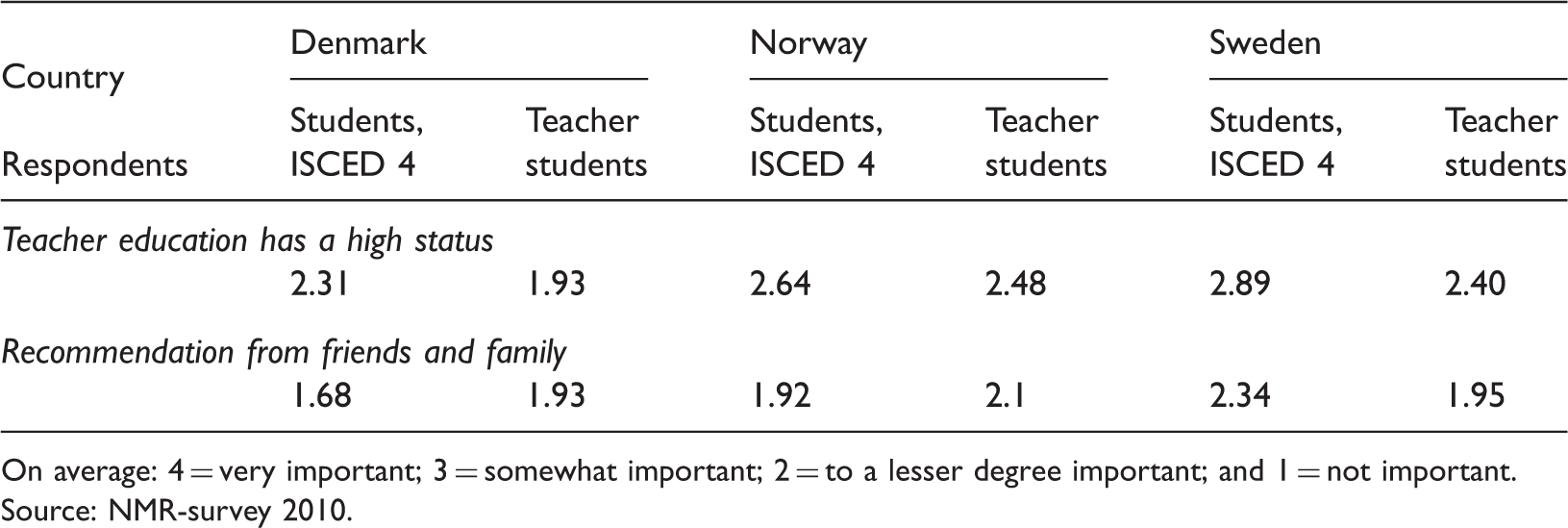
On average: 4 = very important; 3 = somewhat important; 2 = to a lesser degree important; and 1 = not important.
Source: NMR-survey 2010.
To what extent are the following aspects of a profession, in your opinion, important?
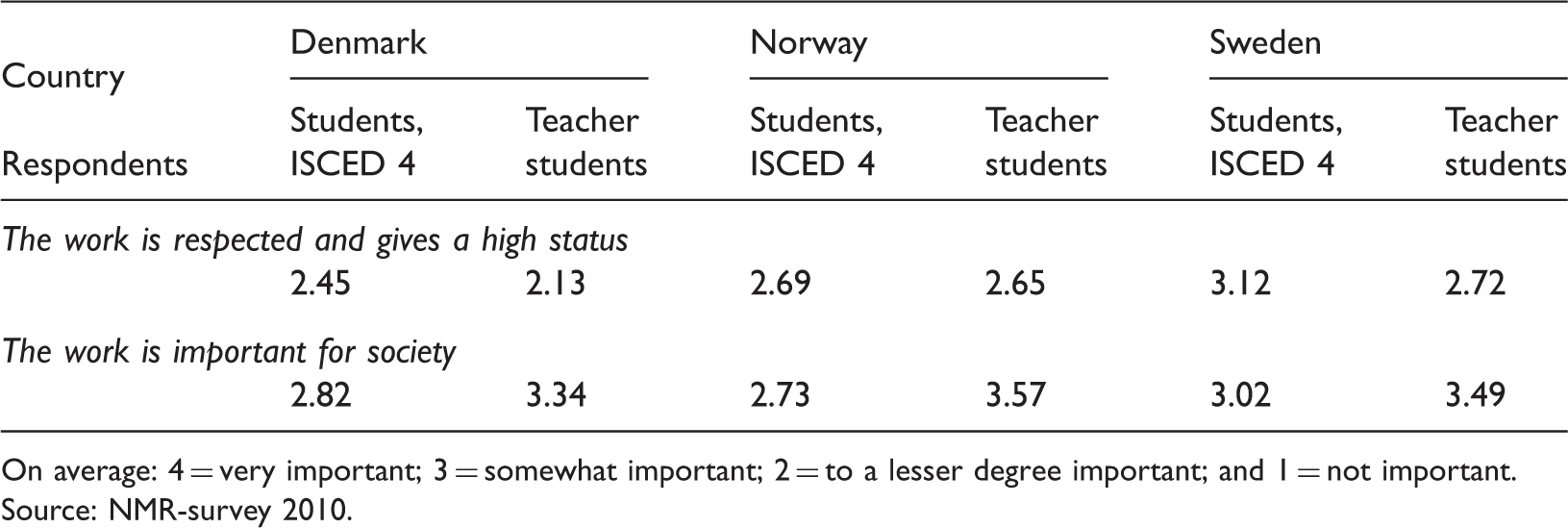
On average: 4 = very important; 3 = somewhat important; 2 = to a lesser degree important; and 1 = not important.
Source: NMR-survey 2010.
The results from both tables underline the fact that it can make a difference to a teacher’s professionalism whether the status of teacher education is conceptualised as important or not; it also defines who will enter the profession and why someone may want to enter the profession. This also affects levels of respect for the profession. Family members of teacher students seem to be quite critical of the profession. In the long run, this may mean that users of school services will increasingly contest the professional judgments and actions of teachers and, thus, the core value of professional autonomy. This happens because parents lose trust in the teachers.
A recent investigation into the relative income situation of teachers in primary schools in certain capital cities (Copenhagen, Oslo and Stockholm) showed a declining development (Werler, 2014). The historical development of teachers’ salaries compared to other occupational fields shows striking fluctuations (cyclically and temporally delayed). Labour unions’ wage negotiations seem to have been used over the years to reduce the comparatively good income situation of teachers. This contributed to the fact that teachers’ incomes moved from a relatively high position in the mid-1970s into the midfield by 2009. It is striking, in all four cases, that it was not possible for the teachers to increase their salary according to the increased length of both theoretical and practical training.
In the wake of new public management implementation, one finds new standards for the organisation and evaluation of a teachers’ work regarding who is to be held accountable for student performance. This can be highlighted as a significant stress factor within the profession. This top-down process can disempower the teacher when multiple tasks and the execution of those tasks is described by others (i.e. school administration). Beyond that, one will find an argumentation for increased decentralisation, but at the same time, this re-introduces centralisation by the implementation of funding for defined tasks. This conversion of professional actions into paid work brings teachers’ labour closer to Adcroft and Willis’ (2006) call for de-professionalisation.
These outlined changes in the form, content and autonomy of teacher education and work will, in the long run, serve to construct a new generation of teachers with different forms of knowledge, skills and professional values. Teacher education reform will alter the nature of teacher professionalism itself. Here, one can already see traces of commodification of individual professionals as the antithesis of professionalism (Abbott, 1988: 146; Freidson, 1984: 22).
Instrumentalisation of teacher education
In order to understand the effects of globalisation and marketisation in teacher education and teacher professionalism, it is useful to see higher education institutions as an imaginative space that is relatively autonomous and relatively insulated from direct political interventions. Historically, the activities in teacher education (in higher education institutions) have focused on the acquisition of the assets of value, which can be described in light of a normative and pragmatic understanding as Bildung. This pragmatic self-understanding of teacher education in higher education seems to be changing. Current reform efforts, such as the introduction of “learning sciences” (OECD, 2002, 2007), utilise teacher education as an instrument to govern the education sector.
This poses several challenges. These problems should be solved by the introduction of the traditional concept of academic recognition in teacher education. Traditionally, academic recognition was mainly acquired by the contribution of a new philosophical/ethical knowledge, peer recognition and/or the intellectual development of students. However, the immanent character of teacher education, as well as moderate motivated employees in teacher education, aggravates these efforts. Thus, one might be sceptical of teacher education with a pragmatic approach when it meets the expectations of instrumentalist research-based higher education.
But the forces of instrumentalisation (modularisation, quality descriptors, learning outcomes, credit transfer system, financing systems, monitoring, etc.) have seemingly impacted teacher education. They do not only alter the nature of rewards and sanctions in higher education but reconceptualise education as a tool. Increasingly, the academic success of teacher educators and students is no longer measured by academic standards but by industrial benchmarks and monitoring methods, in spite of the fact that these governance measurements are new arrivals in teacher education. The instrumentalisation of teacher education is conceptualised as the transformation of educational processes and the ability to build pedagogical relationships into a form that has an exchange value, rather than an intrinsic value. Here, teacher education can be seen as a new amalgamation of processes and knowledge that can be captured and packed in order to be bought or sold under market conditions; this can be carried out independently from the producer.
Since the beginning of the 21st century, one can identify processes of de-professionalisation (or proletarisation) that contradict the dynamics of the professional affirmation of teachers. This process has made teachers more like industry workers; they are less economically advantaged and experience pressure towards an increased workload. Beyond this, they have lost control over their preparation work and no longer have command over the essential elements of teaching. As attractive as this new administrative solution might sound, it does not acknowledge that it is the teacher who shapes the educational process in the end. Part of this development is the consequence of changing teacher education from the seminar level to the higher education level. From a governance point of view, this change should lead to teachers that can function as professional workers – skilled technicians of education who are able to follow guidelines and curricula.
Even if professionalism is an idea that points in many directions, it is crucial for teacher professionalism to point to teaching as a social form of organising knowledge and practical acting in order to qualify and cultivate students. In relation to this, one may ask why such a model appears to be under pressure, when professionalism is treated as an instrument that serves as a performing agent of different stakeholders. With this in mind, it is not merely the knowledge of teaching that gets packed to be sold; it is the educational relationship as such which is transformed into a relationship that is further transformed into a market of relations.
As soon as teacher education institutions, lecturers in teacher education or even teachers become the producer of the commodity, then the pedagogical relationship – as the core of teacher professionalism – becomes a commodity too. Not only does this imply that the students (the learner) are transformed into consumers of educational commodities, but even the pedagogical relationship disaggregates, since both parts (teacher educators/students) enter the situation with distinct and opposing interests (producer/consumer).
The commodified curriculum
Dichotonomy between traditional and commodified curricula.
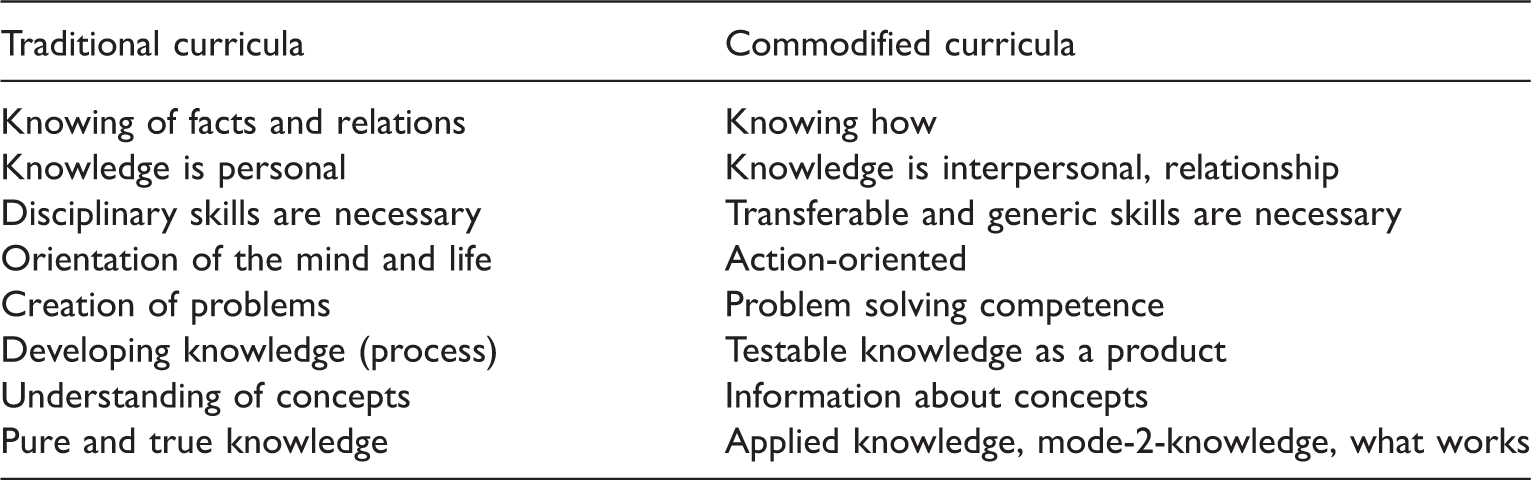
The dichotomous features listed in the table’s right column represent the commodified education skills, knowledge discourse and values of future teachers that might have the power to belittle them. All of these represent a curriculum that focuses on the readiness to teach after completing teacher education (Tatto et al., 2012).
The currently valid logic of teacher education seems to be the rationale of modern industrial production. It is primarily conceptualised as capable of producing expected learning outcomes. The aforementioned arguments and results indicate that the concept of technical rationality – as developed by Gary S. Becker (1976) – governs the educational arena (Werler and Birkeland, 2012). One could state that the institutions of teacher education were changed from being a “window to world” to a country’s employment training institute.
The commodified student
Over the past two decades there has been a remarkable shift in politically used stereotypes of students. There was a shift from the concept of becoming a student for self-cultivation and truth to becoming a market-oriented customer of learning opportunities. The symbolic figure of the “customer” has taken on a life of its own and plays an important role in the educational debate. A closer look into several European programs of teacher education (which followed the Bologna blue print) reveals that prospective students are confronted by curricula with economic terms like learning outcome, competence development or employability. To conclude, it is reasonable for the providers of teacher education to make use of a commercialised language when constructing new curricula. This new outline builds heavily on a redefinition of the citizen. Amongst others, Werler & Birkeland (2012) shows that the producing citizen, as well as the consuming customer, are the core units of the new state formation. As this supports the commodification of education (Ball, 2004), so it supports the commodification of students – into customers acquiring a certain knowledge-and-skill package to enable them to progress to the world of work. Here, knowledge is seen as the most important resource for teaching, and learning the most important process (Lundvall and Johnson, 1994). Educational quality is measured by the student experiences of teaching or/and by testing their knowledge. Indicators for the success of this managerial strategy in teacher education can be seen in single-minded strategy students. As with any other commodity, students want to have the greatest outcomes for their efforts. This creates a situation where the number of applicants for teacher education is declining whilst demand is increasing (Cramer et al., 2012; Werler et al., 2010). Beyond this, it seems to be reasonable to assume that students will act strategically or illegally to get as much out of the system (in terms of grades), while putting as little in as possible.
Learning is labour
As any other commodified system of teacher education, higher education institutions in Europe are in need of a currency. Such a currency was introduced in the wake of the Bologna Process. The following passage explains how the European Credit Transfer and Accumulation System (ECTS) works as currency for current teacher education (Kühl, 2014). According to the official publication of the European Communities, ECTS is “a tool that helps to design, describe, and deliver programs and award higher education qualifications” (European Communities, 2009). Already this short quote shows that earned and accumulated credit points have – typical of any currency – a value: certificates documenting student’s qualifications. Credit points are based on an average students’ workload in order to achieve expected learning outcomes. If students have completed a module consisting of different learning activities and documented by exams then they receive credit points. The basis for the award of ECTS credit points is the assumption of a workload that is measured in hours, which is necessary in order to complete a course. Typically, a higher education institution awards 60 ECTS points per year or per 1500–1800 hours. To obtain a Bachelor’s or Master’s degree, a student in Europe has to earn 240 plus 120 ECTS credit points. Thus, one can easily state that credit point work may be seen as an educational currency or as a “common currency” for European higher education (Adelman, 2009). It is interesting to note that the changed premises in this system, in as far as the ECTS is concerned, the focus shifts from teacher educators’ to teacher students’ quantifiable time consumption for learning. The educational currency has factors in common with other currencies, in that students can (and have to) collect ECTS credit points, and can transfer them from one institution to another within Europe. Having collected enough credit points, these can be exchanged into convertible BA or MA degrees. But, at a critical point, they differ from monetary assets. The exchange value of credit points is limited: the result of a learning process cannot be handed over to another person. Here, a second point becomes interesting. Whilst monetary systems are surveyed by several banks, credit points are managed by accreditation, quality assurance and evaluation systems in order to prevent “inflation” (Berlin Communiqué, 2003: 3).
Against the background of all the aforementioned arguments it becomes clear that learning in European institutions of higher education is treated as the equivalent to (paid) labour. Regarding this, and the concept of the exchange value of credit points, one can see that European politicians has adopted (nolens volens) the concept that the value of a commodity is not defined by its market-value, but by the amount of labour necessary to produce it (Marx, 1898). The central concept of ECTS seems to be that the value of a student’s performance is determined by the time the labour lasts (Marx, 1898) in order to learn or to develop competencies. This means that the value of learning is determined by the number of hours used for learning or competence development (i.e. practical) or, to put it in Marx’s terms, the “commodity is determined by the quantity of labour bestowed upon its production” (Marx, 1898).
The introduction of a highly complex system of higher education in the wake of the Bologna declaration (Bologna Declaration, 1999) created needs for the bureaucratic and economic control mechanisms. Such mechanisms are the concepts of ECTS and its learning-outcome descriptions. This system was supplemented by a grading system, informing the student about their academic performance and how well the allocated time for learning labour was used (Grosges and Barchiesi, 2007; Karran, 2004).
Educational commodification by learning outcomes
Much of public sector reform dealt with ill-defined problems of the welfare state. Traditionally, the solution for those problems was seen in the increase of resource use (use of staff, working hours, school year and budget). But, in as far as there is no solution for ill-defined problems, recent reform movements (underpinned by new public management) have changed the focus from input to output. In order to be able to deal with people’s perennial problems in welfare states, better-defined solutions are required. A viable answer can be seen in the bureaucratic approach of management by expectations (Romzeck and Dubnick, 1993). Applying this concept to education institutions, therefore, works with the central intention to steer actions of professionals in order to achieve a pre-defined set of expectations; for Parsons and Shils (1951: 53) “it is about the attainment of ends in situations”.
That is, that learning outcomes (which are in fact no more than expectations formulated by governmental bodies) stand out as better-defined solutions on behalf of politicians, administrators or interested stakeholders. A European learning-outcome-based educational policy began at the very moment when the Bologna Declaration (1999) was signed by the Ministers of Education in 1999. Learning outcomes are “statements of what the learner will know, understand and be able to demonstrate after completion of a programme of learning” (Rauhvargers et al., 2009: 81). An alternative document clearly defines the point that learning outcomes are statements of “what a learner knows, understands and is able to do on completion of a learning process” (European Commission, 2007: 15). This account reveals that the new focus of educational bureaucracy is on “acquired” or “applied” competences. It is worth noting that the concept of learning outcomes quantifies knowledge and provides and prescribes learning content. Knowledge defined by learning outcomes appears as objectified as well as measurable.
Seen from a quantitative point of view, learning outcomes operate as educational tools and as a significant prescription of the expected results of student learning. Seen from a qualitative point of view, they determine a curriculum and allow for administrative interventions in education (disempowering teachers). Looking into several European learning-outcome descriptions in European teacher education, it becomes clear that future teachers shall ensure the establishment of a producer/teacher–customer/learner relationship. It follows that learning outcomes, as a commodity, describe an economic exchange value since they work as totemic symbols for those who “teach” and “learn” them. In the long run, this will serve a new understanding of education, where teacher educators stand out as producers of the commodity “teacher knowledge and skills” and students befit its ownership.
Even if there is slight variation in the national application of the Bologna Declaration in European teacher education programs, there is a trend towards standardising the (national) preparation of teachers. The new learning-outcome-based curricula for teacher education privileges a more quantitative in substance at the expense of any qualitative aspects. They present and legitimate new knowledge forms through expectation-based construction, while their omnipresence signifies authority, legitimacy and validity. But in addition, the introduction of learning outcomes appears to reconstruct the teacher’s labour-power. Education appears as objectified; it is presented in the curricula as technical, accountable and measurable. The new mode of teacher education industrialises the production of future teachers’ knowings and doings. It functions as utility in order to create an exchange value. Learning-outcome-based teacher education presents itself as the application and practice of a new mode of dealing with ill-defined problems and may have the power to produce and reproduce commodification structures in education.
Commodification of teacher education: the costs
Because of the modularisation of teacher education, students today are considered to be consumers. Therefore, students will reject the traditional view that they will achieve schooling for the common public good. Instead, they have to make a private investment for their future. A consequence of this seems to be the fact that traditional power structures have been turned upside down. Students are evaluating the teaching they experience as well as the provider of the education. The problem here is that students may have difficulty in assessing what might be really important for them to learn in order to meet future needs. Further concerns are related to finding the balance between technocratic administration and pedagogical needs since there is a danger in reducing demands to the students (Werler and Birkeland, 2012).
The outlined commodification of teacher education refers to a deliberate transformation of the educational process into a commodity form in as far as the educational experience gets broken up into discrete and reified units. This causes the interruption of the fundamental educational process in teacher education since attention is shifted to production. Thus, teacher educators get turned into commodity producers and their students become consumers of commodities, as in any other industry. As a consequence, the relationship between teacher educator and teacher student is re-established as a market relationship. Accordingly, it is possible to understand education as a result of the mimetic construction of buying and selling of the commodity. One might wish to ask if the teacher educator’s labour might inevitably boost teacher’s proletariasation and de-professionalisation.
From this, we can learn that commodified teacher professionalism will not only cause a situation where neo-liberalists can behave like neo-liberalists, but could also create a situation where everyone is forced to behave like a neo-liberalist. But what might be at stake here? First, students will learn to think like selfish consumers. And consequently, teachers will be forced to think and act like profit-maximising entrepreneurs. Accordingly, teachers need to think of their teaching as a competitive activity. Those who do not bow to the competition logic will lose their status.
Footnotes
Declaration of Conflicting Interests
The author(s) declared no potential conflicts of interest with respect to the research, authorship, and/or publication of this article.
Funding
The author(s) received no financial support for the research, authorship, and/or publication of this article.