




Abstract
We Love Weather is the fan community of The Weather Channel. Launched in 2016, We Love Weather aims to serve so-called “weather geeks” by providing exclusive and specialized weather content, as well as participatory and communal elements. This study proposes that We Love Weather is an “affinity space” where participants create, procure, and develop content and knowledge. It exemplifies the power and capability of a high-functioning, efficient online information hub. Using digital ethnographic analysis of We Love Weather’s discussion forums and user-generated content, we found that We Love Weather promotes teaching and learning of weather information through sharing and community maintenance that establishes the site as an affinity space. It is an example of a positive, helpful, and deliberative online space.
Introduction
“Thundersnow” is a meteorological phenomenon. It occurs only 6.4 times per year in the United States (Market et al., 2006). It requires unique elements for development: fast-moving cold air colliding with warm air, and lifting into the atmosphere with enough force to separate electrical charges within the cloud (Schultz and Vavrek, 2009). Making it even more elusive is the sound effect of snow, muffling the thunder’s roll so it can only be heard within 2–3 miles of the strike (Market et al., 2006). But if thundersnow is so rare, why is it mentioned so often in the media and pop culture?
Enter The Weather Channel’s (TWC) Jim Cantore.
On 15 February 2015, as Cantore covered a major snowstorm in Plymouth, Mass., cameras captured him standing in a driving snow squall, bundled in winter gear as ice covered his goggles and hardened on his beard, when suddenly the sky illuminated and thundersnow rumbled. Although this wasn’t his first on-camera bout with thundersnow, it soon became his most famous. Cantore shouted “YES! We got it baby!”, pumping his fists in a frenzy. Cantore’s joy lasted several more minutes as the longtime meteorologist experienced an unheard-of six total thundersnow events, all captured on camera (Fritz, 2015).
Given its rarity and Cantore’s reaction, the thundersnow footage immediately went viral, receiving more than 4.8 million views on YouTube (The Weather Channel, 2015).The video moved beyond the weather community, generating a pop culture following. Within a week, YouTube user schmoyoho created an Auto-Tune song called “Thundersnow!” using Cantore’s audio, and it, too, went “viral,” garnering more than 2.1 million views. The moment generated more YouTube “remixes” and popular GIFs and memes, placing Cantore in the eye of a pop-culture cyclone typically reserved for movie icons and rock stars (Fritz, 2015). In this digital age, “weather geeks” are emerging from the cultural fray of the media and creating their own fan-like communities.
Media scholars frequently study fan communities in order to connect societal issues to mass media. Although the relationship between fans and media has existed for several decades, the participatory web and social media have rearranged this landscape. These technological evolutions enabling never-before-seen levels of information sharing and creation, coupled with extreme weather events in recent years, have led to the creation of weather communities, which increasingly mirror traditional fan communities, such as those devoted to sports, music, books, and film (Shepherd, 2016a). Among the more notable online weather fan communities is TWC’s We Love Weather (WLW), on which fans are encouraged to “celebrate” their “excitement of all things weather.”
This study analyzed WLW discussion board posts through digital ethnography. The observations were assessed to examine WLW as an affinity space and to consider its role in the online distribution of weather information. Online weather fan communities merit scholarly attention because of their ability to disseminate news and information and to create knowledge that is useful to the media and the public.
Literature review
Fandom
Fans are loyal and engaged individuals who create interpretive, purposeful communities identified by their intense level of interest in a subject that goes beyond common consumption (Gray et al., 2017). This interest is emotionally fueled and void of rationale, akin to a sports fan believing that a “good luck charm” influences a game. Fans display loyalty in public interactions, such as when fans wearing their favorite team’s gear acknowledge each other at a grocery store (Gray et al., 2017).
Fan communities were initially stereotyped by the mass media, who assigned these groups negative monikers, such as Maureen Callahan’s (2005) New York Post piece describing Harry Potter fans as “Potterheads” while comparing them to “Trekkies,” those who adore the sci-fi series Star Trek. Furthermore, Fried (2003) found that the mass media portrayed subsets of large fan groups, such as young music fans, as outcasts and even dangers to society. Fans are often treated as marginalized “others” who do not fit in. This treatment has traditionally isolated these communities. However, fueled by the connectivity and innovation of the internet, the mainstream media now regularly celebrate fandoms, perhaps due to their advertising and marketing appeal (Gray et al., 2017). Furthermore, the mass adoption of streaming services such as Netflix and Disney Plus encourages binge watching by offering on-demand, high-quality access to longtime fan favorites such as the Star Wars and Marvel franchises (Jenner, 2017). Fan communities no longer exist on the margins; they are the mainstream. And the media industry—including TWC—has acquiesced.
Online fan communities
According to Gray et al. (2017), “most people are fans of something,” and fandom is often formed through a symbiotic relationship with media (1). While fan communities existed long before the ability to organize online, the internet revolutionized the field (Hellekson and Busse, 2006). In the internet age, fan studies have shifted course to explore the dynamic, expansive, and evolving landscape of online fan communities (Busse and Gray, 2011). Fans are now capable of more than just text-only fan fiction or letters. Today’s tech-savvy fans create polished content including YouTube videos, dynamic social media profiles, and cutting-edge blogs (Baym, 2007). Low-cost digital tools produce more professional, shimmering content with great efficiency and creativity (Literat and Glaveanu, 2018; Papacharissi, 2012; Postigo, 2007).
These web-inspired online fan communities, fueled by fans’ acute interest in a shared topic, often generate close friendships and a sense of belonging among participants (Baym, 2007). Fans are also no longer limited by proximity, thanks to online connectivity (Baym, 2007). Relationships established in online fan communities often translate to offline interactions fueled by consistent, intense interactions, which in turn enhance participants’ social capital, confidence, and ties to the community (Shen and Cage, 2015; Xie, 2008). Online fan practices, which once exclusively focused on fictional work, such as content production, character adoration, identity construction, and emotional connection, now include communities devoted to non-fiction content (Barnes, 2014). These communities are fertile grounds for centralizing production and discussion related to many interests (Porter, 2006). This study examines a non-fiction fan community centered around a unique fan interest – weather.
Affinity space
Online fan communities are prime spaces for learning and knowledge creation, which lie at the heart of an affinity space. Gee (2004) described an affinity space as “a place or set of places where people affiliate with others based primarily on shared activities, interests and goals” (67). Fandom often drives affinity spaces, such as fan-fiction forums, where participants not only serve as creators, but also monitors and mentors (Black, 2006). An affinity space shares many traits with a typical fan community, such as mutual interests, loyalty, and passion. Gee (2004) describes an affinity space as an “interest-driven, passion-fueled site” that advances knowledge through positive and productive interactions users perceive as authentic (Curwood et al., 2013). Participants “create knowledge” through interaction, production, and outreach, shifting the community from one that admires to one that influences (Gee and Hayes, 2012).
Affinity spaces emphasize the subject and substance of interest to people and shift attention away from identities that separate people, such as age, race, and class (Gee, 2004). The passion and devotion of participants supersedes these divisions by placing greater emphasis on skill and expertise (Black, 2006). This establishes an informal hierarchy by which the community abides and opens channels for the free sharing of ideas, opinions, and content where the most senior participants are interacting with “newbies” and encouraging further development of the space (Gee and Hayes, 2012).
According to Gee (2004), “intensive” and “extensive knowledge” are critical to affinity spaces. Extensive knowledge refers to broad but surface-level intelligence concerning various topics of importance to the community, while intensive knowledge is expert-level understanding of more acute topical elements (Gee, 2004). Lastly, tacit knowledge based on experience is encouraged, honored, and dispersed to users through varying community routines (Gee, 2007). This study positions WLW as an affinity space where participants teach, learn, and create weather information in a supportive, innovative environment.
Fan labor as gifts
Fandom is driven by a shared economy in which fans produce “gifts” that are given to a particular entity, such as a media outlet, and reciprocated by that entity (Turk, 2013). These gifts are often “art objects” such as fan fiction, drawings, and videos (Turk, 2013). When fans receive gifts and repurpose them for their benefit, they are (ideally) reciprocated with tangible gifts (e.g. pay) and/or intangible gifts, such as recognition, feedback, and/or prestige. Fans value gifts created “by fans for fans” more than commercially produced ones (Hellekson, 2009).
However, media fandom generates more than just “art objects” (Turk, 2013). For example, news outlets can use fan-produced storm reports, text-transmitted observations, and personal weather station data as “gifts” (Holton et al., 2015). This participatory journalism goes beyond the traditional parameters of fan work and provides news outlets with valuable information to enhance their coverage (Turk, 2013). This, in turn, positions members of the public as “produsers” who not only consume, but also produce content (Bird, 2011). Fan entities, such as discussion boards and media outlets, are the primary receivers of these gifts and control the most valued reciprocation (Galuszka, 2015).
“Weather geeks”
Major weather events, such as 2012’s Hurricane/Superstorm Sandy, the record-setting hurricane season of 2017 and burgeoning debate over climate change, have made weather news and information more salient in recent years (Stewart et al., 2012). Increased interest, coupled with media-rich weather content, has created an opportunistic environment for both producers and consumers operating within the weather community. Weather professionals and lay enthusiasts have proliferated through traditional and social media, including blogs and podcasts (Shepherd, 2016a, 2016b). The more “die-hard” proudly bear the label “weather geeks” to project a certain identity both in and out of this network (Hoffman et al., 2017). “Weather geeks” are not exclusive to the National Weather Service; anyone can self-identify as a “geek,” which can be problematic in the era of “fake news” (Shepherd, 2017).
Weather networks anchored by trained storm “spotters,” many of whom operate in-home weather stations, have existed for decades (Doswell et al., 1999). As of 2017, the National Weather Service’s SKYWARN program boasted between 350,000 and 400,000 spotters nationwide (U.S. Department of Commerce, n.d.). These networks—led by a legion of “weather geeks”—have capitalized on participatory digital tools by establishing blogs, producing podcasts, and harnessing the networking power of social media to disseminate information to a wide audience (Gharesifard and Wehn, 2016).
WLW
The media industry has taken note of “weather geeks.” Top web-only news destinations such as Slate and Mashable have established weather-information presences by adding established weather bloggers Eric Holthaus (Slate) and Andrew Freedman (Mashable) and staking their weather vanes in the social “media-rology” landscape (O’Donovan, 2014; Warzel, 2014). In 2008, the Washington Post purchased what would become Capital Weather Gang, a D.C.-based weather blog known for weather “explainers” and social media output that has built a national following of more than one million readers (Owens, 2017).
This renewed public interest in weather has carried over to television, which only recently was challenged by mobile apps as the top source of weather information (Hickey, 2015). In 2016, as another appeal to “weather geeks,” The Weather Company, launched WLW, a web-based community for “those passionate about weather to compare notes, share images, and have conversations on everything from weather patterns, to severe weather, to Q & As with their favorite on–air meteorologists” (IfThen, 2016).
WLW features weather stories and video from weather.com and offers additional exclusive content for weather geeks. One example is “Shop Talk,” a recurring video series featuring TWC meteorologists discussing weather phenomena. Beyond its website, WLW also maintains a social media presence on Twitter, Facebook, and Instagram. Perhaps the most intriguing section of WLW is its “Community,” consisting primarily of a fan discussion board. Here, common posts find users critiquing meteorologists, asking weather-career advice, and swapping harrowing weather stories.
WLW is one example of a growing field of science-focused online communities that are part of the “cyberscience” phenomenon (Masters et al., 2016). These communities tend to be social and informal epicenters of learning through collaboration and even mentoring (Jennett et al., 2016; Liberatore et al., 2018). WLW offers a unique hybrid of online community attributes scholars have yet to explore. It features the collaborative learning environments of “citizen cyberscience” alongside characteristics of pop-culture-like fan communities, while simultaneously serving TWC as a multimedia hub (Masters et al., 2016). This study examines WLW’s roles as a hotbed of learning, entertainment, and production.
Research questions
Method
This study employed digital ethnography to collect and analyze digital artifacts of the WeLoveWeather.tv community forum. This technique allows researchers to observe participant activity and gather data for qualitative analysis with the flexibility to adapt their focus to various types of content (Gerber et al., 2016). We elected to conduct our research of WLW’s community, specifically its discussion boards, as observers. We acknowledge that “observation only” is traditionally not ethnographic. However, digital ethnography is still evolving, and there is a body of literature that suggests immersion in an online community with a cloak of digital invisibility affords researchers an opportunity for more natural observation (Varis, 2016).Therefore, we did not post or interact in any way with community members in order to avoid disturbing the authenticity of the community’s interactions. We also elected to only be observers because the first author is an existing and participating member of the WLW community. Additionally, some view this methodology as “lurking” that is problematic for community participants’ privacy. WLW is a public space because, even though the community can only be accessed by creating a member profile, it is free of charge and does not require any sort of formal credentials beyond having a verifiable email address. Furthermore, we only quoted and identified WLW participants by their public usernames, as opposed to using their real names or other potentially identifying information.
It is also important to note that the authors have experience researching both weather and fandom. The first author has studied and presented research about weather-related media, while the second author has studied and presented research about fan cultures and communities. They combined this experience to make informed methodological decisions and key observations while conducting this research.
Prior to coding discussion board posts, the authors created a coding scheme based on the existing literature corroborating their theoretical and empirical focuses concerning affinity spaces and fan gifts. This resulted in four overarching categories: fostering community (Gee and Hayes, 2012); sharing knowledge (Lammers et al., 2013); user-generated content (Barnes, 2014); and Fan labor (Hellekson, 2009; Knobel and Lankshear, 2010; Turk, 2013). They then identified specific elements of each category using the literature to add clarity and definition for the coding process (see Table 1).
Discussion board coding scheme in relation to research questions, categories, defining questions, and supporting literature.

Once the codebook was developed, both authors independently conducted a qualitative textual analysis of the discussion board posts collected during ethnographic observation. Starting with the first post on 22 July 2016, and continuing through posts made on 31 March 2018, each author reviewed a total of 1923 topic threads, noting the title of each to determine the community discussion’s top-level themes. Threads were monitored as long as possible to account for any major shifts in discussion prompted by weather events. Following the independent review of these top-level themes, each author independently reviewed topic threads related to these themes and the theoretical model. This involved “clicking through” to topic threads and reading individual posts. Following the individual coding, the authors discussed and processed their independent findings, before reconciling the data for applicability to the guiding research questions.
Results
For RQ1, we applied affinity space theory to examine how WLW’s fan community is organized and sustained.
Fostering community
Encouragement
TWC’s WLW fan community must be one of the friendliest places on the internet. It is the Disneyland of online forums. WLW is a place where minor gripes are taken seriously and sympathetically, where punny weather jokes appear when least expected, where members remember each other and the details of others’ lives across threads and time and where members share both a passion for weather and an internalized code of conduct dominated by polite discourse. Members treat each other like digital neighbors, and they share even the most minor parts of their lives that are related to weather.
One of the ways members maintain a tone of overt friendliness is through encouragement of each other and TWC staff. One notable example of praise for TWC’s stars can be seen in the overwhelmingly positives responses to a Q&A series called “Women in Weather” that celebrated the station’s female on-air meteorologists. One discussion leader, AndyMoserWX, left a paragraph-long comment below each of the seven profiles in the series full of unique details he appreciated about each woman. For example, in response to the post about meteorologist Dr Erika Navarro, AndyMoserWX wrote: “… Your zealotry for both weather and science inspires me a lot … You are the master of hurricanes at TWC. I am proud to watch and listen to you on TWC. Keep it up! #5starrating” (26 March 2018, comment on Women in Weather, 2018).
Although both male and female Weather Channel favorites appear regularly in forum posts, female TWC staff tend to receive special attention from online fans. “Girls can do anything, especially weather like the Weather Channel Gals who rule this meteorological world!,” wrote WeatherWizard109. “Thanks WX Channel females, for showing just how amazing weather and girl power can be! #yougogirl #ladythunder #girlsrule” (29 March 2018, comment on Re: Women in Weather, 2018).
On the rare occasion when a community member shares something negative, another member is likely to jump in and push the conversation back to positive. When one member complained about the way on-air meteorologist Liana Brackett pronounces the letter S, AndyMoserWX quickly responded, “please respect Liana like we would do for any other woman in weather. Thank you” (26 March 2018, comment on Liana needs to work on her sibilance. Those “s” are not good for TV I’m afraid to say. 2018). The community’s fans also encourage each other in small but notable ways, such as when members and moderators cheer each other up about bad weather in their areas. “Stay warm out there!” responded a moderator to a member who shared how cold it was in Michigan (3 January 2018, comment on Re: COLD 2018).
In another example, one member asked the community about thundersnow. Rather than respond that it’s exactly what it sounds like, a detailed 260-word response praised the original question, explained thundersnow, and concluded with, “Thanks for your wonderful question! You are welcome!” (10 March 2018, comment on What is THUNDERSNOW??? 2018).
Statements of passion
It goes without saying that the members of the WLW community are very passionate about weather. However, they are almost, if not equally, as passionate about the medium through which they get their weather news, TWC. Members make this clear in overt ways, such as creating one-off hashtags that praise the channel, its staff, and the forum itself, and in more subtle ways, such as the amount of time fans devote to the forum, the new features they request from forum administrators, and the overwhelmingly positive tone of interactions across the forum. Emojis and exclamation points abound. Personal weather testimonials appear commonly throughout threads, especially when new members join and introduce themselves to the community. “I watch the weather channel every change [sic] I get,” wrote one member. “I love learning about clouds, tracking storms, lighting, rain, also all the special shows about the weather. So much just can’t name everything” (29 March 2018, comment on Re: Women in Weather: Jen Carfagno 2018).
Community members can barely contain their weather passion. For example, member Maxweatherman began a thread with the title: “I LOVE WEATHER MORE THAN ANYBODY” only to ask a simple hurricane question (29 August 2018, comment on I LOVE WEATHER MORE THAN ANYBODY 2018).
Discussion leaders
Although members of the WLW community are identified with equal status through the “Member” label below their usernames on each post, some members have distinguished themselves as clear discussion leaders. Discussion leaders on the forum earn their status in a number of key ways, including seniority (the length of time they have been a part of the community), frequency of new threads (super members are often the first to launch a new topic), frequency of interactions (they are also often the first to respond to another’s thread), and knowledge (the amount of information they collect and share with others in the community). These factors make it easy to identify discussion leaders, whose profile pictures also appear over and over again between and within threads. Members who fulfill smaller roles within the community tend not to customize their profile pages or upload profile photos, and the tones with which they communicate do not feature the same level of expertise and community experience.
Sharing knowledge
For RQ2, we applied definitions of knowledge from affinity space theory (Gee, 2004) to investigate how WLW participants share and develop knowledge.
Dispersed knowledge
WLW participants are clearly well-connected within the weather community, as indicated by their propensity to recommend one another to external sources of information, products, self-promotion, and even activism. Participants frequently share basic information accessible to anyone through Google. This includes random lists of a participant’s favorite websites, a link to an explainer piece on what a 50% chance of rain really means, and links to college meteorology programs. In addition, participants share links to weather-related products, such as at-home weather stations and weather radios, with an occasional nod to more advanced weather-tracking software and apps. WLW/TWC staff do, however, make clear that TWC does not endorse any particular products (19 April 2017, comment on Re: Questions 2017).
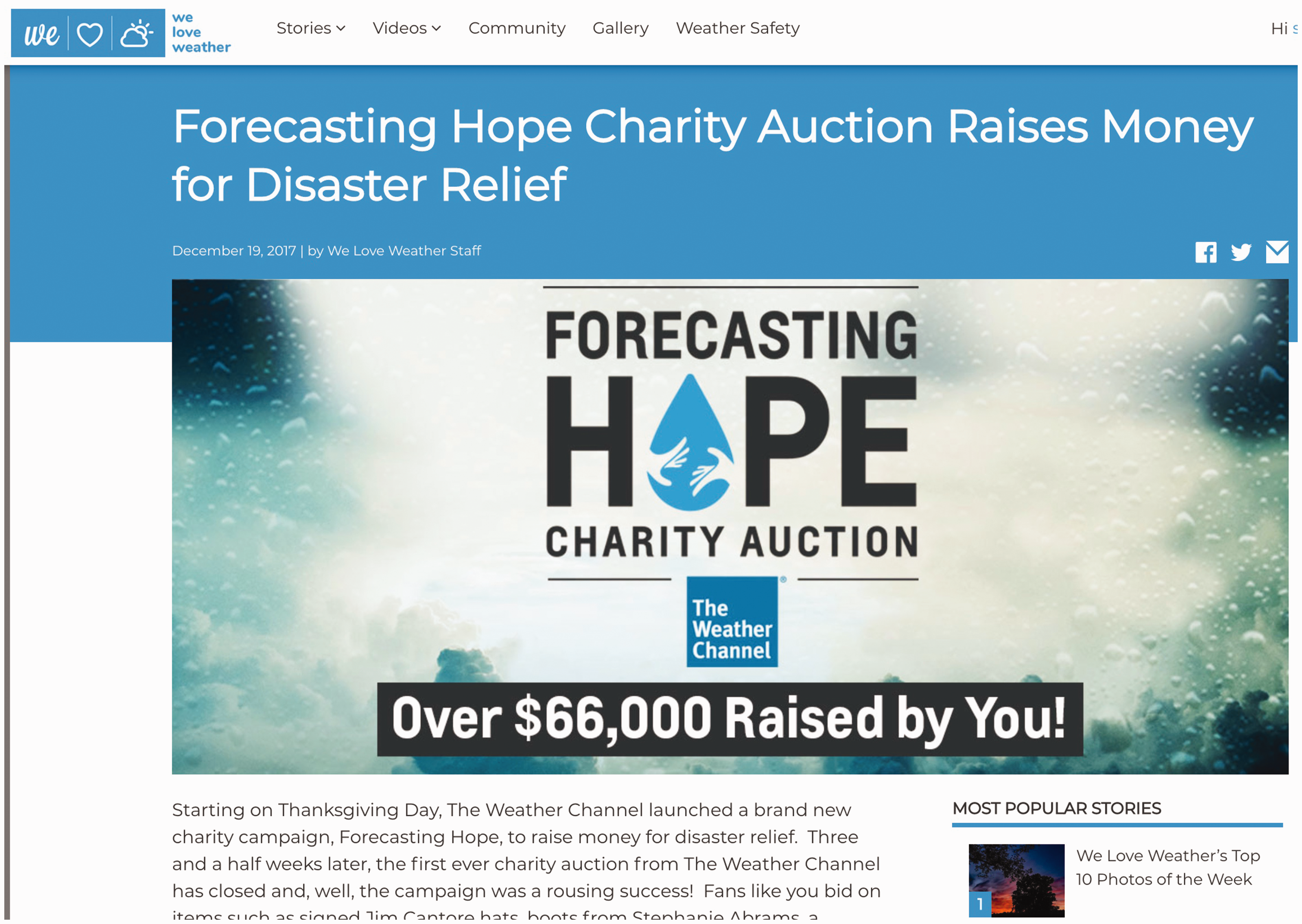
Many WLW participants appear also to be well-established in the weather community. It is not unusual to see posts promoting a member’s social media pages, podcast, blog, YouTube channel, and even real-time streaming events. Some approach the forum as if it were a LinkedIn for weather, and this behavior is typically well-received by other participants, who engage with positive feedback and questions. Finally, WLW has served as a central area for TWC’s “Forecasting Hope” auction that raised money for various charities in the wake of the record-setting 2017 hurricane season (The Weather Channel Television Network, n.d.). Through more than 1800 bids, Forecasting Hope raised more than $66,000 by auctioning off TWC-related items, including on-air meteorologists’ storm gear and live video chats with TWC personnel and more (see Figure 1). Additional WLW posts encouraged activism opportunities, such as becoming involved with the American Red Cross, securing funding for weather research, and training to be a storm spotter.
We Love Weather's Forecasting Hope page.
Tacit knowledge
WLW participants take pride in their ability to report weather from their areas, ranging from simple observations to complicated explanations of data from their personal weather stations. Users add specific location information to lend credence to their claims. These weather experiences are shared frequently, especially in the case of extreme weather, such as very high temperatures or large total inches from major snowstorms. These results are acknowledged with follow-up questions and gratitude, but are rarely questioned.
WLW participants are eager to share their knowledge, especially regarding emergency concerns. For example, in days before Hurricane Irma’s landfall in September 2017, WLW member kenmogul23 posted: I’m in Naples…if I look at the worst case scenario storm surge maps, it says I am in a zone where I can expect up to ten feet. http://www.nhc.noaa.gov/nationalsurge/ So does that mean that I am OK because I am at 14 feet and therefore a ten foot surge won’t get to me. Or does the map mean that I can expect to experience 10 feet of water on top of where I am at 14 feet above sea level? (9 September 2017, Comment on Storm susrge [sic] map interpretation confusion 2017)
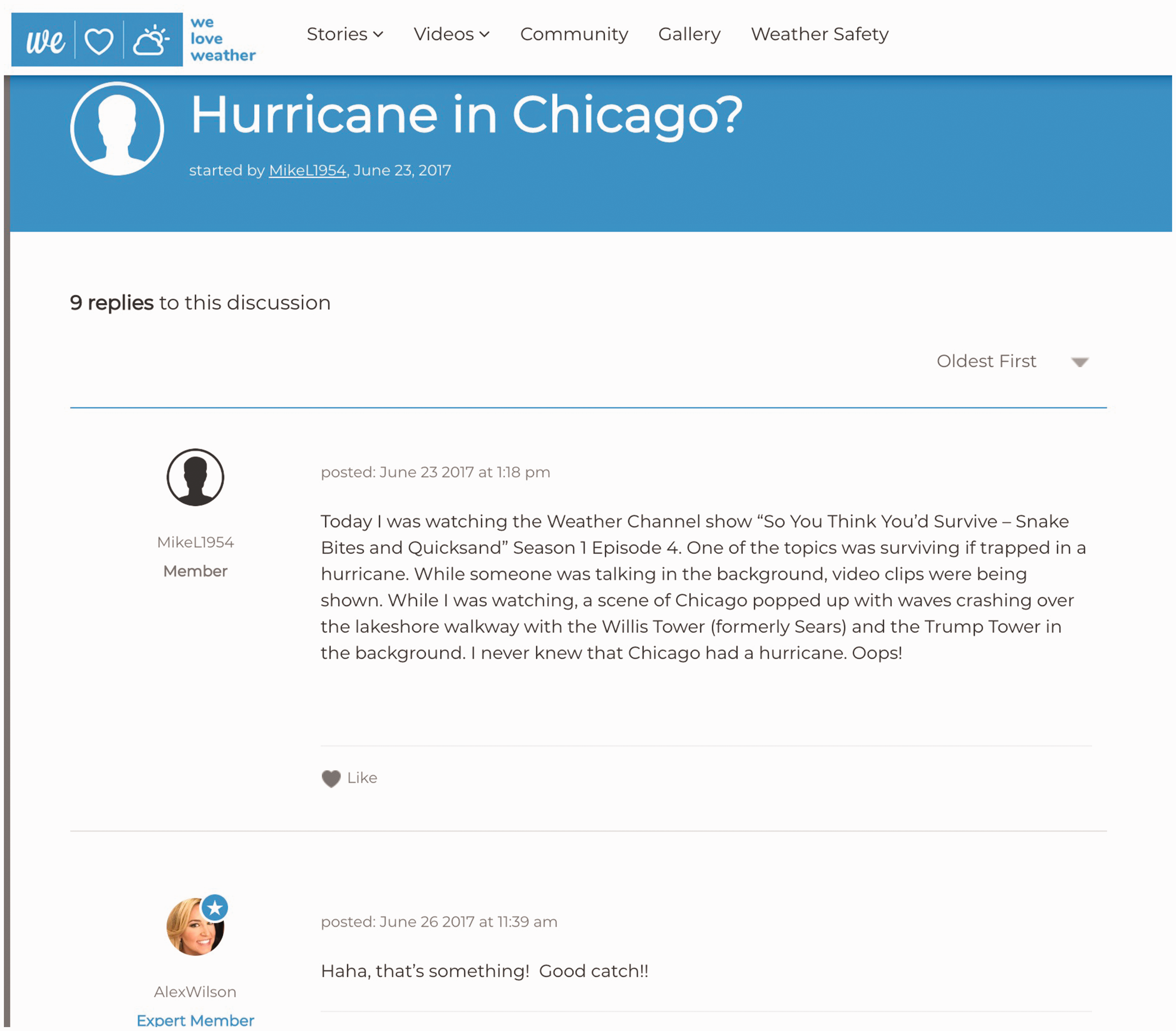
In less extreme situations, WLW participants share all three types of knowledge—tacit, dispersed, and explicit—to be helpful when a participant is curious or seeks clarity. For example, member MikeL1954 posted that he was watching the show “So You Think You’d Survive?” on TWC and saw background footage of waves crashing on the Lake Michigan shore with Chicago’s iconic skyline in the background. He asked if it was even possible for a hurricane to form that could strike Chicago. Responses to what meteorologists might regard as a silly question began rolling in, and not one was negative. On-camera meteorologist Alex Wilson wrote that MikeL1954’s observation of the Chicago footage was a “good catch” (26 June 2017, comment on Re: Hurricane in Chicago? 2017) (see Figure 2), and MikeL1954 suggested the issue could be “handled” on TWC’s “Weather Underground” show, for which Wilson is host (29 June 2017, comment on Re: Hurricane in Chicago? 2017). In a second response to MikeL1954 in the same thread, Wilson replied: “Good idea!! We’ll have to put Dr. Knabb and Dr. Navarro on it!” (29 June 2017, comment on Re: Hurricane in Chicago? 2017), a reference to on-air meteorologists who regularly appear on the show. In one discussion thread, participants with different levels of expertise, skill, and occupational identity united over a single topic to exchange ideas, ask questions, and offer suggestions utilizing tacit, explicit, and dispersed knowledge.
User MikeL1954's post “Hurricane in Chicago?”
Explicit knowledge
As demonstrated in the Chicago hurricane post, WLW participants are eager to help others, no matter their skill level or tenure in the WLW community. In fact, many posts from both WLW/TWC staff and general members express pride in welcoming “newbies” seeking information on the field of meteorology. For example, one member, s754263, posted: “Hello fellow weather friends, I was wondering what I need to do to become a meteorologist? I am in 3rd grade and would like any suggestions” (21 May 2017, comment on Hello:) 2017). The third grader soon received responses from TWC on-air meteorologists Liana Brackett and Alex Wilson and a high-frequency discussion leader, who offered praise, encouragement, and suggestions.
Beyond “newbies,” WLW participants help each other navigate the site by explaining how to follow discussion threads, post multimedia, and even delete their WLW accounts. There are even instructions in the discussion area on weather-related hacks, such as how to treat a burn suffered on a skiing trip or prepare for a camping trip when weather is iffy.
User-generated content
For RQ3, we assessed the production and interaction of WLW members’ user-generated content.
Participant production
WLW is a welcoming-environment for a variety of user-generated content, but the forum appears to place great emphasis on visuals—particularly photos. Merely logging on to the WLW home page makes this clear, as large photos and videos serve as links to help participants navigate the site. At the top of the home page are links to the main pages—Stories, Videos, Community, Gallery, Weather Safety, and Upload. With the exception of Weather Safety, five of the six links relate in some way to participant-created content.
Every Wednesday, WLW selects the 10 best user-uploaded photos, which are then placed in a Google Slides widget with the WLW participant’s name and location. Participants then vote for the top photo, and the winning photo is shared weekly on WLW’s Facebook and Twitter accounts. The photos featured on the site—especially those in the weekly top 10—often appear to be far better than amateur. These user-generated images are rich in color and texture and are taken from a variety of different angles and viewpoints. There are many photos of distant landscapes shot at dusk or dawn that fit nicely into the “sunset” or “sunrise” categories, respectfully. Other photos show weather “in-progress,” such as driving rain, rising waters, and the occasional tornado touchdown. Yet another informal category appears to be weather aftermaths, including the results of storm damage and wooden rulers staked in inches of snow. These photos are as informative as they are artistic.
Production interaction
Mechanisms built into the WLW platform elevate participant content to the forefront, especially photos. Participants can also add comments and share photos from the galleries simply by clicking the Facebook, Twitter, and email buttons on each picture. There are very few comments on photos in the community gallery; those available are short hits like “beautiful!” or “wow!”.
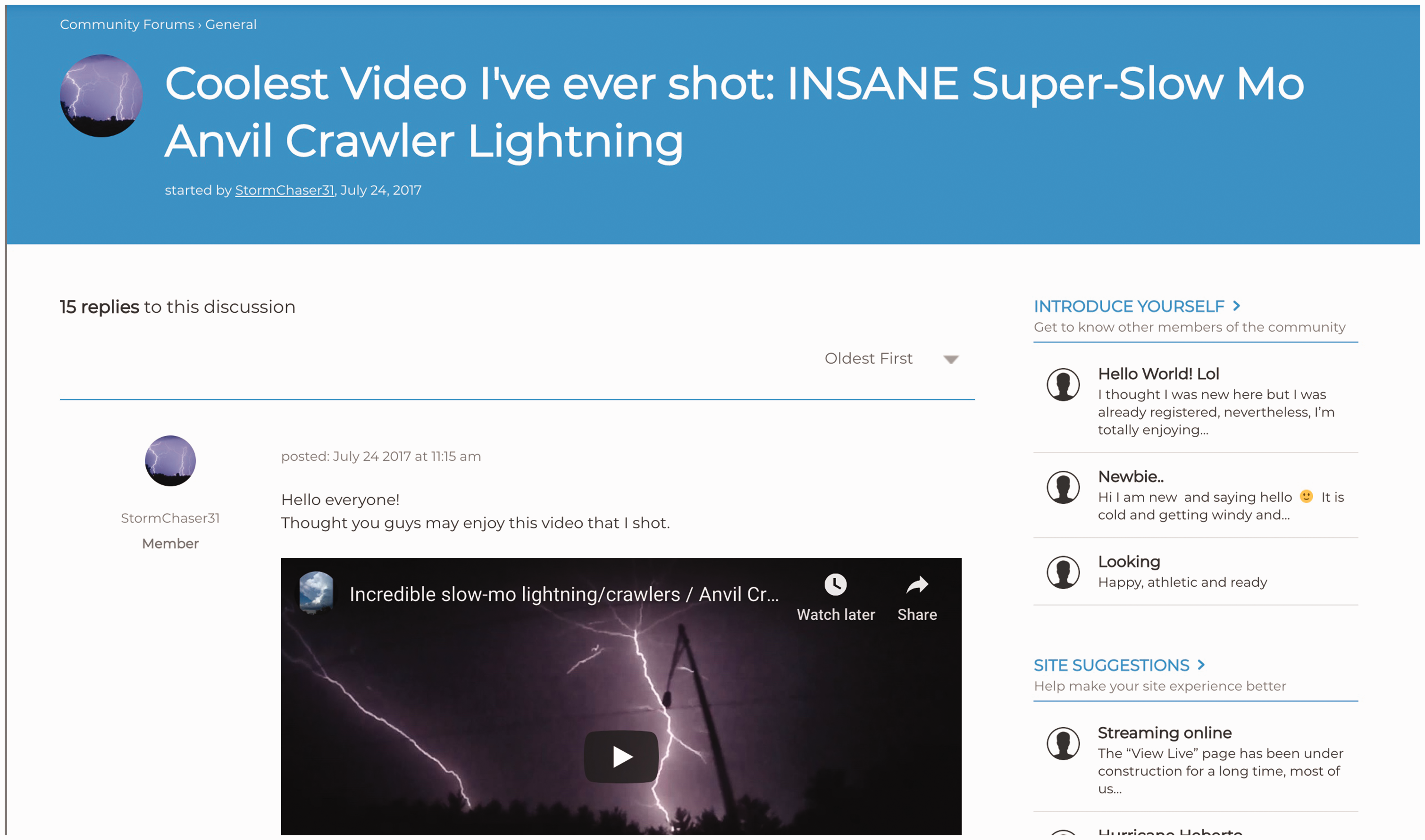
However, participant production interactivity within the discussion area is more engaging and spirited. Participants who share their work on WLW can expect appreciation from both peers and moderators, as well as comments and critiques from other members. For example, member stormchaser31 posted a video of “anvil crawler lightning,” which features a bolt cutting through the middle of the frame followed by tiny bolts scattering into the night sky (see Figure 3). This video represents the higher end of WLW user content quality, because it features a “super slo-mo” effect that enhances the drama of the lightning. On-air meteorologist Dr Ericka Navarro replied to stormchaser31, “Amazing video! I especially loved the branches of intra-cloud lightning originating from the main bolt near the beginning of the video! Really great, and please be safe out there!!” (24 July 2017, comment on Re: Coolest Video I’ve ever shot: INSANE Super-Slow Mo Anvil Crawler Lightning 2017). Similar comments praised the participant’s skill and luck. This granular, detailed and encouraging criticism is evident throughout WLW.
User StormChaser31's post “Coolest Video I've ever shot: INSANE Super-Slow Mo Anvil Crawler Lightning
Fan labor
For RQ4, we assessed fan labor and gifts by determining reciprocity between TWC and its content-creating fans.
Fan gifts
WLW is a bustling trade post in the weather community’s information exchange, making the community flush with weather content. This primarily includes photos and weather observations. TWC makes good use of this content, pushing it out over social media, on its website, and occasionally on its television network. Whether or not the content is selected for amplification through a TWC-branded channel, participants keep coming back to WLW to share photos. As of 31 March 2018, the WLW community photo area boasted nearly 18,000 user-produced images.
Reciprocation
In return for their work, WLW participants receive a variety of reciprocations from TWC and the WLW community at large. The kind and appreciative tone of the WLW community is evident in WLW and TWC responses to participant content; producers and on-air personalities alike compliment fan-produced content.
WLW offers content-producing participants the chance to interact with TWC personnel, such as producers, web editors, and on-air personalities. These interactions function as one reward for those who produce content, and WLW participants are eager to share contributions. Take member Cher, who wrote: “I have even set a goal to one day be one of the featured Top 10 Fan Photo and have my image(s) displayed on TV during your weather segments!!” (27 July 2016, comment on Re: Hi, I’m Michael. Ask me about design 2016).
Discussion
This study examined discussion boards and related content from TWC’s online WLW fan community using a theoretical model founded on Gee’s (2004) affinity space theory. The results indicate that WLW is an affinity space comprised of highly active and passionate fans participating as both users and producers.
WLW is undoubtedly a fan community, as evidenced by the intensity, passion, and knowledge of its participants. This fandom manifests in multiple ways, such as adoration of TWC and its personnel and expressions of a true love of weather. The community, by and large, is aware of this “love” and is quick to identify how members are “othered” by the mainstream population, frequently (and proudly) referring to themselves as weather “geeks” or “nerds.” WLW is unique as a fan community in that its unifying topic—weather—is not fictional. Instead, it is undeniably real, backed by time-tested scientific evidence. This allows for discussion and knowledge creation that go beyond the online space and enter the public sphere through the many TWC channels, where they may be used by the public in their pursuit of weather information. This ever-present opportunity to share information clearly fuels participation on WLW. This interest in and perceived duty to share information may contribute to the positive nature pulsating through the community. Its participants feel they are helping those both within and outside of the community by teaching and informing.
The WLW community takes full advantage of digital, web-based affordances beyond just the discussion board. Participants have added thousands of photos and links to external sites, all while participating in WLW-operated online auctions and polls. WLW has brilliantly blended dynamic digital tools and the media-rich, curiosity-inspiring, and omnipresent nature of weather.
Participant contributions fit the traditional definition of fan labor, in that user-created content directly benefits TWC by providing a vast repository of content to fill TWC’s web pages, social media feeds, and airwaves. While some may regard this exploitative, WLW participants—particularly the content producers—express enthusiasm, excitement, and a strong desire to take part in the creation of shared content. Once again, TWC’s mastery of WLW is on full display, having incorporated foolproof-yet-powerful mechanisms for collecting user content and nearly automated tools for reciprocation, most often in the form of recognition.
WLW adheres to a key affinity space requisite in that participants are not muzzled or discouraged by their demographic traits, such as race and age. However, recurring and sometimes negative emphasis of gender is present. It is not uncommon for participants to target female meteorologists’ appearances, wardrobes, and even their pronunciation of certain words. That said, other participants are usually quick to come to their defense. This dynamic may be unique in that participants rush to stop the incivility, rather than piling on and perpetuating it.
Among the many ways WLW fits the mold of an affinity space, shared knowledge may be the most prominent and unifying. The newbies’ desire to learn, and the experts’ eagerness to share, combined with an almost Utopian level of encouragement and positivity, make WLW a beacon in an age when the public perceives the web as anything but unifying. WLW users are unified in their love of weather and their willingness to be active, helpful members of the community. Beyond the everyday use of weather information, WLW represents the possibility that participant-centric online spaces can still offer value.
That said, WLW is not always a bastion of civility and harmony. Minor “tiffs” between participants, harsh criticism of TWC personalities, and political arguments do exist. Given the sheer amount of user-generated information on the site, some of it is bound to be inaccurate, conflated, and/or misleading. All things considered, WLW is a strikingly civil, tolerant, positive, and helpful online space. This is undoubtedly due in part to TWC’s continuous monitoring and removing of inappropriate content, as stated in The Weather Channel Television Network (2016) Terms of Use. However, member self-policing and pleas for decency also contribute to this positive environment. Disagreements are rare and short-lived, often diffused by fact-based counterarguments, a modern-day unicorn of online discourse. WLW proves that reasonable levels of administrator and member vigilance can contribute to a useful and productive online space.
This study shows that the weather community is also a fan community built by devotees with same levels of loyalty and ferocity as fans of sports and politics. While media outlets are investing more in money and labor in weather coverage, it may be wise to rely on the crowdsourcing, creative and disciplinary power of this and other special-interest groups to maintain online communities dedicated to topics beyond just sports and weather.
Limitations and future research
This study was developed using hundreds of discussion posts analyzed to detect themes. There is inherent bias built into analysis of this type. Revisions of or additions may use quantitative methods, such as those deployed in “big data” research to count word and n-gram frequencies that inform the major themes. Additionally, future studies may take a more traditional approach to ethnography by engaging with community participants, experts, and administrators, thus gathering even more data to be analyzed. Finally, affinity space theory is underutilized in academic research. Given its relevance and applicability, affinity space research should be applied to non-weather communities, especially those comprised of information seekers who express kinship and ownership, such as news aggregator sites like Reddit and news-focused social media groups and pages.
Authors' note
Kelsey N Whipple is now affiliated with the University of Massachusetts at Amherst.
Conclusion
WLW, the online fan community of TWC, is an affinity space built for participation. It exhibits extensive evidence of shared knowledge, positivity, user-generated content, and altruistic content producers. WLW’s utility is clear as fan content is created and knowledge thrives for all participants, not just experts. It is an idyllic shelter of weather harmony in a storm of internet incivility and hostility.
Footnotes
Declaration of Conflicting Interests
The author(s) declared no potential conflicts of interest with respect to the research, authorship, and/or publication of this article.
Funding
The author(s) received no financial support for the research, authorship, and/or publication of this article.
