




Abstract
Learning management systems have become a key component of teaching and learning in higher education. However, the evidence on the importance of learning management systems to learning is still in its infancy. Therefore, we aimed to investigate the role that the Canvas learning management system played in the Sydney School of Public Health at the University of Sydney, Australia. To do this, we conducted interviews with lecturers (n = 9) and postgraduate coursework students (n = 7) from the School during Semester 2, 2018. We analysed the interviews thematically, identifying one overarching theme: that Canvas is predominantly used and perceived as an information repository by teaching academics and students. This means that lecturers place course materials on the learning management system for students to use and are making limited use of other, more interactive features of the learning management system, despite interaction being seen as essential to effective teaching and learning. This use of Canvas was explained by two factors: (1) face-to-face learning is perceived as superior to online learning and (2) the existence of skill and capacity barriers that hinder improved online teaching and learning practice, even where professional development opportunities exist for lecturers. We argue that this represents suboptimal use of a learning management system, especially when online learning is likely to become more significant in the coming years. To address this issue, we recommend employing and appropriately resourcing educational designers within higher education settings. These specialists can aid lecturers in the creation of genuinely interactive online environments so that the benefits of online teaching and learning can be fully realised.
Introduction
Online teaching and learning has become an important part of higher education in recent decades. However, numerous studies have highlighted the difficulty many teaching academics (hereafter ‘lecturers’) face in transitioning from traditional, face-to-face teaching to online teaching (Chiasson et al., 2015; De Gagne and Walters, 2009; Redmond, 2011). It is perhaps unsurprising then that students perceive that they learn less in online courses and are treated with more respect in face-to-face courses (Bergstrand and Savage, 2013). Students also tend to rate face-to-face courses more highly, compared with online courses (Lowenthal et al., 2015). Given the association between student satisfaction and learning outcomes (Kuo and Belland, 2016), it is important that we examine online teaching practices in higher education. This includes the tools that are employed to deliver content and facilitate learning, particularly the primary means of online teaching and learning, learning management systems (LMSs).
LMSs play a pivotal role in the student learning experience and overall student satisfaction (Lee and Lee, 2014). In online courses, the course design and delivery of content has been identified as among the most influential factors determining student satisfaction and their perceived learning (Barbera et al., 2013). This makes it important that we understand how LMSs are being used by lecturers and student perceptions of that use if we are to influence student satisfaction and improve online teaching and learning.
Much of the research to date has focused on LMS features that influence student satisfaction, including a perceived inability to communicate efficiently with staff and other students through the LMS (Al-Drees et al., 2015; Alhosban and Ismaile, 2018; Damnjanovic et al., 2015; Kuo and Belland, 2016; Paechter and Maier, 2010). Other research has shown that, although students like the convenience of online learning (Heirdsfield et al., 2011), they are generally not happy with the amount and quality of interaction with staff and peers within the online learning environment (Cole et al., 2012). Students’ self-efficacy has also been found to be important within this environment (Liaw, 2008). Despite this, there is evidence that students perform equally well in face-to-face and online learning environments (Cavanaugh and Jacquemin, 2015). Furthermore, others have found that it is possible to mitigate the typically lower satisfaction that students have with online learning through proper design of online courses (Driscoll et al., 2012; McFarland and Hamilton, 2005).
Additionally, there is evidence that suggests that LMSs are used by lecturers primarily as electronic document repositories: a location for the storage and transfer of course materials (Carvalho et al., 2011). This encourages students to be passive in their use of LMSs, rather than actively engaging with course materials and fellow students. However, deeper engagement by students is possible where lecturers use the LMS in a more sophisticated way. In particular, lecturers who make best use of interactive elements and act as a facilitator of social interaction among students have been found to have a positive impact on student engagement (Cho and Cho, 2014; Selim, 2007). Despite this, available evidence suggests that lecturers generally adapt their face-to-face teaching style to fit the technology, rather than adopting a different teaching style that is more suited to the online environment (Zanjani et al., 2016). Therefore, understanding barriers to more sophisticated LMS use by lecturers would be valuable, especially when perceived usefulness of a LMS is associated with lecturer engagement with the LMS (Almarashdeh, 2016; Mouakket and Bettayeb, 2015).
Importantly, there is evidence suggesting that students perceive that the negative attributes of a LMS are due to the implementation of that LMS, and not as an inherent problem with the platform itself (Armstrong, 2011). In other words, students are likely to believe that their satisfaction with an online learning environment is driven by how well the lecturers use the platform, making it vital that we understand what motivates and influences lecturer engagement with the LMS and online learning in general. There is some evidence that technical issues and lack of appropriate support are the top barriers to lecturer engagement with the LMS (Al Meajel and Sharadgah, 2017; Bolliger and Wasilik, 2009) but there are still many uncertainties surrounding what influences teaching lecturers when it comes to their use of and engagement with LMSs.
The University of Sydney commenced a transition to Canvas as its primary LMS in Semester 2, 2017, having predominantly used Blackboard for the preceding decade. According to the University, the change of LMS represented ‘an opportunity to rethink, refresh and transform our blended learning approaches using a platform that is equipped to deliver modern designs facilitated by contemporary and future tools’ (The University of Sydney, 2017). During the transition, lecturers were encouraged to ‘unlearn Blackboard’ and ‘think in Canvas’, with Canvas being billed as ‘fundamentally different’ to Blackboard (Bridgeman, 2017). At this time, the University offered optional workshops and seminars for Lecturers to explain the new LMS and build skills in the use of new features. Following the transition, optional online tutorials were made available to students to familiarise them to Canvas and lecturers were provided with notes and slides on how to introduce students to Canvas.
All subjects offered in the Sydney School of Public Health were taught in Canvas from the first Semester (February to June) 2018 onwards. The School only teaches postgraduate students, with the largest degree programme being the Master of Public Health. Most subjects within the School are offered in both online and face-to-face formats, although some are offered face-to-face only or online only. Lecturers within the School (n ≈ 200) are supported by the e-Learning Support Unit (ELSU), a team (three full-time equivalent) of educational designers who are experts in the application of pedagogical theory in online and blended learning environments. Lecturers have control over the design of their subjects but can seek advice and assistance from ELSU on technical and pedagogical questions when desired. During the transition, the ELSU migrated all existing Blackboard sites to Canvas and then worked with lecturers to refine their Canvas sites. The extent of this assistance varied between lecturers, with some lecturers receiving extensive help while others opted for only minor assistance.
This transition from Blackboard to Canvas represented a unique opportunity to capture the views of lecturers and students on the role of LMSs during a time when LMS design differences were actively being experienced. In this study, we explored student and lecturer perspectives and use of Canvas within a postgraduate public health setting, with the aim being to determine the role that the LMS plays and identify factors that influence that role.
Methods
This research involved semi-structured interviews with lecturers and students, using a constructivist approach. That is, we assumed participants’ use of and experience with Canvas would be dependent on social interactions and relative to the values and policies present in their environment (Given, 2008). We also acknowledge our own role in co-creating the understandings of the use of LMS presented in this study, especially considering that all of us are or have been involved in teaching and learning at the School.
We used convenience sampling to recruit participants, sending an email invitation to all lecturers and all coursework students within the Sydney School of Public Health who had either taught, or been enrolled in, at least one subject in the School during Semesters 1 or 2, 2018. Lecturers and students were eligible regardless of their degree programme, experience level, study mode (full- or part-time) or delivery mode (face-to-face, blended or online). All interviews were conducted face-to-face except for one, which was conducted via web-conferencing.
Interviews were approximately 45 minutes in duration. They explored participants’ experience with Canvas, including their own perceived competence with the new LMS; features of Canvas that they liked and disliked; and how Canvas compared to Blackboard, and their experience with the available technical and pedagogical support. Interview guides were developed based on our review of the literature. Interviews were conducted in Semester 2, 2018, approximately one year after the transition to Canvas had commenced. During the interviews, participants were able to navigate through their Canvas sites to highlight any features or issues relevant to the topics discussed.
All interviews were audio recorded. We also used a screen capture recording tool (Camtasia 2018.04, published by TechSmith) to record participants as they navigated through their subjects/learning sites. Audio recordings were transcribed verbatim, with transcriptions imported into NVivo 11 for analysis. Screen captures were also used for analysis purposes, but only to provide context to any participant comments relating to a specific aspect of their Canvas experience. That is, we did not analyse the screen captures independently of the audio recording. To protect participant anonymity, we limited access to the recordings and transcripts to the lead researcher (JK). To analyse the interviews, he developed a coding frame through an inductive, iterative process, using the approach described by Braun and Clarke (2006). He then identified themes across the entire data set, generated from the content of the interviews, rather than a priori. The final themes represent semantic (as opposed to latent) patterns in the data set, highlighting an important aspect of the data in relation to the research questions. All authors were consulted on final theme definitions and interpretations.
The study was approved by The University of Sydney Human Research Ethics Committee (Project number: 2018/662).
Results
Description of participants
In total, we conducted 16 interviews, nine with lecturers and seven with students. Of the lecturers, eight coordinated two or more subjects per semester, almost all of which were offered both in face-to-face and online modes. Two lecturers coordinated at least one subject that was offered online only and two coordinated at least one subject that was offered face-to-face only. Academic teaching experience ranged from two years to more than 10. Participants coordinated subjects that were part of a range of degree programmes, including Masters of Public Health, Masters of Clinical Epidemiology, Masters of Bioethics and Masters of Biostatistics.
Five of the student participants were enrolled in the Masters of Public Health programme, while one was enrolled in the Master of Biostatistics and the other was completing coursework as part of a Doctor of Philosophy. One student was currently studying face-to-face only, four were completing, or had recently completed, both online and face-to-face subjects, and two were studying online only. All student participants reported being satisfied with their degree programmes overall.
Canvas as an information repository
All participants agreed that some form of online presence was essential in higher education subjects, but the role of Canvas was considered predominantly as one of an information repository: a place where lecturers put resources for students to take away and use for learning purposes and where student–student and student–lecturer interaction is generally limited. This was regardless of whether the subject was offered face-to-face or online. We’re probably using [Canvas] as a structure more for [the subject]. There’s information there, so the course outline and maybe sending announcements about things, posting up the slides, that kind of thing. [We’re] not really using it as a teaching tool at all. And I know you can build things into Canvas for teaching purposes, [but] we haven’t really done that. (Lecturer 1) Student 5: It’s just course readings, [the] occasional recorded lecture, and online submission of assignments. Plus the discussion boards. Interviewer: Okay. Is that pretty typical for the other units that you’ve done? Student 5: Yeah. That’s about it. It’s all pretty bare bones. To be perfectly honest, I can’t see a great difference between Blackboard and Canvas. I don’t believe Blackboard is any harder to use than Canvas. In fact, possibly equivalent. I think there will be slight differences, but Canvas may be better on one thing but not better than another, but I think overall I can’t see the difference. (Lecturer 5) I don’t think there was anything particularly wrong with [Blackboard]. Like I said, [Canvas] looks a bit more modern for what that’s worth. I don’t know how much that’s worth. Clearly, [it] seems to be a bit more flexible, but I had no problem using the old system, really. If anything, [Blackboard’s] possibly slightly more intuitive, but probably only because I’d already been using it for a while and it’s just a lot to be said for familiarity. (Student 3)
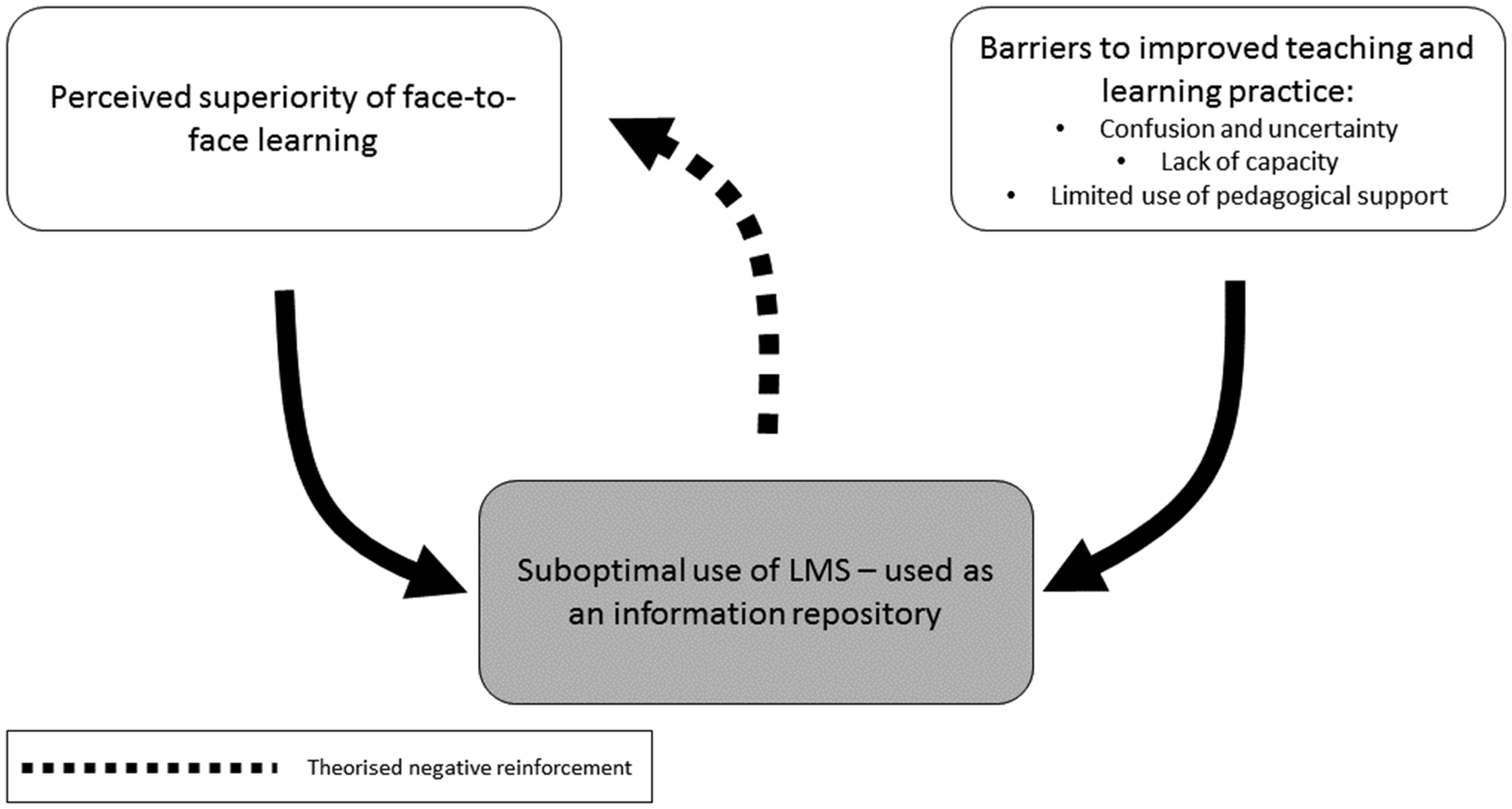
Conceptual map of findings.
Perceived superiority of face-to-face learning
The responses of both students and lecturers in the study appeared to be driven by a perception that face-to-face learning is the best way to learn. It was particularly notable that many lecturers referred to the use of Canvas in their subjects as ‘administration’ and that senior lecturers delegated responsibility for Canvas to junior lecturers. Moreover, students reported a preference for face-to-face learning. Students explained that online learning was more flexible so they would opt to study online to fit around other commitments, especially employment. Nonetheless, all students claimed that they would prefer to study face-to-face if at all possible. This reference to Canvas being administrative and the preference for face-to-face learning suggests that the use of Canvas may not form part of existing understandings of teaching and pedagogy. I hate online. I just find it very impersonal. That’s a general comment, not for Canvas or Blackboard; just in general in terms of teaching. (Lecturer 3) If I can I’ll do [tutorials and lectures] face-to-face. Even if I’m doing an online subject, if for whatever reason I can come in for some of the lectures, I like to be able to come in. I know I have the flexibility online to ask questions on the discussion board, but I still like the more face-to-face. Asking questions in real time and getting answers back, and being able to bounce back at the time. (Student 2) [I don’t offer this subject online because] I think learning in general is done better interactive, but it probably matters more in some than others, so I think it is important with [this subject] because there are principles that take some time to be able to grasp and to understand the nuances of it. There’s probably some areas that are maybe more technical where you mightn’t need [interaction] at all or where it doesn’t help that much, but in most areas, I think that’s the best way to learn. (Lecturer 8) I can grasp things quicker face-to-face and I can ask the quick questions and get an immediate response. And so you can have an interaction that’s more in real time than online where it’s a little bit delayed. Also I think you can learn more from your fellow students in face-to-face than you do on- the way that online is currently set up. The discussion boards are quite slow. And so someone will post a question, and even though another student might respond to that it’s possibly another day before the tutor gets on and clarifies that what everyone’s talking about is on the right track or not. (Student 1) [Students] can do [this online-only subject in] whatever [order] they want. They’re suggested that they study in this order, but they can study in whatever order they want really. Each one is a stand-alone bit. (Lecturer 2) So, yet again, as an online person you don’t feel like you’re involved. You feel like you’re kind of just listening in on somebody else’s course. (Student 4)
Barriers to improved online teaching and learning practice
Participants described some barriers to improving online teaching and learning practice: confusion and uncertainty about how best to use the LMS; lack of capacity; and limited engagement with pedagogical support. These were particularly pronounced in the lecturer interview responses, but students also seemed to be prevented from making greater use of Canvas as a learning tool due to confusion or uncertainty about how some elements/tools of the new LMS worked. The fact that there’s multiple ways to do something isn’t always great. Sometimes that’s difficult … but yes, the point was [accessing feedback is] a bit convoluted and sometimes having multiple ways to do it actually just makes it more confusing. (Student 3) The one thing that is quite difficult is if we’re meaning to do any modifications to [our subject]. In an ideal world, unit administration like myself or [my colleague] would be able to change or modify the content of each of these pages quite easily. I guess it’s okay if you have to edit text or things like that, but if you want to add a different section or different headings or subsets then it gets a little bit tricky with formatting things like that. That being the HTML, given that we don’t know that. Often if we’re needing to make a quick change and it messes up then we’re using the [ELSU] to help. Which for the most part [ELSU] are very responsive, but it’s yes, just a little bit inconvenient having to edit and then it maybe not turning out great and having to work with [ELSU] to fix it up. (Lecturer 7) The reason [why I’m not doing more on Canvas] is probably two fold. One is because I’m [predominantly employed to do research]; I can’t spend vast amounts of time on preparation. I do like to be prepared, so I kind of feel like I already put in enough time for that. The other part is that [my co-coordinator] doesn’t know how to use it. I went to lessons, so I have some sense of it and sort of muddled my way through. And I think it’s a very intuitive system that you can sort of muck around with it and find out how to do things. But [my co-coordinator] didn’t. Taking the time to school myself, work it all out, test it so I know that it works, and then teach it to him because he has very little time – the time investment is too much at this point. (Lecturer 1) I’d say probably, for what I need, I’m happy [with my level of competency in using Canvas]. But I do know there are extra things and tools that if I would need to use it, I probably look up to use it. I would search, I would find, and I feel comfortable going and finding it. But I think I’m okay. I haven’t struggled and I haven’t struggled with finding what place for the right information. So far it’s good. (Student 6) Interviewer: What sort of things have you asked the [ELSU] to help you with? Lecturer 6: Just technical glitches. Interviewer: Have you talked to them at all about what you can do [pedagogically]? Lecturer 6: We only come back for technical support these days because our course has already been established. When it’s been online stuff or e-learning [pedagogical] stuff, then some of the time I used to discuss with [a colleague] … some of the time I would talk to [the ELSU team]. But [more recently], it’s been more the technical aspects of it not the pedagogical aspects of it. If I had pedagogical aspects of it, I’d probably discuss it with [a member of the ELSU team] but I have no idea what [their] background is or whether [they’re] the appropriate person to discuss it with. But if I don’t have it in my mind a specific [person to talk to about pedagogical issues] and then I just ask around or I’d ask people who I knew had done a particular thing about it. (Lecturer 8)
Discussion
In our study, we found that lecturers are still using the LMS predominantly as an information repository, consistent with previous research (Carvalho et al., 2011). There was an awareness that online teaching and learning is an important and inevitable aspect of higher education among all participants but, at the same time, online subjects were considered generally inferior to that of face-to-face subjects. Consequently, it seems that online environments provided a significantly less stimulating and engaging experience for students. While our study was conducted in the context of a transition from one LMS (Blackboard) to another (Canvas), these findings have significant implications for online teaching and learning in general. If practice is to improve, we must address the perception that face-to-face teaching and learning is always better than online teaching and learning. More can also be done to remove or minimise the impact of barriers to online teaching and learning practice. Doing both would significantly improve the online learning experience of students, which is important given the large role online learning is playing in higher education.
Student participants in our study explained that they chose online learning for its flexibility; that is, they could study while still meeting other commitments such as work and family that made face-to-face attendance difficult. This is in line with existing evidence from other studies (Heirdsfield et al., 2011; Selwyn and Aston, 2017). Furthermore, students have identified a number of other benefits, including easier organisation and management of their tasks and the ability to more easily review teaching materials (Selwyn and Aston, 2017). Nonetheless, all of our participants expressed a preference to learn face-to-face, explaining that they would do so wherever they could. The question is why this preference would endure despite the many identified benefits of online learning.
In part, this preference would reflect the historical development of online learning. It is likely that the earliest use of online environments in teaching was as a way of making classical distance learning more efficient (e.g. through instantaneous/cheaper transfer of course material, compared to sending hard copies through the post). While technology has advanced dramatically, our research suggests that practice has been slow to catch up, at least within this institution, with the role of the LMS still largely limited to one of a repository for course material and where all the ‘real’ teaching takes place face-to-face. This practice may be difficult to change because, as we and others have found (Buch and Bartley, 2002; Smith Jaggars, 2014; Holmes and Prieto-Rodriguez, 2018), there appears to be a strong perception that face-to-face learning is superior to that of online. This is despite evidence showing that students can learn just as well online as they can face-to-face (Cavanaugh and Jacquemin, 2015).
It is possible that the preference for face-to-face expressed by both lecturers and students is part of a cycle of negative reinforcement – that is, the experience of online learning is suboptimal because lecturers are not using the LMS to its full potential, reinforcing the student perception that face-to-face learning is superior, which in turn encourages lecturers to focus on face-to-face teaching and reinforces their perception that face-to-face teaching is superior, leading to them not using the LMS to its full potential. It follows then that if use of LMSs could be improved, this perception may well change and the cycle may become one of positive reinforcement instead. This is in line with other evidence that shows student satisfaction and engagement with online learning is higher when there is more sophisticated use of LMSs (Carvalho et al., 2011) and with Anderson’s (2003) interaction equivalence theory, which holds that students will accept and even preference alternative teaching strategies to traditional face-to-face strategies, provided that they perceive that the alternative offers an equivalent or better experience. Importantly, Holmes and Prieto-Rodriguez (2018) have found evidence to support this theory. Considering this and the fact that interaction is both valued and important in learning (as discussed earlier), we recommend a focus on improving the type and nature of interaction that occurs in online environments in higher education settings.
There is evidence that suggests it is possible to change the perception that online teaching and learning is inherently inferior to face-to-face. Online courses that are well-designed, using pedagogically sound principles, are capable of producing interaction that meets student expectations and provides an equally satisfying learning experience for students, compared to face-to-face (Driscoll et al., 2012). Well-designed online courses are learner-centric, with content designed to be interactive and to reduce cognitive load (McFarland and Hamilton, 2005). Creating caring communities would also assist in building engagement and a sense of connectedness in online students (Robinson et al., 2017). Teaching in this way requires lecturers to radically change the strategies they use to teach (Esani, 2010); a change that our study suggests is still in its infancy. One way of ensuring proper design of online courses in higher education settings would be wider adoption of constructive alignment – where the learning outcomes are defined a priori and teaching and assessment is designed in a way that best meets those outcomes (Biggs, 2014). Evidence shows that students are more likely to adopt deep learning approaches in courses that are more constructively aligned (Wang et al., 2013).
In our study, the perception that face-to-face teaching and learning is superior to online appeared to be based on the perceived value of interaction for learning: both lecturers and students believed that interaction is a critical component of learning, helping students to understand the concepts and topics being examined in a particular subject. Available evidence shows that interaction in an online environment can indeed be beneficial for students, improving student assessment outcomes and satisfaction (Beauchamp and Kennewell, 2010; Wu et al., 2010). Despite this, students consistently rate their experience of online courses lower than that of face-to-face (Lowenthal et al., 2015) and this likely reflects the way lecturers are designing and implementing interactive elements in their online subjects. It is notable that the online only subjects described by our study participants appeared to be designed in a way that limited interaction, especially between the students. While our sample is limited to one setting and a limited number of subjects, this is significant and worthy of further research given the emphasis placed on interaction by both lecturers and students as a critical component of effective teaching and learning.
Even where online subjects included interactive elements, these appeared to be largely discussion board-based. This is despite the fact that both lecturer and student participants perceived these as a poor alternative to face-to-face interaction because of the delayed nature of any interaction and the tendency for interactions to be limited to question and answer between student and lecturer. Consequently, students explained that they would do only the minimum required on discussion boards, consistent with other evidence (Holmes and Prieto-Rodriguez, 2018). There is, however, evidence that discussion boards can be used more successfully than that experienced by our participants but it requires active and consistent involvement by lecturers and students (Ishtaiwa and Abulibdeh, 2012). Genuine interaction through discussion boards requires an online community to be built, which must involve a social presence as well as an educational presence (Chen et al., 2010). Improved use of discussion boards would be beneficial for students but social presence – the need for users to feel part of a community of ‘real’ people (Garrison et al., 2010) – is difficult to produce in discussion boards because of the speed of communication and because visual and aural cues are absent (Kear, 2010). Therefore, it follows that greater integration of other interactive tools will be critical if the experience of online learning is to significantly improve.
That said, a possible additional barrier to this is our finding that lecturers believe that it takes a lot of effort and time to learn the technology so that they can improve practice, consistent with previous research (De Gagne and Walters, 2009). Without adequate training, lecturers will often try to replicate the face-to-face experience when transitioning a course to an online environment (Redmond, 2011). However, most of our participants explained that they are unable to spend additional time expanding their knowledge and skills to make better use of the LMS. Therefore, provision of additional training opportunities, while important, is unlikely to lead to a widespread change in practice. This skills deficit may improve as the digital native generations take over as lecturers, but this transition will likely be slow, especially if students’ experience of online learning continues to be one where the LMS is predominantly used as an information repository, thus reinforcing the perceived superiority of face-to-face learning. The challenge then is how to improve pedagogical practice online more quickly. We suggest that educational designers, whose job it is to know how best to teach in an online environment, are employed and appropriately resourced to collaborate with lecturers and improve their practice (Richardson et al., 2018).
Educational designers have long been recognised as valuable in higher education, even before the growth in online teaching and learning (Rowland, 1992). However, evidence suggests that educational designers are not being used to their full potential (Intentional Futures, 2016), which was also evident in our study. Therefore, it may be necessary for universities to factor in a requirement that lecturers engage with such specialists as part of subject development and review processes. Lecturers often lack pedagogical training and qualifications, especially early in their careers (Brownell and Tanner, 2012). This means that they lack the skills to identify and implement better ways to teach online; educational designers can help overcome this skills barrier because they have the required training and qualifications (Intentional Futures, 2016). Moreover, they can assist in training lecturers who have the interest and capacity to develop their pedagogical skills. Furthermore, educational designers can help with capacity barriers because their job is exclusively education focused, whereas lecturers often have competing demands from research. This assistance with capacity is even more important given their remains a perspective in academia that research outputs are more important than teaching (Chalmers, 2011). By drawing on the expertise of dedicated staff, lecturers will be able to deliver higher quality online teaching environments, which in turn should help to shift the perception that face-to-face learning is inherently superior to online learning.
This study has three main limitations. First, the researchers involved in this study had pre-existing relationships with many of the participants, especially the lecturers. To account for this, participants were advised that access to interview recordings and transcriptions was limited to the lead researcher, so as to protect their identities. Nonetheless, these relationships may have shaped the way participants responded to questions, discouraging them from providing critical or negative feedback. Furthermore, the researchers’ involvement in teaching and learning within the School means that the findings of this study are co-constructed, at least to some extent (Alvesson and Skoldberg, 2009). For that reason, we made an effort to be critically reflexive to avoid imposing our perspectives on the study; this, we believe, has meant that our involvement in teaching and learning within the School has served to enhance our understanding and interpretation of the data. Second, most participants had less than one year’s experience with Canvas, which may have influenced how they were using the LMS. As they gain experience with and develop their understanding of the platform, their use of Canvas may improve independently. Conversely, this relative lack of experience with Canvas may have been beneficial for the study as our participants may have been more conscious and thoughtful about the LMS than lecturers and students who were not going through a transition period. Finally, our study was restricted to one School within one university; further research in other settings is necessary to test the generalisability of our findings.
Conclusion
It is clear that online teaching and learning is now firmly embedded in higher education and yet it continues to be perceived as inferior to face-to-face. Improving online teaching and learning practice is therefore critical. Our study has shown that improved practice will mean overcoming barriers such as limited skills and limited capacity to increase skills and understanding. To do this, we recommend employing specialist educational designers to work with lecturers to improve their online offerings. This includes through wider adoption of constructive alignment and a focus on improving the nature and quality of interaction that takes place online.
Footnotes
Acknowledgements
We would like to thank the participants who took part in this research.
Author contributions
All authors conceived of the study, assisted in interpretation of themes and contributed to drafting the manuscript. JK conducted the interviews and analysis and led the preparation of the manuscript.
Availability of data and materials
To protect participant anonymity, data from this study are not publicly available.
Declaration of Conflicting Interests
The author(s) declared the following potential conflicts of interest with respect to the research, authorship, and/or publication of this article: All of the authors are employed by the University of Sydney in teaching-related roles.
Funding
The author(s) received no financial support for the research, authorship, and/or publication of this article.
