




Abstract
The progresses in technology lead to advances in e-learning as well as lead to increase in number of learners participating in e-learning courses. Richness of online resources, activities, and communication tools presented in online courses can be one of the factors that influence learners’ attendance to e-learning. In this regard, the initial purpose of this study was to identify online resource, activity and communication tool preferences of learners studying in two public universities: one located in Turkey and one located in Kyrgyzstan. At the second stage, comparison of Turkish and Kyrgyz learners’ preferences was carried out to explore differences in two countries. The participants are first-year undergraduate learners enrolled in first-year courses in the online environment. The total number of participants is 370, which involves 185 Turkish learners and 185 Kyrgyz learners. In the context of this study, participants’ submissions to the questionnaire were collected as quantitative data; while participants’ opinions toward online resources, activities, and communication tools were obtained as qualitative data. Thus, the study was designed as a mixed methods research that quantitative and qualitative methods were applied for the data analysis. The results demonstrated that Turkish learners perceive communication tools, online exams, and text-based course notes to be the most useful for e-learning, whereas perceive online group activities and wiki pages as not useful enough. On the other hand, Kyrgyz learners perceive interactive materials, online exams, and social media tools to be the most useful for e-learning, whereas perceive online chats and pages as not useful enough. The participants’ opinions cover important points for the improvement of current online materials. In addition, learners from Turkey and Kyrgyzstan showed both similarities and differences in terms of their preferences toward online resources, activities, and communication tools, which are explained through this paper.
Introduction
E-Learning is defined as “instruction delivered on a digital device (such as a desktop computer, laptop computer, tablet, or smart phone) that is intended to support learning” by the use of both content and instructional methods (Clark and Mayer, 2016: 8). With the advances in technology and increasing expectations of learners toward online courses, e-learning is gaining more and more significance.
The undoubted advantage of e-learning over traditional one is that in the e-learning process, learners can access to instructional content and learning activities any time, with no tie to classroom and schedule. In e-learning courses, learners can benefit from several resources (e.g., course notes, e-books, videos) and engage in online activities developed for the purposes of learners’ practice or experience. Another advantage for learners is that there is a possibility to communicate with their instructors and peers by online means whenever they need.
Interaction in e-learning is considered to be an important concept and divided into three categories, which are learner–instructor, learner–learner, and learner–content interactions (Moore, 1989). Satisfaction and retention in e-learning can be achieved with the integration of online resources, activities, and communication tools in online courses. Inadequate interaction in e-learning leads to ineffective learning, and this may lead to lack of retentions, even dropouts of online learners (Anderson, 2003).
Distance Education Centers within universities aim to coordinate and manage e-learning courses and programs of universities. As the developing countries, Turkey and Kyrgyzstan are also locating these centers within the universities. In this study, the major purpose is to identify online resource, activity, and communication tool preferences of learners studying in two public universities located in Turkey and in Kyrgyzstan. Distance Education Center of each university employs Moodle platform as the learning management system (LMS) to provide course content and video lectures for first-year compulsory courses offered to undergraduate students.
In both universities, e-learning participation rates are not at the expected levels. The major reason for learners’ insufficient participation is mostly related to the lack of quality and richness of online resources and activities in course pages. In addition, there is not sufficient use of communication tools for the interaction. On the other hand, learner satisfaction in e-learning depends on many factors that interaction and course structure are identified as most important ones (Yukselturk and Yildirim, 2008).
The use of high-quality course materials, the development of learning activities such as assignments, chats, choice, database, forum, glossary, quiz, and interactive activities will enrich online courses, and hence, learners’ satisfaction and participation to courses will start to increase. At the same time, learners’ satisfaction in e-learning courses increases when they use media they preferred (Kobayashi, 2017). In this regard, it is important to consider learners’ preferences for the type of learning resources and activities to be included in an e-learning environment. In addition, it is significant to identify learners’ preferences toward the use of communication tools in e-learning courses. However, the review of literature demonstrated that a few research was conducted to investigate them. In addition, there is currently not any study that examined differences between countries in terms of learners’ preferences toward online resources, activities, and communication tools.
Hence, the aims of this study are formulated as follows. Initially, the study aims to identify learners’ online resource, activity, and communication tool preferences for online courses. Learners, participated in this study, are studying in two different state universities: one located in Turkey and one located in Kyrgyzstan. These two countries were selected in parallel to the international project conducted by the researchers collaboratively. As the next step, the study aims to provide comparative results to explore differences between learners from two different countries. Another importance of this research is that it studies populations in two countries, and for one of these countries there is little previous study.
The remainder of the paper is designed to cover the following contents. The Literature review section presents the related literature review, the Methodology section is dedicated for the methodology and the analysis. In the remaining part, the Results section presents the results, the Discussion section is allocated for discussion, and in the final section, conclusion together with the recommendations for future research were provided.
Literature review
e-Learning design
Learning design is defined as “the application of learning design knowledge when developing a concrete unit of learning, e.g. a course, a lesson, a curriculum, a learning event” (Koper, 2005: 3). Different approaches can be employed while applying learning design to an online course. The initial one is offered as the instructional design approach consisting various design principles, while another method focuses on best practices in teaching and learning, and the last one considers pedagogical design principles (Koper, 2005).
The use of technologies and activities, especially the projects and assignments, in e-learning promotes learners’ interest, self-regulation, and motivation for participation (Fisher and Baird, 2005). For the design of motivational e-learning, Keller and Suzuki (2004) offered the implementation of the ARCS (attention, relevance, confidence, and satisfaction) model. This model involves the processes of acquiring attention of learners, building relevance of the instruction to goals and learning styles of learners, establishing confidence in terms of anticipations and individual duties for consequences, and enabling the instruction to be satisfactory for achieving students’ intrinsic and extrinsic gaining. According to the study of Fisher and Baird (2005), motivating activities in online course design are social collaboration activities, newsgroups, wikis (collaborative web site), blogs, instant messaging, streaming audio/video, and other participatory media technologies, whereas self-regulation activities are student-led discussions, user-centered design, social networks, web-based collaborative tools, support, and feedback from peers.
In the context of e-learning, learning design involves learning design strategies for constructing the structure of the online course. Initial strategies were mostly based on learning theories that view the design as the transmission of knowledge to learners. On the other hand, more recent strategies consider learning theories that propose the construction of knowledge by learners (Hall, 2007). Hence, e-learning design is advised to focus on all types of interaction (i.e., learner–learner, learner–instructor, and learner–content interactions) at the same time considering “context,” “activity,” and “multi-learner” dimensions of e-learning (Dalziel, 2003).
As the standards/specifications of learning design, IMS Global Learning Consortium proposed the IMS Learning Design specification (IMS, 2003), which can be identified as a notational language for the definition of “meta-model” of instructional design. Universal Design for Learning (CAST, n.d.) was developed as a comprehensive framework to enhance and optimize instruction for learners while addressing individual needs and directing the design of instructional goals, assessments, methods, and materials. UDL offers three major principles for learning design: Provide Multiple Means of Representation (the “what” of learning), Provide Multiple Means of Action and Expression (the “how” of learning), Provide Multiple Means of Engagement (the “why” of learning).
As the recent model of learning design, design thinking has been offered as an iterative process with the purposes as to understand users, identify assumptions, redefine problems, provide novel solutions for prototyping, and testing issues. Design thinking proposes five phases: Empathize, Define, Ideate, Prototype, and Test. The use of design thinking in e-learning is also possible if designers consider the essentials of the phases. The other recent model is agile design model, which can be employed to provide rich and constantly shifting learning environments while preparing learners for a volatile, uncertain, complex, and ambiguous world. According to agile design model, the course is directed by instructional principles that cover “clear learning outcomes or goals, assessment linked to these goals, strong learner support, including timely and individualized feedback, active learning, collaborative learning, and regular course maintenance based on learner feedback, all within a rich learning environment” (Bates, 2015: 165).
Course design with e-learning resources and activities
According to the study of Song et al. (2004), online learners indicated the course design as the most important factor for the successful e-learning experience. The study revealed other factors such as learner motivation, time management, and comfortableness with online technologies. Online course design focuses on developing effective courses with the major consideration on learning rather than teaching. Course Design Framework covers the phases of analyzing, developing, implementing, and evaluating and redesigning. Analyze phase aims to identify learning goals, learner characteristics, and specifications of the e-learning platform. Development phase covers the tasks as generating content, creating activities, and developing/selecting assessment methods for learning and evaluation of the course. Implementation phase consists of tasks of course assessment, course implementation, and course modification. Evaluate and redesign phase aims to collect and analyze feedback, gather course data, compare course according to standards/quality indicators, and plan for course redesign and revision (Morrison, 2013).
Learning resources are developed to convey course content in the context of LMS. Learning resources can cover texts, visuals, audio and video, and structured in different forms like electronic books, course notes, course slides, videos, interactive visuals, interactive videos which are supported to be provided through LMS. Instructors can integrate e-learning resources in the form of file or folder. In addition, they can share URLs or organize the course content in the form of web page or electronic book by using corresponding tools of the LMS.
Learning activities are significant units of online courses and cover the major components as context, tasks, and learning approaches. The initial major component of learning activity is the context that covers the aims, learning outcomes, skills, subject, environment, time, and difficulty related to learning activity. Learning activity requires to complete a task which has the types as assimilative, information handling, adaptive, communicative, productive, and experiential. Task techniques include brainstorming, exercise, fieldwork, role-play, reflection, and syndicates. Interactions can be individual, one to many, student to student, student to tutor, group or class based. Participants of the learning activity (both teachers and students) are assigned some “roles,” such as individual learner, group participant, or presenter. Some tasks can be assessed through assessment types or techniques. Assessment types can be diagnostic, formative, or summative. Assessment techniques are likely to be drill and practice, essay, test, exercise, portfolio, dissertation, assignment, product, short answer, artifact, self-assessment, notes, or summary (Conole and Fill, 2005).
In LMS environment, following learning activities are commonly employed while designing online courses: Assignment. By the use of assignment activity, instructors can collect works of learners, perform evaluations, and conduct grading while providing feedback. Learners’ works can be in several formats like textual documents, presentations, spreadsheets, image, video, or audio files. Chat. With the help of chat activity, learners can participate in a real-time synchronous discussion, and at the same time, they can share links of web sites, upload images, or play sounds. Choice. The choice activity enables instructors to direct a question including a set of responses. This activity can be used to trigger learners’ reflections about an issue or allow learners to vote on a route to a course. Database. By using database activity, instructors and learners can establish a bank of records related to the course topic. The records can be in various formats such as texts, images, files, URLs, numbers. External tool. Learners can access learning resources and activities from the external web sites with the help of the external tool. Feedback. Feedback activity enables instructors to generate and perform surveys for collecting learner feedback related to the course or instructor. Forum. With the help of forum activity, instructors and learners can exchange their thoughts while posting comments generally in textual format, and also they can post URLs, visuals, sounds, or videos. Glossary. By using glossary activity, instructors and learners can build a list of definitions similar to the format of a dictionary. Lesson. Students can navigate through lesson pages according to their choices or responses to questions provided in pages. Additionally, pages provide instructional elements that can be in textual, visual, sound formats. Quiz. Instructors can create quizzes while generating different type of questions like multiple choice, matching, and fill in the blank questions. Besides texts, images, or videos can be included in questions. Survey. Instructors can apply verified surveys in order to obtain learner assessments related to course and instruction. Virtual classroom. Instructors can organize virtual classroom sessions to introduce course content and perform discussion activities. Wiki. Students can collaboratively create a wiki page that may include texts, images, files, URLs, etc. Workshop. Instructors can use the workshop as a peer assessment activity. Students can submit their work consisting of elements in textual, visual, sound format. Works of students are evaluated by their group members, and by their selves.
Learners’ preferences for e-learning resources, activities, and communication tools
Many studies analyzed learners’ preferences for e-learning resources, activities, and communication tools.
Northrup (2002) investigated learner perceptions toward online interaction by the tool called e-learning Interaction Inventory (OLLI) that they developed for this purpose. The results explored that learners stated their desire for online audio narrated lectures, note-taking guides, case studies, debates, role-plays, games, and also expected an immediate response from instructors and from their peers.
In their study, Zhao et al. (2009) investigated the use of information technologies by faculty and learners. According to the results, learners indicated that they were generally using lecture notes, assignments, e-mail, discussions, and chat in their distant courses. Surprisingly, more than 50% of faculty and learners were not using the Internet and TV-based live videos and audios, special computer network, fax, and traditional mail correspondence.
Morris (2012) analyzed perceptions of faculty and students towards the use of web-based technologies for online interaction considering the learner–instructor, learner–content, learner–learner dimensions. According to the results, students recommended an increase in the use of movies, video lectures, tutorials, interactive assignments, interactive tutorials, and online conferencing sessions. On the other hand, they found discussion forums not useful enough since forum activity is designed to be completed by a group of learners.
Simonds and Brock (2014) inspected the relationship between students’ demographic characteristics and their preference for types of learning activities in online courses. The study revealed that age groups differ in terms of their e-learning activity choices. That is, while older students indicated the preference for watching archived lectures asynchronously, younger students indicated the preference for synchronous interactive instructional methods like live chats and group projects.
In a recent study, Kobayashi (2017) explored the types of media preferred by learners in e-learning. The results of the study demonstrated that learners mostly found the following media useful: e-mail, instant messaging, lectures notes, assignments, online slide presentations with audio, online collaboration tools, and online video. However, the same students less favored online discussion boards and chat groups as other media, and they preferred online slide presentations with audio to Internet-based video lectures.
The review of the literature revealed that there is a few research that focus on comparing differences in online activity preferences of learners locating in different countries. In this regard, this will be the initial study that aims to compare Turkey and Kyrgyzstan in terms of online activity preferences of learners registered to undergraduate programs and taking the first-year online compulsory courses.
Many researches indicated user preferences based on country of residence (Hainey et al., 2013; Liu et al., 2010), gender (Kizilcec et al., 2013), and age (Slover and Mandernach, 2018). Therefore, in the scope of this study, the impact of these factors on online resource, activity, and communication tool preferences of Turkish and Kyrgyz learners was examined. Firstly, these impacts were analyzed within countries, and next, the analysis was extended to sample from both countries. Thus, the study covered the following research questions related to learners’ preferences of online activities in the e-learning environment:
Which online resources, activities, and communication tools do Turkish learners indicate as useful for e-learning? Which online resources, activities and communication tools do Kyrgyz learners indicate as useful for e-learning? Is there any difference between learners from Turkey and Kyrgyzstan according to their preference for online resources, activities, and communication tools? What are the opinions of learners toward online resources, activities, and communication tools?
Methodology
Subjects
All of the learners taking online compulsory courses (i.e., Literacy, Foreign Language, Information and Communication Technologies) were sent e-mails with invitation to participate in the online questionnaire developed for this study. One-hundred and eighty-five learners from each university submitted responses to the questionnaire. Thus, the total sample comprised of 370 participants. Demographic characteristics of participant learners are provided in Table 1. The gender distribution of participants from both counties is almost the same: there were more female students (58.4% and 60% in Turkey and Kyrgyzstan, respectively). Age distribution of participants is also similar.
The analysis of demographic data of participants.
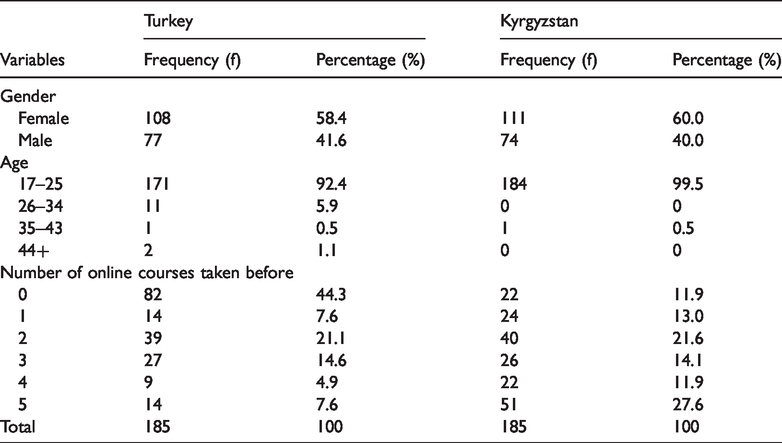
As for the academic major of learners, Turkish participants are studying in 14 different faculties including Agriculture (6.5%), Communication (7.0%), Dentistry (0.5%), Divinity (7.6%), Education (8.1%), Engineering (24.3%), Health Sciences (4.9%), Language, History and Geography (5.9%), Law (5.9%), Medicine (1.1%), Pharmacy (3.8%), Political Science (11.9%), Science (5.9%), and Veterinary (6.5%) programs. Academic major distribution of Kyrgyz participants is as follows: Agriculture (2.7%), Applied Mathematics and Informatics (14.6%), Education (7.6%), Engineering (27.6%), Language (3.8%), Political Science (22.2%), Science (14.1%), and Social Science (7.6%). That is, participants are studying in eight different faculties.
Intervention
The study was performed during 2018–2019 fall term with the participation of undergraduate learners from one public university in Turkey, and from one public university in Kyrgyzstan. Learners from both universities are enrolled in first-year compulsory courses (i.e., Literacy, Foreign Language, Information and Communication Technologies courses) conducted in the online environment; hence they are using LMS to access content and online activities of these courses.
In the public university of Turkey, virtual classroom sessions are additionally held by the synchronous participation of instructors and learners. The virtual sessions are recorded and provided in the video format for the use of learners that have no chance to attend. On the other hand, Kyrgyz learners are only provided with video recordings within these online compulsory courses. Therefore, Kyrgyz participants had no prior experience related to virtual classroom sessions.
In the context of the study, a scale has been developed that consists of names of learning activities provided by LMS and the corresponding rankings. The scale was structured as a 3-point Likert type and consists of rankings ranging from “not very useful” to “very useful.” In total, the scale includes 19 items. Additional opinions of participants were collected by the use of the open-ended question asking their recommendations for e-learning activities to be more attractive.
The scale was based on volunteer participation; therefore, reliability analysis was performed according to data of learners submitted responses to the survey. The resulted calculation demonstrated that the Cronbach Alpha value was found as 0.91.
Research design
This study was structured as a mixed methods research. For data collection, the questionnaire with both multiple choice questions and open-ended questions was utilized. In this respect, learners’ submissions to the questionnaire (i.e., responses to the multiple choice questions) were considered as quantitative data, and learners’ opinions toward online resources, activities, and communication tools (open-ended question data) were considered as qualitative data. The mixed study approach was found appropriate for the analysis of two different data types (i.e., quantitative and qualitative), at the same time, the efficiency of mixed methods for the strength of the research results was widely discussed (Creswell et al., 2003).
Analysis
As mentioned above, in this study, both quantitative and qualitative analysis have been covered.
For the analysis of quantitative data obtained from the scale, statistical analyses were employed. In order to analyze learners’ online resource, activity, and communication tool preferences, descriptive analysis approach was used. In order to analyze differences in learners’ preferences based on age, gender, and academic major factors, t-test and post hoc tests were employed. T-test was additionally applied to analyze the difference between learners from Turkey and Kyrgyzstan according to their preference for online resources, activities, and communication tools.
An open-ended question was directed to learners in order to collect their opinions related to online resources, activities, and communication tools. Learners’ responses to this question formed the qualitative data of the study. For the analysis of qualitative data, content analysis approach has been utilized.
Results
Online resource, activity, and communication tool preferences of Turkish learners
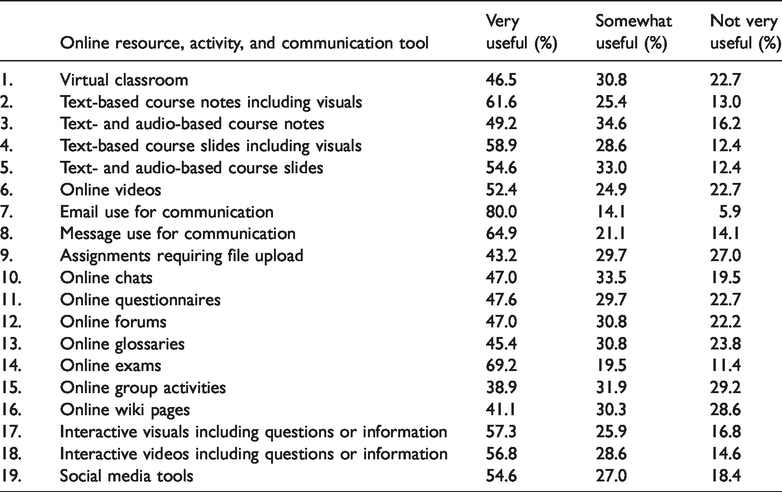
Table 2 demonstrates the frequency distribution of preferred resource, activity, and communication tools in e-learning by Turkish learners. The results demonstrated that learners found the use of email for communication as the most useful that 80% participants indicated their preferences toward the use of e-mails. Online exams, messages, text-based course notes, and slides were also indicated as useful by more than 60% of learners. On the other hand, the same participants indicated online group activities and wikis as not useful enough.
The frequency of preferred online resource, activity, and communication tool by Turkish learners.
As the next step, the perception differences were investigated. Independent sample t-test was employed to investigate whether there was a difference between Turkish male and female learners’ preferences toward online activities. As it is shown in Table 3, the results of the t-test showed a statistically significant difference between Turkish male and female learners perception of third and fourth items.
Results of the independent t-test on Turkish learners’ preferences by gender.

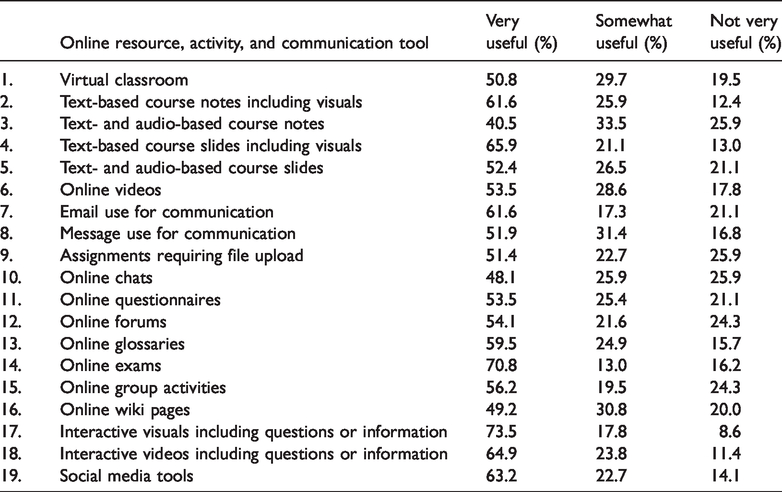
The frequency of preferred resource, activity, and communication tool by Kyrgyz learners.
This implies that male learners indicated more preference towards “Text and audio based course notes,” and “Text-based course slides including visuals” compared to female learners. Tests were conducted in 95% confidence interval.
As for the impact of age of respondents on the online activities preferences, it had impact on none of items but online chat preferences: students of age 19–20 perceived this type of activity as less useful. The academic major of students had an impact on perception of assignments requiring file upload (p < 0.05). Surprisingly, the post hoc analysis revealed the statistically significant difference between perception of learners from Medicine major and those from Social Science departments and Engineering departments: mostly, learners with medical academic background indicated assignments requiring file upload as useful.
Online resource, activity, and communication tool preferences of Kyrgyz learners
Table 4 demonstrates the frequency distribution of preferred resource, activity, and communication tools in e-learning by Kyrgyz learners. In addition to online exams and text-based course slides, indicated by Turkish learners as most useful, the frequency distribution of preferred activity in e-learning by Kyrgyz learners demonstrated that interactive pictures, interactive videos, social media tools are also perceived by Kyrgyz students as more useful. Activities such as text- and audio-based course notes, online chats, online group activities, and online wiki pages were indicated are not very useful by almost quarter of all Kyrgyz respondents.
Next, independent sample t-test was employed to investigate whether there was a difference between Kyrgyz male and female learners’ preferences toward online activities. As it is shown in Table 5, the results of the t-test showed a statistically significant difference between Kyrgyz male and female learners according to 5th, 12nd, and 16th items. Kyrgyz female learners indicated more preference toward text- and audio-based course slides while Kyrgyz male learners have more preference for online forums and online wiki pages.
Results of the independent t-test on Kyrgyz learners’ preferences by gender.

This result implied that Kyrgyz female learners prefer to study individually on course slides. On the other hand, Kyrgyz male learners tend to involve in group activities, hence more preference toward collaboration.
As for the dependence of items of the age distribution, none of differences in items perceptions were found to be significant in 95% confidence interval.
Comparison of online activity preferences by Kyrgyz learners academic major showed that there is a statistically significant difference in perception of text- and audio-based course notes and online wiki pages, with significance being 0.025 and 0.005, respectively (Table 6).
Results of the analysis of variance (ANOVA) on Kyrgyz learners’ preferences by academic major.

Further, post hoc analysis showed that learners from engineering departments prefer text- and audio-based course notes less useful than students from social sciences departments. However, students from both these academic majors are of same opinion about online wiki pages (not very useful); and this opinion differs from perception of students from two other academic majors, namely, natural sciences and education.
Comparison of Turkish and Kyrgyz learners’ preferences
Since there can be difference in perception of online resource, activity, and communication tool among students from different cultural backgrounds, independent sample t-test was performed to examine whether there was a difference between Turkish and Kyrgyz learners’ online activity preferences in education. The results demonstrated a statistically significant difference between the preferences of learners from Turkey and Kyrgyzstan in 7 items out of 19 (Table 7).
Results of the independent t-test on learners’ preference by country.
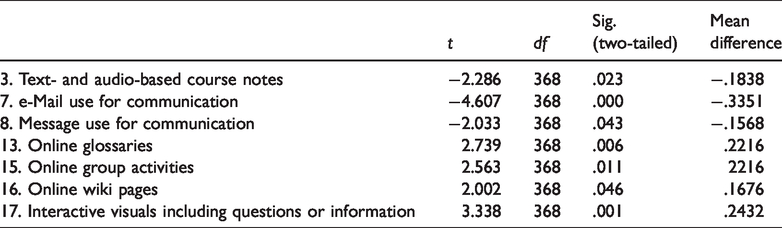
The results related to online activity preferences of learners revealed both similarity and difference between perception of Turkish and Kyrgyz learners. Participants from both countries found online exams as a very useful activity of LMS. In addition, both in Turkey and Kyrgyzstan, learners indicated that text-based course slides as a very useful resource.
The participants from Turkey mostly indicated the usefulness of communication tools like e-mail and messages provided as functions of LMS. At the same time, Turkish learners offered text- and audio-based course notes as very useful resources compared to Kyrgyz learners. On the other hand, online glossaries, group activities, wiki pages as well as interactivity in pictures seemed very useful by participants from Kyrgyzstan.
Learners’ opinions towards online resources, activities, and communication tools
An open-ended question was directed to learners in order to collect their opinions related to online resources, activities and communication tools.
In Kyrgyzstan case, online videos are provided to convey content related to e-learning based compulsory courses. However, majority of Kyrgyz learners are not satisfied with the quality of online course videos and indicated some important offers for their improvement. They initially suggested the transformation of existing videos to short and interactive format. Since the current format of online videos is so long and consists of direct instruction of teachers, and therefore not usually preferred to be employed by learners. That is, learners expect short and dynamic instruction for the improvement of videos. In addition, Kyrgyz learners expected to watch professional video recordings that will cover instructors’ body language and appropriate emphasis on the content. At the same time, some of the learners had expectations for the development of videos including interesting topics or documentary-like videos related to course contents. These video-related offers of Kyrgyz learners are expected since in today’s world young individuals generally prefer to watch short, attractive, and interactive videos by using mobile phones, tablets, or computers. On the other hand, the videos without attractive properties like dynamic instruction or interesting information do not usually get attention of learners.
The Kyrgyzstan University considered in this research currently does not provide synchronous virtual classroom sessions since the university has not acquired the required technological infrastructure yet. On the other hand, Kyrgyz learners heavily offered the implementation of virtual classrooms for the purpose of synchronous interaction with the course instructor. This is included in the statements of Kyrgyz learners that proposed online sessions besides online videos since they expected to participate in online meetings for receiving synchronous instruction and immediate feedback for the questions. Virtual classroom sessions are essential for the effectiveness of e-learning courses since they allow learners to interact with the instructor and their peers, and additionally eliminate learners’ feeling of loneliness in the e-learning environment. Yet, virtual classroom sessions need to be carefully held by the instructors. For instance, although virtual classrooms have been presented in Turkey’s university, Turkish learners indicated some failures like audio loss or video loss during the sessions. Therefore, Turkish learners offered the proper use of microphone and web cams by instructors while virtual classroom sessions are taking place. In addition, high Internet speed is needed for eliminating losses and assuring the quality of online sessions.
Learners from both countries stated expectations for the improvement of online resources which are in the form of electronic books, course notes, and course slides. The initial proposal was toward the development of online resources for all topics of the courses. Currently, the courses lack some resources; hence, learners face with difficulties in learning the whole course content. This expectation is also significant since learners found text-based resources useful for e-learning. Similar to the expectations related to videos, learners recommended the addition of useful and interesting information to the textual resources. Instructors can consider this offer and improve textual materials by integrating extra course related information. In this way, the effectiveness of resources will increase and more number of learners benefit from the course resources.
In both universities, direct instruction method is preferred to be employed by instructors while teaching the course contents. On the other hand, novel instructional methods can be utilized for assuring learners’ satisfaction and success. For instance, some Turkish learners offered the use of collaborative learning that can be implemented through group activities. This will increase peer-to-peer interaction in e-learning. As another approach, problem-based methods were proposed by the participant learners. Flipped classroom method is also one of the recent methods that involve prior study of learners and then learners’ discussions or collaborations during the online sessions. These kind of methods are essential for the accomplishment of deep learning and academic success. In addition, learners offered games to be utilized in e-learning courses. Presentation of games as well as use of badges in courses is important since these tools have the properties as increasing learner motivation and competition among their peers.
Kyrgyz learners also recommended that further courses can be provided in the online environment. For instance, Work Safety, Philosophy, and Psychology like courses are proposed to be implemented in the online format. Since this kind of courses completely cover textual information, learners thought that it is easier to study on this kind of courses from the online environment. Learners’ tendency toward e-learning courses is increasing day by day. Therefore, the offer of learners can be considered by faculties for the opening of wholly online or hybrid courses involving both online and face-to-face sessions.
Learners from both universities found online exams among the useful activities for e-learning. In addition to online exams, Turkish learners proposed provision of self-assessment quizzes for the purposes of performing practices and mastering the course content. This offer is parallel to existing literature that e-exams are generally preferred since learners are satisfied with immediate feedback and self-assessment features.
Some minor number of Turkish learners indicated technical problems related to the use of online activities. For example, they stated the problem of uploading file required for the assignment activity. This problem is related to limitations previously set for the file size and can be prevented with the elimination of these limits. As the other general offer, one of the Turkish learners proposed an improvement in the functionality of the LMS. The usability of LMS can be investigated in the future research for the required LMS improvements.
Discussion
In order to satisfy the effectiveness of online programs, richness and interactivity of online resources and activities are very important. Online courses are structured in a way that the course content and technologies stand in the center whereas instructors and learners stay in edges while interaction occurs between each element (i.e., instructor–content, learner–content, instructor–learner) (Anderson, 2008).
This study considered the significance of interactivity in e-learning hence focused on learners’ preferences and opinions related to online resources, activities and communication tools provided through e-learning courses. The study was conducted in 2018–2019 fall term with the participation of undergraduate learners from Turkey, and from Kyrgyzstan. The concept of comparing learning styles of learners coming from different countries has been analyzed by many researchers (Yamazaki et al., 2018). Mostly, in such research, representatives of remarkably different cultural backgrounds, as in the case of learners from Canada and Turkey (Arpaci, 2015), where major differences in learners mobile learning adoption behavior was found. Tarhini et al. (2016) showed that e-learning success models that are valid in European countries may not fit for sample from Asian country. Research by Khaddage and Knezek (2013) also revealed the difference between e-learning perception of learners from the USA and the UAE. However, in all these cases, the difference was due to profound differences in cultural and economic background in these countries. In the case of Kyrgyzstan and Turkey, although historically there is a difference, yet culturally people in these countries are considered to be close. Therefore, in this study, the e-learning activities perception of learners from these countries was compared. The learners participated in the current research attended first-year compulsory courses (i.e., Literacy, Foreign Language, Information and Communication Technologies) in an online environment while using LMS to access course resources and perform online activities.
With the use of virtual classrooms, instructor and learners meet online while course introduction and/or discussions are taking place at the same time. This kind of synchronous environment highly supports interaction by providing an opportunity for questioning and idea sharing. According to the survey results, participants from Turkey have not found virtual classrooms useful enough for e-learning. On the other hand, qualitative results explored the expectations for the implementation of virtual classes, and it was generally offered by Kyrgyzstan learners. This discrepancy between results may originate from the wider availability of virtual classrooms in Turkey and learners’ dissatisfactions related to virtual classroom implementation. Turkish learners generally stated audio loss or video loss during the sessions. Therefore, it is essential that instructors should use high-speed internet and properly use microphone and web cams in virtual classroom sessions. Qualitative results are in parallel with the results of studies by Johnston et al. (2005), Northrup (2002), and Morris (2012) who found online contact and interaction with instructors is an expected predictor related to satisfaction in e-learning. The difference in quantitative results between current and previous studies may originate from the type of online courses that the studies considered. In this study, learners are taking online compulsory courses (i.e., Literacy, Foreign Language, Information and Communication Technologies), which are already taught in high school level, hence learners had existing knowledge and thought that they could achieve the course through online resources and slides as well as interactive pictures and videos, which are also observed in results of the study. On the other hand, for the courses newly taken, online learners may find virtual classrooms effective since they will be able to receive a synchronous course introduction and benefit from immediate interaction with the instructor.
Communication tools like e-mails, messages, chats, and forums increase interactivity between learners and instructors. Participant learners in this study generally indicated the usefulness of e-mails and messages for communication between course instructors. The similar result was also observed in the studies of Zhao et al. (2009) and Kobayashi (2017) that learners stated the usefulness of e-mails for e-learning. Online learners generally prefer to communicate with the instructors through e-mail hence they may ask questions related to course content, assignments, exams, or other related issues. Message feature provided by LMS is considered as the second option since learners may be more adapted to use e-mails and hence have more tendency to use these tools. On the other hand, chats and forums are not respected as useful enough as e-mails and messages. This is similar to the findings of the studies. For instance, Morris (2012) resulted that discussion forums are less useful group activity, and Kobayashi (2017) revealed that students less favored online discussion boards and chat groups’ activities.
While e-learning programs are becoming widespread, the use of online exams has been increasing parallelism. In this study, majority of participant learners found online exams very useful that is also common result of the studies—Sorensen (2013), Hillier (2014), Jawaid et al. (2014). According to the study of Sorensen (2013), learners indicated that e-assessment added value to their learning, and provided immediate feedback, hence they had expectations for the increase of e-assessment in the online learning environment. According to the study of Jawaid et al. (2014), majority of students preferred computer-based assessment in place of paper-based assessment, felt confident after having experience, and allocated less time compared to paper-based one.
Text-based course materials have been found very useful by the participants from both countries. At the same time, there are some proposes for the improvement of learning materials like the addition of beneficial and interesting information related to course content. This is generally expected property since learners need to be motivated while the self-learning is taking place. Especially, learners from Kyrgyzstan-stated expectations for interactive pictures and interactive videos since they are not satisfied with the existing monotonous and noninteractive course materials. The use of course notes and materials with interactive features will increase learners’ participation and motivations in e-learning.
Conclusion
Summary
This study attempted to explore learners’ preferences toward online resources, activities, and communication tools. Additionally, as many researchers suggest that there can be a difference in the learning styles (Joy and Kolb, 2009; Niles, 1995; Yamazaki et al., 2018), a country-wise comparison was conducted related to their preferences to examine how different factors influence learners in two countries in terms of online learning preferences. The participants are the first-year undergraduate learners from two countries: Turkey and Kyrgyzstan. Learners indicated preferences considering the usefulness of various online resources, activities, and communication tools. In addition, differences were observed in perception of online learning activities of students in two countries. Yet, these differences were mostly due to difference in e-learning experience rather than cultural background.
Recommendations for future research
In the current study, the sample of learners is limited to learners’ preferences according to three courses provided in an online environment. As the future studies, it is necessary that learners’ opinions toward more e-learning courses should be investigated for the improvement of e-learning courses with the rich and high-quality online resources, activities, communication tools.
The study revealed that learners found various technologies useful for e-learning. At the same time, preferences of learners differ in terms of their age, gender, and academic major. Learners’ kind of expectations and their evaluations of e-learning tools can be investigated by the researchers and instructors. Hence instructors can design the future courses considering learner expectations, characteristics, and evaluations. In this way, the motivation and satisfaction of learners in e-learning courses can be increased.
In addition, the results of this study demonstrated that countrywide differences in preference of online activities are highly observed between the two countries. There can be many reasons for this difference, such as differences in online instructional methods used by universities, differences in technology infrastructure, and cultural differences in e-learning. Therefore, there is also a need to inspect the reasons related to these differences, which can be the focus of further study.
Footnotes
Declaration of Conflicting Interests
The author(s) declared no potential conflicts of interest with respect to the research, authorship, and/or publication of this article.
Funding
The author(s) disclosed receipt of the following financial support for the research, authorship, and/or publication of this article: The research was supported by Turkish Council of Higher Education (YOK).
