




Abstract
New literacies research and theory touts the advantages of participatory cultures where youth collaborate, connect, and share knowledge. However, these practices assume a certain level of trust. With a lens that combines sociological theories of trust and a new literacies theory of participatory culture, this paper draws on two studies of youth literacies practices. The participants represent urban and suburban as well as online and offline contexts. Findings bring to bear the centrality of trust to decisions and choices when participating in these communities, pushing research to consider trust and mistrust more thoroughly when theorizing benefits of participatory cultures.
Trust is an assumption forming the bedrock of new literacies practices of collaboration (Beach, 2012), social connection (boyd, 2014), and distributed knowledge (Gee, 2004). However, these practices assume that participants in new literacies, particularly youth, feel comfortable engaging in social, collaborative communities, with others known and not known. Scholars claim that young people participate in these communities with purposes of meeting “friends of friends” (boyd, 2014: x) in an effort to expand into ever wider social networks, to learn and to invent and reinvent identities through creative presentation, and to craft online selves in both physical and virtual spaces (Gee, 2004; Ito et al., 2010; Leander and McKim, 2003; Livingstone, 2008). For the purposes of our research, we define “space” as a virtual or physical gathering place that draws participants based upon some common interest (Gee, 2004).
A particular online context – participatory cultures – has amassed a body of new literacies research that documents participants creating and sharing content in environments that encourage and support collaboration, sharing, and offer informal mentorship (Jenkins et al., 2009). Internet technology has facilitated these environments where few barriers or gates exist for interested participants to pass through in order to get involved. Since Jenkins et al. began theorizing participatory cultures in the early 2000s, the concept has been widely cited and applied to the fields of media studies and education as a way to understand the changing nature of publishing, communication, public discourse, and learning. In participatory cultures, consumers of media, ideas, and content are simultaneously also “produsers” of such forms, signaling a cultural shift (Bruns, 2008) toward community-supported participation and away from more traditional participation motivated by individual goals. Examples of participatory cultures include fan fiction websites or wikis where participants share self-produced content and collaborate to solve problems. These communities often are housed on social media sites or apps like Facebook, Snapchat, or YouTube. Based on this shifting nature of participation, literacy researchers urge a reconsideration of classroom learning.
Jenkins et al. (2009) apply participatory cultures to physical classroom spaces that emphasize creative pursuits like writing, drawing, and performing. Likewise, pedagogical scholarship emphasizes social learning predicated on sharing and self-expression in physical classroom spaces (Leggo, 2007), where learners connect by recognizing, appreciating, and mentoring each other’s contributions. Accordingly, a growing body of research from literacies studies, media studies, and pedagogical studies document meaningful learning that results when young people collaborate, connect socially, and share content in both online and physical spaces (Ito et al., 2013; Jenkins et al., 2009; Marsh, 2018); yet, the role of trust as prerequisite to such participation is rarely examined.
To clarify our use of “participation” and “engagement”, one can participate in a space or a process without being engaged, hence having no influence on the process itself. Engagement is the step beyond participation and is evidenced by an individual doing more than showing up, by adding to the conversation, extending and expanding not only their knowledge and understanding but influencing others as well.
An assumption is conveyed across research disciplines that an interest in engaging, knowing, and collaborating with others are familiar and natural – comfortable behaviors of youth. We challenge this notion by suggesting that, for some participants, a powerful boundary exists, formed by the combination of propensity to trust and generalized trust that influences and impacts how comfortably and willingly they engage, exchanging thoughts and ideas with others, known or otherwise. We believe their perspectives need to be added to the research.
The field of sociology (Gefen, 2000; Glanville et al., 2013; Mayer et al., 1995; McKnight et al., 1998; Stolle, 2002) defines trust as one’s perception that the actions of another individual or entity (A space) can be beneficial to them. Trust is seen as the willingness of a trustor to depend on a trustee, and thus be vulnerable to that party, in the expectation the trustee will do something considered important or valuable to the trustor (Mayer et al., 1995; McKnight et al., 1998). For this article, we utilize a more refined definition that combines a foundation of propensity to trust (disposition) and generalized trust, which builds upon propensity (experiences, expectations, and vulnerability) (Mayer et al., 1995; McKnight et al., 1998). Trust begins with a propensity to believe in the positive attributes of others; one’s faith in humanity (Gefen, 2000; McKnight et al., 2004). Thus, initial levels of trust in an interaction do not begin at zero (e.g. no trust) but with a propensity that varies from person to person.
At a secondary level, generalized trust informs one’s preparedness to engage with others based on experiences, expectations, and beliefs of the other’s intentions as well as a willingness to be dependent on or vulnerable to others. As Stolle (2002) suggests, generalized trust is an approach to others that works in many situations, yet is not completely independent of context. To reveal something about oneself in a classroom with known others may make a person feel more exposed compared to the level of vulnerability that same person might experience in an online space where relationships are less developed. Trust, knowledge sharing, and engagement are less likely to develop when “considerable personal cost or self-sacrifice” (Jones and George, 1998: 539) are at stake; some contexts present more cost to participants’ sharing than others, whether physical spaces or virtual ones.
In exploring the role of trust in youth literacies and participatory cultures, we seek to shift the conversation from issues of access, which have focused on the degree to which diverse groups of youth have digital media available to them (Leu et al., 2015; Warschauer and Matuchniak, 2010), to questions about styles of engagement predicated on trust. We draw from two qualitative case studies on youth new literacies practices to answer the question: What role does trust play for youth in participatory cultures, both online and in classroom spaces? In joining a newer line of research that questions assumptions about the ubiquitous assets new media and technology afford youth (e.g. Lammers and Marsh, 2015), we argue that the role of trust must first be examined before accepting the benefits of participatory cultures.
Situating our inquiry
Much has been written about participatory cultures and how they facilitate youth literacies characterized by engagement and interaction with others. As there in nominal literature that specifically examines the intersection of youth trust in participatory communities, we draw more widely upon literature that addresses theories of trust as they relate to engaging and interacting with others, in physical and online spaces.
Generalized trust and collaboration
Sociologists define trust as an expectation that “cooperative behavior is based on commonly shared norms, within a community” (Fukuyama, 1995: 2). Trust is foundational to our understanding of cooperative behavior by directly impacting willingness to engage with others, participate, take risks, and to share information. “Trust increases people’s desire to take risk for productive social exchange” (Stolle, 2001: 397).
While opportunities abound for the sharing of self and ideas both in online and physical spaces, trust relies on each participant’s comfort with and confidence in how others will interpret their meaning (Rahn et al., 2009). Sharing knowledge requires both trust and a relationship. Relationships are forged through shared ideas whose characteristics are social. In our physically and digitally connected world, access to others has expanded beyond local communities, providing opportunities to enrich both knowledge and understanding. Luhmann (1979) argues that an individual’s decision to trust/distrust is based on experiences as well as risks associated with the decisions made for the future. But to enter any relationship requires an assessment of risk and a propensity to trust (Mayer et al., 1995). The level of risk, as determined by the individual, informs how they respond as well as their level of engagement. Delhey et al. (2011) found a “radius effect” on how individuals conceptualize trust – we trust those we are closest to – those we have had positive experiences with. While some trust can transfer through association, the lowest level of trust applies to those for whom nothing is known. Additionally, strong trust in one domain does not hinder the establishment of distrust in other domains (Delhey et al., 2011).
Generalized trust extended to virtual spaces
Hsu et al. (2007) found that “trust is a crucial factor to sustain the continuity and engagement in virtual communities” (p. 154), where most members are relatively invisible. Most of these communities cannot guarantee that others will behave as they are expected to. A lack of information about the intention/behaviors of others generates uncertainty and also creates risk (Cook et al., 2009). Together risk and uncertainty produce conditions that signal the need and importance of trust (Chai and Kim, 2010; Chang and Fang, 2013). To assess the risks relating to trust in online spaces, participants develop their own hierarchies of cultural and socially determined values, based on prior lived experiences in dealing with others known/not known to determine the reliability of sources and the safety of their own thoughts and ideas (Das and Pavlíčková, 2013). Thus, “trust increases people’s desire to take risks for productive social exchange” (Stolle, 2001: 397).
Online behaviors do not go ungoverned by social conventions; however, the conventions are more flexible, less enforced in the absence of clear social cues, and require some individualized trust/risk assessment as less information is available in online communities upon which to form trusting intentions and behaviors (Haddon and Livingstone, 2014). In this paper, we acknowledge that online environments afford more opportunities to engage with others in participatory cultures – possibilities that are either continuous with and/or distinctive from offline environments. Generalized trust creates a foundation, but personal experiences and assessment of individual risk are essential components in the determination of an individual’s propensity to trust within different contexts. Trust in one space does not translate to unconditional trust in another.
Chai and Kim (2010) found trust to be the main attribute in forming relationships, promoting knowledge creation, and sharing of personal networks. Trust is a considerable antecedent to sharing knowledge (Chai and Kim, 2010) and thus engagement in participatory cultures. Trusting beliefs in online networks, much like physical spaces, can relate either to personal or organization attributes that reflect components of trustworthiness such as competence, benevolence, and integrity. However, the addition of technology-related characteristics such as functionality, reliability, and security can add an additional layer to the trust-risk assessment. In online social communities, each participant evaluates the quality of the content before he or she accepts it, engages with it, and/or transfers it (Grabner-Kräuter, 2009). Trust requires strong evidence like a cumulative history of positive direct experiences or a high public reputation to reduce the perceived risk and facilitate engagement. Distrust, like trust, is a subjective opinion based on direct experiences; however, a small number of negative direct experiences can result in a participant’s distrust decision (Kim and Ahmad, 2013). Our study, which documents mistrust based upon youth experiences, adds contemporary voices to understanding the influence and impact of propensity to trust and generalized trust in both physical and digital spaces.
Participatory cultures
Additionally, our study draws and expands on participatory cultures (Jenkins et al., 2009) to explore communities whereby youth connect and learn through creating, sharing, recognizing, and mentoring each other. Participatory cultures derives from the more encompassing theory of literacy as a social practice (Barton and Hamilton, 1998; Scribner and Cole, 1981; Street, 1995), which emphasizes literacy as something people do in interaction with social others, expanding literacy’s meaning beyond an autonomous (Street, 1995) skill set of encoding and decoding print based texts to an activity, “located in the interaction between people” (Barton and Hamilton, 1998: 3). Jenkins et al. (2009) describe participatory cultures as communities that provide “strong incentives for creative expression and active participation” (Jenkins et al., 2009: 7). Accordingly, participatory cultures are defined as having (1) relatively low barriers to expression/engagement, (2) strong support for creating and sharing creations with others, (3) informal mentorship, where (4) members believe that contributions matter, and (5) members feel some degree of social connection with each other. Table 1 delineates these characteristics for each of this study's three participants, Lily, Cris, and Niesha, in the three contexts where they participated: a classroom (CW), Facebook, and Youtube. “Not every member must contribute but all must believe they are free to contribute when ready and that what they contribute will be appropriately valued” (Jenkins et al., 2009: 7). The propensity to trust impacts the degree of freedom individuals feel when choosing whether or not to contribute. Practicing new literacies in participatory cultures implies that youth feel comfortable with collaborative efforts (Hsu et al., 2007; Nepal et al., 2012).
Participatory culture characteristics examined in CW and online (YouTube and Facebook).
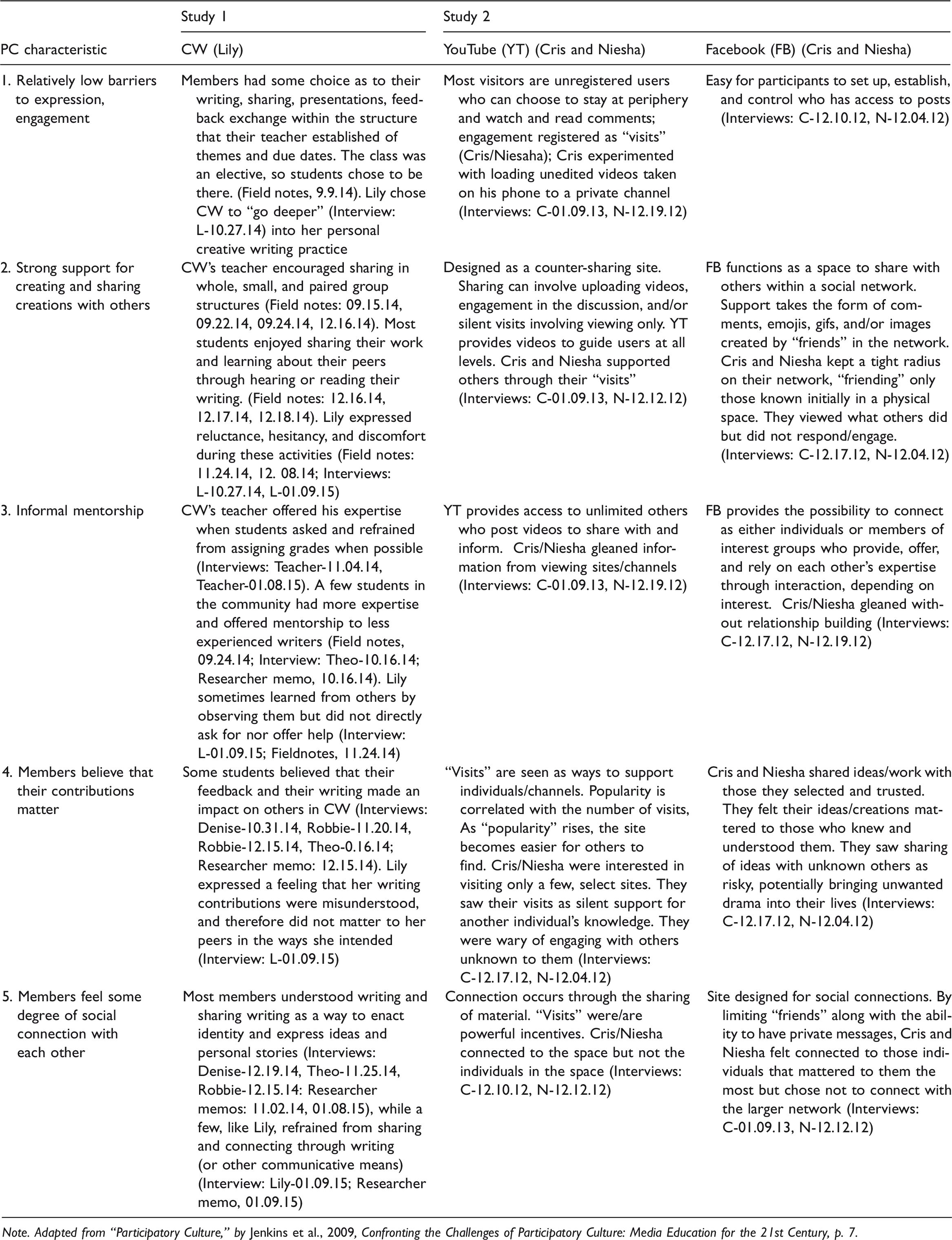
Note. Adapted from “Participatory Culture,” by Jenkins et al., 2009 , Confronting the Challenges of Participatory Culture: Media Education for the 21st Century, p. 7.
While Jenkins et al. (2009) study and discuss participatory cultures that occur in online communities, they also describe how creative writing (CW) classes, like the one in this study, can operate as a participatory culture: every child deserves the chance to express him- or herself through words, sounds, and images, even if most will never write, perform, or draw professionally. Having these experiences, we believe, changes the way youth think about themselves and alters the way they look at work created by others. (p. 7)
Research contexts and methods of analysis
We have designed a retrospective cross-case analysis (Abrams and Lammers, 2017; Dooley and Assaf, 2009) that combines data from two separate case studies into a collective data set and applies the same theoretical lens to the entire data corpus. Case Study 1 explored how youth made sense of new literacies in the physical space of a high school English class (Marsh, 2016); Case Study 2 investigated urban youth who used mobile technology to participate in various online spaces (Hoff, 2016).
Case studies are advantageous when exploring both a phenomenon and a context, especially when the boundaries between the two are not clearly defined (Yin, 2003). Accordingly, positioning trust (phenomenon) as requisite for contributing to a participatory cultures (context) exemplifies the intertwining of phenomenon and context that case studies aptly investigate. Instrumental case studies like ours typically focus on a small pool of participants, allowing researchers to explore the particularity and complexity of a specific case in order to provide opportunities for readers of the research to make “naturalistic generalizations” about the phenomena under study (Stake, 1995). Naturalistic generalizations allow for the case’s transferability or applicability to other situations. What gives the case transferability is a researcher’s inductive analysis – which contextualizes the particulars within emerging patterns and trends in a field of interest (Dyson and Genishi, 2005). Case studies achieve transferability by relying on: an interpretivist epistemology that views the researcher as the primary tool of research (Marshall and Rossman, 2011), protocols of triangulation, and detailed, thick description (Geertz, 1973). These strategies provide readers information they need to generalize beyond a case to their worlds of familiarity (Dyson and Genishi, 2005). By engaging in a retrospective cross-case analysis, we were able to re-examine our data sets in a combined fashion (Abrams and Lammers, 2017), focusing on youth trust and involvement in physical and virtual participatory cultures.
Participants and setting
For this article, we draw upon experiences of three youth, Cris, Niesha, and Lily (pseudonyms) who were focal participants in our studies. Cris and Niesha participated in online spaces. Lily was a student in CW, an English class at a suburban, public high school. Each of these youths were members of participatory cultures, in either virtual or physical worlds (see Table 1). They were also members of ethnic minorities.
Cris: A Latino 10th-grade student at an urban high school, Cris was a budding videographer and YouTube producer, frequenting YouTube channels on his smartphone to learn about video formats and to explore music (I-01). Cris wanted to establish a YouTube channel that would send positive “shout-outs” to fellow students who were doing great things but were relatively unseen by the student body at his school (I-02). Having no one to ask directly about editing videos, Cris sought out “how to” information from various Internet communities (I-03).
Niesha: A 12th-grader at an urban high school, Niesha was African American. She used her smartphone to find online participatory cultures, like YouTube, where she explored beauty-related practices and music (I-01). Niesha preferred to be a silent participant, looking, watching, but never adding her opinion, ideas, or voice to the online discussions she routinely sought out (I-01). Her ideas were shared with those she knew physically in her neighborhood and school.
Lily: A child of Haitian-born parents, Lily (11th grade) identified as Black, not African American (I-02). In her high school’s CW class, most of her peers chose to socially connect by sharing personal stories, while Lily preferred connecting by focusing on writing craft.
Data collection
A defining attribute of case study design is its reliance on multiple sources of evidence (Yin, 2003). Accordingly, we each engaged in participant observation in our respective contexts, collecting multiple and varied data sources that included interview transcripts, field notes, artifacts, and digital communication. The collective data corpus is detailed in Table 2.
Collective data corpus.
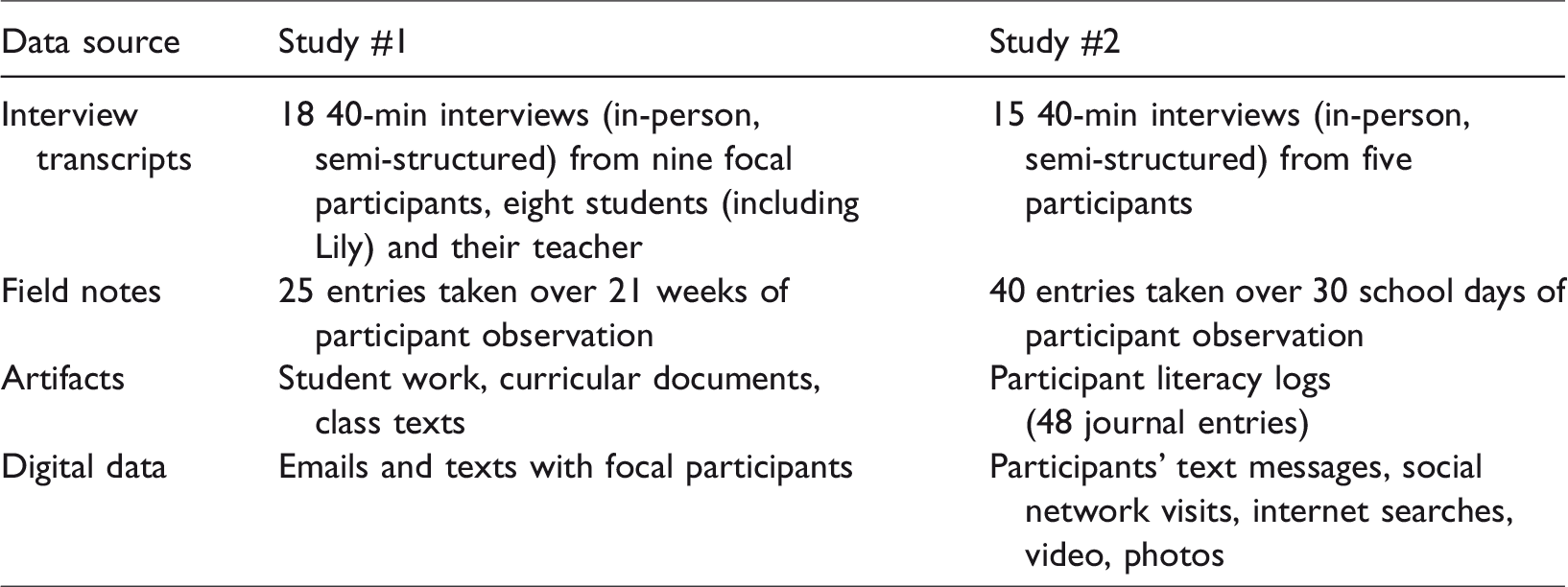
For this article, we draw upon transcripts from two interviews with Cris, one with Niesha, two with Lily, and two with Denise, two with Robbie, two with Theo (Lily’s fellow classmates in CW), and two with their teacher. Artifacts include journals Cris and Niesha kept and a multimodal project Lily designed (Figure 2). Our field notes and reflective research memos complete the data corpus.
Data analysis
While our studies were conducted separately, we later engaged in a retrospective cross-case analysis (Dooley and Assaf, 2009) by combining our data sets and re-examining them through the same theoretical framework of trust and participatory cultures. We began analysis with provisional coding (Saldaña, 2016) – an agreed upon set of codes that helped focus our inquiry. Provisional codes derived from major findings in both of the original studies about trust, youth, and participatory cultures. Thus, during our initial coding phase, we looked for specific incidences that could be labeled with one of the following codes: social connection, trusting, keeping personal and private separate. Like Abrams and Lammers (2017), we individually applied these provisional codes to the data and then met to discuss what was emerging. These meetings began our second phase of analysis, when we looked for themes among our coded data (Saldaña, 2016). During this theming stage, we found two trusting patterns: guarded participation and managing privacy. These themes helped us make sense of the data when we entered them along with other analytical categories (data bits, provisional codes) into a sortable spreadsheet that we could reorganize by whichever category we selected. The spreadsheet also included a category labeled ‘thoughts,’ which recorded our thinking as analytical memos (Charmaz, 2006) or “asides” (Emerson et al., 1995) during the analytic process. It was often in this column where we drew connections between data, codes, and the claims we make here. We provide an example of a data sort based upon the theme “guarded participation” in Appendix A.
Guarded participation – Sometimes called “lurking” (Gee, 2004), this practice is considered a legitimate form of participation. While all three participants chose to be present in various participatory cultures, Cris’s, Niesha’s, and Lily’s participation was characterized by practices of observing or opting out of activities. A theory of participatory culture emphasizes feeling free to contribute and to socially connect (Jenkins et al., 2009), neither of which emerged in our analysis. Managing privacy – Animating their participation, our participants sometimes contributed to their participatory cultures but did so in ways that maintained privacy around their personal information, carefully curating what they shared. While the need to manage privacy is covered regularly in popular media (Berl, 2012; Common Sense Media, n.d.; Privacy Rights Clearinghouse, 2016), a social practice account of literacy depicts online participation as social and collaborative (boyd, 2014; Ito et al., 2010; Jenkins et al., 2009).
In addition to developing themes according to patterns of analysis, we also engaged in iterative, non-linear constant comparative analysis (Glaser and Strauss, 1967), not only comparing data-to-data but also comparing emerging patterns to various theoretical perspectives, an example of theoretical triangulation (Denzin, 1984).
Findings
Table 1 applies the five characteristics of participatory cultures (Jenkins et al., 2009) to the spaces where our focal participants spent time – the classroom space of CW and the online spaces of YouTube and Facebook. The data presented establishes each as a participatory culture and shows how participants both enacted and resisted enacting participatory culture characteristics, highlighting Lily’s, Cris’s, and Niesha’s experiences.
The following findings look more closely at Lily’s, Cris’s, and Niesha’s participation within the two analytical themes, illustrating an emerging friction between our participants’ lived experiences and the way youth are more generally depicted in research literature.
Theme 1: Guarded participation
A hallmark of participatory communities, any individual can contribute their own expertise to a process that involves many intelligences. Collaboration and interaction in communities that produce and distribute ideas while never meeting face-to-face has become the norm. Yet participation varies, from quietly observing to actively contributing. Cris, Niesha, and Lily are situated on the left end of that spectrum, engaging in what we are calling, “guarded participation.” They participated but had reservations that directly affected how they interacted within the communities that were of interest to them. Cris, Niesha, and Lily routinely sought out new information, read, watched, evaluated, added to their own knowledge, but avoided active engagement with others in those spaces: they were circumspect, which influenced how they chose to participate.
Cris stated he was reluctant to engage with those he didn’t know, preferring to watch the conversation or flow of information online: I haven’t talked to people about how I would create it. I go online and look at what’s popular and try to figure out how to do that…sometimes it don’t work…then I’m stuck…[I’m] not comfortable starting conversations with those I don’t know…you know…like not a person I know and can see. (I-03)
This reluctance was also in evidence when Cris expressed an interest in exploring new ways to improve his level of fitness: The other day I was searching fitness tips, and so I’ll go to where people blogged about their different experiences…but I won’t really contribute to the conversation, but I kinda…you know…just watch it…And see what other people have to say. (I-02)
Niesha routinely visited several online communities where she gained insight through visual images and enhanced her technological understanding. A talented stylist, Niesha constantly challenged herself to try new things. Daily she explored online spaces (YouTube) that focused on topics of interest to her – hair and nails. In those participatory communities, information sharing and discussions were abundant. I like to do hair and nails so I go on YouTube to find out how to do certain styles… so I can watch…I don’t need to talk…just watch and rewatch…til it’s in my head. I don’t add comments even when I really like something…somebody might change what I say…or mean…can’t be sure what others might do. (I-01)
Niesha and Cris participated as seekers and gleaners of information, not as produsers (Bruns, 2008), collaborators, or distributors across unknown groups or communities. Individuals participate in their worlds based on a compilation of experiences that directly impact their propensity to trust (Chang and Fang, 2013). Those constructs influence how, when, where, why, and to what level individuals choose to engage with others. For Cris and Niesha, guarded participation was a specific choice proportional to their levels of trust. Feelings and understandings regarding others informed their propensity to trust, which they transferred to online cultures and communities. Trust was a powerful construct that influenced the freedom with which they engaged in physical and online spaces.
Similarly, Lily preferred to hold back or stay quiet when she was expected to participate in ways that required her to move from observation to more interactive engagement in the classroom space of CW. Sometimes, class activities positioned her participation preferences as awkward. During one lesson, when students were working in small groups to explore dialogue, they brainstormed a list of everyday conversational topics, which their teacher wrote on the blackboard (Figure 1).
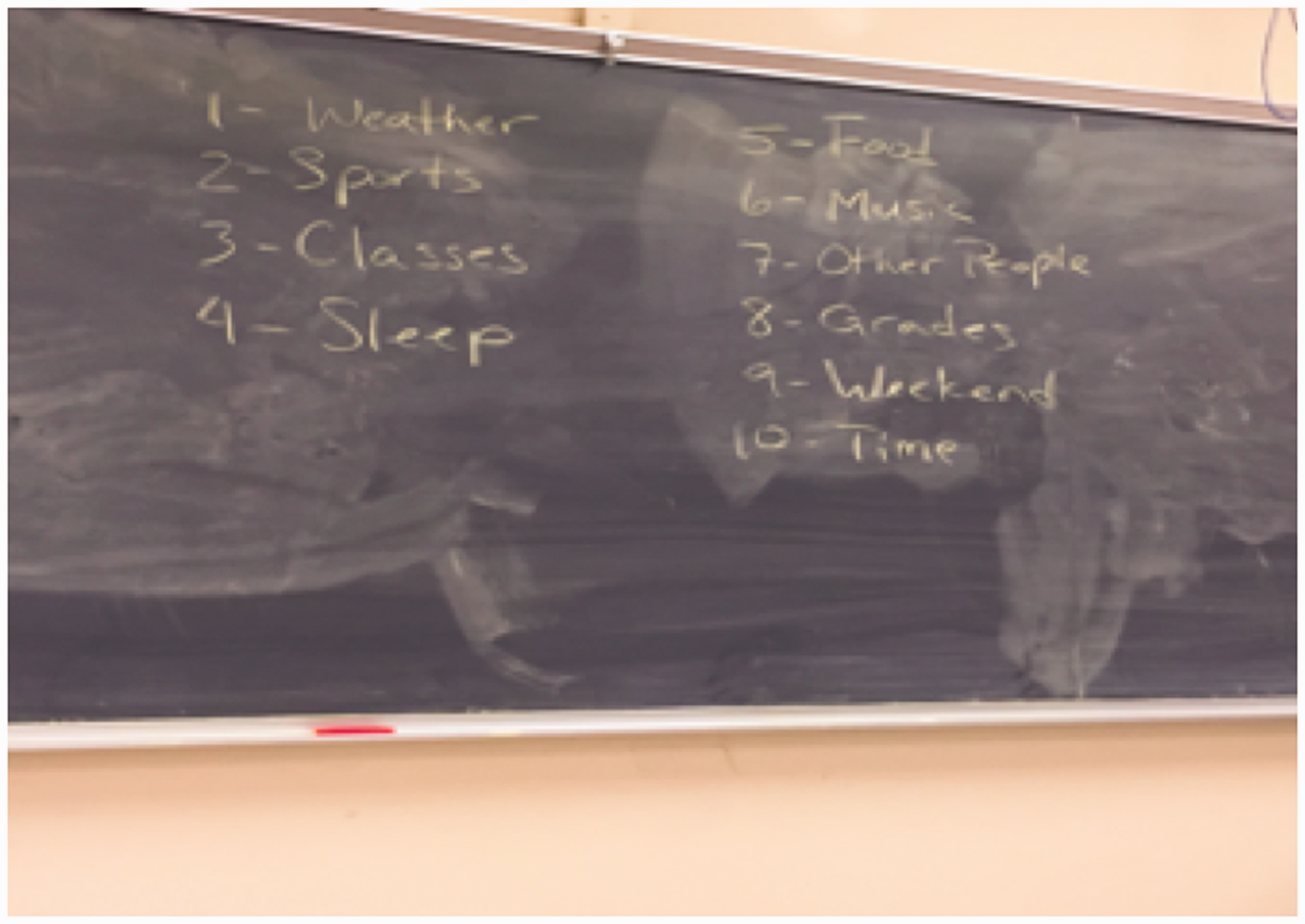
Student-generated list of conversation topics for dialogue activity.
Each group was then asked to choose one of these topics and to engage in a “natural” conversation about it. For different students of CW, natural took on different connotations. For those who felt a degree of trust, it would be more comfortable to talk about each other’s personal lives outside the classroom. Almost every conversation topic on the board required students to discuss their personal lives.
Lily’s group chose to talk about “The Weekend,” and a stilted conversation ensued. Denise, a fellow student, interested and comfortable personally sharing with her peers, led the conversation. Lily spoke softly, avoiding eye contact (Field notes, 8 December, 2014). When Lily mentioned that she had gone to her job over the weekend, Denise pointedly asked where she worked. Lily quietly yet firmly refused to answer, explaining later, “I just like keeping my school life and my personal life separate, unless it involves, like my friends” (I-02). For Lily, most of her peers in CW did not qualify as friends, and therefore she was uncomfortable discussing her personal life with them. The provision of space in CW was not enough to engender her trust, which was mediated by a radius effect (Delhey et al., 2011). After the class, Lily privately attributed her refusal to answer Denise’s question to general feelings of mistrust. She described herself as not a trusting person. In school and in CW, she took care to connect with only a select few friends to whom she had adequate time to “warm” (I-02), similar to Cris and Niesha. Thus, Lily resisted much of the engagement in CW that relied on sharing personal stories with those whom she had not developed relationships and cultivated trust. Other students in CW, like Denise and Robbie, shared personal information freely, enabling them to “feel some degree of social connection with each other” (Jenkins et al., 2009: 7). As Robbie explained, sharing his work with others and receiving their feedback was “nice” and indicative of “having faith in people” (I-02). Thus, Robbie connected sharing with a belief that others were there to help him, signaling his trust in the community (Luhmann, 1979). Lily, however, was not comfortable with this practice.
Theme 2: Engaging while managing privacy
In participatory cultures where members often rely on trust to connect, those who do not trust, may still contribute, but the desire to maintain privacy may override an open and active degree of engagement. Social media is a communication platform that expands and accelerates the way we connect and engage with people. Spaces like Facebook and the communities within it provide opportunities for individuals to gain insight into the social lives and interests of others. Friending and the sharing of updates creates the perceptions of intimacy and closeness that may or may not actually exist for participants. The ways in which Cris and Niesha managed their social media profiles suggest that they were not willing to sacrifice privacy for intimacy (Researcher memo, 15 January 2013).
Even though Cris and Niesha could limit their friends on Facebook, they did not place much trust in what was said there. This wariness influenced not only whom they sought to interact with but also the type of personal information they shared (Researcher memo, 15 January 2013). Cris and Niesha sought to control who had access to their spaces and were willing to share and engage but only with specific, known individuals (C: I-01; N: I-02). At the same time, both were interested in what their friends were doing and checked Facebook several times a day. Their degree of participation was directly related to the trust they had in the other individuals within those spaces (Researcher memo, 15 January 2013). It was not the space, per se, that dictated participation but their propensity to trust that influenced how they, as participants, chose to trust others. The assumption of trust has a direct impact on how privacy and participation in shared spaces is managed (Haddon and Livingstone, 2014; Henderson and Gilding, 2004). Cris and Niesha were selective about whom they allowed in, friending only those individuals that were physically known to them (C: I-01; N: I-01). Friending through association or meeting “friends of friends” (boyd, 2014: 7) was neither endorsed nor practiced. This was their guiding principle and gave them a sense of being able to actively manage privacy (Researcher memo, 5 January 2013). Additionally, both installed privacy settings across their online social networks thus limiting access to their pages and unintentional sharing of their information. Niesha, in her desire to limit access beyond established privacy settings, used her boyfriend’s last name, effectively increasing the difficulty of finding her on Facebook (N: I-01).
Depending on the degree to which they felt others could be trusted to not misinterpret or misuse their Facebook posts, Niesha and Cris carefully chose what they shared. While both posted few images within the “Photos” space on their Facebook walls, they did not upload them directly to their status feeds (Researcher memo, 15 January 2013). This choice implies that there was a desire to share their experiences, connections, and associations to further establish their Facebook identities, yet Cris and Niesha did not purposefully seek out comments from others (C: I-01; N: I-01): There was a desire to share but a stronger drive to avoid “drama” (N: I-01). For Niesha, experience had illustrated how “Liking” another’s post can prompt others to say “oh…she really likes so and so…that leads to trouble” (I-01). Their Facebook statuses were characterized by general statements, “Check out my YouTube Channel” (C: I-02) or “tried new style on my niece’s hair” (N: I-01). Statuses were primarily voiced in a non-emotive textual mode; photos or video clips were not incorporated (Field notes, 19 December 2012). Their documentation of experiences as lives lived was present, but Cris and Niesha only provided access to that information to known and trusted friends.
Lily also found ways to participate in the participatory culture of CW, but like Cris and Niesha, she did so cautiously. For a class project, students were asked to design and present a multimodal production that brought together multiple sensory stimuli (music, visual images, written, and spoken language) about topics of their choosing. The majority of CW writers focused their productions to reveal their identities and personal interests. Lily created hers with care and attention to detail, but in a way that also protected her privacy. She chose a monarch butterfly’s metamorphosis as her topic (Figure 2). She did not create her production as a link to her personal life (I-02); nevertheless, when viewing her presentation, Lily’s classmates relied on assumptions of trust and a belief that personal sharing is desirable. Based on these assumptions, Lily’s presentation generated interest and intrigue among her peers (Field notes, 18 December 2014), but for reasons Lily did not intend. Denise expressed a feeling of knowing Lily better from her production and compared her to a butterfly, explaining:

Lily’s multimodal production. Lily read this poem while the song played in the background and the image was projected on a screen behind her.
I just picture butterflies. They’re really quiet but yet, the way a butterfly’s kind of beautiful. Like Lily has a lot to say. And when she says it, it’s like really, you know powerful and stuff. And I just thought it was so funny how she picked [a butterfly] because that is exactly like Lily. (I-02)
Their teacher drew parallels not only between a butterfly’s delicacy and Lily, but also between the symbolism of metamorphosis and Lily’s seeming emergence during her presentation. Admitting he was only guessing about knowing Lily, her teacher insisted, “I still somehow thought of [Lily] as the butterfly” (I-02). Yet Lily approached the project with a different intention, to express her writing craft in designing multimodally and to manage her privacy.
When it was later shared with Lily that others in her class felt connected to her, that they felt they knew her better through experiencing her butterfly presentation, she responded with skepticism. She said that she did not even like butterflies and spoke of her aversion to “bugs and things that fly” (I-02). She chose the butterfly image because she was interested in the art technique – a type of black and white photographic collage she discovered and researched online, not because she identified with butterflies (Figure 2). Reflecting on the content of her presentation, Lily said, “I don’t think there’s anything I could have said that would have said something about me” (I-02), implying her preference to focus on craft, while also managing her privacy in CW. Nevertheless, other members in CW believed they were gaining insight into Lily’s identity through her multimodal presentation. Thus, she was unable to connect in CW the way she preferred to, or to feel a “degree of social connection” (Jenkins et al., 2009) with others in this participatory culture.
Our findings parallel work that indicates that involvement in participatory communities is influenced by an individual’s propensity to trust (Chang and Fang, 2013; Mayer et al., 1995). Additionally, our work confirms previous findings on engagement within participatory communities, but our findings also suggest that trust plays a critical role in those initial decisions on whether or not to enter a space as well as the type and style of engagement an individual is willing to undertake once in that space. Our participants perceived too much risk in seeking advice or sharing personal thoughts/information (Mayer et al., 1995) in the participatory cultures of YouTube, Facebook, and CW, thus lowering their levels of trust and influencing their participation styles. These findings support theoretical claims that provision of space, whether a writing class or an online community, does not necessarily engender a trusting attitude for those who occupy those spaces (Rahn et al., 2009). Diminished trust inhibited our participants’ experiences of freedom to interact and share (Jenkins et al., 2009). Rather our findings reveal that the radius effect (Delhey et al., 2011) held true for our participants, who tended to apportion trust for their inner radius of friends known in the physical world, with whom they had time to build relationships (Glanville et al., 2013), and denied trust to those in the wider radial circles of their online and classroom communities.
Discussion
Learning is meaningful when we connect socially with others, a seemingly benign statement supported by a significant body of research that documents how youth actively engage with each other, seeking out individuals and communities based on shared interests (Chandler-Olcott and Mahar, 2003; Gee, 2009; Steinkuehler, 2010). An assumption that youth freely imbue and reveal parts of themselves in their literacy practices is one rooted in new literacies scholarship (Alvermann, 2011; Alvermann and Hagood, 2000; boyd, 2014; Livingstone, 2008). Trust is implied in this assumption.
However, the preferences and practices of the youth in our studies are not reflected in youth literacies and participatory cultures literature: “I just don’t conversate with people that I don’t know” (Niesha); “I just watch” (Cris); “So whenever I meet someone…I can’t just trust them” (Lily). Our participants’ experiences of trust and mistrust do align with sociological theories that understand trust as a potentially risky leap of faith in how others will conduct themselves (Haddon and Livingstone, 2014; Luhmann, 1979; Mayer et al., 1995) or a sense that we trust others with whom we are closest to and tend not to trust those who are unknown (Delhey et al., 2011). Our studies also reveal that some youth and their literacies practices are overlooked by general themes in new literacies research of freely contributing, socially connecting, and learning (boyd, 2014; Ito et al., 2010; Jenkins et al., 2009). Niesha, Cris, and Lily preferred to participate by observing, gleaning, or by contributing in ways that preserved privacy. In online participatory cultures that operate outside the structures and expectations of schooling, these preferences may appear easier to enact, as they were for Cris and Niesha. In classroom spaces, guarded participation may not suffice as legitimate participation, and student contributions may be misinterpreted as identity enactments, as was the case for Lily’s multimodal presentation, which her classmates and her teacher construed as an insight into her identity, yet Lily insisted that they misunderstood who she was or what she was trying to do. Further, student preferences unacknowledged, may position their participation styles as awkward or uncomfortable. This also happened for Lily when she tried to limit her exposure during the dialogue activity and found herself in a forced conversation about a topic she wished not to discuss. We believe that there is more educators can do to foster, support, and develop engagement while acknowledging that there are a range of preferences that inform how youth choose to participate and why they may be reluctant to interact or share their ideas, thoughts, and knowledge with others. For some youth, familiar spaces, like a classroom or YouTube, do not necessarily engender their trust (Luhmann, 1979); knowing a social other does not necessarily correlate with trusting. Propensity to trust is unique to each individual and based, in part, on lived experiences. In order to participate and share in ways depicted in literacies scholarship, the youth in our studies would have needed to experience a higher level of trust in the participatory cultures where they spent time. Instead of asking these youth and others who have similar preferences to change, perhaps we should be asking that our theories and pedagogies to encompass a wider diversity of practices and engagement styles. Theories of Culturally Relevant Pedagogy (Ladson-Billings, 1995), expanded conceptions of texts (Paris, 2010), and diversity of languages welcomed into classrooms (Kirkland, 2010) are instructive starting points for educators seeking to diversify their classroom practices and apply participatory cultures more inclusively.
This article shines a light on assumptions of trust, offering insight into the role it plays in classrooms and online. Findings traverse virtual and physical contexts, suburban and urban settings, and raise awareness about styles of engagement that have not previously been documented. If educators are to rely on literacies theories to guide philosophy and practice, these theories must account for all students. Guarded participation and preferences to manage privacy need further exploration as to what it means to be a member of a participatory culture and what it means to feel free to contribute and connect socially. Freedom to choose whether or not to engage along with the propensity to trust are critical elements in both understanding and exploring involvement in participatory cultures. To realize the benefits of online and classroom spaces characterized by collaboration, social connection, and distributed knowledge, we must acknowledge the diversity of engagement styles of all youth. It is our hope that this article leads to further discussion of the role trust plays in predicting and correlating with engagement.
Supplemental Material
Supplemental material for New literacies in participatory cultures: The assumption of trust
Supplemental Material for New literacies in participatory cultures: The assumption of trust by Valerie L Marsh and Martha J Hoff in E-Learning and Digital Media
Footnotes
Declaration of Conflicting Interests
The author(s) declared no potential conflicts of interest with respect to the research, authorship, and/or publication of this article.
Funding
The author(s) disclosed receipt of the following financial support for the research, authorship and/or publication of this article: This research was supported in part by a grant from the University of Rochester’s Margaret Warner Graduate School of Education and Human Development.
Supplemental Material
Supplemental material for this article is available online.
Author Biographies
References
Supplementary Material
Please find the following supplemental material available below.
For Open Access articles published under a Creative Commons License, all supplemental material carries the same license as the article it is associated with.
For non-Open Access articles published, all supplemental material carries a non-exclusive license, and permission requests for re-use of supplemental material or any part of supplemental material shall be sent directly to the copyright owner as specified in the copyright notice associated with the article.
