




Abstract
To develop guidelines for more effective news literacy interventions, we conducted focus groups with early adolescents (12-15 years old) on what these interventions should be like. Participants (N = 55) discussed that motivating early adolescents is a challenge, but did provide more insight into their preferences and needs. Future interventions should be easy to find and use, make news literate behaviors more accessible, should be interactive, and should tailor the content toward the target group. Developing interventions based on these guidelines could positively influence various predictors of news literate behaviors in early adolescents, and, in turn, lead to more news literate behaviors.
Early adolescents—teenagers between 12 and 15 years old—consume most news online, where content is most vulnerable to being manipulated and is thus not always completely trustworthy (Smahel et al., 2020). At the same time, early adolescents have little trust in their capabilities to navigate and evaluate online information. They have insufficient skills and motivation to distinguish between facts and nonfacts and to evaluate the reliability of sources (Smahel et al., 2020; Tamboer et al., 2022; Wineburg et al., 2016). Early adolescents are often confused about the quality of news and information (Apestaartjaren, 2020), and state that they cannot, or do not know if they can, identify fake news (Notley et al., 2017). This is problematic, especially because they start to develop lasting news consumption habits and are highly susceptible in their political and societal interests (Marchi, 2012; Russo & Stattin, 2017; York & Scholl, 2015). An important way to empower early adolescents in their critical engagement with news is by stimulating their news literate behaviors (Kajimoto & Fleming, 2019; Malik et al., 2013).
News literacy is most recently defined as “knowledge of the personal and social processes by which news is produced, distributed, and consumed, and skills that allow users some control over these processes” (Tully et al., 2021, p. 5). Knowledge and skills allow someone to engage with news critically and mindfully: to execute news literate behaviors (Potter, 2004; Vraga et al., 2021b). News literate behavior is an umbrella term for various behaviors, such as identifying misinformation and verifying news (Vraga et al., 2021b). Theory on news literate behaviors posits that to lead to intentions for news literate behaviors and to engage in these behaviors, an individual at least needs news literacy knowledge and skills, favorable attitudes toward news literate behaviors, favorable social norms, and perceived behavioral control over news literate behaviors (Vraga et al., 2021b). These behaviors can empower early adolescents in navigating the online landscape. However, research has yet to show how to most optimally stimulate these factors and, eventually, behaviors.
Over time, various interventions and educational programs that aim to stimulate news literacy (behaviors) have been developed, such as a news literacy course by the Center for News Literacy (Klurfeld & Schneider, 2014). Interventions that are based on theoretical insights and empirical research have been proven effective in various outcomes, such as lowering the perceived reliability of disinformation (Roozenbeek & van der Linden, 2019; Tully et al., 2020; Vraga et al., 2021a), increasing participants’ perception of information accuracy (e.g., Hameleers, 2020), increasing news consumption motivation (e.g., Maksl et al., 2017), increasing political efficacy (Geers et al., 2020), and increasing the discernment between mainstream and false news headlines (Guess et al., 2020). A few existing interventions specifically focus on youth and are attuned to youths’ preferences (e.g., De Los Santos et al., 2021; Literat et al., 2020). Literat et al. (2020), for example, adopted a game-based approach to address youth’s (10–14 years old) lack of news literacy motivation.
However, most existing news literacy interventions focus on older age groups and cannot simply be translated to fit early adolescents, do not explicitly stimulate news literate behaviors, but concepts such as news media knowledge, and are not based on research nor adequately tested (Jeong et al., 2012; Marchi, 2012; Vraga et al., 2021b). To develop effective news literacy interventions for early adolescents, more insight is needed into how interventions can align the target group’s needs and preferences (Peters, 2014; Potter, 2014). Literature predicts that interventions should meet certain gratifications for people to make an active decision to (seriously) engage with it (the uses and gratifications tradition, Ruggiero, 2000). Therefore, a target group should have an active role in the development of an intervention (Literat et al., 2020).
Early adolescents know about the importance of news literate behaviors, but are quite passive in their news consumption and news literate behaviors (Ku et al., 2019; Tamboer et al., 2022). This is likely due to a lack of intrinsic motivation (Tamboer et al., 2022), which is in line with their developmental stage. In early adolescence, the extent to which someone engages in something hinges greatly on their motivation to do so (Valkenburg & Piotrowski, 2017). Furthermore, the moderate discrepancy hypothesis posits that early adolescents are most interested in content that departs moderately from their cognitive and social–emotional development (Valkenburg & Piotrowski, 2017). This translates into a need for fast-paced content and support in their increasing need for autonomy (Valkenburg & Piotrowski, 2017).
In this study, we aim to get more insight into what news literacy interventions for early adolescents should entail to effectively stimulate them to perform new literate behaviors. We facilitated an assignment and discussions in focus groups with early adolescents (12–15 years) to answer the central question in this study: What are early adolescents’ views on what will be effective in the stimulation of their news literate behaviors?
Method
To investigate early adolescents’ views on news literacy interventions, focus groups were conducted. Data gathering and analysis were iterative. This study was part of a larger project (see Tamboer et al., 2022), which has been reviewed independently by the Ethics Committee of the Faculty of Social Sciences at Radboud University (ECSW-2017-033R1).
Participants and Procedure
Eight focus groups with in total 55 participants were conducted. Participants were from two Dutch secondary schools. Informed consent was asked from the schools, parents, and participants. From a total of 241 pupils who indicated to be interested in participating, 99 were randomly selected. Of them, 55 pupils were able to join the focus group sessions. Participants were between 12 and 16 years old (M = 14.04, SD = 1.47), with a variety of educational levels. 1 54.5% was female, 94.5% born in the Netherlands. These participants mainly consumed news via online and social media instead of traditional media (see Tamboer et al., 2022), in line with the expected news use patterns in youths (cf. Marchi, 2012).
The focus groups took place in 2018 in the adolescents’ secondary schools. One moderator conducted all sessions. Discussions were structured based on a topic guide. Each session took around 2 hours, including a short break. The assignment and discussions on news literacy interventions, that we use in this study, took around half an hour. 2 In this part, participants were asked to think about interventions they thought would be effective among early adolescents (see Figure 1). Participants thought about the form of the intervention, the preferred medium, and what content has to be included. To do this, they sat together in dyads or triads and wrote down their ideas on post-its and discussed this. Next, there was a guided discussion with the whole group, including a reflection on their ideas. Participants received a gift card for participation in the focus group.
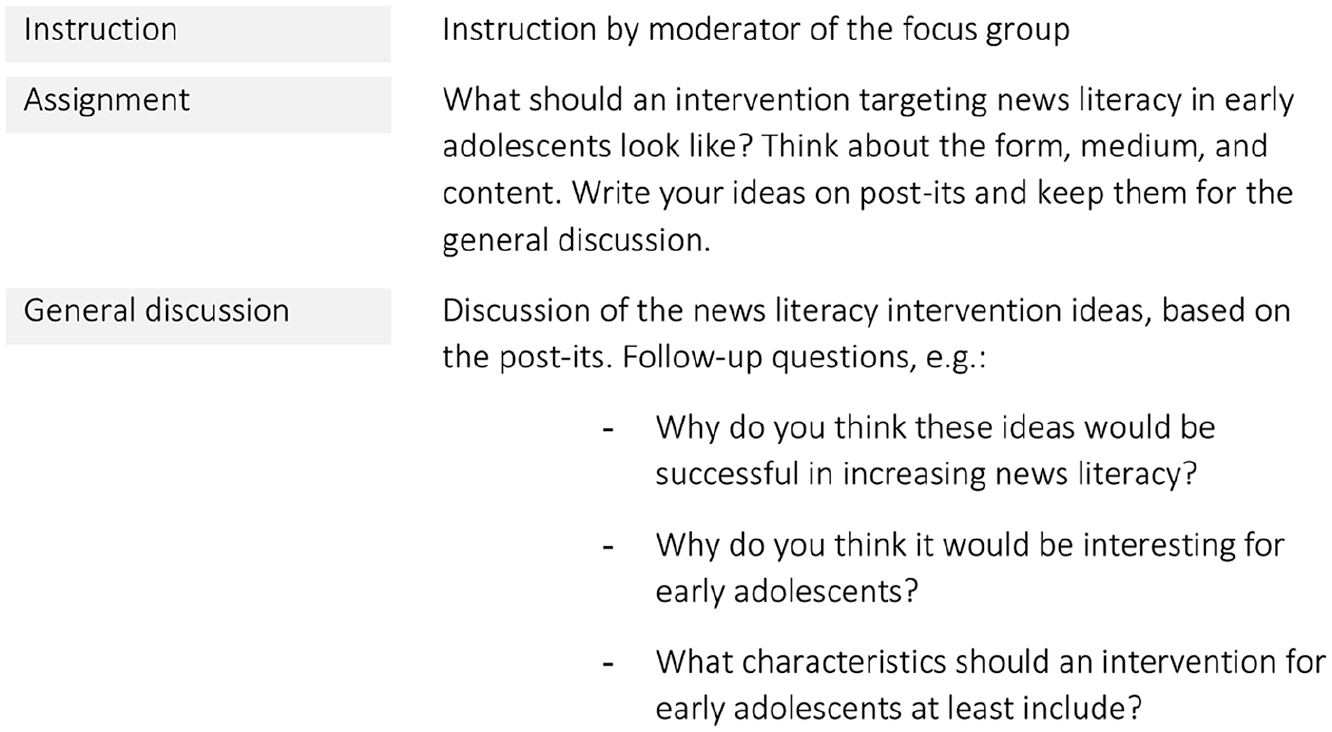
Overview of the assignment and focus group procedure.
To increase internal validity and reliability, we used peer debriefing (constant reflection and discussion), and member checks (provoking a critical response from participants) (Patton, 2002). Ideas that were brought up in one focus group were, for example, brought up in other groups to provoke comments. Statements within focus groups were summarized and tested on whether we correctly understood their ideas. These practices were used to strengthen the validity, fairness, and accuracy of the data.
Analysis
All sessions were recorded and transcribed verbatim, both audio and video. To analyze the data, thematic analysis was used, which provides a “systematic approach for identifying, analyzing, and reporting patterns—themes—across a dataset” (Braun & Clarke, 2006, p. 79). The analysis was conducted in MAXQDA (VERBI, n.d.).
Results
To answer the research question, themes and subthemes were ordered in a thematic map (see Figure 2).
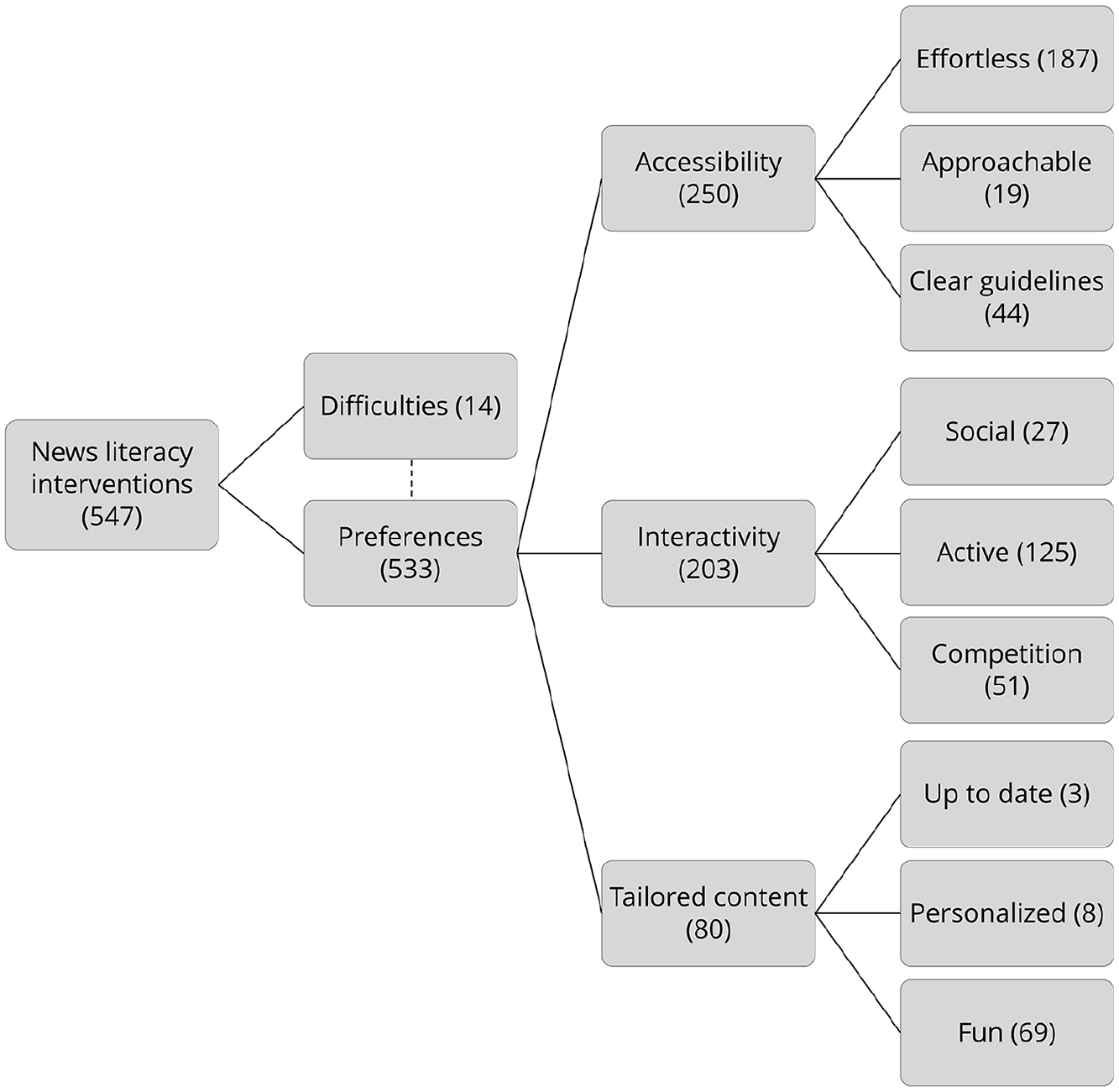
Thematic map of early adolescents’ preferences for news literacy interventions (frequency counts in parentheses).
Difficulties of News Literacy Interventions
Overall, it became clear that participants did not see many opportunities for making a news literacy intervention intrinsically motivating for early adolescents. Some even stated that it would be very difficult, if not impossible, to stimulate early adolescents’ news literate behaviors (see Figure 2, “Difficulties”). They described their age group as a really specific group that is hard to motivate for news consumption and news literacy. As one participant stated: “The problem is, teenagers are really lazy and stubborn, that’s the way it is. So, you have to force them without them knowing they are being forced, otherwise they don’t want to do it.” (ID40, female, 15 years).
Preferences for News Literacy Interventions
After discussing whether it would, at all, be possible to develop effective news literacy interventions for early adolescents, the attention shifted to what can be done in interventions to make them as effective and fitting as possible. In most focus groups, participants first explicitly discussed the goals an intervention has to reach to be effective. These included news literate behaviors such as learning about fake news, how to distinguish incorrect from correct information, and the knowledge-oriented goal to increase knowledge about news media and the news production process. To reach these goals, three practical themes were put forward: focusing on the accessibility, interactivity, and (tailored) content of interventions (see Figure 2).
Accessibility
First, news literacy interventions have to be accessible. It should be easy to participate in the intervention and to learn. Therefore, interventions should be as effortless as possible for early adolescents. Because participants are often relatively passive in engaging in activities that they are not already intrinsically motivated for, interventions should be easy to find, or even better, approach them where early adolescents already are. This can be at schools, social media, or at other places and spaces where young people spend a lot of time. News literacy interventions should be facilitated, or even be forced, for example, at school. Some participants mentioned that they consumed more news while in primary school, partly because they watched the children’s news together in class. Further integrating news (literacy) in their curriculum could be one way to increase their news literate behaviors.
More concretely, ideas on making interventions effortless range from guest lectures at school to advertisements in which they are being warned for fake news, or advertisements for a larger intervention at, for example, their go-to coffee place. Interventions should be able to reach both people from different educational levels and those that are not that interested and would therefore not actively seek more information on news.
In line with interventions being effortless, interventions should be approachable. When early adolescents have questions or want to know more, this should be possible and easy. As participants stated: “You have to make critically evaluating news more accessible by making something like a website, a forum” (ID39, male, 15 years). Other concrete ideas relating to this are a free mobile application, or a fact check in the form of an email address they can use to check messages they doubt.
The final component of accessibility is that news literacy interventions should offer clear guidelines. Information should be short and offer easy-to-follow advice on how to deal with their doubts. It should become easy to critically evaluate news, for example, by following a couple of concrete steps: “When you have doubts that you know, I can do this, I can do this and I can do this and then I probably know more” (ID32, female, 15 years). Everyone should be able to understand the information and act upon it. Concrete ideas include a checklist for fake news and a tutorial explaining how to recognize this.
Interactivity
Second, news literacy interventions should be interactive. To truly stimulate early adolescents to critically engage with news, interventions first have to be social. They have to get the idea that other early adolescents also believe it is important: Well, I think that it is maybe a bit nicer when you already hear something about it, that you have the idea that more people pay attention to it, instead of, for example, only older people. Then you’re like “well you are older, there are more things that you believe are more important while we think those are not [important].” Then you might think “oh that person also thinks it is important, maybe I also have to read about it.” (ID30, female, 12 years)
The goals of interventions should thus preferably not (only) be disseminated by researchers or teachers, but should come from other people of their age or at least be supported by them. As a concrete solution to this, participants raised the idea of working with vloggers or influencers they like, although they were not sure whether they would be right to disseminate news literacy-related goals.
Besides having the idea that other early adolescents support the goals of the intervention, participants stressed that interventions should include interactions with peers. They are thus not only sensitive to what others think, but also want to be able to see what others do or to communicate with others. Concrete ideas include adding a chat function or doing something together with their class.
Next, possibly one of the most important factors is that participants mention that news literacy interventions have to be active. Although they do not want to put that much effort into joining the intervention (see effortless), participants want to actively engage with the topic within the intervention. They emphasize a need for action and/or cognition: “Something in which you can actually do something or think about” (ID42, female, 15 years), which, in turn, might increase the chances of doing something with it later on: “I also think that when you are working on a topic that it makes you think more about it” (ID34, male, 16 years). Active interventions can take many forms: ranging from assignments, to a mobile application including games, to “make your own news broadcast,” and to participating in polls.
A final factor that could increase interactivity is the addition of competition. Like the participants mentioned when discussing the difficulties of interventions for early adolescents, it may be hard to intrinsically motivate this group. To have a chance to be successful among early adolescents, they suggest that a news literacy intervention should include a competitive element and maybe even a chance to win something. This can be anything, from “honor,” to “chocolate” or “extra credit points.” Nevertheless, they agreed that to work as an intervention, it should be as intrinsically motivating as possible. People should learn something instead of only focusing on trying to win, but adding competition can increase early adolescents’ engagement with the intervention and news literate behaviors.
Tailored content. Finally, the content of the intervention is important. When a news literacy intervention includes actual news, this has to be up to date and personalized for early adolescents: “it should take into account what we like” (ID10, male, 13 years), such as sports or events that are directly relevant to them, like school strikes. At the same time, an intervention should not risk becoming one-sided or only focus on the kind of news that interests them, as they stated that interventions should also stimulate a broad news repertoire. They thus want an intervention to appeal to them, gaining their interest by relevant and up-to-date information, but at the same time, stimulate a varied news diet.
Most importantly, participants mentioned that the content should be fun. Although some educational programs can be fun, “others are very boring” (ID12, female, 14 years). This does not have to mean that it is not serious and about news, but participants stressed that this information can also be brought more engagingly. They compare this to their news consumption: they prefer (daily) talk shows over the regular television news broadcasts, because these are more engaging and “fun” to watch. They stated that disseminating information in a nonconventional way—such as higher paced and using humor like in talk shows—can “also lead to a stronger bond with the person you want to reach” (ID50, male, 16 years). Interventions have to show that (some) news is not boring. It has to be funny, original, and lively. At the same time, it should not be too childish or try to be funny when it is not.
More concrete ideas include adding game elements, comics, quizzes, a play, and videos. They would convey news literacy knowledge in a way that fits their everyday media use. A video could, for example, concretely “show what is real and what is not” (ID3, female, 12 years), and a play could do the same: “that you show how something really happened and then, for example, someone who plays as if he is in the news and makes something completely different out of it” (ID6, female, 12 years). These more out-of-the-box ideas show participants’ preference for nonconventional interventions that really grasp their attention and might even entertain them. News literacy interventions should not merely be pedagogical lessons, but go a couple of steps further to really enthuse them for behaving in a more news literate manner.
Discussion
In this study, we investigated early adolescents’ ideas on what effective news literacy interventions should be like. According to our participants, it is a challenge to effectively reach early adolescents with a news literacy intervention. However, they did offer valuable insight into how to design interventions for early adolescents. Future interventions should be and make news literate behaviors accessible, should be interactive in nature, and should be tailored toward their specific interests and media preferences. These insights can be used particularly for interventions for early adolescents, but may also contribute to the development of effective news literacy interventions in general.
To apply these insights by early adolescents in practice, this study’s results have been translated to offer a set of guidelines for news literacy interventions (see Figure 3). First and foremost, the specific target group should be considered. In the case of early adolescents, their lack of intrinsic motivation for news literate behaviors makes the fit between the intervention and their needs of utmost importance. Second, interventions should find people where they are: interventions for early adolescents are more likely to be effective when they do not have to put in much effort to find it or engage with it. Interventions could take place in schools or at other places where it is fitting. Interventions could use age-specific media platforms for recognition and ease of fitting it into existing routines. Third, interventions should start from the target group’s interests. For early adolescents, this means that it could include examples about sports and be fun, but should remain serious and stimulate a varied news diet. Fourth, interventions should make applying their news literacy really easy: participants should feel self-efficient and in control to engage in news literate behaviors. This can be achieved by offering clear (but short) checklists and easily digestible information.
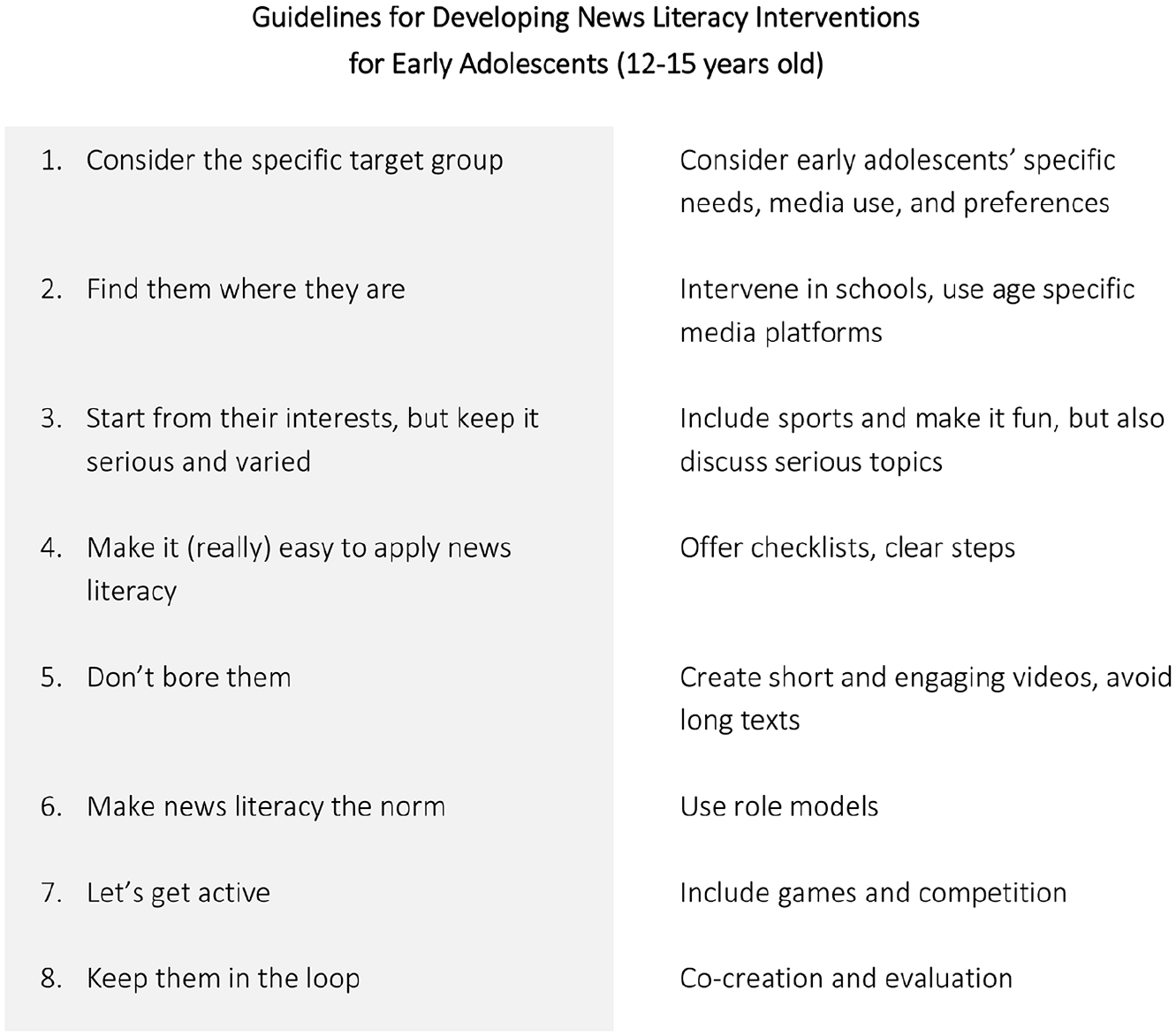
Guidelines for developing news literacy interventions for early adolescents.
Fifth, do not bore them. Interventions should fit early adolescents’ preferences for being engaged and entertained: researchers and practitioners should steer away from long texts and, for example, develop short engaging videos. Sixth, make news literacy the norm: role models can be used to increase early adolescents’ belief that applying news literacy is important and something that important others do. Seventh, interventions should be active: to engage early adolescents and to motivate them to process and internalize news literacy interventions, they should take an active form, such as game-based design. Finally and eighth, the target group should be involved in the creation and evaluation of news literacy interventions. There is a really fine line between developing a fun and engaging intervention and developing one that is considered too childish or, downright, boring. Co-creation and extensive evaluation are recommended.
These guidelines and, more generally, the expressed need for interventions to be accessible, interactive, and tailored bring together and resonate with earlier research on media literacy interventions in general, news literacy pedagogy, information processing, and with early adolescents’ specific needs and preferences regarding news. This shows in that interventions should match early adolescents’ news use preferences by being online, effortless, and engaging (e.g., Swart, 2021; Tamboer et al., 2022; Valkenburg & Piotrowski, 2017). Importantly, our results showed that interventions should be interactive and social, which matches early adolescents’ peek in responsiveness to peers during this developmental period in their lives (Sumter et al., 2008). Youths’ application of news literacy should be seen and considered as a social and connective act (Swart, 2021).
Furthermore, the results contribute to the development of news literacy interventions in general. Although these guidelines describe early adolescents’ preferences, they fit and can be used in the stimulation of factors described in Vraga et al.’s (2021b) theoretical model of news literate behaviors. That is, our guidelines have the potential to increase people’s perceived behavioral control, social norms, and positive attitudes toward news literate behaviors. The need for interventions to be accessible and to make news literate behaviors accessible (e.g., with checklists) may lead to an increase in perceived behavioral control—an individual’s belief that news literate behavior is achievable (e.g., Vraga et al., 2021b). Making interventions interactive (e.g., including role models) may lead to more favorable social norms which could, subsequently, lead to higher intentions to engage in news literate behaviors. Then, the need for tailored content may increase the enjoyment and personal relevance of engaging in news literate behaviors and contribute to more positive attitudes toward these behaviors. The guidelines, as discussed in this article, thus offer an extra layer underneath the model of news literate behaviors by Vraga et al. (2021b), explaining how interventions can stimulate news literate behaviors.
There are a couple of existing news literacy interventions that, based on (parts of) these guidelines, may be effective in increasing early adolescents’ news literate behaviors. These include interventions that use gamification, such as the Bad News game (Roozenbeek & van der Linden, 2019) and the study by Literat et al. (2020). Another example is an intervention in which participants are immersed in a situation room simulation and engage with a hypothetical breaking news event (De Los Santos et al., 2021). Our results underline that these could be fitting intervention forms to stimulate early adolescents’ news literate behaviors, both in the social nature as well as in matching the need to integrate the intervention in age-specific media consumption patterns.
This study is—to our knowledge—the first to offer more insight into what (more) effective news literacy interventions targeted at early adolescents should look like. However, this study is not without limitations. Although our focus groups included a variety of educational levels, gender, and age, our sample was somewhat skewed toward a higher level of education. Furthermore, it is yet to be determined whether early adolescents also “walk the talk.” Future research should shed more light on how effective interventions adhering to these guidelines are in increasing early adolescents’ news literate behaviors.
Overall, this study offers guidelines in the development of news literacy interventions, which can be applied and tested in future interventions. By taking an empowerment approach in the development of news literacy interventions, we are most likely to effectively empower early adolescents in their news literate behaviors. If early adolescents are indeed, as they say, “really lazy and stubborn,” it is researchers’ and practitioners’ task to make sure news literacy interventions are more than just “very boring.” When taking early adolescents’ needs and preferences seriously, there is a lot of potential for future interventions to effectively stimulate news literate behaviors.
Footnotes
Declaration of Conflicting Interests
The author(s) declared no potential conflicts of interest with respect to the research, authorship, and/or publication of this article.
Funding
The author(s) received no financial support for the research, authorship, and/or publication of this article.
