



Abstract
The purpose of the present study is to investigate the behavioral intentions of Turkish English as a foreign language (EFL) pre-service teachers to use a cloud application in their future classes. Preliminary data were collected from 22 senior EFL pre-service teachers via a questionnaire, semi-structured interviews, and an observation form. Before the questionnaire was administered, the participants were trained on the use of Voicethread in language teaching for three weeks. At the end of the training, a Unified Theory of Acceptance and Use of Technology questionnaire was used to collect the data. Semi-structured interviews were designed to have a deeper understanding why pre-service teachers accepted or rejected the use of Voicethread in language teaching. In addition, the teaching demonstrations of the pre-service teachers were observed to see how they used Voicethread in the activities they designed and whether they could carry out an activity based on incorporating Voicethread. The findings indicate that pre-service teachers in this study do not seem to intend to use Voicethread in their future classes. Given some significant potential benefits for use of the tool, this paper then considers more effective approaches to engaging pre-service teachers in exploring and applying the benefits as well as negotiating any difficulties experienced in the use of Voicethread.
Keywords
Introduction
Integrating technology into teacher education programs has become critically important in recent years and is widely addressed in the literature (Anderson and Maninger, 2007; Collier et al., 2004; Halpin, 1999; Hargrave and Hsu, 2000; Pope et al., 2002; Wright and Wilson, 2005). Educational institutions play important roles in training pre-service teachers to integrate technology into their future classes (Alayyar et al., 2012; Jamieson-Proctor et al., 2010; Wood et al., 2005). Technology is especially relevant in learning and teaching languages (Albirini, 2006; Almekhlafi and Almeqdadi, 2010; Dang, 2011; Dogoriti, 2010; Kopinska, 2013; Liu, 2009; Raman and Yamat, 2014; Tsou et al., 2006), as it provides opportunities to engage in virtual travel to different parts of the world and to communicate authentically with people from different cultures around the world (Solomon and Schrum, 2007).
According to Rosaen et al. (2003), it is critical that faculty role models the use of new technologies to support pre-service teachers with their development of new perspectives on the potential of these tools. In this way, pre-service teachers can make use of new technology in their learning process becoming more familiar with classroom technology from the student’s perspective (Hall, 2006). In addition to observing faculty members’ technology integration practices, pre-service teachers need opportunities to prepare units and lesson plans which include technological tools and to implement them in real-life contexts (Niess, 2008). Given such authentic opportunities in the instructional practices, pre-service teachers’ opinions, emotions, and intentions to use emerging technologies can be fully explored. Taking this into consideration, this research aims to reveal the behavioral intentions to use Voicethread in the future classes of Turkish English as a foreign language (EFL) pre-service teachers following the three-week training about Voicethread integration into their teaching demonstrations. Ajzen (1991, p. 181) sees intentions as “indications of how hard people are willing to try, of how much of an effort they are planning to exert, in order to perform the behavior.” Focusing on teachers’ behavioral intentions to use information and communication technologies (ICT) is a significant contribution to the field in terms of predicting their actual actions for integrating ICT in their future classes. This study focuses on finding out Turkish EFL pre-service teachers’ behavioral intention to use Voicethread in their future classes.
Theoretical framework
Unified Theory of Acceptance and Use of Technology
In this research, we adopted the Unified Theory of Acceptance and Use of Technology (UTAUT) in order to explore the intentions of pre-service teachers. This theory was adopted because it predicts behavioral intention with a ratio of 70%. Fishbein and Ajzen (1975) can be considered pioneers of acceptance research, based on their Theory of Reasoned Action (TRA). In 1991, they proposed an extended version of TRA, the Theory of Planned Behaviour (TRB), by adding a new dimension. The TRB focuses on the explanatory powers of the TRA to strengthen the construct of perceived behavioral control. Drawing on earlier proposed models, such as the Technology Acceptance Model (Bagozzi and Warshaw, 1992; Davis, 1989) and the Innovation Diffusion Theory (Rogers, 1995), Venkatesh et al. (2003) in their UTAUT model united eight user acceptance and motivation models—the TRA; the motivational model; the TRB, a model combining the technology acceptance model and the TRB; the model of PC utilization; the innovation diffusion theory; and the social cognitive theory—in order to formulate the UTAUT, which evaluates the factors for individual user acceptance of an innovation.
As illustrated in Figure 1, Venkatesh et al. (2003), in their study with four organizations among individuals being introduced to a new technology in the workplace, found four constructs that directly determined user acceptance and usage behavior: performance expectancy (PE), effort expectancy (EE), social influence (SI), and facilitating conditions (FC). Venkatesh et al. (2003) tested the UTAUT model and found out that the model explains 70% of the variance in predicting behavioral intention and 50% of actual use. While PE, EE, and SI are viewed as the direct factors affecting behavioral intention, using the innovation behavior seems to have been affected by behavioral intention and FC. Additionally, attitude towards using technology, self-efficacy, and anxiety have not been categorized as direct determinants of intention. Finally, gender, age, experience, and voluntariness of use are considered to be the key moderators in the UTAUT model. Venkatesh et al. (2003, p. 447) describe PE as “the degree to which an individual believes that using the system will help him or her to attain gains in job performance”. EE is defined as “the degree of ease associated with the use of the system” (Venkatesh et al., 2003, p. 450). In these studies, PE and EE are shown to be important predictors of behavioral intention (Venkatesh et al., 2003; Venkatesh and Zhang, 2010; Wang and Shih, 2009). PE is the most important predictor of intention in both voluntary and mandatory environments. EE becomes less important over periods of extended and sustained usage. EE is a significant determinant of behavioral intention (Im et al., 2011; Schaik, 2011). SI is described as “the degree to which an individual perceives that important others believe he or she should use the new system” (Venkatesh et al., 2003, p. 451). No effect of SI has been found in environments where using the innovation is voluntary. Moreover, even under conditions of mandatory adoption, SI appears to be significant only in the early periods of adoption, losing effect over time. FC is defined as “the degree to which an individual believes that an organizational and technical infrastructure exist to support use of the system” (Venkatesh et al., 2003, p. 453). Venkatesh et al. (2003) found that when PE and EE constructs are available, FC is insignificant as a predictor of intention. However, FC appears to be a direct determinant of usage. On the other hand, such constructs as self-efficacy, anxiety, and attitude have not been found as direct determinants of intention in the UTAUT Model (Venkatesh et al., 2003). The attitude seems to be important only when performance- and effort-related expectancies are not covered in the model (Venkatesh et al., 2003). Subsequently, it has been revealed that behavioral intention will most probably affect technology use significantly (Venkatesh et al., 2003), and understanding behavioral intentions is a significant element of pre-service teacher education.
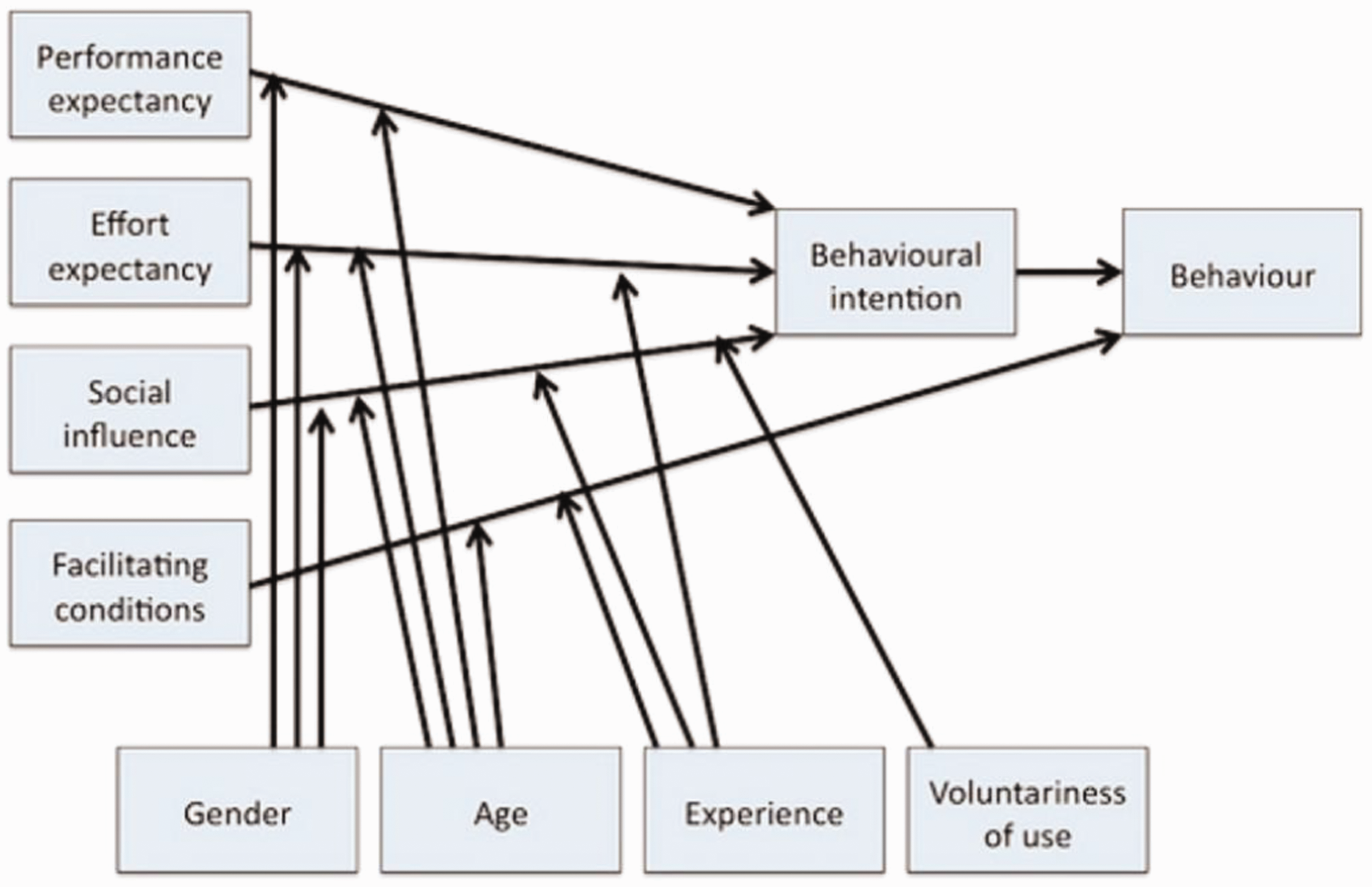
UTAUT model. Adapted from “User acceptance of information technology: Toward a unified view,” by Venkatesh et al. (2003).
UTAUT in education
Research on the validation and application of the UTAUT model in education are limited (Birch and Irvine, 2009; Oye et al., 2014; Schaik, 2011; Teo and Noyes, 2014; Wong et al., 2013) and there are few studies implementing UTAUT in the pre-service teachers’ technology acceptance (Birch and Irvine, 2009; Wong et al., 2013).
In his study about the use of English e-learning websites, Tan (2013) found that PE, EE, and SI positively influence behavioral intention and FC; this research also revealed that behavioral intention positively affects use behavior. Also, if learners perceive a technological innovation to be easy to use, this may contribute to their behavioral intention to make use of this tool. Hsu (2013) investigated the acceptance and use levels of EFL university sophomore students using Moodle. Results indicated that PE, EE, and SI are significant predictors of acceptance in Moodle use. The findings show the significance of learners’ beliefs in usefulness, ease of use, and support they receive in using the technology. Another study examined academic staff’s acceptance and use of ICT in their workplace (Oye et al., 2014). EE and SI were found to be the most significant determinants of their acceptance and use of ICT. The findings also suggest that PE, EE, SI, and FC positively affect the acceptance and use of ICT among academic staff. Baltaci-Goktalay and Ozdilek (2010) determined that pre-service teachers’ perceptions about web 2.0 technologies were positive, and their acceptance and willingness to use web 2.0 technologies were high in terms of bettering their courses. In their study of interactive white board use, Wong et al. (2013) found that their model explains 59.6% of the variance of behavioral intention among student teachers in making use of interactive white boards in their teaching. They note that PE appears to be the dominant predictor of behavioral intention indicating that the student teachers will be more likely to make use of an innovation when they see it as valuable and beneficial to use. EE appears to be important in determining behavioral intention. Hence, it seems necessary to explore positive perceptions about the innovation’s easy to use features during early adoption experiences and provide carefully designed training in the pedagogical values of the innovation compared to technical aspects.
Birch and Irvine’s (2009) research shows that the UTAUT model explains 27% of the variance in preservice teachers’ behavioral intention to use ICT in their teaching. In addition, EE was observed as the only significant determinant of behavioral intention. It was suggested in the study that the main measure of the EE is probably the technology skill level of pre-service teachers, which seems hard to measure because the concept is subjective and pre-service teachers who are skillful at basic ICT tools (e-mail, word, etc.) may see themselves as highly skilled while those more competent in their ICT knowledge may identify themselves lower because they are familiar with the tools (Birch and Irvine, 2009). It may be useful to conduct a performance skill test in order to support both students and teachers in understanding their skill level in using technology. The researchers suggest that pre-service teachers need to be convinced about ICT integration into their lessons. Coffman (2014) researched 151 in-service secondary teachers’ acceptance and use of web-based e-learning technology. This study was the first to use the mixed-methods design in education for the UTAUT model. The scope of the research extended to what kind of UTAUT factors, and possible other factors, has a place in e-learning technology use in classrooms with the help of follow-up interviews. PE was found as the most effective factor in describing acceptance and use of web-based e-learning technology in the results of both the survey and the interview. In addition, EE and FC were said to have a part in technology acceptance.
Becit-İşçitürk (2012) aimed to find out the predictors of behavioral intention for technology use among student teachers. The findings reveal that PE, computer attitude, computer self-efficacy, and SI significantly predict behavioral intention of student teachers for technology use. Such moderating variables as foreign language level, ICT use experience, and gender do not have significant difference. What is more, this study suggests adding anxiety to predict student teachers’ behavioral intention to use technology. Teo and Noyes (2014) investigated whether UTAUT model also works in finding out behavioral intentions in educational context. Using a structural equation model for model verification, the researchers collected data from 264 pre-service teachers enrolled at the National Institute of Education in Singapore. The findings reveal that the model explains 40% of the variance in behavioral intention to use technology among pre-service teachers. PE was found as the most significant construct in the model followed by EE and SI. Baydaş (2015) developed a model that explains the intention to use ICT in pre-service teachers’ future lessons. The participants were composed of 2893 pre-service teachers from pre-school, primary school, primary mathematics, science, social studies, English (n = 179), and Turkish teaching departments. Using a mixed method approach, the researcher took such factors as perceived usefulness, perceived ease-of-use and efficacy, SI, FC, and anxiety into consideration. The model explains 85% of the variance for intention to use ICT in pre-service teachers’ future lesson in which perceived usefulness was determined as the most significant factor followed by perceived ease-of-use, FC and efficacy, SI and anxiety in a negative way. It was suggested that attitude be added to the factors affecting pre-service teachers’ intention to use ICT. As can be observed from the literature, there are few studies using UTAUT model in education in order to find out behavioral intentions to use technology in classes. This study aims to find out Turkish EFL pre-service teachers’ behavioral intention to use Voicethread in their future classes by using UTAUT model. In the following section, Voicethread and Voicethread-related studies are examined.
Voicethread
Voicethread is a cloud application that allows its users the opportunity to create, comment, and share documents, presentations, images, audio files, and videos (Voicethread, 2015) providing students and teachers with opportunities for pedagogical use. Voicethread provides options to create and organize videos related to specific topics. Voicethread has an archive composed of documents, presentations, images, audio files, and videos (Voicethread, 2015) allowing faculty members and pre-service teachers to view numerous example videos about such topics as talking about everyday topics, reporting past events.
Research on use of Voicethread in educational contexts is limited. McCormack (2010) has investigated how Voicethread can be utilized to exact more in-depth answers from the student teachers in early education and special education programs. Findings indicate that Voicethread can enhance reflective and thoughtful responses and engagement. Brunvand and Byrd (2011) listed numerous educational benefits of using Voicethread—including promoting active participation, raising the opportunities of interaction for passive learners, providing a variety of visual and audio input in addition to verbal and written output, diversifying input and output choices in terms of learner needs, enhancing learners’ conversational practices by recording their voices and sharing their thoughts without considering their communicative skills—that may increase students’ motivation to accomplish more qualified work.
Taken as a whole, research indicates that technology integration will continue to be important and necessary in the 21st-century education (Darling-Hammond et al., 2005; Ward and Overall, 2013), all the more so in teacher education. Twenty-first century demands various competencies related to technology use for their future students (Prensky, 2001). Although teacher education programs are supposed to develop their pre-service teachers’ technology integration practices, preparing pre-service teachers for future ICT integration practices needs still attention (Mishra and Koehler, 2006; Vallance et al., 2009). Problematically, such training may be confined to basic technological skills, excluding interaction, collaboration, communication, creativity, and critical thinking skills that are highlighted in the 21st-century teaching and learning objectives. Therefore, there seems to be a need to encourage pre-service teachers to integrate technology into their future classes. To the authors’ best knowledge, currently, there is no study examining the UTAUT model in EFL pre-service teacher education in conjunction with the use of Voicethread. Given these concerns, in this study, we explored the behavioral intentions of Turkish EFL pre-service teachers to use Voicethread in their future classes. The research questions are as follows:
To what extent do Turkish EFL pre-service teachers intend to use Voicethread in their future classes? What factors influence the intention to use Voicethread in their future classes?
Method
Research design
This study aims to reveal the behavioral intentions of Turkish EFL pre-service teachers to use Voicethread in their future classes. Mixed methods design was used in this study because it “can help to clarify and explain relationships found to exist between variables” and “allows us to explore the relationships between variables in depth” (Fraenkel et al., 2011, p. 558).
Setting
The English Language Teaching department chosen for the study is in Turkey. There, pre-service teachers take three technology courses—Computer I, Computer II, and Instructional Technologies and Material Development (ITMD) during the four-year program. Pre-service teachers are expected to learn topics related to computers such as hardware, software, and office programs in Computer I and Computer II courses. ITMD is concerned with instructional technologies and designing instructional materials accordingly. The pre-service teachers are expected to perform teaching demonstrations in a typical Materials Adaptation and Evaluation course which involves the evaluation, adaptation, and design of materials in language classes. For this study, the pre-service teachers were asked to incorporate Voicethread into their teaching demonstrations.
Participants
Participants include 22 senior Turkish EFL pre-service teachers enrolled in a Materials Adaptation and Evaluation in Foreign Language Teaching course during 2015–2016 fall term. Eighteen were females and four were males, and their age ranged from 21 to 23 years.
Treatment
The participants were trained for three weeks (for 9 hours in total) in the use of Voicethread face to face in an interactive discussion class environment. In the first week, the researchers created a PowerPoint presentation on the importance of technology integration and the requirements that 21st-century teachers must meet to effectively serve their students. The presentation was followed by a class discussion of these topics. Next, the researchers assigned the participants to groups and asked them to design some classroom activities integrating technology. Each group related their activities to the class, which then discussed how the technology impacted on the activity. The researchers sometimes guided the discussion but mostly acted as mediator. At the end of the lesson, the researchers asked the participants to log into Voicethread for the next lesson and write down the activities they developed. In the second week, participants brought their own Internet-ready laptops to class, having signed up for Voicethread as instructed. The researchers provided an introduction to Voicethread, including its basic features. They then showed a short tutorial video on Voicethread features, including “create,” “comment” (audio, video, and text), and “share.” After each feature, the researchers paused the video and modelled the feature for participants, then asked them to demonstrate the feature themselves. Participants also received instruction on uploading pictures, documents, and presentations. Researchers then asked participants to design activities and how they could adapt the activities they designed in the previous session to Voicethread. After some time, the participants discussed their own ideas with the class as a group as well as which part of a lesson Voicethread could be used in: pre-, during, or post-lesson. The researchers acted as mediators by posing critical questions to the groups in order to demonstrate Voicethread’s relevance to the activities they had designed. Subsequently, all the groups began to create their activities using Voicethread assisted by the researchers. The researchers then asked each group of participants to prepare a lesson plan for the next week’s class and to integrate Voicethread into the plan. Participants were asked to explain why they had used Voicethread for their chosen activity, and what kind of differences they would expect as an outcome. Participants were then presented with the observation form they were going to be evaluated prior to the presentation. For the third week’s lesson, participants were assigned to do teaching demonstrations as a group concerning use of Voicethread in the lesson plans. When one participant was in the role of teacher and the rest were in the role of students. In the third week, the teaching demonstrations were assigned because the researchers wanted the participants to experience the use of technology in practice. They were in the role of teacher, and their peers were in the role of learners. The researchers gave this opportunity to the pre-service teachers because teaching demonstrations allowed the pre-service teachers to experience the use of technology in practice. The researchers also wanted to help enable participants to manage various problems and difficulties they would likely encounter while using technology in their future classes. The researchers were passive throughout this process filling out the observation form and writing down additional comments as feedback to each group of participants. Researchers also informed participants that they were available to provide feedback. Finally, at the end of the lesson, the researchers distributed UTAUT survey. After that, they did semi-structured interview with voluntary pre-service teachers.
Data collection tools
Data were collected via UTAUT survey (Venkatesh et al., 2003) (in order to answer first research question), semi-structured interview (in order to answer second research question), and observation (in order to answer second research question). Ethics approval was granted from the committee. Participants entered the study on a voluntary basis and all the class members took part in the study. Those who wished to take part were debriefed about the study’s aims and completed a consent form. Participants were notified of their right to withdraw from the study at any time.
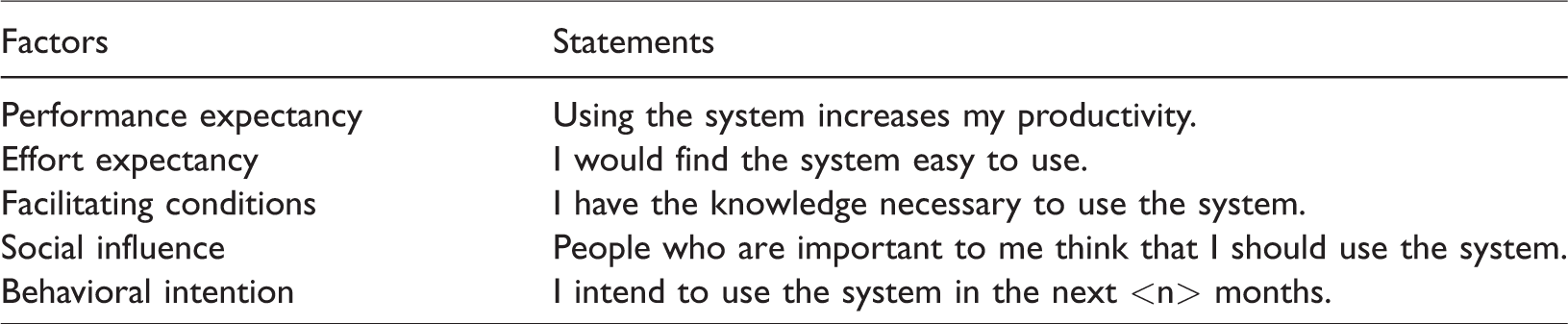
UTAUT survey with seven-point Likert-type scale is composed of five factors namely PE (four statements), EE (four statements), FC (four statements), SI (four statements), and behavioral intention (three statements). Survey scores can range from 19 to 133 and internal reliabilities of the survey for each construct are higher than .70 (Venkatesh et al., 2003). Example statements related to each factor can be observed in Table 1.
Example statements of the factors in the UTAUT questionnaire.
The semi-structured interview was conducted with 11 volunteer participants in order to obtain more in-depth data about participants’ reasons for their acceptance or rejection of Voicethread for use in their future classes. Participants were asked “What do you think about the use of Voicethread in language learning and teaching?”, “What do you think about the use of Voicethread in your future classes?”, and “Will you use Voicethread in your future classes?”.
Participants’ teaching demonstrations were assessed using an observation form. The researchers took expert judgment for the observation form (Appendix A). The form included criteria such as classroom management, sufficient instruction, and help given during Voicethread activity. The researchers used these criteria in order to evaluate the participant’s teaching demonstration from the aspect of Voicethread integration. The form was simply designed and the researchers ticked the suitable criteria based on the performance of the pre-service teacher during teaching demonstration.
Data analysis
Data from the UTAUT survey were analyzed using descriptive statistics in SPSS-15. Total scores were taken for each of the four categories, along with means, standard deviations, and minimum-maximum scores.
Semi-structured interview was analyzed through content analysis. By rereading the data, the recurring codes were presented. Afterward, the data were reread and related quotations from the participants’ expressions during the interview were written under each code.
Each group’s score in the observation form based on classroom management, sufficient instruction, and help given during Voicethread activity was analyzed using mean, and maximum scores. Possible scores ranged from 0 to 25.
Results
Results of the questionnaire
This study investigated Turkish EFL pre-service teachers’ behavioral intentions regarding use of Voicethread in their future classes. Descriptive statistics from the questionnaire are presented in Table 2:
Descriptive statistics for UTAUT questionnaire with five factors.
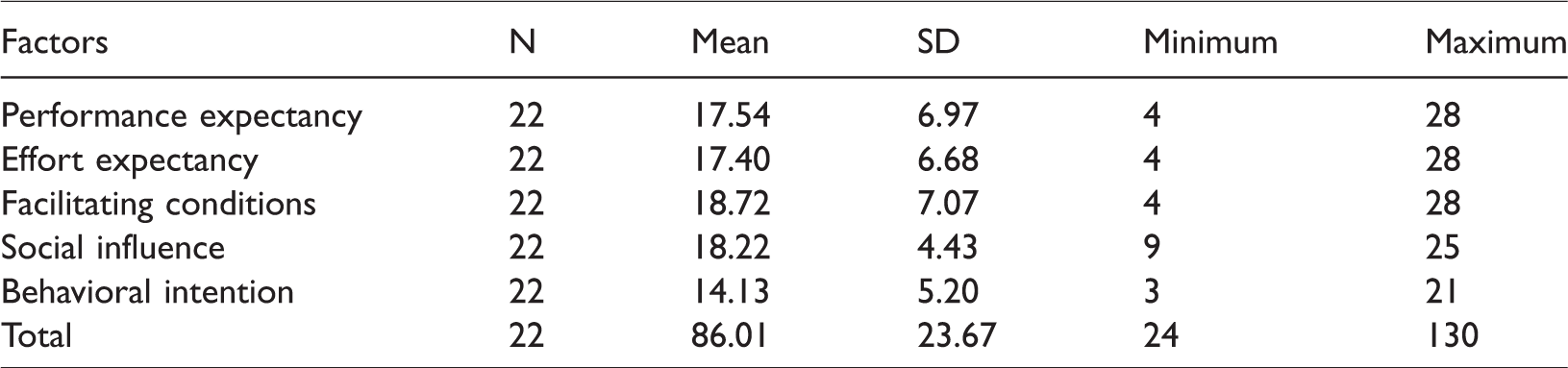
Participants displayed low Voicethread acceptance levels for their future teaching: (FC (M = 18.72); SI (M = 18.22); PE (M = 17.54); EE (M = 17.40); Behavioral intention (M = 14.13)). Additionally, the overall acceptance level of pre-service teachers’ Voicethread use for their future classes is not high (M = 86.01).
Results of the interview
In relation to the questions in the semi-structured interview, the pre-service teachers in this study all agreed that they do not intend to use Voicethread in their future classes due to such emerging themes as lack of facilities, addiction to technology, and being unable to control the learners. Although pre-service teachers in this study find Voicethread easy to use and useful, they do not think that they will be able to use Voicethread due to the reasons mentioned below.
Lack of facilities
A number of those interviewed suggested that lack of facilities in the schools can deter them from using Voicethread in their classes. The participants felt discouraged about getting access to technological facilities in order to be able to integrate Voicethread into their classes:
P1: To be honest, in order to apply this in Turkey, you have to work at a very high standard school. Due to the fact that we all want to work at the state schools, it is not possible. I do not think that I will be able to use it.
P2: We go to a school for internship in a major city in Turkey. Even, they do not have technological facilities. They do not have an interactive white board.
Addiction to technology
There were some suggestions that using technology may trigger the learners’ addiction to technology. The participants seemed concerned about technology’s accelerating fame among the new generation:
P4: The government distributed lots of tablets to the learners. I see my brother play games all the time. He does nothing else.
P5: Actually, it is necessary to put some limits. Directing learners to the computers all the time is mentally a bad thing. If the case is like this in the 21st century, the learners will be completely addicted to it in the following 50 years. Although using the slides attracts the learners, the question is how much should we make use of it?
Unable to control the learners
There was a sense of becoming unable to control the learners during technology integration amongst interviewees. They felt anxious especially for crowded classes: P7: The classes are very crowded. When I ask the learners whether they are using computers in their classes, they say they use Facebook and play games. The teacher cannot control 40 people.
P5: We can use Voicethread very effectively by using projector and without learners using computers. At least, we can use text comment feature. However, as my friends say, it is impossible to handle 40 learners by giving them iPads.
Ease of use and usefulness in Voicethread
Opinions were stated whether Voicethread is easy to use and useful. Although the participants felt that Voicethread is easy to use and useful, which may affect the integration of Voicethread into instruction, other respondents seem to have doubts for using Voicethread:
P6: Although Voicethread is a good web site to use, I do not think it will be used.
P1- P8: I think the web site is useful.
P3-P9: The website is easy to use.
P5: If we have the chance to use, it is really good.
P2-P7-P9-P10: If there is enough facility, we prefer to use Voicethread because it is useful and easy to use.
P10: If everyone has computers, to use Voicethread would be easier.
P8: Our country is not Finland. I do not think when we provide the learners with the computers, they will perform successfully.
Results of the observation form
Results from the observation form indicate that participants were not very successful at integrating Voicethread into their teaching demonstrations. They seemed to have difficulties with network problems (M = 8.12). Participants also lost the control of the class while they tried to handle the network problem (M = 1.87). Furthermore, pre-service teachers (the participants) sometimes were not providing sufficient instruction for the Voicethread activities (M = 2.5). Finally, although participants claimed to be aware of the benefits of using Voicethread in their future classes, they appear to lack either the knowledge or the capabilities to integrate Voicethread based on our observations.
Discussion
Both qualitative and quantitative findings indicate that EFL pre-service teachers in this study do not have behavioral intention to use Voicethread in their future classes for many good reasons. Although some of them intend to use Voicethread in their future classes, they are also subject to the realities of what they can and cannot do in their future classes, regardless of how eager they may be to employ technology. Thus, lack of institutional support for technology, including lack of facilities, appears to prevent pre-service teachers from integrating technology, which is in line with the findings of certain studies (Holtzman, 2009; McCormack, 2010; Morris, 2012; Raman and Yamat, 2014; Schmid, 2009; Starkey, 2010). The findings indicate that although the pre-service teachers seem to like using Voicethread, they were concerned with whether using it would be feasible in a real classroom. This supports the notion that individuals should be persuaded about the usefulness and ease of use of technology (Birch and Irvine, 2009; Coffman, 2014; Hsu, 2013; Oye et al., 2014; Tan, 2013; Teo and Noyes, 2014; Venkatesh et al., 2003; Wong et al., 2013). Faculty members should highlight the functional sides of technology (Teo and Noyes, 2014). PE refers to one individual’s belief about the system’s aid in attaining gains in the performance (Venkatesh et al., 2003). In this particular study, PE has a mean of 17.54, which is not very high. This means that participants do not seem to see Voicethread as an application which will improve their teaching skills and is a useful tool for teaching language. EE is the extent where one finds the system easy to use (Venkatesh et al., 2003). EE is observed to have a mean of 17.40, also not very high, which clearly indicates that participants find Voicethread a bit difficult to use in their classroom practice. On the other hand, the interview results indicate that pre-service teachers find Voicethread useful and easy to use. A note of caution is due here since there seems a difference between the perceptions and capabilities of the pre-service teachers in terms of Voicethread integration practices (see below). FC is the extent to which organizations encourage the use of the system (Venkatesh et al., 2003). The mean score for FC is 18.72 about the same as PE and EE. EFL pre-service teachers may perceive that the school they are going to work for will not facilitate their use of Voicethread. SI indicates the importance of significant others in utilizing the system. The mean SI score was 18.22, similar to the other constructs. It suggests that the participants do not believe that the school administration and other teachers at the schools would significantly reinforce their use of Voicethread. It should be noted that PE, EE, FC, and SI are assumed to be the significant predictors of behavioral intention (Birch and Irvine, 2009; Coffman, 2014; Hsu, 2013; Im et al., 2011; Oye et al., 2014; Schaik, 2011; Tan, 2013; Teo and Noyes, 2014; Venkatesh et al., 2003; Venkatesh and Zhang, 2010; Wang and Shih, 2009; Wong et al., 2013). This suggests that their behavioral intention to use Voicethread in their future classes is not very high, supported by a behavioral intention score of 86.01. Behavioral intention score indicates that they had low intentions to use Voicethread in their future classes and qualitative findings for these low intentions point to three reasons why pre-service teachers do not seem eager to use Voicethread: lack of institutional facilities, student addiction to technology, and teacher’s inability to control the class.
Based on observations of their teaching demonstrations, participants do not seem to have the necessary knowledge and capabilities to use Voicethread in their future classes. Their inadequacy in technology acceptance (Jones, 2001), reluctance to use technology (Raman and Yamat, 2014), and lack of computer capabilities (Hawkins, 2002; Raman and Yamat, 2014) were some of the factors working to hinder their technology integration practices. In Fishbein and Ajzen’s (1975) theory of reasoned action, the importance of attitude is emphasized, and prominent efforts should be made to develop positive attitudes towards the use of technology in classes. Ertmer (1999) strongly suggests the elimination of factors both external (necessary sources etc.) and internal (belief, confidence, attitude, etc.) for technology integration in the classrooms. Therefore, more experience with technology and access to various web 2.0 tools should be provided to the pre-service teachers (Baltaci-Goktalay and Ozdilek, 2010; Smith and Dobson, 2011) so that they can not only develop their confidence and attitude but also learn various types of technology integration practices.
Some contradictoryfindings can be observed throughout the data. Although pre-service teachers noted the ease of use and usefulness of Voicethread, the questionnaire results are not very high. Participants appear to believe in their own capabilities to integrate Voicethread into their future teaching effectively if the conditions are available. However, observation results do not support participants’ confidence, as they did not adequately address problems during their demonstrations, nor provide appropriate instruction and help during the activity. It can be said that pre-service teachers in this study look very confident about their capabilities and knowledge regarding Voicethread. It can be seen as a triggering factor in technology integration (Wang et al., 2004) but that contradicts with observation results. This is in line with notion that though pre-service teachers see the positive sides of using technology, they may still not be able to integrate it (Becker et al., 1999; Loveless, 1996; Swain, 2006). These data must be interpreted with caution because the pre-service teachers believe in themselves for integrating Voicethread into their instruction but this study has been unable to demonstrate their sufficient ability to actually carry out Voicethread integration. This discrepancy could be attributed to the fact that there may occur some differences between what one believes one can do and what one can actually do. A possible explanation for these results may be the lack of adequate judgment of one’s own capacities and capabilities.
Overall, the data indicate that the pre-service teachers in this study are less than eager to use technology in their classrooms, although 21st-century education demands technology integration practices (Darling-Hammond et al., 2005; Ward and Overall, 2013). The data suggest that users with high PE are more inclined to use technology than those with lower PE. In order to promote perceived usefulness among pre-service teachers, which can be regarded as a key factor that enables them to use technology in their own classrooms, faculty members should highlight the importance of functional aspects of technology for teaching and learning, which “may include ensuring that making relevant contents easily accessible, allowing users to choose when and how they could access contents, permitting users to access contents on various platforms such as the learning management system, and portable or mobile devices” (Teo and Noyes, 2014, p. 60). The findings also support the notion that the teacher education programs may not be particularly influential in developing pre-service teachers’ technological practices (Mishra and Koehler, 2006; Vallance et al., 2009) and readying learners for the digital world (Bena and James, 2001). It would be another aspect to look at learning a new technology from the angle of not only Voicethread practice but also all of pre-service teachers’ practice. For instance, Groves and Zemel (2000) found that the factors that are believed to facilitate the use of technology in educational settings had a great influence on the use of instructional technologies in teaching.
Conclusion and implications for practice
Although Turkish EFL pre-service teachers find Voicethread useful and easy to use, they do not appear ready to use it in their future classrooms due to lack of institutional facilities, concerns about students’ addiction to technology, and inability to control their classes while working with technology. Participants seemed discouraged by the realities of the schools and learners. Although they seem confident in their ability to integrate Voicethread into their future classes, observational evidence did not support this confidence. Overall, pre-service teachers in this study value the use of technology in education, but they do not seem ready to integrate technology into their future teaching. In conclusion, these results indicate that the pre-service teachers in this study may not meet the expectations for the 21st-century education.
This study highlights valuable new perspectives, especially for language teacher educators who are trying to integrate technology into teacher education programs. Results indicate that there are many roles for faculty members and faculties of education in order to produce teachers who can meet modern students’ educational needs. Educational professors should model technological tools in the classroom so that the pre-service teachers can become familiar with them. Pre-service teachers should be informed not only of how to use technology, but also how to handle with the problems—both technical and class related—while using technology. Pre-service teachers should also be introduced to schools with both high standards and low standards so that they will have realistic expectations for their careers. Educational professors should clearly communicate what it means to integrate technology, and what kind of transformations in student outcomes can occur with the use of technology.
Preliminary findings should enable researchers to pursue a more in-depth analysis of the relationship between web 2.0 and language teacher education. More importantly, the link becomes more amiable when we come up with more relevant data in future studies. The limited use of UTAUT model in education has been observed in the studies using technology acceptance models. Therefore, this study opens a path for researchers studying acceptance and use of technology and behavioral intention to use technology by using UATUT model and also shows the benefits of using the model in class practices. Through its basic four constructs, UTAUT model can provide specific factors enabling and restricting technology use in the classrooms. Additionally, language teacher educators can evaluate their pre-service teachers’ acceptance and usage level of a specific technological tool by using this model. More reliable and valid assistance could be provided to pre-service teachers by considering the percentages based on the UTAUT model and more importantly faculty members can identify specific techniques for developing skills and competencies of pre-service teachers.
Limitations
This study offering preliminary data is limited to 22 Turkish EFL pre-service teachers. Therefore, the sample should be widened to larger samples, different departments, and cultures. Other variables such as anxiety, attitude, and self-efficacy should be added to the study. To the researchers’ best knowledge, this is the first study to combine UTAUT model and Voicethread use in an EFL setting; therefore, more studies should be conducted to determine the factors that pre-service teachers, teachers, and learners think are important to consider regarding use of Voicethread in education.
Footnotes
Declaration of Conflicting Interests
The author(s) declared no potential conflicts of interest with respect to the research, authorship, and/or publication of this article.
Funding
The author(s) received no financial support for the research, authorship, and/or publication of this article.
Author Biographies
 ) since 2016. Her research interests are technology integration into language learning and teacher education, web technologies in language learning and teacher education, and intercultural competence.
) since 2011. His professional interests include learner/teacher autonomy, the role of technology in language learning/teaching, and second language teacher education.