



Abstract
This article approaches games from the perspectives of design and analysis in order to describe how games might employ pedagogical strategies that capitalize on their strengths as interactive media while avoiding the pitfalls of traditional learning games. Specifically, it draws attention to how games employ world building through lore—such as through item text descriptions—as well as affective game design aesthetics to create a learning experience closer in similarity to touring a museum than reading a textbook. Describing this phenomenon as the interactive museum, the article discusses how the concept operates through an analysis of the game Valiant Hearts: The Great War. The article first addresses games as teaching tools, including their potential to teach about historical wars, while paying close attention to the ethical dilemma of producing an entertaining game that also aims to teach. The design analysis begins by examining item text descriptions, lore and historical world building before describing the affective aesthetic of the interactive museum. The article concludes with a discussion on games’ potential use of tangential learning as a method to teach through interactivity.
August 1st, 1914. After the assassination of the prince Franz Ferdinand of the Austro-Hungarian Empire, the German Empire declares war on Russia. Because of established alliances, France is preparing for conflict. A few hours after the announcement of the general mobilization, German civilians living in France are asked to leave the country. Karl is one of them. [Voiceover narration in Valiant Hearts: The Great War]
The epigraph above would not feel out of place on a museum placard. Museums function in a nebulous space of pedagogy, entertainment, and public memory (Dickinson et al., 2010), and as such they imbue affective design into commemoration and teaching. The quote certainly operates to educate as well as move the reader with its personalization of historical events, but it is not from a museum display: it is the opening voiceover narration to a video game. The intersection of video games’ interactive design and learning presents opportunities to transgress popular expectations regarding gaming’s social utility. If museums may entertain and educate through their affective design, then why not video games?
In this article, I approach games from the perspectives of design and analysis in order to describe how games might employ pedagogical strategies that capitalize on their strengths as interactive media while avoiding the pitfalls of traditional learning games. Specifically, I draw attention to how games employ world building through lore—such as through item text descriptions—as well as affective game design aesthetics to create a learning experience closer in similarity to touring a museum than reading a textbook. I call this phenomenon the interactive museum, and I describe how the concept operates through an analysis of the game Valiant Hearts: The Great War. Specifically, the analysis does not describe what the game developers intended by including historical lore in the game, given the fact that intention is not accessible to researchers. However, the game’s design itself is accessible, and thus the analysis dissects the game’s design to demonstrate how tangential learning may operate. I first discuss games as teaching tools, including their potential to teach about historical wars, while paying close attention to the ethical dilemma of producing an entertaining game that also aims to teach. I then begin my analysis by examining item text descriptions, lore and historical world building before describing the affective aesthetic of the interactive museum. I conclude with a discussion on games’ potential use of tangential learning as a method to teach through interactivity.
Theoretical considerations: Games with history
Gee (2007) notes that video games rely on principles of teaching, for “you cannot play a game if you cannot learn it,” and “if no one plays a game, it does not sell, and the company that makes it goes broke” (3). Games teach players how to play them, sometimes through what is known as in-game tutorials but also simply through good game design. For instance, the first level of the 1985 game Super Mario Bros. teaches players how to run, jump, collect items and defeat enemies without any words. Games’ entertainment value, combined with their ability to convey information through interactive design, has led many researchers to investigate games’ teaching potential, especially in the classroom (Boyle et al., 2016; Clark et al., 2016). An entire branch of game studies revolves around “serious games,” or games purposefully made with a particular, nonentertainment, primary goal, including training, persuasion, and education (Koban et al., 2018; Ritterfeld et al., 2009). The primary weakness of serious games—or more specifically games designed for education as their primary purpose—is how they contrast in terms of popularity and accessibility: very few learning games sell as many copies as the popular entertainment games. One conclusion drawn from this comparison, while no empirical study exists on the subject, is still a reasonable assumption: namely that these types of serious education games do not engage players in the same level as entertainment games. Therefore, a game like Valiant Hearts demonstrates how potential pedagogical strategies can exist in mass-marketed entertainment games as already-established game design principles such as lore and text descriptions.
More salient to this investigation is the study of entertainment-education in games, what Singhal and Rogers (2002) define as “the intentional placement of educational content in entertainment messages” (117; Moyer-Gusé, 2008; Singhal and Rogers, 1999; Slater and Rouner, 2002). It is within this context that this article intervenes by acknowledging the potential for games to teach tangentially: games which are designed for game hobbyists, without an explicit classroom focus, may still be avenues of learning. This type of tangential education, explored in this design analysis of Valiant Hearts: The Great War, suggests that learning is central games’ ability to entertain and that tangential learning occurs as a natural extension of the game design process. If games necessitate that players learn their controls, their goals and their worlds, it is not difficult to imagine mass-marketed games teaching players by implementing material for learning into the structure of the game.
Video games have included historical material perhaps more so than any other pedagogical topic: word games or math games tend to fall flat in terms of ludic potential, and only a few have reached any sort of public prominence—think Words with Friends or 2048, both mobile games. Fisher (2011) identifies that, while history tends to be the most boring subject for K-12 students (Loewen, 1995), history-based video games are among the most popular in terms of sales (Schott, 2008). Fisher (2011) then takes an optimistic position regarding games’ potential to teach history, citing players’ self-described learning of World War II history through their engagement with WWII-themed games. Hess (2007) takes a more critical position in his analysis of the WWII game Medal of Honor: Rising Sun by pointing out the perils of portraying historical wars, specifically that they may omit unsavory, yet substantive, details in favor of a narrative driven by revenge and family drama. However, he admits that games may produce a museum-like experience through the production of both factual and fictional artifacts such as newsreels and letters. Given that museums create and maintain public memory (Dickinson et al., 2010), games that evoke the characteristics of an interactive museum must adhere to moral guidelines that keep the representation of history in line with proper pedagogical standards.
The ethical design of an interactive museum is difficult, to say the least, especially when the goal of a particular video game is to entertain rather than to educate or commemorate. Ethical design is even more salient in games themed around wars and violence given violent video games’ potential to induce aggression (Anderson and Bushman, 2001). Moshirnia (2007) proposes that the solution to this dilemma is through the modification of games to align their goals to pedagogical principles. Through his case study of a modified version of Civilization IV, he suggests that instructors may alter the scenarios in games in order to focus on historical contexts, provide information through text descriptions, approximate geography and offer other strategies in order to provide an educational experience for students. Ultimately, Hess’ (2007) solution is situationally specific inasmuch as he aims to provide additional tools to teachers, and the majority of history games are bought and played outside of educational institutions. It is in the context of everyday play that Rughiniș and Matei (2015) propose their solution to moral quandary of history games, that being a focus on a respectful experience of playing through difficult moments in history. Their study of memorial games, or games aimed at recreating a public tragedy in order to commemorate it, reveals four primary characteristics to invoke respect into the learning experience: specificity of the event, claiming to provide a truthful representation, inviting empathy and offering moments of reflection. The games must carry out these design strategies through both ludic or procedural means and narrative construction with an ultimate goal that eschews pure entertainment pleasure for uplifting players through commemoration.
WWI games may avoid some of the pitfalls often found in other historical games, perhaps because WWI games are in the minority compared to the number of WWII games on the market. Their method of portraying of historical events seems to stem from their subject matter occurring further in the past and the lack of common heroic tropes often found in WWII narratives in film, television, literature, and games. While many WWII games, and most military action games, rely on power fantasies and player empowerment, WWI games rely on distancing players from the exhilaration of play in order to convey their stories. Of course, this is not always the case: the inclusion of WWI-themed scenarios in flight simulators speaks the public’s fascination with early aviators (Wackerfuss, 2013). But most WWI games wear their moral ambiguity and dedication to historical facts on their sleeves. For instance, in her analysis of Valiant Hearts, Matei (2015) argues that video games may utilize their medium-specific strengths to portray history, such as assigning players as participants in a re-created, historical world. In this example, the goal of the experience is to reshape understanding of the historical event rather than imbue a sense of total control and violent power. Additionally, Kempshall (2015) emphasizes how WWI video games target the complicated nature of the First World War, mostly due to players’ and audiences’ expectations of violence and moral ambiguity. He suggests that video games cope with this ambiguity by placing players in the position of soldiers: “It is here where computer games have the real advantage over other forms of media… . [C]omputer games allow the player to become a soldier in that war” (670, emphasis in original). And when players interact with the game world as soldiers, in the best WWI games, they do so “in name only, and scarcely then—[the games] show that such figures were just people” (670). Unlike most historical war games, WWI games invite players to engage with the games at an educational level, most likely because the primary draw of such games is their portrayal of history.
In order to play in a re-created, historical world, games must conjure a sense of worldness, the process of which is called world building. And the most powerful tool when world building is lore. Lore is a type of mythos: it consists of any element of the game—text, visuals, or other design elements—that contextualizes a game’s world. Primarily inspired by the world building of tabletop RPGs such as Dungeons and Dragons, lore offers players a feeling that the diegetic world has existed long before them and will exist long after them. For instance, lore emerges from quest descriptions in World of Warcraft, and Karlsen (2008) notes that the descriptions provide an avenue for players to access the fiction of the world. In World of Warcraft, as well as in any game that provide what many players call flavor text, these descriptions tell players what have happened in the world’s history. Visual cues also lead players to make assumptions about what has happened in the world’s past, for example, if players stumble into an abandoned mine full of rusty tools and abandoned food, then players may assume that some tragedy occurred to force the miners to flee.
Lore creates a sense of history for a place. Krzywinska (2014) describes lore and world building as grounded in “past events that constitute the world’s current state of affairs, to which the player character is subject” (127). She argues that lore implies that “the world has to have a history” and “[i]n accordance with this, the world’s putative history (its lore and narrative) … lend the world its integrity, vivacity and dramatic gameplay possibilities” (127). In other words, lore in a fictional universe creates history where none exists. And while games use “a range of mythic structures to lend coherency and stylistic character” to their fictional worlds (Krzywinska, 2014: 126), historical games must use similar strategies to build a historical version of the world. Wherein games located in fictional worlds must use fictional lore, historical games must create lore founded in actual historical fact. For history games, the history created through lore is not fictional. Instead, it reflects the narrative reality of those who live in the world and must accept a history that came before them. To this end, players must rely on previous exposure to historical learning while also accepting that the lore of the game acts as an additional history lesson.
Method: Qualitative video game content analysis
Released in 2014 by Ubisoft Montpellier, Valiant Hearts: The Great War is a 2D side-scrolling adventure game set in World War I France. The game garnered critical acclaim, winning the Best Narrative award and the Games for Change award at the 2014 Game Awards (Sarkar, 2014), and the Best Video Game award from the 42nd Annie Awards (Pedersen, 2015). The player controls five characters as they experience the ravages of war while trying to reunite with loved ones, and each area of the game offers simple puzzles as well as myriad collectible items that teach players about this important moment in history. The characters are not heroic soldiers, but common people such as an aging father, a young German expatriate, an American expatriate, and a Belgian veterinary student. The game presents the opportunity to discover interactive design principles for teaching, specifically regarding history, inasmuch as the game employs traditional game design strategies at the service of education as well as entertainment.
In order to access the strategies the game uses to teach history as an interactive museum, the following research questions guided the analysis:
What interactive design elements exhibit pedagogical potential when portraying World War I? What audiovisual design elements support the game’s pedagogical potential?
To identify a variety of design elements, the analysis must rely on a method that allows for exploration of the game as a text, and Malliet (2007) argues that qualitative content analysis affords researchers with both the flexibility and the rigor to access themes in game design. For example, instead of coding items as binaries, such as whether a character interaction is violent versus no-violent, a qualitative approach to content analysis allows for the identifying how several design elements create a theme or manifest an idea. The method centers around seven types of game design: audiovisual style, narration, complexity of controls, game goals, character and object structure, spatial properties of the game world and balance between input and preprogrammed rules. Anderson (2016) adds an eighth category, production systems, as well as suggest that the seventh category be re-named—and thus repurposed—from input and rules to “procedurality” given that the term holds more significance for qualitative game scholars (Bogost, 2007). Not all categories must be identified, and instead Malliet’s (2007) list provides a vocabulary around which researchers may organize their data.
The strength of design analysis is to outline how a game’s design invites a particular experience, and, in the case of this article, how game design invites a certain way of learning. Malliet’s method adds flexibility to an otherwise rigid content analysis in order to explore novel concepts while also providing structure to otherwise structure-less textual analyses. As a part of that structure, I adapt the process, Malliet (2007) proposes as follows: play the game, collect or list examples of game design salient to the research questions, and replay the game as necessary while using external resources to gather information about the games, such as wikis and walkthroughs. I then categorized the data before identifying patterns across the examples.
Valiant Hearts: Game design for the interactive museum
The primary design strategies that emerged as salient from the analysis are world building through item descriptions and lore and the aesthetic based on creating an affective gameplay experience. Both strategies address different aspects of an interactive museum experience, namely the provision of historical information in an attempt to educate and the creation of an empathic connection to the historical material through appeals to emotion.
Item descriptions and lore
The central conceit of Valiant Hearts is its reliance on historical facts provided through several history-teaching institutions. The collectible item descriptions, lore, diaries and even level themes find grounding in text descriptions of the war. Much like a museum, Valiant Hearts presents a pedagogical stance on WWI: museums aim to teach and commemorate, and so does Valiant Hearts. It accomplishes this task through written descriptions, much like exhibit descriptions in a museum. It may seem counterintuitive that players would voluntarily engage in non-ludic gaming activities such as reading, but this tradition stems from the earliest days of gaming and continues today.
The tradition of games with significant amounts of text descriptions began with tabletop roleplaying games (RPGs) wherein the players’ manual included descriptions of monsters, cities, worlds, histories, and other information that drove the narrative elements of gameplay sessions. The manual supplemented the information provided during gameplay by the dungeon master whose duty was similar to a narrator’s. Text descriptions have evolved with games over the last several decades, and currently several design tropes remain that embody their history in RPGs. First, many games, including big-budget, AAA titles, include collectible items that players may find throughout their gameplay, and players may navigate to an in-game menu to read descriptions—sometimes of consequential length—of what the items mean within the context of the fictional world. Games such as Middle-Earth: Shadow of Mordor, Rise of the Tomb Raider, the Dark Souls series, and the Assassin’s Creed series all include items players may find, many of which serve no ludic purpose besides narrative world building. For instance, in Shadow of Mordor players roam two large, open areas, and the in-game maps mark where players may locate relics left behind from the world’s former human inhabitants. Upon locating such an item, players may open an in-game menu, select the discovered items, and both read and listen to the stories of the people who left the relics behind. The narrative embellishments provided by these text descriptions give players information about the fictional world they inhabit and color their gameplay experience accordingly. The popularity of item collectibles, along with text descriptions for those items, is undeniable: most open-world adventure games include item collectibles, and it may be safely surmised that players have come to expect them.
Second, quest logs take their inspiration from RPGs in order to provide players with information about what they have done, what they are doing, and what they are supposed to do in the near future. While more common in modern RPGs such as The Witcher series or the Elder Scrolls series, quest logs appear also in some adventure games such as Tomb Raider. Players may access quest logs in an in-game menu, and once there they may read about current and past objectives as well as the world they inhabit, character histories, city descriptions, and other contextual pieces of information. Text descriptions, both in terms of collectible items and quest logs, are common enough in games to signify that players enjoy breaks from ludic engagement to participate in world-building through the practice of reading lore. This lore, as expressed in item and quest descriptions, colors a world—fictional or otherwise—and gives emotional and narrative context to the gameplay experience. In the case of Valiant Hearts, this context stems from historical facts.
The collectible items in Valiant Hearts are scattered across each area, three to six per area, with a total of 120 collectible items in the game. Upon locating an item, an illustration of that item zooms into the screen before shrinking and disappearing with a prompt to push a button to read its description. Upon doing so, the game showcases the illustration with a text description underneath (see Figure 1).
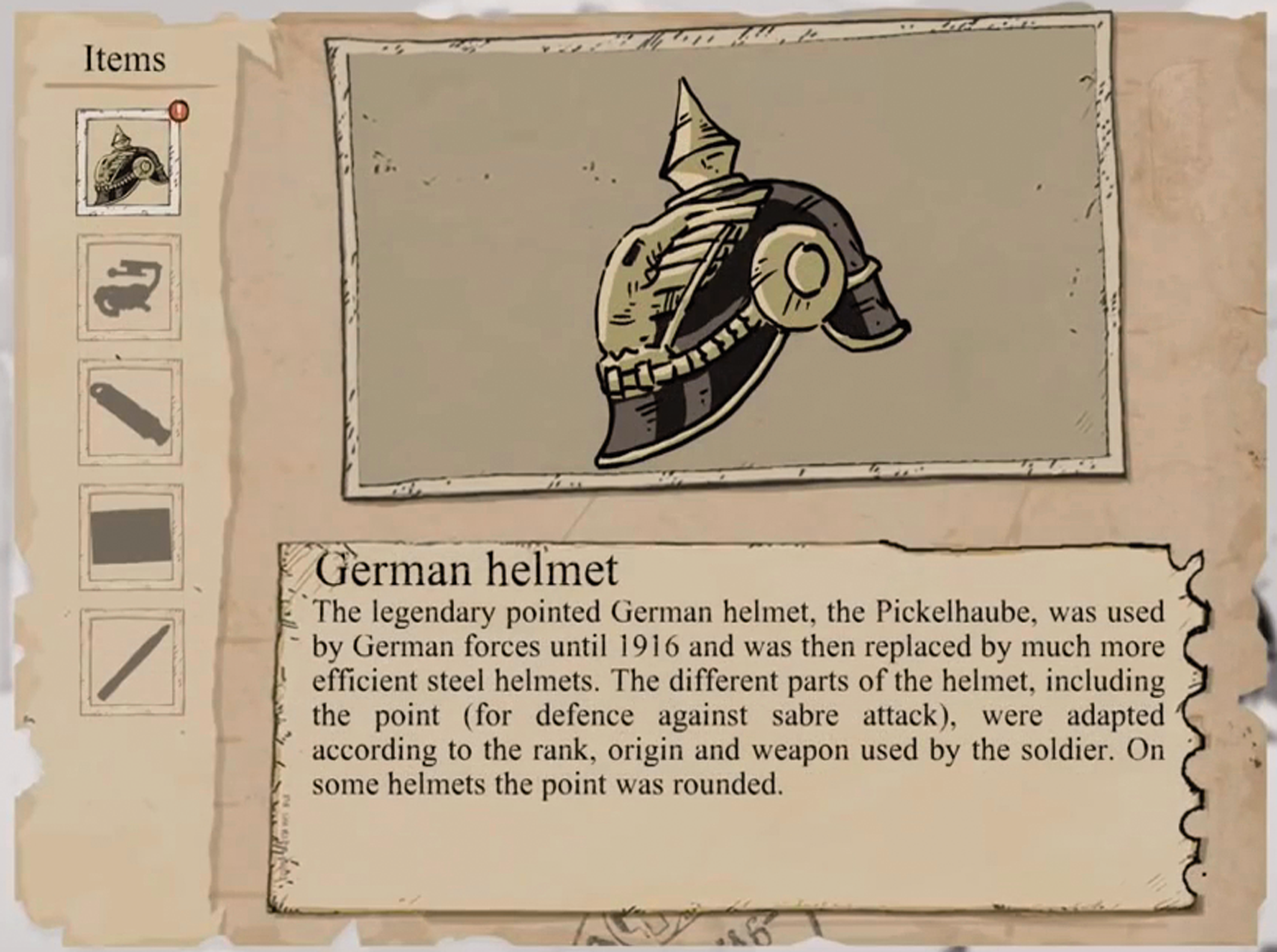
The first collectible item in the game with its accompanying description [personal screenshot from Valiant Hearts: The Great War].
For instance, the first collectible in the game is a German military helmet, and its descriptions read as follows: The legendary pointed German helmet: the Pickelhaube, was used by German forces until 1916 and was then replaced by much more efficient steel helmets. The different parts of the helmet, including the point (for defence [sp] against sabre attack), were adapted according to the rank, origin and weapon used by the soldier. On some helmets the point was rounded.
The items vary widely, and include military equipment, common household items during the war, various types of currencies and other items that provide information regarding life, both military and civilian. Another such item is a brochure found in the last area of the first chapter of the game (see Figure 2).
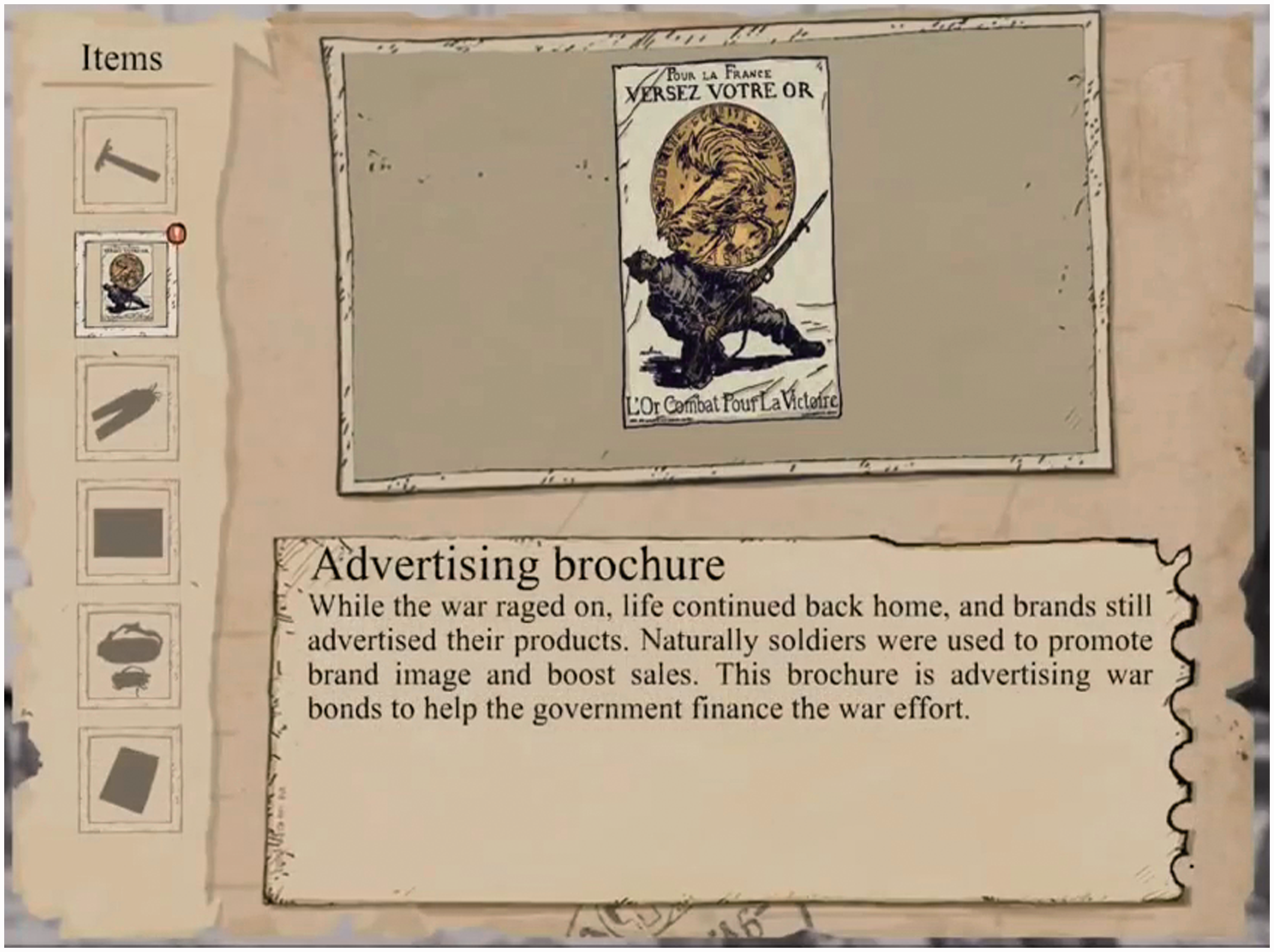
Item illustration and description of an advertising brochure [Personal screenshot from Valiant Hearts: The Great War].
The item description reads, “While the war raged on, life continued back home, and brands still advertised their products. Naturally soldiers were used to promote brand image and boost sales. This brochure is advertising war bonds to help the government finance the war effort.” The item descriptions tell stories about life on the war’s front as well as how the war affected everyday life at home, a fitting inclusion considering many of the game’s areas do not take place on battlefields, but in cities where citizens must cope with the war’s devastation.
The collectible items in Valiant Hearts teach history, and they do so through tangential learning. They let players discover the collectibles at their own pace: collecting the items is not required to complete the game’s story, but players will undoubtedly stumble upon many of them throughout their playthrough considering the sheer number of them. There are 120 collectible items in a game that takes roughly 4–6 hours to play. If players only discover half of the items then they will still find an item every 6 minutes on average. Once discovered, players may choose to continue playing the game or to pause to read the descriptions. However, the gameplay tends not to be oriented around heart-pounding action given that much of the game consists of wandering around an area, solving simple puzzles to progress, and finding item collectibles. Given the centrality the game places on the collectible items, it is safe to assume that players will turn to the item descriptions as a valuable part of the gameplay experience, and by so doing they expose themselves the pedagogical history embedded in the items’ text descriptions.
Their illustrated style keeps their presence in the game in line with the aesthetic established through the game’s audiovisual design, and so jumping between gameplay and the item menu does little to interrupt the experience. Additionally, the game controls are designed around giving quick access to the item descriptions inasmuch as a prime controller button—the triangle for PlayStation consoles and the Y button for Xbox consoles, for instance—is dedicated to switching to and from the item description menu at any playable moment in the game. To give a point of comparison, it would be like changing the B button in Super Mario Bros., which speeds up the character’s movement, so that it opens a menu detailing information about the world Mario inhabits. By remaining unobtrusive and optional, while also maintaining accessibility, the menu, items and descriptions let players control how they engage with the historical material. Perhaps a player finds an item that they have been curious about ever since seeing a picture of it in grade school, such as the famous pointed German helmet. In that instance, the player would feel compelled to read more about the object. In other instances, the player may be less interested to learn about how military members’ families corresponded with them, and so, upon discovering a related item, they would choose to focus the current gameplay objective. Regardless of their decision, learning history in the game is controlled by the player while also only being a quick press of a button away.
In addition to collectible items, the game includes a “facts” menu, similar in format to the item menu, where players can read about salient information regarding particular locations or events around which the game’s areas are themed. Unlike the collectible items, these facts accompany actual historical photographs while conveying their contextual information. Players need not find any item to unlock access to these facts. Instead, facts become accessible when the appropriate area or event occurs in the game. For example, in one area of the game, the player must help a group of citizens who have suffered loss, injury and confusion after a bombing raid. Upon beginning the area, a symbol appears to alert the player that a new fact is available, and upon pressing the information button—the same button used to access the item menu—a photograph appears of the area as it actually appeared in WWI (see Figure 3). The description states:
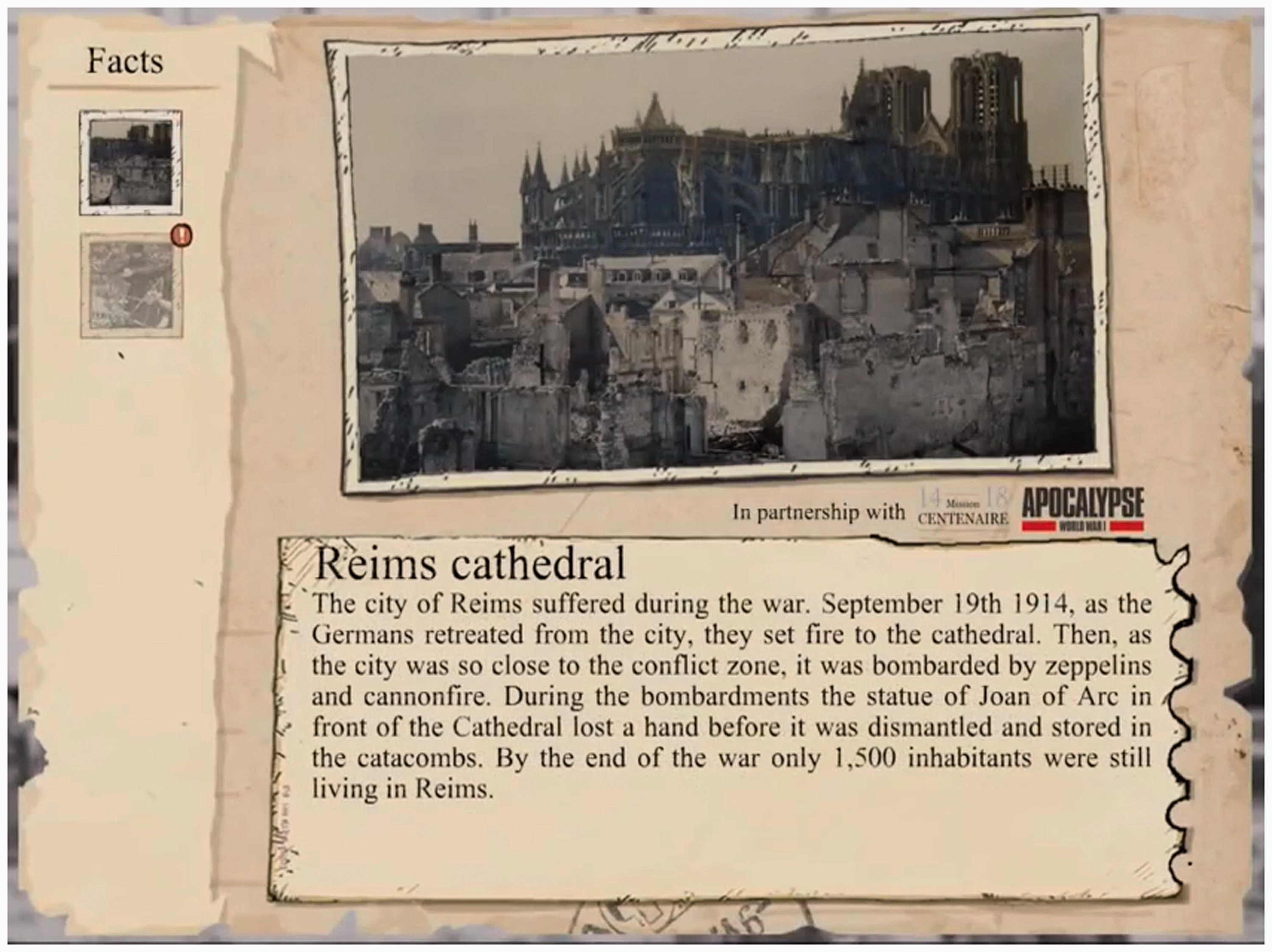
The fact that appears at the beginning of the Reims cathedral area of the game [personal screenshot from Valiant Hearts: The Great War].
The city of Reims suffered during the war. September 19th 1914, as the Germans retreated from the city, they set fire to the cathedral. Then, as the city was so close to the conflict zone, it was bombarded by zeppelins and cannonfire. During the bombardments the statue of Joan of Arc in front of the Cathedral lost a hand before it was dismantled and stored in the catacombs. By the end of the war only 1,500 inhabitants were still living in Reims.
The description and its accompanying photograph influence the gameplay to follow as the player wanders the area, sees the destruction and witnesses the hurt and loss experienced by the residents of the city.
The facts cover history-defining WWI experiences such as the introduction of chlorine gas as a chemical weapon or the use of trenches and tunnels on the war’s front. One such fact is the description of the introduction of the machine gun and its deadly potential in warfare (see Figure 4). Accompanying a photograph of a child dressed in white and soldiers dressed in blue is the following caption:
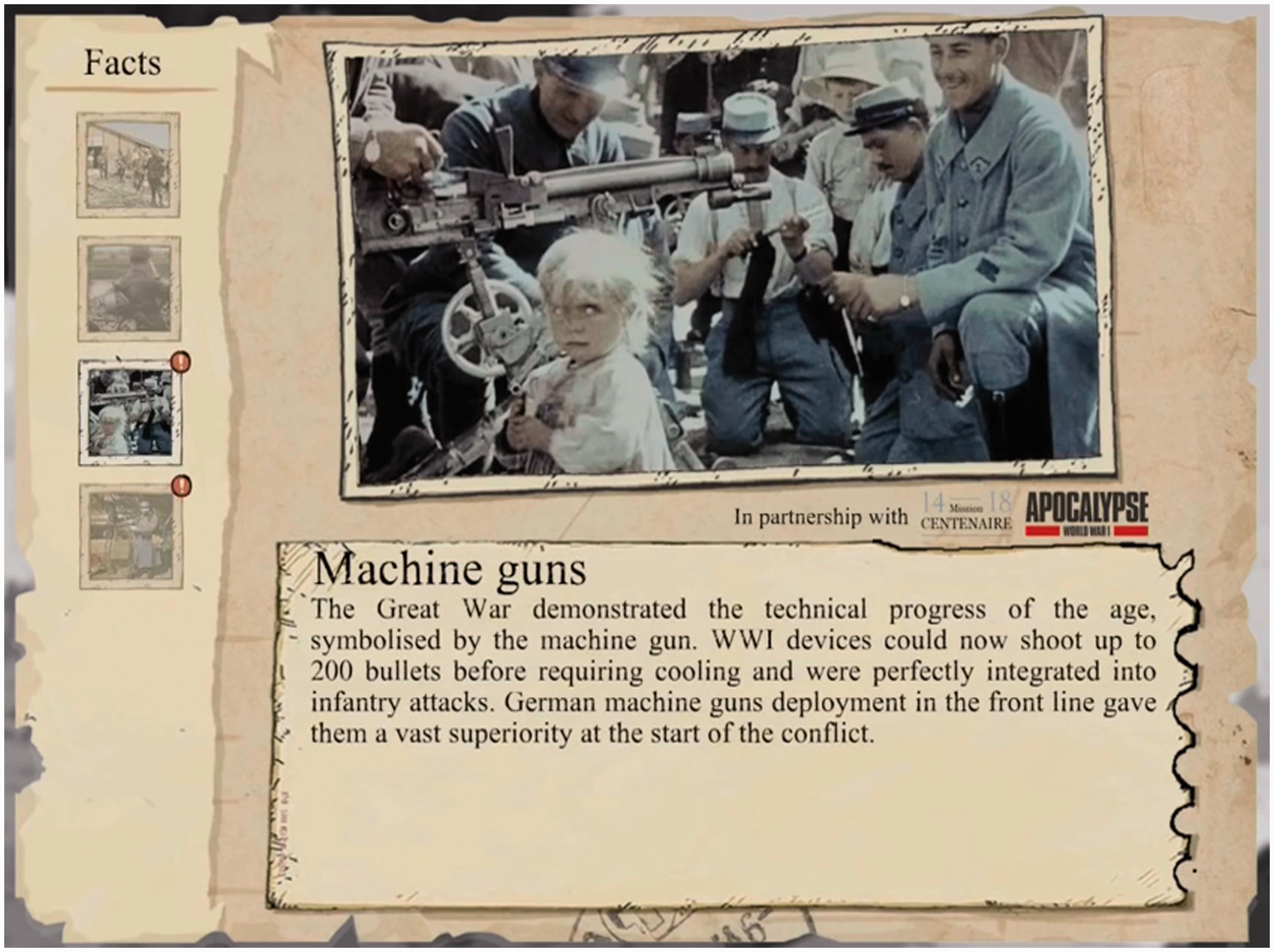
Photograph and description in the “facts” menu for machine guns [personal screenshot from Valiant Hearts: The Great War].
The Great War demonstrated the technical progress of the age, symbolized by the machine gun. WWI devices could now shoot up to 200 bullets before requiring cooling and were perfectly integrated into infantry attacks. German machine guns deployment in the front line gave them a vast superiority at the start of the conflict.
The photograph and text describe one of WWI’s iconic characteristics—perhaps a characteristic already well-known by most players—but then adds additional information to convey the implications in the war. In this instance, the fact covers subjects such as who used machine guns to the greatest effect at the beginning of the war—the Germans—and how many bullets could be fired before the gun needed to be cooled.
These facts and photographs offer exposure to history through tangential learning by remaining unobtrusive to the gameplay experience. Apart from the symbol appearing on the screen to alert players that new facts are available, nothing strong-arms players into reading the descriptions. They do not go unnoticed, however, since each fact gives narrative context to what players are experiencing in the game, and thus any area or event that takes place in the game that piques a player’s interest invites the player to learn more simply by pressing the corresponding button which lies mere centimeters from play-focused buttons.
Additionally, the photographs tie the gameplay experience in the game to lived experiences and historical facts, and therefore help history feel more vibrant and relatable to players. Unlike the items which the game depicts as illustrations, the photographs accompanying each fact confront players with people, environments, and objects through an aesthetic of realism. If players would ever to lose themselves in the diegesis of the game, the photographs bring players back to the reality of WWI. For added connection to actual, historical experiences, the photographs are colorized, meaning that black and white photographs have gone through a process of colorization to create the illusion of color photography. Black and white photographs, by withholding color information, emphasize composition within the photograph, while colors showcase objects, details, and the primary subjects within image. Through the inclusion of color, players may more easily notice the materiality of WWI be seeing people and objects over general image composition. For example, in the photograph of machine guns and soldiers, players may more easily identify the various moving parts the soldiers are handling and cleaning, thus highlighting how these guns were complicated machines that required delicate maintenance. The facts, with their photographs and text, may appear less frequently than the collectible items, but they equally support the game’s focus on creating an interactive historical learning experience by bringing that experience closer to what players may more easily relate.
Other design elements convey historical and pedagogical weight, but they do so in support of the game’s narrative. Their service to narrative does not diminish their ability to teach history, and they bridge the myriad historical elements within the game with a coherent story. Game elements in this category include map illustrations that appear between areas, showing the location of the war’s fronts, pertinent cities to the game’s story and the locations of characters (see Figure 5).
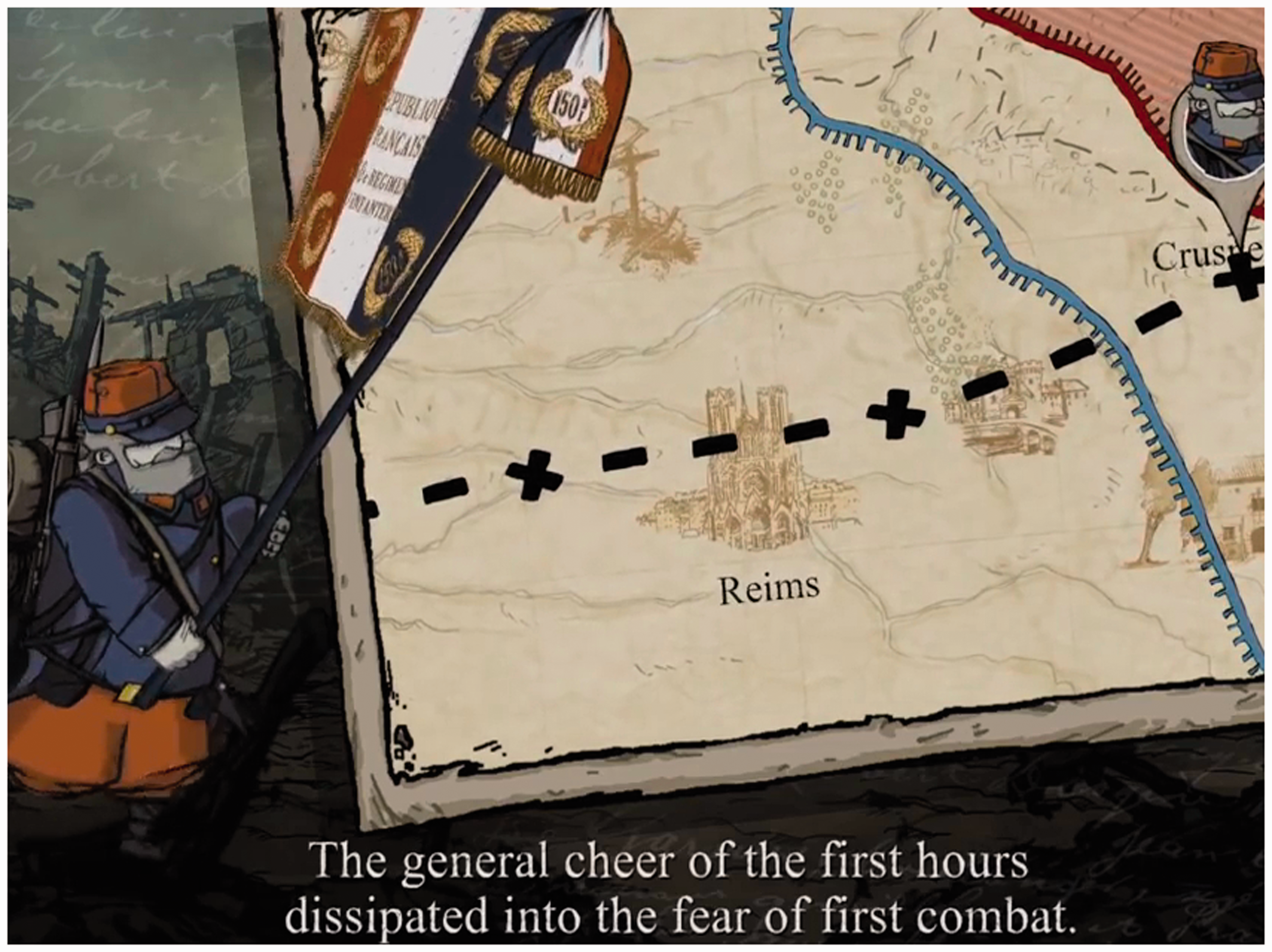
Screenshot during a cutscene explaining character locations and war history [personal screenshot from Valiant Hearts: The Great War].
A voiceover narration tells the story of the war while describing how those events affect the characters, their motivations and decisions, also appearing between areas in the game. At the start of a new area, text appears on the screen showing the date and location, continually reminding players that the places and events are real and rooted in actual history and geography. These diegetic elements straddle the line between historical recreation and fictional storytelling. They tell the story of WWI France in the broadest possible terms—dates, locations, inciting events, and maps—while also driving the characters’ stories forward. By so doing, the game adds a compelling layer of personal investment in the history of the war by connecting it to the affectual experience of relating to fictional characters who live through that war. Unlike the facts or items, these added narrative elements are inherent to the game itself so that they are not hidden away as optional: if players do nothing to find or read information provided through the items or facts—something highly unlikely given how integral they are to the game and how frequently players are given the option to do so—the additional narrative elements ensure that players will not leave Valiant Hearts without engaging with the history of WWI at some basic level.
Aesthetics and the affective gameplay experience
Museums do not operate solely through conveyance of facts: their central conceit is the powerful, oftentimes emotional, experience of walking through the exhibits and traversing the building’s interior design aimed at producing an affective response in visitors (Cohen, 2011; Soren, 2009; Wang, 2001). The interactive museum follows the same principle. The organizing aesthetic of Valiant Hearts is that of creating affect through empathy, and, conversely, creating empathy through affect.
The most readily accessible manifestation of this aesthetic is the audiovisual design of the game. First, the visual design of Valiant Hearts could best be described as like an animated comic book, and the overall theme of the visuals invoke innocence, intimacy, and simplicity. The game’s characters, environments, and menus are proudly two-dimensional, and their rough and thick lines evoke a sketchbook-like style. The game was built with Ubisoft’s proprietary UbiArt engine which is software that allows artists to translate their visual ideas directly into a game, and the style shows: the flat backgrounds move in a standard, animated parallax often seen in hand-drawn animated movies, the characters, and items look as if they are pieces of art moving around on a painted background, and even the menus and in-game cinematics maintain the game’s signature comic book-inspired look.
The characters’ designs, in particular, invite an affective response based on innocence contrasted with deep foreboding (see Figure 6).
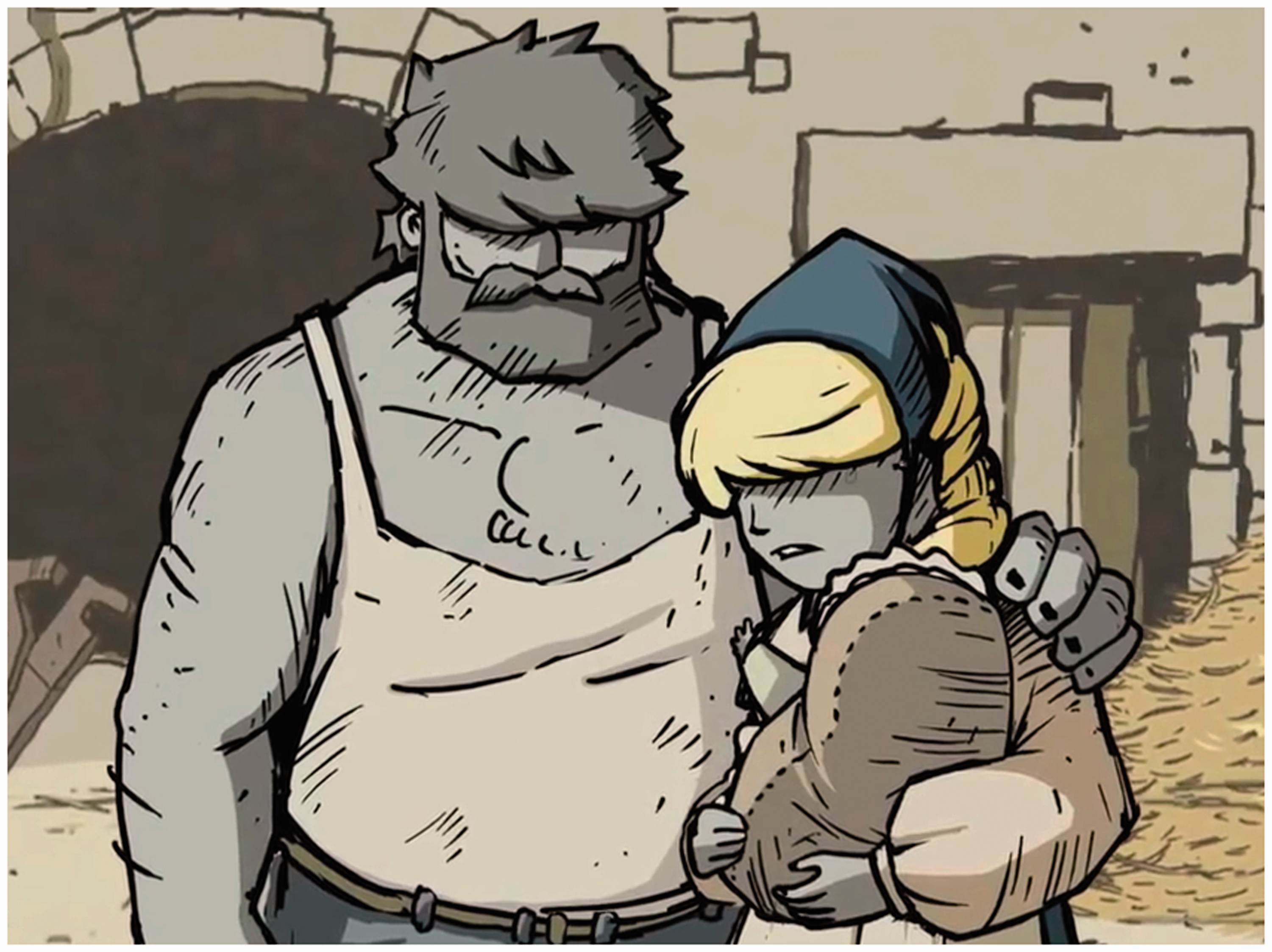
The character designs for Emile and his daughter as shown in a introductury cutscene [personal screenshot from Valiant Hearts: The Great War].
For instance, the color palette is desaturated, but the skin especially exhibits a lack of color, almost appearing gray. While cartoons in design, the skin color reminds players that this is not a fairytale. The colors, which fit the horrors the game portrays, contrast with some amount of joviality which emerges from the blocky, pudgy feel of the characters in addition to the characters’ bouncy animated movements. The combination of grim colors with energetic characters evokes feelings of misplacement, as if the innocence and happiness of these characters do not belong among the painful realities of war. Overall, a sense of foreboding sadness pervades from the characters’ designs, as if what these characters must do is not easy or fun and that they are supposed to meet with tragedy. Their cute appeal only makes the war seem more menacing.
The audio design continues the aesthetic of creating affect and empathy through the dialogue design and musical score. Apart from the voiceover narration, and a few key moments when characters narrate letters that they have written each other, the characters’ dialogue design mumbles actual words in order to emphasize the emotion the characters are attempting to convey. For instance, in an area of the game a mother has lost her child, and she pleads with the player’s character for assistance. When speaking, her dialogue is rapid, slurred and in French even in the English version of the game, and so players may best interpret the emotion of the moment—desperation. All of the characters’ dialogue, when speaking to each other in the game, follows these same rules: the characters speak the language of their country of origin, the volume is low, the rate is fast, and the enunciation is mumbled. The only elements of dialogue that come across clearly are pitch and timbre, both of which best convey characters’ emotions. In addition to the dialogue, the musical score within the game enforces the emotional beats of the story, such as calm, emotive piano music when a character is reading about how a loved one has been imprisoned. The game’s title menu, as a primary paratext, uses similar piano music to set the tone for the rest of the gameplay experience (Genette, 1997; Gray, 2010). Other notable musical moments eschew original composition in favor of well-known classical works set to adventurous gameplay set pieces. For example, during a car chase sequence, Brahms’ Hungarian Dance No. 5 plays in time with the events taking place in the area to add urgency to the action.
The most popular war-themed video games aim for a cinematic version of verisimilitude in their audiovisual design, perhaps in an attempt to convey the heart-pounding action of living out the fantasy of being a hero in combat. Valiant Hearts, on the other hand, demonstrates how a game may employ audiovisual design in order to break down power fantasies through intimacy and emotive energy. The music, dialogue, sound effects, character designs, and environment designs all contribute to feelings of relatability, innocence, and earnestness. The innocence of the audiovisual design serves to emphasize the violence and tragedy of WWI through contrast. The cartoon design of the characters does not fit in the dark, muddy and bloody atmosphere of WWI, hence invoking sympathy for the characters. The tragedy presented through the game’s audiovisual design aesthetic is that innocent people, people who had no hand in shaping the war, had to suffer the war’s effects. The simplicity found in the lines, colors and sounds offer no relief to players who must witness through empathy the pain that the story offers. If anything, the game’s audiovisual aesthetic accentuates that empathy.
The game’s narrative showcases personal stories to emphasize affect through empathy. Unlike other war-themed games, Valiant Hearts leans from both physical and political action toward the personal stories of everyday people involved in WWI. There are no great soldiers here, just an assortment of people separated from their loved ones by the war. There are five main characters, each with stories that focus more on loss and family than the glory of war. Emile is an aging father and new grandfather, and when the war begins the French government drafts him into involuntary service. He leaves his farm, his daughter and his grandson to join the military, and throughout the game’s story, he never serves in a combat role: he works as a chef, a flag carrier and a trench digger. Emile’s son-in-law, a German ex-pat named Karl who married Emile’s daughter, is deported when the war begins, and, upon returning to Germany, the government enlists Karl to join the German military as an unwitting soldier. Freddie is an American ex-pat who married a French woman only to lose her to wartime violence. He voluntarily enlists with the French military to avenge his wife’s death, and he is the sole character in the game to embody any desire to fight in the war. Anna is a Belgian veterinary student studying in Paris when the German military kidnaps her father, a scientist and engineer, to work for the German government. She works as a medical aid throughout the game’s story. Lastly, Walt is a medical service dog who accompanies Freddie, Emile and Anna on various missions.
The game’s narrative intertwines these characters stories so that they work against the war that befell them all while inviting players to empathize with their motivations. For instance, Emile is captured by Germany and becomes a prisoner of war. When he escapes German imprisonment and returns to serving in the French military, he ultimately rebels against unethical orders by his French commanding officer, resulting in his court-martial and execution at the end of the game. Karl deserts his unit in an attempt to reunite with his wife and son back in France, a journey that takes him to the brink of death through illness. Anna’s story takes her across Europe to rescue her father—she succeeds—and Freddie aids Emile regardless of military orders. The overarching narrative finds players experiencing each character’s story, often jumping back and forth between them from area to area, making the game less about players’ delving into an adventurous personal fantasy and more about witnessing each character as they traverse the tragedies of war.
By decentralizing players’ engagement from a single main character to several playable characters, the game attempts to destabilize the potential for power fantasies. Instead of players fantasizing of being the hero in a violent war-time quest, Valiant Hearts invites players to see WWI through the eyes of characters suffering the sorrows of war. Each character’s personal story, with motivations driven by personal relationships instead of the war machine, provides a foundation of affect: players may feel the heartbreak of these characters’ stories. For example, players watch Karl as he is ripped from the arms of his wife and son while being deported. Players watch Emile as he decides to stop following orders of a tyrannical officer whose actions continually lead to the death of fellow soldiers. Players are with Emile as he is tied to a pole and executed by firing squad. Players see Freddie, Anna, and Walt as they work to save, and reunite with, their friends and family. And by so doing the characters invoke empathy for the people, actual living and breathing people, who lived through WWI. As a commemorative museum tells stories from the lives of those it commemorates, Valiant Hearts, as an interactive museum, establishes a tone of empathy based on characters’ relatable motivations and relationships.
Tangential learning and lore: Conclusions and implications
Because of games’ abilities to immerse players in gameplay, often for many hours on end, video games’ best contribution to learning is tangential learning (Breuer and Bente, 2010). Somewhere in the history of gaming, a divide arose between games for learning—also known as serious games—and games for entertainment. However, that divide has only highlighted the benefits of tangential learning: learning games tend to be boring, monotonous, and frankly not very well-designed visually, mechanically, or even pedagogically. Valiant Hearts bridges the divide between learning games and games for entertainment by borrowing the engaging gameplay and story from the latter while maintaining the primary purpose of the former. Valiant Hearts offers learning tangentially, or indirectly, by making learning a part of the game’s design decisions while also focusing on how the game may affect players emotionally. As a comparison, most learning games are to textbooks as Valiant Hearts is to a museum, meaning the games capitalizes on games’ ability to involve players through interactivity and compelling stories while maintaining a pedagogical focus.
By allowing learning to take an ancillary role—such as through text descriptions—the fun, immersive and gripping experience of playing the game remains intact while learning takes place naturally and almost unnoticed. To borrow an example from movies, the 2007 film 300 was clearly not made to educate; it is an action-packed, blood-spattering good time at the movies. However, after watching the movie, audiences might have learned who Leonidas is, they could have become curious and looked up information about the Battle of Thermopylae, or they might even have taken a general interest in ancient Greek culture.
In the case of Valiant Hearts, the game offers interactive learning primarily through the tangential transfer of information. The game provides a context for gameplay that does not force the player to learn any specific piece of history, but instead it helps inspire curiosity and familiarity with a historically significant war in order for the player to search out and learn more either through in-game text or by learning information on their own. Of course, learning is not guaranteed to happen, but that is both the benefit and the cost of tangential learning. The goal of tangential learning is to help inspire self-motivated discovery through exposure, and Valiant Hearts, and as well as other games such as the Civilization series, achieve this goal without much fanfare. For instance, any avid player of the Call of Duty franchise of games can tell you, by sight, the name of various military weapons, their histories, and how they operate. They can even explain the hierarchy of U.S. military ranking and they learned all of this without the game directly confronting the players with this information. The learning took place tangentially, specifically through gameplay context and by providing a compelling space wherein players can invest their interest.
World building through lore, specifically item lore, is one way of creating that learning space, and the analysis suggests that lore might be better implemented in the future as a pertinent design element of games. Lore is a mainstay in game design: it has reached a level of popularity and wide utilization in the both the biggest-budget and independent games that mirrors players’ expectations regarding the interactive worlds games create. Games produce lore through audiovisual design, but their most explicit manifestation comes in the form of text descriptions, a counterintuitive yet relatively simple design mechanic that cuts to the heart of the matter—a game’s world needs to feel as if it has a history built on narrative. Text descriptions for items, quests, collectibles, weapons and places provides a pulse to an otherwise cold, programmed and digital world. Lore has hitherto been a method of giving narrative weight to a game, and Valiant Hearts demonstrates how lore might be employed at the service of teaching. But how else might games use lore as a non-interactive design strategy?
Lore acts as a narrative context, usually operating as present manifestations of past diegetic events, and it tends to appear through procedural design, audiovisual design and written text descriptions. Games have produced lore to tell stories and, in the case of Valiant Hearts, to teach history, but, with the above definition in mind, various other applications for lore are possible. For instance, news games would benefit from lore’s ability to add avenues of information conveyance without disrupting the flow of gameplay. These journalistic games may include optional text descriptions to better provide details salient to the event or issue they are covering. Another possible application can be found in training games or simulations wherein the largest drawback to player engagement is the lack of emotive potential—in other words, players do not feel invested in the experience, and thus they do not fully engage with the simulation. As a personal anecdote, as part of an intense 8-week Spanish language training seminar I had the option of playing a training game. It included traditional gamified design elements such as progress bars, interactive menus, etc., but what would have made the experience much more enjoyable, and thus more effective as a training tool, was narrative engagement. In training games, it is difficult to employ otherwise commonplace narrative tools such as protagonists or journeys, and so these games or simulations simply omit narrative. However, lore does not require juvenilizing the experience with oversimplified narrative elements: it instead uses context to add emotional investment. By adding text descriptions with real or fictional characters and histories, the tasks in the simulation engage players through narrative.
Lore, by definition, is not invasive. It exists on the edges of both storytelling and interactivity in order to provide context and emotional engagement, and it has untapped potential to improve games with goals outside of entertainment. I offer two suggestions. First, serious games of all types, including education games, can include contextual information through text descriptions or collectible items. Tangential learning exists to spur curiosity and self-guided learning experiences, and text descriptions or lore-as-context can open opportunities for students to find avenues of personal interest in the learning material. Second, lore can provide a narrative justification for participating in an educational game’s primary mechanic, thus motivating play outside of interactivity and adding emotional weight to the experience. One example of this type of implementation is in the Where in the World is Carmen Sandiego? series of games: the lore surrounding the player character’s up-and-coming job as a detective motivates the gameplay. Other possible applications could exist to use lore and other elements of tangential learning into serious games, and as digital games become more heavily utilized in classrooms those strategies might emerge in yet-to-be-released games. For now, teachers may look to mass-marketed entertainment games for instances wherein tangential learning may benefit their students, such as in Assassin’s Creed: Origins which allows players to switch into a “discovery” mode that disables quests and combat and enable players to explore ancient Egypt and learn about daily life and architecture.
The interactive museum uses lore to convey history and affective design to help players invest in the experience. It may not be the answer to the many challenges teachers face on a day-to-day basis, but within the world of gaming culture—a culture inundated by thrills, power fantasies and dozens of hours of play per game—the interactive museum opens avenues to exploring the potential of games. Just as when tourists in Atlanta, Georgia decide to visit the Center for Civil and Human Rights instead of attending the many other attractions the city offers, games that invoke the interactive museum can exist in the same marketplace as other, less edifying, gaming experiences. Games such as Valiant Hearts are certainly less expansive and detailed than a textbook, but people tend to choose the museum over the textbook when the option exists.
Footnotes
Acknowledgements
The author would like to acknowledge character designer and illustrator Kendall Hale (Instagram and Twitter: @kendallhaleart) for contributing to the character design section of the analysis.
Declaration of Conflicting Interests
The author(s) declared no potential conflicts of interest with respect to the research, authorship, and/or publication of this article.
Funding
The author(s) received no financial support for the research, authorship, and/or publication of this article.