




Abstract
Participation in synchronous online learning is an increasing need for students’ learning outcomes. Teachers generally cannot be sure about the fact that students who are seen in the participation lists are really following the online tasks. Recent studies have shown that gamification can be an effective way to support learners’ participation in the tasks. This study intended to suggest sample scenarios in line with using gamification elements in online learning environments. Two basic scenarios were developed considering the properties of online learners’ characteristics and gamification elements. First scenario giving learning responsibilities to the learners includes a puzzle activity. Second scenario presents a block-building activity including the leaderboards. The suggested model includes some new ways of using awards, reputation, badges, levels, and leader boards to provide an attractive learning environment. It is hoped that suggested scenarios can provide learning opportunities via increasing participation in synchronous learning environments.
Introduction
Recent research showed that participation has attracted increasing attention in online higher education (Kuh, 2001). Online participation plays a key role in learners’ completion of courses (Chou and He, 2017). Previous research has reported positive effects of participation to the satisfaction, higher retention rates (Rovai, 2003), and learning outcomes (Hiltz et al., 2000). Thus, considerable effort has been invested in innovative practices in students’ active participation to online courses (Denny, 2013; Muntean, 2011). Many synchronous or asynchronous online learning tools have been developed to enhance interaction among students, instructors, or content. Sun and Ruenda (2012) indicated that multimedia and discussion boards in online learning settings increase the emotional participation. At this point, it is suggested to use multimedia materials with their potential of audio and visual communication. Also, cooperative activities are suggested to increase interest and motivation which are seen as important elements for the participation (Brady et al., 2010; Domínguez and Antequera, 2012). Online learning settings present e-mail, discussion forums, or chat platforms to the participants as interaction tools to provide real-time interactions. Particularly, synchronous learning environments allow participants communicating with narration, texts, or camera; sharing documents, working together, and more (McBrien et al., 2009).
In synchronous online settings, instructors cannot control whether the learners follow the tasks during lesson periods (Dixson, 2015; Tomas et al., 2015). Moore (2013) in his transactional distance theory explained the situation in the description of the term “distance.” He suggested a framework for interactions in synchronous online learning. The sense of distance is concerned with student interaction and engagement in the learning experience. In this sense, Fung (2004) indicated that a lack of interesting question and content may be cause for nonactive participation. Vonderwell and Zachariah (2005) reported that online participation is significantly influenced by the technology infrastructure and participants’ roles in the presentation of instructional tasks. Also, Picciano (2002) and Cronk M (2012) addressed the links between student interaction and participation in online learning.
Moore (2003) suggests two-way interaction in distance education as dialog. The virtual classrooms or web conferences in synchronous settings have potential of this kind of two-way interaction. In this sense, West and Jones (2007) argued that students have asked to interact with the instructor and class peers as similar to the traditional classroom with more synchronistic ways. Riggs and Linder (2016) addressed that in synchronous web conferences, where students and the instructor meet, active learning activities are required for interaction and students’ participation. For instance, Adobe Connect as a web conferencing system offers a variety of interaction opportunities for students. Students can communicate via audio, text, or visual components; share documents; present rich content resources; and share their desktops. Adobe Connect has a flexible architecture that allows presentation software to integrate the system with new components. This kind of integration aims to increase the participation of learners in online learning settings and to keep students connected to the system for a long time. However, using these components may be insufficient for students to participate in online learning activities (Denny, 2013; Tvarozek and Brza, 2014) and some improved strategies are needed to provide students a more participative learning environment (Darejeh and Salim, 2016). Instructors are suggested to have sufficient knowledge about the students involved in the online classes and the affordances of online settings for increasing student participation. In this context, instructional designers are trying to adopt some specific technological features to synchronous settings with specific teaching methods. While some researchers have already been working on to decrease the transactional distance between instructor and students in online learning settings, there is still little work on online participation techniques (Denny, 2013; Li et al., 2012; Tvarozek and Brza, 2014). Thus, a need exists for integration of some new approaches to effective use of the online learning tools.
Social networks which are popular among educators and students may be used for this integration. Brady et al. (2010) emphasized that social networking sites have potential for contributing to active participation (Despotovic-Zrakic et al., 2011). Considering collaboration, Brady (2010) suggested that instructors can create interactions among group members and ask them to work on short questions using Facebook functions. In addition, it is known that the social network sites may be used for play and entertainment purposes. In line with this, Jaime and Michael (2010) claimed that social network sites provide various interactions for online learning such as game playing on Facebook and Facebook which has been very successful in attracting the games to their learning potentials (Chen et al., 2011). The most preferred games are those the users buy a farm, land, or city which engage the players to the game environment via rewards or scores they obtained in the game. Students who play those games compete with their friends through Facebook and sometimes they work cooperatively in order to complete the tasks within the games. Multiplayer strategic games are one of the popular social network games which include cooperative activities and offer creativity, critical thinking, and decision-making strategies. The most common features of these games are the fascinating scenarios or stories which keep users’ motivation alive (Sweetser and Wyeth, 2005). In this context, if the instructional potentials of social network games can be integrated to the learning environments, this will contribute to the learners’ participation. This study takes gamification as a way for this integration (Darejeh and Salim, 2016; Thiebes et al., 2014). Gamification which is derived from gaming may provide positive outcomes to increase student participation in online settings (Cassells et al., 2015; De-Marcos et al., 2014; Hsu et al., 2013; Raymer, 2011).
Gamification for participation
Although there are different definitions for gamification in the literature, the common idea that comes up in the definitions is “Gamification is an approach that uses game elements in non-game contexts to engage people in their activities and participants do not play games” (Deterding et al., 2011; Werbach and Hunter, 2012; Zicherman and Cunningham, 2011). Game mechanics are the elements used to play an activity and evoke the emotions of the player (Bunchball, 2010). These emotions are shaped by the desires and motivations that are called game dynamics (Simoes et al., 2013). Points, levels, badges, leaderboard, and virtual gifts are the most common use of game mechanics (Bunchball, 2010). Different studies have been conducted on various game mechanics and dynamics such as leaderboards (Landers et al., 2017; Nebel et al., 2016), points (Attali and Arieli-Attali, 2015; Alavi and Dufner, 2005), and rewards (Simoes et al., 2013). A strong association between student participation and high achievements is reported in some studies which are focused on the badges as gamification elements (Hamari, 2017). In a gamifying process students take the roles assigned to them as part of the game (Krause et al., 2015) and keep their motivations constantly high while performing the tasks (Banfield and Wilkerson, 2014; Li et al., 2012).
Research using leaderboard as game mechanics has been widely used for student participation (Çakıroğlu et al., 2017; Grell, 2015; Krause et al., 2015) and keeping motivations alive (Nebel et al., 2016; Schubert et al., 2014; Willems et al., 2014). Researchers suggest using leaderboard appropriately to provide student participation, otherwise an adverse effect may be caused in some learners’ participation (Çakıroğlu et al., 2017; Grell, 2015). For this reason, the sample scenarios may provide guidance for instructors to provide relations between the nature of gamification elements and the tasks in the course activities. This study suggests concrete example scenarios to adopt gaming elements in an online teaching process in higher education.
Aim of the study
This study intended to suggest a model for integrating social network game elements into the implementation of gamification. The research addresses the following question: “Do social network gamification strategies be used to enable students to participate actively to the synchronous online learning courses?”
The activities were planned as learning scenarios and the gamification elements were designed for undergraduate students to provide the participation. Adobe Connect web conferencing software was used to implement the gamification activities. While the active participation of the students who are online with the puzzle activity is targeted, it is aimed to increase the academic achievements through the block-building activity and the willingness of the students to play. Under these circumstances, we hope that the motivation of the students will be kept alive in working on the tasks. Students will interact with others, instructor, and content and socialize in synchronous online learning settings as well as they entertain themselves with playing games. We present the gamification scenarios and we explain how to use them to keep students active and how they participate in the tasks. It is hoped that the samples contribute to the studies focusing on to reduce the distance that students experience in online learning.
Gamification scenarios for participation
Before the scenarios were designed, we searched the participation problems in synchronous online learning settings. The relevant literature and the experiences of four online learning instructors were indicated that one of the important problems in the synchronous learning is continuing the participation. Namely, students may participate in some activities but they do not keep on participating and they generally drop out before finishing the activity or interaction. Then we reviewed positive aspects of gamification elements for participation. We developed a scenario similar to the social network games such as farm or city building which students are more familiar with the strategies of them.
Subsequently, a draft scenario was prepared and piloted with undergraduate students in order to reconstruct the scenario through their experiences. Face-to-face interviews were conducted with the pilot users. The interview data were analyzed with four instructors having at least five years of online teaching expertise and gaming technologies. Taking into account the underlying elements of participation, the possible impacts of the scenario in increasing the participation were taken in to consideration. The scenarios were finalized after the tasks and the potential of gamification elements was theoretically associated within the aspects of participation. The rest of the paper includes the presentation of the scenarios, the ways for implementations, and the potential benefits for online participation.
Scenarios
Puzzle activity
A puzzle activity is constructed for each units of the curriculum for one semester. During the sessions, the pieces of puzzles are presented on the symbolic puzzle board at the beginning of the course. The pieces of puzzles could only be seen on the screen of randomly selected students. Students drag the puzzle pieces and place them on the common board. If a student cannot place the puzzle piece in a certain period, then the piece is sent to another random student at any time in that session. Thus, all of the students should be warned during the lessons period. A piece of puzzle is sent up to three times in a particular session.
A puzzle will be designed when it is dragged to its place and the participants whom the piece is sent will be labeled. If student is sent the piece and does not catch it, he is labeled as a noncatcher in another place and his identity is begun to be known by the instructor and other students. In this way, the interests of the students may be increased since they will be responsible not only in their own learning but also the learning of their friends. In addition, if any piece of the puzzle is sent for three times and not caught by the students in the given period, in other words, if the puzzle cannot be completed because of the noncatchers, their friends and instructor will see their labels, so their responsibilities in the activity will increase.
Figure 1 reflects a roughly established puzzle for giving an idea. For example, let us assume that excel and its aspects are taught in a course. During this instructional process, each piece of the puzzle will be sent to a different student by the instructor at periodical times. However, the student should always be on alert since it is possible that the student whom a piece of puzzle is sent may receive another piece of puzzle. In addition, the points obtained from the activities in the puzzle creation section will also be transferred to the block-building activity section.
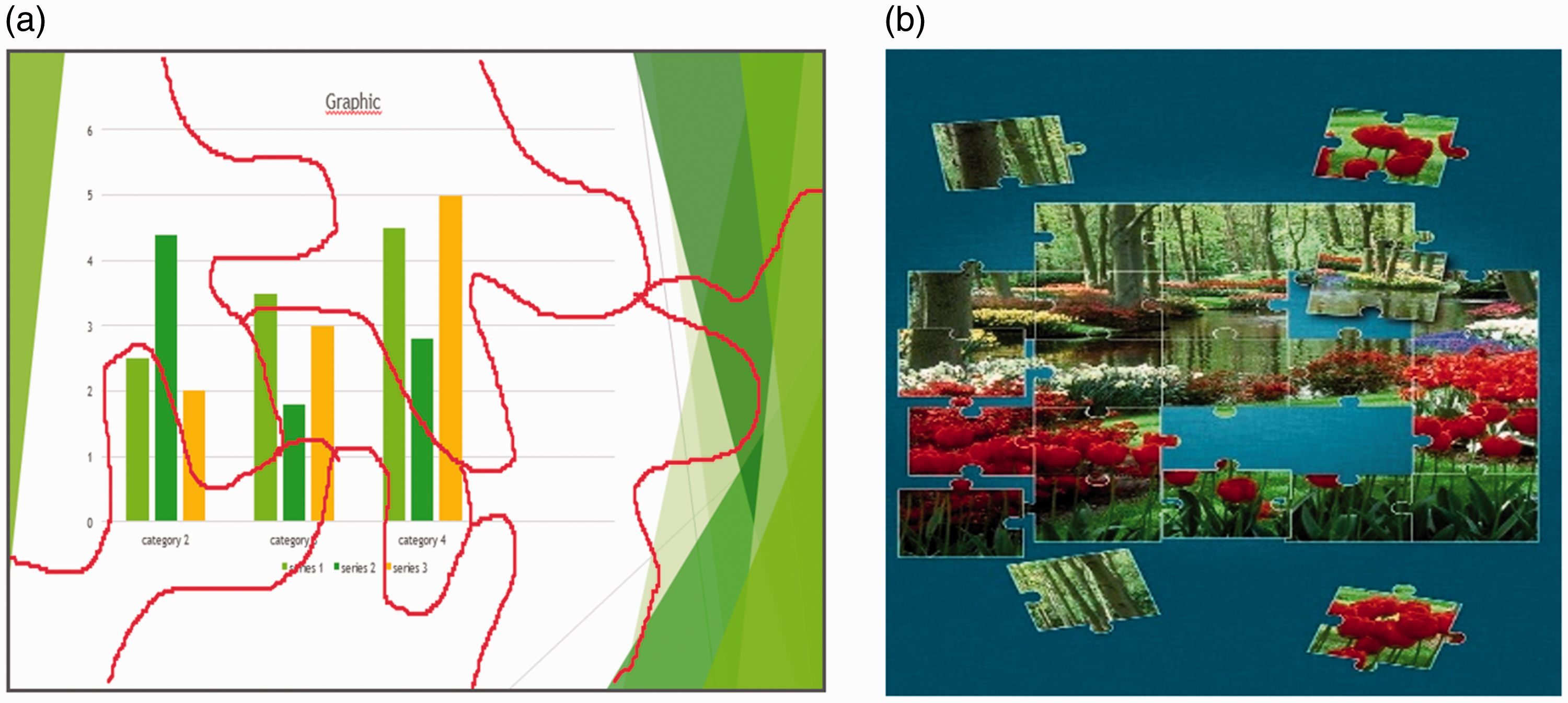
A sample puzzle to be employed in the course sessions.
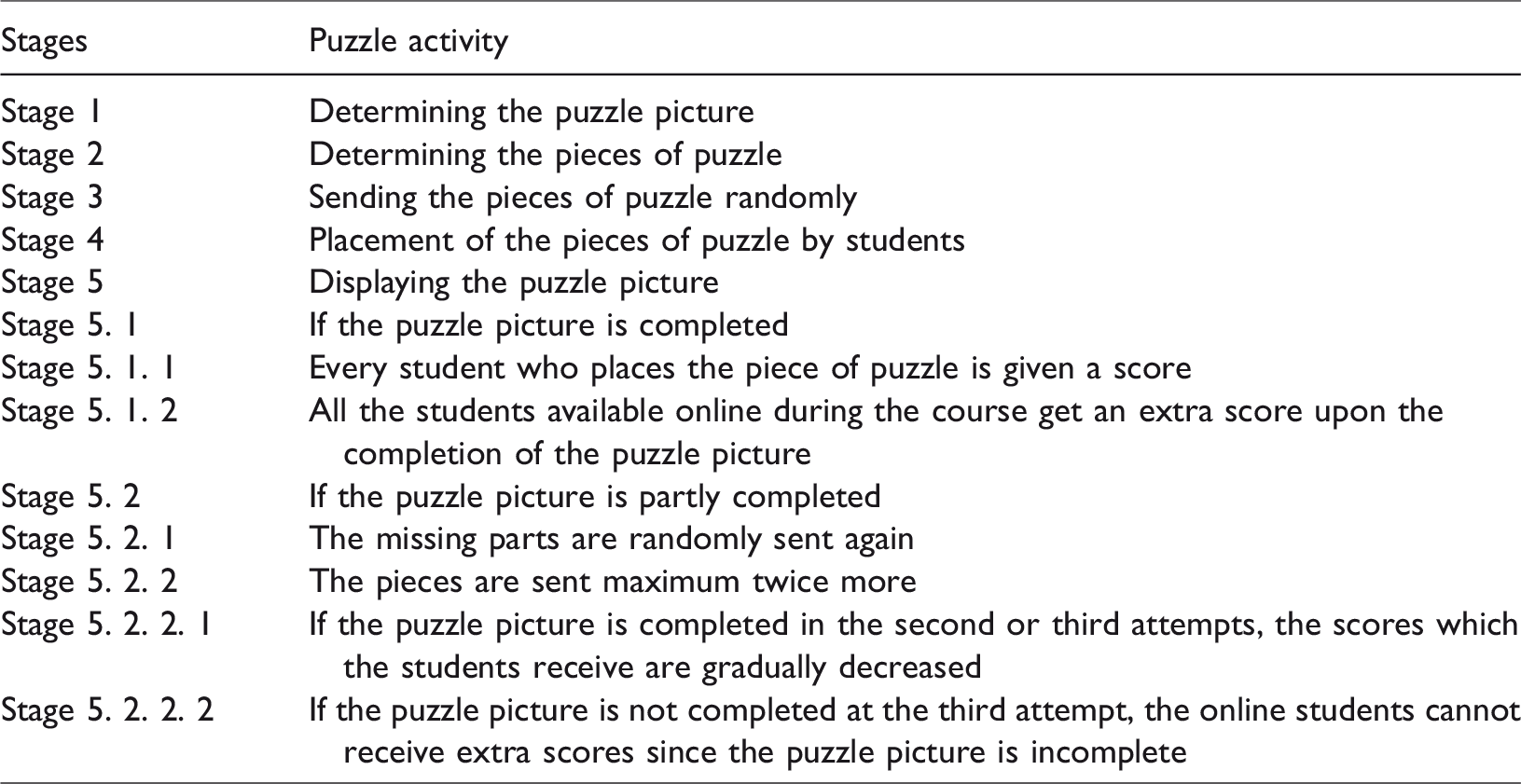
The activities specified in the scenario will be performed within the course curriculum considering a set of rules. At the beginning of the course, students receive information about the use and operation of the system. In this case, students are required to participate in the activities in order to get points from the activities and to fulfill their assigned tasks. Indicators will also provide the level of active participation in the course to determine student scores. In this context, it is expected that the motivation of the students will be kept alive during the course events, if the students are aware of the responsibilities they have in order to fulfill in this process. Table 1 shows the steps of puzzle effectiveness.
Stages of the puzzle activity.
Block building
The puzzle activity may increase students’ participation intentions and accordingly may positively affect on sustaining their motivation at a particular level. In this sense another activity may empower this motivation to continue during the session. For this reason, “block-building activity” is considered as another activity containing more surrounding activities.
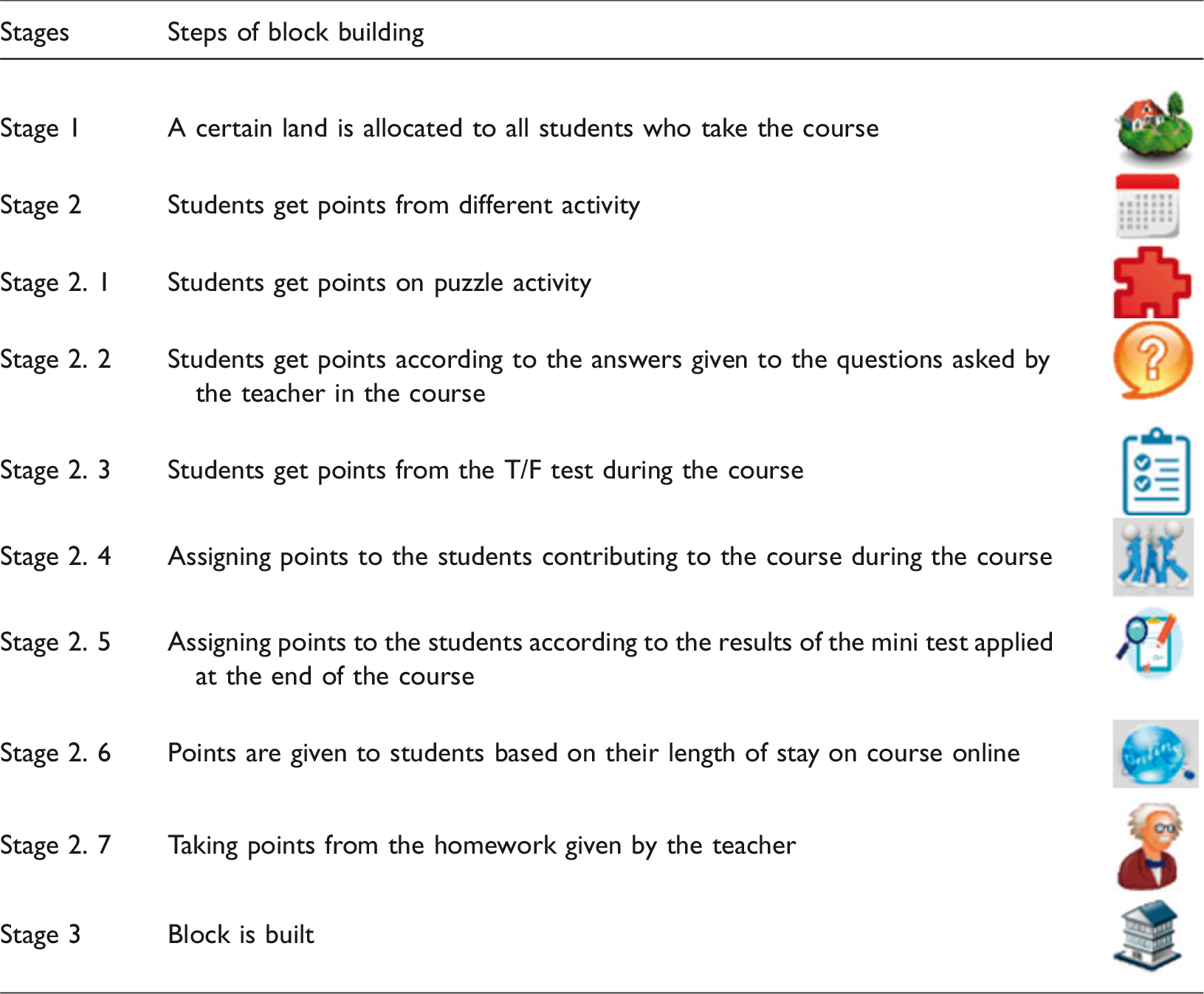
The block-building activity is designed in a way similar to the “city building” and “farm building” activities in Facebook. Each student will be given the same amount of land and they will be assigned as a contractor who builds blocks. The number of floors, the number of rooms, color and pattern options, block name, and other features are related to the students’ scores. Blocks are constructed with a maximum of 10 blocks. In addition, if the student collects more points, he/she may also acquire block security, setting regulation, pool, gym, car park, and other setting elements. In order to provide all of these features, enough points will have to be collected in the lessons. These points will be collected if the following conditions are fulfilled:
1. 2. 3. 4. 5. 6.
In sum, Table 2 presents a list of the scores that the student will have to use in the block-building activity.
Scores in which a student can get from a gamification process.
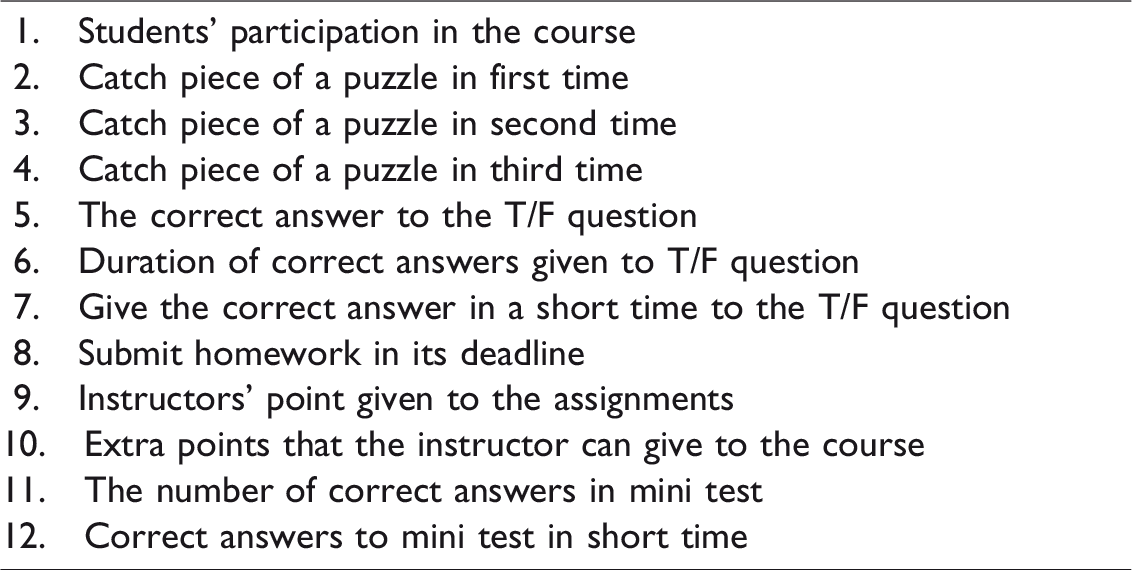
Students get a weekly total point according to these 12 items, and at the end of the course period the total of these weekly points will provide the total point of student. On the other hand, gold or bonus rewards can be used instead of points in the activities. Students can take time, room, and pool with points after completing each course. Thus, at the end of the term each student will have a block. Some will be able to build higher buildings, some will not complete 10 blocks, or they will build houses with fewer floors. Some students will be able to do luxury blocks that include social areas such as pools and cinemas, while others will be able to build a block that does not even have a basic green area. Sample block views are shown in Figure 2. Block 1 and Block 2 present the blocks that can be created by students with higher points, while block 3 and block 4 are those of lower scores can create.
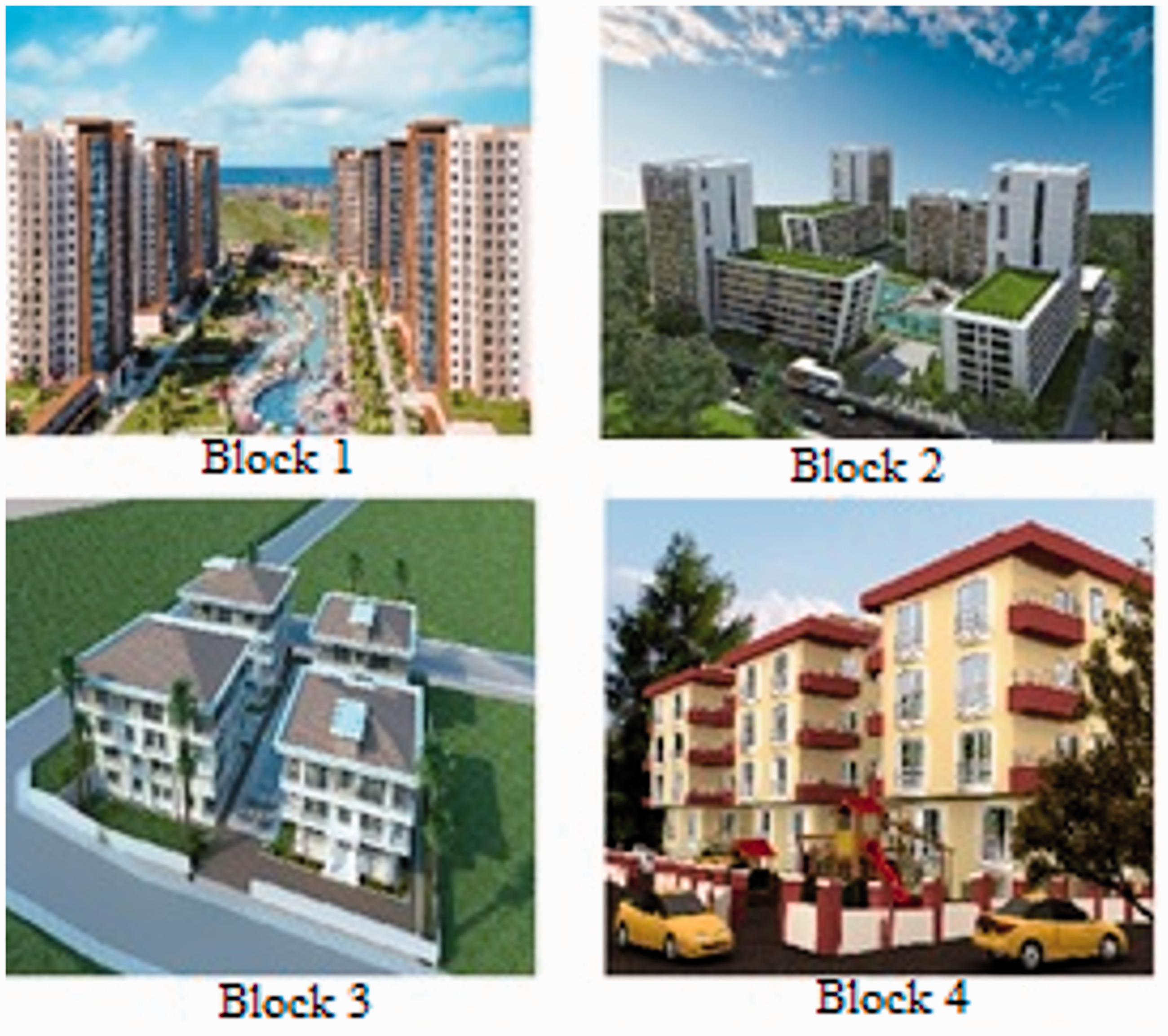
Examples of cities leaderboard in block building. (a) Block 1, (b) block 2, (c) block 3, and (d) block 4.
When a student participates in a two-week course, the total number of the second week and the number of students in the previous week will be displayed. For example, suppose that 50 students attended the course, the system will assign five students with the highest score for the week. These five students will be able to see 25, 20, 15, 10, and five students on the leader boards according to their scores. A student entering the top five for two consecutive weeks will be able to see a total number of the second week and the number of students in the previous week. For example, if S1 is in the first week, he is allowed to see 35 (20 + 15) participants’ blocks. Likewise, if S2 in the first week is “fourth” and the second week is “fifth,” then S2 will see the order of 15 (10 + 5) blocks. A student will have the right to see the full leaderboard (25 + 25) if he is at the top of two consecutive weeks. While students are not required to participate in this activity, students will receive 20% of their final grade from this activity. The stages of block-building process are shown in Table 3.
Steps to get points for building blocks.
Potentials of participation in the suggested activities
While online courses demand active students participating in the teaching process during the lessons, students not being on the computer are a problem. In this study, the puzzle activity is specifically designed to solve this participation problem. For this purpose, an instructor can present the piece of the puzzle to the students’ puzzle board at any time. If the students give a correct answer at a certain time, the instructor can be informed about the participation of the students with this kind of interaction.
While the first puzzle activity is mainly aimed to increase students’ responsibility in tasks, the block-building activity is aimed to enhance participants’ interest and motivation. Reward such as points (bonus, gold) which are used to enhance the motivation can be considered as an external motivation. In addition, some other factors are considered to trigger the intrinsic motivation. The factors that increase motivation in the literature are difficulty, curiosity, control power, and imagination. To that end, levels of difficulty have been taken into account in the tasks that students must perform in order to get points. The tasks and responsibilities of the students in the informal lessons have also been observed in online gamification settings. Students can use the points they have achieved and they are allowed to control themselves according to their peers’ status. This gives students the opportunity to design different levels of their self-control by imagining them. In every lesson, the leaderboard keeps the curiosity of students constantly alive. The block-building process continues with particular rules and students are informed with the rules at the beginning of the course.
Discussion and conclusions
Gamifying an instructional process is suggested for student participation in online settings (Cassells et al., 2015; De-Marcos et al., 2014; Hsu et al., 2013; Raymer, 2011). Scenario and activities created in this study are hoped to have a positive effect on the students’ active participation. Likewise, FarmVille is one of the most popular games played on Facebook (about 65,000,000 people, URL-1, 2016). Users spend much time in the virtual setting for hours and they can enjoy and learn from the game activity. Accordingly, Garris et al. (2002) stated that some games like the popular SimCity series are very entertaining, instructive, and thought provoking, and that these games can be as interesting as action games. In that scenario, users can use a land allocated to them and enlarge it according to the money/points situation and farm it. Hou (2011) stated that users play the games such as FarmVille and CityVille for the purpose of relieving themselves, stressing, and getting away from responsibilities. In addition, PopCap Games’ January 2010 survey found that 24% of 4.917 participants played social games at least once a week indicating that social games have reached a massive part of the population. The block-building activity in this study created in a similar structure, such as FarmVille, CityVille, and SimCity, is expected to provide positive motivation for students to participate in the course.
Students are increasingly becoming more comfortable with online courses. In line with this, they experience different tools (online, chat, games, etc.) during the course. Muntean (2011) stated that a systematic process of gamification would allow students to spend more time with their course materials and content. Since the element of face-to-face human contact that is missing in the online setting increases the transactional distance (McBrien et al., 2009), ways in which to include opportunities to simulate face-to-face interactions may be improved by the gamification elements. Such as the time period that the student spent in the course, the frequency of visits, etc., is important measures of success in gamification (Muntean, 2011). Therefore, puzzle activity and block building suggested in this study are hoped to encourage participation, to answer questions directed to them, and to fulfill assigned tasks in order to get more points and construct more complex blocks. In this way, students will follow the instruction with paying more attention; this way will allow them for more interaction with the instructor.
In this study, the block-building activity was constructed to provide students’ active participation in the course while creating puzzle activity to provide physical participation of the students. The leaderboard in the block-building activity has been preferred to provide student participation and motivation (Nebel et al., 2016). In the prior studies, leaderboards are suggested to increase online student participation (Grell, 2015). When the leaderboard was introduced at the end of the game, it often increased the students’ motivation to play again (Landers and Landers, 2015; Schubert et al., 2014; Willems et al., 2014). Similar to the suggestion in this study, stated that using a leaderboard element could increase social connectivity among students. The leaderboard element needs to be well organized and presented, otherwise, for some students this could lead to an early towel on the way to success (Domínguez et al., 2013; Willems et al., 2014). A relative leaderboard is suggested because it is more motivating to compete against students who are normally at the same skill or level of knowledge. For example, Grell (2015) Hamari, J. emphasized that a student must see only five students at the top and below the current position on the leaderboard. On the contrary, if a student sees that the leaderboard is at a higher level than student’s own and is difficult to reach, student’s competitiveness may be reduced. In this study, a new approach was proposed to list the students in the leaderboard to increase participation. Seeing the list based on the performance of the participants may be a useful approach for educators to give a chance to the participants to see more than others’ status on the list.
Consequently, it is still critical for instructors to find the ways to deliver effective online courses, so they can ensure that the participants are really participating. The current study, while not generalizable, suggests scenarios based on basic theoretical aspects of gamification and may provide positive synchronous learning experiences. In a future study, we plan to implement the scenario in synchronously delivered courses by taking the evaluations of instructors and students by integrating our ideas with participation as well as the cognitive engagement perspectives.
Footnotes
Declaration of Conflicting Interests
The author(s) declared no potential conflicts of interest with respect to the research, authorship, and/or publication of this article.
Funding
The author(s) received no financial support for the research, authorship, and/or publication of this article.