




Abstract
This study examined the use of Twitter for online discussions in one asynchronous online, journalism class. A content analysis of the transcripts of the tweets from 25 undergraduate students was performed, coding for social presence using the social presence density measurement tool, one of the three aspects of the community of inquiry framework. Participants generated 1096 unique tweets over a 12-week course. Additionally, the community of inquiry survey was administered at the end of the course. Internal consistency measures and correlation analysis were used to identify the relationships between the social presence density scores and the community of inquiry survey results, which showed significant positive relationships exist between teaching, cognitive, and social presence, and the nature of the tweets. Results also underscored that social presence could be established on a micro-blogging platform, making it a potentially useful tool in an online learning environment.
Introduction
Today’s university students increasingly participate in online courses, with one in four students currently taking at least one online class (Allen and Seaman, 2016). These students have expectations from the pedagogy and technology employed by their instructors and universities, and instructors can meet these needs with thoughtful design of instruction (Jones and Shao, 2011). One common practice for online classes is engaging students in online discussions to provide “for high levels of freedom of time and place to engage in interactivity” (Rourke et al., 1999: 2) and the ability to allow for collaboration and community building. The importance of collaboration and communication among students has been shown to make positive contributions to learning (Garrison, Anderson, and Archer, 1999) and helps establish a community of inquiry (COI) in online education (Rourke et al., 1999).
The online social networks that permeate the lifestyle of students today can serve as a useful pathway for cultivating a COI (Ahn, 2011). The micro-blogging and social networking tools that students use extensively outside the classroom may provide the engagement and social presence benefits in formal education environments, including online courses. Blogging, micro-blogging, and social network sites provide a platform and tools (e.g. profiles, friend, networks) for their users to develop personal and social identities (Manago et al., 2008) and support engagement with others in the network (Ahn, 2011).
Micro-blogging using the Twitter social networking platform is the emphasis of the present study. Micro-blogging is a broadcast medium in the form of blogging. However, it differs from traditional blogging in that it allows users to exchange small chunks of content such as short sentences, website links, images, or video links. Emerging evidence indicates that students express positive attitudes toward using social media for learning in general and the micro-blogging platform Twitter specifically (Tur and Marin, 2015). Twitter has also been shown to help students feel more connected to each other and the course (Domizi, 2013). Given the social networking and micro-blogging affordances provided by Twitter, on one hand, and its popularity among the millennials, on the other hand, this study was designed to examine how social presence and COI can be supported when Twitter is used to host online discussions in a formal education setting of an online course.
Theoretical foundations
COI and social presence
One of the popular frameworks for designing effective online learning is the COI model that operationalizes critical and reflective discourse as an essential component of meaningful online learning. COI emphasizes that knowledge acquisition is not necessarily done through a fixed reality, rather it is “shaped by purposeful, open and disciplined critical discourse and reflection” (Garrison and Vaughan, 2008: 14). Further, “ideal educational transaction is a collaborative constructivist process that has inquiry at its core” (Garrison and Vaughan, 2008: 14). COI was selected for this research because it meaningfully incorporates social presence as a focus of the conceptual model, which is the emphasis of the present study.
The three core elements in the framework are described as social presence, cognitive presence, and teacher presence as shown in Figure 1. All of these elements are necessary for the COI to be effective and these elements are interdependent and support each other. While cognitive presence emphasizes student interaction with the content and teacher presence denotes the extent of student interactions with the instructor, social presence, examined in this article, is described as the ability to cast one’s self and establish personal and purposeful relationships with the community (Garrison, 2007). Social presence relies on three essential components: open communication, group cohesion, and personal connection (Garrison and Vaughan, 2008). Students need to feel safe and free to openly communicate with other students in the course. They also must feel as if they belong to a group that encourages them to think critically and share a common purpose. With these elements in place, they will develop trust and emotional bonding to others in the group. The term social presence, originally defined by Short et al. (1976), is the “salience of the other in a mediated communication and the consequent salience of their interpersonal interactions” (Rourke et al., 1999: 4).
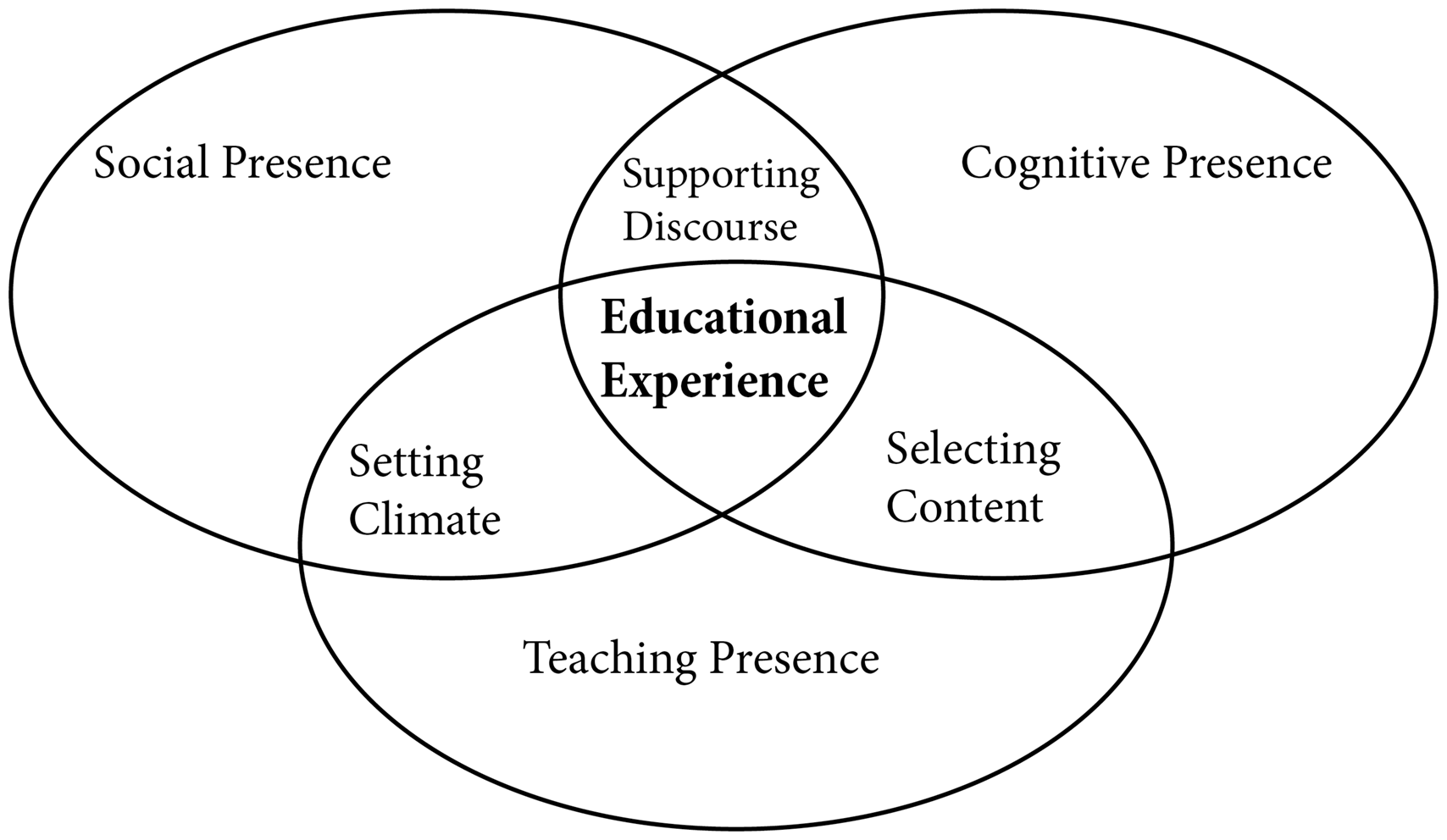
COI model.
Mehrabian (1968) noted that interpersonal actions, including facial expressions, posturing, and eye contact, make up the part of the nonverbal communication process that enhances closeness within a community. While these elements are lacking in a computer-mediated text-based discussion, they can nonetheless be achieved through rich messages, such as expressions of feeling, use of humor, personal greetings, and thoughtful self-disclosures (Hara, Bonk, and Angeli, 2000). Rourke et al. (1999) found that these and other research results indicate that computer-mediated communication can support both the cognitive and affective dimensions of higher education. In order to establish social presence in class and create a robust COI as defined by Garrison et al. (1999), it is important to establish a climate that allows for open discussion. Clear guidelines for all discussions need to be provided, reviewed, and posted. The teacher must maintain his or her presence to facilitate the conversation and nurture cohesion, which is what sustains a COI (Garrison et al., 1999).
Micro-blogging and Twitter
Social media use continues to increase among the general population, with 74% of online adults in the U.S. now reporting using a social media tool and 52% using more than two platforms, according to a 2015 Pew Research report (Duggan et al., 2015). As of 2016, Twitter was used by 24% of online adults, the majority of whom are college educated (Greenwood et al., 2016). A 2015 Pew report found 33% of all teens are on Twitter (Lenhart et al., 2015) and this demographic is soon to be college aged. Twitter is one of the world’s most popular micro-blogging sites, with an average of 313 million active monthly users, and 82% of those users accessing the network in a mobile environment (Twitter, Inc., 2016). While not fully adopted by millennials or other generations (use is less than 50% overall), Twitter does offer an online social networking platform that can potentially connect and engage users.
Micro-blogging is limited in the amount of information shared for any given post, which in turn requires that the content generator be more selective with content (Thoms and Eryilmaz, 2015). Instead of inhibiting the reader’s understanding of these limited communiqués, sentiment analysis research by Bermingham and Smeaton (2010) determined that this shortened form of writing can make it easier to understand the writer’s opinion and outcomes. Ebner et al. (2010) state that the exchange of information within 140 characters requires competency and the ability to focus and express oneself clearly. Twitter allows registered users to read and post tweets, which are short messages, limited to 140 characters, or about 25 words, as well as post videos, emojis, memes, and photographs. Tweets, which are public by default, are labeled with a user-generated hashtag and are archived and searchable. This allows users to follow conversations related to their interest and then add comments of their own. Users can easily retweet, or quote, someone else’s comment and extend the thought with an additional comment, or they can reply directly to the comment with their own thoughts on the subject.
Research of the use of Twitter in formal education
A number of studies have explored incorporating micro-blogging into formal educational settings (e.g. Carpenter and Krutka, 2014; Ebner et al., 2010; Junco et al., 2011, 2013; Lin et al., 2013; Lomicka and Lord, 2012; Lord and Lomicka, 2014; Thoms and Eryilmaz, 2015). In fact, some scholarship has even reviewed studies on the use of Twitter over several years in language learning (Hattem and Lomicka, 2016). Thoms and Eryilmaz (2015) examined enhancing the traditional LMS by embedding Twitter into the LMS platform to see if it would further engage students in meaningful learning. Their study measured students’ perceptions and found that the majority of students agreed that the use of Twitter increased their learning, social interaction, and sense of community in the course. In a study of graduate students asked to micro-blog as part of a class, Ebner et al. (2010) showed that their average daily posts increased through the time of the course thereby creating a constant flow of information. Ebner et al.’s (2010) research analyzed the content of the tweets and found evidence of a high number of activities with great potential for process-oriented learning. The study also found a high percentage of private messaging among the students and concluded that micro-blogging supports informal and formal process-oriented learning.
Twitter has also been shown to enhance social presence in addition to establishing informal, just-in-time communication between student and faculty (Dunlap and Lowenthal, 2009). Results of this study showed that social interactions occurred more naturally and immediately, and with a “persistent presence” (Dunlap and Lowenthal, 2009: 132) and that engaging in Twitter discussions unexpectedly helped them “attend to the other two components of the COI framework – cognitive and teaching presence” (p. 133). Lord and Lomicka (2014) conducted a study with preservice teachers in a graduate seminar on language teaching methodology using Twitter. Using discourse analysis and survey data, their findings showed that the micro-blogging tasks enabled participants to form a virtual Community of Practice in which they were able to learn, share, and reflect; in essence, enhancing the social presence of the course (Lord and Lomicka, 2014).
Evans (2014) study found that increased Twitter usage improved the students’ feeling of curricular engagement; however, the study failed to show whether increasing Twitter usage engages students, or if more engaged students tend to increase Twitter usage. It may be that increasing Twitter usage causes an increase in engagement, or that students who are more engaged will make greater use of Twitter. Other studies have examined students’ perception of the use of Twitter and found that the majority of them felt more connected, involved in the class, and they had positive reactions to using it as tool (Domizi, 2013; Rinaldo et al., 2011). While Munoz et al. (2014) study contradicts these findings, it did find the content of the online students’ Twitter conversation to be more friendly and engaging than students using a traditional LMS embedded micro-blog.
Method
Building on prior research, this exploratory sequential mixed-method study (Creswell, 2013) was designed to examine the potential to establish social presence in an online course through using Twitter micro-blogging as an alternative platform to the traditional LMS-enabled asynchronous discussion board. The overarching research question that guided this study was: How does using a micro-blogging platform like Twitter contribute to the establishment of social presence and the COI in an online course?
Online learning context
This study drew data from one asynchronous online undergraduate course offered at a major public research university in the southeast United States. The course took place over a 12-week summer semester and had been set up in Canvas, the LMS of choice at the university. The course was in journalism and looked at historical and current political trends and the challenges facing today’s media, especially with the advent of digital platforms. The course was divided into eight topic-specific modules. In addition to weekly readings, writings, and lectures, students needed to respond to a weekly discussion prompt initiated by the instructor in Twitter. Each of the eight modules’ discussion prompts were independent of each other and once posted the students had seven days to respond. Students were required to participate in the Twitter discussion and interact with their peers in the digital environment for part of their course grade. At the end of the week, the next prompt was posted and a new discussion would ensue. Students could start different threads, but all the conversations were held together with a common hashtag, which was the course number. Example of a prompt is provided below: “What steps should the media be taking to make sure market pressures don’t get in the way of us fulfilling our vital role of fostering democracy? #MMC3614”.
Students were required to follow the conversation and post at least twice during the week. Weekly Twitter discussions accounted for 25% of the students’ total course grade. In addition to the weekly discussions, each student had to choose a current political news story from an online news source and then take one point of interest of the article and create a prompt to be used as an additional discussion topic that would then be tweeted to the class. That student was then required to act as discussion leader for their prompt that week. Garrison and Anderson (2003) offered that having students moderate the online forum may lead to freer discussions. The instructor required that each student has a personal Twitter account and that they follow him/her on that account. The students were not required to follow each other but they were required to use the course-specific hashtag with all of their posts. This would keep the conversation threaded and enable students to track when someone had added a post.
Participants
Twenty-five students enrolled in the course participated in the study; 76% of the students were female. All of the students were undergraduates, the majority were seniors, and all were under the age of 25. Of the 25 students, their majors included Journalism (13), Telecommunication (6), Public Relations (3), International Studies (2), and Advertising (1). The students were geographically dispersed throughout the U.S. and two were based internationally. All students had taken at least one online course before, and 15 of them reporting having taken five or more.
All but one of the students had made use of online discussion boards before in their online classes and their overall impressions of the forums were mixed. Survey data revealed that 44% agreed that they enjoyed using discussion boards (M = 2.96). Almost half (48%) agreed that the online discussion boards helped with understanding the course subject (M = 3.16) and more than half (60%) agreed that discussion boards were an important part of the class (M = 3.32). Social relationships area also established, as 56% responded that they agreed that they helped in getting to know their classmates (M = 3.20). Data revealed that 100% of the students already had personal Twitter accounts and 68% of them had previously used Twitter within the realm of a classroom. Activity on the already established Twitter accounts was varied from having less than 100 tweets to some having more than 500.
Measures
Background presurvey
A voluntary presurvey to capture demographic data and experience with online courses and Twitter was used at the start of the course. Survey questions related to a student’s major, online course experience, Twitter experience, and a special focus on questions pertaining to a student’s use of online discussion forums.
Social presence density
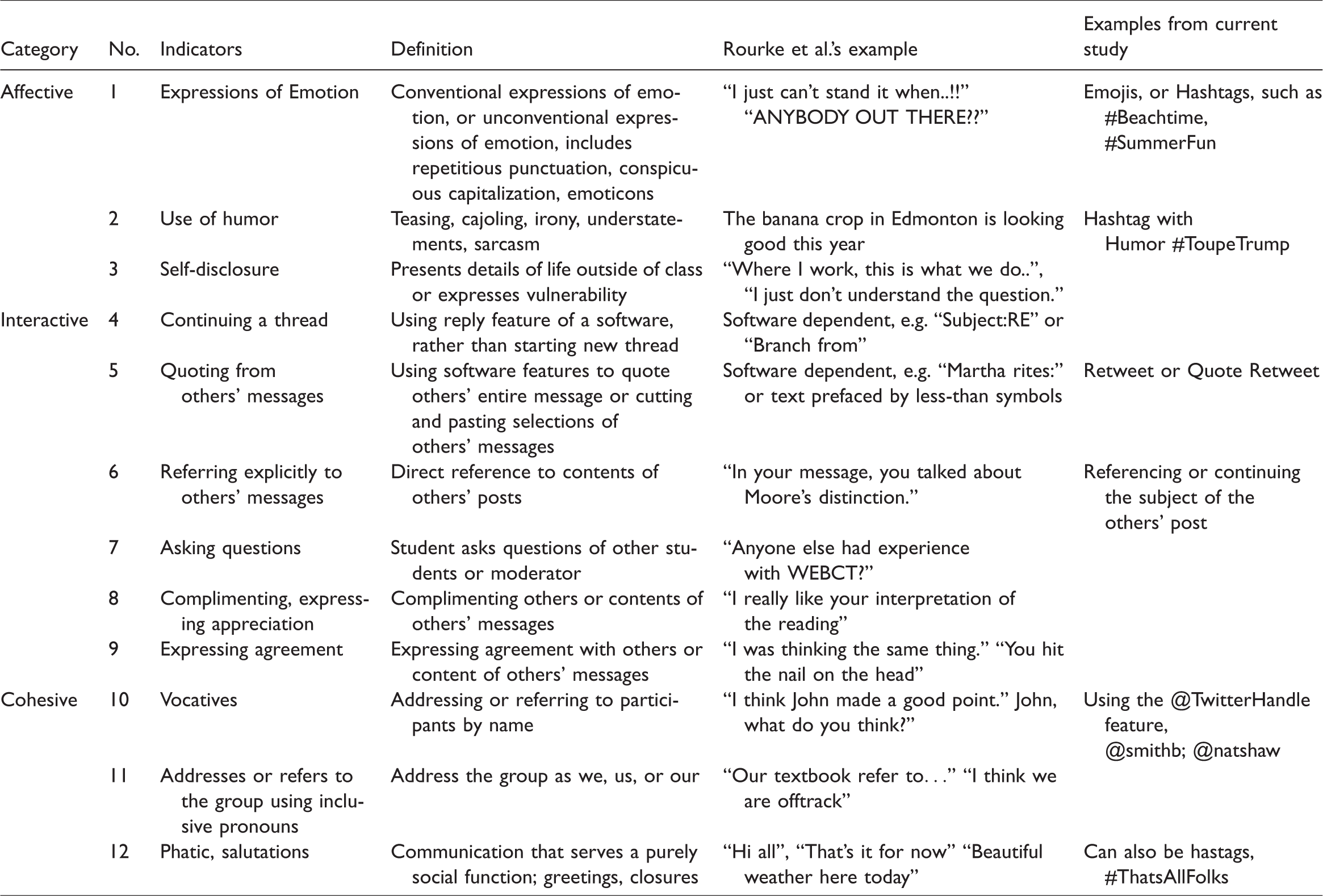
At the end of the course, a content analysis of all of the tweets was performed to assess social presence density (see Table 1). Rourke et al. (1999) measure was employed. The tool measures three broad categories that contribute to social presence: interactive, affective, and cohesive responses. The first category, interactive responses, reflects the open communication described in the COI. It refers to indicators of threaded exchanges combined with messages of a socially supportive nature. Interactive responses can be identified by the presence of six indicators as shown in Table 1. The second category used to code the tweets was affective responses, which correlate to emotional presence. “Affect is expressed in computer conferencing in a number of ways, including use of emoticons (Falman, 1981), humor and self-disclosure” (Rourke et al., 1999: 6). The third category that a tweet could be designated into was a cohesive response, which includes three indicators.
Social presence density instrument example (per Rourke et al., 1999).
COI survey
At the end of the course, students were asked to complete the widely used COI survey, as a means to measure if the students’ perceptions of the COI indicators have a correlation to the recorded aggregate social presence density scores. Validated by Arbaugh et al. (2008), the COI survey was designed to measure the presence categories of the COI framework. It is a 34-item survey that addresses each of the COI presence: 12 items measure cognitive presence, nine items measure social presence, and 13 items are designed to measure teaching presence. The scale uses a 5-point Likert type, where 1 = strongly disagree, 2 = disagree, 3 = neutral, 4 = agree, 5 = strongly agree. The instrument was validated with a sample of 287 students from universities in Canada and the United States (Arbaugh et al., 2008). Cronbach’s alphas yielded internal consistencies equal to α = .94 for teaching presence, α = .92 for social presence, and α = .90 for cognitive presence.
Coding and inter-rater reliability
The researchers used the online software tools Tweet Archivist and TwDocs to download the students’ Twitter™ conversations. Transcripts from the class’s Twitter conversations were subjected to a content analysis using the social presence density tool (Rourke et al., 1999). Two researchers used a combination of the thematic unit and syntactical unit to code for the presence of the 12 indicators within the tweets. It is not always appropriate to identify syntactical units such as grammatically correct phrases, clauses, and complete sentences. Thematic units, such as single thoughts or ideas that can be interpreted from a conversation should be included in the measurement, as online conversations “combined the telegraphic style of email with the informality of oral conversation” (Rourke et al., 1999: 9). By combining the flexibility of the thematic unit, with the ruled-based structure of a syntactical unit, coding consistency increased.
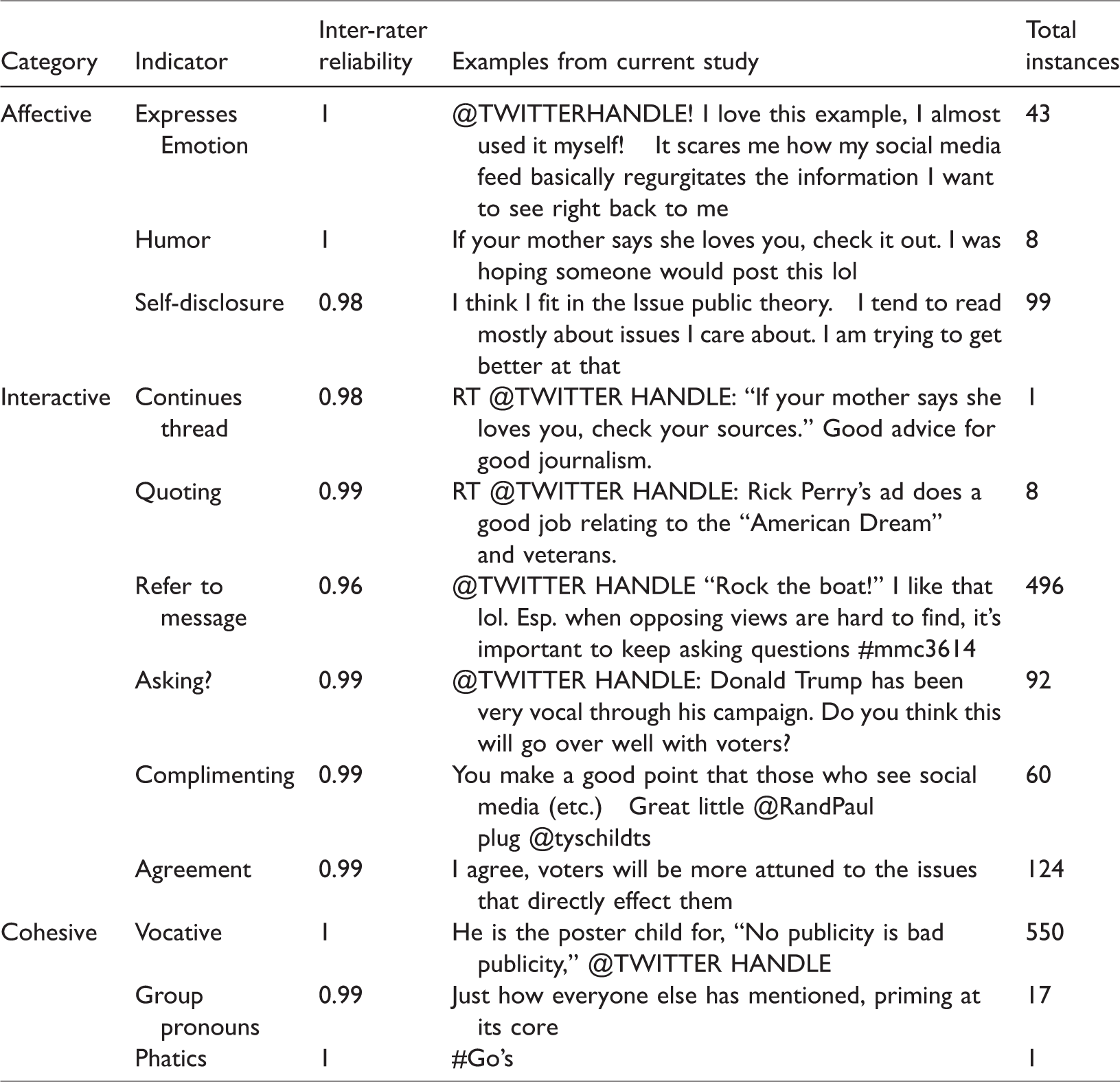
The simplest method to compute inter-rater reliability, and the method used by Rourke et al. (1999), is the percent agreement statistic, or the Holsti method. Before coding, the two researchers separately analyzed the first 100 tweets from the course: coding for the presence of the 12 indicators. The researchers then came together in a one-on-one discussion and compared how they categorized the 100 tweets. After the discussion, the researchers separately analyzed tweets number 101–200 and came together again to compare results. This time, sufficient agreement was reached, and aggregate inter-rater reliability was .989, so the researcher then independently coded the remaining 896 tweets (see Table 2).
Overall social presence density with inter-rater reliability.
Data analysis
The study used content analysis to code the social presence density in the students’ Twitter™ conversations. We used descriptive analysis of the background survey and COI survey by interpreting means, standard deviations, and response frequencies. We also performed internal consistency reliability (Cronbach’s alpha) and correlation analysis (Pearson correlations) to identify the relationships between the social presence density scores and the COI survey results. An alpha of .05 was used for all statistical tests.
Results
This study examined undergraduate students’ use of the micro-blogging platform Twitter, measuring for social presence density and establishment of a COI. It was assumed that millennial students’ mobile lifestyle, familiarity with social networks, and the just-in-time capabilities of a micro-blogging platform would lend themselves well to the development of social presence in an online course.
Content analysis of tweets using social density tool
While inter-rater reliability for each indicator varied, this variation was within acceptable ranges (>.96). Manifest indicators such as “Use of Vocatives” had a reliability of 1.0; other indicators, with presumably manifest characteristics, such as “Asking a Question” had a .99. Indicator “Uses Humor” had an inter-rater reliability of 1.0 as shown in Table 2. Rourke et al. (1999) designed the social presence density measurement tool to equally weight each of the 12 indicators. In this study the most prevalent social presence indicator was “Vocative” or the use of personal pronouns in a post. There were 550 incidences of vocatives, which were 50% of all tweets. Examples of this include “@TwitterHandle, journalists need to come together to raise the standard of information they discuss,” and “He is the poster child for “No publicity is bad publicity”, @TwitterHandle.”
The second most prevalent social presence indicator was “Refer to message,” with 496 occurrences, which was 45.26% of all tweets. For example “I hear you with exhausting, but it’s worth it” and “@TwitterHandle. Well said. Journalists do a public disservice when commentary and $get in the way of sharing news.” It is notable that the indicators “Use of Vocatives” and “Refers to Message” usually appeared together. There were 113 tweets that showed no social presence indicator. There were 269 tweets (25% of total tweets) representing two indicators and 228 tweets (21% of total tweets) reflecting three indicators, and 134 tweets with more than three indicators. There was one tweet with six indicators, which was the highest recorded.
The final calculated aggregate social presence density for all 12 indicators was 11.40%. The indicators fall into three categories, and the aggregate density for each category was as follows: Affective: 4.56%; Interactive: 11.88%; Cohesive: 17.27%. Figure 2 illustrates the exact density score of each indicator. The lowest incidences were “Phatics” and “Continues Thread,” both with only one occurrence. The indicator “Continues Thread” was coded when retweets were used within the class. If a student’s comment was retweeted by someone else outside of their class, it was not counted as part of the class’s social presence.
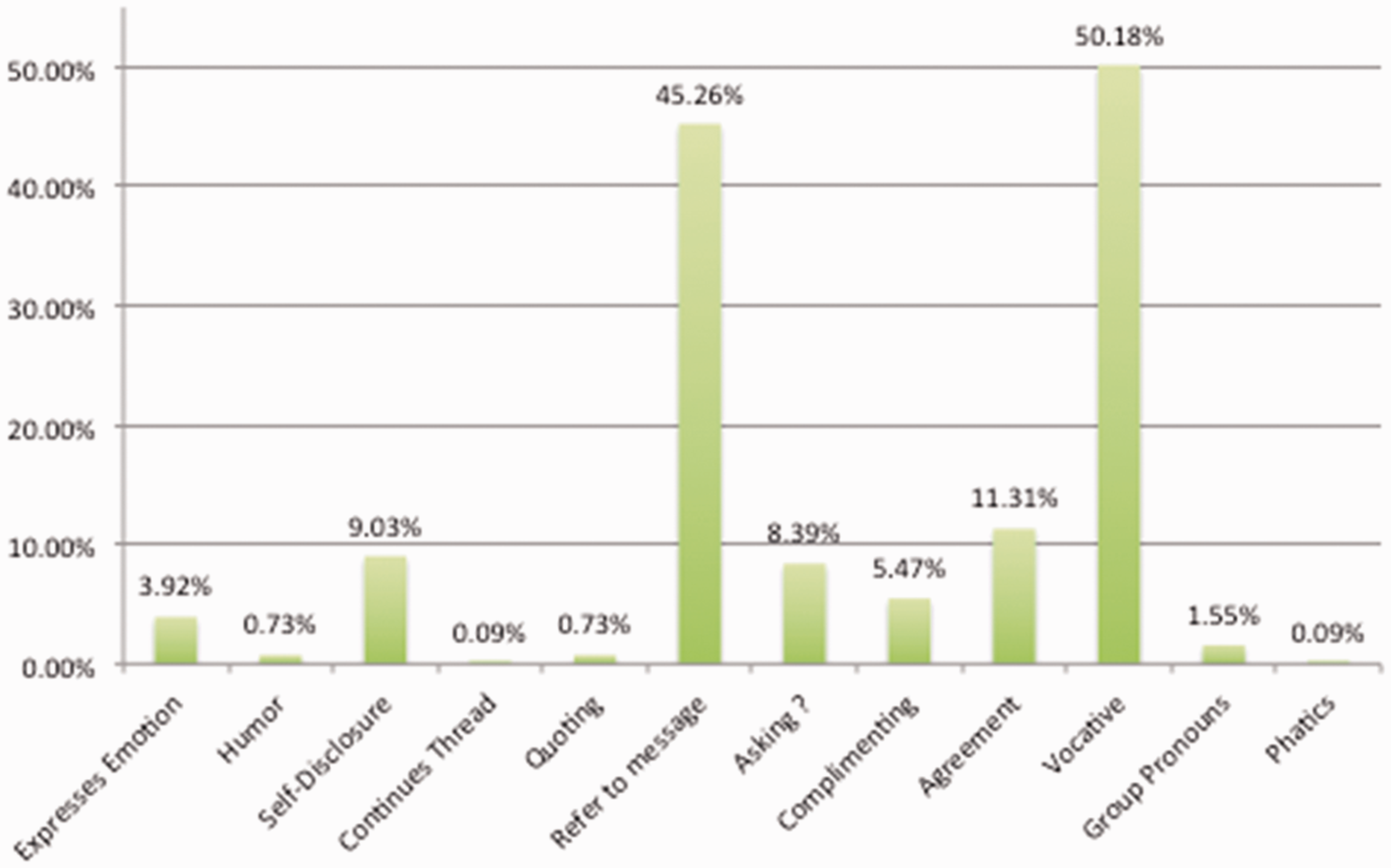
Social presence density per indicator.
COI survey results and relationships
The COI survey developed by Arbaugh et al. (2008) was administered through an online survey on the last week of the class and yielded 13 responses, which is a 52% response rate. Extra credit was given to those taking the survey. Appendix 1 includes all of the descriptive statistics for the individual items. Mean responses for teaching presence were 4.37 (SD = 0.94), social presence was 4.42 (SD = 0.77), and cognitive presence was 4.63 (SD = 0.53).
Two questions had the lowest means. One was within the Teaching Presence construct, Item 10: “Instructor actions reinforced the development of a sense of community among course participants” was at M = 3.69. The other response with M = 3.69 was Item 16 within the Social Presence domain: “Online or web-based communication is an excellent medium for social interaction.” While these were the lowest means, it is notable that both are above the central point. The highest mean score was M = 4.85 in Teaching Presence (Item 4: “The instructor clearly communicated important due dates/time frames for learning activities”). Per our guiding research question, we performed Pearson correlations using the results of the COI survey and the findings from the social presence density content analysis. Fourteen of the correlations were statistically significant and ranged from r = +.985 to r = −.630, p < .05 (see Table 3).
Pearson correlation matrix between social presence density scores and COI survey scores.
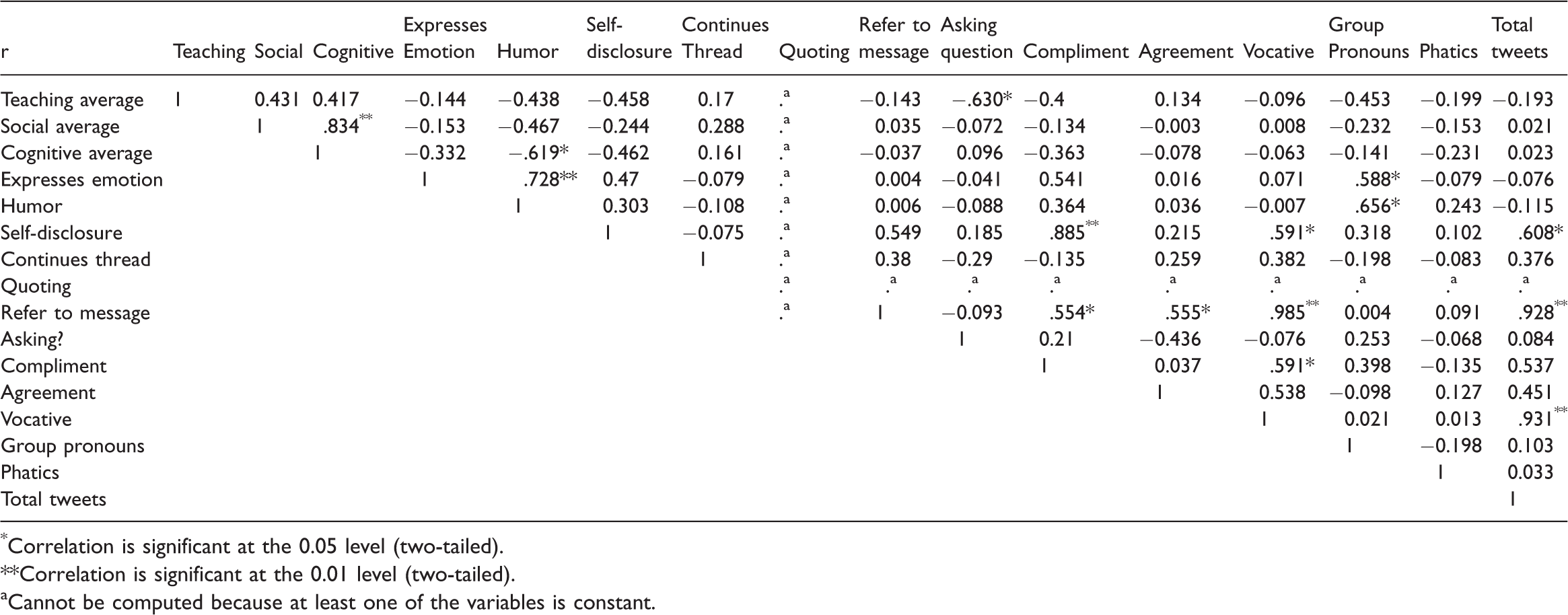
*Correlation is significant at the 0.05 level (two-tailed).**Correlation is significant at the 0.01 level (two-tailed).aCannot be computed because at least one of the variables is constant.
Using the guide for strength of effect size as suggested by Evans (1996), a significant and very strong positive relationship (i.e. r = .80–1.0) was found between the indicators “uses vocatives” and “referring to others’ message” (r =.985, p < .01), indicating that students were inclined to call a person by their name when they were referring to something that person said. This shows a relationship between the interactive and cohesive categories of social presence density tool. A significant and strong positive relationship between the indicators “self-disclosure” and “complimenting” (r =.885, p < .01) indicated that students would likely reveal something about themselves when they complimented another student on their tweet, showing a relationship between affective and interactive social presence density categories.
Those students that had a high number of total tweets tended to be the same ones that referred to others’ messages and called others by their name, and there was a significant and strong positive relationship between “number of tweets” and “refers to others’ message” (r=.928, p < .01), as well as “number of tweets” and “uses vocatives” (r = .931, p < 01).
Significant and strong positive relationships were found between the reported COI categories of Cognitive Presence and Social Presence (r = .834, p < .01); however, there was no statistically significant relationship between Teaching Presence and Cognitive Presence (r = .417, p=.156) or Social Presence (r = .431, p = .141). Significant and strong positive relationships (r = .60–.79) were found between the indicators “uses humor” and “expresses emotions” (r =.728, p <.005), both of which are indicators in the affective category of social presence density tool. Students who had a high total number of tweets also had a tendency to participate in self-disclosure and a significant and strong positive relationship was detected (r = .608, p = .027). A significant and strong positive relationship was also found between students who used group pronouns and used humor (r = .656, p = .015).
Significant and moderate relationships (r = .40–.59) were found between “both refers to message” and “complimenting” (r = .554, p = .049) and “refers to message” and “agreement” (r = .555, p = .049). There was a significant and negative relationship between the COI construct “teaching presence” and “asking questions” (r = −.630, p = .021) and a significant and negative relationship between the construct Cognitive Presence and “humor” (r = .619, p = .024).
Discussion
The social-mobile community in which today’s students live leads to questioning the use of a traditional LMS versus a public cloud-based social network, such as Twitter™. The value of the online discussion forum has been established by a number of researchers (Gunawardena and Zittle, 2009) and is widely used in the implementation of online courses, but many LMSs do not capitalize on the ability of a student’s mobile lifestyle or allow for a truly threaded discussion in a public forum. The content analysis of the Tweets showed that social presence was established within the discussions. While this analytical tool does not specify an optimal score for achieving social presence, Garrison (2007) points out that it is merely important that social presence exists in an online community to support the conditions for inquiry and the quality of interactions.
The indicator with the highest social presence density score was the “Vocative” or the use of a person’s first name. This could simply be an unintended consequence of using the “Reply” function, a feature that allows the person to thread their conversation back to the original author. While the TwitterHandle is inserted automatically in the post when a student responds, it is also possible to delete it or add other TwitterHandles to attract the attention of others in the threaded conversation. Since students were using the class number hashtag to keep the conversation threaded, they did not have to use the @TwitterHandle for threading. For this reason, the @TwitterHandle username was coded as a Vocative in each situation.
Indicators with the lowest incidence were “Phatics” and “Continues Thread,” both occurring only once. This is an interesting finding, as the “Retweeting” feature creates a simple way to continue a thread of conversation. While give-and-take conversation did take place within these discussions, the students only retweeted one time. This could be because they felt limited by the 140 characters and did not want to waste any of them on a continued thread.
Another interesting observation is that while performing the inter-rater reliability, the indicator “Uses Humor” had a perfect score of 1.0. Humor can be defined as having latent characteristics, as everyone tends to have a different or a personal sense of humor, so it is notable that there was 100% agreement on this indicator. Perhaps if the researchers used a more diverse cohort, this would not have been the case and more instances of humor (or less) would have been coded. Nonetheless, humor can be an effective mechanism for creating a sense of community in online courses, but must be used with caution and clarity, especially in online courses (James, 2004). Further research on the use of humor in online spaces is warranted.
A correlation analysis was performed using a postclass COI survey to examine the relationship between the three COI constructs and the 12 indicators of social presence density tool. Students who had a high total number of tweets also had a tendency to participate in self-disclosure which may indicate that people that are active in an online social network may tend to be more active in an online class discussion. However, the public nature of the Twitter™ platform might also diminish the nature and type of discourse in online courses. Some learners might be active in private discussion forums locked behind an LMS and much less active in a public forum in which there is a digital footprint of their discourse. This question and point is certainly an area worthy of future research.
The results indicated that there was a negative relationship between the COI construct “teaching presence” and the social presence density indicator “asking questions” which would lead to the interpretation that if the students felt a high teacher presence, they would be asking fewer questions. The results of the COI survey showed that the student perception of teaching presence was relatively high and the incidence of asking questions was low within their tweets (8.89%). This result leads to further questions, as the instructor only tweeted four times as part of the conversation during the time of the class.
Social presence is identified as a function of both the students and the instructors, and teaching presence is crucial to the COI model (Garrison, 2007). In this study, it appears the instructor’s low participation in the conversation may have contributed to the low social presence density scores. It should be noted that the overall mean for teaching presence in the COI survey, while high, was still the lowest of the three COI constructs. Teaching presence also had the highest standard deviation, so noting there was greater variability among the students as to the strength of teaching presence in the course.
The students’ perception of teacher presence can also be affected by the type of prompts for the discussion. The structure of these prompts can also influence responses (Darabi et al., 2011). If the questions do not ask the students to search for practical applications, then the discussion may not lend itself to anything more than declarative statements. There may be little inquiry and no closure to the conversation. The lowest average score within the COI post survey fell within the teaching presence construct, Item 10: “Instructor actions reinforced the development of a sense of community among course participants,” indicating that this was one area where the students were not in agreement as to the teacher’s contribution to the sense of community.
Another important discussion point is that we focused our inquiry exclusively in an online environment with undergraduate students. The application of micro-blogging tools like Twitter is not exclusive to online courses or undergraduate students. Blended learning approaches can also incorporate micro-blogging technology into the instructional method, aiming at increasing the social presence of a blended environment. Some research has already attempted to compare the outcomes of the use of Twitter in online versus blended courses (Thoms and Eryilmaz, 2015). Future research should attempt to provide empirical evidence of the application of micro-blogging to blended spaces.
Recommendations for practice
Tools shape our practice. Today’s students will be using social networking tools when they enter the workplace, whether they are in marketing, engineering, business, education, medicine, or even sports. As educators and researchers, we should try to incorporate social media and social networking tools in to our teaching practice so students have an opportunity to master the skills in their educational experience. By using a micro-blogging tool, such as Twitter, online instructors can engage these always-connected students and establish student-to-student social presence and community. In turn, this can contribute to positive learning outcomes.
Instructors need to be actively involved in the online discussion forum, whichever platform they decide to use for implementation. Twitter provides a simple, just-in-time, persistent presence for instructors to connect with students. Instructors can implement it in teaching in other ways as well, such as imparting important class information (e.g. “Read Chapter 2 tonight, not Chapter 3”), asking questions (e.g. scheduling appointments), and research (e.g. pose questions to Twitter-verse to find answers).
Instructors should leverage opportunities to connect with these always-connected and mobile students. In this study, almost half of the students accessed their Twitter account from mobile devices when participating in the class discussions. Smartphones were the main device for mobile, but iPads were also used. This finding indicates that if the online discussion is easily accessible on a mobile device, students will take advantage of the opportunity, and possibly participate more frequently, further enhancing the idea of Rourke et al. (1999) that computer-mediated discussions need to allow for high levels of freedom of time and place to engage in interactivity.
While students in this research seemed comfortable tweeting to each other (1096 tweets over the 12-week course), further research should take a look at learner outcomes, both perceived and real. Some research has examined student engagement and learning outcomes using Twitter as an intervention in higher education settings (Junco et al., 2011, 2013). However, the importance of collaboration and community in online classes has been established. Tying the use of these just-in-time discussions to learning outcomes would further sanction the use of micro-blogs in the online class. More research is necessary to fully comprehend the use of Twitter in formal educational settings, particularly in online learning spaces.
Conclusion
The empirical evidence from this study found that using Twitter to promote social presence and COI within an online class is an appropriate use of this social networking tool. Twitter is a free, public forum, easy to learn to use, and available to anyone with a connection to the Internet and computing device (e.g. smartphone). This social networking platform has the potential to increase student engagement, satisfaction, involvement, and learning in the online class. However, the use of tools like Twitter should be exercised with caution in formal educational settings by following the best practice derived from empirical studies like the present study. Our research has provided preliminary evidence of the role of Twitter in online courses in shaping the COI and social presence. In particular, our methodological approach may be useful if scaled into larger online courses and programs. While this research has provided some guidance on the use of Twitter in online spaces, many unanswered research questions still remain in the research base, such as do students actually want their formal learning experience to be “just-in-time” and continuous on a mobile device? Or should students be forced to engage in learning in a public forum? These questions are not clearly answered in the research literature at the present time, and future research on these important topics is warranted. We hope this study is an additional contribution to the understanding of micro-blogging in online courses.
Footnotes
Declaration of Conflicting Interests
The author(s) declared no potential conflicts of interest with respect to the research, authorship, and/or publication of this article.
Funding
The author(s) received no financial support for the research, authorship, and/or publication of this article.