



Abstract
In the 21st century, the information and communication technology explosion increases the uses of digital devices for many purposes in the world of work and in formal and non-formal education. This study analyzes existing literature on the basis of the definition of the concepts, terminology used, differences, fundamental perspectives, benefits, disadvantages, and finally the similarities and differences of the e-learning (electronic learning), m-learning (mobile learning), and d-learning (digital learning). It reveals that e-learning and m-learning are subsets of d-learning. On the other hand, some learning tools could be considered as m-learning as well as e-learning.
Keywords
Introduction
In the 21st century, technology is playing a crucial role in our daily lives and it calls professionals, educators, and learners reflect again over their basic beliefs in order to use technology for the re-design or re-engineering of education and training system. In addition, these technological devices play a significant role to help learners and teachers to get more advantages from it. However, the terms of electronic learning (e-learning), mobile learning (m-learning), and the digital learning (d-learning) are used indifferently or in a complementary way to mean technological learning. E-learning is the alternative of traditional education and it can also be a complementary to it. On the other hand, the m-learning is the complementary of both traditional learning as well as e-learning. M-learning allows learners to interact with their learning resources when they are far away from their normal place of learning environments (Clark, 2007). Through the m-learning, students can easily buy e-books and they can download to their devices (Geist, 2011) and it is no longer a novelty for learners, but “it is a mainstream, pervasive learning delivery medium relied upon by thousands of post-secondary education institutions and millions of workforce” (Cherian and Williams, 2008). M-learning is the subset of e-learning and the e-learning is a macro concept and it includes the mobile learning as well as online environments. Quinn (2000: 1 of 4) pointed that “M-learning is e-learning through mobile computational devices: Palms, Windows CE machines, even your digital cell phone.” D-learning is a tool which addresses a numerous of challenges that are faced by educational institutions, community leaders as well as by the policymakers and it helps learners to connect in the remote areas “with high quality college – and career-prep courses taught by a highly qualified teacher who does not work inside their school building”. In addition, the d-learning can also be very helpful for instructors in fact who is facing a lot of barriers in order to meet student’s needs (Digital Learning, 2011). And uses of these technical terms sometimes confuse users with the concepts of online learning or e-learning, m-learning, and the d-learning encompasses. This paper will clearly encompass the aforementioned concepts. Firstly, it presents the conceptual elements and methodology of the study. Secondly, it presents the conceptual definition of e-learning, m-learning, and d-learning. Finally, it analyzes the terminology used in e-learning, m-learning, and d-learning in order to present in the subsequent parts the comparison between them and in then also presents the advantages and disadvantages of e-learning, m-learning, and d-learning.
The significance of the study
How to select appropriate teaching and learning scenario and techniques? The rise of the online technology learning stimulates many ways of learning. But a bit of confusion remains when comes time to name the different technological ways of learning. E-learning, m-learning, and d-learning stimulated in this digital uses for learning are not always used correctly where they overlap. The similarities and differences between e-learning, m-learning, and d-learning should be clarified for teachers, researchers, trainers, learners, etc. to solve educational and learning issues and improve educational outcome that are associated with the current real life situation.
Conceptual elements and methodology of the study
Research questions
The following research questions were taken into consideration:
What is meant by e-learning, m-learning, and d-learning? What are the differences, similarities, advantages, disadvantages, and terminology used in e-learning, m-learning, and d-learning?
The aim, objective, and sub-objectives
The aim of this study is to shed light on the e-learning, m-learning, and d-learning. To achieve the aim, the following objective is considered:
Objective:
To analyze the concept and the fundamental perspectives of e-learning, m-learning, and d-learning.
In order to achieve the objective the following sub-objectives were taken into consideration:
Sub-objective 1: Analyze the terminology used and differences in e-learning, m-learning, and d-learning. Sub-objective 2: Analyze the conceptual definitions of e-learning, m-learning, and d-learning. Sub-objective 3: Analyze the fundamental perspectives of e-learning, m-learning, and d-learning. Sub-objective 4: Examine the similarities and differences between e-learning, m-learning, and d-learning. Sub-objective 5: Compare the benefits and disadvantages of e-learning, m-learning, and d-learning.
The methodology
The methodology is defined by Arksey and O’Malley (2005), the five framework stages are:
Framework stage 1: Identifying the research question: As with any systematic review, starting point is to identify research questions that need to be addressed. Framework stage 2: Identifying relevant studies: At the beginning, we conducted a targeted search on the e-learning, m-learning, and d-learning. Then, we have used some keywords on the two search databases, namely, Google (only scientific articles were considered) and Google Scholar. And for each of the keywords we searched up to 10 pages. “E-learning, M-learning, D-learning”, “Digital learning for education” (first 10 pages of Google Scholar), “Mobile learning teaching and learning”, “Comparative analysis of E-learning, M-learning, and Digital learning”, Digital learning environment (first 10 pages of Google and Google Scholar), “Digital learning” (first 10 pages of Google). Framework stage 3: Study selection: Our initial search picked up from two search databases a large number of relevant studies. From this initial search using two databases, we have found a total of 292 articles. Having read all the 292 articles we found that a total of 280 articles were related and selected for inclusion in the review. Framework stage 4: Charting the data: Having read all the 280 articles, we have summarized in a Microsoft word document a total of 130 pages of all the information. Then, we have put information from each article in a Microsoft word document. In general, this information was about the study and specific information relating to, for instance, study population, type of the intervention, outcome measures that employed, and the study design. And finally, we kept information (such as author(s), year of publication, study location, intervention type, comparator, study population, aims, methods, literature, results, etc.) that are related to our study with regard to the e-learning, m-learning, and d-learning. Framework stage 5: Collating, summarizing, and reporting the results: We have gone through all the 280 articles step by step and selected a total of 126 articles and these 126 articles were directly related with the e-learning, m-learning, and d-learning study. We analyzed these 126 articles that are directly associated to our key themes. This have presented with a graphical representation in Figure 1.
Conceptual definition
E-learning is “the learning supported by digital electronic tools and media” and m-learning is the “e-learning using mobile devices and wireless transmission” (Hoppe et al., 2003: 255) and finally, the “Digital learning is any type of learning that is facilitated by technology or by instructional practice that makes effective use of technology” and it occurs in all learning areas and domains (Victoria State Government, 2017: n.p.). While having significant impact on the sustainable development and on the living conditions (Podlacha et al., 2016), e-learning, m-learning, and d-learning seem to be very closely related. But there are some differences among them. M-learning is the subset of e-learning and d-learning is the combination of e-learning and m-learning. This is represented in Figure 2.
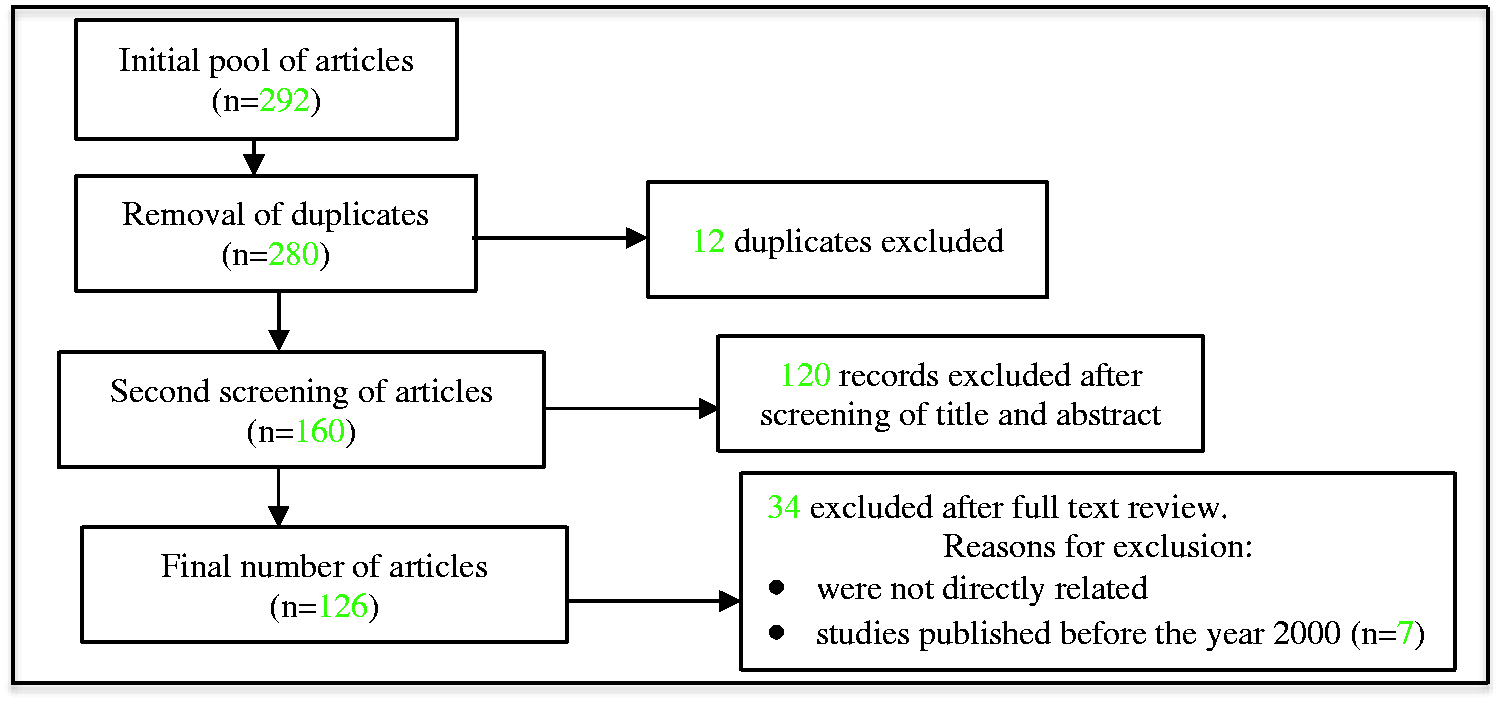
Flowchart of the studies included in the review.
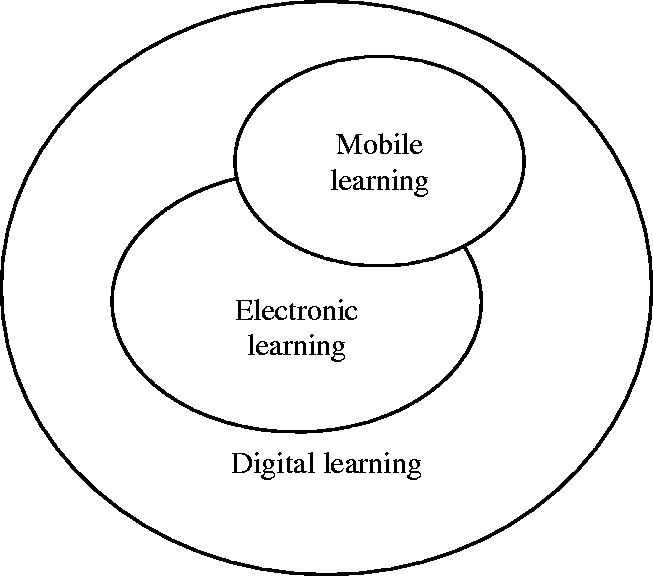
Relationship of e-learning, m-learning, and d-learning.
D-learning is a term that is increasingly replacing e-learning and it concerns the use of information and communication technology (ICT) in the open and distance learning. Furthermore, d-learning is the technical solution to support teaching, learning as well as for the studying activities (Suhonen, 2005) and it can also be an educational software, a digital learning tool, an online study program or a learning resources (Anohina, 2005). D-learning technologies enhance learners grasping more quickly and fully in order to connect theory and application adeptly. In addition, it also improves the instructional techniques, leveraging instructor time, and to facilitate the widespread of knowledge sharing. It is a new and better way to create possibilities beyond limits of our current imagination (https://odl.mit.edu/value-digital-learning).
Some of the definitions of d-learning are given below:
“Digital learning means bringing this together in a format that fits today’s digital world of work. All great learning organizations should deliver learning solutions through simulations, collaboration, meeting other people and learning from experts. So, digital learning is not all digital, but it should take advantage of digital tools in an integrated way” (Bersin, 2017: 1). “The term ‘digital learning’ means any instructional practice that effectively uses technology to strengthen a student’s learning experience and encompasses a wide spectrum of tools and practices:
Interactive learning resource, digital learning content (which may include openly licensed content), software, or simulations, that engage students in academic content; Access to online databases and other primary source documents; The use of data and information to personalize learning and provide targeted supplementary instruction; Online and computer-based assessments; Learning environments that allow for rich collaboration and communication, which may include student collaboration with content experts and peers; Hybrid or blended learning, which occurs under direct instructor supervision at a school or other location away from home and, at least in part, through online delivery of instruction with some element of student control over time, place, path, or pace” (Renton School District: n.p.).
According to Behera (2013), m-learning is involved in e-learning and mobile computing. M-learning is considered to be an extension of e-learning, but the quality of m-learning can be delivered with the awareness of special limitations and benefits of mobile devices. Sánchez-Prieto et al. (2016) stated that m-learning is a method of learning which is directly linked to the e-learning and it belongs to the independent typology, where teaching and learning process can have an electronic context. Kothamasu (2010) argued that m-learning is nothing but learning through the use of mobile devices and it is targeted to those who are on the move and the current mobile phones can support many latest services such as SMS, GPRS, MMS, email, packet switching, WAP, Bluetooth and many more. Besides mobile communications, there is a wide range of mobile products available such mobile scanner, mobile printers and moble labelers (Kothamasu, 2010: n. p.).
Some of the definitions of m-learning are given below:
“M-learning is learning as it arises in the course of person-to-person mobile communication” (Oloruntoba, 2006 as cited in Clark, 2007: 7). “Mobile learning is learning through mobile computational devices” (Quinn, 2000 as cited in Behera, 2013: 63). “M-learning is not just electronic, it’s mobile”. “Mobile learning as a form of education whose site of production, circulation and consumption is the network” (Polsani, 2003, as cited in Behera, 2013: 63). “M-learning is the use of mobile technology to aid in the learning, reference or exploration of information useful to an individual at that moment or in a specific use context” (Feser, 2010, as cited in Mboungou Mouyabi, 2012: 787).
According to Duderstadt et al. (2002), e-learning is used in the study environments to learn with a special importance of the web to describe a wide range of applications of electronic technologies, namely, TV, radio, CD-ROM, DVD, cell phone, Internet, etc. Sharma and Kitchens (2004) stated that e-learning includes learning with the help of a web-based training facilities such as virtual universities and classrooms that allows digital collaboration and technology assisted distance learning. E-learning innovation can be defined as the technological or the methodological e-learning forms that are perceived as new by the potential users (Fischer, 2013). According to Ally (2005), e-learning plays a significant role in any nations in the educational growth and it offers opportunities to develop nations in order to enhance their educational development. Furthermore, it also helps for the new generation of teachers to upgrade their skills for pedagogies of learning of the existing teaching force to the 21st century tools. Behera (2013) also stated that the modern technology, namely, the Internet is no longer limited within the four walls of classrooms and it includes all sorts of electronically supported learning as well as teaching. E-learning is defined as learning through the use of electronic devices, namely, desktop/laptop computers, smart phones, CD/DVD players, etc. that was firstly emerged in 1980s as a contender to the classical face-to-face learning (Abuhamdeh, 2010; Wains and Mahmood, 2008). The growth of e-learning is accredited to advantages such as manpower, cost, flexibility, and convenience (Ozkan and Koseler, 2009).
Some of the definitions of e-learning are given below:
“E-learning refers to the use of computer network technology, primarily over or through the internet, to deliver information and instructions to individuals” (Wang et al., 2010: 167). “E-learning covers a wide set of applications and processes, including multimedia online activities such as the web, Intéernet video SD-ROM, TV and radio. Students can use these materials to teach themselves” (Hassenburg, 2009 as cited in Tittasiri, 2003: 68). “E-learning is a wide set of applications and processes, such as Web-based learning, computer-based learning, virtual classrooms, and digital collaboration. It includes the delivery of content via internet, intranet/extranet (LAN/WAN), audio and video tapes, satellite broadcast, interactive TV, and CD-ROM” (ASTD in DeRouin et al., 2005 as cited in Norén Creutz and Wiklund, 2014: 303–304). “E-learning as the experience dimension of e-learning, which includes such factors as engagement, curiosity, simulation and practice” (Elliott Masie as cited in Behera, 2013: 67).
Terminology used in E-learning, M-learning, and D-learning
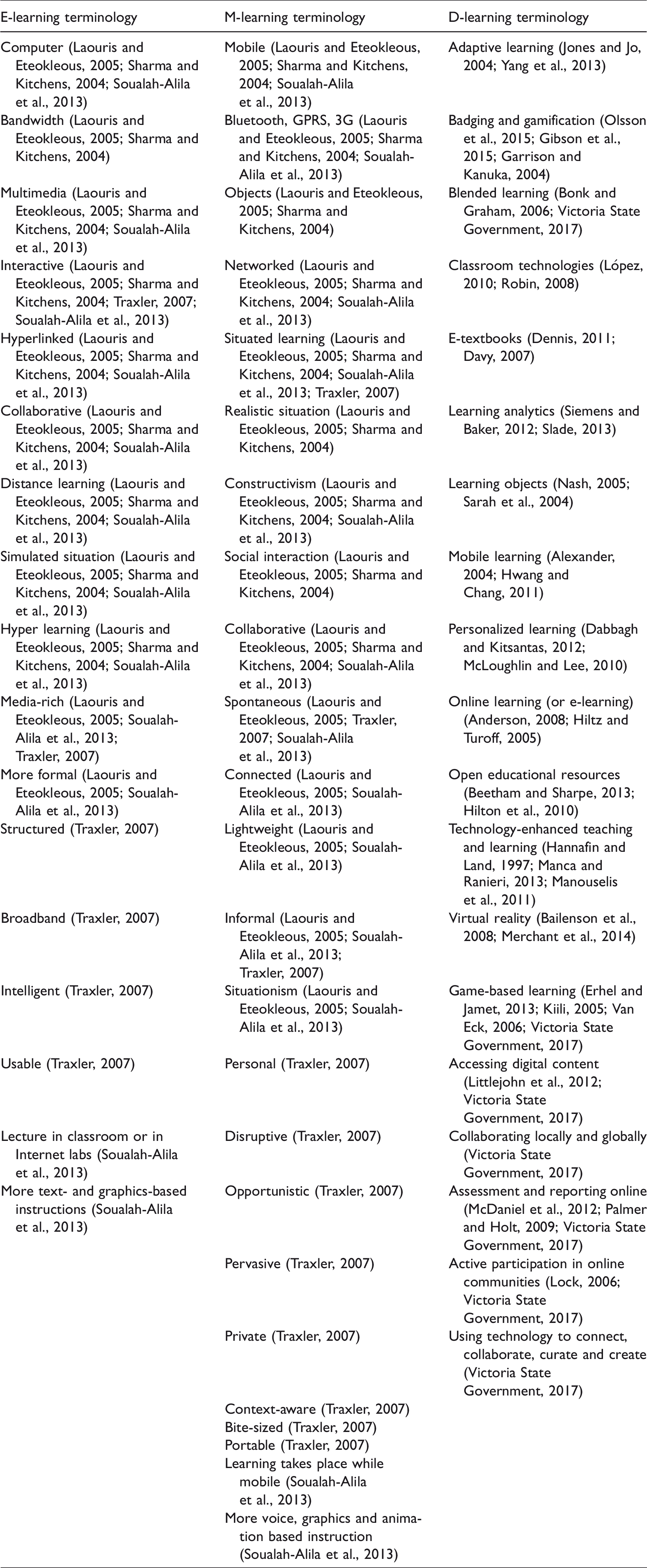
The transition from e-learning to m-learning to d-learning can be characterized by a change in the terminology of learning environment. Many studies have shown how to distinguish e-learning, m-learning, and d-learning by analyzing the descriptions of these three fields that are found in the existing literature.
Some of the terminology from the existing literature of e-learning, m-learning, and d-learning is given in Table 1.
Terminology used in E-learning, M-learning, and D-learning.
Fundamental perspectives of E-learning, M-learning, and D-learning
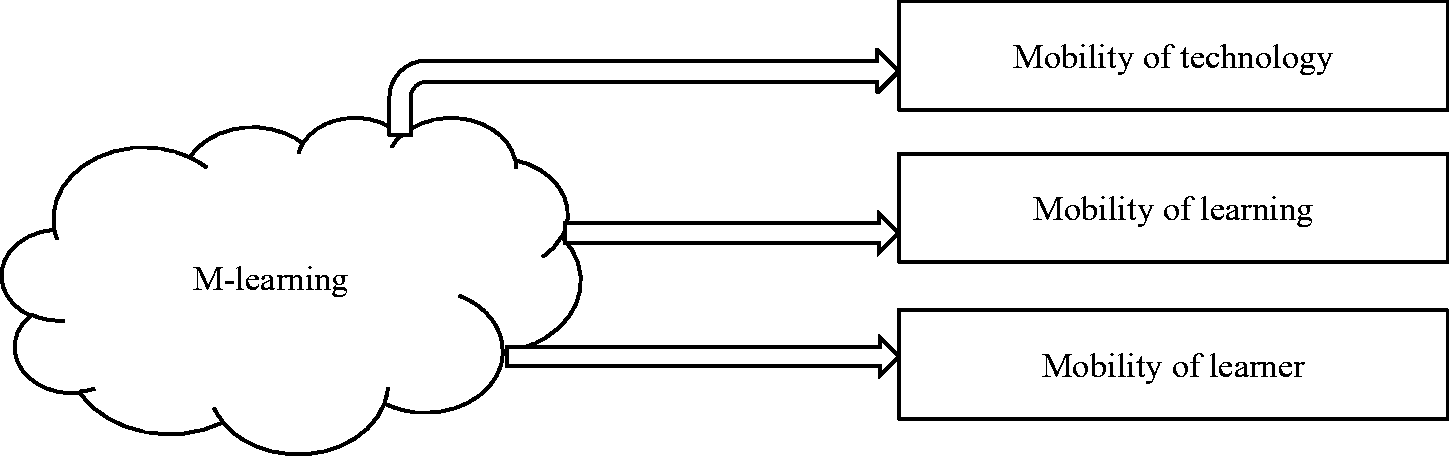
Each of these learning tools has fundamental perspectives, namely, cognitive perspective, emotional perspective, behavioral perspective, contextual perspective. M-learning has three fundamental perspectives such as mobility of technology, mobility of learning, and mobility of learner. Finally, for the d-learning perspectives are technology, digital content, and instruction.
Figure 3 represents the graphical depiction of four fundamental perspectives of e-learning that are delivered in higher educational institutions and these four fundamental perspectives of e-learning are interdependent and equally important in terms of making electronic devices feasible as instruments for the delivery of educational institutions.
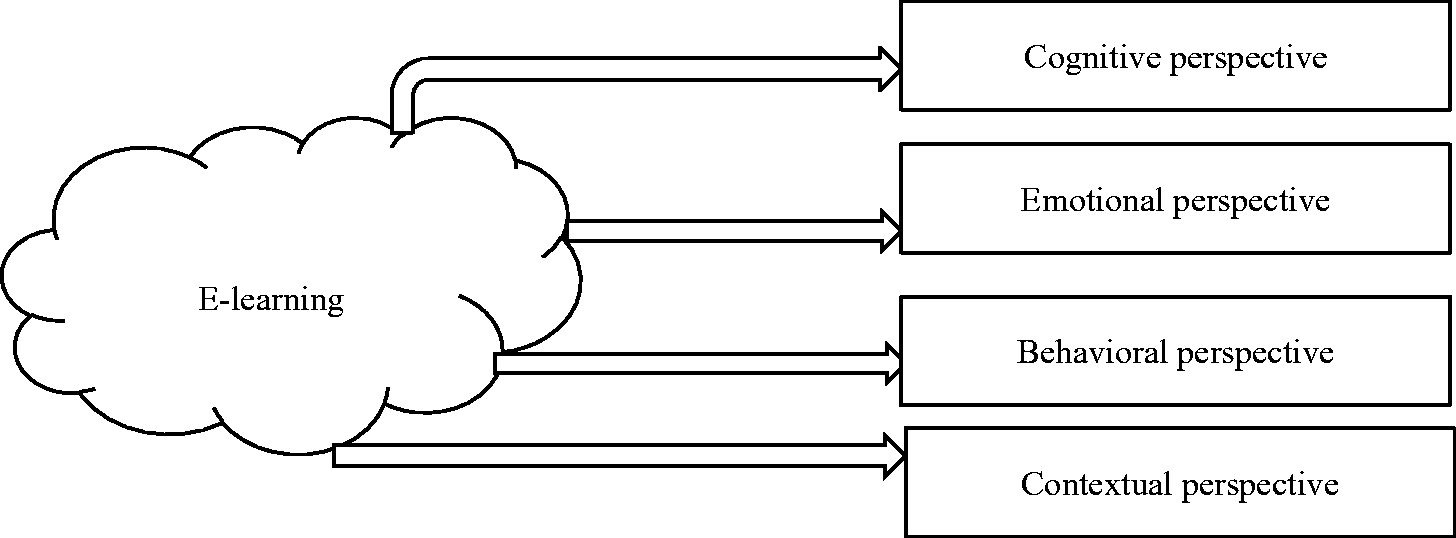
Fundamental perspectives of e-learning.
Cognitive perspective: Cognitive perspective focuses on the cognitive processes that involves in the learning and how does brain works (Clark, 2007). In order to apply the cognitive pedagogical models in an e-learning environment, the smart learning system and adaptive learning technology can be used to optimize learner’s progress; virtual (simulated) worlds and other structured learning environments that can also help learners in the content. The support system can be guided and be used quickly to teach learners to communicate; and social and other collaborative tools can be used to promote dialogue, interaction, and vicarious learning (Tlambda, 2014).
Emotional perspective: Emotional perspective focuses on motivation, engagement as well as other emotional aspect of learning (Clark, 2007). Kim (2008) points out various emotions, namely, pride, frustration, relief, resistance, fear, expectation, hopelessness, anxiety, confidence, complex, and the envy confirms that these functions are strongly associated with the integration of cognition, motivation, and action.
Behavioral perspective: Behavioral perspective focuses on the skills and behavioral outcomes of the learning process (Clark, 2007; HRDI Developmentinfo, n.d.) and it focuses on the role-playing and application to on-the-job settings (Ryan, 2012).
Contextual perspective: Contextual perspective focuses on the environmental and social aspects that can stimulate learning (Clark, 2007; Ryan, 2012) and it focuses on the interaction with people, discovery of collaboration as well as the importance of peer support and pressure (Ryan, 2012).
Figure 4 represents the graphical depiction of three fundamental perspectives of m-learning that are delivered in higher educational institutions and these three fundamental perspectives of m-learning are interdependent and equally important in terms of making mobile devices viable as instruments for the delivery of educational institutions.
Mobility of technology: Mobile technology refers to the digital cellular phones that are used to deliver different educational content and instructors for learners (Trinder, 2005). Most of these cellular phones are connected to public switching telephone network and have many services, namely, email, WAP, Bluetooth, SMS, GPRS, MMS, etc. (Kothamasu, 2010). Mobility of learners: With the m-learning, learning can be at any place and at any time. The m-learning is a platform where learners can have interaction opportunities with their fellow learners and educators from different locations although they will not be in the formal classroom (Kukulska-Hulme and Taxler, 2007). M-learning is not restricted to learners in a specific physical environment, a specific delivery channel, or for the particular set of training and education (Naismith et al., 2004). Then m-learning concerns either formal or informal education but also non-formal education. Mobility of learning: The mobility of learning is a powerful learning experience where learners can move from everyday context and can develop themselves in terms of any professional, social, intercultural, and interpersonal competencies (Lifelong Learning Platform, n. d). M-learning is engaged in the pioneering experiments to transmit the full content of higher educational learning, especially for learners using mobile cellular devices. According to Walker (2007), learning experience with mobile devices is unique since it can receive and process within the context for which a learner is situated. And the context is utterly individual – as well as entirely different from the rigid outlay of a traditional classroom or to the lecture room, and finally in the computer laboratory.
Fundamental perspectives of e-learning adopted from El-Hussein and Cronje (2010: 17).
Figure 5 represents the graphical depiction of three fundamental perspectives of d-learning that are delivered in higher educational institutions and these three fundamental perspectives of d-learning are interdependent and equally important in terms of making digital devices viable as instruments for the delivery of educational institutions.
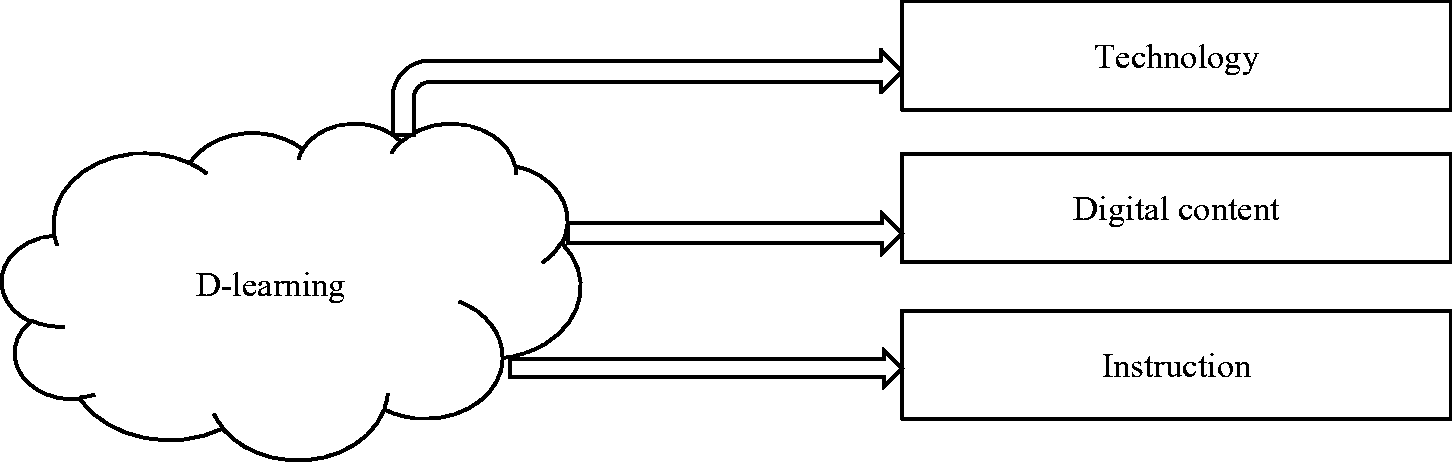
Fundamental perspectives of d-learning.
Digital “learning facilitated by technology that gives students some element of control over time, place, path and/or pace” (DDLN, n.d.) as cited in Georgiagov (n.d.: n.p.). In the case of time, learning is not restricted anymore to the school day or to the school year and the Internet access have given learners to learn anytime. In the case of place, the learning is not restricted to four walls of classrooms because the Internet has given the opportunity for learners to learn anywhere and everywhere (Georgiagov, n.d.). In the case of path, learning is not restricted to pedagogy used by teachers because the interactive and adaptive software allows learners to learn in their own style, making learning personal and engaging. In addition, learning technology provides a real time data that provide teachers relevant information which are needed to make the adjustment of instruction in order to meet the unique need of each learner (Georgiagov, n.d.). In the case of pace, learning is not restricted to the pace of an entire classroom of learners and software such as interactive and adaptive software allows learners to learn at their own pace and spend time more or less on lessons or subjects in terms of achieving the same level of learning (Georgiagov, n.d.).
D-learning needs a combination of technology, digital content, and the instruction and below each term is explained.
Technology: Technology is a tool, but it is not an instruction and it is a mechanism which delivers the content and it enables learners to receive the contents. Technology also incorporates Internet access and hardware that can be any Internet access device – from the desktop to the laptop to iPad to the smartphone (Georgiagov, n.d.). Digital content: Digital content is a high quality of academic material that is delivered through technology and it is not just a PDF of the text or the PowerPoint presentation. It is ranged from the interactive and adaptive software to classic literature to video lectures to games (Georgiagov, n.d.). Instruction: Educationists are required for digital education. Technology can change the teacher’s role, but it will never end teacher’s requirements. Through digital education, teachers will be able to provide personal guidance and support to learn and to stay on track – for years and years after year – to graduate to high school. The teacher can be the guide next; the sage is not on stage (Georgiagov, n.d.).
E-learning, M-learning and D-learning over the time
E-learning
The e-learning term was originated in the mid-1990s when the Internet began to gather the momentum (Garrison, 2011) and the application of e-learning includes a computer-based learning as well as web-based learning. Finally, these learning contents can be transferred via Internet, intranet, video/audio tapes, CD-ROM, DVD, and TV channels (Mohanna, 2015). Papanis (2005) as cited in Tittasiri (2003: 69) stated that “e-learning provides faster learning at reduced cost, increased access to learning, and clear accountability for all participants in the learning process”.
A study conducted by Harriman (2010) indicated different types of e-learning, namely, online learning, distance learning, blended learning, m-learning. In the case of online learning, it is done through the Web and it may add graphics, animation, text, audio, video, email, discussion boards, and testing. In addition, it is self-directed and “on demand” but it can incorporate the web-based teleconference such as audio, graphics, synchronous chat, or technology that are similar (Harriman, 2010). In the case of distance learning, it takes place when learners and instructors are not in the same place and also when learners and instructors are at the same place but not at the same time. In recent days, the distance learning takes place using the number of media and these media are from the postal mail to the teleconferencing or the Internet. In addition, these two terms such as distance learning (learner focus) and distance education (instructor focus) are used interchangeable since learning is the result of education. In the case of blended learning, it is nothing but the combination of two learning steps that are face-to-face learning and online learning. The main purpose of blended learning is to combine delivery modalities of the efficient and effective instruction experience. Furthermore, it is used to describe a solution that includes different delivery methods, namely, collaboration software, Web-based courses, and the electronic performance support systems. In the case of m-learning, it is used to handheld many information technology devices that can be used in teaching and learning namely, personal digital assistants (PDAs), mobile phones, laptops.
According to Rosenberg (2001) and Wentling et al. (2000), e-learning is the use of Internet technologies that can provide a wide range of solutions to enhance knowledge and performance. It facilitates and enhances the learning through and based on the computer and communication technology. In addition, it can also support learning using a Wide Area Network (WAN) and it can be considered as a flexible learning. Papanis (2005) stated that e-learning components include the content delivery in different formats, to manage the learning experience, learners’ network community, and content developers and experts. E-learning is a personalized approach that focuses on the individual learner and it includes self-paced training, many of the virtual events, mentoring, simulation, collaboration, assessment, competency road map, authoring tools, e-store, and the learning management system. E-learning also includes many of the different components that are very familiar with the traditional learning, namely, learner’s presentation ideas, group discussions, arguments and other different forms that conveying the information accumulating knowledge (Bencheva, 2010).
Researcher found that e-learning factors include bandwidth (Homan and Macpherson, 2005), lack of formal implementation process (Masoumi and Lindström, 2012), lack of interest of faculty (Forman et al., 2002; Qureshi et al., 2012), lack of ICT-enabled teachers (Carr, 1999; Iqbal and Ahmad, 2010; Levy, 2003; Nawaz and Khan, 2012; Põldoja et al., 2012), lack of ICT-enabled students (Oliver, 2001; Qureshi et al., 2012; Qureshi et al., 2011), power failure (Sangi, 2008; Iqbal and Ahmad, 2010), lack of learning objects (LO) in local language (Khattak, 2010), socio-cultural norms (Iqbal and Ahmad, 2010), lack of resources (Iqbal and Ahmad, 2010), accessibility of Internet broadband (Farid et al., 2014), cost of mobile Internet, practical arrangements for practical oriented courses, and literacy rate (Expert opinion) (Farid et al., 2015).
M-learning
It is in 1960s by Alan Kay that the concept of the mobile educational device was established (Najmi and Lee, 2009 as cited in Pollara, 2011). M-learning is portable electronic devices that are used as a trend in higher education in order to access and share information (Geist, 2011; Miller, 2012). Kothamasu (2010) argued that five basic parameters are used in m-learning, namely, portable, social interaction, sensitive to the context, connectivity, and customized. In the case of portable, it is easy to carry such as PDA along with users everywhere, including a restroom and this can help learners to get information very quick and rapid. In the case of social interaction, it helps to interact with friends to send messages. In addition, it also helps to exchange data with other people and get and gain some extra knowledge. In the case of sensitive to the context, it helps to gather data (real data and simulated data) unique to the current location, time, and the environment. In the case of connectivity, it helps to get a strong network where a learner can connect to mobile phones, data collection devices, and to a common network. Finally, in the case of customized, it is very unique because it can help learners to customize learning information.
A study was conducted by Sobri and Fatimah (2012) in Malaysian students’ on the awareness and requirements of mobile learning services in higher education and the results of the study revealed that students have enough knowledge and awareness to incorporate m-learning in their education environment. Another study conducted by Mao (2014) at the southwest university on 300 undergraduate learners and the study revealed that 76% of the learners were satisfied to use m-learning. In addition, 84% of the respondents also indicated that they will use m-learning as a future learning. Furthermore, the study also revealed that the majority of the learners was immensely benefited from the m-learning because it helped them to solve problems very quickly that they were encountered in the learning.
Using m-learning, learning setting is changing frequently because of the mobility of learners, learning technology, and learning content. According to Chen and Kotz (2000), there are four categories of mobile context, namely, computing context, user context, physical context, and the time context. Computing context is all about a network connection, communication bandwidth, and the used resources. The user context is all about the learner profile and location. The physical context is all about noise, lighting, traffic conditions, the temperature of the learner’s physical location. Finally, in the case of time context, it is all about the specific time of learning. Similarly, Zhao and Zhu (2010) and Li and Qiu (2011) stated three important factors that are needed to be considered when dealing with the m-learning systems and having considered, these three pillars can provide the desired level of quality. These three pillars are namely, learner’s style, mobile, mobile device or applications, and the learning content. Furthermore, the advanced hardware of mobile devices such as camera, accelerometer, and different software such as Apps provides more capability to manipulate, organize, and to generate the formation for teaching and learning (Chen et al., 2008; Keskin and Metcalf, 2011).
Mohanna (2015) stated that m-learning can be integrated with the help of various software and hardware technologies into the multimedia applications that can facilitate to communicate the educational format in different formats such as games, short messages, quizzes, and multimedia contents. Similarly, m-learning can also be applied to many subjects in different level of education such as primary, secondary, higher, lifelong, community, and the professional education. Different devices of m-learning applications includes usually general mobile phone, PDA, smart phone, portable media player (Apple’s iPod), or event in the tablet computer and all these applications are incorporated with the WiFi, 4G, and 4G Long Term Evaluation (LTE) telecommunication networks.
Sharples (2006) as cited in Pollara (2004: 67–68) stated that m-learning i) enables knowledge building to take place in different contexts; ii) provides the ability to gather data unique to the current location, environment, and time (real and situated); iii) enables learners construct their own understanding (customized to the individuals path of investigation); iv) changes the pattern of learning or the work activity (supports interactivity); v) supports the use of mobile learning applications which are mediating tools and can be used in conjunction with other learning tools; and vi) goes beyond time and space in which learning becomes part of a greater whole.
A study conducted by Adeyeye et al. (2013) revealed that several factors that are linked with the success or failure of m-learning projects and these factors are from the existing literature, namely, technology availability, support of the concerned institution, network connectivity, assimilation with study curriculum, student experience, or real life and the technology ownership by the learners. According to UNESCO (2011), m-learning considers several factors for the successful adoption and these factors are affordability, leadership, content, support from educators and parents, well-defined m-learning goals, recognition of informal learning, and the defined target learner groups for m-learning. Huang et al. (2010) revealed that m-learning applications not only can facilitate learners but also can interact with others for collaborations anytime and anywhere. Hereafter, m-learning for the education has significant implications in the way learners and instructors interact in educational institutions.
D-learning
D-learning is perceived to be an educational tool that is capable to change the way higher education is delivered and it continues to getting wide spread and to gaining popularity day by day in the digital world (Chitkushey et al., 2014). It is an instructional practice that is effectively used by technology in order to strengthen students’ learning experience. It encompasses a wide spectrum of tools and practices, including, among others, online and formative assessment; an increase in the focus and quality of teaching resources and time; online content and courses; applications of technology in the classroom and school building; adaptive software for students with special needs; learning platforms; participation in professional communities of practice; and access to high-level and challenging content and instruction (Alliance for Excellent Education, 2012, as cited in Council of State Governments, 2013: n.p.)” (Council of State Governments, 2013: n.p.)
According to Suhonen (2005), d-learning environments can provide solutions to support learning, teaching and studying activities. Anohina (2005) stated that d-learning environment is educational software, digital learning tool, and online study program or the learning resource. Wit and Dompseler (n.d.) urged that the d-learning environment can consist of different components where learners and teachers can use as it is needed. Furthermore, they also stated that some of the components will only be available to all learners and teachers at the institution whereas others needed authorization. These components must be swappable between learners and teachers in order to adopt the latest development in the education and to the technological innovations. These components are namely organization of learning; testing; submission and assessment of assignments; management and use of student information; timetabling; internships and final projects; developing, managing, and sharing learning materials; education process support; learning analytics; communication; collaboration; multimedia; and freely available applications.
In the case of organizational of learning, it makes assurance to learners that clear and easy accessibility for the right content. In addition, this also includes the functionalities namely, learners assigning into groups, learners assigning to courses and finally arranging their access management. In the case of testing, it can improve the learning quality and testing in the education. For the submission and assessment of assignment, it is a key element of the learning environment that is provided by an uploaded tool. Moreover, this component also incorporates the functionalities to manage the submission and evaluation process, namely, setting and communicating deadlines (deadline alerts and the inclusion of deadlines for learner’s calendars), to allocate the first and second assessors, to coordinate between assessors, to provide feedback to learners, awarding marks for learners, notifications of assessment, and the option for learners in terms of appeal decisions. In the case of management and use of student information, it involves with the student administrative data management (such as personal details) and the registration of marks, progress, and the attendance (Wit and Dompseler, n.d.). For the timetabling, it is all about time and resource distribution across learners and teachers. In the case of internships and final projects, it provides the opportunity to evaluate the match between internship assignment or final assignment and the host organization and learners. For the developing, managing, and sharing learning materials, it deals with the functionalities in terms of developing, managing, and sharing learning materials (Wit and Dompseler, n.d.). In the case of education process support, it concerns with tools that are used to monitor learners’ progress and giving them targeted feedback in order to support the learning process. For the learning analytics, it deals with the collection and analysis of information for the learners’ learning process to improve their knowledge and skills for the teaching and learning process. In the case of communication, it is an essential part of the sort of education that involves sending message and information and staring dialogues. For the collaboration, it can enable and enrich depth learning. In the case of multimedia, it plays an important role in the education sector and this multimedia are video, virtual reality, 3D-printing, etc. and finally, for the freely available applications, institutions provides learners and teachers to use social media, software and many other applications for their learning process (Wit and Dompseler, n.d.).
Some of the d-learning factors include, instructor overall rating, facilitator rating, and the overall course satisfaction (Chitkushev et al., 2014), system characteristics and their perceived functionality (Lee, 2006 as cited in Nasser et al., 2011; Hayashi et al., 2004), academic success (Heath and Ravitz, 2001), funding and technology access (Copley and Ziviani, 2004), lack of ICT knowledge and teachers provide a little support (Drent and Meelissen, 2008), teachers’ attitudes and teaching styles (Selim, 2007), learner motivation (Selim, 2007), technical competency of learners (Selim, 2007), learner–learner interaction (Selim, 2007), easy access to technology (Selim, 2007), infrastructure reliability (Selim, 2007), lack of support at the postsecondary level (Selim, 2007), teachers are prone to teach using the traditional methods (Becker, 2000), novice teachers with less training are less likely to use the technology (Becker, 2000), a lack of commitment for the constructivist pedagogy (Becker, 2000), a lack of availability for the professional development (Becker, 2000), and a low level of contact between teachers who have little experience using technology (Becker, 2000).
Similarities among E-learning, M-learning, and D-learning
There are similarities among e-learning, m-learning, and d-learning; each of the tools needs infrastructure and with or without WiFi. All the three tools are digitized and used for the education environment and learners and instructors can learn on their own. The learning materials delivered in e-learning, m-learning, and d-learning are texts, images and video clips, etc. For all the three models, learners and teachers are the main users. All the three models provide learning opportunities for learners and teachers and finally for all tools, the learning materials can also be updated.
Differences between E-learning, M-learning, and D-learning
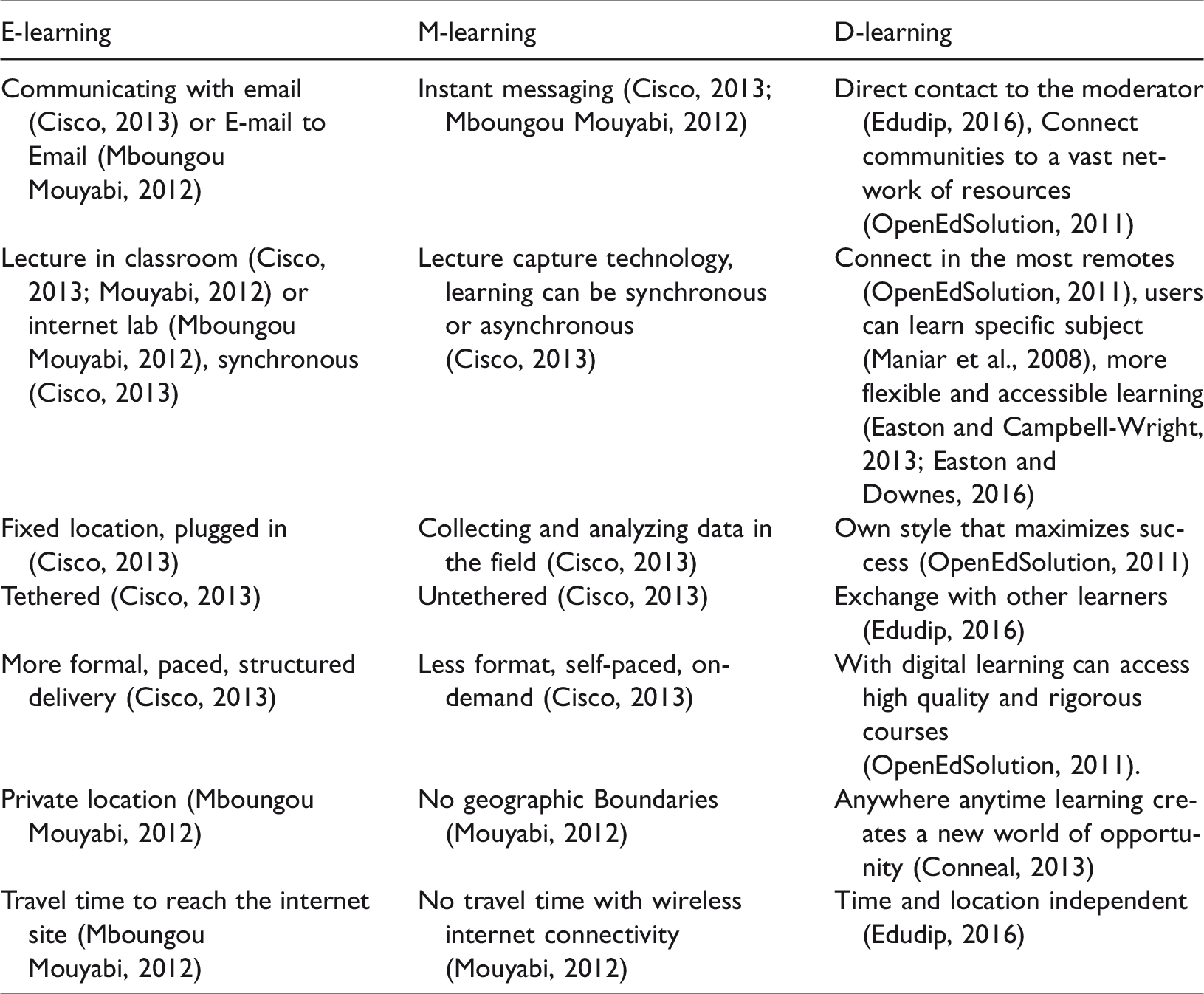
Some of the differences of e-learning, m-learning and d-learning defined by researchers are given in Table 2.
Differences in e-learning, m-learning, and d-learning.
Advantages and disadvantages of E-learning, M-learning, and D-learning
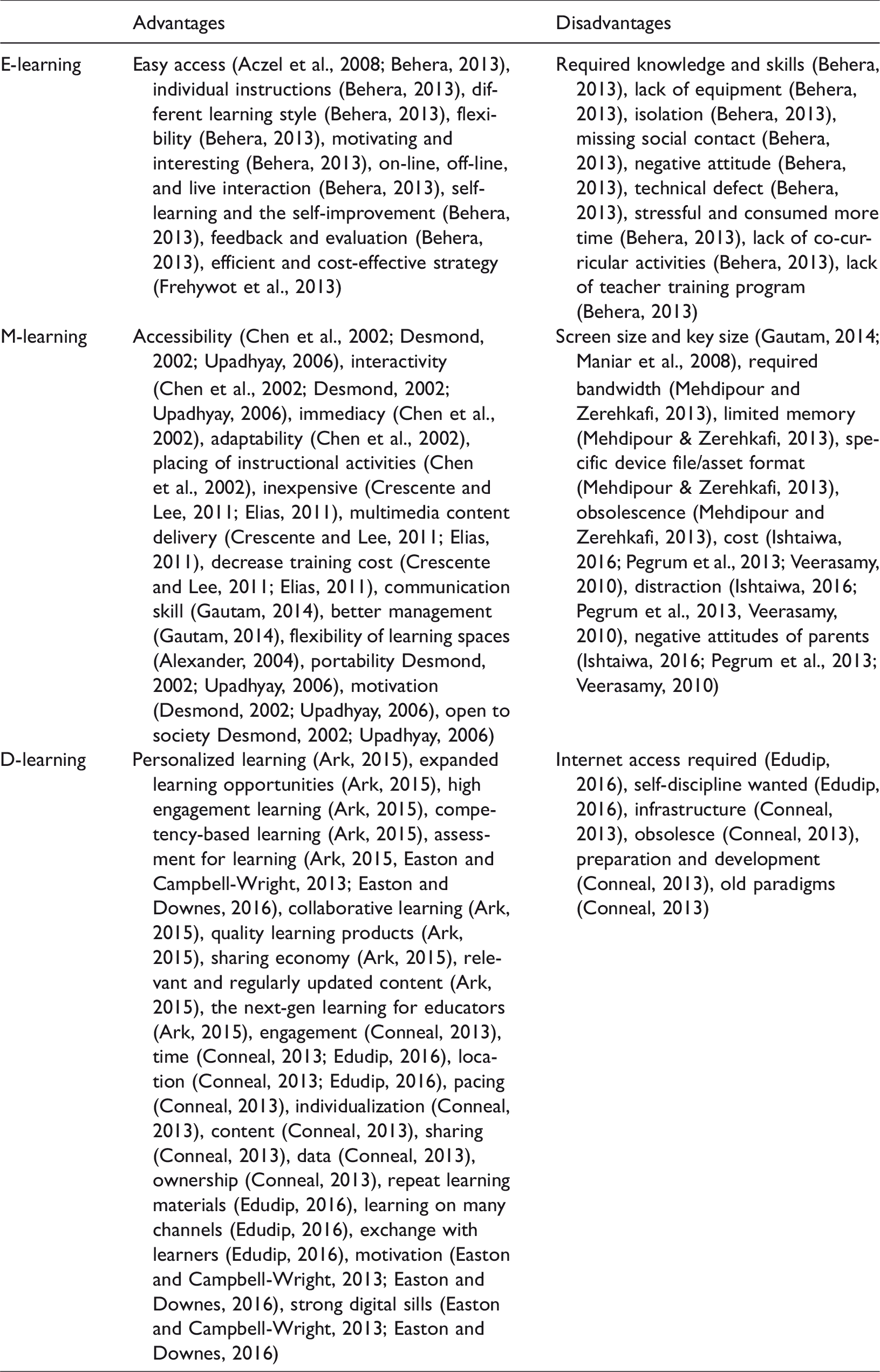
Advantages and disadvantages of e-learning, m-learning, and d-learning are given in Table 3.
Advantages and disadvantages in e-learning, m-learning, and d-learning.
Conclusion
The main objective of this paper was to review and analyze the concept, terminology used, differences, fundamental perspectives, benefits, disadvantages, and the similarities and differences of e-learning, m-learning, and d-learning. A total of 292 articles were retrieved and reviewed from the Google and Google Scholar Databases and a total of 126 articles were taken into consideration which passed the quality appraisal criteria. All the three technology tools (e-learning, m-learning, and d-learning) are very important and play a crucial role in the modern education society. These tools help teachers as well as learners to take responsibility of their personal growth. E-learning, m-learning, and d-learning require innovative approach that are interrelated. Therefore, we can conclude that learners and teachers need to acquire technological skills to success in the e-learning, m-learning, and d-learning environments.
Footnotes
Declaration of Conflicting Interests
The author(s) declared no potential conflicts of interest with respect to the research, authorship, and/or publication of this article.
Funding
The author(s) received no financial support for the research, authorship, and/or publication of this article.