




Abstract
This article experiments with creativity, ambiguity, design thinking, research, and teacher education in computer-assisted language learning within the development of a distance teacher education course on computer-assisted language learning. By deploying philosophy of immanence, the associated agencements of teacher becoming in computer-assisted language learning, and design thinking, this article generates new ways of thinking about creativity, ambiguity, design thinking, language-teacher education, and research. Data collection included course materials, student interviews, and assignments. The paper uses rhizoanalysis to map affective connections within the research agencement, highlighting potential for transformation. It presents vignettes to palpate, disrupt, and encourage further concept creation.
Introduction
Positioning Canadian students for today’s fast-changing and intricate information-based workforce (OCDE Secretariat, 2013), educators have identified the following competencies: (1) ‘the capacity to apply creative and innovative thought processes’; (2) ‘the capacity to adapt to ever-changing and complex environments’; (3) ‘the capacity to use ICT to access and create knowledge, solutions and products’; (4) ‘the capacity to use computers and digital resources to access information and create knowledge, solutions, products and services’; and (5), more broadly, the capacity to appreciate diversity, disorder, and ambiguity (C21 Canada, 2012: 10–12).
Teachers, at the forefront of educating future generations, must crucially possess these same competencies. The non-profit Canadians for 21st Century Learning and Innovation articulated this requirement, having recently developed a twenty-first century learning framework for Canada’s public education systems, whereby ‘Personalized access to teachers highly skilled in 21st Century learning skills and research-based learning environments is a universal right of every Canadian learner’ (C21 Canada, 2012: 4).
Within these reforms, information communication technology (ICT) appears to be a key enabler in achieving such competencies. To realize ICT’s full potential in education, ICT integration must follow sound educational principles and design (Son and Windeatt, 2017). Yet, research shows that pre- and in-service teachers in the L2 instruction field are unconfident in their abilities to integrate ICT into their teaching practices because the knowledge and skills acquired in their teacher preparation often does not transfer into real-life classrooms (Son and Windeatt, 2017; Bangou, 2013). Unsurprisingly, L2 education and computer-assisted language learning (CALL) integration experts question the adequacy of teacher preparation in developing the technological competencies L2 teachers need. In this context, design thinking has progressively become the preferred method to stimulate learners’ creativity and to promote experimentation, innovation, and the use of ICT in the classroom (Gamba, 2016).
Similarly, in terms of CALL and L2 teacher-education research, an increasing number of researchers (Johnson, 2013; McKay et al., 2014) have progressively broken away from traditional methods of studying educational practices and do so to determine novel and more comprehensive methods with which to conceptualize and study the teaching and learning practices and knowledge development of L2 teachers and learners. Such an undertaking requires a new set of conceptual and methodological resources to work within an intricate and ever-changing reality. Such resources include the development of, not only, ‘novel scientific tools but also [of] fresh philosophical insights as well as new conceptual vehicles’ to develop a better understanding of complexity and work with(in) intricacies (Weinbaum, 2015: 2). Given that L2 teachers must develop competencies to train students for a complex, ambiguous, ever-changing, and unpredictable information-based society (Guichon, 2012), CALL teacher-education preparation can potentially become something new, as opposed to what it is or should be, which is based on past presumptions.
This article aligns with the necessity to rethink and redesign L2 teacher education in CALL. It will tackle the above issues through the ontology of Deleuze and Guattari (1987, 1994) at the antipodes of the existing frameworks in the teacher education and CALL fields. It will also experiment with how knowledge, the implementation of CALL (as well as twenty-first century competencies associated with creative and innovative thought processes), and the appreciation of ambiguity emerge, function, and produce with(in) a research agencement associated with the design of an online L2 teacher education in CALL. More precisely, this article aims (1) to generate means of thinking differently (Sellers, 2015) about creativity, ambiguity, design thinking, teacher education in CALL, and research; and (2) to illustrate what can potentially be created when one does so by working with(in) Deleuze and Guattari’s (1987) ontology and the associated concepts/agencements that emerged during the writing of this article.
How might one exist?
This article contends that issues related to creativity, ambiguity, innovation, design thinking, and the integration of ICT in language teaching are intrinsically connected to the possibilities of what one’s existence might become. That said, it also contends that current educational and scientific thoughts and practices associated with such potential are, for the most part, articulated around one’s capacity to reproduce preconceived images and practices associated with what existence should be. For this reason, educators and researchers are always trying to shape and control reality: they do so to ensure learners’ existence will become what it should be in a given moment. Majoritarian understanding of reality is deeply rooted in ‘western dogmatic thinking’ (Weinbaum, 2015: 2) that implies a distinct subject/subjectivity in a world that can be experienced by a separate and observing rational subject who can represent, reproduce, and mould reality, in part, through the creation of rules, codes, norms, methodologies, patterns, definitions, and standards.
A consequence of this approach is that most research focuses on facts, not possibilities, and that the potential, creativity, and ambiguity of life become marginalized and dissociated from scientific rigor and precision (Masny, 2016; St Pierre, 2014). Importantly, the same is true of teacher education. Although schools may seem open to innovations, so-called successful and innovative teaching practices are often associated with control, behavioural norms, standards, and methodologies. Within these programmes, teachers’ behaviours are observed and analysed through sets of criteria that determine whether those teachers perform as standards assume they should be performing (Strom and Martin, 2017). Consequently, teachers continue ‘to be bound by the Platonic tenets of “image-copy,” or recognition and representation, that defines so much of schoolwork’ (Roy, 2003: 5). Teachers also often feel ill equipped to teach with(in) the disorder, unpredictability, and ambiguity of a classroom, realizing that what they learned in their teacher education programmes cannot be reproduced (Strom, 2015; Strom and Martin, 2017).
This paper does not claim that guiding pre- and in-service L2 teachers with sets of techniques, principles, standards, and knowledge associated with best technology-enhanced language-teaching and -learning practices is valueless. Instead, it emphasizes the ambiguous and messy thought processes and practices (Teal, 2010) in L2 teacher education in CALL and in the associated research and does so to provide teachers with the means to work with(in) the uncertainty, messiness, and creativity of technology teaching in their classrooms. In that regard, Deleuze and Guattari’s ontology aids in the reconsideration of teacher educators and researchers’ thinking and practices, as in CALL (Strom and Martin, 2017; Teal, 2010; Bangou, forthcoming).
For Deleuze and Guattari (1987, 1994), how one thinks about themselves and the world shapes how one lives: to change how one lives, one must change how one thinks by disrupting the common ways of doing – the routines, habits, and pre-established assumptions that long guided everyday life (May, 2005). To aid in the breaking away from everyday thinking, Deleuze and Guattari offer an ontology that emphasizes not what something is, but what it might become (May, 2005). Such an ontological leap requires a new set of concepts, what Deleuze and Guattari refer to as a toolkit of concepts that disrupt normative logic and hegemonic practices and further rebuild new concepts, with dynamic potential, that can co-adapt to an ever-changing world. Thus, for Deleuze and Guattari, concepts must be flexible and open to constant disruption and re-creation, which, again, serves an ontology that emphasizes the possibility of what something might become rather than the essence and identity of what it currently is (Fleming et al., 2017). This article focuses on the potential for CALL teacher education, design thinking, creativity, ambiguity, and research to become something new. Accordingly, this experimentation is guided by the Deleuzo–Guattarian concepts of the virtual, actual, becoming, desire, agencement, and rhizome.
Deleuze and Guattari’s ontology (1987, 1994) is a philosophy of immanence 1 wherein elements and entities that make up reality are not defined by predetermined structure and organization but by the boundless possibilities that emerge in the movement between actual and virtual dimensions and constitute how the world is experienced. To importantly distinguish between the actual and virtual: the virtual realm exceeds the actual and serves as a space free of hierarchy and a structure where elements, forces, flows, and intensities interconnect and are transformed and then experienced as actualizations. The workings in the virtual dimension drive the reality subjects experience in the actual and can be understood as immanent, codependent, and everchanging (as opposed to transcendent, predetermined, and unidirectional). Immanence, therefore, makes possible and privileges the potential for ongoing creative becoming, rather than stability and essence (Bangou, 2014): what is possible is as powerful as what is materialized, meaning that facts (i.e. what is actualized) are the materializations of possibilities.
Central to Deleuze and Guattari’s philosophy of immanence is the ongoing process of becoming something new. Becoming is: certainly not imitating, or identifying with something; neither is it regressing-progressing; neither is it corresponding, establishing corresponding relations; neither is it producing, producing a filiation or producing through filiation. Becoming is a verb with a consistency all its own; it does not reduce to, or lead back to, ‘appearing,’ ‘being,’ ‘equaling,’ or ‘producing’ … becoming produces nothing other than itself. (Deleuze and Guattari, 1987: 239)
Relevant elements to this research on teacher education in CALL may extend beyond the immediate and direct (e.g. course content, researcher, reviewers) to include an infinite number of productive capacities that emerge only when these elements (and others yet to be actualized) connect in the virtual and produce actualizations. Connections and transformation within and between an agencement’s elements occur through territorialization (i.e. stabilization), deterritorialization (i.e. destabilization), and reterritorialization (i.e. becoming), which are always interacting, shaping, and reshaping elements that come into contact with each other (though never in the same way or producing the same thing twice). Constant production, through deterritorialization and reterritorialization of movement between the virtual/actual, produces becoming.
In the context of such perspective, desire becomes a deterritorialization force. In Deleuze and Guattari’s ontology, desire connects not to aspiration or lack but with creativity. Indeed to paraphrase Deleuze we always desire an ensemble. For instance, one’s desire to design something never concerns just the element that needs designing but also other elements, such as the impact one thinks the designed element will have on people’s lives including his/her own. Hence, desire is both a creative and created force that can destabilize existing agencements and be transformed by them (Ross, 2010). As Deleuze and Guattari (1987: 272) write, ‘becoming is the process of desire’.
Interconnectivity with(in) the agencement occurs through rhizomatic connections, a term derived from the Deleuzian concept of rhizome which refers to an underground plan that expands in multiple directions, unlike a tree, which grows in a unidirectional linear path. Such growth is unpredictable, multiplicious, and disruptive: like the lines with(in) the agencement establishing flexible and temporal connections between elements (Deleuze and Guattari, 1987). Just as connections expand, connections may also shatter and cease; such a rupture, however, may be temporary because lines may later form new connections from what was once considered dead. Growth and interconnection follow no order, logic, hierarchy, beginning, or end. Furthermore, in rhizomatic growth there is no single driving force, no centre in control, no human actor privileged, and no participant subjectivity. A decentred individual dissolves human agency, intentionality, and the rational actor as supreme. Lines can also, potentially, be shattered and broken. However, this rupture is not permanent: new lines may grow from what has ruptured, forming new connections (Bangou, 2014). With(in) the agencement, as with the rhizome, movement and transformation occurs through an entanglement of connective lines that bring together multiple heterogeneous elements to coproduce new becomings.
With this toolkit of concepts, this paper experiments with how teacher education in CALL and design thinking might transform when they collide within this study’s agencement.
Teacher becoming in CALL (TBIC)
TBIC is an agencement that emerged while thinking with(in) the agencement of teacher education in CALL, Deleuze and Guattari’s (1987, 1994) ontology, and this article. When this article was first submitted to this journal, TBIC was actualized as a concept. One reviewer, though, expressed discomfort with such actualization, arguing that teacher becoming was the productive concept with(in) this article and that TBIC was instead an emerging agencement within which the concept of teacher becoming was located. We (the researchers/authors), rather than stabilize TBIC as a concept, then pursued the line of inquiry opened by the above comment to experiment, in this article, with TBIC as an agencement rather than a concept. Readers can then experience how this actualization functions and witness what it produces when they connect with this text.
As an agencement, TBIC does not, by way of actualization, represent/identify teacher education in CALL but, rather, palpates teacher education in CALL as living and creating new potential and does so by disrupting the habits, routines, expectations, and preconceived methods teachers are educated and research is conducted with(in) CALL. Therefore, in TBIC, education is not replaced but transformed into becoming, expressing the immanence, movement, unpredictability, intricacy, timeliness, and creativity of teacher education in CALL. TBIC focuses on elements’ transformations with(in) the agencements associated with education, research, and CALL and how these transformations occur. TBIC’s substance constantly becomes other because TBIC never repeats itself the same way. Creativity is immanent to TBIC and is not located in minds or things but in the collectivity of agencements associated with education, research, and CALL. By focusing on movement, interconnection, and production, representations and identifications of elements pertaining to TBIC become less important than experimenting with TBIC.
TBIC cannot be captured, controlled, and solved but only created through experimentations with the connected elements of TBIC agencements (e.g. teachers, design thinking, students, language, technology, regulations, research methodology, etc.). Collectively, these elements work/think with(in) immanence rather than work through/think about transcendence. Moreover, the agencement’s elements contribute to TBIC’s emergence and, like anything else in the agencements, can potentially transform and be transformed by any other human, non-human, tangible, and intangible elements with(in) the agencements. TBIC cannot be directly comprehended because the virtual is always inherent to any perceivable and conceivable actualizations in TBIC’s time and space. Only through experimentations, can researchers, teachers, and teacher educators palpate the possibilities CALL offers with(in) their agencements.
Rethinking design thinking
Design thinking was a central element in this online CALL teacher education course’s development. To assist teachers in developing students’ twenty-first century competencies and to challenge students’ capacity to grapple with the ambiguity, complexity, change, and uncertainty of real-life teaching practice, the course’s curriculum integrated principles of design thinking.
Design thinking emerged in the 1960s and now functions in many disciplines, including management, design, psychology, and education. Through its history, design thinking actualized in many ways, making it difficult to capture. For instance, on the NoTosh global consultancy website, design thinking currently actualizes as a creative process, an ethos, an ideology, and a philosophy. 2
Comprehensively reviewing decades of design thinking research, Kimbell (2011) differentiates three main research strands by their aims, approaches, and methods. The first strand conceptualizes design thinking as a cognitive style. Research within this strand creates clear boundaries between the designer, the researcher, and the world; it is interested in the way designers think and does not consider the environment in which the designer evolves (Kimbell, 2011).
Alternatively, research within the second strand blurs designer and world as well as researcher and object of study to develop a general theory and methodology of design. ‘[T]hese accounts attend to the situated, embodied ways that designers go about their work and the artifacts they engage with and make’ (Kimbell, 2011: 297). The first and second strand focus on what designers do and how they think, suggesting that non-designers think and do things differently (Kimbell, 2011).
The third strand focuses less on designers’ cognitive styles and methodologies and more on the way design thinking work could attend to design culture. Research within this strand focuses on how design practices develop within varieties of organizational arrangements to help the public better use and grasp design thinking. Such a perspective concerns object design and social arrangements, while acknowledging that non-designers also do design work (Kimbell, 2011).
IDEO’s five-step design thinking process.
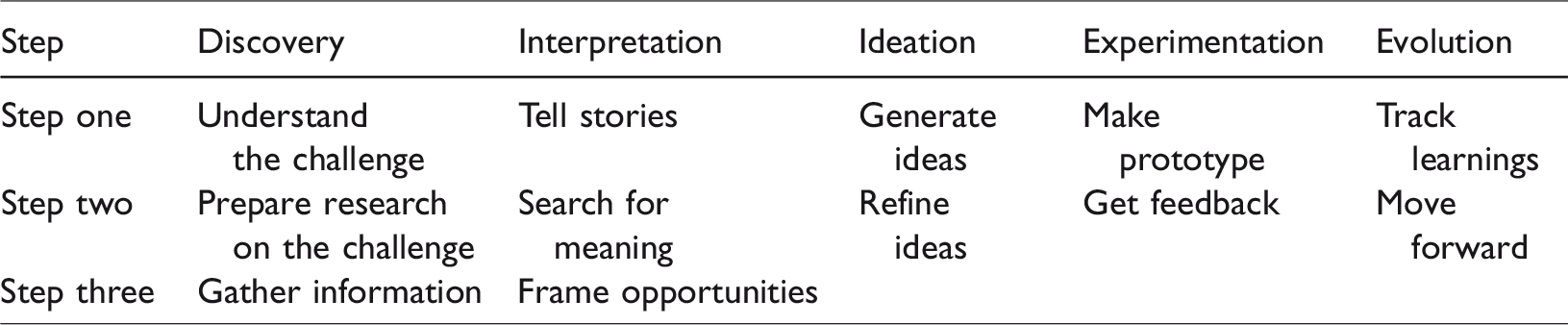
Although design thinking has been adopted in many areas, it faces criticism: Nussbaum (2011) calls design thinking a failed experiment, partly because of how it has morphed into a linear, systematic, and closed process, which Nussbaum argues is unconducive to creativity and innovation. Teal (2010) similarly argues that students with educational training rooted in the scientific method and representational thinking ‘are primed to alter the fluidness of design thinking to fit with the linear causal schemas that they have been brought up on … students are more likely to treat design as calculative problem solving than responsive making’ (p. 295).
For Kimbell (2011: 301), overall design thinking ‘remains undertheorized and understudied’. She problematizes design thinking, which constitutes the designer as the main agent of design activity, for discounting the other ways design might actualize. She further argues for a rethinking of design thinking that is ‘a messy, contingent combination of minds, things, bodies, structures, processes, and agencies’ institutionalized in different ways that transform the sociomaterial world (141).
Teal (2010) similarly recognizes that design thinking ‘calls upon faculties often considered a-rational, a-causal and a-logical’ (p. 294). Unfortunately, such indeterminacies often generate suspicion among researchers and practitioners, reducing design thinking’s potential to linear steps, rules, and codifications, which tend ‘to eliminate the complexities, accidents and flows that are basic to a dynamic and vital existence’ (Teal, 2010: 295). Building on Deleuze and Guattari’s rhizome, Teal (2010) rethinks design thinking as a linear and non-linear process that ‘promotes complex visualisations while still incorporating the intelligibility of order and linearity’ (p. 295).
If design thinking is not an identifiable, stable entity but rather an ever-transformed and transformative agencement between thinking, design, and potentially any other element, then, with(in) this agencement, both design and thinking can constantly be rethought and redesigned. As such, design thinking’s potential to transform and be transformed is affected by the rhizomatic connections emerging from each element of the design agencement and from thinking, including this research article and the design of the online teacher education course in CALL.
The study
This articles first author experimented, in 2016, with design thinking, TBIC, and the online course’s design and delivery, which aimed to help language teachers themselves experiment with ICT integration in their practice and develop the twenty-first century competencies, as outlined by C21 Canada (2012, 2015). The first author first taught the online course in fall 2016. This article focuses on the course’s second actualization in fall 2017. Twenty-one students attended the course (19 in Ontario, one in Ghana, and one in Australia). Most students were professionals (six full-time teachers, two occasional teachers, one technology resource teacher, one accessibility advisor, one adaptive technologist, one senior writer and editor, and one test coordinator in the medical field) and experienced using technology to teach a language or another subject. Three students thought their technological skills were basic, six estimated theirs as moderate, and 10 students declared themselves comfortable with technology. All students were interested in language education and technology and indicated this interest as the reason they enrolled in the course.
As in the course’s first actualization, in this 12-week-long course, students navigated five modules which focused on diverse topics associated with ICT integration in the language classroom. Within three of these modules, students had to meet specific targets corresponding to the five stages of IDEO’s design thinking toolkit.
Course outline.
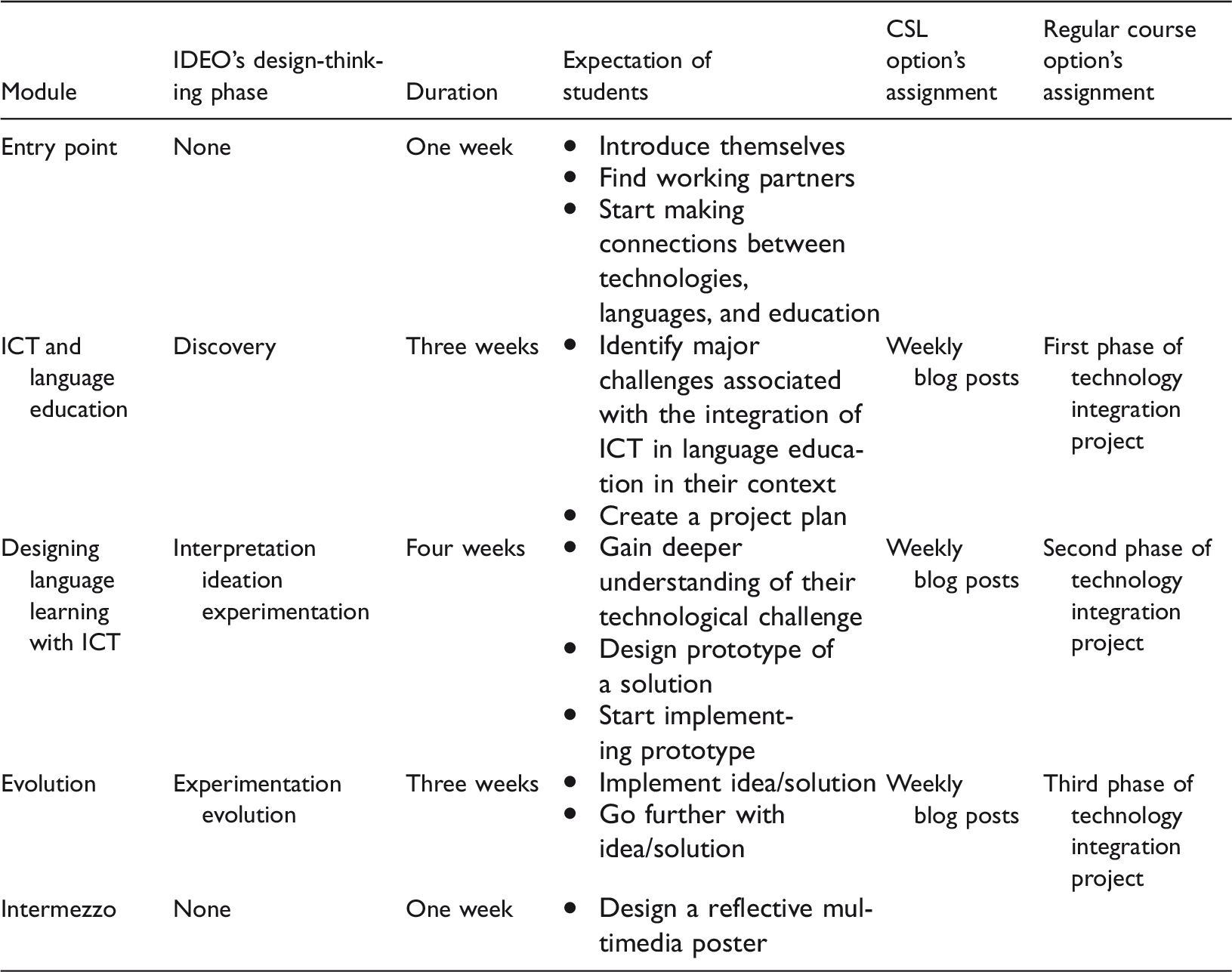
CSL: Community Service Learning; ICT: information communication technology.
As part of the experiment with design thinking, students could choose one of two paths: a ‘Community Service Learning (CSL) Option’ and ‘regular course option’. Students who selected the former were required to volunteer with an educational institution or a community-based organization for a minimum of 30 hours and design a solution to an ICT integration problem in language education under a community supervisor’s guidance. Two students selected this option: One was placed in a local elementary school where she helped a grade-four and -five teacher integrate VoiceThread and Google Slide into her teaching practice. The other student, placed in the University’s Institute for Canadian and Aboriginal Studies, contributed to the development of a new Indigenous language learning programme by writing a report on how ICT has been used for Indigenous language revitalization.
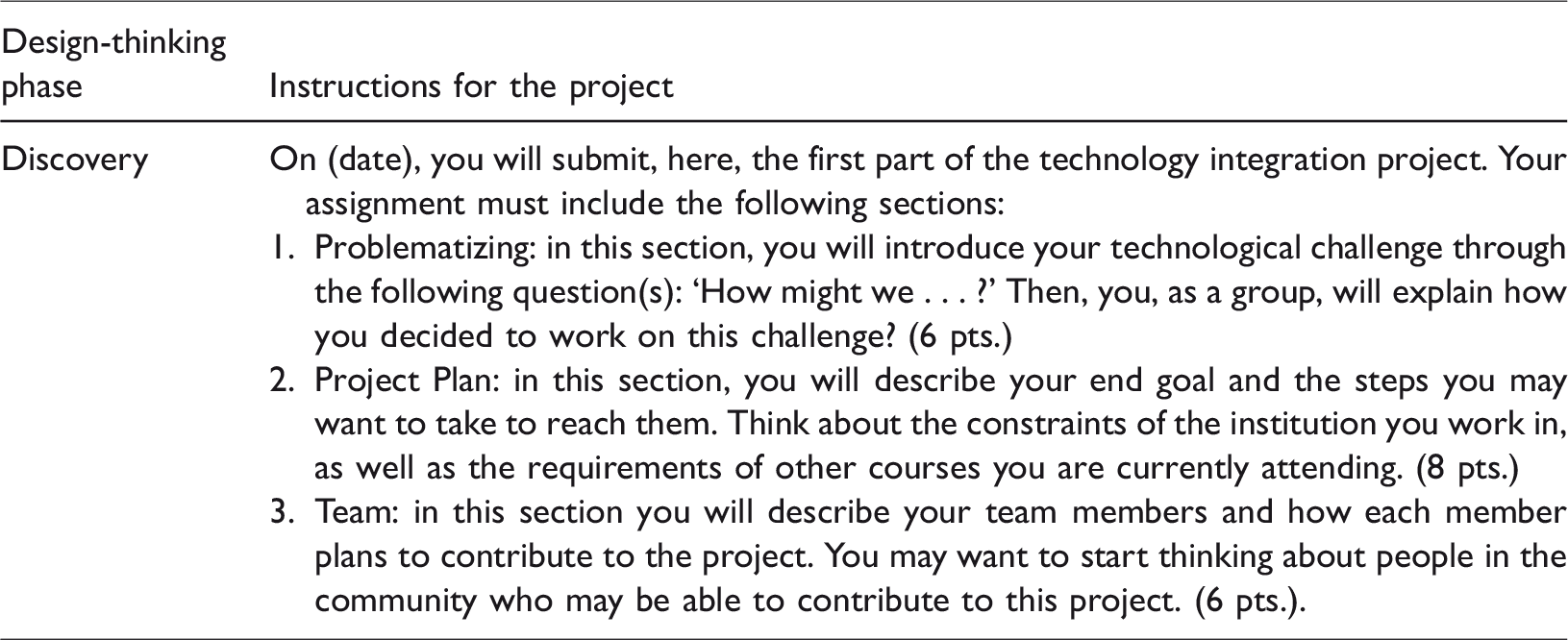
To guide their experimentation, students had to maintain a blog of weekly responses to prompts inspired by TBIC agencement, including ‘What connections can be made to technologies and languages?’ and ‘How will computer-mediated communication function in your project?’ Students in this path did not have to follow the five-stage design thinking process, though that process regularly inspired weekly blog prompts. For instance, week two’s prompt took inspiration from the discovery phase of IDEO’s design-thinking process: Thinking about the issues raised in module 2 and the knowledge that you accumulated so far about your placement can you anticipate any factors that may affect positively or negatively your project? How are you going to take these elements into consideration in your action plan?
Instructions for the first phase of the technology integration project.
At the session’s end, students in both paths had to submit a reflective multimedia collage of their becoming in CALL throughout the session. In doing so, they would map the elements that contributed to their transformations in CALL and disturb current representations of the connections between technology, language, and education. The assignment’s purposes were to provide students the opportunity to reflect on their experiences with(in) the course and consider the potentiality of their becoming in CALL and to provide more space for ambiguity and messiness as a means to promote creative thought processes and practices in the course. The assignment’s instructions were, therefore, purposefully broad. The assignment also invited students to experiment with ways technology could help them communicate differently. The session introduced TBIC to the students as both an oral and a visual concept (Bangou et al., forthcoming). The instructor invited students to use the concept to guide their reflections and the collages’ designs.
Collection of field material
At the session’s end, after grade submissions, the instructor invited students to participate in an interview about their experience in the course and to grant the first author the authorization to use their assignments and course reports (analytics) pertaining to their activities on the course platform as data for this research. Eight students granted the first author authorization to use their assignments (two had selected the CSL option and six the regular course option) and seven of these students also agreed to participate in an interview (two had selected the CSL option and five the regular course option). The first author kept a journal when designing and teaching the course. In line with the rhizome, the author recorded journal entries whenever the desire to do so emerged. As such, the author recorded journal entries on diverse devices (e.g., digital recorders, mobile phones, tablets, computers, etc.) depending on their availability when the desire to record materialized.
Experimentation through rhizoanalysis
Consistent with the Deleuzian philosophy of immanence, Deleuzian-inspired research does not seek to reproduce a tracing of reality (i.e. a documentation of identified and classified actualizations) but to examine the workings of the actual/virtual realm and the potential of what is yet to come (Coleman and Ringrose, 2013). Accordingly, Deleuzian-inspired research draws upon transcendental empiricism, which works within a singular experience’s immanence to map how the virtual might be actualized. Accordingly, such research focuses not on the already observed but on the sensations, forces, and movements beneath the skin in matter, in cells and in the guts as well as between individuals and groups. This kind of empiricism traces intensities of affects that move and connect bodies subatomically, biologically, physically and culturally. (MacLure, 2011: 999)
Consistent with transcendental empiricism and the drive to think differently and explore different ways of knowing, Masny (2015, 2016) offers the rhizoanalysis (non)method as an analytical orientation derived from the rhizome and its principles of multiplicity, connectivity, heterogeneity, rupture, and non-linear mapping. Rhizoanalysis maps connections between elements with(in) the agencement, including relationality between human, material, and expressive entities. As such, rhizoanalysis encourages the palpation of field material to explore the connections that may be occurring in the virtual rather than privileging actualizations that uncover a phenomenon’s meaning and representation.
In palpating the field material, ‘data’ can no longer be viewed as static and stable but must be seen as fluid, with the potential for the not-yet-actualized to take form. ‘Data’ is a process of ‘vignettes-becoming-map-actualize’ (Masny, 2015: 343) entangled with(in) the researchers’ becoming as they collide with other elements with(in) the research agencement, including the research site, participants, researcher/educator roles, responsibilities, and duties, including the production of this article – all of which collectively compose desire. Researcher becoming, as a process of desire, may emerge from new connections, impressions, thoughts, and actions emerging with(in) the vignette’s capacity to transform the researchers and the researchers’ capacity to transform the vignette. Again, Deleuzian-inspired research aims not to represent reality, nor to offer solutions to the phenomenon at hand, but to rupture normative logics and provoke thinking of what else may be occurring beyond the obvious, as well as what might be created (Masny, 2016).
The following section uses vignettes to generate new pathways of understanding regarding the productive potential of creativity, ambiguity, design thinking (as an agencement), and the research with(in) the entanglements of a TBIC.
Rhizoanalysis of vignettes
Point of entry: Do you have an exemplary example?
The researchers took inspiration for this vignette from an email the first author received from a student who picked the CSL option and wanted clarification about the collage. Though this article focuses, in part, on design thinking and the ‘regular course option’ and though this vignette does not centre on a student from that group, keep in mind that the article also emphasizes the productive potential of creativity, ambiguity, design thinking, and research with(in) the entanglements of a TBIC by exploring the connection that may be occurring in the virtual between these elements. Moreover, the article does not focus on what a vignette is but rather on what a vignette is capable of doing with(in) this collectivity of agencements. By thinking in the flow of rhizomatic connections, more space is provided to a-rational, a-causal, and a-logical processes. In this way, this vignette became the point of entry into this rhizoanalysis because the first author remained preoccupied with this email when writing this article. In the following vignette, bolded passages show elements that produced thinking when reading this email as a way to map what this vignette is capable of doing with(in) the agencements of the researcher, design thinking, this article, and TBIC, creativity, and ambiguity. Do you have
Thank you for your help.
Many elements seem to have contributed to this actualization’s emergence of this student’s becoming in CALL (e.g. assignment, confusion, fear, doing enough, what it is worth, etc.). One may want to think in the transformed and transformative potential of design thinking’s agencement when it collided with elements like fear, confusion, and the assignment’s weight. Questions one may want to ask could include: With(in) this student’s becoming in CALL, as materialized through this vignette, how did fear, confusion, and the assignment’s weight increase or decrease the capacities of the students’ design, thinking, and ability to design an original collage to transform and be transformed? How did the transformative capacity of confusion and the thoughts of this student become other when both elements collided? How could connections between fear, the assignment’s weight, confusion, design, and thinking have actualized differently with(in) this student’s becoming in CALL? How did desire for a good grade transform the capacity of an exemplary example to increase or decrease the creative potential of design and thinking with(in) the above vignette’s agencement? Such questioning primarily opens lines of thoughts that could potentially contribute to deterritorialize and reterritorialize the above elements, including design thinking. Readers should not forget, though in any agencement, territorialization is constantly at play. Somehow, at this point of this rhizoanalysis, intensive thoughts associated with the following journal entry surfaced.
Vignette 2: I’m very happy about that
In the following vignette, the first author talks about changes made to the course’s design to decrease the ambiguity of instructions associated with the technology integration project (this project required students to follow the five steps of design thinking). As with the previous vignette, bold passages show elements that produced thoughts in the mind of the first author when reading this journal entry. Hello we are October 21, 2017 and this is my third log about the course. This month has been dedicated to module 3 which is the design of their project and their solution and so far the students seem to be okay.
To speed up TBIC’s flow with(in) this research/writing agencement, one may wonder about the capacity of this online course to produce TBIC differently. To do so, one may want to experiment with the capacity of a characteristic of this course (e.g. the fact that the course in online) to transform and be transformed with(in) entanglements of territorialization, deterritorialization, and reterritorialization. From this point of the rhizome, intensive thoughts associated with an event that occurred the day before emerged in the mind of the first author.
Vignette 3: Quality Matters standards for online courses
This vignette connects with the intense thoughts that occurred to the first author when he collided with the Quality Matters standards
4
for online courses (2014). In the following extracts, bold passages indicate elements that triggered thoughts in the first author’s mind when reading the standards.
1.4 Course and/or institutional policies with which the learner is expected to comply are
1.5 Minimum technology requirements are 1.6 Prerequisite knowledge in the discipline and/or any required competencies are
1.7 Minimum technical skills expected of the learner are
2.4 The relationship between learning objectives or competencies and course activities
4.2. Both the purpose of instructional materials and how the materials are to be used for learning activities are
4.6 The distinction between required and optional materials
While thinking in this rhizoanalysis, the first author remembered that, when teaching online, he usually focuses on the clarity of instructions to, in part, avoid spending too much time responding to emails from students requesting clarifications. He asked how could time efficiency have transformed the agencement of online, clarity, and course design by increasing or decreasing the capacity of this agencement to territorialize thoughts with(in) clarity? Thinking about this agencement’s first vignette, one may also wonder about the ways time efficiency could have transformed the agencement of fear, assignment weight, confusion, design, and thinking by increasing or decreasing the capacity of one of these elements to stabilize the student’s becoming in CALL within territories associated with clarity. That said, in any agencement, territorialization, deterritorialization, and reterritorialization always transform each other through rhizomatic connections. Such connections suddenly made the first author think about the interview of the student associated with the first vignette.
Vignette 4: That’s more of a weakness in the educational system in general
In this vignette, the student talks about her experience with the ambiguity of instructions associated with the collage to one of this article’s researchers:
Researcher (R): So the collage, the assignment was also related to ambiguity and that’s why it was so open and so vague, in a sense. Could you tell me a little bit more about your experience with that?
Student (S):
Vignette 5: Piktochart
The following vignette is an extract from the interview of the same student. In this vignette, the student talks about her experience with the application Piktochart, which she used to design her multimedia collage: S: Anyways,
R: Could you give me an example in particular?
S: I like the different multimedia that you can use for example, like I was trying to use a timeline, and
From this point, thoughts associated with another student started to emerge in the mind of the first author. However, because of word limitations with(in) this research/writing agencement, this line of thought will be explored in another article.
Exiting in the middle
This article aimed to (1) generate ways of thinking differently about creativity, ambiguity, design thinking, teacher education in CALL, and research; and (2) illustrate what can be created when we do so.
Hence, TBIC and design-thinking agencements were put to work with(in) this article to experiment with the capacity of design, thinking, creativity, research, and ambiguity to transform and be transformed through contact with elements associated with a student’s becoming in CALL (e.g. fear, excitement, grade, creativity, ambiguity, Piktochart, etc.), and to open lines of thoughts that could potentially contribute to a world yet to come.
Deleuze once said: ‘We never know in advance how someone will learn; by means of what loves someone becomes good at Latin, what encounters make them a philosopher, or in what dictionaries they learn to think’ (Deleuze, 1994: 165). A similar statement could be made about TBIC, design, thinking, and research, as we never know in advance how TBIC, design, thinking, and research will occur; by means of what reaction/inspiration (e.g. excitement, fear, stimulation of diverse multimedia, being struck and quality matter standards, etc.) elements of TBIC are transformed, and data surface; by means of what encounters (e.g. Piktochart, reviewers’ comments, a student’s email, etc.) TBIC, design, thinking, and research are led into a direction; and in what agencements TBIC, design, thinking, and research are located.
Creativity, design thinking, teacher education in CALL, and research are created and are creative entities. The creative potential of a teacher-education curriculum in CALL and the associated research can provide the space to experiment with the creative capacity of human, non-human, tangible, intangible elements with(in) such curriculum and research at a particular time (e.g. standards, grades, instructions, material, goals, methodologies, etc.), as opposed to exclusively reproduce an a priori image of what these elements are and should be. This could be particularly relevant to prepare teachers and learners to deal with innovation and the capacities to engage creatively and appreciate ambiguity.
This article should be considered as an actualization of such experimentation. Through this writing process, many questions and wonderings emerged and opened lines of thoughts that could potentially generate new pathways of understanding, ways of doing teacher education in CALL, and means of conducting research on the subject. Such possibilities, of course, depend on the ways this article will function with(in) the agencements generated when readers and this article collide, when anything is possible.
To boost such potential and accelerate the flow of becoming, this paper’s researchers invite readers to explore and comment on students’ multimedia collages 5 on the following website (http://bangou-education.weebly.com/).
Footnotes
Declaration of Conflicting Interests
The author(s) declared no potential conflicts of interest with respect to the research, authorship, and/or publication of this article.
Funding
The author(s) received no financial support for the research, authorship, and/or publication of this article.