



Abstract
Across a broad range of subjects in higher education institutions, students are required to complete assessment tasks that involve the production of digital artefacts. Examples include podcasts, digital stories, animations, video and blended media. To produce effective digital artefacts, one must be digitally literate. This requires a certain set of technical, audio-visual, behavioural, critical and social skills. In this article, the authors propose a framework that can be used to develop digital media literacies and train students in digital media creation. The framework considers three interdependent domains: conceptual, functional and audio-visual. A series of examples will be provided to illustrate the importance and interdependent nature of these domains. Implications of the framework on student training are discussed.
Keywords
Introduction
The concept of literacy emerged at the end of the 19th century and referred to the ability to decode and encode text (Ohler, 2009). Overtime, conceptualisations of literacy have expanded to include a range of modes including online literacies (De Abreu, 2013), media literacy (Potter, 2013), new media literacy (Ohler, 2013), multimodal literacy( Serafini, 2015) and digital literacy (Buckingham, 2007a). The term Digital Literacy, which is well established in academic and public discourse, was first introduced in the 1990s and described as ‘the ability to understand and use information in multiple formats from a wide range of sources when it is presented via computers’ (Gilster, 1997).
There are several modern definitions representing different perspectives on digital literacy. These include functional aspects, such as of operating computers (Buckingham, 2007b), critically reading websites or viewing digital images (O’Brien and Scharber, 2008), as well as definitions that encompass social awareness, critical thinking, and knowledge of digital tools (Hague and Williamson, 2009). From the multiliteracies perspective (Kalantzis and Cope, 2000), literacies cannot be restricted to the acquisition of skills or mastering practices but must consider analysis, evaluation, critical reflection including the impact of the artefact on the community, and the ability to make informed judgments about the role of technology in society and culture. The prevailing view as described in the latest NMC Horizon Project (Alexander et al., 2016) portrays digital literacy as the combination of practical and critical understanding of digital technologies in socio-cultural settings.
The definition advanced in this paper is that digital literacies are the set of technical, audio-visual, behavioural, critical and social skills that enable users to learn, communicate, socialise and contribute in the digital space. Technical skills refer to the use of computers, software and applications to develop digital content (Hashimoto and Clayton, 2009). Audio-visual skills are related to understanding and applying digital media principles that guide the development of digital media artefacts (Malamed, 2015; Stockman, 2011). Behavioural skills are associated with knowing what is acceptable in online communications and Netiquette (Spinks et al., 1999; Strawbridge, 2006). Critical skills are the ability to search, identify, analyse and judge online content for credibility (Hinrichsen and Coombs, 2014; Vaičiūnienė and Mažeikienė, 2017). Finally, social skills are the ability to interact effectively with other online users (Poore, 2011).
Digital literacies are a broad term that is not appropriated for this paper that aims to develop a practical model to help educators and students to produce digital media for learning. Instead, the article uses digital media literacies as a subset of digital literacies. From now, the paper will be focusing on digital media literacies. The proposed framework has been inspired in digital media production workflows commonly used in the industry, for example in graphic design (Lupton and Phillips, 2015), animation (Lasseter, 1987), video (Stockman, 2011) and blended media (Kindem and Musburger, 2012).
Digital media literacies framework
Digital media literacy is critical for the production of effective digital artefacts. Arguably, the effectiveness is contingent upon how well messages are communicated to the intended audience (Carroll, 2014; Hashimoto and Clayton, 2009; Malamed, 2015). This paper proposes a digital media framework to articulate the skills required to produce effective digital media. As an example, a digital media company will be the typical setting of production where digital media is conceptualised, designed, created and deployed online. The digital media literacies framework (DMLF) is composed of three domains: (1) conceptual, (2) functional and (3) audio-visual (Figure 1). Each domain has a set of related skills which must be understood and applied to ensure the production of an effective digital artefact.
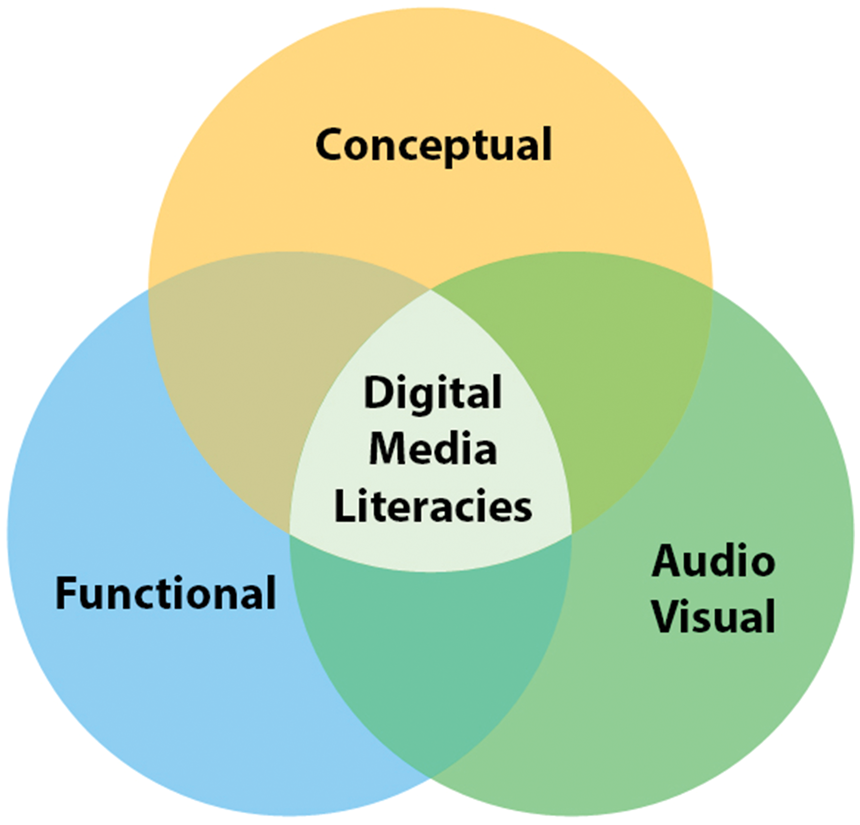
The three domains of digital media literacies from the production perspective.
Conceptual domain
Conceptual skills can be defined as the set of abilities that allow a person to visualise concepts, see patterns, understand abstract ideas, solve problems, formulate processes and understand how systems, programs and ideas interrelate (Carroll, 2014). In the context of digital media production, conceptual skills can be defined as the ability to tailor content to specific types of digital media (Kindem and Musburger, 2012). As an example, to produce an animation about climate change, a student would need to search, analyse and understand relevant topical literature, think creatively and translate the content appropriately to fit the medium.
For the DMLF, the ability to search, sort, analyse and understand information, think critically and creatively to inform the content of digital media artefacts will be labelled the ‘conceptual’ domain. This conceptual domain is required to be able to adapt content to different types of digital media objects (Masterman and Shuyska, 2012). For example, developing content for an audio podcast is, in essence, different from content for a poster or a video (McLoughlin and Lee, 2007). In an audio podcast, there are no visuals involved. In contrast, in a poster, there is no audio and the visuals and information displayed are crucial as users only have one page of information to engage. For a video, the type and sequence of the shots (long, medium and close-up) and information flow is essential (Stockman, 2011). In sum, the content must be shaped to the type of digital media artefact.
Functional domain
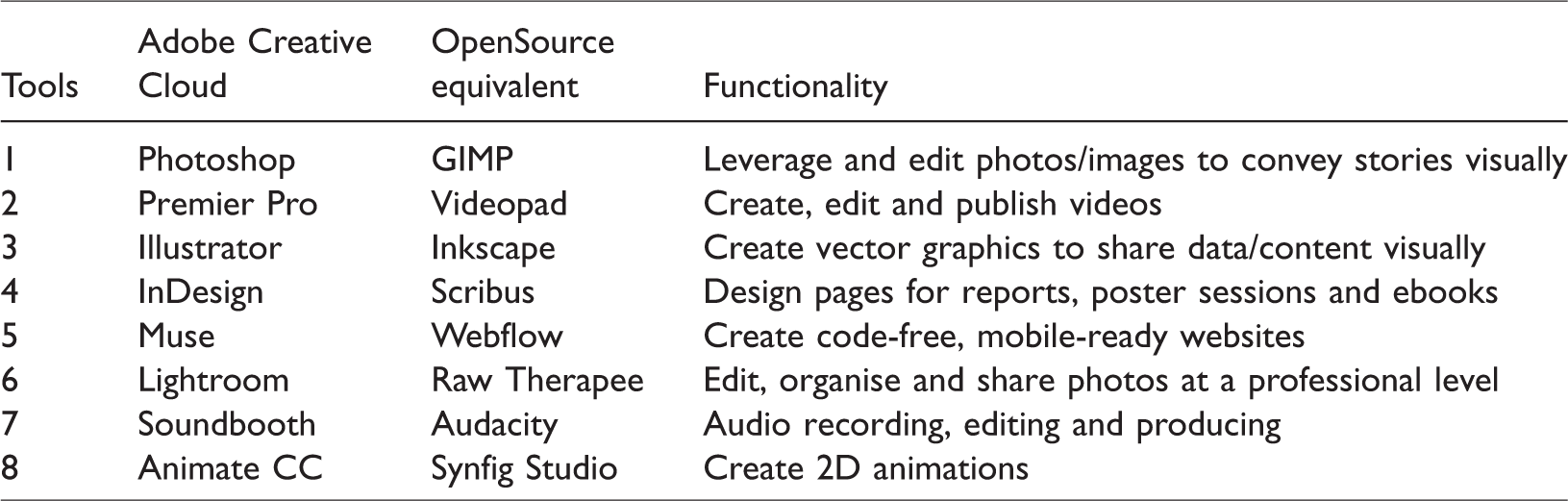
The functional domain is related to the use of computers (Buckingham, 2007a; O’Brien and Scharber, 2008). In a digital media production environment, these skills include audio recording and editing, digital photography, use of image and graphics manipulation software, web authoring tools, animation software, video recording, editing and production, 3D creation and so on. The NMC Horizon Project (Alexander et al., 2016) recommended six tools (1–6) from the Adobe Creative Cloud Suite for digital media creation. Table 1 shows these tools (1–6) and two additional tools for audio editing and animation (7, 8) with their OpenSource equivalent software used by the authors of this paper.
Digital tools for media creation (functional domain).
Audio-visual domain
There is a vast body of literature on visual literacy, which can be defined as the skills that facilitate a person to understand (read) and use (write) visuals to communicate a message to an audience (Ausburn and Ausburn, 1978b; Hortin, 1980). An analogy between visual literacy and verbal literacy was described that proposed two principles. Visuals are a language to communicate a message and it is expected that a visually literate person should be able to read (decode) and write (encode) visual language (Ausburn and Ausburn, 1978a). From the digital media production perspective, visual literacy is linked to visual design and composition principles. These principles are essential to the production of effective visual communications (Heinich, 1996; Malamed, 2015; Stockman, 2011).
The ‘audio-visual’ domain is related to applying knowledge of audio and digital media principles to develop effective digital artefacts. The artefacts could be restricted to either the audio, e.g. podcast or visual, e.g. poster elements or combine the two, e.g. video. The audio-visual domain is composed of audio quality, sounds effects and editing, layout design, colour theory, typography and use of images to convey messages (Hashimoto and Clayton, 2009). Visual design principles (Kimball, 2013), video shots, the rule of thirds, transitions and timing are also included in this domain (Stockman, 2011), see Table 2.
A summary of digital media principles for the audio-visual domain.
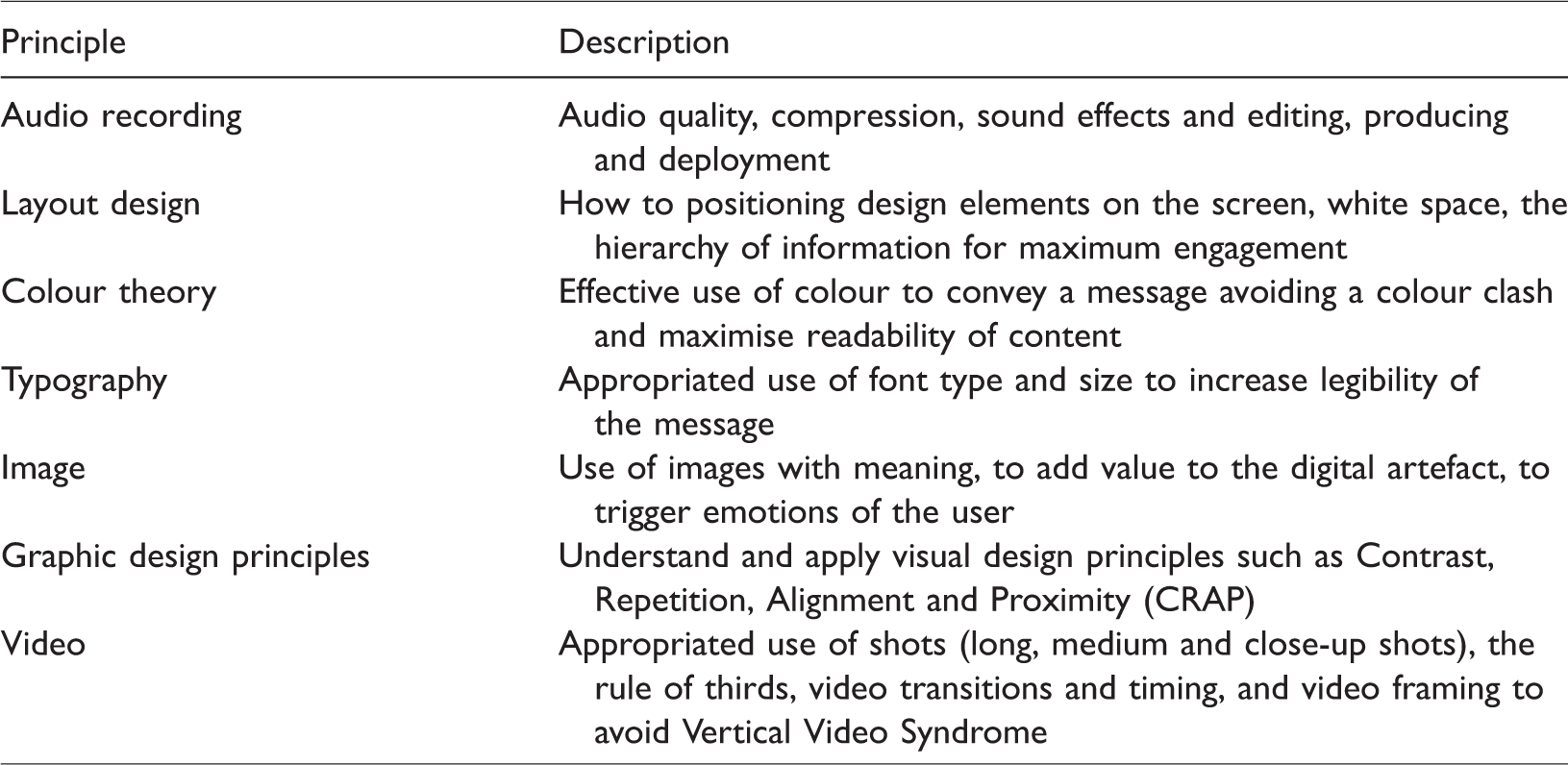
Table 2 presents a summary of the basic principles, in a ‘prosumer’ version of these principles. The term ‘prosumer’, coined by futurist Alvin Toffler in the 1970s, refers to those users who hover between producer and consumer (Bruns, 2007). In other words, a prosumer is a consumer who has moved beyond using equipments in ‘automatic mode’ and requires advanced features. In electronics, prosumer equipment is considered to be professional entry level such as digital handycams and Digital Single-Lens Reflex cameras. For example, a standard point-and-shot camera has limited functionality in terms of manual settings, users cannot control aperture, shutter speed, ISO, at the same time, instead, the user need to choose from predetermined settings. A prosumer version will allow the user to control all these settings and offer advanced functionality similar to professional digital cameras such as shooting in RAW format (uncompressed image), bracketing (multiple exposures), High Dynamic Range images, and so on. In the context of the digital media literacy framework, it would not be expected that students develop a deep professional level of knowledge, but rather have a ‘prosumer’ level of understanding of the domain principles that will enhance their creation of digital artefacts beyond the most basic levels. If students were studying digital media, film or visual arts, they will need a professional working knowledge, but outside of these disciplines, for teaching and learning matters, the prosumer level is sufficient.
Some educators may consider the principles outlined in Table 2 as belonging to the functional domain. However, the principles of the audio-visual domain cannot be considered functional for the simple reason that a digital artefact can be developed independently of understanding sound quality and digital media principles. Furthermore, all the domains are interconnected. The separation proposed in this framework was presented for instructional reasons. Ultimately, all of the literacies overlap to some extent. The separate skill sets presented need to be present, to some degree, at the same time to produce effective digital media content.
Application of the framework
The two scenarios presented below illustrate how the framework works and further explains the interdependence between the three domains of digital media literacy.
Scenario 1
A pharmacology student is preparing an assessment task on the medicinal use of cannabis. The assessment task requires the student to produce a brochure to communicate the concept to the general public. The student will need to identify, use, evaluate and think creatively to produce a message that explains the topic and can be suitably presented in a brochure. A storyboard will be required to brainstorm and visualise the ideas (Domain 1, conceptual). The functional part of the task will require the use of relevant software applications (e.g. Adobe Photoshop, Illustrator, InDesign, Microsoft Office Publisher) to create the brochure (Domain 2, functional). Finally, the student will need to understand and apply visual design principles, such as Contrast, Repetition, Alignment, and Proximity (CRAP) (Kimball, 2013), colour theory, typography and so on (Malamed, 2015) (Domain 3, Visual). Let us assume the student was able to identify the content appropriate for the topic but failed in Domain 1 (conceptual). Even if Domains 2 (functional) and 3 (visual) are present, the content of the brochure will not be suitable for the medium or engage the audience. In other words, the message will not be conveyed effectively. If Domains 1 and 2 are present (conceptual and functional), but the design uses an inappropriate colour scheme, with a lack of contrast between background and text, or hard to read fonts or a chaotic layout, it is unlikely that the end product will engage the audience effectively or be considered credible. Based on this scenario, it is evident that these three domains are interconnected. To complete the task and produce a useful brochure, the requirements of all three domains need to be met.
Scenario 2
A student from psychology is required to explain the self-serving bias theory with computers (Windows vs. Macintosh) using digital video. The student will need to be able to search for evidence-based information and then visualise ideas using a storyboard (Domain 1, conceptual). The functional part of the task will be shooting and editing video (Domain 2, functional). However, the ability to operate a video camera and use a video editing software will not guarantee the end product will be good enough to communicate the message to the audience (Stockman, 2011). The student will need to understand and apply basic video principles during the shooting such as the type of shots, timing, location and so on during the editing process. Also, the student will need to understand and apply video effects such as transitions, titles, background sound effects and music (Domain 3, audio-visual). If the student achieves Domains 1 and 2 only (conceptual and functional), the end product may not engage the audience; it may be too long, confusing or just boring to watch. If Domain 1 is only achieved, in which the content is accurate, but there are no video filming and editing skills (Domain 2, functional), and no audio-visual skills (Domain 3), the video will not be useful to communicate the message appropriately.
To highlight the interdependency of the three digital literacy domains, the two scenarios above can be examined in simple terms of either failing or succeeding to meet the requirements of a domain. Table 3 illustrates how the success or failure in a particular domain may combine to produce eight possible outcomes. It is noteworthy, that a failure in all domains can still result in a digital artefact, but the quality will be compromised. The validation of this table will be presented in the next section using working examples as evidence the domains interdependency.
Digital media literacy domains and digital media creation outcomes.
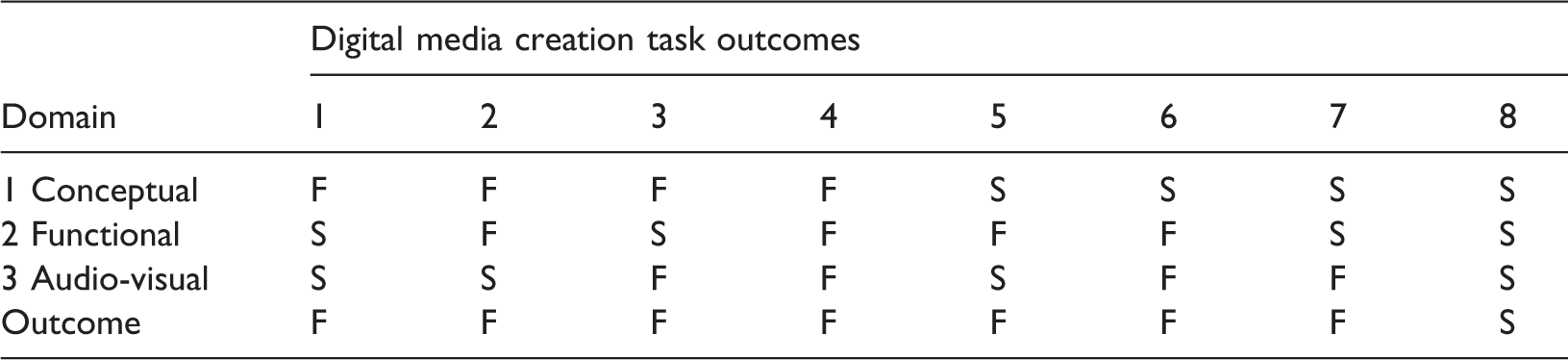
F: Failure; S: Success.
Each column explains a different scenario for the task with possible combinations of Failure (F) and Success (S) in the three domains discussed. Notice that failing in the functional domain (scenarios 2, 4, 5 and 6) does not necessary mean no artefact is developed. For example, a video can be created from a mobile device and upload it straight to YouTube without any planning and editing. In this case, the three domains will not be fulfilled, and this artefact could become digital media waste or content that fails to engage users. Currently, the Internet is inundated with this type of content and could make searching a process of sorting and discarding information.
In summary, digital media literacies in the context of effective production of digital media are composed of three domains: conceptual, functional and audio-visual. These domains are interconnected and failure of one, two or all could still translate into a digital artefact, but the quality will be undermined. The lack of these domains will result in a product that does not communicate the intention and will not engage the audience.
Working examples to explain the DMLF
As an illustrative example of the interdependencies of the framework domains as noted in Table 3, the authors of this paper have developed a hypothetical poster design about a French Film Festival (Table 4) using the Canva online application (www.canva.com). The possible outcomes (1–8) are explained.
Working examples of a poster design task using possible outcomes of domains.

These eight examples illustrate clearly all combinations of the domains in the DMLF and how it mastery can translate into an effective production of digital media artefacts. Similar examples can be developed for other digital media types such as audio podcasts, videos and blended media, but these examples go beyond the scope of this paper.
Discussion
There are a broad range of definitions regarding digital literacies from various discipline perspectives (Vaičiūnienė and Mažeikienė, 2017). This paper defines digital literacies as the set of technical, visual, behavioural, critical and social skills required to use current technologies that enable users to learn, communicate, socialise and contribute in the digital space. The main contribution of this paper is the articulation of the DMLF. This paper explores the DMLF from the production perspective for teaching and learning in higher education. The DMLF is based on three domains: conceptual, functional and audio-visual. The case studies and working example demonstrate the interdependency of the domains which is intrinsically applied to professional digital media production. Designers have this knowledge as second nature and it is honed with years of professional practice in the field (Kimball, 2013). The framework presented in this paper provides a method by which educators can scaffold the learning of digital media literacies for their students.
A graduate capability in digital literacy is required across discipline areas (Martin and Zahrndt, 2017), not just in media and creative disciplines (Alexander et al., 2016). Proficiency in digital media is crucial to developing effective communication skills in the 21st century (Hobbs, 2017; Vasilchenko et al., 2017). As defined within the framework, students must first learn conceptual skills (conceptual domain) applicable to the planning of content for digital media creation. Storyboarding is a good practice used by the digital video industry (Stockman, 2011), other creative industries such as graphic design and digital media (Hashimoto and Clayton, 2009). Storyboarding skills should be nurtured within university programmes as they help students visualise ideas and ensure their content is sharp, succinct and suitable for the digital media artefact to be developed (Malamed, 2015; Carroll, 2014).
To facilitate the learning of digital media literacies, a division between functional and audio-visual domains was made within the framework. The use of a computer and software (functional domain) does not guarantee the appropriate application of digital media principles (audio-visual domain). The NMC Horizon report about digital literacy assumes that students need to learn the functional domain (Alexander et al., 2016), but appears to have overlooked the audio-visual domain. The emphasis of learning should not be on using the software and applications, but about using it appropriately to communicate a message to an audience. As the affordances of technology continue to improve, digital media literacies have a crucial role in online communication. For this reason, it will be necessary to ensure students have an appropriate level of competency in audio, image and video filming and editing (functional domain). They should be able to integrate their knowledge with the audio-visual domain, employing the digital media principles at a ‘prosumer’ level. Students no need to be professionally competent but should be able to apply the basic principles of digital media design.
Critical thinking and the ability to critique digital artefacts are also important skills in digital media literacies, which should not be seen merely as ‘production standards’. Critical literacy for digital content has two dimensions: internal which allows users to analyse, evaluate and judge digital artefacts both in terms of content and presentation; and external, which is related to exploring social relation bonds in these artefacts (Hinrichsen and Coombs, 2014). This section is out of the scope of the framework that is merely a guide to produce digital media for learning, but the authors recognised the need to foster student critical media literacy via reflection.
Currently, digital media in education is being used in an opportunistic way, as a vehicle of learning or pedagogical agent (Hoban et al., 2015; Nielsen et al., 2017; Pearce and Vanderlelie, 2016). This opportunism may neglect the learning opportunity for students to develop effective digital media skills. This may account for why training in digital media literacies to students outside of the media disciplines is rare. This absence of training may be compounded by several other factors such as the lack of consensus for a definition of digital literacy (Vaičiūnienė and Mažeikienė, 2017), the inaccurate assumption about ‘digital natives’ postulated in 2001 by Prensky, and the lack of knowledge and skill in digital media of educators (Krumsvik, 2014). This paper envisages that the DMLF will play a crucial role in guiding the development of digital media literacies and assist educators in scaffolding these learning experiences. A balance between content and technology-centred approaches is required to ensure students learn subject content and develop true digital media skills required to successfully work, learn and socialise in the digital age.
The DMLF can help to identify gaps in knowledge and to implement appropriate training for the students. In our institution, the framework is being used to design the delivery of student training in digital media, either face-to-face or online. For example, the digital media principles lecture delivers the essential concepts the students need to understand when creating digital media (audio-visual domain). In contrast, the workshops deliver storyboarding techniques and writing content for digital media projects (conceptual domain). Finally, the computer labs introduce students to basic video shooting techniques and editing (functional domain). Currently, data are being captured to understand student perceptions of digital media for learning using an online survey. This survey has been validated using Factor Analysis and covers constructs such as (1) digital media for learning; (2) digital media for career; (3) digital media support provided and (4) knowledge construction. The development of a standardised digital media literacy quizzes could be a desirable intervention. Educators can measure students understanding of the topic by gathering data at the beginning and end of the semester. Then, by comparison, it can be determined if students gained the desirable skills to produce digital media and the data can be used to improve teaching strategies.
However, in applying the framework, several questions are raised which will need to be addressed by curriculum designers. For example, should the DMLF be incorporated into the curricula across all discipline areas? Do we want the students to develop a good understanding of digital media creation? Where and how this will be taught may depend on the educational setting, e.g. in a tertiary setting, a first-year subject called ‘Applied Digital Media’, where students learn or reinforce conceptual, functional and visual domains could be developed or alternately, such digital media literacies could be taught throughout a curriculum. There also remain a significant number of issues around designing digital media as an assessment tool and evaluate its effectiveness for learning. A promising approach can be considered self-regulation and motivational factors (Schunk and Zimmerman, 2011), and the development of psychometric tools to gauge student learning when digital media is used in the classroom. These issues will be further explored in upcoming papers.
Additionally, it is important to emphasise the development of critical thinking and good digital citizenship skills. These critical skills are essential in the age of fake news. Training in digital media literacies will help future professionals to evaluate digital media, be copyright compliant and develop e-civism, which can be described as representing the virtues and sentiments of a good digital citizen. The digital media framework proposed in this paper could help to identify the training needs of the students and educators for the competent production of effective digital media artefacts to effectively communicate their discipline to a wide audience.
Footnotes
Declaration of Conflicting Interests
The author(s) declared no potential conflicts of interest with respect to the research, authorship, and/or publication of this article.
Funding
The author(s) received no financial support for the research, authorship, and/or publication of this article.