




Abstract
A multitude of different technologies are used in school today. Some are provided by the school and others are brought by the individual teacher or student. In addition, different applications are available. In this study the focus is on student-initiated uses of technology and how it conditions learning. Based on a case study with surveys, interviews and an observational time study, it is shown that students appear to be the most frequent users of technology in the classroom and for the most part initiate its use. We also show that they often initiate uses directed towards communication and inquiry. Against the prevailing understanding that students mainly use technology for extra-curricular activities, we found that most of the student-initiated technology and applications related to the task in hand and were therefore not regarded as problematic by teachers or students. However, with regard to student-initiated uses of social media, games and communicative applications the picture is more diverse. In this context, teachers and students complain that such use may distract students, although some regard it as rewarding, for example due to the informal learning or time for contemplation and relaxation that results. We conclude by questioning the dichotomies of curricular–non-curricular and intended–unintended learning and we argue for the need to add contemplation to the taxonomy used for understanding the educational use of information technologies as conditions for learning.
Keywords
Introduction
Although the use of technology in schools is nothing new, the amount of technology that is used in classrooms today is unprecedented. We have moved from classrooms with calculators and overhead projectors via designated computer labs to classrooms with laptops, mobile phones, interactive whiteboards, tablets, and so forth. Some of these technologies are provided by the school, while others are brought into the classroom by teachers or students. Only a few years ago (and even still today) students were not allowed to bring laptops or mobile phones from home because they were regarded as a distraction (Lenhart, 2010). Now that almost every student has a mobile phone, a common solution is for teachers to collect these items and return them to the students at the end of the day or after class. This is done in order to avoid the ‘school anarchy’ that is reported to result when students use their own apparatus in the classroom (Cuban and Jandrić, 2015: 425). However, many teachers are re-evaluating this policy and allowing students to use their mobile phones for school-related work (Thomas et al., 2013). Mobile devices and applications are increasingly seen as valuable learning tools and the ‘bring your own device’, or BYOD model, is becoming more and more acceptable (Johnson et al., 2012, 2013; Parsons and Adhikar, 2016). Students’ personal mobile phones and devices are quickly becoming common resources both inside and outside the classroom (Swain and Pearson, 2002). Personal mobile technologies like these can thus be used to improve learning in the classroom and to support learning beyond the classroom walls (Ciampa and Gallagher, 2013).
The type of technology that is available in schools and its increasing proliferation has become an interesting object of research. In addition to investigating who initiates the use of technology in the classroom, our research interest here lies in how it conditions learning. In this technological landscape a common distinction is made between teacher-initiated (or teacher-defined) and student-initiated uses (Mifsud and M⊘rch, 2010; Mifsud et al., 2013). Teacher-initiated uses of technology are often defined as curricular-related activities and student-initiated uses as activities that the students perform when they are not involved in activities set by the teacher. However, in this study a distinction is made between teacher- and student-initiated uses and especially those that are curricular related or task related but are not defined by the teacher. The main focus of this article is thus on student-initiated uses of technology, whether curricula related or not, where no distinction is made between technology provided by the school and technology brought from home. This focus opens up possibilities for us to explore and question the common distinction between curricular–non-curricular, intentional–unintentional learning.
The research question is: Which uses of technologies and applications do students themselves initiate in classrooms and which conditions for learning are thereby shaped?
In order to answer this question, we analyse our empirical data stepwise. In order to do this, the following questions need to be addressed:
What kind of technology and applications are in use? Who uses them? Who initiates their use? How do teachers and students describe the various uses in relation to learning opportunities? How is this use understood in terms of conditions for learning (intentional as well as unintentional)?
Theory
Different theories for digital didactics and technology in education have been developed as education has become more digitalised. In this study, the focus is on student-initiated uses of technology in the context of education. Although the study mainly concentrates on such use for ends that can be planned for and foreseen, it is also open to uses for ends that cannot be foreseen and that reflect changes in technology: ‘Technological change is a constellation of what is chosen and what is not chosen; what is foreseen and what cannot possibly be foreseen; what is desired and what is not’ (Burbules and Callister, 2000: 2).
To help us better understand the conditions for learning that are shaped by student-initiated uses of technology, a way of thinking about education is needed that focuses on students’ actions as central to learning. These may be hidden or taken for granted in theories concerned with education as teacher-driven activities or in more psychological or cognitive perspectives. There is a danger that studies of the use of technology in education could get stuck in a construction of learning as access to and the dissemination of information. When discussing this risk, Bruce and Levin (1997, 2003) and Levin (2014) offer a taxonomy for the educational use of information technologies. For this they use four categories borrowed from Dewey (1902/2001): inquiry, communication, construction and expression. Dewey regards these categories as the impulses to act that a child brings to school and that education needs to build on. According to Dewey, inquiry builds on the impulse to investigate, communication builds on the social impulse, construction on the impulse to make things and expression on the impulse of artistic expression (Dewey, 1902/2001).
This Deweyan pragmatism suits our purposes in that it offers an understanding of education as action, participation and collective meaning making by communicative action. In this context, a crucial implication for education is that teaching is not simply a matter of transferring information from teacher to student but involves the mutual creation of a shared social situation (Biesta, 2010).
The interest in this study concerns student-initiated uses of technology and their potential for creating conditions for shared social situations, where students’ actions in terms of learning are enhanced. The introduction of digital technologies may in itself suggests more opportunities for communication and participation. However, in a Deweyan perspective, communication does not automatically imply the creation of a shared social situation for participation (Biesta, 2010) and learning. Dewey’s pragmatism, with its insistence on the centrality of social action, moves education away from the realms of philosophy of consciousness. Thus, the subject (‘student’) is not understood as primary to communication, but communication comes first. Following Biesta (2010), this change from consciousness to communication can be understood as half a step. Biesta (2001, 2010) uses Derrida’s deconstruction to take this further, where deconstruction is regarded as intrinsic to communication. In this perspective, communication cannot be understood as predetermined and neither subject nor communication can ‘come first’.
Questions about whether the use of different educational technologies makes a difference in terms of conditions for learning depend on what kinds of educational goals and contexts are in focus. Hence, an educational use of technology needs to be studied with regard to the needs that are made possible (Wamick and Burbules, 2007). ‘Tools’ like technology do not merely help us to achieve given purposes, but may also create new purposes and new ends that have previously not been considered possible. These tools are not just instrumental, but are part of a social environment – a space in which human interaction (Burbules and Callister, 2000) or transaction occurs. In this sense, participants, subjects, becoming-identities, matter, tools and places transact to form relational learning spaces or ‘assemblages of learning’, as proposed by Carmichael (2015: 291) making use of Deleuze’s time dimensions in a study of educational technology design. In Deleuze and Guattari’s (1988: 24) conception, an assemblage is a producing machine constituted by multiple connections: ‘An assemblage, in its multiplicity, necessarily acts on semiotic flows, material flows, and social flows simultaneously.’ They use the concept of becoming for the process in which any such multiplicity ‘changes its nature as it expands its connections’ (Deleuze and Guattari, 1988: 8). Understanding education as a process where semiotic, material and social flows; discourse, objects, humans, etc. are changing by expanding their connections, opens up for a much broader definition than that of goal-oriented, teacher-planned curricular activity.
In the study this theoretical framework is important for at least two reasons. First, it allows us to understand learning as closely connected to transaction and communication. Second, it makes a case for an understanding of education and learning as open in the sense that it is not always possible to plan in advance. This enables us to challenge the division between intended and unintended learning and to question the educational curricular–non-curricular dichotomy. It also helps us to understand the education/communication process in terms of becoming rather than instrumental development. Understanding student-initiated technology use in this light delimits the scope of our analysis and thereby allows more room for difference in terms of how student-initiated technology conditions learning and whether it is regarded as a friend or foe and to challenge the narrow definition of learning beyond this very dichotomisation.
Empirical setting
1:1 educational programmes, in which students are provided with their own laptops, are becoming increasingly popular. It can therefore be said that the use of technology in schools is on the upswing (Learning Cultures Consulting Inc, 2009). One of the first larger 1:1 initiatives took place in Maine (USA) from 2002 to 2004, when 27,000 students and 1700 teachers were equipped with a personal laptop (Silvernail and Lane, 2004). Since then 1:1 initiatives have spread throughout the world, including Sweden and its Nordic neighbours.
In Sweden, with a population of 9.7 million, there are 11.6 million mobile phones (CIA, 2015). There are thus more computers and mobile phones in the country than human beings (Findahl, 2013). Two out of three Swedes use their mobile phones to connect to the Internet (an increase from 22 to 65% in three years) and every third Swede (31%) has access to a tablet (Findahl, 2013). Sweden also has a long history of using computers in school and the government continuously updates its directives to the Swedish National Agency for Education on how to encourage the use of ICT in schools. The 2011 national school curriculum gives ICT a stronger role than ever before. The trend has been to stop using computer labs and instead provide Swedish students, from preschool to upper secondary level, with their own personal laptops. More than 250 municipalities (of Sweden’s 290 municipalities) have either started or are planning to implement one-to-one laptop classrooms in their schools (Taawo et al., 2012).
Despite this rapid distribution of laptops, very little is known about the benefits and drawbacks of their various uses. Against this background, 23 schools decided to join forces and have their 1:1 implementation evaluated by researchers. It was decided that a group of researchers from Educational Science and Informatics should follow the development of these schools over a period of three years. The research project, Unos uno, was conducted from 2010 to 2013. During the project the research group monitored and analysed the effects of the 1:1 initiative. The valuation criteria, which were set by the schools and the steering board, related to students’ learning and development, teachers’ roles and methods, the school management’s steering and school–home relations. In this particular study the focus is on the technology and applications used in the classroom and, above all, how the students’ initiated use of these conditions for learning.
Methods and materials
In this qualitative study, the data collection methods that have been used are observations, interviews and surveys. The research is mainly based on the observational time study, where we observe which technology and applications are in use and who initiates them. The interview and questionnaire data relate to the benefits and drawbacks of the various technology used in terms of how it conditions learning.
Observations
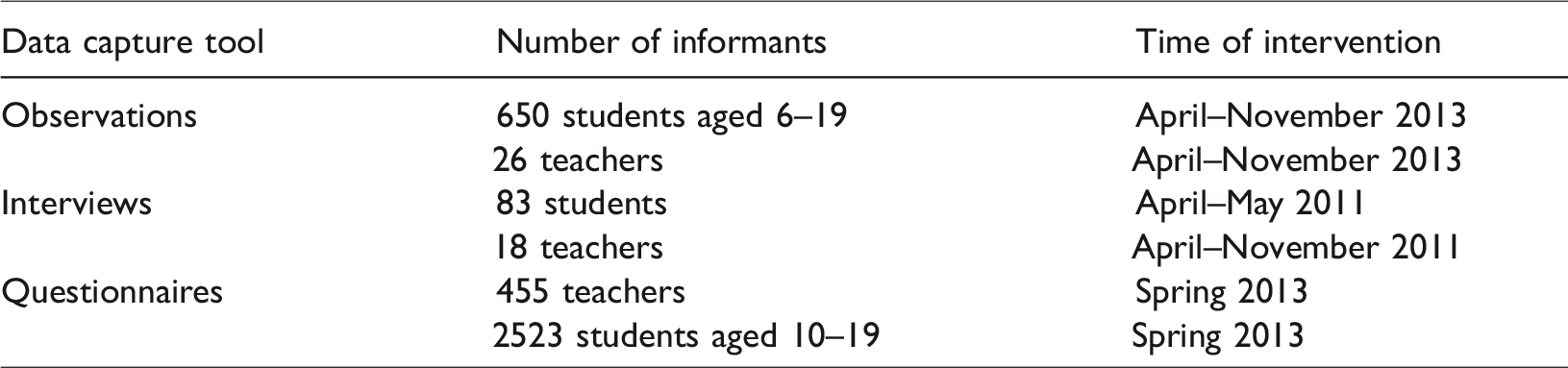
The classroom observations took place from April 2013 to November 2013, during which time we spent 15 days in 14 different schools. Five of these schools were at the upper secondary level (age range 15–19) and nine were at the compulsory level (age range 6–15). The schools visited and the classes observed were mainly selected by convenience sampling, which means that we asked our contacts in the schools if they were willing to take part in the study. Our sample thus constitutes the schools that answered this call. A total of 36 classroom observations were conducted and 2509 minutes of field notes were documented. A total of 650 students were observed (some were observed several times, which made the total count 832). Our observations covered the arts, chemistry, English, geography, history, natural science, maths, social science and Swedish (native language).
The observational approach was overt in that the observed people knew that they were being observed. The observations were fairly systematic, in that we had decided in advance what to look for and how this should be documented. The observation protocol was based on a timeline that enabled us to document what happened every minute in the activities in general and the use of the technology and applications in particular. The observation protocol took the form of a spreadsheet. Tablets were used to document the observations in order to cause as little distraction as possible. There were three observers in total, who sometimes worked individually and at other times in pairs. We were complete observers (Oates, 2008), which meant that we were present in the classrooms (at back of the room) but did not interfere with or take part in the class activities.
Interviews
Eighty-three students from 13 of the researched schools were interviewed on site in their respective schools. The ages ranged from Year 2 (7–8 years of age) to the final year of upper secondary school (17–18 years of age). Our contact person at each school selected the participants for our interviews – the only stipulation being that the gender distribution should be equal. The interviews were conducted in groups (17 altogether) and lasted from 30 to 90 minutes. The interviews were semi-structured and an interview guide (Patton, 1990) was used. The themes of the interviews concerned: (1) computer use in everyday school activities, (2) changes in the learning environment, (3) benefits and challenges with the use and (4) future use and the measures needed to achieve this.
Eighteen teachers were also interviewed – some at their respective schools and others online or by telephone. A convenience sample was created, which simply meant that those teachers who had the time and were willing were chosen. The interviews were conducted individually or in groups and lasted from 40 to 60 minutes. These interviews were also semi-structured and used the same themes as the student interviews. This data collection took place between April and November 2011 (Table 1).
Summary of data material.
Questionnaires
In the research project annual surveys were sent to the teachers and students. For comparative reasons most of the questions were the same, but due to the frequent discussions in schools about which technology to invest in, more questions about the technology use were included in the final survey of 2013. These questions have been used for this study. All the surveys were available online and links to the surveys were distributed to teachers and students via e-mail. In 2013, the teacher survey yielded 455 answers representing the 18 schools still active in the project. The student survey was designed in two different ways in order to allow for age differences. One was distributed to compulsory school students (aged 10–15) and one to upper secondary school students (aged 16–18). Eighteen schools took part and a total of 2523 students responded to the survey.
Analysis
The data analysis was conducted in several steps. In the first step, observation protocols were used to map the technology in use and to document whether the use was initiated by the students or the teachers. In the second step the aspects of curricular–non-curricular use and intended–unintended learning were examined. In the third and last step, these dichotomies were questioned. The remaining project data (interviews and surveys) were analysed in order to discern the learning conditions by applying Bruce and Levin’s four categories (1997, 2003) and Lewin (2014) of inquiry, communication, construction and expression.
Observations
After the final observation all the protocols were compiled in one spreadsheet and the content analysed. Colour codes were used to denote the various types of technology in use. Notes were taken and calculations made as to how often a teacher or student initiated the use of the technology. When analysing who had initiated its use a 1–1 relation was allowed for in order to compensate for unequal number of students and teachers. As the use of technology differed in the various lessons, the amount of time that each item of technology was used was not recorded (although minutes were marked in the left-hand column). Instead, we analysed how the technology was used in the 36 observed lessons and calculated the time intervals of use in percentages.
Interviews and questionnaires
All the responses to the questionnaires and interview questions were analysed by categorising the topics that emerged and counting the number of times they appeared. Based on this, a picture emerged as to how often the topics appeared or were mentioned as more or less important.
Qualitative analyses were used to deepen our understanding of how teachers and students rated the use of technology and how they thought it benefited learning. For this we used the narrative responses to the survey’s open questions and the interview transcripts. These textual analyses were conducted in two steps. The first step involved a theme analysis (Oates, 2008), which entailed reading through all the data and looking for key themes. This supplied us with a first broad set of categories to work with. The second step consisted of a content analysis (Krippendorff, 2004) of these categories, which involved going through all the texts in each category to determine how positive use was reported or how many students requested shorter breaks and time for contemplation. This information, when linked to who said what, gave a valuable picture of which aspects were most pertinent to the study.
Results
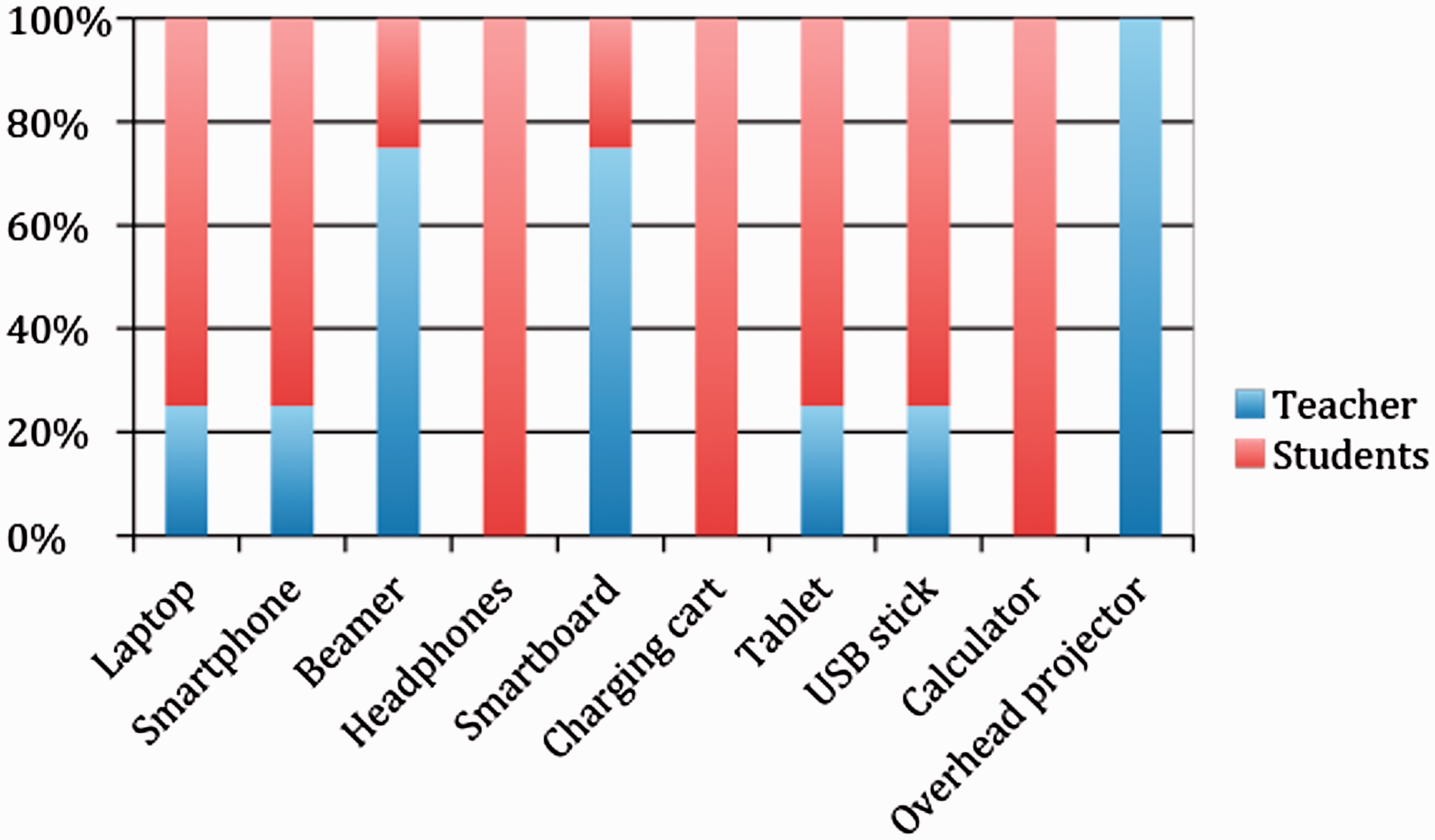
In order to answer the research questions, the technology and applications that were in use needed to be identified as well as who had initiated this use. As Figure 1 shows, students are the most frequent users of technology in the classroom. Although teachers also use technology in the classroom, they spend more time on other tasks, such as lecturing and helping individual students with their work.
Most frequent initiator of the technology.
When it comes to who initiates the use of the technology, the findings show major differences in the kind of technology used. For example, headphones are only used by students, for things like listening to music while working on an assignment. The results also show that teachers control the old overhead projectors, a fact which could be due to expertise or understood as a generation gap. The charging cart is only used by the students, because it is used to charge their laptops (in cases where this practice occurs), while the teacher charges his or her own laptop elsewhere. An interesting difference is the use of ordinary calculators, which only seem to be used by students. Although the students’ smartphones, tablets and laptops all have calculator programmes, they seem to prefer to use the hand-held calculating apparatus available in the classroom.
Moving beyond the type of technology to look at who initiates the use of the various applications, the findings show, as seen in Figure 2, that students initiated the use of chat, Google translate, iTunes, Skype, text messages and Spotify. Google translate was mainly used in language classes for quick translations of, e.g. an English text or to translate a Swedish sentence into English. Chat, Skype and text messages were used for communication, including messaging teachers and communication about school-related activities, iTunes and Spotify were mainly used for listening to music. Teachers, on the other hand, initiated the use of the calculator, Creative Commons, educational games, GoodReads, radio programmes, spreadsheets and USGS Science. All these applications were used when lecturing or explaining a student assignment. When the teacher introduced the application the students then used it for the task at hand. As already indicated, the only application that was not teacher initiated was the calculator.
Time distribution of initiatives for certain applications.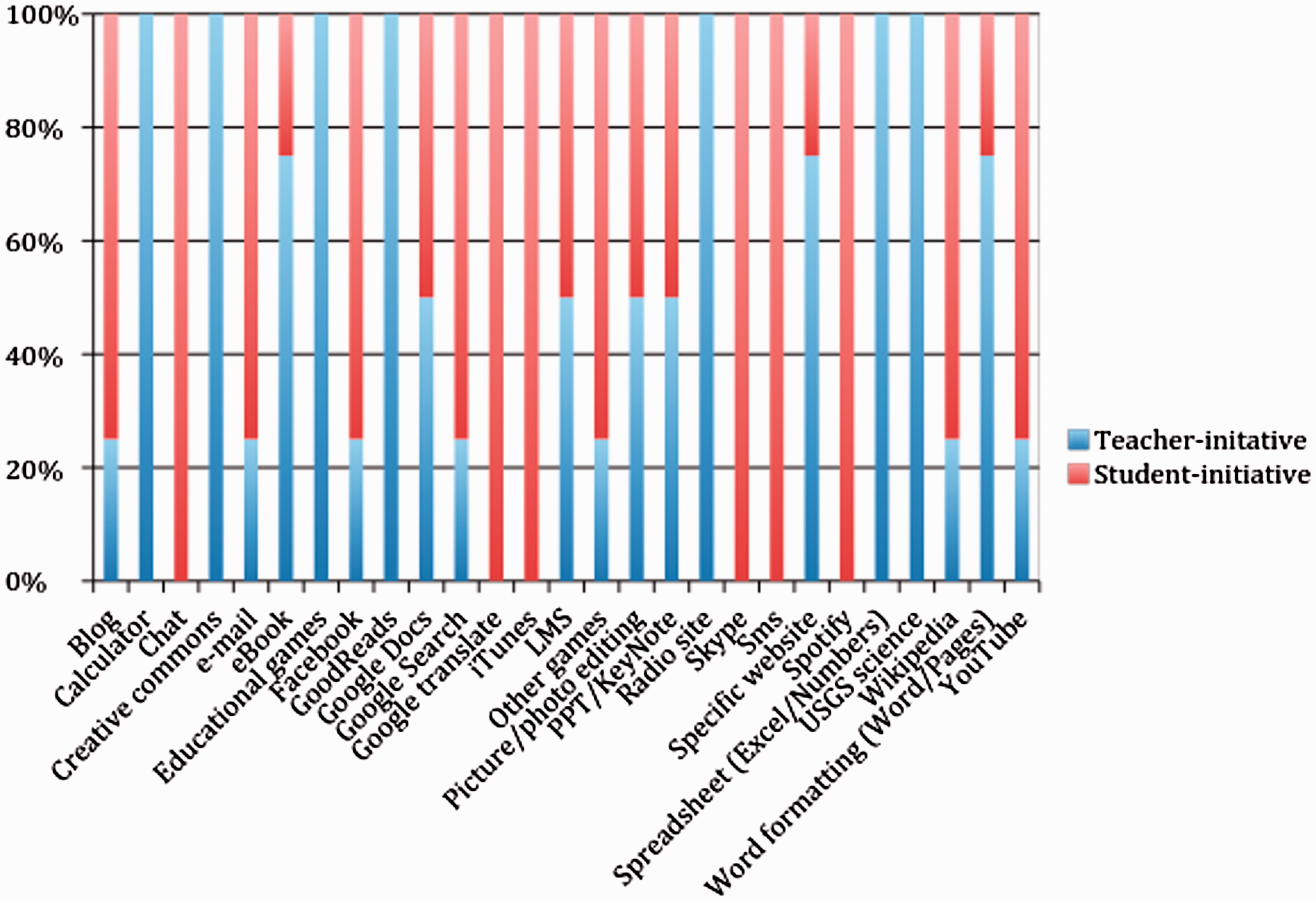
Having described the technology and applications used and who initiates the use, we now look at how teachers and students describe the student-initiated uses in relation to learning opportunities. The observations revealed that most of the student-initiated use of technology and applications related to the task at hand, e.g. calculators were used to solve a maths problem, Google search and Wikipedia were mostly used to search for information about a topic under discussion and Google translate was used to translate from languages that the students did not understand. Listening to music via iTunes or Spotify was not part of any direct curricular-related activity, but in general was something students did to help them concentrate on their tasks – especially during maths lessons: I listen to music, Spotify. It makes me work better – I simply concentrate more. (Student, compulsory school). The best thing about a computer is that I do not have to write by hand and can listen to music at the same time as I work. Listening to music while working makes me work better. (Student, upper secondary school) [the laptop is useful because] it has made communication with the students easier, it is easier to follow their work progress. It has also become easier to individualise. Students who have difficulties concentrating in an ‘ordinary’ classroom situation can now more easily concentrate by e.g. listening to music. (Teacher) It is so easy to fall into that during the lessons if the teacher is boring and just stands there talking about something totally uninteresting… then you take notes on the computer and open a new window and then a classmate starts playing games and you also want to try it and then you are totally gone. (Student, upper secondary school) It’s a bit harder to concentrate with the computer, it’s so easy to end up on blogs and Facebook. (Student compulsory school) It’s hard to keep some students off Facebook and games, they lose their concentration and cannot focus during the lessons. (Teacher) The computers are on all the time and divert the students’ attention with ‘seductive’ information from Facebook and other social media that are not school related and that totally put all other classroom activities out of business. (Teacher) I don’t think you can sit and study for a whole day. If you miss something you can catch up at home. You need the short breaks that Facebook or gaming give you. If the break is not Facebook it will be something else. (Student, upper secondary school) It is not that I usually use social media when I’m doing a task. But when I do I log in for about 15 seconds, but then I get bored and continue with the schoolwork. (Student, compulsory school) Everyone needs a break now and then – even when working. That’s not a bad thing. It’s easy for students to give Facebook a quick check but then they’re back. My students are good at multitasking. (Teacher) […] besides, everyone can need to clear their heads at times – even when they are working. That doesn’t necessarily have to be a bad thing. (Teacher) It [students chatting or being on social media] happens a lot but I see it as a part of society. Sure, they may lose concentration but they also get it back. Additionally they can benefit from networks and information technology to improve their learning. (Teacher)
The student-initiated use of technology was mainly curricular in nature and related to tasks and assignments. Listening to music was something that helped students to concentrate and was generally sanctioned by the teachers. The student-initiated use of social media, games and communicative applications was more complex in nature. Some teachers and students complained about such use and found it distracting, whereas others found it rewarding, because it opened up for informal learning opportunities or relaxation.
In the next section the focus is on how the use of technology and applications in the classroom can be understood in terms of conditions for learning – intentional as well as unintentional.
How technology conditions learning
In the surveys and interviews (Grönlund et al., 2013) the most common uses of technology for teacher-initiated tasks mentioned by teachers and students alike are search for information on the Internet, writing essays and making presentations. In terms of the taxonomy proposed by Bruce and Levin (1997, 2003) and Lewin (2014), inquiry is the most commonly reported use, here understood in terms of conditioning learning. In the surveys, teachers as well as students report that searching for information and exploring different sources are common curricular activities. In this context, examples of subject-specific databases and software are suggested by the teachers and used by the students. Communication in terms of e-mailing is also reported as an activity conditioning learning, although this mainly relates to communications between students and teachers and not so much with people outside school or in other countries. In 2013, communication with regard to the sharing of documents increased significantly. Technology is often used for communication and expression, such as writing essays and making presentations, but significantly less so for construction, apart from that involved in the editing of texts and presentations.
Turning to what the material has to say about the use of technology initiated by the students themselves, a somewhat other picture comes into view. In some instances the usage is similar, in the sense that students report using technology for tasks initiated by teachers relating to active, planned, curricular and intended learning activities when given the choice of working with or without technological tools. In line with the activities proposed by Bruce and Levin (1997, 2003) and Lewin (2014), and in accordance with Dewey (1902/2001), these are all ‘active activities’ involving varying degrees of, mainly, inquiry and communication and, to a lesser degree, expression and construction, all of which have a more or less clear learning goal in mind.
Other stories are also told. Both students and teachers report on student-initiated technology for relaxation and contemplation, such as listening to music while working and as a pause from work.
This introduces a fifth category in relation to those proposed by Bruce and Levin (1997, 2003) and Lewin (2014), which is that of contemplation. Our understanding of education in line with deconstructive pragmatism suggests contemplation as an activity that is related to education, but not directly connected to any given or pre-planned goal. Contemplation cannot really be planned into curricular activities and it is difficult to make it fit the goals that are commonly referred to as essential for schooling. Contemplation, or turning to social media, also questions the division between the individual and the social. It is not certain whether a social media using student is contemplating at all, doing it alone or together with other users of the media, or what this really means. As seen in the above quotes, such usage is considered by some students and teachers as good and by others as bad. In this sense it can either be a friend or a foe. The good aspects are constructed as relaxation and the clearing of heads and the bad aspects as distraction, diversion or lack of concentration, all of which imply a drifting away from the task in hand.
Conclusion
The findings show that the use of technology initiated by students in the classroom, understood in terms of actions conditioning learning, is a complex issue. Based on these findings, we argue that the educational needs that technology makes possible are not just related to curricular aspects. The student initiated uses of technology in the classroom is shown to distract AND relax and we argue that both aspects can be understood as conditions for unintended learning, in that they lead students away from that which is pre-planned and ordered. Following Biesta (2001), we question the curricular–non-curricular dichotomy, and claim our results to indicate that technology use may pose possibilities in these terms. Given that education must be open to what cannot be foreseen, curriculum needs to be potentially non-curricular and technology use is indicated to offer students ways to take a step aside of curriculum without leaving it altogether. In Deleuze and Guattari’s terms (1988), school, technology, social media and the student may be seen as flows connecting into an assemblage of learning (Carmichael, 2015) a multiplicity always already becoming; changing in nature by expanding its connections.
The paper began by asking the research question: Which uses of technologies and applications do students themselves initiate in classrooms and which conditions for learning are thereby shaped?
We have shown that, in our empirical materials, students initiate uses of technologies and applications that are (mostly) curricular and task related. We have also shown that they are mainly communicative in nature or directed towards inquiry. This indicates that conditions for learning as investigative and social are shaped.
Conclusions drawn from the students’ and teachers’ talk about the distracting and relaxing aspects of student-initiated technology use, also concern the taxonomy (Bruce and Levin, 1997, 2003; Levin, 2014) that has helped us make sense of the material. In accordance with the progressivist tradition, the impulses inquiry, communication, construction and expression all relate to ‘active activity’. In response to the experiences voiced by our participants, it was found necessary to include a fifth category of contemplation.
Footnotes
Declaration of Conflicting Interests
The author(s) declared no potential conflicts of interest with respect to the research, authorship, and/or publication of this article.
Funding
The author(s) received no financial support for the research, authorship, and/or publication of this article.