




Abstract
The ePortfolio has been used in initial teacher education for its storage and presentation functions; however, its use as a pedagogic tool to enhance learning outcomes is less common. This study explored students’ perceptions of ePortfolio and their learning in a Bachelor of Education (primary) programme at a New Zealand university. The research sought to identify courses in which learning had been enhanced by ePortfolio use and the related reasons. Data were collected through document analysis, a survey questionnaire and a focus group discussion. The findings indicate a relationship between students’ perceptions of their enhanced learning through ePortfolio and a number of threshold concepts in curriculum design. These ePortfolio-related concepts include its purpose for learning, design of constructivist learning activities, social pedagogy for co-construction of knowledge and the constructive alignment of ePortfolio concepts for enhanced learning outcomes. An argument is made for course designers and developers to deeply understand the nature of these threshold concepts when planning to incorporate ePortfolio into curriculum processes.
Keywords
Electronic portfolios (ePortfolio) are increasingly being used in higher education institutions. This digital tool has been described as “the next great innovation in education” (Gathercoal et al., 2007: p. 641) and it has been linked to transformational learning (Stefani et al., 2007). The Joint Information Systems Committee (Joint Information Systems Committee, 2008) describes the ePortfolio as a 21st-century tool for supporting learning, teaching and assessment. Its purposes are well suited to develop attributes which have been listed as essential for the workplace of the future: graduates who can be flexible, adaptive, integrative, reflexive and critically engaged life-long learners (Peet et al., 2011). The ePortfolio is identified as a digital pedagogic tool which can trigger and support these kinds of learning (Bass, 2014; Eynon et al., 2014); however, Joyes et al. (2010) caution that this does not happen without intentional planning, as ePortfolio is disruptive in that it does not fit with existing systems and processes. The purpose of this research study was to seek undergraduate students’ understanding of ways in which ePortfolio enhanced (or not) their learning in a Bachelor of Education (primary) programme at a New Zealand university with a view to inform curriculum design with ePortfolio as a pedagogical tool for enhanced learning outcomes.
The purpose and use of ePortfolio for learning
ePortfolios involve a constructivist perspective of learning (Barrett, 2005; Stefani et al., 2007) with associated pedagogies such as reflective and evaluative approaches to learning (Lin, 2008), self-regulation of professional learning through standards-based achievement (Blackburn and Hakel, 2006; Ring and Foti, 2006) and social learning (Bass, 2014; Baxter Magolda, 2014). In addition, integrative learning through ePortfolio draws on meaning-making from formal and informal learning experiences across different contexts and time (Peet et al., 2011).
It follows that identifying the learning purpose of an ePortfolio in the curriculum is fundamental to the design of authentic learning activities. The assumption that the ePortfolio is one discrete thing belies the complexity and potential of the technology to be used for both its tool and pedagogic purposes. In this article, the definition by the Joint Information Systems Committee (2008) will be used: An eportfolio is the product, created by the learner, a collection of digital artefacts articulating experiences, achievements and learning. Behind any product or presentation, lie rich and complex processes of planning, synthesising, sharing, discussing, reflecting, giving, receiving and responding to feedback. These processes referred to here as ‘eportfolio-based learning’ are the focus of increasing attention, since the process of learning can be as important as the end product (p. 6).
The view of the ePortfolio as a process focuses on ePortfolio-based learning around self-appraisal and reflection across time and often involves formative assessment for learning (Barrett and Wilkerson, 2004). An individual in this case will construct an integrated learning or development portfolio (Matthews-DeNatale, 2013) which may be associated with the notion of the ePortfolio as a tool of social pedagogy: engaging users in iterative cycles of creating, reflecting, seeking feedback, reviewing and “integrating revised work within a larger context of professional or learning identity formation” (p. 2). The focus is on the pedagogical capabilities of the ePortfolio. Such a portfolio has also been described as a working (Barrett, 2010) or learning (Gerbic and Lewis, 2011) portfolio, supporting the process of powerful personalized learning often through reflective blogging, and with a strong developmental focus over a period of time.
Using the ePortfolio as both product and process involves the construction of a showcase (Matthews-DeNatale, 2013) or presentation (Barrett, 2010) portfolio. This type of ePortfolio contains a selection of evidence of integrative knowledge drawn from diverse sources and usually accompanied with reflective comment on learning, growth and professional development. Showcase portfolios can present a graduate’s personal and professional capabilities (Zeichner and Wray, 2001) and can be useful for employment purposes and as a pre-interview tool (Cambridge, 2008). While such a portfolio reflects the tool aspects of ePortfolio, these are subsumed within its pedagogical capability to support integrative learning (Peet et al., 2011).
Joyes et al. (2010) contend that the ePortfolio can effectively be used as a pedagogic tool through its inclusion in teaching and learning activities. Reporting on an evaluation of 21 ePortfolio projects by the Joint Information Systems Committee in the United Kingdom, which sought to identify factors influencing ePortfolio practice, they argue that while evidence reveals “tangible benefits for users” (p. 16) such as time efficiency and the enhancement of skills, misconceptions held by those implementing the ePortfolio reveal a lack of understanding of the complex impact of the technology on curriculum decisions. Joyes et al. (2010) have identified the following threshold concepts around the role of ePortfolio in curriculum: the purpose for its use, learning activity design, processes involved in its use, and ownership of the ePortfolio. They contend that unless these threshold concepts are understood as disruptive in terms of new ways of ePortfolio learning, the technology will simply remain an add-on with misalignment of purpose, rather than opening up a new space for learning. The first two concepts relate to a course level while the final two involve an institutional response.
This research study draws on, and develops further, the argument made by Joyes et al. (2010) that an understanding of specific threshold concepts is required for effective ePortfolio practice at a course level. An argument is made for course designers and developers to understand a number of critical threshold concepts which relate to enhanced learning experiences described by research participants. This will be of interest to educators who are involved in implementing or already use ePortfolio in initial teacher education curriculum.
Theoretical framework
Threshold concept theory was proposed by Meyer and Land (2006) as a way of understanding learning experiences related to key discipline concepts (core concepts) considered essential for deep subject knowledge. Understanding a threshold concept results in a transformed way of viewing or appreciating the concept (described as a portal experience) which opens up a new and previously inaccessible way of knowing. This is different from the liminal (pre-threshold) state many learners may achieve as a result of rote learning or mimicry without full understanding of the concept. For example, to grasp the threshold concept of opportunity cost in Economics a student must accept the idea that opportunity cost involves the comparing of choices and the rejection of alternatives. Such understanding moves thinking about choice as predetermined towards an appreciation of “two sides to every choice…. Thus, if ‘accepted’ by the individual student as a valid way of interpreting the world, it fundamentally changes their way of thinking about their own choices” (Meyer and Land, 2006: p. 6, emphasis in original). The student has thus moved through a portal experience and is open to further concepts which may depend on the fundamental understanding of opportunity cost. Scott (2014) argues this transformational experience involves an epistemological and ontological shift in the learner.
According to Meyer and Land (2006) threshold concepts have the following characteristics: transformative (leading to a significant shift in perception); irreversible (difficult to unlearn); integrative (exposes previously hidden integrative understandings); potentially troublesome (can be counter-intuitive) and sometimes bounded. While research using threshold concept theory has mainly focussed on the identification of concepts within an academic discipline, there are examples of research which has followed the suggestion by Meyer and Land that “ways of thinking and practising within a discipline constitutes a critical threshold function” (p. 15). Tucker et al. (2014) conducted a study on the process of learning-to-search in Library and Information Studies to identify threshold concepts that novices needed in order to develop expertize, and Joyes et al. (2010) have similarly applied threshold concept theory to the effective practice of ePortfolio in teaching and learning. This research study uses threshold concept theory as a lens through which to view student perceptions of their learning using ePortfolio.
Methodology
This qualitative study is based on an interpretivist paradigm (Crotty, 1998) with an ontological perspective that truth is subjective and multiple realities exist. My related epistemological perspective holds that cognitive meaning-making is constructed by an individual, based on experiences and often in a social context. Thus, reporting the student voice, as in this project, aligns with a social constructivist approach in which students are seen as active participants in their learning and meaning-making (Tosh et al., 2006). I support Cousin’s (2009) view that threshold concept research does not involve a specific method for inquiry, but offers an analytical framework for exploring difficulties in learning and teaching in order to support curriculum design.
I acknowledge my insider research perspective in that I have been a lecturer and developer of ePortfolio in the Bachelor of Education (primary) programme. In addition to being informed by the literature, my interpretation flows from my personal beliefs and experiences regarding the potential for learning through ePortfolio. Being sensitive to my potential power position in relation to the participants, I employed a research assistant to communicate with participants, collect data and enter such data into electronic formats. The project received ethical approval through the university ethics process and participants gave informed consent.
Context of the ePortfolio within the Bachelor of Education (BEd) courses
The ePortfolio was first introduced into the BEd programme in 2009 and by 2013 it was being used by eight different courses. Students first encounter the ePortfolio in the Professional Inquiry and Practice 2 (PIP) course when time is allocated for introduction to the concept of ePortfolio as well as workshop sessions.
Participant characteristics
Participants were drawn from a third-year cohort studying a BEd (primary) programme. The composition of the group was predominantly female (80%). Age varied within the group, with 64% in the younger age group (18–24 years) and 36% in the more mature age group (25–50 years). These demographics are representative of initial teacher education programmes in New Zealand, with more females entering the profession than males and a large number returning to study as mature students. The research project was conducted during August 2013 when the students had used an ePortfolio over a period of five semesters. Forty-eight participants (85% of the group) had used their ePortfolio in seven or more courses. They were therefore able to draw on their ePortfolio experiences based in a range of curricula as well as the different approaches adopted by their lecturers. Recognising the level of exposure to ePortfolio, the student voice was valued in assessing the impact of ePortfolio on their learning.
Methods of data collection and analysis
The aim of the study was to answer the research question: how is the use of an ePortfolio in courses within the BEd programme impacting student learning? In order to focus the participants on the value of ePortfolio in each specific course, the following sub-question was designed: in which courses has the use of ePortfolio enhanced your learning and why?
Three tools were selected as most appropriate to collect the data. Firstly, document analysis of study guides aimed to provide the context for ePortfolio use in a course and represented the official communication from lecturer to student on the purpose and use of ePortfolio. Secondly, in order to survey the views of the whole participant group and gather data in a standardized way so as to provide a picture at a cohort level, a questionnaire was designed comprising closed and open responses (Appendix A). The quantitative data collected through the questionnaire were statistically analysed using simple calculations for reporting purposes (Bell, 2005) while open-ended questionnaire data were collated at a course level to seek patterns and trends. Thirdly, the use of a focus group aimed to collect rich data by providing an opportunity for participants to explore, in greater depth, ideas linked to the questionnaire survey. The set of focus questions is detailed in Appendix B. Qualitative data collected from the survey and focus group were analysed using an inductive approach with coding to reduce and categorize the data into themes (Miles and Huberman, 1994). Analysis of focus group data was specifically at a cohort level for the purpose of seeking relationships (or not) with data collected through the questionnaire.
The full cohort of 106 students was approached by the research assistant for their participation in the project. Of these, 56 consented to complete the survey questionnaire. The sample size of the questionnaire group is sufficient and representative enough of the student cohort to draw tentative conclusions from the research. From the participant group, six consented to participate in a one-hour focus group; however, only three took up the opportunity. The focus group sample size, while small, provides rich data and the decision was made to use the participants’ comments to illuminate the survey data and give specific examples of experiences where appropriate.
Results
Question 1 of the survey questionnaire asked participants to identify courses in which they had experienced ePortfolio and for each of these courses to state how the ePortfolio had affected their learning. Questions 2 and 3 of the survey questionnaire, as well as the focus group discussion, provided explanation for choices made in Question 1. The courses identified by the respondents were:
Teaching the Arts Teaching Technology Professional Inquiry and Practice (PIP) (five individual papers over five semesters) Teaching Social Sciences Teaching Children from Diverse Ethnicities
ePortfolio impact on learning in eight Bachelor of Education courses.
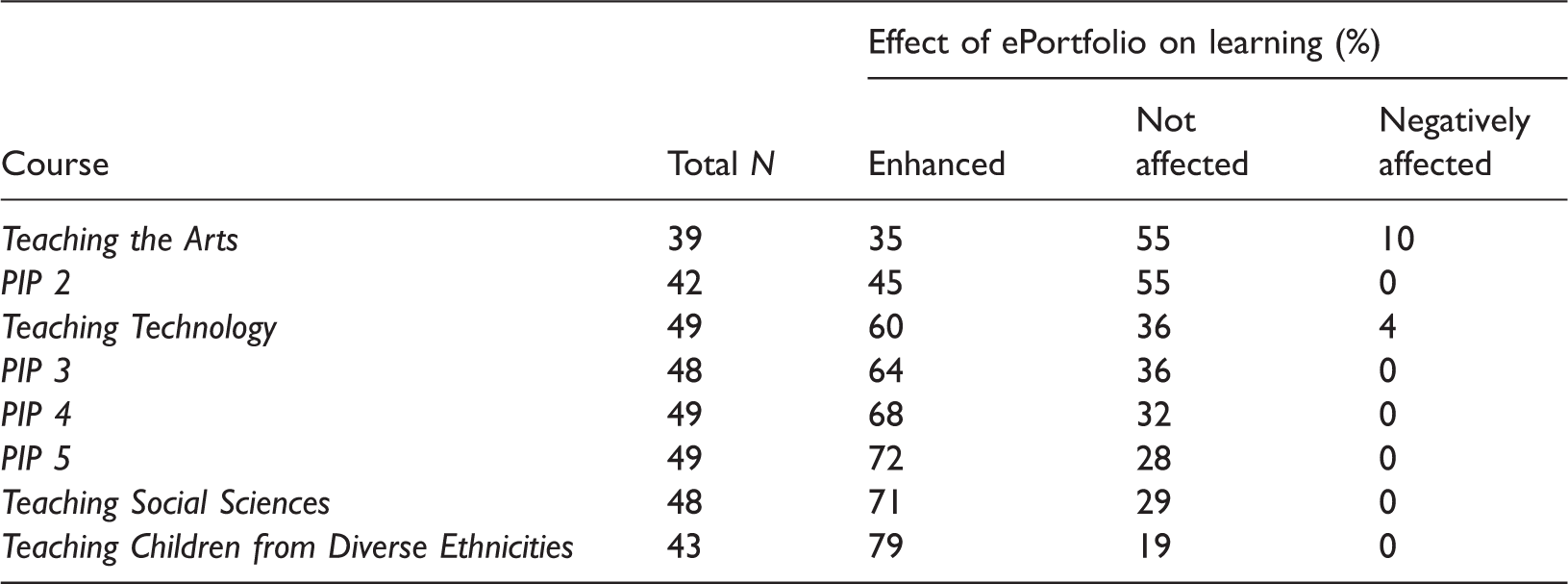
Total N: total number of responses; PIP: Professional Inquiry and Practice.
Courses are ordered from least to most reported learning enhancement through use of ePortfolio.
In the section that follows, results for each of these courses are considered, drawing on the document analysis and participant data. As the students were surveyed in their third year of study, the study guide dates reflect the year in which the ePortfolio was experienced. While it could be argued that this range of dates might influence the results due to increasing familiarity with the ePortfolio in each course, this is only evident in the case of the PIP courses which ran across five semesters. In the other courses, the purpose for using ePortfolio appears to exceed an increasing familiarity in using the technology. This is further elaborated in the discussion of results for each of the courses.
Teaching the Arts
The ePortfolio was named in the study guide (2013) for the Teaching the Arts course as the required presentation tool for a summative assessment task. This purpose for the ePortfolio meets the description of a documentation or directed portfolio (Matthews-DeNatale, 2013) for a product of learning which evidences achievement of learning. However, such a specific purpose was not made clear to students in the documentation.
The survey data showed that more than half of the participants felt that the use of the ePortfolio in the Teaching the Arts course did not add to their learning, while 10% stated that the ePortfolio had a negative impact on their learning. One focus group participant commented that the focus was “not a critical piece of work, just pictures of you doing art”. Little explicit connection was made by participants to their learning.
Teaching Technology
The Teaching Technology study guide (2012) specifically listed the use of the ePortfolio in the session schedule, where it was linked to the Design, Make & Appraise technology process. A summative assessment required students to include artefacts and commentary on the application of theory to practice. Such a use of ePortfolio meets the description of a showcase (Matthews-DeNatale, 2013) or presentation (Barrett, 2010) portfolio as it includes both product and process learning.
While almost two thirds of participants responded that the ePortfolio enhanced their learning in the Teaching Technology course, one third felt it made no impact and there was unanimous agreement in the three-person focus group that this course would have been better off without the ePortfolio as: “it was an essay that was just put up on a page” and “it felt just a little bit meaningless… just uploading for no reason.” The survey participants who responded positively showed their awareness of learning through the ePortfolio as a digital pedagogy with comments such as: “a record of learning”, “a showcase of work” and “presenting my learning progression”. The new ways of presenting their learning (such as visual images, sound files and video) were perceived to stimulate creativity and “made learning fun”.
Professional Inquiry and Practice (PIP)
The study guide for PIP 2 (2011) had a session dedicated to student teaching goals and building the ePortfolio page for the forthcoming teaching experience. The design and contents of the page were dictated with a visual example provided of a completed ePortfolio page detailing practicum goals, weekly reflections and selected Graduating Teacher Standards (Education Council, 2007). The subsequent four PIP study guides (2012, 2013) repeated the identical ePortfolio expectations except for the inclusion of different Standards. The purpose of ePortfolio in these courses was made very clear to participants and this aligned with a documentation or directed portfolio (Matthews-DeNatale, 2013) as it was used as a product for the storage of learning artefacts. Only in the case of the weekly practicum reflections, which involved formative feedback, was the ePortfolio purpose for a learning (Gerbic and Lewis, 2011) portfolio.
Over the course of the five PIP experiences, participants demonstrated an increased awareness of the ePortfolio enhancing their learning (from 45% in PIP 2 to 72% in PIP 5). This is an interesting trend considering that the requirements for the ePortfolio use and its purpose were identical in each iteration of the course. Those participants who selected to explore PIP more fully in survey question 2 cited reasons for their enhanced learning related to using ePortfolio for its tool functions, such as its convenience for electronic submission purposes and its value for storage and organization of documents. There was limited reference to ePortfolio being used as a digital pedagogy, with only one participant noting its capability to represent the progression of learning over time: “I just always like to go back to it and see how I have grown and changed”. Another comment hinted at the ePortfolio being used as a social pedagogy through “sharing knowledge” with peers.
Teaching Social Sciences
ePortfolio was mentioned in the study guide (2011) for the Teaching Social Sciences course as part of the content themes, and an ePoster (a visual narrative) was named as the presentation format for a community-based, collaborative group learning activity. Using an ePoster would suggest an integrated learning portfolio (Peet et al., 2011); however, such a purpose was not made explicit to the student readers.
ePortfolio was perceived by 71% of survey participants as enhancing their learning in Teaching Social Sciences, and more than a third of survey participants chose to explore their reasons. Members of the three-person focus group unanimously agreed that this was the course in which the use of an ePortfolio significantly enhanced their learning, with one commenting: “I learnt to interpret and create meaning through a selection of pictures”, while another noted that documenting the experience in visuals “allowed more time to be spent on analysing and reflecting on the group learning experience”. Another declared: “you get the best features of ePortfolio to showcase your learning”. One survey participant noted that the integrative nature of the assessment was “ideal to synthesise the wide array of learning and evidence from the group” while another commented on the ePortfolio as a tool of social pedagogy as a “great way to bring everyone’s work together”.
Teaching Children from Diverse Ethnicities
The study guide (2013) for the course Teaching Children from Diverse Ethnicities contained a specific section on using the ePortfolio for weekly journaling for the purpose of reflecting on a provocative statement related to the session topic as a way to examine assumptions and to increase awareness of beliefs and behaviours. The purpose of the ePortfolio in this course aligns with a working (Barrett, 2010) or learning (Gerbic and Lewis, 2011) portfolio, which focusses on personalized learning and formative feedback.
The Teaching Children from Diverse Ethnicities course received the highest positive support from the survey and focus group, with just under 80% of respondents claiming that the ePortfolio enhanced their learning. One participant observed that the ePortfolio reflected a change in learning over time, while another appreciated the feedback on blog entries from peers, noting it “allowed for a collaboration of ideas”.
Discussion
The discussion section will elaborate on a set of ePortfolio pedagogies and practices based on threshold concepts which, it will be argued, can enhance student learning if course designers and developers grasp and optimize the capabilities of ePortfolio as a pedagogy.
Meyer and Land (2006) contend that threshold concepts are an important consideration in the design of effective learning environments. An analysis of the courses in which participants identified ePortfolio as enhancing their learning reveals a number of such threshold concepts which fit Meyer and Land’s (2006) framework of characteristics in terms of being transformative, irreversible and integrative. The characteristic of troublesome, in that the concept is counter-intuitive, alien or incoherent (Perkins, 2006), is not deemed to apply in this case. Course designers and developers who wish to use the capabilities of ePortfolio for learning are recommended to consider the following four threshold concepts which have been associated with the use of ePortfolio in different courses within the BEd programme.
Threshold concept one: the purpose of ePortfolio for learning needs to be clear and explicit
The threshold concept of purpose was identified by Joyes et al. (2010) who contend that “the purposes behind the use of ePortfolios must be aligned to the particular context” (p. 22). The findings from this research study support such a view, for when the purpose of the ePortfolio was made explicit through the study guide or learning activities, the participants were more likely to report their learning as being enhanced. This was evidenced in the purpose of ePortfolio for journaling in the Teaching Children from Diverse Ethnicities course, as a storage and presentation tool in the PIP courses and as a narrative ePoster in Teaching Social Sciences. In contrast, the differences in opinion on the value of learning through the ePortfolio in the Teaching Technology course suggest that the purpose of the ePortfolio was not clear enough for all participants. This is surprising as reference to its use in the study guide is more detailed than in any other course, which leads one to question the lecturer’s role in ensuring students make links between the ePortfolio purpose and learning intentions. Thus, explicitly identifying the purpose of ePortfolio in courses will authenticate its place in the learning. As described by Meyer and Land (2006), the portal learning experience associated with this threshold concept results in an irreversible positioning and understanding which leads designers and developers towards accommodating the next threshold concept as a conceptual building block.
Threshold concept two: the design of constructivist learning activities should include authentic ePortfolio pedagogy
The threshold concept of constructivist learning activity design relates to the second concept identified by Joyes et al. (2010) who state that there should be “conscious design and support of a learning activity suited to the purpose and context” (p. 22). Laurillard (2012) supports the view that intentional use of technology as a pedagogic tool for learning requires appropriate design of learning experiences. These research findings suggest that where the learning activities utilized the capability of ePortfolio for constructivist learning, participants perceived their learning to be authentic.
Examples of such activities were illustrated in the personal and professional reflective activity in Teaching Children from Diverse Ethnicities and in the digital visual narrative in Teaching Social Sciences reflecting self-authorship (Baxter Magolda, 2014) and digital identity (Lewis and Gerbic, 2012a). On the other hand, the activities in PIP did not utilize the ePortfolio capabilities for synthesizing and integrating learning (Peet et al., 2011), and the opportunity to utilize the pedagogic capability of ePortfolio to support a range of thinking skills was lost.
This threshold concept, once operationalized, draws the learner into constructivist learning in different ways which are authentic to ePortfolio as a vehicle for that learning. This requires course designers and developers to appreciate the transformative and integrative capability of ePortfolio for learning, rather than simply an add-on to a course.
Threshold concept three: ePortfolio as social pedagogy enables co-construction of knowledge
A threshold concept of social pedagogy is identified in this research project to be a powerful way of learning through ePortfolio. This is supported by Bass (2014) who describes an ePortfolio as social pedagogy which engages learners in scripting for an audience of peers for the purpose of seeking critical feedback from the community of learners. Such an approach fits well the ePortfolio, which is part of the suite of Web 2.0 tools which enable the creation and sharing of information online, anywhere and anytime (Foroughi, 2015) as learners actively co-construct knowledge.
Teaching Social Sciences drew on social pedagogy in the context of the collaborative group community-based project, when participants shared experiences and supported each other in activities reflected in their ePoster. In Teaching Children from Diverse Ethnicities, students were required to seek peer feedback from their community of learning on their critical reflections, as a way of refining and sharpening their ideas as well as surfacing assumptions. Student voice on the value of such learning speaks to the transformative nature of what was perceived as an authentic experience.
Threshold concept four: constructive alignment includes ePortfolio as part of learning design for defined outcomes
The final threshold concept of constructive alignment integrates the three previous concepts into what appears a common sense approach to ePortfolio and curriculum processes. This illustrates Meyer and Land’s (2006) point that deeply understanding a threshold concept represents a transformed way of viewing which was inaccessible prior to the portal experience, but becomes common sense and thus irreversible. Biggs (nd) describes constructive alignment as an approach to teaching where the outcomes of learning are initially defined, and teaching, learning activities and assessment are then designed to achieve the intended outcomes.
The constructive alignment of the threshold concepts of ePortfolio purpose, constructivist learning activity and social pedagogy for the purpose of enhanced learning outcomes has been evidenced in participant experiences in courses such as Teaching Children from Diverse Ethnicities and Social Sciences. However, such alignment has not occurred in all courses. In Teaching Technology the alignment is not clear enough, and in the Arts course, where the ePortfolio was perceived as not enhancing learning, there is a lack of constructive alignment. This would suggest that many course designers and developers have yet to cross through the portal to view these threshold concepts as essential for student learning. Once constructive alignment occurs, the connections appear to be expressed as authentic learning experiences, deep learning and increased motivation (Atherton, 2011).
Conclusions
This article has reported on student perspectives of learning through ePortfolio in a number of curriculum courses. A tentative conclusion to be drawn from the findings is that the intended role of ePortfolio in a curriculum requires intentional curriculum design with regard to a number of threshold concepts. If these concepts (purpose, constructivist learning activity, social pedagogy and constructive alignment) are included in the design of ePortfolio in curriculum, student learning may be enhanced. One example of such enhanced learning might reflect the capability of ePortfolio for social constructivism (Bass, 2014) in presenting learning through digital visual narratives. These can reveal more of the “self” (Lewis and Gerbic, 2012a) than that of a traditional written essay. Furthermore, ePortfolio has the capability to reflect different ways of thinking, such as purposeful goal-directed thinking for evidencing, relating and appraising learning associated with standards-based assessment (Lewis and Gerbic, 2012b). Peet et al. (2011) contend that ePortfolio can support integrative thinking as a 21st century skill, while Strudler (2006) reported on the strength of ePortfolio to support critical reflective thinking. Some of these characteristics of enhanced learning have been identified in the research study, particularly in the Children from Diverse Ethnicities and the Social Sciences courses.
Based on the theoretical lens of threshold concept theory, the use of ePortfolio for learning, and the findings of this research study, the following recommendations are made for course designers and developers:
Key threshold concepts should be incorporated into course design if the capabilities of the ePortfolio for enhanced learning are to be realized. Ad hoc implementation of the ePortfolio into discrete courses within a programme should be avoided in favour of planning for ePortfolio use at a programme level, with consideration of its purposes and capabilities for specific contexts. Documentation, such as study guides developed for student users, should explicitly name the type of ePortfolio to be developed, as this makes clear the purpose of the ePortfolio in the course. Staff, and particularly course designers and developers, should receive professional learning on the place and potential of ePortfolio in curriculum design related to the threshold concepts.
This research project had a focus on students as stakeholders for the purpose of informing course designers and developers. While acknowledging the need to be mindful of the self-report nature of students, it appears that participant expectations, assumptions and experiences of learning through ePortfolio align with the identified threshold concepts. This can be tentatively linked to the awareness of the course developer of such concepts for, in those courses where participant learning experiences suggest an absence of the threshold concepts, one could argue that the course developer was in a liminal (pre-threshold) state of shallow understanding of ePortfolio pedagogy, which acted as a barrier to student learning. On the other hand, those who had moved across the threshold and through the portal, with subsequent deeper conceptual understanding, had utilized the constructive alignment of the threshold concepts for enhanced learning. Further research through a similar study of course developer experiences of ePortfolio for learning could test this hypothesis, as well as critique the threshold concepts based on student participant experiences in this study.
It is acknowledged that, in this instance, threshold concept theory has been uncritically adopted; however, an approach involving a critique of the theory through the dominant hegemonic view (which hides assumptions, expectations and power positioning) might reveal significantly different results with respect to identifying threshold concepts in ePortfolio for enhancing student learning. There is ample opportunity to continue to explore the question: how do we enhance student learning through ePortfolio?
Footnotes
Declaration of Conflicting Interests
The author(s) declared no potential conflicts of interest with respect to the research, authorship, and/or publication of this article.
Funding
The author(s) received no financial support for the research, authorship, and/or publication of this article.