




Abstract
In this study, I discuss the need to increase girls’ involvement with game design due to the numerous benefits that engaging in this practice might have. In particular, I discuss the tool Twine, an accessible and relatively easy-to-use platform for creating text-based games. I provide an overview of the tool and its potential benefits for learning, including traditional and digital literacy skills. I present the findings from an after-school workshop in which I led a small group of ten- to twelve-year old girls in designing their own games. Finally, the ways in which the girls engaged with the tool and the workshop, and the implications for literacy and education, are discussed.
There can be little doubt that playing video games is a popular activity. According to the Entertainment Software Association (2014), people who live in the United States spent more than $21 billion on video games and related equipment in 2013. Related interest in video games as a focus of academic research has appeared across a number of disciplines, including education, cognitive science, media studies, and computer science. While most video game research has focused on video game play, far less of it has focused on video game design, although design is also a popular activity among video game players (Gee and Hayes, 2010).
Game design refers to the practice of creating or modifying video games rather than playing them. Game design can be both a hobby and a professional practice (Khaled, 2012), or, as I discuss here, a practice that takes place in both formal and informal educational settings. Designers can make games from scratch by programming them or by using special software designed for such purposes. Some scholars have also noted that game design can lead to the development of a number of computational fluencies, such as a familiarity with various types of software and the ability to think like a designer (Caperton, 2012; Gee and Hayes, 2010; Werner et al., 2012).
Along with the potential development of computational fluencies from game making, making and playing games constitute important digital literacy practices. Digital literacy involves meaning making and participating in social practices around various kinds of digital texts (Lankshear and Knobel, 2008). Particularly, some scholars have framed playing and critically understanding games to be an important literacy practice, while others have conceptualized software development (e.g. developing programs and applications) and game design as forms of literacy (Buckingham and Burn, 2007; diSessa, 2002; Games, 2010; Gee, 2003; Peppler and Kafai, 2010; Salen, 2007; Squire, 2008). In this paper, I discuss game design, particularly in terms of designing a game’s story, as a form of literacy practice.
Given the potential benefits of game making for the development of both computational fluencies and digital literacies skills, it is key to students’ success that all students have access to these tools and related practices. However, this is often not the case, because girls and women have long been excluded from communities of video game players and particularly of video game designers (Consalvo, 2008; Taylor, 2008). This exclusion has been, in part, due to social barriers that discourage women from participating in such practices through both subtle and explicit signals indicating that they are not welcome (Hayes, 2008). This unwelcoming environment follows a broader trend of women and girls being discouraged from computer-related careers and from technology more generally (Margolis and Fisher, 2003). Differences in the ways in which girls and boys engage with games—and how this affects their development of computational skills— needs to be studied in depth (Fristoe et al., 2011). More specifically, it is important to examine how girls engage in game making and how game making might serve as a way to motivate girls toward an interest in technology, both for programming and for developing valuable digital literacy skills. I will first provide a brief overview of literature that supports this notion, and then provide an explanation of the game making tool I used (Twine) and how I structured the study.
The study
In the present study, I explore the intersection of digital literacies, learning, and computational fluencies for girls using the game-making tool Twine in an after-school workshop. Twine is a free, web-based tool for creating text-based games. Very little research has been done on Twine, despite claims made by popular sources such as news outlets (Ellison, 2013) and gaming websites (England, 2015) that Twine is engaging and accessible to a wide audience due to its ease of use and free access.
I conducted this study, with approval from my university's IRB, in a K-8 school (ages 5-14) in a suburb in a city in the Southwestern United States. The participants were volunteers who were recruited by teachers, and they signed up for the workshop as an optional after-school activity. I chose specifically to target girls between 10 to 12 years of age, as this is a critical time for them developmentally, especially with regard to losing interest in science and technology (American Association of University Women, 1990; Gill, 1994; Zimmer, 1987). The lack of participation of girls in STEM, particularly in computer science and game design, can lead to lost opportunities. Eventually, women can find that they are less prepared for majors and careers in computer science and other technology related fields due to lack of exposure to and practice with computers and games when they are younger (Margolis & Fisher, 2003). As such, I was interested in the girls' engagement with the workshop generally, and specifically how they approached game design and programming.
Cultural and social factors affect how girls experience both designing and playing video games. However, it is important to acknowledge that girls are not a monolithic group who find some games or game elements inherently appealing. The purpose of this research is not to contribute to reductionist or essentialist characterizations of females. While there may or may not be aspects of game design that appeal to women, gaming is like any other social practice, in that how individuals are socialized into gender roles and constructs can affect their participation and attitude (Hayes, 2005). This need to study gender and how it affects participation in gaming communities, then, is part of a much broader need to examine the ways in which other factors and social categories such as sexual orientation, disability, and socioeconomic status (SES) affect gaming communities, about which there is a paucity of research.
Conceptual framework
Within educational research on digital media and game making, the notion of design has predominated. The New London group (1996: 74) broadly defined design as “any semiotic activity, including using language to produce or consume texts,” explaining that when individuals create new texts or artifacts, they often use existing designs and resources in order to do so. Hence, design is a process not only of creating but also of reusing and redesigning existing artifacts. Researchers have expounded upon this notion of design as remixing and reusing, especially in terms of remixing cultural artifacts (e.g. Ito et al., 2010). Henry Jenkins (2006) outlined the idea of participatory culture, in which people (particularly young people) are not simply consumers of digital culture, but also active makers of it. Within this participatory culture framework, it is no longer sufficient for students to be consumers of texts; media literacy and an understanding of creative production are necessary for all learners in order to meaningfully engage in our culture today (Jenkins et al., 2007; Li, 2010; Peppler and Kafai, 2007). As such, it is essential that girls practice not only using computers and technology, but producing content as well.
While much of this learning through making and participatory culture occurs in informal settings (including online), there have been attempts to leverage these learning potentials in formal education. One area of educational research in which scholars have addressed the need for this type of media and digital literacy is arts education (Halverson and Sheridan, 2014), of which digital media has in recent years become an important part (Peppler and Kafai, 2010). Youth who make digital media such as games and narratives are not just creating texts or code, but are also remixing and repurposing existing resources and multimodal representations in a way that comports with New London Group’s notion of design (Jewitt, 2008; Kafai and Peppler, 2012). One area of arts education that some scholars have researched is narrative arts (Halverson and Sheridan, 2014). A number of researchers have focused on narratives made with digital tools and examined how the people who made them drew upon their existing interests, such as pop culture, in a way that reused and repurposed these existing cultural artifacts (Black, 2008; Haynes-Moore, 2015; Jenkins et al., 2007). This notion of reusing existing artifacts informed the present study, as I encouraged participants to draw on their knowledge of cultural objects and use it to inspire their writing and game making. As I discuss below, Twine is a unique tool for game making in that it allows users to draw on many forms of cultural knowledge, not just knowledge about video games.
Overview of Twine
There is a plethora of video game making tools that have been developed in recent years, for both children and adults (Burke and Kafai, 2014)—for example, Kodu (Microsoft Research, 2009), GameSalad (Gamesalad Inc., 2009), and RPG Maker (Enterbrain, 2011). While many of these tools, such as the commercially popular Unity (Unity Technologies, 2015), can be complicated to learn, the creators of many of these newer tools listed above claim that their tools make the practice of game making more accessible (Gee & Tran, 2015). A recent New York Times magazine article (Hudson, 2014) provided an overview of the platform Twine and explained how people who have often been excluded from the game making community (including women) have recently embraced it.
Games made with Twine are similar to choose-your-own-adventure books, in which the reader is faced with choices that lead to different outcomes. For example, the reader may encounter a passage instructing her to choose to which page to turn (e.g. to walk along the river, turn to page 34; to try and cross the bridge, turn to page 78).
In order to create a Twine game, a user writes passages of text that are akin to pages in a book. These passages can then be linked to other passages that the user has written. Players, in turn, can go from passage to passage in a linear fashion, or they can be offered a choice by the designer regarding which passage to go next. Because Twine games are written in plain text, the platform is relatively easy to use. If one wants to create a more complex game, however, Twine also has the flexibility for this. Twine games can, accordingly, feature images, sounds, and videos, which are slightly more difficult to add than regular text.
Hence, the games created in Twine are not necessarily based on rules and mechanics so much as narrative. Some might view Twine games as being in the category of interactive fiction, but the border between games and interactive fiction can be permeable. Janet Murray (1997), for example, categorized games alongside hypertext stories and other digital artifacts using the umbrella term “cyberdrama” to encompass all such works. In another type of investigation into games and stories, Barab et al. (2010) examined narrative games and found that they can be a rich source of learning and engagement for youth.
As such, there has long been a history of games that blur the boundaries between game and interactive fiction. While some game scholars have contested the importance of narrative in games, believing that a focus on narrative takes away from a focus on gameplay, video game content and design clearly employ interactive fiction and narrative (Frasca, 2003). Hence, today there are still many games that ride this line between interactive fiction and game, such as The Chinese Room’s Everybody’s Gone to the Rapture (2015) or Gao’s To the Moon (2011). Twine games are part of this tradition of blending more traditional literacy practices (text, reading, and narrative) with new digital literacies (hypertext, interaction).
Twine and story
This story-based nature of Twine games offers potential benefits for studying girls and game design, because girls might find that story is a motivating factor toward making games (Kelleher et al., 2007). Another potential benefit is that making games with Twine does not rely as much on existing knowledge of specific types of games and their terminologies, with which girls might not be as familiar with as boys due to a lack of social and even physical access to games, especially genres of games that are often viewed as being “for boys” (Taylor, 2008; Yee, 2008).
Finally, Twine has unique advantages as a game design tool in terms of literacy practices, due to its text-driven nature where writing and text are inherent to the design of the games. The tool is, therefore, uniquely positioned to bridge the gap between traditional literacy practices such as writing stories and digital literacy practices such as making games. The relationship between, and possible co-development of, these two types of literacy skills could potentially lead to new insights about the both types.
Creative production
One of my goals was to examine how girls use Twine as a tool for creative production. Peppler and Kafai (2007) suggested that creative production (such as making video games, producing YouTube videos, and so on) is an entry point for youth to engage with new media. By critically examining existing media and integrating a variety of related resources into their own media mixes, youth can come to develop media literacy and an understanding of existing cultural forms.
Buckingham (2003) also noted that production is a key component of media education, as opposed to the critical/analytical approach many educators have taken (“reading” such texts instead of “writing” them). As such, youth need to understand on some level how to design new media in order to become critical participants in today’s media culture, including on the Internet.
Peppler and Kafai (2007) posited that engaging in participatory culture is key to creative production, and allowing youth to reuse and renegotiate resources which are meaningful to them is crucial.
Convergence culture
Jenkins (2006), in his notion of convergence culture, explained that cultural forms and practices which were once distinct are merging together because such forms (e.g. television shows, music, blogs, videos) are now easily mixed with each other. In the participatory culture which he envisions (Jenkins et al., 2007), media literacy entails not just watching or consuming media, but also producing and remixing it. One of the things I was most interested in in this study was whether or not this held true for the girls, and whether their use of Twine facilitated their becoming participants in this convergence culture. The girls had free access to the Internet during the duration of the workshop and frequently used it (all of them also had Internet access at home). One popular activity among the girls was to go on to YouTube and watch videos, often showing them to one another. Sometimes, they would play music in the background and listen to it while working on their games, commenting on the music as it played. Participants also often used Google’s search engine to look up information or find images. Staying “on task” was not a concern here, because I wanted to observe the ways in which the girls used the Internet and how this Internet usage (and participation in convergence culture) affected their game design processes. The girls’ interest-based information gathering and disseminating was similar to the practices described by Ito et al. (2010), in which youth used the Internet to learn and share information, connect with peers, and engage in fan practices around media.
The Workshop
In order to explore 10–12-year-old girls’ engagement with the tool Twine, I led an after-school workshop. Student participants met once a week after school for six weeks, in 1.5 hour-long sessions. I recruited eight participants for these sessions. I led the workshops with the assistance of a teacher, Ms. Mila (all names here are pseudonyms), who was present in the room and occasionally joined our conversations, but did not assist the girls with Twine as she had never used the tool before. I also had the assistance of another graduate student, who helped to scaffold student activities and assisted me with data collection.
The research questions which guided me were:
How do participants report integrating their Twine usage with their everyday lives and practices, such as their interests in pop culture and everyday Internet usage? How can Twine (and this Twine workshop in particular) serve as a way for participants to engage in creative production? How do participants report that their writing in the sessions is different from work they do in school?
Data collection
I administered three survey questionnaires in total—a pre- and post-survey as well as a follow-up survey. I sent the follow-up survey home with the students at the last session and collected it at the focus group two weeks later. Additionally, I had each girl save her games at the end of each session to a flash drive, which I collected. They wished to have their own copies to take home as well. As a result, they all ended saving their games both on my flash drives and on their own personal flash drives to take home. Some girls worked on one game for the duration of the workshop, while others made a variety of games, experimenting with different ideas. The most games made by any one girl was five.
I video recorded each weekly session with a small handheld camera. When she was not taking notes, my graduate student team member walked around with the video camera, capturing students’ screens. Both of us periodically walked around the room with the camera and had conversations with the girls, asking them to show us their games or explain why they were doing something. These moments in which participants told us about their games and their thinking behind them proved very valuable for understanding how the girls were thinking about their games.
To supplement the rest of this data collection, I collected field notes. My team member typed descriptive field notes during the sessions, and I would add reflections and things to look out for during analysis. The things that we took notes about included social dynamics, the games that participants were working on, what they were looking at on the Internet, and so on.
Two weeks after the end of the workshop, I held a focus group with all of the participants. I chose this approach because focus groups are particularly useful for exploring participants’ knowledge and experiences, and the group setting can help participants clarify their own views and knowledge (Kitzinger, 1995). I video recorded the interview while my graduate student colleague took notes.
Findings
What follows is primarily based on the workshop observations, field notes, and videos, as well as participants’ games. I was targeting a small number of participants and, as such, the surveys were intended to be exploratory. I used the responses of individual girls on the survey questionnaires to supplement my other data sources. I now discuss participants’ activities in the workshop.
Information online
The ways in which participants used the Internet to look up information was a recurring topic of interest for me. When they were first making their games, for example, one participant wanted to write a story about pandas (animals were a common theme) who were celebrating Valentine’s Day. However, she then told us that she knew that pandas were from China, and wondered aloud if people in China celebrated Valentine’s day. She looked this up on Google, and discovered that there is, in fact, a holiday in China which celebrates romantic love, which she told the other girls about.
Participants often conducted this type of information gathering with no prompting by us or Ms. Mila. As Ito et al. (2010) had observed, participants used the Internet not only to learn information, but also to connect with peers and position themselves as creators of content and even experts in a domain. As another example, one participant, Gillian, told us that she might start a YouTube channel for video game streaming and discussion. Participants told us about classmates who had their own YouTube channels or blogs. Although these girls were significantly younger than many of the adolescents that Ito et al. researched, they were already engaging in many of the same practices.
Girls and their games
While I initially had planned on analyzing the games based on how many times students used certain programming constructs or multimodal elements such as pictures, this ended up being a much less prominent part of the games than I had initially expected, especially as I modified the workshop to fit participants’ skills and interests. The girls were not as interested in these elements as I anticipated, preferring to work on story instead. As a result, I decided to focus on the themes and topics of girls’ games and to particularly focus on three participants and the games which they made. I chose these girls because they each engaged with Twine and the workshop generally in very different ways. I present the three participants here as vignettes to illustrate the ways in which participants in the workshop engaged in creative production and participatory culture, as well as the ways in which they engaged with the workshop as space outside of traditional school. These three vignettes are representative of activities in the workshop. I now introduce the focal participants from whom I draw the vignettes.
Alice
Alice was very focused on making her games, and only used the Internet occasionally to look at humorous pictures. She would talk to the other girls and play their games or have them play hers. Alice made two games that I saw, although she indicated that she had worked on others at home. She frequently asked me how to spell words, something with which she struggled. She wrote one story about animals and one about her family.
“Her story was so complex”
One aspect of the workshop which several of the girls reported enjoying was the “freedom” that they were granted during the workshop. In not having to conform to the standards of school, the girls noted that they were able to write what they wanted and experiment with different forms and ideas. One of the school-based standards which the girls did not feel the need to conform to was that of academic writing. I never commented on the grammar or spelling in girls’ games, and most of the girls did not seem to attend to these elements.
One day, Ms. Mila played one of Alice’s games and commented that it had quite a few spelling and grammatical errors in it but told Alice that she liked the game. Ms. Mila brought this up to me later, and I acknowledged that many students’ games were not up to the standard of spelling and grammar that she would expect from them in class. Ms. Mila, however, said that while Alice’s language use in her game was not up to school writing standards, the actual game was complex, and Alice must have put a lot of thought into it in order to achieve that story structure. Ms. Mila was very impressed by the number of choices and outcomes that Alice had included in her game and thought that it showcased a different kind of skillset than what was normally used in class.
In this way, a participant who might not otherwise be interested in writing (Alice indicated that she was only “somewhat” interested in stories while being “very” interested in games on both her pre- and post- survey) was able to enjoy writing as a creative outlet in the context of game making. She told us that she enjoyed coming to the workshop because she liked being able to be creative and try out ideas in a way that she normally was not able to. In one of her stories, the player must initially decide where to go, such as the mall or the zoo. Each of these choices leads to several more choices; for example, encountering lions at the zoo and then deciding how best to escape. In order to test her story structures, Alice would design iteratively by writing a new part, playing the game to see how this part fit into the story narratively, then modifying the part if needed. This process of testing and revision is key not only to game design, but also to developing traditional writing skills (Zimmerman and Kitsantas, 2002).
Tammy
Tammy was an avid Twine user; by the end of the workshop, she had made five different games (the most of any participant). She also used Twine at home and continued to do so after the workshop was over. She was unique among the participants in her interest in learning the coding elements of Twine. When we discussed if–then statements, she worked on an adventure game in which players needed to collect keys and coins in order to progress. She was also very interested in adding pictures to her games.
Tammy was an active Internet user, both at home and in the workshop. During sessions, she would often go online and watch videos or look at information, and would show her findings to the other girls. She indicated on all of her surveys that while she was somewhat interested in stories, she was very interested in games. She was focused on making her Twine games with many different choices and outcomes. Tammy also strongly considered the aesthetic element of her games.
Tammy was very interested in looking at animal pictures (mostly dogs and cats) online, so I suggested she write a story about a pet. Tammy took this in an unexpected science fiction-like direction: the player ends up shrunken down to a very small size and eaten by a pet cat, and the player has to navigate around as this cat. In each passage, one word is bolded for emphasis, giving cues to the player about what is important in the text (Figure 1). This indicated that she was thinking about the audience—how players would navigate her games.
Tammy’s game.
Her fellow workshop attendees responded to this attention to detail. They commented that the cat game was “fun” and told me that I “had to try it,” and many of them laughed as they played it. In the stories she wrote after the cat story, she always used the different text styles seen here, and continued to use humor, which the other girls responded to positively. A such, Tammy valued the input of the other girls and sought to make games that would be fun for her audience, considering the audience in the way a writer of a more traditional story might.
She also told us, emphatically, that the ability to use the Internet was a key part of her story-writing process. She reported that being able to look at information online inspired her and gave her ideas for her stories. For example, one day she wanted to write about Doge in a story. Doge was a well-known meme (a popular, usually humorous, cultural item; see discussion below) featuring a comical Shibe Inu dog and various captions. She tried to type the word “doge” into Google translate in order to learn how to spell Doge in French, which she wanted for a story. When she realized that the word did not translate, she announced it to the group and asked me why. When I explained (“Doge” is a deliberate misspelling of “dog”), this led to a discussion among the group about why someone would misspell a word on purpose, and where the Internet memes they enjoyed come from. The group discussion of the meaning of what girls found on the Internet (“How does Google Maps work?”) was a common practice among the girls, leading them to share information and ideas with one another.
Gillian
Gillian was very excited about the workshop from day one. She told us that her father programmed for a living and that was what she wanted to do when she grew up. She was also an avid gamer—while most of the girls reported that they played video games at home sometimes, Gillian talked about them frequently, in almost every session. When she used the Internet, she mostly went on YouTube in order to watch gameplay videos, especially related to the game Minecraft, because she wanted to have her own YouTube channel. She would often show the other girls Minecraft videos, even though the other girls did not play, and ask them what they thought.
Gillian wrote some of the most complex games of any of the participants, with many branching outcomes to players’ decisions. In one game, the player takes on the role of a student at a girls’ academy. There are numerous references to other pop culture artifacts—a player can read The Hunger Games or watch Titanic in the course of the game. This provided a way for players (her fellow workshop attendees) to relate to the protagonist, as these cultural artifacts had come up in discussion among the girls.
At one session, she came in with a flash drive and said that she had spent a lot of time that week working on a new game at home, which she wanted us and all of the other girls to play. The game involved navigating a fantasy landscape, and was designed to be a challenging experience for other players. She indentified herself as a gamer, and told us that she was very inspired by other video games. She was, for example, inspired by Undertale (Fox, 2015), a popular roleplaying computer game, to write the story which she worked on at home. The girls had positive feedback for her, literally lining up for their chance to play the game. Gillian’s creations were very “game-like” in that there was a clear win state which could only be achieved through choosing a particular path. Below is the outline of one of her stories. Each square represents a part of the game, and the lines represent the connections between these parts. Note how the story structure forms a funnel where there are many parts at the top, but as their player progresses (and loses if they choose the wrong path) there are fewer parts at the end, with the game concluding in the win state of “go home” (Figure 2).
Gillian’s game.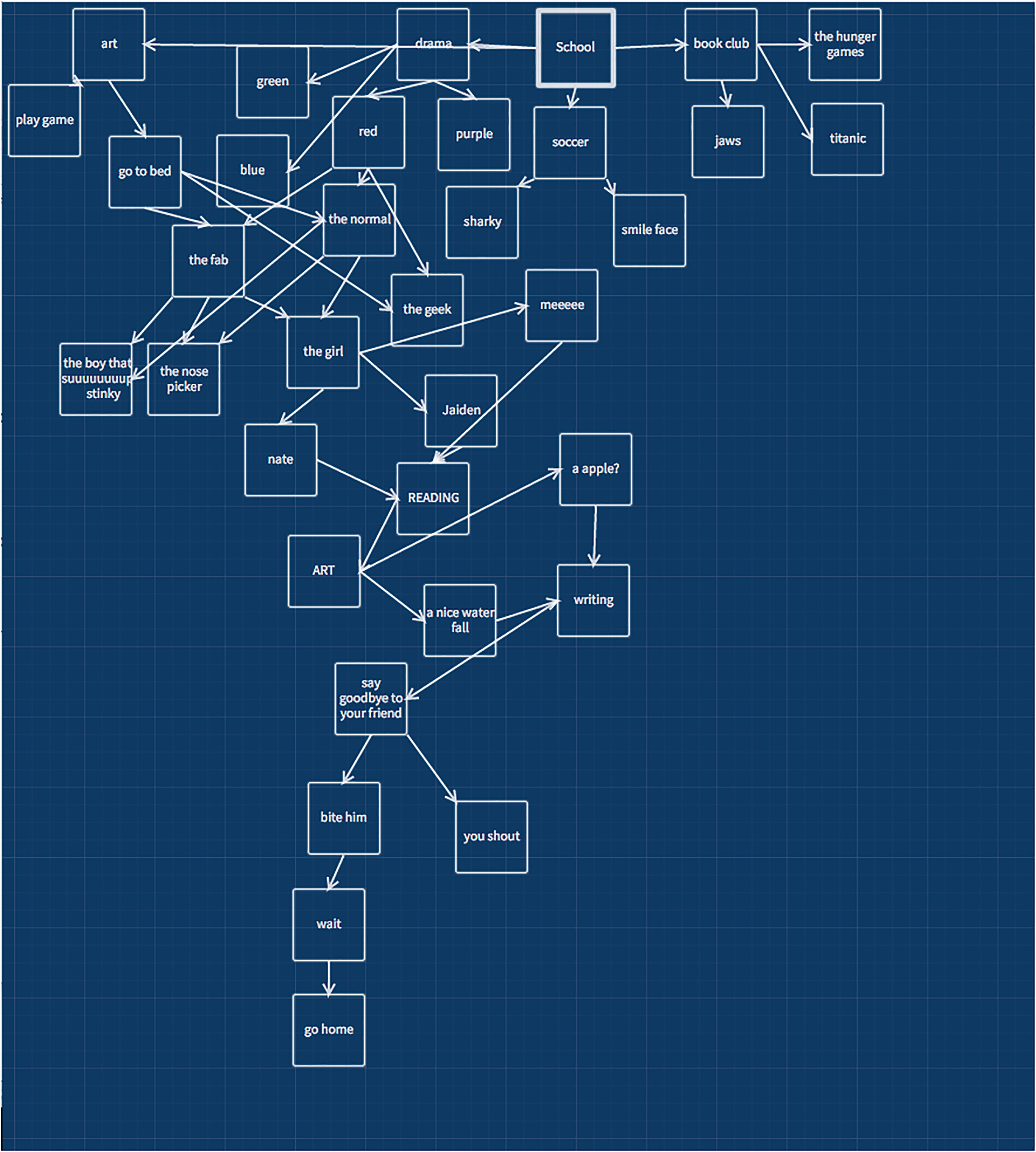
Although Gillian professed an interest in programming, she was not very interested in the more technical features of Twine, such as if–then statements. She was much more interested in coming up with elaborate game ideas and worlds and making an interesting experience for the player. She accomplished her story structures through writing and keeping track of narrative branches alone. She expressed that she was very motivated to make games in the workshop because she was able to be inspired by and write about her own interests.
Discussion
Most girls in the workshop engaged in the practices of looking up information, including references to pop culture and games, and experimenting with genre and form. They also asked each other for feedback and shared ideas and information.
Connected learning, connected writing
Through the workshop, these girls were drawn into participatory culture through their creative production with Twine. As such, they integrated their personal interests, taking parts from different media that they liked. One type of content that the girls were particularly interested in were memes. Memes are cultural artifacts that spread quickly online, and are usually intended to be humorous (Bauckhage, 2011). Looking at image memes, such as animals or cartoon characters with humorous captions (including Doge which Tammy wanted to write about), was particularly popular activity for participants. In another example, a popular blog post that links the film Frozen to all of the other Disney films ended up being the topic of discussion for 10 minutes one day, with all of the girls going to the site to look at this post. The participants in this workshop embraced these Internet-based artifacts and integrated them into their games; for example, the discussion of Disney films led to girls making games with settings inspired by these movies, and the sharing of humorous pictures led to various humorous moments in their games inspired by them.
The games connected to students’ lives in ways other than pop culture as well. Lenhart et al. (2008) found that teenagers were more motivated to write if a topic was perceived as relevant to their lives and communities. Although these girls were not yet teenagers, they told us that they enjoyed writing about their friends and everyday activities. Tammy, in particular, wrote games about her real-life friends and her pets, and she had her family members and friends play the games that she made. Gillian shared games with her father, who in turn suggested other ideas for games. Additionally, the video games which she wrote about were an important part of her world and were a shared hobby with her some of her family members and friends.
Alice wrote about more fantastical worlds—in the game she worked on most of the time, the player took the role of a unicorn. In another, she wrote about her family members, with the twist that they were all Vikings. However, she told us that she appreciated the opportunity to write about things that were not “school appropriate.” For example, teachers had told her and some of the other girls that they were not allowed to write about characters dying in their stories. Alice told us about another time that she wanted to include a unicorn “barfing rainbows” in one of her stories but was told to change it by a teacher. As such, the girls relished the opportunity to include this kind of content in their games and also took full advantage of the opportunity to experiment with writing that did not conform to school standards and genres
A number of scholars have discussed how one of the advantages of out-of-school, online writing spaces is that writers are free to experiment. They are able to try out different genres and forms and write about the things that interested them (Curwood et al., 2013). In these spaces, writers who are less interested in school writing might feel more confident and motivated, even if they are not native English speakers (Black, 2008; Lam, 2014), have challenges with writing such as dyslexia (Lammers, 2011), or simply want to write for an available and supportive audience with whom they share interests (Magnifico, 2012). While these are all examples of online spaces, feedback we received from participants indicated that this workshop may have served as a similar kind of space—one that existed outside of the bounds of school—where concerns about conforming to school genres and rules did not apply and where a supportive audience who offered feedback (in the form of the other workshop participants) were always available to play their games.
While Twine did not end up engaging girls with programming as much as I had initially hoped, I believe that it is still an excellent tool for creative expression and for allowing students to experiment with game making. I believe that the importance of this has implications beyond just Twine.
Directions for Future Research
Sharing
The participants frequently asked me to play their games and would swap computers with each other in order to play each other’s games. Indeed, sharing is an important part of participatory culture (Jenkins et al., 2007) and is also key to the fandom-based writing online that has been researched by a number of scholars (e.g. Curwood et al., 2013).
However, the participants in this workshop were not participating in these online spaces of learning and literacy development, and the workshop was a bounded experience. The girls were simply too young for us to encourage them to go on the Internet. In fact, Ms. Mila and I warned the girls to only play Twine games made by others with adult supervision due to the adult content of many Twine games posted online. If participants were older and already on social media, it would be fascinating to observe how online practices can intersect with a physical, face-to-face experience like the workshop.
The digital divide
One issue that cannot (and should not) be avoided is the access to technology that children have in and out of school. Gaming practices, especially the literacy-promoting practices found in research referenced throughout this paper, may be less prevalent or absent in low SES settings (Andrews, 2008). The school in which I conducted this research was fairly well equipped, and each of the students had a laptop to herself to use during the sessions. The school also had reliable Internet, which made using Twine online possible. Additionally, the girls had access to the Internet at home, as evidenced by the fact that several of the girls said they used Twine at home and showed their parents the tool. Finally, when I asked the girls if they would like me to give them an extra flash drive to bring home, only one of the girls said she did not already have access to a flash drive that she could use and took one of mine.
As such, these were participants who had some familiarity and background with computers and the Internet. Students without such access to technology both in their homes and in their schools, however, need this space for creative production and exposure to digital technologies even more. Further research in a variety of schools and settings is crucial.
Footnotes
Declaration of Conflicting Interests
The author(s) declared no potential conflicts of interest with respect to the research, authorship, and/or publication of this article.
Funding
The author(s) received no financial support for the research, authorship, and/or publication of this article.