




Abstract
Eighteen special education teachers explored one prominent example of three-dimensional virtual worlds, namely Second Life. This study aimed to (a) determine their perception of the effectiveness of a systematic 7-Step Virtual Worlds Teacher Training workshop in terms of enabling them to make informed decisions about the usability of virtual worlds for students with social skills challenges and (b) determine whether there was a teacher change of attitude resulting from engagement in this systematic workshop. The seven steps are described in detail. The teachers’ change of attitude was statistically significant with a large effect size. The teachers’ feedback on the effectiveness of the training program resulted in 14 practical guidelines, which informed the revised 4-Step Virtual Worlds Teacher Training model that can be used both in general and special education with minor adjustments depending on the teacher and student population.
Keywords
Introduction
Virtual worlds allow students to go on a fieldtrip, to explore the inside of a cell as part of a biology course, or to replicate classic experiments without the cost of running a real laboratory. Virtual worlds allow students to practice Spanish with native speakers in a dance club in Barcelona without traveling. Virtual worlds allow students of psychology to experience hallucinations without actually suffering from them. Virtual worlds allow groups to work in a secret cave behind a waterfall, rather than in a bland classroom, without the need of a nature trip. These options may sound unreal, but they are realistic. Taking students to three-dimensional immersive virtual worlds has become increasingly popular in education (Chapman and Stone, 2010). In particular, virtual worlds hold great promise for supporting students with social skills challenges. Most definitions of social skills reflect the notions of choosing effective communicative actions that are appropriate to a given situation (Segrin and Givertz, 2003). Individuals with autism, for example, may benefit from practicing social encounters in a safe, virtual platform (Bernardini et al., 2014; DeAngelis, 2009; Fusar-Poli et al., 2008; Parsons and Cobb, 2011; Smith et al., 2007; Stichter et al., 2014; Trepagnier et al., 2011). For these individuals, virtual worlds offer a common platform where they can get together to practice peer interaction, engage in collaboration, and take advantage of the benefits of experiential learning, all under the guidance of a virtual teacher, and without having to be in the same room (Stichter et al., 2014).
Popular examples of 3D platforms include Active Worlds, Second Life, Kitely, OpenSimWorld, Hypergrid, My Virtual Life, and, most recently, Edorble. Second Life, for example, is an online virtual world developed by Linden Lab, where people aged 16 and over can meet other residents, socialize, join groups (such as support or discussion groups), or simply explore the world independently. Hundreds of educational institutions worldwide have recognized its considerable potential for education (Ollé and Kristof, 2014). Educational platforms can be found in the areas of astronomy, medicine, music, literature, biology, history, mathematics, forensic science, ecology, and tourism, to name a few. A virtual world provides three important features: an interactive 3D environment, avatars for visual representations of the users, and a chat tool for communication (Dickey, 2011).
Although the use of virtual worlds for educational purposes has greatly increased in the past decade, there is still a lack of research addressing the preparation of teachers to use these virtual environments in teaching (Guasch et al., 2010; Guzzetti and Stokrocki, 2013; Nussli and Oh, 2014; O’Connor and Sakshaug, 2009; Pérez-García, 2009; Storey and Wolf, 2010). Research reporting on teacher training for the use of virtual worlds in special education is particularly difficult to locate, which indicates the need to provide special education teachers with training opportunities (Stichter et al., 2014). Such training opportunities would enable teachers to help their students take advantage of the potential benefits of virtual worlds for social skills practice.
While the potential for this technology in a classroom setting is immense, its practical implementation requires that teachers receive appropriate training that builds both their confidence in their virtual teaching skills and their commitment toward 3D technology. Stamina, modeling, scaffolding, and continuous mentoring are key prerequisites (Alvarez et al., 2009; Compton et al., 2010; DiPietro, 2010; Silva et al., 2010) for a successful and meaningful experience. A critical component of virtual teacher training is that all educational virtual activities should be framed by sound pedagogical rationales. School administrators might become increasingly accepting of the incorporation of virtual worlds into teaching if they are confronted with compelling evidence of purposeful and pedagogically sensible virtual teaching (Nussli et al., 2014). Increasing popularity of virtual teaching, in turn, may boost the demand for teacher training in virtual worlds.
This intervention contributes to research by providing empirical data about special education teachers’ experiences in Second Life, from the perspectives of both the teacher and the learner, with a focus on social skills practice. The intervention was based on three premises: if educators are immersed in virtual worlds to get first-hand experience, if they have repeated opportunities for inquiry-based self-reflection on the classroom applicability of Second Life for special education, and if they can receive maximal and continued support from their peers and their instructor in practicing virtual navigation and communication, then they will quickly and effectively be able to use virtual worlds to their satisfaction (Pérez-García, 2009). The research was guided by the concepts of ‘perceived usefulness’ and ‘usability.’ Perceived usefulness refers to the degree to which using Second Life would enhance learning (Fetscherin and Lattemann, 2007), whereas usability refers to the investigation of specific user needs, such as navigation, accessibility, information delivery and presentation, dialogue, security, and interface (Butkutė and Lapin, 2010). One of this intervention’s objectives was to enable special education teachers to make informed decisions about the usefulness and usability of virtual worlds for special education, especially for students with social skills challenges.
Another goal of this intervention was to help address the lack of information about virtual worlds teacher training, especially in special education, by measuring special education teachers’ perceptions of the effectiveness of virtual worlds teacher training. For the purposes of the intervention, ‘effective’ was defined as the participants’ ability to make informed decisions about using virtual worlds in both K-12 and higher education, with a focus on special education. A systematic 7-Step Virtual Worlds Teacher Training workshop (7-SVWTT) was designed to help raise 18 special educators’ awareness of the affordances and challenges of one particular virtual world, namely, Second Life.
Literature review
For many students and teachers, virtual worlds are fun and combine some of the best teaching tools from distance education, face-to-face, and virtual reality into a viable educational medium with virtually unlimited capabilities (Smith and Berge, 2009). Virtual reality helps students gain a greater understanding of abstract concepts; students can improve their understanding by manipulating and scaling virtual objects or environments, and they can visit places that distance, time, or safety concerns would normally prohibit (Jackson and Fagan, 2000). This means that learners can (a) immerse themselves in situations that would be impossible or impractical in real life (e.g. visiting a nuclear power plant), (b) take advantage of 3D data visualizations (such as the Pythagorean theorem), (c) see hidden phenomena (forces directed on an object), and (d) have easy access to museum artifacts, such as the Splo Museum in Second Life with more than 100 hands-on scientific exhibits (Rothfarb and Doherty, 2007).
Virtual worlds teacher training
Research suggests that teachers may have difficulties in developing comfort with this technology (e.g. Blankenship and Kim, 2012; Inman, 2010). From 2001 through 2012, Nussli and Oh (2014) identified 21 articles reporting on virtual worlds teacher training. Their literature review discusses (a) the importance of teacher awareness and understanding of virtual worlds, (b) how students may benefit from learning in a virtual world, (c) which virtual world to use for which target population (age, gender, education level, interest, achievement levels, and personal characteristics), (d) how to create tasks for a specific purpose, (e) how to align tasks with learning objectives and a curriculum, and (f) how learning objectives may be met or enhanced using virtual worlds. In their review, the authors extrapolated seven guidelines from the 21 articles, namely, the need for a pedagogical rationale (unique affordances of virtual worlds), managing synchronicity (how to maximize the benefits of virtual communication), providing continuous scaffolding (clarifying expectations and goals), taking into account prior virtual experience, using stimulating places (creative and visually stimulating spaces to support experiential learning), maximizing functional design (using transient space accommodating a variety of tasks), and offering technical support (helping students overcome the steep learning curve associated with virtual worlds).
Systematic attempts to provide teacher training in the realm of virtual worlds, however, have been rare (Guzzetti and Stokrocki, 2013). In 2010, Storey and Wolf reported being unable to find a College of Education that was using Second Life, still the most frequently used virtual world among educators (Dalgarno et al., 2013), as a pedagogical tool to deliver course content in teacher preparation. They emphasized that even though future teachers were strongly encouraged to engage their students by using new tools and adopting new strategies, there was little evidence of teacher education colleges practicing what they advocate (Storey and Wolf, 2010).
Objective measurement of learning gains in virtual worlds
Systematic and methodologically rigorous research testing the effectiveness of virtual worlds is still in its infancy (Hew and Cheung, 2010; Jestice, 2010), although many possible benefits of virtual realities in learning have been investigated (e.g. Dalgarno and Lee, 2010; Livingstone and Kemp, 2006; Warburton, 2009). Limitations to research typically include a lack of control groups, a lack of member checking in qualitative studies, a lack of inter- or intra-observer agreement reliability, the use of self-report measures, and the novelty effect of virtual worlds (Hew and Cheung, 2010).
Few studies have objectively measured learning outcomes. Chau and colleagues (2013), for example, described a task requiring students in an introductory management information system course to identify information security issues in a virtual office set-up in Second Life. The experimental group using Second Life performed significantly better (p < .0001) than the control group who watched a video showing the exploration in the 3D virtual environment. Farra (2012) provided another example of objectively measured learning outcomes in a 3D virtual world, namely, the learning retention of disaster training with nursing students. The experimental group who was immersed in a virtually simulated disaster experience and also completed web-based modules significantly outperformed (p < .0001) the control group who only completed the web-based modules.
Moskaliuk et al. (2013) compared three training conditions (virtual condition, standard condition, and control condition) of communications training for police officers. In terms of knowledge transfer, the findings showed that the virtual training was significantly more efficient (p = .02) than both the standard and control conditions. In terms of knowledge acquisition, both the virtual and standard trainings were equally efficient, which indicates that virtual training may be an effective tool for training complex collaborative tasks that would be too risky in real life. Finally, Okutsu et al. (2013) compared learning outcomes in an aerospace design course. Although the experimental virtual world group, which attended lectures remotely in a prototype 3D environment called Aeroquest, did not outperform the real-world control group, the virtual world group also achieved the performance benchmark defined by the exam scores of the real-world control group. The fact that both groups performed similarly suggests the untapped potential of virtual worlds as a teaching platform in early engineering courses, especially in distance education.
Social skills training in virtual worlds
Despite an array of research conducted in the field of virtual environments and special education, previous studies reporting about virtual world training for special education teachers are difficult to identify. Several studies paint a very encouraging picture of the potential of virtual worlds in assessing and educating individuals with autism, especially for social skills training. Mitchell et al. (2007), for instance, demonstrated how virtual environments could be used to teach social understanding and empathy to adolescents with autism. Training in a virtual café led to statistically significant improvements in the participants’ judgments and explanations about where to sit. Virtual worlds can help develop the ability to identify emotions of avatars (Moore et al., 2003), and have resulted in statistically significant increases in social cognitive measures and emotion recognition, as well as in real-life social and occupational functioning (Kandalaft et al., 2013).
The key advantages of a virtual environment for people with social skills challenges include: (a) anonymous interactions and high levels of interactivity, (b) a virtual space where a sense of collaboration, community, and cohesion can be developed, and (c) a virtual space where rules can be learned and tasks repeated as many times as needed (Fusar-Poli et al., 2008). Social interaction has been reported as one of the key affordances of virtual worlds. It has been associated with community building and the possibility to observe and replicate modeled behavior (e.g. Warburton, 2009). Some areas in virtual worlds offer a high degree of interaction (Firat and Kabakci Yurdakul, 2011). One of the benefits, which may increase an individual’s quality of life, includes the elimination of barriers to social participation, such as sharing a sense of community (Stendal et al., 2011). Synchronous virtual social interaction can be beneficial for individuals with social skills challenges who may feel more comfortable interacting through computers (Fusar-Poli et al., 2008).
Individuals with social skills challenges will experience less stress in all of the above situations if they can have these interactions in a virtual space, reducing the stress and sense of risk that can occur during face-to-face interaction with another person (Bernardini et al., 2014; Smith et al., 2007). The notion of a safe learning environment aligns with the “Psychosocial Moratorium Principle” (Gee, 2007), a term coined by Erik Erickson (1956). It can be applied to a learning space “where real-life consequences are lowered” (Gee 2007: 59). Social mistakes, for example, are less catastrophic in a virtual world than in a real environment (Strickland, 1996). Thus, learning in a virtual space may be more motivating for individuals who are afraid of failure because there is always the opportunity to retry as many times as needed.
In sum, the potential benefits of virtual worlds for students with autism are that the users can role play (Parsons and Mitchell, 2002), learn social rules and social skills (Cobb et al., 2002; Rutten et al., 2003), have control over their learning experience (Cheng et al., 2002), practice and learn by their mistakes (Cobb et al., 2002), and learn at their own pace (Parsons et al., 2004) in an environment that is increasingly similar to the real world (Parsons and Mitchell, 2002).
The systematic 7-SVWTT described in the present study was designed in a way that allows for simple adjustments so that it can be used for teacher educators in various fields and teachers with various student populations. The participating teachers’ feedback on the effectiveness of the 7-SVWTT has resulted in a revised model of a systematic four-step virtual worlds teacher training. In the next section, each step will be described in detail.
Context and methodology
Research questions
What are special education teachers’ perceptions of the effectiveness of the systematic 7-SVWTT in terms of enabling them to make informed decisions about the usability of virtual worlds for special education? To what extent is there a teacher change of attitude resulting from engagement in the systematic 7-SVWTT?
Research design
In this exploratory case study, a mixed-methods approach enabled the researchers to explore the data from different perspectives. The qualitative data were used to gain insight into the perceptions and reflections of special education teachers. The quantitative data informed the story and substantiated the qualitative data. Multiple data streams from the preliminary survey, the post-survey, the written reflections, the lesson plan analysis prompts, and the researcher journal were used as triangulation tools.
Participants
The intervention was an integral part of a graduate-level technology course for special education teachers at a university in the west coast of the US. The intervention was approved by the university’s Institutional Review Board for the Protection of Human Subjects. The convenience sample consisted of 18 (16 female and two male) special education teachers who were specializing in students with mild and moderate disabilities. Most participating teachers were between 20 and 30 years old. Fifty percent (nine) of the participants were between 20 and 25, 33% (six) between 26 and 30, 11% (two) between 31 and 35, and 6% (one) between 41 and 45 years old. Eighty-nine percent (16) were female and 11% (two) were male. The majority (78%) had less than one year of teaching experience. Their daily use of technology varied between less than an hour and more than 10 hours. Both the mean and the median were five hours a day. When asked to rate how tech-savvy they considered themselves on a scale from 1 to 10 (1 = I dislike technology and I don’t feel comfortable using it. 10 = I love technology and I am very good at using it.), all answers ranged between 3 and 10, with a mean of 7.33 and a mode of 7. Only three participants rated their technological expertise as between 3 and 5, whereas 15 participants rated themselves between 6 and 10. Seventy-two percent stated that they were inexperienced users (rare use) of virtual worlds, while 28% reported using virtual worlds occasionally. The class met once a week for four hours during an entire semester. One of the course projects was the purposeful and critical exploration of Second Life mediated by a systematic workshop.
Systematic 7-SVWTT
Virtual worlds teacher training is important because it helps teachers develop an understanding of the pragmatics of 3D technology integration into their teaching. Eighteen special education teachers collaboratively explored one prominent example of virtual worlds (Second Life) through a combination of practical and reflective activities, which will be described in detail. A survey quantitatively measured whether there was a statistically significant change of attitude toward the usability of 3D virtual worlds in special education as a result of the intervention. Qualitative analyses were based on multiple instruments. Figure 1 displays the purpose of each step of the intervention.
Purpose of each step of the teacher training.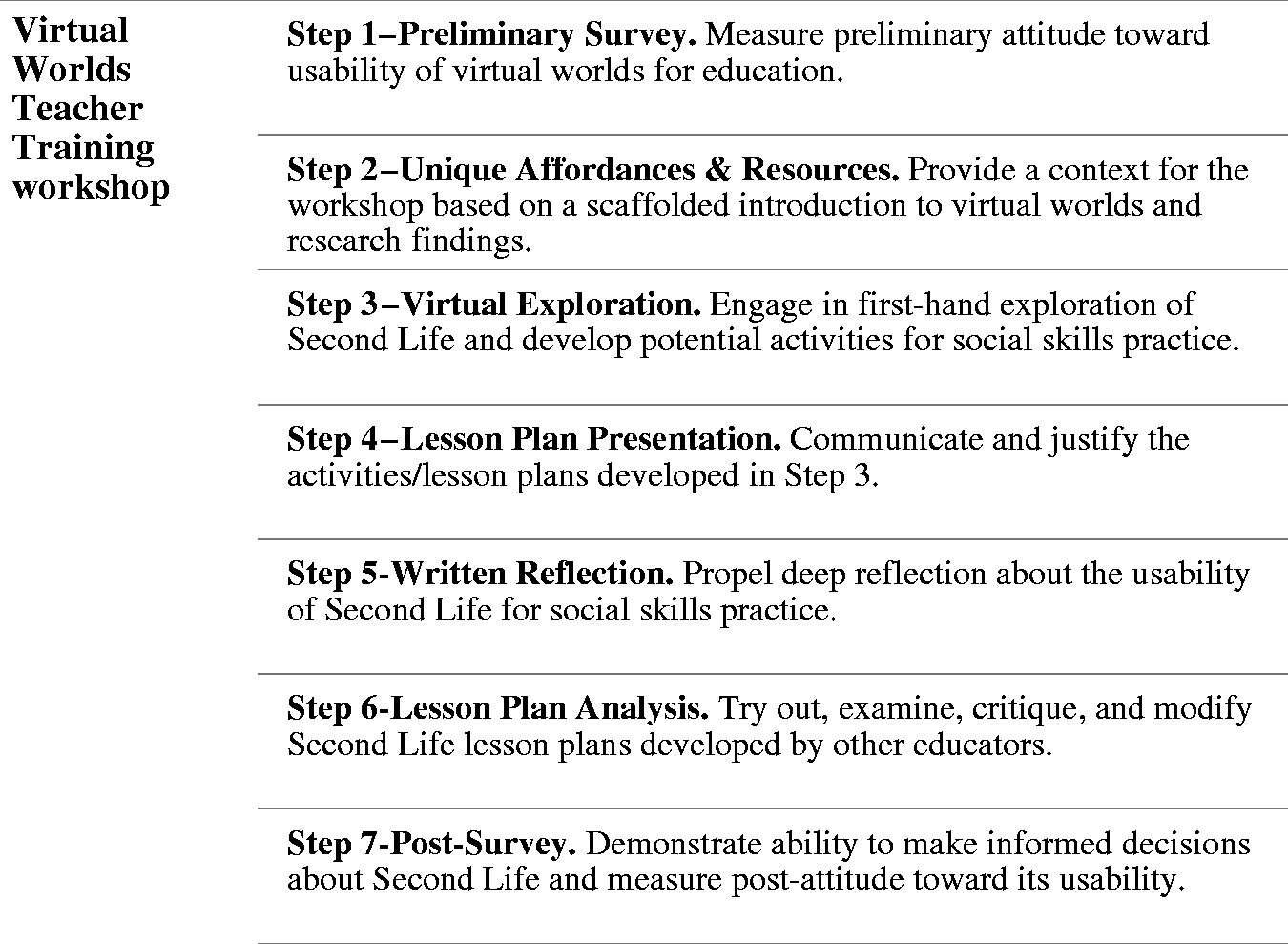
Instruments and procedures
The purpose and procedure of each step will be described. All instruments are available from the authors.
Step 1 – introduction
Eleven-item attitude scale.
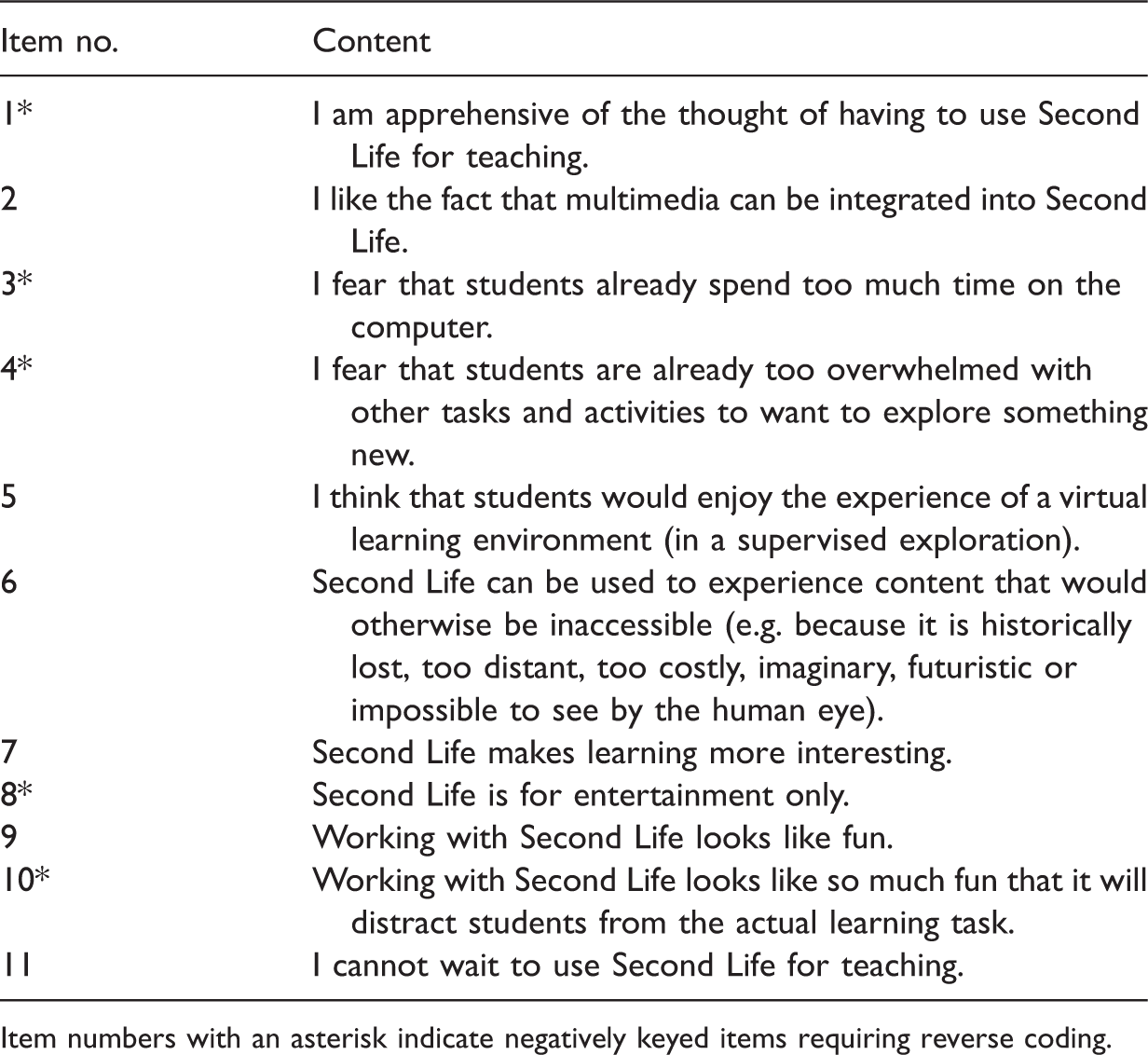
Item numbers with an asterisk indicate negatively keyed items requiring reverse coding.
Step 2 – unique affordances and resources
The primary purpose of this step was to provide a scaffolded introduction to the topic of virtual worlds in education, to contextualize the intervention, and to share research-based findings about the unique affordances of virtual worlds for both general and special education. The participants watched two short videos for introduction purposes. One video illustrated how a virtual space could be used to teach history, and the other video discussed the possibilities of using a virtual world to practice social skills with individuals with autism. In addition, the instructor (second author) introduced the five unique benefits of virtual worlds, as identified by Dalgarno and Lee (2010), and offered a brief overview of the special affordances for individuals with social skills challenges.
The instructor also provided an overview of the inquiry cycle that framed the training and shared virtual world resources for educators. The inquiry cycle started with an open-ended question for investigation: how usable is Second Life for special education purposes? Overall, participants completed seven steps during which they built knowledge of virtual worlds (Second Life in particular) based on first-hand collaborative experiences. Next, the instructor showed a three-minute screencast to provide tips on how to join virtual communities of educators interested in teaching in Second Life, how to locate Second Life destinations according to subject areas, and how to follow developments in virtual worlds research (not limited to Second Life). Participants received access to a multitude of resources about 3D virtual worlds and specific resources for Second Life educators (e.g. Bignell and Parson, 2010; Savin-Baden, 2010).
Step 3 – virtual exploration
The purpose was to engage participants in a first-hand exploration of Second Life as a key step in their investigation of its usefulness for special education. Participants logged in to Second Life from home to ensure a stable and, if possible, hard-wired Internet connection, and met with their group members in a designated region. To maximize sound quality, Skype was used for voice communication, which means that Second Life and Skype were running simultaneously. Groups had chosen one out of 16 pre-tested educational destinations ahead of time, namely, the Abyss Observatory (Nishimura et al., 2012), Genome Island, Exploratorium, Sploland, The Museum of Surrealism, Paris 1900, Etopia Eco Village, St. Michel The Jules Vernes Museum, Imzadi Island, Holocaust Museum, Roma, Renaissance Island, Sunny Breezes Museum Island, StarTrek Museum of Science, Oddprofessor’s Museum and Science Center, and Spaceport Alpha (examples shown in Figure 2). All of the pre-tested destinations tend to promote a sense of discovery, which aligns with Gee’s “Discovery Principle” (2007). A virtual learning space should provide ample opportunities for experimentation and discovery, with minimal teacher input.
Underwater exploration (Imzadi), learning about alternative energies (Etopia Eco Village), and a history lesson in Notre Dame Cathedral (Paris 1900).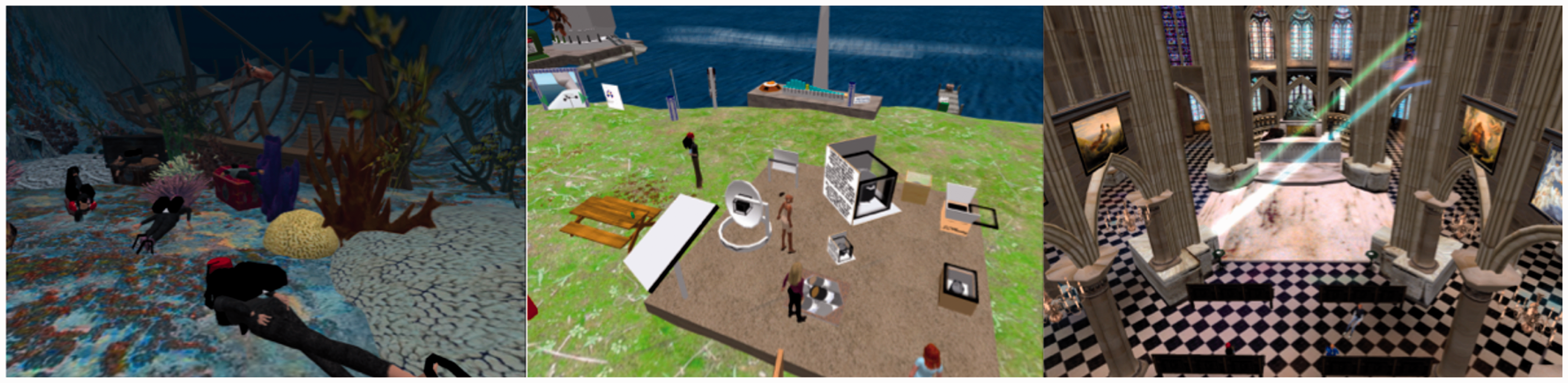
Participants were given 30 minutes for the collaborative exploration of one destination, and then brainstormed tentative learning activities for 30 minutes. They specified the learning objectives, determined the student group for whom they were designing the activities, developed a rationale supporting the use of Second Life specifically for these activities, rated the Second Life destination for special education students, and discussed potential modifications of the destination. The first author (facilitator) provided an overview of the highlights of a specific region and was also in charge of technical troubleshooting. The second author (instructor) scaffolded the tasks and asked critical questions to prompt deeper reflection.
Step 4 – lesson plan presentation
The purpose in Step 4 was to help the participants make an informed decision about the usability of the explored Second Life regions by asking them to communicate and justify the learning activities that they had developed in Step 3. The lesson plan presentations were given in a traditional classroom, with all participants and the instructor (second author) physically present. The presentations were video-taped for later analysis.
Step 5 – written reflection prompts
The reflection step offered an opportunity for participants to express, clarify, justify, and represent their beliefs about their new experiences in a non-traditional learning environment. One of the questions required the participants to think of a lesson that would accomplish the following goals: Research suggests that virtual worlds offer potentially unique benefits to develop social and communicative skills and provide educational intervention for individuals with social skills challenges, such as autism or Asperger (Mitchell et al., 2007). Question: How would you create a virtual lesson that enhances interactivity among individuals with social skills challenges, supports a sense of collaboration, and where individuals with social skills challenges experience less stress than in a face-to-face situation?
To propel deeper reflection and to engage in a conversation with the participants, the first author posted a (written) response to each participant’s (written) reflection, including one new, individually tailored question. For example, after reading the individual reflections, the first author asked one of the participants, “When are virtual worlds an advantage in instruction, and when are they more of an obstacle?” This participant replied in writing: The question that comes up is what makes virtual worlds better than [a] regular online curriculum? An online curriculum is focused on content, while virtual worlds incorporate social interaction. That’s what makes virtual worlds advantageous, when socializing is incorporated.
Step 6 – lesson plan analysis
The purpose in Step 6 was to try out, examine, critique, and modify an existing lesson plan designed around an educational region, for example, a lesson plan for an eighth grade earth/environmental science course using the International Spaceflight Museum in Second Life. In the third class meeting, one week after the (written) reflections had been posted, participants chose and analyzed one existing lesson plan from a selection of nine lesson plans, which had been developed by other educators (http://msitsecondlife.wikispaces.com/Lesson+Plans). The authors then created an overview of these destinations with brief descriptions of each Second Life region, the subject matter, the Second Life hyperlink (SLurl), and the grade level for which the lesson plan had been designed. The participants received a printout of their selected lesson plan. With a partner, they carried out each step at the university’s Mac laboratory. Each participant was instructed to navigate through Second Life at an individual computer station. During and after the virtual fieldtrip, partners engaged with each other to discuss the four prompts. The written prompts steered the participants’ attention toward the unique affordances and challenges of virtual worlds and the special needs of students with social skills challenges. The participants were also asked to reflect on how learning happens in Second Life, based on the specific lesson plan activities they had chosen for analysis. Each pair submitted their written answers to the four prompts.
Step 7 – post-survey
The post-survey consisted of 37 items. The content revolved around the participants’ perceptions of the components of effective virtual worlds teacher training, the classroom applicability of Second Life for special education, and collaborative learning in Second Life. Reliability has been demonstrated for those 11 survey items (attitude scale) that were used both in the preliminary and the post-survey.
Additional instruments included a researcher journal and a pre- and post-interview with the instructor (second author) to examine potential biases.
Data analysis
Quantitative data analysis
The participants’ answers to the 11-item attitude scale were coded and summed to obtain a cumulative attitude score (maximum = 55) regarding their perception of the classroom applicability of Second Life for special education. The class means in the pre- and post-survey were calculated. To explore the difference in means, non-parametric Wilcoxon signed-rank tests were performed in SPSS. To explore whether the difference in means was statistically significant, given the small sample size (N = 18) and inability to verify the assumptions required of a parametric test, the Wilcoxon signed-rank test was performed. The significance level was set at p < .05.
Qualitative data analysis
The qualitative data emerged from multiple sources, namely, from the open-ended items of the preliminary survey, the post-survey, the written reflection, the lesson plan analysis, the researcher journal, and the pre- and post-interview with the instructor. After rereading the raw data, recurring themes were identified through open-coding. Preliminary codes were developed in the first two rounds of reading. Each code received an extensive code description based on both the participant responses and the virtual worlds research. It was ensured that codes were mutually exhaustive and clearly delineated (Merriam, 2009). A team of three interraters validated 41 preliminary codes, which were then entered into NVivo for a frequency analysis. Of the high-frequency codes identified in NVivo, only those that directly relate to the effectiveness of the systematic training will be reported and discussed here.
Results
Research question 1: effectiveness of the teacher training intervention
Effectiveness of the individual steps
In this first result section, we will report the special education teachers’ perceptions of the effectiveness of the training. Our goal was to find out how well the workshop assisted the teachers in making informed decisions about Second Life for the purpose of practicing social skills. Overall, the participants were quite satisfied with the intervention. Steps 3 and 4, in particular, received the best ratings. As a reminder: Step 3 consisted of a hands-on, guided virtual exploration in Second Life. Step 4 required participants to (a) brainstorm potential learning activities that could be conducted in Second Life with a focus on social skills practice and (b) present these learning activities as well as a pedagogical rationale to their peers in class. The presentations were followed by peer and instructor feedback. None of the other training steps received a similarly high level of positive responses. Rather, most responses fell under the category of “Reasonably effective.”
Overall effectiveness of the intervention for social skills practice
When asked how well the intervention had prepared them to make informed decisions about the usability of virtual worlds for students with social skills challenges to practice social encounters, 56% (10) reported “reasonably well” and 33% (six) “quite well,” whereas 11% (two) were rather unsatisfied (“not so well).”
Design suggestions
Components of effective virtual worlds teacher training.
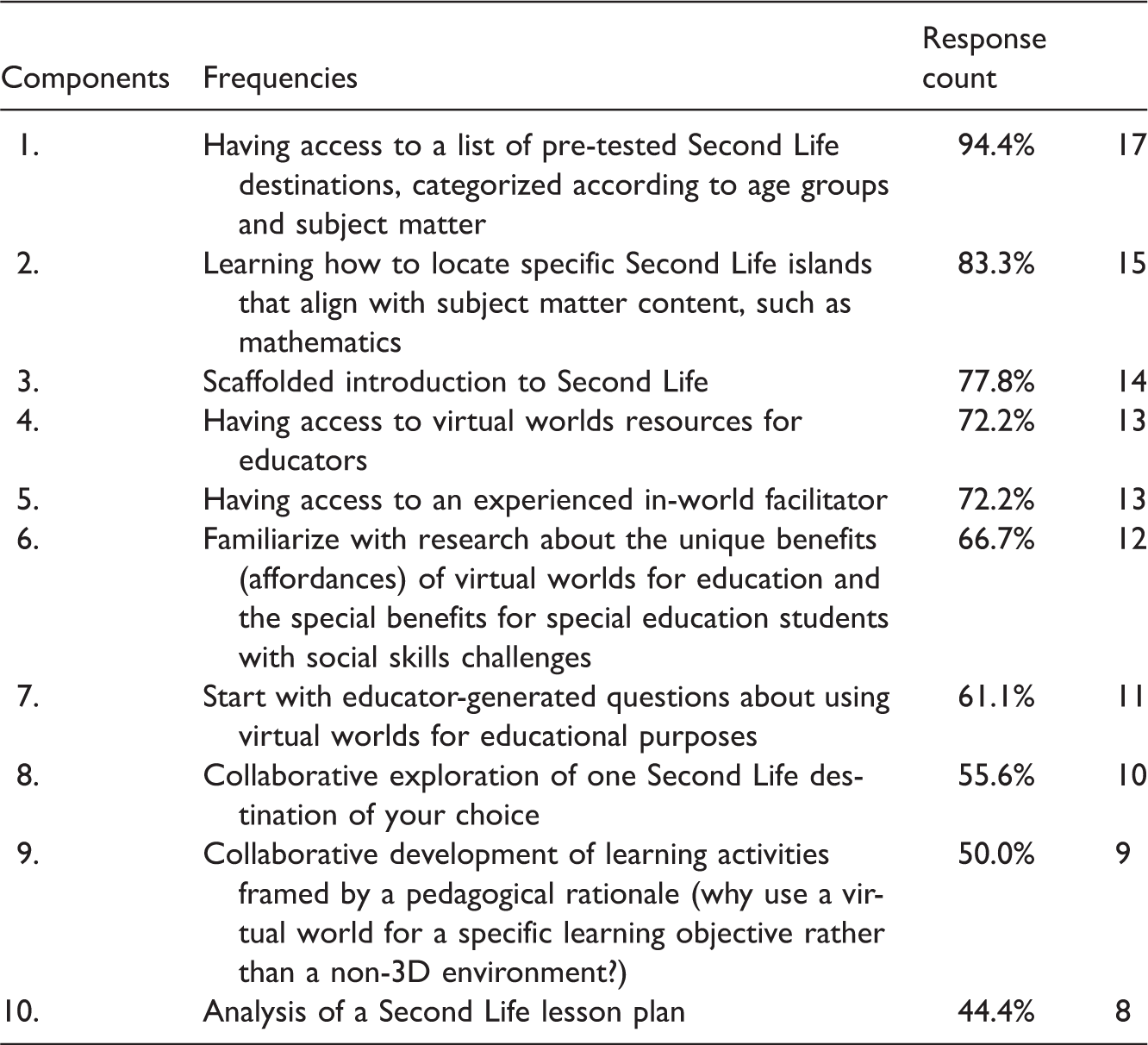
The top five components suggest that the teachers were especially interested in getting scaffolded instruction on how to locate and access pre-tested, subject-appropriate Second Life destinations and resources for virtual educators, as well as having access to an experienced in-world facilitator. The analysis of a Second Life lesson plan developed by other educators was the least popular element. A possible explanation for the unpopularity of the lesson plan analysis was: Something else we noticed that maybe the person who created this lesson plan thought of but just didn’t mention it within the plan is to include more activities where you socialize and communicate with a partner. This lesson is just a list with places to go or see, but it doesn’t tell the students to read the cards together, answer questions together, lead one another, etc. We believe this lesson should be more specific to students with social skills challenges and give them specific tasks to work with one another.
Virtual world pedagogy
Virtual world pedagogy describes how virtual worlds can be implemented pedagogically and practically, addresses the training and support of 3D virtual teachers, describes the type of activities that could be undertaken in virtual worlds, defines the extent of learner support, and discusses curricular alignment with regard to virtual worlds.
Pedagogically wise implementation
The participants raised a topic that has been widely discussed in virtual world research, namely, the pedagogically wise use of virtual worlds. They tended to agree that “teachers should use their islands wisely and look for the best ways of how to incorporate this lesson into other standards for different subjects (i.e. art, marine science life, sustainability, etc.).”
Activities
The participants reflected on pedagogically sound activities and applications. The favorite activities were timed scavenger hunts and games incorporating other topics/subjects that improve on-task behavior, are fun for students, and simultaneously promote socializing. Several participants, however, pointed out an apparent lack of games. It was suggested that activities should be rich in content and engagement; also, they should be framed by clear, direct, and simple tasks. While some of the suggested activities seemed to be borrowed from traditional lines of instruction, the following participant, for instance, demonstrated out-of-the box thinking: I would like to see a social dining place, where students can order food and make small talk. Maybe an amusement park where they can wait in lines and ride roller coasters. You could have a rehearsed, set event occur that students can repeat and interact with. For example, have a 3D reenactment of the JFK assassination that students can walk through, fly through, and see how the events unfolded. They can explore the conspiracy theories. Or maybe the Berlin wall falling, etc.
Model lesson plans
It was also suggested that teachers should use model lesson plans to frame virtual fieldtrips to avoid spending time on creating these themselves. This concern makes sense given that virtual lesson design tends to be much more time-intensive than preparing a regular lesson plan.
Modeling practical implementation
The participants appreciated being shown how virtual teaching and learning can work and how technical issues can be addressed, which “has made them feel much better about their ability to handle any issues that may arise.”
Teacher training and teacher support
The participants highlighted the need for continuous support during the transition into virtual teachers. They also emphasized the need for teachers to prepare themselves thoroughly before sending students to a virtual world, such as Second Life, not only to develop the ability to troubleshoot but also to become aware of potential frustrations that students might encounter. The need for in-depth training was mentioned several times, for example in the form of “an online training program that walks you through the Second Life mechanics,” not only to avoid frustrations but also to avoid losing time on troubleshooting issues. One participant provided feedback, saying, “I think how we have been trying it out with other teachers and using activities as well as coming up with our own is a really good way because it helps us see things from the students’ eyes.” Allowing teachers to explore Second Life as learners may better enable them to relate to their own students’ experiences. Teachers should “understand the possible errors students might encounter so that they are able to provide technical support to their students.”
Need for technical facilitator
Although it was agreed “that teachers should be trained on what to do or how to handle common technical glitches that may occur during Second Life,” the participants highlighted frequently that a technical troubleshooter should be present during a virtual class activity. While the technical troubleshooter can assist those individuals experiencing technical issues, the instructor can keep focusing on the task at hand, for example, facilitating a group discussion or accompanying students on a virtual sightseeing trip. It would be difficult for an instructor to do both simultaneously, that is, troubleshoot technical problems and continue to facilitate a virtual lesson.
Ground rules and control
Both the need for setting ground rules and the concept of “having control” emerged as important prerequisites. Typical statements were, “A teacher has total control over the environment: what the avatars look like, what items are in it, what the avatars can do.”
Learner support
Throughout the participants’ reflections on the practical implementation of Second Life as one example of virtual worlds, they emphasized the importance of learner support. Key descriptors of learner support included guided, structured, scaffolded, direction, ground rules, and control.
Structured guidance and scaffolding
In this 7-SVWTT, structured guidance was key to ensuring smooth procedures, providing satisfying user experiences, and achieving learning. Many participants mentioned that it was essential to prepare a well-structured plan to guide students through a virtual activity. Some were wondering to what extent Second Life could be tailored to the individual needs of students with different needs. When discussing the importance of scaffolding, it became readily apparent that a few participants viewed the abundance of visual stimuli, interactive objects, and content as beneficial, whereas most participants tended to perceive the virtual environment as overwhelming due to the abundance of space and stimuli. Some participants suggested scaffolding a virtual activity with explicit teaching and coaching before and during a virtual fieldtrip. To facilitate conversation and communication in a structured way, participants recommended offering unobtrusive, structural support, such as good lead questions and sentence starters. The abundance of space and stimuli is also evident in the next topic.
Direction and disorientation
The concept of direction emerged because some participants had difficulties with teleportation. We believe that a teacher needs to transport the students to [sic] direct spot of where the tour begins. When we first got to the island, we were so lost and had no idea where to go, and the map didn’t help much.
In the next section, we will present the quantitative results and report the change in the teachers’ attitude toward the use of virtual worlds.
Research question 2: change in the teachers’ attitude
Item means, item mean differences, and standard deviations, results of Wilcoxon signed-rank test for differences between means on the attitude survey.
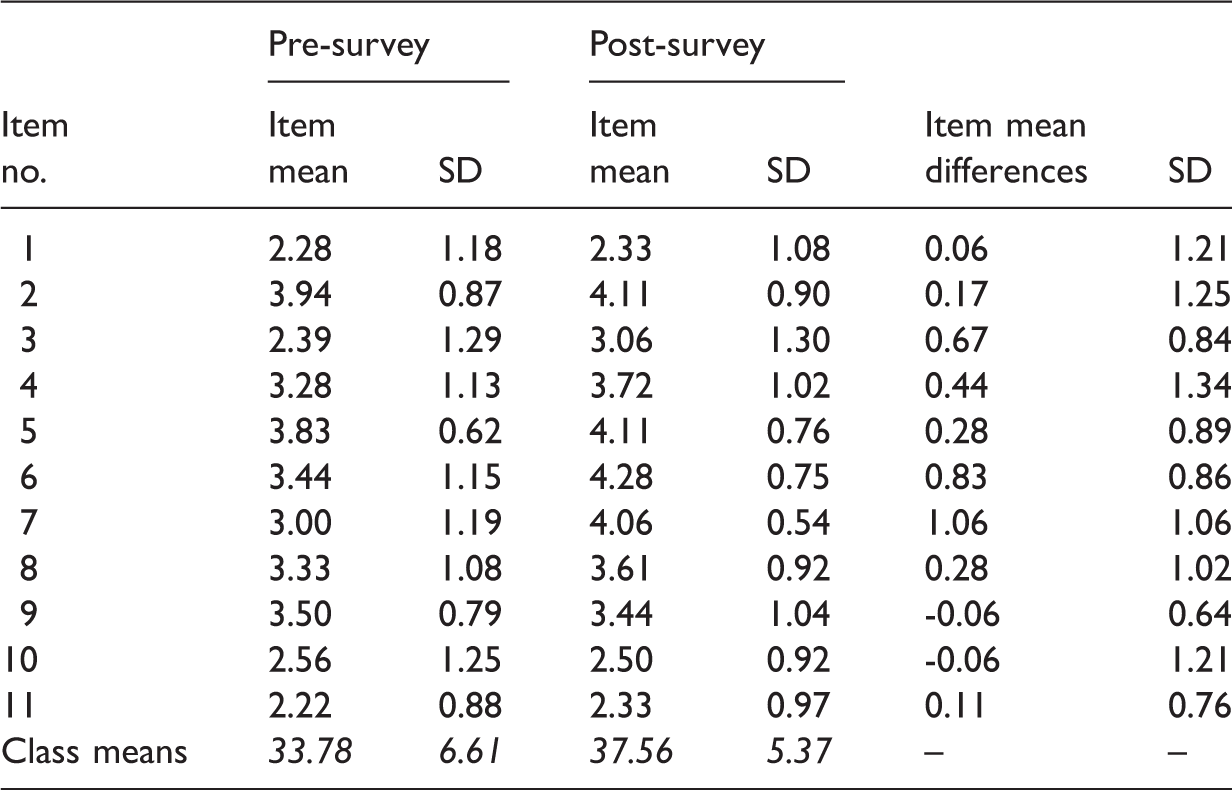
As shown in Table 3 second-to-last column under Item mean differences, items 3, 6, and 7 show the largest gains. Item 3 (“I fear that students already spend too much time on the computer”) was negatively keyed and reverse-coded for data analysis, which indicates that the participants’ fear about excessive computer time actually decreased. Item 6 (“Second Life can be used to experience content that would otherwise be inaccessible (e.g. because it is historically lost, too distant, too costly, imaginary, futuristic or impossible to see by the human eye)”) also emerged as a key topic in the qualitative data. Item 7 (“I think that students would enjoy the experience of a virtual learning environment (in a supervised exploration)”) represents the participants’ perception of whether Second Life makes learning more interesting. This gain is also supported by the qualitative data in that the participants acknowledged that Second Life may promote learning generally, and active learning in particular. The post-survey attitude score of 78% (14) of the participants increased, whereas the scores of 16% (three) decreased. No change was noted for 6% (one) of the participants. The attitude scores ranged from 22 to 42 at the pre-survey, whereas at the post-survey they ranged from 30 to 48. The median increased from 31.5 at the pre-survey to 36.5 at the post-survey, and the mean increased from 33.78 to 37.56. Reliability analyses of the preliminary and post-surveys (11 item-attitude scale) were conducted again after administration. The overall reliability was alpha .79 and .72 for the pre- and post-surveys, respectively.
Discussion
Research question 1: effectiveness of the workshop
Overall, the 18 special educators found the 7-SVWTT to be effective because it helped them develop the ability to make informed decisions about the usability of virtual worlds (Second Life in particular) for special education purposes. Most of the seven steps of the intervention received reasonably good ratings, although the participants suggested a number of improvements. When asked about the critical components of a virtual worlds teacher training workshop, the most popular were: (a) having access to a list of pre-tested Second Life destinations, (b) getting instructions on how to locate subject-appropriate destinations, (c) receiving a scaffolded introduction to Second Life, (d) having access to resources for educators, and (e) having access to an experienced in-world facilitator. In the next section, we will discuss how the workshop could be improved.
Teaching virtual mini-lessons
One way to improve the training would be to have participants teach a mini-lesson. Such a simulation would reinforce the experiential aspects, which would help them experience what it means to be a 3D virtual teacher, having to address questions such as how to avoid a lesson in which the technology overshadows the pedagogy (de Freitas and Oliver, 2006). Educators will benefit from making exact plans before starting to teach virtually. Planning instruction in a virtual world requires more care and accuracy and a clear rationale for each phase of learning (Alvarez et al., 2009; Davey, 2005; de Freitas and Neumann, 2009; Ollé and Kristof, 2014; Silva et al., 2010). In a virtual space, it is more challenging to know what the students are doing and in which phase of a task they are than in a real-life environment.
Extended training
Another way to improve the intervention would be to give participants more time to process the information. In Step 2, for example, the participants watched a three-minute screencast outlining several virtual world resources for educators without the opportunity to try any of these resources in class. Although they had received an extensive list with over 300 virtual educational spaces in Second Life, as well as an ebook offering practical guidance to using Second Life in higher education, it is very unlikely that they were able to spend time exploring these resources in their own time.
Age-appropriate platform
Exploring a more age-appropriate virtual world or a variety of virtual worlds would have been another option to improve the training. The use of Second Life for this training led to intense discussions among the participants, especially in terms of potentially inappropriate content.
Next, we will discuss how our findings support, extend, or contradict previous research findings.
Virtual world pedagogy
In terms of virtual world pedagogy, teacher training and teacher support emerged as critical areas, which is in agreement with previous research (e.g. Dickey, 2011; Good et al., 2008; O’Connor, 2010). In the present study, these areas have manifested themselves in the teachers’ concerns about the practical implementation of Second Life into their teaching; concerns about learner support; classroom management, such as control; the need for access to a coach or mentor for ongoing pedagogical guidance; the request for access to tested resources and virtual regions to ease the newcomers’ transition into virtual teachers; and access to a technical facilitator/troubleshooter while teaching virtually. The study’s findings concur with those of Omale et al. (2009), who recommended that virtual tasks should be well-structured, with clearly defined student roles and responsibilities. The present study also reinforces findings by Storey and Wolf (2010), who emphasized the importance of clearly identified learning outcomes, as well as pedagogical and technical scaffolds to support understanding, assessment, knowledge building, and interaction. Our participants perceived the first-hand experience of one example of a virtual world to be useful because exploring such a platform through the lens of a student may help teachers understand possible student errors, successes, and frustrations. Although the participants frequently mentioned technical issues, they also pointed out that it had been useful to see the types of problems that could appear and how these could be addressed, which indicates that seeing someone model troubleshooting may help increase the teachers’ self-confidence in their own troubleshooting abilities.
Both authors modeled how to divide responsibilities, with one person guiding the task and the other person acting as a technical facilitator and troubleshooter, which supports Ollé and Kristof (2014), who highlighted that multiple teachers and facilitators should simultaneously be present in-world to offer support. While it could be argued that most schools do not have the resources to provide multiple teachers and facilitators to support an in-world experience, it is critical that teachers new to virtual worlds receive maximal technical support initially, as well as pedagogical mentoring over a longer period of time (Silva et al., 2010). This level of support could be achieved by developing a peer-support network through which more experienced virtual teachers support newcomers.
The participants were especially interested in curriculum-related areas and practical procedures, specifically how virtual activities could be incorporated into their teaching and be aligned with the learning objectives. One possibility to help teachers see how virtual worlds, such as Second Life, can be applied practically is to share empirical articles with them that describe in detail how a lesson was taught, why it was taught that way, why the authors chose a virtual world as a medium for instruction, and if the learning gain was superior to other modes of transmission. Virtual worlds research offers numerous examples of practical classroom applications, such as Morgan (2013), who used the U.S. Holocaust Museum in Second Life to facilitate a more intimate encounter with a historical event and as a venue for a student-led history discussion group, combined with historical inquiry, research, and creativity. Similarly, Prude (2013) described teaching Asian religions in Asian-inspired destinations in Second Life using a synchronous discussion format. These applications, however, are mostly used in higher education and rarely address the needs of special education students.
Learner support
The fact that our participants emphasized the need for scaffolding is not surprising because virtual environments tend to be ill-structured (Hills and Hannafin, 2001). Our participants highlighted the importance of giving students the freedom of exploration, which is in line with the principles of inquiry-based learning, experiential learning, and Gee’s (2007) “Discovery Principle”. At the same time, however, the participants realized that virtual teachers need to provide more structure than might be necessary in a face-to-face lesson. Careful scaffolding (Delwiche, 2006; McVey, 2008; Mayrath et al., 2007; Rappa et al., 2009; Sanchez, 2007) and well-structured virtual class management and organization are vital because unpredictable, open-ended, or less structured virtual activities tend to decrease student engagement (Penfold, 2008).
The participants’ wish to offer strong guidance can be interpreted as a natural consequence of the disorientation they experienced during their own virtual immersion. Many were unable to find a region despite having access to the Second Life hyperlink to a specific destination. Therefore, the facilitator (first author) had to offer teleportation quite frequently. The feeling of disorientation was also addressed in Boland (2009). Although she reported that her participants’ confusion and disorientation decreased with time spent in-world, it seems critical to address these threats during a virtual training session because a feeling of disorientation can undermine teachers’ and students’ self-confidence in their technical abilities, thereby reducing their willingness to use virtual worlds. Confusion and disorientation can be avoided by presenting teachers with clear instructions on how to find educational destinations, and by confining an activity to a designated space within a larger area. As the participants were reflecting on learner support, they also raised questions of classroom management.
The data also revealed a potential control issue, which seems to be linked with the participants’ fear of inappropriateness. The teachers realized that classroom management in a 3D space is different from in a real-world classroom. Having control over students may, indeed, be important when working with younger students. In the same vein, a common fear among the participants was to lose their students in the virtual space. It makes sense that teachers of younger students, special educators in particular, would be concerned about losing track of their students and that these students, in turn, may have a traumatizing experience. The teachers’ desire for control, however, was rather surprising, given that many participants had previously emphasized the importance of experiential learning, which would require teachers to let students explore a virtual space freely. This potential contradiction raises the question of whether too much teacher control may hamper students’ motivation and sense of exploration.
Research question 2: change of the teachers’ attitude
The cumulative attitude scores were based on the 11-item attitude scale, which inquired about the teachers’ fears, their perceptions of the affordances and challenges of Second Life, and their enthusiasm and preparedness to use Second Life, or a similar virtual world, in their own classroom. The scores suggest that the teachers’ attitudes toward using Second Life for educational purposes became more positive as a result of the intervention at a statistically significant increase (p = .02, r = .51). The result suggests a reconceptualization of the participants’ beliefs, similar to the results of the pilot studies (Nussli et al., 2014; Oh and Nussli, 2014a). At the beginning of the workshop, the teachers had reservations about the use of virtual worlds for education, but after being immersed in Second Life and after exposure to empirically identified unique affordances of virtual worlds for students with social skills challenges, they had a more positive attitude.
With regard to the participants’ change in attitude, the increase from a mean score of 33.78 (SD = 6.61) to a mean score of 37.56 (SD = 5.37) was equally spread over the entire range (22 to 42 in the preliminary survey, 30 to 48 in the post-survey). These findings indicate that for the majority of the participants, the intervention has made, if not a big difference, a noticeable difference compared with their initial attitude. This positive change justifies the intervention because today’s 21st-century educators may benefit from being aware of the potential classroom applicability of these 3D tools.
Implications
Fourteen guidelines for the design of effective virtual worlds teacher training.

The above recommendations have informed the revised 4-Step Virtual Worlds Teacher Training, which encompasses four steps describing the major learning phases a transitioning teacher has to go through, namely, introduction, exploration, reflection, and assessment. These four pedagogical steps replace the seven, rather mechanical, steps of the original intervention. The training is framed by two critical factors, namely, ongoing access to pedagogical guidance and technical facilitation. Figure 3 displays the revised four-step model.
Revised 4-Step Virtual Worlds Teacher Training model.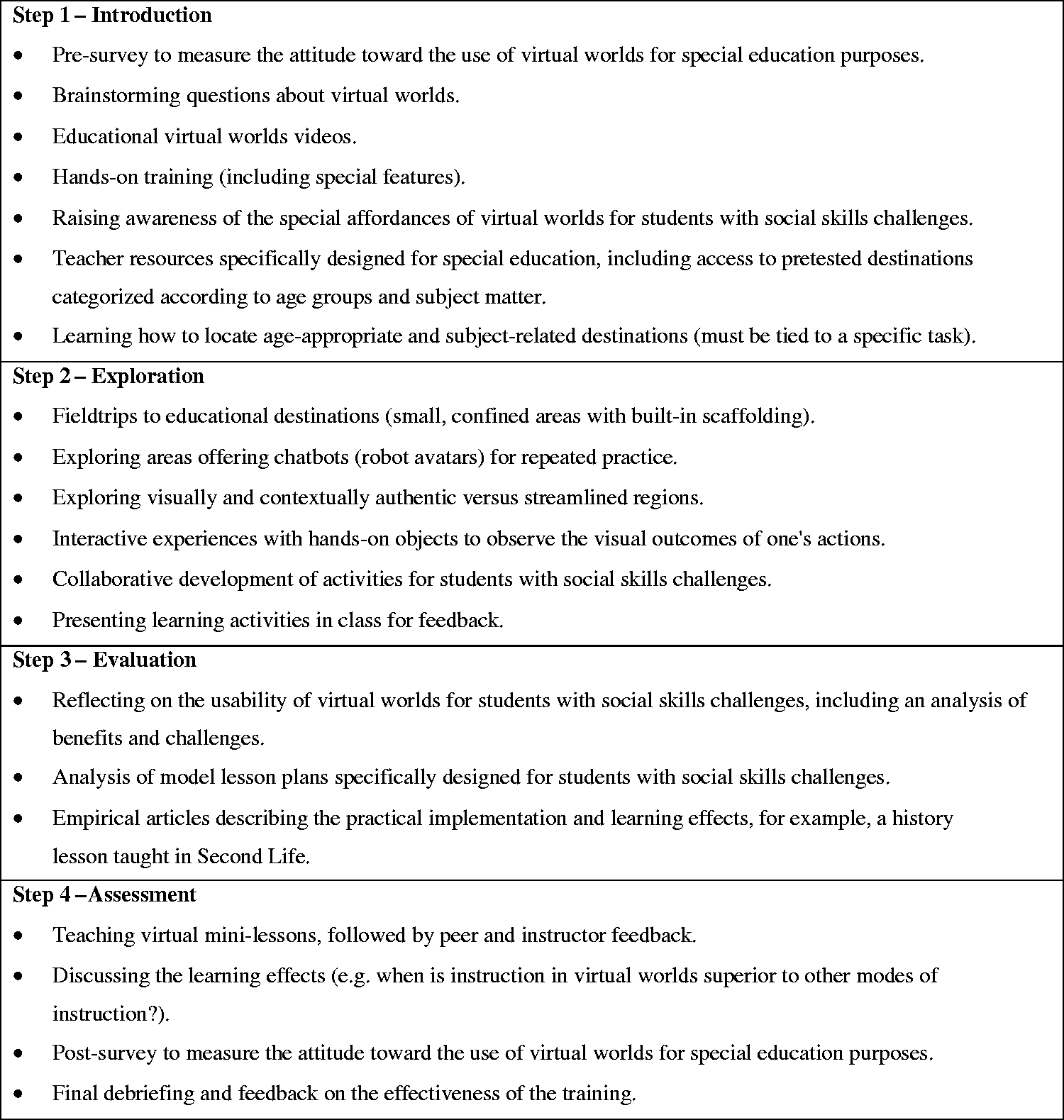
Admittedly, the question of the implementation of virtual worlds teacher training into teacher credential programs is a difficult one due to time constraints and a lack of freedom in teacher education. More realistically, optional training for teachers interested in virtual worlds could be offered via professional development. Each of the four steps of the revised model could be offered as an individual module (with increasing difficulty and immersion) in a half-day-long training.
Limitations
The intervention had several limitations regarding the sample, the participants’ Internet access, prior experience, and the training duration.
Second Life
The activities of this study were limited to Second Life. On the one hand, different results might have emerged in other virtual worlds. On the other hand, it can be assumed that Second Life is a fair representation of virtual worlds due to a number of shared characteristics, such as the use of avatars, 3D immersion, and communication through text and voice chat (Dickey, 2011). It is important to remember that the purpose of the intervention was to enculturate teachers into the use of virtual worlds rather than the use of Second Life.
Sample
Due to the small size (N = 18), the sampling method (convenience sampling), and the participants’ background in special education, the sample cannot be generalized to a wider teacher population. The participants, all of whom were special educators, were not emblematic of all instructors. The intent of the intervention, however, was not necessarily to generalize to a larger population but to provide a full evaluative account to inform the design of other studies and teacher training interventions. Working with special education teachers exclusively may actually have been an additional asset rather than a limitation because there is, to our knowledge, no literature about virtual worlds teacher training for special education teachers. Although the sample was smaller than that normally used in quantitative studies, it was comparable to the samples used in similar qualitative and mixed-methods studies. The fact that we used convenience sampling limits the generalizability of our findings. A more representative sample may have resulted in different findings. Finally, there may have been a gender bias due to the fact that 16 out of 18 participants were female.
Internet access
Depending on the quality of the participants’ Internet access and computer graphic card, technical issues arose that were detrimental to the participants’ virtual experience and were bound to affect their attitude.
Prior experience
The participants had already been exposed to Second Life in an earlier course. As a result, they started the intervention with a bias (Oh and Nussli, 2014b).
Research method
Another limitation is related to the nature of qualitative research. A large amount of data was gathered through multiple instruments. Data analysis necessarily involved reducing and synthesizing the data into themes. This task required emphasizing some data while devaluing other data. A meticulous audit trail documents the data reduction process.
Self-identification
The submission of the assignments and surveys required students to identify themselves. Anonymous submission was not an option because the intervention was an integral part of the graded coursework. Thus, there was a risk that the participants might have manipulated their answers in order to please the instructor, who was in charge of the intervention and administered the data collection instruments.
Training duration
The workshop duration of five hours was too short to convey specific strategies to make virtual teaching effective, especially as it relates to special needs students.
Furthermore, a longer workshop would have allowed us to include teaching episodes so that the teachers get the chance to teach their students in a virtual world.
Despite these limitations, the findings have resulted in recommendations aimed at assisting educators in the implementation and use of Second Life in education.
Conclusion and future research
The study revolved around the implementation and design of effective virtual worlds teacher training for social skills practice. The findings suggest that the teachers’ attitude toward virtual worlds as a platform for social skills practice has improved at a statistically significant level. The participants’ reflections on the effectiveness of the 7-SVWTT offered in this study have informed the design of a revised 4-Step Virtual Worlds Teacher Training model that other educators can adjust to their needs. This revised model will need to be tested for its effectiveness. As outlined earlier, previous research (Stichter et al., 2014) suggests that there is a need to train special education teachers so they can help their students take advantage of the potential benefits of virtual worlds for social skills practice. The results suggest that the 7-SVWTT has addressed this need by offering a carefully scaffolded and systematically designed training promoting inquiry, experiential learning, and reflection.
It is recommended that the revised four-step model be tested on a variety of teacher populations in special education in different types of virtual worlds. After the teacher training, the participating teachers get the opportunity to teach in-world for a longer period of time. In a follow-up interview, these teachers could provide valuable information to further improve the design of the teacher training. It is also recommended that the training be conducted with more male participants to determine a possible gender bias. Larger samples would allow investigations of the relationship between gender/age and the attitude toward using virtual worlds for educational purposes. Special educators using virtual worlds for instruction may wish to start an online repository of lesson plans specifically designed for their student population, for example, for students with social skills challenges, so that other educators will not have to start from scratch. Future research could also investigate the relationship between teachers’ technology background and their attitude toward using virtual worlds, similar to Inman (2010), but with larger sample sizes. Another suggestion for future investigations is related to the need for model activities and lesson plan templates tailored to specific student populations and specific skills so that educators do not need to reinvent the wheel.
Given that teacher control emerged as an important topic in this study, it would be interesting to find out how much control on the part of the educator is necessary to ensure an effective learning experience in a virtual environment without excessively restricting the users’ freedom of exploration and sense of active participation, which might lead to demotivation. A final recommendation for future research is the investigation of mobile 3D virtual worlds to investigate whether these would reduce issues related to hardware and software requirements, thereby increasing teachers’ willingness to use virtual worlds.
Footnotes
Declaration of conflicting interests
The author(s) declared no potential conflicts of interest with respect to the research, authorship, and/or publication of this article.
Funding
This research received no specific grant from any funding agency in the public, commercial, or not-for-profit sectors.