



Abstract
Despite the increased role of digital curation tools and platforms in the daily life of social network users, little research has focused on the competencies and dispositions that young people develop to effectively curate content online. This paper details the results of a mixed method study exploring the curation competencies of young people in digital culture. Forty-seven college students from two institutions in the north-eastern United States used the social curation platform Storify to curate essays on the topic of income inequality. Their curated stories were coded to explore for narrative development, consistency, sourcing, analysis, and content type. Regression models were used to assess clarity and balance of the curated stories, and a detailed questionnaire explored dispositions towards curation as a relevant and effective mode for engagement in digital culture. The paper argues that curation can enhance core media analysis and storytelling skills, and an understanding about the role of peer-to-peer platforms and collaborative spaces in digital culture. The results advocate the utilization of student- and creation-driven pedagogies that embrace curation as core digital and media literacy competencies for young people in daily life.
Introduction
Much has been made in recent decades about the potential of the Internet as a robust and dynamic “place for collaboration” (Godwin and Parker, 2012: 3), where individuals gather to share, participate and coordinate around common interests (Boyd, 2014; Jenkins, 2006; Shirky, 2008). Beyond using networks for personal communication, connective platforms now facilitate a majority of daily information needs (Mitchell, 2014), becoming “an essential part of the younger generation’s everyday life,” (Pfaff-Rüdiger et al., 2012: 43).
The increasing connectivity inherent in and enabled by online networks has led to an emergence of new opportunities for vibrant interaction and collaboration around advancing causes, advocating for rights and promoting ideas small and large. In The Culture of Connectivity, Jose Van Dijck acknowledges, “the very word social associated with media implies that platforms are user centric and that they facilitate communal activities” (Van Dijck, 2013: 11).
To embrace the opportunities for communal activities provided by connective networks, scholars have argued that individuals must have a fluid knowledge of not only how technologies function, but also the affordances for collaboration that are embedded within each network (Bennett and Wells, 2009; Ito et al., 2012; Notley and Tacchi, 2005). Hobbs advocates for the incorporation of digital competencies that utilize networked technologies to support “the capacity of individuals to participate as both producers and consumers in public conversations about events and issues that matter,” (Hobbs, 2010: 16) and that position such competencies as central to the “practice of citizenship.” (Hobbs, 2010: 16). Gerodimos supports the need “to understand [young people’s] motivations, expectations and actual uses” (Gerodimos, 2005: 12) of technologies for social and civic participation as part of an ecosystem for engagement in contemporary digital culture.
As youth embrace ever-connective networks to facilitate an increasing majority of their daily information and communication needs, research has shown that the skills and dispositions they develop to engage in networked spaces can influence their levels of critical engagement, interaction, and expression (Ryberg and Dirckinck-Holmfeld, 2008; Watson and Pecchioni, 2011). At the same time, how they acquire competencies to critically engage with information and participation online has been advocated as a meaningful practice for developing more effective digital and media literacies (Buckingham, 2007a, 2007b, 2008; Hobbs et al., 2013; Kahne et al., 2011, 2012).
This paper builds on existing research in digital and media literacy and young people’s engagement in participatory culture to detail the results of a mixed method study exploring digital curation as a core competency for critical inquiry, aggregation and narrative storytelling. In spring 2013, 47 college students at two north-eastern higher education institutions in the United States curated digital essays using the social curation platform Storify. Their essays were coded for use of content, platform and information type, and for narrative development, consistency, balance and use of sources. These were complemented by an open-ended questionnaire that inquired about curation as an effective technique for critical media evaluation and analysis, and a relevant approach to aggregation and storytelling—core concepts of the media education discipline (Aufderheide and Firestone, 1993; Jenkins et al., 2009).
The findings reinforce existing models for curation (Andrews and McDougal, 2012; Mihailidis and Cohen, 2013), digital media literacy education (Alvermann, 2010; Hobbs, 2011; Rheingold, 2012a, 2012b) and connected learning (Ito, 2009; Ito et al., 2015), that collectively call for more relevant and effective means for engaging young people in digital media practice and reflection. The recommendations below advocate for a series of approaches to curation centered on building effective digital competencies for critical inquiry and expression in digital culture today.
Literature—curation, engagement, and learning in digital culture
The emergence of “networked publics”—“simultaneously (1) the space constructed through networked technologies and (2) the imagined community that emerges as a result of the intersection of people, technology, and practice” (Boyd, 2014: 29)—has led to a variety of research that ponders young people’s engagement with daily life in networked spaces. Scholarship supports the potential of networks as dynamic spaces for participation and expression (Dahlgren, 2012; Delli Carpini, 2000; Feenberg and Barney, 2004; Iyengar, 2011; Levine, 2008), and as conduits for increased social capital and connectedness (Ellison et al., 2010; Gil de Zúñiga et al., 2012; Steinfield et al., 2008; Valenzuela et al., 2009). Research has also investigated the role of connective technologies in supporting responses to oppression, marginalization, or injustices in political, social, or corporate contexts (Earl et al., 2013; Thorson et al., 2013; Tufekci and Wilson, 2012). Less attention has been given to the set of competencies people need to effectively participate in daily life. Discussions of competencies often take the form of speculative calls for individuals to “learn to use the media that have infiltrated, amplified, distracted, enriched and complicated our lives” (Rheingold, 2012a: 1). Similar works embrace the general notion that digitally literate citizens must lead in building a more diverse, tolerant, and dynamic global public sphere (Boyd, 2014; Thompson, 2013; Zuckerman, 2013).
The competencies advocated for in these calls to action—from critical inquiry, evaluation and analysis, to appropriation, aggregation, and collaboration, among a host of others1—collectively embrace the goals that have built the media education movement over the past half century. From foundational abilities to critique, analyze, and evaluate information (Aufderheide and Firestone, 1993; Buckingham, 2003; Hobbs, 1998; Livingstone, 2004; Mihailidis, 2014) to more recent work advocating the need for digital fluencies around collaboration, interactivity, and participation (Jenkins et al., 2009; Koltay, 2011; Park, 2012; Pischetola, 2011), the renewed call for engagement in digital culture has emerged in relation to a new range of technologies that have reframed the relationship between information, communication and engagement in daily life (Lankshear and Knobel, 2008).
One particular concept gaining attention as an effective pedagogical approach to engagement in digital culture is that of curation. Long associated with information holders—specifically librarians and museum curators—who organize media for public display, curation today increasingly rests in the hands of individuals who organize their daily information and communication habits increasingly in mediated spaces with fewer limitations of content or medium (Beagrie, 2008; Bergdoll, 1998). In this context, “the web now mandates curation as a default for users navigating its exponential content.” (Mihailidis and Cohen, 2013). Andrews and McDougal see curation as a competency “…that resists recourse to the idea of ‘the media’ as external to mediated/ing agents in social practice.” (Andrews and McDougal, 2012: 163). Building on the work of Potter (2012: 11) they position curation as “an active literacy practice, providing “alignment between theories of media production, learner agency, voice and identity in a new formation around the concepts of curatorship, representation and exhibition” (p. 11) (from Andrews and McDougal, 2012: 153).
Digital curation is embedded in participatory and connected learning processes (Drotner and Schrøder, 2010; Ito, 2010; Jenkins, 2006) where the traditional detachment and formality of content exchange is seen as a less relevant mechanism for knowledge transfer (Thomas et al., 2007). At the same time, curation embraces the multimodal competencies that scholars have argued are now central to effectively navigating abundant and complex information landscapes (Kellner, 2002; Kress, 2003). Lim et al. advance the need for both “receptive and expressive modes” of learning to confront the “proliferation of multimodal representation in today’s media landscape have been shifts in how meanings are created and understood (Jewitt and Kress, 2003; Lankshear and Knobel, 2003).” (Lim et al., 2011: 175).
While much has been written about multimodal and participatory learning techniques for digital culture, few studies to date have addressed the specific role of curation in developing digital literacies in young people. To address this gap in the literature, this study posed the following research question: RQ1: What role can curation play in the development of digital and media literacy competencies of college students? RQ2: How do college students understand curation as an effective process for learning about critical analysis, aggregation and storytelling in digital culture?
Exploring curation—methodology
To explore the research questions posed above, this study employed a content analysis of curated essays and an open-ended survey questionnaire with a group of 47 college students from two institutions of higher education in the north-eastern United States. A detailed codebook was developed to analyze the curated essays in terms of digital and media literacy skills, and to explore the questionnaire responses on student dispositions towards curation. Regression models were used to explore the overall clarity and balance of the coded curations.
Instruments and data gathering
To administer the curation exercise, study participants were trained on the social curation tool Storify. Launched in April 2011, Storify allows for organizing information on the web as well as facilitating access to social media outlets like Facebook, Twitter, Flickr, YouTube, Tumblr, Instagram and external links. It contains its own search function and allows for drag and drop into the Storify timeline. Storify also allows for the insertion of text boxes within the story, so that users can provide direction, narrative, scope, justification, and context for their curated story. The tutorial employed for this study explained Storify’s features, and shared examples of previously curated Storify essays to show examples of in-depth digital curations.
After the instruction period students were given a few minutes to familiarize themselves with the Storify platform and were then handed instructions that explained the curation exercise. The topic for their exercise was income inequality, which was introduced as: The topic of your curation is Income Inequality. Lots of attention has been given lately to the economic top 1%, the Occupy Movement, and whether or not we have an income gap, what the source of it is, and if it really is a problem. We ask you to curate a comprehensive, in depth, thorough, and insightful story on this issue. In your curation, you must have a summary introduction, and use the narrative text box function to insert analysis around the story you construct.
Students were given 60 minutes to complete their curation. They were not directed to develop any explicit narrative or use any specific content or platform, but to provide an in-depth curation of the topic. While students curated their stories, the researchers remained in the room to answer questions and help with any technical difficulties. Upon completion of their essays, participants were directed to an online survey where they were instructed to paste the link to their completed Storify and complete a questionnaire that took approximately 30 minutes. The questions asked students to reflect on the curation exercise, the advantages and disadvantages of the platform, the ethics of curating content, and the role of curation as a learning experience.
Participants
The participants, 36 females and 11 males from two reputable higher education institutions in the north-eastern United States, were offered a stipend to participate in the study, and were guaranteed full confidentiality and the option to opt out at any time. Majors were spread across communication fields, but clustered around Marketing Communication (51%) and Journalism (43%). The distribution of college rank was fairly consistent with sophomores (35%) and juniors (30%) represented most, followed by freshmen (24%) and seniors (11%). The average age of the participants was 20 years old.
The descriptive data show a population that is, not surprisingly, entrenched in social networks for daily information and communication needs. Forty percent of participants reported posting updates to social networks multiple times per day, 27% posted daily, and 33% posted several times per week. Fifty-eight percent of participants reported commenting on status updates or shared content by peers several times per day, 32% reported commenting several times per week, and less than 10% commented weekly or less; participants reported sharing content—links to videos, stories, and images—less frequently than posting personal updates. Only 13% of the sample shared content more than once a day, with the majority sharing several times per week (38%), weekly (19%) or less than weekly (32%).
While self-reporting activity on social networks is in no way a rigid measure for exploring young people’s curatorial competencies, it does provide insight into the increasingly central place of curation in daily life. If curated spaces have become the central platforms for information consumption and communication of young people, then it would logically follow that possessing the skills to effectively curate information is an increasingly significant predictor for engagement and expression in digital culture.
Analysis and data coding
Once data were collected, trained graduate research assistants coded the completed Storify curations. The code book built for the curated essays consisted of 39 analysis points that coded for content, platform, sources, source origination, order of information, clarity of curation, depth of the story, integration of narrative tool boxes, overall narrative construction, and for the ability to curate a digital essay that incorporates diverse content, voices and platforms, while maintaining a cohesive and clear narrative. Scholars have advocated such storytelling competencies as core digital literacy skills (see Hobbs, 2011; Kingsley, 2007). To analyze the overall clarity and balance of the curations, probit regression models were utilized to explore the significance of the coefficient results of the coded data. This provided data on which variables were most significant indicators of clarity and balance in the curated essays.
A pre-test was conducted to gather data with which coders could be trained and that were used to develop the codes used in the study. To establish intercorder reliability, Krippendorff’s Alpha was calculated at 0.68 from the pre-test. While this number is a bit below the common held standard for strong reliability (0.7) (Krippendorff, 2004), this measure provides general strength for the exploratory results found in this study.
The codebook also included analysis points for the open-ended survey questions and reflections. These codes analyzed questions that asked if the participants felt it was ethical to curate, if they felt like they were leaving out information in their curation, the advantages and disadvantages of curation, curation as a learning tool, and about their experience curating stories: did they open and fully read the content they used and did they think of an audience? Responses to the open-ended questions were used to qualitatively explore emerging narratives and trends in how participants reflected on curation as a competency for engagement in digital culture.
Limitations
In choosing the topic of income inequality this study tried to focus on a broad, wide-reaching, and current topic in the US and global media ecosystem. While the topic proved to be rich in diverse searchable content, students who were not as aware or interested in the topic may have had a more difficult time crafting their story. Restricting the curation exercise to 60 minutes in a controlled setting limited the amount of time participants spent researching the topic and exploring various search terms and content types. Not being able to edit and revisit their curation over a longer period of time may have hindered the amount of final edits and adjustments that participants made before completing the exercise. Also, setting the data collection in a classroom laboratory is less reflective of the ways that college students normally use social networks to find, share and repurpose information. Lastly, while trained and compensated for their assistance in the research process, the qualitative data analysis is limited by the coders' personal dispositions in sorting through large datasets to find emerging trends in the narrative responses.
Findings—assessing digital curation competencies
The first research question explored the role of curation in the development of digital literacy competencies. This question was measured by the participants’ ability to aggregate and integrate diverse content and platforms into cohesive narratives around the chosen topic of income inequality, and the resulting balance and clarity of the curated essays.
Mixing platforms, content, and voice
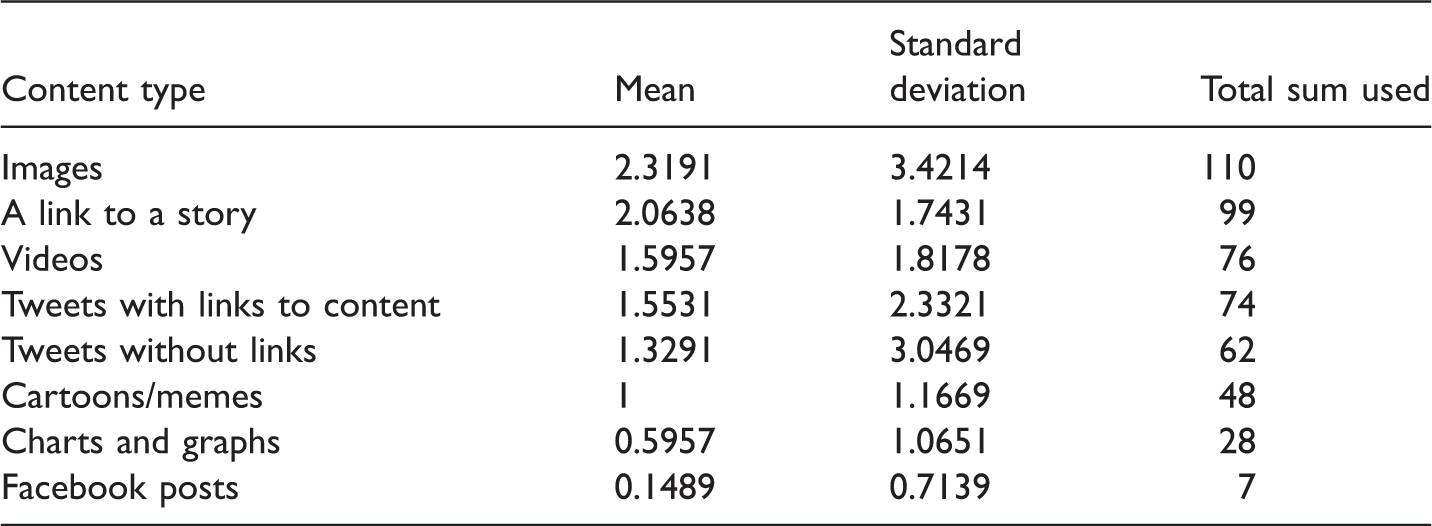
Distribution of content types used to curate stories.
Distribution of platforms used to curate stories.
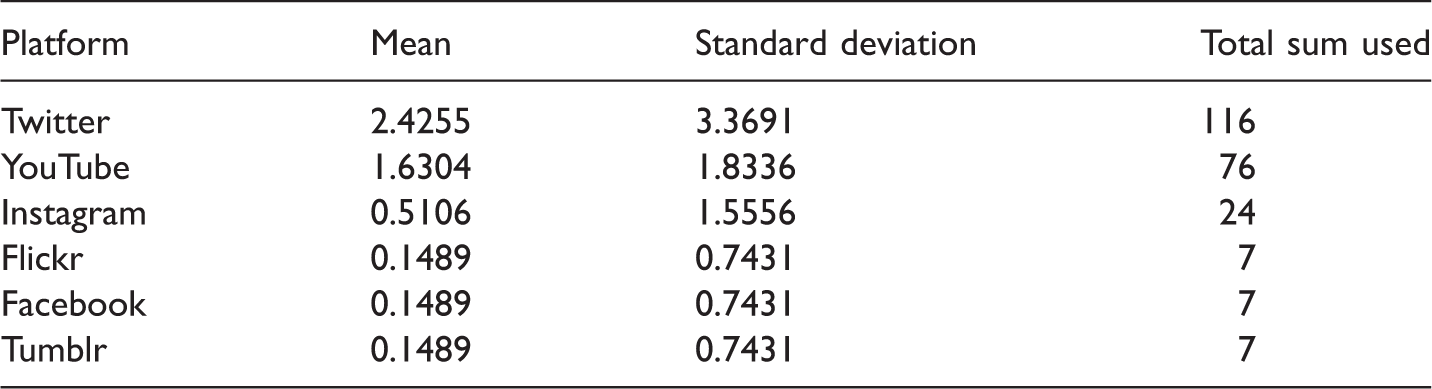
In addition to the frequency of content and platforms used, essays were also coded for the integration of top down content—information from the direct sites of credible media organizations—and bottom up content—information posted by peers and shared through networks. Messages shared by peers in social networks were included with the most frequency (m = 2.04/StD = 1.35), but followed closely by direct links to reputable news organizations (m = 1.83/StD = 1.83) and stories posted by news outlets on social networks (m = 1.7/StD = 1.49). The use of personal blogs (m = 0.7/StD = 1.02) or non-credible social media messages or platforms was sparse. This reflects the continued reliance on reputable information outlets for credible information even through social networks.
At the same time, the integration of sources, content types and platforms did not compromise the clarity of the curated essays. Twenty-eight of the 47 stories (60%) were coded as balanced: incorporating the same amount of top down and bottom up sources used within three top-down or bottom-up sources. The remaining 19 stories were evenly split between top-down (9 of 47) and bottom-up (10 of 47): which was constituted by five or more sources that were skewed towards top down content from reputable outlets, or bottom up content from personal blogs, social networks, etc. In terms of clarity, fifteen of the 47 stories (32%) were coded as very clear, while 19 of 47 (41%) were coded as generally clear, and 13 (27%) were coded as unclear. This finding speaks to perhaps a lack of familiarity in using curation to present a single and cohesive story, and specifically in a timed and controlled setting. To further explore the coded data for clarity and balance of stories, an ordered probit model was used. The probit model incorporates the ordinal nature of the dependent variables, in this case clarity=f(videos, total tweets, links to story, narrative, cartoons–memes–charts–graphs, twitter, YouTube, Instagram, reputable, blog, social media), to concentrate on the significance of the coefficient results.
Ordered probit regression model for clarity of curated essays.
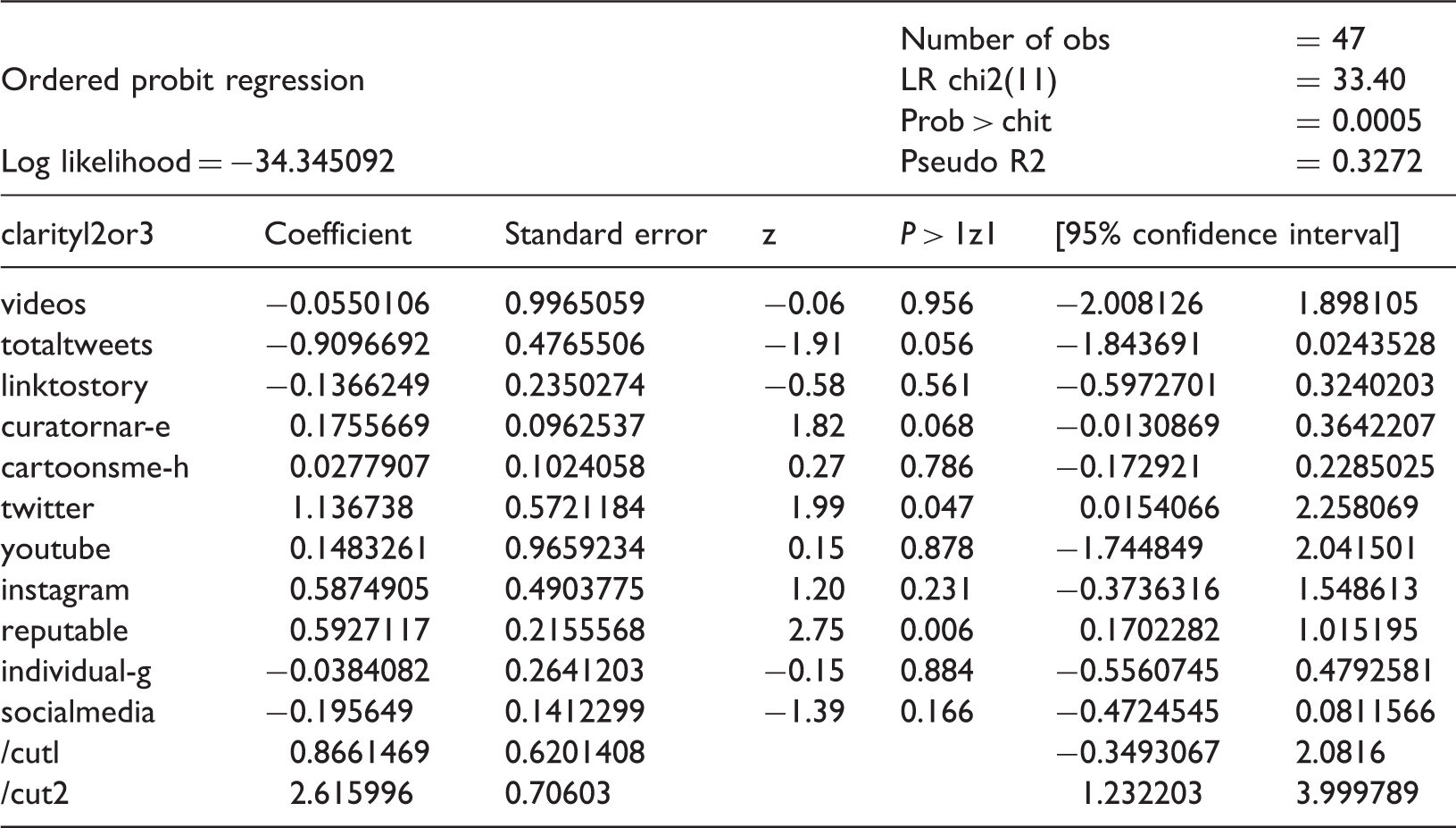
The data corresponding to the first research question show that the participants instinctively maintained a balance of sources and content while integrating a wealth of diverse viewpoints and information types. The curators were not dependent on any single platform, and did not give preference to any single source or voice over another. And while the narrative textbox and reputable sources did correlate significantly with the clarity of their curated essays, there was evidence that certain social media muddled the clarity of their curations. The second research question builds on these results to explore how college students understand curation as reflective of information and communication uses in digital culture.
A more relevant approach to aggregation and storytelling in networked culture
To address the second research question, students completed a detailed questionnaire that explored the ethics of curation, the process as similar or different to daily social media use, advantages and disadvantages of curation, notions of audience, and engagement in curation as a learning process.
Thirty-nine of the 47 (83%) participants believed curation was ethical, emphasizing the responsibility of the reader “to determine if the information is biased or not,” whether curated by a user or written by a journalist. To the participants, there was a sentiment that “readers must be aware of the bias that is most likely going to be in what[ever] they view,” and that “having a curator to sort through [the abundance of content that flows regularly online today] is necessary.” At the same time, they reinforced that “credit must be given to the sources” in the curation process. Those who questioned the ethical nature of curating content mostly did so from a more traditional skepticism towards information credibility online. Participants mentioned that an individual curator could never “know the full story,” has “no way to stay objective since the power is in [the curator’s] hands to filter the story,” and can “show whatever opinion they would like.” These concerns reflected a general inclination to see the web’s users as skewing content, spreading rumors, or biasing issues.
A follow up question asked participants whether or not they left facts out of their curated stories. Two-thirds admitted omitting facts and were aware of the choices involved in curating information from a seemingly endless content ecosystem, where “the greatest challenge was actually selecting which facts to place in the story and which ones to leave out.” Acknowledging that “there are so many facts floating around the Internet, it is physically impossible to add them all,” allowed students to curate stories that “showed different points of view rather than really getting deep into any one perspective.” Those who claimed to have included “all the facts” did not believe that there were a finite amount of facts that existed, but rather that they incorporated “every fact that I researched throughout my story,” and reasoned that they could not exclude facts because “it is important to tell the whole story.” This narrative appeared seldom in the participant reflections. A majority of the students recognized that “facts are [always] left out” and saw the importance of the curation process as a sense-making tool.
Incorporating notions of audience into the curation process was equally important for the outcome of the curated essays. Recent research shows that classroom exercises with a public component often produce more engaged learning outcomes (Thompson, 2013). Twenty-nine participants (62%) reported curating stories with an audience in mind, generally “college students or individuals with the same knowledge as the curator,” “people who know little about the income inequality issue,” and overall “younger people.” Participants conceived of their audiences as “people who would be turned off by a story that was too heavily influenced by individual influence,” or “someone like myself sitting at a computer” whose “interest I wanted to hold,” and “not lose as a reader.” That curation helped the students actively think about their audience offers potential for seeing storytelling exercises in more public and outward contexts.
When asked about the similarity of curation to daily social media use, 75% of respondents equated curation to what they do in social networks. Students mentioned “reposting,” “sharing,” “searching,” “interacting,” and “remixing,” as core elements that mirrored daily social network behaviors. One student noted, “When we retweet, share links, or comment on what someone else is saying, we are curating.” Those few who saw curation as distinct from their daily media use believed that curators were “taking content produced by others for their own use without their permission or notice.” These ideas were few and far between, however, as the curation process was seen by a large majority as an efficient way to “recirculate original ideas and open up digital spaces for discussion and debate.”
To a majority of the study participants, curation was seen as a dynamic storytelling tool that offered the “potential to discover new ideas,” from a “wider variety of information.” “Being able to access Twitter, Facebook, and news media and collecting all of these facts and opinions into one space,” one student reflected, “is a great way to generate a narrative and start to facilitate discussions.” Curation offered participants a new way to “present opinions, facts, stories and information from different sources,” that incorporates “many aspects of a story” in real time. The “organization of several different media sources in a clean format,” was clearly appealing to the participants, as was the ability to integrate a “wide variety of information and opinions,” in the storytelling process.
The disadvantages of curating information were rooted in more traditional concerns about inserting opinion and bias into the storytelling process. Participants mentioned the relative ease for “fact and opinion to be confused,” the “increased potential for author bias,” and the “credibility of the curator as well as the sources.” The conflict between information credibility and diversity was evident here, but those who advocated for individual responsibility for judging credibility significantly outnumbered those who distrusted curation as another platform for opinion and bias. Likewise, a majority of the student participants placed greater weight on curation as an efficient and dynamic method of inclusive storytelling that is relevant, effective, and reflective of how they engage with information and communicate in daily life.
Discussion: curation as a core digital literacy competency
The results of this study show the potential for curation as a core competency for critical inquiry, aggregation and storytelling in digital culture. The first question explored the role of curation in the development of digital literacy competencies. These were assessed by students’ ability to effectively combine sources, ideas, content, and platforms to create clear and balanced essays on income inequality. The data show general proficiency in the aggregation, repurposing, and appropriation of content while maintaining accuracy, cohesion, narrative flow, and point of view. The results revealed some variability in the overall clarity of the curations, and in the variables associated with clarity, which may be attributed to skepticism towards the credibility of social networks, and a lack of formal learning around curation.
The second research question explored curation as an approach to learning that is more reflective of the information and communication habits of young people in daily life. The findings here support an embrace of curation as an effective and relevant approach to build critical aggregation and storytelling competencies for connective networks. Students showed a proficient understanding of how digital curation impacts ethical, factual, rigorous, and balanced storytelling. This offers promise for the curation process as a meaningful way to critically engage with current events, and to think publicly about the presentation of large amounts of content in real time.
The point of exploring curation in this study is not to replace traditional academic approaches to classroom teaching and learning assessments. The results, however, support a need to acknowledge the relevancy of curation to daily information and communication habits. “It mimics the way our brains work,” reflected one student, “in the sense that it allows the user to branch off in a bunch of directions all while in the same platform.” This was supported by participants advocating for the curation platform as “interactive,” “accessible,” “compatible” “fun,” and “what students do when researching a topic.” Perhaps because curation was so familiar to the students they were more apt to find the experience meaningful and familiar.
This study provides further evidence to recommend curation as central to the development of digital and media literacy competencies that are student-driven, creation-driven and support savvy media consumption and production, critical evaluation and analysis, and a participatory approach to expression today. It further supports recent research that finds media production pedagogies contribute to media literacy competencies (Hobbs et al., 2013), and that show how participation in media processes can lead to more active engagement with media texts (Diakopolous, 2008). This study locates curation as an avenue for developing digital fluencies for the future participants of a digital culture (Rheingold, 2008), and that collectively, “places the responsibility of composing and creating a story, in real-time, from the depths of the Internet, in the hands of the students; shifting the educational framework from read, write, and, react, to create, curate, and contemplate” (Mihailidis and Cohen, 2013).
The use of personal narrative into curated stories also reinforces the responsibility on the curator to help make sense of the diverse and dynamic content in abundant social networks. This supports the concept of connected civics, advanced by Ito et al., which they position as “a form of learning that mobilizes young people’s deeply felt interests and identities in the service of achieving the kind of civic voice and influence that is characteristic of participatory politics.” (Ito et al., 2015: 11). The evidence of this study supports the need to mobilize the voice and agency of young people through pedagogies that place them as more centered, active, and publicly situated in the process of learning and expression.
Future research can build on this work by exploring curation not in an isolated one-off laboratory setting, but rather integrated into the classroom. Future studies may also enhance the relevancy of curation to social network use by establishing a stronger baseline of social media use to correlate to the act of curation against daily information and communication habits on social networks. Work in this area may also find ways to compare curation with traditional academic paper writing, to provide more insight into the process of curation as a pedagogical equivalency to traditional education assessment.
Curation is a foundational competency for information consumers, sharers and creators today. If more formal pedagogies can explicitly support and utilize curation to help uncover the digital literacies needed for engagement in digital information consumption and communication today, the future storytellers of digital culture will be better prepared to handle an ever growing and ever abundant information ecosystem.
Footnotes
Declaration of Conflicting Interests
The author(s) declared no potential conflicts of interest with respect to the research, authorship, and/or publication of this article.
Funding
This research received no specific grant from any funding agency in the public, commercial, or not-for-profit sectors.
Acknowledgments
I would like to thank Emerson College for its support for this research project, and to Dr. David McEvoy, Associate Professor of Environmental Economics at Appalachian State University in North Carolina, for his facilitation of the quantitative data analysis.
1
The seminal white paper by  “Confronting the Challenges of Participatory Culture” provided a list of new media literacies that embraced the competencies needed to strive in digital culture. These competencies include: play, performance, simulation, appropriation, multitasking, distributed cognition, collective intelligence, judgment, transmedia navigation, networking and negotiation.
3
In the analysis of data, the narrative text box was used more than any specific type of content (m = 6.78, StD = 3.53). It was not incorporated into the analysis of content and platform used, as it was inserted by curators to provided guidance and content for the curation. It was incorporated into the coding of the curated essay narratives.