




Abstract
The substitution, augmentation, modification, redefinition (SAMR) model offers a framework by which schools and teachers can implement digital tools through curricular design that encourages participatory learning. 21st Century students should be producing content and making meaning in educational settings with high levels of engagement and by the same literacy methods they use in social contexts. This case study examines the digital pedagogy of one English teacher at a Western United States high school. Using the SAMR model as a theoretical framework, this article first reviews relevant literature on creating participatory cultures in schools with Google Docs. Then, through observations, interviews, and artifacts, the analysis attempts to pinpoint specific phases of the teacher’s instruction where the potential to enhance academic opportunities is transformed by creativity and collaboration and leads to a redefinition of the learning environment. This article considers both the teacher’s pedagogy in her Macbeth unit as well as the school’s technology procedures in measuring its progress within the SAMR model.
According to columnist Benjamin Herald (2015), public schools in the United States now make available devices for one-fifth of its students and spend more than $3 billion on digital content. 2015–2016 marked the first year on record to have more standardized tests administered digitally than through paper/pencil. Seventy-five percent of high school students utilize a smartphone or tablet for classroom use, and ninety-five percent of teens aged 12–17 are avid Internet users (Madden et al., 2013). Despite the mass influx of available technologies, along with growing research on technology’s impact on student learning, teachers have been slow to transform the ways they teach (Purcell et al., 2013). Howell et al. (2016) suggest that usage of digital tools in classrooms is not as collaborative or creative as it is outside of school, resulting in few opportunities for students to produce original content.
In light of these data, a greater number of resources only tell part of the story of how schools construct 21st Century learning environments. Groff (2013) suggests that modified and redefined environments thrive on systematic cooperation between the institution and its educators. Schools make available resources for teachers to utilize in their lesson plans, set policies and procedures for the implementation of technology tools, and help cultivate an atmosphere of 21st Century collaboration. Teachers, for their part, calculate pedagogical decisions in curricular design which create spaces where dynamic learning occurs. In this article, I track one teacher and her school’s movement toward facilitating a redefined educational experience. I begin by framing applications of the SAMR model, which served as the school’s framework for technology integration. Next, I review the literature on how schools are using Google Docs as a tool to push students past passive forms of consumption toward active modes of creation. I then present a case study of one secondary English teacher, focusing on her design of a Macbeth assignment for British literature students. Through class observations as well as artifacts and student discourse, I analyze her design choices which lead to transformative learning, along with the challenges that complicate those efforts.
Theoretical framework: SAMR for 21st Century learning
The SAMR model (Figure 1), popularized in 2006 by Dr. Ruben Puentedura, offers schools a chance to gradually integrate digital tools with traditional resources with the aim of facilitating 21st Century learning. Its framework of substitution, augmentation, modification, and redefinition seeks to enable teachers to create quality digital learning experiences based on the design, development, and infusion of technology (Romrell et al., 2014). At the substitution level, students complete activities where teachers exchange print materials for digital tools. For example, McMahon and Frantzen (2011) demonstrate how Microsoft Excel can be used to categorize terms and phrases unfamiliar to students to enhance their close reading and comprehension of The Canterbury Tales. In SAMR, this counts as substitution because the activity is possible without digital tools. Augmentation also makes use of new technologies but does so in a way that provides fundamental improvements to the lesson (Hockly & Dudeney, 2018). To illustrate, Latham and Carr (2012) use a new literacies approach to an online method course where preservice students utilize a new program each week to solve a literary mystery. Because a major goal of the course is to prepare future teachers for a variety of teaching contexts, the rotating technologies not only delivered content, but did so in ways that a traditional setting could not.
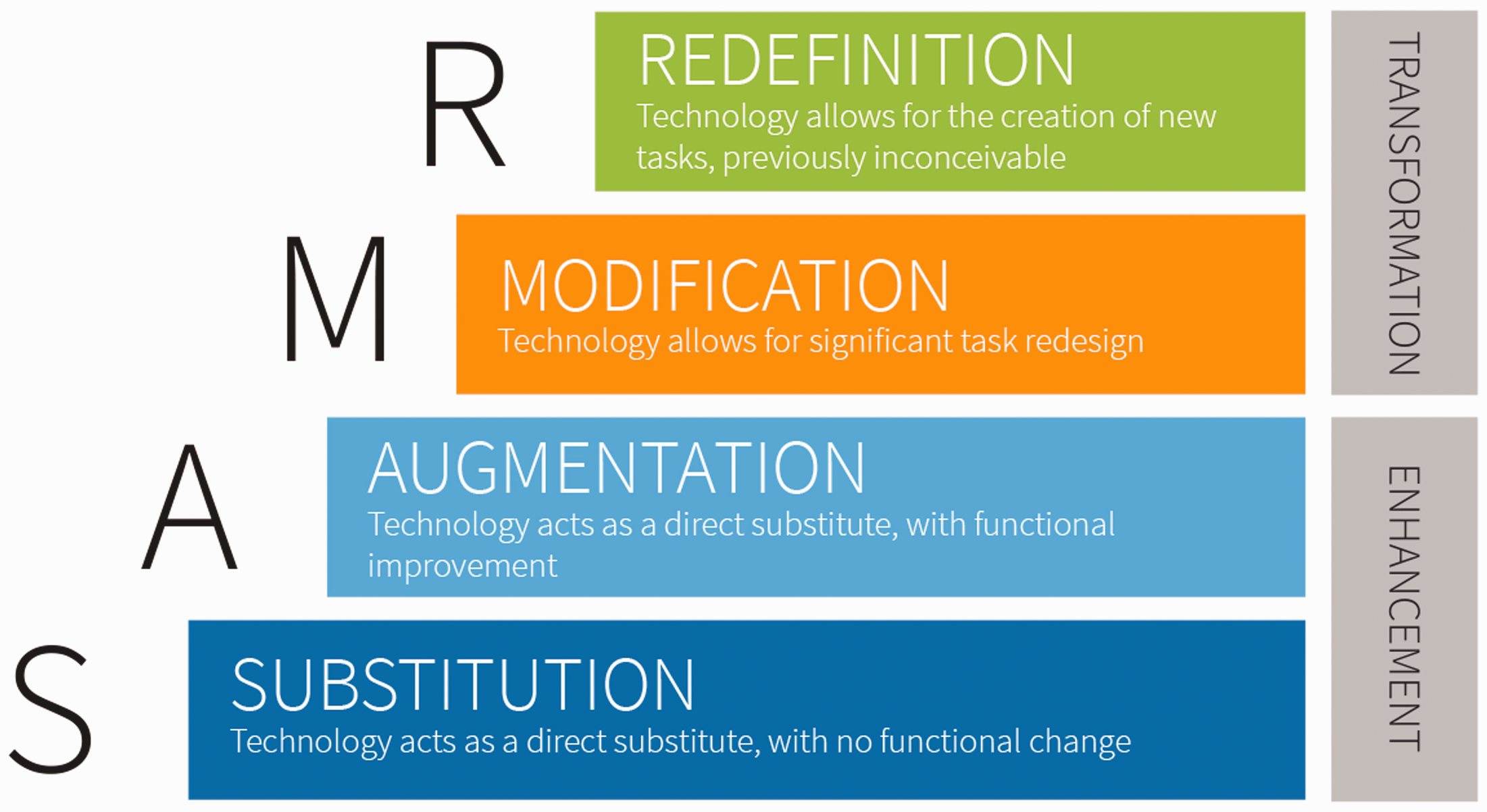
The SAMR model.
Modification allows for multiple levels of redesign of the learning activity (Cornelius et al., 2011). In a forensic education course, Harron et al. (2017) support group interaction through smartphone usage during speech and debate modules by facilitating trainings with a number of social media applications. Activities via Skype, Facebook, WeChat, and YouTube were added to face-to-face meetings and spurred students to think about how important concepts could be delivered through a combination of traditional and 21st Century approaches. The diversity in redesign techniques came when students practiced assembling their own lesson plans which included various levels of digitization of a performance discipline. Finally, redefinition occurs when technology brings about holistic change in which new tasks are created for students that are not possible without digital intervention (Wu et al., 2012). Walser (2011) describes a middle school in Milwaukee that initiated an environmental campaign through a school-sponsored Twitter presence designed to save the endangered Kinnickinnic River. These mostly Spanish speaking students not only broke language barriers but also devoted themselves to research, outreach, and fundraising that created new channels of communication between district administrators and community leaders. Redefined instructional tactics incorporate new applications to engage digitized learners while encouraging purposeful participation in the world at large.
Activities that fall within the substitution and augmentation phases have the potential to enhance opportunities for students while modification and redefinition have the power to transform learning altogether (Puentedura, 2013). Transformation occurs as students are asked to move beyond the consumption levels of understanding, application, and evaluation, and are invited to enter the realm of production. Unfortunately, many schools appear fixed in the substitution stage, offering technology tools to students largely for consumption rather than creation (Hutchison et al., 2016). So, while schools are offering digital opportunities in classrooms, they are doing so in ways that continue traditional instruction and assessment, thus reinforcing transmissive modes of teaching (Hutchison and Reinking, 2011). Progressing beyond substitution into higher levels of SAMR where students are producing content and constructing their own models for understanding involves establishing a culture of constructivism and participation.
Literature review: Google Docs for a participatory culture in schools
Implementing a model for technology usage such as SAMR involves decisions about digital tools. Google Docs are one platform that educators have implemented in school curricula in an attempt to increase student participation through collaboration and creation (Prasertsith et al., 2016). Available for free within a Google user’s Drive, Docs include various text genre options users can select including Docs for word processing, Spreadsheets, Forms, and Drawings. While these choices each have their own special features and purposes, they have all been shown to contribute to student-driven activities in literacy settings. By enabling collaboration on, through, and around shared texts, Docs offer students the chance to reflect on what they have learned, demonstrate their knowledge of course content, and publish a plethora of personal experiences related to their learning. This can all be accomplished in any space with Internet access, removing the physical classroom as the sole location for learning (Oxnevad, 2013).
In their study of the effects of Google Docs on students’ writing abilities, Suwantarathip and Wichadee (2016) find that the collaborative features of Docs made a significant difference in the writing scores of students who benefited from the interaction of multiple editors and the immediate feedback made available in the online document. Sharp (2009) argues that Docs’ combination of small group instruction and peer editing is well-suited for digital writing workshops in that texts can be shared and manipulated instantaneously. Sharing options allow users to edit and modify a variety of different kinds of texts (Lamy and Hampel, 2007). Storing documents is efficient because all changes are automatically uploaded into Drive (Thompson, 2008). The upload includes revision histories, previous versions, and web-based author suggestions that users can access at any time. Chinnery (2008) explores a number of innovative possibilities with Docs in literacy instruction such as students correcting sample papers for grammar and conventions and chain storytelling where peers take turns adding their own entries to a running text. Moreover, group projects in Docs have allowed for seamless transitions and fewer interruptions than in face-to-face contexts (Conner, 2008; Perron and Sellers, 2011).
The implications of Docs on participatory learning have been studied in a number of different literacy contexts. Bahari (2012) finds that the built-in dictionary and translation program was ideal for language learners in both individual and group activities. Seyyedrezaie et al. (2016) attest to the positive effects Docs had on the writing process of second language writers and also examined the perceptions of success the application inspired in its users. Zhou et al. (2012) argue that Docs were particularly useful outside of class in allowing flexible access for students to complete work. Docs have also been instrumental in establishing online learning communities (Abdelmalak, 2015). Leh (2014) describes a successful course redesign that utilized Docs as the main platform for a number of activities including literature reviews, research papers, and formative exams.
These cases speak to the potential of Docs to support growth within a technology framework like SAMR by empowering both teachers and students, and the growing body of research is a positive sign for scholars hoping to transform classrooms. Still, data suggest that schools still have a long way to go in terms of providing transformative literacy opportunities for student-led creation on a large scale. In their research on writing teachers’ perceptions of using Web 2.0 tools, Howell et al. (2016) suggest that while many teachers express a desire to use more technology tools that will aid students in creation of texts and production of information, they are unable to do so due to a lack of confidence and training. Implying that the issue has less to do with technology and more to do with instructional philosophies, the authors call for further investment in professional development in digitized literacy pedagogy, which is the only way teachers can truly prepare students to participate fully as citizens in the 21st Century (Howell et al., 2016).
Without a commitment to comprehensive and sustained curricular integration of digital tools, teaching and learning in literacy will remain at a level unlikely to affect change. To redefine learning via digital tools, schools must not only provide appropriate and equitable technology infrastructure, but teachers must also understand how to teach with those technologies in ways that promote creation as part of a participatory culture. While SAMR provides an example of a blueprint for schools to emulate, and Docs offer teachers innovative instructional capabilities, more investigation is needed to showcase actual classroom practices that contribute to redefined learning environments.
Case study of a secondary English teacher
The following case study contributes to these issues of educational transformation within participatory cultures by examining the efforts of one English teacher who seeks to utilize the technology at her disposal to the best of her abilities and to strive for redefinition of the learning environment by challenging her students to create using Docs. After receiving ethics approval to conduct qualitative research at this teacher’s school, I collected data from multiple sources including observations, interviews, and physical artifacts (Yin, 2003). Jottings during observations were transposed to field notes; interviews were transcribed and analyzed; and cumulative field notes were coded for thematic frequency (Emerson et al., 2011). To illustrate a concentrated example of real people in their real situations, I offer Althea’s curricular design as the primary focus of this article (Cohen et al., 2000).
Contexts
Althea
Althea is a third year English teacher at River City High School (RCHS) in the Western United States. All names of participants, cities, and schools have been changed. Althea majored in English with a 7–12 endorsement at a large secondary certification program. Her British Genres course satisfies prerequisite status for admittance into the state’s university system and represents the final literature-based experience before students enter a collegiate program. The design of this class is intended to be college preparatory. Deadlines, workloads, and academic expectations are high, and the course overall is aimed at preparing students for a life in literacy. The featured texts represent a standard survey of British canonical pieces such as Beowulf, The Canterbury Tales, and Macbeth. Althea presents these texts not in isolation, but rather introduces them in conjunction with their historical contexts and literary eras. She also makes a point to expose her students to the social and political events of the time. Authorial background information, past and current critical reactions to texts, adaptations of works both old and new, and the significance, influence, and legacy of texts are also key components of the course’s literature study. Her objective is holistic, as she puts it, “I don’t want them to read it. I want them to know it. And I want them to do it.”
As I got to know Althea, I could see that she was energetic about the teaching profession and driven to become a leader of positivity and collaboration within the school. I could also see that she was enthused about working with young adults. I understood her pedagogy to be strong, characterized by two overarching elements: technology and texts. Althea is a self-described “tech geek.” She seems to always be trying out new applications and programs in her classes and is a go-to for staff members who need troubleshooting with their Macbooks or quick fixes with document cameras and projectors. She is also a lover of literature, especially the British classics she teaches. Althea is particularly fond of Shakespeare, joking that they “are an item on some ethereal level.” She came to RCHS with this tandem focus of enriching her students’ academic and social lives with impactful literature study while delivering digitized content through myriad technology tools. In one of our first interviews, Althea was clear that she bases her pedagogy in these two areas: I feel like I came here with specific skills that I bring to the table and those are the same skills that made me an attractive candidate during the interview process. When I think about college I think about my cohort and the amazing lessons we came up with for getting kids excited about reading, and a big part of that for me was thinking about what this lesson would look like in a 1:1 environment. For me, especially in methods classes, the literature and the technology went hand-in-hand. That’s what I was looking for in a job. And that’s how I have approached teaching. (Althea Interview, 20 April 2016)
RCHS
Althea found her opportunity in her new position right away. RCHS is a large, suburban secondary institution, the fourth largest in the state. Using the SAMR model as its guide for digital integration, RCHS strives for a technology-rich environment. In 2013, RCHS issued each student a Google Chromebook and reconfigured much of the school’s professional development and information management systems to function within Google Apps for education including Docs. Students are required to have their devices with them at all times during the school day, and they are responsible for the device’s maintenance and battery charge as well. In an interview with John, the school’s principal, he outlined a number of goals for the 1:1 initiative. These aspirations included implementing SAMR, streamlining student achievement, and translating technology integration into an increase in graduation rates. He adds that the aim was for teachers and students to transition into the substitution phase during year one and move into a blended learning environment during years two through four.
Due to their lack of storage and memory, Chromebooks load in a matter of seconds, which is conducive to the school environment where students can open and close their devices and move from classroom and to classroom without the need for startup time or rebooting. Students have no need for desktop storage or programs such as Microsoft Works. In fact, the number of web applications students need is far fewer than what they use on their smartphones. Docs can encompass their entire digital learning experience. With its Chromebook initiative, technology coach, troubleshooting staff, and commitment to projectors in each classroom, RCHS appears equipped to facilitate a strong digital infrastructure. These factors, coupled with Althea’s dedication to the enhancement of literacy through digitized collaboration, created an ideal setting to examine the SAMR model in action.
The following question guided my research: How does one high school English teacher navigate the demands of digital pedagogy by offering students opportunities to be participators in class?
Results: Macbeth background presentations
Day One: Summarizing
As part of her introduction to the Macbeth unit, Althea shared background on Shakespeare’s tragedy including the play’s curse, which critic Mara Sherman (2015) calls the scapegoat for “any time anything goes wrong on a production of Macbeth–from stubbed toes, to poor box office receipts, to untimely deaths” (para. 1). According to Sherman (2015), legend holds that mysterious incidents surrounding the play’s production began occurring centuries ago with real daggers mistaken for fakes and actors struck dead with unexplained illnesses, and continue today with reports of performers forgetting lines or suffering strange injuries. This mythology provokes the superstitions of some people involved with theatre including actors, producers, directors, technicians, and even audience members – many of whom make a point not to utter “Macbeth” inside of the theatre. Some go as far to say that even in informal conversation, it is best to refer to Macbeth as “The Scottish Play,” “Mackers,” or “The Bard’s Play” (Sherman, 2015).
Althea saw the curse as an opportunity for young adult readers to connect with textual lore; to step into a long and storied tradition of British language, literature, and history; and to recognize how the play’s portrayal of lust for power still captures our imaginations today. At the heart of her design, she aimed to give students a way to actively engage with these ideas and to create their own related content before entering the text: Student interest is one thing. They like curses; they like urban legends; they like spooky stuff. That leads right into the play with Shakespeare’s tropes of witchcraft and possession and spells. But what I really want is for them to show me what curses they know. I think they get more out of it when they are making things and showing off their texts. More than telling me I want them to show me. (Althea Interview, 20 April 2016)
As I observed students compose their summaries, they were buzzing about the video and making jokes about uttering the word, “Macbeth.” Althea bantered back and forth with them. Once the room was quiet, an automated voice suddenly said, “Macbeth.” The students erupted in laughter, not to mention Althea, who seemed to know the exact source of the outburst. She approached Stella’s desk and kiddingly accused her of cursing the class. Explaining that it did not count because she had used the Voice Typing tool in Docs, Stella defended herself by saying, “I Didn’t Say Macbeth; it was my Google Doc!” The class laughed once again. Althea smiled and nodded in agreement. The following excerpt describes the scene that ensued as students settled into their summaries: Class will be over soon. A couple of students seem to have finished, but most are still working on summarizing the Macbeth curse. The room is quiet. The only sound I hear is the tapping of keys on keyboards. Everyone seems engaged in their work. Althea rises from her desk and walks slowly across the room. She appears to be preparing for dismissal and stands near the door. She covers her mouth and yawns, watching students work. From where I am sitting, I can see her slyly reach behind her back for the light switch. She turns the lights off. The room goes dark except for the white squares of Chromebook screens. Most students look up nonchalantly and return to their work. A few show more alarm and look around for clarification. Stella, however, gasps and throws her hands over her mouth. Althea then rapidly flicks the lights on and off and widens her eyes in mock horror. The class starts laughing. Althea laughs and walks up to a startled Stella and gives her a high five. She apologizes, and they both laugh. (Field Notes, 22 April 2016)
Day Two: Research
Althea began Wednesday’s class by reviewing the curse. She then recounted the parameters of the project and checked multiple times for understanding. The goal for today was for students to collect information regarding a curse of their choice. Althea had designated a number of key elements such as where the curse originated and who was involved. She also requested that students embed a related video in their presentation. She was adamant, however, that she wanted students to investigate the content with creative license and construct their presentations based on what they felt was most interesting. As research began, Althea monitored the room, answering questions and demonstrating excitement about what the students would come up with. She saw this as an ideal setting for digitized literature study: With the curse assignment I want the students to recognize that legends and traditions are kind of our blueprints for human society and culture. One side of this is that kids will familiarize themselves with Shakespeare and his writing, and also with the myths that he has inspired through his genius. The other side is that they will be creating. They locate their own content and connect it back to the text. So with their Chromebooks they are reading, discussing, collaborating, and doing. That’s what I want my classroom to look like. (Althea Interview, 20 April 2016)
As the second half of class began, Althea explained the activity’s assessment. She shared an easy-to-follow rubric with performance indicators she would use for evaluation such as content, quality, organization, etc. The final indicator of the rubric, “Responsibility,” is telling. It indicates that the assignment is to be submitted via Google Classroom, another extension of Docs. Althea began using Docs during her first year at RCHS because it was used widely by administration for announcements, handbook information, professional development notices, and lessons from the technology coach. In addition, she learned early on that many of her colleagues, especially veterans within her department, were avid users of Classroom because of its compatibility with Docs. Althea points to Classroom’s convenience, but adds that its prevalence has a more pragmatic explanation: I use Classroom because it’s easy. For me and the kids. Everything is a one stop shop. I can upload assignments, the kids do them, turn them in. I send announcements, post links, whatever. And every time I post something the kids get an email, so there’s nowhere to hide. It’s black and white for parents. Yes, he turned this in, no, he didn’t. I mean, it’s definitely not my favorite thing in the world, but it gets the job done. And I feel like everyone uses Classroom, including admin, so it just becomes common. When I first got here I did my own thing, didn’t use it. I feel like I missed out on a lot of stuff. (Althea Interview, 20 April 2016)
Day Three: Presentations are due
On Thursday, students had until the end of the block to turn in their presentations on Classroom. Before submitting their projects, Althea asked the students to share their Docs with a peer and complete her patented “Two Stars, A Wish, and A Bear” feedback activity. This is her spin on allowing students to comment on one another’s work in a fun, productive manner: So stars, wish, bear goes like this. Two stars are two things you really thought work well with it, something you really like or think is important. Kids are great at compliments, they just need to do it more. A wish is one thing you would really like to see change. Could also be added. Some type of constructive criticism. The bear is any kind of bear that the piece makes you think of. On paper we draw our bears. On our phones and Chromebooks, we use emojis or images from the web. If I get a grizzly, I want to know what that means. If I get a polar bear, I ask them, and it’s more dialogue. I think it works. The kids like it. (Althea Interview, 20 April 2016)
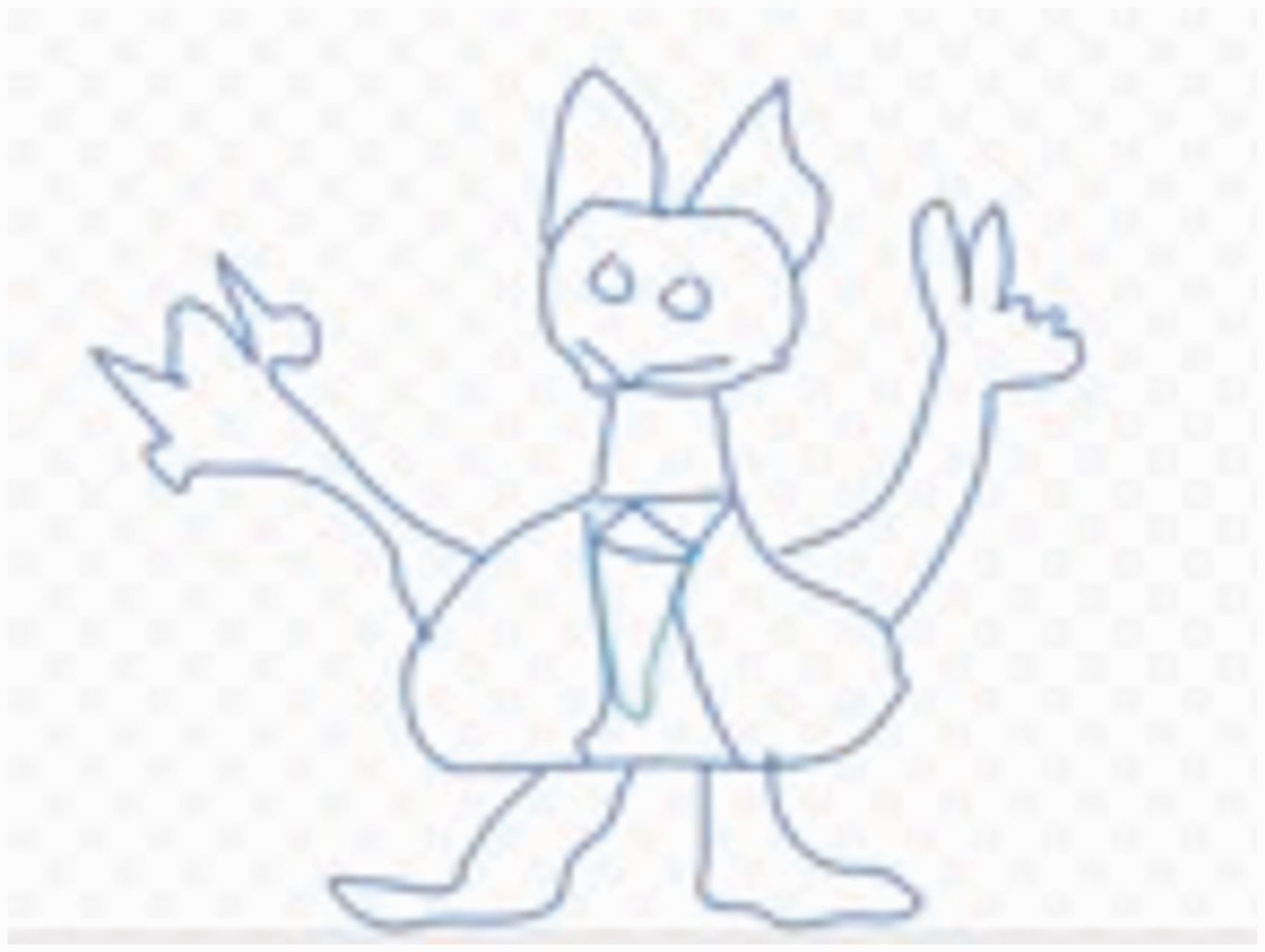
Suzy and Magilla’s multi-beast.
Suzy: (laughter) Oh my God. What is that?
Magilla: (laughter) It’s a multi-bear
Suzy: (laughter) Wow, I can’t, what is this?
Magilla: The boy has multiple feelings like fear and anger and sad.
Suzy: Multi-feelings?
Magilla: (laughter) Multi-feelings!
(Field Notes, 24 April 2016)
These were students being playful with technology, but their activity was focused on the course topic. Althea reminded the class that as the creators, final decisions regarding revisions were theirs. However, she encouraged students to consider their partners’ suggestions. Students appeared to mostly take the feedback as they made final edits before submitting. Through Docs, they were practicing the skills of publication and performance. The student-driven, workshop-style interaction positioned them to ask questions about their work and explore further. Since the textual operations were exchanged digitally, and face-to-face communication supplemented the activity, the classroom was blended. Althea took a routine activity like turning in an assignment, and, with the students’ help, made it into something fresh. Docs presented a number of new ways to rethink commonalities, therefore bringing modification to the classroom.
Althea reviewed the finished products after school. I sat with her as she skimmed through Classroom, reflecting on how her students’ work reflected their unique personalities. Guyete, a player on the football team, whose comments in class appeared to be mostly factoids derivative of professional sports, created a presentation on the Madden Curse, the legend that a player’s career goes downhill once his image appears on the cover of the EA Sports video game. Kitty, a speech and debate student who Althea described as a “horror movie freak,” studied the Crying Boy Curse involving a mysterious painting connected with a line of tragic fires in the 1980s. Much of Kitty’s content drew parallels to popular films such as the Saw and A Nightmare on Elm Street series. Other students presented on new topics that caught their attention. For instance, Minkin, a drum major in the school band and member of the theatre repertoire, remarked that he had been doing some casual web surfing before coming across James Dean’s Little Bastard Curse and decided to research the infamous car that claimed the life of the film icon then carried on with subsequent mishaps. Althea told me later that the curse assignment was the first time she had seen Minkin “really go out on his own” and engage with something outside his comfort zone. Althea was glad to see a mix of students doing what they were comfortable with and others doing some unexpected things.
Day Four: Students present their products in an interactive digital space
Friday was presentation day. As requested, most presentations lasted between five to seven minutes and featured a mix of facts and interpretation. If not well-polished, most reflected familiarity with speaking in front of the class. A few performances stood out as superior. Althea assigned a form on Docs for audience members to complete. These were not extensive but asked students to focus on particular areas of the piece and respond with their feedback. In addition, presenters enabled the interactive Question and Answer (Q & A) feature in Docs during their performances. The Q & A allowed audience members to ask questions that arose while the speaker was in action. Presenters could either weave their responses to the questions in with their delivery in real time, insert commentary during breaks in their sequence, or wait until the end.
An interesting element in the presentations was the creative license students brought to their inclusion of a video. While many students elected to insert related videos from YouTube or other sites, several actually created their own. Some of the more well-known legends have videos uploaded with millions of views. The Chicago Cubs’ Curse of the Billy Goat and the myth of King Tut are examples that have permeated societal and cultural literacies for years. These were interesting and added a nice visual feature. Yet, student-created videos truly accentuated the participatory nature of the activity. For instance, Palmer (Figure 3), who was vocal in his interest in the television show, Ghost Hunters, did his project on the unexplained deaths of cast members and crew involved with the Poltergeist film. Maggie and Corinna, two students who normally kept to themselves in the back of the room, showed a flair for showmanship with an original script, costumes, and props in their depiction of twin Queen Victorias retelling the legend of the Crown Jewel (Figure 4).
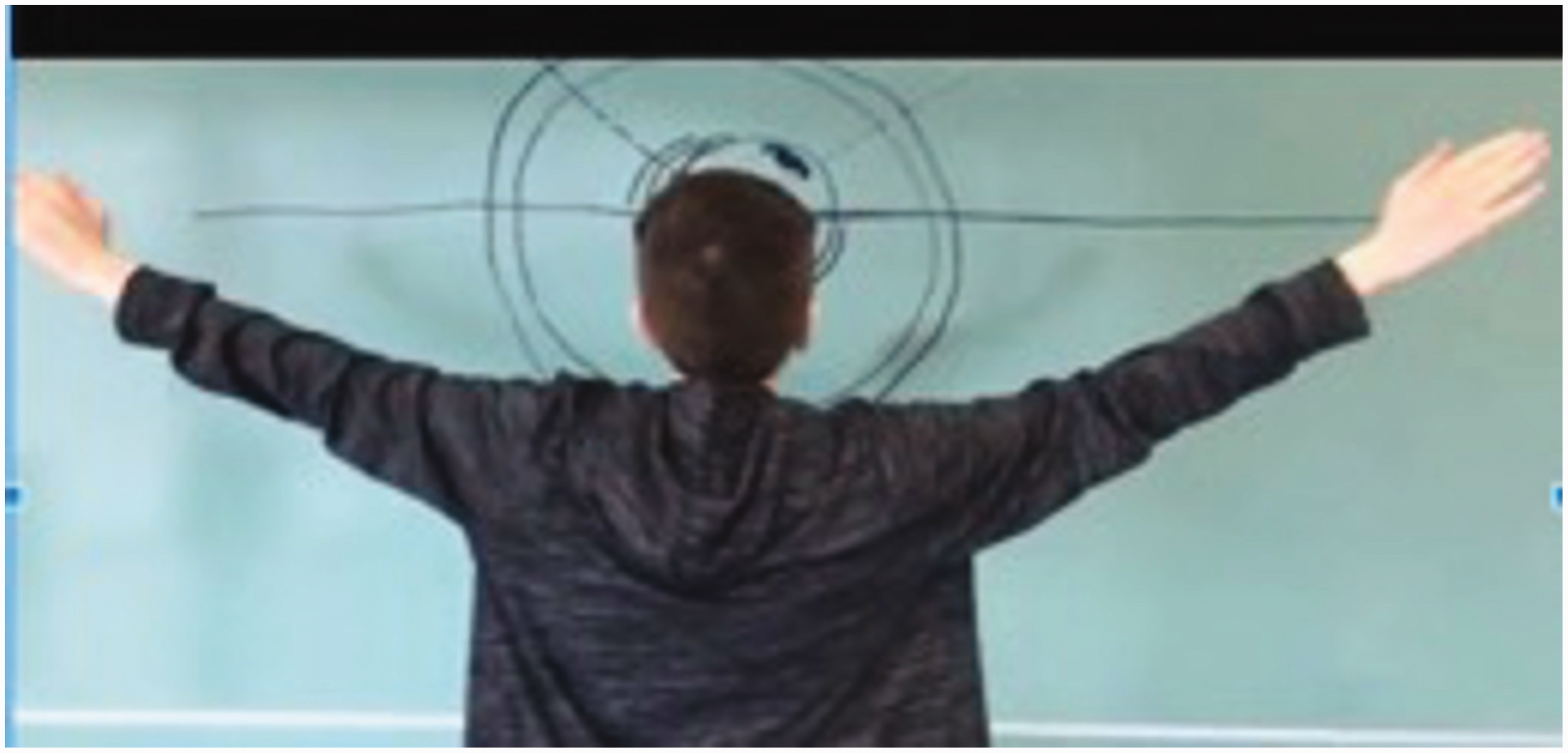
Palmer’s Poltergeist video.
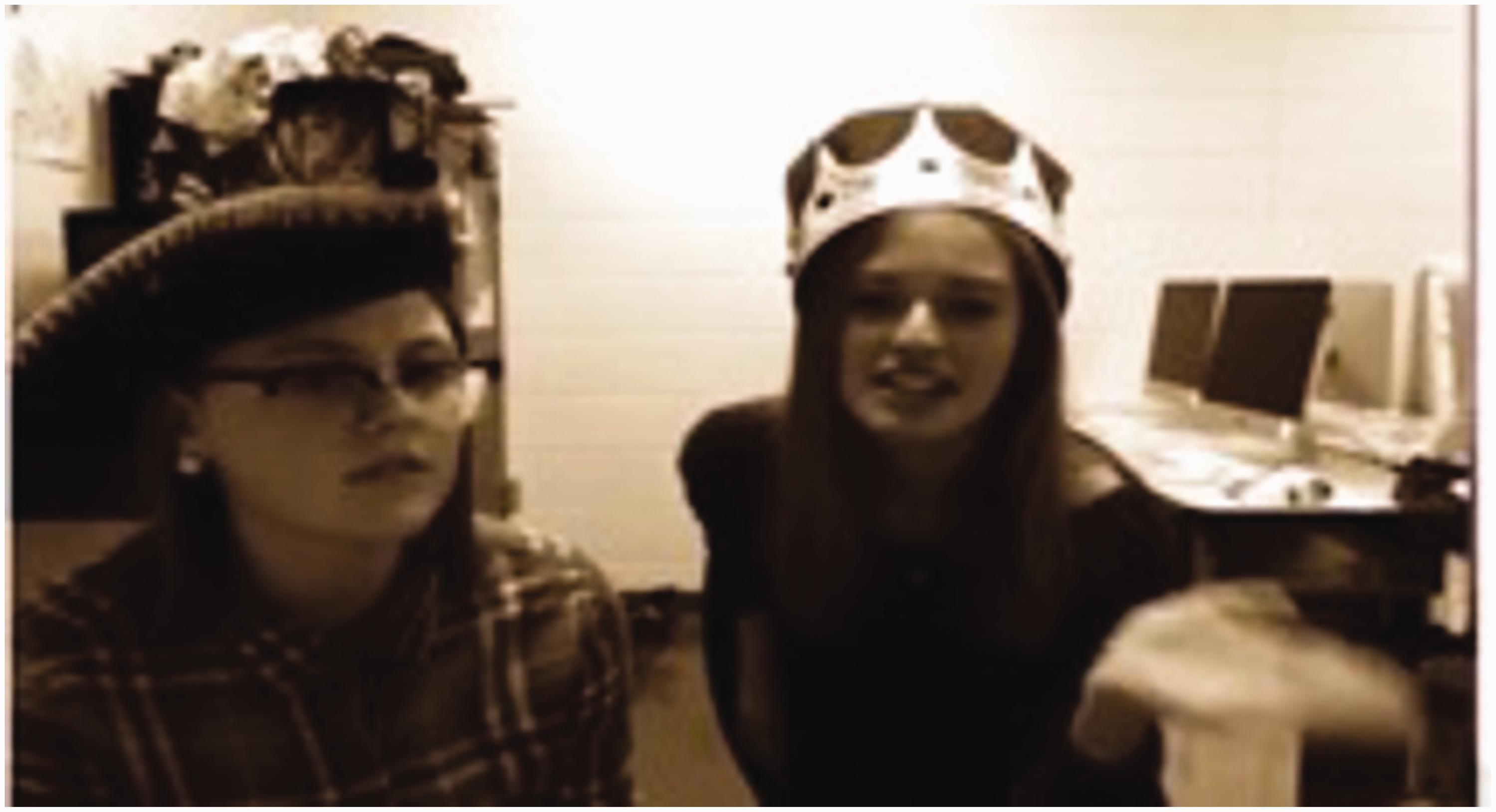
Maggie and Corinna’s Queen Victorias.
Finally, in an attempt to further enhance the digital interaction of performance day, Althea arranged for her class to connect with Alice’s class in another city two hours away. Alice is a colleague of Althea’s who also teaches senior British literature. They are old college pals, having been cohort mates in their teacher education program. To set up the forum, Althea used Google Hangout, yet another extension from Docs that she had “played around with all summer.” Using Hangout on her Macbook, Althea was able to stream the action from her class through Alice’s computer and into Alice’s class. Alice’s class watched Althea’s students present and contributed to the discussion by using the Q & A feature. Alice arranged her room so that Althea’s presenters could see her students when they were talking across the digital space that had now become virtual. Althea’s students saw beyond geographic boundaries and were shown a validity in what they were learning. The work they had done and the knowledge they had constructed now mattered in a larger sense. It was not sitting on their teacher’s desk or buried in the recycling bin. It was out in the world. And they were doing it.
Althea’s students used 21st Century dispositions to discover, shape, and share within collaborative digital spaces. Audience members were not passive consumers of information. Instead, they navigated specific aspects of content, and they pursued their own ideas. In turn, those curiosities were addressed by the presenters, co-constructing discovery with their peers. And when students shared their screens with the other class, the design offered a virtual tour for the other class, except the guests were not merely observing; they were entering the content analytically These breakthroughs were a result of making digital tools available and teaching the specific skills needed to maximize their interactive capabilities. Her classroom was a participatory space where students were engaged in the “doing” of learning.
Monitoring and adjusting within curricular design
The following week, Althea shared that she was still trying to perfect this lesson but that it “had come a long way” since her first attempt two years before. In our interview, she returned to the topic of using Classroom. When she taught the curse the first time, she had students submit their projects, she evaluated them, and that was it. She described far less collaboration among learners, a lack of creativity, and no performance element. Althea pointed out that she was a new teacher at the time, just trying to establish herself. She was trying to establish herself as a colleague as well, someone who was a team player who would “go along with trends” within the department. The beginning was hard. Obviously I wanted to start out as a good teacher. But I was learning the curriculum on the fly, trying to put things together. When we would meet or talk about lessons, they were all on Classroom and assumed I knew how to use it. I had a Dell in college. We didn’t use the apps as much. When I played with it, it got better because I was showing them that you could do more than just put the assignment in and grade it. They were using Docs as a worksheet. Done. Graded. The principals used it too so it was like this thing that everyone did but didn’t explain. That made it hard for sure. (Althea Interview, 28 April 2016)
Discussion
Active participation
The school’s SAMR focus offers a path toward redefining learning through digital creation and collaboration. As demonstrated by Althea’s design, the ascending stages of SAMR can be used as a model that provides multidisciplinary examples of substituting, augmenting, modifying, and redefining while teachers are charged with designing specific sequences of student activity needed in order to attain the SAMR stages of technology implementation. The various phases of Althea’s assignment, starting with comprehension and understanding and ending with creation and publication, reflected a commitment to student participation. As a result, digital intervention that began at the substitution stage during initial research eventually enabled redefinition during presentations. While ascending successes are attainable in the SAMR model, technology tools themselves do not dictate redefinition. The design decisions of teachers emphasizing how students should be encouraged to utilize technology are paramount.
Beyond its practical application, the components of the SAMR model also helped me to interpret what I observed throughout the study. While I was able to track students’ literacy practices and connect those operations with the kind of learning environment they constructed, I also observed Althea’s tactics as an instructor, which moved progressively from the role of leader to that of facilitator. As students’ interaction increased, Althea became less of a lecturer on Macbeth and more of a guide to unlocking new understandings about an age-old text. Allowing students to construct and share their knowledge through technology involves a pedagogical decision to release control. Althea’s pedagogy has been a work in progress largely developed through her own self-reflection. Redefinition includes not only what learners are doing but also what teachers are doing to grant students creative license in a blended space.
The right tool for the right context
Requiring presentations be submitted through Classroom without social contexts results in students missing the chance to hear their peers talk about their products and to experience the multimodal elements within their texts. 21st Century learners operate within a space of constant communication. Without a collaborative element, Docs can function through isolation. When students submit an assignment, it is marked “Done” in the class stream. Unless sharing or navigating materials is part of the curricular design, students do not see what their peers are doing. For all of its convenience, Classroom presents limitations, none more evident than its potential to cancel the payout of creative production. Moreover, it failed to disrupt the normal flow of schooling by regenerating standardization and prescription while de-individualizing the learning process (Latham and Carr, 2012). Because Docs enabled transformative learning in one instance yet constricted innovative opportunities in another, researchers and educators must recognize that in order to sustain growth within the SAMR model, digital tools must be approached critically within the contexts of the classroom. Learning objectives, textual activities, and assessment models are factors that must be considered with each implementation of technology.
Administration and faculty communication as a participatory culture
SAMR offers a pathway toward redefinition of the learning environment, which stems from the unification of design and infrastructure. This case speaks to the need for participation not only between students and teachers but also administrators and teachers. More staff-led technology trainings, not only on what is available but also on what is required, would provide a much healthier starting point for teachers. From Althea’s perspective, resources were not an issue. If anything, she was inundated with choices in a 1:1 school. What she needed was guidance. Also, more staff collaboration time for digitizing innovative lesson plans would help transformation thrive. Part of the reason her original lesson and those of her colleagues failed to approach meaningful substitution had little to do with what Althea knew about technology tools or wanted to model for her students. She implemented Classroom due to a combination of external pressures, not because she thought it would facilitate powerful demonstration of knowledge. This shortcoming represents another potential gap in the SAMR model. While teachers must make critical decisions about which technologies under which circumstances, administrators must also be committed to understanding the nuances of digital tools and dedicated to extending to teachers learning and collaboration centered around transformative technology practices.
A clear position from administration on specific applications would guide staff members in their instructional design, with the caveat that consistency amongst faculty should not come at the expense of losing transformative opportunities in digital spaces. Taking the safe route does not reflect the kind of adventurous spirit that got young teachers like Althea and Alice interested in 21st Century literacy education. Examining the institutional contexts surrounding curricular design is an important step in making future decisions about the role of technology in our schools going forward. Another limitation of the SAMR model is the lack of flexibility for teachers that results when administrators settle upon a single digital approach that may work under some conditions but prove ineffective in others. A participatory culture among educators spurs multidirectional innovation through practicing the very skills – collaboration, adaptability, and critical and creative thinking – we should be modeling for young adults.
Conclusion
By applying a school’s SAMR model to a case study of its teacher’s digitized English pedagogy, I have shown that transformative technology integration requires more than having available devices and staff. Sleek devices and flashy programs are not enough. Redefinition involves a critical approach to curricular design, the considerations of certain technologies under specific contexts that can cultivate a participatory culture among learners. After some trial and error and a willingness to learn from past mistakes, Althea’s design demonstrated strong emphasis on creation, publication, and collaboration – skills that 21st Century learners must transfer from their social selves into their academic lives. Schools play a large role in these efforts as well, and their involvement is both infrastructural and philosophical. For SAMR to be successful, a connection must be visible between the curricular design of teachers and the digital culture established by their institutions.
Footnotes
Declaration of Conflicting Interests
The author(s) declared no potential conflicts of interest with respect to the research, authorship, and/or publication of this article.
Funding
The author(s) received no financial support for the research, authorship, and/or publication of this article.