




Abstract
This 14-month study examined the phone-based composing practice of three adolescents. Given the centrality of mobile phones to youth culture, the researcher sought to create a description of the participants’ composing practices with these devices. Focal participants were users of Twitter and Instagram, two social media platforms that are usually accessed by way of applications (mobile phone software). A Bakhtinian theoretical framework was used to locate composing as a social act involving relationships among multivocal texts and authors and audiences. Findings indicate that much of the participants’ literacy engagement was spontaneous, in the moment, reactive, and emergent. Another finding was that audience feedback informed text production. Finally, the practice of digital curation (appropriating others’ texts) was central to online phone-based composing practice.
Researchers of adolescent literacies have illustrated the tensions between the in-school and out-of-school literacy practices of youth. The field has also demonstrated the implications of these tensions for success in schooled literacy contexts. In particular, researchers have shown that those youth who are frequent users of digital media, composing in networked, digital contexts, are deskilled when they enter the typical schooled literacy context, often organized around print literacy skills (Hull & Nelson, 2005; Mahiri, 2006). Their “ways of doing things, ways of being, and ways of viewing the world” are not recognized in an era of standardized curriculum that limits ways of being literate (Coiro, Knobel, Lankshear, & Leu, 2008, p. 7). Furthermore, while most schools now have Internet connectivity (Federal Communications Commission, 2010), the technology is seldom employed in the kinds of rich and meaningful ways that youth employ technology in their literacy lives, to dialogue with others with and through a variety of multimodal text forms.
Over the past decade, researchers have carried out rigorous and illuminating research in the area of youth digital literacy practice. However, much of this research focuses on the engagement of exceptional youth. Adolescent girls, the demographic who blog the most, have been studied extensively (e.g., Davis, 2010; Guzzetti & Gamboa, 2005) although Technorati found that 95% of blogs are abandoned, so long-term bloggers are rare (Quenqua, 2009). Digital storytelling has been widely studied even though it is a digital composing practice uncommon among youth (e.g., Hull & Nelson, 2005; Lundby, 2008). Other studies of exceptional youth digital engagement include English language learners using the web to practice English (e.g., Black, 2007, 2008, 2009; Lam, 2000, 2004, 2006, 2009; Lam & Rosario-Ramos, 2009; Lam & Warriner, 2012), youth composers of fan fiction (a niche subculture; for example, Black, 2009; Chandler-Olcott & Mahar, 2003; Jenkins, 1994; Mackey & McClay, 2008), and teens interacting in virtual worlds (e.g., Thomas, 2004, 2005, 2007), an activity taken up by just 8% of teens (Pew Internet and American Life, 2009). While this work has provided rich insight into the digitally literate lives of some adolescents, there is little work that highlights the naturally occurring digital literacy practices of mainstream youth who struggle with schooled literacy.
It is becoming increasingly important to recognize and examine the digital literacy practices of mainstream youth, in addition to exceptional youth, as Internet access expands to include most young people. Despite the fact that many have suggested a “digital divide” or inequities among demographic groups with respect to digital access, research shows that among students of color, 92% of African American and 87% of Hispanic youth use the Internet (Lenhart, Arafeh, Smith, & Macgill, 2008). Computers have become commonplace, even in low-income schools; 97% of all schools had Internet connectivity as of 2010 (Federal Communications Commission, 2010). While students from low-income households score lower on federally mandated writing assessments than their more affluent peers, more than three quarters (86%) of teens from households with an income of US$30,000 or less are digitally literate Internet users (Zickuhr & Smith, 2012). Using the web and contributing to web content require digital reading, writing, and multimodal literacy skills, or proficiency with a variety of communicative modes including linguistic, visual, kineketonic (video), gestural, spatial, and auditory (New London Group, 1996). The ubiquity of computer-mediated communication has brought about multimodal transformations in the ways people communicate (Siegel, 2006).
Many young people from the working class or living below the poverty line connect to the Internet not via a computer and broadband connection but using mobile phones (Duggan & Smith, 2013). In fact, a 2013 study found no significant difference in smartphone (an Internet-equipped phone) ownership between teens from low-income households and the highest income households surveyed (Smith, 2013). Increasingly, people are turning to Internet-enabled mobile phones as a more affordable means of Internet access and the “digital divide is smaller for smartphone use than for Internet use across race” (U.S. Census Bureau, 2012). Phone-based access shapes literacy practice because of the digital keyboard, which makes the typing of long alphabetic texts cumbersome, and the affordance of the camera for communicating with images, an increasingly popular communicative practice with 52% of Internet users posting photos online (Duggan, 2013).
These realities inspired this study of the phone-based composing practices of three youth who struggled with formal schooled literacy but who were avid digital composers. The research question at the heart of this inquiry was as follows:
Theoretical Framework
Theoretically, this study understands literacy as the process by which people learn how to use language through interacting with others and the world (Bakhtin, 1981, 1986). In doing so, we constantly take up others’ language and signs and use them in our own communication. This idea, which Bakhtin termed “dialogism,” grew out of his study of the novel (in his time a new textual form), which he saw as multivoiced and intertextual. Bakhtin’s ideas have been applied generatively within the realm of language and literacy studies to examine the ways in which students’ home and school environments contain voices in dialogue, how student identities are formed as a process involving linguistic forces in tension, and how recognizing the dialogic and multivocal nature of spaces for learning can inform classroom practice (e.g., Ball & Freedman, 2004; Nelson & Hull, 2008; Pleasants, 2008). In this study, I drew on Bakhtin’s ideas to acknowledge the multitude of voices within and the social nature of digital composing practices. Although multimodality and mobility are significant features of phone-based literacy practice, I relied on a Bakhtinian framework to examine the social and dialogic aspects of the practices under consideration in particular. Specifically, I took up Bakhtin’s concepts of addressivity, heteroglossia, and internally persuasive and authoritative discourse as a conceptual framework.
Addressivity
According to Bakhtin (1981), any signifying practice represents a two-way engagement with a social world. Although every utterance is present “at a particular historical moment in a socially-specific environment” (p. 276), it at once both speaks back to all utterances that have come before it and anticipates a response in the future (a characteristic he called “addressivity,” to suggest that it is directed toward an other). A text, then, represents not something devoid of influence or history, but a link in a larger chain of communication (Bakhtin, 1981), and thus production and reception are mutually constitutive. Rather than being completely confined as communicators to the conventions of existing language systems, however, Bakhtin (1981) noted that “Every utterance participates in the unitary language (in its centripetal forces and tendencies) and at the same time partakes of the social and historical heteroglossia (the centrifugal, stratifying forces)” (p. 272).
Heteroglossia
Bakhtin (1981) used the term “heteroglossia” (in Russian, literally “different-speech-ness”) to describe the ways language is at once populated with one’s authorial intent and the words and authorial intent of others. Bakhtin (1981) wrote that this double-voiced nature of language was “another’s speech in another’s language, serving to express authorial intentions but in a refracted way” (p. 324). This idea of language as heteroglossic acknowledges the hybridizations, the
mixture of two social languages within the limits of a single utterance, an encounter, within the arena of an utterance, between two different linguistic consciousnesses, separated from one another by an epoch, by social differentiation or by some other factor. (Bakhtin, 1981, p. 358)
Such hybridization is common in online communicative practice especially in an age of remix (Knobel & Lankshear, 2008), reblogging or text curation (Mihailidis & Cohen, 2013), and cut-and-paste (Roth, 1999), all practices that are heteroglossic writ large (Nedeljkov, 2011). In his discussion of heteroglossia, Bakhtin (1981) delineated the concepts of “authoritative” discourse and “internally persuasive” discourse, describing the two as enmeshed in an ongoing struggle. Authoritative discourse is
located in a distanced zone, organically connected with a past that is felt to be hierarchically higher. It is, so to speak, the word of the fathers. Its authority was already acknowledged in the past. It is a prior discourse. (Bakhtin, 1981, p. 342)
Authoritative discourse, then, is language that is already in existence that is attributed some kind of authority or power. It is privileged language that is thought of as official or authentic.
Bakhtin (1981) put forth internally persuasive discourse as in opposition to authoritative discourse, a “retelling in one’s own words” (p. 341), imaginative discourse that is “tightly interwoven with one’s own word” (Bakhtin, 1981, p. 345). For Bakhtin, people have agency as communicators, but are inextricable from their context, linguistically and historically. In other words, through his distinction between authoritative and internally persuasive discourse, Bakhtin describes the hybrid nature of language: A person’s words are ever populated with historical meanings, even as she or he contributes authorial intent. To use youth writing online as an example, authoritative discourse might be the standard American English taught in school or the discursive conventions associated with a particular platform (e.g., hashtagging on Instagram or long-form writing on a blogging platform). Internally persuasive discourse might be the inner, private voice of the individual youth composing on a particular platform. A consideration of both of these voices, the authoritative and the internally persuasive, is necessary to better understand the digital literacy practices of youth.
Methods and Research Context
This analysis is part of a larger, 14-month connective ethnographic (Hine, 2000; Leander & McKim, 2003) study of the phone-based digital literacy practices of three adolescents across physical and digital spaces. The networked and mobile digital media at the heart of this work has problematized existing notions of place and space; they have become unbounded and destabilized. McCullough (2004) maintained, “. . . Digital technology now pours out beyond the screen into our messy places . . .” (p. 6). To deal with the issues of place and space (“the field”) in this ethnographic study centered on mobile digital media engagement, I employed connective ethnography (cf. Hine, 2000; Leander & McKim, 2003), which considers the off-line and online as part of one continuum. Connective ethnography is employed by researchers who seek to describe and interpret participants’ practices both online and off-line through and across the spaces they inhabit (e.g., boyd, 2008; Hine, 2000; Markham, 1998). Researchers have attested to the “seamlessness” of young people’s online and off-line realities (e.g., boyd, 2008; Thomas, 2007), and research shows that teenagers’ self-presentation and written expression on the web is in harmony with their off-line lives (Blinka & Smahel, 2009; boyd, 2007, 2008; Huffaker & Calvert, 2005; Stern, 2007). In carrying out this study, I called upon the traditional tools of the ethnographer: participant observation, field notes, and interviews (see Figure 1 for protocol) across digital and physical spaces. I used participant-kept logs of online travels and hyperlinks within participant web spaces to follow participants’ interactions online.
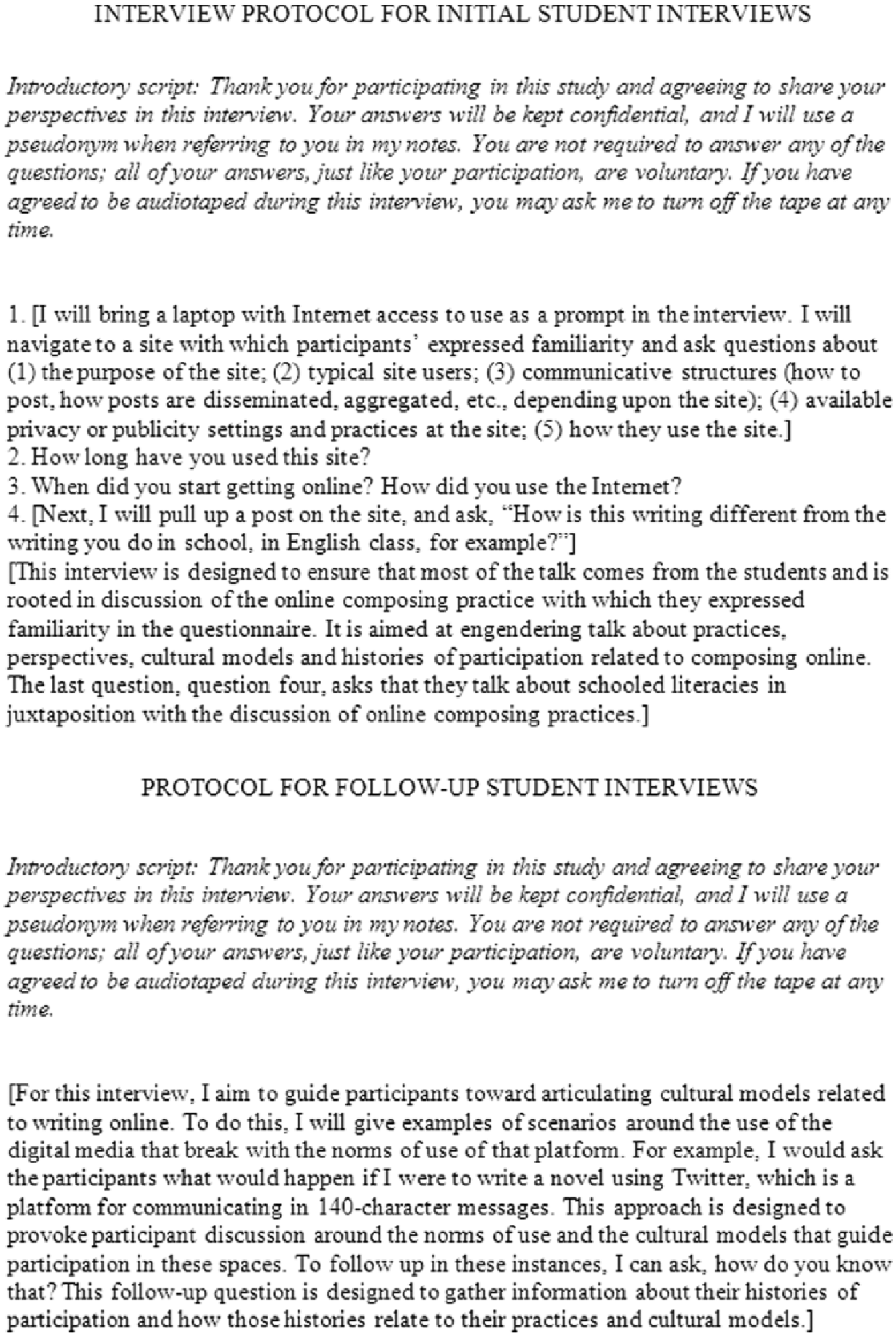
Interview protocol.
Research Site and Participants
Purposive sampling (Merriam, 1998) was used to identify the research site, White Birch High School (all names of institutions, places, and participants are pseudonyms), a Title I “failing” technology magnet high school, to represent a focal population that engaged in digital literacy practices with a history of failure in schooled literacy. The school opened in 2010 aiming to reduce the dropout rate in one of the most economically depressed areas in the county in which it is situated. White Birch focuses on technology integration to break the “cycle of failure,” as a school board chairman put it.
I carried out initial observations for 6 months in a ninth-grade English class of a cooperating teacher, Ms. Harrison, and then followed three focal participants in the online spaces they frequented for the remaining 8 months of the study. For the duration of the study, I moved back and forth among online and off-line spaces, collecting data online and off-line and being careful not to privilege the online or the off-line as sites for data collection.
Purposive sampling (Merriam, 1998) was also used to find focal participants who were frequent and skillful users of technology from the ninth-grade class. I used a brief questionnaire administered to all students in the ninth-grade class that asked about students’ composing practices, frequency of use, and tools for Internet access. Selected focal participants included three students; they happened to reflect the gender and racial distribution of the class (see Table 1). All three of the focal participants accessed the Internet primarily via mobile phones (see Table 1). This was found to be typical across Ms. Harrison’s ninth-grade English class. As displayed in Table 1, all three participants reported that they were heavy users of the social media platforms Twitter and Instagram, two platforms that are usually accessed by way of applications or “apps” (software designed for use on mobile phones). This is important to mention as apps have distinct affordances and constraints. As boyd (2011) asserted,
While networked publics share much in common with other types of publics, the ways in which technology structures them introduces distinct affordances that shape how people engage with these environments. The properties of bits—as distinct from atoms—introduce new possibilities for interaction. As a result, new dynamics emerge that shape participation. (p. 39)
Focal Participants and Self-Reported Demographic Information, Tools, and Access.
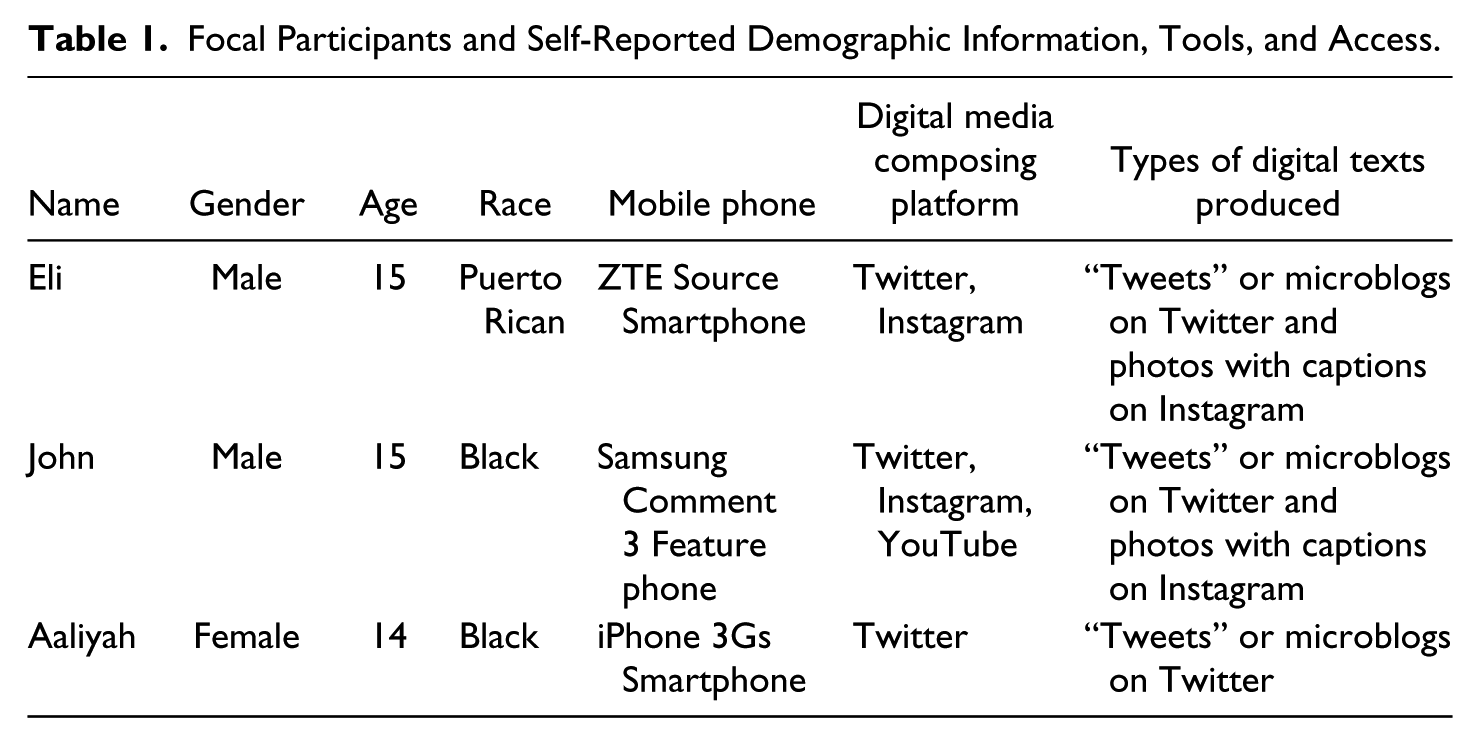
Thus, the participants’ use of the mobile phone as a means of composing digital texts was central to this inquiry.
Researcher’s Role
The trustworthiness of a study has traditionally referred to the extent to which the findings are “true” and “objective.” Yet, postmodern times complicate the idea of trustworthiness. Ethnographic researchers assume the social world they study is a world of multiple realities rather than a single reality that exists apart from their knowledge of it. As a result, they acknowledge that they themselves are central instruments with particular positionalities that accordingly affect data collection and analysis. My role in this study was as a participant researcher and a co-learner. Even though as the daughter of a software developer I had long-term familiarity with digital composing, I was unfamiliar at the start of the study with some of the tools the participants were using such as Instagram and had to install them on my phone to gain familiarity with the software’s affordances and mechanisms as the study began.
As a former high school English teacher in a Title I school, I had questions rooted in my experience that led to this study. That fact was not inherently problematic, but assumptions that arose from my background as a high school English teacher and my position at the time as an instructor of composition at a university were important to confront, including those regarding the texts and practices of not only English teaching in general but also English teaching in higher education. Throughout the study I had to confront what texts, practices, approaches, and worldviews I privileged and interrogate my own assumptions about literate practice.
I was limited in my perspective as an outsider in data collection. My positionality as a reader of youth practices positioned me outside the action by definition. My outsider status limited my ability to interpret how participants used the creation of texts and the texts themselves and their movement through space(s) to mediate their respective experiences. Also of note is my positionality as a White, middle-class woman, because I studied participants who were different from me and I had to be conscious of the assumptions I made about them. I took some steps to mitigate these realities.
Throughout this study, I attempted to make clear my preoccupations and values and to connect my prior experiences and background to my analytical perspective through analytical memoing (described in the section that follows on data analysis). In addition, to ensure that I was true to the experiences and perspectives of participants, I used two or more sources of evidence to draw conclusions related to my inquiry. For example, if a conclusion was drawn from considering an observation and interview responses in conjunction with one another, that conclusion is more trustworthy than a conclusion drawn from one of those data sources alone. Whenever possible, three data sources were used to draw conclusions.
In addition, I attempted to document the participants’ practices in ways that were faithful to the practices in situation. Because I transferred digital artifacts to print, I attempted to maintain awareness of what was lost in the transfer by making notes about where hyperlinks led. I used a two-column format for field notes that helped me to separate my own impressions from data as much as possible. I used field notes to capture my thoughts and perspectives alongside more straightforward accounts of what happened in various spaces. As a Millennial myself and as someone who grew up around technology, I was aware that I needed to consistently check with participants as to whether or not my assumptions were in line with their perspectives. At several points throughout this study after probing my assumptions with participants, I was surprised by the complexity of the participants’ literacy practices that would have eluded me otherwise.
Data Sources
Qualitative research methods (Charmaz, 2000; Lincoln & Guba, 1985) were used across digital and physical spaces including participant observation and semi-structured, in-depth interviews of the three participants. Data sources included observational notes in a researcher journal from observations of participants’ English class and online observations. Two individual interviews and one focus group interview with the students concentrated on their technology use, literacy practices, and experience at school with official curriculum. I collected artifacts related to both official school curriculum (e.g., classroom materials related to the English class) and the unsanctioned literacy practices of the participants (e.g., web texts, multimodal compositions) digitally as screen captures using an iPad and an iPhone (Table 1 presents the types of texts captured). Final sources of data were participant-reported lists of websites frequently visited and sites where participants shared their media creations, which usually led to more artifacts.
I used a two-column format for collecting field notes during both online and off-line observations. In one column, I aimed to capture the elements of the environment and the social practices; I described in this column only what I observed. In the second column, I captured my interpretive notes and my emerging analysis. These perceptions were often the basis for analytical memos (described below).
Although a wide range of data was gathered, this analysis draws from the data relating specifically to composition (defined as text creation or text dissemination) with mobile phones. The digital texts created by the participants varied across platforms and participants. For example, all three of the participants composed microblogs called tweets on Twitter, but the tweets varied across participants. For example, one participant seldom included images in his tweets, while another participant relied heavily on visual images in her microblogging practice. On a different platform, the social photo-sharing site Instagram, only two of the participants composed using original photography, and both used original photos, curated images, and linguistic text captions to compose there.
Data Analysis
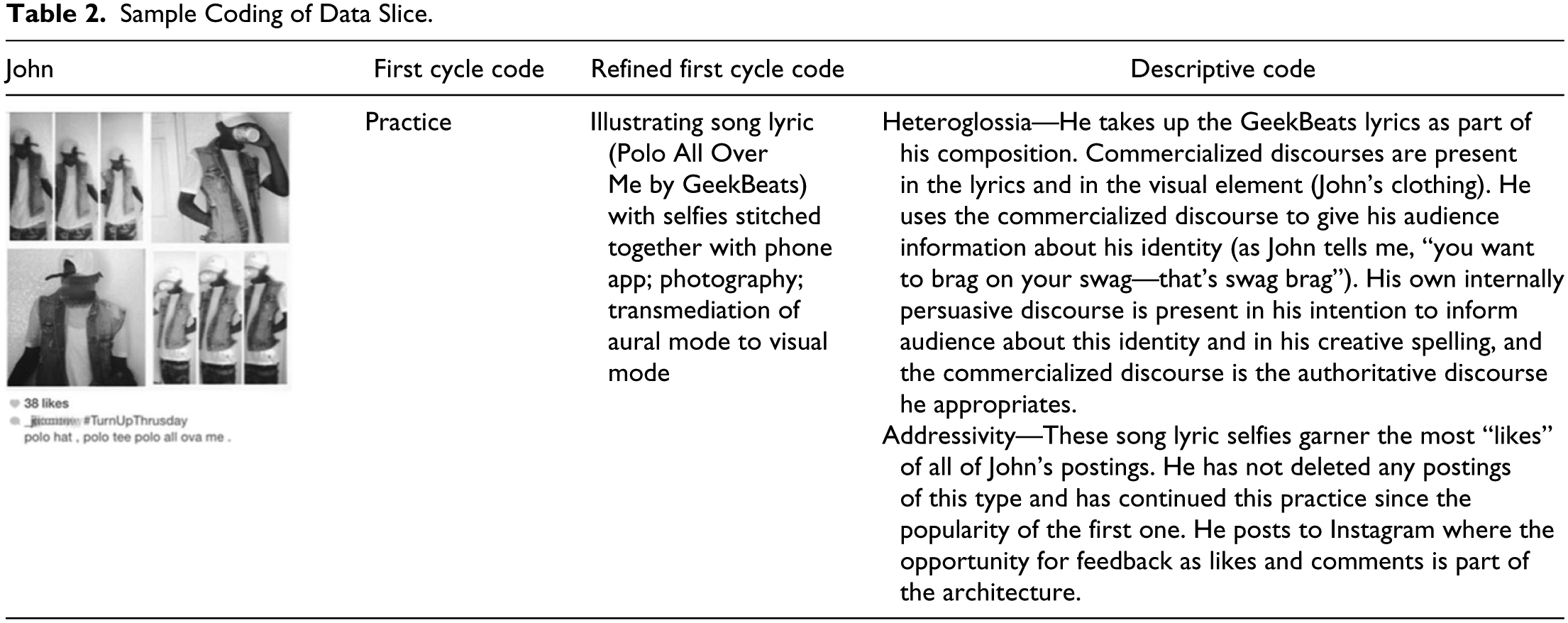
Because of the large amount of data collected (most of the participants created phone-based digital compositions daily), I captured data digitally and printed and filed it chronologically in a notebook on a near daily basis. I coded the data printouts by hand as I collected and formatted the data. Using Saldaña’s (2013) model for coding data, I carried out first cycle coding, second cycle coding, and memo writing. In the first cycle, I coded the data using the research question as a guide and labeled data “practices” where I saw text creation or dissemination. After I read, re-read, considered, and re-considered the data, I refined the first cycle codes to reflect recurring themes and patterns in the practices of the participants (Saldaña, 2013). For example, the code “practices” was refined in various cases as “curation,” “photography,” and sometimes even further as “favoriting as curation” or “deleting as part of composing.”
In the second cycle, I carried out descriptive coding (Saldaña, 2013), assigning a short word or phrase to chunks of coded data that reflected the essential nature of that data in light of my research question and theoretical framework. For example, a slice of data that was originally coded as “practice” was recoded as “social photo sharing” and then in the second cycle “heteroglossia” was a descriptive code. I paired this descriptive coding with memoing, described in the next section.
Throughout data collection and coding, I followed Saldaña’s (2013) memoing practice. Saldaña (2013) recommended writing memos in the field during data collection and while coding:
The purpose of analytic memo writing is to document and reflect on: your coding process and code choices; how the process of inquiry is taking shape; and the emergent patterns, categories, and subcategories, themes, and concepts in your data—all possibly leading toward theory. (p. 32)
I used analytic memoing to explore my emergent ideas related to the participants’ digital practice and to interrogate some of my assumptions about “legitimate” literacy practice. It complemented the coding process by bringing my ideas around the pithy codes into sharp relief. I also recognized a need early on to write about the status of the study’s methodology to clarify potential shortcomings. For example, early on in the study, I noticed that participants were posting and then deleting texts regularly. This led me to integrate an iPhone as a tool for data collection as I identified the need for heightened vigilance as a participant observer. (My iPhone had more persistent access to the online space via a 4G connection than did my iPad, which required a wireless Internet connection to function fully and therefore could only be used where wireless Internet was available). I revisited these methodological memos during data analysis as well because they related to the youth’s repertoires of digital practice.
After the data were coded, I performed a thematic analysis (Auerbach & Silverstein, 2003). Table 2 shows illustrative examples of this method of analysis with a data slice from this study.
Sample Coding of Data Slice.
Findings
The following cases illustrate the ways in which the participants’ mobile phone–based literacy practices, while highly individualized, shared several characteristics that showed composing to be a social act involving conversation among composers, polyphonic texts, and audiences. In these cases, we can see the ways in which authorship is reconceptualized to make space for practices that include the voices of others through retweeting, remixing, and other kinds of text curation. Feedback from audiences is taken into consideration by the participants during the composing process in a way that showed audiences to be actively involved in the texts’ authorship. In their use of the cameras within their mobile phones, the participants captured and sometimes stylized and captured their physical worlds to communicate ideas without encoding ideas in alphabetic text. They used their faces, bodies, objects, and physical worlds to communicate through selfies and other digital photography. The use of the built-in camera (and apps that did not require logging or other interruptions to fluidity of process) as composing tools meant that the participants often composed rapidly and spontaneously. This was not always the case, however; sometimes, participants took great pains to stylize their photographs. In either case, their texts were in dialogue with their physical worlds and demonstrated an immediacy of expression that cut out the middleman of linguistic text to directly illustrate an idea. In all three of the cases, the participants did not adhere to the authoritative discourses of conventions on the platforms they used; even within this tiny sample, there was a wide variance of composing practice as they contributed their own voices. Despite early deterministic claims about the Internet’s damaging effects on language and thought (e.g., Carr, 2008; Crystal, 2009), the participants demonstrated agency through ratifying, remaking, and remixing existing voices and practices in composing spaces.
All three participants were frequent users of the social media site Twitter, which they accessed through an app on their phones. Two of the participants migrated near the end of the study to Instagram, which they also accessed through a phone app. One participant, John, the most frequent and dexterous digital composer of the three, also accessed the web through a computer, and he was the only participant who published original work to YouTube. The findings presented here are focused on Twitter and Instagram engagement rather than YouTube as the participant engagement on YouTube was exceptional among the three participants.
Eli: “This Picture Got Me Feelin Some Type of Way.”
Eli was 14 years old when this study began. Of Puerto Rican descent, he was one of the few non-African American students at White Birch. Ms. Harrison described him as one of her brightest and best students. In the classroom space, he was always engaged, adding to class discussions and responding to questions posed by his teacher in a way that suggested he was invested in the freshman English course. Still, he failed the government-mandated End of Course Test.
Eli was 10 years old when he started going online. He had been using the Internet, then, for 4 years when the study began. I asked Eli what he would do online at 10 years old, and he said, “Nothin. Act stupid, post pictures of me with my lunchbox. I found my MySpace a couple years ago and I seen me when I was like 10 years old.” He laughed at the thought of his early “rookie” social networking practice, shown in Figure S1 (see Figure S1 in the online supplementary archive http://jlr.sagepub.com/supplemental).
During the study, Eli had just begun to use Instagram, a social photo-sharing site. The majority of the photos Eli posted to Instagram were “selfies,” a colloquialism that refers to a self-taken self-portrait, added to the Oxford Dictionary Online in 2013. A recent Pew Research Center study found that 91% of teens have posted a photo of themselves online (Madden et al., 2013). An integral component of the selfie is the social, addressive component: The selfie is posted online, allowing others to comment on the photo and offer feedback. Eli posted selfies that captured his outfit or “swag” (i.e., style or fashion sense) on any particular day, as well as selfies that told a story, like “I’m at work.” Sometimes, his selfies worked to do both (see Figure 2). Lenhart and Madden (2007) asserted that adolescents use social networks to garner “feedback and affirmation” as they develop their identities. I noted that pictures that received negative or little to no feedback Eli often deleted. In this way, Eli, new to Instagram, was socially learning how to interact in the space and also gathering information that informed his emerging sense of his identity.

A “selfie” from Eli’s Instagram page with 60 “likes” from peers.
When I asked Eli about when or why one might post a selfie, Eli told me, “It just depends on what you feelin. When you are feelin some type of way.” “Some type of way” was an expression the youth in the study used to describe a state of feeling emotional. For example, Eli posted a picture of a framed photograph of his family, pre-divorce, himself featured as a young child. He added the caption to his digital posting, “This picture got me feelin some type of way.” As Eli relied heavily on photography as a means of composing digitally in the online space, the available means of expression were often limited to physical objects that could be photographed (in the previous example, this was the framed photograph). Oftentimes, as in his selfie practice, he used his body, photographed and posted to his Twitter or Instagram account, as a means of communicating. In this way, Eli used objects in the physical space, captured with the camera on his phone, to convey a message quickly and without having to use linguistic text to do so, perhaps because typing long messages comprised of alphabetic text on the phone is burdensome. Selfies feature prominently the face, a powerful visual conveyer of human emotional states. Eli could quickly and effectively convey “feelin some type of way” with a self-taken self-portrait posted to Twitter or Instagram. His composing practice was thus in dialogue with his material world.
In walking me through his typical approach to composing digital texts, Eli described that he had an app on his phone, and this smartphone software allowed him to connect to his social networking sites without having to stop to enter his log in credentials. Nor did Eli have to take photos from outside of the app; the app could access his camera seamlessly. The affordances of the smartphone make it possible to compose rapidly and spontaneously without much forethought. There was nothing slowing him down and encouraging him to consider a composition in the smartphone app interface. The smartphone was always with him, and he could snap and upload a photo to his social media accounts in seconds in a fluid, easy process. In this way, many times his literacy practice was spontaneous and in the moment, rather than planned or focused on an end product (cf. Leander & Boldt, 2013).
This fact became clear to me early on in the study. One day, I was carrying out participant observation on Instagram when Eli posted a photo of himself that garnered expressions of shock from his friends. After feedback from several friends indicating that they were unsettled that he would post the picture, he deleted it (presumably in response to the comments). Revision often came after publication in Eli’s practice. For example, he often used feedback in the space to make decisions about revising his text. He considered what others thought (addressivity) as he formed his utterance. For Bakhtin, a text does not constitute an end point, but instead a link in the larger chain of communication, a part of “ongoing discursive activity” (Vasudevan & Hill, 2008, p. 231). The malleable digital spaces in which Eli composed with his phone allowed for this kind of tinkering and as such it “re[wrote] the conceptual binary of process and product” (Alberti, 2008, p. 1).
In addition to creating original postings on Instagram and Twitter, Eli often retweeted the tweets of others in his sphere on Twitter. Retweeting is a way of recirculating existing content. Eli explained that he saw the practice of retweeting as a way to communicate ideas though others’ texts:
What does it mean when you retweet something on Twitter?
Like, you just say what the person said before.
What’s the point of it? When would you do it?
Like, If you like a song or something, or if you like what they said, like, if somebody says somethin like, real, if they say something funny or something, real, like, catchy, then you retweet it, or something that they believe in and you believe in at the same time, then you retweet that.
And what’s the point of doing it?
Just to tell people, like, you and them, like, I guess like, that you like what they said, and like, you think what they said is true or whatever.
The retweeting practice, then, allowed Eli to speak through the voices of others heteroglossically (Bakhtin, 1981) with just the press of a button. He did not have to type out an entire message to express himself; instead, if he read a tweet that resonated with him, he could press the retweet button, and the tweet would post to his Twitter page quickly and fluidly. At the same time, it would be disseminated to his followers, displaying attribution to the original author as well as to Eli. It was a way to communicate the ways in which he was in dialogue with the world of ideas in which he interacted. From Eli’s perspective, it was a way of not only showing agreement with the idea (“you think what they said is true” and “something that they believe in and you believe in at the same time”) but also affirming the speaker (“you like what they said”).
John: “Really Good at Internet Stuff”
The first day I observed Ms. Harrison’s class, John immediately captured my attention as he very vocally participated in class, often “cutting up” in the words of his teacher, but more often contributing insightful feedback that moved classroom conversation in ways that led Ms. Harrison to describe him as one of her best students. He made the room laugh and provoked reflection in equal measure. Like Eli, though, he performed poorly on the government-mandated End of Course Test. What I came to discover was that John was a prolific digital writer who posted frequently to Twitter with a large base of “followers,” those who subscribed to his Twitter updates. John seemed to have a sense of how to produce content that was meaningful and relevant to his followers as his posts were often retweeted and favorited 1 by others. In fact, one of the other participants in the study told me that John was “really good at Internet stuff.”
In my first interview with John, I asked him about his history of digital composing:
School taught me how to use the computer. Like, we had to go to the computer lab and stuff. You know Computer Labs Class at [name of middle school]? They had Computer Labs Class. We would, like, have to go on a learning site, they would have the site on the board, we would have to type it in and stuff. I would go home and I’d be like, Mom, can I play a game? And she’d be like, let me show you how to do it, and I’d be like, no I know how to do it! And type it in myself.
John carried these early technical skills learned originally in school into his out-of-school practice, and moved from consumer of content, navigating to websites and playing games, to producing content. Like Eli, John used his phone primarily to access the Internet, and engaged in microblogging, social photo sharing, and retweeting. He told me, “I get on a lot in school, in church, and in the car, or at home.”
Although all three focal participants in this study were Twitter users, John had a markedly larger number of Twitter followers of the participants in the study, at 660, and had upward of 5,000 tweets more than the other participants had (see Table 3). John did indeed seem to be “good” at Twitter, as he had many followers. John described to me in an interview what it meant to be “good at Twitter.” His response demonstrated a sense of the value of his attention on Twitter as well as what was acceptable to him and others in the space (the authoritative discourse of the Twittersphere):
Yeah. Tell me more about what you said if you have a lot of followers then you’re doing something right. What kind of thing are you doing right?
Uh, tweeting tweets . . . funny stuff.
It has to be funny?
No—some do funny stuff, real weird stuff, postin’ funny pictures. Um, you tweet things that everybody relate to.
Number of Tweets by Type of All Three Participants.
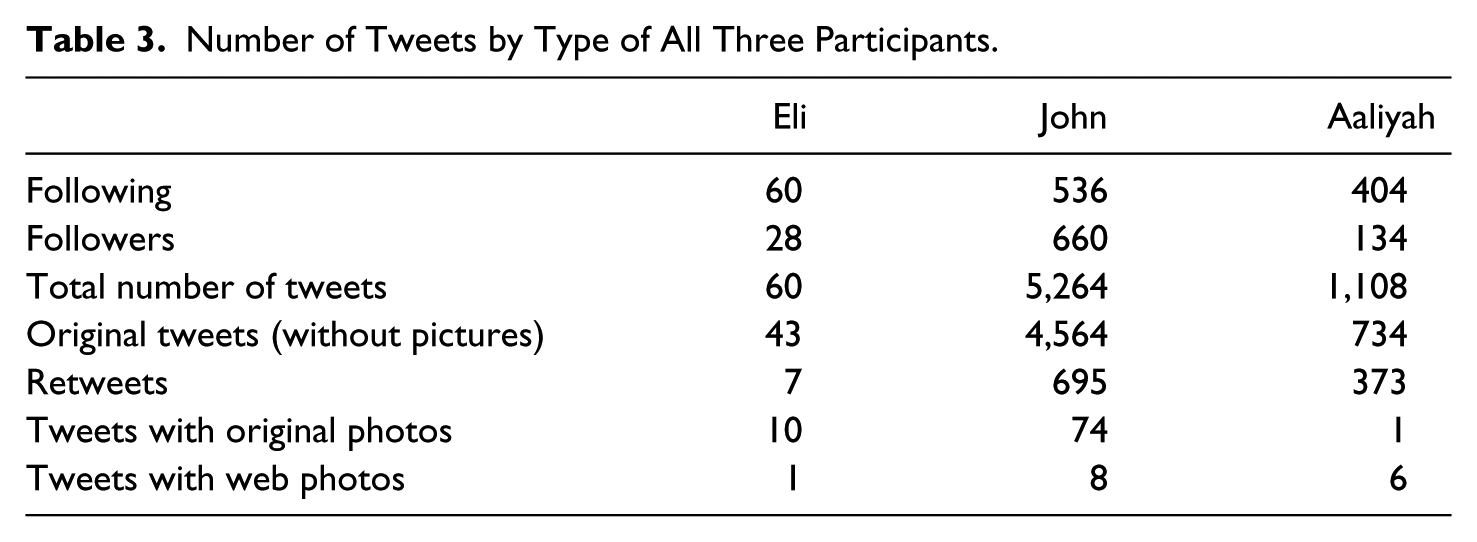
John’s understanding was that resonating with many was the objective in the space. To John, the fecundity of a tweet was a function of its berth of relevance. The more of his followers who found his tweets relatable, the more his texts would be spread by them. John’s nuanced sense of what was valuable and meaningful online may have been a consequence of his relatively large network of connections as well as his high level of involvement in the space, which afforded him a chance to observe conventions (see Table 3). He determined what was applicable, socially fitting, and what would be understood or appeal to his audience, who were not physically or even necessarily temporally present, through reading and through the feedback he received in this space that allowed for such interactivity. Addressivity was constitutive of John’s composing practice in this way.
Most people use the retweeting feature on Twitter to spread content they find noteworthy to all of their followers. For this reason, I was puzzled when I noticed that John would often retweet seemingly insignificant content. For example, he would retweet others’ tweets that were solely comprised of short greetings such as “hi” or “good morning.” When I asked him why one might retweet (thus spreading) such a seemingly unimportant message, he told me, “[Why] retweet it? Because they feelin’ the same mood as you. You know, they jus’ gettin’ on Twitter.” Instead of retweeting to spread content—the intended function of the retweet feature—John told me he would retweet a tweet if he “feel[s]” it. In other words, if the tweet by the original poster resonated with him, he would retweet it. In doing so, he would communicate using the voices of others, the ultimate economy of words. By appropriating and then displaying someone else’s tweet, he could communicate to the original poster and to their followers, “Me too,” in a heteroglossic way (Bakhtin, 1981, 1986). In addition, this grabbing and using of another’s tweet was a means of instigating a conversation with that person. Boyd, Golder, and Lotan (2010) explored the “conversational aspects” of retweeting, and similarly found that, for some users, retweeting was a way to bring “new people into a particular thread, inviting them to engage without directly addressing them” (p. 1). As I found in Eli’s retweeting practice, this practice was focused on demonstrating alignment with others as much as it was about communicating a message.
John saw his digital literacy practice as a means of not only connecting with others but also a means of dialogue with the self. He described using a feature on Twitter called “favoriting” as a means of curation. Favoriting a tweet links it to the user’s Favorites section, allowing a user to recall the tweet later by clicking on the Favorites tab. When I asked John about his use of the favoriting feature, he told me it was so he could read certain tweets later and have a “memory time”:
When you favorite something . . . you can go back . . . it goes into like your little, like a little secret box like on the Internet or whatever. Just that only you can see, so if you wanna go look at it again. Or if you just goin, scrolling down through it, havin’ like, a little memory time. That’s why I favorite stuff. To see it again.
John’s description suggests storage (“it goes into . . . a little secret box”) of the past (“memory time”). Considering the Internet’s rapid pace of information exchange, it is no wonder he leveraged the features of technology that allowed him to collect and save the bits and bytes that he deemed valuable. John’s suggestion is that if he fails to favorite a post, he will never see it again. He seems to understand web content as slippery, fast moving, and nearly ephemeral, and his invented practice is a means of creating a space for storage and reflection at once. He drew from the Twitter posts in his web sphere to create this patchworked, multivocal new text that represented his history and would allow for future reflection.
As was true in Eli’s case, the majority of John’s original (i.e., not retweeted) tweets were related to emotions:
Might be the happiest day if my life On my way to school . . . swear I hate ths sht whats the point there’s no place like home you make me feel like I can fly feels good to be bakk home today oomf [one of my followers] piss me off widd da sht she was doin man school been funny af today just uh beautiful day
His postings were reactive in this way rather than planned. If he felt “some type of way,” he would create a post on Twitter.
Like Eli, John moved to Instagram toward the end of the study. He announced his migration in a tweet and linked his Instagram to his Twitter page by writing “IG,” with his Instagram handle at the top of his Twitter profile. John continued to interact on Twitter, but his postings to Instagram were more frequent than his postings to Twitter after he announced his migration. On Instagram, John posted mostly selfies, as can be seen in the screenshot of John’s Instagram page in Figure S2 (see Figure S2 in the online supplementary archive http://jlr.sagepub.com/supplemental).
Although many of the teens in John’s web sphere posted copious selfies, what was unique to John’s practice was his affinity for illustrating song lyrics through the photos he posted. John would take a selfie, then match the selfie to a hip hop song lyric, as in some of the photos in the feed shown in Figure S2. John explained that when a particular song lyric resonated with him (when he “feel[s] it”) he would post the lyric, either with a selfie previously taken and already in the phone, or by taking one on the spot. John’s illustrated lyric postings are an interesting exercise in transmediation (Siegel, 1984) as he represented an aural artifact visually and through linguistic text, extracting salient lines from the lyrics of his focal songs. He used the song lyrics and his photography practice to express his emotions and his identity, and to give his network information about his way of being in the world (cf. Freire, 1972; Street, 1984). This was a heteroglossic practice wherein two social languages populated the same utterance (Bakhtin, 1981). In addition, he used linguistic text to evoke aural information, demonstrating an understanding of the ways in which the modes were in dialogue.
As the selfie practice indicates, John relied heavily on the camera on his phone to compose. That meant that he relied on objects in his physical space to communicate. In this example from his Twitter profile, he engaged in wordplay using physical objects (see Figure S3 in the online supplementary archive http://jlr.sagepub.com/supplemental). John arranged a loaf of bread and a stack of money on his kitchen counter and then took a photograph, playing on the slang term for money, “bread.” In this way, he could use physical objects to communicate (in this case, as he used the photograph as his profile picture, it seems to be intended to mean that he has a lot of “bread” and that he is also linguistically clever).
Aaliyah: Curating the Digital Museum of the Self
Fourteen-year-old Aaliyah was just a freshman but had already attended three different high schools by the time I met her at White Birch High School. Rather than complain about having to continually uproot, she matter-of-factly described to me the ways that she harnessed mobile technologies, mainly Twitter, to keep in touch with her dispersed friends. She created a space for herself and her friends, apart from her parents and family members (who were on Facebook, which she avoided for that reason), where she could be “stupid” and “post stupid stuff.” She understood her capacity to produce a new space with digital tools (Lefebvre, 1991). To access Twitter, she always used her phone. For Twitter, “I don’t get on the computer. I don’t like it on the computer,” she told me. She explained further that she enjoyed the ease of access made possible by the Twitter app on her phone that meant she never had to stop and enter her credentials to log in.
I asked Aaliyah about what she might post on her Twitter page. She said, “Mostly when funny things happen, or when I have to talk about something.” She then added she might also post when she is “doing something stupid,” which she explained meant something “corny, like a joke or something.” As she explained it, the Twitter space was a space for her and her friends to joke around. “If we were to talk about deep stuff,” she explained, “they would direct message me or we would talk about it on the phone.” Indeed, Aaliyah’s expressiveness varied in different spaces. At school, she was quiet and reserved. Online, she was boisterous and silly. Her online handle or screen name on Twitter included derivatives of the words “psychotic” and “crazy.” She saw Twitter as a safe space where she was among friends and where she displayed and posted content that reflected her personality, beliefs, sense of humor, and worldview.
Although she did post some original tweets, Aaliyah’s Twitter feed was rife with retweeted or curated content. In this study, Aaliyah was unique as a heavy circulator of content. Table 3 shows the number of types of tweets of each participant: 33% of Aaliyah’s overall tweets were retweets, or digitally curated content. By comparison, 10% of John’s tweets were curated, and 11% of Eli’s tweets were curated.
Aaliyah subscribed to youth and pop culture Twitter aggregator accounts. These accounts took popular content from around the web to use as the basis for their feeds. Aaliyah would read tweets from these various aggregator accounts as the tweets appeared in her feed. She would then retweet the content she found relevant, true, or amusing, according to her description. Aaliyah was thus an aggregator and disseminator of content herself.
Sometimes, Aaliyah would preserve the content she retweeted in its original form, but as can be seen in Figure S4 (see Figure S4 in the online supplementary archive, http://jlr.sagepub.com/supplemental), she would sometimes add her own commentary. In Figure S4, Aaliyah added the commentary “LMAO” (Internet slang for laughing my ass off). In adding commentary, she shifts the previous meaning or significance of the text. It goes from being a commentary about the sartorial choices of Superman to being about her identity (i.e., what entertains her). Conversation is inherent to the practice (Bakhtin, 1986). Not only did she speak back to the original poster through a retweet with added commentary, but she also spoke to readers of her Twitter page who would get a sense of her opinions about the tweets she recirculated by reading this polyphonic curated text.
All three of the participants in this study spread and remixed Internet memes, highly spreadable, digital cultural artifacts like the one that appears in Figure S4. As previously stated, Aaliyah did most of her composing on Twitter on her phone. Her phone had limited affordances for digital composing because the keyboard was small and hard to type with and because the phone had no mouse for fine manipulation. However, curation is a form of composing that is easy to engage in with a mobile phone because there is so much semiotic richness that can be accessed with just the click of a (retweet) button. In Aaliyah’s curation practice, the practices of reading and composing were nearly collapsed. She had to first read her feed to “grab” a tweet to integrate into her feed. This laminated (Bakhtin, 1981; Prior, 1998) the composing process in that the reading and writing were layered and almost seamless. In the practice of curation, there was no observed planning; instead, the process was a continuous, fluid one, one in which reader and writer collided, the boundaries between author and audience blurring.
Aaliyah curated digital texts to communicate to her social connections about her beliefs, values, emotional states, and sense of humor. By subscribing to and taking in posts from teen content aggregator accounts, she reflected on what she believed and disbelieved from this world of ideas, and she grabbed and displayed that which she agreed with or liked. She was in dialogue with the texts she consumed in this way. Her internally persuasive voice built upon the a priori authoritative discourse in the spaces.
Discussion
In undertaking this research, I sought to describe the digital literacy practices of youth who were engaging not in niche, “exceptional,” or fringe practices, but more common composing practices encouraged by the mobile phone. Initially, I was aware that there was very little research that explored online composing practices with mobile phones and I wanted to investigate the ways that youth were communicating with mobile devices because of the prevalence of such tools and their concomitant supported practices. I sought to contribute new knowledge about emerging practices that are markedly different from the “new literacies” practices that have warranted study in recent years. How youth think about and approach the act of composing using the phone with its particular affordances and constraints is different from computer-based digital media with less cumbersome keyboards as well as mouse access. This study of youth composing with mobile phones showed that the traditional idea of writing process is challenged, curation (collecting and displaying digital texts) is a new form of authorship, and that youth rely on the voices of others as a central means of communicating with texts. The youth’s phone-based composing practices were characterized by the rapidity of the composing process, the centrality of photography, the important role of audience feedback, and curation. In this discussion, I draw upon my dialogic framework to describe these findings and demonstrate the implications for literacy research and practice.
Composing Practice in Dialogue With Spaces
The youth’s composing practices were in dialogue with the spaces, both digital and physical, which they inhabited, as they used their phone cameras to capture physical spaces to create texts, or relied on existing voices and content in digital spaces to compose. Their practices were thus reactive and emergent rather than controlled and planned (cf. Leander & Boldt, 2013). Instead of creating planned texts from the ground up, they responded to the world around them, digital and physical, through texts and often revised their compositions after publishing, a practice that appeared to be related to the rapidity of the composition process.
In a similar vein, audience response was central to the youth’s composing practice. The youth’s composing practices were distributed and less cohesive than I had imagined prior to the study. Bakhtin’s dialogic model holds that reception and production are reciprocal and mutually constitutive in that every utterance responds to/anticipates a response. Along similar lines, the participants learned through dialogic interaction with the social world how to communicate in a way that would resonate or support understanding either through direct linguistic feedback or through the act of one passing on or favoriting a posting (Bakhtin, 1981, 1986). Because they were not afforded direct instruction in how to use Twitter to communicate, it makes sense that the participants would turn to the practice of those around them in their web spheres, those to whom they were connected, to learn how to interact there. It was through engagement that they learned how to communicate in the digital space in a way that would be understood by others and that adhered to the conventions of that space (while contributing his or her own intentions; Bakhtin, 1986).
Composing Practices in Dialogue With Other Texts
My findings indicate that because of the major communicative affordances of the phone, including the camera, the cumbersome digital keyboard, and the architecture of the apps such as the retweet and favoriting features, the participants relied heavily on digital curation as a means of composing. It offered less friction and was a means of communicating powerfully in nearly an instant. Digital curation involves selecting, compiling, and displaying existing digital content rather than creating from the “ground up.” In other words, typing long texts or creating complex multimodal texts on the phone was difficult, but curation could be accomplished with the touch of a button. Baron (2008) warned of electronic communication’s “Faustian bargain of sacrificing thoughtfulness for immediacy” (pp. 198-199) because “the proliferation of writing, often done in a hurry, may be driving out the opportunity and motivation for creating carefully honed text” (p. 198). Perhaps thoughtfulness and immediacy are not mutually exclusive, though. Instead, it seems to be more a matter of rearrangement of process. In the youth’s practice, they created their postings with some immediacy to provoke a response that was then considered, and the text was never “finished” but could be deleted given a particular audience response. Thoughtfulness was not gone, but instead came later than one might expect.
Although the participants’ digital curation practice relied heavily on the texts of others, this kind of explicitly heteroglossic practice is notable as a way for youth without extensive technical skill or elaborate hardware (such as those with only mobile phones) to begin to learn to compose online. I also noted the resourcefulness inherent to this practice of using the mobile phone with its limited support for complex composing to participate in web spaces in an increasingly digital world. Black (2008) explored this idea in depth in her work on fan fiction, digital composition that drew from existing texts instead of springing forth anew (which Bakhtin holds as impossibility anyway). “Far from being ‘mindless consumers’ and reproducers of existing media,” Black asserts, “they actively engage with, rework, and appropriate ideological messages and materials of the original text” (p. xiii).
In addition to engaging in ongoing conversations (Bakhtin, 1981) online by creating, responding to, and circulating existing content, the youth in this study created their own original practices and conventions. Furthermore, by disassembling and reassembling culture through the process of curation, the participants demonstrated rich learning around the process of signification within multimodal texts and demonstrated addressivity (Bakhtin, 1981) by calling upon resources that carried relevance to the current moment and held particular meanings within an audience. Dissembling, rearranging, and otherwise tinkering with language, modes, and texts demonstrated their deep understanding of culture and expression (Jenkins, Clinton, Purushotma, Robinson, & Weigel, 2006; Potter, 2012).
Of course, youth who are primarily using the voices of others to express themselves through digital curation are limited by the available voices. In the practice of curation, youth engaging heavily in digital curation because of the lack of access to tools with less cumbersome keyboards are limited in this way. Youth’s perspectives, views, and unique voices are in a subordinate position to existing cultural artifacts or resonant voices in the digital spaces they inhabit. This suggests that there is a need to teach critical digital literacy wherein youth are encouraged to interrogate the discourses and voices that permeate the texts they draw from in their own composing practices.
Furthermore, while composing using existing texts can act as a scaffold to production from the ground up, it is not a substitute for but exists in addition to true rendering, and it is rendering, not curating texts, that is rewarded in schooled literacy contexts. The kinds of texts the participants and their classmates were asked to produce in their English class were solo-authored. In school, appropriation without attribution constitutes plagiarism or cheating, but online, appropriating the ideas and products of others is prevalent and even encouraged. In fact, on the web, this kind of appropriation is a form of authorship.
Proposing an Expanded Understanding of Composing
Schooled literacy has recognized that composing involves the integration of discourses (Bakhtin, 1981). Persuasive writing, as it is often framed by official curriculum, is highly addressive, and research writing is explicitly multivocal. Allowing for the integration of media forms across a variety of spaces in the teaching of formal schooled writing would grant more pathways for meaning making in the schooled space. Gardner and Davis (2013) acknowledged the “creative potentials of apps and other forms of digital media” and lament the narrowness of what counts in school in light of the “increased sophistication of what youth can create, and the wider variety of creative opportunities now open to young people” (p. 149). Ito, Baumer, Bittani, boyd, and Cody (2010) suggested in their exploration of the overlap of “‘serious’ online information and culture” and “social and recreational activities online” that there is a necessary “cultural shift” that needs to happen within formal institutions for learning that would allow for an array of opportunities for learning denied by a view of youth digital practice as merely frivolous (p. 347). Potter (2012) raised the possibility that activities involving curation and the creation of exhibitions and collections might be fruitfully integrated into schooled literacy practice.
Finally, as the youth in this study demonstrated tacit social learning of communicative conventions and came to understand what constituted effective communication in online spaces through interaction, perhaps the provision of more opportunities for composing for real audiences that afford timely feedback would serve students who compose digitally with fervor yet struggle with schooled literacy. Capitalizing on the tendency of youth to make meaning intertextually and dialogically would benefit youth in the pursuit of school-sanctioned literacy learning. This is what Ito et al. (2010) characterized as “highly active forms of learning” (p. 291).
Further Research
Recent research on youth digital literacy practice has confirmed that teens are doing more than “hanging out” and “messing around” (Ito et al., 2010) and that widespread fears about bullying, loss of privacy, and other online dangers are misconceptions that obscure the agency, important identity work, and critical thinking teens mobilize in their digital practices (boyd, 2014). Further research on implications of the practices described in this article with regard to the body of work on the digital divide is needed given the near ubiquity of these practices among youth and widespread mobile adoption as the primary form of Internet access. And as more schools are moving to Bring Your Own Device models (St. George, 2014) and lifting classroom bans on cell phones (Rich & Taylor, 2014), teachers need ways to generatively mobilize the affordances of cell phones for formal literacy learning (without colonizing/appropriating youth practices for the teacher’s goals). The field of literacy research will need to address these issues given this major shift toward social, collaborative, and dialogic composing amid a dominant paradigm of literacy that divorces composers and texts from their networked contexts.
To carry out such research, new frameworks are needed to allow for the richness of these practices. The Bakhtinian framework taken up in this study was useful in framing the multivoiced, intertextual, and dialogic nature of the youth’s literacy practices. However, there is so much social practice outside of that dealing with language and voices imbued in these phone-based composing practices. For example, curation evokes categorization and hierarchical thinking. In addition, the mobility of the youth practice was not fully compatible with the dialogic framing. Bakhtin’s focus on spoken and written language is not fully compatible with a discussion of multimodal texts. We need new frameworks to describe these transspatial, multimodal, socially rich new practices happening with and through mobile technologies.
Footnotes
Acknowledgements
The author would like to thank Amber Buck who offered constructive feedback on initial drafts of this article.
Declaration of Conflicting Interests
The author(s) declared no potential conflicts of interest with respect to the research, authorship, and/or publication of this article.
Funding
The author(s) received no financial support for the research, authorship, and/or publication of this article.