




Abstract
This paper introduces the role of personalisation in the learning process, with a focus on aspects of the philosophy of technology and Internet studies. Significant changes in education, with the spread of the technological capabilities of open educational resources (OER) and massive open online courses (MOOC), offer the possibility to develop new approaches to solve problems resulting from a limited perception of new knowledge. This makes it possible to increase the effectiveness of learning through the personalisation of educational content which utilises information about participants in the educational process—students, lecturers and managers. In this work, we use the concept of a ‘world view’, which is a key feature of the ‘thesaurus’ approach. Practice of the thesaurus approach to the analysis of data about the participants’ educational projects allows the construction of an individual world view of each participant in the educational process. Firstly, by utilising a world view, it is increasingly possible to identify potentially interesting topics which are open to the perception of an individual. Secondly, these themes can serve as a background or context through which an individual will be open to new information. Thirdly, following the analysis of a world view it seems possible to find authorities whose opinions are important to a person and will affect his behaviour. Finally, understanding of a community’s world view can give insight into the best and most productive combinations in the formation of work groups, learning classes and other human interactions. Shakespeare’s ‘eternal images’ are used to illustrate how this can be done.
Background
Significant changes in education through the spread of open educational resources (OER) and massive open online courses (MOOC) has raised questions about the basis of a university's system and its operation—what to teach, what to study and how to provide shared knowledge from generation to generation during the rapid changes that are occurring in modern sciences. In this respect, the question of effective organisation of modern educational programmes assumes new features in which interaction occurs between students and teachers with different cultural codes and also together with interactions between learning technologies. These interactions cannot just be a result of the summary of educational ideas, principals, study materials or technologies from every country. It should be something more significant. The key issue is to ensure more effective learning occurs through taking advantage of the opportunities of the digital age. We can see that the personalisation of educational content, including important aspects such as a dialogue of cultures, students’ and teachers’ backgrounds and also the world view of participants in the educational process have become key issues in learning.
A change of communication technologies has updated ways of knowledge transfer, but the final formation of the values of the knowledge society can be considered accomplished only when the educated man begins to implement the concept of sustainable development, accepts social responsibility values and is open to new ideas that are appropriate to our global society. Meanwhile, the conservative and response delay of a university's system are occurring very slowly and mostly in matters relating to forms of educational activities and not their substance. The education system needs a new impetus to development. The content of higher education needs to take into consideration global risks to human civilisation in the 21st century. Therein lies one of the main issues of modern development and implementation of projects in the field of higher education.
In the contemporary conditions of the open society, there is no obstacle to thousands of students participating in student exchanges, learning foreign languages, utilising trendsetting technologies, receiving international educational qualifications and diplomas, being ready to be educated throughout their life and being able to rapidly adopt and assimilate new technologies and developing innovations. The quality and affordability of global educational programmes has changed significantly and this has created great difficulty. Even in this case, students are not too eager to be included in them or to have access to them. This is a corollary of the significance in scale and consequences of the pressure of circumstances not relevant to a university environment, but located in the internal mind set of students, including their cultural differences and different survival needs.
Introduction
The modern concept of the development of society is oriented towards the collaborative activities of many people in creating a global society. This global society is built on network-based social interactions, informatisation, virtualisation, the levelling of the role of space and time, innovation having precedence over the maintenance of cultural patterns and the validity of both virtual and real interactions, where social groups are formed in autonomous systems of interaction.
As a result, a major issue for current global educational projects is that international educational programmes face a challenge in how the compatibility of personal experiences interact. Inevitably students cannot to the full extent explore all the scope of knowledge which is laid out in an educational programme. As a result, reduced motivation, future possibilities and prospects after graduation become unknown and unclear.
In respect to international educational projects, it also important to take into consideration the fact that the characteristic stage of formation of the informational epoch requires a high level of education as a consequence of the change in education and related social practices. Consequently, common cultural knowledge becomes more important than professional specialisation. Mobility of human resources makes demands on the one hand for unification and standardisation of educational programmes, and on the other hand on decentralisation and on a unique training experience.
Current and future informational technologies are opening new opportunities for the management of the educational process. Internet technology, machine education and the analyses of large amounts of data allows for more knowledge and information about students and their backgrounds. That is to say that the process of receiving, dissemination and processing information by societies has changed significantly over the period of the last two decades. People get more and more information and the value of such information increases. With the advent of search systems users’ interests have become known—including the most frequent search requests. Social networks accumulate information about a person: his/her social environment, interests, political and religious views, cultural preferences, etc. Along with the mass media expansion on the Internet, we have a relevant source of information about news streams and information channels which have an influence upon a user’s choice of goods, his/her decision making and inclinations to certain kinds of actions. These tendencies in the sphere of information and communication technologies expansion give new characteristics to user interaction.
These trends in the communication area and the global presence of information and communication technologies also add new characteristics to the educational process. This makes it possible to increase the effectiveness of learning through the personalisation of educational content which can use information about participants for the educational process—students, lecturers and managers. We use the concept of ‘world view’ which is a central concept in the thesaurus approach to generalise and analyse information about an individual which allows for the personalisation of educational content.
The thesaurus approach
In the thesaurus methodological approach which was developed at the Institute of Fundamental and Applied Studies at the Moscow University for the Humanities, a ‘thesaurus’ is understood to be a systematic set of fully mastered knowledge by a social subject which is significant to its orientation towards the environment and self-development of the subject. The key function of a thesaurus is to organise and provide interaction with the external environment of a subject: ‘… in the cognitive aspect (through the organisation of knowledge) a thesaurus links the individual to society. The combination of elements (information, models of behaviour, attitudes, values, and so on) that comes up in the course of the process of socialization is built out of fragments of the thesauruses of “significant others”.’ (Lukov, 2014: 75)
The major task of a thesaurus is to orientate the individual towards the socio-cultural environment. It is provided by mastering new information which is built on the basis of the correlation of knowledge, which the individual has received, on the basis of the principle of ‘one’s own’, ‘someone else’s’ and the ‘alien’. The systematisation of all the acquired knowledge in a thesaurus is not built from the general to the particular; it is built from ‘one’s own’ to ‘someone else’s’. In the thesaurus's construction, the orientation to ‘one’s own’ and ‘someone else’s’ is accompanied with open-mindedness to others opinions and tolerance of other cultures. The border between ‘one’s own’ and ‘someone else’s’ has plastic properties and can vary. The ‘alien’ in this scheme marks interactions with other thesauruses. ‘Alien’ is knowingly hostile to an individual and should be excluded from a thesaurus because while ‘someone else's’ is far removed from ‘one's own’, it is still in unity with a thesaurus and against the ‘alien’, which is reflected in a thesaurus only indirectly like a form of criticism. In this context we draw attention to the thesaurus's organisation of knowledge for educational aims as the most acceptable of its system-forming organisations of knowledge.
The life experience of human beings involves the interactions of the external and internal environment that form a thesaurus of an individual. The uniqueness of the life experience of an individual is the basis of the hierarchy of the thesaurus. This special aspect allows a thesaurus to act as a complex form of knowledge which is built in the orientation of behaviour of a subject which in turn is constructed hierarchically. Subsequently and eventually this thesaurus framework acquires stable notions about the world, which are designated as a world view and gradual form in people's minds in the course of socialisation.
World view
German
The concept of a world view gains currency primarily in German (‘Weltbild’) and Russian (‘Kartina mira’) scientific literature. For the first time, the concept of a world view was conceived at the beginning of the early modern period. It was representative of significant changes in a world perception of cultural layers in European society. Alexander and Wilhelm von Humboldt were among the first to develop the concept of a world view, but they approached the issue from different perspectives. Alexander von Humboldt (Von Humboldt and Sabine, 1849) addressed a physical view of the world, whereas Wilhelm von Humboldt (Von Humboldt and Heath, 1988) considered a linguistic view of the world. The principle of linguistic relativity (Sapir, 1929; Whorf, 1956) was forestalled by Wilhelm von Humboldt with his hypothesis about perception differences due to differences in languages.
Russian
The active discussion about the concept of a world view started in Russian literature, predominantly originating from the philosophical problems of natural science, since the mid-1950s. The treatment of the concept was linked to only the scientific view of the world characteristics. Connection between a world view and other forms of public mind set were not considered. Currently the concept of a world view links different aspects of social life: economic, political, legal, moral, scientific and other subsystems.
The concept of a world view gained momentum through the framework of a thesaurus approach. The concept of a world view plays the role as a core concept in a system of concepts and cultural constants of a thesaurus, which emerges during the socialisation of a person. A world view is constantly reinforced, transformed and influenced by external and internal factors.
Keeping in mind the aim of the research, we understand a world view as a multilevel system of concepts which reflect natural, cultural, social and virtual reality of the past, present and future. A world view is produced by a person in the course of socialisation and sets stable borders in the perception of reality. Proceeding from this assumption, a basic construction of a world view represents a matrix whose rows reflect the separation units: ‘nature’, ‘humanity’, ‘culture’ and ‘virtuality’ and columns which reflect time zones: ‘past (experience)’, ‘present (the ongoing)’ and ‘future (expectations)’. This consideration of a basic construction of a world view is the most productive for analytical purposes. Currently, opportunities and tools for analysing and designing world views have been created along with the extensive use of digital technologies.
The basic construction of a world view.
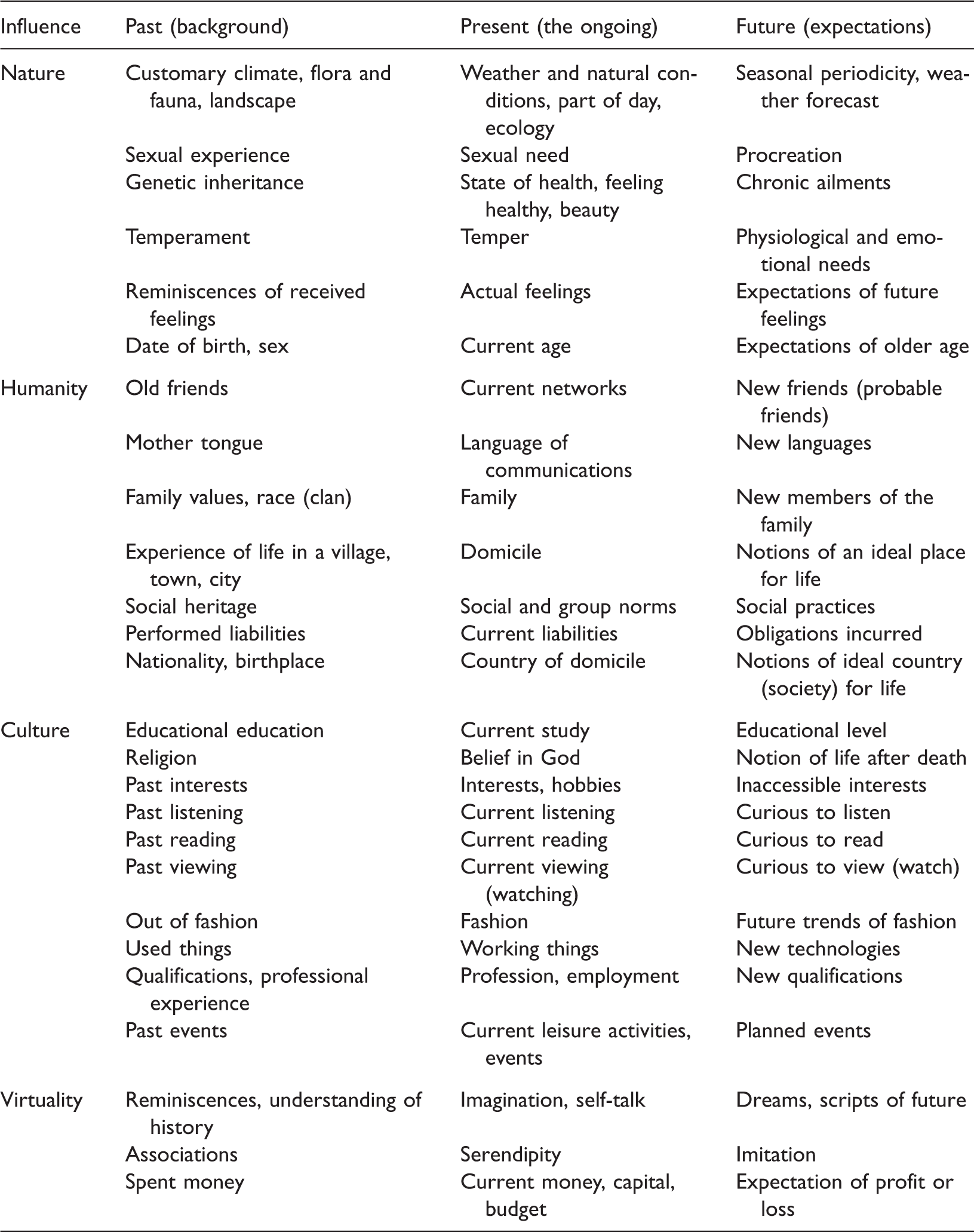
The practice of a thesaurus approach to the analysis of data about the participants’ educational projects allows the construction of an individual world view of each participant in an educational process. It offers the opportunity to provide solutions to issues. Firstly, with the world view's help, it is increasing possible to identify potentially interesting topics which are open to the perception of an individual. Secondly, these themes can serve as a background or context through which an individual will be open to new information. Thirdly, due to the analysis of a world view it seems possible to access authorities whose opinions are important to a person and will affect his behaviour. This approach can be applied in forming intercultural communications and educational projects in order to ensure better understanding and assimilation of new information.
The classification of world views
To classify world views, it is useful to turn to the the thesaurus approach (Lukov and Lukov, 2008) and Shakespeare's heroes and heroines because today Shakespeare's ‘eternal images’ are entrenched as ‘constants of culture’ and they more completely reflect the full range of possible human characteristics. For this purpose, we use 12 key heroes from Shakespeare's works—six male heroes and six female heroines for each type of a world view, respectively:
A community's world view
A world view reflects the thesaurus of an individual and determines its behaviour and its perception of new information. Moreover, world views of individuals can be projected on the communities—classes, academic and research groups, colleges and universities. A community's world view is a product of the characteristics and interactions between the world views of participants of the group under consideration. A world view of a community represents the model of behaviour and the distribution of roles between group members. The interaction between different world views and their transformations under the influence of other members of the community is predetermined by the general behavioural patterns of the group.
The usage of world views in order to analyse societies and relationships inside educational groups enables an understanding of the development of the scenarios of interaction inside these communities or relationships. Figure 1 shows the structure of the student group ‘English Language Teaching Centre of The University of Edinburgh’ on Facebook. At the time of analysis, the group consisted of 32 members, which together had 239 interconnected friendships. As it can be seen, two key segments and one micro-segment of three people are partitioned in the group. This segmentation is based on interconnected friendships which differ according to the home country of the students.
The Facebook group ‘English Language Teaching Centre of The University of Edinburgh’.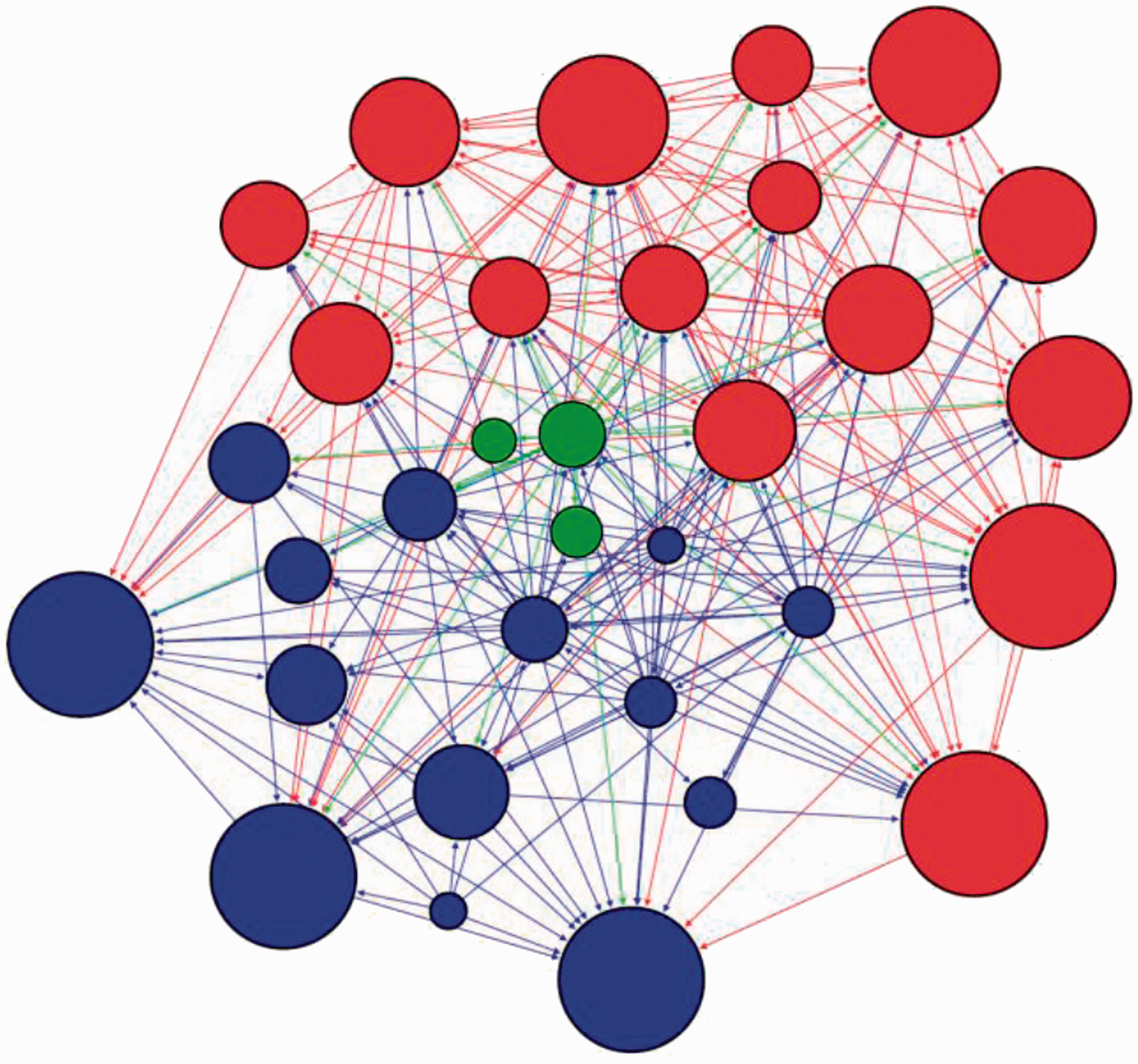
Each segment in the community has a role which can affect both the behaviour of the entire community as a whole and for each individual member of the group. This draws attention to world views as applied to communities. In Shakespeare’s play The Taming of the Shrew, this group has characters that are divided into three segments as shown in Figure 2: Baptista's household, Petruchio's household and induction presenters (Crystal and Crystal, 2002).
Characters of a comedy by William Shakespeare, The Taming of the Shrew.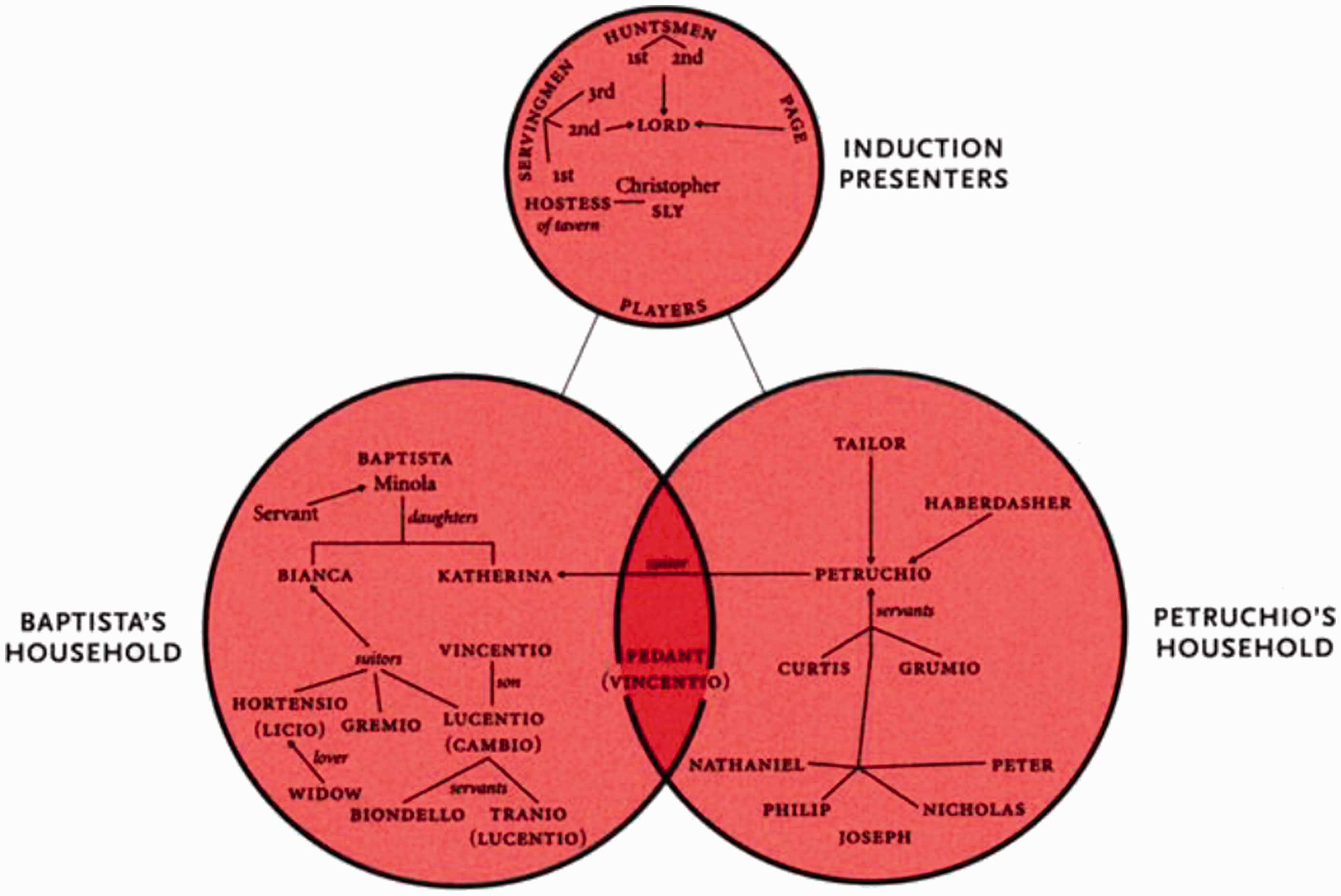
This analogy can be a benchmark in the following aspects:
The first aspect aims to determine the role of each cluster in the life of the society, by analogy with groups of characters such as works of Shakespeare. It may help to find out specifically what kind is the most active group in terms of provoking or governing the rest of the audience community. Furthermore, it will highlight the leaders and outsiders which are influencing the behaviour of other members of the community. A behavioural response can be appropriated for each cluster—strong points and possible weakness—for the subsequent maintenance of the strong points and correction of the weaknesses. The second aspect is related to the prediction of the development of relationship scenarios which are based on the motives of ‘eternal images’ of Shakespeare. It will be observed that a number of difficulties are possible in this aspect, such as the restriction of information, since predictions can be difficult due to a lack of information on all actions, groups and participants of the process under consideration. However, even partial consideration of the process may give short hints to analyse all of the actions under consideration. In addition, for the understanding of a world view of a community we should turn our attention to a horizontal interaction and a hierarchical architecture which characterises a network relationship inside the community.
Network principle of world views
Digital communications suggest a further development of decentralisation and augmentation of strength of the horizontal network relationship. However, digital communications remain hierarchical, but in a modified form; an essential property of the digital era is that hierarchal structures cease to be the dominant type of social organisation—its priority is undermined by social networks. Hierarchical structures are stored in networked connections but are represented in the horizontal plane and are characterised by a position in the network structure (Weng et al., 2012) and the number of social contacts (Christakis and Fowler, 2013). As can be seen from the above, to the end that the majority will make a decision, modern communications and the digital era have multiplied the effect of a horizontal hierarchy and can form a special type of personality. This type of personality is characterised by a propensity and willingness to make new contacts, openness to a dialogue with representatives of other cultural codes, tolerant attitudes and perceptions to elements of someone else’s and alien cultures which interact with the individual. The mutual exchange of cultural values by virtue of the network's contacts has created a new type of social experience—‘bunch-forming’ virtual interactions, i.e. a relatively stable relationship between dozens, sometimes hundreds of people in remote communication modes. In such a manner, the ‘bunch-forming’ virtual interactions can form a reality which is no less important in its consequences for an individual and a group, than face-to-face contact. This effect is well illustrated as exemplified by research groups from different universities. Understanding the network relationships inside such learning groups and breaking down the community and individual world views make it possible to increase the efficiency of global educational projects through the personalisation of educational learning content.
We should focus on the practical side of applications in educational types of world views. At the current level of development of digital technology, where there is a large part of self-guided work and in-class work related to computer and Internet access, insufficient attention is paid to the personalisation of educational programmes. As an example, we can use student's classes and the principle of their formation. Educational groups often form with allowances made for future specialty and omit past experience, current interests and other personal information about students. In this respect, identifying world views of course participants would allow us to mould more strong-knit groups which are based on common experiences, interests and cultural constituents. This personalisation is particularly relevant for online and distance education when educational content is selected on an individual basis for each student by system software and self-learning systems.
Conclusion
The model design of network communities and individual world views, which is based on the data analysis of Internet activity, provides the key to understanding how we can motivate interest in students to receive and assimilate new information. It also allows the analysis of particular events aimed at predicting subsequent behaviour. During the emergence of the digital era and the increasing development of electronic communications and computing facilities, taking into account the world views of individuals and communities, there is a particular perspective in international educational projects which is focused on the personalisation of educational content and the dialogue of cultures in the educational process. In addition, this principle can be effectively transferred to political projects in the field of analysis of electoral expectations and loyalty marketing programmes, as well as other areas that employ user experience.
The application of world views in the design of international educational projects aimed at providing online content can contribute to more effective collaboration on horizontal and vertical levels—between students, students and teachers and teachers and teachers. Taking into account world views is particularly necessary where the life experiences of the participants of the educational process are different, not only because of individual differences, but because of differences in the system as a result of differences in lifestyle and life experience.
World views are closely related to various aspects of social life; its economic, political, legal, moral, scientific and other subsystems. In these, the specificity of linguistic, artistic, spiritual, religious and environmental issues make themselves felt in important historical events. All of these aspects leave their own stamp on the perceived information obtained during the learning process and beyond. Understanding of world views in human, economic, educational and other interactions can give insight into the best and most productive combinations in the formation of work groups, learning classes and other human interactions.
Footnotes
Funding
This paper was supported by grant number 12-33-01293a2, project ‘The potential of youth online communities: the formation of information and communication culture of the person’ from the Russian Foundation for the Humanities.