




Abstract
Continuous glucose monitoring (CGM) has revolutionized diabetes management globally, offering real-time insights into blood glucose levels and trends. In India, where diabetes prevalence is significant, the adoption of digital health tools (DHTs) for CGM has seen remarkable growth. However, successful integration and adoption of these DHTs require collaboration between healthcare professionals and individuals with diabetes. Ensuring the compatibility, accuracy, and reliability of CGM systems is imperative for optimizing diabetes management outcomes in India. Several challenges persist in adopting DHTs for CGM in the country. The adoption of ambulatory glucose profiles and CGM using DHTs has been transformative in diabetes clinics. This paper culminates with expert recommendations on integrating DHTs into diabetes clinics, focusing on training, communication, and technology utilization. The introduction of the Freestyle® Libre into diabetes clinics demonstrates the system’s influence and the advantages seen by both patients and healthcare professionals. With real-time data, improved patient interaction, real-world data for evidence-based practices, and the ability to support patients’ and healthcare professionals’ informed decision-making, these tools have the potential to completely transform the management of diabetes. The goal is to enhance diabetes care through digital health solutions, considering the unique healthcare landscape of India.
Plain language summary
Continuous glucose monitoring (CGM) has transformed how diabetes is managed by providing real-time insights into blood sugar levels and trends. This technology has grown significantly in India, where diabetes is highly prevalent. Digital health tools (DHTs) like CGM enable patients and healthcare professionals to monitor blood sugar patterns, make informed decisions, and improve treatment outcomes. Even with these advantages, there are still a few difficulties. Successful adoption depends on ensuring device accuracy, training medical professionals, and teaching patients how to use these tools. The Freestyle® Libre system is one such example, which has shown notable benefits in diabetes clinics. It improves doctor-patient communication, allows real-world data to inform evidence-based practices, and empowers patients with actionable insights into their health. This paper offers expert recommendations for effectively integrating CGM and DHTs into Indian diabetes care. It emphasizes the need for proper training, clear communication, and leveraging technology to address India’s unique healthcare challenges. These tools hold the potential to revolutionize diabetes management, enhancing the quality of care and outcomes for patients nationwide.
Keywords
Introduction
The global burden of diabetes is rising due to an increase in obesity and other metabolic disorders, especially in developing countries such as India. 1 The estimates predict that by 2045, low- and middle-income countries will account for 94% of the rise in the number of individuals with diabetes worldwide. 2 The International Diabetes Federation’s Diabetes Atlas 2021 estimates that 537 million people aged 20–79 years have diabetes worldwide, comprising 10.5% of this age group. By 2030, it could rise to 643 million (11.3%), and by 2045, to 783 million (12.2%). 2 The incidence of prediabetes and undiagnosed diabetes is also set to increase, as per the ICMR INDIAB 17 data. 3 Despite pharmacological and technological advancements, many people with diabetes struggle to achieve glycemic targets. 4
As healthcare demand grows and capacity constraints continue, patients turn to new technologies for support. 5 Digital healthcare includes platforms for managing chronic conditions like diabetes and managing health data. 4 With over 4.9 billion smartphone users worldwide and approximately 0.5 billion users of mobile applications for managing chronic diseases, diet, and exercise, diabetes apps show significant potential.6,7
Preliminary studies show that digital interventions for glucose control, medication adherence, weight management, and quality of life (QoL) yield promising results. 6 Individuals with diabetes can use health apps on smartphones to adjust medication and lifestyle based on glucose data. 6
HbA1c remains a key glucose control indicator, but time-in-range (TIR, 70–180 mg/dL) has gained importance in diabetes management.8–10 Since 2020, the American Diabetes Association (ADA) has now emphasized TIR, time-below-range (<70 mg/dL), and time-above-range (>180 mg/dL) for comprehensive glycemic assessment.11,12 These metrics assess glycemic control effectively9,13 and should be individualized, especially for pediatric patients, young adults, and pregnant women. 8
Continuous glucose monitoring (CGM) technologies can assist in glycemic management by providing insights into current glucose trends. CGM sensors are made up of three main parts: (1) a sensor, (2) a transmitter applied over the sensor for signal transmission, and (3) a portable device for receiving the signal and visualizing it on the monitor. 14 In some CGM systems, the transmitter is reusable and attaches to each new sensor, while in others it is integrated into the disposable sensor unit. 13
FreeStyle® Libre Pro (blinded professional CGM) has been available in India since 2015, while FreeStyle® Libre 1, an intermittently scanned CGM (isCGM) was introduced in 2020 (Figure 1). 4 The isCGM provides glucose data without finger-pricks or calibrations.4,15 An isCGM system typically consists of (1) a sensor with an integrated transmitter, which is applied to the upper arm, and (2) a compatible reader or smartphone app to scan and display glucose readings. 16 As per the ADA and the American Association of Clinical Endocrinology, the use of CGM is recommended in patients receiving multiple daily insulin injections, infusion pumps, and noninsulin therapy. 17

A representative image of the FreeStyle Libre 1 sensor and reader. The sensor is worn on the upper arm and continuously measures interstitial glucose levels, which can be scanned using the handheld reader to obtain real-time glucose data.
This position paper aims to provide insights into the adoption of CGM-related digital health tools (DHTs) and the integration of CGM into diabetes practice in India, based on an expert panel discussion.
Expert panel discussion and keyword search
A digital advisory board meeting was convened on September 16, 2023, to gain insights from a panel of experts on the impact of CGM-related DHTs in diabetes practice in India. The advisory board consisted of six experts with knowledge and experience in the field. The key objectives of this meeting were to: (1) provide insights into workflow limitations and unmet needs in diabetes clinics, (2) understand how DHTs can be an enabler in driving the adoption of CGM and TIR, (3) provide guidance on ensuring the smooth adoption of CGM and DHTs, and (4) propose modes of educating and training diabetes educators, nurses, and clinic staff.
Challenges and unmet needs for the use of DHTs in CGM in India
Non-standardized software solutions
Due to the inconsistent use of standards of care in practice, the challenges with DHT interoperability complicate transitioning from paper-based to digital systems. 18 Despite 500,000+ health apps, few randomized controlled trials (RCTs) and case-control and cohort studies have explored their impact on behavior. Digital health products evolve continuously, hindering RCT publication and research quality. Moreover, RCTs may not always be optimal for assessing digital behavior interventions, as they often lack the scale and diversity of real-world use. Large-scale real-world data in these situations can yield more representative and broadly applicable insights, especially for marginalized or isolated communities. 19
Diabetes digital health apps face technological challenges. Fully automated interpretation of glucose data is needed for doctors and patients. 20 Comparing the clinical and numerical (statistical) accuracy evaluation of CGM sensors to that of self-monitoring blood glucose test systems is complex. CGM provides continuous, time-series data points, uniformly spaced and arranged—reflecting the blood glucose changes. 21
Infrastructure implementation
Poor infrastructure, such as unreliable electricity and internet, hinders the adoption and effective use of digital health solutions. 22 Parajuli et al. found that the insufficiency of technology and the infrastructure issue (inadequate Wi-Fi connectivity, mobile phone penetration, and telephone network) to support digital health have emerged as major obstacles to its adoption in Nepal. 23
For the adoption of CGM into clinic workflows, hospitals need infrastructure for downloading and analyzing CGM data. Before standardizing CGM use, they should develop plans with process maps, protocols, staff training, and order sets.24,25 Key duties in work system domains (technology, tasks, personnel, organization, environment) must ensure the safe and effective use of CGMs in clinics. CGMs collect protected health information, so institutions must manage this data to ensure its appropriateness, integrity, and security. 24
Workforce requirements
Lack of skilled workforce is one of the challenges faced in the implementation of CGM and DHTs into practice. A systematic scoping review on the uptake of digital tools in cardiovascular care identified fear of technology, poor internet connectivity, perception of impersonal care, older age, and disinterest in technology as patient-level barriers to be addressed. Clinician-level barriers included high workload, unreliable technologies, insufficient evidence, and lack of electronic medical record (EMR) integration. Financial, data privacy, and security concerns were also noted. 26 healthcare professionals (HCPs) need to be competent in initiating, reviewing, and troubleshooting CGM for effective clinical use. 27 Understanding system operation, data collection, and CGM-based metrics is crucial. Learning resources include continuing education courses, online materials, and manufacturer training programs. 27
Need for structured education
Inadequate HCP training on CGM software and data interpretation is a barrier. 20 The American Academy of Family Physicians (AAFP) developed a medical education program to improve CGM use and diabetes care. Three primary care practices participated in a trial study, with two engaging in team training. According to the evaluation survey, most personnel (55%) had no queries post-training, and 95% understood their role in CGM integration. Physicians and interdisciplinary care team members in the AAFP TIPS CGM online course and in-person training expressed high satisfaction with the course’s instruction, substance, and application. 28
Workflow challenges
Integrating CGM and DHTs into clinic workflows improves healthcare access, coordination, and patient consultations. Benefits include cost savings, better outcomes, fewer medical errors, and enhanced care quality.26,29 However, DHT adoption is likely to be restricted to doctors who are driven to adopt technologies to enhance care unless adequate measures are undertaken to resolve workflow inefficiencies. 26
The expert panel recommended everyday practices to facilitate the incorporation of software tools in clinics (Table 1).
Expert recommendations on everyday practices to facilitate incorporation of software tools.

CGM, continuous glucose monitoring; HCPs, healthcare professionals; ID, identifier.
Patient-related factors
Factors hindering CGM and DHT adoption include low literacy, limited English proficiency, limited access to technologies, visual disabilities, inadequate internet access, affordability, lack of support, and insufficient disease education and self-care. The potential solutions for mitigating these barriers are education and interface design, multilingual applications, subsidized internet access, financial support or device loans, and easily available technology support. 30 Additional barriers include inadequate healthcare support, disrupted patient-physician relationships, and technology privacy concerns. 30 Poor follow-up in diabetes patients is due to geographical issues, busy schedules, reporting reluctance, and monitoring inertia. DHTs offer accessible solutions to these challenges. 31
The unique challenges in the implementation of CGM in India are listed in Table S1.11,32,33
FreeStyle Libre in diabetes clinics
The FreeStyle Libre sensor, accompanied by the cloud-based platform LibreView®, is among the leading CGM systems. 34 It is approved for individuals aged 4 years and above, 35 and it features a small glucose sensor applied to the back of the upper arm. The sensor, with a 5 mm filament inserted into the subcutaneous tissue, measures glucose in the interstitial fluid (ISF). 36 The FreeStyle Libre is designed for a 14-day usage period, continuously monitoring glucose levels every minute. The reader/phone device displays current glucose values along with glucose trends over the past 8 h upon scanning the sensor. 36
LibreView is a cloud-based portal for uploading glucose data, offering detailed reports on metrics, ambulatory glucose profiles (AGPs), daily patterns, and food and insulin data. 35 Integrating LibreView, LibreLink®, and LibreLinkUp®, developed by Abbott, can revolutionize diabetes care with seamless CGM and clinical assessment.36,37 They enhance clinical outcomes by providing precise data for HCPs, enabling targeted therapy adjustments.31,38,39 The link between data collection and action has historically posed challenges in diabetes management. 31 A meta-analysis of 25 real-world studies indicates adult users experience an average HbA1c decrease of 0.56%, while children and adolescents see a reduction of 0.54% with these digital tools.9,40
The expert panel outlined possible challenges and patient concerns for the adoption of LibreView in diabetes clinics (Table 2).
Expert recommendations on possible challenges and patient concerns for the adoption of LibreView in diabetes clinics.
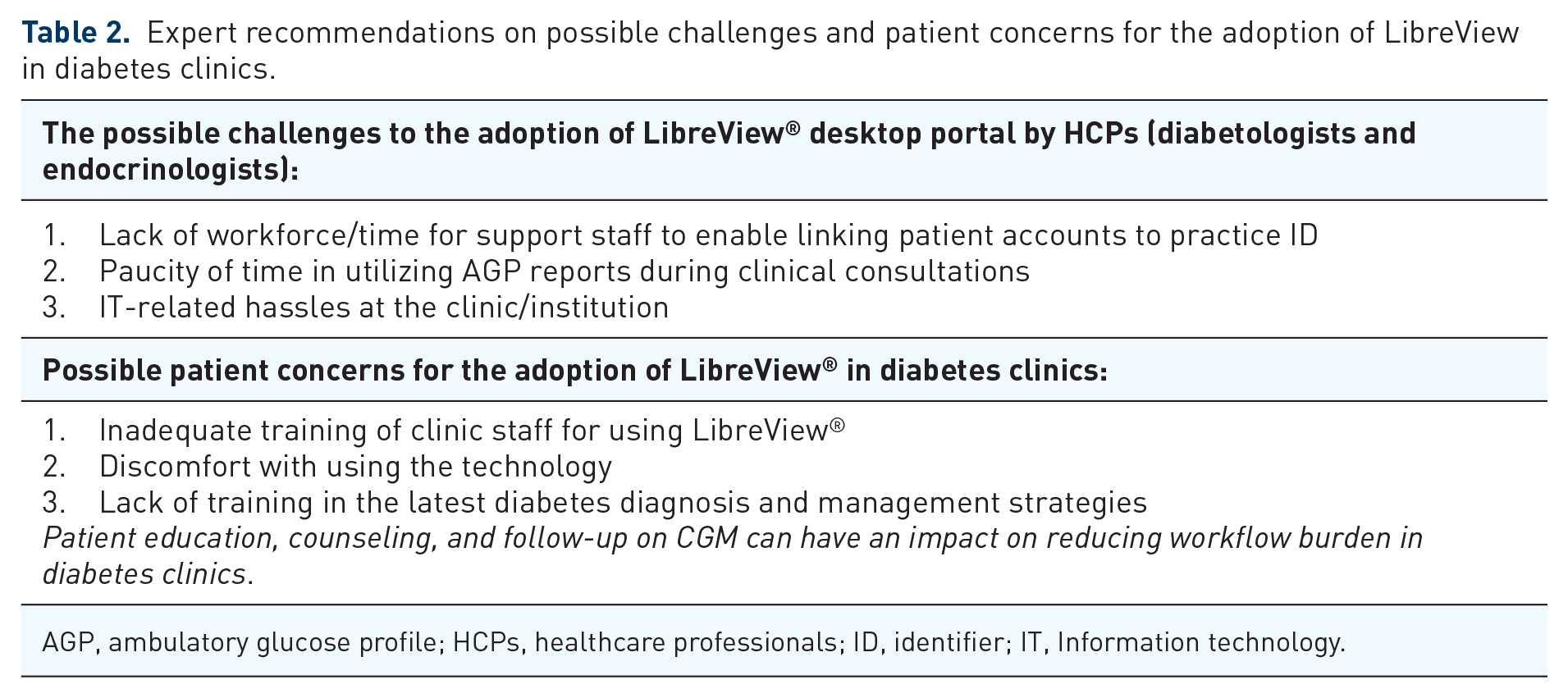
AGP, ambulatory glucose profile; HCPs, healthcare professionals; ID, identifier; IT, Information technology.
In this manuscript, we have developed an algorithm (Figure 2) that recognizes a possible treatment path for people with either type 1 diabetes mellitus (T1DM) or type 2 diabetes mellitus (T2DM). 9

Diabetes treatment algorithm designed for implementation through the Libre View® digital platform. 9
LibreView provides HCPs with remote access to patients’ glucose data, which aids in decision-making. The user-friendly interface streamlines analysis and generates reports, simplifying patient consults.7,9,11,31 The LibreLink app enables access to glucose data and trends via smartphones. LibreLinkUp enables caregivers to view data remotely, fostering support.36,41 The perceived advantages of utilizing the FreeStyle Libre® sensor with LibreView are given in Table 3.
Advantages of utilizing FreeStyle Libre sensor with LibreView.

HCPs, healthcare professionals.
The isCGM desktop software helps HCPs by streamlining practice, centralizing patient data, and providing efficient monitoring and analysis. Customizable reports save time and enhance patient discussions.13,36 A UK study observed the impact of an organized approach by HCPs using digital software on metabolic outcomes and QoL in children with T1DM. After a year, the FreeStyle Libre system notably improved patients’ QoL, reduced diabetes symptoms, and addressed treatment obstacles. 42 In addition, research by Massa et al. indicated high satisfaction levels among children and adolescents with T1DM using FreeStyle Libre. 35 They reported less pain, comfortable wearability, discreet scanning, and no interference with daily activities. 35 Deeb et al. concluded that FreeStyle Libre effectively enhances glucose surveillance and identifies hypoglycemia in young individuals with diabetes. 43
Mobile application: Benefits for patients
The smartphone app for glucose monitoring enables proactive diabetes management by tracking levels and setting personalized reminders. Overall, these software tools can revolutionize diabetes management, fostering a collaborative network between patients and HCPs and improving the quality of care for individuals with diabetes. 37
Incorporation of DHTs in diabetes clinics
Benefits observed with DHTs
Stevens et al. found that DHTs improved HbA1c more than standard therapy in T1DM, T2DM, and prediabetes, with mean differences of −0.56%, −0.90%, and −0.26%, respectively. 44 Small studies on digital programs targeting QoL, medication adherence, weight loss, and glucose management show promising outcomes, but more clinical data are needed to assess diabetes app efficacy.6,45–47
Unnikrishnan et al. studied the My Dose Coach (MDC) app, aiding T2DM patients in titrating basal insulin. High MDC usage led to improved fasting blood glucose (FBG) target achievement and quicker FBG target attainment compared to moderate and low usage (p < 0.01). The high usage group adjusted insulin doses more (p = 0.01), 48 with better FBG outcomes without increased hypoglycemia risk. Pregnant individuals with diabetes should consider CGM use, but treatment customization is crucial for T2DM or gestational diabetes mellitus (DM). 49 The nationwide audit conducted by the Association of British Clinical Diabetologists showed that the adoption of the FreeStyle Libre system is linked to better outcomes, which, in turn, leads to a decrease in the real-world use of diabetes-related resources in T1DM populations. 50 The FreeStyle Libre is utilized for a full year by 1365 individuals with DM who were part of a prospective countrywide registry. With a difference of −4 (95% CI: −6 to 3) mmol/mol, HbA1c dropped from 64 (95% CI: 63–65) mmol/mol to 60 (95% CI: 60–61) mmol/mol after 12 months. The EQ-VAS (4.4 (95% CI: 2.1–6.7)), the health-related QoL measured by EQ-5D tariff (0.03 (95% CI: 0.01–0.05), and the SF-12v2 mental component score (3.3 (95% CI: 2.1–4.4)) all showed improvements. Patient-reported outcome measures improved for most. The rates of work absenteeism after 6 months and hospital admissions related to diabetes after 12 months had a significant decline, falling from 18.5% to 7.7% and 13.7% to 2.3%, respectively. 51
Adoption of AGP and CGM using DHTs in diabetes clinics
The AGP is a one-page report used to summarize glycemic control in patients with diabetes using CGM devices. According to the 2019 international consensus, AGP offers a statistical and visual summary of glucose measurements essential for evaluating glycemic control.8,52 It identifies glucose patterns for therapy adjustments and personalized goals, improving metabolic management, QoL, and treatment adherence. Data analysis typically spans at least 14 days, with each AGP evaluation session recommending only one or two treatment modifications. 53 For all the CGM devices, as per the ADA Standards of Care 2024 recommendations, real-time continuous glucose monitoring (rtCGM) or isCGM should be offered diabetes management in adults with diabetes on multiple daily injections (MDI) or subcutaneous insulin infusion (CSII), diabetes management in adults with diabetes on basal insulin, diabetes management in youth with T1DM and T2DM on MDI or CSII, who are capable of using the device safely. rtCGM devices should be used as close to daily as possible for maximal benefit. isCGM devices should be scanned at least every 8 h to avoid data gaps. Uninterrupted access to supplies is essential. In conjunction with pre-prandial and postprandial blood glucose monitoring, CGM can assist in meeting A1C goals in diabetes and pregnancy. 54
Consultation time management with web-based digital tools
A survey of GPs in three European countries assessed their knowledge of new T2DM treatments and the potential of digital tools in aiding treatment decisions. 82.8% found digital clinical decision support tools very or extremely helpful. 34 Kaissar et al.’s survey on teleconsultation in France revealed that 54% of physicians felt teleconsultation should take as much time as in-person visits (15–20 min). 55
Role of CGM in teleconsultation
Research shows CGM aids new interventions, overcomes clinical inertia, promotes self-care, and reduces physician workload.4,56 The Indian Council of Medical Research-National Centre of Disease Informatics and Research (ICMR-NCDIR) developed telemedicine guidelines for diabetes, cancer, cardiovascular disease, and stroke, detailing clinical services and teleconsultation processes. 57
How DHTs can enhance clinical practices
Physician support is crucial for patient acceptance of DHTs. 30 Ruiz de Adana et al. investigated telemedicine’s impact on glycemic control, health-related QoL, and satisfaction in T1DM patients. Telemedicine is clinically effective, safe, and comparable to in-person visits, enhancing access for financially constrained patients.58,59 Physician endorsement and personalized telemedicine methods greatly influence patients’ decisions to use telemedicine. Future research should focus on improving telemedicine infrastructure and increasing physician participation, especially during implementation. 60 If a person with diabetes has a smartphone, the FreeStyle Libre web portal “LibreView®” facilitates data sharing in almost real time between patients and their HCPs. 60 Patients’ glucose reports are accessible securely online through LibreView, enabling HCPs to have more productive diabetes management discussions with their patients. 61
Future of DHTs
In India, DHTs include CGM for glycemic management, insulin pumps for continuous subcutaneous insulin infusion, telemedicine platforms for various services such as diabetes education and follow-ups, mobile health for education and consultations, and EMRs for patient data management and research. Digital health is gaining visibility for enhancing healthcare value due to abundant data and new technology advancements. 4 The future of diabetes treatment could be transformed by five key technologies: telehealth, integration of diabetes digital data into electronic health records, artificial intelligence, cybersecurity for diabetes devices, and diabetes registries. It is also important to recognize that advanced blood glucose meters (BGMs) increasingly offer connectivity to mobile apps and clinician portals, creating robust digital ecosystems for patients who do not have access to CGM. Structured BGM, combined with digital analytics, can generate meaningful patterns for patients who test frequently, offering insights such as AGP. Such connected BGM solutions could play an important role in extending the benefits of digital diabetes care, especially in resource-limited settings. 62
Adoption of digital tools in diabetes clinics
Even with the advancement in diabetes management, profound therapeutic inertia exists. Developing or integrating specialized diabetes management apps is crucial. CGM digital tools are revolutionizing diabetes management by streamlining patient care and improving decision-making. They enable telemedicine, allowing HCPs to conduct virtual consultations, monitor glucose levels remotely, and intervene promptly. By integrating clinical insights with advanced algorithms, CGM systems enhance clinical decision-making for more personalized care. These digital tools are used with a CGM monitor to measure blood glucose, track lifestyle habits, ensure medication adherence, and help with patient education. Integration with wearable devices provides real-time data for improved insights. Collaborative efforts between HCPs (including clinicians, dietitians, nurses, and technology experts), along with ongoing assessments and adaptations informed by patient feedback and technological advancements, are essential for continuous improvement in digital diabetes clinics.63–65
The acceptance of digital healthcare software by children and youth is crucial for its successful use. 41 A French study of 347 children and parents found that the main reasons for using FreeStyle Libre were avoiding painful finger-pricks and monitoring glucose levels at night. 66
Improving digital healthcare apps requires addressing workflow challenges, 67 such as setting development guidelines, ensuring consistent safety reports and documentation, investing in clinical data, and prioritizing patient confidentiality and security. 6
Measures to increase the adoption of DHTs in CGM
Enhancing DHT adoption in CGM needs a comprehensive strategy. Innovative technologies are shaping diabetes digital health, and adopting DHTs with targeted policies is essential for effective diabetes care, especially in India. 4
To boost DHT adoption in CGM, empowering healthcare staff is vital. World Health Organization (WHO) research shows that digital health literacy is key to overcoming HCP barriers. Dr. David Novillo-Ortiz highlights that tailored training improves HCP proficiency in CGM and DHT use. Effective diabetes clinics rely on skilled educators, nurses, and staff for data interpretation and communication.6,68 This support aids physicians who otherwise might find the data overwhelming (Table 4).
Experts’ recommendations on topics that could be incorporated into the nurse/educator training curriculum related to CGM.

AGP, ambulatory glucose profile; CGM, continuous glucose monitoring; IT, information technology; SMBG, self-monitoring blood glucose.
Patient education on CGM and DHTs is crucial. Online resources, such as portals, blogs, and videos, offer valuable training, enhancing patient engagement and understanding. This can improve effectiveness and potentially reduce long-term costs by minimizing complications.4,68
CGM data, with the help of DHTs, enable population-level analysis and registry development. While less rigorous than RCTs, this real-world evidence can significantly impact clinical practices. 63
The recommendations by the expert panel for the smooth adoption of CGM-related DHTs in diabetes clinics across India are summarized in (Table 5).
Expert recommendations on DHTs for CGM in diabetes management.

ADA, American Diabetes Association; ADCES, Association of Diabetes Care & Education Specialists; AGP, ambulatory glucose profile; CGM, continuous glucose monitoring; DHT, digital health tools; EMR, electronic medical record; HCP, healthcare professional; RSSDI, Research Society for the Study of Diabetes in India.
Limitations
While CGM is a valuable tool for optimizing glucose management, its accuracy may be affected in people with chronic kidney disease (CKD) due to factors such as fluid shifts during dialysis, inflammation, and changes in ISF dynamics. Patients undergoing hemodialysis may experience significant glucose fluctuations, including intra-dialytic hypoglycemia and post-dialysis hyperglycemia, while peritoneal dialysis can introduce exogenous glucose, further influencing readings. Individuals with advanced CKD are also at higher risk for frequent and severe hypoglycemia due to impaired insulin metabolism. Therefore, CGM data in people with CKD should be interpreted with caution and ideally supplemented with periodic blood glucose checks, especially during dialysis sessions. Individualized treatment plans and more research are needed to guide optimal sensor selection and use in this population. 69
In addition, although studies have shown that FreeStyle Libre CGM systems are cost-effective compared to self-monitoring of blood glucose in various countries, robust evidence specific to India remains limited.70,71 Further local research is necessary to evaluate the cost-effectiveness and practical implementation of CGM technologies in the diverse Indian healthcare context.
Finally, while CGM offers continuous data, it can sometimes generate data overload for both patients and healthcare providers, requiring proper training to interpret trends and avoid alarm fatigue or unnecessary treatment changes. 72 This highlights the need for ongoing education and support for users and clinicians to maximize CGM’s clinical benefit. More large-scale, long-term real-world studies are warranted to address these challenges and guide best practices in diverse patient populations.
Conclusion
The use of DHTs for CGM in diabetes management in India provides valuable insights for advancing care. Integration of CGM systems and their associated digital platforms into routine clinical practice can positively impact patient care and workflow efficiency for healthcare providers and patients alike. Successful integration of DHTs requires infrastructural readiness, stakeholder collaboration, and tailored training and awareness. A future with connected DHTs enhancing diabetes management in India is crucial, necessitating a comprehensive and inclusive approach.
Supplemental Material
sj-docx-1-tae-10.1177_20420188251372290 – Supplemental material for Using digital tools to improve diabetes care in India with continuous glucose monitoring
Supplemental material, sj-docx-1-tae-10.1177_20420188251372290 for Using digital tools to improve diabetes care in India with continuous glucose monitoring by Jothydev Kesavadev, Banshi Saboo, Manoj S. Chawla, Ambika Gopalakrishnan Unnikrishnan, Timothy C. Dunn and Mangesh Harihar Tiwaskar in Therapeutic Advances in Endocrinology and Metabolism
Footnotes

References
Supplementary Material
Please find the following supplemental material available below.
For Open Access articles published under a Creative Commons License, all supplemental material carries the same license as the article it is associated with.
For non-Open Access articles published, all supplemental material carries a non-exclusive license, and permission requests for re-use of supplemental material or any part of supplemental material shall be sent directly to the copyright owner as specified in the copyright notice associated with the article.
