




Abstract
Diabetes Mellitus, characterized by persistent hyperglycaemia, is a heterogeneous group of disorders of multiple aetiologies. It affects the human body at multiple organ levels thus making it difficult to follow a particular line of the treatment protocol and requires a multimodal approach. The increasing medical burden on patients with diabetes-related complications results in an enormous economic burden, which could severely impair global economic growth in the near future. This shows that today’s healthcare system has conventionally been poorly equipped towards confronting the mounting impact of diabetes on a global scale and demands an urgent need for newer and better options. The overall challenge of this field of diabetes treatment is to identify the individualized factors that can lead to improved glycaemic control. Plants are traditionally used worldwide as remedies for diabetes healing. They synthesize a diverse array of biologically active compounds having antidiabetic properties. This review is an endeavour to document the present armamentarium of antidiabetic herbal drug discovery and developments, highlighting mechanism-based antidiabetic properties of over 300 different phytoconstituents of various chemical categories from about 100 different plants modulating different metabolic pathways such as glycolysis, Krebs cycle, gluconeogenesis, glycogen synthesis and degradation, cholesterol synthesis, carbohydrate metabolism as well as peroxisome proliferator activated receptor activation, dipeptidyl peptidase inhibition and free radical scavenging action. The aim is to provide a rich reservoir of pharmacologically established antidiabetic phytoconstituents with specific references to the novel, cost-effective interventions, which might be of relevance to other low-income and middle-income countries of the world.
Introduction
Diabetes mellitus (DM) is the most common endocrine disorder resulting from a defect in insulin secretion, insulin resistance or both. It is the third leading cause of morbidity and mortality, after heart attack and cancer. In 2015, about 415 million people had diabetes in the world and 78 million people in the Southeast Asia (SEA) region; by 2040 this will rise to 140 million. India is one of the epicentres of the global DM pandemic. There were 69.1 million cases of diabetes in India in 2015.1,2 DM characterized by persistent hyperglycaemia is a heterogeneous group of disorders of multiple aetiologies that affect the human body at multiple organ levels, thus making it difficult to follow a particular line of treatment. The treatment protocol requires a multimodal approach which should be personalized so that it varies from person to person. 3 In general, DM is classified into two categories: type 1 and type 2. In type 1 diabetes (T1DM), hormone insulin is not produced due to the destruction of pancreatic β cells, while type 2 diabetes (T2DM) is characterized by a progressive impairment of insulin secretion by pancreatic β cells and by a relative decreased sensitivity of target tissues to the action of this hormone. T2DM leads to other pathological consequences like cardiovascular disorders, nephropathy, neuropathies and the patient becomes prone to a number of infections too. 4 The increasing medical burden on patients with diabetes-related complications also results in an enormous economic burden, which could severely impair global economic growth in the near future. This shows that today’s health system has conventionally been poorly equipped to confront the mounting impact of diabetes on a global scale and demands an urgent need for newer and better options. The overall challenge of this field of diabetic treatment is to identify the individualized factors that can lead to improved glycaemic control.
Besides conventional oral and injectable medications, diabetes treatments include diet modification, regular exercising, lifestyle changes, weight regulation and other alternatives or add on therapies such as herbal therapy.5,6 Herbal drugs are prescribed widely as drugs of choice because of their effectiveness, few side effects and relatively low cost. 7
In present day modern science, concoctions or crude extract based studies are losing their significance and the focus has, for the better, shifted towards discovery and exploitation of specific compounds for their therapeutic actions. Knowledge about specific compounds from various herbal (plant) parts makes the experimental studies easier and helps to focus on better understanding the mechanism of action and future therapeutic potential. Since diabetes is a multifaceted disease with an effect on almost all the organs, 4 exploitation of plant resources for better therapeutic molecules needs a boost in research and development. Another advantage of exploiting plant-based resources is the time and money saving since it will surpass the need for drug design and screening. This review documents the present armamentarium of antidiabetic herbal drug discovery and developments, highlighting the mechanism-based antidiabetic properties of over 300 different phytoconstituents of various chemical categories from about 100 different plants modulating different metabolic pathways. The aim is to provide a rich reservoir of pharmacologically established antidiabetic phytoconstituents with specific references to the novel, cost-effective interventions, which might be of relevance to other low-income and middle-income countries of the world.
Materials and methods
This review article is a compilation of the current knowledge and future expectation of various chemical categories of phytoconstituents with their mode of actions on a single platform, which have been shown to display potent hypoglycaemic activity against DM. We have searched the literature using PubMed, SCOPUS, MEDLINE, and Google scholar with the key words ‘diabetes, antidiabetic phytoconstituents, metabolism, their mode of action on metabolic pathways, and induction’ to prepare this review article. The literature search included only articles written in the English language. The references lists of all listed articles were searched manually to obtain relevant and additional information. Review and original research articles published between 1984 and 2017 (in English) were included in this review as a reference. The selection of phytoconstituents in this review was on the basis of their antidiabetic activity and ethanopharmacological use.
Carbohydrate metabolism: problem statement
Metabolism in the living system is concerned with managing the material and energy resources within cells involving complex molecules like carbohydrates, lipids and proteins as chief substrates. After a normal meal, the transient increase in plasma glucose, amino acids, triglycerols and chylomicrons is responded to by increased secretion of insulin from pancreatic islet cells, thus enhancing the synthesis of triacylglycerols, glycogen and protein. During this period virtually all tissues use glucose as a fuel. 8 Problems with glucose and carbohydrate metabolism are quite rare in cultures adhering to a primitive diet, one low in refined foods, starches and sugars. Although hereditary predispositions, viral and bacterial afflictions of the pancreas and autoantibodies to pancreatic islets do contribute to the development of this disorder, diet, lifestyle and obesity are by far the most significant risk factors. 9 In the following section various pathways in which glucose is involved, either as a substrate or liberated as a product, are discussed and the corresponding plant-derived drugs that inhibit or activate the steps in these pathways are listed.
Therapy and management of DM
A combination of side effects, contraindications and lack of effect of synthetic drugs on disease progression highlight the need for newer therapies that minimize the frequency and severity of DM exacerbations. 10 The plant kingdom historically has been the driving force for the development of novel drugs. Herbal products have been thought to be inherently safe because of their natural origin and traditional use rather than systemic studies designed to detect adverse effects. Approximately 80% of the world’s population relies on biomedicines for their health and wellbeing.11,12 According to ethnobotanical information based on Indian Pharmacopoeia, about 1200 plants with antidiabetic properties have been cited. Of these, around 400 plants and their products have been documented to have antidiabetic properties after significant investigation. 13 There are unique theories for concepts of aetiology, systems of diagnosis and treatment for plant-derived drugs, which are vital to using them in practice. The mechanisms of action of plant-derived drugs involve regulating glycaemic metabolism, decreasing cholesterol levels, eliminating free radicals, increasing secretion of insulin and improving microcirculation. 14 With the background that phytoconstituents form the mainstay of therapy and management of DM, this paper reviews the common Indian antidiabetic plants and their constituents.
Phytoconstituents and their antidiabetic effects
Plants contain numerous chemical compounds having medicinal values and include alkaloids, amino acids, amines and carboxylic acid derivatives, anthranoids, carbohydrates, glycosides, flavanoids, minerals, vitamins and inorganic compounds, peptidoglycans, polyphenol and its derivatives, saponins, and so on. 15 These compounds are extracted from different parts of the various plants (root, stem, leaf, flower, fruit, etc.) (Table 1). This review aims to document and summarize the present knowledge about the mechanism-based action of antidiabetic plants, with emphasis on their phytoconstituents that target the various metabolic pathways in humans. The review has been organized according to various categories of phytoconstituents, targeted metabolic pathways and plant sources in Table 1 (A–J), which are also shown in Figures 1–4 at different steps with arrows and phytoconstituent numbers (A-1, B-6, J-2, etc.). Figures 1–4 clearly show the action of various phytoconstituents discussed in this review (Table 1) at different steps of various metabolic pathways.
Chemical categorization of various phytoconstituents having hypoglycaemic potential that regulate intermediates of different metabolic pathways.

PPAR, peroxisome proliferator activated receptor.

Phytoconstituent regulation of glycolysis and Krebs cycle with sources and fate of acetyl coenzyme A.
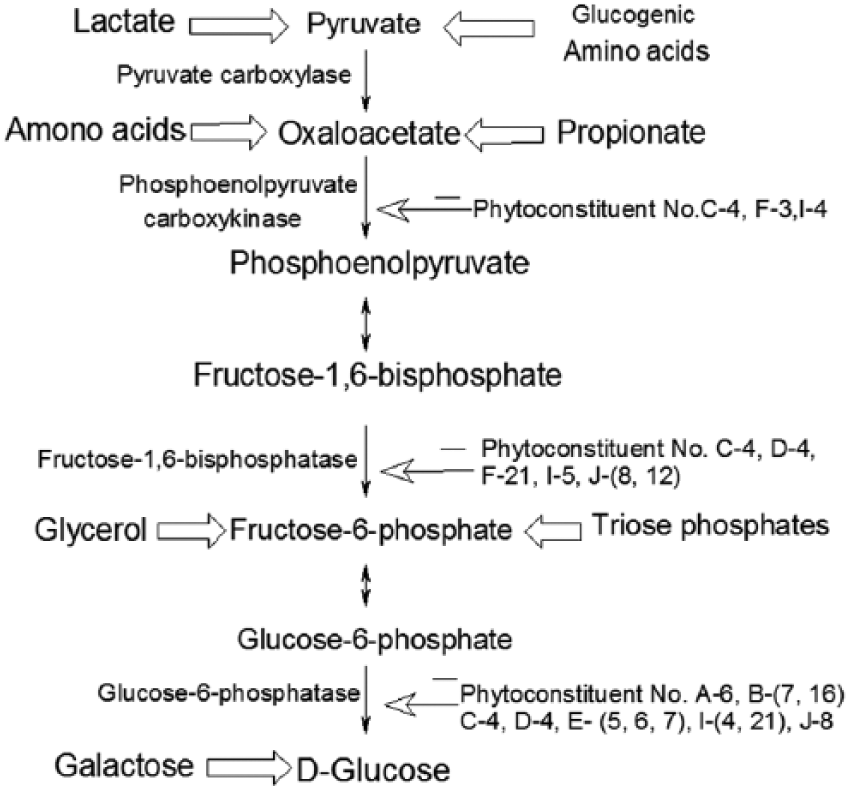
Illustration of the gluconeogenesis pathway with major substrate precursors and regulation by phytoconstituents.

Regulation of carbohydrate metabolism by phytoconstituents.

Mechanism of action of the peroxisome proliferator activated receptor (PPAR) family and their regulation by phytoconstituents.
Alkaloids
A large number of alkaloids have been isolated from numerous medicinal plants and investigated by the researchers for their possible antidiabetic activity. 112 Glycolysis is the hub of carbohydrate metabolism because virtually all sugars (whether arising from the diet or from catabolic reactions in the body) ultimately can be converted to glucose via a series of 10 reactions with three regulatory steps catalysed by the enzymes hexokinase, phosphofructokinase and pyruvate kinase. The alkaloid berberine, extracted from Tinospora cordifolia, enhances the activity of hexokinase and phosphofructokinase, resulting in glucose transport, carbohydrate digestion and absorption. 16
Carbohydrates are the major constituents of the normal diet of humans. Starch and sucrose are its major forms, which supply about 70–80% of the energy requirement to the body. Their digestion starts in the mouth and continues even in the small intestine producing glucose, which is absorbed into the bloodstream through the walls of the intestine, and finally it is transported to different parts of the body through the liver. The digested products are mainly glucose with small amounts of fructose and galactose. Starch is first decomposed into oligosaccharides by the enzyme α-amylase, found in saliva and pancreatic juices. A membrane-bound enzyme α-glucosidase, in the epithelium of the small intestine, catalyses the cleavage of glucose from disaccharides and oligosaccharides. Hence, α-glucosidase inhibition is one of the effective treatments for diabetes since it will delay the time of absorption of glucose. 3 There are a number of phytoconstituents known to suppress the activity of α-glucosidase and inhibit the absorption of glucose in both the small intestine and kidney, so that the concentration of glucose in the blood remains constant after a meal. The α-glucosidase inhibitors slow the digestion of starch in the small intestine, so that glucose enters the bloodstream more slowly and can be matched to an impaired insulin response or production. Gluconeogenesis is a ubiquitous multistep process occurring in the liver and kidney in which pyruvate or a related three-carbon compound like lactate, alanine, is converted to glucose. Seven of the 10 enzymatic reactions of gluconeogenesis are the reverse of glycolysis with four regulatory steps that are catalysed by the enzymes pyruvate carboxylase, phosphoenolpyruvate carboxykinase, fructose-1,6-bisphosphatase and glucose-6-phosphatase. During gluconeogenesis a phytoconstituent barberine reduces the activity of glucose-6-phosphatase enzyme which affects the conversion of d-glucose from glucose-6-phosphate.
Catharanthine, vindoline and vindolinine, obtained from Catharanthus roseus lower the blood sugar level and show free radical scavenging action.18,19 Glucose takes part in the glycation of the membrane lipid and its peroxidation to produce free radicals. In DM, the glucose concentration is very high and so is the amount of free radicals in the body which are highly reactive. To prevent their deleterious effect, our body has a defence system comprising several enzymes, which include superoxide dispiutase, catalase, reduced glutathione and glutathione-S-transferases. 113 Catharanthine, vindoline and vindolinine activate these free radical scavenging enzymes and prevent our body from their adverse effects. Vinblastine and vincristine are isolated from Vinca rosea, which also activate free radical scavenging enzymes.20,57 Sotolon [4,5-dimethyl-3-hydroxy-2(5H)-furanone], trigonelline, gentianine and carpaine compounds are extracted from Trigonella foenum graecum and downregulate the activity of fructose-1,6-bisphosphatase and check the dephosphorylation of fructose-1,6-bisphosphate.21,66,67,84 Ginkgolides found in the Ginkgo biloba plant have been reported to have an antihyperglycaemic effect on in vitro models. 22 The mangiferin, a xanthone glucoside found in the leaves of Mangifera indica, has antidiabetic and antihyperlipidaemic properties. 114 The Allium sativum plant is a rich source of alkaloid allylpropyl disulfide that is involved in glycogen synthesis and insulin secretion. 23 Glycogen synthesis is a multistep process, but allylpropyl disulfide checks the conversion of pyruvate into lactate by reducing the activity of the lactate dehydrogenase enzyme.
Aegelin, marmesin and marmelosin are the major alkaloids from the plant Aegle marmelos25,26 that causes regeneration of pancreatic β cells and insulin secretion. Insulin produced by the pancreatic β cells is one of the most important peptide hormones coordinating the utilization of fuels by tissues whose metabolic effects are anabolic, favoring, for example, the synthesis of glycogen, triacylglycerols and protein. The aim of this holistic approach by these botanicals is to repair pancreatic β cells and maintain the proper amount of insulin by increasing the expression of the insulin gene, increasing the secretion of insulin and inhibiting their degradation. Patients with T1DM have virtually no functional β cells (implicated due to genetic, autoimmune, environmental or viral factors) which leads to gradual depletion of the cellular population. They can neither respond to variations in circulating fuels nor maintain a basal secretion of insulin. Patients with T1DM must rely on exogenous insulin to control hyperglycaemia and ketoacidosis. The β carbolines (harmine, nor-harmine, pinoline) are believed to promote insulin secretion by β-cell regeneration and are the extracts of Tribulus terrestris.27,28 Carbohydrate digestion and absorption is affected by betaine, achyranthine and β ecdysone isolated from Achyranthes aspera. 29 Castanospermine, epifagomine and fagomine are the chief phytoconstituents of Xanthocercis zambesiaca that are actively involved in carbohydrate digestion, absorption and insulin secretion. 30 Berberine, found in the plant Berberis aristata, has been shown to have dipeptidyl peptidase IV (DPP-IV)-inhibiting activity. 17 The seed extract of Castanospermum australe contains three alkaloids, namely castanospermine, 7-deoxy-6-epi-castanospermine and australine, which have been shown to have DPP-IV inhibition activity and are effective in controlling the hyperglycaemic state in experimental rats.11,31
Amino acids, amines and carboxylic acid derivatives
The compounds allicin, apigenin and alliin extracted from Allium sativum target cholesterol and glycogen synthesis pathways.32,33 Cholesterol is the most abundant sterol in our body and is essential for normal functioning of the cells. If the cholesterol level exceeds the normal value, the chances of cardiovascular diseases increase. Cholesterol synthesis is approximately a 30-step process with acetyl coenzyme A (CoA) as its precursor. Regeneration of pancreatic β cells and insulin secretion are activated by gurmarin, betaine, choline, gymnemic acid IV and trimethylamine isolated from Gymnema sylvestre.32,34,35 (–) Hydroxycitric acid and 2-heptyl acetate, 2-methyl butyl acetate and isoamyl acetate are carboxylic acid derivatives from Garcinia cambogi and Gymnema sylvestre respectively that induce insulin secretion.35,36 Erulic acid from Curcuma longa activates free radical scavenging activity and insulin secretion. 37 Aloe vera extracts contain leucine, isoleucin and alanine, which trigger insulin secretion. 38
Some plant extracts of Caralluma edulis, Syzygium cumini and Acacia Arabica contain malic acid and chiorogenic acid that check the steps of Krebs cycle. 39 The Krebs cycle is the central pathway for energy production in the mitochondrial matrix. Here pyruvate gets oxidized to CO2 and H2O via acetyl CoA with the synthesis of energy equivalent Nicotinamide Adenine Dinucleotide (NADH), which ultimately is oxidized to produce energy via the electron transport chain. Out of seven enzymes involved in the cycle, only two, succinate dehydrogenase and malate synthase, are regulated by these botanicals. The compound polypeptide-P in Momordica charantia extract is shown to regulate insulin secretion and glycogen synthesis.40,41 The compounds S-methyl cysteine sulfoxide and S-allyl cysteine sulfoxide derived from Allium cepa act on glycolysis and cholesterol synthesis.24,42 Contrarily, the nitrosamines, nitrosated derivatives found in Areca catechu, are a great hyperglycaemia risk factor in the Asian population. 43 The compounds brevifolin carboxylic acid and ethyl brevifolin carboxylate extracted from Phyllanthus amarus are also involved in carbohydrate digestion and absorption. 44 Viscum album extracts have been shown to have antihyperglycaemic effects and insulin-releasing effects in streptozotocin-induced diabetic rats and glucose-sensitive insulin-releasing pancreatic cell lines.45 –47 Coriander, a common household food ingredient used worldwide, has been shown to have significant insulin-like activity and helps in insulin secretion too. 115 The compounds furfural and captylic acid from Agaricus campestris,48,49 and bis-(2-ethyl) hexyl phthalate from Cassia auriculata, enhance insulin secretion and glycogen synthesis. 51 The raisins from Vitis vinifera have insulin-mimetic activity. 52 Procyanidins, extracted from grape seeds, have insulin-mimetic properties. 50
Anthranoids
Anthranoid compounds like aloin, barbaloin, isobarbaloine, aloetic acid, aloe-emodin, emodin, cinnamic acid and crysophanic acid from Aloe vera and Cassia tora initiate insulin secretion/synthesis. 38 Momordica charantia is a rich source of vicine which acts on insulin secretion and glycogen synthesis.40,41 Extracts from Cassia tora also stimulate insulin release. 53 Compounds like camphor, eugenol, trans-β-ocimene, geraniol, α-pinene, limonene, p-cymene, 1,8-cineole and thujone, which help in pancreatic β-cell restoration and insulin secretion, are reported to be found in Ocimum sanctum, Coriandrum sativum, Artemisia roxburghiana and Syzygium aromaticum.54 –56
Carbohydrates
Plants like Aloe vera, Ocimum sanctum, Alpinia galangal, among others, contain polysaccharides which have a considerable hypoglycaemic effect. Glucomannan, caryophylline, protein-bound polysaccharide, cellulose and mannose from these plants are either directly or indirectly involved in insulin secretion, carbohydrate digestion and absorption. 57 Guar gum, pectin and pectin fibres and mucilaginous fibre are secretory and excretory products of Trigonella foenum graecum, Citrus sinensis and Coccinia indica that initiate insulin secretion, carbohydrate digestion and absorption.20,58 Hericium erinaceus contain many β-glucan polysaccharides such as D-threitol and D-arabinitol which have antihyperglycaemic action.59,60 Carbohydrate digestion and absorption are also regulated by L-arabino-D-xylan, cinnzeylanin, cinnzeylanol and D-glucan, which are extracted from Cinnamomum zeylanicum blume. 61 Opuntia ficus indica, Myrtus cummunis and Taraxacum officinale probably inhibit α-glucosidase, leading to slow absorption of carbohydrates.62,63 Fructo-oligosaccharide extract of plant and microbial origin significantly decreases glycosuria, advanced glycation end products (AGEs) and plasma triglycerides, as well as very low density lipoproteins. 9
Glycosides
Gymnemic acid and gymnemosides from Gymnema sylvestre,34,35 and astragalin, scopolin, skimmin and roscoside II from Morus alba 65 are mainly involved in the restoration of pancreatic β cells and insulin secretion. Some major glycosides that control the process of insulin secretion and glycogen synthesis are vin α-ginsenoside R3 from Panax quinquefolium, 64 momordin, momordicine, charantin, momorcharaside A and B, and momorcharin A and B from Momordica charantia,40,41 cucurbitacin B and isocucurbitacin B from Helicteres isora, 69 momordina and luffina from Luffa cylindnica, 69 kotalanol and salacinol from Salacia reticulate and Salacia oblonga, 70 arbutin and eriolin from Arctostaphylos uvaursi, 71 citrullol, colocynthin, elaterin, elatericin B and colosynthetin from Cifrullus colocynthis,72,73 leucopelargonidin, leucocyanidin and pelarogonidin from Ficus bengalensis,74 –76 and taraxacin from Taraxacum officinale. 56 Tinospora cordifolli and T. crispa are the major sources of tinosporine, cordifolide, tinosporide, cordifole and columbin that regulate cholesterol synthesis and glycolysis.6,20,57,68 Glucose transport and carbohydrate metabolism are the targeted pathways of C-glycosides which are extracted from the plant Trigonella foenum graecum.66,67
Flavonoids
Flavonoids are poly-hydroxy poly-phenolic compounds which have a wide ranging herbal presence. Flavonoids are classified into categories like flavanols, flavones and flavanones, and have numerous medicinal effects including antidiabetic properties. Chrysin and isoquercitrin isolated from Morus alba are involved in insulin secretion. 42 Free radical scavenging and insulinonematic activity have been shown by epigallocatechin gallate (EGCG), epigallocatechin (EGC), epicatechin, catechin and quercetin extracted from Camellia sinensis, Punica granatum, Satureja khuzestanica and Bauhinia forficate.77 –80 Myrcia multiflora and Abelmoschus moschatus are important sources of myrciaphenones A and B, and myrciacitrins I and II.18,81 Citrus bioflavonoids (hesperidin and naringin) are extracts of Camellia sinensis which target glycogen synthesis, glycolysis and gluconeogenesis. 82 Flavanoids such as quercetin, quercetrin, apigenin, rutin, apigenin-7-O-glucoside and naringenin are important phytoconstituents of Panax notoginseng,83,64 Urtica dioica, Bauhinia varigtla55,84 and Camellia sinensis 78 which are actively involved in the restoration of pancreatic β-cell and insulin secretion. Soy isoflavones (genistein and diadzein) are major chemical constituents of Glycin max and Curcuma longa and are involved in lipid and glucose metabolism by activation of peroxisome proliferator activated receptors (PPARs).85,86 The PPARs bind DNA as heterodimers with the retinoid X receptors to the peroxisome proliferator response elements identified in the promoter region of a number of genes involved in lipid and carbohydrate metabolism.11,12 The three human isoforms of PPAR, α, δ and γ, show distinct patterns of tissue distribution and ligand preference, and control different biological activities (Figure 4). PPARα is a regulator of fatty acid catabolism and peroxisome proliferation in the liver, while PPARγ plays a key role in adipogenesis. All three isoforms are expressed in macrophages where they are implicated in the control of cholesterol efflux. The use of synthetic PPAR ligands has demonstrated the importance of these receptors in the regulation of lipid and glucose homeostasis and today PPARs are established molecular targets for the treatment of T2DM and cardiovascular disease.11,12,116 Phytoconstituents like aegelin, marmesin, marmelosin, momordin, momordicine, charantin, momorcharaside A and B, momorcharin A and B, cucurbitacin B, isocucurbitacin B and β-sitosterol (Table 1) increase the expression of PPARγ and decrease insulin resistance. The thiazolidinediones class of drugs (troglitazone, pioglitazone, etc.) is known to consist of activators of PPARγ, which are used pharmacologically as insulin sensitizers. With the growing understanding of PPAR biology, it has become evident that novel herbal drugs modulating PPAR activity could improve current diabetes treatment.11,12,116
Bauhinia candicans and Bauhinia forficata produce kaempferitrin that affects glycolysis.69,87 Proanthocyanidins, α-terpineol and hexanol obtained from Vitis vinifera and Agaricus campestris have insulinomimetic activity.49,50,52 The compounds catechin, epicatechin, chiorogenic acid, liquiritigenin and isoliquiritigerin have been extracted from a number of plants, namely, Phylanthus embelica, Acacia Arabica, Pterocarpus marsupium and Phylanthus embelica.7,20,39,57 Insulinomimetic activity was also shown by the potential applications of silymarin, silybin, silychristin and silidianin (extracts of Silybum marianum) along with 3-hydroxy-3-methylglutaryl Coenzyme A (HMG CoA) suppression activity. 88 Insulin secretion and glycogen synthesis are also targeted by amarogentin, swerchirin, chirantin and gentiopicrin (extracts of Swertia chirayita), 57 shamimin (extracts of Biophytum sensitivum),89,90 leucopelargonidin and dulcitol (extracts of Casearia esculenta), 91 isorhamnetin, quercetin and kaempferol (extracts of Matteuccia orientalis) and anthocyanosides (bioflavonoids found in bilberry). 92 Among all the reported flavonoids in Table 1, some have potential antidiabetic effects, like quercetin, naringenin, chrysin, 20 citrus bioflavonoids like hesperidin and naringin, 117 anthocyanidins, 92 soy isoflavones genistein or daidzein, 86 kaempferitrin [kaempferol-3,7-O-(alpha)-l-dirhamnoside],69,87 green tea flavonoid, EGCG and epicatechin. 78
Minerals and vitamins
Zinc has been shown to be associated with proper functioning of pancreatic β cells and maturation of insulin secretory granules. A high serum level of zinc has been related to improved insulin sensitivity. The antioxidant property of zinc has been related to the prevention of oxidative stress. 93 It has been shown that oxidative stress plays an important role in DM and reactive oxygen/nitrogen species (ROS/RNS: superoxides, hydrogen peroxide, hydroxyl anions, singlet oxygen and nitric oxide) are believed to be important independent risk factors that are developed in DM and known as autooxidative glycosylation (a process which is relevant at elevated blood glucose level). 118 Once they have formed, they react with cellular components such as DNA, or the cell membrane and cellular damage starts due to a chain reaction. Cells may function poorly or die if this occurs. Many phytoconstituents have antioxidant properties that inhibit the formation of free radicals and lipid peroxidation or neutralize them in cells to prevent the propagation reaction from continuing. Tocopherol and carotenoids, the two common natural vitamins, from the seeds of Cucurbita pepo (pumpkin) have been shown to have antidiabetic effects on experimental diabetic rats. 12 Vitamin D has a strong relation with pathogenesis of T2DM. Vitamin D level and β-cell functioning are positively correlated. Vitamin D deficiency leads to T2DM and people with T2DM are also prone to vitamin D deficiency and related pathologies.119,120 Vitamin D supplementation improves fasting plasma glucose and insulin level. 121
Peptidoglycans
A few phytoconstituents of this category like fenugreekine (extract of Trigonella foenum graecum), 21 inulin, taraxacosides (extract of Taraxacum officinale)55,94 and glucosamines (extract of Aloe vera) 38 are efficiently involved in glucose transport, carbohydrate digestion and absorption.
Polyphenol and its derivatives
Polyphenolic phytochemicals are ubiquitous in plants, in which they function in various protective roles. It is suggested that polyphenols, and particularly curcuminoids might be of value as a complement to pharmaceutical treatment, but also prebiotic treatment, in conditions proven to be rather therapy resistant, such as Crohn’s disease, long-stay patients in intensive care units, but also for conditions such as cancer, liver cirrhosis, chronic renal disease, chronic obstructive lung disease, diabetes and Alzheimer’s disease. Curcuma longa is the chief source of curcumin, turmerone, germacrone and zingiberene which improve glucose metabolism.20,95 There are so many plants such as Potentilla candican, Phyllanthus niruri, Caesalpinia ferrea and Arctostaphylos uvaursi which produce ellagic acid, helpful in carbohydrate digestion and absorption, and insulin secretion. 96 A number of phytoconstituents like corosolic acid, 4-hydroxybenzoic acid, 3-O-methylprotocatechuic acid, caffeic acid, p-coumaric acid and kaempferol are actively involved in carbohydrate digestion and absorption, and insulin secretion. These phytoconstituents are extracted from Lagerstroemia speciosa and Acacia arabica. 97 Compounds like wedelolactone and dimethyl wedelolactone, extracted from Eclipta alba, are involved in insulin secretion and carbohydrate digestion. 98 Phytoconstituents of Ocimum sanctum (carvacrol, linalool) regulate insulin secretion, carbohydrate digestion and absorption.54,56 Mangiferin extracted from Salacia species has α-glucosidase-inhibiting activity, making it an effective antihyperglycaemic agent. 99
Saponins
Saponins are bioactive compounds present naturally in many plants and known to possess potent antihyperglycaemic activity. 26 Stigmasterol, quercitol, gymnenic acid IV (extract of Gymnema sylvestre),34,35 quinquenoside L3 and L9 (extract of Panax quinquefolium), 64 andrographolide (extract of Andrographis paniculata), 100 myrtucommulone and limonene (extract of Myrtus communis), 101 3-hepatadecanone and 8-hexadecenoic acid (extract of Asparagus adscendens) 102 and ginsenosides Rg2 and panaxan A, B, C, D, E (extract of Panax quinquefolium)103,104 are efficiently involved in the restoration of pancreatic β-cell and insulin secretion. Lactucain C obtained from Lactuca indica was found to produce significant antihyperglycaemic activity. 105 Salacinol, kotalanol and EGC obtained from Salacia reticulate and Salacia oblonga were found to possess significant antihyperglycaemic activity.70,106 Several polyphenols obtained from the plant of Artemisia pallens exhibit potent antioxidant and hypoglycaemic activity.107,122 Diosgenin from Trigonella foenum graecum regulates glucose transport and carbohydrate metabolism but the exact action mechanism of the constituents is not properly understood. 21 Sotolon [3-hydroxy-4,5-dimethyl-2(5H)-furanone] and trigonellin are other compounds of Trigonella foenum graecum which restore pancreatic β cells for proper insulin secretion. 21 Ursolic acid and mulberrofuran-U of Morus insignis have antihyperglycaemic activity in both types of diabetes. 108 Kotalagenin-16-acetate, diterpene and triterpens are a few saponins extracted from the plants Salacia oblongaq and Croton cajucara.106,109 They are either directly or indirectly involved in carbohydrate digestion and absorption. Extract of Azorella compacta contains muinol, azorellanol, mulin-11, 3-dien-20-oic-acid and mulinolic acid,110,111 which restore pancreatic β cells and increase insulin secretion.
Conclusion
Diabetes is a disorder of carbohydrate, fat and protein metabolism attributed to the diminished production of insulin or mounting resistance to its action. In spite of all the advances in therapeutics, diabetes still remains a major cause of morbidity and mortality in the world. The most commonly used drugs of modern medicine such as aspirin, antimalarials, anticancers, digitalis, among others, originated from plant sources. Considering the safety, efficacy and time tested utility in humans under different traditional systems of medicines, plant sources are regarded as safe. Thus, plants offer a natural alternative or an adjunct to conventional agents with fewer side effects. However, for concrete evidence and application as drugs in the stricter norms of drug development, more studies are required to evaluate their activities and associated benefits in the prevention or treatment of diabetes in humans. Several plant-derived drugs have been scientifically validated as potent antidiabetics and include flavonoids (queretin, neringerin and chrysin), alkaloids (berberin, catharenthine and vindolin), glycosides and saponins (triterpenoid and steroidal glycosides such as charantin, lactucain C, β-sitosterol and gymnemic acid), glycolipids, dietary fibres, imidazole compounds, polysaccharides, peptidoglycans, carbohydrates and amino acids. Among these, the alkaloids, flavonoids and saponins show diverse effects. Most of the plants having antihyperglycaemic activity also show other functions that are beneficial to patients with DM. Taken together, the data on botanical compounds compiled in this review provide a lead with respect to diabetes management, showing the regulatory effects on various steps of different metabolic pathways that may have therapeutic and other applications. Although recent progress has been made in understanding the underlying mechanisms and diverse activities of these plant-derived drugs, further studies are required to firmly establish the mechanisms of actions.
Future prospects
Using biotechnological tools, the future would be better equipped to offer personalized approaches to preventive diabetology. Advances in plant genomics would facilitate individualized diets customized to a person’s genetic profile to maximize health and wellbeing. A futuristic doctor’s desk reference would contain information on individual genetic profiles to be matched with specific phytochemical interventions. Simultaneously, toxicity to specific ingredients would be minimal, as recommendations would be based on an individual’s genetic profiles and susceptibility data. Armed with a cornucopia of phytoconstituents, and a dazzling array of genomic evidence, preventive diabetology is all set to trace the footprints of ancient wisdom. Also, these drugs are absolutely natural and very economical, which could make them applicable for the masses at large. In addition, many herbal remedies used today have not undergone careful scientific assessment and some have the potential to cause serious toxic effects and major drug–drug interactions.
Footnotes
Acknowledgements
The authors are grateful to the Department of Biotechnology, National Institute of Technology, Raipur, India, and the Department of Biochemistry, Patna University, Patna, India for providing facilities, space and resources.
Funding
This research received no specific grant from any funding agency in the public, commercial, or not-for-profit sectors.
Conflict of interest statement
The authors declare that there is no conflict of interest.
