




Abstract
Cost-efficient strategies for protecting structural elements against the effects of explosive detonations are of interest for vulnerable infrastructure. Dynamic loading due to both blast pressures and impact from fragments are of concern. This investigation focuses on the protection of concrete structural elements against impact damage. A recent experimental study by the authors demonstrated that an elastomer coating can provide a significant impact mitigating effect when applied to the impacted face of a concrete substrate. Preliminary numerical results have indicated that the elastomer serves to alter the details of damage initiation in the concrete, though there remains a limited understanding of the protective effects at play. In this work, a numerical investigation is performed to determine the mechanisms of impact damage initiation exhibited by a concrete circular cylinder of diameter, 100 mm and height, 100 mm when impacted by a 0.1 kg circular cylindrical (i.e. blunt) projectile, travelling at velocities in the range 5–150 m s−1. The influence of applying a 5 mm elastomer coating on these damage mechanisms is assessed. At the lowest impact velocities, the concrete remains undamaged, though the sub-surface stress state is influenced by the polymer coating. At higher impact velocities, two distinct damage initiation mechanisms are observed. Damage Mechanism 1 is characterised by immediate, severe concrete damage initiating under the indenter corner. Damage Mechanism 2 is characterised by more diffuse, sub-surface damage. Adding a polymer coating serves to shift damage initiation from Damage Mechanism 1–2, delaying the onset of severe concrete damage. Simplified 1D and 2D numerical models are employed to interrogate how the elastomer achieves this effect. Two protective effects are identified: (i) a temporal effect causing a reduction in the magnitude of peak acceleration and an increase in contact duration between projectile and target and (ii) a spatial effect where the stress concentration under the indenter corner is removed.
Introduction
Recent research has highlighted the protective benefits offered by an elastomer coating as a retrofit solution, applied to structural elements. Its low cost and possibility of convenient spray application has gained the attention of industry and researchers seeking a solution for blast and impact mitigation in the built environment.
Early experimental work studied polymer coatings applied to masonry block wall structures to establish their blast mitigating capabilities. Encouraging results were reported based on the polymer’s ability to hold together the failed masonry block components, causing a significant reduction in fragmentation debris (Davidson et al., 2004; Knox et al., 2000). Despite the potential demonstrated, only a very limited number of studies have extended consideration to the retrofit of concrete and reinforced concrete (RC) structures. Concrete represents a significant proportion of the ageing infrastructure in today’s built environment and thus appears an ideal candidate to benefit from this type of retrofit solution. Recent work focusing on the blast response of elastomer-coated concrete (Fallon and McShane, 2019a, 2021; Raman et al., 2012) has suggested that the coating is most effective in high intensity blast regimes, when the concrete has already been severely damaged.
Studies specifically investigating the impact mitigating capabilities of an elastomer coating are mostly limited to elastomer-metallic bilayer and laminate plates subjected to projectile impacts (Amini et al., 2010a, 2010b; Mohotti et al., 2013, 2015; Roland et al., 2010, 2013; Xue et al., 2010). While encouraging results are reported, the key protective mechanisms at play appear to be a complex picture, dependent on the details of the projectile, substrate and polymer coating. In some cases, it has been suggested that an elastomer layer positioned on the impacted face gives rise to significant energy dissipation via an impact-induced glass transition (Roland et al., 2010, 2013) while in other cases it is argued that it predominantly serves to stabilise the onset of necking in the metal (Xue and Hutchinson, 2007, 2008). In other cases, it has been postulated that the elastomer layer effectively changes the nose shape of the indenter, thereby changing the deformation mode in the metal (Mohagheghian et al., 2016, 2017). In most cases, the focus has been on a ductile (metallic) substrate.
A recent experimental investigation (Fallon and McShane, 2019b) has focused attention on the impact mitigating capabilities of an elastomer coating applied to a quasi-brittle concrete substrate. This substrate will have a very different stress state sensitivity of deformation and damage compared to a metallic target. A 5 mm elastomer layer, placed on a 100 mm side length concrete cube was subjected to impacts from a 0.1 kg, blunt, steel projectile and it was concluded that the elastomer provides a significant protective benefit over the range of impact velocities tested: c.45–150 m s−1. Finite element (FE) analysis was used to interrogate the mechanisms behind the protective benefit offered by the coating. The model was validated at early time steps, before severe concrete damage and during the loading phase of elastomer penetration. Results indicated that the elastomer served to reduce projectile decelerations (and thus contact pressures), thereby influencing the stress state and time evolution of damage initiation in the concrete substrate. However, only a limited number of impact cases were analysed in that investigation, which focused on comparison with the experimental measurements. Further analysis is required to better understand the details of the protective effects at play, and their dependence on key coating and impact parameters.
The present study employs finite element analysis using the commercial code ABAQUS/Explicit (ABAQUS, 2011) to axisymmetrically model the impact indentation of concrete cylinders of diameter, 100 mm and height, 100 mm in two configurations – uncoated and coated with a 5 mm elastomer layer on the impacted face. Normal impact only is considered, that is, with the projectile impacting the target at 90°. A range of impact velocities are considered (c.5–150 m s−1) and the damage patterns exhibited by the concrete targets in each configuration are assessed. The objective is to identify the damage initiation mechanisms and to understand the elastomer influence on these mechanisms. The sensitivity to the concrete and polymer boundary conditions and coating thickness is then examined. Finally, the protective effects contributed by the elastomer are interrogated using simplified 1D and 2D models.
Impact indentation damage mechanisms
Numerical model development
Impact indentation of a concrete circular cylinder of diameter, 100 mm and height, 100 mm is simulated using an axisymmetric model in ABAQUS/Explicit (ABAQUS, 2011), illustrated in Figure 1. The concrete constitutive model is chosen as the same Concrete Damaged Plasticity (CDP) model as described in Fallon and McShane (2019b) which was chosen to match the uniaxial compressive response of cast concrete targets. These are designed to have a target mean compressive strength at 28 days of,
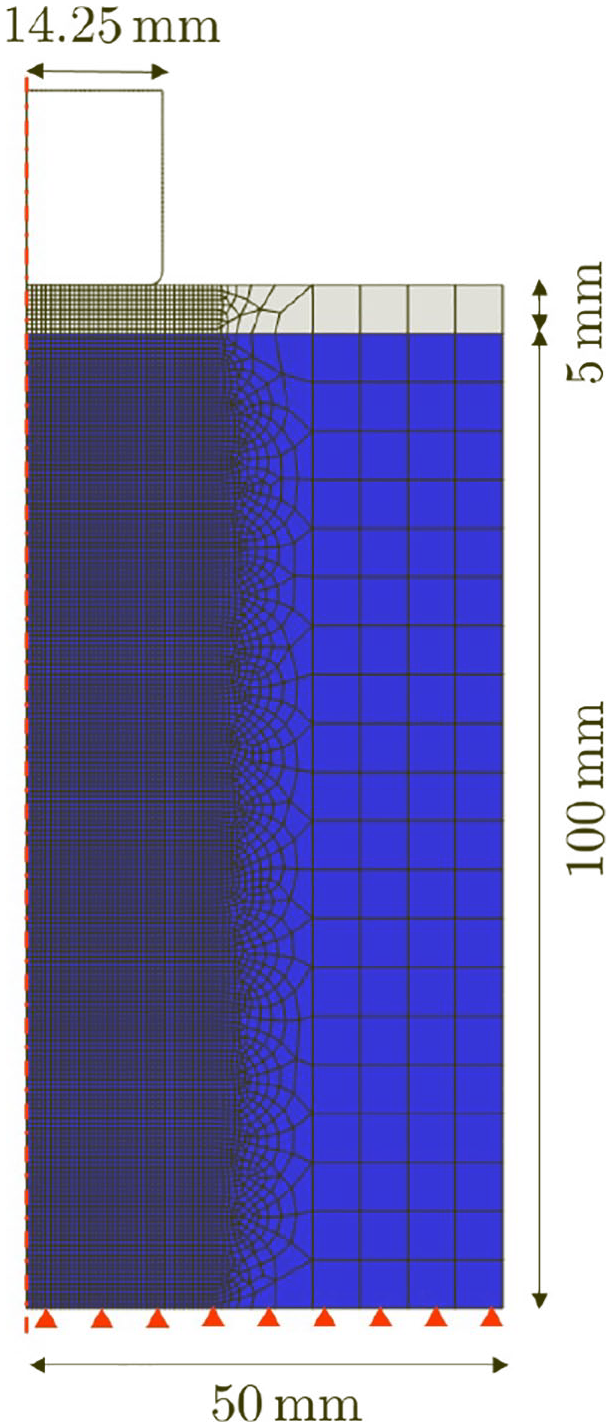
Reference geometry case: axisymmetric model in ABAQUS/Explicit of the impact indentation of a coated concrete target.
A 0.1 kg, circular cylindrical (i.e. blunt) projectile of radius, 14.25 mm is modelled as a rigid part and is assigned an initial velocity,
For the coated cases, a 5 mm thick elastomer layer is modelled as an axisymmetric, deformable part and assigned a constitutive model based on a series of material characterisation tests performed on a sample of a commercially available spray-on, polyurea/polyurethane coating, described in detail in Fallon and McShane (2019a). A hyperelastic relationship is selected, based on best fit to the uniaxial tensile response up to a nominal strain,
To assess the model’s validity at higher strain rates, the numerical predictions were compared in Fallon and McShane (2019b) with impact indentation experiments performed using 0.1 kg, blunt steel projectiles of radius, 14.25 mm, launched by means of a gas gun at concrete targets (cubes of side length 100 mm). Tests were performed on both uncoated concrete and concrete with a 5 mm elastomer layer placed on the impacted face. The numerical model validation was performed by comparison with projectile velocity-time profiles measured from high-speed video and post-impact visualisation of damage for projectile impact velocities up to ~100 m s−1. Good agreement was observed for the loading response of the curve, up to maximum projectile penetration for both uncoated and coated concrete targets. For uncoated concrete, projectile rebound velocities were also well predicted. It was deemed that the model was valid at early time steps, before severe concrete damage and during the loading phase of elastomer penetration. Further details can be found in Fallon and McShane (2019b).
Damage mechanisms: Reference geometry
Considering the range of impact velocities,
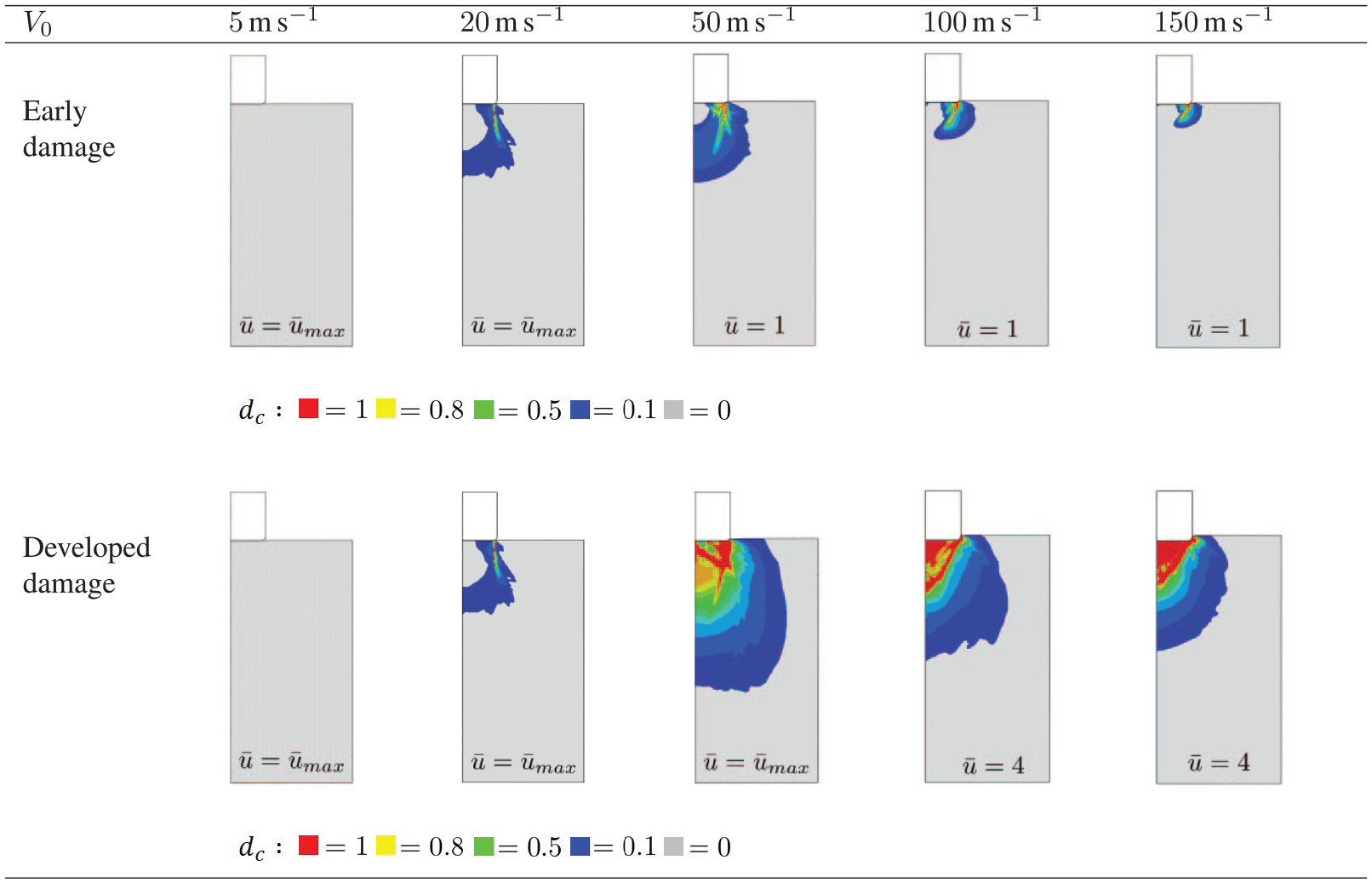
Comparing contours of the compressive damage parameter, dc for uncoated concrete, subjected to projectile impacts at various velocities, V0.
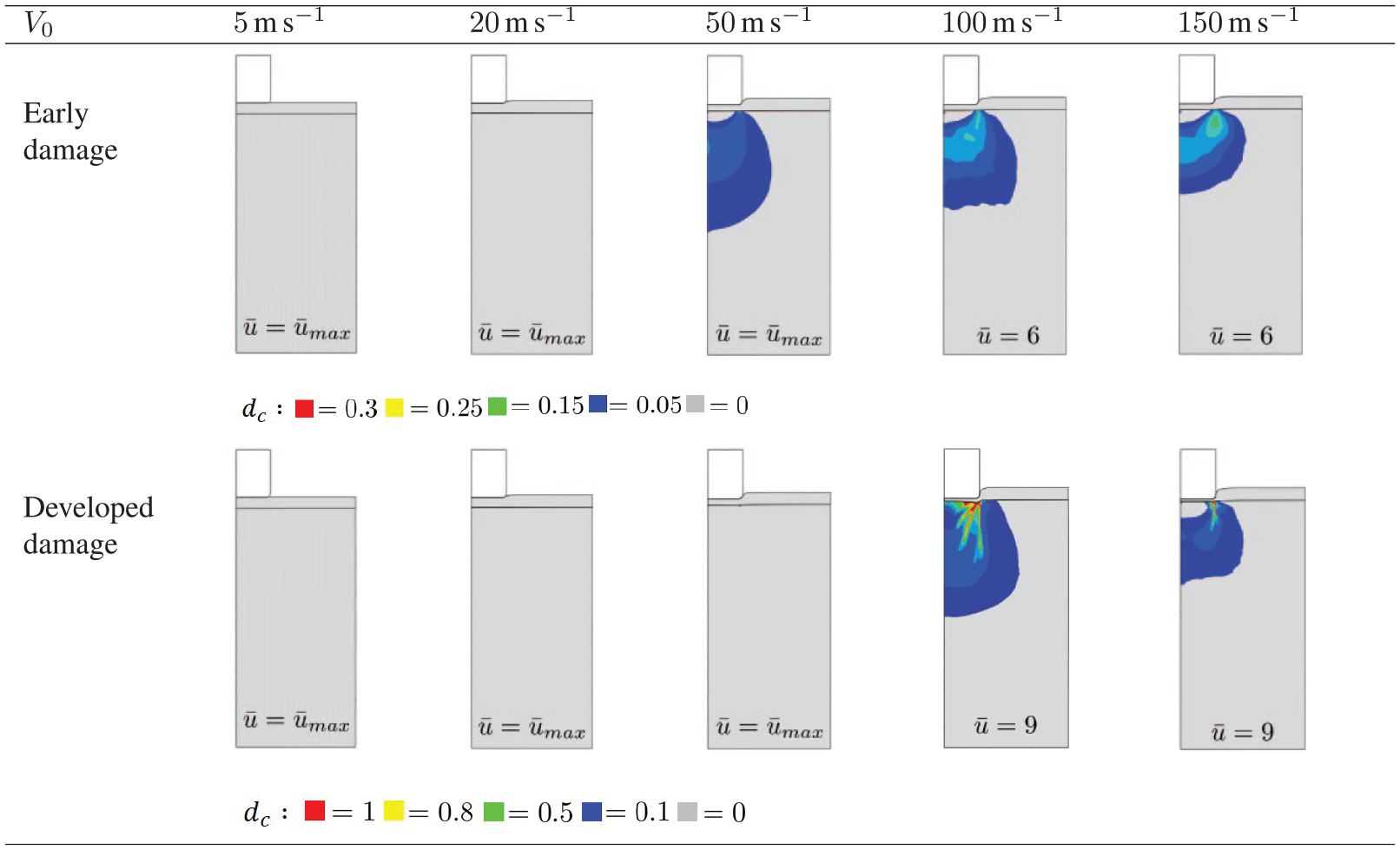
Comparing contours of the compressive damage parameter, dc for concrete coated with a 5 mm elastomer layer, subjected to projectile impacts at various velocities, V0.
On each of the images presented in Figures 2 and 3, the value of normalised displacement,

Damage patterns are compared at two phases of the impact response, denoted early damage and developed damage, each defined, on the basis of visual inspection, by a specific
Comparison between Figures 2 and 3 reveals a difference in the early damage behaviour between uncoated and coated targets. This prompts the definition of two distinct damage mechanisms:
Mechanism 1: Severe damage initiates early in the impact, under the corner of the indenter.
Mechanism 2: Diffuse sub-surface damage develops in the region below the indenter, which eventually concentrates under the corner of the indenter.
For the uncoated targets, Mechanism 1 is observed for all but the very lowest impact velocities (
Sensitivity to boundary conditions
In this section, the influence of the concrete and polymer boundary conditions, and the polymer thickness, on the damage mechanisms are examined.
Edge constraint
First the effect of constraining the outer edges of the concrete cylinder is considered. The axisymmetric model illustrated in Figure 1 (the reference case) is subjected to an additional boundary condition on the outer edges to constrain the lateral displacement of the elastomer and concrete. The early and developed damage patterns are compared with the reference case in Figure 14, for one projectile velocity,
Target geometry
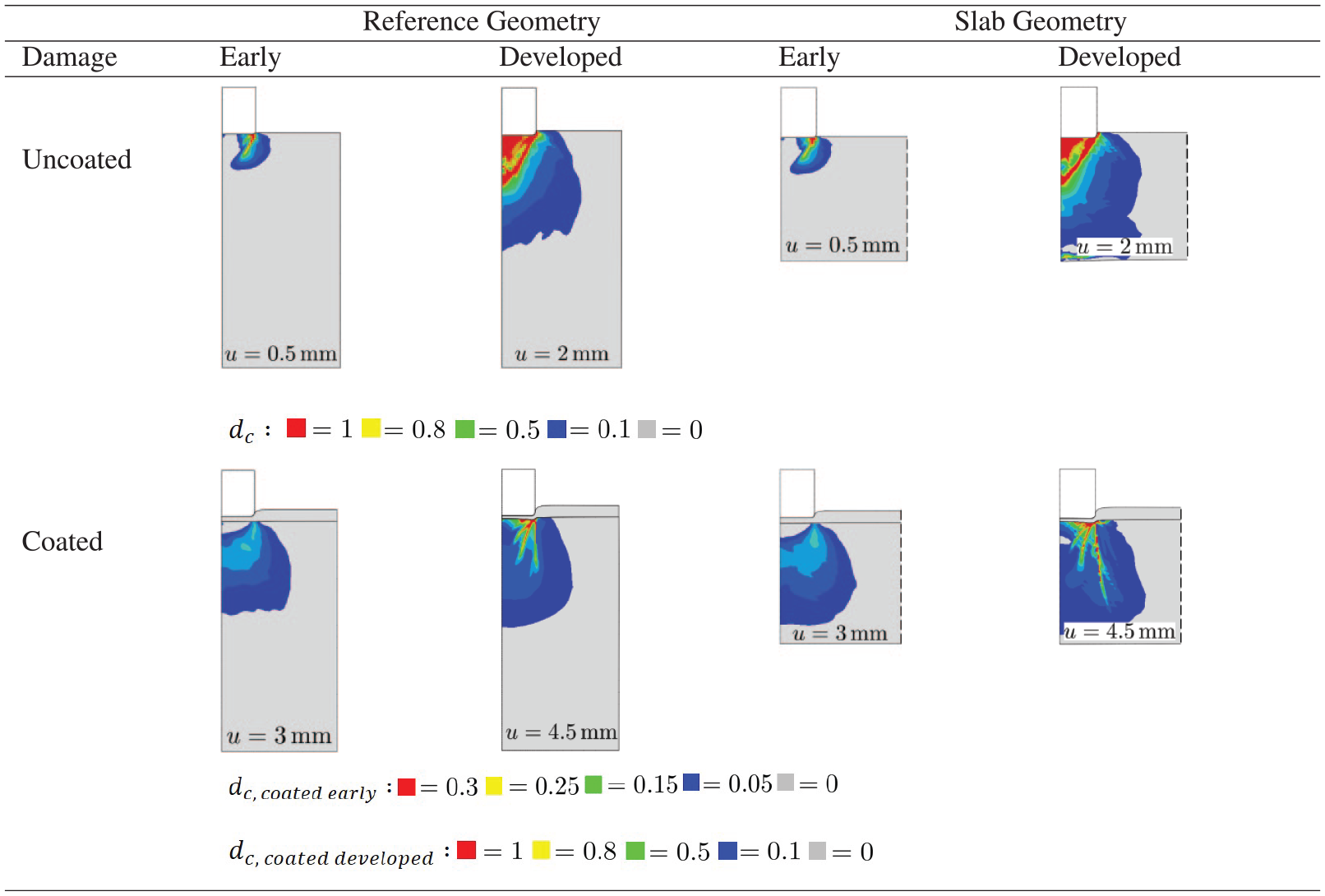
Next, the effect of a change in target geometry is assessed. A more practical structural concrete slab configuration is considered: 50 mm deep, with a span of 1 m. Once more, an axisymmetric model is employed for computational efficiency, illustrated in Figure 4. The edge of the slab (at its outer perimeter) is fully constrained, with all degrees of freedom set to zero. To avoid unrealistic stress concentrations at the perimeter, a degree of boundary compliance is introduced: a 50 mm wide region at the edge of the slab is placed between rigid, frictionless surfaces, which terminate with a radius of curvature of 90 mm. For the coated cases, a 5 mm elastomer layer is modelled on the impacted face and Coulomb friction, with a friction coefficient of µ = 0.8 is assumed at the concrete/elastomer interface. Frictionless conditions are assumed at elastomer/steel and concrete/steel interfaces based on the findings in Fallon and McShane (2019b). The indenter geometry and mesh details remain unchanged, with a fine 0.5 mm mesh in the central 40 mm portion of the slab, transitioning to a much coarser mesh away from the impact site.
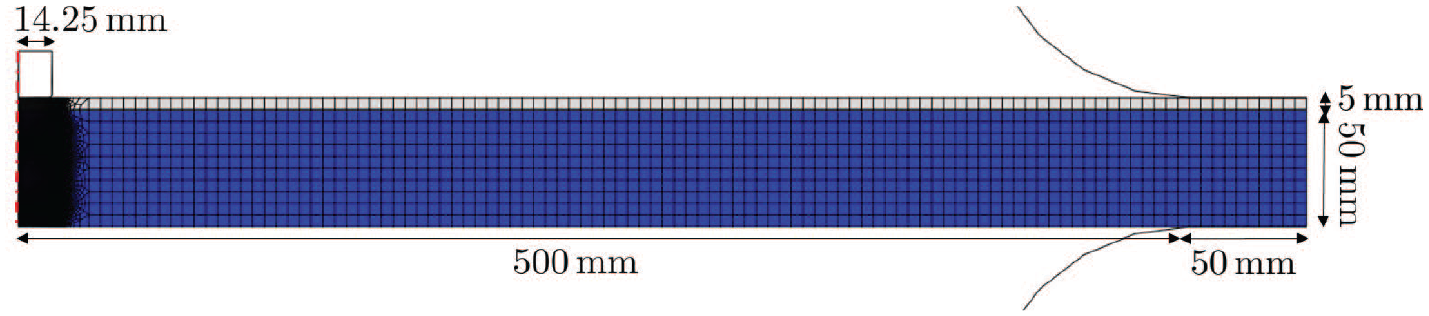
Axisymmetric model in ABAQUS/Explicit of the impact indentation of a coated concrete slab.
Figure 5 compares the early and developed damage patterns for the reference geometry (Figure 1) and the slab (Figure 4) for a projectile impact at
Elastomer-concrete bond strength
To explore the influence of contact conditions at the elastomer/concrete interface, two limiting cases are compared – frictionless and perfectly bonded (tying all degrees of freedom at the interface). This is compared with the reference case, assuming Coloumb friction with a friction coefficient of µ = 0.8 (determined in Fallon and McShane (2019b)) to give the best fit to quasi-static experimental data). The effect on the early and developed damage patterns is presented in Figure 6 for the reference geometry (Figure 1) subjected to a projectile impact at
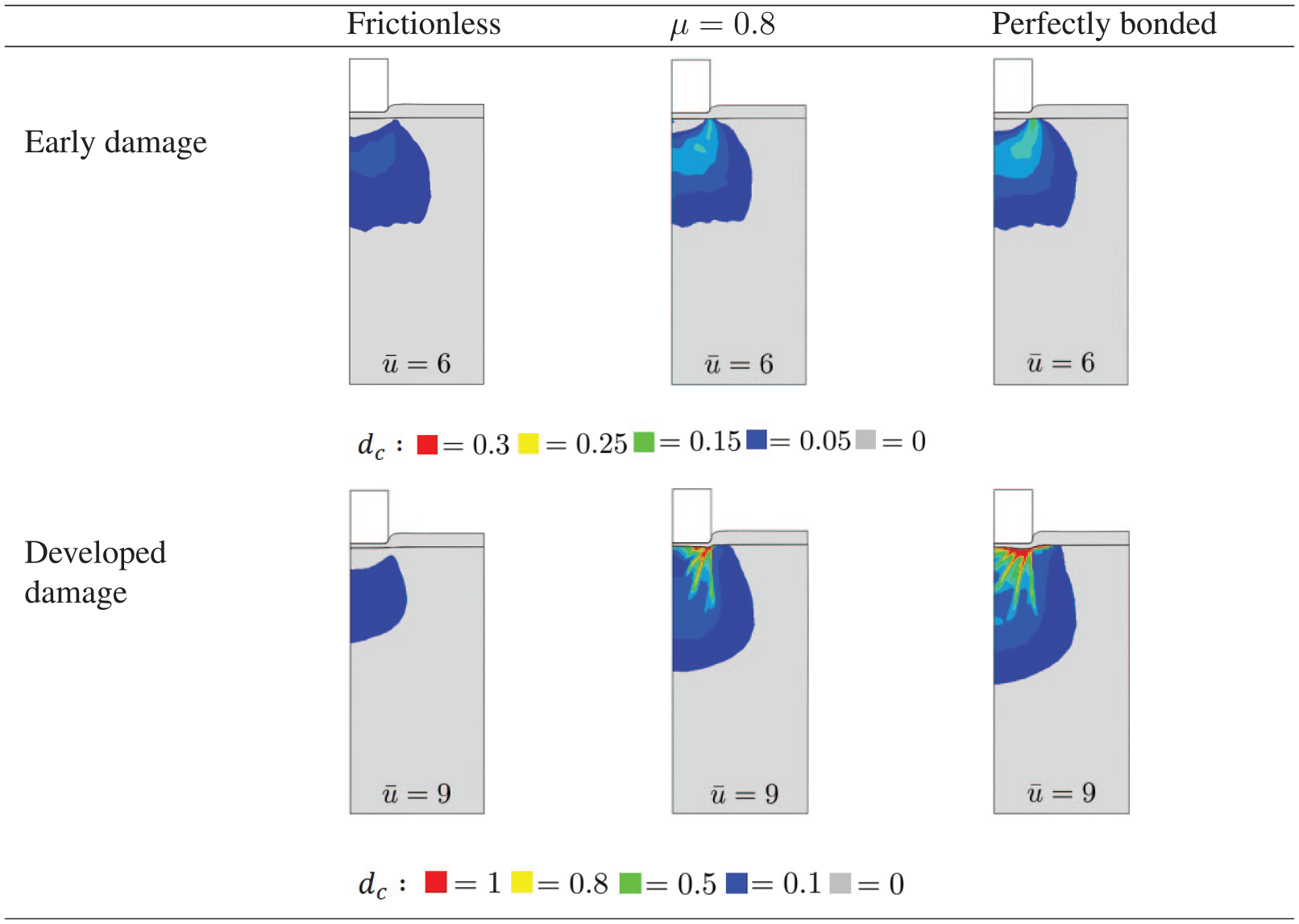
Comparing contours of the compressive damage parameter, dc for the reference geometry (Figure 1) when subjected to a projectile impact at
First, it is noted that the elastomer/concrete interface strength does not affect the damage initiation mechanism in the concrete: this remains Mechanism 2 for all coated cases. However, the interface does appear to have an influence on the level of developed damage in the concrete. While the perfectly bonded interface and µ = 0.8 cases result in similar developed damage patterns, the frictionless case shows less damage. This would imply that reducing shear tractions at the interface is beneficial to reducing impact damage. A reduction in shear tractions at the interface may affect the distribution of stress triaxiality, to which concrete is particularly sensitive. This is investigated in more detail subsequently (Figure 10). However, it is noted that a frictionless interface would be challenging to realise in practice.
Coating thickness
Finally, the effect of varying the coating thickness on the damage mechanisms is considered. Figure 7 compares a 5 mm coating with a 10 mm coating, assuming a coefficient of friction, µ = 0.8 at the elastomer/concrete interface. It is clear that the thicker coating serves to delay the onset of damage in the concrete substrate. Minimal damage is observed for an impact velocity of 100 m s−1 for a 10 mm thick coating. Therefore, as expected, a thicker coating appears to increase the protective benefit. However, from a design perspective, this added benefit must be weighed against the increase in weight and cost.
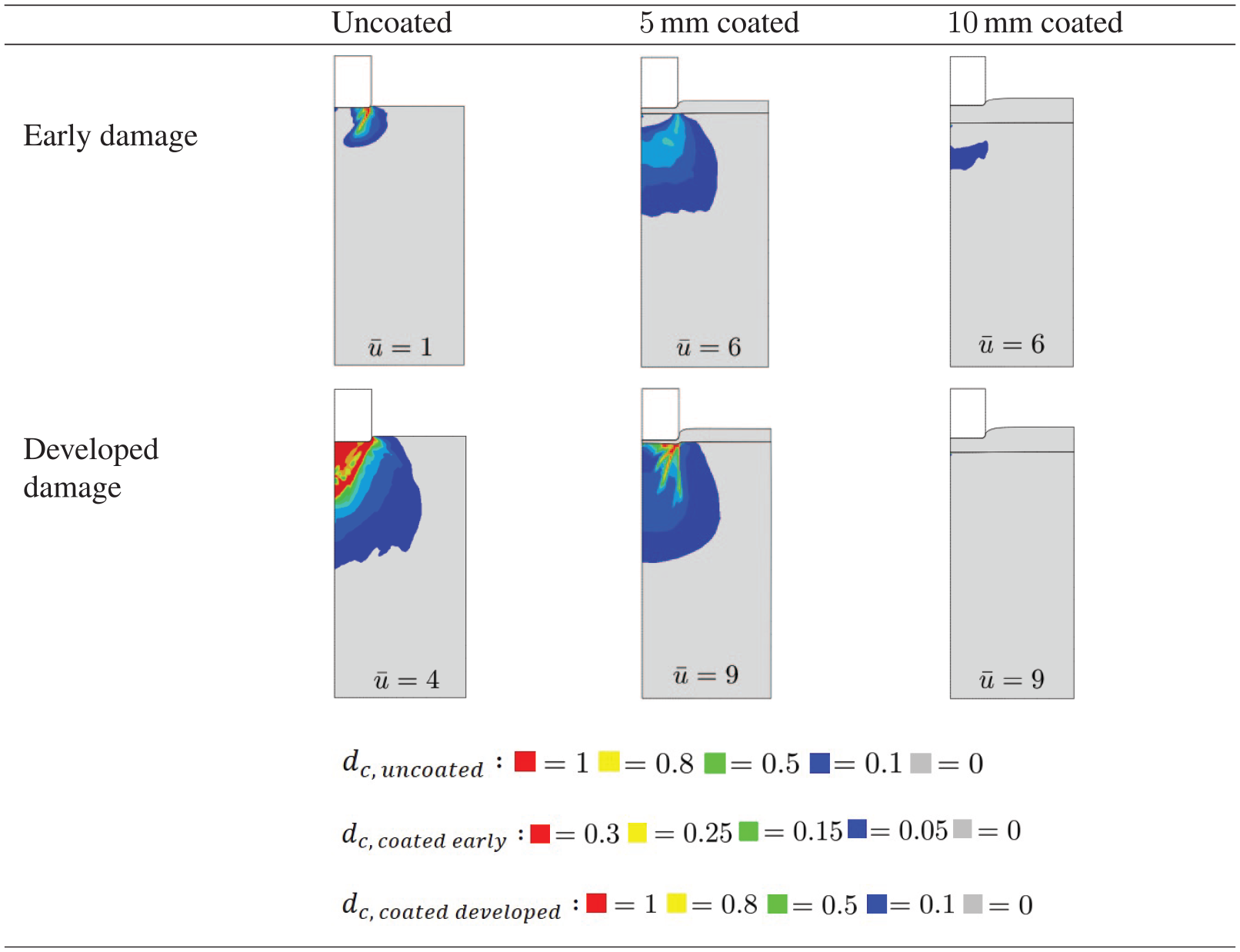
Comparing contours of the compressive damage parameter, dc for the reference geometry (Figure 1) when subjected to a projectile impact at
Investigating the protective effect of the coating
The previous section has highlighted that the application of a relatively thin elastomer layer to a concrete substrate affects the damage mechanisms in the underlying concrete, providing a significant protective benefit across a range of impact indentation velocities. In this section, the objective is to understand precisely how the elastomer achieves this effect.
Projectile acceleration and contact pressure
Considering first the reference geometry and boundary conditions, illustrated in Figure 1. The numerical model, defined previously, is used to interrogate the projectile acceleration-time histories for two different impact velocities and the results are presented in Figure 8.
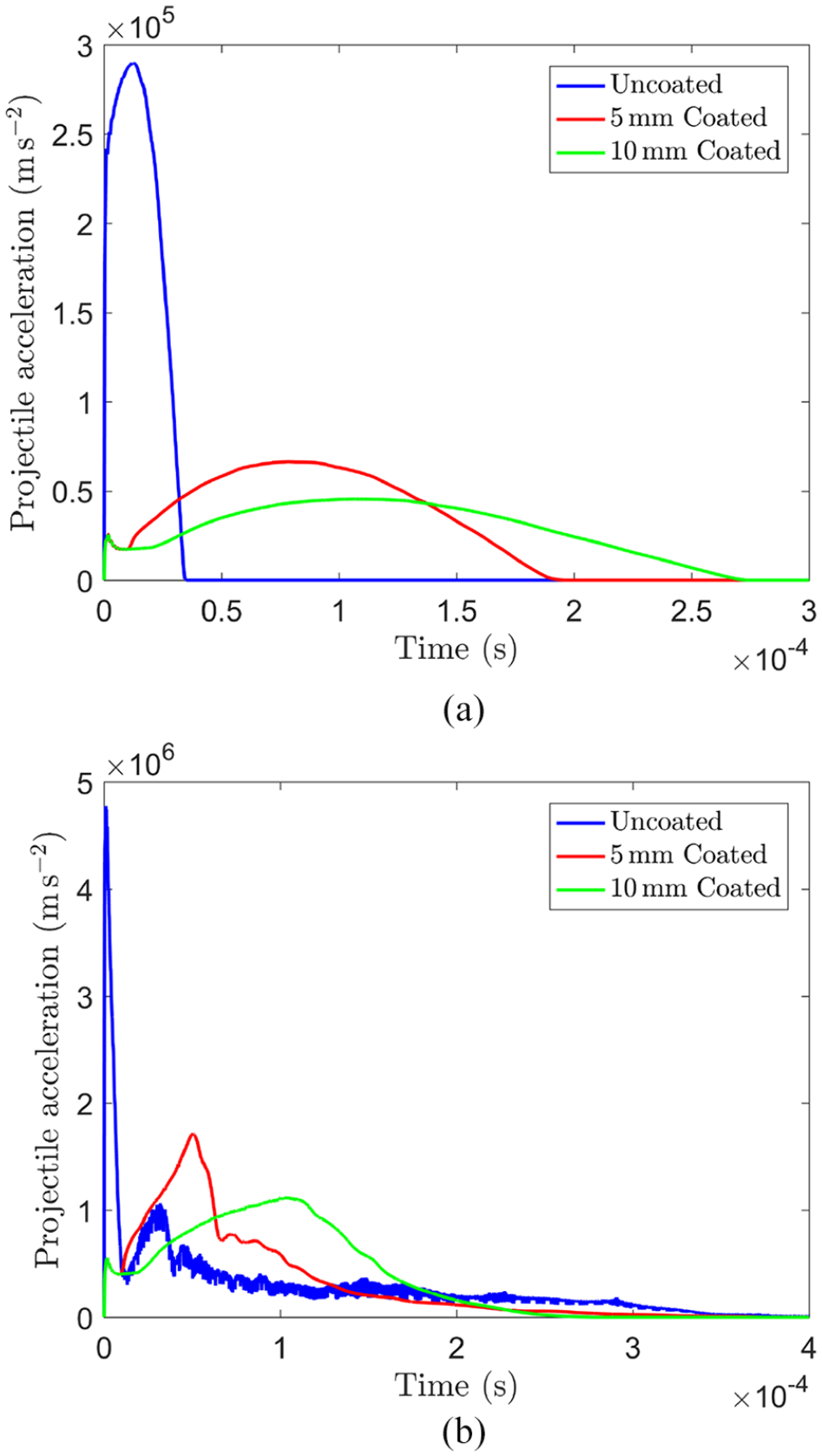
Projectile acceleration - time histories for the reference geometry (Figure 1) subjected to projectile impacts at: (a) V0 = 5ms−1, and (b) V0 = 100ms−1.
For the low velocity impact case (Figure 8(a)), the concrete exhibits an elastic response and the shape of the acceleration-time profiles of both uncoated and coated cases are approximately sinusoidal. The peak acceleration recorded for the 5 mm coated case is significantly lower in magnitude than that for the uncoated case. Increasing the coating thickness to 10 mm reduces the peak acceleration further. Additionally, the duration of contact is much longer with the coating present, with the duration increasing with coating thickness. There is therefore a fall in the average projectile accelerations with the addition of a coating. For the lower velocity case, average accelerations are measured up to the time when acceleration falls to zero (
Peak and average accelerations measured from the plots in Figure 8.
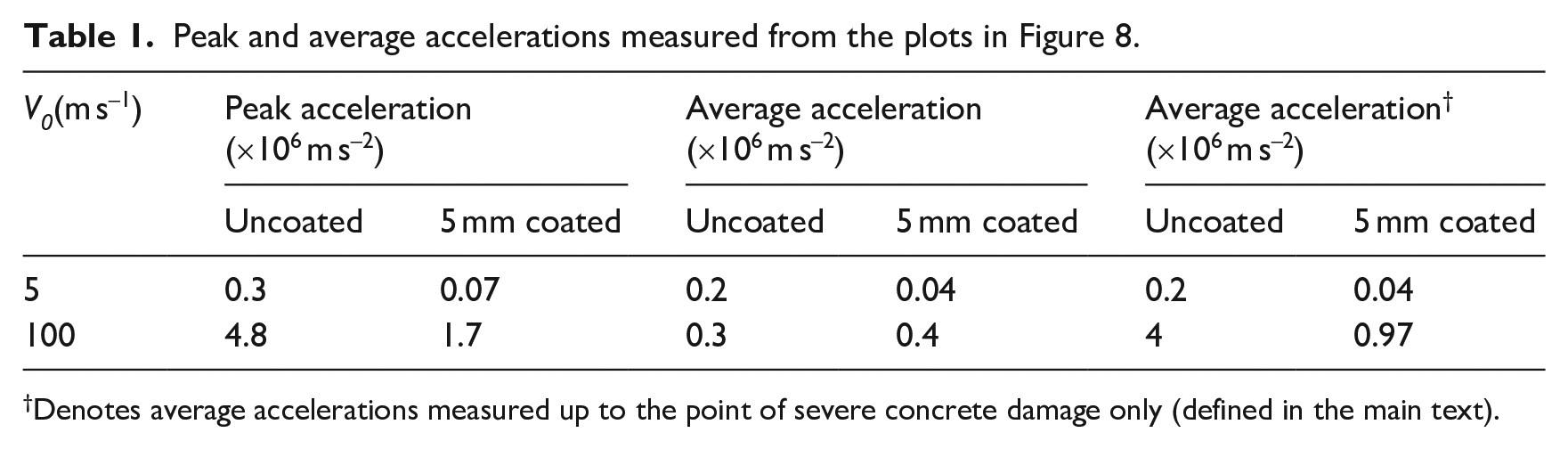
Denotes average accelerations measured up to the point of severe concrete damage only (defined in the main text).
Next, the higher velocity impact case in Figure 8(b) is examined. For the uncoated case, there is an initial transient on impact, giving a high peak acceleration. Comparing to Figure 8(a) (and subsequently Figure 12(a)) it is interesting to note how the shape differs, and appears to be related to both projectile impact speed and projectile corner radius, with a low impact velocity and small projectile corner radius, smoothing the sharp peak of the initial transient in acceleration upon impact. In Figure 8(b), the sharp peak is followed by a slower rise in acceleration as the projectile indents the concrete. The acceleration then tails off, as plastic deformation and damage develops in the concrete. For the 5 mm coated case, damage initiation in the concrete is also predicted, and is evident in a drop in acceleration at around
Table 1 shows that while peak accelerations for the higher impact velocity case are significantly reduced with the addition of the coating, average accelerations are not. This is in contrast to what was observed for the lower impact velocity case and is likely due to the severe concrete damage experienced after the initial transient peak in acceleration. Average accelerations are measured up to the time when acceleration falls to zero (
Next, the spatial contact pressure variation is interrogated in Figure 9. For both low and high impact velocity cases, the magnitude of the contact stresses experienced by the concrete are significantly reduced with the coating present. This is due to the significant reduction in peak accelerations discussed previously. However, another coating benefit is also identified. Examining the lower velocity impact case in Figure 9(a), the addition of the coating results in a much more uniform distribution of contact pressure under the indenter. When uncoated, there is a concentration in contact pressure under the indenter corner. With the coating in place however, the magnitude of the contact pressure remains spatially more uniform. Similar effects are observed for the higher impact velocity case in Figure 9(b).
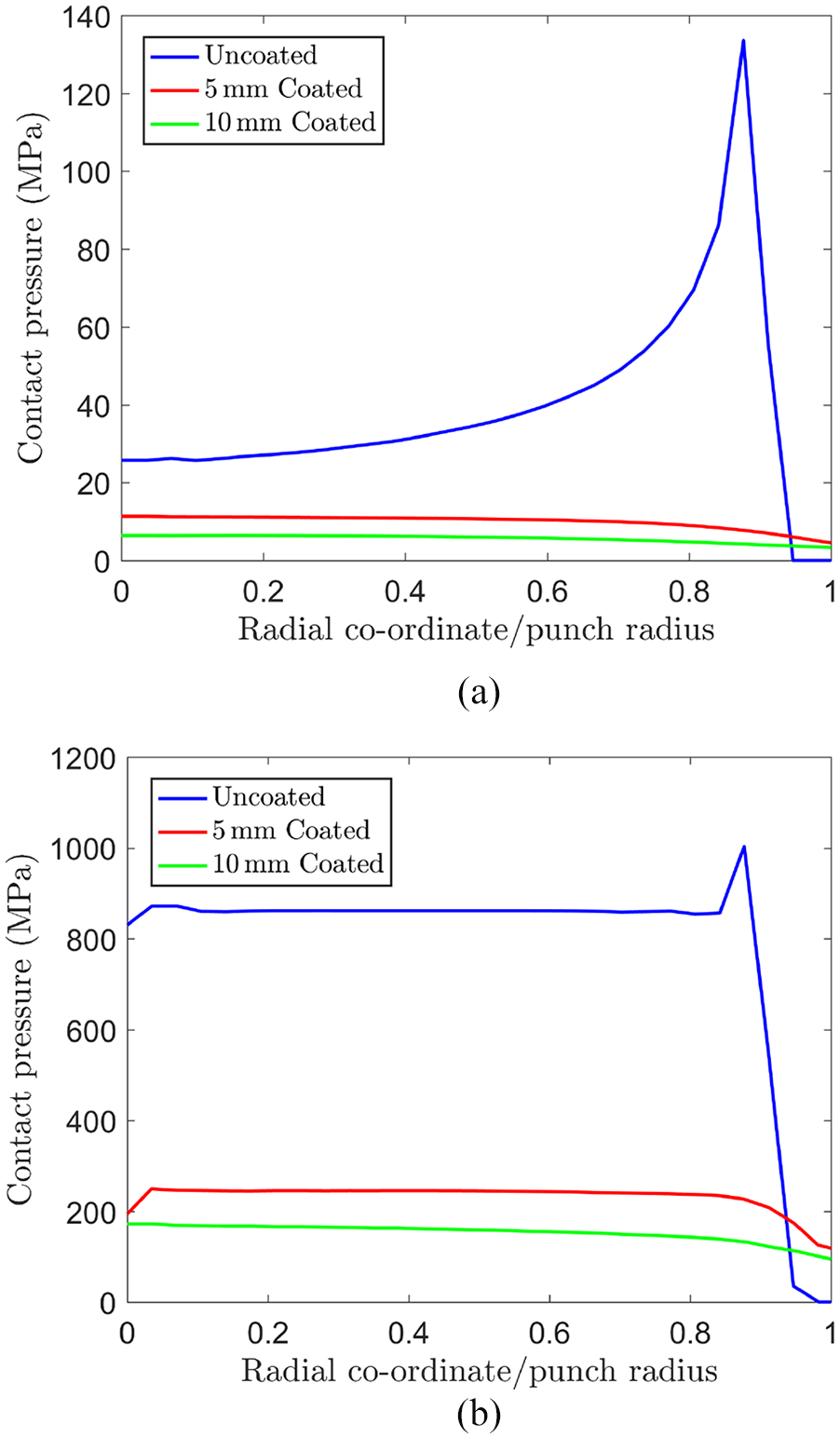
Concrete contact pressure variation with normalised radial co-ordinate for the reference geometry (Figure 1) subjected to projectile impacts at: (a) V0 = 5ms−1, and (b) V0 = 100ms−1.
Furthermore, Figure 10 provides evidence that the coating also serves to change the sub-surface stress state. The stress triaxiality is more uniformly distributed in the coated case. However, the magnitude of the compressive stress triaxialities (plotted negative in Figure 10) also tends to reduce for the coated case. This may be of concern, as the strength of the concrete is sensitive to the stress state, and increases with the magnitude of the compressive stress triaxiality. However, the triaxiality is similar in the coated and uncoated cases at the critical locations of maximum contact pressure. And so, reducing the magnitude of the contact pressures with the coating offers a net benefit for delaying damage initiation. Also, the more uniform distribution of stress triaxiality observed for coated concrete (Figure 10(b)) may account for the more uniform distribution of sub-surface damage that characterises the early damage response of coated concrete (illustrated in Figure 3 and defined as Mechanism 2.) These effects are denoted collectively as the spatial effect contributed by the elastomer.
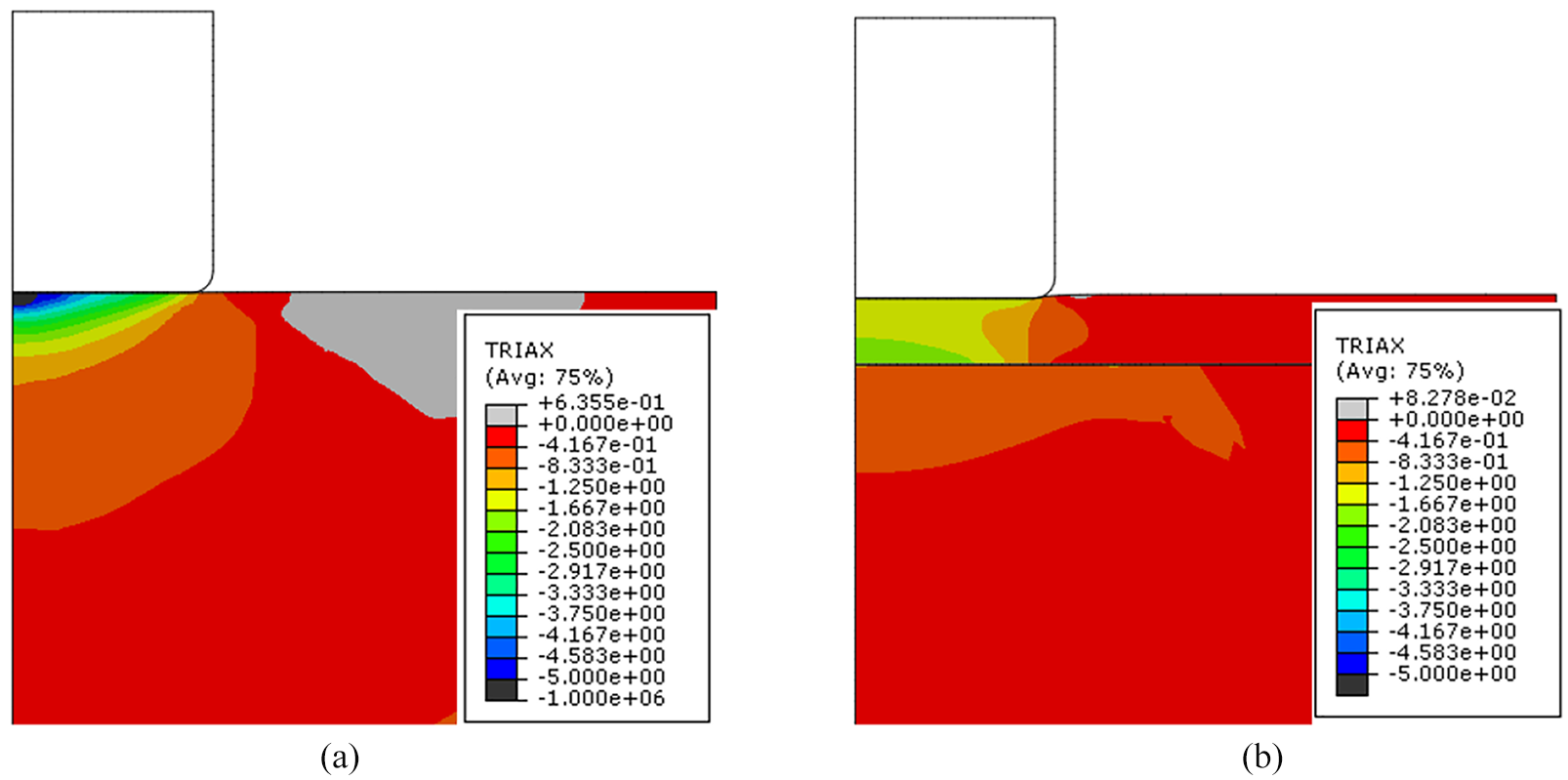
Contours of stress triaxiality (TRIAX in ABAQUS notation) for: (a) uncoated and (b) 5 mm coated concrete subjected to projectile impact at 5 ms-1. Images taken at a time corresponding to peak projectile acceleration in each case (
Interrogation of the protective effects
In this section, simplified 1D and 2D models are used to understand to what extent the protective effects described above rely on indentation, that is, to what extent they are 2D, rather than 1D, phenomena. This provides insights that may help the future development of simplified models to capture these effects and support coating design.
1D model
Figure 11(a) and (b) illustrate simplified models giving a 1D representation of the projectile impact on uncoated and coated targets. Thus, any 2D indentation phenomena are eliminated from the analysis.
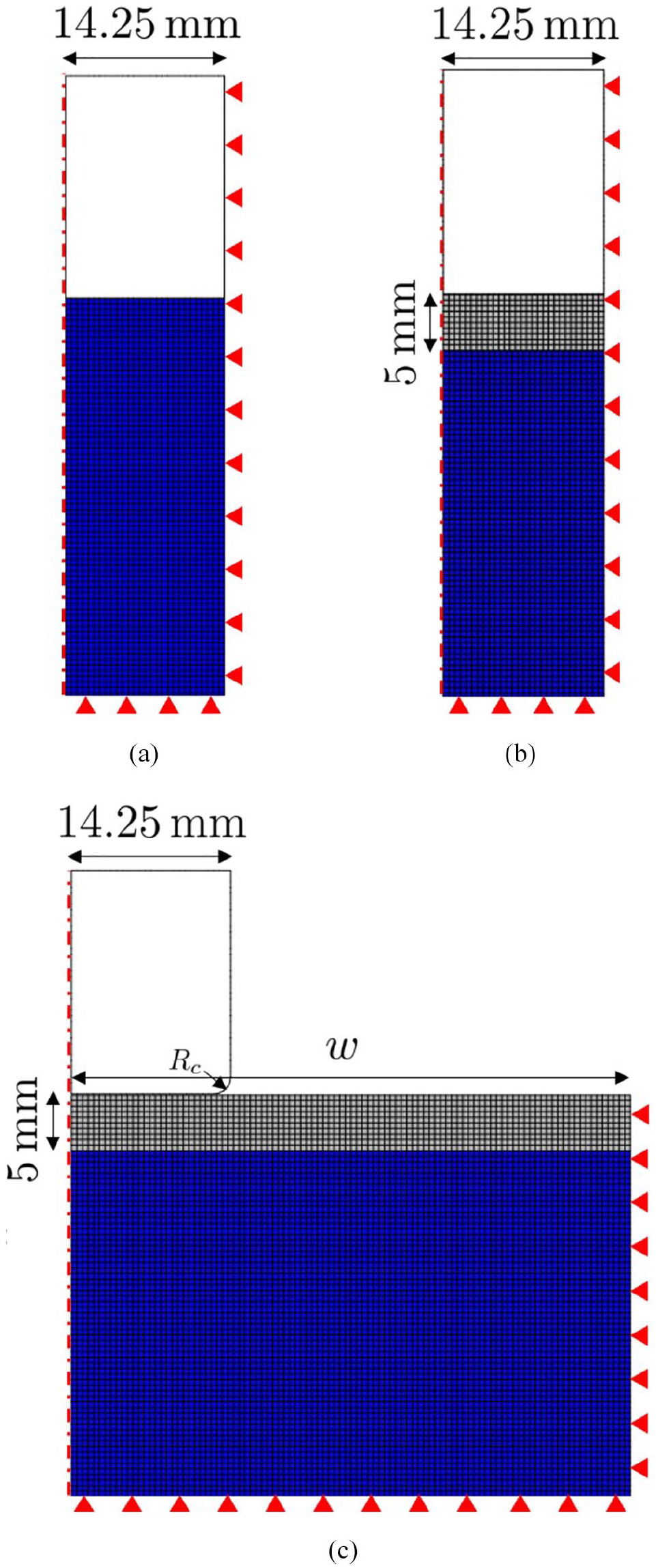
Axisymmetric models used to interrogate the protective effects: (a) 1D model, uncoated, (b) 1D model, coated, and (c) 2D model, coated, indenter radius, Rc. In all cases, the concrete column is made long enough to prevent interference from wave reflections. Not to scale.
A linear elastic model is chosen for the concrete target in this simplified analysis, with a Young’s Modulus,
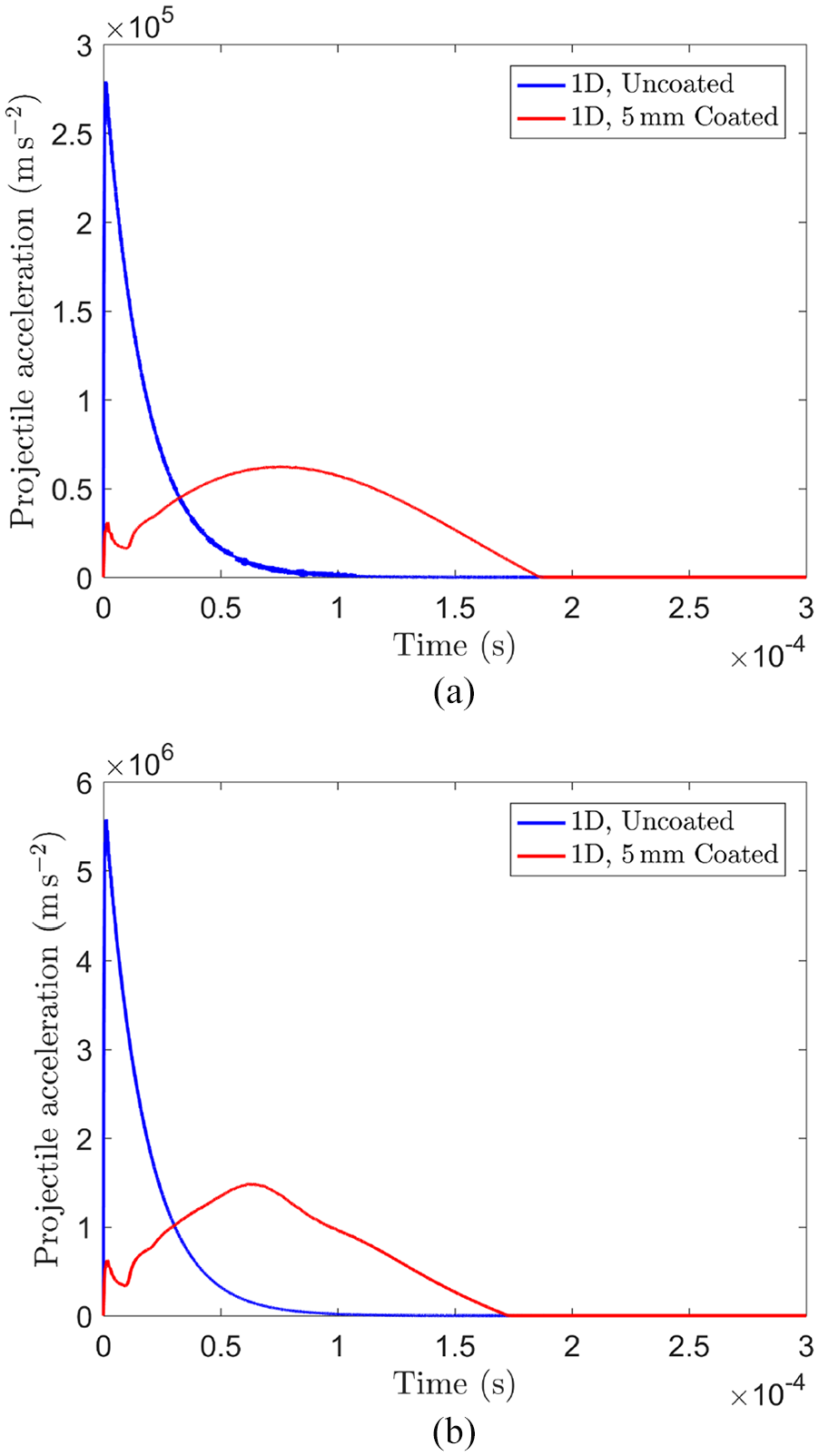
Projectile acceleration - time histories for the axisymmetric, 1D models in Figure 11(a) and (b), subjected to projectile impacts at: (a) V0 = 5ms−1, and (b) V0 = 100ms−1.
It is observed that the addition of the elastomer coating in a purely 1D analysis replicates the temporal effect observed for the impact on the concrete targets in Figure 8. The presence of the coating reduces the magnitude of the peak accelerations (and hence contact pressures). Furthermore, the coating serves to increase the duration of the response. Thus, it is established that 2D indentation effects are not required to reproduce the temporal effect of the coating – a 1D analysis is sufficient.
In a 1D analysis, no spatial effect can be predicted – the contact pressure must be spatially uniform. However, the contact pressures (and thus sub-surface stresses) for the coated case are significantly reduced in the 1D calculations, confirming the protective benefit of the temporal effect. For projectile impact at 5 m s−1, the peak contact pressure recorded is 44 MPa for the uncoated case compared with 10 MPa for the 5 mm coated case, each recorded at the time corresponding to peak projectile acceleration,
2D model
The spatial effect observed for the concrete targets, involving radial variations in contact pressure, is necessarily a 2D phenomenon, and hence likely to be linked to target indentation effects. A simplified 2D model is now used to interrogate the transition from the 1D case to the indentation of an effectively semi-infinite half space, to see at what point the spatial effect becomes apparent. The same target properties described in the previous section are used, but now a 2D axisymmetric calculation is performed with a variable target radius, w (Figure 11(c)). Simulations for increasing values of
Indentation of the polymer is therefore key to delivering the spatial effect. Next, we consider whether this effect is equivalent to changing the projectile tip geometry. It was shown by Mohagheghian et al. (2016) that for thin metallic targets, the spatial effect induced by a polymer coating was key to the protective benefit, and could therefore be reproduced to a large extent by altering the projectile tip geometry. To investigate this for the current problem, a number of variations on the model presented in Figure 11(c) are considered. A large concrete domain width is selected (
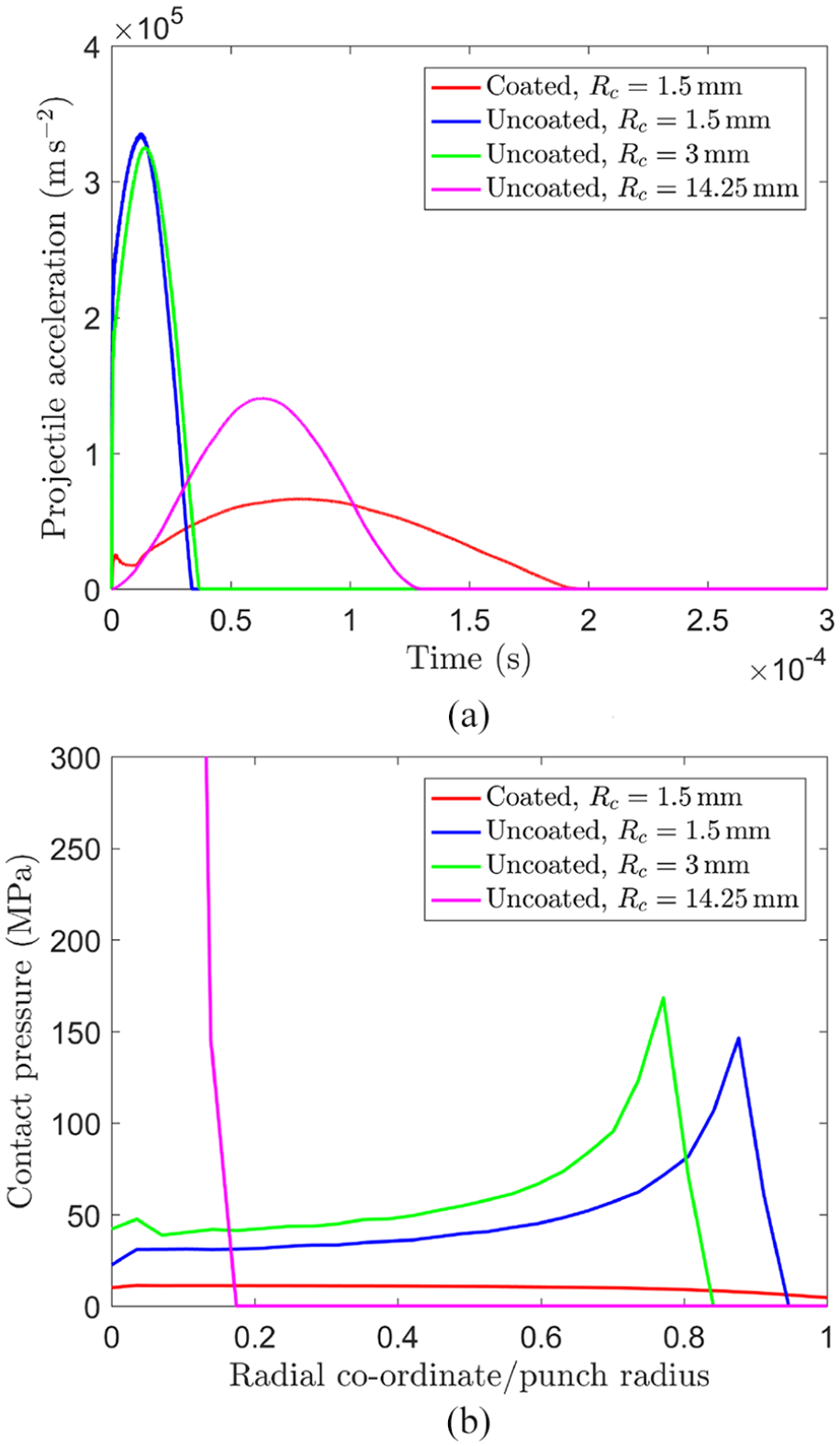
(a) Projectile acceleration - time history and (b) spatial contact pressure variation for a projectile impact at
First, the spatial variation in contact pressure is examined in Figure 13(b). Doubling the corner radius to
Next, considering the acceleration-time histories in Figure 13(a), doubling the corner radius to
In summary, it has been shown that indentation of an elastomer coating is required to achieve both the protective temporal and spatial effects. The temporal effect is essentially a 1D phenomenon where the key consequence is to reduce peak accelerations and thus contact pressures. The spatial effect is observed when there is indentation of the target (even when the concrete domain size is relatively small with respect to the indenter i.e.
Conclusion
A numerical study is performed in ABAQUS/Explicit to interrogate the impact indentation of a concrete cylinder of diameter, 100 mm and height, 100 mm in two configurations: uncoated and coated with a 5 mm elastomer layer on the impacted face. The concrete damage mechanisms are identified and the elastomer’s influence is assessed. The following conclusions are established:
Two distinct damage initiation mechanisms are observed. Mechanism 1 is characterised by severe concrete damage, initiating over shorter timescales under the indenter corner. Mechanism 2 is characterised by more diffuse, sub-surface concrete damage which develops over longer timescales, before eventually concentrating under the indenter corner.
For all but the very lowest impact velocities, where no damage is observed, uncoated targets exhibit Mechanism 1 and coated targets exhibit Mechanism 2. By shifting the damage mechanism, the coating achieves a significant increase in the projectile velocity required to cause severe damage. Increasing the coating thickness provides an increased protective benefit.
A frictionless interface between the concrete and elastomer appears to provide a protective benefit. However, this would be difficult to achieve in practice.
The elastomer achieves its protective benefit via two mechanisms – a temporal effect (a reduction in the magnitude of the peak acceleration and an increase in the duration of contact between projectile and target) and a spatial effect (a more uniform contact pressure distribution is achieved, removing the stress concentration under the indenter corner and providing a more uniform state of stress triaxiality under the indenter).
To achieve both temporal and spatial effects, the indentation of an elastomer coating is required. The temporal effect is essentially a 1D phenomenon but the spatial effect is only observed when there is indentation, that is, once the concrete domain width is larger than the projectile radius (
Footnotes
Appendix
Declaration of conflicting interests
The author(s) declared no potential conflicts of interest with respect to the research, authorship, and/or publication of this article.
Funding
The author(s) disclosed receipt of the following financial support for the research, authorship, and/or publication of this article: The authors are grateful to the George and Lillian Schiff Foundation of the University of Cambridge for financial support.
