




Abstract
Job crafting, or proactive changes that individuals make in their job design, can influence and be influenced by coworkers. Although considerable research has emerged on this topic, overall, the way job crafting is responded to by coworkers has received little theoretical attention. The goal of this article is to develop a model that allows for a better understanding of job crafting in interdependent contexts. Drawing on attribution and social information theories, we propose that when job crafting has a negative or positive impact on coworkers, coworkers will make an attribution about the crafter’s prosocial motive. This attribution in turn influences whether coworkers respond in an antagonistic or a supportive way toward job crafters. Ultimately, coworkers’ reactions shape the experienced affective work outcomes of job crafters. We also theorize the factors that moderate coworkers’ reactions to job crafting behaviors and the job crafter’s susceptibility to coworker influence.
Keywords
Job crafting research has been discussed as “some of the most interesting research on job design to emerge in the early 2000s” (Oldham & Fried, 2016, p. 27). Referring to self-initiated changes in the job boundaries to improve the job (Bruning & Campion, 2018), job crafting is assumed to be an individual-level process that is prompted by the individual’s motives to maintain a positive self-image, enhance work meaning, or improve one’s well-being and performance (Berg et al., 2010; Tims & Bakker, 2010). Consistent with the idea that job crafting is primarily an individual-level activity (Wrzesniewski & Dutton, 2001), most job crafting studies have focused on the personal characteristics of job crafters (e.g., self-efficacy and proactive personality) and the individual outcomes of job crafting (e.g., a change in work identity and meaningfulness or well-being; see meta-analyses of Lichtenthaler & Fischbach, 2018a; Rudolph et al., 2017).
While job crafting refers to informal actions that intend to benefit the job crafter by making changes to one’s work (Bruning & Campion, 2018), a growing number of studies have included the broader social work context when studying job crafting. This extended focus is important, as jobs, roles, and tasks are embedded in an interpersonal structure (Berg et al., 2010; Grant & Parker, 2009), increasing the likelihood that others in the work environment influence how one crafts or that others influence the outcomes of job crafting for the job crafter. To illustrate, researchers have argued that others may influence how coworkers craft based on the others’ job characteristics (Berg et al., 2010; Bizzi, 2016) or as a result of behavioral modeling (Demerouti & Peeters, 2018; Tims et al., 2013b). In addition, collaborative job crafting indicates that employees do not always craft on their own but that they also decide how their work is organized and conducted together with each other (Leana et al., 2009; McClelland, Leach, Clegg, & McGowan, 2014). Furthermore, scholars have described instances in which individual job crafting has an impact on others (e.g., Tims et al., 2015a; Wrzesniewski & Dutton, 2001). At present, however, there is no coherent theoretical framework that clarifies why and how social processes influence job crafting outcomes for the job crafter.
The goal of this article is to propose a conceptual model that takes the interpersonal work context into account to theorize how individual job-crafting outcomes are affected by coworkers’ reactions and how these reactions shape future job crafting behaviors over time. Given the self-relevance of job crafting, compared to the organizational focus of other proactive behaviors (e.g., taking charge; Morrison & Phelps, 1999, or personal initiative; Frese & Fay, 2001), we assume that crafting behaviors can be disturbing and/or surprising for coworkers. Moreover, as studies have shown that job crafting can sometimes result in negative outcomes for the initiator of crafting, such as lower work-related well-being (Bruning & Campion, 2018; Kooij et al., 2017), we argue that taking coworkers into account may help explain these mixed outcomes. As coworkers reinforce the good or reject the bad work behaviors of others (Chiaburu & Harrison, 2008), they might also try to regulate others’ crafting behaviors through positive or negative responses, which could then influence the affective outcomes for the job crafter.
Specifically, we integrate attribution theory (Kelley, 1973) and social information processing (SIP) theory (Salancik & Pfeffer, 1978) into job crafting research to provide a better understanding of how and why coworkers react in the ways they do to others’ job crafting. We also incorporate a temporal dynamic into the model that explains how this social influence process can have implications for future job crafting activities. Our model expands job crafting theory and allows researchers to answer practical questions raised by managers and other professionals about how individual job crafting can work in collaborative settings without deteriorating work processes and outcomes.
Job crafting
Individuals engage in job crafting to achieve work that better fits their own characteristics to experience greater work meaning, a positive work identity, better work-related well-being, and better job performance (Tims & Bakker, 2010; Wrzesniewski & Dutton, 2001). As Wrzesniewski et al. (2013, p. 287) pointed out, “…traditional job designs are unlikely to come preloaded with much opportunity for highly personalized pursuits.” Through job crafting, employees can create a better job for themselves that fits their individual skills, needs, and preferences.
Recent developments in the field of job crafting have illustrated that job crafting behaviors can be classified into two higher order constructs in which the crafting behaviors are seen as either approach or avoidance crafting (Bruning & Campion, 2018; Zhang & Parker, 2019). Approach crafting refers to self-directed actions to gain positive work aspects, whereas avoidance crafting is defined as self-directed action to avoid or get away from negative work aspects. These two higher order constructs can be further differentiated based on whether job crafting is behavioral (i.e., an individual making actual changes to their job; e.g., Tims et al., 2012) or cognitive (i.e., changes in the way an individual thinks about work; e.g., Wrzesniewski & Dutton, 2001) and based on whether individuals change their job resources or job demands (see Zhang & Parker, 2019). As a result, Zhang and Parker have proposed eight types of job crafting that reflect whether the crafting is approach- or avoidance-oriented, behavioral or cognitive, and whether it is directed toward job resources or job demands (e.g., approach behavioral resource crafting or avoidance cognitive demands crafting).
Although approach and avoidance crafting can be cognitive in form (Wrzesniewski & Dutton, 2001; Zhang & Parker, 2019), the approach and avoidance behavioral forms of crafting job demands and job resources are the most relevant in this article, given that these changes are the most likely to create a positive or negative event for a coworker that triggers attributions and responses. In the behavioral form, approach crafting reflects behaviors directed toward solving problems and improving the work situation, whereas avoidance crafting reflects behaviors whereby individuals try to reduce or eliminate the negative aspects of the job. Literature reviews (Lazazzara et al., 2020; Zhang & Parker, 2019) and meta-analyses (Lichtenthaler & Fischbach, 2018a; Rudolph et al., 2017) indicate that approach crafting is related to positive experiences for the crafter, such as increased meaningfulness, occupational identity, work engagement, and performance, whereas most often, avoidance crafting behaviors are associated with burnout, decreased performance, turnover intentions, and job strain.
Job crafting theory focuses on job crafting as an individually-oriented proactive behavior that—with the exception of considering crafting behaviors that target the social context (see next)—has given little theoretical or conceptual attention to the social processes involved in crafting. In what follows, we describe some of the emerging research on the social aspects of job crafting. To provide a stronger and more integrated theoretical basis for future studies, we then build our framework to explicate how job crafting is attributed and responded to by coworkers and what implications these responses may have for future job crafting behaviors.
Placing job crafting in the social context
Some research exists that recognizes the social context in which job crafting behaviors take place. These studies can be organized by the role that the social context is given, that is, the social context as the target of job crafting, as influencing an individual’s job crafting, as being involved in the crafting, and as a moderator. We consider each in turn.
Social context as the target of job crafting
Wrzesniewski and Dutton (2001) identified relational crafting, in which an individual tries to increase or decrease the social boundaries at work. This form of job crafting has direct implications for other parties, such as when a person is contacted more or less frequently by the job crafter. Tims et al. (2012) also defined a social form of job crafting by focusing on how individuals can increase access to social job resources, such as colleague support and feedback. Nielsen and Abildgaard (2012) further distinguished between decreasing social resources (e.g., reducing contact with emotionally demanding colleagues) and increasing social resources (e.g., seeking more support). Although others in the social context (e.g., coworkers and supervisors) are the target of this behavior, it remains untested as to how these others experience this type of job crafting.
Social context as influencing individual job crafting
Another line of research considers how others in the work environment influence whether and how individuals craft their jobs. For example, drawing on role theory (Katz & Kahn, 1966), Bizzi (2016) argued that others at work function as role-senders, who communicate expectations about tasks based on their own job characteristics. The results of a social network analysis showed that when others had high autonomy and feedback, the focal employee reported more job crafting, presumably because others did not restrict the focal employee’s crafting opportunities. In this category, researchers have also applied a behavioral modeling framework (Bandura, 1986) to theorize and show that job crafting behaviors can be imitated by coworkers (e.g., Bakker et al., 2016; Demerouti & Peeters, 2018). Finally, researchers have investigated the role of leadership as an antecedent of job crafting, including servant leadership (Bavik et al., 2017; Harju et al., 2018), employee-oriented leadership (Lichtenthaler & Fischbach, 2018b), transformational leadership (Hetland et al., 2018), and the quality of the leader–member exchange relationship (Radstaak & Hennes, 2017). These studies mostly show a positive relationship between a supportive leadership style and approach forms of job crafting, but they provide limited evidence that leadership style affects avoidance crafting.
Social context as being involved in job crafting
A third social perspective on job crafting is collaborative or team job crafting, in which the work group collectively changes how work is organized and performed. For instance, Leana et al. (2009) found that collaborative crafting, but not individual crafting, was positively related to quality of care, job satisfaction, and organizational commitment. Other studies have similarly identified positive outcomes of collaborative crafting (McClelland et al., 2014; Tims et al., 2013b), with some attention also being given to antecedents of collaborative crafting (e.g., innovative team climate and self-efficacy for teamwork; Mäkikangas et al., 2017).
Social context as a moderator
Two studies have examined the social context as a moderator (Sekiguchi et al., 2017; Shin et al., 2018). First, Sekiguchi and colleagues found that social skills strengthened the relationship between autonomy and individual job crafting, although this relationship depended in complex ways on the level of social status. Second, with a focus on the social context as a moderator between individual crafting and work engagement, Shin et al. (2018) showed that emotional support strengthened the relationship between job crafting and work engagement, presumably because this support allowed experimentation and acceptance. In contrast, instrumental support weakened this relationship, which the authors suggested might arise because this form of support takes away job challenges and autonomy or because it fuels feelings of incompetence.
The above review provides important evidence that social aspects can influence job crafting behaviors, their antecedents, and their outcomes. However, the reviewed studies have taken a narrow theoretical focus on specific social processes (e.g., role-sending or behavioral modeling) and lack a clear and overarching theoretical framework about how and why others influence job crafting and its outcomes. To better understand job crafting in the social context, we introduce a comprehensive model (see Figure 1) that explicitly incorporates coworkers’ responses to job crafting, including when and how they react as well as how their reaction then affects whether the job crafter achieves their intended crafting outcomes. We also consider how these processes shape crafters’ subsequent job crafting in a dynamic feedback loop.
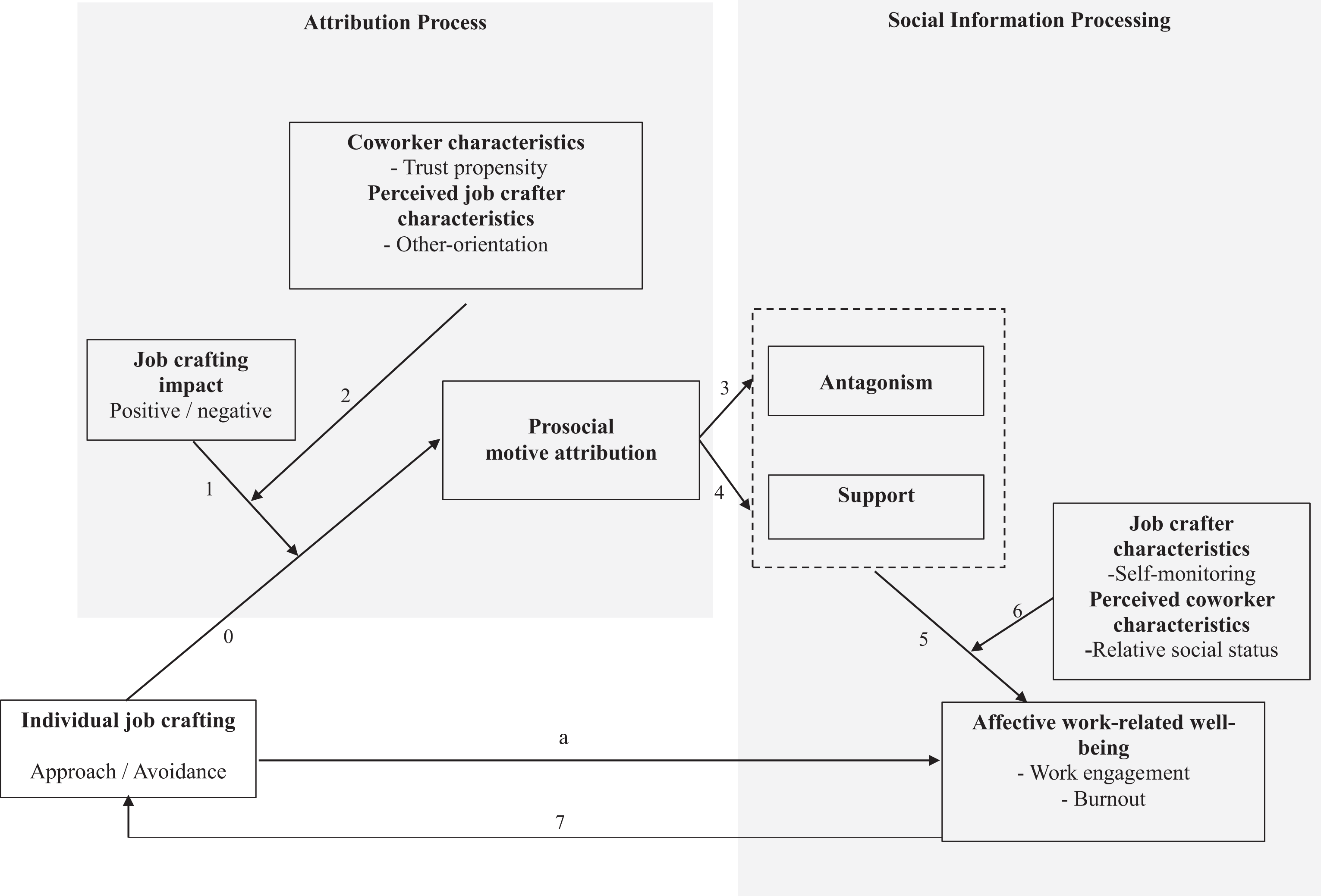
Overview of the conceptual model indicating how coworkers may influence the individual’s job crafting outcomes. Note. Path a refers to the well-established direct relationship between individual job crafting and individual work outcomes. The numbered paths refer to the relationships proposed in this work.
A model of coworker influence on job crafting outcomes
When individuals craft their work based on their personal goals, these behaviors and the changes they give rise to can at times contradict the expectations and work methods of their coworkers. Following this reasoning, among coworkers, there will be situations in which the job crafting of one person positively or negatively affects the job of the coworker(s). The core premise that we develop here is that—when job crafting has a positive or negative impact on the coworker—the coworker likely wants to understand what motivated the crafting, that is, they will make an attribution of the behavior. Attribution theory posits that a causal search starts when an individual encounters an event that is negative or positive, that is relevant to oneself, and that deviates from the normal routine (Geddes & Callister, 2007; Morgeson et al., 2015). In these situations, individuals are likely to try to identify the motive for a behavior, especially when the behavior impacts their desired outcomes, goals, and values (Douglas et al., 2008).
Job crafting behaviors that are self-starting and that affect the jobs of coworkers, either positively or negatively, therefore prompt a search for a causal explanation to understand why a crafter acted as they did. This argument also implies that if job crafting does not affect a coworker’s desired outcomes, goals, and values, this means it is less “relevant” and unlikely to invoke the attribution processes that we outline next. For instance, this might happen when the crafted change is not noticed by others because it does not impact the way they work. In these cases, based on the existing literature, we expect that individual job crafting behaviors will be directly related to individual affective work outcomes (e.g., work engagement and meaningful work), as depicted by path a in Figure 1, and unrelated to attributions made by the coworker, as depicted by path 0.
Both positive events (e.g., helping behaviors; Halbesleben et al., 2010) and negative events (e.g., an offense; Crossley, 2009) evoke attributional reasoning, although negative events are more powerful triggers of attributions because they alert the individual that change is needed (Baumeister, Bratslavsky, Finkenauer, & Vohs, 2001; Weiner, 1985). Given that job crafting can have a negative or positive impact, we next discuss how the type of impact can influence the attribution of a prosocial motive to the job crafter. First, we outline how positive and negative impacts result in the causal attribution of a personal motive (“the job crafter is responsible”), and second, we describe how this attribution can be prosocial (“the job crafter is responsible and cares about others”) or how it can be attributed to a lack of prosocial motive (“the job crafter is responsible and does not care about others”).
Job crafting and coworkers’ attributions: The role of job crafting impact
Building on attribution theory, we propose that job crafting behaviors, when they impact a coworker, will most likely be attributed to a personal motive, that is, the person is seen as responsible for the behavior and not the situation (Brees & Martinko, 2015). This expectation is based on the fact that job crafting behaviors are by definition voluntary and self-starting (Wrzesniewski & Dutton, 2001) and that actions or behaviors are commonly assumed to be caused by an individual’s own will (Kruglanski, 1975). However, such attributions will only be made when the coworker is motivated to understand this behavior, which is likely to occur when the coworker experiences a negative or positive impact due to the individual’s job crafting. Following the attribution of personal causation, job crafting that impacts a coworker triggers a search for the motive that the job crafter had when engaging in the crafting behavior.
Theoretically, job crafting is motivated by the need to maintain a positive self-image, to have personal control and a human connection (Wrzesniewski & Dutton, 2001), and to create a job that better fits the individual’s characteristics (Tims et al., 2012). In the workplace, these general motives represent an abstract, higher level reasoning that coworkers are unlikely to use when trying to understand each other’s voluntary behaviors. It is more likely that coworkers will try to gauge whether the job crafter cared about them when engaging in job crafting—a concept that is captured by prosocial motives (i.e., the desire to benefit other people; Grant, 2008; Grant & Mayer, 2009). We specifically focus on the attribution of a prosocial motive because, although job crafting represents a desire to improve the work for the individual, job crafters can choose to engage in job crafting behaviors that are also helpful for coworkers or they can explain their motives (cf. Crossley, 2009), for example, by “selling” their avoidance behavioral crafting to coworkers as acts of altruism (e.g., “I rejected this task because I thought you would like it”). Thus, in interdependent settings, even pro-self-behaviors can benefit others. In addition, individual behaviors are driven by both self-interest and concern for others (De Dreu & Nauta, 2009). Therefore, coworkers can see job crafting as a behavior that a job crafter engages in to satisfy their own goals, yet at the same time believe that the job crafter has a reasonably strong prosocial motive (De Dreu, 2006). A coworker can also believe that the job crafter is lacking a prosocial motive and is not at all concerned with or cares about others. Guided by our focus on how coworkers respond to the individual’s job crafting, we argue that it is therefore the presence or the lack of a perceived prosocial motive that is theoretically central to our model.
In situations in which job crafting negatively impacts a coworker, we expect that the coworker is less likely to attribute a prosocial motive to the job crafter. This situation may occur when, for example, the job crafter created a change in their workflow that hinders the progress of the coworker who counted on the regular workflow of the job crafter to finish their task. The attribution of a low prosocial motive can be explained by the fundamental attribution error that asserts that people are as they act, meaning that a bad act is assumed to be caused by a bad person (Kelley, 1973). Research indeed shows that those who perceived their offender’s motives as selfish were more likely to conceive of the offense as being under the offender’s control (Crossley, 2009).
A second reason that explains why job crafting that the coworker experiences as a negative impact on themselves is likely to be attributed to a low prosocial motive is because it deviates from accepted social norms (Griffin & Lopez, 2005). Workplace norms communicate expectations about how employees should behave and contribute to the work team. Norms about social relations generally indicate that people are expected to demonstrate positive behaviors toward each other (cf. Ybarra, 2002). Behaviors that violate these norms are particularly likely to have a negative effect on coworkers and to result in a perception of the actor as having low prosocial motivation.
Fortunately, coworkers can also experience an individual’s job crafting as having a positive impact on themselves. Examples of job crafting positively impacting coworkers include the situation where the change initiated by the crafter makes the job of a coworker more interesting (e.g., connecting with others and adding new tasks to the team) or easier to do (e.g., the job crafter takes on more responsibility and improves work methods that coworkers also use). People tend to like others who do something good for them and dislike people who harm them (Weiner, 2010). Thus, the individual’s job crafting behavior will be attributed to a prosocial motive to the extent that the coworker is positively impacted by the job crafting. Being the recipient of benefits because of an individual who crafts should result in the coworker perceiving the job crafter in a positive light (cf. Jones & Davis, 1965). When a coworker perceives the job crafter to be responsible for the positive event, that is, when they make a personal attribution, coworkers are likely to assume that the job crafter intended to benefit them (cf. Grant, 2008). The experience of a shared benefit (when both the job crafter and the coworker benefit from the job crafting) increases the perception that the job crafter means well and that they think about the consequences of their behavior for others (i.e., prosocial).
Research has shown that supervisors who perceived subordinates’ helping behaviors as internal and stable ascribed prosocial motives to these employee behaviors (Halbesleben et al., 2010; Johnson et al., 2002). Moreover, in an experimental study, Alicke et al. (1990) reported that respondents who read a scenario in which a target person experienced a positive situation due to another person (i.e., actor), inferred that the actor had a positive intention to place the target in this situation. Taken together, as depicted by path 1 in Figure 1, we propose the following:
Proposition 1
The relationship between individual job crafting and a coworker’s attribution of a prosocial motive depends on the job crafting impact, such that when the coworker is negatively (positively) impacted, job crafting will negatively (positively) relate to the attribution of a prosocial motive to the job crafter.
Additional moderators that influence the attribution of job crafting motives
The above provides an understanding of how coworkers use the outcome of a job crafter’s behavior for them, either positive or negative, to infer the motive for the crafting. Attribution theory further suggests that observers usually take multiple informational cues into account when trying to determine the cause of a specific event. That is, although the job crafter is seen as the one who initiated the behavior that negatively or positively impacted the coworker, discounting and augmentation principles (Kelley, 1973) suggest that the perception of the motive of the person to produce an effect is reduced or strengthened depending on other available cues.
Informed by attribution theory, we focus on two types of moderators that further shape the coworker’s attributional processes when the coworker is impacted by the job crafting (see Figure 1, path 2). First, we consider coworker characteristics, that is, the personal characteristics of the coworker that can influence the attribution they make, in this case, the trust propensity of the coworker. Second, we consider perceived characteristics of the job crafter, here, the coworker’s perception of the job crafter’s orientation toward others (i.e., other-orientation; De Dreu & Nauta, 2009). Our intention here is not to be exhaustive but to illustrate how this process can work for each of the two domains that influence attributions. We elaborate on additional factors that might affect coworkers’ attributions in the “Discussion and conclusion” section.
Coworker characteristics: Trust propensity
According to attribution theory, personal characteristics influence how individuals view and interpret things (Hollander & Offerman, 1990). Trust propensity refers to an individual characteristic that affects the likelihood that a person will trust others (Mayer et al., 1995). Propensity to trust influences how one attributes the actions of others (Bergman et al., 2010), especially when the behavior is ambiguous (Gill et al., 2005). As job crafting behaviors are likely to emerge in situations that do not have strong demand characteristics, trust propensity will shape how an impacted coworker attributes these behaviors. Extending the first proposition, in which the coworker is likely to attribute individual job crafting to a low prosocial motive when the coworker experienced job crafting as having a negative impact, we further propose that this relationship will be moderated by trust propensity (i.e., a three-way interaction).
More specifically, coworkers with a low propensity to trust will attribute the lowest prosocial motive to the individual’s job crafting that negatively impacted them. This is because low trust propensity has been found to relate to interpersonal negativity (e.g., Bergman et al., 2010; Ferguson & Peterson, 2015), which, together with a negative impact, will make it difficult for the coworker to perceive the job crafting as a behavior that indicates any concern for them. In essence, the negative impact and the low trust propensity reinforce each other to result in a low prosocial motive attribution.
For example, in the context of avoidance behavioral resources crafting, we can consider a person working on a sales team who consciously avoids cold-calling tasks because they feel the task is not rewarding (due to the mostly negative responses of those who are called). The job crafter impacts a coworker negatively with this behavior because all team members need to engage in cold calling to increase the team’s sales performance. A coworker with low trust propensity, who generally perceives that people cannot be trusted, is likely to react especially strongly to this instance of crafting that negatively impacts them, resulting in a low prosocial motive attribution to the crafter’s behavior. On the other hand, if a second coworker who has high trust propensity experiences the same negative job crafting, we can expect that this coworker will attribute the job crafting behavior to a low prosocial motive but not as low as their counterpart. This is because those with a high propensity to trust tend to be more lenient in their evaluation of the negative behaviors of others (Dirks & Ferrin, 2001) and are more likely to want to continue to cooperate (Rotter, 1980). Consequently, the second coworker will be more positive in their prosocial attribution compared to the first coworker.
Conversely, focusing on the situation in which a coworker experiences a positive job crafting impact following an individual’s job crafting and in which they are characterized by a high trust propensity, it is expected that this will result in a high attribution of a prosocial motive. Using approach behavioral job demands crafting (Zhang & Parker, 2019) as an example, imagine a call center employee working on a new roster that improves the working conditions for others as well. This task is not formally part of their work, but the job crafter finds it interesting to take it on. The coworker who benefits from this type of job crafting will attribute this to a high prosocial motive (i.e., proposition 2) and will also be influenced in this attribution by their tendency to trust others. Those with a high trust propensity generally have positive expectations of others, which is in line with the positive impact they experience. As a consequence, this coworker will be likely to strongly perceive this activity of the job crafter as being prosocially motivated due to the positive impact on themselves, as augmented by their general tendency to positively evaluate others.
In contrast, those who generally distrust others do not expect others to act in ways that benefit them. Interestingly, attribution theory suggests that this situation would receive the coworker’s attention because the positive impact deviates from their expectations of how others usually are (cf. Morgeson et al., 2015). The more that the coworkers generally distrust others, the more they may doubt the motives for others’ behaviors, even when those behaviors are positive (Sinaceur, 2010). We therefore expect the following:
Proposition 2
A coworker’s trust propensity moderates the two-way interaction of individual job crafting and job crafting impact. Specifically, higher (rather than lower) trust propensity (a) decreases a coworker’s tendency to attribute a lower prosocial motive to the crafter when the coworker is negatively impacted and (b) increases a coworker’s tendency to attribute a higher prosocial motive to the job crafting when the coworker is positively impacted.
Perceived job crafter characteristics: Other-orientation
In addition to coworker characteristics, the way in which the coworker perceives the job crafter will influence the attribution that the coworker will make to the job crafting behavior. Relevant to our model, other-orientation reflects a personal characteristic that indicates one’s propensity to be concerned with and to be helpful to other persons (De Dreu & Nauta, 2009; Meglino & Korsgaard, 2004). Individuals high on other-orientation pursue behaviors that are more in line with prevailing social norms (Vecchio, 1981), focus on joint inputs and outcomes, and take into account how they influence others’ consequences (De Dreu & Nauta, 2009). In essence, the other-orientation parallels the concept of prosocial motivation, but other-orientation is a more stable individual difference trait rather than a motive in a specific situation.
We conceptualize that the way a coworker perceives a job crafter’s other-orientation helps the coworker to make sense of the job crafter’s behavior (cf. Kelley, 1973). Specifically, we predict that the combination of a negative impact created by the job crafter and the job crafter being perceived by the coworker as having low other-orientation will result in a low prosocial motive attribution to the individual’s job crafting behavior. This is because the behavior of the job crafter who has a negative impact on the coworker aligns with the coworker’s view of the job crafter as being someone who is unlikely to serve the collective (i.e., low other-oriented). Research has shown that perceptions of whether individuals are likely to show a concern for themselves (i.e., self-concern) or others (i.e., other-orientation) influence the perceiver’s expectations of cooperative behaviors (Van Lange & Liebrand, 1989). The coworker who searches for a motive for the job crafting behavior due to its negative impact on them will use the perception of the job crafter as someone who generally does not take the outcomes of others into account to further inform their motive attribution. Perceiving the job crafter as someone who attaches a low value to the outcomes of others in combination with a negative impact will therefore result in a low coworker attribution of a prosocial motive.
Alternatively, a job crafter who is generally seen to have a high other-orientation is expected to engage in behaviors that show their concern for others, for example, by making sure that others’ outcomes are also increased or at least not impaired by their actions. Thus, when this job crafter impacts the coworker negatively with their behavior, this will be surprising for the coworker due to the difficulty to create a coherent story of the possible cause for the negative behavior. That is, the negative impact cannot be explained by the perception of the coworker that the job crafter is highly concerned with the coworker. Research on attribution theory has shown that, in these instances, attributors are likely to discount the inconsistent information (i.e., negative impact) (e.g., Ahn & Bailenson, 1996; Hampson, 1998), given that the other-orientation is seen as a more stable characteristic. As such, attributors are unsure about the cause of this specific behavior (person-situation trade-off; Kelley, 1973) and minimize its impact on their motive attribution. In other words, although the individual’s job crafting that a coworker experienced as a negative impact will be attributed to a low prosocial motivation (i.e., proposition 1), the available information about the job crafter’s general high orientation toward others will result in a higher prosocial motive attribution than when the job crafter is seen as having low other-orientation.
A similar process is proposed for the relationship between individual job crafting and the attribution of a prosocial motive when taking into account that the job crafting had a positive impact on the coworker and when taking into account how the coworker perceives the other-orientation of the job crafter. When a job crafter is generally seen to behave in a low other-oriented way, the coworker will not expect the job crafter to act in a way that benefits them. Again, inconsistencies in the perception of how others are and what they do are likely to influence the strength of the motive that is attributed. Hampson (1998) noticed that inconsistencies in how people are described can be reconciled by a situational explanation. The coworker’s perception of a job crafter as being low on other-orientation but as at the same time creating a positive benefit for the coworker may be reasoned to be situationally determined. To illustrate, the coworker may realize that the only way the job crafter could increase their own resources was by negotiating a budget from the supervisor that allows the coworkers to also use this budget. Consequently, the coworker is more likely to attribute a low prosocial motive to the job crafter who positively impacted them but whom they perceive as being low on other-orientation.
In contrast, when coworkers experience that the individual’s job crafting has a positive impact on their own jobs and when they perceive the job crafter as having a high other-orientation, the attribution of a prosocial motive will be high. Namely, individuals high on other-orientation emphasize and strive for positive outcomes for all parties involved (De Dreu & Nauta, 2009). The behaviors of other-oriented individuals are therefore likely to be driven by mutual gains, and as such, others expect them to engage in behaviors that positively impact coworkers as well. Coworkers can gauge whether the other person has generally good intentions to benefit another person as well (cf. Grant & Mayer, 2009). According to attribution theory, observers use this type of information to understand the intentions behind a behavior (Mayer et al., 1995). The available information about the job crafter’s high other-orientation thus strengthens the relationship between individual job crafting and the attribution of a prosocial motive when job crafting positively impacts the coworker. The two sources of information (positive impact and high other-orientation) align and augment each other in determining the prosocial motivation attributed to the individual’s job crafting behavior.
Proposition 3
A coworker’s perception of the other-orientation of the job crafter moderates the two-way interaction of individual job crafting and job crafting impact. Specifically, higher (rather than lower) other-orientation (a) decreases a coworker’s tendency to attribute a lower prosocial motive to the crafter when the coworker is negatively impacted and (b) increases a coworker’s tendency to attribute a higher prosocial motive to the crafter when the coworker is positively impacted.
Coworker responses to the job crafter
People respond more negatively to others when they ascribe low prosocial motivations to their behaviors and respond more positively to others’ behaviors to which they have ascribed a high prosocial motive (Tomlinson & Mayer, 2009; Weiner, 2001). Chiaburu and Harrison (2008) suggested that positive coworker responses are reflected in behaviors or cues that indicate social support, such as the provision of desired resources (e.g., helping, mentoring, or positive affect), while negative coworker responses are referred to as behaviors and cues that signal antagonism: “the enactment of unwelcome, undesirable, or disdained behaviors towards a focal employee” (p. 1084). Examples of antagonism are incivility, social undermining, and interpersonal abuse. Both support and antagonism serve as informational cues (Carroll & Russell, 1996; Salancik & Pfeffer, 1978) that convey information about the coworker’s emotions.
The relationship between attributions and responses is well established (cf. Weiner, 2001). Allen and Rush (1998) found that helping behaviors were related to a supervisor’s overall evaluation of a coworker when they attributed an altruistic motive (similar to prosocial motivation) to the employee’s behavior. This relationship was not found when the supervisors attributed the helping behavior to an instrumental, that is, a self-serving motive. Similarly, Rodell and Lynch (2016) found that employees who volunteer can receive credits (e.g., other-focus) or be stigmatized (e.g., self-righteous), based on whether their volunteering is attributed to intrinsic motives or impression management motives, respectively. As a final example, Halbesleben et al. (2010) found that attributions of negative motives (e.g., impression management) to organizational citizenship behaviors (OCBs) resulted in negative emotional and behavioral responses, while attributions of positive motives to OCB (e.g., organizational concern and prosocial values) resulted in positive emotional and behavioral responses of supervisors.
Applied to job crafting, the above literature suggests that attributing a coworker’s job crafting to a low prosocial motive likely results in an antagonistic coworker response, while job crafting behavior that is viewed as triggered by a high prosocial motive is likely to result in a supportive response (Figure 1, paths 3 and 4). A potential explanation for this relationship is that a low prosocial act (as with the example of the sales person not engaging in cold calling acquisition) indicates a selfish act by the job crafter, which justifies a negative reaction to protect one’s own interests (cf. Eilam & Suleiman, 2004). The opposite is expected to happen with a positive job crafting impact: this outcome indicates cooperation and consideration, which is likely to be rewarded with coworker support (e.g., Rodell & Lynch, 2016).
Proposition 4a
A coworker’s attribution of a lower (higher) prosocial motive to the job crafter is positively (negatively) related to the coworker’s antagonism toward the job crafter.
Proposition 4b
A coworker’s attribution of a higher (lower) prosocial motive to the job crafter is positively (negatively) related to the coworker’s support toward the job crafter.
Individual affective outcomes for the job crafter
When coworkers signal support for, or rejection of, a crafting behavior, these cues can be direct via remarks and complaints, but they can also be more subtle, such as via facial expressions or gestures (Carroll & Russell, 1996). In terms of SIP theory, the social cues serve mainly a role-sending function: coworkers help clarify which behaviors are seen as appropriate for one’s work role (Bizzi, 2016; Chen et al., 2013). If coworkers send social signals, job crafters are likely to attend to these cues. It has been stated that individuals generally spend more time dealing with the consequences of their actions than with the planning of these actions (Pollock et al., 2000), and we expect that this would be the case for job crafting as well. That is, when an individual crafts, this person is likely to search the environment for cues to assess their coworkers’ reactions. When one is supported or antagonized by coworkers following job crafting activities, this likely affects whether the crafter experiences positive or negative outcomes of job crafting.
We consider affective work-related well-being as a particularly relevant outcome for our theorizing, based on the likelihood that this outcome is influenced by others, as supported by SIP theory (e.g., Pollock et al., 2000; Zalesny & Ford, 1990), and based on the fact that this outcome is most often studied in the job crafting literature (e.g., Lazazzara et al., 2020; Zhang & Parker, 2019). Affective work-related well-being refers to the experience of positive or negative affect at work (Diener & Larsen, 1993) and is studied using constructs such as work engagement, job satisfaction, burnout, strain, and meaningful work (e.g., Blanchflower & Oswald, 1999; Rothmann, 2008; Warr, 1990). Crucially, while meta-analyses show that job crafting is associated with work-related well-being (Lichtenthaler & Fischbach, 2018a; Rudolph et al., 2017), we argue that next to this empirically supported direct relationship, this relationship is also influenced by the response of coworkers.
Social information informs individuals’ attitudes and behaviors in such a way that positive cues are found to be associated with higher satisfaction, and the reverse is found for negative cues (Salancik & Pfeffer, 1978; Zalesny & Ford, 1990). Thus, when coworkers support the crafted change, the job crafter will experience positive work outcomes, such as work engagement and job satisfaction, but when the coworkers signal their disagreement with the change, this may limit the benefits of the crafted change for the individual’s affective well-being (Figure 1, path 5). By taking into account the coworker responses, it may become possible to understand why job crafting is not always associated with positive affective well-being or is even associated with negative affective well-being constructs (e.g., Petrou et al., 2015; Tims et al., 2013a).
Initial evidence that supports this reasoning is found in a study by Tims et al. (2015a). These authors reported a positive relationship between avoidance demands crafting and shared perceptions of conflict among coworker dyads, indicating that this form of job crafting may indeed be criticized by coworkers. Importantly, the results also indicated support for the mediating role of conflict in the relationship between avoidance demands crafting and the disengagement of the job crafter. On a more general level, research supports that positive interactions with one’s social environment fuel work engagement (Hornung et al., 2010) and job satisfaction (Ng & Sorensen, 2008) and relate negatively to psychological strain (Beehr et al., 2000), whereas negative relationships at work are positively associated with job strain and overall decreased well-being (Beehr et al., 2000).
In sum, with the expectation that the coworker response relates to the individual’s experience of positive or negative affective well-being outcomes, it becomes possible to understand why job crafting may or may not be related to such outcomes: it depends on whether others allow the job crafter to reap the benefits of this behavior.
Proposition 5a
An antagonistic coworker response increases the job crafter’s negative affective well-being and decreases the job crafter’s positive affective well-being.
Proposition 5b
A supportive coworker response increases the job crafter’s positive affective well-being and decreases the job crafter’s negative affective well-being.
Moderators of the coworker response— job crafter affective outcomes relationship
Similar to the attribution process of the coworker that we described earlier, SIP theory (Salancik & Pfeffer, 1978) also allows a specification of how much the job crafter will be influenced by the coworker response. We again focus on the moderating effects of perceiver characteristics and perceived target characteristics, with the perceiver in this case being the job crafter (Figure 1, path 6).
Job crafter characteristics: Self-monitoring
Not all individuals pay equal attention to the feedback they receive from their environment. Self-monitoring represents a personality characteristic that indicates a sensitivity toward information sent by others (Lennox & Wolfe, 1984; Snyder, 1974). Self-monitoring allows one to control self-presentation, such that it is situationally appropriate (Gangestad & Snyder, 2000), which requires responsivity to social cues. High self-monitors pay more attention to what others in their direct social environment feel and communicate to them (Burkhardt, 1994). For those low on self-monitoring, social cues are unlikely to affect their work outcomes because these individuals are not concerned with what others think and communicate about their behaviors (Lennox & Wolfe, 1984). Seen from the perspective of SIP theory, this sensitivity to social information provides an important boundary condition on the influence that the coworker response has on the job crafter’s affective outcomes. Namely, if job crafters are not susceptible to the social influence of the coworkers (i.e., low self-monitoring) because they are not motivated to process the social information, the coworker response will not be influential in determining the job crafter's experienced affective outcomes.
In contrast, those job crafters who are highly sensitive to what their coworkers communicate with them will take this feedback seriously and will be influenced by the negativity or positivity sent by the coworkers. As a consequence, job crafters experience stronger positive or stronger negative affective outcomes following a supportive or an antagonistic coworker response, respectively. Support for this reasoning can be found in research in the area of leadership style and work engagement: followers with high (rather than low) self-monitoring capabilities were more likely to respond to their leader’s emotional expressions, which strengthened the relationship between leadership style and work engagement (Sosik & Diener, 2007; Zhu et al., 2009).
Proposition 6a
A job crafter’s self-monitoring moderates the relationship between an antagonistic coworker response and the job crafter’s affective well-being, such that coworker antagonism more strongly increases negative affective well-being and more strongly decreases positive affective well-being for high (rather than low) self-monitors.
Proposition 6b
A job crafter’s self-monitoring moderates the relationship between a supportive coworker response and the job crafter’s affective well-being, such that coworker support more strongly increases positive affective well-being and more strongly decreases negative affective well-being for high (rather than low) self-monitors.
Perceived coworker characteristics: Relative social status
Based on SIP theory, it is also known that the information provided by those with a high social status is usually given more weight than information provided by those with a lower social status (Anderson et al., 2001; Latané, 1981). Social status refers to one’s social standing and interpersonal influence that is determined by characteristics that are seen as ideal to possess in the social group (e.g., competencies) (Anderson et al., 2001). We focus on the social status of the coworker as perceived by the job crafter in comparison with themselves. This focus on relative status allows for a more nuanced view of how the job crafter perceives others, given that absolute status differences (e.g., one’s official position on the team or department) may be of limited value for our theorizing at the coworker dyad level. Moreover, given that the job crafter’s perception of the social status of the coworker is important in influencing the value the job crafter attaches to the coworker’s response, we emphasize that relative social status is not necessarily a shared perception of the dyad. That is, the job crafter may perceive the coworker to be of higher (lower) social status than themselves, whereas the coworker may have a different view (e.g., discrepant perceptions: Byron & Landis, 2019).
Individuals who are perceived to have a higher social status have more control over group decisions and processes and more autonomy, and they thus have more influence than lower status individuals (Anderson et al., 2001). The response of a coworker with a higher social status than the job crafter will therefore be given more scrutiny and weight by the job crafter than a response by a coworker who holds a lower social status than the job crafter. To elaborate, the negative response of a high social status coworker provides the job crafter with important information regarding their job crafting behavior: It signals that the higher status coworker is not pleased with the job crafter’s behavior, which can be interpreted by the job crafter as a potential threat. As a consequence, the job crafter who holds a lower social status will be more likely to pay attention to this feedback and will be more susceptible to the influence of the coworker (cf. Anderson et al., 2001; Fiske, 1993). Being the target of a negative response from a coworker who has a higher social status should therefore result in the experience of less positive affective outcomes of job crafting and more negative affective outcomes for the job crafter. Research has indeed shown that negative feedback from a high social status person is related to higher feedback acceptance than feedback delivered by a low social status individual (Lechermeier & Fassnacht, 2018). In addition, in experimental studies, it was found that those with lower status attuned to the expectations of those with a higher status (e.g., Copeland, 1994), which also indicates that lower status individuals pay attention to what higher status individuals communicate.
Conversely, if the coworker who responds negatively to the job crafter is of a lower social status, SIP theory suggests that the job crafter is less likely to be influenced by this response. The coworker is less threatening to the job crafter, as they do not have greater access to important resources and rewards. Moreover, the job crafter may view the feedback of the lower social status coworker as lacking credibility and ignore the feedback (cf. Fedor et al., 2001), and they may likely expect the lower status individual to adapt to their behavior rather than the other way around (cf. Copeland, 1994).
A supportive response of a coworker with a higher social status relative to the job crafter should result in the experience of a higher positive affective well-being and lower negative affective well-being. A review of the feedback literature concluded that positive feedback generally has a positive association with individual experiences, as it tends to be viewed as enhancing one’s self view compared to negative feedback that is self-discrepant (Lechermeier & Fassnacht, 2018). Thus, it is generally expected that a positive response is associated with higher positive affective well-being and lower negative affective well-being. However, when a person with a higher relative social status provides a supportive response, this support will even be perceived as more important and will thus further strengthen the relationship between job crafting and positive affective well-being (e.g., work engagement) and decrease the experience of negative affective well-being (e.g., job strain or burnout).
Proposition 7a
A coworker’s relative social status moderates the relationship between an antagonistic coworker response and the job crafter’s affective well-being, such that coworker antagonism more strongly increases negative affective well-being and more strongly decreases positive affective well-being when the perceived coworker has a high (rather than low) relative social status.
Proposition 7b
A coworker’s relative social status moderates the relationship between a supportive coworker response and the job crafter’s affective well-being, such that coworker support more strongly increases positive affective well-being and more strongly decreases negative affective well-being when the perceived coworker has a high (rather than low) relative social status.
How the job crafter’s affective outcomes shape their job crafting over time
Our affective experiences serve as information about whether a change is needed (Clore et al., 2001). For example, in the context of counselling, Lent (2004) indicates that individuals are motivated to make changes when they experience impaired affective well-being. Similarly, in the work context, the experience of affective well-being functions as a motivator to engage in behavior that can maintain or improve positive affective well-being (cf. Elliot, 2006). Job crafters who experience positive affective outcomes following their job crafting behavior may use this positive feeling as information that guides their judgment and decision-making (cf. Clore et al., 2001; Weiss & Cropanzano, 1996). Research indeed shows that positive affect signals that the continuation of the behavior is desirable to keep receiving positive responses (e.g., Ashton-James & Ashkanasy, 2005; Baumeister et al., 2001; Ilies & Judge, 2005). The positive emotions associated with experiencing positive outcomes serve as rewards and facilitate control over the future as they indicate that the behavior can be used successfully in the future (Baumeister et al., 2001).
Accumulating evidence indeed suggests that positive affective well-being is associated with proactive behaviors, although these studies have yet to incorporate prior proactive behaviors as drivers of the experienced positive affective states. For example, Tims et al. (2015b) found that work engagement predicted approach crafting in the next month, while controlling for earlier levels of work engagement. With regard to other proactive behaviors, Hahn et al. (2012) showed that vigor predicted personal initiative over a period of 2 years, Sonnentag (2003) found that day-level work engagement was related to proactive behavior during the next working day, and Bindl et al. (2012) found in a longitudinal study that positive affect predicted proactive goal regulation.
These findings are in sharp contrast with results about the behaviors of those who experienced negative affective well-being. That is, individuals experiencing exhaustion (i.e., a core aspect of burnout; Halbesleben & Buckley, 2004) were more likely to withdraw from their work environment (either by disengaging themselves from work or by being absent; Bakker, Demerouti, De Boer, & Schaufeli, 2003) and to turnover (Swider & Zimmerman, 2010). These results suggest that individuals experiencing negative affective work-related well-being will be unlikely to engage in proactive behaviors that require investing effort to make changes in the job. Since we have also argued that coworkers’ reactions to job crafting shape whether job crafters experience positive or negative affective work outcomes, we identify an indirect path by which coworker reactions affect the individual’s job crafting over time through their influence on the job crafter’s experienced affective work outcomes.
Specifically, SIP theory states that individuals adapt their behaviors to their social context (Chen et al., 2013; Salancik & Pfeffer, 1978), which indicates that the coworker response provides important information about whether adaptation is needed (in the case of an antagonistic response) or not (in the case of a supportive response). Job crafters thus use the outcome of their interactions with coworkers to evaluate their behaviors (cf. Brass & Burkhardt, 1993) and to determine whether engaging in these behaviors again would be beneficial or not. If, for example, avoiding a certain task was supported by a coworker, the job crafter may be likely to refer to this type of job crafting in the future compared to when this behavior would have been met with resistance. By adjusting their behavior, job crafters can try to shape and exert control over their future work experiences. This way, affective work-related outcomes instill regulation processes that allow adaptive functioning in the work environment (Ashton-James & Ashkanasy, 2005; Carver & Scheier, 1999). Following this reasoning, whether job crafters are likely to repeat a specific job crafting behavior depends on whether this behavior is associated with positive or negative affective work-related well-being. Altogether, therefore, theory and prior evidence suggest that job crafters’ experienced affect as a result of their crafting is likely to shape their subsequent job crafting. As depicted in Figure 1 by path 7, we propose the following:
Proposition 8
Over time, the experienced affective job crafting outcomes influence whether the job crafter will engage in similar job crafting behaviors again, with positive affective outcomes increasing the likelihood of similar job crafting behaviors being repeated and negative affective outcomes reducing that likelihood.
Discussion and conclusion
By highlighting the role that individuals have in creating a job that fits their personal characteristics, job crafting has received much attention from researchers and professionals. Although research to date has shown highly promising results, the individually focused studies have mostly overlooked the responses of others to job crafting (see also Oldham & Fried, 2016). To the extent that studies on social aspects of crafting do exist, these studies have focused on specific processes and have not provided a comprehensive theory to help understand coworker responses and their impact on the job crafter. Our proposed model contributes to job crafting theory by broadening its scope, as we elaborate next.
Implications for job crafting research
As a first contribution, our model takes into account that job crafting (in all its forms) can represent a negative or positive event for a coworker and, as such, examines coworker reactions to job crafting that have been neglected so far. The proposed model recognizes the complexity of the social processes at work that may influence the affective outcomes of proactive employee behaviors. While earlier research has mainly focused on the impact that job crafting has on the outcomes of the job crafter, given the interrelatedness of tasks and people at work, we propose that job crafting can also have important implications for coworkers. Although negative events are most powerful (Baumeister et al., 2001), we consider that job crafting may have a negative or positive impact on coworkers. This approach broadens our understanding of the influence that job crafting can have on interindividual processes at work and adds important insights to the team literature. Specifically, we posit that the attribution process is influenced by several characteristics (i.e., moderators) that coworkers take into account when making an attribution. We focused on their own characteristics (i.e., trust propensity) and their perceptions of the job crafter (i.e., other-orientation) when making attributions about and responding to the crafters’ actions. We go beyond the simple case that “a negative impact means a negative response” to propose that coworkers’ reactions to individuals’ crafting are more nuanced. Based on their personal dispositions (e.g., trust propensity) and their available information about the job crafter (e.g., perceived other-orientation), people are likely to understand that some of the others’ actions can be constrained and shaped by the context, while other actions more likely reflect the person’s own motives.
A second contribution is that our model also highlights the direct consequences for job crafters arising from coworker reactions along with the respective moderators determining how job crafters are influenced by this social information. As a consequence, our model is able to explain why research has sometimes found negative effects of crafting despite the theory suggesting that job crafting helps people achieve a better and/or a more meaningful job. Namely, even though the crafted change may seem to be good for the job crafter, when coworkers experience the crafted change as negative and as being driven by a low prosocial motive, it can be expected that the coworkers will try to influence the job crafter to inform the job crafter that the change is not supported. Elaborating on the social processes surrounding job crafting may be particularly helpful in explaining why avoidance crafting is often found to result in negative outcomes for the job crafter (e.g., Rudolph et al., 2017). The process of social influence can be very powerful (Chen et al., 2013) and could prevent the job crafter from achieving the intended job crafting goal. However, our model is also more nuanced because it recognizes that avoidance crafting is not necessarily always negative for others and that the coworker’s response depends on the attributions surrounding the job crafting behavior.
Third, it is also proposed that the experienced job crafting outcomes of the job crafter may shape the job crafter’s future crafting behaviors. That is, one’s experienced affective outcomes following job crafting signal whether it will be wise to engage in similar job crafting behaviors in the future. Viewing attributions, responses, and outcomes as a dynamic process, our model thus allows for a dynamic perspective on how job crafting behavior is shaped over time in interdependent contexts.
Directions for future research
We acknowledge that the proposed model takes a focused set of variables into account and suggest that those we have proposed are seen as exemplars of key processes that can influence job crafting outcomes in diverse work settings. Research is needed to empirically test whether job crafting indeed has an impact on coworkers, as very little is known about this crucial aspect of our model. Drawing on evidence from earlier studies that suggest that the social context plays a role in influencing job crafting and its outcomes (Berg et al., 2010; Bizzi, 2016; Tims et al., 2015a), making this assumption explicit in the research is a next step.
It will also be important to establish whether the different forms of approach and avoidance crafting have a distinct impact on others or whether they can both be experienced as positive or negative. We envision that avoidance crafting will most often have a negative impact on coworkers because usually, if one person reduces their engagement in a task, another person in an interdependent system needs to take it on. However, we also expect that some instances of avoidance crafting will not have a negative impact on coworkers. One example might be where an individual reduces their involvement in a task that a colleague finds interesting to do and sees as a chance for skill development.
With respect to approach crafting, the impact on a team member could be even more mixed. For example, approach resources crafting might represent a positive event for a coworker when the coworker has access to the resources that were crafted by the individual (e.g., feedback or support for tasks). However, approach resources crafting might also represent a negative event for a coworker when the crafter uses existing resources that cannot consequently be accessed by the coworker (e.g., supervisor support). It is therefore important that future research tries to examine which factors influence the experienced job crafting impact. For example, it could be interesting to examine whether approach crafting is perceived more negatively if the crafted resources or demands are finite compared to infinite and whether avoidance crafting can become more positive depending on the types of job demands or resources that are crafted (e.g., change in responsibility from job crafter to coworker).
Another way to develop this idea of impact further is to examine whether the impact is needed to trigger the attribution process or whether observing job crafting is enough to start this process. Observing another’s behavior may impact the observer’s affective or cognitive states and behaviors (e.g., Bakker et al., 2016; Bandura, 1986), suggesting that research is needed to test whether observing job crafting can trigger this social process of attribution and response, even without being affected by crafting. Related to the issue of visibility, cognitive crafting does not represent a change in the way that work is performed but refers to a change in how one views work. As such, the change is unlikely to directly impact a coworker. However, cognitive crafting has been identified as a potential antecedent of further job crafting: when a person changes the way in which they view work, this may result in additional and more behavioral changes in the way one does work (Tims & Bakker, 2010; Wrzesniewski & Dutton, 2001). This notion has, to our knowledge, not been examined in studies and may therefore represent a valuable start for future research on cognitive crafting and how it might affect coworkers. A final point related to the idea of visibility is whether the coworker’s supportive or antagonistic response needs to be examined as enacted behavior or as the job crafter’s perception. Based on SIP theory (Salancik & Pfeffer, 1978), we argued that the perception of the job crafter is key in this process of influence. However, it may be worthwhile to corroborate these perceptions with coworker reports of support and antagonism.
Future research may also focus on the moderators that we have proposed and extend them in a meaningful way. For example, regarding coworker attributions of the job crafting behavior, additional moderators that might be relevant are observer (coworker) characteristics that influence the attributions one makes, such as attribution biases (e.g., hostile attribution bias; Douglas et al., 2008; or the correspondence bias; Gilbert & Malone, 1995). Personality characteristics that generally make coworkers more likely to focus on positive or negative aspects of crafting, such as agreeableness and neuroticism, respectively, might also play a mitigating role. Other factors that might shape the strength of the relationship between the job crafting impact and the ascribed motive could be found in the way that the coworker perceives the situation of the job crafter. Given that the work situation also provides cues that can help the coworker interpret the job crafter’s action, it will be interesting to examine perceived job characteristics, such as workload, task interdependence, and task variety. For example, when the job crafter is seen as having a high workload, their actions to reduce job tasks might be seen as sensible and necessary, even though this action might have direct negative implications for the coworker.
Finally, relational characteristics may be examined as important moderators of the attribution process. As time progresses, more information about the other person and their situation becomes available and helps to form an attribution. Greater familiarity with a person strengthens one’s confidence in the accuracy of the attribution (Lau, 1984). For example, we focused on the trust propensity of the coworker in our model, but the trustworthiness of the job crafter might also be an interesting relational characteristic to consider in future research. Trustworthiness is based on knowledge or perceptions about the ability, benevolence, and integrity of the job crafter (Mayer et al., 1995). This knowledge is based on factors that change or remain stable during successive interactions and that are used to adjust the way a person is perceived. Relational characteristics are dynamic and can be affected by job crafting over time. For example, although trust allows people to deal with temporal asymmetries in input/outcomes between the coworker and the job crafter (Chen et al., 2013; Kamdar & Van Dyne, 2007), this perception can be eroded over time. Specifically, when knowledge becomes available that the job crafter generally contributes less (e.g., consistently refuses to help certain customers or uses up limited resources) relative to what they receive (e.g., low benevolence) or that they did not have the competence to work on specific projects (low ability), the trustworthiness of the job crafter will decrease, likely changing the attributions made about their behavior. Future research is needed that looks at how these processes unfold over time.
Similarly, with regard to the information processing part of the model, relational aspects may also be relevant to examine. For example, expected future interactions or the intensity of repeated interactions are characteristics that might determine how much attention the job crafter pays to the information sent by the coworker or the value that is attached to the information (e.g., Ketelaar & Au, 2003; Van den Bos et al., 2011). Additionally, it could be interesting to examine whether job crafters think they sometimes “deserve” to act in a selfish way based on earlier accrued credits (i.e., moral licensing; Miller & Effron, 2010) and therefore feel entitled to engage in crafting that might negatively impact coworkers.
Moreover, we focused on coworkers because they influence perceptions and experiences at work and hold informal power over team processes (Chen et al., 2013; Chiaburu & Harrison, 2008). However, information received from supervisors will also be important, given that a supervisor holds formal power over employees. We chose to examine coworker attributions and responses due to their greater likelihood of being affected by job crafting, as coworkers deal with each other on a regular basis. This is not to say that supervisors are unlikely to be affected: Supervisors can be avoided or approached by job crafting. Based on earlier studies examining how supervisors attribute motives to employee helping behaviors (e.g., Allen & Rush, 1998; Grant & Parker, 2009), we expect that the processes we outline are likely to hold when studying supervisors. Furthermore, it will be interesting to expand the focus to the influence of other team members on the job crafter, beyond any coworkers immediately affected. Prevailing group norms may be influential in this process (Ybarra, 2002).
The final aspect of the model that needs further examination relates to the job crafting outcomes we focused on, namely, affective work-related well-being. Most job crafting studies have so far focused on work engagement, as it represents the way one feels about work (e.g., Lichtenthaler & Fischbach, 2018a; Rudolph et al., 2017), while other potential outcomes, such as job performance, the quality of work, sustainable employability, and other career outcomes (e.g., progress, promotion and salary) have received less attention. Building our arguments from SIP theory, we deem it appropriate to focus on subjective affective experiences as outcomes of our model. However, it needs to be determined whether our conceptual model can also explain outcomes beyond affective work-related well-being. For example, it can be examined whether and how an antagonistic coworker response can influence the job crafter’s job performance or perceptions of conflict and cooperation with coworkers.
Finally, we hope that our model will also have implications beyond the job crafting literature. For example, although job crafting has the potential to be more impactful due to changes directly related to work characteristics, other behaviors aimed at benefitting the team (e.g., voice, i.e., expressing change-oriented ideas or suggestions; Ng & Feldman, 2012) or the organization (e.g., personal initiative; Frese & Fay, 2001) may instigate similar processes when they impact individuals (e.g., Cai et al., 2019). Therefore, one general message from this work is that social processes contribute to an understanding of how certain change behaviors may be perceived and responded to in social settings. We hope that we have contributed to more explicit attention being paid to these mechanisms in future research, as social processes are important sources of information that individuals use in understanding, responding to, and managing each other’s behaviors.
Footnotes
Funding
The author(s) disclosed receipt of the following financial support for the research, authorship, and/or publication of this article: This work has been supported by a research grant from the Dutch Research Council (NWO - 451-16-022) awarded to Maria Tims and an ARC Australian Laureate Fellowship (FL160100033) awarded to Sharon Parker.
