




Abstract
Workplace team resilience has been proposed as a potential asset for work teams to maintain performance in the face of adverse events. Nonetheless, the research on team resilience has been conceptually and methodologically inconsistent. Taking a multilevel perspective, we present an integrative review of the workplace team resilience literature to identify the conceptual nature of team resilience and its unique value over and above personal resilience as well as other team concepts. We advance resilience research by providing a new multilevel model of team resilience that offers conceptual clarification regarding the relationship between individual-level and team-level resilience. The results of our review may form the basis for the development of a common operationalization of team resilience, which facilitates new empirical research examining ways that teams can improve their adversity management in the workplace.
Introduction
In times of ongoing global change, following a period of economic recession, and the current trend of work intensification, employees are likely to face high pressures at work. Adverse events may be inevitable within most organizational contexts. These can range from small-impact events, such as project setbacks, or high-impact incidents, including financial crises, accidents, or emergencies, to more chronic stressors, such as high job demands. Adverse events not only have the potential to impair employee performance but to contribute to serious mental or physical strain for employees. Workplace resilience (i.e., employees’ ability to manage and positively overcome adverse events at work; Fletcher & Sarkar, 2013) has been proposed as a potential key asset to maintain performance and well-being in the face of adversity. Most researchers agree that resilience can only be demonstrated in the presence of adversity and, subsequently, result in positive adaptation (Alliger et al., 2015; Fletcher & Sarkar, 2013). The notion of adversity management resonates with the work stress literature, which examines how people develop and respond to strain in the workplace. For instance, resilience has been shown to have a negative effect on psychological stress (Y. Chen et al., 2017; Shatte et al., 2017) as well as positive effects on well-being (Pangallo et al., 2016), task performance (Ceschi et al., 2017), and work engagement (Malik & Garg, 2017).
Resilience has not only been studied as an individual-level capacity but has also been introduced as a team-level construct that captures team processes of effectively managing pressures and adjusting positively following adversity (Flint-Taylor & Cooper, 2017). Since team-based structures have become more predominant in recent years (Hollenbeck et al., 2012), it is important to examine how teams effectively manage collective challenges that may disrupt team functioning. Team resilience is critical for those contexts in which failure of effective teamwork can have serious consequences (e.g., emergency response teams failing to effectively collaborate and, thereby, jeopardizing people’s lives). By understanding the mechanisms that underlie an effective collective response to adversity, research may be able to shed light on the key team factors that facilitate the successful management of adverse events with minimal performance losses. Due to diverging conceptual approaches and the absence of a commonly accepted theoretical framework of workplace team resilience, advancements in this line of research have been impeded. Indeed, the body of empirical literature on the antecedents and outcomes of team resilience has remained modest. Using a systematic review methodology, we aim to advance research on workplace team resilience by clarifying the conceptual basis of the team resilience construct and by proposing a multilevel theoretical framework of team resilience. Our multilevel framework intends to augment previous theoretical models of team resilience by introducing new conceptual propositions regarding the relationship between resilience at the individual and team levels. The systematic integration of current perspectives on team resilience at work can form a starting point for unified research on the nomological network of workplace resilience. It may also open new avenues for empirical research on team adversity management at work.
Conceptualizing team resilience
While resilience has been mostly studied at the individual level, team resilience has recently been given more theoretical and empirical consideration (Kennedy et al., 2016). Although the concept has not been unambiguously defined, team resilience generally refers to processes of “managing pressure effectively across the team as a whole […], that further strengthen the capacity of the team to deal with future challenges in adversity” (Flint-Taylor & Cooper, 2017, p. 130). Drawing on team stress research, we may define adverse events as such events external to the team that have the potential to lead to losses or breakdown of interdependent team processes (Dietz et al., 2017). These events may vary in the degree of novelty, duration, criticality, and negative impact on team behaviors (Morgeson et al., 2015). Many employees who work in teams may face mutual challenges that may impede their performance or well-being at work. A collective response to adverse events requires teams to have mutual work goals as well as a certain degree of interdependence in performing work tasks, achieving goals, and outcomes (Kozlowski & Ilgen, 2006). The work stress literature lends itself as a theoretical basis for studying resilience at the team level. It provides support for the notion that adverse stressors can negatively affect team members’ health and team performance, thereby impacting the team’s overall functioning (Dietz et al., 2017). With most stress research focusing on the individual level, there is a clear need for more research to advance our understanding of how team resources explain effective team responses to adverse events at work.
Although the interest in studying team resilience has grown in recent years, research on team resilience suffers from inconsistent conceptual and methodological approaches. We see two main conceptual concerns: (a) the differing conceptualizations of team resilience in the current literature and (b) the conceptual overlap between team resilience and related team constructs. First, various conceptualizations of team resilience have been discussed in the previous literature. For instance, team resilience has been suggested to be a capacity to cope and recover from difficulties, which becomes only visible in the presence of adversity (Alliger et al., 2015). Further, team resilience has been studied as a post-adversity outcome (i.e., successful team recovery from disruptions; Flint-Taylor & Cooper, 2017). Other researchers have postulated that team resilience may be better conceptualized as a dynamic process of managing and overcoming adverse events effectively over time (Morgan et al., 2013). Thus, there is a need for a coherent conceptualization of team resilience and integration of different conceptual approaches.
Second, identifying the conceptual basis of team resilience may also help clarify its unique explanatory value over and above other team concepts such as team adaptation (i.e., a team’s adjustments to relevant processes in response to a trigger or disruption; Maynard & Kennedy, 2016; Maynard et al., 2015). Triggers for adaptive processes have been largely defined as events that prompt teams to change their processes to achieve their task goal (Maynard et al., 2015). These changes in the team task or environment may or may not be adverse. However, we emphasize that adverse triggering events are an important prerequisite for team resilience. Further, whereas adjustment processes lie at the core of the team adaptation construct, we argue that adjustments are not a necessary condition for team resilience. We agree that adverse events can potentially disrupt team activities and prompt a team to adjust their processes to meet their objectives. Yet, we argue that resilient teams can resist the negative impact of adverse events, by showing minimal disruption to their performance. Thus, resilience protects teams against major disruptions and may make team adjustments unnecessary.
Moreover, team resilience may be distinct from other team states, such as collective efficacy or team potency. These team states refer to a shared belief among team members regarding successful performance as a team, but they do not inform us sufficiently about a team’s ability to perform well in response to negative events (Carmeli et al., 2013). The focus on adverse triggering events highlights the unique conceptual contribution of team resilience and may imply a distinct set of antecedents and outcomes (Kennedy et al., 2016).
A multilevel perspective on team resilience
Taking a multilevel perspective is a necessity to understand team phenomena (Kozlowski & Bell, 2013). A team of resilient members may not necessarily demonstrate high resilience as the group interaction may still be characterized by a lack of communication or support, which can result in poor management of disruptions (Alliger et al., 2015). Given the interdependency within teams, team interactions may ultimately determine how successfully the team deals with adversity (Meneghel, Salanova, et al., 2016b). The lack of a multilevel approach in studying workplace resilience carries the risk of omitting potentially crucial elements of the conceptual structure. Team resilience has been mostly studied independently from personal resilience in research, with few attempts to consider cross-level effects between individual-level and team-level resilience. By examining the conceptual relationship between personal and team resilience, this review seeks to clarify a potential cross-level interaction, as well as to identify the unique value of team resilience for the effective management of adverse events at work, beyond personal resilience. Practically, our conceptual insights on team resilience may aid the identification of potential new ways to minimize team performance losses in the face of adversity. This article may also stimulate empirical efforts to develop measures of team resilience, which are grounded in theory. We expect that these measures can form the basis of further empirical research on antecedents and outcomes of workplace resilience.
Rationale for a systematic review
Although there is a substantial number of reviews that have critically reviewed the resilience construct within various disciplines (e.g., Aburn et al., 2016; Ahern et al., 2006; Bonanno & Diminich, 2013; Vanhove et al., 2016), workplace resilience has played a minor role in previously published reviews. Adverse events at work may differ in their features from personal life events and subsequently require domain-specific skill sets to manage effectively (e.g., using professional knowledge to generate new solutions after project failures; Caza, 2007). Therefore, the context specificity of many psychological constructs justifies an examination of workplace team resilience as a phenomenon in its own right (McClenahan et al., 2007). A preliminary search of resilience reviews resulted in four published systematic review articles that focused exclusively on workplace resilience. These articles have either reviewed resilience conceptually within a specific occupational group (e.g., health-care setting; Hart et al., 2014; Robertson et al., 2016) or have taken an intervention-focused approach by evaluating the effectiveness of resilience-based training in the workplace (Robertson et al., 2015; Vanhove et al., 2016). Strikingly, team resilience has not formed part of any systematic resilience reviews. Therefore, we aim to address the lack of comprehensive reviews by providing a systematic review of previous research on team resilience at work. A systematic approach to reviewing literature is important to comprehensively synthesize all relevant conceptual research that has been conducted on workplace team resilience. Based on the findings, we develop a comprehensive theoretical framework of team resilience. This framework integrates all the different conceptualizations of team resilience and clarifies how team resilience fits into the nomological network of workplace resilience and related team concepts. By drawing on relevant theories to guide the conceptual analysis, the review provides an integration of team and stress research that advances our understanding of how adversity is effectively managed at the team-level in the workplace. Consequently, we address the following research questions in this review: How is workplace team resilience best defined and conceptualized in the work context? What individual factors are associated with resilience at the team level? What is the conceptual relationship between individual- and team-level resilience?
Search strategy: Identification and selection of articles
The literature review was structured in accordance with the Preferred Reporting Items for Systematic Reviews and Meta-Analyses (PRISMA) guidelines (Moher et al., 2009). The search included all published articles up to May 2018. The databases for the search included PsycINFO, Scopus, and Web of Science (as these publish the majority of psychology-related publications). To identify any additional relevant articles, the literature search was complemented by a Google Scholar database search and an additional manual search of reference lists from key reviews/articles. We applied key terms to identify relevant workplace team resilience studies, including combinations of resilien* and words denoting an occupational context, such as work, occup*, employ*. As our initial search yielded over 8,000 citations, the literature search was subsequently restricted to terms used in the article title. We recognize that potentially relevant articles may not be detected due to the search restrictions. However, the number of articles initially identified through the databases was unmanageable and we found that the term “resilience” was used in circumstances without any reference to psychological resilience, which made a stricter search strategy necessary. Additionally, to identify articles that specifically focus on team research as well as to account for other wordings to describe the team resilience concept (i.e., adversity-related content, such as disruption, stress, failure), the combination of key words team and disrupt*, stress*, or fail* was added to the search string.
Articles were included in the analysis if (a) they specifically addressed psychological resilience in the work context, (b) provided a definition of team resilience, (c) used employee samples, and (d) were published in English. As the main aim of the article was to review definitions and conceptualizations of team resilience, a broad search strategy was applied that allowed for inclusion of conceptual papers, empirical papers, book chapters, reviews, and dissertations/theses. However, we excluded conference abstracts, commentaries, secondary data, measure translation studies, and editorials from the analysis. Further, nonemployee samples (i.e., clinical samples) were excluded from the search strategy. Due to the small number of published team resilience articles, we decided to include sport, military, and student samples, which allowed us to draw on a greater pool of team resilience research articles. Articles that focused on resilience at individual, organizational, or community levels (i.e., the study of resilient systems rather than psychological resilience; Hale & Heijer, 2017) were excluded as these do not consider resilience-related team processes.
The initial search yielded 1,188 articles, which were subsequently screened for inclusion based on title and abstract content (see Figure 1). Following the second screening phase, full articles were accessed for the remaining 158 studies and subsequently reviewed with regard to the inclusion criteria (i.e., team resilience definition, document type, and sampling). The final data set consisted of 35 studies, including 15 quantitative research studies and 9 qualitative research articles. The small number of team resilience articles, most of which had been published in the last 5 years, highlights the recently emerged interest in team-level resilience research. The lack of empirical research on team resilience may be partially explained by the lack of conceptual clarity and paucity of validated measures.
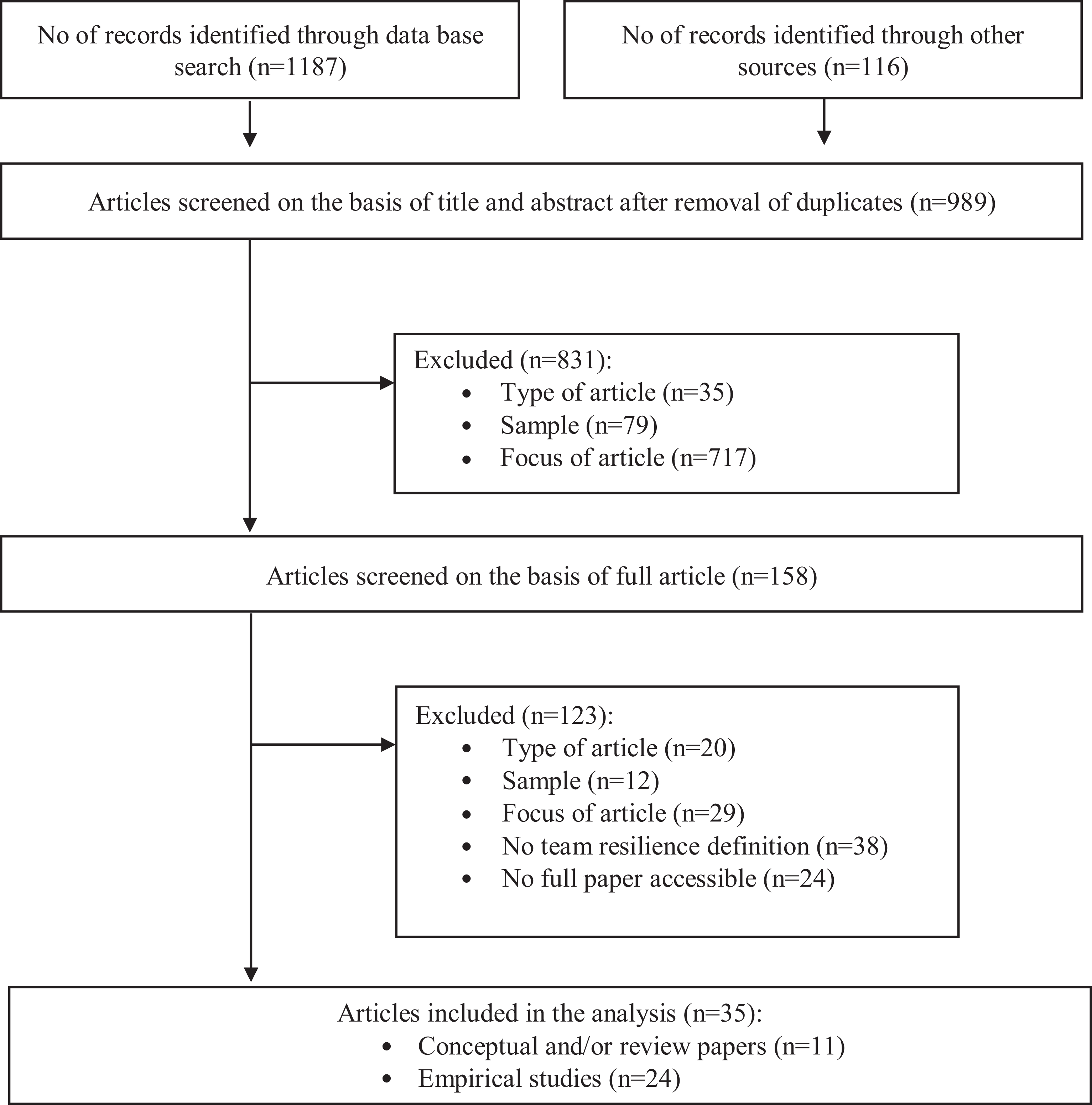
Flowchart of search strategy.
Aim and analytical framework
In this systematic review, we aim to examine the conceptual nature of workplace team resilience by synthesizing previous definitions and conceptualizations discussed in the literature. We take an integrative approach by combining ideas from team and stress theories to guide the conceptual analysis.
We draw on two team theories to structure our multilevel conceptual analysis. Since the notion of effective adversity management is central to the team resilience concept, we use the Input-Mediator-Output-Input (IMOI) model of team effectiveness (Ilgen et al., 2005) as the main framework for the conceptual analysis. The IMOI model comprises team input factors that facilitate team processes, mediating team processes (i.e., group processes and states), and team outcomes. The model provides a useful, flexible structure for the conceptual analysis. It recognizes the temporal nature of team processes and allows for the examination of multilevel factors that affect group dynamics (Kozlowski, 2015). In contrast to the Input-Process-Outcome model (McGrath, 1964), which dominated the team research literature for many decades, the IMOI model allows a broader array of mediators to be captured, including dynamic processes and emergent team states, and incorporates a cyclical feedback loop.
Secondly, we draw on the principles of multilevel theory proposed by Kozlowski and Klein (2000), which provide guidelines for the conceptualization of multilevel phenomena in organizational systems. The development of multilevel models is appropriate if a cross-level interaction (i.e., relationship between constructs at the individual and team level) is theoretically expected, as in the case of team resilience. Multilevel theory states that higher level phenomena (e.g., team resilience) emerge from interaction processes among individuals (i.e., team members). Therefore, the nature of the emergence process should be specified in the model. These principles guide our conceptual analysis of the team resilience literature. Based on these principles, we propose individual-level factors associated with team resilience and clarify the multilevel relationship between individual and team resilience.
Furthermore, the review draws on one psychological theory that has been widely applied to work stress and employee well-being research: the Conservation-of-Resources (COR) theory (Hobfoll, 2002). COR theory proposes that individuals aim to accumulate resources and avoid resource losses. Employees can draw on personal or external resources (i.e., in their work team) to tackle stressors or to thrive in the face of adverse events. The theory provides an appropriate theoretical framework for our review to identify the multilevel resources teams use for adversity management and how these are transformed into team resilience outcomes.
Data extraction
We analyzed the included articles using a data extraction template based on the PRISMA guidelines for systematic reviews (Moher et al., 2009). The template included information on article content, theoretical framework/model, team resilience definition/conceptualization, and study settings. The aim of the present review was to gain an advanced understanding of how team resilience has been conceptualized in previous research as well as to examine how it fits into a multilevel nomological network of workplace resilience. To this end, definitions and conceptualizations of team resilience were derived from either authors’ argumentation, summaries, and variable labels or direct quotes from participants (if qualitative data were provided in the study). A theoretical thematic analysis technique was applied to generate themes relating to conceptualizations of workplace team resilience. In doing so, we followed Braun and Clarke’s (2006) recommendations on the coding process. The first author generated initial codes by systematically coding all included articles. These articles were reviewed after the initial coding phase, along with their associated quotes, to ensure adequacy as well as consistency and were subsequently collated into themes. The wording and scope of codes were altered throughout the coding process, if appropriate. Subsequently, the derived themes were reviewed and refined by the first author and checked by the second and third author. Any disagreements were resolved by reaching consensus. The themes were divided into two categories: (a) definitions of resilience at the team level and (b) team resilience attributes (i.e., antecedents, processes, states, or outcomes associated with resilience). Finally, the themes were organized according to the IMOI framework (Ilgen et al., 2005) to form an integrative multilevel theoretical model of workplace team resilience.
Defining team resilience
Given the numerous definitions of team resilience, we attempt to synthesize previous research and give an overview of the main definitional themes proposed in the previous literature. The number of articles adopting a certain type of conceptualization of team resilience gives us an indication of conceptual perspectives that have been predominant in past research and ways in which we may shift our conceptual focus in the future research. Most articles either presented their own definition of team resilience or adapted previous definitions from other researchers. Team resilience was defined by the authors as a capacity, process, behavior, or outcome at a team level. All definitions included some level of “exposure to significant threat or adversity” (p. 506; Meneghel, Martínez, et al., 2016a) as a necessity for team resilience. The majority of articles (22/35 articles) conceptualized team resilience as a team-level capacity to respond and bounce back from adversity (e.g., Blatt, 2009; McCray et al., 2016; Meneghel, Martínez, et al., 2016a). Sixteen articles defined resilience predominantly as a team process of managing adversity and adapting to disruptions (e.g., Alliger et al., 2015; Edson, 2012; Gonzalez et al., 2016; Morgan et al., 2017). Five articles described team resilience as an emergent state, which results from adaptive team processes and may comprise a combination of other team states (Bowers et al., 2017; Maynard & Kennedy, 2016). Team emergent states may be defined as “cognitive, motivational, and affective states of teams, as opposed to the nature of their member interaction…[that are] products of team experiences (including team processes)” (Marks et al., 2001, p. 357–358). In most instances, team resilience was operationalized as a state-like construct, including those that referred to the concept as a “team belief,” “capacity,” or “second-order state” of the team. Interestingly, some authors proposed multiple conceptualizations of team resilience. For instance, McEwen and Boyd (2018) referred to resilience as a team capacity and specified resilient team behaviors. Similarly, Flint-Taylor and Cooper (2017) viewed team resilience as an overarching term and adopted a process and outcome conceptualization of team resilience. In fact, various articles conceptualized team resilience as a higher order factor or emphasized the multidimensional nature of the construct (Alliger et al., 2015; Bowers et al., 2017; Carmeli et al., 2013; Flint-Taylor & Cooper, 2017; McEwen & Boyd, 2018; Sharma & Sharma, 2016).
The variety of conceptualizations highlights the need for an integration of different conceptual facets of team resilience. We seek to develop a coherent model of team resilience for future research, which may assist researchers to clarify what component they specifically aim to address, or measure, in their respective studies. We argue that all the various conceptualizations may capture aspects of the team resilience construct. Thus, team resilience may be an emergent state resulting from resilient team processes, which are fostered by team composition and contextual factors. Thus, there is no team resilience state without the manifestation of observable team processes, nor are there resilient team processes without enabling team compositional factors.
Although most researchers seem to use similar terminologies when conceptualizing team resilience, definitional descriptions of the team resilience attributes were more nuanced and varied. Three key themes were identified through the coding process: “Dynamic nature of resilience,” “Positive adaptation to adversity,” and “Sustained team viability.” In the following section, each theme is presented alongside supportive evidence from the literature. The definitional themes and codes are presented in Table 1.
Overview of definitional themes and codes of team resilience.

Positive adaptation to adversity
Many definitions of resilience referred to some form of team adaptation (i.e., terms related to the ability to adapt, adaptive processes, or positive adaptation outcomes), which was proposed as an important component of the team resilience construct. Resilient teams were mostly characterized as being able to cope well with adversity, to recover from the disruptive events by employing adaptive processes, and to show perseverance throughout (e.g., Carmeli et al., 2013; McEwen & Boyd, 2018). This finding resonates with previous work on team adaptation by Maynard and Kennedy (2016) who conceptualized team resilience as an emergent state that is affected by the team’s ability to adapt and is “central to the team adaptation nomological network” (p. 9). Moreover, Fletcher and Sarkar (2013) concluded from their literature review of psychological resilience that positive adaptation, or good functioning following an adverse event, “must be evident” (p. 14). Nevertheless, the articles that included adaptation as part of their team resilience definition applied different conceptualizations of adaptation, such as a team’s ability to adapt (e.g., McCray et al., 2016), adaptive team processes (van der Beek & Schraagen, 2015), or demonstrated adaptation as an outcome (Maynard & Kennedy, 2016). According to Maynard and Kennedy’s (2016) team adaptation model, it may be argued that all three conceptual elements of adaptation are important in the cyclical feedback loop of the team process model (IMOI).
Dynamic nature of resilience
Another definitional theme characterizes team resilience as a dynamic construct that is influenced by team processes or external forces, such as leadership or organizational-level factors (Maynard & Kennedy, 2016). Team resilience may also change depending on how effectively a team overcomes an adverse event. For instance, incidents of ineffective adversity management may result in reduced team resources and strained relationships within the team, decreasing the capacity for resilience overall (Alliger et al., 2015). For example, a change in the team configuration, due to team members leaving or joining the team, was found to lead to a temporal disruption of team processes and to affect the team’s ability to behave resiliently (Morgan et al., 2013). Furthermore, West and colleagues (2009) provided empirical support for greater consensus among team members’ perceptions of team resilience over time, due to more shared experiences of challenges. This evidence strengthens the argument that resilience emerges over time as a function of team member interactions. Concurrently, some articles proposed team growth as an outcome of successful management of adverse events (e.g., Stephens et al., 2013; Vera et al., 2017). In this sense, experiences of overcome adverse events may strengthen team resources and a team’s capacity to deal with future disruptions (Flint-Taylor & Cooper, 2017). In addition, findings showed that resilience may be deliberately increased through training interventions (Alliger et al., 2015; Flint-Taylor & Cooper, 2017). The idea of trainability of resilience has been previously supported in the context of personal resilience. An intervention review by Robertson and colleagues (2015) found support for the effectiveness of workplace interventions aiming to increase employee resilience. Overall, most authors agreed that team resilience may be malleable and open to change.
Sustained team viability
Some authors defined high team viability, performance, and health following adversity as key characteristics of team resilience (e.g., Alliger et al., 2015; Bowers et al., 2017; McCray et al., 2016; McEwen & Boyd, 2018). For instance, Alliger et al. (2015) stated that “many teams can make it through an initial challenge or two, but only resilient teams can sustain performance and morale over time” (p. 177) and that resilient teams “maintain their team health and resources, recover quickly, and show ongoing viability” (p. 178). Hence, resilient teams may be less likely to experience negative effects of adversity and are able to thrive in the face of adverse events (Meneghel, Martínez, et al., 2016a; Meneghel, Salanova, et al., 2016b). Again, the protective capacity against major disruptions of team performance distinguishes team resilience from team adaptation processes in response to adverse events. Our findings suggest that the magnitude of any temporary decrease in performance or health following an adverse event is indicative of the level of team resilience. Thus, if conceptualized as the demonstration of team resilience (i.e., positive adaptation as an outcome of adversity management), resilient teams may be expected to show evidence of maintained or restored performance and health.
Team resilience themes
In the next section, we provide a detailed review of the team resilience themes, which we developed based on the team resilience attributes discussed in the past research. We created four candidate themes (“team resilience input factors,” “resilient team processes,” “mediating team states,” and “team resilience outcomes”), which were organized alongside the associated codes into the IMOI framework of team processes (Ilgen et al., 2005; see Table 2). We marked the codes that refer to quantitatively tested constructs to clarify which themes have been discussed as part of the previous conceptual work and which themes have been empirically tested.
Overview of conceptual themes, subthemes, and codes of team resilience.
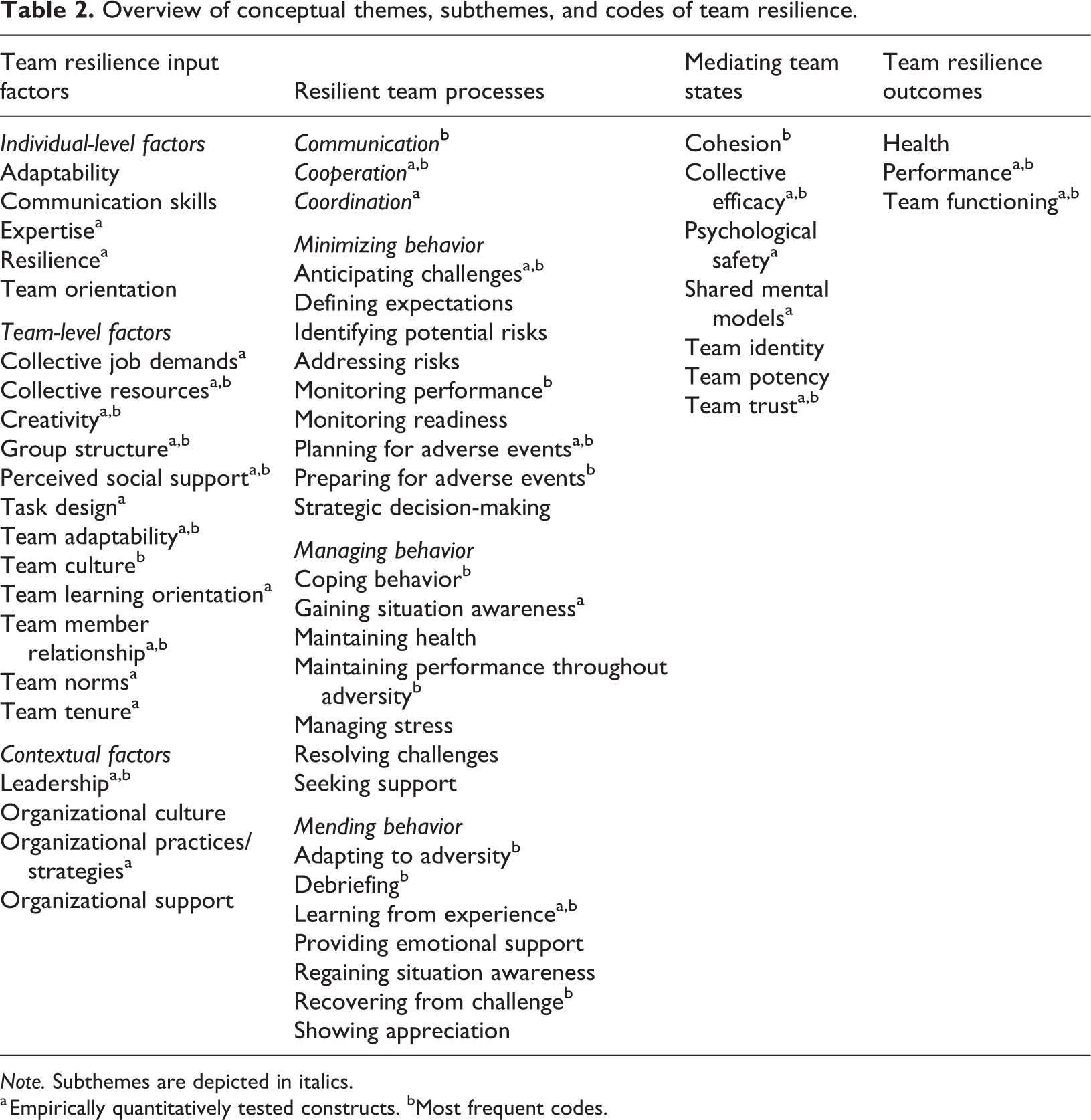
Note. Subthemes are depicted in italics.
a Empirically quantitatively tested constructs. bMost frequent codes.
Team resilience input factors
The first theme we created based on the team resilience literature (i.e., team resilience input factors) represents the enabling factors for a team to be resilient against adversity at work. These factors were grouped into subthemes according to their level of occurrence: individual, team-level, and contextual factors. This includes team member resources, team-level resources, and contextual factors, such as team leaders’ behavior (van der Beek & Schraagen, 2015; Vera et al., 2017) or organizational support (Bowers et al., 2017; Rodríguez-Sánchez & Vera Perea, 2015). Past team resilience research discussed mostly structural and relational characteristics of the team as potential antecedents for team resilience.
Individual-level factors
Team configuration is an important consideration for optimal team functioning, given that team members’ personality, knowledge, and skills enable effective team processes and affect team performance outcomes (Bell, 2007). We suggest that resilient team processes emerge from team members’ combined knowledge, skills, and abilities (Kozlowski & Klein, 2000). A team member’s contribution to effective team communication, cooperation, and coordination during adverse events may depend on their capacity to engage in interactive processes within the team. Thus, a good team composition may facilitate high team performance; however, the importance of team member resources may become more pronounced if adverse events occur that threaten a team’s performance. For example, findings from an interview study on long-duration spaceflight teams suggested that the incompatibility of team members can be a potential threat to the resilience of the team, as team members may be less likely to cooperate and support each other (Vanhove et al., 2015). Reduced cooperation can, in turn, affect the team’s ability to maintain performance during pressurized situations. In alignment with COR theory (Hobfoll, 2002), team members’ motivation, knowledge, and skills may serve as key resources for the team and facilitate resilient team-level processes and outcomes. Given the limited multilevel research on team resilience, we make some propositions regarding possible individual-level factors that act as important resources for the team and facilitate team resilience.
Firstly, we suggest that members of a resilient team may have high team orientation (i.e., demonstrate a high preference for working with others and are motivated to engage in team-oriented behaviors; Campbell, 2018; Driskell & Salas, 1992). In order for the team to engage in effective adversity management behavior, team members need to be motivated to cooperate with other members of the team, as the absence of such may likely lead to suboptimal performance when faced with adverse events (Driskell & Salas, 1992; Sims & Salas, 2007). Relating to team orientation, we suggest that social skills (e.g., communication skills) are essential for team members to contribute effectively to collective adversity management (Morgeson et al., 2005). Further, we would expect that resilient teams consist of skilled individuals that have the right expertise to respond appropriately to any adverse or unexpected events and apply their knowledge to facilitate team problem-solving (Stewart, 2006). For example, a study on professional hockey players found that the exit of experienced team players led to a higher disruption of team performance than the exit of less experienced team players (Stuart & Moore, 2017).
Previous research on team resilience suggests that individual resilience may be an important antecedent of team resilience, especially in safety-critical and extreme teams (i.e., firefighting services, health care, or spaceflight; Sandal, 2018). For instance, Landon and colleagues (2016) suggested in their evidence report on resilience in astronaut crews that individual resilience may enhance team performance and functioning. Empirical support was further provided by McEwen and Boyd’s (2018) scale development paper in which individual and team resilience showed a strong positive correlation. We provide a more elaborate discussion of the relationship between individual and team-level resilience further below.
Team-level factors
One of the key team-level resources for team resilience that emerged from the analysis is the relationship quality among team members (e.g., Meneghel, Martínez, et al., 2016a). Good relationships among team members may foster cohesion (Mach et al., 2010) and facilitate a shared belief that social support is available when problems occur. Team members who have high-quality relationships in their team may feel better emotionally equipped to withstand the strain of adverse events (Meneghel, Martínez, et al., 2016a). We also argue that relational bonds within the team may facilitate supportive behavior and cooperation when faced with adversity. The importance of good social ties and supportive actions may be particularly salient during adverse events, as members rely on each other for informational and emotional support when experiencing negative emotions and performance disruptions (Sharma & Sharma, 2016). Resilient team processes may also be enhanced by a supportive team culture (Bowers et al., 2017). Shared values and norms may promote mutual understanding and help develop a shared identity among team members, which can further enhance connectiveness within a team (Shin et al., 2016). A team culture that values teamwork and employee participation may contribute to the development of social ties in the team and enhances mutual support during disruptions.
There may be different pathways through which individual-level antecedents affect team resilience processes: they may facilitate team resilience processes through their effects on team resources (team input factors), by contributing to the development of team states and/or by affecting team interactions directly. For instance, team members with high team orientation may be more motivated to develop good social bonds in the team, which strengthens team member relationships (team-level resource). Alternatively, team members’ expertise can be shared through team interactions, which may lead to the emergence of common team mental models (i.e., shared understanding of each other’s knowledge, roles, and responsibilities; Grand et al., 2016). Shared team mental models in turn affect how effectively team members can coordinate tasks to overcome adverse events. Furthermore, individual resources, such as communication skills, will influence how effectively team members can engage in resilient team processes (e.g., how well they communicate with others in the team to resolve disruptions). Team resilience may be the product of a variety of individual and team resources that all contribute to facilitating resilient team behaviors and outcomes (Chen et al., 2015).
Contextual factors
Only a few studies made explicit assumptions about what contextual factors may impact team resilience. Our findings suggest that leadership is one of the key antecedents of team resilience. Leaders may serve as a source of guidance and support for team members to manage any disruptions successfully (Harms et al., 2017; Yukelson & Weinberg, 2016). We suggest that transformational leadership (referring to leaders’ behavior that aims to inspire and motivate employees; Bass, 1999) may be one potential resilience-enhancing leadership style. The link between transformational leadership behavior and team resilience can be explained from a social identity perspective. According to social identity theory (Ashforth & Mael, 1989), people who see themselves as a member of a group develop a group-based sense of self (i.e., social identity). This sense of belongingness enhances individuals’ motivation to support the team’s interests (van Knippenberg & Ellemers, 2003). Previous research findings support the notion that leaders who enhance team members’ identification with the group increase team members’ willingness to contribute to group objectives, as well as social support within the group (Cheng et al., 2016; Lyons & Schneider, 2009; Nielsen & Daniels, 2012). A transformational leader may enhance group identity by articulating a group vision or by encouraging cooperation among team members to strengthen their belief in their ability to overcome difficulties (Nielsen & Daniels, 2012; Schaubroeck et al., 2007; Steffens & Haslam, 2017). Some support for the identity-enhancing impact of transformational leadership behavior has been provided in the previous research (Steffens et al., 2014; Wang & Howell, 2012). Although no current study has tested the mediating effect of social identity, multiple studies have empirically supported the link between transformational leadership and team resilience. For instance, a small training intervention showed positive effects of transformational leadership training on team resilience (van der Kleij et al., 2011). Furthermore, transformational leadership has been found to have a mediated effect on team viability through team resilience (Dimas et al., 2018). Vera et al. (2017) also found a significant effect of transformational leadership on resilience in a large team sample from multiple organizations. Despite the empirical evidence for transformational leadership, we argue that a further examination of specific leadership behavior associated with team resilience would be needed to advance research on the influence of leadership on team resilience processes.
Overall, the input factors may serve well as an indicator of a team’s preparedness for adverse events or team’s potential for positive adaptation in face of adversity, which may therefore alternatively be termed “team resiliency” to match previously studied team input factors (e.g., team adaptability).
Resilient team processes
Most conceptualizations of team resilience in the literature referred explicitly or implicitly to resilient group processes associated with successful adversity management. In fact, all definitions included a behavioral element by characterizing team resilience as a team’s capacity to overcome, rebound from, or adapt to adversity. In accordance with COR theory, teams can draw on their resources (i.e., team input factors) to persist in the face of challenges or recover from adversity-induced losses. Key components of team resilience processes involve effective team communication (e.g., McCray et al., 2016), coordination (Flint-Taylor & Cooper, 2017), and cooperation (e.g., McEwen & Boyd, 2018) before, during, and after adverse events. These team processes are at the core of effective team interactions (Marks et al., 2001) and therefore serve as essential prerequisites for team adversity management. For example, team members need to communicate well during preparations for challenges, to coordinate their actions to respond to an adversity, and to effectively conduct debriefs after the events (Crowe et al., 2014; Maynard & Kennedy, 2016). Relating to cooperative behavior, the exchange of social support among team members has been emphasized as another important team process pre- and post-adversity in several articles across different types of teams (Decroos et al., 2017; Sharma & Sharma, 2016; Vanhove et al., 2015). Team members may help each other to maintain confidence, help to coordinate tasks according to individual resources, and provide information or ideas to generate solutions for adverse events (Morgan et al., 2013; Sims & Salas, 2007).
Our findings suggest that different resilient team processes are required at different times during teamwork. We adopt the categorization of team resilience behavior as proposed by Alliger et al. (2015): minimizing behavior (i.e., preparing for and preventing negative effects of adversity), managing behavior (i.e., coping and recovering from adversity), and mending behavior (i.e., debriefing and learning from past challenges). Prior to an adverse event, teams may take a proactive approach in identifying any potential risk factors for adversity and minimizing risks by either removing the source or preparing to adequately manage them. This may include simulation training (Gomes et al., 2014; Pollock et al., 2003) or “what-if discussions” that help to plan out contingency plans for adverse events (Alliger et al., 2015). For example, a focus group study with crisis response teams developed specific training strategies to help the teams to prepare themselves for improvised roles on their missions (Lundberg & Rankin, 2014). Preparation for challenges was addressed by many authors in the resilience literature. Preparation activities aid the development of adequate response sets when faced with adversity and may simultaneously lower the risk of detrimental effects of adverse events on the teams (e.g., McEwen & Boyd, 2018; Pollock et al., 2003).
During the disruption, resilient teams assess the situation in a timely manner, execute or revise plans where appropriate, develop new strategies if situation change occurs, and adjust their processes when necessary (i.e., engage in team adaptive processes; Maynard et al., 2015). For example, in case of an emergency, teams are required to quickly gain situational awareness and coordinate effective responses to the emergency (Gomes et al., 2014). If adverse events require change of actions, teams must recognize the demand for change and adjust procedures where needed (Sims & Salas, 2007). Accurate team mental models help the teams to identify appropriate strategies to determine what adjustments to team processes should be made, such as changes in team member tasks or roles. For instance, a team task simulation study with 20 teams found that teams with high mental model accuracy showed higher adaptive performance (before and after an unforeseen simulated system breakdown) than those without high mental model accuracy (Sander et al., 2015).
After the event, teams may engage in debriefing or reflective processes. Debriefing behavior may involve analyzing how team behavior has been affected by the adverse event, identifying potential needs for team process adjustments following the event, and developing plans to respond more effectively to future challenges (Schippers et al., 2014). In accordance with COR theory, teams restore or gain resources through learning activities, which helps prepare them for upcoming adverse events. Reflection is an important aspect of learning behavior within a team that can improve current ways of working and promote effective teamwork in the future (Schippers et al., 2017). Previous research on team reflection has provided meta-analytic support for the positive effect of debriefing on team performance (Tannenbaum & Cerasoli, 2013). Morgan et al. (2013) found that more resilient teams had high learning orientation and saw setbacks as an opportunity to learn. Similarly, the findings from their follow-up case study (Morgan et al., 2015) suggest that team learning is a way of organizing team members’ knowledge on how to collectively act in an event of adversity or crisis. Learning therefore facilitates more accurate team mental models on roles, responsibilities, and coordinated actions, which are required to respond effectively to an adverse event. Learning may also help gain a better awareness of effective and ineffective adversity management behavior. Teams may adopt the most effective adversity management strategies, which enhances preparedness for future disruptions. By mastering adverse events, teams may strengthen their resources to protect against future threats to team performance (Sutcliffe & Vogus, 2003).
The diversity of resilient behavioral strategies highlights the complexity of team interactions that facilitate effective management of adverse events. The findings suggest that resilience may not be characterized by one specific team response to adversity but rather comprises multiple processes over the course of adverse events that are fostered by team resources (team input factors) and ultimately lead to positive team functioning following adversity. However, none of the empirical papers employed a longitudinal research design to examine work team processes linked to resilience over time. Hence, no unequivocal conclusions can be drawn with regard to the relative value of each group process in explaining how well teams manage adversity at work.
Mediating team states
There are several team states that have been suggested to facilitate the emergence of team resilience: team identity, shared mental models, collective efficacy, cohesion, trust, and psychological safety (e.g., Sharma & Sharma, 2016). For example, if team members feel connected, show trust in each other, and believe in their team’s potential to perform well, they may engage in more cooperative, supportive behavior when faced by adversity. Subsequently, high cooperation may contribute to more effective adversity management (Pollock et al., 2003). Drawing from COR theory, these team states serve as important resources for resilient team behavior. Some empirical support has been provided for the link between team resilience and collective efficacy (Sharma & Sharma, 2016; Vera et al., 2017), trust (Sharma & Sharma, 2016; Stephens et al., 2013), and psychological safety (van der Beek & Schraagen, 2015). A strong shared sense of identity and cohesion in a team may help to develop good social ties and foster cooperative behavior among team members during disruptions (Morgan et al., 2013; Payne, 2007). Collective efficacy (i.e., the shared confidence in a team’s ability to successfully achieve set team objectives; Bandura, 2000) can drive a team’s effort to persist in achieving their goal despite adversity and use available resources in an optimal way. Similarly, trust among team members is an important resource for the team. Team trust affects team members’ willingness to cooperate and help each other during adverse events (Vanhove et al., 2015), which in turn contributes to continued teamwork and effective problem-solving in case of adverse event. For instance, ad hoc teams that respond to disasters have limited time for trust to form and develop “swift trust” (Meyerson et al., 1996) through immediate interactions. This allows teams to perform as a unit without past shared experience.
Team mental models serve as another important source of team resilience. The shared representation of each other’s knowledge, roles, and responsibilities enables the team to better coordinate their actions during and after adverse events (Pollock et al., 2003). The lack of an accurate team mental model is likely to lead to team derailment (Sims & Salas, 2007). Stevens and colleagues (2015) provided empirical evidence for the link between collective organization of a task and team performance under pressure. They proposed that collective organization prior to the task may facilitate a team’s ability to apply the collective knowledge to perform under pressure. Shared team mental models can be shaped in the minimizing and mending phase, where there is time for elaborate planning and information sharing (Pollock et al., 2003). A team’s knowledge about potential risks is then combined with an accurate assessment of the situation during the adverse event. Good communication can facilitate both accurate mental models and situational awareness (Mohammed et al., 2017).
Psychological safety may also facilitate resilient behaviors in teams. Past research suggests that psychological safety (i.e., a team’s shared belief to be safe to take interpersonal risks; Edmondson, 1999) is an important prerequisite for effective reflection processes (Drach-Zahavy & Freund, 2007). If there is a shared belief that it is safe to discuss concerns and ideas, team members reflect honestly on challenging situations in the past and how the team has dealt with them, without the fear of rejection or blame (Schippers et al., 2017). For teams to take interpersonal risks, they also need to have a culture that encourages team members to speak up, takes responsibility for their contribution to team goals, and invites them to share differing opinions. Thus, we suggest that perceived psychological safety facilitates team resilience through increased communication and team learning processes. Past empirical work has provided strong support for the effect of psychological safety on team learning behavior (Edmondson, 1999; Frazier et al., 2017). Hence, a team is more likely to learn from previous setbacks and adverse events and can adapt their team processes accordingly. This example shows how the different components of the IMOI model are interlinked, specifically team resilience input (i.e., team culture), team state (i.e., psychological safety), and team resilience behavior (i.e., team reflection).
Team resilience outcomes
Those researchers who advocated a conceptualization of team resilience as an emergent state viewed resilience as a dynamic phenomenon resulting from team adversity management processes and other team states (Bowers et al., 2017; Maynard & Kennedy, 2016). The emergent state approach to resilience is consistent with the notion that team resilience may be understood as a multidimensional construct and could be determined by an array of team factors. In fact, a multidimensional view on resilience was supported by many of the authors (e.g., Sharma & Sharma, 2016). Although only a few authors directly referred to team resilience as an emergent state, most implicitly support such conceptualization by assessing team resilience as state (i.e., as a perception or belief of the group members). We propose that the team emergent resilience state develops as a function of team member interactions. Thus, team resilience is open to change through, for example, learning processes following a disruption. Our conceptualization is in alignment with the conceptual framework of team resilience as proposed by Gucciardi et al. (2018), who distinguish between a team resilience emergent outcome (i.e., a product of team interaction following the exposure to adversity) and the emergence of a team resilient composition state (i.e., a shared belief in a team’s ability to respond effectively to adverse events). Resilience may be strengthened through positive teamwork experiences as well as the successful recovery from disruptions of teamwork (Pollock et al., 2003; Stoverink et al., 2018).
The “team resilience outcome” theme also comprises evidence of demonstrating resilience following adversity. The previously discussed definitional themes of team resilience (i.e., positive adaptation and sustained team viability) appeared to be crucial elements of the team resilience construct. The resilience of a team may be assessed by their ability to maintain performance, health, and team functioning throughout disruptions or, alternatively, by their ability to rebound to previous level of team effectiveness (or beyond) following adversity. Thus, resilient teams may even show increases in team functioning and enhance their resilience for future events (Carmeli et al., 2013; Dimas et al., 2018). Overall, performance was more often studied as a team resilience outcome than team member health or well-being in the past literature. One reason for this observation may be that effects of adversity on health are more pronounced when individuals are personally threatened by adversity. This may also support the notion that adversity primarily affects team processes negatively and that teamwork potentially serves as a buffer against strain on team members. Overall, teams need to demonstrate evidence that they have effectively managed adversity, resulting in positive adaptation.
Summary of findings
The most prominent finding from the analysis of team resilience research was the multiplicity of conceptualizations of team resilience. We argue that all main conceptualizations of team resilience (i.e., team capacity, process, emergent state, or outcome) capture the concept in a complementary way. Even if one were to adopt a state conceptualization of team resilience over a process or outcome view, we would expect that such team state would manifest itself in a team’s adversity management processes. The IMOI framework allows for an incorporation of all these different conceptualizations. They are embedded in a dynamic team process cycle that includes contextual factors and team composition factors, team interactions, team emergent states, and team process outcomes. The articles we reviewed also discussed different possible trajectories of positive adaptation following the exposure to an adverse event (i.e., minimal change in performance or team functioning, recovery, or growth). Although the findings suggest a diversity of post-adversity changes in team performance, evidence of positive team functioning marks the endpoint of any team resilience trajectory.
So far, many conceptual components of team resilience have not been empirically examined, which stresses the need for more empirical research on team resilience. Future research may not only establish empirical support for the different conceptual elements and antecedents of team resilience but may also determine which factors have most predictive power in explaining a team’s demonstration of effective adversity management.
A multilevel conceptual model of team resilience
Following the thematic analysis of team resilience conceptualizations, we grouped the emerging resilience themes under the main three categories of the IMOI model: team inputs (i.e., multilevel resources for resilience), mediators (i.e., processes associated with adversity management), and outcomes. We also made some propositions with regard to the key antecedents and processes associated with team resilience. Based on these propositions, we developed an integrative multilevel model of team resilience that depicts the proposed key attributes of workplace team resilience (see Figure 2). In accordance with multilevel theory (Kozlowski & Klein, 2000), the model integrates individual-level factors (i.e., team members’ relevant knowledge, abilities, and skills), which serve as important resources for effective team resilient processes and outcomes. These personal resources may facilitate effective communication, cooperation, and coordination to overcome adverse events. It is important to acknowledge that further theoretical and empirical support is needed to determine the necessity and relative weight of each proposed resilience component.
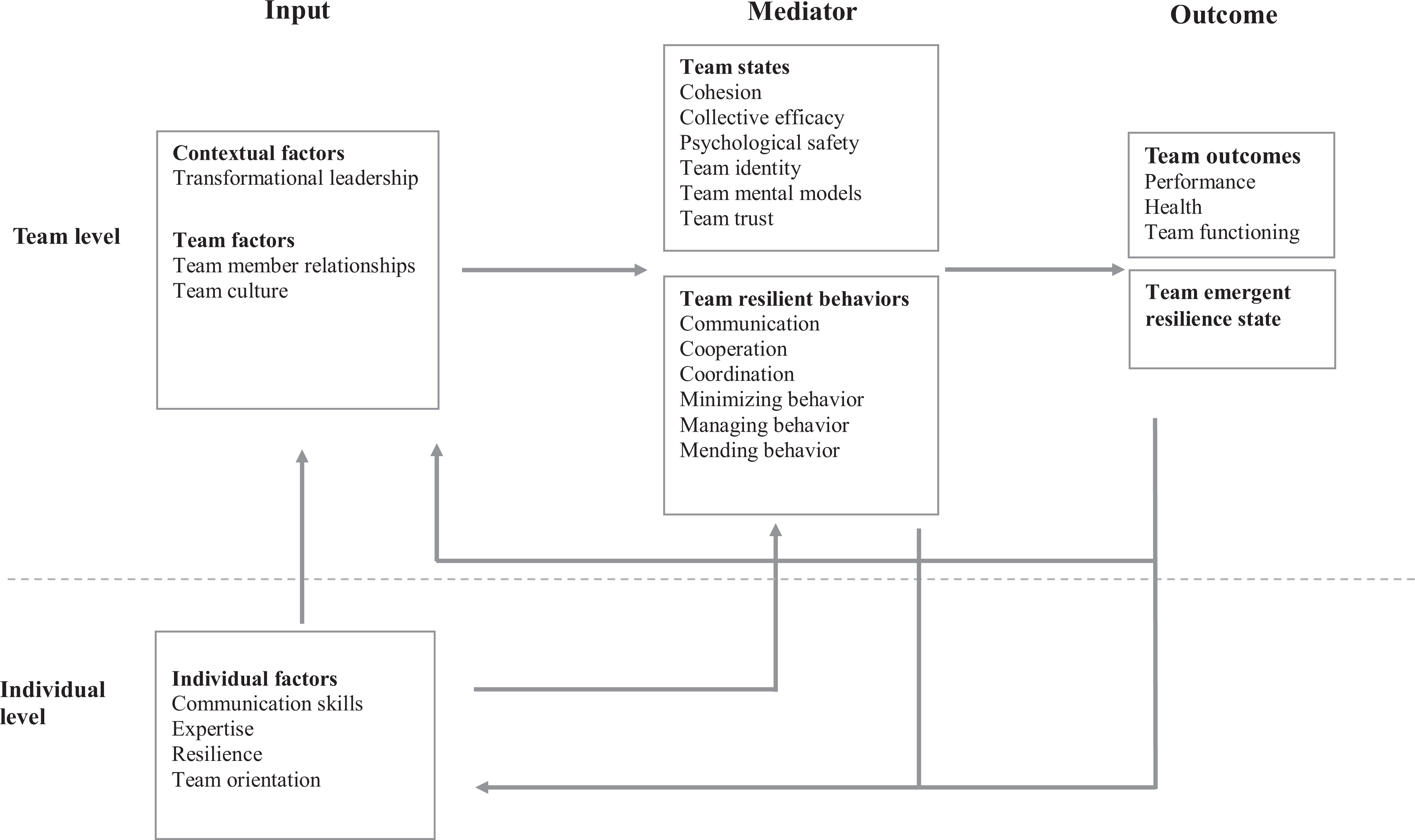
A multilevel model of workplace team resilience.
Based on the multilevel model of team resilience, we adopt a dynamic process view to understand the team resilience phenomenon, which comprises the following conceptual components: (a) team resiliency or team resilience input factors (i.e., contextual and team resources that facilitate successful adversity management), (b) team resilience processes (i.e., adversity management behaviors), (c) team resilience state (i.e., an emergent property of the team that results from adversity management processes and other emergent team states), and (d) team resilience outcomes (i.e., the demonstration of resilience or post-adversity trajectory of team functioning). In alignment with the most recent research on team resilience, we propose the following definition: Team resilience is defined as a team’s capacity to withstand or recover from adverse events (i.e., events that may lead to losses or breakdown of independent team processes), which we conceptualize as an emergent team state that results from preparative, adaptive, and reflective team processes and which is demonstrated by a persistence, recovery, or growth trajectory of team functioning following exposure to adversity.
Relationship between individual and team resilience
Individual and team resilience share some functional features, such as adversity management processes of sensemaking, response formulation, and execution; however, the two constructs are very distinct structurally, due to the conceptual differences between individual and interactive behaviors (Stoverink et al., 2018). Collective responses to adversity require effective communication, collaboration, and coordination among team members, which are absent from individual adversity management processes. Researchers largely agree that a group of resilient team members is not a necessary or sufficient condition for team resilience to occur (e.g., Alliger et al., 2015; Bowers et al., 2017; Flint-Taylor & Cooper, 2017). A group of highly resilient individuals does not guarantee a team’s successful recovery from adversity since team members may still fail to effectively cooperate and communicate to overcome setbacks (McEwen & Boyd, 2018). We argue that the aggregation of individual resilience in a team (i.e., average level of individual resilience in the team) does not best represent the team resilience level in the team (i.e., average level of team resilience in the team), which is a product of interactive processes. Nevertheless, we propose that there may be reciprocal cross-level effects between individual and team resilience, which we discuss in the following section. Team members’ resilience may function as an individual-level antecedent of team resilience and may be, in turn, affected by the team resilience of a team. Drawing on social learning and crossover theories, we aim to extend previous team resilience literature by discussing potential mechanisms that may explain the relationship between individual and team resilience.
Some researchers have suggested that having resilient team members in the team may be an advantage, as resilient individuals manage workplace pressures well and may share their skills with other team members to benefit the team as a whole (Flint-Taylor & Cooper, 2017). Aligned with COR theory, a group of resilient individuals (i.e., high average of team member resilience) may possess more team member resources that facilitate effective resilient processes. Team members can strengthen each other’s individual resilience through social learning mechanisms (Bandura, 1977). Team members may learn from each other by observing each other’s resilient actions, thoughts, and emotions and may adopt resilient processes from fellow team members (Chen et al., 2015; Stoverink et al., 2018). The combined force of individual resilience resources may be particularly salient if the team members have a strong sense of shared group identity (Steffens & Haslam, 2017). The shared identity may facilitate more support among team members and help develop a sense of collective efficacy, which can foster resilient team behaviors.
We also suggest that individual resilience may affect team resilience through the facilitation of effective team resilient processes. Resilient team members cope well individually with adverse events and experience fewer negative effects on their performance. This may give them more capacity to focus on teamwork tasks and engage in effective team communication and cooperation during adverse events. For example, in an event of emergency onboard of an aircraft, flight crew members can experience high stress, which reduces their cognitive or physical capacities to perform their team role tasks (e.g., preparing for emergency landing; Dietz et al., 2017). We would therefore expect that such reduced team members’ contribution to team processes would result in a decrease in team resilience. Previous research has shown that stress can cause the narrowing of attention at the individual level, which may lead to more individualistic-oriented, and less cooperative behavior, and reduced focus on team goals and interpersonal cues (Driskell et al., 1999). Moreover, high strain experienced by one team member can affect the level of strain of other team members through crossover effects (i.e., the interindividual transmission process of affective states; S. Chen et al., 2015; Westman, 2011; Westman et al., 2011). Such stress-related crossover effects can contribute to the development of team stress and compromise goal-directed functioning of the team (Drach-Zahavy & Freund, 2007). In alignment with COR, the negative crossover effects can result in decreased availability of team member resources and may affect the overall team performance under pressurized conditions. This mechanism may apply especially if the team operates in a highly interdependent way. Nevertheless, we suggest that nonresilient team members may not necessarily disrupt team processes, as other team members can compensate for reduced individual contribution to the team by increasing their efforts. However, such a compensation effect may need to be explored further in the future research.
We also suggest there may be a reversed cross-level effect of team resilience on individual resilience. Team resilience can influence a team member’s resilience through different pathways. A shared perception of team resilience may enhance individual self-efficacious beliefs about one’s own capacity to cope well with adverse events (Bandura, 2000; Galli, 2016). When judging their personal efficacy, they may consider the available team resources and how well the team works together, since the group dynamic can affect one’s own performance in the face of adverse events. Further, team members working in a resilient team may perceive more availability of resources from the team to deal effectively with adverse events. According to COR, support from group members can serve as an important social resource and may make team members more stress resistant (Chen et al., 2015). A shared social identity may also be an important mechanism for the top-down effect of team resilience on personal resilience. If there is a strong shared identity, team members are more likely to provide support for each other, which reduces individual strain levels (Frisch et al., 2014; Häusser et al., 2012; van Dick et al., 2018). Being part of a team that effectively manages an adverse event could mean that team members may have reduced individual workload and greater capacity to cope individually with the effects of adversity. For example, findings from a recent study on 40 project teams suggest that team stressors, such as team role overload, not only correlated with decreased team learning behavior but also had a significant effect on individual role overload and subsequent individual performance (Savelsbergh et al., 2012).
In conclusion, we argue that individual resilience is not an inherent part of the team resilience construct or a necessary condition for team resilience to emerge. This notion is in alignment with most recently proposed conceptualizations of team resilience (Flint-Taylor & Cooper, 2017; Gucciardi et al., 2018; Stoverink et al., 2018). Nevertheless, we argue that individual resilience may act as an antecedent by facilitating effective adversity management processes (as depicted in Figure 2). Conversely, we argue that team resilience may function as a resource for team members’ personal resilience. However, we require more research to specify the exact role of individual resilience for developing team resilience (i.e., exactly how personal resilience affects team processes) and what team composition of individual resilience may be most beneficial for team resilience to emerge. For instance, we do not know if there is such an effect of “too much of a good thing” (i.e., whether a high average of individual resilience within the team may decrease team resilience as team members may only focus on their personal coping). Future empirical work is needed to test the interaction between team resilience and individual resilience.
General discussion and implications
One of the key features of the multilevel team resilience framework is the adoption of a dynamic view on team resilience. Multilevel input factors facilitate relevant team states and team adversity management processes and result in positive team functioning outcomes in response to adversity. In accordance with COR, teams draw on multilevel resources (i.e., individual, team-level, and contextual resources), which facilitate resilient team behaviors. The specification of multilevel resources for adversity management may also advance work stress research. We offer an integrative view on stress management that considers individual, as well as team-level, resources that contribute to teams’ ability to overcome adverse events at work. The review thereby provides new conceptual ideas for a multilevel approach to stress management at work. The findings provide support for the conceptualization of team resilience as a distinct phenomenon that contributes to our understanding of team stress management. First, the theoretical model draws attention to the team (member) factors that enable a team to maintain team functioning throughout adversity, preventing any strain or decreases in team performance following adverse events. Second, the multilevel model introduces the idea of a post-adversity team growth process, which shifts the study of resilience as an adversity management mechanism to an ongoing team learning cycle, shaped by a team’s shared experiences with setbacks or disruptions.
The process view also clearly resonates with contemporary approaches to team research, more specifically, multilevel theory of teams (Kozlowski, 2015; Kozlowski & Klein, 2000). This theory postulates that team interactions are inherently dynamic and could be characterized by either cumulative, or emergent, team processes leading to specific team-level states. In terms of cumulative processes, the combination of individual-level input factors shapes team interactions and processes. For emergent processes, an individual’s behavior, thoughts, or emotions manifest themselves through interactions with team members into unit-level shared phenomena, which can be treated as team states. Thus, team resilience processes are affected by individual characteristics and the team emergent resilient state is the result of such team interactions.
Following our analysis, we see a need for advancement in our understanding of what constitutes the demonstration of resilience. More specifically, we require explicit assumptions about the team resilience trajectories to be considered resilient. Past research has suggested three different possible trajectories of team processes following an adverse event: (a) resistance to the effects of adversity and no or minimal negative effect on team functioning, (b) the quick return to previous level of functioning after temporary significant disruption, or (c) recovery to functioning over an extended period of time (Chapman et al., 2020; Gucciardi et al., 2018). This proposition is in line with the most recent conceptual paper on team resilience, which argues that resilient teams demonstrate recovery or adaptation trajectories in response to adverse events (Stoverink et al., 2018). Similarly, Gucciardi et al. (2018) define team resilience as “an emergent outcome [that] characterizes the trajectory of a team’s functioning, following adversity exposure, as on that is largely unaffected or returns to normal levels after some degree of deterioration in functioning” (p. 7). Thus, they suggest that team resilience could be operationalized as the performance trajectory over a specific time period in which the team has been exposed to an adverse event. Teams may either bounce back quickly from adverse events or take a longer time to restore team functioning (i.e., an extended recovery process; Chapman et al., 2020). For example, a study on professional hockey players found that the recovery time, following an exit of a team member, depended on team members’ role and experience with the team (Stuart & Moore, 2017). We argue that both the degree of deterioration in functioning following adversity exposure and the time needed to recover from adversity are important indicators of the resilience trajectory. Thus, we suggest that the demonstration of resilience could be understood as a continuum along which teams vary depending on their resilience trajectory. The more time a team needs to recover from adversity, the less resilient they may be. Similarly, the more their team functioning is disrupted by an adverse event, the less resilient they are against the impact of adversity. What resilience trajectory can be observed may largely depend on the context in which a team operates. For example, in the context of spaceflights, flight crews are required to manage continuous high-pressure conditions, such as isolation and confinement, and demonstrate sustained functioning. In contrast, the notion of bouncing back may be associated with more acute temporarily bound events (e.g., failure of equipment). Findings from qualitative research on spaceflight teams suggest that both sustained functioning and a recovery curve are possible resilience trajectories (Vanhove et al., 2015). The authors discuss how the demonstration of resilience may manifest itself differently across different mission phases. For example, resilience may be demonstrated through adaptation to the space environment in the early mission phase but through maintaining team functioning during the interim phase.
In addition to these trajectories of team resilience, we suggest a fourth possible trajectory, which considers that the team may increase their team functioning following adversity exposure and demonstrate post-adversity team growth (Stephens et al., 2013; Vanhove et al., 2015). The notion of post-adversity thriving has been previously discussed in the context of dyadic resilience (Thompson & Ravlin, 2017). The dyadic reflective process may contribute to the joint learning experience and strengthen communication and cooperation between the interacting agents. Similarly, the reflective team processes after adverse events (i.e., during mending phase) can lead to positive improvements of team activities and prepare the team for upcoming adverse events (Amaral et al., 2015). Thus, the process of adversity management may be described as an iterative learning cycle of preparing for, managing, and learning from adverse events. We may expect the team resilience state to change over time through the learning processes that take place with each setback that a team overcomes. Resilience may be cultivated through the successful recovery and/or subsequent growth from disruptions of teamwork. The idea of history-based development of team states has been previously applied to the team trust literature. For instance, Costa and colleagues (2009) provided support for the notion that teams with more experience working together had higher level of team trust and performance, compared with teams in which prior experience was lower. Stoverink et al. (2018) have postulated a similar notion that team resilience may be strengthened through shared mastery experiences. We explicitly argue that all four trajectories of team functioning following an adverse event are plausible; thereby, we extend past work that has considered mainly three potential trajectories.
The process view is supported by Gucciardi et al. (2018) and Stoverink et al.’s (2018) most recent conceptual work on team resilience. Both author teams conceptualize team resilience as an emergent team state or outcome, which is the result of dynamic team interaction in response to adversity. Our multilevel model extends the work of both articles in multiple ways. First, we applied a systematic review methodology in reviewing previous research on team resilience to inform the multilevel team resilience model. This allowed us to rigorously identify all relevant articles as well as specific research gaps in the resilience literature and provide guidance for future empirical work. Further, Gucciardi et al. (2018) offer a template that defines explicit necessary and sufficient conditions for team resilience to occur. Our results may be utilized to refine these conditions and advance current conceptual understanding of team resilience outcomes. For example, the resilient team behaviors we reviewed may be utilized to specify the necessary interactions between team members for resilience to emerge. Second, our multilevel model of team resilience specifies individual antecedents of team resilience and provides clarification with regard to the interaction between individual and team resilience, which is missing from previous models of team resilience (Gucciardi et al., 2018; Stoverink et al., 2018). Gucciardi et al. (2018) discussed the distinctiveness of resilience at the team level and introduced the idea that team resilience “emerges from combinations of human capital resources of individual members that are relevant to team objectives” (p. 12). We aimed to go beyond conceptually differentiating team resilience from individual resilience in our review by discussing reciprocal cross-level effects between individual and team-level resilience, using social learning and social identity theory. Further, we extend the discussion of multilevel antecedents of team resilience by specifying potential individual-level factors in our model based on previous literature (e.g., team orientation). Third, the review contributes to the team resilience literature by suggesting team growth as a potential trajectory following the exposure to adversity. Both previous models of team resilience did not suggest post-adversity growth as a team resilience trajectory. However, our findings from the thematic analysis support the notion that team resilience can entail a growth process trajectory, which is consistent with previous conceptual propositions regarding dyadic resilience (Thompson & Ravlin, 2017).
In studying team resilience from an emergent property perspective, two aspects are important, the degree of agreement between team members that constitutes the team state as well as the change in magnitude of the agreement over time. This has important consequences for the operationalization of team resilience. To adequately capture the dynamic nature of team resilience, we need to not only assess team resilience as a state at one point in time but view its trajectory across multiple time points to track changes in shared team perceptions and interactions. Up until now, none of the developed measures have been tested longitudinally and do not offer any insights into the dynamic of team resilience over time. In fact, Kozlowski and Chao (2018) noted that there is an absence of empirical assessments of emergence processes over time within team research. Future research may address this gap in team research by promoting longitudinal study designs and more dynamic assessments of team phenomena, such as team resilience (see Table 3 for recommendations for future research). For instance, future assessment tools may incorporate more technology, such as sociometric badges that can track changing team compositions and interactions based on physical location and movement, or computational modeling, which allows us to simulate group interactions via agent-based simulations (Dionne et al., 2010; Kozlowski & Chao, 2018).
Recommendations for future research.
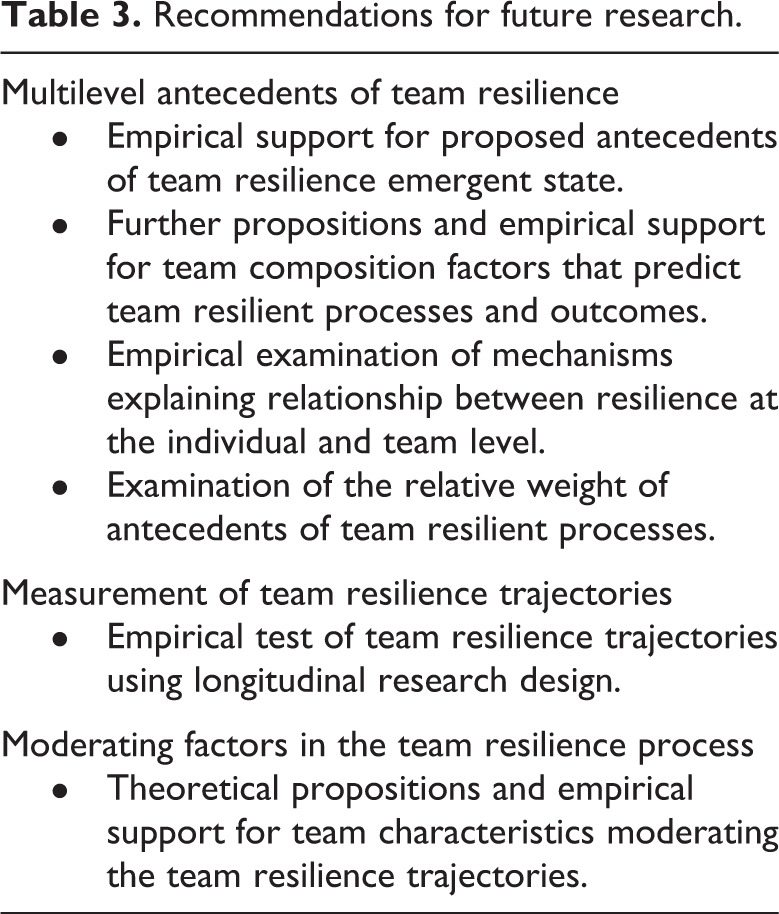
Although we have offered some propositions regarding key antecedents of team resilience, we need more empirical research to identify those factors that predict how well teams cope with adversity at work. For example, one question that remains unanswered concerns the exact composition of individual resources within the group that is needed to develop the capacity for team resilience. Relating to antecedents of effective adversity management, more research is required to determine the boundary conditions for team resilience. For instance, work teams may react differently to different adverse events and may need different skill sets, depending on the type of adversity faced in a particular organizational context. We would also argue that team characteristics may serve as important moderators for the resilience process. For now, there is no empirical research that has specifically examined the context-specificity of team resilience.
The need for further examination of predictors for team resilience link well with the discourse on the best operationalization of team resilience. Future team resilience measures may assess team composition factors that are predictive of resilience. Alternatively, future scales may measure specific resilient team behaviors that are associated with successful adversity management. In any case, resilience assessment needs to reflect the dynamic nature of the construct. Hence, measuring team resilience as a static phenomenon may not provide a good insight into how the team overcomes pressures over time.
Our findings suggest that there is currently little research on contextual factors that contribute to team resilience. Given that work teams are inherently embedded within specific work environments and influenced by supervisory and organizational practices, it is surprising that contextual factors have not yet formed a major part of the discourse in team resilience research. Thus, there is scope for future research to specifically address the role of contextual factors (e.g., organizational practices) in explaining team resilience.
Limitations
It is important to acknowledge some limitations of the review methodology and proposed theoretical framework. First, it is likely that our search strategy precluded an integration of all relevant published research on workplace team resilience, due to the strict inclusion criteria. Despite our systematic search strategy, some key articles still may have not been detected using the applied search string. Relating to this limitation, we acknowledge that the applied search string was created based on the assumption that the concept of resilience is labeled as such in the literature. Hence, we may have excluded previous research on the same phenomenon which used a different label for resilience (e.g., resistance, stress).
Second, the conceptual analysis was performed using a thematic analysis technique which is associated with researcher biases that may influence the coding process and interpretation of findings. Thus, the derived themes and proposed theoretical model are the result of an analytical process guided by our prior knowledge, skills, and ideas. Nevertheless, as the review integrated research sources from over 30 articles, we can be confident that the proposed model incorporates the current main conceptual ideas on team resilience.
Third, we did not discuss the developed theoretical framework with regard to the empirical evidence for its components. With only a small amount of empirical research published, support for theoretical propositions of the current team resilience research has still been limited. Thus, we focused on the theoretical development for the purpose of this article to provide conceptual clarification regarding team resilience. Therefore, we decided to exclude an extensive discussion of empirical support for each factor presented in the model. Future research is required to empirically test the propositions of our theoretical framework.
Conclusion
We contributed to the conceptualization of team resilience by synthesizing conceptual propositions from previous research and by developing a multilevel framework. Our model clarifies the conceptual nature of team resilience and its relation to individual resilience. By integrating the different conceptual components of team resilience into the IMOI framework, we advance previous work on team resilience and present a way forward to commonly conceptualize the phenomenon. We hope that our theoretical framework will stimulate further theoretical work and empirical research on workplace team resilience to advance our understanding of how to support employees and their teams to manage adversity at work.
