



Abstract
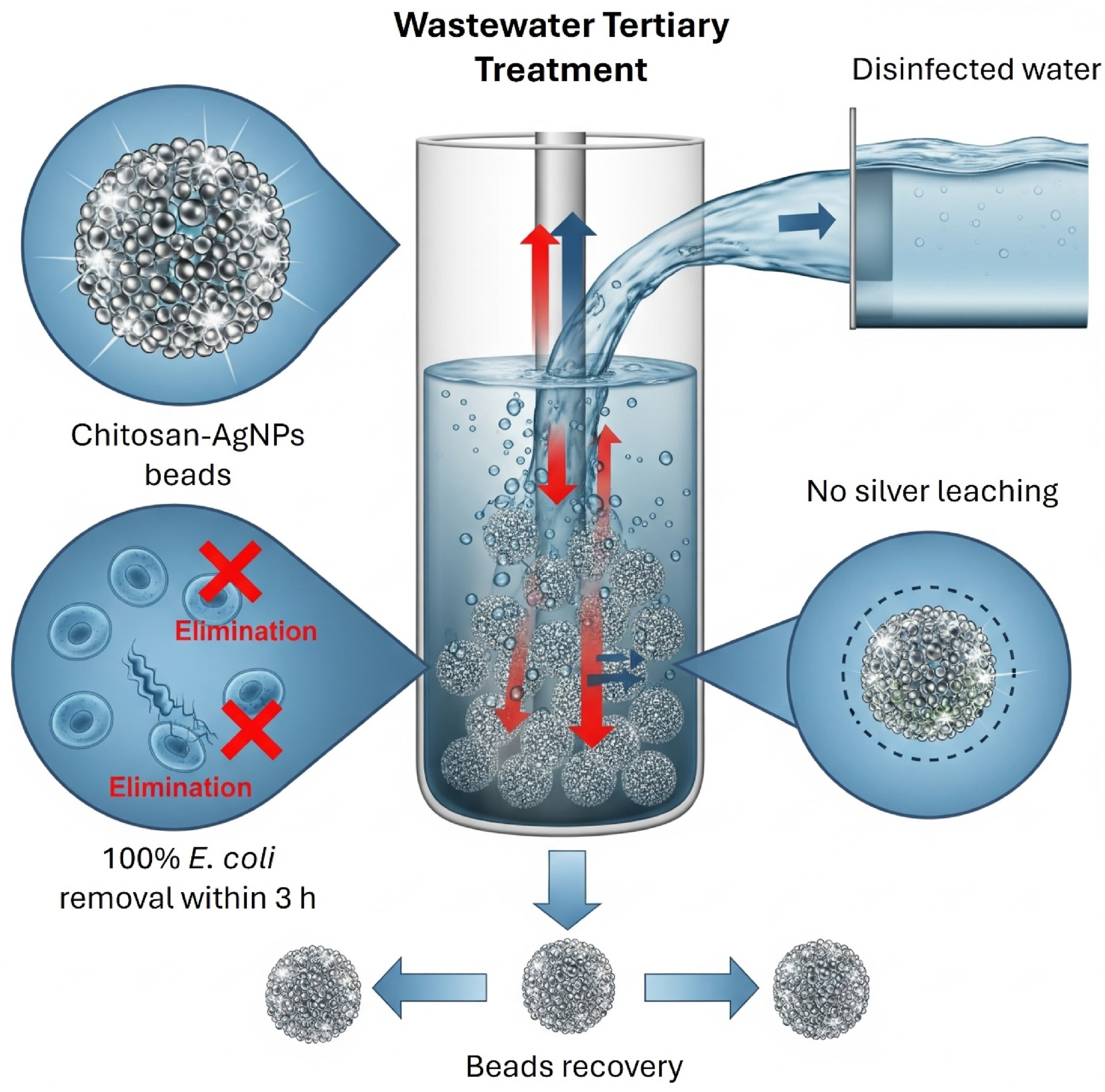
The tertiary treatment of industrial wastewater using metallic nanoparticles anchored onto polymeric matrices presents a promising alternative to conventional bactericidal techniques, enabling material recovery after treatment and ensuring water quality. In this study, silver nanoparticles (AgNPs) were synthesized by chemical reduction and successfully confirmed by UV-Vis spectroscopy, exhibiting characteristic surface plasmon resonance bands around 390 nm. Chitosan beads containing AgNPs were then prepared and crosslinked with glutaraldehyde, and their structural and thermal properties were evaluated by X-ray diffraction (XRD), Fourier transform infrared spectroscopy (FTIR), and thermogravimetric analysis (TGA), evidencing reduced crystallinity and changes in thermal behavior due to crosslinking. A 23 factorial design with a central point was employed to optimize the production of chitosan beads, considering acetic acid concentration, glutaraldehyde volume, and AgNPs content as independent variables, while bactericidal activity against Escherichia coli and Staphylococcus aureus was used as the response variable. Statistical analysis revealed that acetic acid concentration was the most significant factor influencing antibacterial performance. The optimized beads, prepared with 0.75 mol L−1 acetic acid, 60 µL glutaraldehyde, and 30% (v/v) of AgNPs colloidal solution, exhibited the largest inhibition zones against both bacterial strains. These optimized materials were subsequently applied to disinfect wastewater from a local industry, and after 3 h of treatment, complete inactivation of Escherichia coli and a 47% reduction in total fecal coliforms were achieved. Inductively coupled plasma optical emission spectrometry (ICP-OES) analyses indicated no detectable silver leaching, ensuring compliance with Brazilian regulations for industrial wastewater disposal. Overall, these findings demonstrate that AgNPs-loaded chitosan beads combine favorable structural properties with effective antibacterial activity and environmental safety, highlighting their potential for tertiary industrial wastewater treatment.
Get full access to this article
View all access options for this article.