

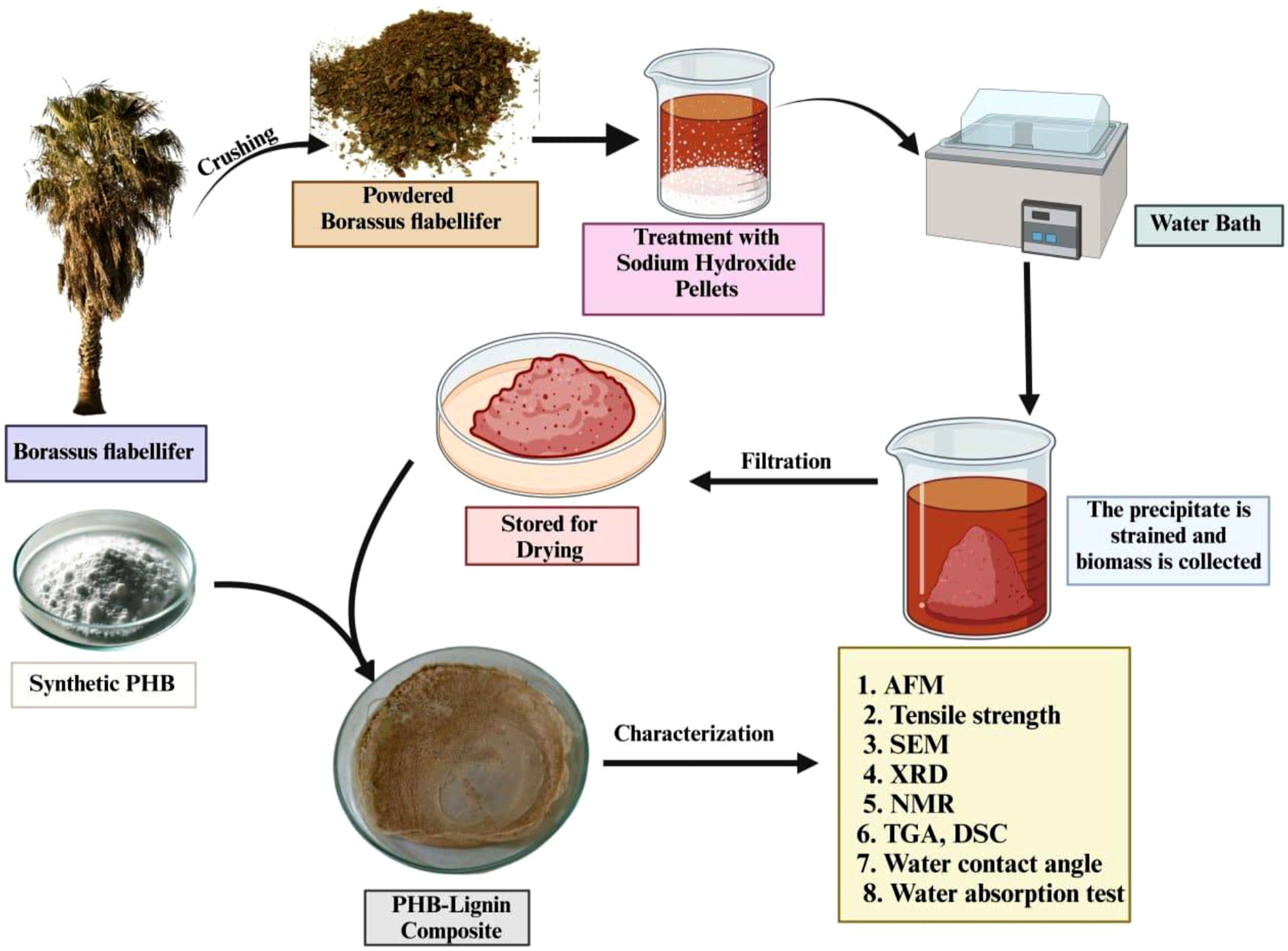
Deterioration of the environment is occurring at an alarming rate due to the widespread use of plastics. Conventional plastics do not degrade easily and pose severe environmental threats. Hence, it is imperative to devise a sustainable solution to reduce their detrimental impact on our ecosystem. The applications of polyhydroxybutyrate (PHB) are limited due to its shortcomings, such as low tensile strength, poor thermal stability, and inherent brittleness. In the present study, lignin, another natural polymer, was blended with the polymer PHB to address these limitations. Lignin, extracted from the leaves of Borassus flabellifer, is a complex polymer second only to cellulose in abundance. It possesses excellent mechanical properties, good toughening capacity, and disease resistance in plants, making it a promising co-polymer for PHB. Upon blending the polymers PHB and lignin, the composite film was further assessed for structural, mechanical, and thermal analysis. Incorporation of 20% lignin into PHB increased the tensile strength from 0.5 MPa (pure PHB) to 1.05 MPa. Water absorption after 24 h was reduced from 13% in PHB to 10% in the composite, indicating improved hydrophobicity due to effective lignin integration. Enhanced thermal properties were also observed, with the composite film showing a degradation temperature of 300°C, compared to 290°C for PHB alone. These findings affirm the improved thermal stability and durability of the composite film. Furthermore, PHB-lignin composite films hold strong potential for applications in sustainable food packaging systems as the polymers involved are entirely bio-derived and bio-stable. The approach demonstrates a simple yet effective method for enhancing biopolymer performance using plant-derived additives. The developed composite offers a promising alternative to synthetic packaging materials, aligning with global sustainability goals.
SinghJKRoutAKKumariK. A review on Borassus flabellifer lignocellulose fiber reinforced polymer composites. Carbohydr Polym2021; 262: 117929.
2.
SunRC. Lignin source and structural characterization. ChemSusChem2020; 13(17): 4385–4393.
3.
DasARinguTGhoshS, et al.A comprehensive review on recent advances in preparation, physicochemical characterization, and bioengineering applications of biopolymers. Polym Bull2023; 80(7): 7247–7312.
4.
KaniukŁStachewiczU. Development and advantages of biodegradable PHA polymers based on electrospun PHBV fibers for tissue engineering and other biomedical applications. ACS Biomater Sci Eng2021; 7(12): 5339–5362.
5.
LiuPZhangTZhengY, et al.Potential one-step strategy for PET degradation and PHB biosynthesis through co-cultivation of two engineered microorganisms. Eng Microbiol2021; 1: 100003.
6.
AydemirDGardnerDJ. Biopolymer blends of polyhydroxybutyrate and polylactic acid reinforced with cellulose nanofibrils. Carbohydr Polym2020; 250: 116867.
7.
MaQZhangX. An integral method for determining the molecular composition of lignin and its application. Sci Rep2022; 12(1): 19136.
8.
KaiDTanMJCheePL, et al.Towards lignin-based functional materials in a sustainable world. Green Chem2016; 18(5): 1175–1200.
9.
GordobilODelucisREgüésI, et al.Kraft lignin as filler in PLA to improve ductility and thermal properties. Ind Crop Prod2015; 72: 46–53.
10.
FlaigW. Effects of micro-organisms in the transformation of lignin to humic substances. Geochem Cosmochim Acta1964; 28(10-11): 1523–1535.
11.
Oliver-OrtegaHEvonPEspinachFX, et al.Polyhydroxy-3-Butyrate (PHB)-Based composite materials reinforced with cellulosic fibers, obtained from barley waste straw, to produce pieces for agriculture applications: production, characterization and scale-up analysis. Materials2024; 17(8): 1901.
12.
PipatchartlearnwongKSwatdipongAVuttipongchaikijS, et al.Genetic evidence of multiple invasions and a small number of founders of Asian palmyra palm (Borassus flabellifer) in Thailand. BMC Genet2017; 18(1): 88.
RosenowPFernández-AyusoCLópez-GarcíaP, et al.Design, new materials, and production challenges of bioplastics-based food packaging. Materials2025; 18(3): 673.
15.
Garcia-GarciaDQuiles-CarrilloLBalartR, et al.Innovative solutions and challenges to increase the use of poly (3-hydroxybutyrate) in food packaging and disposables. Eur Polym J2022; 178: 111505.
16.
AthinarayananJPeriasamyVSQasemAA, et al.Borassus flabellifer biomass lignin: isolation and characterization of its antioxidant and cytotoxic properties. Sustain Chem Pharm2018; 10: 89–96.
17.
EissenbergerKBallesterosADe BisschopR, et al.Approaches in sustainable, biobased multilayer packaging solutions. Polymers2023; 15(5): 1184.
18.
DasSMajumderAShuklaV, et al.Biosynthesis of poly (3-hydroxybutyrate) from cheese whey by Bacillus megaterium NCIM 5472. J Polym Environ2018; 26: 4176–4187.
19.
DerkachevaOSukhovD (2008). Investigation of lignins by FTIR spectroscopy. Macromol Symp; 265(1): 61–68.
20.
XiaZAkimLGArgyropoulosDS. Quantitative 13C NMR analysis of lignins with internal standards. J Agric Food Chem2001; 49(8): 3573–3578.
21.
AngeliniSCerrutiPImmirziB, et al.Acid-insoluble lignin and holocellulose from a lignocellulosic biowaste: bio-Fillers in poly (3-hydroxybutyrate). Eur Polym J2016; 76: 63–76.
22.
ManikandanNAPakshirajanKPugazhenthiG. Preparation and characterization of environmentally safe and highly biodegradable microbial polyhydroxybutyrate (PHB) based graphene nanocomposites for potential food packaging applications. Int J Biol Macromol2020; 154: 866–877.
23.
LugoloobiILiXZhangY, et al.Fabrication of lignin/poly (3-hydroxybutyrate) nanocomposites with enhanced properties via a pickering emulsion approach. Int J Biol Macromol2020; 165: 3078–3087.
24.
Iglesias-MontesMLD'AmicoDAMalbosLB, et al.Thermal degradation kinetics of completely biodegradable and biobased PLA/PHB blends. Thermochim Acta2023; 725: 179530.
25.
SucindaEFAbdul MajidMSRidzuanMJM, et al.Development and characterisation of packaging film from napier cellulose nanowhisker reinforced polylactic acid (PLA) bionanocomposites. Int J Biol Macromol2021; 187: 43–53.
26.
García-NegrónVKizzireDGRiosO, et al.Elucidating nano and meso-structures of lignin carbon composites: a comprehensive study of feedstock and temperature dependence. Carbon2020; 161: 856–869.
27.
WenJLSunSLXueBL, et al.Recent advances in characterization of lignin polymer by solution-state nuclear magnetic resonance (NMR) methodology. Materials2013; 6(1): 359–391.
28.
LiuQWangSZhengY, et al.Mechanism study of wood lignin pyrolysis by using TG–FTIR analysis. J Anal Appl Pyrolysis2008; 82(1): 170–177.
29.
RandriamahefaSRenardEGuérinP, et al.Fourier transform infrared spectroscopy for screening and quantifying production of PHAs by pseudomonas grown on sodium octanoate. Biomacromolecules2003; 4(4): 1092–1097.
30.
MousaviounPHalleyPJDohertyWO. Thermophysical properties and rheology of PHB/Lignin blends. Industrial crops and products2013; 50: 270–275.
31.
GomideRACde OliveiraACSRodriguesDAC, et al.Development and characterization of lignin microparticles for physical and antioxidant enhancement of biodegradable polymers. J Polym Environ2020; 28: 1326–1334.
32.
UzunGAydemirD. Biocomposites from polyhydroxybutyrate and bio-fillers by solvent casting method. Bull Mater Sci2017; 40: 383–393.
33.
ConstantinoCJLDhanabalanACottaMA, et al. (2000). Atomic force microscopy (AFM) investigation of langmuir-blodgett (LB) films of sugar cane bagasse lignin.
34.
LambertEAguié-BéghinVDessaintD, et al.Real time and quantitative imaging of lignocellulosic films hydrolysis by atomic force microscopy reveals lignin recalcitrance at nanoscale. Biomacromolecules2018; 20(1): 515–527.
35.
ZouariMStanciuSGJakesJ, et al.Investigations on the topography and micro-mechanical properties of polyvinyl alcohol thin-film composites reinforced with hardwood biocarbon particles. J Mater Res Technol2023; 27: 5533–5540.
36.
KaiDZhangKLiowSS, et al.New dual functional PHB-Grafted lignin copolymer: synthesis, mechanical properties, and biocompatibility studies. ACS Appl Bio Mater2018; 2(1): 127–134.
37.
VostrejsPAdamcováDVaverkováMD, et al.Active biodegradable packaging films modified with grape seeds lignin. RSC Adv2020; 10(49): 29202–29213.
38.
WeihuaKHeYAsakawaN, et al.Effect of lignin particles as a nucleating agent on crystallization of poly (3‐Hydroxybutyrate). J Appl Polym Sci2004; 94(6): 2466–2474.
39.
FeijooPMarínASamaniego-AguilarK, et al.Effect of the presence of lignin from woodflour on the compostability of PHA-Based biocomposites: disintegration, biodegradation and microbial dynamics. Polymers2023; 15(11): 2481.
40.
VaidyaAAColletCGauglerM, et al.Integrating softwood biorefinery lignin into polyhydroxybutyrate composites and application in 3D printing. Mater Today Commun2019; 19: 286–296.
41.
ZubairMRaufZFatimaS, et al.Lignin-derived bionanocomposites as functional food packaging materials. Sustain Food Technol2024; 2(4): 945–966.
42.
BoarinoAKlokHA. Opportunities and challenges for lignin valorization in food packaging, antimicrobial, and agricultural applications. Biomacromolecules2023; 24(3): 1065–1077.
43.
VasileCBaicanM. Lignins as promising renewable biopolymers and bioactive compounds for high-performance materials. Polymers2023; 15(15): 3177.
44.
GautamSGautamAPawadayJ, et al.Current status and challenges in the commercial production of polyhydroxyalkanoate-based bioplastic: a review. Processes2024; 12(8): 1720.
45.
ZhangBWangGHuangX, et al.Formulation and application assessment of lignin-based biodegradable composite mulching film with emphasis on lignin enhancement. Ind Crop Prod2024; 215: 118634.
46.
MohammadalipourMBehzadTKarbasiS, et al.Optimization and characterization of polyhydroxybutyrate/lignin electro-spun scaffolds for tissue engineering applications. Int J Biol Macromol2022; 218: 317–334.
47.
GarrisonTFMurawskiAQuirinoRL. Bio-based polymers with potential for biodegradability. Polymers2016; 8(7): 262.
48.
DattaRKelkarABaraniyaD, et al.Enzymatic degradation of lignin in soil: a review. Sustainability2017; 9(7): 1163.