




Abstract
Background:
It is crucial to start an early intervention in unilateral cerebral palsy. Intensive therapies are focused on training based on activities.
Objective:
The objective of the study was to study the changes in the bimanual functional performance (BFP) after early intensive therapies at home compared with standard care in children with unilateral cerebral palsy from 9 to 18 months of age.
Design:
A single-blind comparative effectiveness study will be conducted.
Methods and Analysis:
Children will be randomized into four groups: infant-mCIMT, infant-BIT, infant-hybrid, and infant standard therapy (control group, CG). Each early intensive protocol will last 50 h and will be applied throughout a 10-week period with the family involvement at home. The main outcomes are BFP measure with mini-Assisting Hand Assessment (mini-AHA) scale, functional goals measure with Goal Attainment Scale (GAS), and satisfaction and expectations on intensive therapy from parents measure through specific questionnaire. Baseline characteristics between groups will be compared using independent t test and Fisher’s exact test. Pre- and post-treatment outcomes of standard assessments will be compared using analysis of variance (ANOVA) for parametric and Kruskal–Wallis test for non-parametric variables. The Bonferroni correction is applied for multiple comparisons. An alpha level of p ⩽ 0.05 is considered significant.
Discussion:
In relation to other studies that have analyzed intensive therapies, although with fewer intervention groups, it seems that the application of any of the intensive interventions is effective with the applied dose to obtain changes in BFP and increase the spontaneous use of the affected upper limb.
Registration:
ClinicalTrials.gov Identifier: NCT04642872
Keywords
Introduction
The early detection of cerebral palsy (CP) is increasingly being carried out at an earlier age, 1 facilitating access to early intervention for children and their families.2,3 But there are not many studies on early intervention in CP, and more specifically, in unilateral CP. 4
Unilateral cerebral palsy (UCP), which represents almost 30% of all CP cases, 5 is characterized by sensorimotor impairment on one side. The affected hand has characteristics that can be described as slow and weak, with uncoordinated movements, spasticity and, commonly, altered sensation, as well as difficulties in grasping, releasing, and manipulating objects.6,7
At times, there are bilateral projections of the corticospinal tract (CST) which, due to activity-dependent competition, reorganize to a predominantly crossed projection by age 2 years. Post-lesional CST reorganization also occurs, either around the lesion within the affected hemisphere, maintaining the contralateral projection, or alternatively with loss of this projection but retention of a substantial ipsilateral projection from the undamaged hemisphere. The latter pattern of reorganization is associated with poorer hand function and often the presence of pronounced mirror movement of reorganizations.7,8 Thus, it is crucial to start an early intervention in UCP because, on one hand, it will improve the functionality of the affected upper limb, but also to include the parents in the intervention. 9
In this sense, it is necessary to listen to families to make a correct design of early intervention in infants and young children with UCP, in a way that facilitates the development of skills in the specific family context, being the promoters of therapy. 8
This suggests that an early and intensive intervention, based on learning motor skills at home with the participation of the family, could stimulate neuroplastic changes,10–12 which would lead to improvements in functional skills such as bimanual performance in UCP. 6 Constraint-induced movement therapy (CIMT) and its modified version (mCIMT) in infants called infant-mCIMT refer to the practice of restraining the functional hand while training the affected hand. 9 Bimanual intensive therapy (BIT) in infants is called infant-BIT and it is a form of intensive functional training and focuses on improving coordination of the two hands through the practice of structured tasks integrated into bimanual play and functional activities. Both intensive therapies are focused on training based on activities. 13 The hybrid/combined models14,15 of intensive therapy that combine mCIMT and BIT have been used with great benefits to avoid limitations in mCIMT programs since bimanual activities were not included, but they have not been applied in children below 2 years of age. Early intervention in babies with UCP began by applying baby-CIMT up to 8 months of age, with a dose of 36 h, but different applications have now appeared considering BIT is also aimed at babies below 2 years of age.1,16
In this age group, no research to date has contemplated the presence of four intervention groups [infant-CIMT, infant-BIT, infant-hybrid (mCIMT/BIT combination) and infant therapy (control group, CG, based on the execution of infant massage4,17 and unimanual activities without restraint directed to the affected upper limb)] comparing them with each other. To our knowledge, there are few studies that apply this type of treatment in such young children. 18
Due to limited evidence, 19 the aim of this study is to investigate the different changes in the bimanual performance after different intensive therapies applying infant-mCIMT, infant-BIT or infant-hybrid (mCIMT/BIT combination) compared with infant therapy (CG) directed to children with UCP from 9 to 18 months.
Methods
Design
A single-blind (evaluator) comparative effectiveness study will be conducted. Children will be randomized into four groups: infant-mCIMT, infant-BIT, infant-hybrid, and infant standard therapy (CG). Software EPIDAT, version 4.2, will generate a list of random numbers that will pair both a unique sequential number and the intervention type. Someone outside the study will seal the pairs in tamper-evident envelopes. Figure 1 shows diagram with the different phases of the study.

Flow chart of the phases of the study.
Sample size
The estimated number of participants needed to achieve the study objectives is based on F tests – multivariate analysis of variance (MANOVA): Repeated measures, within-between interaction, with a number of groups = 4, number of measurements = 3, an effect size f = 0.5, a significance (α) level of 0.05% and 90% power, we require 10 participants in each group for a total sample of 40. For all this, the estimated number of participants needed to achieve the objectives of the study is 10 participants in each group.
Participants and recruitment
This study is approved (Reference N: 75-2020-H) by the Ethics Committee of University of Malaga according to the World Medical Association Declaration of Helsinki. Before the study begins, the written informed consent of the children’s families will be obtained. ClinicalTrials.gov Identifier: NCT04642872.
The infants will be recruited from the association of UCP in Spain, HEMIWEB, and other hospitals and early intervention centers, following the established inclusion and exclusion criteria. The inclusion criteria are the following: diagnosis with spastic UCP, ages 9–18 months, ability to follow simple age-appropriate instructions, and parental agreement to participate.
Exclusion criteria
Exclusion criteria are not having received an intensive treatment of the same characteristics during the 6 months prior to the study, nor receiving any intensive therapy during its execution, and additional medical issues, such as respiratory problems and intractable epilepsy, and no difference in the function of both hands, indicated by a perfect or nearly perfect score on the main outcome measure.
Early intensive intervention procedure
Three different protocols of intensive therapy have been designed to be delivered at home: an infant-mCIMT protocol (unimanual activities using a restraint), an infant-BIT protocol (bimanual activities), and an infant-hybrid protocol (unimanual and bimanual activities) and they will be compared with the infant therapy (CG: infant massage and unimanual activities without using a restraint). Each protocol in the four groups will last 50 h and will be applied throughout a 10-week period with the family involvement at home. The children will be encouraged to perform the structured activities for one non-consecutive hour, in two periods of 30 min per day (from Monday to Friday). The treatment will be initiated only when the families are confident about it. To ensure family safety, the parents have to believe that their involvement in the treatment is adequate and the support they are going to receive from the therapist would help them with any existing complications. The therapist who will support families for the therapies will be a pediatric physiotherapist, independent of the study. In each intervention, two pediatric physiotherapists will have to guide families and infants in the execution of exercises (one per five children in each one of the four groups). All of them will have experience in the pediatric field and the intensive therapies and baby massage application. They will be trained in the appropriate use of different therapies that will be applied in the study. The training will last 30 h for 3 days in a row and will address the foundations of the infant-mCIMT and infant-BIT therapies and the application of baby massage. The first 26 h of training will be given by a physiotherapist with extensive knowledge in intensive therapies and experience in their clinical application. During the intervention, the information that families receive will be about the intervention protocol and the activities to be carried out, and the variation of activities will be carried out considering the motivation of the child and the family. The training will finish with a workshop (4 h), in which a psychologist will propose different strategies to motivate the family to avoid frustration and to improve adherence and active support by the pediatric physiotherapist.
Prior to therapy, the families will be trained for 3 weeks (1 day per week) in the different therapies they must apply at home. They will receive specific training with the pediatric physiotherapist related to the correct position of the infant, parents, toys, and the massage’s maneuvers. They will have a week to prepare the games and the space where it will take place. During that week, the family is contacted online so that they could show the pediatric physiotherapist the activities to be carried out and so the physiotherapist can assess the proper execution and possible modifications and to decide between families and professional the correct form to perform the activities., After it, if they agree, the intervention will proceed.
The home program is based on motor-learning approaches, considering different aspects within both interventions: active involvement of the child and the family, goal-oriented, structured, and individualized functional tasks for the child according to the child’s motivation, interest, and his or her manual ability with the help of the physiotherapist who chooses to join the family, the toys and play situation on an appropriate ability level, and repetition of the task. 20 The task includes grasping action, unimanual and bimanual toy exploration, unimanual and bimanual manipulation with different objects, so the toys need to have different characteristics to promote different actions. It is important to choose toys and expect motor actions to the appropriate ability level. A goal (goal-oriented) will be established in each group with Goal Attainment Scale (GAS)21,22 based on their daily routines.
During the playful session, the infant is placed in a sitting position, with the trunk vertical, avoiding asymmetries to facilitate the movement of the affected upper limb. It can be in the highchair, on the floor, in an adapted seat, while the parents stand in front and toward the affected side of the child to offer them the toys and give the child time to explore the objects and develop their own abilities and to draw the child’s attention into his or her field of vision using objects/toys with sound and starting the game.
Infant-mCIMT protocol is implemented by a long-sleeved T-shirt with a clamp on the edge of the sleeve to prevent the unaffected hand use from grasping and releasing the object (Figure 2), while the affected hand is induced to use. The restraint is only used during the training. The choice of toys for the different activities is determined based on the infant’s age and motor ability. In infants with reduced motor ability, it is necessary to present the toys into their reaching distance to stimulate touching and reaching. Then, the toys will be placed near the affected hand to stimulate grasping (necklaces, chains, earrings, bracelets with beads, objects with an elongated and spherical shape from smaller to larger in size to achieve the opening of the hand). When the ability increases, they show interest in exploring the toys and then these can be presented in a long distance and with other difficult features, and the best ability of the child would be to be able to do a more precise grasping (colored cottons of different sizes and textures, foods such as cookies, cereals, worms. . . Small stickers, sticks, or toys that are held in the hand. Small toys, beads, and buttons placed in appropriately sized containers to prompt removal of items from the container. Books with a lot of detail, finger puppets to dissociate fingers. . .).

Restraint used in the unaffected upper limb for infant-mCIMT protocol.
Infant-BIT protocol considers the use of both hands. In children with less ability, bimanual reaching for and holding objects begins, in addition to transferring objects from one hand to another, so that children can carry out bimanual exploration with both hands (objects easy to grasp with each hand to hit them, crash them, shake them. . .). The frequency of grasping and reaching for objects increases and the children become interested in achieving the action. They explore objects presented in both hands using various actions, such as shaking, hitting, pressing, and mouthing. When the level increases, the infant grasps more precisely using more distal movements at the finger level and uses the pincer or distal grasp, so it is possible to grasp smaller and more fragile objects to stabilize them (multi-part toys that require the use of both hands to open, close, pull, move. . .).
Infant-Hybrid protocol is intended for the application of one-handed activities aimed at the affected upper limb, considering the infant-mCIMT considerations for the first 30 min of the session and followed (not continued) by 30 min of two-handed activities promoting the use of both hands through the considerations used in the infant-BIT.
Some examples of unimanual and bimanual activities are shown in Figures 3 and 4.

Unimanual actions to perform in the mCIMT program.
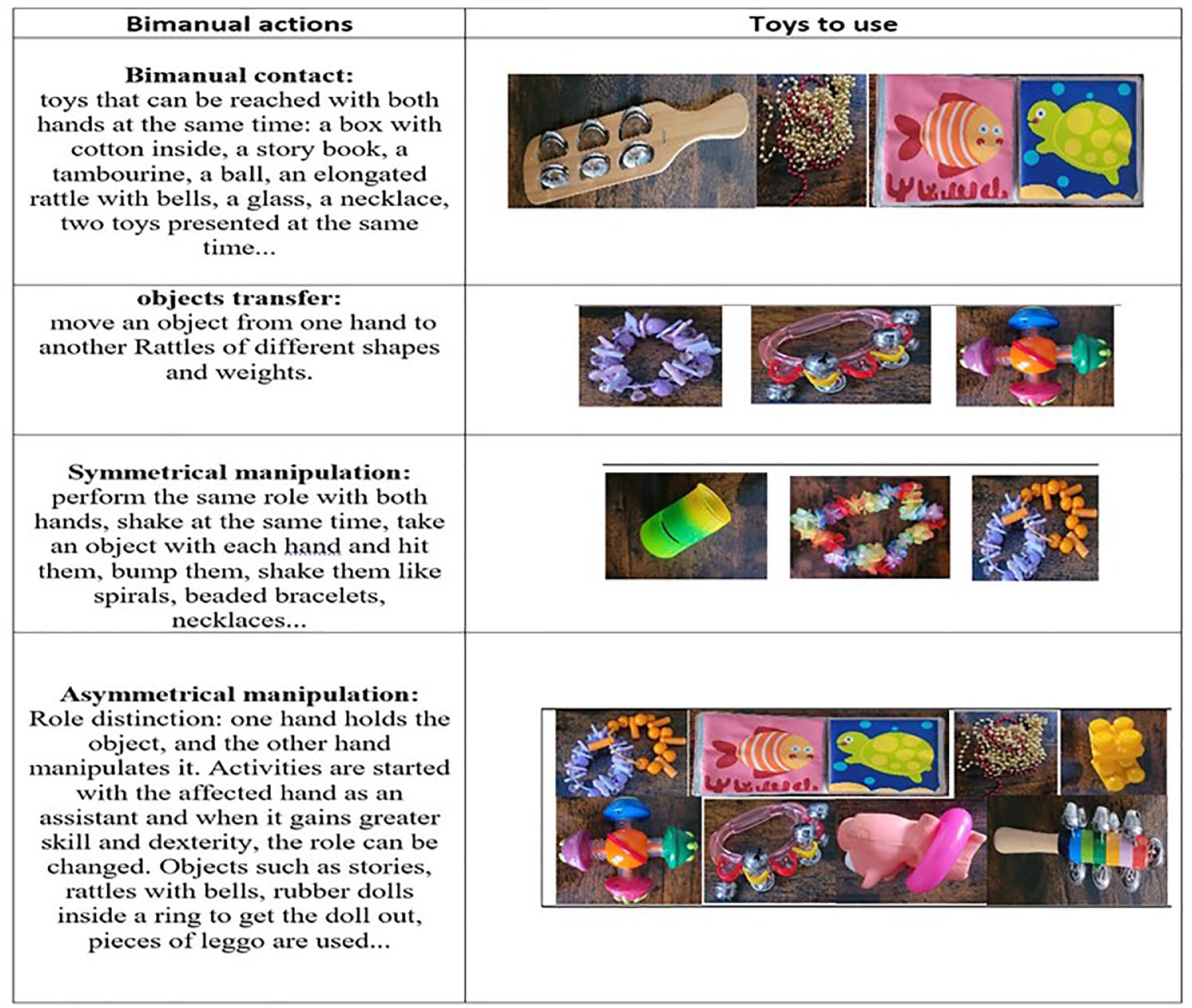
Bimanual actions to perform in the BIT program.
Infant-Therapy (CG) is based on the execution of infant massage and unimanual activities without restraint directed to the affected upper limb. The sessions will focus on the application of full-body infant massage during the first 30 min 17 according to the guidelines received by pediatric physiotherapists in the training. (Parents will be taught to massage each body part in sequence using slow and gentle strokes, smooth circular movements, and gentle squeezing depending on the body part. An instruction sheet will be given to parents, who will practice the technique on an ongoing basis at home.) The second part (30 min to complete the full hour) will be dedicated to performing unimanual activities without restraint. The activities will be the same as planned in the infant-mCIMT (see section ‘Infant-mCIMT protocol’) but without using the restraint in the unaffected upper limb.23,24
Families follow-up
For the three intensive therapy groups (infant-mCIMT, infant-BIT, and infant-hybrid) and the CG, a weekly follow-up will be carried out by a pediatric physiotherapist. The follow-up is aimed at resolving the doubts of the parents about the different therapies (unimanual/bimanual activities, restraint type or complications in its use, massage maneuvers. . .), changing different toys to increase the difficulty or provide other motor actions and improving the positioning of the infant through the viewing of videos of the proposed games and reviewing the use of the restraint to avoid frustrations in the infant. Families will have time to comment on their experiences, difficulties and how they feel during the implementation of the intervention. In addition, each family has to fill out a monitoring sheet, including the toys used in each session and what objectives were set for their use, how the infant was positioned and how their interaction was (rejection, tired, active) and the time spent on it to check the adherence of the child and the family in the therapy and compliance with the dosage. And for the massage phase in the CG, the sheet will include the maneuvers used and what were the most accepted by infants or the easier to apply by families, the time spent for massage, the interaction with infants and so on.
Outcome measures and instruments
All variables will be measured three times: before starting treatment, just after finishing it (10 weeks) and 6 months after treatment.
Bimanual functional performance
The bimanual functional performance (BFP) will be measured with the infant version of the mini-Assisting Hand Assessment (mini-AHA) scale 25 and Assisting Hand Assessment (AHA) scale. 26 Both tools are used to assess the treatment’s impact on bimanual performance in the affected upper limb. The mini-AHA is a reliable and validated observation-based criterion referenced test that measures how effectively infants ages 8–18 months with hemiplegia use their affected hand. The test is conducted by observing the infant play with specific toys that encourage bimanual hand use; it discriminates between different levels of ability to evaluate change over time. The raw scores range from 20 to 80 and are converted into standard-unit scores (mini-AHA units from 0 to 100). A higher score indicates better performance. Scores are not influenced by age. Within the age range of the test, typically developing infants perform perfectly and no correlation exists between age and performance among infants with hemiplegia.
The Assisting Hand Assessment v. 5.0 (AHA v. 5.0) scale26–29 was used in children after 18 months when they were involved into the therapies and were older than 18 months in the post-treatment assessment or follow-up assessment. This scale has been validated previously for children aged between 18 months and 12 years with UCP and obstetric brachial plexus palsy. The AHA v. 5.0 (school kids) is a valid and reliable tool that includes 20 items, each scoring from 1 (total lack of use) to 4 (effective use). The play session will be videotaped for the mini-AHA scale and then scored by a trained rater blinded to group assignment and the same will be done with the AHA scale. To facilitate the interpretation of results, the logit scale is converted to a user-friendly 0–100 scale that is still Rasch-based and presents interval-level data (namely, AHA units). In addition, a clinically meaningful change is obtained with five AHA units of difference pre–post-treatment scores.
Functional goals
Functional goals will be measured through the Goal Attainment Scaling (GAS),21,22 which is widely used as an individualized outcome measure of attributes in which no standardized measure exists. The degree to which the objectives will be achieved through the intervention is assessed. Each goal identified by the family will be scaled from –2 (current level of performance) through 0 (desired result) to +2 (result much greater than expected). GAS is useful in evaluating pediatric therapy services and is responsive to change.
Satisfaction and expectations from parents
Parents must complete a questionnaire about their expectations before executing the therapy, based on different studies15,30 on home-based intensive therapies and another questionnaire after completing 50 h of intensive therapy, collecting information on satisfaction in the execution of the program. Both questionnaires consist of five questions and each question has five possible answers depending on the question asked (see supplementary information).
Data analyses
Data analyses will be conducted using IBM SPSS Statistics for Windows, version 24.0. The demographic and baseline characteristics will be described by counts and percentages for nominal variables and by means and standard deviations for interval and ratio variables. Baseline characteristics between the infant-mCIMT, infant-BIT, infant-hybrid therapy and infant therapy (CG: infant massage and unimanual activities without using a restraint) will be compared using independent t test and Fisher’s exact test. In addition, pre- and post-treatment outcomes of standard assessments will be compared using ANOVA for parametric and Kruskal–Wallis test for non-parametric variables. The Bonferroni correction is applied for multiple comparisons. An alpha level of p ⩽ 0.05 is considered significant.
Expected results
Intensive therapies’ feasibility
Feasibility will be measured by quantifying participant enrollment, infant adherence (participant compliance with dose exercise sessions in the program), and reports on adverse events completed by parents. The adherence rate is expected to be high, above 90% in all groups, and dropouts are not expected during the program.
Functional goals
It is expected that the categories of the objectives proposed by the families belong to leisure activities and games at home or in the park, as well as activities related to food.
Bimanual functional performance
In the intragroup comparison, all groups are expected to show significant increases in the mini-AHA/AHA scales after the intervention. These results are not so expected in the CG.
For multiple comparisons, we would expect to find statistically significant differences between each group compared with the CG at both pre-intervention and post-intervention assessments and at pre-6-month follow-up assessment.
Satisfaction and expectations on intensive therapy from parents
Significant changes in satisfaction and expectations after the intervention are also expected to be found. In the multiple comparisons, it is expected to detect statistically significant differences in all the questions between each experimental group in the pre-intervention versus post-intervention assessment.
Discussion
The objective of this study is to study the different changes in the bimanual performance after different intensive therapies applying infant-CIMT, infant-BIT or infant-hybrid (mCIMT/BIT combination) compared with infant therapy (CG: infant massage and unimanual activities without using of restraint) directed to the children with UCP between 9 and 18 months old. Early intervention has begun to be carried out from 3 months in children with neurological risk applying baby-CIMT.2,3,4,31 But we considered a higher age than that of other studies because we wanted to introduce bimanual therapy, the possibility of interaction between both hands and the manipulation of the object through more complex actions for which a higher age is needed. These findings are described in the study by Ek et al., 32 in which it is considered that some manual skills develop early, for example, the ability to grasp close to the hand, which more than 95% of infants acquire by 5 months of age. Meanwhile, other skills develop later, for example, the ability to preposition the hand and arm to grasp an object, which is acquired at 8 months of age. For bimanual hand use, the first skill to develop is ‘holding an object bimanually’, which develops between 3 and 5 months of age. The transfer of an object between the hands is acquired at 6–8 months of age and the two bimanual skills ‘bimanual manipulation’ and ‘transfer of objects in a sequence’ are not acquired until 10 months of age. 32
To achieve a correct adherence of the family and the infants to the three intensive therapy groups and the CG, a correct interaction is necessary through weekly follow-up between the pediatric physiotherapist and the families, as an important factor to avoid any complication and guide the families and babies in the proposed activities according to the perceptions and interests of the parents. 23 The follow-up and the collecting data according to their perceptions and experiences allowed us to know what is more useful and easier to be applied by families although it wasn’t the most effective or beneficial to increase the affected upper limb function. 4 These findings will give more support to improve the training directed to families, or the support they must obtain during the treatment, or even more information, or guidelines. The functional objectives that are measured through the GAS allow families to be involved with greater satisfaction in intensive therapies or infant therapies (CG) to achieve them. 33 The perception of the parents at the beginning of the interventions about the implementation of the intervention, the care of the children or the families’ own tolerance to the intervention can be very negative as they are unaware of how their children will function during therapy. The care, tolerance of the family and the feeling of wanting to repeat must be present if there is good satisfaction of the families. The different intensive therapies and infant therapy used in the CG, depending on their action protocol, can affect families’ anticipation. Participation in bimanual activities may be a factor that facilitates the child’s participation in activities and allows the infant to be more accepted by them, in relation to unimanual activities or perhaps using a restraint. 34 In the study of Eliasson et al., 4 however, the application of mCIMT was recommended by the parents, while the recommendation of massage was uncertain. Perhaps because it was a non-goal-directed therapy, parents did not view the participation of the affected hand in performing tasks in the same way. This phenomenon would not occur in our study when massage was combined with unrestricted one-manual activities in the CG. 4
In relation to other studies that have analyzed intensive therapies,13,18,20 although with fewer intervention groups, it seems that the application of any of the intensive interventions is effective with the applied dose to obtain changes in BFP and increase the spontaneous use of the affected upper limb. Chamudot et al. 18 conducted a study with two groups (infant-mCIMT and infant-BIT for 56 h) and obtained benefits in hand function.
Among the strengths of this study, we could consider the application of 50 h of intensive therapies such as infant-mCIMT and infant-BIT would be sufficient to obtain changes in bimanual performance, to achieve the objectives and adherence. Apart from that, we also add the combination of both therapies in the infant-hybrid group and the comparison with a CG (massage and unimanual activities without restraint). Our study involves a larger number of children and, in turn, compares different similar protocols and not only with other techniques as different as infant massage. 4
If this study provides positive results, it may be possible to recommend the implementation of these intensive therapy protocols in patients with UCP below 2 years old and even justify new cost-effectiveness studies.
Supplemental Material
sj-doc-1-taj-10.1177_20406223221136059 – Supplemental material for Shall we start? Ready, set, go! Toward early intervention in infants with unilateral cerebral palsy. A randomized clinical trial protocol
Supplemental material, sj-doc-1-taj-10.1177_20406223221136059 for Shall we start? Ready, set, go! Toward early intervention in infants with unilateral cerebral palsy. A randomized clinical trial protocol by Rocío Palomo-Carrión, Elena Pinero-Pinto, Helena Romay-Barrero, Isabel Escobio-Prieto, Carmen Lillo-Navarro and Rita-Pilar Romero-Galisteo in Therapeutic Advances in Chronic Disease
Footnotes

References
Supplementary Material
Please find the following supplemental material available below.
For Open Access articles published under a Creative Commons License, all supplemental material carries the same license as the article it is associated with.
For non-Open Access articles published, all supplemental material carries a non-exclusive license, and permission requests for re-use of supplemental material or any part of supplemental material shall be sent directly to the copyright owner as specified in the copyright notice associated with the article.
