




Abstract
The purpose of protection against dismissal is to protect the employee against unjustified dismissal, which is expected to lead to stable employment relationships and job security. In recent years, the concept of employment security has entered the world of policy and science. This article aims to contribute to the field of labour law by investigating the objectives and effects of the Dutch transition payment process in relation to the relatively new notion of employment security. To do so, the ins and outs of the Dutch transition payment process are discussed. We compare and analyse the Dutch dismissal law before and after the introduction of the Work and Security Act (Wet werk en zekerheid (WWZ)) on 1 July 2015. We discuss the (unintended) employer and employee effects of dismissal law reform in the Netherlands and we analyse the objectives of the transition payment in relation to employment security. Based on a large-scale survey of redundant employees we shed light on the question of whether the transition payment is used for the purpose intended by the legislature. This article concludes by discussing the changes to the transition payment and dismissal compensation with the introduction of the new Balanced Labour Market Act (Wet arbeidsmarkt in balans (WAB)) on 1 January 2020. Although the legislature has attributed a clear formal transition function to the transition payment, the transition function is lacking from a substantive law perspective and we conclude that employment security is still in its infancy in Dutch dismissal legislation.
1. Introduction
The value and importance of employment is widely recognised. Work not only leads to income security but also contributes to personal development, vitality, and social capital. Unemployment has implications for individuals, organisations and society. Previous research into the consequences of job loss for individuals has shown that it has a negative impact on health 1 and scarring effects in terms of wage inequality in future jobs. 2
A specific public interest, which affects society as well as people and organisations, concerns the costs of unemployment. For the economy and society, a high level of short- and long-term unemployment is problematic in several respects because the affordability of services is at stake, especially in an ageing society. The cost of unemployment concerns not only social security—the various types of benefits and reintegration costs on which billions are spent—but also the cost of healthcare, pension and other welfare state financing costs. It is, therefore, important that labour market participation increases and that people obtain and keep their new jobs after redundancy.
For some fifteen years now, this objective has been referred to as the pursuit of employment security. It is a key aspect of the European monetary flexicurity concept. 3 In the second half of the 1990s, much of the labour market research was shifting towards a transitional perspective of labour markets. 4 It was - and is - no longer just about the labour market status of people here and now—working, not working, et cetera—but also about accounting for the transition people make to, on, and from, the labour market. This more dynamic view of the European labour market is referred to as the transitional labour market 5 in which employment security 6 (the possibility of finding employment and remaining employed, but not necessarily in the same job with the same employer) 7 is regarded as the new concept instead of job security (staying in the job with the same employer). The step from one job to another in the event of redundancy is one of the crucial transitions on the labour market that enhances employment security. 8
In the context of the global economic crisis—The Great Recession—of 2008, job-to-job thinking and policy gained momentum in Europe. During this period, many restructuring and downsizing processes took place. Short-time working schemes were introduced in several European countries. 9 These are public schemes aimed at preserving jobs in firms experiencing a drop in demand. Examples are practical reductions in the normal working week for a limited period of time or temporary lay-offs (zero-hour contracts). In both cases the employment contract is not broken. This is one way that governments can assist employers in times of recession to preserve jobs and to protect employees. However, it is not always possible to keep jobs, and being employed by one employer for a lifetime is an outdated notion. Welfare states traditionally focus on income security in social security laws and on tertiary unemployment prevention in so-called active labour market policies, aimed at preventing long-term unemployment, in cases where people have lost their jobs. 10
The purpose of protection against dismissal is to protect the employee against unjustified dismissal, which is expected to lead to stable employment relationships and job security. Although there is not a fixed legal definition of employment security the notion touches the core of labour and employment law but is still underdeveloped. 11 In the Netherlands the dismissal law has been changed fundamentally and the legislature has taken a first step towards promoting employment security with the introduction of the transition payment, known as ‘transitievergoeding’ in Dutch. This article aims to investigate the objectives and effects of the Dutch transition payment in relation to the relatively new notion of employment security. The mechanics of the Dutch transition payment are discussed including the changes to the regulation from 1 January 2020. The second section first compares Dutch dismissal law before and after the introduction of the Work and Security Act (Wet werk en zekerheid (WWZ)) on 1 July 2015. Secondly, we question what the objectives are of the Dutch transition payment in relation to employment security. Is the transition payment used in practice to facilitate the transition to other employment? What are the effects of the transition payment for employers and redundant employees? In section three we discuss the changes to the transition payment and dismissal compensation with the introduction of the new Balanced Labour Market Act (Wet arbeidsmarkt in balans (WAB)) on 1 January 2020. Finally, in the concluding section we put the main findings in perspective.
2. Dutch dismissal law and the transition payment
Employment Protection Legislation (EPL) is an institutional factor, which varies across countries and can influence the extent to which job mobility occurs. At the European level, there is no general dismissal legislation and countries are free to regulate the standards of dismissal protection. 12 In countries with strict employment protection legislation the dismissal costs are high, which ultimately will result in avoidance of dismissals. Kovács concludes that ‘in the whole, it can be noted that dismissal protection – as part of the EPL – has been regarded negatively as a burden on employment, productivity and growth and has been held responsible for the structural dysfunction of the labour market’. 13
Dismissal law and the related compensation have been the subject of debate for many years in the Netherlands. In this context, dismissal law was often considered as complicated, costly and unfair. The latter referred to the related compensation as a result of the employer’s option to terminate the employment contract prior to the entry into force of the Work and Security Act (WWZ). The Extraordinary Labour Relations Decree of 1945 (BBA, 1945) applied if the employer ended the labour relationship by giving notice without the employee’s approval. Prior to the notice being given, the employer had to obtain permission from the Public Employment Service (UWV) to be allowed to terminate the employment contract. 14 The consequence of obtaining prior permission was that the employee could not apply for severance compensation, unless there was evidence of a manifestly unreasonable dismissal as referred to in Article 7:681 paragraph 1 (old) of the Civil Code (BW). If that were the case, the judge could award the employee compensation for losing their job (see section 2.2). Another possible route was termination by subdistrict court judgment. On the basis of Article 7:685 (old) of the Civil Code (BW), the employer could request that the subdistrict court judge dissolves the employment contract on the grounds of serious and important reasons. If these balanced reasons were based on a change of circumstances, the judge could also grant the worker a fair compensation (see section 2.2).
2.1 Work and Security Act
On 1 July 2015, the Work and Security Act came into force, which made fundamental changes to Dutch labour, and more specifically, dismissal law. The Dutch legislature argues that the Work and Security Act (WWZ) is simpler, more transparent and less costly. 15 Under the Work and Security Act (WWZ), employers are no longer free to choose between the two routes described above: a dismissal permit via the Public Employment Service (UWV) or termination by subdistrict court judgment. Simplicity is assumed through the termination of the employment contract in Article 7:669 paragraph 1 of the Civil Code (BW) in conjunction with Article 7:671 paragraph 1 of the Civil Code (BW) to be in line with the consent of the employee. If this consent is lacking, the employer’s choice is limited. For termination based on business or economic reasons and long-term incapacity for work, the employer must obtain permission from the Public Employment Service (UWV) pursuant to Article 7:671a paragraph 1 of the Civil Code (BW). For personal reasons, such as disfunction, a breakdown in the employment relationship or employee misconduct, the employer must request dissolution from the subdistrict court judge on the grounds of Article 7:671 paragraph 1 of the Civil Code (BW). According to the Dutch legislature, the law on dismissal has become fairer with the introduction of the Work and Security Act (WWZ) because, if the requirements laid down in Article 7:673 of the Civil Code have been met, the employee is eligible for a so-called ‘transition payment’ (see section 2.2). 16 Furthermore, the legislature anticipates that the new law will be less costly for employers through faster procedures and the introduction of the transition payment, which will generally be lower than the former severance payment (see section 2.2). In essence, the Work & Security Act (WWZ) aims to achieve a new balance between flexibility and security in the labour market with a smaller difference between flexible and permanent contracts, the activation of the dismissal and unemployment benefit systems, and the promotion of both employment and income security. 17
2.2. From severance pay to transition payment
2.2.1 Situation before the introduction of the Work and Security Act
Before the introduction of the Work and Security Act (WWZ) on 1 July 2015, Dutch dismissal law contained two types of dismissal related compensation. The first was redundancy pay, which was granted by the court based on Article 7:685 paragraphs 2 and 8 (old) of the Civil Code (BW) on the grounds of a change of circumstances necessitating employee dismissal. The judge could use the Cantonal Court Formula to determine the amount of redundancy pay. The exact severance pay was based on multiplying three factors: 1) the adjusted number of years of service, 2) the corrected monthly gross salary and 3) a correction factor that was usually 1.0, but could be assigned a higher or lower amount by the court judge in order come to a fair and adequate severance pay, taking into account other factors such as the behaviour of both employer and employee, the labour market position of the employee and the financial position of the employer.
The second type of dismissal related compensation was monetary damages, and this could be granted on the basis of Article 7:681 paragraph 1 (old) of the Civil Code (BW). Under the old BW, the subdistrict court could award damages to the employee if the dismissal by notice was manifestly unreasonable. This payment of damages occurred when the reasons for dismissal were judged to be manifestly unreasonable and the severance pay did not adequately compensate the employee for the loss of employment. Based on the ‘consequences criterion’ of Article 7:681 paragraph 2 subsection b (old) of the Civil Code (BW), a balance of interests was struck between the seriousness of the consequences of the dismissal for the employee in question and the interest of the employer in the termination of the employment contract. All the circumstances of the case were taken into account: (1) the duration of the employment contract, (2) the age of the employee, (3) the level of the salary and sometimes (4) the financial position of the employer. 18 This was also reflected in the factors that played a role in the calculation of the amount of the severance payment by the cantonal judge. In the literature, 19 the following factors are mentioned: (1) remuneration for loyal service, (2) compensation for the employee’s loss of his investment in the employment relationship, (3) accumulated goodwill, (4) (im)material damage, (5) compensation for loss of income on the part of the employee, and (6) the so-called post-contractual care of the employer. The Supreme Court of the Netherlands indicated that all the facts and circumstances of the case should be taken into account, i.e. (1) the reason for the dissolution of the employment contract, (2) the risk of the dissolution, (3) the detrimental consequences for the employee, (4) the duration of the employment contract, (5) the age of the employee, (6) the financial position of the employer and good ‘employeeship’ and ‘employership’ (see Article 7:611 of the Civil Code (BW)).
Both types of compensation showed a certain degree of similarity when it came to the factors that played a role in determining the amount of the compensation. In practice there were differences between the two dismissal routes. Research showed that in the case of termination by Court in almost 90% of these cases compensation was granted. However, in the event of termination by giving notice, in less than half of these cases compensation was granted. Also, the amount of compensation differed. The average amount of severance pay in the event of termination by Court was more than EUR 33,000, whereas in the case of termination by notice the average amount was EUR 8,700. 20
2.2.2 Introduction of the transition payment in the Work and Security Act
The transition payment is intended partly as compensation for the dismissal and partly as compensation for what is referred to as ‘employment security’. In addition, the transition payment helps to ensure an employee’s ‘employability’ and ‘labour market position’; in other words, it promotes the transition to another employer and helps to contribute to unemployment prevention. The ‘flexicurity’ of the labour market means that the old concept of job security is replaced by ‘employment security’. 21 As already addressed in the introduction, there is an important difference between these two forms of security. Job security offers the employee security on an individual level. Employment security refers to the confidence that you are able to keep your job, to find a job or to acquire work yourself now and in the future. This trust is based on the individual employability of people and on the proper functioning of the labour market. The latter means that employment security not only has an individual aspect but also a collective element (see section 2.3.2).
In the Work and Security Act (WWZ), the concept of ‘employment security’ has been translated into the possibility ‘for the transition to another job’, 22 and this has been taken into account in the aforementioned ‘transition payment’. 23 The legislature makes it abundantly clear that the introduction of the transition payment in the Work and Security Act (WWZ) is intended to compensate for job dismissal on the one hand (similar to the old severance pay) and as an incentive to make the transition to another job easier, on the other hand. 24 Under the new law, the transition payment can, but does not have to, be used for training or support to gain other employment. Under the Work and Security Act (WWZ), the lump sum transition payment replaces the EPL’s old monetary damages payment made when an employer undertook a manifestly unreasonable dismissal (see Article 7:681 paragraph 2 subsection b of the (old) Civil Code (BW)). 25 The ‘old’ severance pay and the underlying weighting factors have therefore disappeared. A counterargument could be that even now a termination indemnity can still be granted on the basis of Article 7:671b of the Civil Code (BW). This termination indemnity is no more than a shadow of the ‘old’ severance pay, which was awarded with a change of circumstances as the basis for the compensation and the amount being determined by reasonableness and fairness and governed by the circumstances of the case.
Under the current law, the employee is only eligible to receive fair compensation if there is a serious culpable act or omission on the part of the employer. The intention is that only in very exceptional situations is fair compensation awarded, which is for the subdistrict court judge to decide. The legislature is apparently not aware that there is an internal contradiction. Only in case of serious culpability, is there room for awarding a dismissed employee with fair compensation. 26 The law makes the following clear: 27 ‘The criterion or test of whether the dismissal is reasonable is no longer applied to the situation because it is addressed by the transition payment’. In other words, the benefits based on the current consequence criterion are, as it were, addressed in the transition payment. 28 The transition payment is a combination of severance pay and damages. Nevertheless, there is a problem here. The employer must have a reasonable ground for dismissing the employee, but reasonableness no longer plays a role in determining the transition payment amount for the employee in the event of dismissal.
The transition payment (see Articles 7:673a-7:673c of the Civil Code (BW)) is a right that the employee is entitled to and that he/she builds up in his/her working life.
29
The employee is entitled to the transition payment at the expense of the employer if he/she has been employed by the employer for at least 24 months and the employment contract: ends after employer provides notice of termination; ends after dissolution of the employment contract at the employer’s request; does not continue after termination by operation of law (in the case of a fixed-term contract) at the initiative of the employer (he does not offer a new contract), unless the employment relationship has not been continued due to serious culpability on the part of the employee; is terminated by the employee, terminated at the employee’s request by the lower court, or the employee refuses to accept a continuation offered as a result of grossly culpable acts or omissions on the part of the employer.
30
In principle, therefore, the transition payment is always due at the point of dismissal or contract termination with the exception of misconduct on the part of the employee. The only time that the transition payment is not necessary is in the event of termination of the employment contract by mutual consent, whether or not by means of (termination) agreement (‘beëindigings-’ and/or ‘vaststellingsovereenkomst’) (see Articles 7:670b and 7:900 of the Civil Code (BW)). In such cases, the employer and the employee themselves determine the conditions under which the employment contract ends. In addition, there is no need for transition compensation when termination is the result of the employee reaching legal retirement age or when the dismissal is the result of the employee’s grossly culpable acts or omissions, such as theft, fraud, (sexual) harassment, frequent tardiness or poor work attendance. 31
In the case of a collective agreement, it is possible to deviate from the regulation of the transition payment, but only under the condition that an equivalent provision in money or in kind is made, aimed at preventing unemployment or shortening the period of unemployment (see Article 7:673b of the Civil Code (BW)).
The amount of the transition payment paid by the employer in the event of dismissal is determined on the basis of two elements: the monthly salary and the number of half years of service. The general rule is that for the first ten years of employment, the transition payment is one sixth of the gross monthly salary for each half year of the employment contract. The transition payment for subsequent years is a quarter of the monthly salary for every six months worked. Workers aged 50 or over who lose their job and who, at the time of dismissal, have been employed for at least ten years by an employer with at least 25 employees are entitled to higher transition payment compensation until 2020. The employee receives one half of a month’s salary per each half year of service from the age of 50. This starts from the first full period of six months after the employee reaches the age of 50.
2.3 Effects of the transition payment
2.3.1. Is the transition payment used for the purpose of ‘from-work-to-work’?
It is noteworthy that the law states that the transition payment does not have to be used for training or support to obtain another job. 32 The employer may also deduct the costs associated with the training and support from the transition payment he has to pay. 33 The costs to be deducted should include transition and employability costs. The first category includes (1) training costs, (2) outplacement costs and (3) the observance of a longer notice period than that applicable between the parties. Employability costs mainly concern (1) non-work related courses or training courses, (2) courses aimed at the employee’s personal skillset, for example aimed at personal development or profiling, and (3) courses aimed at obtaining future employment.
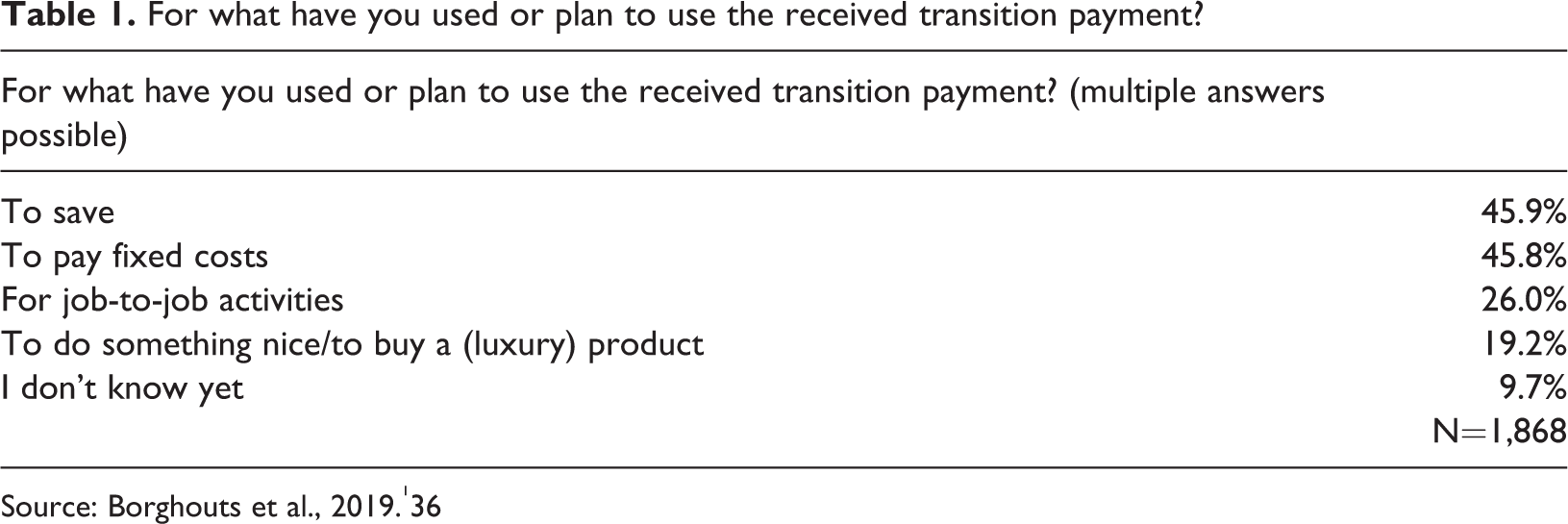
The question arises as to extent to which the transition payment relates to employment security. Is the transition payment used in practice for ‘from-work-to-work’ activities when it is not compulsory to use this transition payment for training or support to obtain other work? 34 The Minister of Social Affairs and Employment has promised to inform the Lower House of Parliament about the outcome of the evaluation of the Law and Security Act (WWZ). The evaluation study is expected in 2020. 35 In general, the study will have to provide an insight into the extent to which the aforementioned measures in the field of dismissal law have led to making dismissals quicker, fairer, and less ambiguous and costly for the parties involved. The transition payment will also be evaluated. In a survey conducted in 2016/2017 of redundant employees who participated in job-to-job activities we included questions about the transition payment. Of the 15,187 redundant workers that received an invitation to participate in the study 2,258 completely filled out the first questionnaire. The vast majority (83%) of the redundant employees who participated in this survey were in receipt of either a transition or severance payment. A quarter of respondents who received a transition payment indicated that they used or would use the transition payment for job-to-job activities. It can be seen in Table 1 that the payment was mainly used to save and/or to pay fixed costs (e.g. rent, mortgage, cost of living).
For what have you used or plan to use the received transition payment?
Source: Borghouts et al., 2019. 36
2.3.2. Employer effects
The transition payment has been explicitly made into a strictly individualised matter, which is intended for ‘job-to-job transition’ in the context of employment security. The individual employer is obliged to pay compensation to the individual employee if the requirements for the transition payment have been met. This also applies if the employee has been ill for two years. There is no difference between paying the transition payment to a healthy and a sick employee. That is the consequence of treating the transition payment as a fixed remuneration and not as a periodical allowance. In addition to the obligation to pay the transition payment, the employer also bears the financial consequences of the privatisation of the Sickness Benefits Act. The employer is saddled with an obligation to continue to pay wages in the event of illness for a period of at least 104 weeks. In practice, employers are increasingly maintaining employment contracts after two years of illness. However, the obligation to pay wages has stopped and this has created ‘sleeping employment contracts’. 37 After all, when the employment contract is still in force, the employer does not have to pay a transition payment. To put a stop to these undesirable practices, Article 7:673e of the Civil Code (BW) has been added to the Act of 11 July 2018 containing measures relating to the transition payment in the event of dismissal due to economic circumstances or long-term incapacity for work. 38 Article 7:673e of the Civil Code (BW) stipulates that the Public Employment Service (UWV) shall, at the request of the employer, provide compensation in the amount of the transition payment paid by the employer upon termination of the employment contract due to the fact that the employee is no longer able to perform the stipulated work due to illness or disability. Compensation to the employer can be granted under the following circumstances: (1) if the employer has paid transition payment after the termination or dissolution of the employment contract or the non-renewal of a temporary employment contract, or (2) if the employer has paid a monetary payment on the basis of a termination agreement concluded between him and the employee. Compensation may also be granted to the employer if the transition payment has been paid to the employee in connection with the partial termination of the employment contract. The fifth paragraph of Article 7:673 of the Civil Code (BW) stipulates that rules shall be laid down with regard to the application for and provision of this compensation. These rules on the compensation of the transition payment at the end of the employment contract after long-term incapacity for work, were announced in the Regulation of the Minister of Social Affairs and Employment of 18 February 2019. 39 The Ministerial Regulation was introduced in February 2019 and came into force on 1 April 2020. The application for compensation may relate to compensation provided by the employer on or after 1 April 2020, but also applies to compensation provided for ‘old cases’, i.e. transition payments paid by the employer to the employee between 1 July 2015 and 1 April 2020. 40 The Supreme Court has taken this into consideration and indicated in November 2019 41 that these ‘sleeping employment contracts’ do not hold up, because when the employee requests to end the contract by termination agreement the employer has to honour the request, being a good employer (see Article 7:611 Code Civil (BW)). The employer also has to pay compensation up to the amount of the transition payment with only one exception: a justified interest in continuing the labour contract.
2.3.3. Employee effects
A negative effect of the introduction of the transition payment in the Work and Security Act is that an employee is only eligible if he is employed by his employer for at least 24 months (see Article 7:673 paragraph 1 of the Civil Code (BW)). These 24 months correspond exactly to the period that applies to the conversion of a temporary employment contract into a permanent employment contract, the so-called conversion. However, this is subject to the condition that the conversion must involve at least two temporary employment contracts (see Section 7:668a, subsection 1, part a, of the Civil Code). The purpose of this period is to help the employee who is working on a temporary employment contract to obtain a permanent employment contract earlier in comparison to the old law, where the period was 36 months. With the introduction of the Work and Security Act (WWZ), flex workers are entitled to a permanent position earlier than they were previously, and after two years they are eligible to receive a transition payment. These interventions make it more expensive for companies to hire flex workers, which is why they are reconsidering whether hiring this category of employee is still necessary. In practice, another negative consequence occurred in anticipation of the introduction of the Work and Security Act (WWZ): employers did not convert the temporary contracts into permanent jobs and sent the temporary workers away. The ‘logic’ on the part of employers was that the existing temporary workers would become more expensive due to the (accelerated) conversion and employers would be responsible for paying the transition payment after the Work and Security Act (WWZ) came into force. 42
In section 2.3.2 we discussed the employers’ obligation to continue to pay wages in the event of illness. This wage payment obligation is based on the idea of encouraging the employer and the employee to curb absenteeism due to sickness with, among other things, a reintegration obligation. In reality, it has had a negative effect on the functioning of the labour market. Employers have indicated that they have become more cautious when hiring staff (28%) or converting temporary employment contracts into open-ended contracts (45%) because of the obligation to continue to pay wages in the event of (long-term) illness. 43 The above means that with (1) non-customisable transition payments, (2) a shorter 24-month transition from flex to permanent employment status, and (3) the obligation to continue to pay wages for employees with long-term illness, employers are now opting for flexible employment relationships and as a result the job security of employees in the labour market has greatly deteriorated.
3. The Balanced Labour Market Act
The Dutch Parliament adopted the bill for the Balanced Labour Market Act 44 (Wet arbeidsmarkt in balans (WAB)), with the new Act due to come into force on 1 January 2020. 45 This law is seen as a necessary improvement to the Work and Security Act (WWZ), which itself only came into force for three years previously. The Balanced Labour Market Act (WAB) is intended to regulate the labour market better than under the previous Act. Many believe that this new Act will actually repair the labour market situation because research has shown that the Work and Security Act (WWZ) does not work well in practice. 46 Due to the costs and risks associated with the permanent contract, employers are often reluctant to hire employees on a permanent basis. For those in work, labour market opportunities are unevenly distributed, with the prospect of a permanent contract for vulnerable groups (i.e. people with disabilities, older people) in the labour market often far removed. The aim of the Work and Security Act (WWZ) was to reduce the gap between ‘fixed’ and ‘flex’ employment. However, in practice the gap has actually widened and that is why the Cabinet decided to introduce the Balanced Labour Market Act (WAB).
3.1 Changes to the transition payment
With the introduction of the new Balanced Labour Market Act (WAB), employees are entitled to the transition payment from the first working day. The so-called reference period of 24 months has disappeared.
Furthermore, there are changes with regard to the calculation of the transition payment. Under the Work and Security Act (WWZ), the employment contract is rounded off to the nearest half year of full employment. Under the new law, the amount of the transition pay is lower, calculated per day of employment and without rounding off to fully worked half years. From 1 January 2020 onwards the transition payment is one third of a month’s salary per whole year of service from the first working day. The payment for the remaining part of the employment contract is calculated according to the formula: (gross salary received over the remaining part of the employment contract/gross monthly salary) x (1/3 gross month salary/12). This formula is also used to calculate the transition payment if the employment contract has lasted less than one year. The transition payment must also be paid in the event of termination during the probationary period. The maximum compensation is EUR 81,000 gross. Or, if the annual salary is higher than EUR 81,000, a maximum of 1 year’s gross annual salary (see Article 7:673 (2) of the Civil Code (BW). This amount is indexed annually in accordance with Article 7:673 (3) of the Civil Code (BW).
In addition, the new law reduces the transition payment for an employment contract of more than ten years to the standard level of a sixth of the monthly salary per six months worked. These changes are intended to reduce the cost difference between permanent and temporary contracts in the event of dismissal. The legislature expects that these new changes will make it more attractive for employers to offer workers a permanent contract.
Furthermore, the Balanced Labour Market Act (WAB) contains a new regulation to compensate small employers for the transition payment if the employer is retiring or is ill and wants to shut down the business. This concerns employers with less than 25 employees. This should prevent a disproportionate burden falling on certain employers and ensure that smaller employers offer employees a permanent contract sooner. In addition, employers’ organisations and trade unions may agree that the employer will not pay transition payment in the event of dismissal for economic reasons if a collective labour agreement contains provisions to limit the employee’s unemployment or entitles him to reasonable financial compensation.
3.2 Extra compensation based on the new accumulation dismissal ground
In the previous section we discussed the changes to the transition payment with the introduction of the new Balanced Labour Market Act (WAB). The new law also impacts the law on dismissal. As of 1 January 2020, there will be a new ground for dismissal: the accumulation ground or ‘i-ground’. This ground of accumulation will allow employers to combine several grounds for dismissal. Before the introduction of the new law an employer had to choose one ground for dismissal. Under the new law, by combining different grounds a dismissal can be justified, whereas the grounds separately were not sufficient to justify dismissal under the Work and Security Act (WWZ). The following grounds for dismissal can be combined in the event of dismissal on the grounds of accumulation: frequent absenteeism, whether or not due to illness; inadequate performance; culpable action or failure to act on the part of the employee; failure to comply with reintegration obligations without valid reasons; refusal to work on grounds of conscientious objection; a breakdown in the employment relationship; or other circumstances. Circumstances relating to economic reasons or long-term disability cannot be combined.
The legislature considers the possibility of granting extra compensation in addition to the transition payment to be desirable ‘because the employees can be compensated for the termination of the employment contract, while the grounds for dismissal were each insufficient in themselves to justify a dismissal’. 47 This extra compensation based on the accumulation ground is in addition to the transition payment and amounts to a maximum of 50% of the transition payment. This means that an employee is entitled to a maximum of 1.5 times the transition payment in the event of a dismissal on the grounds of cumulative causes. The court will determine the exact amount of the compensation on the basis of the extent to which the employer complies with the grounds for dismissal invoked.
4. CONCLUSION
Traditionally, dismissal law focuses on job security with severance payments as compensation for termination of the employment contract. In recent years we have seen a new element in the Dutch dismissal law which relates to the new notion of employment security: promoting the transition to other employment following a job loss. In the Netherlands this is most evident with the introduction of the transition payment, where it is intended that this payment is used partly to find other employment and partly to compensate for the dismissal.
In this article we questioned what the objectives and effects are of the Dutch transition payment in relation to employment security. What are the effects for the redundant employees and what are the effects for the employers? We conclude that the Dutch legal transition payment is intended to increase employment security for redundant employees, so that workers can invest this budget in their human capital to support transitions within the labour market. Although the legislature has attributed a clear formal transition function to the transition payment, the transition function is lacking from a substantive law perspective. 48 First of all, the transition payment is non-binding. The employee is free to choose whether or not to spend the amount on work-to-work activities. On the basis of our survey conducted among redundant employees who participated in job-to-job activities, we can conclude that only one quarter of respondents use this budget paid by employers for this purpose. The transition budget is more often considered as extra income. As such, it seems, for those who receive job-to-job support from the employer, that the transition payment contributes more to income security than to employment security. Secondly, the substantive transition function can be promoted by early access to the transition payment. From an unemployment prevention and employment security perspective it makes more sense to provide the transition budget to redundant employees at an earlier stage, i.e. when they are under notice and not once the contract has been terminated.
At first glance it seems that, with the introduction of the Balanced Labour Market Act (WAB), employment security is formally expanded in dismissal law. From a macro and collective perspective, the conclusion is that more people are eligible to receive a transition payment since the transition payment claim can be made from the first day of employment, instead of only after two years. From an individual perspective, the new law will reduce the chances of employment security and protection against dismissal. The transition payment - which also under the new law is intended as compensation for dismissal and to promote transitional support in the event of forced dismissal - will be much lower from 2020 onwards. Workers over the age of 50, in particular, will suffer under the new law. In 2019, they received a higher transition payment after ten years of service, i.e. one month per year of service. From 2020, with the introduction of the new law, there are no more exceptions for older workers and they will receive a third of their monthly salary per year worked.
It is important that legislation and social policies pay attention to employment security, unemployment prevention and job-to-job transition. Companies do not wait to adapt their organisations in times of economic crisis alone. Due to developments in technology and increasing competition, companies are faced with the need to restructure processes even in times of economic prosperity. As a result, in good times and bad, increasingly more of the workforce are forced to find other employment, which underlines the importance of employment security. We conclude that the transition function and the aim to strive for employment security have been introduced into the Dutch dismissal legislation with the transition payment, but both are still in their infancy.
Footnotes
Declaration of conflicting interests
The author(s) declared no potential conflicts of interest with respect to the research, authorship, and/or publication of this article.
Funding
The author(s) disclosed receipt of the following financial support for the research, authorship, and/or publication of this article: The authors received financial support for the the survey among redundant employees conducted in 2016/2017 by Instituut Gak (grant number 2015-678). The authors received no financial support for authorship and/or publication of this article.
