




Abstract
Background
The COVID-19 pandemic saw many radiology departments worldwide adopting work from home (WFH) practices for social distancing and operational resilience. This paper explores the attitudes and perceptions of radiologists on WFH in Singapore.
Methods
A survey was conducted amongst radiologists at a large tertiary hospital in Singapore from 1 August 2022 to 1 September 2022. Topics included whether they met pre-requisites for WFH, the preferred frequency of WFH, equitability, and perceived impact on joy at work, resident training, and talent recruitment and retention. Results were analysed for significant associations with respondent demographics.
Results
There was an 88% response rate (49/56). 78% met pre-requisites for WFH. Most radiologists preferred a hybrid arrangement of WFH up to 2 days a week (70%) with 15-20% of their team WFH at any one time. Majority of radiologists wished to WFH when providing out-of-hours coverage (76%). There was perceived positive impact of WFH on individual joy at work (mean rating: 4.1), team joy at work (mean rating: 3.5) and talent recruitment and retention (mean rating: 4.0). Perceived impact on radiology resident training was negative to neutral (mean rating: 2.8). Free-text responses revealed concerns about equitability, WFH setup, training, and collegial relationships. Statistically significant differences in responses were found between genders and radiologists who met pre-requisites versus those who didn’t.
Conclusion
Our radiologists prefer a hybrid WFH model and anticipate it will increase joy at work and talent recruitment and retention. A hybrid WFH model may help address and mitigate some of the potential negative effects of WFH.
Introduction
The COVID-19 pandemic forced radiology departments worldwide to implement or ramp up their adoption of ‘Work from Home’ (WFH) practices to prevent disease transmission and disruption to services.1–4
Singapore is a small country with a population of just under 6 million, but it has emerged has a regional medical hub in Southeast Asia. Our hospital is a large tertiary public hospital with nearly 2000 beds equipped with emergency and inpatient imaging centers, as well as several outpatient and community hospital imaging centers.
During the COVID-19 pandemic, our hospital’s imaging informatics team and radiologists iterated a WFH hardware solution, with internal testing showing preserved image quality, productivity, and cost-effectiveness (Supplementary Material). This superseded an earlier version of WFH hardware previously published. 5 The final WFH hardware setup was tested on a pilot group of 3 users. Prior to expansion to more radiologists, department leadership commissioned a survey to explore their perception and attitude towards WFH to help inform future decisions.
Methods
Summary of survey questions. * In our department, one radiologist from each subspeciality team provides weekday evening and weekend daytime coverage. ^Numeric 1-5 Likert scale with a score of 1 representing significant negative impact, 2 representing negative impact, 3 representing neutral, 4 representing positive impact and 5 representing significant positive impact.

Participants were given one month from 1 August 2022 to 1 September 2022 to respond. Responses were tabulated in Excel (Microsoft, Redmond, WA). Mann-Whitney U Test was used to look for statistically significant differences in individual responses based on compared variables such as team roles (team leader vs team member), gender, number of dependents (2 or fewer vs 3 or more) and home set-up (radiologists with suitable home set-up vs radiologists without). Descriptive statistics were used to summarise demographic questions and free-text responses.
Results
Demographics
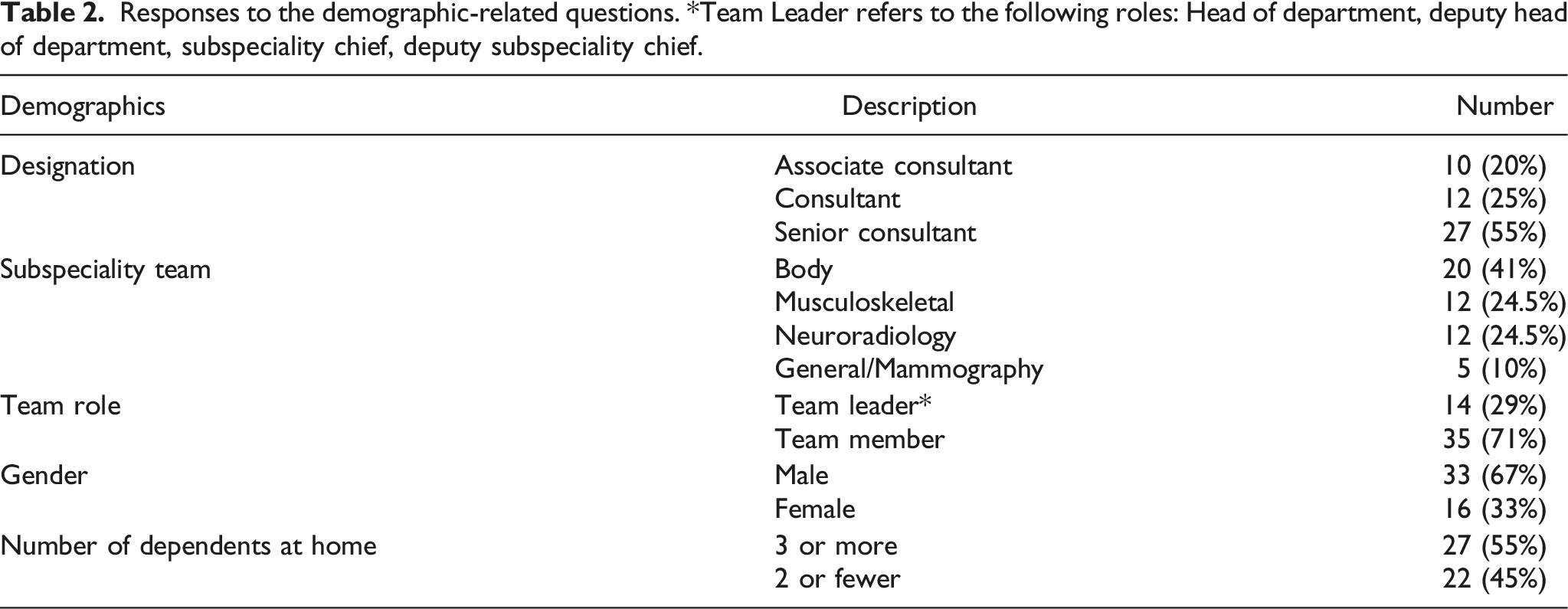
Responses to the demographic-related questions. *Team Leader refers to the following roles: Head of department, deputy head of department, subspeciality chief, deputy subspeciality chief.
WFH pre-requisites
38 of the 49 (78%) radiologists reported their home was equipped for WFH.
Of the respondents that did not meet the pre-requisites, 5(10%) did not have access to private space with air-conditioning, 7(14%) did not have ambient lighting control, 8(16%) lacked a suitable table and 2(4%) reported having insufficient internet speed.
Radiologists who did not meet the pre-requisites to WFH preferred to WFH fewer days (median 1 day) compared to the group who did meet the pre-requisites (median 2 days) during office hours (p = .0005) (Figure 1). Number of days radiologists who meet all pre-requisites prefer to WFH vs number of days radiologists who do not meet all pre-requisites prefer to WFH during office hours. Radiologists who did not meet the pre-requisites to WFH preferred to WFH fewer days (median 1 day) compared to the group who did meet the pre-requisites (median 2 days) during office hours (p = .0005).
Office hours WFH
Figure 2(a) shows the number of days respondents preferred to WFH during office hours. Majority of respondents (34/49, 70%) preferred to WFH up to two days a week. (a) Number of days respondents preferred to WFH during office hours. Majority of respondents (34/49, 70%) preferred to WFH up to two days a week. (b) Number of days respondents would like to WFH grouped by gender. Statistically significant difference in desired WFH frequency during office hours between females and males (median 2 days vs 1 day respectively, p = .006). (c) Respondent’s opinion on the proportion of their subspeciality that can WFH on any given day. Majority of respondents (34/49, 69%) felt that 15-30% of their team could WFH at any one time. *Respondents were given an option of selecting ‘others’ which was a free-text option. Their responses were ‘no comment’, ‘0%’, ‘1 person a day’ and ‘I disagree with the initiative’.
Females preferred to work more days from home (median 2 days) compared to males (median 1 day) (p = .006) (Figure 2(b)). All respondents that preferred not to WFH at all were male.
There was no significant difference in the preferred number of WFH days between the group who had 3 or more dependents (27/49, 55%) (median 1 day) and the group who had 2 or fewer dependents (median 2 days) (p = .3).
There was no difference in responses between team leaders and team members in the preferred number of WFH days a week (median 2 days).
Majority of radiologists (34/49, 69%) were comfortable with 15% to 30% of their subspeciality team WFH on any given day (Figure 2(c)). 9 radiologists (18%) felt that 40% or more of their team can WFH at any one time. 2 respondents (4%) preferred only 5-10% of their team to be WFH. The rest of the respondents (4/49, 8%) selected ‘others’ which was a free-text option and the responses collected were ‘no comment’, ‘0%’, ‘1 person a day’ and ‘I disagree with the initiative’.
Equitability
Respondents were near-evenly split on the issue of equitability. Just over half the respondents (26/49, 53%) believed that the workload of WFH radiologists should be the same as on-site radiologists while the other 47% (23/49) felt WFH radiologists should take on more work.
There was no difference in responses between team leaders and team members with 18/35 (51%) of team members feeling WFH should be treated the same and 8/14 (57%) of team leaders responding similarly (p = .8).
Out-of-hours WFH
47% (23/49) of the respondents said that out of the four consultants providing out-of-hours coverage, one should be on-site. 29% (14/49) felt that all four consultants should be able to WFH out-of-hours.
Joy at work, team morale, talent recruitment and retention
Survey results on anticipated impact of WFH on joy at work, relationship with colleagues, and talent recruitment and retention are shown in Figure 3. Respondent’s anticipated impact of WFH on individual joy at work, team joy at work, talent recruitment and retention and resident training. A score of 1 indicates significant negative impact, 2 indicates negative impact, 3 indicates neutral, 4 indicates positive impact and 5 indicates significant positive impact. The x-axis shows the percentage of respondents.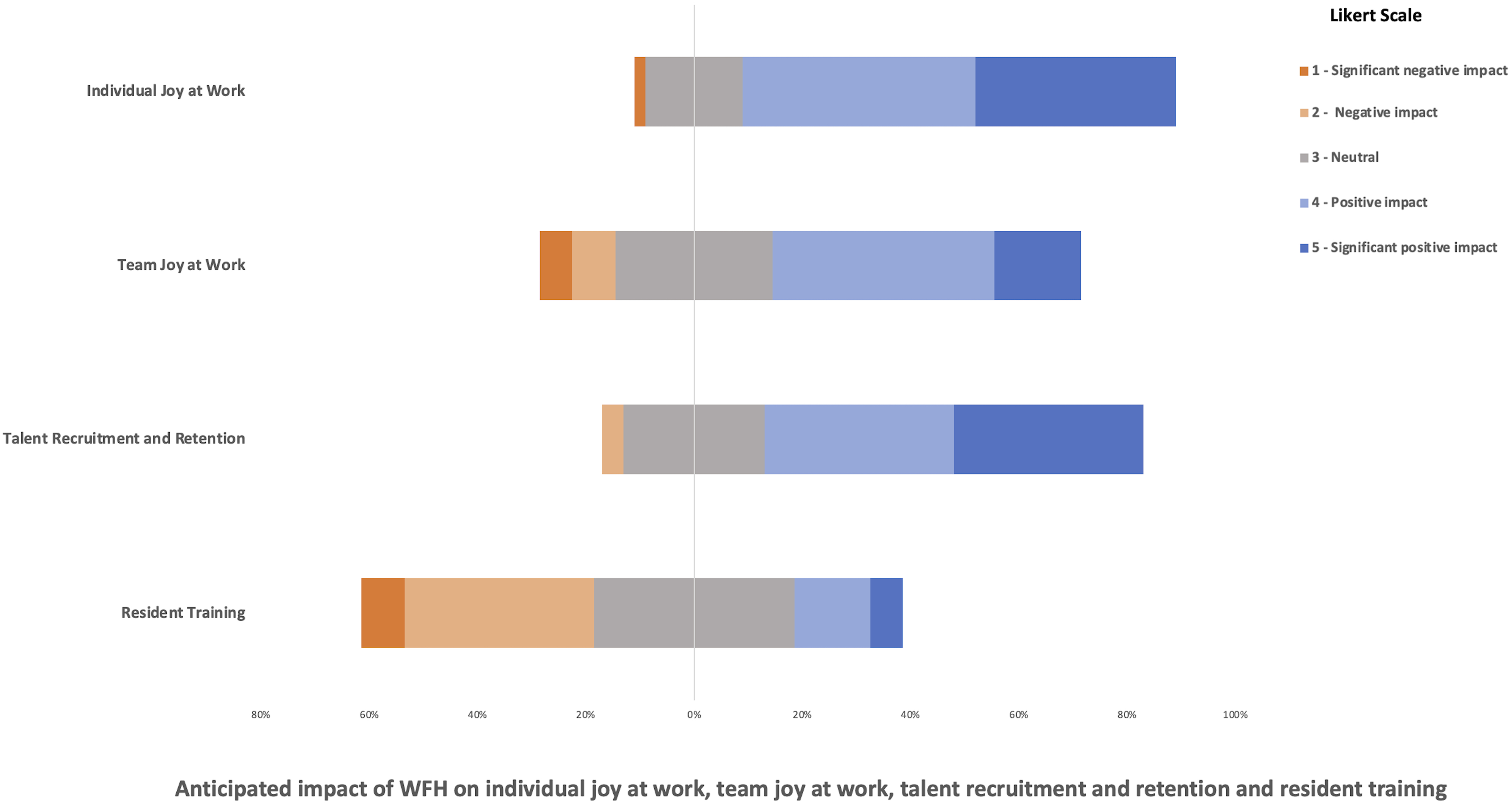
Overall, respondents felt that WFH will have a positive impact on individual joy at work (mean rating: 4.1) as well as talent recruitment and retention (mean rating: 4.0) with 80% and 70% of respondents anticipating a positive impact (Likert score of 4 or 5) on individual joy at work and talent recruitment and retention respectively. Respondents reported an expected neutral to positive impact of WFH on team joy at work (mean rating: 3.5) with 57% of respondents anticipating a positive impact (Likert score of 4 or 5).
Resident training
The anticipated impact of WFH on resident training was negative to neutral (mean rating: 2.8). Most respondents felt WFH will have a negative impact (Likert score of 1 or 2) (43%) or no impact (Likert score of 3) (37%) on resident training. Only 20% of respondents anticipated WFH will have a positive impact on resident training (Figure 3).
Free text responses
Summary of free-text responses to the question “Anything else you would like to convey regarding working from home?”. Comments lightly edited for clarity and grammar.

Discussion
The pandemic has seen a rise in demand for telehealth services. 6 Radiology is a specialty that is relatively well suited for telehealth and several publications describing WFH practices in radiology emerged during the pandemic.1,4,7,8 WFH in radiology is a relatively new practice in Singapore and the results of this survey highlight the preferences of radiologists as well as the potential benefits and challenges of WFH which we enumerate below.
Potential benefits of WFH
Increased joy at work
Burnout has been reported to be present in over 50% of radiologists which can manifest as apathy, emotional exhaustion and leaving the workforce.9,10 Potential causes of burnout include lack of autonomy, frequent workroom interruptions, noninterpretive work and reading exams out-of-hours. 8 WFH addresses many of these causes in addition to reducing commuting and increasing flexibility. Respondents of our survey anticipated that WFH will have a positive impact on joy at work. Our radiologists also expressed a strong desire to provide out-of-hours coverage from home which could help to mitigate burnout by increasing time spent with loved ones. This is in line with previous studies in the United States where radiologists cited decreased stress levels and increased job satisfaction as benefits to WFH.2,3,8 However, it is important to note that while multiple studies have shown increased productivity in remote employees, they have also discovered that these workers are increasingly working outside office hours which could fuel rather than fight burnout. 11
Increased talent recruitment and retention
In the pre-pandemic era, employees feared that working remotely will result in being sidelined. 12 In Asia, sociocultural barriers such as strong workplace hierarchy and reward for physical presence at work also prevented adoption of such practices. 13 Remote work during the pandemic challenged traditional rigid organizational practices leading to a paradigm shift with employees increasingly demanding flexible work options and companies being more willing to provide them. 12 In Singapore, even after the government has allowed workers to return to their offices, the Ministry of Manpower continues to encourage employers to offer flexible work arrangements. 14 They believe these policies improve work-life balance and talent attraction which in turn benefits employers. 14 The results of our survey reflect these changes and most radiologists felt that WFH will help with talent recruitment and retention.
Operational resilience
The COVID-19 pandemic forced many radiology departments to adopt WFH measures to help with social distancing and prevent manpower shortages resulting from illness or quarantine orders.1–4 Future pandemics are inevitable and finetuning WFH practices will ensure workplaces are well equipped to face the next infectious disease crisis.
Demand for 24/7 radiology consultant coverage is increasing as it is perceived to provide higher-quality interpretation, help clinicians with decision making and potentially improve patient care.15,16 In Singapore, extramural radiology is not widely practiced largely due to regulations and clinician’s concerns about being unable to contact extramural radiologists to discuss about patients. Therefore, radiology departments that provide 24/7 consultant coverage roster their own radiologists for night shifts. Our hospital has not yet adopted 24/7 consultant coverage; however, it is a likely scenario in the future. If this is the case, WFH will be helpful in easing the transition to provide full out-of-hours consultant coverage.
Potential challenges of WFH
WFH pre-requisites
A small number of our radiologists who do not meet the pre-requisites for WFH expressed less interest in WFH. Free-text comments also raised concerns regarding inadequate infrastructure and personal costs incurred.
European research showed an optimal home office boosted productivity of white-collar workers.17,18 In Asia, white-collar workers reportedly prefer working in the office as it is viewed as a more conducive work environment and lack of WFH infrastructure leads to dissatisfaction amongst employees.13,19,20
There is no doubt that an optimized WFH environment is crucial, however, the question of who bears the cost remains a grey area. Employers would argue savings from commuting can be channeled towards their WFH set-up. 21 On the other hand, tech companies such as Google and Twitter have previously provided WFH reimbursements.22,23 In Singapore, utility expenses incurred during WFH qualify for tax deductions. 24 However, even with these subsidies, most employees are unlikely to recoup the full cost of maintaining a workspace. Our department currently does not provide monetary reimbursements but aims to provide all radiologists who wish to WFH and meet the pre-requisites with a WFH workstation.
In our hospital, advanced imaging applications such as Vitrea® (Canon Medical Systems, Tochigi, Japan) and Syngo.via (Siemens Healthineers, Erlangen, Germany) are currently not accessible at home due to cybersecurity and technical constraints. One commonly used function of these applications is the review of thin slice images which can be sent to Picture Archiving and Communication System (PACS) instead should the radiologist need to review them at home. However, certain studies such as CT Colonography and CT Coronary Angiograms still require these dedicated software which are currently only available on-site. Accessibility of these applications from home is something we are working towards.
Caregiving responsibilities and productivity
Literature suggests that many white-collar workers in Asia view WFH as a barrier to productivity due to caregiving responsibilities at home.13,19 Chinese and Singaporean authors reported that WFH during the Covid-19 pandemic reduced productivity and job satisfaction in women due to increased domestic and childcare responsibilities. 25 A Singapore survey found that white-collar workers who WFH during the pandemic were more stressed than frontline workers and this was attributed to caregiving responsibilities when WFH. 26
Interestingly, caregiving responsibilities was not cited as a potential barrier in our survey despite majority of respondents having 3 or more dependents at home. Conversely, female radiologists, who presumably have more caregiving responsibilities, expressed desire to work more days at home.
Asian publications on WFH in radiology is scarce but results from a pre-pandemic survey of Japanese radiologists also suggests WFH may help female radiologists balance childcare and work. 27 The survey revealed a significant gender disparity with only 27% of full-time radiologists being female versus 54% of part-timers. 27 Out of the group of part-time radiologists, over 50% reported considering returning to full-time work if offered a hybrid model. 27 This suggests traditional full-time schedules post challenges particularly for female radiologists who bear the brunt of childcare responsibilities.
Similar sentiments were also reflected in a recent survey of paediatric radiologists which reported increased flexibility of child and elder care as a benefit of WFH. 1 Another group of US radiologists reported that even with potential distractions from children, aggregate work output improved significantly when WFH. 8 This desire for flexibility, particularly among female radiologists, appears to be consistent across cultures.
Equitability
There were split opinions on work allocation and equitability. Nearly half of the respondents felt that WFH radiologists should report more scans. Free-text comments raised concerns that on-site radiologists may have to take on more tasks requiring physical presence such as on-table protocolling of scans and resident training. Certain subspeciality work such as fluoroscopy and at present, mammograms, cannot be performed from home.
This could be a potential source of discontent and disharmony. Allowing non-interpretive tasks such as study protocolling or virtual tutorials for residents to be performed from home may help mitigate this. It is also important to ensure everyone gets opportunities to WFH , 28 for example, allowing breast radiologists to cover plain film stations from home. Fairness is a tricky topic as individuals hold different roles that require different arrangements. Departments will need to consider individual preferences and on-site manpower needs to optimize WFH policies.
Outside the department, there is also the risk of other specialties resenting radiologists for being able to work remotely. A strong on-site presence and visibility to our clinical colleagues is important in combating this.
Resident training
Views on the impact of WFH on resident training range from negative to neutral. Our findings are consistent with some literature from the US reporting the negative impact of remote arrangements on resident experience.29,30
Leveraging on virtual communication tools such as secure messaging platforms, videoconferencing and PACS screensharing helped many radiology programs including ours maintain quality of resident education during the pandemic and will be useful tools when training residents remotely. 31
During the pandemic, read-outs and diadetic lectures for our residents went virtual using communication tools. In addition, online learning modules were developed by our core faculty and uploaded on Google Classrooms (Google LLC., Mountain View, CA) to supplement learning. While there are mixed reviews in the literature regarding online learning, a recent study showed that online learning during COVID-19 produced equivalent or better course performance compared to pre-pandemic in dental students. 32 There are also benefits such as reduced commuting to attend diadetic lectures, ability to attend off-site teaching sessions and increased autonomy. 31
However, fully virtual residency training is unlikely to be successful.28,31,33 Engagement and gauging understanding are more challenging virtually and, in many cases, there is reduced educational feedback particularly when it comes to read-outs. 28 Lack of face-to-face interactions can also result in feelings of isolation and difficulty developing personal relationships with consultants which is essential for mentorship and career development. 28
Our radiologists have indicated preference for a hybrid WFH model which can provide flexibility while ensuring sufficient in-person resident training.7,31 We also incorporated a mentorship program pairing first year residents to senior residents to increase personal interactions and guidance. In addition, our residency program conducts a monthly anonymous survey for residents with feedback used to constantly improve the learning experience.
Commoditization of radiologists
Technological advances have resulted in reduced variation in image acquisition and led to the growth of teleradiology as remote reporting became possible with PACS. This has resulted in reduced visibility of radiologists to patients and our clinical colleagues which puts us at risk of becoming commodities.33,34 Hospital administrators may also turn to cheaper teleradiology providers if they do not view radiologists as an integral part of the clinical care team. 33
On-site presence for clinicians and radiographers to consult us is important if we wish to be regarded as a clinical specialty. 28 A hybrid working model where majority of radiologists are on-site at any one time with radiologists working on-site most of the time will ensure this.
Organizational barriers
Before WFH can be implemented, there needs to be buy-in from team leaders. Surveys of US paediatric radiologists showed that while most respondents favored a hybrid WFH model, team leaders were less positive towards WFH. 1 In contrast, our survey did not show significant differences in responses between team leaders and team members indicating that our leaders are open to WFH arrangements.
‘5C Challenges’ of hybrid work
The Harvard Business Review described the ‘5C Challenges’ of hybrid work: communication, coordination, connection, creativity, and culture which need to be addressed. 35 WFH may create barriers to communication despite best efforts to use virtual communication tools. A high level of coordination by the roster planners to ensure team members have overlapping on-site days will be key. This will also help to address the next two Cs – social connection and creativity which were concerns highlighted in the free-text responses. Social connections, not just between radiologists but also with trainees, radiographers, and clinicians, are important for patient care and creativity which is often inspired by spontaneous face-to-face interactions. 35 In-person socialization also builds departmental culture, without which employees may have reduced motivation and lower organizational commitment. 35 Our survey indicated that most radiologists only wish to WFH 1-2 days a week which would hopefully minimize detriment to social connections.
Limitations
We recognize that this survey only represents the views of radiologists working in one department and may not be generalizable to other departments or specialties.
Most of the respondents have yet to WFH and their preferences and views may change as they start to experience WFH firsthand.
The survey only included radiologists who have completed training and did not explore the views of radiology residents whose training and possibly recruitment will be impacted by WFH. Future surveys including residents will be required once department-wide implementation takes place as constant re-assessment is necessary to ensure a successful WFH model.
Future directions
Since the survey, we have deployed home workstations to allow 6 more radiologists to WFH with plans to gradually scale up. The results of this survey have provided guidance for our department’s still-fluid WFH policies, and we hope other departments adopting WFH practices will find it useful as well. Once implementation becomes more widespread, we hope to study the impact of WFH from the perspective of residents, radiographers, and clinicians to guide future practices.
Conclusion
Majority of our radiologists are keen to adopt a hybrid WFH model and anticipate positive impact on joy at work as well as talent recruitment and retention. Expectedly, radiologists who do not have the required home set-up to WFH were significantly more pessimistic about WFH. There were concerns about equitability, the impact on resident training and collegial relationships. These issues may be mitigated by adopting a hybrid WFH model which is likely the future of the workplace. We hope that this paper provides a basis for future work on optimizing hybrid WFH models in radiology.
Supplemental Material
Supplemental Material - Survey of radiologists on work from home: Using the results to plan a hybrid work model
Supplemental Material for Survey of radiologists on work from home: Using the results to plan a hybrid work model by Emma Choon Hwee Lee, Wenlu Hou, Gita Yashwantrao Karande, Lai Peng Chan, and Keefe Yusheng Lai in Proceedings of Singapore Healthcare
Footnotes
Acknowledgements
We would like to thank the radiologists at Department of Diagnostic Radiology, Singapore General Hospital who participated in the survey.
Author contributions
WLH, GYK, LPC and KYL conceived the study. WLH, GYK, KYL were involved in data collection and analysis. ECHL and WLH researched the literature and wrote the first draft of the manuscript. All authors reviewed and edited the manuscript. ECHL and KYL approved the final version of the manuscript.
Declaration of conflicting interests
The author(s) declared the following potential conflicts of interest with respect to the research, authorship, and/or publication of this article: LPC has been a paid speaker for Phillips, our Picture Archiving and Communication System (PACS) and Radiology Information System (RIS) Vendor. All other authors have no relevant disclosures.
Funding
The author(s) received no financial support for the research, authorship, and/or publication of this article.
Ethical statement
Disclosure
Author 4 has been a paid speaker for Phillips, our Picture Archiving and Communication System (PACS) and Radiology Information System (RIS) Vendor. All other authors have no relevant disclosures.

Data Availability Statement
The datasets generated and/or analysed during the current study are available from KYL.
Supplemental Material
Supplemental material for this article is available online.
References
Supplementary Material
Please find the following supplemental material available below.
For Open Access articles published under a Creative Commons License, all supplemental material carries the same license as the article it is associated with.
For non-Open Access articles published, all supplemental material carries a non-exclusive license, and permission requests for re-use of supplemental material or any part of supplemental material shall be sent directly to the copyright owner as specified in the copyright notice associated with the article.
