




Abstract
Despite decades of research and growing public awareness, sexism and gender discrimination remain pervasive, partly due to men’s lower awareness of sexism. Here, we explored whether man−woman romantic relationships can be leveraged to promote men’s awareness of sexism. In Study 1 (N = 576), men who read about gender discrimination targeting their ostensible partner (versus a friend or stranger) were more likely to perspective-take and appraise the situation as sexist, and in turn, reported greater broader awareness of gender discrimination toward women and less sexist attitudes. In Study 2 (N = 570), 76% of men reported that their partner had disclosed an experience of sexism. Greater perspective-taking was associated with recognizing these experiences as sexist and greater awareness of sexism and allyship behaviors (n = 432). The findings suggest that man−woman romantic relationships offer a unique context to promote men’s awareness of sexism and gender discrimination, revealing both novel insights and challenges for reducing sexism.
Despite decades of research attention and growing public awareness, sexist attitudes and gender discrimination against women remain prevalent (United Nations, 2017, 2024). Sexism has far-reaching consequences; countries with a higher prevalence of sexist attitudes report greater intimate partner violence and gender pay inequity, and poorer health outcomes for both women and men (Agadullina et al., 2022; Zawisza et al., 2025). Although movements such as #metoo and #timesup have highlighted some of the harmful consequences of sexism, predominantly sexual assault and harassment, this increased awareness has not translated into meaningful (or accelerated) reductions in sexism (Archer & Kam, 2020). While there are many reasons for these slow gains—including structural and cultural barriers (e.g., regressive government policies, pandemic-related gender-equity setbacks), and the broader difficulty of identifying sexism (Hopkins-Doyle et al., 2019)— increasing men’s awareness of gender inequality remains a central challenge. Men, on average, have more difficulty identifying sexism and perceive sexist scenarios as less discriminatory and harmful than women (Becker & Swim, 2011; Blodorn et al., 2012; Drury & Kaiser, 2014; Rotundo et al., 2001; Women and Gender Equity Canada, 2020). However, evidence suggests perspective-taking with targets of sexism can increase men’s awareness (Zawadzki et al., 2014). Given the interdependence inherent in romantic relationships (Rusbult & van Lange, 2003), we test whether men report greater perspective-taking when the target of sexism is an ostensible romantic partner (versus a friend or stranger), and whether this in turn predicts perceiving the situation as more sexist and discriminatory (Study 1). We also test whether greater perspective-taking in response to a recalled disclosure of sexism from a romantic partner predicts viewing the situation as more sexist (Study 2) and, in turn, greater awareness of sexism and lower endorsement of gender-based attitudes (Studies 1–2).
Perspective-Taking as a Strategy for Promoting Men’s Awareness of Gender Discrimination and Reducing Sexism
Unlike other forms of prejudice, sexism involves attitudes about groups (men and women) who are often dependent on one another (i.e., for reproduction, intimacy, and support). Therefore, established prejudice-reduction strategies (i.e., increased contact with targeted groups) do not reduce sexism (Glick, 2014) and novel approaches to sexism reduction are needed. Prompted by calls to reduce harmful gender-based attitudes (Becker et al., 2014; Glick, 2014; Pettigrew & Tropp, 2006), researchers have increasingly targeted men’s awareness of sexism and gender discrimination. This work, which to date has predominantly involved high school and college-age men (De Lemus et al., 2014; Guthridge et al., 2022; Stewart et al., 2021; Van Laar et al., 2024; Zawadzki et al., 2014) reveals an uncomfortable truth: promoting men’s awareness of gender discrimination and inequities is especially challenging.
Yet some approaches to reducing sexism show promise. Perspective-taking promotes empathy for targets of discrimination and increases the likelihood that people will recognize and label discrimination (see Todd & Galinsky, 2014 for review) and appears critical for promoting men’s awareness of gender discrimination (Cundiff et al., 2014; Zawadzki et al., 2014). For example, while paying attention to daily acts of sexism reduces women’s sexist attitudes, for men the same effect only appears when they are instructed to take the perspective of the (unknown) woman experiencing discrimination (Becker & Swim, 2011). Similarly, the Workshop Activity for Gender Equity Simulation (WAGES) showed that simulating the experience of gender discrimination reduced sexist attitudes, increased interest in reducing gender inequality, improved detection of subtle biases, and heightened concerns about gender bias for men and women (Cundiff et al., 2014; Zawadzki et al., 2014). By allowing participants to experience the disadvantages faced by women, the WAGES intervention encourages men—who might otherwise resist acknowledging the extent of gender discrimination—to empathize with women’s experiences and develop greater awareness of the harms of sexism. Below we propose that man–woman romantic relationships offer a powerful context to promote men’s awareness of sexism, as the interdependence inherent in these relationships motivates men (and women) to consider their partner’s perspective and experiences.
Romantic Relationships: A Key Context for Perspective-Taking
Interdependence theory suggests that when people’s needs, goals, and well-being are closely tied to another person (i.e., high levels of dependence), they are more motivated to understand and consider that person’s perspective (Kelley & Thibaut, 1978). Romantic relationships, in particular, are characterized by high levels of interdependence, wherein partners’ experiences, emotions, and well-being are deeply intertwined (Rusbult & van Lange, 2003). Thus, in the context of man−woman romantic relationships, men should be highly motivated to perspective-take with their romantic partners. Given that men’s ability to perspective-take increases awareness of, and motivation to confront, sexism (Becker & Swim, 2011; Gervais et al., 2010; Good et al., 2018), learning about a romantic partner’s experience of sexism or discrimination may enhance men’s recognition and awareness of sexism and gender discrimination. Recent research reveals women do share experiences of sexism with men partners (i.e., past sexual assault; Person et al., 2024), and report receiving support from partners after experiencing sexism (Maimon & Sanchez, 2022) suggesting that men may learn about instances of sexism through their partners. However, whether such disclosures increase men’s awareness of sexism and gender discrimination remains an open question.
The Current Research
Across two studies, we tested whether men’s perspective-taking predicts recognizing a woman’s experience of gender discrimination as sexist, and broader awareness of gender discrimination and gender-based (sexist) attitudes. In Study 1, we tested the basic proposition that given the interdependence inherent in romantic relationships (Rusbult & van Lange, 2003), men (in relationships with women) would report greater perspective-taking (ability to put themselves in the other’s shoes) when the target of sexism is their ostensive romantic partner compared to a woman with whom they are less close (i.e., friend, stranger), and be more likely to view the situation as sexist/discriminatory. We also explored the downstream consequences for men’s broader awareness of gender discrimination and sexist attitudes, as identifying specific instances of sexism can reduce broader sexist attitudes (Becker & Swim, 2011).
In Study 2, we extended Study 1 by examining men’s recalled experiences in their current romantic relationships. Specifically, we tested whether men who reported greater perspective-taking in response to a partner’s disclosure of sexism/discrimination were more likely to appraise the situation as sexist, and in turn, report greater general awareness of gender discrimination (as experienced by their partner and women in general), less sexist attitudes, and greater allyship (i.e., commitment to learning about and confronting gender discrimination). Across studies, we also explored the role of men’s existing sexist attitudes, general perspective-taking, and relationship quality. See OSF for Study 1 preregistration, and data/syntax across studies. Supplemental materials (SM) detail recruitment, target sample sizes, and data exclusions across studies.
Study 1
Method
Procedure and Participants
Eligible participants were above 18 years old, identified as a man, and were in a relationship with a woman for at least 1 year, recruited via Prolific Academic, an online recruitment website. A priori power analyses (G*Power.31; Faul et al., 2009) indicated a sample of 390 provides power (.95) to detect small (r = .20) main effects of condition. As preregistered, participants were excluded for failing at least one attention/comprehension check (n = 144), admitting dishonesty (n = 3), or being less than 18 (n = 1). In total, 19.97% (n = 149) of the 725 collected responses failed preregistered data quality checks, leaving a sample of 576.
Participants first reported their demographics, relationship quality, sexist attitudes, and general tendency to perspective-take, and were randomly assigned to read a scenario in which a woman—their romantic partner (35.9%, n = 207), a friend (29.7%, n = 171), or stranger (34.4%, n = 198)—shared an experience of perceived gender discrimination related to paid work. Afterward, they answered questions about the situation, including their ability to perspective-take with the woman, whether they perceived the scenario as sexism or discrimination, and their broader awareness of sexism and gender-based attitudes. 1
Measures
Table 1 defines key constructs and provides representative items and scales across measures. Items were averaged to create scale scores. Higher scores reflect higher levels of the construct. Table 2 presents sample information.
Key Constructs, Definitions, and Representative Items Across Studies
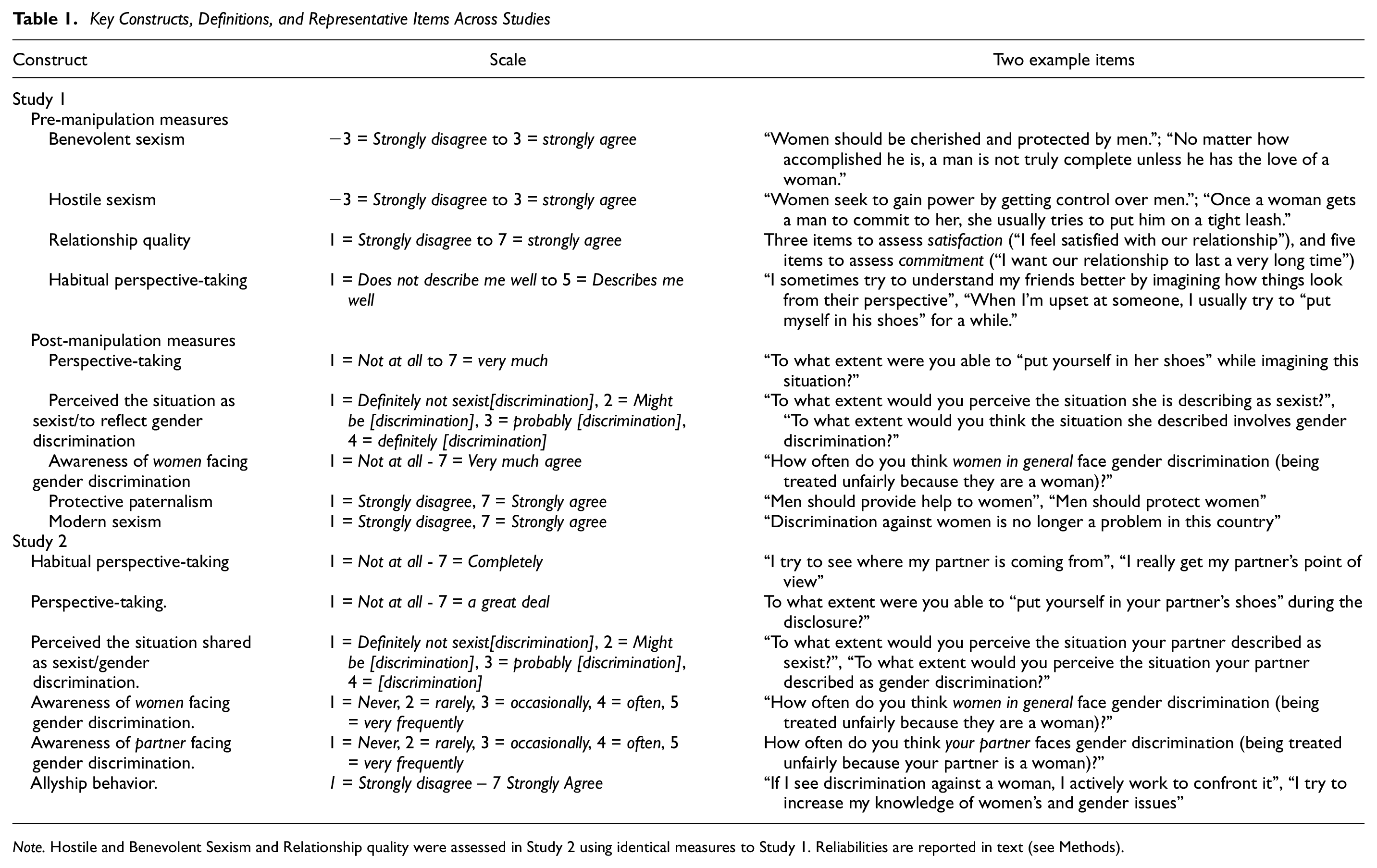
Note. Hostile and Benevolent Sexism and Relationship quality were assessed in Study 2 using identical measures to Study 1. Reliabilities are reported in text (see Methods).
Demographic Information Across Studies
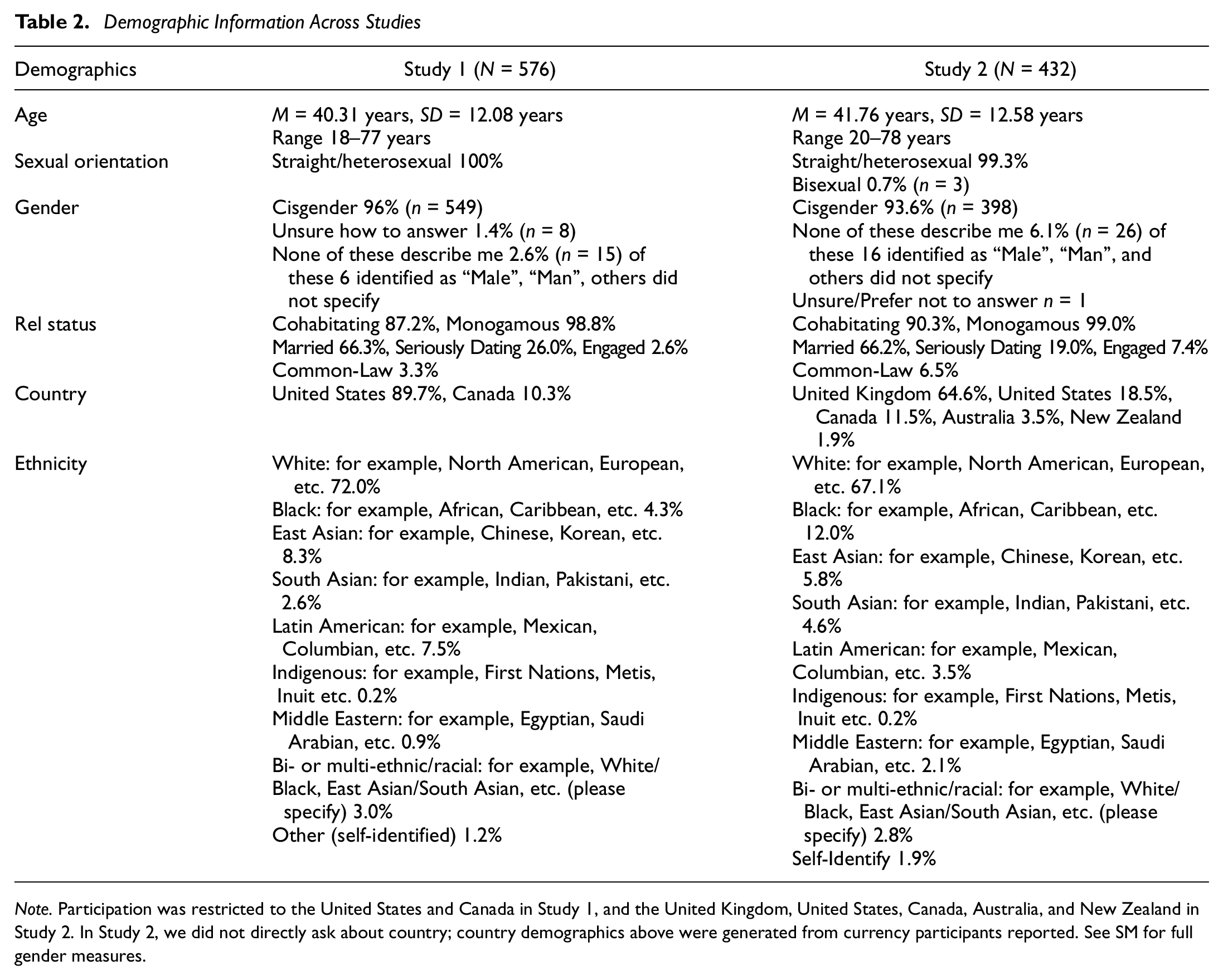
Note. Participation was restricted to the United States and Canada in Study 1, and the United Kingdom, United States, Canada, Australia, and New Zealand in Study 2. In Study 2, we did not directly ask about country; country demographics above were generated from currency participants reported. See SM for full gender measures.
Pre-Manipulation Measures
Sexist Attitudes
Hostile and benevolent sexism were assessed with 11 items each (Ambivalent Sexism Inventory; Glick & Fiske, 1996).
Relationship Quality
Three items assessed satisfaction and five items assessed commitment (combined to index relationship quality, Rusbult et al., 1998).
Habitual Perspective-Taking
The seven-item Perspective-Taking subscale of the 28-item Interpersonal Reactivity Index was used (Davis, 1983).
Scenario
After completing pre-manipulation measures, participants were randomly assigned to one of three conditions where the woman making the disclosure varied. In the
All participants were told She shares the following situation and read: I just found out that a guy who started his job at the same time as me, is at the same level as me, and has the exact same degree as me, is making more money than me. If anything, I have more experience than he does, but his salary is almost 25% more than what I am making! I can only assume this is because I am a woman. There is no reason he should be making more money than me. I think the company is being unfair and I am not sure what to do about it.
Attention Checks
Three questions assessed attention and comprehension: (a) Who shared the experience? (1 = Unknown woman, 2 = Friend, 3 = Romantic partner, 4 = Co-worker, 5 = Sister); (b) What was the situation? (1 = A man at her work made more than her [correct], 2 = A man-made less, 3 = A co-worker took her job, 4=A woman made more); (c) Did the person have similar experience? (1 = Yes [correct], 2 = No, he had more experience). As preregistered, only participants answering all three correctly were included in analyses.
Post-Manipulation Measures
Following the manipulation participants completed measures of
Results
We conducted a series of one-way analyses of variance (ANOVAs) (in SPSS 29) to test our key proposition that men are more likely to perspective-take when sexism targets a romantic partner (versus a friend or stranger) and that this will be associated with their appraisal of the situation as sexist, and broader awareness of sexism/discrimination. The models tested whether the condition (romantic partner, friend, or stranger) influenced men’s: (a) perspective-taking, (b) appraisal of sexism, (c) awareness of gender discrimination, and (d) broader gender-based attitudes.
As predicted, men’s perspective-taking (i.e., ability to “put themselves in her shoes”) differed across conditions, F(2, 573) = 13.21, p < .001,
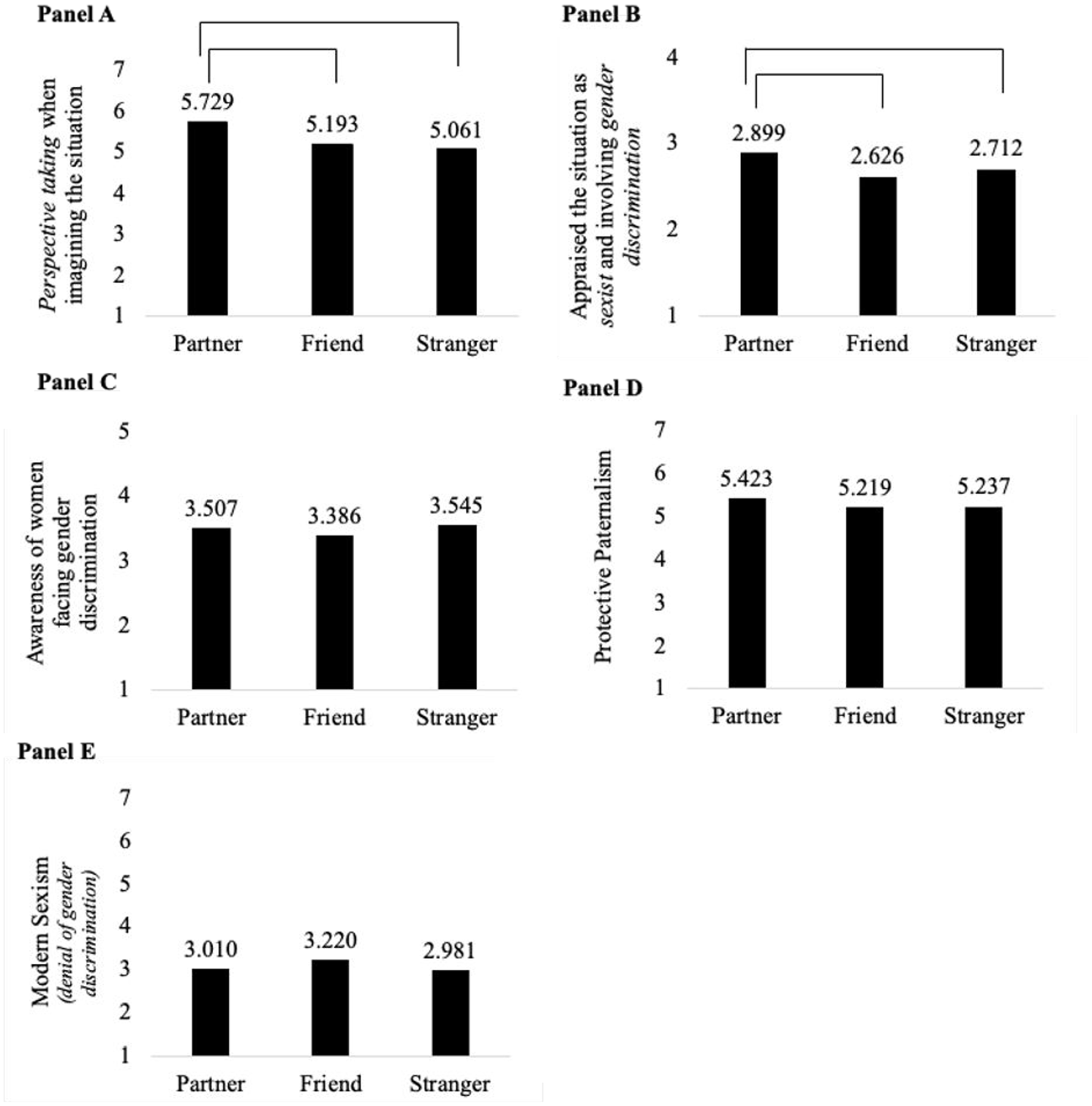
Bar Graphs Displaying the Effect of Condition (Partner vs Friend vs Stranger) on Perspective-Taking With Target (Panel A), Appraising the Situation Described to Reflect Sexism and Gender Discrimination (Panel B), Awareness of Women Facing Gender Discrimination (Panel C), Protective Paternalism (Panel D), and Modern Sexism (Panel E)
Next, we explored whether imagining their partner disclosing an experience of sexism (versus a friend or stranger) would affect men’s broader awareness of women’s experiences of gender discrimination or their broader gender-based attitudes. Yet, there were no significant effects of condition on men’s broader awareness of women facing gender discrimination, F(2, 573) = 1.81, p = .165,
Exploratory Serial Mediations
Since the condition influenced more proximal outcomes (perspective-taking and appraisals of sexism) but not broader attitudes (awareness of women facing gender discrimination, protective paternalism, modern sexism), we explored potential indirect effects. These analyses were not preregistered and were conducted post hoc after reviewing the results above. Using PROCESS in SPSS (29), we tested whether the effect of condition (e.g., partner vs. friend or stranger) on perspective-taking was associated with appraising the situation as sexist, which in turn predicted greater awareness of sexism and less sexist attitudes (i.e., serial mediation; Model 6 in PROCESS). Significant indirect effects emerged across outcomes (except protective paternalism) for both partner versus friend and partner versus stranger (see Table 3). Men who imagined their partner (vs. a friend or stranger) disclosing discrimination were more likely to perspective-take, leading to greater recognition of sexism, which predicted increased awareness of gender discrimination and lower modern sexism. However, several alternative pathways (see Tables SM2 and 3) with different sequencing of perspective-taking, appraisals, and broader awareness and attitudes were also significant, warranting cautious interpretation and inconclusive results.
Mediations Across Outcomes for Study 1
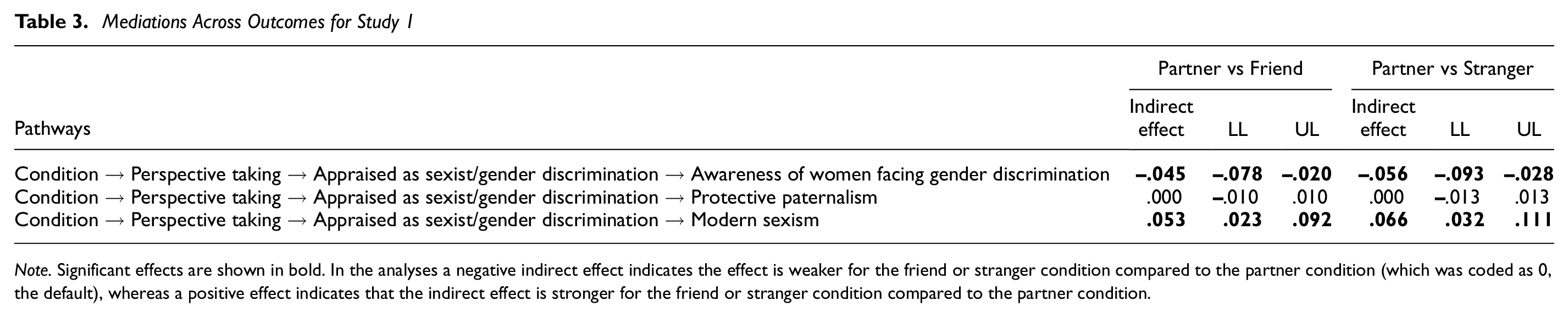
Note. Significant effects are shown in bold. In the analyses a negative indirect effect indicates the effect is weaker for the friend or stranger condition compared to the partner condition (which was coded as 0, the default), whereas a positive effect indicates that the indirect effect is stronger for the friend or stranger condition compared to the partner condition.
Additional Analyses
As preregistered, we tested whether the main effects of the condition held controlling for theoretically relevant variables: (a) men’s sexist attitudes (hostile and benevolent), (b) general perspective-taking tendencies, and (c) relationship quality. Rerunning analyses with these controls (in separate models) revealed the focal effects remained unchanged (Tables SM4 and 5). These results confirm the findings are not due to individual differences in men’s endorsement of sexism or general tendencies to perspective-take in everyday life and rule out the possibility that men in higher-quality relationships may be more motivated to perspective-take or appraise the situation as sexist and discriminatory. We also tested whether these variables moderated the effects of condition, and no significant interactions emerged (see Table SM6). The exploratory mediation pathways outlined above remained robust when controlling for these variables (see Table SM3). Together these results highlight the critical, and independent, role of the relational context in shaping perspective-taking, sexism appraisals, and in turn, broader awareness of women’s experiences.
Study 2
In Study 2, we aimed to conceptually replicate and extend Study 1, enhancing ecological validity by examining men’s reactions to a previous instance of their partner sharing an experience of sexism or gender discrimination. Men reported whether their partner had previously disclosed an experience of sexism or gender discrimination to them. If so, they responded to questions about the situation their partner described. Accordingly, we focus only on romantic partners’ disclosures of experiences of gender discrimination and consider variation in men’s perspective-taking and, in turn, appraisals of the situation as sexist, and their broader sexist attitudes.
We predicted that greater self-reported perspective-taking during these recalled discussions would be associated with a greater likelihood of appraising the situation as sexist and discriminatory. We also predicted that in turn, greater appraisals of the situation as sexist would be associated with greater awareness of women experiencing gender discrimination. New to Study 2, we also assessed whether greater perspective-taking via appraisals were associated with greater awareness of their partner’s broader experiences of sexism, and greater self-reported allyship behaviors (e.g., commitment to learning about and addressing gender discrimination). Finally, we tested whether the focal associations were independent of men’s sexist attitudes, general partner perspective-taking, and relationship quality. See OSF and SM for preregistration details.
Method
Procedure and Participants
Eligibility required participants to identify as men, be above 18, and be in a relationship with a woman for at least 1 year, recruited via Prolific. We collected 587 responses. Men who could not recall or were unsure whether their partner had shared an experience of gender discrimination read and responded to the Study 1 scenario (romantic partner condition, see SM). As preregistered, we excluded participants for failing attention checks (n = 12 and n = 4 did not respond) or admitting dishonesty (n = 1). The final sample included 570 participants, but analyses focused on the 432 men whose partners had shared a discrimination experience (which provided adequate power [.99, G*Power.31] to detect small [r = .20] effects).
Measures
Table 1 displays representative items, Table 2 sample information, and Table 4 descriptive statistics, reliabilities, and correlations.
Descriptive Statistics, Reliabilities, and Correlations for Primary Measures (Study 2)
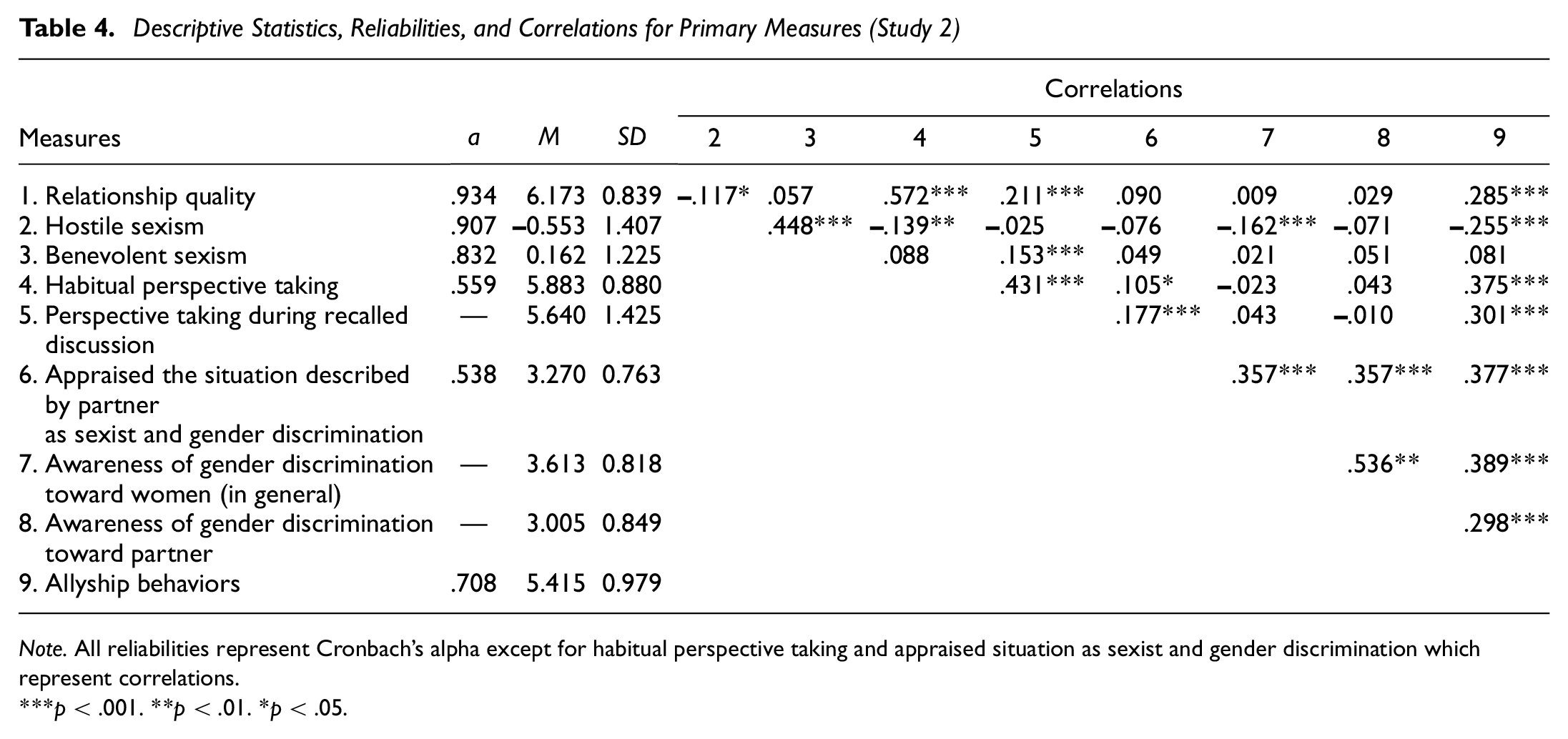
Note. All reliabilities represent Cronbach’s alpha except for habitual perspective taking and appraised situation as sexist and gender discrimination which represent correlations.
p < .001. **p < .01. *p < .05.
Relationship Quality
Participants completed the same scale as Study 1.
Sexist Attitudes
Participants completed the short 12-item version of the Ambivalent Sexism Inventory (ASI; Glick & Fiske, 1996). Six items assessed endorsement of
Habitual Perspective-Taking
Participants rated two items adapted from the Perceived Responsiveness and Insensitivity Scale (Crasta et al., 2021).
Partner Sharing an Experience of Sexism or Gender Discrimination
To prompt men to reflect on their partner sharing experiences of sexism, men rated the extent to which their romantic partner had experienced gender discrimination using a 26-item scale (Becker & Swim, 2012) assessing stereotypes, gender bias, unwanted sexual attention (e.g., “ogling, unwanted touching”), complaints (e.g., “negative attitudes about gender inequality”), and sexist behavior (e.g., “sexist jokes”; 1 = Never–5 = Very Often). Participants were then asked “Thinking about your responses above, and other experiences your partner may have had that they would consider sexism or gender discrimination. Has your partner ever told you about one of these experiences?” (1 = Yes, 2 = No, 3 = I’m not sure, 4 = Yes, but I didn’t label it sexism or gender discrimination). If they answered “Yes” or “Yes, but I didn’t label it,” they were asked to “Please describe the experience of sexism or gender discrimination that your partner shared with you. Please try to describe in some detail” and rated the following measures.
Perspective-Taking
Participants completed the same item as Study 1, replacing “put yourself in her shoes” with “put yourself in your partner’s shoes.”
Perceived the Situation Shared as Sexist/Gender Discrimination
Participants completed the same two items as Study 1, replacing “she” with “your partner.”
Awareness of Women in General and Partners Facing Gender Discrimination
Participants completed the same item in Study 1 assessing awareness of women facing gender discrimination and another item specific to the partner; “How often do you think your partner faces gender discrimination (being treated unfairly because your partner is a woman)?” These items were assessed in independent analyses.
Allyship Behavior
Three items assessed engagement in allyship behaviors.
Results
We first tested the percentage of men who reported that their partner had shared an experience of sexism or gender discrimination (i.e., responded “yes” or “yes, but did not label it sexism”), and found 75.8% (n = 432 of 570) of men reported that their partner had disclosed such an experience. The disclosed experiences included paternalism (e.g., “mansplaining”), objectification (e.g., unwanted sexual attention), exclusion (e.g., overlooked for opportunities based on gender), derogation (e.g., sexist jokes), and gender stereotyping (e.g., hearing messages about how men and women should act). Participants who answered “no” (16.1%) or “I don’t know” (8.1%) were presented with the imagined scenario, partner condition, from Study 1 (additional analyses replicate the pattern found in Study 1, see Table SM7).
Next, linear regression results demonstrated that men who reported greater perspective-taking (i.e., were able to put themselves “in her shoes”) in response to their partner’s recalled disclosure were more likely to appraise the situation as involving sexism or gender discrimination (β = .177 [95% CI lower limit (LL) = .045, upper limit (UL) = .145], t = 3.735, p < .001). In turn, as shown in Table 5, appraising the situation as more sexist and discriminatory was associated with (a) greater awareness of gender discrimination experienced by women (in general) and partners, and (b) greater allyship behaviors (i.e., a commitment to increasing knowledge of and confronting gender discrimination). All direct and indirect effects were significant, supporting the hypothesized pathways.
Mediations Across Outcomes for Study 2
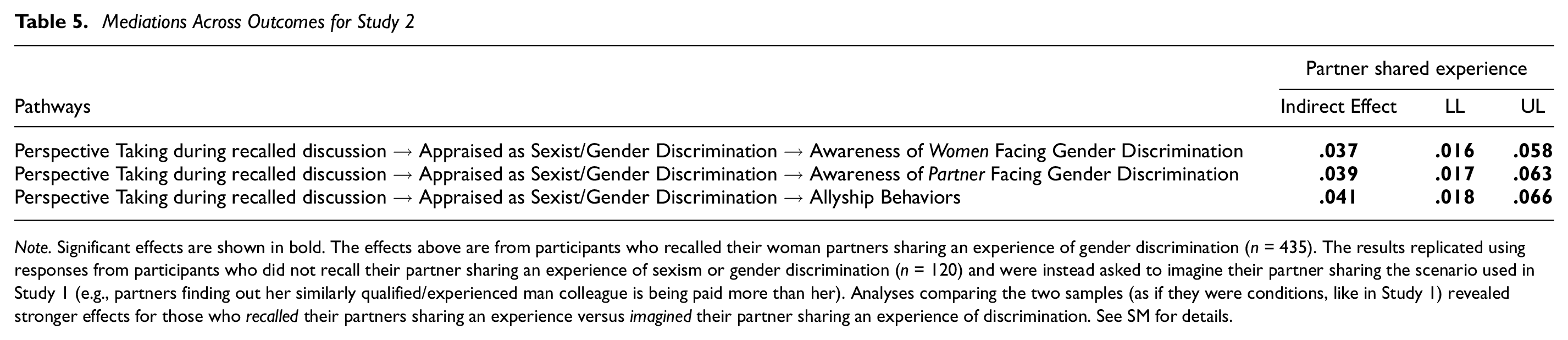
Note. Significant effects are shown in bold. The effects above are from participants who recalled their woman partners sharing an experience of gender discrimination (n = 435). The results replicated using responses from participants who did not recall their partner sharing an experience of sexism or gender discrimination (n = 120) and were instead asked to imagine their partner sharing the scenario used in Study 1 (e.g., partners finding out her similarly qualified/experienced man colleague is being paid more than her). Analyses comparing the two samples (as if they were conditions, like in Study 1) revealed stronger effects for those who recalled their partners sharing an experience versus imagined their partner sharing an experience of discrimination. See SM for details.
Given the correlational nature of our data, we again tested all potential alternative pathways (see Table SM8). Our predicted pathway had the strongest support across outcomes. Yet, one of the five alternative pathways tested for each outcome also emerged as significant for 2/3 outcomes. In these alternative models, greater awareness of the extent to which women in general, or partners, experience gender discrimination predicted greater appraisals and, in turn, greater perspective-taking, suggesting that appraising situations as sexist is a consistent mediator across both pathways, and both perspective-taking and awareness of gender discrimination play reciprocal roles in shaping men’s responses to their partners’ experiences of sexism. For allyship behaviors, a more complicated pattern emerged; with three significant alternative pathways, suggesting reciprocal relationships between perspective-taking, appraising situations as sexist, and allyship behaviors (see SM).
Additional Analyses
Consistent with Study 1, we tested whether the focal associations, across three outcomes, remained significant when controlling for (a) men’s sexist attitudes, (b) general partner-focused perspective-taking, and (c) relationship quality (see Table SM9). All associations (hypothesized and alternative) remained significant, reinforcing the robustness of our findings. These results indicate that the effects are not driven by ideological biases toward gender (in)equality or general tendencies to perspective-take but reflect meaningful situational and relational dynamics. Moreover, independence from relationship quality suggests these effects are not merely a byproduct of higher-quality relationships.
Discussion
The current set of studies provides novel evidence that man−woman romantic relationships are a powerful context to promote men’s awareness of gender discrimination. Across two studies, we examined how men partnered with women responded to their partners’ experience of gender discrimination, focusing on the role of the relational context in shaping these responses. In Study 1, men were more likely to engage in perspective-taking and appraise a situation as sexist and discriminatory when the disclosure came from their ostensible romantic partner compared with a woman friend or stranger. Study 2 replicated and extended these findings, showing that when men partnered with women reported greater perspective-taking in response to their partner’s disclosure of an experience of sexism, they appraised the situation as more sexist/discriminatory, and in turn, reported greater awareness of sexism (experienced by women in general and their partner) and greater allyship behaviors. These associations were robust to individual differences in sexist attitudes, general partner perspective-taking, and relationship quality. Together, these findings highlight the unique potential of man−woman romantic relationships as a context for fostering men’s awareness of gender discrimination and sexism.
Man− Woman Romantic Relationships: A Promising Context to Promote Men’s Awareness of Gender Discrimination
Romantic relationships involve high levels of interdependence in which partners are invested in each other’s well-being (Rusbult & van Lange, 2003). Past work demonstrates that the interdependence inherent in man−woman romantic relationships makes this a context in which the consequences of sexism are often most acutely experienced (see Cross et al., 2019; Fisher & Hammond, 2019; Hammond et al., 2020; Hammond & Overall, 2017). Yet, the current findings suggest this interdependence can be leveraged to heighten men’s awareness of sexism and gender discrimination. The findings are in line with broader theory and evidence suggesting that perspective-taking improves intergroup relations, in part, because it fosters people’s greater recognition of discrimination (see Todd & Galinsky, 2014). Relatedly, research shows that learning about a close other’s experience of racial discrimination can increase awareness of racial prejudice (Carter & Murphy, 2017). However, responsibility should not fall solely on those experiencing discrimination; partners must actively engage in perspective-taking. Indeed, other research indicates that close relationships can be a safe and productive space for discussing discrimination, but only when disclosures are met with validation and support (McNeil Smith et al., 2020; Rice et al., 2023).
These findings also highlight challenges for broadening awareness beyond the context of partner disclosures. A key challenge is encouraging men to reflect on their behavior and biases, which may involve confronting how certain attitudes or behaviors complicity upholding gender inequality (Van Laar et al., 2024) or how societal norms discourage men’s emotional vulnerability (Levant, 2011). High-quality listening (i.e., attentive, empathic, nonjudgmental listening) is a trainable skill that promotes partner responsiveness and autonomy support during difficult conversations (Itzchakov, 2020; Itzchakov et al., 2022, 2023; Reis & Itzchakov, 2023). High-quality listening serves as a promising intervention by reducing defensiveness, facilitating attitude change (DeMarree et al., 2023; Itzchakov et al., 2017; Moin et al., 2025) and reducing prejudice (Itzchakov et al., 2020; Weinstein et al., 2022). As discrimination is often less visible to those not targeted (Roberts & Rizzo, 2021), hearing about it from a close other can increase empathy and awareness (Carter & Murphy, 2017). However, for this to be effective those sharing their experiences must feel understood and validated (Bergseiker, 2023). We encourage researchers to explore high-quality listening as a strategy for fostering responsive conversations about gender discrimination to promote awareness of gender inequality.
Limitations and Future Directions
The current research introduced a novel relationship-centered approach to increasing men’s awareness of sexism, but open questions remain. Interdependence theory (Rusbult & van Lange, 2003) would suggest a linear effect of relational closeness across conditions (partner, friend, stranger), yet no significant differences emerged across friend and stranger conditions (Study 1) highlighting the unique role of romantic relationships. This may stem from the study design; we did not confirm whether men had a specific woman friend in mind. Prompting men to consider a specific woman friend, and assess their closeness, could provide clearer insights. In addition, future research should explore whether similar effects emerge in other interdependent relationships (e.g., mothers, sisters), and examine how relational factors like emotional attachment, caregiving roles, or shared history shape perspective-taking and awareness of gender discrimination.
Our findings highlight the role of perspective-taking in men’s identification and awareness of sexism, but further research is needed. Romantic relationships provide a context in which men are motivated to empathize with their partners (Rusbult & van Lange, 2003), and affective empathy has been linked to reduced gender stereotyping (Guthridge et al., 2023). However, leveraging this relational context to enhance men’s awareness of gender inequality remains largely underexplored. Lab-based studies are particularly well-suited to advance this work: observing man−woman couples as they discuss experiences of sexism would offer insight into whether men’s recognition of sexism is shaped by how women share the experience, and the personal and relational costs women might face when disclosures are met with unsupportive responses. Importantly, while partner disclosures may raise awareness, they may risk placing additional emotional burden on women (Dean et al., 2022). We emphasize that women should not bear the responsibility for educating men about sexism. Hence, future research should also explore alternative strategies—such as structured conversations, media interventions, or virtual reality simulations featuring close others (partner, sister, mother)—to promote perspective-taking and examine the flow on effects.
A key avenue for future research is to clarify the temporal sequence of these processes. Although our predicted direction aligns with theory and prior evidence that perspective-taking can lead to greater identification of discrimination (e.g., Todd & Galinsky, 2014), it is possible that men who are more aware of sexism may, in turn, be more likely to perspective take with their partners and appraise their experiences as sexist. Given plausible alternative pathways (see SM), an important next step is to conduct a longitudinal experience-sampling study with man–woman couples to clarify the causal direction of these processes.
Finally, future research should examine different relational and individual factors in how men respond to disclosures of sexism. As is common in relationship research (Barton et al., 2020) our samples involved men in relatively high-quality relationships raising the question of whether effects differ in lower-quality or less interdependent relationships. Future work should clarify the role of sexist ideologies as neither men’s benevolent or hostile sexism moderated the effects, especially unexpected for hostile sexism given prior links with lower responsiveness (Overall et al., 2025) and relationship difficulties (Cross & Overall, 2019). Another priority is identifying which behaviors men recognize as sexist. In Study 2, men reported partner disclosures on different types of sexism (e.g., objectification, exclusion, paternalism, etc.), but we did not assess which they viewed as most sexist. Since men are less likely than women to identify certain behaviors as sexist (e.g., sexual harassment; Rotundo et al., 2001), examining what men recognize—or fail to recognize—as sexism may shed light on gender gaps in awareness.
Conclusion
Man−woman romantic relationships can serve as a powerful context for increasing men’s awareness of sexism and gender discrimination. The interdependence in these relationships may foster greater perspective-taking, leading men to recognize gender inequities more readily. However, broadening this awareness beyond direct partner disclosures remains challenging, as it requires men to reflect on their own biases and behaviors. We hope this research inspires future work on innovative ways to increase men’s awareness of sexism and gender discrimination, including structured discussions or interactive interventions that engage men without overburdening women.
Supplemental Material
sj-docx-1-spp-10.1177_19485506251345111 – Supplemental material for Leveraging Man−Woman Romantic Relationships to Promote Men’s Awareness of Sexism and Gender Discrimination
Supplemental material, sj-docx-1-spp-10.1177_19485506251345111 for Leveraging Man−Woman Romantic Relationships to Promote Men’s Awareness of Sexism and Gender Discrimination by Emily. J. Cross, Alyssa DeBlaere and Amy Muise in Social Psychological and Personality Science
Footnotes
Handling Editor: Shenel Husnu
Declaration of Conflicting Interests
The author(s) declared no potential conflicts of interest with respect to the research, authorship, and/or publication of this article.
Funding
The author(s) disclosed receipt of the following financial support for the research, authorship, and/or publication of this article: via the Social Sciences and Humanities Research Council (SSHRC) Insight Grant (no. 611-2024-0104) and Insight Development Grant (no. 430-2022-00746).

Supplemental Material
Supplemental material for this article is available online.
Notes
Author Biographies
References
Supplementary Material
Please find the following supplemental material available below.
For Open Access articles published under a Creative Commons License, all supplemental material carries the same license as the article it is associated with.
For non-Open Access articles published, all supplemental material carries a non-exclusive license, and permission requests for re-use of supplemental material or any part of supplemental material shall be sent directly to the copyright owner as specified in the copyright notice associated with the article.
