




Abstract
This study examined the associations between ambivalent sexism (i.e., hostile and benevolent sexism) and relationship adjustment in young adult couples by testing an actor-partner interdependence model. The sample was composed of 219 cohabiting heterosexual Canadian couples. The findings suggest that ambivalent sexism plays a role in young adults’ perceptions of the quality of their romantic relationship, but gender differences exist. Women and men who more strongly endorsed hostile sexism tended to report lower relationship adjustment. Women’s hostile sexism was also negatively related to their partners’ relationship adjustment, whereas their benevolent sexism was positively related to their own and their partners’ relationship adjustment. For their part, men’s ambivalent sexism was unrelated to their partners’ relationship adjustment and their benevolent sexism was also unrelated to their own relationship adjustment. The results are discussed in light of the insidious consequences that can accompany ambivalent sexism. Even though hostile sexism functions to protect men’s societal advantages, it comes with costs to their romantic relationships. In contrast, despite the rewards benevolent sexism can bring on the relational level, its endorsement may hinder the attainment of gender equality by encouraging women to invest in their relationship at the expense of independent achievements.
Keywords
Introduction
Despite the greater support for gender equality observed around the world in recent decades and the relatively common belief that sexism is no longer a societal problem, gender inequity and sexist attitudes toward women persist, even among younger generations of adults (Hillard & Liben, 2020; Leaper, 2015; Liben, 2016). The ambivalent sexism theory posits that gender inequity is enduring partly because negative attitudes toward women often go hand in hand with superficially positive attitudes that justify gendered roles (Glick & Fiske, 1996). Specifically, two fundamental interrelated dimensions characterize sexist attitudes: hostile sexism and benevolent sexism. Hostile sexism is the classically understood form of sexism entailing hostility, negativity, and antipathy toward women who are perceived as stepping outside of traditional gender roles, competing with men, or manipulating them to gain power. Benevolent sexism is a more subtle form of sexism, which involves attitudes that appear positive yet idealize women as pure, fragile, and needing to be cherished and protected by men. It is also associated with chivalrous behaviors, romantic-sounding discourse, and intimacy-seeking conduct, especially toward women who conform to traditional gender roles (Glick & Fiske, 1996).
Hostile sexism devalues women’s competence, legitimates violence toward women, and discourages women from aiming for independent success (e.g., Glick et al., 1997, 2000; Hammond & Overall, 2017; Masser & Abrams, 2004). Although attitudes and behaviors of benevolent sexism are more prevalent and tend to be perceived as less offensive than those of hostile sexism (Barreto & Ellemers, 2005; Bohner et al., 2010; Oswald et al., 2019), scholars argue that it does not mean they are innocuous. Women who endorse benevolent sexism tend to feel less competent, to show reduced cognitive performance, and to be less inclined to independent thought and behavior (Calogero & Jost, 2011; Dardenne et al., 2007; Dumont et al., 2010; Feather, 2004; Moya et al., 2007; Oswald et al., 2019). As it functions to maintain men’s societal dominance (Glick & Fiske, 1996), benevolent sexism ultimately reinforces gender inequality and contributes to the subordination of women in all types of relationships (Lee et al., 2010). Together, hostile and benevolent sexism are described as “complementary tools of control” in relationships (Lee et al., 2010, p. 583). On the one hand, hostile sexism uses hostile force to maintain men’s position of power (Jackman, 1994). On the other hand, benevolent sexism is dubbed the “soft power” to control a partner (Renzetti et al., 2018, p. 188) because, with its associated positive stereotypes and paternalistic behaviors, it entices women to support and invest in their partners’ advantaged position of power by conferring them a privileged status in the relationship (Glick et al., 2000; Hammond & Overall, 2017).
Early research on ambivalent sexism has overlooked how it operates within intimate heterosexual relationships to influence well-being and romantic dynamics (see Hammond & Overall, 2017 and Waddell et al., 2019 for similar arguments). Recently, relationship researchers have started to integrate literature on sexism with that on relational well-being. We are following in their footsteps by investigating how sexist attitudes influence relational dynamics among cohabiting young adult couples. More precisely, we tested an actor-partner interdependence model examining the associations between heterosexual romantic partners’ endorsement of hostile and benevolent sexism and their relationship adjustment during young adulthood. Relationship adjustment was conceptualized as representing four aspects of relationship quality; consensus between partners (i.e., level of agreement on matters of importance in a relationship), dyadic satisfaction (i.e., level of happiness, satisfaction, and stability in the relationship), cohesion (i.e., degree of connectedness, togetherness, and emotional bonding), and affectional expression (i.e., degree of demonstrations of affection and sexual relationship). Dyadic adjustment appears to be an appropriate concept to examine as it is one of the most widely studied in research on marital relationships (South et al., 2009) and is known to be associated with other more specific aspects of intimate relationships, such as commitment (Owen et al., 2013), communication (Rehman et al., 2011), responsiveness (Gadassi et al., 2016), and partner support (Verhofstadt et al., 2013). As argued by South and colleagues (2009), terms such as relationship satisfaction, quality, and adjustment are often used interchangeably in the marriage and romantic relationship literature. However, we use the term “adjustment” to refer to the overall concept of current relationship functioning.
Ambivalent sexism and well-being
Napier and colleagues (2010) studied ambivalent sexism and life satisfaction among a representative sample from 32 countries. Whereas they found that hostile sexism was overall negatively associated with life satisfaction for men and unrelated for women, they documented a positive correlation between benevolent sexism and life satisfaction among both men and women across the countries. Hammond and Sibley’s (2011) research conducted with a sample of New Zealanders also supported an absence of gender differences in terms of how benevolent sexism influences life satisfaction. However, it revealed that the mechanisms of influence are distinct for men and women. For men, the observed positive association between benevolent sexism and life satisfaction was direct, whereas for women, the positive effect of benevolent sexism was mediated by the perceptions of gender relations as fair and equitable. Similarly, Connelly and Heesacker’s study (2012), conducted among college students, revealed that benevolent sexism reinforces the perception that gender inequality and status quo are fair and, consequently, favors life satisfaction. These results are in line with the system justification theory (Jost & Banaji, 1994) and suggest that benevolent sexism endorsement promotes men and women’s diffuse justification by emphasizing the complementary nature of gender roles. The authors argued that “by highlighting how a warm female nurturer complements a strong male provider, benevolent sexism implies that society is fair and functions as it should in part because of balanced and seemingly well-designed gender roles” (Connelly & Heesacker, 2012, p. 434).
Furthermore, research suggests that benevolent sexism can also lead to other perceived benefits on the personal level. For instance, its endorsement is significantly associated with higher levels of happiness, well-being, and life satisfaction among both men and women (Connelly & Heesacker, 2012; Hammond & Sibley, 2011; Napier et al., 2010). As relationship adjustment is an important component in personal well-being and life satisfaction for couples (Mellor et al., 2008), ambivalent sexism may also influence it. Even though it has yet to be investigated with dyadic data, a number of studies point in that direction.
Ambivalent sexism and heterosexual relationships
Perception, endorsement, and experiences of ambivalent sexism can influence relationship processes and dynamics from the very first stages of the relationship. Research suggests that, early in adulthood, the levels of ambivalent sexism potential male partners portray influence how heterosexual women are attracted to them (Bohner et al., 2010; Gul & Kupfer, 2019). In their recent study, Gul and Kupfer (2019) found that young women perceived male profiles presenting high levels of benevolent sexism as more attractive than those presenting low levels of benevolent sexism because they considered the former would be more willing to invest in a romantic relationship. This was the case even though the women recognized the attitudes and behaviors of these potential partners as more undermining and patronizing compared to those of potential partners with low levels of benevolent sexism (Gul & Kupfer, 2019). For their part, Bohner and colleagues (2010) found that young women evaluated profiles portraying benevolent sexist men as more attractive and those portraying hostile sexist men as less attractive than those presenting nonsexist men. The women were more attracted to profiles expressing high benevolence even though they were aware that benevolent attitudes usually coexist with hostile attitudes (Bohner et al., 2010). A study conducted among young adults revealed that stronger endorsement of hostile sexism predicted more traditional ideas about romantic and family relationships (Bermúdez et al., 2015).
Once in a romantic relationship, the endorsement of ambivalent sexism also colors how heterosexual individuals perceive and react to their partners. Research has shown that men and women who endorse hostile and benevolent sexism are more likely to fear intimacy and have anxious or avoidant attachments (Yakushko, 2005). Hostile sexism, in particular, has been associated with negative attitudes, such as victim blaming and rape proclivity (Abrams et al., 2003; Cross et al., 2017; Yakushko, 2005). Men with higher hostile sexism also express more hostility during conflict and show poorer conflict resolution skills (Overall et al., 2011). In addition, they demonstrate more aggressive behaviors toward their intimate partners, including threatened and completed acts of physical, sexual, and psychological abuse (Cross et al., 2019; Renzetti et al., 2018). Recent research revealed that heterosexual men who endorse high levels of hostile sexism are more likely to cyberbully their romantic partners (Martinez-Pecino & Durán, 2019). Their propensity for aggression is heightened when they feel manipulated or controlled by their partners (Cross et al., 2017). Researchers have documented that men who strongly endorse hostile sexism tend to maintain biased perceptions of their partners, perceiving their behavior as more critical, manipulative, and less supportive and dependable than appears merited based on their partners’ reports of that behavior (Hammond & Overall, 2013, 2020). These biased perceptions would involve insecurities about dependence and lead men to behave more negatively toward their partners and, in turn, to experience lower relationship satisfaction (Hammond & Overall, 2013, 2020). Dyadic data from a sample of married, cohabiting, and dating partners aged 16 to 74 suggested that the consequences of men’s hostile sexism extend beyond actor effects (Cross et al., 2019). More precisely, the results revealed that men’s hostile sexism was associated with their female partners experiencing more severe problems in the relationship, such as problems with power dynamics, jealousy, abuse, infidelity, and alcohol/drugs. These problems were further associated with more negative relationship evaluations for women (Cross et al., 2019).
Research conducted by Waddell and colleagues (2019) revealed that ambivalent sexism has the power to modulate the benefits people typically receive from a heterosexual romantic relationship. More precisely, they found that the benefits of being in a romantic relationship on life satisfaction were reduced for individuals endorsing higher levels of hostile sexism (compared to lower levels of hostile sexism), but heightened for those endorsing higher levels of benevolent sexism (compared to lower levels of benevolent sexism). Other findings revealed that benevolent sexism can enhance feelings of relationship security. More precisely, Cross and colleagues (2016) found that women who experience high levels of anxious attachment feel less insecure during conflict when they perceive their partner as endorsing benevolent sexism. The authors argued that perceived benevolent sexism helps these women overcome their anxious fear that their partners’ love and commitment could eventually wane. Furthermore, compared to men who endorse hostile sexism, men who endorse benevolent sexism are more willing to listen to their partners’ viewpoints and display less hostile behavior when facing a conflictual discussion, which leads to better discussion and relationship satisfaction (Overall et al., 2011).
The results of the handful of research investigating the effects of women’s endorsement of sexist attitudes toward women on dynamics in intimate relationships parallel those of studies on men’s ambivalent sexism. For instance, Hammond and Overall’s (2015) study revealed that women who endorse benevolent sexism tend to provide greater relationship-oriented support—by emphasizing that their relationship was a secure and stable base for their partner to pursue their goals—which in turn, led their partner to feel positively regarded and intimate in their relationship. Even though women’s agreement with hostile sexism may appear unlikely considering that they are the target of this gender discrimination, research documented that women do endorse these beliefs to a varying extent (e.g., Becker, 2010; Becker & Wagner, 2009). Women who agree with hostile sexist beliefs toward women could internalize them by believing, for instance, that there is nothing wrong with trying to hold more power than men (Becker, 2010). Therefore, they may engage in behaviors that could lead their partner to be less satisfied with their relationship, such as showing hostility toward them or seeking control or power in a way that is not seen well by the partner.
The reviewed available research demonstrates the utility of integrating ambivalent sexism theory with the literature on heterosexual relationships. It suggests that it is important to consider women and men’s endorsement of hostile and benevolent sexism to gain a more thorough understanding of the impact of ambivalent sexism in daily life. Relying almost exclusively on individual data, researchers have started to examine the links between sexism and several specific personal and relational concepts. Their research focusing on outcomes such as feelings of attraction, attachment, hostility during conflict, jealousy, infidelity, relational support, and relationship satisfaction established the relevance of studying sexism in heterosexual intimate relationships. Nevertheless, because of the focus on specific aspects of relationships, it remains unclear how sexism relates to overall relationship functioning and success. Considering that when two people are in a romantic relationship, their individual outcomes are influenced by both their own and their partner’s attitude, cognition, emotions, and behaviors, it is informative to examine the impact of endorsing sexist attitudes, but also of experiencing the ambivalent sexism of a partner. Relying on couple data to examine dyadic adjustment, which globally represents four central concepts of relationship functioning, will help gain a more general understanding of the impact of sexism in intimate relationships.
Current study
Given the importance of understanding interdependent processes in close relationships and building on the assumption that an individual’s relationship adjustment may be affected by his or her own endorsement of ambivalent sexism as well as by his or her partner’s, we proposed an actor-partner interdependence model (APIM; Kenny et al., 2006) examining the links between ambivalent sexism and relationship adjustment among cohabiting young adult couples.
The proposed APIM examines how young heterosexual adults’ relationship adjustment is influenced by their own (actor effect) and their partners’ (partner effect) endorsement of hostile and benevolent sexism toward women. Consistent with research revealing that the endorsement of benevolent sexism is significantly associated with higher levels of happiness, well-being, and life satisfaction among both men and women (e.g., Connelly & Heesacker, 2012; Hammond & Sibley, 2011; Napier et al., 2010), we hypothesized that both men and women’s relationship adjustment would be impacted positively by their own level of endorsement of benevolent sexism. In contrast, considering previous results indicating that men who endorse higher levels of hostile sexism tend to behave more negatively toward their partners and to be less satisfied with their relationship (e.g., Hammond & Overall, 2013, 2020), we postulated that men’s endorsement of hostile sexism would be negatively associated to their own and their partner’s relationship adjustment. Finally, considering that less is known about the consequences of women’s endorsement of hostile sexism toward their own gender, the examination of the links between this variable and both partners’ relationship adjustment is exploratory.
Method
Participants and procedure
A total of 224 cohabiting heterosexual Canadian couples between the ages of 18 and 30 were recruited for the study. Five couples were excluded of the analysis because one or both partners failed to complete all questionnaires. The final sample of 219 couples was composed mostly of post-secondary students (60, 28% of men; 99, 45% of women) or full-time employees (142, 65% of men; 88, 40% of women). Most couples were living together without being married (202, 93%) and without children (196, 90%). The average age of the men was 24.51 years (SD = 2.93) and of the women was 23.09 years (SD = 2.82). The men and women averaged 15.78 years (SD = 2.45) and 16.29 years (SD = 2.35) of education, respectively. The average length of relationship was 3.34 years (SD = 2.15).
The university’s research review committee certified that the proposal met its ethical standards before the research was conducted. Heterosexual couples were recruited through social media, advertisements in places frequented by young adults (e.g., apartment buildings for students, university and college libraries, coffee shops), and classes in postsecondary education establishments. Interested individuals and their partners were invited to our research laboratory to fill out the questionnaires. Most of the couples (135; 63%) accepted the invitation and filled out the questionnaires in the laboratory, while the other couples (80; 37%) completed the task at home for various reasons (i.e., they lived too far from campus, had conflicting schedules). All participants were presented the study procedures before giving their informed consent to complete the task. Every participant was asked to consult with researchers, but not with partners, if questions arose when completing the questionnaires. The questionnaires were available in both Canadian official languages: 34% of men and 25% of women completed the questionnaire in English and the remainder completed them in French.
Measures
Sociodemographic characteristics
The participants were asked to report information such as age, length of relationship and of cohabitation, marital and parenthood statuses, and years of education (including elementary to postsecondary education).
Ambivalent sexism
Hostile and benevolent sexism toward women were measured with the 22-item Ambivalent Sexism Inventory (Glick & Fiske, 1996). Eleven items assessed hostile sexism (e.g., “Women seek to gain power by getting control over men,” “Feminists are seeking for women to have more power than men”) and 11 items assessed benevolent sexism (e.g., “Women should be cherished and protected by men,” “Many women have a quality of purity that few men possess”). The participants indicated the extent to which they agreed with each item using a 6-point Likert-type scale (0 = Strongly disagree, 5 = Strongly agree). Mean scores were calculated for each subscale, with higher scores reflecting higher levels of sexism. In the current study, Cronbach’s α for hostile and benevolent sexism were .93 and .87, respectively, for men, and .91 and .87, respectively, for women.
Relationship adjustment
The participants’ relationship adjustment was measured using the 32-item Dyadic Adjustment Scale (DAS) developed by Spanier (1976). It is the most widely used inventory of relationship functioning in the social sciences and one of the only ones to have been proven to measure the same concept in men and women (South et al., 2009). Using a measure that is invariant across gender is important in dyadic research as it allows to conclude that dissimilarity between men and women is due to true gender differences, and not bias in the instrument (South et al., 2009). Designed for use with cohabiting and married couples, the DAS comprises four subscales, including dyadic consensus (13 items, e.g. “To what extent do you and your partner agree on the amount of time spent together?”), dyadic satisfaction (10 items, e.g. “How often do you discuss or have you considered divorce, separation, or terminating your relationship?”), dyadic cohesion (5 items, e.g. “Do you and your partner engage in outside interests together?”), and affectional expression (4 items, e.g. “Does ‘being too tired for sex’ cause differences of opinions or problems in your relationship?”). Items are mainly scored on a 5- or 6-point Likert scale, representing levels of agreement or frequency of behaviors; however, the scale also includes two dichotomous items (Yes or No). The overall dyadic adjustment score, which ranges from 0 to 151, is obtained by adding up the responses to all the items, after reverse-coding scores when necessary. Higher overall scores correspond to greater relationship adjustment. In the current study, relationship adjustment Cronbach’s α for men and women were .89 and .91, respectively.
Results
Descriptive analyses
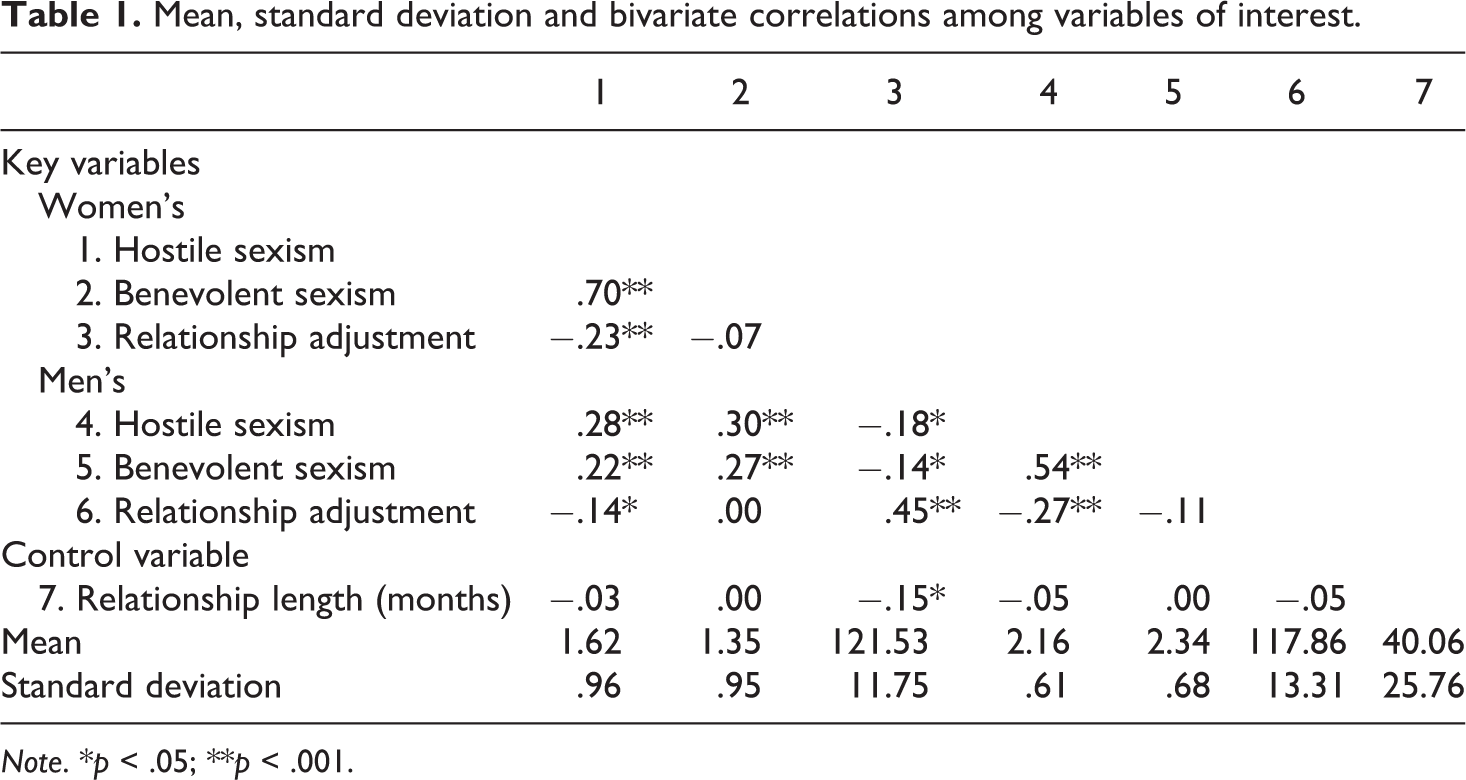
The means, standard deviations, and bivariate correlations for the variables used in this study are displayed in Table 1. Three dependent t-tests were also conducted to assess differences between men and women on key variables. A Bonferroni-adjusted α level of .017 was used for alpha inflation. The results indicated that men reported higher levels of hostile and benevolent sexism than women, t(218) = 8.11, p < .001 and t(218) = 14.41, p < .001, respectively. The results also showed that women reported greater relationship adjustment compared to men, t(218) = −4.12, p < .001.
Mean, standard deviation and bivariate correlations among variables of interest.
Note. *p < .05; **p < .001.
Main analyses
EQS 6.3 for Windows was used to test the hypothesized actor-partner interdependence model (APIM) of the couples’ relationship adjustment. Kenny and Ledermann’s (2010) proposed analytical procedure for distinguishable dyads 1 was used to test the hypothesized model, and to detect and test dyadic patterns. As the APIM is designed to measure interdependence within relationships by studying dyads, couples rather than individuals were treated as the unit of analysis (Cook & Kenny, 2005). Therefore, the final sample size consisted of the number of couples who completed all the questionnaires ( n = 219). The analyses were conducted using the robust maximum likelihood estimation method. This technique is recommended by Hu and Bentler (1999) when the sample consists of 250 units or less. The overall model fit is considered to be acceptable if the Satorra-Bentler χ2 value is nonsignificant, the standardized root mean square residual (SRMR), and the robust root mean square error of approximation (RMSEA) are smaller than .08 and .07, respectively, and the goodness-of-fit index (GFI) and the robust comparative fit index (CFI) are greater than .90 (Hooper et al., 2008).
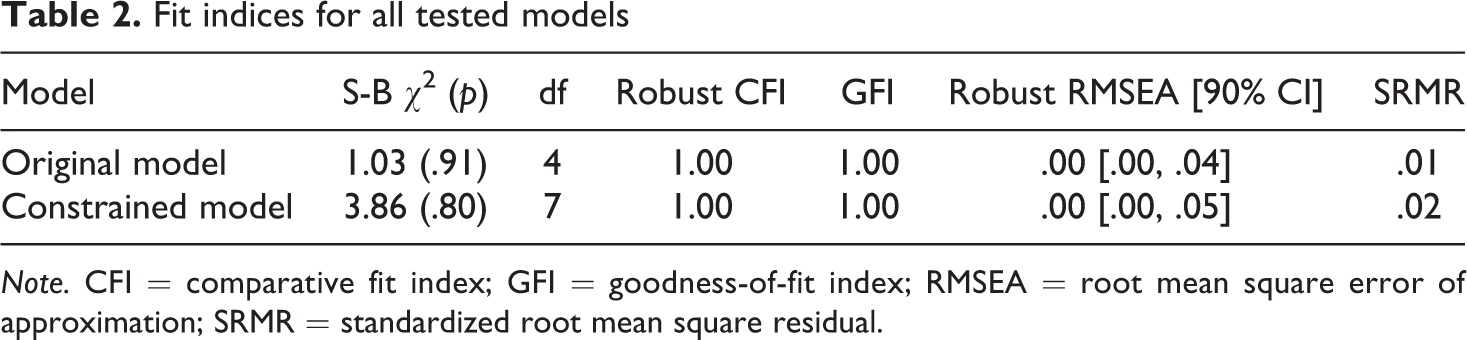
The hypothesized model was tested first. As illustrated in Figure 1, the men and women’s hostile and benevolent sexism served as predictor variables, while their relationship adjustment served as outcome variables. Relationship length was entered as a covariate, given that it significantly correlated with the women’s outcome variable (see Table 1). As recommended when analyzing dyadic data using structural equation modeling, predictor variables were allowed to correlate with one another (Kenny et al., 2006). Similarly, the covariance between the error terms of outcome variables was also permitted. As presented in Table 2, the model provided a good fit for the data, with all goodness-of-fit indices indicating acceptability. The results revealed that 6 of the 10 paths in the model were significant. More precisely, the women’s hostile sexism was negatively associated with their own and their partner’s relationship adjustment, whereas their benevolent sexism was positively associated with both partners’ outcomes. The results also revealed that the men’s hostile sexism was negatively associated with their own relationship adjustment, but not with their partner’s relationship adjustment. The paths between the men’s benevolent sexism and the outcome variables were not significant. Finally, the length of relationship was negatively associated with the women’s relationship adjustment, but not with the men’s.
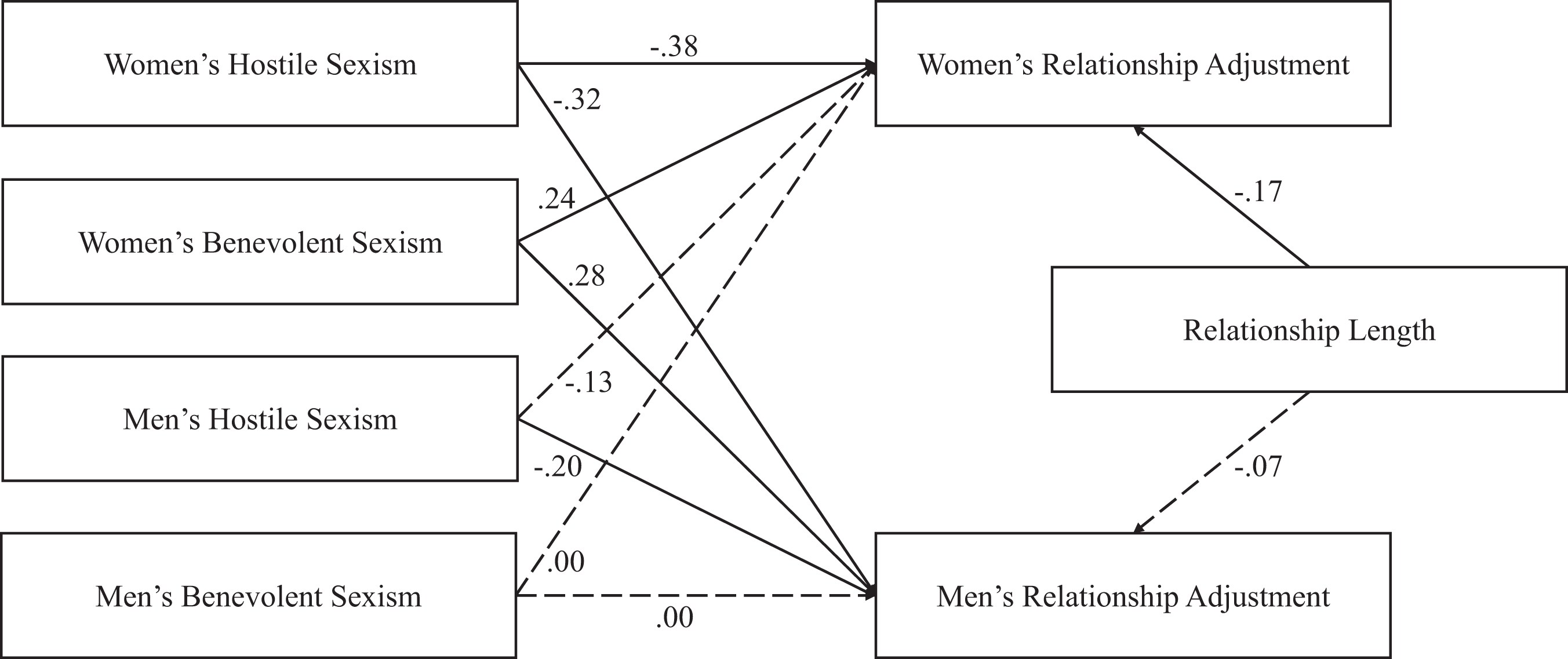
The constrained actor-partner interdependence model predicting relationship adjustment. Note. Values represent standardized parameter estimates. A solid line indicates a significant effect (p < 0.05). A dashed line indicates a non-significant effect. All goodness-of-fit indices indicate acceptability.
Fit indices for all tested models
Note. CFI = comparative fit index; GFI = goodness-of-fit index; RMSEA = root mean square error of approximation; SRMR = standardized root mean square residual.
We then proceeded to estimate each predictor variable using the parameter k, which is defined as the partner effect divided by the actor effect (Kenny & Ledermann, 2010). Four specific patterns are of particular interest when describing processes in dyadic relationships: the couple, the contrast, the actor-only, and the partner-only patterns. A couple pattern, represented by a k value near 1, takes place when the actor and partner effects are non-zero and equal in size. When the actor and partner effects are of equal size, but opposite signs, a contrast pattern, indicated by a k value near −1, is obtained. A k value near 0 indicates an actor-only pattern: a respondent’s outcome variable is influenced by his or her predictor variable, but not by his or her partner’s predictor variable. Finally, if the data are consistent with a partner-only pattern, which means that a respondent’s outcome variable is influenced by his or her partner’s predictor variable, but not by his or her own predictor variable, the k value will be higher than 1.
In this study, four k parameters were computed. The values of k parameters for benevolent sexism suggest an actor-only pattern for the women’s relationship adjustment (k = −.21) and a partner-only pattern for the men’s relationship adjustment (k = 7.67). These patterns suggest that both men and women report greater relationship adjustment when women (but not men) are high in benevolent sexism. Regarding hostile sexism and men’s relationship adjustment, results are consistent with a couple pattern (k = .83), suggesting that men’s relationship adjustment is equally and negatively affected by his and his partner’s hostile sexism. Results for hostile sexism also suggest a pattern in between the actor-only and the couple pattern for the women’s relationship adjustment (k = .37), indicating that the actor effect is greater in magnitude than the partner effect, without the latter being zero.
One of the advantages of computing k values is that it allows researchers to impose constraints on parameters based on the detected dyadic patterns, in order to construct a more parsimonious, conceptually meaningful, and powerful model (Garcia et al., 2015; Kenny & Ledermann, 2010). It is then recommended to compare the constrained model with the original model implying no specific pattern, by using the chi-square difference statistic test. If the test is nonsignificant, it favors the simpler constrained model; otherwise, the more complicated original model must be chosen as the final model. In the current study, three k values were consistent with dyadic patterns of interest: an actor-only, a partner-only, and a couple pattern. The fourth k value was in between two idealized patterns, which suggests that none of the dyadic patterns of interest takes place. Hence, we specified the original model by imposing three constraints only. As shown in Table 2, the constrained model presented in Figure 1 provided a good fit for the data. Moreover, the Satorra-Bentler scaled chi-square difference test between the original model and the simpler constrained model was nonsignificant, Δχ 2 (3, N = 219) = 2.65, p > .05. The constrained model was therefore considered our final model. This model accounted for 10% and 13% of the variance in the men and women’s relationship adjustment, respectively.
Discussion
The results of this study provide insight into young adult romantic partners’ endorsement of ambivalent sexism and its impact on both partners’ relationship adjustment. Our findings with regard to young adults’ endorsement of “hostile” and “benevolent” attitudes were consistent with previous work on ambivalent sexism among adults (e.g., Napier et al., 2010): we found that young adult women were less likely than young adult men to endorse both hostile and benevolent sexist attitudes. Furthermore, as expected, men who more strongly endorsed hostile sexism tended to report lower relationship adjustment. The women’s hostile sexism was also negatively related to their own and their partners’ relationship adjustment. In contrast, the women who more strongly endorsed benevolent sexism reported higher levels of relationship adjustment, and their partners did too. However, contrary to what we hypothesized, the men’s ambivalent sexism was unrelated to their partners’ relationship adjustment and their benevolent sexism was also unrelated to their own relationship adjustment. In sum, these results revealed that ambivalent sexism plays a role in young adults’ perceptions of the quality of their romantic relationship, but gender differences exist.
Our finding that actor hostile sexism was associated with lower relationship adjustment is consistent with earlier research for men (Hammond & Overall, 2013; Overall et al., 2011) and provides new insights for women whose hostile sexism has been understudied. The actor effect of hostile sexism for men can be understood in light of previous studies revealing that newly married heterosexual couples are more likely to divorce when the husband is not willing to be influenced by his wife (Gottman et al., 1998). Men who endorse hostile sexism are also considered more likely than those who do not endorse hostile sexism to perceive their partners’ behaviors negatively, possibly because they fear that their partners are trying to control them in their relationship (Hammond & Overall, 2013). Overall and colleagues (2011) found that men who more strongly endorse hostile sexism show greater hostility during couples’ conflictual discussions, which makes them less successful in obtaining desired changes from their partner. A decreased ability to influence their partner may be especially harmful for their own relationship adjustment as their hostile sexist attitudes may lead them to interpret this lack of influence particularly negatively. Our results would also be consistent with previous findings revealing that men demonstrating higher hostile sexism benefit less from romantic relationships (Waddell et al, 2019). Overall, our results, combined with previous findings, support the idea that even though hostile sexism protects men’s societal advantages, it comes with costs to their romantic relationships (Hammond & Overall, 2013; Overall & Hammond, 2018). However, one could argue that hostile sexist men may not always perceive these costs as problematic as they may give more importance to having submissive partners allowing them to endorse traditional gender roles than to feel close to or loved by their partner.
Our findings for women are also interesting as relatively little research has focused on the consequences of women’s hostile sexism. The available research has revealed that in spite of belonging to the target group of gender discrimination, some women endorse hostile sexist beliefs, and the more they do, the more they internalize them as well (e.g., Becker, 2010; Becker & Wagner, 2009). Our results suggest that young adult women tend to hold low levels of hostile sexism: on average, the women in our sample tended to disagree with the hostile sexist statements that comprised the hostile sexism scale. Nevertheless, levels of hostile sexism varied from one woman to another and were negatively associated with their and their partners’ relationship adjustment. This may be due to the fact that women who less strongly reject hostile sexism may be more likely to engage in behaviors that have consequences for the relationship. For instance, they may be less fervently opposed to the idea of sometimes using their interpersonal capacity “unfairly” to undermine their partner’s power in the relationship (Glick & Fiske, 1996; Hammond & Overall, 2013b). These behaviors could explain why their partners report lower relationship adjustment. In contrast, women who fervently oppose hostile sexism could experience higher levels of relationship quality—as could their partner—because they are more likely to believe in gender equality. It has actually been documented that young adults tend to express greater preferences for egalitarian partnerships compared to previous generations (Gerson, 2010).
Research has documented that men’s endorsement of hostile sexism can have many negative implications for women in our society. For instance, hostile sexism predicts greater acceptance of gender income inequality and more negative perceptions of female breadwinners than of women portrayed in traditional roles (Connor & Fiske, 2019; Gaunt, 2013). Other research suggests that hostile sexist attitudes hinder women’s autonomy by being associated with perceptions that men have the right to constrain women’s reproductive choices (Patey et al., 2019; Petterson & Sutton, 2018) and maternal behaviors (Huang et al., 2020) Men who more strongly endorse hostile sexism are reported to be more physically and verbally aggressive toward their partners (e.g., Forbes et al, 2004; Martinez-Pecino & Durán, 2019) and women experience more severe problems in their relationship when their partners more strongly endorse hostile sexism, including jealousy, gender-role conflict, abuse, affairs and addiction (Cross & Overall, 2019). Considering these significant costs for women, the absence of a link between men’s hostile sexism and women’s relationship adjustment in our study is puzzling. Our results could be explained by the fact that hostile sexism is often accompanied by its complementary form—benevolent sexism—which may offset its negative consequences. However, it might be that our research focused on young adults, whereas prior research focused mainly on older and married couples. Younger adult women may not have fully experienced all the negative implications associated with their partners’ hostile sexist attitudes.
A particularly striking finding in our research is that women’s hostile sexism did impact men’s dyadic adjustment, but men’s hostile sexism did not influence women’s dyadic adjustment. More research is necessary to understand this dyadic pattern of results. A possible explanation could be that men and women did not use the same referent when answering the hostile sexism measure, such that women answered according to their perception of their own behaviors, whereas men answered according to their perception of women as a group—or even feminist women in particular—and perceived their partners as differing from this group. If women internalize hostile sexism toward women, it may translate into damaging relationship behaviors, whereas men’s hostile sexism may not translate in their behavior toward their partners if they do not perceive their partners as representative of these stereotypes. Whereas hostile sexism tends to damage intimate relationships, benevolent sexism facilitates intimacy by offering women security of their partners’ devotion, support, and reliability (Overall & Hammond, 2018). Consistent with findings documenting that benevolent sexism is associated with greater life satisfaction (Hammond & Sibley, 2011; Napier et al., 2010), our results revealed that the women’s benevolent sexism was positively associated with their own and their partner’s relationship adjustment. Researchers have argued that women adopt benevolent attitudes because it helps them deal with the threat of hostile sexism by rewarding them with protection, provision, and affection (Glick & Fiske, 2001; Sarlet et al., 2012). By endorsing benevolent sexist attitudes, women may gain power within their romantic relationship, while also meeting gender role expectations of nurturance and warmth (Casad et al., 2015; Overall et al., 2011). Thus, it helps them feel more adequate in their role of romantic partner and experience greater relationship adjustment. Our results are also in line with those of Hammond and Overall (2015) showing that men perceive feeling more intimate, understood, and valued when their partners endorse benevolent sexism. They provided evidence that women with stronger benevolent sexist attitudes led their partner to feel secure in their relationship by being warm, affectionate and supportive during couples’ discussion. Benevolent sexism may therefore be beneficial for men’s relationship adjustment as it encourages women to foster men’s relatedness needs by adopting caring relationship related roles.
Despite the evidence that benevolent sexism seems to promote relationship adjustment, research highlight that it can have important costs for women and gender inequalities. For instance, women’s endorsement of benevolent sexism can hinder the attainment of gender equality by encouraging them to invest in their relationship at the expense of independent achievements (Hammond & Overall, 2017; Overall & Hammond, 2018). Connelly and Heesacker (2012) also argued that by emphasizing how a delicate female nurturer complements a strong male protector, benevolent sexism enhances the sense that society is fairly structured. Hammond and Sibley (2011) found that women’s benevolent sexist attitudes led them to perceive gender relations as fair, which in turn was linked with greater life satisfaction. Following this line of thought, when female partners believe in these attitudes, they are probably less likely to reject the traditional role of housewife, which might help them justify the well-documented iniquity that is generally observed in the family sphere, such as in terms of the division of household labor (Lachance-Grzela & Bouchard, 2010). Thus, this would lessen the dissatisfaction that tends to arise from unbalanced division of housework (Charbonneau et al., 2020). Taken together, these findings and ours could imply that endorsing the ideology positioning women as deserving of men’s adoration and protection and men as needing women would help young adult women perceive their gender roles as fair, thereby preserving their and their partners’ relationship adjustment. In spite of the rewards it can bring on the relational level, women’s endorsement of benevolent sexism can hinder the attainment of gender equality by encouraging them to invest in their relationship at the expense of independent achievements (Hammond & Overall, 2017; Overall & Hammond, 2018).
In contrast, the associations between the men’s benevolent sexism and their own and their partner’s relationship adjustment were both nonsignificant. These findings differ from previous studies on life satisfaction, which suggested that men’s endorsement of benevolent sexism was related to their level of life satisfaction (Connelly & Heesacker, 2012; Hammond & Sibley, 2011), and with studies on women’s attraction to benevolent men (Bohner et al., 2010; Gul & Kupfer, 2019). Considering that life satisfaction and relationship adjustment tend to be related, our results are somewhat surprising. However, our focus on young adults may partly explain the divergence between our findings and previous results. Young adult men and women are more likely to favor gender equality than previous generations (Gerson, 2010). Yet, Hammond and Overall’s (2015) study revealed that the patterns of support behaviors prompted by benevolent sexism foster traditional heterosexual relationships by placing men in a high-status leadership role and women in a low-status caregiving relationship role. Young adult couples may not benefit as much as older couples when the male partner endorses such attitudes, because young women may be more likely to recognize their negative undertones. Previous results have suggested that young women tend to be particularly attracted to men who endorse more benevolent sexist attitudes (Gul & Kupfer, 2019). It is possible that the downsides associated with men’s benevolent sexism (e.g., increased dependency, pressure to adhere to traditional gender roles) are more salient for women during the relationship stage than during the courtship stage, and thus offset the advantages they could have derived from their partner holding benevolent sexist attitudes. This could help explain why men’s benevolent sexism is not associated with relationship adjustment either among themselves or their partners.
Limitations and future directions
Although the current study makes important contributions to our understanding of ambivalent sexism in the context of romantic relationships among young adults, there are several limitations that warrant discussion. The participants forming our sample were mostly homogenous with respect to educational level, ethnicity, age, geographic location, and sexual orientation. Similarly, our data having been gathered in Canada, a country known for its relatively high levels of gender equality, might underestimate the links between ambivalent sexism and relationship quality among romantic couples. Future research might build on our findings with a more diverse sample. In addition, the correlational nature of the current study prevents causal conclusions. We know little about whether relationship attitudes or experiences explain the level of endorsement of ambivalent sexism. It is possible, for example, that men who perceive their romantic partners more negatively end up facing more negative relationship experiences or, rather, that men who go through hurtful relationship experiences go on to develop more hostile attitudes toward women (see Hammond & Overall, 2013; Hart et al., 2012). Longitudinal studies could help fill this gap in our understanding of the processes that underpin the endorsement of sexist attitudes. Studying the very encompassing concept of relationship adjustment was an appropriate first step in exploring the general dyadic impact of sexism in intimate relationships. However, future research should aim to understand the more specific underlying dyadic processes that play a role in explaining the associations between sexism and relationship adjustment. Finally, the total variance explained by the chosen model was relatively low. It could be that other relevant variables that were not considered in this study, such as sexist behaviors in the relationship, are equally relevant. Future studies could include other variables known to influence dyadic adjustment to improve the model.
Conclusion
Research combining sexist attitudes and romantic relationships is important for our understanding of both of these domains. Our study extends the literature on these topics by providing support for the idea that the endorsement and the experience of ambivalent sexism can influence couple dynamics early in adulthood. Hostile attitudes toward women are accompanied by relational challenges, and women’s benevolent sexist attitudes, despite being related to relationship adjustment among partners, may have the insidious consequence of confining women’s power to the family sphere, thus limiting their social advancement while maintaining men’s societal dominance.
Footnotes
Funding
The author(s) disclosed receipt of the following financial support for the research, authorship, and/or publication of this article: This research was supported by the Faculté des études supérieures et de la recherche at the Université de Moncton.

Open research statement
As part of IARR’s encouragement of open research practices, the author(s) have provided the following information: This research was not pre-registered. The data used in the research are available. The data can be obtained via email at