



Abstract
Prior research suggests that people hold more favorable impressions of others who make deontological (vs. utilitarian) judgments in sacrificial moral dilemmas. To examine the specific factors underlying this phenomenon, two preregistered studies (N = 644) measured impressions of morality, sociability, and competence of a known target person and investigated their associations with welfare maximization, norm adherence, and general action aversion in presumed moral-dilemma judgments of the target person. Results suggest a reliable positive association between perceived morality and norm adherence in presumed moral-dilemma judgments. Other factors of social impressions and moral-dilemma judgments revealed inconsistent results. The findings underscore the centrality of norm adherence in naïve intuitions of morality.
In a classic thought experiment called the trolley problem, a moral agent must decide whether to let a runaway trolley continue its path and kill five people, or to pull a lever to direct the trolley onto a different path where it would kill one person (Foot, 1967). Moral agents who pull the lever can be described as having made a characteristically utilitarian judgment, in that their judgment maximizes overall welfare (i.e., sacrificing one to save the lives of five; see Conway et al., 2018). Conversely, those who let the trolley continue its path can be described as having made a characteristically deontological judgment, in that their judgment conforms to moral norms relevant to the situation (i.e., do not kill; see Conway et al., 2018). Expanding on a large body of research on the processes underlying moral-dilemma judgments (for a review, see Gawronski et al., 2025), an emerging line of work is concerned with how people perceive others who opt to maximize welfare or abide by moral norms in moral dilemmas. Results of this work suggest that people view others who make deontological judgments more positively than those who make utilitarian judgments (for a review, see Crockett et al., 2021). In the current research, we aimed to gain deeper insights into this phenomenon by distilling three dimensions of social impressions (i.e., morality, sociability, and competence; see Brambilla et al., 2021) and investigating their associations with three factors underlying responses to moral dilemmas (i.e., welfare maximization, norm adherence, and general action aversion; see Gawronski et al., 2017).
Social Impressions and Moral-Dilemma Judgments
Most prior research on the relation between social impressions and moral-dilemma judgments has used a paradigm in which participants rate their impressions of a moral agent who made either utilitarian or deontological judgments in moral dilemmas such as the trolley problem (i.e., trolleyology paradigm). Research using this approach suggests that people view moral agents who made deontological (vs. utilitarian) judgments as more moral (Bostyn & Roets, 2017; Everett et al., 2016; Sacco et al., 2017), more trustworthy (Bostyn & Roets, 2017; Everett et al., 2016; Sacco et al., 2017), more predictable (Turpin et al., 2021), and warmer (Jin & Peng, 2021; Rom et al., 2017), whereas moral agents who made utilitarian (vs. deontological) judgments are perceived as more competent (Rom et al., 2017). Yet, some studies suggest that impressions of moral agents may depend on contextual factors (e.g., whether their social role requires warmth or competence), specific features of the dilemma (e.g., whether harm is caused by action or inaction), and participants’ own moral preference (Bostyn et al., 2023).
While prior research has provided valuable insights into the relation between social impressions and moral-dilemma judgments, the predominant reliance on the trolleyology paradigm involves two major drawbacks. First, the trolleyology paradigm treats welfare maximization and norm adherence as mutually exclusive options, in that endorsement of one necessarily entails rejection of the other (Conway & Gawronski, 2013). Second, the trolleyology paradigm conflates moral preferences with general action preferences, in that welfare maximization typically involves action (e.g., switching the lever), whereas norm adherence typically involves inaction (e.g., not switching the lever; Crone & Laham, 2017). These aspects obfuscate the relation between social impressions and moral-dilemma judgments, because the obtained associations could be driven by any combination of differences in (a) welfare maximization, (b) norm adherence, or (c) general action preferences (Gawronski & Ng, 2025).
The Consequences, Norms, and Generalized Inaction Model
One approach to address these limitations is the CNI model of moral-dilemma responses (Gawronski et al., 2017). To disentangle different factors underlying moral-dilemma judgments, the CNI model employs a battery of real-life dilemmas that systematically vary whether (a) the benefits of acting are greater or smaller than the costs and (b) the action is proscribed or prescribed by moral norms of harm and care. Using multinomial processing tree modeling (Hütter & Klauer, 2016), the CNI model quantifies three morally grounded factors in responses to moral dilemmas (see Figure 1). Welfare maximization is captured by the CNI model’s C parameter (labeled sensitivity to consequences), which reflects the extent to which participants show (a) a preference for action when the benefits of acting outweigh its costs and (b) a preference for inaction when the costs of acting outweigh its benefits (first row in Figure 1). Norm adherence is captured by the CNI model’s N parameter (labeled sensitivity to moral norms), which reflects the extent to which participants show (a) a preference for action when the focal action prevents proximal harm (i.e., when action is prescribed by a prescriptive norm) and (b) a preference for inaction when the focal action causes proximal harm (i.e., when action is prohibited by a proscriptive norm; second row in Figure 1). General action aversion is captured by the CNI model’s I parameter (labeled general preference for inaction vs. action), which reflects the extent to which participants show a preference for inaction versus action across all dilemma variants (third and last rows in Figure 1). Although the three tendencies involve distinct patterns of responses, they are all morally grounded, in that (a) sensitivity to consequences reflects a preference for welfare maximization, (b) sensitivity to moral norms reflects adherence to moral norms surrounding harm and care, and (c) general preference for inaction versus action reflects omission-bias tendencies arising from the perception that harm caused by action is morally worse than equivalent harm caused by inaction (e.g., killing someone is perceived as morally worse than letting someone die; Cushman et al., 2006; Yeung et al., 2022).

CNI Model of Moral Decision-Making Predicting Action Versus Inaction Responses in Moral Dilemmas With Proscriptive and Prescriptive Norms and Consequences Involving Benefits of Action That Are Either Greater or Smaller Than Costs of Action. Reproduced From Gawronski et al. (2017). Reprinted With Permission From the American Psychological Association
Presumed Moral-Dilemma Judgments
Expanding on prior research on social impressions and moral-dilemma judgments, Gawronski (2022) used the CNI model to examine how morally exceptional figures are presumed to differ from others in their moral choices. Across four studies, participants were asked to nominate a person they would deem morally exceptional and indicate how this person would respond to moral dilemmas from the CNI model battery. Participants in various control conditions were asked to do the same for the average person, a morally average public figure, and an influential public figure. Overall, moral exemplars were presumed to be more sensitive to moral norms compared with the average person, morally average public figures, and influential public figures. No reliable differences were found for sensitivity to consequences and general preference for inaction versus action.
While Gawronski’s (2022) findings suggest a link between perceived morality and norm adherence, social impressions are known to differ along three fundamental dimensions: morality, sociability, and competence (Brambilla et al., 2021). Thus, while it is obvious that moral exemplars are perceived to be more moral than others, they may also be perceived as more sociable and more competent, raising questions about the critical dimension(s) driving the obtained difference in norm adherence: Is it driven by differences in perceived morality, sociability, or competence? Moreover, even if moral exemplars are perceived to differ from others only in terms of their morality but not their sociability and competence, Gawronski’s (2022) findings entail the possibility that, beyond impressions of morality, impressions of sociability and competence may also show systematic relations to the three factors underlying moral-dilemma judgments (e.g., perceived sociability being positively related to norm adherence; perceived competence being negatively related to general action aversion). Based on these considerations, the current work aimed to provide a comprehensive analysis of links between the three fundamental dimensions of social impressions (i.e., morality, sociability, and competence) and the factors underlying presumed responses to moral dilemmas (i.e., welfare maximization, norm adherence, and general action aversion).
The Current Research
In two preregistered studies, we asked participants to nominate a specific adult and to rate that adult along various traits pertaining to the dimensions of morality, sociability, and competence. Following this task, participants were presented with a series of moral dilemmas for research using the CNI model and asked to indicate how the nominated person would respond in each scenario. Responses in the moral-dilemma task were analyzed using the CNI model to quantify sensitivity to consequences (i.e., welfare maximization), sensitivity to moral norms (i.e., norm adherence), and general preference for inaction versus action (i.e., general action aversion) in presumed moral judgments. Based on Gawronski’s (2022) findings, we preregistered the hypothesis that perceived morality of the nominated person would be positively associated with sensitivity to moral norms in presumed responses to moral dilemmas. For comprehensiveness, we also preregistered that we would exploratorily test all other possible associations between the three impression dimensions and the three factors underlying presumed moral-dilemma responses.
Transparency and Openness
For each study, we report how we determined our sample size, all data exclusions, all manipulations, and all measures. Study 1 was formally preregistered at https://osf.io/hgr5w/. Study 2 was formally preregistered at https://osf.io/yrhnm/. The data, analysis codes, and research materials of both studies are available at https://osf.io/h7pyj/.
Study 1
Method
Participants
Participants were recruited via a university subject pool and received research credit for an introductory psychology course. Based on sensitivity analyses suggesting a sample of N = 314 was needed to detect a correlation of r = .20 (two-tailed) with 95% power, we preregistered that we would recruit 320 participants for the study. In line with our preregistered exclusion criteria, participants who did not complete the entire study or who provided the same response to all moral dilemmas were excluded from analyses.
We received a total of 350 submissions. Not all participants requested credit for their submissions, and some participants who completed all or most items but failed to submit the study were initially declined their credit and replaced with new participants. Of the 350 submissions received, 33 were duplicate cases wherein participants attempted the study more than once and 25 were incomplete submissions. In accordance with our preregistered exclusion rule, we excluded the 25 participants who did not complete all items of the study. Because we did not anticipate receiving multiple complete submissions from the same participants, we did not preregister any exclusion criterion to deal with such duplicate cases. Thus, deviating from the preregistered data exclusion plan, we retained the first complete submission for two participants who completed the entire study more than once. 1 The final sample included in the analyses was N = 323. Demographics for the final sample are as follows: 73.4% female, 25.7% male, 0.9% other; 27.9% Spanish, Hispanic, or Latino; 57.0% White, 35.0% Asian, 7.4% Black or African American, 5.0% other, 1.9% American Indian or Alaska Native, and 0.3% Native Hawaiian or Pacific Islander; Mage = 19.23 years, SDage = 1.47.
Procedure
Participants accessed the online study using a hyperlink provided upon registration. Participants were first asked to nominate a specific adult; no constraints were placed on who the nominated individual could be. Participants then rated their nominated individual along 18 traits reflecting the impression dimensions of morality, sociability, and competence. Next, participants responded to a battery of moral dilemmas for research using the CNI model by indicating the presumed responses of their nominated individual. Finally, participants answered demographic questions and were debriefed.
Measures
Impressions of the nominated targets were measured along 18 traits using 9-point rating scales with the end-point labels not at all (1) and extremely (9). The 18 traits reflected the impression dimensions of morality, sociability, and competence. Each dimension was captured by six traits (Landy et al., 2016). The traits capturing morality were moral, principled, honest, trustworthy, fair, and responsible; the traits capturing sociability were sociable, warm, friendly, easygoing, extraverted, and playful; the traits capturing competence were competent, capable, intelligent, effective, skillful, and talented. All 18 traits were presented in a fixed random order for all participants.
The moral-dilemma battery included 48 validated dilemmas for research using the CNI model (Körner et al., 2020), which were presented in a fixed random-order. The dilemma battery is comprised with 12 basic scenarios, each with four variants manipulating (a) consequences for the greater good (i.e., the described action produces benefits that are either greater or smaller than the costs) and (b) moral norms (i.e., the described action is either prescribed or prohibited by a moral norm). Each dilemma was accompanied by the question Would <nominated individual> do X in this case? Participants indicated the presumed responses of the nominated individual using a yes (1)—no (0) answer choice.
Data Aggregation Plan
Impression ratings were aggregated by calculating mean ratings across the six items of each dimension to obtain indices of perceived morality, perceived sociability, and perceived competence. Presumed responses to the moral dilemmas were aggregated by summing the number of times the nominated target was presumed to act in each of the four dilemma variants, resulting in four action indices per participant. Inaction indices were obtained by subtracting the indices of action responses from 12 (i.e., the total number of dilemmas per variant). The values of the action and inaction response indices can thus range from 0 to 12. Using these action/inaction indices, we then estimated the three CNI model parameters for each participant individually, following the procedures by Körner et al. (2020). Following Gawronski et al. (2017), we used a fixed estimation algorithm with random start values, two replications, and a maximum of 90,000 iterations. The CNI parameters were estimated with the freeware multiTree (Moshagen, 2010) using the template files provided by Körner et al. (2020).
To permit comparisons with past research using the trolleyology paradigm, the action index for the dilemma variants that parallel the trolley problem (i.e., where the focal action is prohibited for causing proximal harm but brings about greater benefits than costs) is regarded as reflecting the nominated target’s relative preference for utilitarian over deontological judgments. We refer to this index as traditional score, which we analyzed in non-preregistered exploratory analyses.
Data Analytic Plan
We preregistered that we would first examine zero-order correlations between the three impression dimensions (i.e., morality, sociability, and competence) and the three factors underlying presumed responses to moral dilemmas (i.e., sensitivity to consequences, sensitivity to moral norms, and general preference for inaction vs. action). We also preregistered that, expanding on the correlational analyses, we would conduct multiple-regression analyses to examine unique associations between the three impression dimensions and the three CNI model parameters. To this end, we simultaneously regressed each of the three CNI model parameters onto the indices of perceived morality, sociability, and competence.
Results
Descriptive statistics of the study variables are provided in Table 1. The measures of perceived morality (Cronbach’s α = .86, mean inter-item correlation = .52), sociability (Cronbach’s α = .83, mean inter-item correlation = .46), and competence (Cronbach’s α = .84, mean inter-item correlation = .48) had good internal consistencies, and showed no major deviations from normality (Table 1).
Descriptive Statistics of Impression Dimensions, CNI Model Parameters, and Traditional Dilemma Score
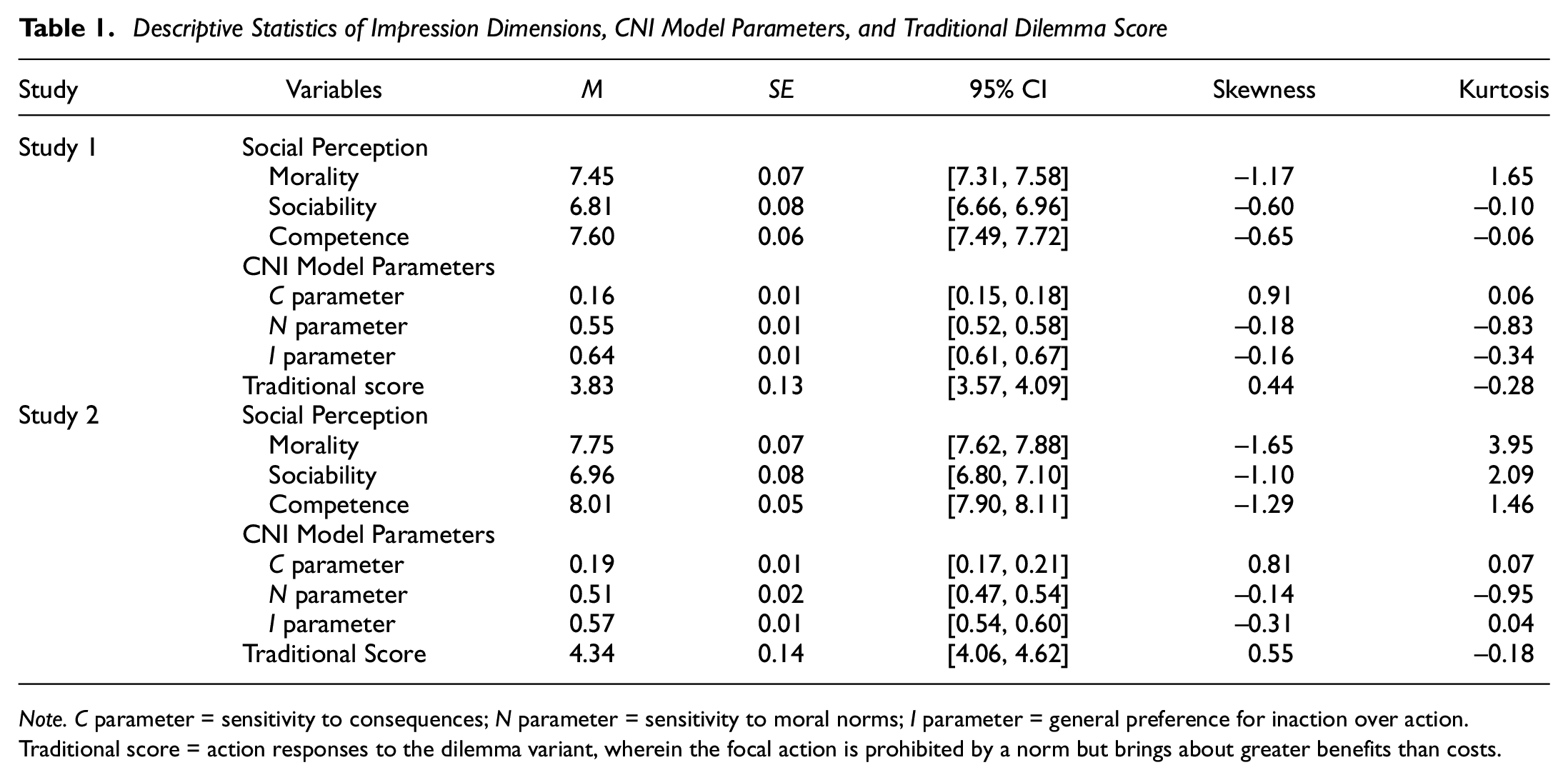
Note. C parameter = sensitivity to consequences; N parameter = sensitivity to moral norms; I parameter = general preference for inaction over action. Traditional score = action responses to the dilemma variant, wherein the focal action is prohibited by a norm but brings about greater benefits than costs.
Correlational Analyses
Table 2 presents the zero-order correlations between the three impression dimensions and the three factors underlying presumed responses to moral dilemmas. As hypothesized, we found a significant positive correlation between perceived morality and sensitivity to moral norms in presumed moral-dilemma judgments. In addition, our analyses revealed a significant positive correlation between perceived competence and sensitivity to moral norms in presumed moral-dilemma judgments.
Zero-Order Correlations Between Impression Dimensions and CNI Model Parameters
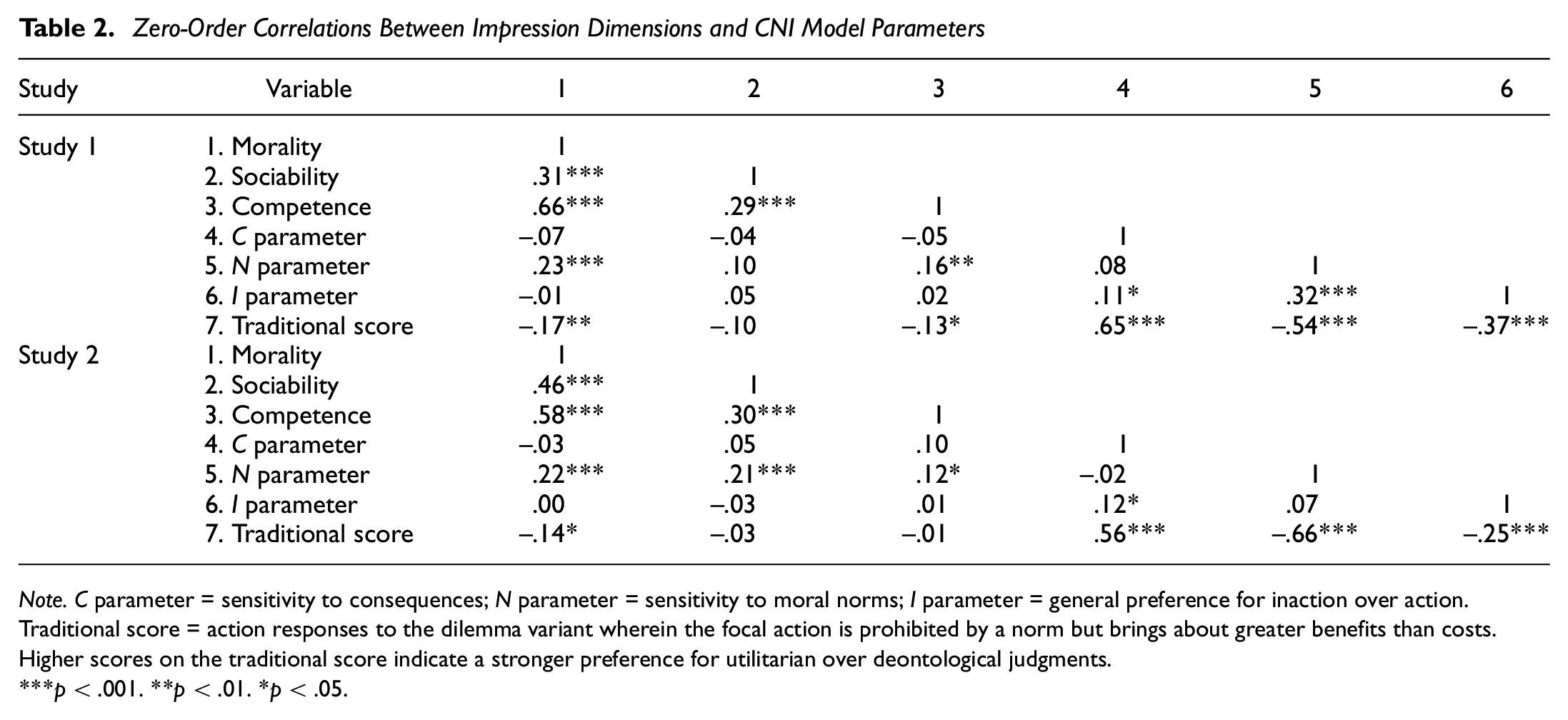
Note. C parameter = sensitivity to consequences; N parameter = sensitivity to moral norms; I parameter = general preference for inaction over action. Traditional score = action responses to the dilemma variant wherein the focal action is prohibited by a norm but brings about greater benefits than costs. Higher scores on the traditional score indicate a stronger preference for utilitarian over deontological judgments.
p < .001. **p < .01. *p < .05.
Multiple-Regression Analyses
Table 3 presents the results of multiple-regression analyses regressing each of the three CNI model parameters onto the three impression dimensions. After controlling for shared variances between the three impression dimensions, perceived morality remained positively associated with sensitivity to moral norms in presumed responses to moral dilemmas. The positive association between perceived competence and sensitivity to moral norms became nonsignificant.
Results of Multiple-Regression Analyses Regressing CNI Model Parameters Onto the Three Impression Dimensions of Morality, Sociability, and Competence
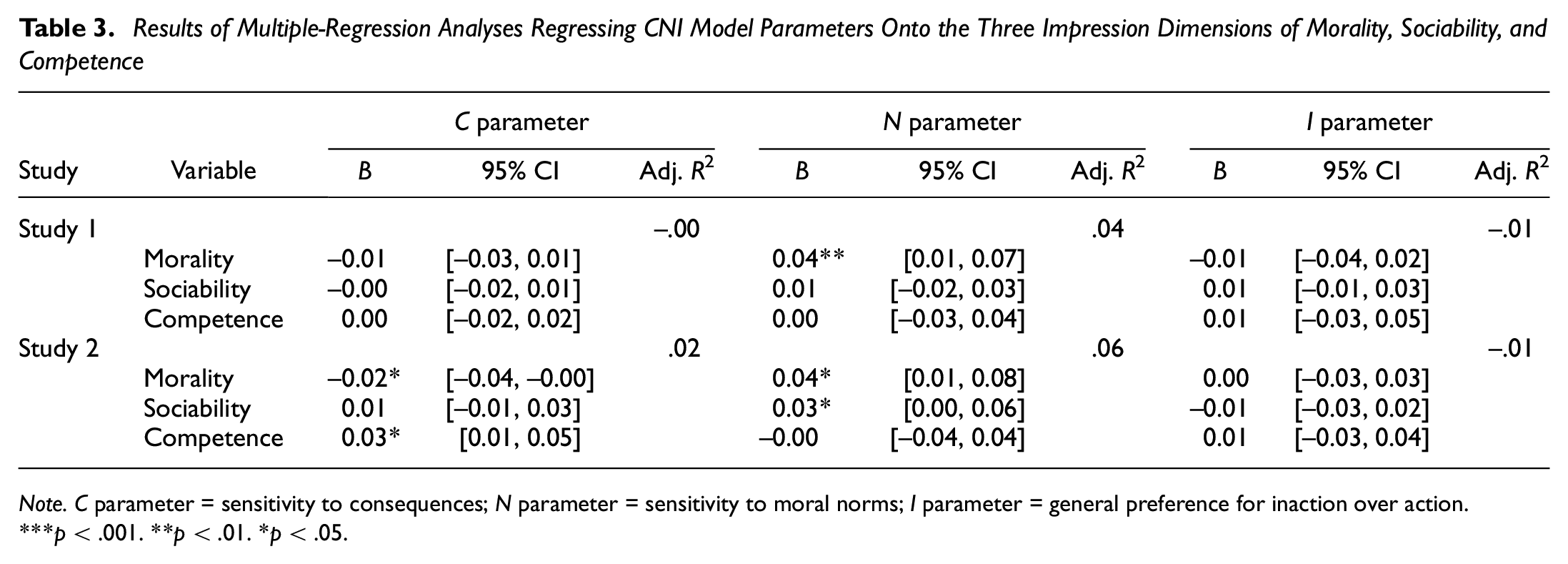
Note. C parameter = sensitivity to consequences; N parameter = sensitivity to moral norms; I parameter = general preference for inaction over action.
p < .001. **p < .01. *p < .05.
Traditional Dilemma Analyses
Perceived morality and perceived competence were negatively correlated with relative preference for utilitarian over deontological judgments in presumed responses to moral dilemmas (see Table 2). After controlling for shared variances between the three impression dimensions in a multiple-regression analysis, only perceived morality showed a significant negative association with relative preference for utilitarian over deontological judgments in presumed responses to moral dilemmas (see Table 4).
Results of Multiple-Regression Analyses Regressing the Traditional Score Onto the Three Impression Dimensions of Morality, Sociability, and Competence
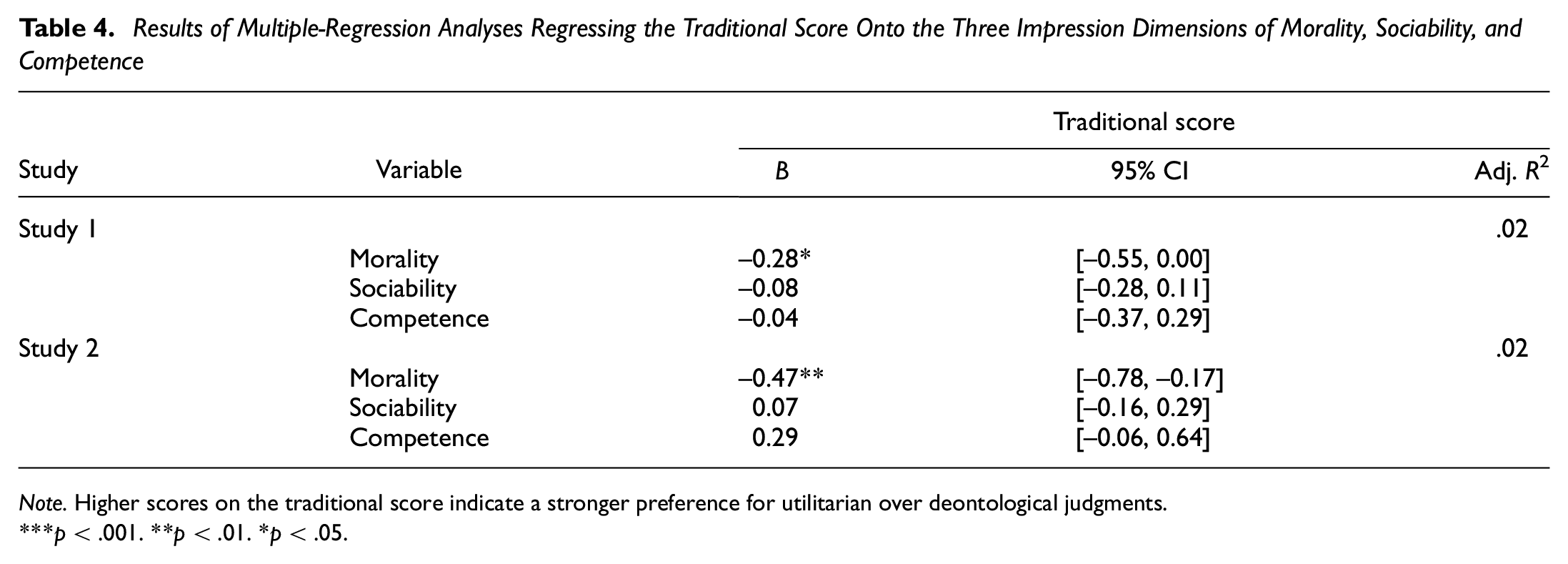
Note. Higher scores on the traditional score indicate a stronger preference for utilitarian over deontological judgments.
p < .001. **p < .01. *p < .05.
Discussion
Consistent with prior research, perceived morality was negatively associated with relative preference for utilitarian over deontological judgments in presumed responses to moral dilemmas. Analyses with the CNI model further revealed that this association is driven by a positive association between perceived morality and sensitivity to moral norms. Perceived morality was not reliably associated with sensitivity to consequences and general preference for inaction versus action. Although prior research suggests that perceived competence is linked to greater relative preference for utilitarian over deontological judgments (Rom et al., 2017), our correlational analyses revealed the opposite pattern. However, this association disappeared in the multiple-regression analyses controlling for shared variances between the three impression dimensions. Overall, there were no reliable associations involving perceived sociability and perceived competence, and there were no reliable associations involving sensitivity to consequences and general preference for inaction versus action.
A notable limitation of Study 1 is that the measure of social impressions included only positively worded traits, making it susceptible to acquiescence bias. To address this limitation, Study 2 sought to replicate the findings of the first study using a modified measure of social impressions that includes both positive and negative traits for each of the three dimensions.
Study 2
Method
Participants
Participants were recruited via a university subject pool and received credit for research participation for an introductory psychology course. Sensitivity analyses, sample size determination, and preregistered exclusion criteria were identical to Study 1. Study 2 had a total of 330 submissions. As in Study 1, some participants completed all or most items but failed to submit the study and were thus initially replaced with new participants. Of the 330 submissions, seven were incomplete cases and 14 were duplicate submissions. All incomplete submissions were excluded. Of the 14 duplicate cases, we retained the submissions of those who had completed all items of the study. In cases where multiple complete submissions were available, we retained the first complete submission. The final sample included in the analyses had 321 participants. Demographics for the final sample are as follows: 67.0% female, 28.3% male, 2.8% other, 1.9% preferred not to answer; 32.1% Spanish, Hispanic, or Latino; 61.7% White, 34.0% Asian, 5.3% Black or African American, 7.5% other, 1.2% American Indian or Alaska Native, and 0.3% Native Hawaiian or Pacific Islander; Mage = 18.79 years, SDage = 1.23.
Measures
We modified the social-impression measure to include both positively and negatively worded items. The traits capturing morality were moral, honest, trustworthy, principled, immoral, dishonest, untrustworthy, and unprincipled; the traits capturing sociability were sociable, warm, friendly, extraverted, unsociable, cold, unfriendly, and introverted; the traits capturing competence were competent, capable, intelligent, skillful, incompetent, incapable, unintelligent, and unskillful. Impressions along the 24 traits were measured using the same 9-point rating scale used in Study 1. The traits were presented in a fixed random order. The moral-dilemma task was identical to the one in Study 1.
Data Aggregation and Data Analysis Plan
Ratings of negative traits were reverse coded before averaging responses across items reflecting the same impression dimension. Otherwise, data aggregation and data analyses followed the procedures in Study 1.
Results
Descriptive statistics of the study variables are provided in Table 1. The modified measures of perceived morality (Cronbach’s α = .91, mean inter-item correlation = .55), sociability (Cronbach’s α = .87, mean inter-item correlation = .46), and competence (Cronbach’s = .91, mean inter-item correlation = .56) had good internal consistencies. No major deviations from normality were detected (Table 1).
Correlational Analyses
Table 2 presents the zero-order correlations between the three impression dimensions and the three factors underlying presumed responses to moral dilemmas. Consistent with the results of Study 1, both perceived morality and perceived competence were positively correlated with sensitivity to moral norms in presumed moral-dilemma judgments. Different from Study 1, there was also a significant positive association between perceived sociability and sensitivity to moral norms in presumed moral-dilemma judgments.
Multiple-Regression Analyses
Table 3 presents the results of multiple-regression analyses regressing each of the three CNI model parameters onto the three impression dimensions. Replicating the findings of Study 1, perceived morality remained positively associated with sensitivity to moral norms in presumed responses to moral dilemmas after controlling for shared variances between the three impression dimensions. Also replicating the findings of Study 1, the association between perceived competence and sensitivity to moral norms became nonsignificant in the multiple-regression analysis. Different from Study 1, perceived sociability remained a positive predictor of sensitivity to moral norms. In addition, there was a significant negative association between perceived morality and sensitivity to consequences, as well as a significant positive association between perceived competence and sensitivity to consequences.
Traditional Dilemma Analyses
Perceived morality was negatively correlated with relative preference for utilitarian over deontological judgments in presumed responses to moral dilemmas (see Table 2) and this association remained statistically significant in the multiple-regression analysis controlling for shared variances between the three impression dimensions (see Table 4).
Discussion
Exploratory analyses using traditional scores yielded results consistent with prior research, in that perceived morality was negatively associated with relative preference for utilitarian over deontological judgments in presumed responses to moral dilemmas. More importantly, Study 2 replicated the central finding of Study 1, indicating that this association is driven by a positive association between perceived morality and sensitivity to moral norms. Like Study 1, the results of Study 2 suggest that the obtained positive correlation between perceived competence and sensitivity to moral norms is accounted for by the shared variance between the three impression dimensions. Different from Study 1, Study 2 also obtained significant associations involving sensitivity to consequences, but these associations did not replicate across data analytic approaches (i.e., correlational analyses, multiple-regression analyses). The only novel finding that replicated across data analytic approaches was a positive association between perceived sociability and sensitivity to moral norms. However, because we did not obtain such an association in Study 1, we refrain from drawing conclusions from this finding.
General Discussion
The current research aimed at providing a comprehensive analysis of the links between three fundamental dimensions of social impressions (i.e., morality, sociability, and competence) and three factors underlying responses to moral dilemmas (i.e., welfare maximization, norm adherence, and general action aversion). Using different measures of social impressions and different data analytic approaches, we found a robust positive association between perceived morality and norm adherence in presumed responses to moral dilemmas. Other factors of social impressions and moral-dilemma judgments showed no reliable associations that replicated across the two studies.
Clarifying Relations Between Social Impressions and Moral Judgments
Gawronski (2022) demonstrated that moral exemplars are perceived as more norm adherent compared to others. However, the strong positive correlations between the three impression dimensions (see Table 2) suggest that moral exemplars are likely perceived as more sociable and more competent in addition to being perceived as more moral. Moral exemplars’ greater norm adherence in presumed moral-dilemma judgments could thus be driven by perceptions of morality, sociability, or competence. The current research suggests that norm adherence in presumed moral-dilemma judgments is robustly associated with perceived morality, but not reliably so with perceived sociability and competence.
The current findings also provide further clarity on research suggesting that perceived warmth is negatively related to relative preference for utilitarian over deontological judgments (e.g., Jin & Peng, 2021; Rom et al., 2017). By delineating the warmth dimension into morality and sociability (Brambilla et al., 2021), the current research demonstrates that this association is likely rooted in perceptions of morality rather than sociability.
Although some studies suggest a positive relation between perceived competence and relative preference for utilitarian over deontological judgments (e.g., Jin & Peng, 2021; Rom et al., 2017), perceived competence was not reliably associated with presumed moral-dilemma judgments in the current studies. If anything, our findings suggest a negative (rather than positive) association between perceived competence and preference for utilitarian over deontological judgments. Thus, if there is a link between perceived competence and moral-dilemma judgments, it seems to be much more fragile than the link between perceived morality and sensitivity to moral norms.
Norm Adherence Underlies Favorable Impressions of Deontological Agents
Prior research suggests that people hold more favorable views of moral agents who make deontological judgments compared with those who make utilitarian judgments (for a review, see Crockett et al., 2021). However, because the trolleyology paradigm used in prior research (a) pits utilitarian preferences against deontological preferences and (b) conflates moral preferences with general action preferences (see Gawronski & Ng, 2025), the critical factors underlying favorable impressions of deontological agents remained unclear. The current research indicates that favorable impressions of deontological agents are rooted in a positive link between perceived morality and norm adherence, rather than links with welfare maximization or general action aversion.
Note that, under the CNI modeling approach, sensitivity to moral norms and sensitivity to consequences are independent (see Table 2)—different from the trolleyology paradigm where deontological and utilitarian judgments are treated as mutually exclusive options (Conway & Gawronski, 2013). The independence of norm adherence and welfare maximization in the CNI modeling approach implies that perceived morality could be positively associated with both factors. Yet, in the current research, perceived morality only showed a reliable association with sensitivity to moral norms, but not with sensitivity to consequences.
Another feature of the trolleyology paradigm is that deontological judgments are conflated with inaction (Crone & Laham, 2017), which implies that favorable views of deontological agents could be driven by presumed action aversion. A response pattern of general action aversion can arise from the perception that harm caused by action is morally worse than equivalent harm caused by inaction (e.g., killing someone is perceived as morally worse than letting someone die)—a phenomenon known as omission bias (Cushman et al., 2006; Yeung et al., 2022). The current research demonstrates that favorable views of deontological agents stem specifically from their perceived adherence to moral norms of harm and care, and not omission-bias tendencies.
In line with our findings, research using economic games suggests deontological agents are viewed as more trustworthy and altruistic than their utilitarian counterparts even when they were objectively not (Capraro et al., 2018). The idea that norm-adhering deontological tendencies may be evaluated more positively by others is also supported by work showing that discussing moral dilemmas with others and considering reasons to justify one’s responses increase preference for deontological judgments (Hashimoto et al., 2022; Ng et al., 2025). But why are perceptions of others as moral (vs. immoral) not linked to welfare-maximizing and omission-bias tendencies even though people do exhibit such tendencies when resolving moral dilemmas? While prior research using the trolleyology paradigm suggests deontological agents may be preferred because of their predictability (Turpin et al., 2021), welfare-maximization, and omission-bias tendencies could be said to reflect predictable applications of abstract principles, such as always maximize overall welfare and first, do not harm. Hence, accounts referring to predictability do not adequately explain why lay people’s impressions of morality are shaped specifically by perceptions of adherence to moral norms of harm and care but not other moral principles. Future research is needed to identify the mechanisms underlying these findings.
Limitations
We note several limitations of the current work here. First, because both studies recruited a North American undergraduate student sample, the findings’ generalizability is potentially limited. Second, because the current work aimed to examine how social impressions influence presumed responses to moral dilemmas, we always measured social impressions before the moral-dilemma task instead of counterbalancing the task order. It thus remains unclear whether social impressions of nominated targets differ when the targets’ presumed moral-dilemma judgments are considered first. Third, the study was advertised to participants as a study on moral judgments, which could have primed participants to think of moral exemplars. While participants in the current studies largely nominated regular individuals (i.e., friends, family) instead of influential public figures who are moral exemplars like in Gawronski’s (2022) studies (e.g., Abraham Lincoln, Mahatma Gandhi, Martin Luther King), the nominated regular individuals could still be highly moral.
Fourth, while the current research suggests that, on average, people perceive morality as being linked to norm adherence and not to welfare maximization and general action aversion, it is possible that people’s own moral preferences moderate this relationship (Bostyn et al., 2023). For example, individuals who exhibit heightened welfare-maximization tendencies might perceive welfare maximization to be more morally relevant than their counterparts with average or weak welfare-maximization tendencies. Similarly, individuals who exhibit heightened action aversion might perceive general action aversion to be more morally relevant than their counterparts with average or weak action aversion. To the extent that participants with heightened welfare-maximization and heightened action aversion were underrepresented in the current samples, potential associations of the two factors with perceived morality would remain undetected. Future research using more diverse samples and measuring participants’ own moral-dilemma judgments in addition to measuring presumed judgments by a focal target would be helpful to examine potential moderating effects of personal moral preferences on the link between social impressions and presumed moral-dilemma judgments.
Fifth, although the CNI model resolves known confounds associated with the trolleyology paradigm, a notable limitation of the model is its assumed hierarchical structure (Baron & Goodwin, 2020, 2021). Some of the basic dilemmas used are also potentially problematic. To address these issues, we conducted supplementary analyses, which largely corroborate the positive association between perceived morality and sensitivity to moral norms (see Supplemental Materials).
Conclusion
By demonstrating that perceived morality is robustly linked to norm adherence in presumed responses to moral dilemmas, the current research suggests that naïve intuitions about morality emphasize adherence to moral norms of harm and care. In contrast, lay conceptualizations of morality do not seem to emphasize welfare maximization or general action aversion arising from omission-bias tendencies. Moreover, although sociability and competence are two fundamental dimensions of social impressions beyond morality, sociability and competence were not consistently linked to moral-dilemma judgments.
Supplemental Material
sj-docx-1-spp-10.1177_19485506251324689 – Supplemental material for Social Impressions and Moral-Dilemma Judgments
Supplemental material, sj-docx-1-spp-10.1177_19485506251324689 for Social Impressions and Moral-Dilemma Judgments by Nyx L. Ng and Bertram Gawronski in Social Psychological and Personality Science
Footnotes
Handling Editor: Mata André
Declaration of Conflicting Interests
The author(s) declared no potential conflicts of interest with respect to the research, authorship, and/or publication of this article.
Funding
The author(s) received no financial support for the research, authorship, and/or publication of this article.

Supplemental Materials
The supplemental material is available in the online version of the article.
Notes
Author Biographies
References
Supplementary Material
Please find the following supplemental material available below.
For Open Access articles published under a Creative Commons License, all supplemental material carries the same license as the article it is associated with.
For non-Open Access articles published, all supplemental material carries a non-exclusive license, and permission requests for re-use of supplemental material or any part of supplemental material shall be sent directly to the copyright owner as specified in the copyright notice associated with the article.
