




Abstract
Research on moral decision making usually focuses on two ethical principles: the principle of utilitarianism (= morality of an action is determined by its consequences) and the principle of deontology (= morality of an action is valued according to the adherence to moral norms regardless of the consequences). Criticism on traditional moral dilemma research includes the reproach that consequences and norms are confounded in standard paradigms. As a remedy, a multinomial model (the CNI model) was developed to disentangle and measure sensitivity to consequences (C), sensitivity to moral norms (N), and general preference for inaction versus action (I). In two studies, we examined the link of basic personality traits to moral judgments by fitting a hierarchical Bayesian version of the CNI model. As predicted, high Honesty–Humility was selectively associated with sensitivity for norms, whereas high Emotionality was selectively associated with sensitivity for consequences. However, Conscientiousness was not associated with a preference for inaction.
In the German movie “Terror,” the Air Force combat pilot Lars Koch is brought to court because he decided to shoot down an aircraft with 164 passengers kidnapped by terrorists to avoid a terror attack on a soccer stadium. One hundred sixty-four people died as a consequence of his decision. However, if Lars Koch had not shot the plane, the terrorists would have killed 70,000 people by crashing the plane into the stadium. While watching the movie, the German audience had the possibility to vote via internet on the following question: Was it morally justified to kill the 164 passengers on the plane to save the 70,000 people in the stadium?
According to the ethical principle of utilitarianism (Bentham, 1781/2000; Mill, 1861/1998), the answer to this question is “yes.” The principle of utilitarianism states that the morally right behavior is the one that produces the best overall outcome, meaning that the consequences are evaluated independently of the actions that lead to them (valuing the end over means). Conversely, according to the principle of deontology (see, for example, Kant, 1788/2003), killing innocent plane passengers is morally unacceptable. According to this principle, an action is valued according to the adherence of moral rules, rights, duties, or obligations that people must honor (valuing the means over ends). Hence, the morality of an action depends on the intrinsic nature of the action (e.g., killing innocent people is immoral regardless of how many lives may be saved). In case of the movie “Terror,” the TV audience favored the utilitarian principle over the deontological principle. That is, the vast majority (86.9%) of the 609,000 German voters judged Lars Koch to be free from blame (“German TV Terror Drama,” 2016).
However, the utilitarian principle and the deontological principle do not always contradict each other. Conway and Gawronski (2013) developed scenarios in which a morally unacceptable action simultaneously leads to worse outcomes than doing nothing (i.e., inaction). In such a case, the relevant action is unacceptable by both principles. For instance, if a police officer decides to torture a prisoner because he wants to know where the prisoner placed messy but harmless paint bombs, both principles would condemn this act strongly. Nevertheless, there are specific situations that imply a conflict between the two principles.
According to Kohlberg (1969), morality is a product of conscious reasoning. David Hume (Hume et al., 2007), in contrast, proposed that moral judgments are based on intuitions. This idea was revisited by Haidt (2001), who also proposed that moral judgments arise from intuitions generated by automatic cognitive processes. Until now, there is an ongoing debate about these two views (Cushman, 2013; Cushman et al., 2006). Greene and his colleagues (Greene, 2007; Greene et al., 2001, 2008) combined these two theoretical views in a dual-process model of moral decision making, according to which two independent processes lead to deontological and utilitarian decisions. The model assumes that moral dilemmas trigger affective reactions that result in a deontological moral judgment (a harmful action is emotionally unacceptable). However, given sufficient time, cognitive resources, and motivation, this immediate judgment can be overridden by more elaborate cognitive processing, resulting in utilitarian decisions (Conway & Gawronski, 2013; Koop, 2013). 1
Consistent with the dual-process model, Bartels (2008) found that interindividual differences in thinking style are predictive of moral judgments (i.e., utilitarian judgments were more likely for persons with a rational rather than an intuitive thinking style). Furthermore, persons with higher working memory capacity rated the utilitarian option as morally more acceptable (Moore et al., 2008), indicating the role of individual differences in executive control mechanisms as predicted by dual-process theory. 2 Moreover, previous research has established systematic gender differences, with men giving more utilitarian answers to personal moral dilemmas (Friesdorf et al., 2015). However, there is an ongoing discussion as to whether these differences are based on differences in cognitive evaluations of action outcomes, affective responses to harmful actions, or a combination of both (Conway & Gawronski, 2013; Friesdorf et al., 2015). Research has also shown that other higher order processes beyond affective and cognitive influences are involved in moral judgments (Fleischmann et al., 2019), for example, the heuristic application of moral rules (Nichols & Mallon, 2006; Sunstein, 2005) or the influence of different thinking styles such as integration, deliberation, rule, and sentiment moral orientations (Fleischmann et al., 2019). Furthermore, Rom and Conway (2018) showed that social processes such as self-presentation strategies contribute to dilemma judgments.
In moral dilemma research, scholars have emphasized that making a judgment consistent with either the deontological or utilitarian principle does not render one a deontologist or a utilitarian (Kahane, 2015). Researchers in this field often alleviate this problem by using the terms “deontologist” and “utilitarian” in a more descriptive sense, namely, whether moral judgments objectively follow moral norms (= deontological judgment) or objectively maximize the overall outcome in line with a cost–benefit trade-off (= utilitarian judgments). Recently, Conway et al. (2018) suggested a five-level taxonomy of utilitarian judgments. On one extreme (Level 1), a moral judgment can be characterized as utilitarian in a descriptive sense “simply because it favors the greater good, regardless of the mind-set, intentions, or philosophical commitments of the judge” (p. 242). On the other extreme (Level 5), a moral judgment can be classified as utilitarian only if it reflects an explicit commitment to utilitarian principles.
Besides the theoretical definition of utilitarian judgments, there is also the concern that some people may have judgment tendencies in line with the utilitarian principle without thinking that the deontological option is somehow wrong (Conway & Gawronski, 2013). The standard moral dilemma paradigms used in this kind of research describe causal scenarios in which participants have to decide either for or against an intervention that leads to a more desirable outcome with higher utility (i.e., saving the lives of a number of people) while being morally wrong on deontological grounds (i.e., sacrificing a life). However, the structure of these dilemmas is not without problems. Besides the debate whether scenarios such as the trolley problems are seen as unrealistic or (in the worst case) as amusing to participants (Bauman et al., 2014), the more severe theoretical issue is whether these dilemmas can, in principle, measure people’s sensitivity for moral norms and consequences (Gawronski et al., 2017).
As pointed out before, deontological judgments are defined as being sensitive to moral norms, whereas utilitarian judgments are defined as being sensitive to consequences. Therefore, to interpret moral decision making as being deontological, it is necessary to test whether answers consistently adhere to moral norms across multiple scenarios even if these scenarios differ with respect to cost–benefit trade-offs (i.e., utilitarian reasoning; Gawronski & Beer, 2017). As Gawronski et al. (2017) pointed out, “the most significant limitation in this regard is the exclusive focus on proscriptive norms (i.e., norms that specify what people should not do) without any consideration of prescriptive norms (i.e., norms that specify what people should do)” (p. 345). Moreover, another problem of the sole focus on proscriptive norms is the confound of sensitivity to moral norms with general preference for inaction (see Gawronski et al., 2016). 3 A similar problem concerns the measurement of utilitarian judgments. In the classical dilemma structure, if a participant is willing to accept the death of one person to save the life of several others, it is usually assumed that she makes a utilitarian judgment. However, if this participant would still accept the death of one person even if only one other person or nobody would have been saved, the observed decision should not be classified as utilitarian (for a more detailed discussion of these problems, see Gawronski et al., 2017). In this case, the person may have a tendency to accept any default implied by the scenario.
However, other scholars have argued that decisions following proscriptive or prescriptive norms cannot directly be compared. Haidt and Baron (1996), for example, showed that harmful acts were generally rated as more blameworthy than harmful omissions. Moreover, harmful acts and omissions were differentially affected by information about social roles (e.g., authorities were judged more harshly than equals or subordinates). Harmful acts can be seen as cases of proscriptive immorality, whereas harmful omissions represent cases of prescriptive immorality. Similarly, Cushman et al. (2006) examined the influence of the factors action (action vs. omission), intention (intended harm vs. side-effect harm), and contact (contact vs. no contact) on moral-wrongness ratings. Overall, participants rated (a) harmful actions as morally worse than harmful omissions, (b) harm intended as the means to an end as morally worse than harm occurring as a side effect, and (c) harm that involved direct contact as morally worse than harm without contact.
To summarize, research on utilitarian and deontological principles in moral judgments requires measuring the sensitivity for consequences and moral norms independently. However, the structure of classical moral dilemmas that pit the two principles against each other is not appropriate for disentangling these concepts. Moreover, focusing only on proscriptive norms confounds deontological answers with a general preference for inaction. As a remedy for these problems, Gawronski et al. (2017) developed a multinomial measurement model that disentangles different preferences relevant in moral decision making.
The CNI Model of Moral Decision Making
Multinomial measurement models are stochastic models that allow researchers to disentangle multiple latent cognitive processes underlying categorical responses. These models have many advantages and have become popular in social and cognitive psychology (for reviews, see Batchelder & Riefer, 1999; Erdfelder et al., 2009; Hütter & Klauer, 2016). Gawronski et al. (2017) developed a multinomial model that disentangles sensitivity to consequences, sensitivity to moral norms, and general preference for inaction versus action in moral dilemmas (see Figure 1). By comparing participants’ responses (action vs. inaction) with four types of dilemmas across multiple scenarios, researchers can estimate the probability that responses to a given dilemma are driven by consequences (parameter C), by moral norms (parameter N), or by a general preference for inaction versus action irrespective of consequences and norms (parameter I). Each of these three parameters represents the probability with which certain cognitive processes occur. First, parameter C represents the case that consequences drive the responses to the four types of moral dilemmas (= utilitarian response pattern). Second, parameter N represents the conditional probability that responses to the four types of dilemmas are driven by moral norms given that consequences do not drive responses (= deontological response pattern). Third, parameter I represents the conditional probability that responses to the four types of dilemmas reflect a general preference for inaction given that neither consequences nor moral norms drive responses. In a series of experiments, Gawronski et al. (2017) demonstrated the validity and usefulness of the CNI model.
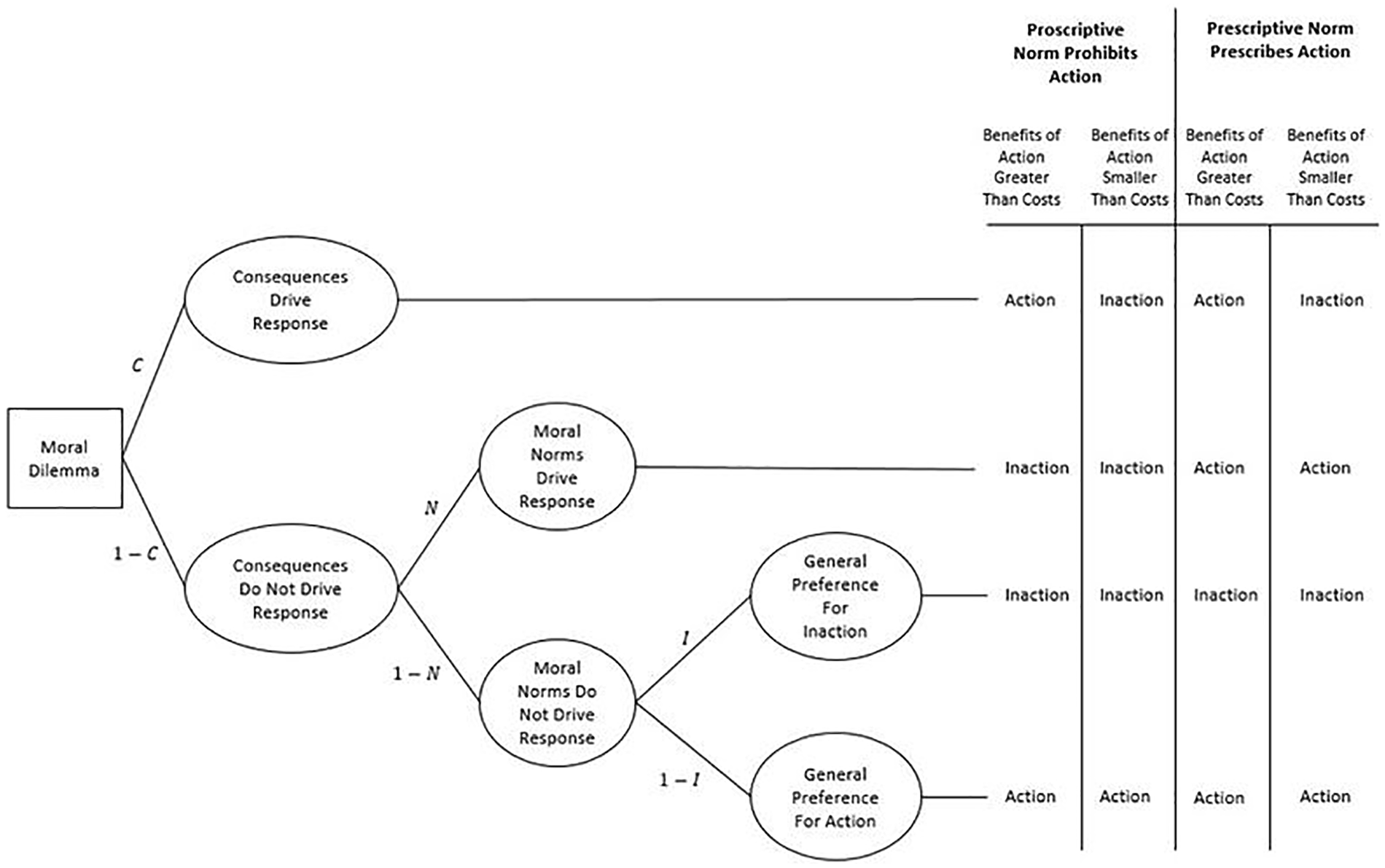
The CNI model predicts “action” versus “inaction” responses in moral dilemmas that differ with respect to proscriptive versus prescriptive norms and the type of consequences, involving benefits of action that are either greater or smaller than costs of action.
Besides disentangling different processes in moral decision making within an individual, research has also focused on individual differences between individuals. For example, classical dilemma research showed that psychopaths often make utilitarian decisions (Bartels & Pizarro, 2011; Kahane et al., 2015; but see Cima et al., 2010, and Glenn et al., 2009, for different results). However, given the utilitarian definition discussed above, this would mean that psychopaths have a higher sensitivity for morally relevant consequences in comparison with nonpsychopathic participants. When using the standard moral dilemmas, it is not possible to differentiate whether participants with high levels of psychopathy show a strong utilitarian tendency or whether they are simply more willing to accept harmful actions (regardless of the number of people they have to sacrifice). In two experiments, Gawronski et al. (2017) showed that participants with high levels of (subclinical) psychopathy have significantly lower sensitivity for moral norms (= N parameter) in comparison with participants with low levels of psychopathy. The effect of psychopathy on sensitivity for consequences (= C parameter) and preference for inaction (= I parameter) was less clear (only in one of two studies, an effect on both parameters emerged).
The example of psychopathy shows that the CNI model opens up new possibilities for explaining interindividual differences in moral decision making. As a first step in this direction, the present studies aimed at linking basic personality traits to the sensitivity for norms, consequences, and the general preference for inaction. Whereas Gawronski et al. (2017) compared two extreme groups using a median split (high vs. low levels of subclinical psychopathy), we investigate the link of basic personality traits with the three cognitive processes measured by the CNI model. More precisely, we derive and test three hypotheses based on the HEXACO model of personality, which assumes the six basic trait dimensions Honesty–Humility, Emotionality, Extraversion, Agreeableness, Conscientiousness, and Openness to Experience (Ashton et al., 2014; Ashton & Lee, 2007, 2008).
Our first hypothesis concerns Honesty–Humility, the first dimension of the HEXACO model of personality that refers to characteristics such as sincerity, modesty, and fairness. Honesty–Humility has been linked to moral decision making such as cooperation in social dilemmas (e.g., Hilbig et al., 2012; Klein et al., 2017; Mischkowski & Glöckner, 2016), preferences for ethical business decisions (Lee et al., 2008), and cheating behavior in general (Heck et al., 2018; Zettler & Hilbig, 2015). Moreover, Djeriouat and Trémolière (2014) recently showed that the well-known link between the Dark Triad of personality (Machiavellianism, subclinical narcissism, and subclinical psychopathy; Paulhus & Williams, 2002) and moral utilitarianism is negatively mediated by Honesty–Humility (see also Lee & Ashton, 2005). They concluded that this result was due to a lower concern for prosocial altruistic behavior in participants with high levels in psychopathy. Overall, these results show that high levels in Honesty–Humility are related to more prosocial concerns and, thus, lead to our first hypothesis:
Given the inconclusive results from Gawronski et al. (2017) between subclinical psychopathy and sensitivity for consequences, we expected a null effect for the association of Honesty–Humility with the parameter C.
Our second hypothesis concerns the factor Emotionality from the HEXACO personality inventory, which represents constructs such as empathic concern, sensitivity, harm avoidance, and help seeking. According to Greene’s dual-process theory (Greene, 2007; Greene et al., 2001, 2008), the idea of causing harm triggers automatic emotional responses that lead to an inclination toward deontological judgments. In contrast, utilitarian judgments result from effortful cognitive processes. From this dual-process perspective, differences in affective processing (i.e., in the personality trait Emotionality) should lead to differences in moral decision making. Support for this idea also comes from research linking gender differences to moral decision making. Research has shown that women and men differ in emotional processing: Women tend to experience stronger emotions and express more emotions (Cross & Madson, 1997). In a meta-analysis using the moral dilemmas developed by Conway and Gawronski (2013), Friesdorf et al. (2015) found that men had an overall stronger preference for utilitarian judgments. A process–dissociation analysis showed that this difference was mostly due to stronger deontological inclinations among women than among men, 4 which led Friesdorf et al. to conclude that “most of the variance in relative preferences for utilitarian over deontological judgments stems from gender differences in affective reactions to causing harm” (p. 13). Potentially, this gender difference may be due to the fact that on average, men score about one standard deviation lower in the personality trait Emotionality than women (Ashton et al., 2014; Yoo et al., 2004). Overall, these results suggest that interindividual differences in Emotionality are associated to moral decision making. Hence, our second hypothesis is as follows:
However, according to dual-process theory, Emotionality has no influence on (more effortful) utilitarian judgments. Based on these premises, we expected a null effect of Emotionality on parameter C.
Our third and final hypothesis concerns the Conscientiousness dimension of the HEXACO inventory, which corresponds to engagement in task-related endeavors (working, planning, organizing, decision making). As discussed above, a major problem of classical dilemma research is the confound between sensitivity to moral norms or consequences with general preference for inaction. As a remedy, the CNI model allows measuring the preference for inaction independently from utilitarian or deontological reasoning. Because persons high in Conscientiousness are organized, precise, and persistent, whereas persons low in Conscientiousness tend to make more impulsive decisions and avoid difficult tasks (Ashton & Lee, 2001, 2007), our third hypothesis states the following:
Because the personality trait Conscientiousness is primarily concerned with task performance, we did not expect to find a link between Conscientiousness and the other two parameters of the CNI model.
Study 1
Method
Participants
One hundred forty-two participants were recruited online via internet communities. Of these, 137 participants (102 females) fulfilled the criteria for inclusion (i.e., above 18 years, given approval to informed consent, and completion of all tasks). Participants’ age ranged from 18 to 87 years (M = 27.4 years, SD = 12.2 years).
Materials
Moral dilemmas
Participants were asked to work on three moral dilemmas in each of the four conditions of the CNI model shown in the columns of Figure 1. These 12 dilemmas, originally developed by Gawronski et al. (2017), include four parallel versions of the assisted suicide dilemma, the torture dilemma, and the transplant dilemma (see Supplemental Appendix A). All dilemmas were phrased in a second-person view, each depicting the participant as an actor who must choose whether or not it is acceptable to perform the described action (“yes” vs. “no”). We used the German versions of the dilemmas, provided by Gawronski et al. (2017) via the Open Science Framework (OSF). The four parallel versions of each dilemma varied in two important aspects matching the columns in Figure 1: First, whether the dilemma involved a proscriptive norm that prohibits action or a prescriptive norm that prescribes action, and second, the benefits of the described action for overall well-being were either greater or smaller than its costs for overall well-being.
Personality
We assessed personality with the German version (Moshagen et al., 2014) of the 60-item HEXACO personality inventory (Ashton & Lee, 2009). Participants rated the statements on a 5-point Likert-type scale ranging from strong disagreement to strong agreement. Internal consistencies were satisfactory for the three traits of interest (Honesty–Humility: α = .71, Emotionality: α = .75, Conscientiousness: α = .67).
Design and procedure
After providing informed consent, participants responded to several items assessing demographic information. Next, half of the participants (N1 = 70) completed the HEXACO-PI first before responding to the moral dilemmas, whereas the other half (N2 = 67) completed the moral dilemmas first before answering the HEXACO-PI.
In line with Gawronski et al. (2017), the 12 moral dilemmas were presented in a fixed pseudo-random order to avoid order effects for the four parallel versions of the three basic scenarios. Similar to Gawronski et al. (2017), we explicitly told our participants that some scenarios may seem similar at first glance, while still being different in important details. Moral decisions were provided by answering either “yes” or “no” to the question whether it is morally appropriate to take the proposed action. There was no time limit for the decisions.
Results
In contrast to the studies by Gawronski et al. (2017), our hypotheses focus on continuous interindividual differences and, thus, forbid an aggregation of response frequencies across participants. Therefore, we fitted the CNI model using a Bayesian hierarchical approach to multinomial processing tree (MPT) modeling (Klauer, 2010; Matzke et al., 2015). This method expands standard MPT models by modeling each of the parameters using a generalized linear regression (Heck et al., 2018; Klauer, 2010). Based on a probit-link function (which resembles the well-known logistic-link function in logistic regression), the probability parameters C, N, and I of the MPT model are modeled by (a) a group-level parameter μ that describes the latent mean of the parameter for the sample, (b) a random intercept δ to account for differences between participants, and (c) one or more regression slopes β to estimate the association of the MPT parameter with external covariates (here, specific personality traits; Heck, Arnold, & Arnold, 2018). Using this methodology, we tested the link between the three parameters of the CNI model and the three trait dimensions of the HEXACO model relevant for our hypotheses. For example, a positive regression weight βC~HH would imply that the probability of being sensitive to moral consequences (parameter C) increases for larger values on the covariate Honesty–Humility. To test the effect of the personality traits Honesty–Humility, Emotionality, and Conscientiousness on the parameters C, N, and I, we use the R package TreeBUGS (Heck, Thielmann, et al., 2018), which fits Bayesian hierarchical MPT models with continuous predictors using Markov chain Monte Carlo methods (Plummer, 2003).
As derived in the introduction, our first hypothesis predicts a positive link of Honesty–Humility to the parameter N but no link to the parameter C. Moreover, based on dual-process theory (Greene, 2007; Greene et al., 2001, 2008), we also expected a positive link of Emotionality to the parameter N, but no link to the parameter C. Finally, we expected to find that Conscientiousness correlates negatively with the parameter I. To test these hypotheses, we fitted a Bayesian hierarchical MPT model that included Honesty–Humility as a predictor of the parameters N and C, Emotionality as a predictor of the parameters N and C, and Conscientiousness as a predictor of parameter I. 5 Model fit was assessed with posterior-predicted p values and indicated a satisfactory fit both with respect to the mean (p = .15) and the covariance structure (p = .06) of the observed individual frequencies as tested by the T1 and T2 statistics proposed by Klauer (2010). The posterior estimates for the group-level parameters of the MPT model (including 95% Bayesian credibility intervals [BCIs]) were N = 0.478, 95% BCI = [0.269, 0.663]; C = 0.351, 95% BCI = [0.303, 0.397]; and I = 0.547, 95% BCI = [0.421, 0.682].
The unstandardized regression coefficient of the effect of Honesty–Humility on parameter N was estimated to be β = 0.765 with a 95% BCI = [0.042, 1.620]. Since the credibility interval excluded zero, this indicates that Honesty–Humility had a substantial influence on parameter N in the sense that higher Honesty–Humility was associated with a higher sensitivity for moral norms. The absolute value of the slope parameter β can be interpreted as a predicted increase of sensitivity for moral norms from 41.1% to 56.9% for participants one SD below versus one SD above the Honesty–Humility group mean, respectively. Furthermore, the one-sided Bayes factor in favor of the directed hypothesis that β was greater than zero versus exactly zero was B10 = 5.06 (Savage–Dickey density ratio; Heck, 2019; Wetzels et al., 2010), and thus indicated evidence for our prediction that low levels in Honesty–Humility are associated with a reduced sensitivity to moral norms. For the link between Honesty–Humility to the C parameter, the credibility interval for the unstandardized regression coefficient did overlap zero (β = 0.098; 95% BCI = [−0.100, 0.301]), indicating that Honesty–Humility had no effect on sensitivity for consequences. This conclusion was supported by the one-sided Bayes factor in favor of a null effect (B01 = 4.4), indicating evidence for a null and against a positive effect.
The unstandardized regression coefficient of the effect of Emotionality on parameter N was estimated to be β = −0.551 with a 95% BCI = [−1.444, 0.225], indicating that Emotionality had no effect on the sensitivity for norms. This conclusion was corroborated by the one-sided Bayes factor (B01 = 7.0). However, the regression slope for Emotionality on parameter C was estimated to be positive, β = 0.273 with a 95% BCI = [0.079, 0.469]. Because the credibility interval excluded zero, this indicates that higher Emotionality resulted in a higher sensitivity for consequences. The absolute value of β can be interpreted as a predicted increase of sensitivity for consequences from 29.6% to 42.0% for participants one SD below versus one SD above the Emotionality group mean, respectively. Moreover, the Bayes factor in favor of the directed hypothesis that β was greater than zero versus exactly zero was B10 = 7.6, indicating evidence for the positive link of Emotionality to the sensitivity for consequences.
The slope for Conscientiousness on parameter I was estimated to be β = 0.256 with a 95% BCI = [−0.123, 0.647], pointing in the opposite direction as predicted. The credibility interval overlapped zero, indicating that Conscientiousness did not have a substantial influence on preference for inaction. Accordingly, the one-sided Bayes factor of B01 = 16.32 showed substantial evidence for a null effect versus a negative effect of Conscientiousness on I (see Table 1 for an overview of all parameter estimates and Bayes factors).
Regression Estimates and Bayes Factors of the Hierarchical CNI Model.
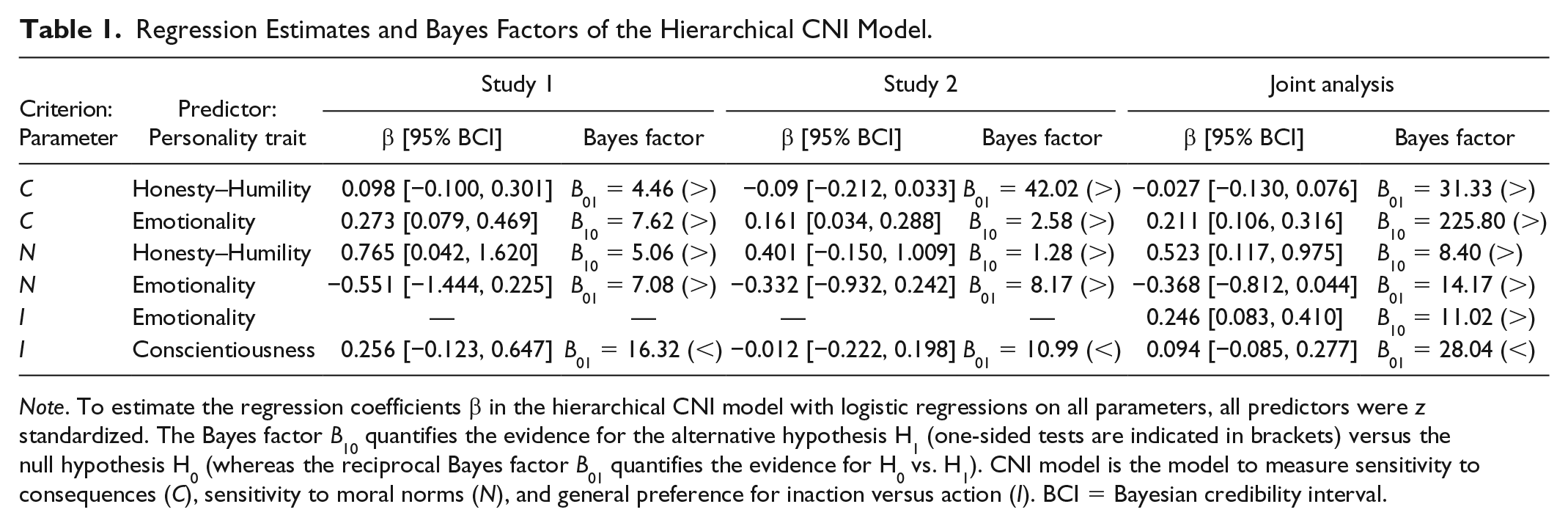
Note. To estimate the regression coefficients β in the hierarchical CNI model with logistic regressions on all parameters, all predictors were z standardized. The Bayes factor B10 quantifies the evidence for the alternative hypothesis H1 (one-sided tests are indicated in brackets) versus the null hypothesis H0 (whereas the reciprocal Bayes factor B01 quantifies the evidence for H0 vs. H1). CNI model is the model to measure sensitivity to consequences (C), sensitivity to moral norms (N), and general preference for inaction versus action (I). BCI = Bayesian credibility interval.
Discussion
The results of Study 1 confirm our first hypothesis that Honesty–Humility is positively linked to sensitivity to norms (parameter N) but not associated with sensitivity to consequences (parameter C). These results are in line with previous research showing that participants with high levels of (subclinical) psychopathy showed a weaker sensitivity to moral norms compared with participants with low levels of psychopathy (Gawronski et al., 2017).
An opposite pattern emerged for Emotionality: Opposed to our second hypothesis, Emotionality did not explain variance in the N parameter but in the C parameter. This implies that participants high in Emotionality (i.e., persons with high empathic concern and high harm avoidance) showed a higher sensitivity for the consequences of a decision. Greene’s dual-process theory states that deontological judgments result from immediate affective reactions, whereas utilitarian judgments are the result of effortful cognitive processes. As discussed above, the Emotionality factor from the HEXACO framework represents empathic concern, sensitivity, harm avoidance, and help seeking. People low in Emotionality feel little emotion in reaction to the concerns of others and little stress in response to making difficult decisions. Our study indicates that these attributes reduce the sensitivity for the (harmful and possibly distressing) consequences of moral decisions.
Contrary to our third hypothesis, Conscientiousness was not linked to the general preference for inaction (parameter I). According to the definition of Conscientiousness, persons with low scores tend to make decision under impulse with little reflection and avoid difficult tasks, whereas persons with high scores are organized, accurate, and careful when making decisions (Ashton et al., 2014). The fact that Conscientiousness is defined in terms of completing and dealing with tasks, but less with the decision-making style within a given task, may explain our finding that Conscientiousness is not associated with the preference for inaction in moral dilemmas.
To confirm our results, we designed Study 2 as a replication of Study 1. Furthermore, to ensure a strict test of our hypotheses, we preregistered our research questions and analysis regarding the influence of personality on the C, N, and I parameters (https://aspredicted.org/w2sf2.pdf).
Study 2
Method
Participants
Two hundred sixty participants were recruited online via internet communities and from a local participant pool at the University of Koblenz–Landau. Of these, 249 participants (195 females, one third gender) fulfilled the criteria for inclusion (i.e., above 18 years, given approval to informed consent, and completion of all tasks). Participants’ age ranged from 18 to 65 years (M = 28.31 years, SD = 9.46 years).
Materials and procedure
Because Study 2 was a replication of Study 1, the same materials and procedure were used described above. However, the subset of participants recruited from the local participant pool already answered the HEXACO in a previous experiment. Via a personal code, it was possible to link both datasets together without threatening the anonymity of participants. Therefore, participants from the pool did not have to answer the HEXACO for a second time. All other participants had to answer the HEXACO questionnaire after responding to the moral dilemmas.
Results
All analyses were conducted exactly as in Study 1 by fitting a Bayesian hierarchical MPT model including Honesty–Humility as a predictor of the parameters N and C, Emotionality as a predictor of the parameters N and C, and Conscientiousness as a predictor of parameter I. Model fit was assessed with posterior-predicted p values and indicated a satisfactory fit with respect to the mean (p = .62) but not with the covariance structure (p < .01) of the observed individual frequencies as tested by the T1 and T2 statistics by Klauer (2010). Parameter estimates for the group means of the MPT parameters (including 95% BCIs) were N = 0.567, 95% BCI = [0.411, 0.713]; C = 0.380, 95% BCI = [0.350, 0.411]; and I = 0.588, 95% BCI = [0.526, 0.655].
As can be seen in Table 1, for the link between Honesty–Humility to the N parameter, the BCI for the unstandardized regression coefficient did overlap zero, indicating no effect of Honesty–Humility on the sensitivity for norms. The one-sided Bayes factor in favor of the directed hypothesis that β was greater than zero versus exactly zero was B10 = 1.27, showing only ambiguous evidence for a positive effect. The BCI for the unstandardized regression coefficient of the effect of Honesty–Humility on parameter C did overlap zero. This indicates that Honesty–Humility had no effect on sensitivity for consequences. This conclusion was supported by the one-sided Bayes factor in favor of a null effect (B01 = 42.01), indicating very strong evidence for a null and against a positive effect.
The unstandardized regression coefficient of the effect of Emotionality on parameter N showed that Emotionality had no effect on the sensitivity for norms. This conclusion was corroborated by the one-sided Bayes factor (B01 = 8.17). However, similar to Study 1, the credibility interval of the regression slope for Emotionality on parameter C excluded zero. This indicates that higher Emotionality resulted in a higher sensitivity for consequences. The absolute value of β can be interpreted as a predicted increase of sensitivity for consequences from 34.4% to 42.03% for participants one SD below versus one SD above the Emotionality group mean, respectively. Moreover, the Bayes factor in favor of the directed hypothesis that β was greater than zero versus exactly zero was B10 = 2.57, indicating evidence for the positive link of Emotionality to the sensitivity for consequences.
In line with Study 1, the BCI of the slope for Conscientiousness on parameter I overlapped zero, indicating that Conscientiousness did not have a substantial influence on preference for inaction. In line with this result, the corresponding Bayes factor of B01 = 10.99 showed substantial evidence for a null effect versus a negative effect.
Discussion
Study 2 was designed as a replication of Study 1. Contrary to Study 1, we found only ambiguous evidence that Honesty–Humility is positively linked to sensitivity to norms (parameter N). However, in line with Study 1, we found no association between sensitivity to consequences (parameter C) and Honesty–Humility. Also in line with Study 1, Emotionality explained variance in the C parameter but not in the N parameter, and Conscientiousness was not linked to the general preference for inaction (parameter I).
Given that the design and procedure of Study 1 and Study 2 were almost identical, we decided to analyze all data jointly to increase the predictive value of our analyses. A main advantage of Bayesian inference is the possibility to rely on sampling plans with optional stopping and to synthesize the evidence provided by multiple studies (see, for example, Scheibehenne et al., 2016).
Joint Analysis of Study 1 and Study 2
Analysis with the CNI model
The joint analyses of the aggregated data of Studies 1 and 2 were conducted similarly as before. Again, we fitted a Bayesian hierarchical MPT model that included Honesty–Humility as a predictor of the parameters N and C, Emotionality as a predictor of the parameters N and C, and Conscientiousness as a predictor of parameter I. As suggested by an anonymous reviewer, we also included Emotionality as a predictor of I. 6 As mentioned before, according to the dual-process theory, automatic emotional responses are triggered by the idea of causing harm to someone leading the person to make a decision consistent with deontological judgments. Only in proscriptive dilemmas, a direct action can lead to harm. In prescriptive dilemmas, not doing something can lead to harm. However, there are also findings showing that harm caused by inaction feels less immoral compared with the same amount of harm caused by action (Cushman et al., 2006). Based on these ideas, it is possible that Emotionality is positively correlated with the parameter I.
Model fit was assessed with posterior-predicted p values, and indicated a satisfactory fit with respect to the mean (p = .43) but not with the covariance structure (p < .01) of the observed individual frequencies as tested by the T1 and T2 statistics by Klauer (2010). Parameter estimates for the group means of the MPT parameters (including 95% BCIs) were N = 0.539, 95% BCI = [0.426, 0.645]; C = 0.372, 95% BCI = [0.347, 0.397]; and I = 0.564, 95% BCI = [0.494, 0.646].
As can be seen in Table 1, for the link between Honesty–Humility to the N parameter, the BCI excluded zero. Honesty–Humility had a substantial influence on parameter N in the sense that higher Honesty–Humility was associated with a higher sensitivity for moral norms. Figure 2A illustrates this effect graphically: The absolute value of the slope parameter β can be interpreted as a predicted increase of sensitivity for moral norms from 45.6% to 57.9% for participants one SD below versus one SD above the Honesty–Humility group mean, respectively. Furthermore, the one-sided Bayes factor in favor of the directed hypothesis that β was greater than zero versus exactly zero was B10 = 8.40, and thus indicated moderate evidence for our hypothesis that high levels in Honesty–Humility are associated with an increased sensitivity to moral norms. For the link between Honesty–Humility to the C parameter, the BCI for the unstandardized regression coefficient did overlap zero, indicating that Honesty–Humility had no effect on sensitivity for consequences. This conclusion was supported by the one-sided Bayes factor in favor of a null effect (B01 = 31.33), indicating very strong evidence for a null and against a positive effect.
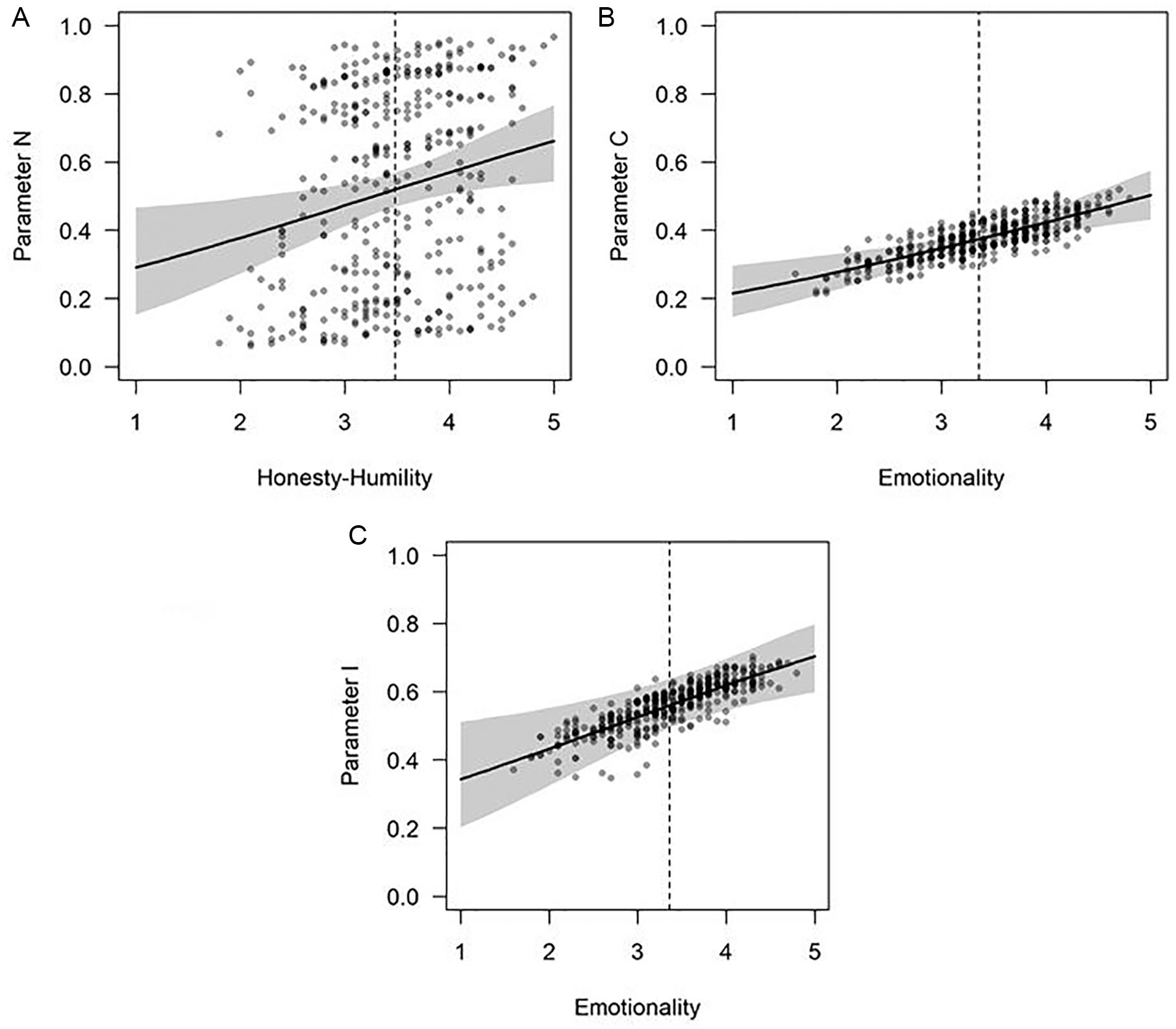
Regression of CNI model parameters on HEXACO personality traits: (A) Sensitivity to norms (deontological), (B) Sensitivity to consequences (utilitarian), and (C) Preference to inaction.
Emotionality had no effect on the sensitivity for norms (parameter N). This conclusion was corroborated by the one-sided Bayes factor (B01 = 14.17). The credibility interval of the regression slope for Emotionality on parameter C excluded zero, indicating that higher Emotionality resulted in a higher sensitivity for consequences. As shown in Figure 2B, the absolute value of β can be interpreted as a predicted increase of sensitivity for consequences from 32.6% to 42.4% for participants one SD below versus one SD above the Emotionality group mean, respectively. Moreover, the Bayes factor in favor of the directed hypothesis that β was greater than zero versus exactly zero was B10 = 225.80, indicating clear evidence for a positive link of Emotionality to the sensitivity for consequences.
The credibility interval for the effect of Conscientiousness on parameter I overlapped zero, indicating that Conscientiousness did not have a substantial influence on preference for inaction. In line with this finding, the corresponding Bayes factor of B01 = 28.04 indicated strong evidence for a null effect versus a negative effect. Emotionality was positively associated with the preference for inaction (parameter I). The absolute value of β can be interpreted as a predicted increase of sensitivity for consequences from 50.1% to 62.1% for participants one SD below versus one SD above the Emotionality group mean (Figure 2C). The one-sided Bayes factor in favor of the directed hypothesis that β was greater than zero versus exactly zero was B10 = 11.02, indicating strong evidence that high levels in Emotionality are associated with a higher preference for inaction.
Traditional analysis
To highlight the benefits of the CNI model, we also performed a traditional analysis by testing the link between the three HEXACO traits Honesty–Humility, Emotionality, and Conscientiousness to moral decisions in those scenarios resembling the standard moral–dilemma paradigm. As discussed above, classical moral dilemmas typically focus on proscriptive norms, where choosing action over inaction is interpreted as a preference for utilitarian over deontological moral decisions. Of the 12 moral–dilemma scenarios by Gawronski et al. (2017), the three scenarios that belong to the first column of Figure 1 have exactly this standard structure.
To test whether moral decisions in these three standard dilemmas are linked to personality, we fitted a hierarchical probit regression with the choices of (utilitarian) action over (deontological) inaction as the dependent variable. 7 The regression slope for Emotionality on the probability of choosing the utilitarian option was estimated to be positive, β = 0.154 with a 95% BCI = [0.041, 0.286]. Because the credibility interval excluded zero, this indicates that higher Emotionality is linked to utilitarian reasoning. However, the corresponding Bayes factor of B10 = 2.05 indicated only ambiguous evidence for this effect. All other BCIs included zero, indicating no meaningful effects of the two personality traits Honesty–Humility and Conscientiousness. In line with the BCIs, all one-sided Bayes factors were in favor of a null effect (Honesty–Humility: B01 = 15.94, Conscientiousness: B01 = 41.17). These ambiguous and null findings based on the traditional analysis of decisions in standard moral dilemmas highlight the importance of using the CNI model to disentangle latent processes in moral judgments and provide further evidence for its validity as a measurement model.
General Discussion
In classical moral dilemmas, participants have to decide whether they are willing to violate a moral norm (e.g., “you shall not kill a person!”) to achieve a more desirable, utilitarian outcome (e.g., “save 10 persons”). Usually, affirmative decisions in such paradigms are simply interpreted as utilitarian reasoning, whereas negative decisions are interpreted as deontological reasoning. However, according to Gawronski et al. (2017), this approach is not without problems. A major problem concerns the interpretation of observed choices as direct indicators for either utilitarian or deontological reasoning. For example, just because a participant decides to accept the death of one person to save the life of several others, it is not clear whether moral judgments of this participant consistently adhere to the utilitarian principle. To categorize moral judgments as utilitarian, it is essential to confirm that they are consistently in line with the described consequences independent of moral norms. The same problem holds with respect to the question whether participants adhere to moral norms (e.g., decide not to kill one person to save others). To categorize moral judgments as deontological, it is essential to confirm that responses consistently follow moral norms independent of the consequences. Thus, to identify the processes underlying moral judgments, it is necessary to manipulate consequences and norms experimentally. Based on this reasoning, Gawronski et al. (2017) developed the CNI model, a multinomial model that measures sensitivity for consequences (= C parameter), sensitivity for moral norms (= N parameter), and the general tendency to avoid action separately in response to moral dilemmas (= I parameter).
Whereas the original CNI model was developed and applied to disentangle the underlying cognitive processes of moral decisions on the group level (e.g., to compare different levels of subclinical psychopathy using a median split), we are concerned with continuous interindividual differences and the link of personality traits to moral decision making. To account for heterogeneity of the CNI parameters between persons, we proposed a hierarchical version of the model using a Bayesian hierarchical MPT approach (Heck, Arnold, & Arnold, 2018; Klauer, 2010). Whereas MPT models are traditionally fitted using data aggregated across participants and items, the hierarchical model assumes separate set of parameters for each person, and thereby allows to regress the three CNI parameters on external continuous covariates (such as personality factors). Using these novel methods, our studies tested three hypotheses concerning the link of three HEXACO personality factors (Honesty–Humility, Emotionality, and Conscientiousness) to the parameters of the CNI model to explain interindividual differences in moral judgments.
Overall, the joint analysis of Studies 1 and 2 confirmed the hypothesis of a positive association of Honesty–Humility with sensitivity to norms (parameter N), meaning that sincere, honest, faithful, and fair-minded individuals were more likely to consistently adhere to moral norms. As discussed above, this finding is in line with studies demonstrating that people with high levels of (subclinical) psychopathy have a weaker sensitivity to moral norms (Gawronski et al., 2017) and that Honesty–Humility is negatively correlated with psychopathy (Lee & Ashton, 2005). As expected, Honesty–Humility did not explain variance in the C parameter (= sensitivity to consequences).
Moreover, Emotionality was positively linked to sensitivity for consequences (C parameter), meaning that individuals with high empathic concern and high harm avoidance were more sensitive to the outcome of a decision. However, opposed to the predictions derived from the dual-process model, Emotionality was not associated with sensitivity for norms (N parameter). The joint analysis of Studies 1 and 2 showed that Emotionality was also positively linked to preference for inaction. As discussed above, the Emotionality factor from the HEXACO framework represents empathic concern, sensitivity, harm avoidance, and help seeking. People low in Emotionality feel little emotion in reaction to the concerns of others and little stress in response to making difficult decisions (Ashton et al., 2014). Our study indicates that these attributes reduce the sensitivity for the consequences of moral decisions (which often involve emotionally disturbing outcomes involving the death of people). However, participants low in Emotionality also have a lower preference for inaction in comparison with participants high in Emotionality. The dual-process theory assumes that automatic emotional responses are triggered when imagining the act of causing harm to someone, in turn, leading the person to make a decision consistent with deontological judgments. The CNI approach uses two types of moral dilemmas: dilemmas including proscriptive norms and dilemmas including prescriptive norms. Only in proscriptive dilemmas, a direct action can lead to harm. In prescriptive dilemmas, not doing something can lead to harm. Therefore, it is possible that Emotionality is also linked to the I parameter. Indeed, our study showed that high levels in Emotionality were associated with a higher preference for inaction.
Finally, we found that Conscientiousness was not associated with a general preference for inaction (parameter I). According to the definition of Conscientiousness, persons with low scores tend to make a decision under impulse with little reflection and avoid difficult tasks, whereas persons with high scores are organized, accurate, and careful when making decisions (Ashton et al., 2014). The fact that Conscientiousness is defined in terms of completing and dealing with tasks, but less with the decision-making style within a given task, may explain our finding that Conscientiousness is not associated with the preference for inaction in moral dilemmas.
Despite the benefits of the CNI model for disentangling different processes in moral decision making, this approach is not without criticism. As discussed in the introduction, it is not clear whether decisions following proscriptive or prescriptive norms can directly be compared, given that harmful acts are generally judged as more severe than harmful omissions (e.g., Cushman et al., 2008; Haidt & Baron, 1996). In turn, dilemmas based on proscriptive norms can be seen as harsher and more demanding in comparison with dilemmas based on prescriptive norms (Janoff-Bulman et al., 2009). However, to underline the importance and benefits of the CNI model, we also analyzed our data using the “traditional” approach (e.g., Bartels & Pizarro, 2011). For this, we only analyzed responses to the subset of classical moral dilemmas, that is, scenarios involving proscriptive norms that prohibit actions in cases where the benefits of action are larger than its costs to well-being. These analyses provided evidence against an association of the traits Honesty–Humility and Conscientiousness with moral decision making, and showed only ambiguous evidence for a positive association between Emotionality and the propensity to make utilitarian choices. These results highlight the advantage of the multinomial CNI model, which allows researchers to test novel and more specific hypotheses concerning three important aspects in moral decision making: sensitivity to consequences, sensitivity to moral norms, and general preference for inaction versus action.
To summarize, the present work demonstrates the benefits of the CNI model for providing deeper insights on the links between basic personality traits and moral–dilemma judgments. Building on recent methodological developments in MPT modeling, we showed that heterogeneity in moral decision making can be explained by selectively linking specific personality traits to different latent processes underlying moral reasoning.
Supplemental Material
Kroneisen_OnlineAppendix – Supplemental material for Interindividual Differences in the Sensitivity for Consequences, Moral Norms, and Preferences for Inaction: Relating Basic Personality Traits to the CNI Model
Supplemental material, Kroneisen_OnlineAppendix for Interindividual Differences in the Sensitivity for Consequences, Moral Norms, and Preferences for Inaction: Relating Basic Personality Traits to the CNI Model by Meike Kroneisen and Daniel W. Heck in Personality and Social Psychology Bulletin
Footnotes
Declaration of Conflicting Interests
The author(s) declared no potential conflicts of interest with respect to the research, authorship, and/or publication of this article.
Funding
The author(s) received no financial support for the research, authorship, and/or publication of this article.

Supplemental Material
Supplemental material is available online with this article.
Notes
References
Supplementary Material
Please find the following supplemental material available below.
For Open Access articles published under a Creative Commons License, all supplemental material carries the same license as the article it is associated with.
For non-Open Access articles published, all supplemental material carries a non-exclusive license, and permission requests for re-use of supplemental material or any part of supplemental material shall be sent directly to the copyright owner as specified in the copyright notice associated with the article.
