



Abstract
Nostalgia, a sentimental longing for one’s past, is associated with, or confers, psychological wellbeing (PWB). We identified a mechanism for this link: collective effervescence, a potent sense of connection to those present in an assembly and a sensation of transcendence (i.e., feeling that an experience is special or sacred). In six studies, involving measurement-of-mediation and experimental-causal-chain designs, nostalgia was associated with, and led to, higher PWB via collective effervescence. In Study 1, nostalgia was related to PWB through collective effervescence at the dispositional level. In Study 2, induced collective effervescence increased PWB. In Studies 3a–3c, induced nostalgia led to greater PWB due to collective effervescence. In Study 4, induced nostalgia increased PWB due to collective effervescence even when controlling for authenticity, an alternate mediator.
Nostalgia occurs frequently (several times a week; Hepper et al., 2021; Wildschut et al., 2006) and is observed across cultures (Hepper et al., 2014; Wildschut et al., 2019) and ages (Juhl et al., 2020; Madoglou et al., 2017). Although nostalgia entails a degree of sadness and yearning for bygone moments (Frankenbach et al., 2021; Leunissen et al., 2021; Sedikides & Wildschut, 2016), it is positively associated with, and increases, psychological wellbeing (PWB; Cox et al., 2015; Hepper et al., 2021; Layous et al., 2021). This benefit of nostalgia might seem counterintuitive. Why would yearning for the olden days augment current PWB? We propose a mechanism: People often feel nostalgic for events at which they experienced collective effervescence, and reliving those events rekindles PWB.
Nostalgia, Collective Effervescence, and PWB
Nostalgia, “a sentimental longing or wistful affection for the past” (Pearsall, 1998, p. 1266), typically refers to momentous events from one’s life (e.g., birth of child, birthday or anniversary celebrations, graduations) that incorporate cultural rituals (e.g., Thanksgiving dinners, vacations from one’s childhood, picnics with friends or family; Madoglou et al., 2017; Wildschut et al., 2006). These same events frequently generate collective effervescence (Gabriel et al., 2017). The term was coined by Durkheim (1912), who defined it as “‘emotional excitation felt by those who join with others they take to be fellow members of a moral or biological tribe’ and a ‘sensation of sacredness’” (Hochschild, 2016, p. 225). Furthermore, Durkheim (1965, pp. 431–432) delineated several precipitating conditions: “that men are assembled, that sentiments are felt in common and expressed in common acts; but the particular nature of these sentiments and acts is something relatively secondary and contingent.” Collective effervescence can occur in extraordinary events such as fire-walking rituals (Xygalatas et al., 2011), large-scale cultural gatherings (Páez et al., 2015), or giant dance parties (Berkers & Michael, 2017), but also in collective assemblies such as gathering for a family dinner, watching a movie, or lunching with friends (Gabriel et al., 2020). Durkheim (1912; see also Haidt et al., 2008) identified two components of collective effervescence: a strong sense of connection to those present and a mental transformation of a situation from pedestrian to divine (a sensation of transcendence). The scant empirical evidence suggests that collective effervescence is positively linked to PWB (Gabriel et al., 2017, 2020).
Collective Effervescence as a Mediator of the Relation Between Nostalgia and PWB
Nostalgia is also associated with, and augments, PWB (Baldwin et al., 2015; Cox et al., 2015; Frankenbach et al., 2021; Hepper et al., 2021; Kelley et al., 2022; Layous et al., 2021; Zhou et al., 2022). We define PWB in terms of eudaimonic aspects. The term “eudaemonia” has come under criticism for its ambiguity (Martela & Sheldon, 2019). Some of its key constituents, though, are meaning in life, social acceptance or support, optimism, goal orientation or attainment, and a positive appraisal of the self (Ryff, 2013, 2014; Ryff & Singer, 2008). We define PWB in terms of these constituents and operationalize it accordingly.
That nostalgia is associated with, and augments, PWB may seem counterintuitive. Why would yearning for an irredeemably gone past be related to, or elevate, current PWB? We propose that it does so, at least in part, because individuals often feel nostalgic for events at which they experienced collective effervescence; reliving nostalgically such events rekindles PWB that was infused by collective effervescence. Indeed, collective effervescence is positively related to PWB (Gabriel et al., 2017; Páez et al., 2015). That is, events that make individuals feel as if they are connected to others and as if something special is happening predict higher PWB.
People are likely to be nostalgic for collectively effervescent events. Nostalgia is often felt for social events, and in particular events that entail collective effervescence—such as family traditions or relational celebrations—are frequently the targets of nostalgic reflection (Abeyta et al., 2015; Wildschut et al., 2006). We posit that nostalgizing about such events, that is, mentally transporting to them and reliving them (Evans et al., 2021), reignites their inherent collective effervescence either chronically or momentarily. Furthermore, we posit that nostalgia elevates PWB, because it reminds people of events during which they felt collective effervescence and allows them to relive it. In summary, we hypothesize that nostalgizing is associated with, or increases, relived collective effervescence; in turn, collective effervescence is related to, or promotes, PWB.
Overview
Across six studies, we tested the hypothesis that collective effervescence mediates the effect (correlational or causal) of nostalgia on PWB. In Study 1, we used a measurement-of-mediation design. In the next studies, we employed an experimental-causal-chain design, examining each step of the mediation chain (Spencer et al., 2005). Specifically, in Study 2, we manipulated collective effervescence and measured PWB. In Studies 3a–3c, we tested the full model by manipulating nostalgia and measuring collective effervescence and PWB. Finally, in Study 4, we tested the full model while measuring an alternate mediator, authenticity (Kelley et al., 2022).
Participants in all studies were undergraduate students at a large U.S. state university. No participant was involved in more than one study. We received ethical approval from the first author’s institution. We did not preregister the studies. We provide Supplementary Materials (stimulus materials, ancillary analyses) and data/codes at https://osf.io/rudav/?view_only=836d72ef86234112892e895bd1a5db11.
Study 1
In Study 1, we tested the hypothesis that collective effervescence mediates the relation between nostalgia and PWB at the dispositional level.
Method
Participants
We determined the sample size required for mediation analysis, here and in Studies 3a–3c and 4, according to Fritz and MacKinnon’s (2007) guidelines, which describe estimates of sample sizes required to achieve .80 power for various types of tests given estimates of magnitude for each tested path. There is no literature from which to derive magnitude estimates for the relation between nostalgia and collective effervescence (a path). However, relying on aforementioned theoretical link between these two constructs, we estimated that this association would be at least medium (r = .30). Similarly, we estimated that the relation between collective effervescence and PWB, controlling for nostalgia (b path), would be at least small (r = .10). A sample size of 391 participants is recommended to achieve .80 power for detecting a mediated effect via bias-corrected bootstrapping (95% CI).
We tested 414 participants (227 women, 181 men, 1 gender queer/gender nonconforming, 5 unreported). Of them, 54.3% identified as White, 8.8% as Black, 29.3% as Asian/Pacific Islander, and 7.6% as Other; also, 9.3% of participants identified as Hispanic. Their ages ranged from 18 to 30 years (M = 19.05, SD = 1.89).
Procedure
We assessed trait nostalgia with two scales (administered in counterbalanced order), for convergent validity purposes (Campbell & Fiske, 1959; see also: Routledge et al., 2008; Stephan et al., 2014; Zhou et al., 2008). The first was the Nostalgia Prototype Scale (Cheung et al., 2017; Kelley et al., 2022). It comprises five items (e.g., “I bring to mind rose-tinted memories,”“I remember shared experiences with my family and friends”) that describe centrally prototypical features of nostalgia (Hepper et al., 2012); that is, laypersons consider these features core to the nostalgia construct. Participants rated both the frequency of engagement in each feature (1 = I do this very rarely, 7 = I do this very often) and the personal importance of doing so (1 = this is not important for me, 7 = this is very important for me). The second scale was the 7-item Southampton Nostalgia Scale (Sedikides et al., 2015; Wildschut & Sedikides, 2022). Three items refer to the degree to which participants find nostalgia important, significant, or valuable (e.g., “How valuable is nostalgia for you?”; 1 = not at all, 7 = very much). The remaining four items refer to the degree to which participants are prone to nostalgizing (e.g., “How prone are you to feeling nostalgic?”; 1 = not at all, 7 = very much) or the frequency of nostalgizing (e.g., “Generally speaking, how often do you bring to mind nostalgic experiences?”; 1 = very rarely, 7 = very frequently). The two nostalgia scales were positively correlated, r = .63, p < .001. As per prior practice (Juhl et al., 2020; Routledge et al., 2008; Stephan et al., 2015), we standardized (z scores) and then averaged responses to create a composite (ω= .91; Peters, 2014). 1
We assessed trait collective effervescence with the 11-item Tendency for Effervescent Assembly Measure (Gabriel et al., 2017). Sample items are: “I feel very connected to others when in a large group activity I like,”“When I attend a wedding, I feel a connection to the other people there” (ω= .87). 2
In assessing PWB, we included the key eudaimonic constituents mentioned above (Ryff, 2013, 2014; Ryff & Singer, 2008): meaning in life, social acceptance or support, optimism, goal orientation or attainment, positive appraisal on the self. We used three scales. The first one was the 5-item Presence of Meaning subscale of the Meaning in Life Questionnaire (MLQ Presence; Steger et al., 2006). Sample items are: “I understand my life’s meaning,”“My life has a clear sense of purpose” (1 = absolutely untrue, 7 = absolutely true). The second scale was the 12-item Multidimensional Scale of Perceived Social Support (MSPSS; Zimet et al., 1988). Sample items are: “I get the emotional help and support I need from my family,”“I can talk about my problems with my friends” (1 = very strongly disagree, 7 = very strongly agree). The third scale was the 10-item Brief Inventory of Thriving (BIT; Su et al., 2014), applicable to a broad range of relevant constructs (1 = strongly disagree, 7 = strongly agree), such as optimism (“I am optimistic about my future”), goal orientation or attainment (“I am achieving most of my goals”), and a positive appraisal on the self (“I feel good most of the time”). We obtained very similar results when analyzing the data separately for each PWB scale (Supplementary Materials). Therefore, we standardized (z scores) and then averaged the three PWB scales to create a composite (ω = .96). We present correlations among all study measures in Table 1.
Correlations Among All Measures in Study 1
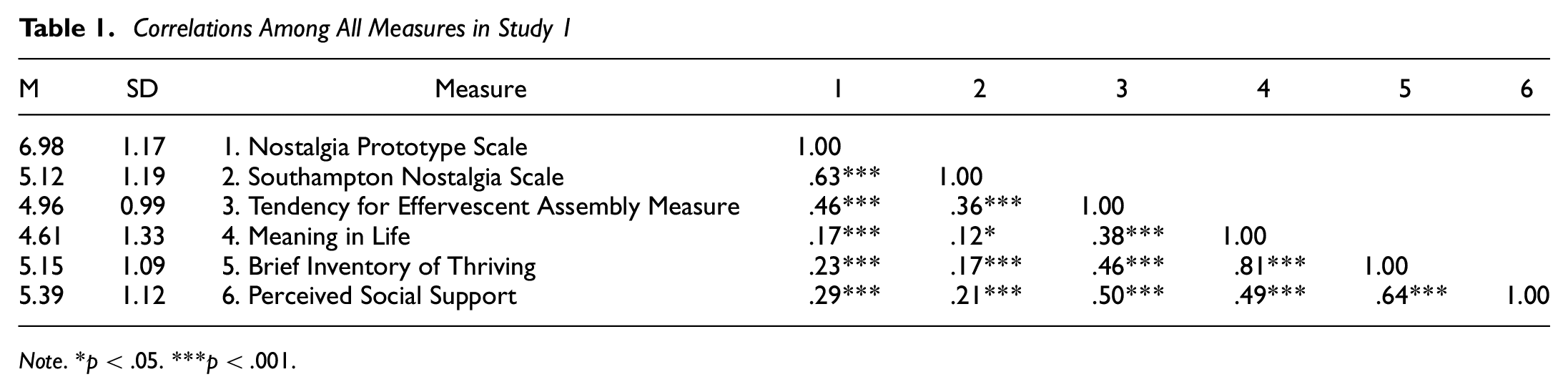
Note. *p < .05. ***p < .001.
Results and Discussion
Nostalgia was positively associated with collective effervescence (r = .45, p < .001) and PWB (r = .25, p < .001), while collective effervescence was also positively associated with PWB (r = .51, p < .001). A mediation analysis (bootstrapping with 5,000 samples; Preacher & Hayes, 2008, Model 4) showed that collective effervescence mediated the relation between nostalgia and PWB (Figure 1). Nostalgia was positively associated with collective effervescence, b = 0.44, 95% CI [0.36, 0.52], t(408) = 10.28, p < .001. When controlling for nostalgia, collective effervescence was positively associated with PWB, b = 0.45, 95% CI [0.36, 0.53], t(407) = 10.49, p < .001. The indirect effect of nostalgia on PWB via collective effervescence was significant, ab = 0.20, 95% CI [0.14, 0.26]. We proceeded to test reverse mediation models, but found no support for them. Nostalgia did not mediate the relation between collective effervescence and PWB (ab = 0.01, 95% CI [−0.03; 0.05]), and PWB did not mediate the relation between nostalgia and collective effervescence (ab = 0.01, 95% CI [−0.04, 0.06]). 3
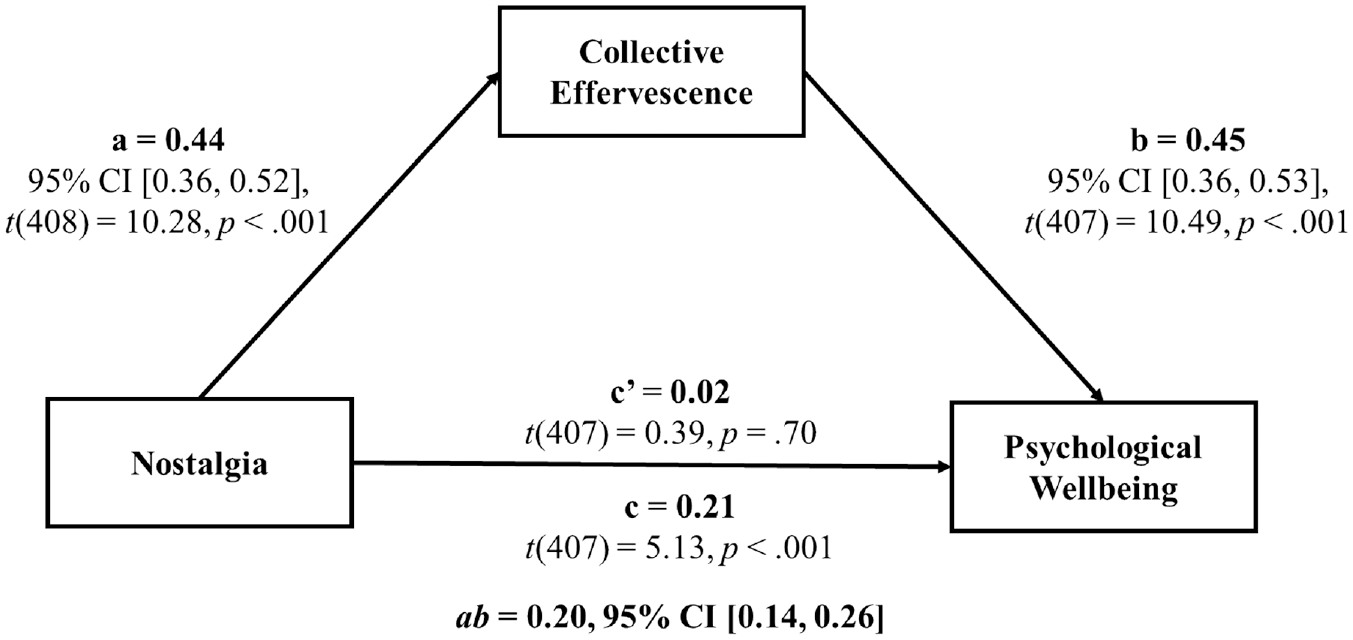
Collective Effervescence as a Mediator of the Relation Between Nostalgia and Psychological Wellbeing in Study 1
As hypothesized, highly nostalgic individuals enjoyed better PWB due to their stronger proclivity for collective effervescence. Such individuals have a greater tendency to experience (and re-experience) collective effervescent events, which are conducive to PWB. Yet, Study 1 used a measurement-of-mediation design. Although these designs, despite their limitations (Bullock et al., 2010; O’Laughlin et al., 2018), place the researcher’s hypothesis at risk (Anderson & Bushman, 1997; Fiedler et al., 2011), they cannot establish causation. To do so, we needed to harness the strengths of experimental-causal-chain designs (Spencer et al., 2005).
Study 2
In Study 2, we tested the hypothesis that collective effervescence impacts on PWB, as per the logic of experimental-causal-chain designs (Spencer et al., 2005). Despite some evidence congruent with the possibility that collective effervescence influences PWB (Gabriel et el., 2017, 2020; Páez et al., 2015), no prior research has causally examined this link.
Method
Participants
We determined the sample size by conducting power analysis via G*power (Faul et al., 2007). To detect a medium effect (d = 0.5), we would need a sample size of at least 128 participants for achieving power of .80 (two-tailed alpha = .05). We opted to oversample, testing 197 participants (125 men, 70 women, 1 gender nonconforming, 1 unreported). Of them, 53.1% identified as White, 30.0% as Asian, 10.2% as Black, and 6.6% as “Other”; also, 7.1% identified as Hispanic. Their age varied from 18 to 35 years (M = 19.22, SD = 1.99).
Procedure
We created a manipulation of collective effervescence for the current purposes. Participants in the experimental condition first received an explanation of the construct: “There are times when we are at an event with other people and we feel as if there is something special or sacred about the event, and we feel connected to the other people present.” Then, they thought about an event where they felt collective effervescence, and spent 2 minutes immersing themselves in the experience. Subsequently, they listed four keywords relevant to the event. Finally, they wrote about this event for 3 minutes. Participants in the control condition followed the same protocol, but for an ordinary collective experience. They were instructed to think of an ordinary event from your life when other people were present. This should be a time (either in person or online) when other people were also there but you did not feel connected to those other people. It should be a time that did not feel special.
Next, all participants completed two manipulation checks (Gabriel et al., 2020). They reported whether they currently “feel a sense of connection to the people who were at that event” (1 = strongly disagree, 7 = strongly agree) and whether they currently “feel as if life has moments that are special or even sacred” (1 = strongly disagree, 7 = strongly agree). Afterward, they completed a measure of PWB. Given that the Study 1 results converged for all three PWB scales, we only used the state version of the BIT (ω= .94). All items were preceded by the stem “right now.”
Results and Discussion
The degrees of freedom differ slightly across analyses due to missing data. Participants in the collective effervescence condition (M = 6.16, SD = 1.22) felt more connected to people who were at the event relative to controls (M = 3.22, SD = 1.83), t(192) = 13.07, p < .001, d = 1.87, 95% CI of the mean difference [2.49, 3.38]. Likewise, participants in the collective effervescence condition (M = 6.18, SD = 1.23) felt that life has moments that are special and sacred more so than those in the control condition (M = 5.26, SD = 1.68), t(192) = 4.32, p < .001, d = 0.62, 95% CI of the mean difference [0.50, 1.34]. The manipulation was effective. Importantly, participants in the collective effervescence condition reported higher PWB (M = 5.39, SD = 1.04) than controls (M = 4.72, SD = 1.32), t(192) = 3.86, p < .001, d = 0.55, 95% CI of the mean difference [0.32, 1.00]. Collective effervescence increased PWB.
Studies 3a, 3b, and 3c
In Studies 3a to 3c, we tested experimentally the hypothesis that the effect of nostalgia on PWB is transmitted by collective effervescence. We did so in multiple studies aiming to examine the replicability of the proposed mediational model. We followed the same procedure across studies, but conducted them in different academic semesters.
Method
Participants
As in Study 1, we followed Fritz and MacKinnon’s (2007) criteria for determining our sample size. Based on the medium-to-large effect size of the correlation between trait nostalgia and trait collective effervescence observed in Study 1 (r = .45), we inferred that this relation would also be medium-to-large at the state level. Relying on the effect size of the relation between trait collective effervescence and trait PWB observed in Study 1 (r = .51), we estimated a medium to large effect size for this path as well. Therefore, a sample size of at least 71 participants is recommended to achieve .80 power to detect a mediated effect using bias-corrected bootstrapping (95% CI). Given that this is the first experiment of its kind, we conservatively oversampled in each study.
In Study 3a, we tested 266 participants (110 women, 154 men, 2 unreported). Of them, 54.3% identified as White, 24.6% as Asian, 11.3% as Black, and 9.8% as Other; also, 10.4% of participants identified as Hispanic. Their ages ranged from 18 to 47 years (M = 19.22, SD = 2.12). In Study 3b, we tested 507 participants (255 women, 249 men, 1 gender nonconforming, 2 unreported). Of them, 52.1% identified as White, 31.2% as Asian, 8.7% as Black and 7.7% as Other; in addition, 8.3% of the participants identified as Hispanic. Participants’ ages ranged from 18 to 42 years (M = 19.06, SD = 1.828). In Study 3c, we tested 431 participants (203 women, 223 men, 2 gender nonconforming, 3 unreported). Of them, 59.3% identified as White, 22.8% as Asian, 11.6% as Black and 7.2% as Other; in addition, 8.7% of the participants identified as Hispanic. Participants’ ages ranged from 18 to 38 years (M = 19.16, SD = 1.836).
Procedure
We induced nostalgia with the Event Reflection Task (Sedikides et al., 2015). In the experimental condition, after reading a definition of nostalgia (“a sentimental longing or wistful affection for the past”), participants spent 2 minutes reflecting on a past event from their lives that made them feel nostalgic. Next, they listed four keywords capturing the gist of their experience, and narrated the event in writing for 3 minutes. In the control condition, participants followed the same protocol, but for an ordinary event from their lives. A manipulation check followed. Participants indicated their agreement with three items (e.g., “I am feeling quite nostalgic”; Study 3a ω= .96; Study 3b ω= .94; Study 3c ω= .96).
Subsequently, participants completed the 8-item state Collective Effervescence scale (Gabriel et al., 2020), on the basis of how they felt at that moment. Sample items are “I feel as if most everyone at the event felt a connection to the other people there” and “I feel as if there was something sacred about the event” (Study 3a ω= .91; Study 3b ω= .92; Study 3c ω= .93). Finally, participants completed the state BIT in response to the event they recalled earlier (Study 3a ω= .91; Study 3b ω= .94; Study 3c ω= .94).
Results and Discussion
The manipulation was effective: Participants in the nostalgia condition reported feeling more nostalgic than controls in all three studies. Furthermore, nostalgia increased collective effervescence: Nostalgic participants reported higher collective effervescence than controls in all three studies. Also, nostalgia increased PWB: Nostalgic participants reported higher PWB than controls in all three studies. We present relevant statistics in Table 2.
Means (Standard Deviations) for Dependent Variables by Condition in Studies 3a–3c
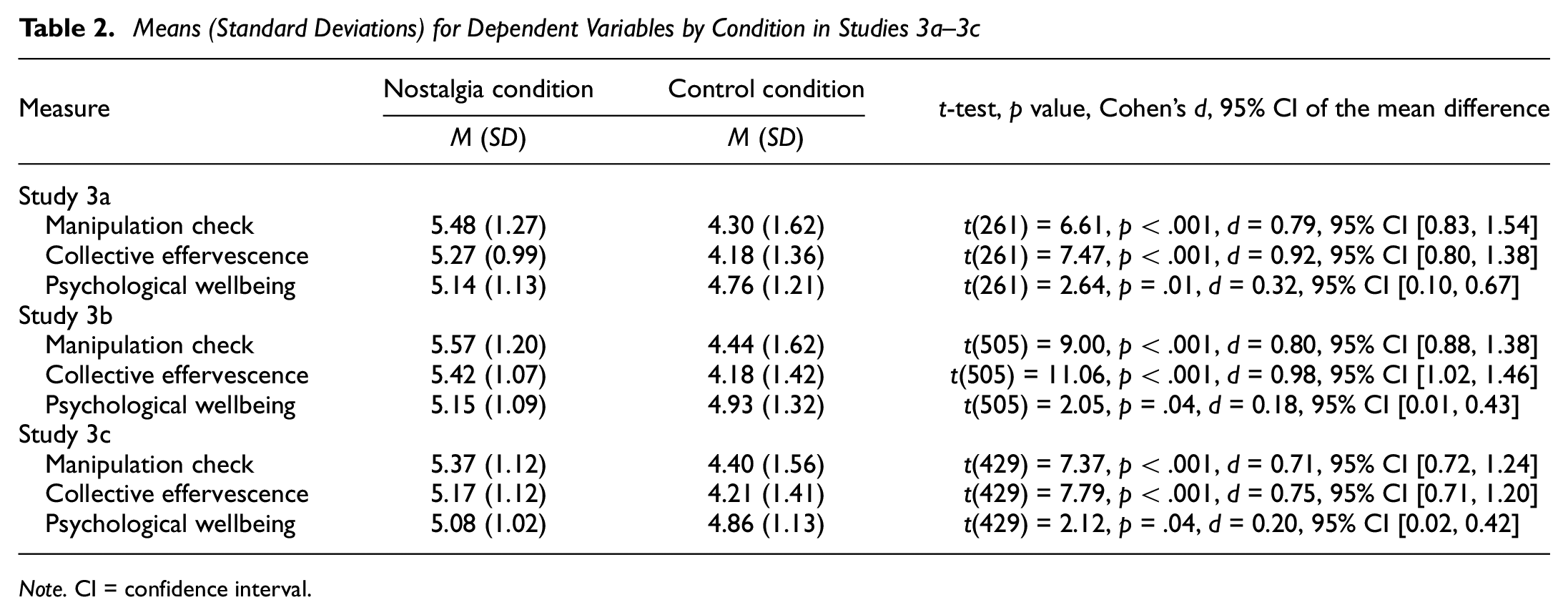
Note. CI = confidence interval.
Next, we examined mediation (bootstrapping with 5,000 samples; Preacher & Hayes, 2008, Model 4). In all three studies, nostalgia (coded: −1/2 = control, 1/2 = nostalgia) increased collective effervescence; when controlling for nostalgia, collective effervescence was associated with higher PWB; and the indirect effect of nostalgia on PWB via collective effervescence was significant. (We present models and relevant statistics in Figure 2.) Most importantly, in all three studies, collective effervescence mediated the effect of nostalgia on PWB. When collective effervescence was accounted for, the effect of nostalgia on PWB was no longer significant in Studies 3a and 3c, and reversed in Study 3b. Taken together, the results were consistent with the hypothesis. Nostalgizing (vs. not) raised collective effervescence. Furthermore, collective effervescence transmitted the effect of nostalgia on PWB.4,5
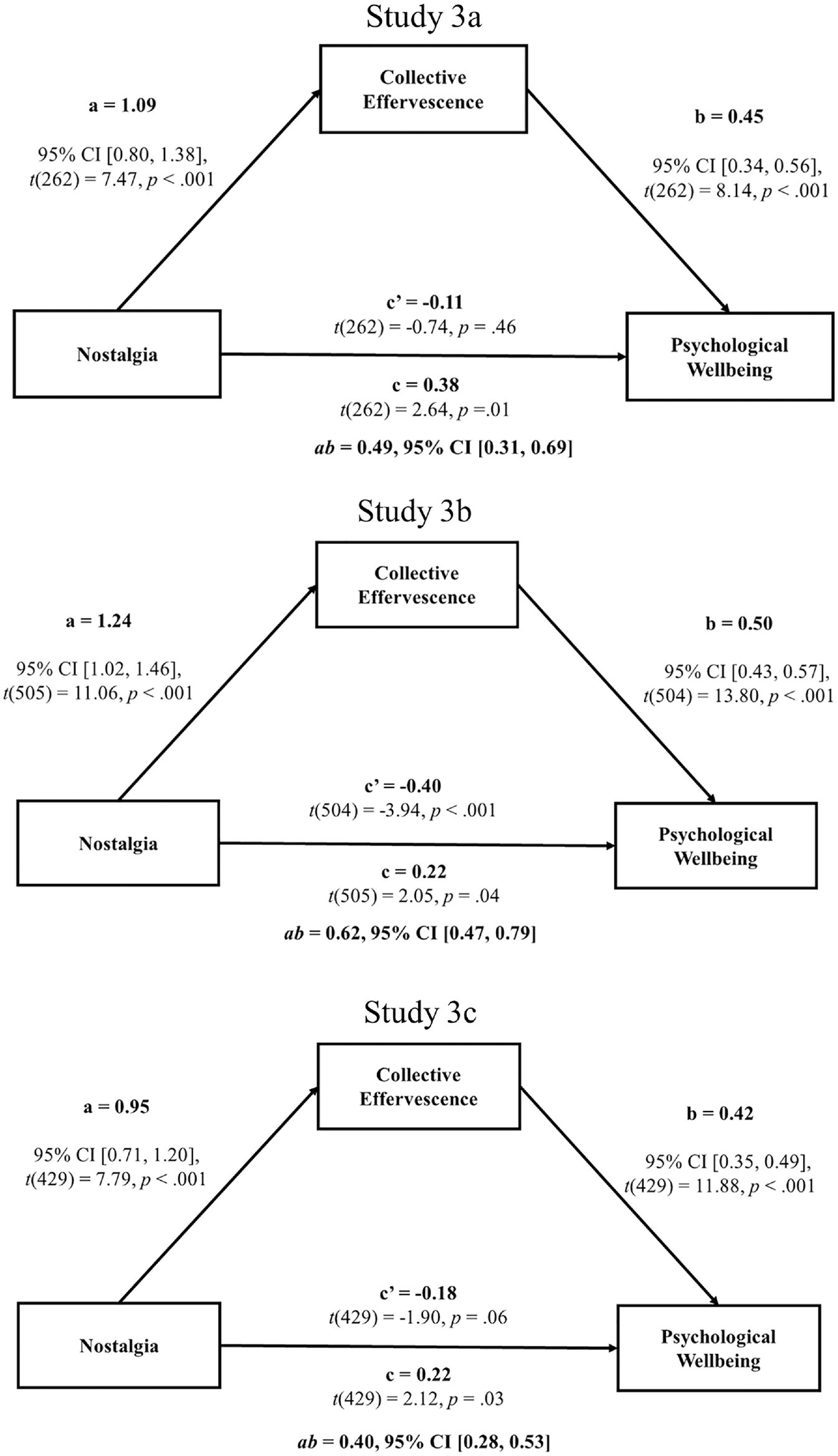
Collective Effervescence as a Mediator of the Effect of Nostalgia on Psychological Wellbeing in Studies 3a–3c
Study 4
Prior work has established authenticity as a mediator of the relation between nostalgia and PWB (Kelley et al., 2022). In Study 4, we put the mediational strength of collective effervescence to the test: We evaluated the hypothesis that collective effervescence mediates the effect of nostalgia on PWB, even when compared to authenticity.
Method
Participants
As in the previous studies, we followed Fritz and MacKinnon’s (2007) criteria for determining our sample size. Based on the medium size of nostalgia’s effect on collective effervescence observed in Studies 3a–3c (b* = .42, b* = .35, b* = .44), which implemented an almost identical procedure to Study 4, we inferred that this effect would also be medium in Study 4. Relying on the medium-to-large effect size of the relation between collective effervescence and PWB found in Studies 3a to 3c (b* = .49, b* = .53, b* = .58), we estimated a medium-to-large effect size for this path. Therefore, a sample size of at least 71 participants is recommended to achieve .80 power for detecting the indirect effect via bias-corrected bootstrapping (95% CI). To infer relations among nostalgia, authenticity, and PWB, we based our estimates on research by Kelley et al. (2022, Studies 1–2). Relying on the small-to-medium size of the effect of nostalgia on authenticity in their studies (b* = .26, b* = .13), we inferred that this effect would also be small-to-medium in this study. Also, relying on the medium-to-large effect size of the unique relation between authenticity and PWB observed by Kelley et al. (b* = .51, b* = .55), we estimated a medium-to-large effect size for this path. Given these estimates, a sample size of at least 115 participants is recommended to achieve .80 power to detect a mediated effect using bias-corrected bootstrapping (95% CI). Therefore, to test both models, we required at least 115 participants. We tested 337 participants (193 women, 139 men, 3 gender queer or gender nonconforming, 2 unreported). Of them, 53.9% identified as White, 26.5% as Asian, 7.7% as Black, 0.3% as American Indian or Alaska Native and 12.2% as Other; also, 6.6% of participants identified as Hispanic. Their ages ranged from 18 to 62 years (M = 19.27, SD = 3.20).
Procedure
We induced nostalgia using the Event Reflection Task and manipulation check (ω= .95) of Studies 3a to 3c. Next, we assessed collective effervescence and authenticity, administering the relevant measures in a random order for each participant. We assessed collective effervescence with the 8-item state Collective Effervescence scale (Studies 3a–3c); participants responded on the basis of how they felt at that moment (ω= .90). We assessed authenticity with two state scales to which participants also responded on the basis of how they felt at that moment. The first was the 4-item Southampton Authenticity Scale proposed and validated by Kelley et al. (2012). Sample items are: “I feel authentic,”“I feel true to myself” (1 = strongly disagree, 7 = strongly agree”; ω = .90). The second was Authentic Living Subscale of Wood et al.’s (2008) Authenticity Scale, also used by Kelley and colleagues. It comprises four items on expression of the true self (e.g., “I live in accordance with my values and beliefs”; ω = .85). We collapsed across responses to the eight items to form a composite (ω= .89). 6 Finally, participants completed the BIT in response to the event they recalled earlier (ω= .93), as in Studies 3a to 3c.
Results and Discussion
The manipulation was effective: Participants in the nostalgia condition reported feeling more nostalgic that those in the control condition. Furthermore, nostalgic participants (vs. controls) reported higher collective effervescence, authenticity, and PWB (Table 3).
Means (Standard Deviations) for Dependent Variables by Condition in Study 4
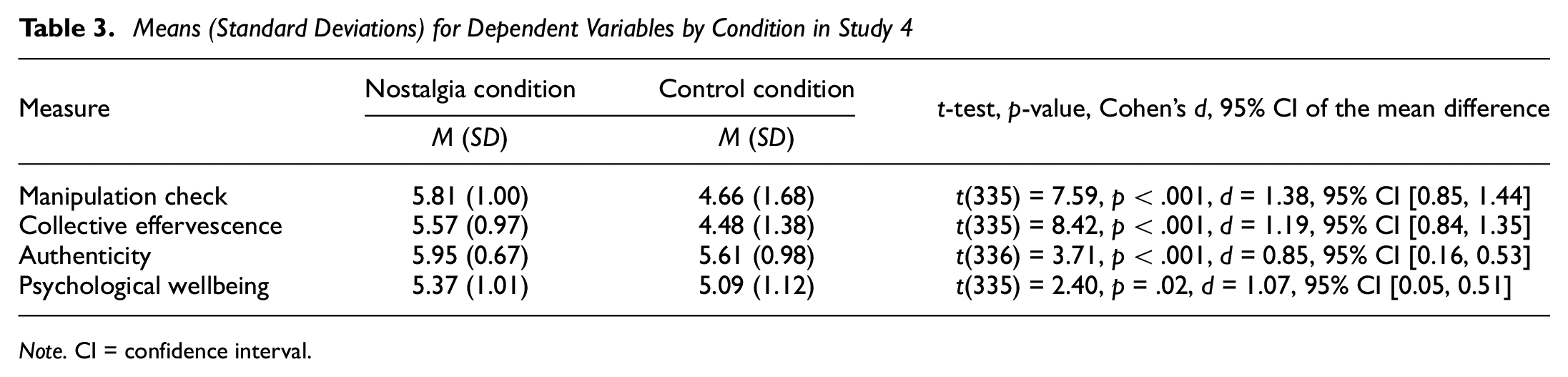
Note. CI = confidence interval.
Next, we examined mediation (bootstrapping with 5,000 samples; Preacher & Hayes, 2008, Model 4). We tested a parallel mediation model in which we entered both collective effervescence and authenticity as mediators of the effect of nostalgia on PWB. Nostalgia (coded: −1/2 = control, 1/2 = nostalgia) increased collective effervescence and authenticity. When controlling for nostalgia and authenticity, collective effervescence was associated with higher PWB. When controlling for nostalgia and collective effervescence, authenticity was also associated with higher PWB. The indirect effect of nostalgia on PWB via collective effervescence was significant, and the indirect effect of nostalgia on PWB via authenticity was also significant. (We present the model and relevant statistics in Figure 3.) Importantly, even when including in the model an alternative mediator (i.e., authenticity), collective effervescence mediated the effect of nostalgia on PWB.
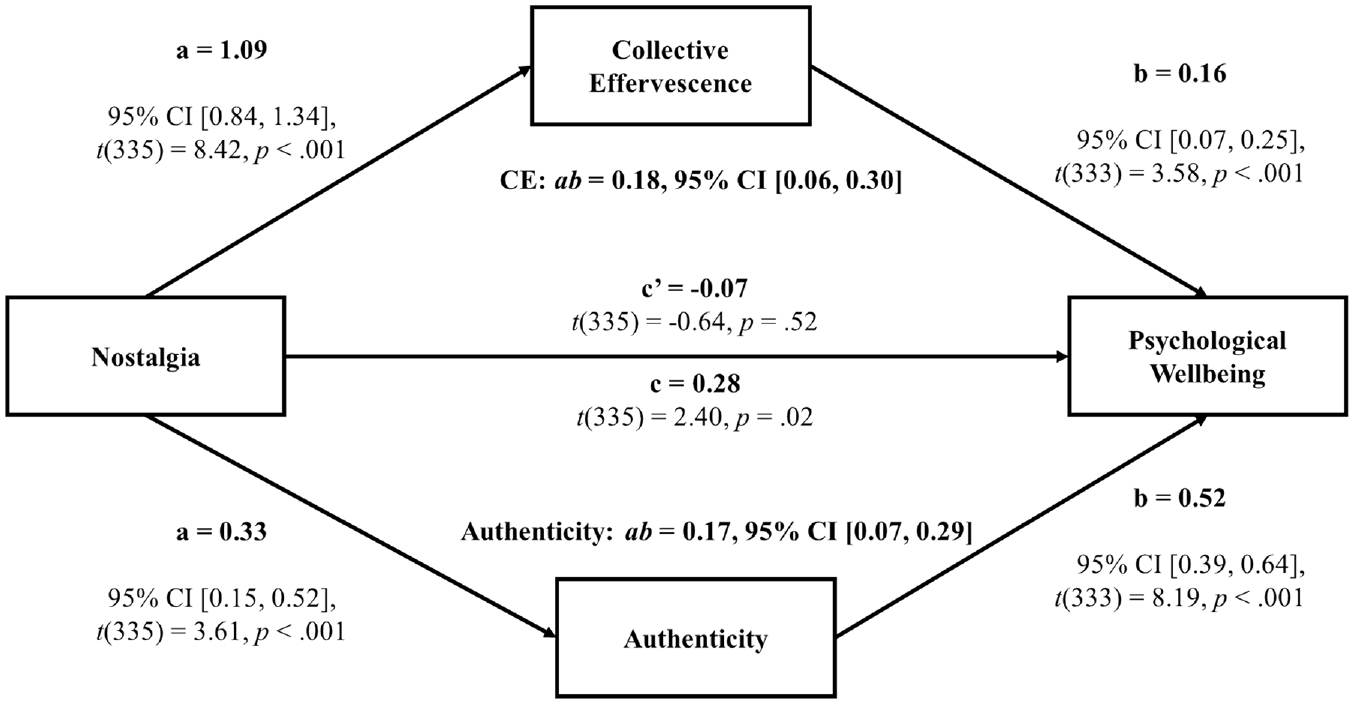
Collective Effervescence and Authenticity as Parallel Mediators of the Effect of Nostalgia on Psychological Wellbeing in Study 4
General Discussion
The results of six studies were consistent with the hypothesis that the influence of nostalgia on PWB is transmitted by collective effervescence. Not only did collective effervescence mediate the effect—correlational or causal—of nostalgia on PWB (Study 1, Studies 3a–3c, Study 4), but the effect of nostalgia on PWB was eliminated (Studies 1, 3a, 3c, and 4) or reversed (Studies 3b) when collective effervescence was accounted for. Put otherwise, the results clarified why nostalgizing, at least in part, augments PWB: because it allows people to relive moments in which they felt connected to others and life was special. It is possible that when collective effervescence is fully accounted for, nostalgia ceases to confer wellbeing or is even linked to lower wellbeing. In all, the findings enrich the nostalgia and PWB literatures by documenting a critical linking mechanism, collective effervescence. Similarly, they enrich the collective effervescence literature by establishing its broader role in nostalgic reflection and eudaimonia.
We examined and established the mediational potency of collective effervescence through additional analyses or research. Using the Study 1 data, we decomposed the PWB score into its thriving (assessed with the BIT; Su et al., 2014), social support (assessed with the MSPSS; Zimet et al., 1988), and meaning in life (assessed with the MLQ Presence; Steger et al., 2006) components. We then tested and found that collective effervescence still mediated the relation between nostalgia and thriving when social support and meaning in life were added as parallel mediators (Supplementary Materials). In Study 4, we tested collective effervescence against an alternative mediator, authenticity (Kelley et al., 2022), and found that collective effervescence still mediated the effect of nostalgia on PWB.
Nostalgia may play a role in the long-term consequences of collective effervescence on PWB. Even among people who had not participated in a social event over the prior month, collective effervescence is positively related to PWB (Gabriel et al., 2017). Also, the positive aftereffects of collective effervescence typically last for 1 week (Rimé et al., 2010), or, in the case of an extreme event (e.g., pilgrimage), up to 3 weeks (Páez et al., 2007). The longevity of these aftereffects may be partly due to nostalgic reminders of connection and transcendence. Longitudinal studies can test this idea. Moreover, cross-cultural research can expand the scope of our findings to other populations. Future work may also examine whether collective effervescence explains the benefits of nostalgizing for nonsocial events. We found that both components of collective effervescence (connection and transcendence) mediated the relation between nostalgia and PWB. Connection might be a stronger mediator for social nostalgia (e.g., family rituals) and transcendence for nonsocial nostalgia (e.g., climbing a mountain alone). Moreover, transcendence might mediate more strongly than connection the relation between nostalgia and nonsocial wellbeing such as psychological richness (Oishi & Westgate, 2022).
An early nostalgia theorist, the sociologist Fred Davis (1979), wondered why nostalgia might be associated with, or confer, PWB. We addressed a plausible mechanism: collective effervescence. Nostalgia capitalizes on its inherent sociality to enrich human wellbeing.
Supplemental Material
sj-docx-1-spp-10.1177_19485506221149813 – Supplemental material for Reliving the Good Old Days: Nostalgia Increases Psychological Wellbeing Through Collective Effervescence
Supplemental material, sj-docx-1-spp-10.1177_19485506221149813 for Reliving the Good Old Days: Nostalgia Increases Psychological Wellbeing Through Collective Effervescence by Esha Naidu, Shira Gabriel, Tim Wildschut and Constantine Sedikides in Social Psychological and Personality Science
Footnotes
Declaration of Conflicting Interests
The author(s) declared no potential conflicts of interest with respect to the research, authorship, and/or publication of this article.
Funding
The author(s) received no financial support for the research, authorship, and/or publication of this article.

Supplemental Material
The supplemental material is available in the online version of the article.
Notes
Author Biographies
References
Supplementary Material
Please find the following supplemental material available below.
For Open Access articles published under a Creative Commons License, all supplemental material carries the same license as the article it is associated with.
For non-Open Access articles published, all supplemental material carries a non-exclusive license, and permission requests for re-use of supplemental material or any part of supplemental material shall be sent directly to the copyright owner as specified in the copyright notice associated with the article.
