




Abstract
Research on collective emotion spans social sciences, psychology and philosophy. There are detailed case studies and diverse theories of collective emotion. However, experimental evidence regarding the universal characteristics, antecedents and consequences of collective emotion remains sparse. Moreover, current research mainly relies on emotion self-reports, accounting for the subjective experience of collective emotion and ignoring their cognitive and physiological bases. In response to these challenges, we argue for experimental research on collective emotion. We start with an overview of theoretical frameworks to identify a set of three characteristics of collective emotion. Based on research in cognitive and affective sciences, we then examine the corresponding candidate mechanisms. Finally, we highlight outstanding questions, review experimental evidence, and suggest ideas for future experimental research.
Keywords
Introduction
Background. Crowds cheer in stadiums, friends and relatives meet for celebrations, and online communities thrive on their members hating or loving together (Turner & Stets, 2005). These examples are typical case studies of collective emotion, which is the topic of a growing literature in social sciences, psychology and philosophy (Von Scheve & Salmela, 2014). Research on collective emotion investigates the idea that emotions can be shared with other individuals, and that shared emotions have specific characteristics. In affective sciences, the development of this idea is also related to the theories of human cognition that stress the socially extended and distributed nature of mental processes (Gallagher, 2013), including emotions (Huebner, 2011; Krueger, 2014; Krueger & Szanto, 2016; Slaby, 2014). Furthermore, research on collective emotion fits into the recent development of integrative research programs in neuroscience and psychology, which span multiple levels of analysis to elucidate the bases of collective cognition (Sliwa, 2021; Vlasceanu et al., 2018).
Objectives. Our primary goal is to address two main challenges for research on collective emotion moving forward. First, there is still little consensus regarding the definition of collective emotion. Available theories rely on different conceptual and methodological frameworks that target different aspects of emotion (e.g., expression, subjective conscious experience) at different levels of analysis (e.g., individuals, dyads, crowds). As a consequence, these theories often focus on different facets of collective emotion in isolation. Previous literature reviews have offered comprehensive accounts of available theories (Salmela, 2012, 2014), highlighted their differences, and discussed potential mechanisms (Pacherie, 2017; Von Scheve & Ismer, 2013). More research is now needed to understand how these theories relate to each other and, in particular, the extent to which they make compatible or conflicting empirical predictions. The second challenge stems from the bias of current research towards the phenomenology of collective emotionand, methodologically, its reliance on the subjective experience reported by individuals. In comparison, emotion is thought to involve multiple processes besides subjective experiences, such as evaluations, physiological responses, expressions and action tendencies (Moors, 2009). In other words, there is a gap between current research on collective emotion and contemporary affective sciences, which comes with the risk of overlooking non-conscious aspects of collective emotion (see Lamm & Silani, 2014 for a similar argument). In response to these two challenges, we argue for developing experimental research on collective emotion. This approach opens new perspectives for identifying the mechanisms of collective emotion and testing empirical predictions of existing theories, thereby providing new, critical material for discussions.
Scope. The following discussion relies on a few assumptions. First, we are not talking about collective emotion to imply that social entities can experience emotions in the same way as individuals. Therefore, we leave aside the discussions on the nature of group agents and the possibility of group consciousness (List, 2018; Pacherie, 2017). Second, we focus our discussion on collective emotions, which are relatively short-term acute responses to specific objects or events, as opposed to other types of affects such as collective moods. Third, we do not assume a priori that collective emotion only occurs in large groups as opposed to small groups and dyads, and during in-person physical gatherings (e.g., marches) as opposed to technologically mediated interactions (e.g., online discussions). However, we distinguish between collective emotion and related phenomena that do not involve influence between individuals. As such, we provisionally define collective emotion as a pattern of emotions that emerges within a group from common and reciprocal influence between individuals. Table 1 provides definitions that clarify the distinctions between collective emotion and related concepts mentioned in the text.
Glossary.
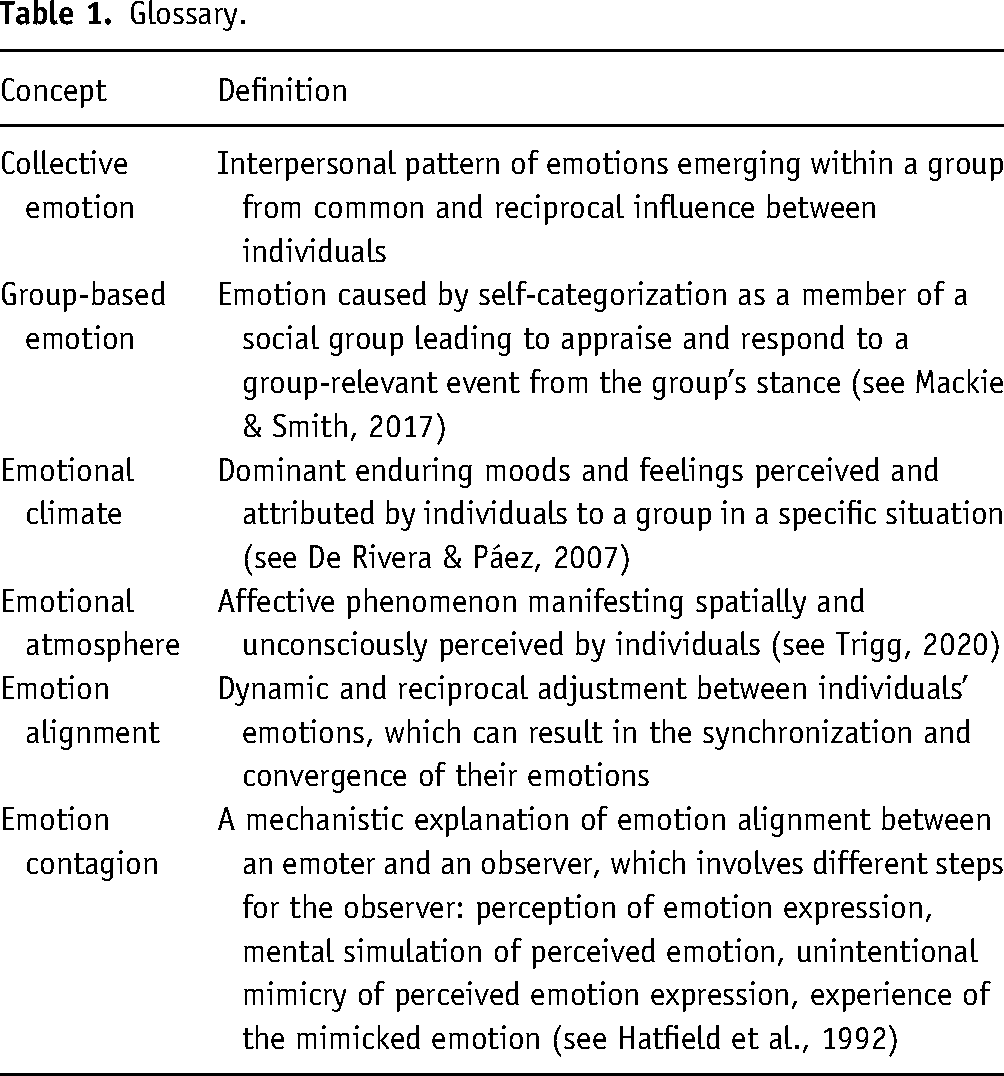
Plan. The first section presents an overview of recent theories that emphasize different aspects of collective emotion. Our goal is not to provide a systematic review of the theoretical literature, but to introduce the reader to different theoretical approaches. In the second section, we then derive a set of three characteristics of collective emotion (emotion alignment, feeling of togetherness, mutual awareness) from the theories. These characteristics provide a simple reference frame highlighting the similarities and differences between theoretical approaches. In the third section, we turn to research in affective and cognitive sciences to identify candidate mechanisms underlying these three characteristics. Finally, in the fourth section, we review previous and on-going experimental research on collective emotion, and we outline promising directions for future research.
Theories of Collective Emotion
Theories of collective emotion can be divided into three main approaches focusing on different facets of the phenomenon: the aggregation of emotional responses across individuals, the subjective feelings related to experiencing collective emotion, and the similarity and reciprocity of emotional dispositions across individuals.
Emotional Responses
Some theories of collective emotion in social sciences focus on the properties that emerge from the aggregation of emotional responses across individuals. The aggregation of emotions at group-level is “the sum of its parts” (Barsade & Gibson, 1998, p. 88), and it can be apprehended as the mean intensity or the variability of emotional responses within the group. Goldenberg et al. (2020) gave several examples of group-level patterns that characterize collective emotion: emotional amplification, an increase or decrease in the average magnitude of emotional responses (Figure 1a); emotional convergence or polarization, a decrease in the variability of emotional responses within the group (Figure 1b) or within subgroups (Figure 1c); emotional synchronization, a decrease in the temporal variability of emotional responses (Figure 1d); and emotional cascading, which involves delayed synchronization (Figure 1e). The aggregative theories of collective emotion contend that these emotion patterns result from connections between individuals, but they disagree on the type of patterns and the type of connections that define collective emotion.
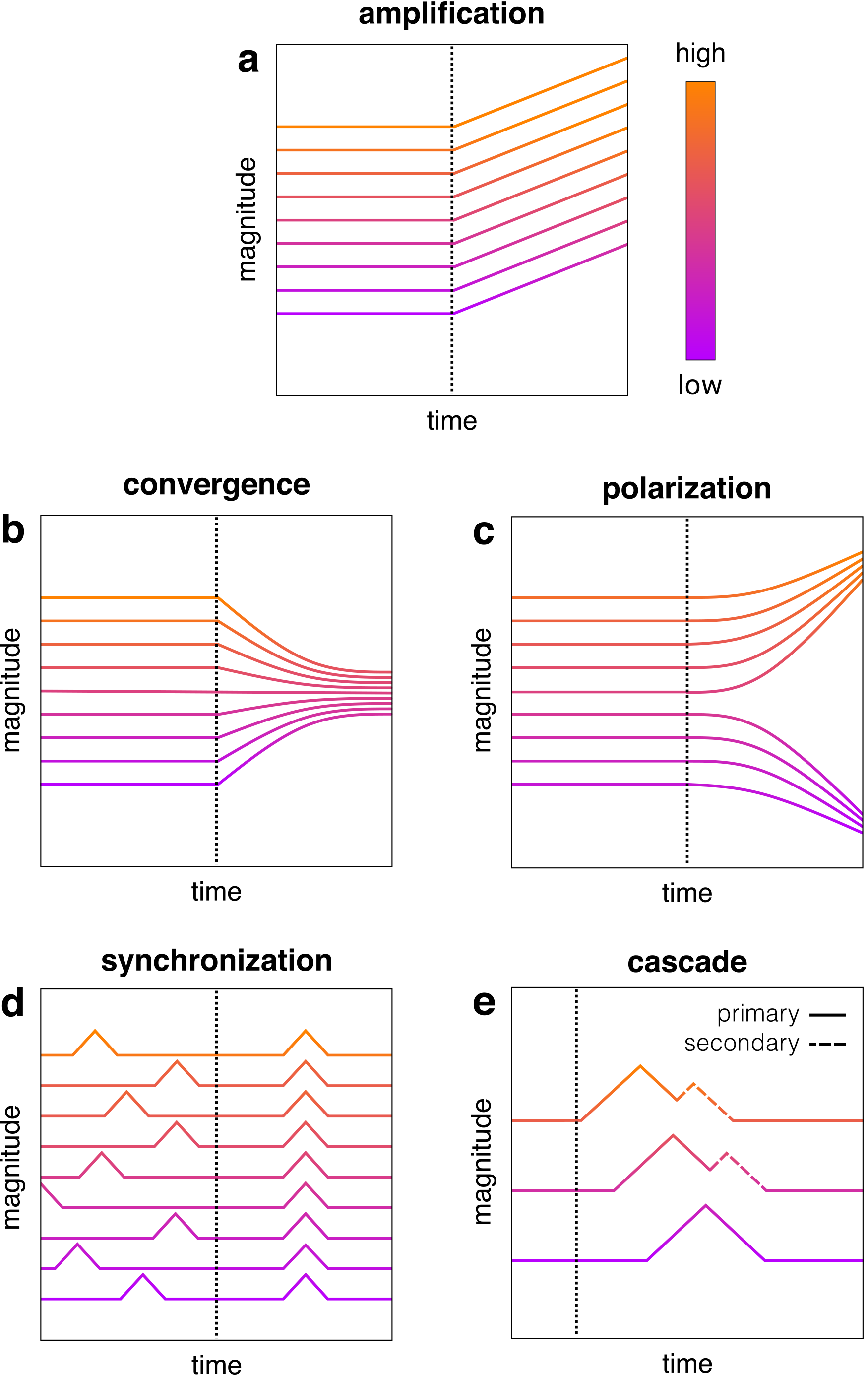
Examples of emotion patterns emerging at group-level. Individual emotional responses (horizontal lines) are represented as a function of time and magnitude (e.g., valence or arousal) after onset of an emotion-eliciting event (vertical dotted line). (a) Amplification, reflecting an increase in the magnitude of the responses; (b) Convergence or consolidation, reflecting a decrease in the variance of the responses; (c) Polarization, a specific case of convergence within two diverging sub-groups; (d) Synchronization, reflecting the instantaneous temporal alignment of the responses; (e) Cascade, a specific case of delayed synchronization: a primary response triggers the responses from other individuals, which may trigger back secondary responses from the original influencers, thereby elongating the emotional episode. See Goldenberg et al. (2020) for empirical data.
For instance, Von Scheve and Ismer (2013) defined collective emotion as the “synchronous convergence in affective responding across individuals towards a specific event or object” (p. 411). According to this definition, collective emotion corresponds to the convergence and synchronization of emotional responses across individuals who are connected, at the minimum, through common influence. As per this definition, interaction between individuals is not necessary: for example, the converging emotions of remote individuals who attend the same TV broadcast count as collective. In comparison, Goldenberg et al. (2020) defined collective emotions as “macrolevel phenomena that emerge from emotional dynamics among individuals who are responding to the same situation” (p. 2). This latter definition does not presuppose synchrony or convergence, as other types of group-level patterns could emerge during collective emotion (e.g., emotional cascading). Moreover, the notion of “dynamics among individuals” suggests that reciprocal influence, in addition to common influence, is necessary for collective emotion.
The latter definition sets a distinction between, on the one hand, group-based emotion and, on the other hand, collective emotion as a type of group-shared emotion (Menges & Kilduff, 2015). Group-based emotion occurs when individuals self-categorize as members of a social group and adopt the group's stance when responding to an emotional event (Mackie & Smith, 2017). Group-based emotion predicts that members of a common social group will experience similar emotions in response to a group-relevant situation (e.g., the joy of political partisans in response to their party's success). However, it requires neither that co-present and interacting individuals reciprocally influence each other nor that individuals be concurrently responding to a common emotion-elicitor (but see “Social identification” for a more nuanced picture). In contrast, group-shared emotion requires “synchrony of attention among group members to the emotion-eliciting stimuli, and some level of social interaction among group members” (Menges & Kilduff, 2015, p. 851). It is worth mentioning that group-based and group-shared emotions are not mutually exclusive, and that collective emotion in the strong sense may result from their combination. In summary, aggregative theories of collective emotion emphasize group-level emotion patterns, but these theories do not necessarily presuppose that collective emotion has a specific experiential quality.
Subjective Experiences
In contrast, phenomenological theories in philosophy define collective emotion as a specific type of subjective experience. These definitions draw from the concept of we-mode experience inspired by Tuomela's terminology (2007). The core idea is that a collective emotion is felt as our emotion rather than my emotion, although it remains debatable what exactly is meant by the first-person plural. Salmela (2022) distinguished two possible interpretations in terms of togetherness. According to the first interpretation, togetherness corresponds to the pleasant feeling of closeness and rapport with other individuals. According to the second interpretation, togetherness corresponds to “awareness that there are particular others with whom one is experiencing the emotion” (Salmela, 2022, p. 53).
The first interpretation is best developed in accounts of collective emotion in terms of collective effervescence (Collins, 2014; Páez & Rimé, 2014). In his neo-Durkheimian conceptualization of collective emotion, Collins (2014) described collective effervescence as “the rhythmic entrainment of all participants into a mood that feels stronger than any of them individually, and carries them along as if under a force from outside” (p. 299). More recently, Rimé and Páez (2023) described collective effervescence as the “high-intensity experience of self-transformation” (p. 18). The authors highlighted two aspects of this subjective experience: the experience of amplified emotions leading to feelings of empowerment, and the experience of perceived similarity with other individuals leading to feelings of closeness and rapport with these individuals. This definition partly overlaps with the definition of “kama muta”, which is a specific emotion involving the positive experience of feeling moved and connected to others as well as physiological responses such as goose bumps (Fiske, 2019).
The second interpretation corresponds to accounts of collective emotion as a subjective emotional experience from the second-person perspective. According to these theories, two conditions are necessary for collective emotion to occur: reciprocal other-awareness and integration (León et al., 2019; Thonhauser, 2018; Zahavi, 2015). First, collective emotion requires that several individuals experience emotions, and that these individuals be reciprocally aware of each other (i.e., they are aware of being attended by the other individual). Hence, this condition sets a distinction between collective emotion (i.e., reciprocally engaging from the second-person perspective) and other types of socio-emotional experiences such as vicarious feelings (i.e., feeling the emotion of another individual as one's own, from the first-person perspective) and empathetic concern (i.e., understanding the emotion of another individual without necessarily feeling it, from the third-person perspective) (Szanto & Krueger, 2019; Zahavi & Rochat, 2015). In other words, collective emotion requires preserving the perceived distinction between the self and other individuals. Second, collective emotion requires integration or reciprocal identification, so that individuals perceive each other as similar-yet-distinct individuals. This specific condition sets a distinction between collective emotion and cases in which individuals are reciprocally aware of each other but experience antagonistic emotions (e.g., those of a perpetrator and its victim). Thonhauser (2022) translated these two requirements in terms of “self-organizing systems”. He defined collective emotion as “a complex system of socially distributed components based on dynamical self-organization through social interaction”. This definition, by stressing the importance of social interaction, adopts the aforementioned distinction between collective emotion and group-based emotion. Overall, phenomenological theories do not consider that emotion patterns, such as fine-grained similarity in subjective emotional experiences, are defining features of collective emotion. For example, individuals may feel their emotion as collective, while experiencing dissimilar but compatible and complementary emotions (e.g., anger and sadness in response to the failure of a joint activity).
Emotional Dispositions
In comparison to phenomenological theories, analytical theories build upon the definition of emotion in terms of concerns (e.g., desires, aversions, interests, attachments). These concerns contribute to “patterns of emotional dispositions” (Salmela, 2022) that determine how individuals appraise and respond to a situation. Indeed, appraisal theories (Moors et al., 2013) consider that emotional responses result from the evaluation, often unconscious, of a situation. Accordingly, collective emotion is a matter of holding similar concerns, to which individuals are committed as members of a common group (Helm, 2014). These common concerns then lead to similar appraisals and emotional responses (Salmela, 2012, 2014; Salmela & Nagatsu, 2016). On this view, collective emotion follows from public and joint, as opposed to private and overlapping, commitments to common concerns. For example, the emotions of football supporters are collective, insofar as their social identities commit them to share similar concerns for their favourite team, to appraise the game's events accordingly, and therefore to show emotional responses of the same type.
Following this idea, Salmela and Nagatsu (2016) listed the defining features of collective emotion: “x and y experience an emotion of the same type with similar (1) evaluative content and (2) affective experience”; and “x and y are mutually aware [thereof]” (p. 36). In other words, individuals are aware that they experience similar emotions, that other individuals are aware of this fact, and that they all are aware of their respective awareness of this fact. This definition shares with phenomenological theories the idea that collective emotion entails awareness of self and others. Yet, there is a disagreement on what individuals are thought to be aware of. On the one hand, individuals are “mutually aware that others are feeling the same” (Salmela & Nagatsu, 2016). On the other hand, individuals are mutually aware of being co-present and taking part in a collective emotional episode, without necessarily being aware of the similarity of their emotions (León et al., 2019; Thonhauser, 2018). In both cases, mutual awareness does not necessarily imply an affective experience such as felt togetherness. According to Salmela (2022), the experiential quality of collective emotion derives from mutual awareness, and varies as a function of individuals’ commitments to their concerns (see Interim conclusion). Moreover, unlike the aforementioned phenomenological theories, Salmela and Nagatsu defined collective emotion as a pattern emerging from both emotional dispositions and emotional responses, including expressions, physiology and action tendencies, besides subjective feelings.
Interim Conclusion
In summary, there are both similarities and differences between theories of collective emotion. The list of debated issues includes: whether patterns of emotional responses, emotional dispositions, or both are defining features of collective emotion; whether collective emotion has a distinct experiential quality; whether it requires awareness of and identification with other individuals (“top-down” processes) or can emerge from unconscious emotional interactions (“bottom-up” processes); what individuals are aware of during collective emotion; and the extent to which emotional responses should exhibit fined-grained similarity. However, some of these debates may reflect the existence of different types of collective emotion rather than incompatibility of theories. Indeed, it has been argued that collective emotion is a continuum (Salmela, 2012, 2014) and that there are different types of collective emotion (Thonhauser, 2022). Salmela distinguished three types of collective emotion: weakly, moderately and strongly collective emotions. 1 In short, the more emotional dispositions reflect commitments that are conjoint and public (i.e., expected), as opposed to unilateral and private, the more emotions are collective. In comparison, Thonhauser (2022) distinguished five types of collective emotion: fusion, segregation, matching, contagion and sharing. Each type represents a combination of distinct features 2 along a continuum. 3 Both typologies valuably underscore the complementarity between different theories of collective emotion, although they come with their own acknowledged limitations. The typology in terms of emotional dispositions accounts for the “intentional background” of collective emotion (Salmela, 2014, p. 171), hence, it insists on the antecedents of collective emotion. By comparison, considering the dynamics of emotional responses unfolding during a collective emotional episode could provide a different, complementary typology. 4 As such, Thonhauser's typology provides a valuable framework, but it primarily focuses on collective emotion experience. In contrast, we believe that collective emotion involves not only subjective experiences but also unconscious affective processes (see “Mechanisms of collective emotion”) that are relevant for establishing a typology that makes empirical predictions. In this regard, considering other facets of emotional responses seems an essential step towards elucidating how the different families of theories relate to each other. For this purpose, we now turn to the characteristics and mechanisms of collective emotion. In the following section, we derive from the theories of collective emotion three characteristics that clarify the similarities and differences between conceptual frameworks (Table 2).
Comparison between theories of collective emotion
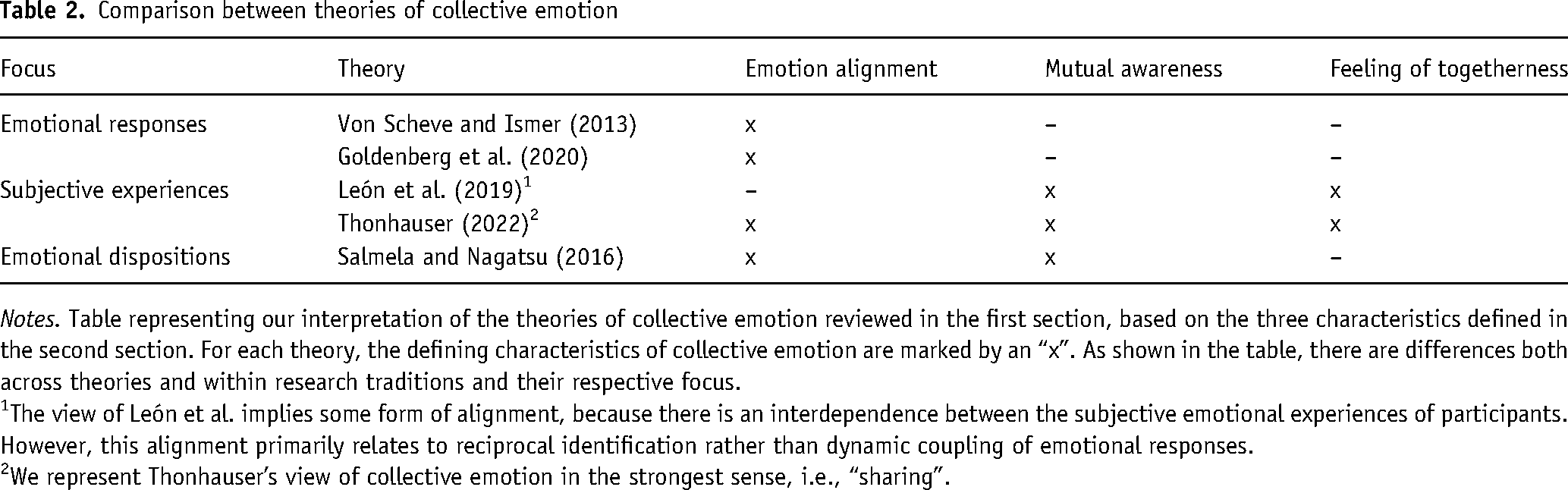
Notes. Table representing our interpretation of the theories of collective emotion reviewed in the first section, based on the three characteristics defined in the second section. For each theory, the defining characteristics of collective emotion are marked by an “x”. As shown in the table, there are differences both across theories and within research traditions and their respective focus.
The view of León et al. implies some form of alignment, because there is an interdependence between the subjective emotional experiences of participants. However, this alignment primarily relates to reciprocal identification rather than dynamic coupling of emotional responses.
We represent Thonhauser's view of collective emotion in the strongest sense, i.e., “sharing”.
Characteristics of Collective Emotion
The theories described in the previous section suggest that collective emotion can be defined by combinations of three basic characteristics: emotion alignment, feeling of togetherness and mutual awareness.
Emotion Alignment
A recurring idea in theories of collective emotion is that individuals reciprocally influence each other so that they have, to some extent, similar emotions. In other words, collective emotion is characterized by a dynamic process that results in patterns of similar intertwined emotions. We define this process as emotion alignment, namely, “the dynamic and reciprocal adjustment of the components of a system for its coordinated functioning” (Dumas & Fairhurst, 2021, p. 3), where the system components are the emotions of individuals. Following our working definition of collective emotion, emotion alignment implies coupling, or reciprocal interaction between individuals. Emotion alignment can result in differentemotion patterns, notably: theconvergence of emotions, or increasing similarity between the emotions of individuals (Anderson & Keltner, 2004; Dezecache et al., 2016), and the synchronization of emotions, or instantaneous or delayed co-variation of emotions (Butler, 2011; Wood et al., 2021). Convergence corresponds to the consequence of alignment on the form and content of emotions, whereas synchrony corresponds to the consequence of alignment on the time course of emotions. Overall, theories debate whether collective emotion is defined by alignment of emotional dispositions, emotional responses, or both. It is also worth noting that some theories do not subscribe to the view that collective emotion implies convergence. For instance, reciprocal influence between individuals can lead to the synchronization of emotional responses without clear convergence patterns over the course of the emotional episode.
Feeling of Togetherness
Another characteristic of collective emotion is its distinct experiential quality: individuals not only feel as other individuals do, but with others, which translates into a feeling of togetherness. Here, we describe this feeling as the positively valenced subjective experience of increased similarity between the self and other individuals. This definition highlights the potential compatibility between accounts of collective effervescence and phenomenological integration. However, both approaches may differ in their conception of the relation between the feeling of togetherness and the other characteristics of collective emotion. The question is whether the feeling of togetherness arises from awareness of emotion alignment with other individuals. Furthermore, theories of collective emotion do not all agree that the feeling of togetherness is a defining characteristic of collective emotion: it is sometimes argued that being aware of emotion alignment without having this feeling is sufficient.
Mutual Awareness
Phenomenological and analytical theories of collective emotion posit that individuals taking part in the collective emotion are mutually aware of each other. Here, we describe mutual awareness as a form of mutual co-representation, meaning that individuals represent both their own mental states and the mental states of theindividuals with whom they interact. Co-representation, initially discussed in the context of cooperative joint action (Sebanz et al., 2003), has two properties worth mentioning. First, it does not necessarily imply reflective awareness of the mental states of other individuals. Second, successful co-representation entails distinguishing between the self and other individuals so that individuals do not mistake the representations of other individuals for their own. In other words, co-representing individuals need not feel the emotion of the co-represented individual.
Interim Conclusion
Emotion alignment, feeling of togetherness and mutual awareness are building blocks of theories of collective emotion. These three characteristics compose a reference frame clarifying the similarities and differences between definitions of collective emotion (Table 2). Specifically, theories emphasize different characteristics and make different hypotheses about the relations between these characteristics. In the next section, we turn to research on emotion and social cognition to review candidate mechanisms for each characteristic.
Mechanisms of Collective Emotion
There are different possible mechanisms underlying emotion alignment, feeling of togetherness and mutual awareness. In this section, we briefly describe these mechanisms and how they relate to each other.
Emotion Alignment
Social identification. To begin with, individuals taking part in a collective emotional episode may belong to a common social group (i.e., family, activity group, organization). 5 Social groups are characterized by values, beliefs, concerns, as well as norms about the emotions that group members are expected to feel (Hochschild, 1979) and display (Ekman & Friesen, 1969) in a given context. These characteristics are part of the culture and knowledge of social groups (Illouz et al., 2014; Von Scheve & Ismer, 2013), and they shape the individual's emotional dispositions. In particular, group membership predicts group identification, meaning that individuals subjectively experience that they are similar to exemplar tokens of group members and entertain the desire to belong to that group (Taipale, 2019). Individuals who identify with a common group hold similar concerns related to the group culture, they appraise events that are relevant to their group from this group's stance, and they experience similar emotions on behalf of the group. This process, which corresponds to the convergence of emotions across group members, leads to what we described earlier as group-based emotion (Mackie & Smith, 2017). Although group-based emotion does not necessarily involve interaction between individuals, social interactions can promote group identification in specific ways. In particular, the culture of social groups includes recurring social interactions that correspond to specific places, events, practices and norms, such as religious offices or a military ceremonies. These collective affective niches are designed to trigger group identification and compliance to the group's emotional norms, giving rise to collective emotion as a result of joint success or failure in doing so (Nagatsu & Salmela, 2022). In this respect, there may be differences between acquainted group members (e.g., spouses, friends), who are already aligned in terms of emotional dispositions, and unacquainted group members (e.g., music fans, political partisans), for which engaging in a joint activity is key for social identification (Salmela, 2022). Crucially, individuals are committed to conform to the group's emotional norms, even without awareness of this normative influence (Cialdini & Goldstein, 2004).
Social appraisal. Unlike group-based appraisal, social appraisal relieson the influence of other individuals on how one appraises a situation (Parkinson, 2020). Indeed, emotional appraisal is a dynamic process, and it is permeable to contextual social information: one's emotion is shaped by the emotions of other individuals (Manstead & Fischer, 2001). For instance, one may realize that one's emotion is incongruent with those expressed by other individuals, which leads to revising one's appraisal of the situation. Yet, social appraisal does not necessarily imply consciously perceiving the emotions of other individuals. In addition, the relation between social appraisal and emotion alignment depends on identification with other individuals: individuals are more likely to align via social appraisal with their fellow group members than with individuals from an out-group. Therefore, social appraisal could explain how the perception of the emotions and social identities of other individuals interplay to cause collective emotion (Bruder et al., 2014).
Emotion regulation. Social identification and social appraisal suggest that individuals invest resources in intrapersonal emotion regulation to remedy the discrepancy between their own emotion and the emotions perceived to be the group's norm. Emotion regulation is not necessarily a conscious process, and it can manifest in different strategies corresponding to, e.g., changing one's appraisal of the situation (reappraisal), changing one's attentional focus (distraction) or altering one's physiology through drugs or relaxation exercises (McRae & Gross, 2020). In the context of social interaction, individuals may also engage in interpersonal emotion regulation or co-regulation. This process corresponds to the dynamic alignment between interacting individuals towards a stable emotional state (Butler & Randall, 2013; Zaki & Williams, 2013). Previous research argued that emotion co-regulation, such as between infants and their caregivers, is the core mechanism of collective emotion (Krueger, 2015).
Emotion matching and imitation. Another category of explanations describes emotion alignment as the by-product of the perception-action matching system. This cognitive system is responsible for the effortless and unconscious mental simulation of others’ actions during social interactions (Preston & De Waal, 2002). For instance, perceiving someone laughing would activate motor and premotor areas responsible for laughter (but see Caruana et al., 2022 for a more nuanced picture). According to the Primary Emotion Contagion model (Hatfield et al., 1992), the perception and simulation of emotional expressions leads to their imitation: individuals tend to unintentionally and automatically mimic the emotional facial expressions and bodily postures of other individuals (e.g., reciprocated smiles during a conversation). Mimicry of emotion expressions then leads individuals to experience the mimicked emotions through afferent feedback. This mechanism, labelled “emotion contagion”, has been presented as a precursor of collective emotion (Hatfield et al., 2014). However, it has been argued that mimicry is not automatic and reflects a communicative action based on knowledge about the emotions of other individuals (Hess et al., 2014). For example, previous research found that participants spontaneously mimicked happiness displays of other individuals, yet mimicked sadness displays only when the expresser was a fellow group member (Bourgeois & Hess, 2008). This finding has been discussed as evidence that emotion alignment relies on contextual interpretation of the expresser's emotional expression, similar to social appraisal (Fischer & Hess, 2017). Consequently, other researchers have distinguished between emotion contagion and empathy, the latter involving reflective processes (i.e., awareness that one's emotion results from the perception of another individual's emotion) that regulate emotion alignment (Lamm & Silani, 2014).
Interpersonal entrainment. An alternative explanation of emotion alignment highlights the role of orientation calibration (Parkinson, 2020) or interpersonal entrainment (Pacherie, 2017). During a social interaction, individuals unintentionally and unconsciously adjust their gaze direction and coordinate their bodily movements to those of other individuals, orienting their attention and behaviour in socially relevant ways. For example, visual attention is oriented in priority to socially relevant signals such as emotions, and it is influenced by information about what other individuals attend to (e.g., eye gaze), which can lead individuals to mutually adjust their attentional focus (Brosch, 2014). This mechanism is not limited a priori to visual attention and also applies to auditory attention (see also “Social and joint attention” below). Crucially, interpersonal entrainment reflects a spontaneous tendency for alignment, and it does not require experiencing emotions norperceiving the emotions of other individuals in the first place.
Relations between mechanisms. The potential mechanisms of emotion alignment are not mutually exclusive. As an illustration, social identification increases the saliency of co-present individuals as fellow group members, which facilitates social appraisal, unconscious emotion co-regulation and mimicry-based imitation, besides dispositions for interpersonal entrainment. However, specific contexts can recruit these mechanisms independently. For example, interpersonal entrainment does not require perceiving the emotions of other individuals. Moreover, the above-mentioned mechanisms do sometimes reflect competing explanations of emotion alignment. A debate concerns the extent to which emotion alignment results from automatic processes (i.e., emotion contagion) or from context-dependent inferential processes (i.e., social appraisal) that vary with the type of emotion and relationship between individuals (see Wróbel & Imbir, 2019 for a discussion).
Feeling of Togetherness
Social identification. We described the potential role of social identification in emotion alignment. Here, we consider social identification as a potential mechanism of felt togetherness. It has been argued that the feeling of oneness with the group is the result of identity fusion between the personal and social identities of individuals (Swann et al., 2012). Fusion occurs when individuals “view themselves through their group membership (“My group membership is a crucial part of who I am”)” and when they “perceive the group through their personal self (“I am an important part of the group”)” (p. 442). Crucially, identity fusion does not require perception and awareness of the presence of other individuals, nor that individuals engage in a joint activity. A different account of the feeling of togetherness argues that social identification in crowds is conceptually different from self-categorization involved in group-based emotion and identity fusion (Neville & Reicher, 2011). During collective gatherings, crowd members not only identify with a common group but also perceive other co-present individuals as fellow group members, leading to the emergence of a shared identity. Here, social identification is the consequence of a joint activity between co-present individuals and varies as a function of the saliency of the shared identity. The authors proposed that shared identity can generate a positive feeling of empowerment, which arises from the possibility of acting in unison with other group member to attain shared goals.
Social and joint attention. An alternative explanation of the feeling of togetherness emphasizes the role of attention in collective emotion. As mentioned before, individuals tend to orient their attention to individuals expressing emotions, and they tend to adjust their attentional focus to those of other individuals. This entrainment mechanism predicts different types of social attention. Siposova and Carpenter (2019) distinguished between forms of social attention that have an individualistic nature and forms of social attentions that are relational and bidirectional (joint attention properly speaking). While simply attending to other individuals is an individualistic form of attention (i.e., monitoring others from a third-person perspective), joint attention proper is relational: individuals simultaneously attend to the same event, as well as to each other attending to the event and to other individuals. Accordingly, there are two candidate mechanistic pathways for the feeling of togetherness. On the one hand, the feeling of togetherness results from an individualistic form of social attention (monitoring of other individuals) leading to the belief that one's emotion align with those of other individuals. On the other hand, it results from joint attention leading to mutual or shared knowledge (mutual awareness) among individuals that they are part of a bidirectional relationship (Siposova & Carpenter, 2019).
Relations between mechanisms. Social identification and social attention are conceptually distinct mechanisms, but they likely interplay. In particular, monitoring attention leading to perceived alignment or joint attention leading to mutual awareness could explain why individuals identify with each other as fellow group members. Both categories of mechanisms are mentioned in research on collective effervescence. According to Rimé and Páez (2023), the feeling of togetherness experienced during collective effervescence can arise at multiple stages of the process: as the result of social identification leading to the realization of a shared identity with other individuals, as the result of perceived alignment of attention and emotional responses during the event, and finally as the result of emotion amplification leading to empowerment and reinforcement of shared identity in response to the event.
Mutual Awareness
Joint attention. In paradigmatic examples of collective emotion, such as audience members watching a sports game together (Thonhauser & Wetzels, 2019) or listening to music together (Krueger, 2014), individuals not only reciprocally adjust and orient their attention to the same emotion-eliciting event, but they also engage in forms of social attention that sustain mutual awareness. In their typology of attention, Siposova and Carpenter (2019) further distinguished between two forms of joint attention: mutual and shared. Both forms of joint attention involve individuals being aware—in a second-person relation to each other—that they are attending to the same thing with each other. The main difference between these two forms lies in the absence (mutual attention) or presence (shared attention) of intentional communication about the object of attention. It is worth noting that joint attention does not presuppose that individuals actually orient their attention to, and perceive, the emotions of other individuals.
Emotion recognition. Another interpretation of mutual awareness during collective emotion holds that individuals are mutually aware of emotion alignment, which we defined as emotion co-representation. The conjunction of emotion alignment and awareness thereof is characteristic of empathy, presented as a mechanism of collective emotion (Lamm & Silani, 2014). In particular, empathy implies inferences of the emotions of other individuals. Empathic accuracy (Ickes, 2016) measures the ability to infer the thoughts and feelings of another individual, and emotional aperture (Sanchez-Burks & Huy, 2009) measures the ability to infer the emotional composition of a group (e.g., the emotion most expressed by group members). Empathic accuracy and emotional aperture generally presuppose that inferences are based on the emotions expressed by faces, postures, gestures such as clapping, and sounds such as cheers and groans. In contrast, when information about the emotions of other individuals is lacking, individuals may instead base their inferences on the belief that their experience is shared (Smith & Mackie, 2016b). In these contexts, mutual awareness of emotion alignment can be explained by the combination of social projection and self-stereotyping (Cho & Knowles, 2013): the former refers to attributing mental states that are similar to one's own to other individuals, whereas the latter refers to adopting mental states that are congruent with one's beliefs about the group one identifies with.
Interim Conclusion
The foregoing review of candidate mechanisms of collective emotion is not exhaustive. Yet, it already suggests that these mechanisms operate at different levels (intrapersonal, interpersonal and group-level) and reflect different types of processes (automatic, context-dependent). Crucially, these mechanisms are the hypothetical universal building blocks that support the emergence of collective emotion across cultures. Moreover, making hypotheses about the mechanisms of collective emotion hints at relevant methods to collect experimental data.
Experimental Evidence and Future Research
Based on this review of theories, characteristics and mechanisms of collective emotion, we now turn to outstanding questions, available experimental evidence and promising directions for future research. In this section, we focus on experimental research, and we will not cover the full range of empirical research that includes rich case studies of collective pride and shame (e.g., Pettigrove & Parsons, 2012; Sullivan, 2014; Sullivan & Day, 2019).
Antecedents of Collective Emotion
What is the relation between collective emotion and other affective phenomena such as emotional climates (De Rivera & Páez, 2007) and emotional atmospheres (Trigg, 2020)? Emotional climate refers to the prototypical emotions that characterize relationships in a social group (e.g., fear in a dictatorship), whereas emotional atmosphere refers to the mood that unintentionally spatially manifests as a response to a specific event (e.g., amusement in the theatre at a comic show). Emotional climates and atmospheres highlight the existence of an affective background for collective emotion. This background includes, e.g., emotional dispositions underlying relations between individuals and collective moods corresponding to affective niches (Nagatsu & Salmela, 2022). Emotional atmospheres have been described as bases for collective emotion, as they establish a “common ground between people” that facilitates mutual awareness and feelings of togetherness (Trigg, 2020). Remarkably,the analysis of large datasets corresponding to the expressions of emotions in online communications clarifies how collective emotion emerges from background collective moods. Indeed, there is now reliable evidence that emotion alignment occurs through interactions on online social networks (Goldenberg & Gross, 2020), which results in collective cyberemotion that do not involve face-to-face interactions (Holyst, 2017). Research on frequency patterns of collective cyberemotions revealed the existence of periodic collective emotional episodes. For example, Sano et al. (2019) analysed Japanese blog articles over ten years, which revealed a difference between collective responses to transient events (e.g., the 2011 Tōhoku earthquake) and periodic events (e.g., Valentine's Day). Studies of collective emotion on online social media also shed light on the temporal dynamics of collective emotional episodes across different cultures (e.g., Covid-19; Metzler et al., 2023; Wu et al., 2022). We hypothesize that collective moods and collective memories (Hirst et al., 2018) constitute both antecedents and consequences of collective emotion, with collective moods and memories representing a pre-existing background for collective emotional episodes, and collective emotion shaping collective moods and memories in return (for a similar argument, see Von Scheve & Ismer, 2013). Future research could experimentally test this relation by measuring participants’ moods before emotion elicitation, while manipulating the relevance of the emotion-eliciting event for participants as a group.
Consequences of Collective Emotion
What are the consequences of collective emotion? Has collective emotion a function?
Social bonding. Ritualistic accounts of social interactions and collective gatherings suggest that collective emotion promotes social bonding (Collins, 2014; Páez & Rimé, 2014). Following the pioneering work of Durkheim on rituals (1912/1915), collective gatherings such as protests, religious marches and music festivals have been described as rituals eliciting collective effervescence via social identification, interpersonal entrainment, joint attention, emotion amplification, alignment with other group members, and awareness thereof (Hobson et al., 2018; Knottnerus, 2010; Rossner & Meher, 2014). A recent meta-analysis found that collective effervescence, commonly measured as perceived emotional synchrony (Wlodarczyk et al., 2020), predicted social integration, empowerment and adhesion to social values (Pizarro et al., 2022). Previous studies in the laboratory and in the field shed light on the neurochemical pathways underlying social bonding in ritual contexts (Charles et al., 2020). Crucially, this social bonding effect is not limited to physical gatherings and positive events: similar to research on rituals, Garcia and Rimé (2019) observed a burst in the number of negative emotional communications on Twitter after the Paris terrorist attacks of November 2015. The analysis of tweets revealed that participating in the episode of emotion alignment on Twitter after the attacks positively related to expressing solidarity in subsequent messages up to a month after. Lastly, the consequences of collective emotion may not only extend across time but also beyond the group of participants. For instance, the self-transformative experience of participants in a secular mass gathering predicted their willingness to invest time to help socially distant strangers (Yudkin et al., 2022). Overall, social rituals are ubiquitous (Whitehouse, 2021), and researchers found that experiences of collective effervescence are frequent in everyday settings (Gabriel et al., 2020). Accordingly, collective emotion, even of negative valence, may increase the motivation for subsequent social interactions by inducing “emotional energy” (Collins, 2014). This process would explain how micro-level small-scale interactions translates, at macro-level, into social groups exhibiting solidarity and shared identity. For example, it has been argued that collective emotion contributes to national identification (Beyer et al., 2014; Sullivan, 2018). This functional approach is also central in Salmela's typology based on shared concerns, with stronger types of collective emotion predicting social bonding to a greater extent than weaker types of collective emotion (Salmela, 2012, 2014).
Collective action. Emotion is both a cause and a reason for action (Pacherie, 2002), hence, it has been proposed that collective emotion promotes collective action (e.g., Michael, 2011; Salmela & Nagatsu, 2016). First, collective emotion would act as a prerequisite, motivating participants to form collectives to act together (Jasper, 2014). This effect is exemplified in social movements (Van Ness & Summers-Effler, 2018), and it matches evidence-based models of collective action. A meta-analysis found that group-based emotion mediated the relationship between social identification and collective action (Van Zomeren et al., 2008). Conversely, an experimental study inducing group-based emotions revealed that participants were more willing to engage in collective action with fellow group members when they had perceived that their own group-based anger was congruent with the emotions of fellow group members (Livingstone et al., 2011). Moreover, willingness to engage in collective action with fellow group members was higher when the anger of in-group members contrasted with the indifference of out-group members. In other words, collective action may follow not only from self-categorisation, which characterizes group-based emotion, but also from perceived emotion alignment with fellow group members, which characterizes collective emotion. Second, collective emotion would act as a facilitator of coordinated action. Salmela and Nagatsu (2016) argued that constitutive aspects of collective emotion (e.g., joint attention, interpersonal synchrony, mutual awareness of shared concerns) are key processes to ensure successful joint action, especially impulsive joint actions engaged in without prior deliberation and planning. However, despite some evidence regarding the relation between emotion and joint action (Beaurenaut et al., 2021; Bieńkiewicz et al., 2023), the role of collective emotion in coordinating joint action remains experimentally under-explored.
Moving forward, future research should compare collective emotion to group-based emotion, which will help to elucidate their respective consequences on collective action and social bonding and to clarify the role of related mechanisms such as interpersonal synchrony (Mogan et al., 2017; Rennung & Göritz, 2016). Besides, mutual awareness of emotion alignment and feelings of togetherness among co-present individuals are potential triggers of collective action stemming from group-based emotion, and they may explain the long-lasting effects of collective emotion in extended social networks. Future research should also investigate the relations between typologies of collective emotion (Salmela, 2012; Thonhauser, 2022) and typologies of joint action and sense of agency (Loehr, 2022; Pacherie, 2014; Silver et al., 2021). Does collective emotion, which involves feeling connected to other invididuals, foster collective action, which is characterized by united agency (i.e., the sense of acting as one)? Lastly, previous research suggests that collective emotion can have negative outcomes, such as violence in intergroup conflict (e.g., Beyer et al., 2014; Sullivan, 2014), poor collective decision-making, and lack of creativity as consequences of group conformity and obedience (Gelfand et al., 2020). These observations raise questions about the type of groups and interactions that favour positive over negative social consequences.
Group Membership and Affiliation
To what extent are common group membership and affiliation pre-requisites of collective emotion? Does collective emotion emerge more quickly, last longer, and feel stronger in groups in which common group membership is salient or explicit? Previous research found that the degree of social identification with a group predicted the similarity between the personal emotions of group members and the emotion they reported on behalf of their group (Seger et al., 2009). There is also preliminary evidence that affiliation is a pre-requisite for the alignment of physiological markers of emotion: in the context of a fire-walking ritual, Konvalinka et al. (2011) detected significant levels of cardiac synchrony between fire-walkers and audience members, but only when performers and spectators were related family members. In other words, interpersonal alignment of cardiac activity could relate to empathy driven by kinship. These findings are consistent with evidence that group membership modulates candidate mechanisms of collective emotion such as attentional orientation (e.g., Brosch, 2014), emotion perception (e.g., Gamond et al., 2017), behavioural mimicry (e.g., Bourgeois & Hess, 2008) and mental simulation of other's emotions (Eres & Molenberghs, 2013). Crucially, some of these studies suggest that minimal group membership (i.e., artificial, context-specific and experimentally-induced) is sufficient to generate these effects (e.g., Gamond et al., 2017). A promising direction consists of manipulating social identification in the context of shared emotional experiences, either explicitly by inducing minimal group membership (Tajfel, 1970) or implicitly by changing the salience of social identity (e.g., Kuppens et al., 2013). Future studies could then test whether group-level alignment of emotions (subjective experiences, physiological responses) vary as a function of social identification.
Group Size
Are there typical features of groups who take part in collective emotions? In particular, to what extent does group size modulate the mechanisms and characteristics of collective emotion? Assuming that rituals are paradigmatic examples of social gatherings inducing collective emotion, it is worth considering the distinction between two types of rituals: doctrinal rituals that are high-frequency, large-scale, low-arousal and foster group identification by way of routinized behaviours (related to shared culture and knowledge); and imagistic rituals that are low-frequency, small-scale, highly arousing and lead to shared identity by way of intense emotional experiences (Whitehouse & Lanman, 2014; Whitehouse, 2021). This distinction hints at differences in small-scale as opposed to large-scale collective emotions. For example, in large groups, in which individuals only engage in direct and reciprocal interaction with a subset of the group, attention and coupling to a common third-party (e.g., speaker or performing artists on stage) could provide a basis for emotion alignment. Similarly, emotion perception and recognition may greatly differ in large as opposed to small groups. Research on emotional aperture found that participants asked to evaluate the emotional composition of a group tended to focus their attention on a few individuals (Masuda et al., 2008), and in particular on those expressing more intense emotions, which in another study led participants to overestimate the group's average emotional intensity (Goldenberg et al., 2021). This finding suggests that in large groups, inaccuracy in emotion representation could actually contribute to the emergence of group-level emotion amplification. In sum, future research should investigate how the mechanisms and characteristics of collective emotion change with the size of the group. A potential benefit is clarifying the relations between theories of collective emotion that focus either on large-scale crowd events or on bidirectional dyadic relationships. Experimental studies could contrast dyads with groups of three and up to, e.g., six participants. Indeed, previous research indicated that human groups spontaneously split into subgroups of about three to four people in the context of conversations (Dunbar et al., 1995) and laughter (Dezecache & Dunbar, 2012). Based on cases studies of collective emotions (e.g., Sullivan, 2018; Sullivan & Day, 2019), future experimental research could also investigate the influence of other group features such as its structure (e.g., reciprocity and strength of connections, presence of an out-group) and the balance between homogeneity and heterogeneity across individuals (e.g., diversity in the motives of participants, leader-follower relationships).
Type of Emotion
Does collective emotion preferentially occur in positive as opposed to negative contexts, or beyond certain intensity thresholds? In their meta-analysis, Pizarro et al. (2022) found that collective effervescence was associated with self-reported experiences of emotional arousal, positive emotional valence and perceived positive general mood—although the absence of a significant association with negative emotional valence could be explained by the small sample of intense negative events. In the context of cyberemotions, the analysis of over four million comments on social media indicated that the discussion length was predicted by intensity at the start of the discussion thread, suggesting that emotion intensity regardless of valence (positive or negative) modulates the duration of collective cyberemotion and the lifespan of the online group it binds together (Chmiel et al., 2011). Future research should combine dimensional measures of emotion (e.g., scales of valence and arousal; Bradley & Lang, 1994), discrete measures of emotion (e.g., Scherer et al., 2013), and physiological measures (e.g., cardiac activity) to clarify whether some of the characteristics of collective emotion arise only in intense emotional contexts. Moreover, we speculate that specific types of emotions such as self-conscious emotions (e.g., pride, shame) relate to specific combinations of characteristics and mechanisms (e.g., emphasising mutual awareness).
Awareness of Collective Emotion
What is the evidence regarding the role of awareness of other individuals during collective emotion? Although the spontaneous verbal communication of one's emotions (or social sharing of emotion; Rimé, 2009) is a strong candidate mechanism for emotion alignment during social interactions, previous research found that participants emotionally converged based on the visual perception of non-verbal facial cues and without explicit awareness of the perceived emotion (Dezecache et al., 2013). Nonetheless, experimental research on shared experiences indicated that awareness that acquaintances are present and facing the same situation amplified subjective affective experiences (Boothby et al., 2016). In the context of aesthetic experiences, participants simultaneously attending to positive or negative emotional stimuli felt more intense emotions than participants attending alone (Shteynberg et al., 2014), and participants watching negative film clips on the same screen as opposed to different ones reported higher liking of and perceived similarity with other participants (Rennung & Göritz, 2015). These findings support the idea that joint attention leads to social bonding by establishing mutual awareness and felt togetherness, which ultimately reinforces the shared concerns that underlie emotional dispositions (Shteynberg, 2018). What is the relation between mutual awareness of emotion, reflected in empathic accuracy, and interpersonal alignment? Previous research found that empathic accuracy relies to some extent on alignment between the perceiver and the emoter via sensorimotor simulation (Paracampo et al., 2017; Wood et al., 2016) or interpersonal synchrony (Levenson & Ruef, 1992), although findings are mixed (Jospe et al., 2020; Mackes et al., 2018; Soto & Levenson, 2009). To our knowledge, research on empathic accuracy has to date only evaluated this cognitive ability in a unidirectional fashion (i.e., the ability of an observer to recognize the emotion of an emoter). Therefore, future research could investigate the relation between emotion alignment (e.g., as a group-level index of convergence or synchronization of emotional responses) and mutual awareness within the group (e.g., as a group-level average index of empathic accuracy).
Promising Directions
Evidence regarding collective emotion mainly comes from research on collective gatherings and rituals, cyberemotions, shared experiences, and computational models of group behaviours. Research on rituals and cyberemotions provide valuable insights into some of the mechanisms and outcomes of collective emotion with a high degree of ecological validity. However, these studies typically rely on self-reports and personal communications (but see Konvalinka et al., 2011; Liebst, 2019) that are relatively silent about non-conscious aspects of collective emotion. In comparison, computational models of collective emotion draw from research on complex systems and its application to collective cognition (Couzin, 2009). As such, models of collective emotion investigate the emergence of group-level emotion patternsthrough repeated local interactions between individuals. However, these models typically simulate the emergence of emotion patterns in physical crowds as the spread of a contagious disease (e.g., Gao & Liu, 2017; Fu et al., 2014), equating collective emotion with emotion alignment. There are also discrepancies between present experimental research and contemporary theories of collective emotion. In particular, there is relatively little investigation of mutual awareness and its relation to emotion alignment, and of the relation between collective emotion and joint action. Moreover, research mostly focuses on collective emotion in the context of verbal interactions, whereas our review of candidate mechanisms points to the role of non-verbal, unconscious processes.
Experimental studies in laboratory settings are particularly relevant to investigate the mechanisms and outcomes of collective emotion, while ensuring a fine-grained control over the social interaction, the type of group, and the type of emotion. A typical experimental protocol could include the induction of minimal group identities, the elicitation of group-relevant emotions via joint activities (e.g., watching together emotion-inducing film clips), the manipulation of joint attention (e.g., Bruder et al., 2012; Rennung & Göritz, 2015), and the manipulation of communication modality between participants (e.g., Järvelä et al., 2016). Emotion induction phases would be preceded and followed by experimental tasks capturing social bonding, action coordination and cooperation during interactions between participants. These studies could also benefit from methodological advances in research on interpersonal synchrony of behaviour (Mogan et al., 2017; Rennung & Göritz, 2016; Tschacher et al., 2014) and physiology (Chen et al., 2021; Mayo et al., 2021; Palumbo et al., 2017).
For example, experimenters could manipulate emotion alignment between co-participants and assess whether convergence and synchrony of emotions co-vary with felt togetherness, while controlling for affiliation and group bias. This kind of study would help to clarify the relation between different aspects of emotion alignment (convergence of self-reports, physiological synchrony) and their relation to other characteristics of collective emotion (feeling of togetherness, mutual awareness). Ultimately, these experiments would contribute to tackle theoretical debates, e.g., whether the convergence of emotions between individuals is necessary for subjectively experiencing collective emotion.
Furthermore, the validity of these studies in laboratory settings could then be tested using mobile devices and wearable physiological sensors in the context of large groups attending emotion-eliciting events, such as concerts or theatre plays (e.g., Chabin et al., 2022; Sun et al., 2023). Besides providing increased ecological validity, these replications would enable testing hypotheses about the influence of group features such as its size and spatial arrangement. Naturalistic studies could also bridge the gap between experimental findings and qualitative research by targeting specific, discrete types of collective emotion (e.g., pride; see Sullivan, 2015 for a discussion).
Lastly, future research could combine experimental studies with computational modelling. New models of collective emotion could be developed based on insights from experimental research, and the validity of these models could then be tested on empirical datasets (e.g., Garcia et al., 2017). Crucially, computational models could generate new hypotheses for experimental studies, notably regarding the influence of group features (e.g., the connections between participants) and the temporal dynamics of collective emotion within the group. Conversely, experimental results could then be used to fine-tune models.
Conclusion
An ideal framework for experimental research would build from theories of collective emotion, previous empirical research on rituals, case studies of collective emotion, and methods in affective sciences and social cognition. Experimental research on collective emotion should therefore bring together philosophers, psychologists, cognitive and social scientists from the very first stage of evaluating key questions and designing studies accordingly. This joint undertaking is likely to generate new ideas to conceptually and methodologically approach collective emotion. As an illustration, we hypothesize that collective emotion preferentially emerges at the intersection between social groups (cognitive categories reflecting common emotional dispositions), social networks (empirical structures reflecting the strength and recurrence of connections between individuals) and interaction clusters (see Van der Löwe & Parkinson, 2014 for a detailed discussion). The present paper proposed some bases for interdisciplinary collaboration.
We started with the observation that research on collective emotion, while spanning multiple academic fields, remains divided into specific research foci and partly limited to accounts of subjective, conscious experiences. Thus, we proposed to make sense of collective emotion as a universal, cross-cultural phenomenon that involves a core set of three characteristics (emotion alignment, mutual awareness, feeling of togetherness), each related to universal, evolved cognitive mechanisms. In other words, we adopted a functional stance that helps to elucidate the universal cognitive bases recruited in collective emotion across cultures. Based on this framework, we identified current theoretical debates, and we proposed a framework to generate and test empirical predictions with experimental methods (Figure 2). We showed that experimental research on collective emotion is not only feasible, but also that it would be beneficial for theories of collective emotion.
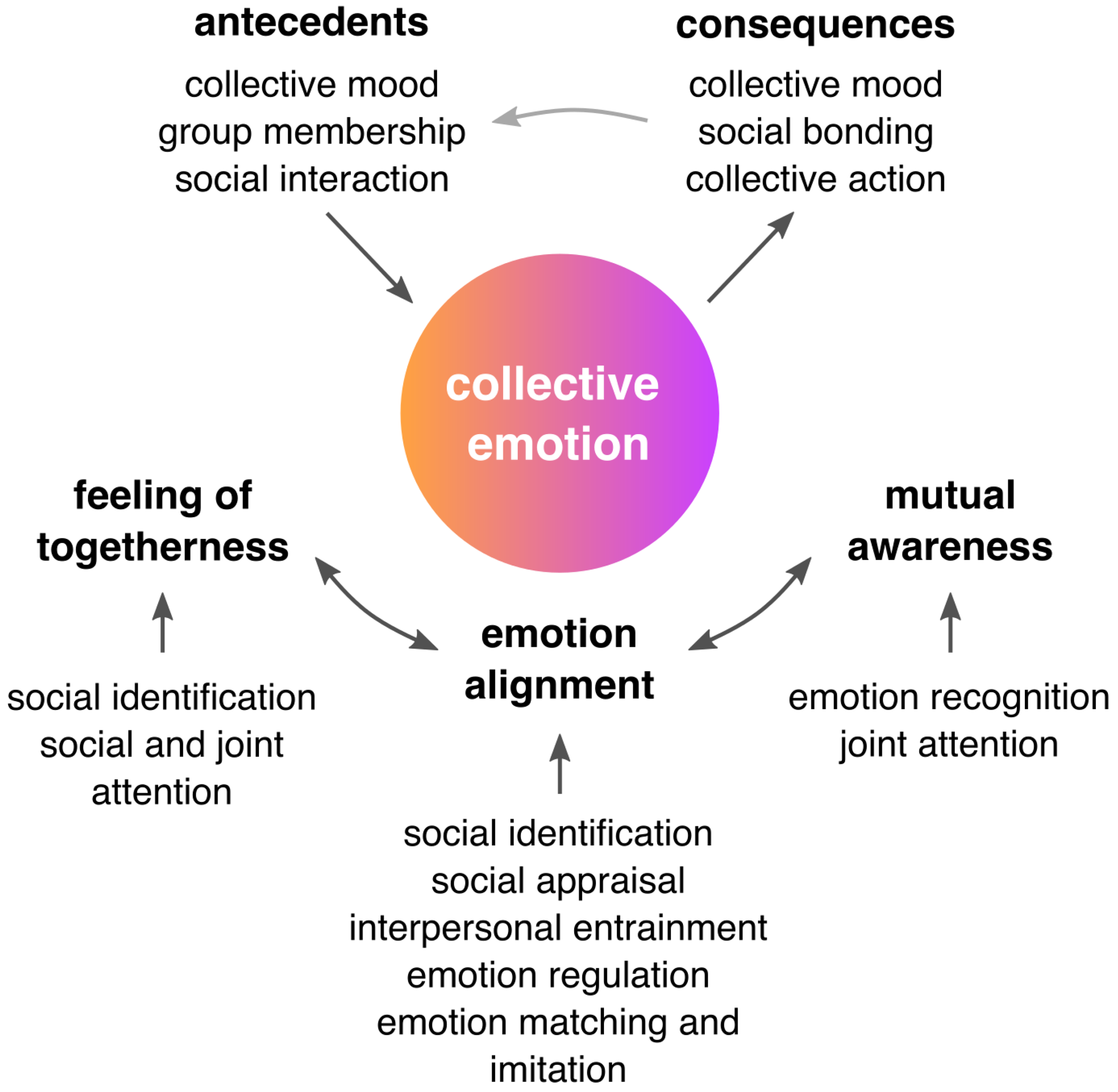
A framework for experimental research on collective emotion. The relations between characteristics, mechanisms, antecedents and consequences of collective emotion are represented by dark arrows and correspond to hypotheses for future experimental research. The gradient colours illustrate that collectiveness is a continuum that includes several types of collective emotion.
Furthermore, we believe that bridging the gap between research on collective emotion and broader research in cognitive and affective sciences would be mutually beneficial, as it would contribute to the social turn to macro-level affective phenomena (Keltner & Haidt, 1999; Van Kleef & Fischer, 2016). Experimental research on collective emotion is also an essential step to map the relations between different aspects of human collective cognition such as collective memory (Hirst et al., 2018), collective decision-making (El Zein et al., 2019; Tsarev et al., 2019) and collective intelligence (Centola, 2022). An integrative multi-disciplinary approach to collective phenomena is likely to elucidate their universal bases, while clarifying the existence of cultural specificities. Finally, putting empirical predictions to the test is crucial if we aim to understand the role of collective emotion in group behaviours related to a broad range of societal topics, such as social movements (Dunbar, 2022), group conflicts (Bar-Tal et al., 2007), responses to terrorist attacks (Garcia & Rimé, 2019), pandemics (Metzler et al., 2023) and climate change (Fritsche & Masson, 2021).
Footnotes
Acknowledgements
We thank Michèle Chadwick and Rocco Mennella for their proofreading and feedback, and anonymous referees for their valuable suggestions on earlier versions of this manuscript. A CC-BY public copyright license has been applied by the authors to the present document and will be applied to all subsequent versions up to the Author Accepted Manuscript arising from this submission, in accordance with the funding grants' open access conditions.
Declaration of Conflicting Interests
The author(s) declared no potential conflicts of interest with respect to the research, authorship, and/or publication of this article.
Funding
The author(s) disclosed receipt of the following financial support for the research, authorship, and/or publication of this article: This work was supported by the Institut National de la Santé et de la Recherche Médicale and the Agence Nationale de la Recherche, (grant numbers ANR-10-IDEX-0001-02, ANR-17-EURE-0017, ANR-20-CE28-0003, ANR-23-CE28-0003).
