



Abstract
This research estimates how changes in admiration and rivalry narcissistic traits correlate with changes in relationship satisfaction over time. Longitudinal analyses based on data from the Panel Analysis of Intimate Relationships and Family Dynamics (pairfam) studies were used to investigate this question. Findings show associations between heightening rivalry narcissistic traits and decreased levels of relationship satisfaction among men and women, and between heightening admiration narcissistic traits and decreased levels of relationship satisfaction among men. When the two aspects were estimated together, accounting for collinearity, heightening admiration narcissistic traits were not associated with changes in relationship satisfaction among men, while, among women, they correlated with increased levels of relationship satisfaction. These findings advance previous propositions in recent literature and shed light on gender differences in this regard.
The role of narcissistic traits in romantic relationships has been the focus of several prior studies (e.g., Campbell, 1999; Campbell et al., 2002; Ha et al., 2018). Few studies, however, have looked at narcissism and changes in relationship satisfaction in a longitudinal study. Within these studies, no known studies divided narcissism into rivalry and admiration components and fully estimated their roles longitudinally. Therefore, the current study determines the associations of each of these components with changes in relationship satisfaction in a longitudinal design, divided by men and women.
Narcissism and Relationships
Narcissism is a multidimensional construct that is characterized by the tendency to focus on oneself and exploit others, including romantic partners, for personal gain. People who are high in narcissism also display a tendency to insult their partners to maintain self-esteem and elevate self-appreciation (Balzen et al., 2022; Holtzman et al., 2010).
The association of narcissism with relationship satisfaction has mostly been examined cross-sectionally. Studies have shown that these narcissistic behaviors and attitudes directly correlate with various problems in relationships (Brunell & Campbell, 2011). Narcissists’ need for attention, extreme sensitivity, and criticism are precursors to failure in relationships, and it has been shown that within a relationship, narcissism plays a significant role in sabotaging intimate relationships (Altınok & Kılıç, 2020; Kealy & Ogrodniczuk, 2014; Keller et al., 2014).
In particular, studies have shown that narcissists find it difficult to experience genuine intimacy because they often exploit rather than connect with others and are motivated by the fear of abandonment (Brunell & Campbell, 2011; Zeigler-Hill et al., 2020). Narcissists, who have an inflated sense of self, are caught up in self-admiration and reject opportunities for honest and sincere relationships (Besser & Priel, 2009). Instead of self-revealing, narcissists present their idealized image and hide their full personalities. Thus, the high levels of self-admiration and competition make it difficult to sustain an intimate relationship (Vrabel et al., 2020, 2021).
In addition, narcissism is correlated with both a general lack of empathy and a reduced need for intimacy (Twenge et al., 2008). Traits such as reduced warmth, aggressive behavior, and conflict have also been reported among narcissists (Horan et al., 2015; Keller et al., 2014), as well as lower levels of emotional closeness, acts of trust, and communication (Campbell et al., 2006). In addition, narcissists were found to be less likely to display long-term commitment and to be more susceptible to infidelity and eventual divorce (Brewer et al., 2015). Negative behavior as a response to conflict has also been reported, such as revenge and lack of forgiveness (Peterson & DeHart, 2014). Other studies have shown narcissists to be more argumentative, evasive, and less “giving” in relationships (Campbell & Foster, 2002; Sedikides & Campbell, 2017). The collection of these studies shows the negative role of narcissism in relationships.
Narcissism and Relationships in Longitudinal Studies
The results of the few longitudinal studies that documented how narcissism relates to relationships, however, are more mixed. A longitudinal study of newlywed couples found that only the wives’ narcissistic levels predicted a decline in marital satisfaction over time for both partners (Lavner et al., 2016). Another study found that narcissism negatively correlated with spouse-reported marital satisfaction, but not with self-reported marital satisfaction (South et al., 2020). Yet, in two other longitudinal studies, there was no correlation between narcissism and changes in satisfaction (Ingram & South, 2021; South et al., 2020).
These mixed findings have stimulated deeper investigations into the mechanisms at play, distinguishing the different components of narcissism to understand what components are indeed harmful to relationships. Such division may explain the diverting results, revealing that the population composition in each of these studies is different in the nature of narcissism. A recent study, for example, divided narcissism into grandiosity, entitlement, and vulnerability (Balzen et al., 2022). The authors found, for example, that grandiosity was not linked to any romantic relationship outcomes, while participants with higher vulnerability reported lower levels of relationship satisfaction.
Within this framework of dividing narcissism into its components, particular attention has been given to the narcissistic rivalry and admiration concepts. These concepts will be investigated in this article through a longitudinal design, further divided into men and women.
The Narcissistic Rivalry and Admiration Concepts
Back et al. (2013) characterize two traits that appear at varying degrees within the narcissistic individual: admiration and rivalry (see also in Seidman et al., 2020). Narcissistic admiration is the need to enhance one’s self-image by achieving positive reactions and validation from others. Narcissists scoring high on this aspect consider themselves to be different or unique as well as superior to or better than others. Displays of admiration include confidence, dominant, and assertive behavior in social situations, often resulting in positive social reinforcement and being considered likable (Leckelt et al., 2015).
The narcissistic rivalry trait, by contrast, describes a defensive technique in which aggressive behaviors are used to protect one’s self-image. The narcissistic rivalry trait reflects impulses to protect one’s esteem and social validation through derogative behavior toward others. People scoring high on this aspect can be exploitative and are envious of others’ accomplishments (Dhawan et al., 2010). Consequently, this makes narcissistic rivals unlikable in long-term social interactions. Back et al. (2013) refer to this behavior as “antagonistic self-protection,” which manifests through selfish, rude, arrogant, confrontational, and generally aggressive behavior in social situations.
In particular, Wurst et al. (2017) propose that distinguishing between narcissistic rivalry and admiration traits is an important means of understanding how narcissists’ behavior affects long-term relationships. They showed that the narcissistic rivalry trait is negatively linked to long-term relationship satisfaction levels, but stopped short of showing how the narcissistic admiration trait affects relationships. Moreover, the two dimensions were not directly compared in a longitudinal analysis that followed individuals over time and were not examined in how changes in these traits correlate with changes in the levels of relationship satisfaction.
The current study, therefore, examines this division and the associations of changes in the levels of these two dimensions with relationship satisfaction. To wit, the question this current study addresses is how changes in the narcissistic rivalry and admiration traits correlate relationship satisfaction over time. Yet, this link is hypothesized to differ between men and women, as the following section explains.
Gender and the Role of Rivalry and Admiration Narcissism in Relationships
Gender differences in this regard have not received much attention in the past (Green et al., 2020). A recent study developed this direction in a survey conducted among college students concerning sexual behavior (Barnett & Millward, 2021). This study suggests, for example, that women with high levels of the narcissistic rivalry trait may demonstrate higher levels of aggressive sexual behavior. Yet, findings are scarce, and the current literature on gender differences in what relates to the effect of narcissistic rivalry and admiration traits on changes in the levels of relationship satisfaction is still underdeveloped.
To theorize the interaction of the narcissistic rivalry and admiration traits with gender, there is a need to consider that individuals who are high in narcissism score high on self-esteem in some studies (Bosson et al., 2008) and on several indicators of well-being and mental health (Egan et al., 2014; Sedikides et al., 2004). In turn, these consequences can boost self-standing and self-appreciation within a relationship and help maintain more equal relationships in certain cases (Campbell et al., 2002). Moreover, people who lack confidence and self-esteem may choose lower-quality relationships because they feel they are not worthy of a proper partner. By proxy, they are more susceptible to long-term relationship difficulties due to a mismatch with their partners (Campbell et al., 2002).
The proposition here is that women’s adoption of high levels of narcissistic admiration may be indicative of enhanced confidence and self-esteem, as was shown above (e.g., Leckelt et al., 2015). As the positive self-image and self-confidence of women still lag those of men in many nations (e.g., Torres-Guijarro & Bengoechea, 2017), it is probable that this trait helps women to offset some of the inequality that exists in many relationships. In turn, this trait might be associated with increased self-reported relationship satisfaction among women, on average, or show no effect.
The narcissistic rivalry trait, on the other hand, might be associated with decreased self-reported relationship satisfaction among men and women alike. Traits associated with rivalry narcissism, such as revenge, lack of trust, and forgiveness, are especially harmful during long-term relationships regardless of their gender. Moreover, as long-term relationships require mutual interdependence between partners and necessitate communication, trust, and proactive problem-solving behavior (Finkel et al., 2015), the narcissistic rivalry trait is harmful. Indeed, Wurst et al. (2017) conclude that rivalry may be the main force causing long-term relationship problems for narcissists regardless of their gender.
It is, therefore, hypothesized that increases in self-reported admiration and relationship satisfaction levels are more positively correlated among women than among men, while the narcissistic rivalry trait is not expected to show such divergence and thus be negatively linked with the levels of relationship satisfaction among men and women alike.
Method
Data
This study is based on the ninth and 11th waves of the Pairfam study, where data on the narcissistic admiration and rivalry traits exist in the short form. The German Research Foundation (DFG)-funded Panel Analysis of Intimate Relationships and Family Dynamics (Pairfam) study (Brüderl et al., 2021; Huinink et al., 2011), funded by the German government, began collecting yearly longitudinal data in 2008, and the sample includes three age cohorts: adolescents, young adults, and people in middle adulthood. The survey fieldwork for Pairfam was conducted by Kantar Public (formerly TNS Infratest Sozialforschung), and the ninth and 11th waves of the Pairfam study took place in the years 2016/2017 and 2018/2019, respectively.
The Pairfam’s target population included all German-speaking individuals, irrespective of nationality, living in private households in Germany. A two-stage sampling procedure was applied. First, municipalities in Germany were sampled via stratified random sampling. The strata were defined via federal states of Germany, administrative districts, and settlement structures with a proportional approach. In the second stage, individuals from the target population with a main residence within the selected municipalities were sampled by municipality administrations based on local population registers. The total number of individuals as well as the selection process were pre-defined by the Pairfam research team. In 29 cases, municipalities refused to provide addresses from local registry data. These were then replaced by structurally similar municipalities.
Several standardized procedures were applied to ensure long-time panel stability, including a personalized cover letter and data protection leaflet before the first contact with an interviewer, an incentive of 10 euros (15 since Wave 9) after the interview has been completed, and a thank-you card, which was sent to all respondents after the first wave. In addition, to increase panel stability, starting with Wave 3, respondents who withdrew participation in the previous wave were recontacted in the subsequent wave. Respondents who did not participate in two subsequent waves were excluded from the panel. The total number of data points in this current study is 11,295 (including repeated measures).
Participants
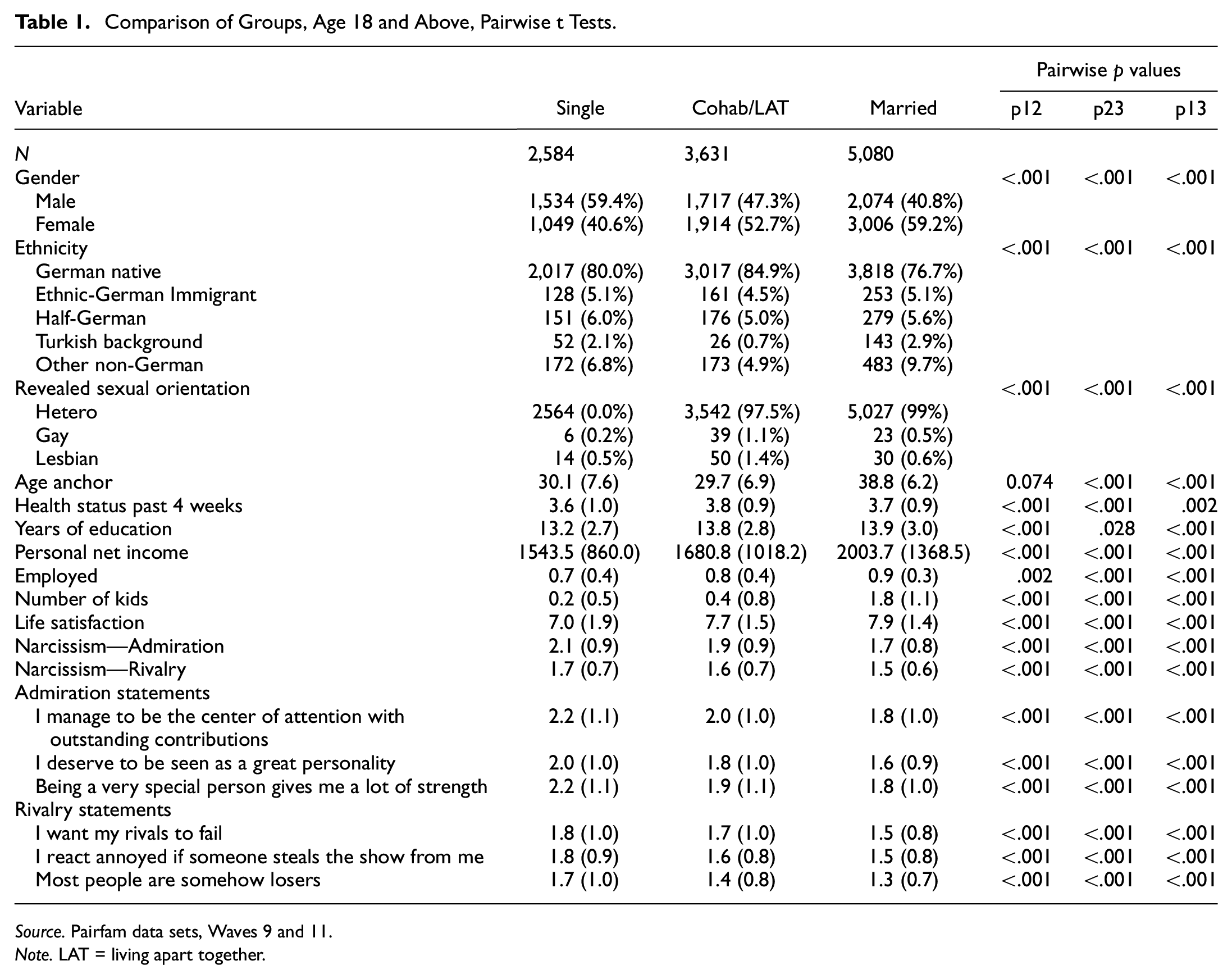
The current study only includes participants over the age of 18 (with 49 being the maximum age level available in the sample). Couples living apart together (LAT), cohabitating couples, and married people were examined in this study, while never-married singles were added to the descriptive statistics as a reference group. All coupled respondents are defined to be at least 3 months in a relationship. This means that all propositions regarding the dating period (e.g., the “chocolate cake” model in Campbell, 2005) cannot be tested and are beyond the scope of the current study. Sample size, age, gender, ethnicity, and revealed sexual orientation distributions can be found in Table 1. Note that no gender identities besides men and women were found, and no sexual orientation data, besides gay and lesbian, were collected. Racial identity was not collected as well; only specified ethnicities as per Table 1 were collected in this study. These subgroups should be investigated further but are beyond the scope of this current article due to the small numbers found in the data. No exclusions were made besides underaged persons (under 18 years old) and the widowed group, of which the number of cases is low. No missing values imputations were applied, and data points in this study only include the anchor respondent.
Comparison of Groups, Age 18 and Above, Pairwise t Tests
Source. Pairfam data sets, Waves 9 and 11.
Note. LAT = living apart together.
Variables
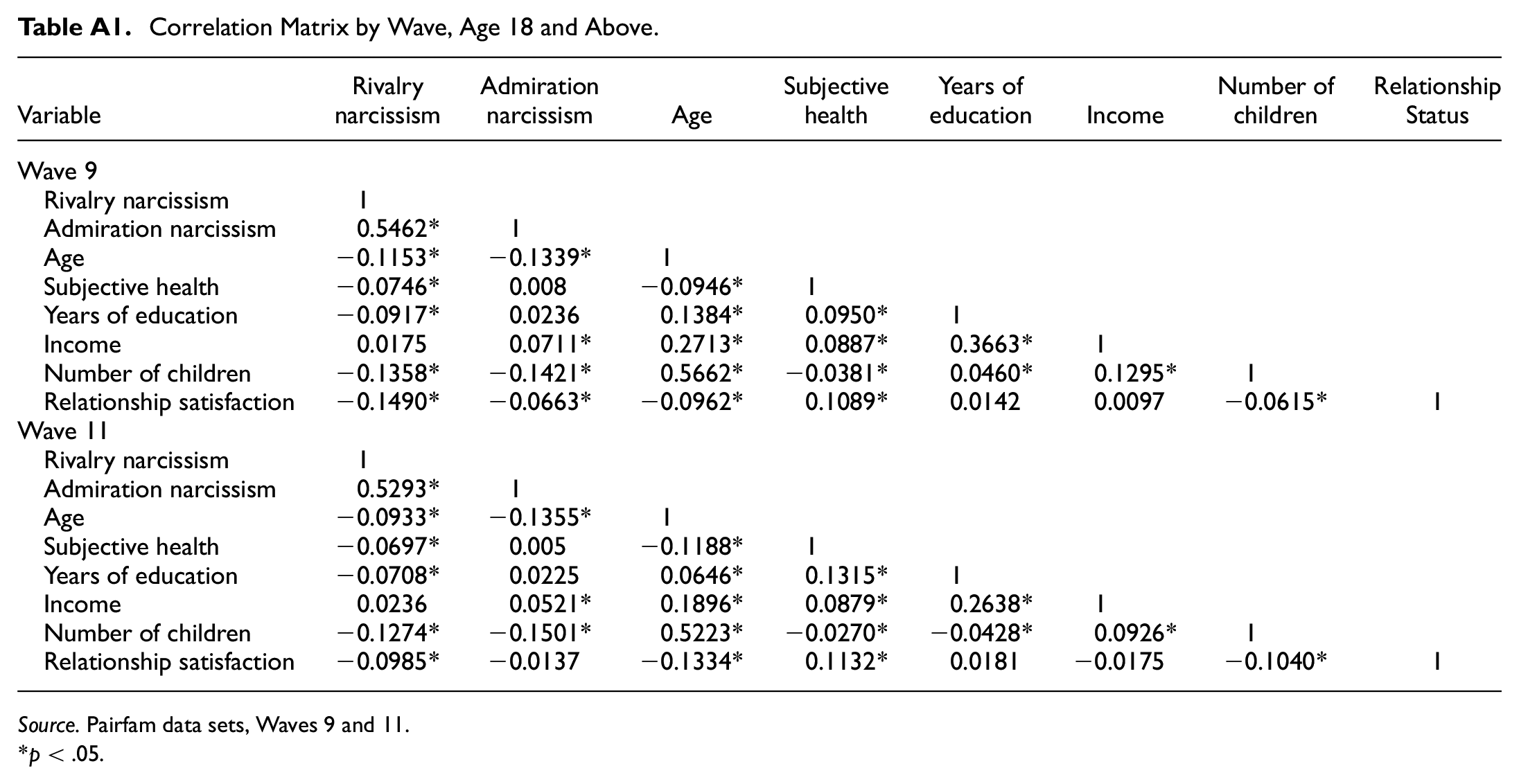
The analyses herein include several socioeconomic and demographic variables based on previous findings (Kislev, 2018, 2020a, 2020b, 2021a, 2021b). They include gender, age, years of schooling, subjective health assessment (ranging from 1, bad to 5, very good), personal net income, and the number of children, if any. The two variables that were at the focus of this study are Pairfam-constructed variables regarding the levels of narcissistic rivalry and admiration traits based on Back et al. (2013). The matrix of correlations between variables for both time points can be found in Appendix Table A1.
The narcissistic rivalry trait was measured with the following items: “I react annoyed if another person steals the show from me”; “I want my rivals to fail”; and “most people are somehow losers.” The internal consistency reliability measured by Cronbach’s alpha statistic is 0.6486 for Wave 9 and 0.6494 for Wave 11.
The narcissistic admiration trait was measured with the following items: “I deserve to be seen as a great personality”; being a very special person gives me a lot of strength; and “I manage to be the center of attention with my outstanding contributions.” Agreement with these six statements ranged from 1 (not at all) to 5 (absolutely). The internal consistency reliability measured by Cronbach’s alpha statistic is 0.792 for Wave 9 and 0.7944 for Wave 11.
This study aimed to measure the correlation between narcissistic rivalry and admiration traits and the levels of relationship satisfaction among those who are in a relationship (LAT, cohabitating, and married people). Relationship satisfaction was measured with the following item: “all in all, how satisfied are you with your relationship?” using an 11-stage rating (0—Very dissatisfied to 10—Very satisfied). Examining the narcissistic metrics over Pairfam waves provides a longitudinal measure of how changes in narcissistic levels correlate with one’s own propensity to enjoy a relationship and feel satisfied within.
Procedure
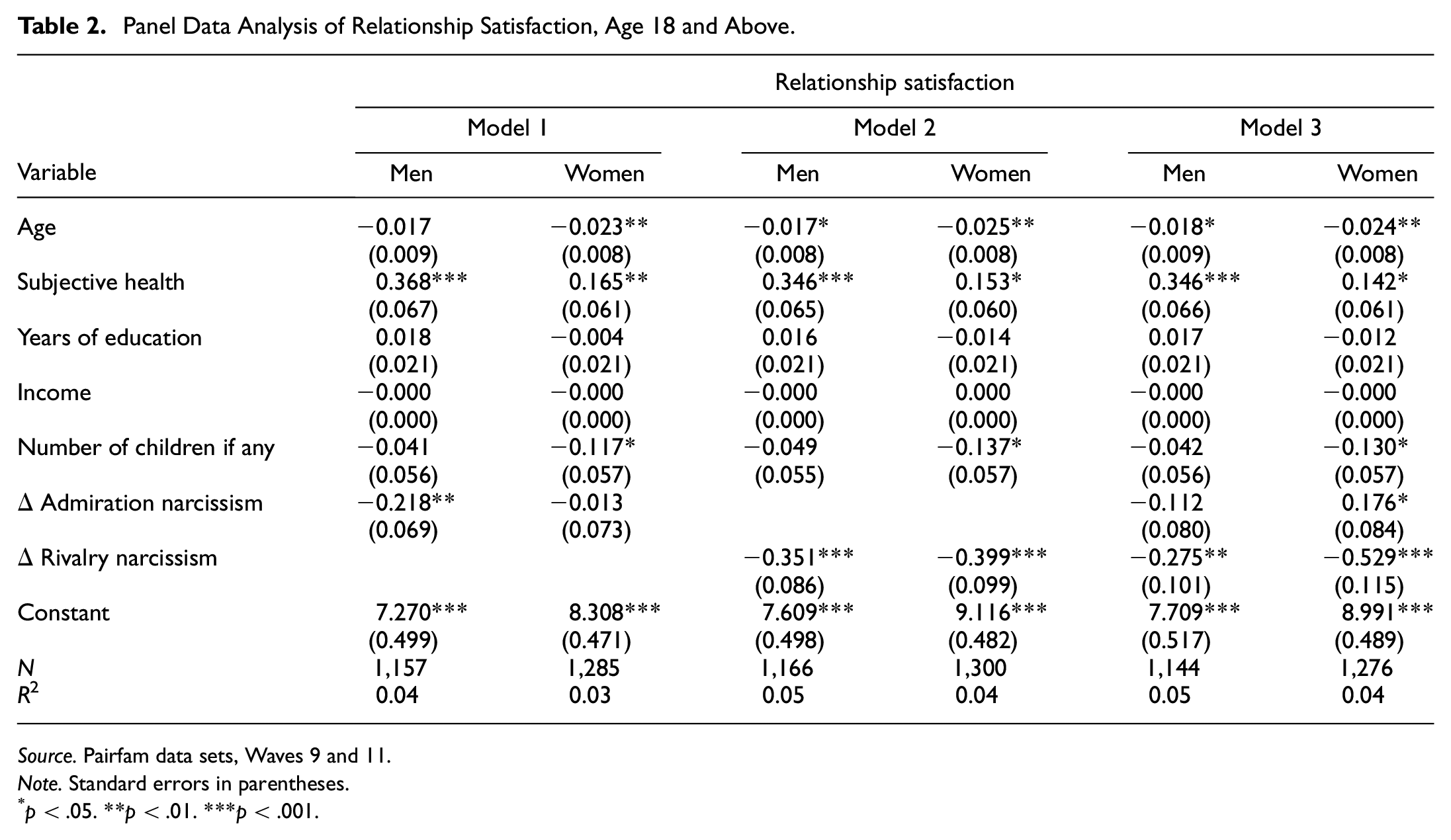
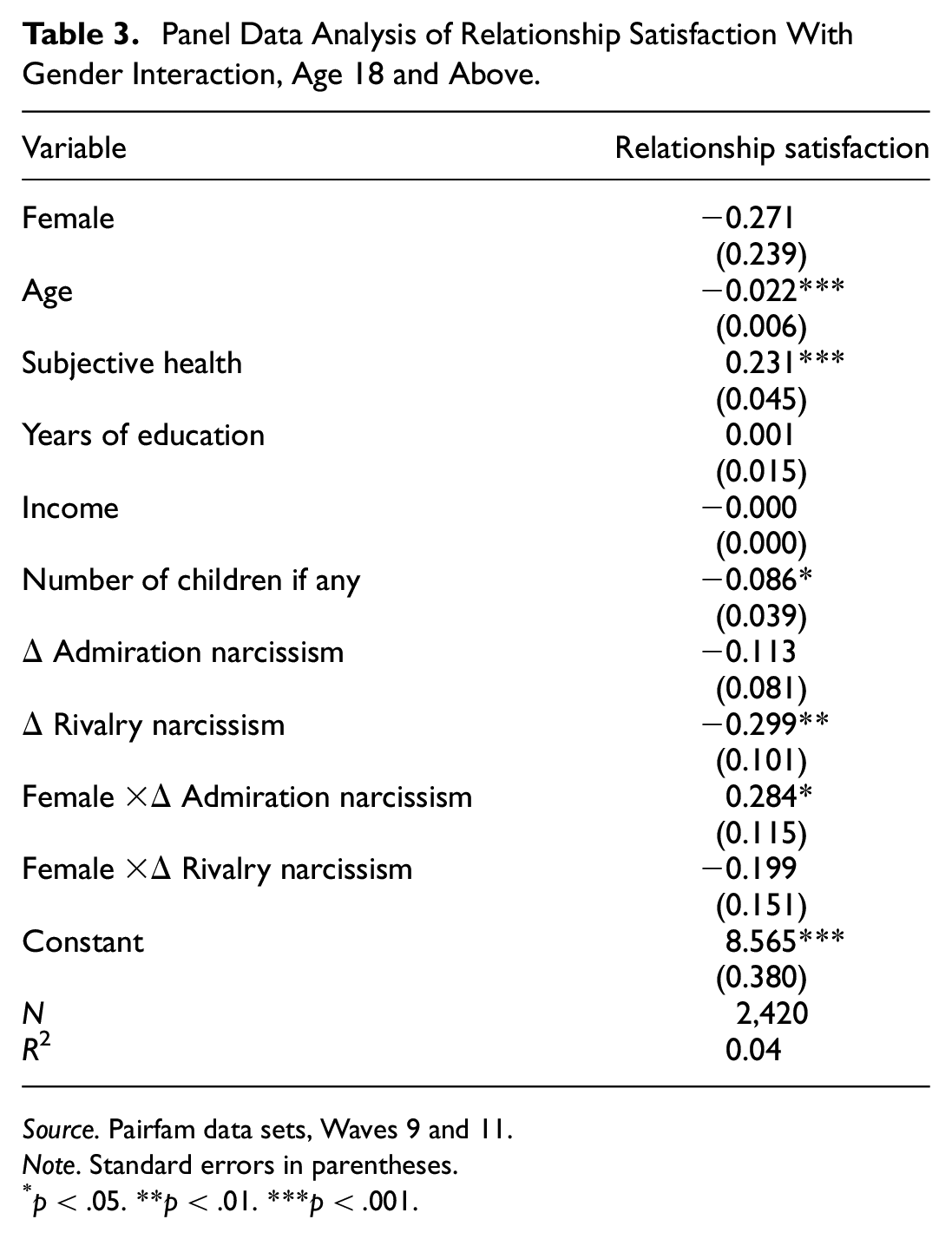
Table 1 present descriptive statistics. Table 2 presents an analysis of the panel data and estimates the relationships between changes in the levels of the narcissistic rivalry and admiration traits over time (2 years) and the levels of relationship satisfaction in the latter year. The changes over time were calculated by the 2-year lag operator (Bolger & Laurenceau, 2013). Given that the two dimensions tend to be positively correlated with each other (Seidman et al., 2020), the two aspects are also examined here together, in the same equation, to test their effect in isolation. Table 3 presents interaction terms of gender with changes in the levels of the narcissistic rivalry and admiration traits over time.
Panel Data Analysis of Relationship Satisfaction, Age 18 and Above
Source. Pairfam data sets, Waves 9 and 11.
Note. Standard errors in parentheses.
p < .05. **p < .01. ***p < .001.
Panel Data Analysis of Relationship Satisfaction With Gender Interaction, Age 18 and Above
Source. Pairfam data sets, Waves 9 and 11.
Note. Standard errors in parentheses.
p < .05. **p < .01. ***p < .001.
Transparency and Openness
To maintain transparency and openness, data files are available from the Pairfam study website, and the coding file is available via the data depository at the URL cited (Kislev, 2022) or through the journal’s editor. Researchers are wholeheartedly encouraged to use the data and coding files to test and replicate the results presented here. Data were analyzed using STATA version 15.1. This study’s design and its analysis were not pre-registered.
Results
To provide an overview of the population at hand, a detailed comparison between relationships status groups was performed with pairwise statistical tests (Table 1). Cohabitating and LAT individuals were grouped together in this table to make the tests more manageable (pairwise tests for four groups would have doubled the number of columns) and to make the groups more equal in terms of the number of cases. Note that the results are not different upon performing the pairwise tests among the four groups.
Table 1 shows that the groups differ in most demographic and socioeconomic characteristics. The healthiest group, for example, is the one comprising cohabiting and LAT individuals, while top earners were found among married people. These findings are in line with previous studies (Kislev, 2019; Klinenberg, 2012; Lesthaeghe, 2020; Perelli-Harris et al., 2014) and should be accounted for in further analyses, as reported below.
The main analysis, however, measured how changes in the levels of admiration and rivalry narcissism between the ninth wave of the Pairfam study, where these questions were asked for the first time, and the 11th wave of the study, where these questions were asked again, correlate with relationship satisfaction in the latter wave (the 11th wave of the Pairfam study). This longitudinal analysis accounted for demographic and socioeconomic variables. To test for collinearity, the first column in this table, divided into men and women, presents a model that accounts for admiration narcissism, the second column accounts for rivalry narcissism, and the third accounts for both in the same equation.
This analysis shows that increasing levels of the narcissistic rivalry trait (Model 2 in Table 2) were correlated with decreased self-reported relationship satisfaction among men and women. The same pattern was demonstrated for men whose relationship satisfaction levels went down with increasing narcissistic admiration levels (Model 1 in Table 2). In contrast, women did not show similar patterns, and their relationship satisfaction levels were not linked to a change in their narcissistic admiration levels.
Accounting for both aspects in the analyses (Model 3 in Table 2 and Appendix Table A1) shows that rivalry narcissism, rather than admiration narcissism, is what correlates with decreased relationship satisfaction levels. In fact, a marginal positive coefficient was shown among women holding higher narcissistic admiration levels in the combined model. This gender difference was tested statistically and comparatively in Table 3 with interaction terms.
Discussion
The current study supports existing literature on the impacts of narcissistic traits on romantic relationships (e.g., Campbell, 1999; Campbell et al., 2002; Ha et al., 2018) and extends it. In particular, the longitudinal analysis in the current study demonstrated reduced levels of relationship satisfaction with increasing levels of the narcissistic rivalry trait among individuals already in relationships. The levels of the narcissistic admiration trait were also shown to be associated with reduced relationship satisfaction, but this is probably due to collinearity with rivalry narcissism (Seidman et al., 2020). Indeed, after incorporating changes in both the narcissistic admiration and rivalry traits into the analysis, the changes in rivalry held the explanatory value for the levels of relationship satisfaction in the latter year.
Importantly, while the aforementioned findings were consistent between men and women, among men, relationship satisfaction levels also decreased with increasing narcissistic admiration levels when they were measured alone, whereas women did not show similar patterns. The combined analysis in Tables 1 and 3 showed that admiration levels had a small, positive effect on women’s relationship satisfaction levels, while such a rise did not appear among men.
Indeed, an encompassing series of seven studies (Wurst et al., 2017) suggested that diverging romantic effects might be the consequence of admiration and rivalry narcissism, two dimensions that govern different relationship stages in different ways (Back et al., 2013). The overall findings from Wurst et al. (2017) showed that the admiration dimension governs short-term romantic contexts and boosts the narcissist’s charming, self-confidence, and entertaining qualities; meanwhile, problems associated with long-term relationships are governed by the rivalry dimension. Thus, with rivalry as the driving force behind increasing risks posed to romantic relationship success (e.g., due to outcomes such as dysfunctional coping after transgressions), greater levels of the narcissistic rivalry trait should be associated with reduced relationship satisfaction, in particular.
The findings from Wurst et al. (2017) also hinted there could be a positive association between the narcissistic admiration trait and long-term romantic outcomes. While this was not developed in their article, the mechanisms behind such effect might be that higher admiration levels reflect more positive thinking about one’s own relationship or that the narcissistic admiration trait serves as a protective factor, potentially explaining adaptive aspects of narcissism in long-term romantic relationships (e.g., in Study 4 of Wurst et al., 2017, among 133 online participants, although the results were not reproduced in Study 5).
The findings in this current study confirm this previous proposition among women. These findings might be explained considering the development of self-admiration as empowering women that are culturally still disadvantaged in many situations. For example, in many nations, women’s self-image and self-confidence still lag behind those of men, as several studies have shown (e.g., Torres-Guijarro & Bengoechea, 2017). In this sense, self-admiration may counter ingrained gender roles. Indeed, more research is needed to confirm this explanation or suggest others, but the theory suggested here is that individuals who are high in admiration narcissism boost their self-standing and self-appreciation within a relationship and help find and maintain more equal relationships (Campbell et al., 2002). For women, more than men, this can help them feel more satisfied within a relationship. The current findings, thus, support the proposition of Wurst et al. (2017) and provide a gender context for the distinctive narcissistic admiration and rivalry associations with the levels of relationship satisfaction put forth previously.
Implications
It is important to understand the implications for the relations between the narcissistic rivalry and admiration traits and the levels of relationship satisfaction. Narcissistic characteristics have been shown to be negatively associated with relationship satisfaction levels, with a suggestive distinction between the narcissistic rivalry and admiration traits. The current longitudinal analyses advance these previous results and suggestions. In particular, the longitudinal study herein shows that relationship satisfaction levels vary inversely with over-time changes in the levels of the narcissistic rivalry trait for both men and women. However, while there is also a negative relation between increasing narcissistic admiration over time and relationship satisfaction levels for men, there is no similar link among women. Moreover, when the two dimensions are considered together, it is only the narcissistic rivalry trait that carries a significant association, even among men. These findings advance our understating of narcissistic admiration and rivalry traits in their associations with relationship measures. Ultimately, it is the narcissistic rivalry trait that is more linked to relationships’ failure, whereas the narcissistic admiration trait is effectively neutral or may rather have a mild positive correlation with relationship satisfaction levels among women.
The implications of these findings are important, especially in light of the recent growing prevalence of narcissism (Konrath et al., 2014) and reduced marriage rates (Kislev, 2019). It was shown that the narcissistic admiration trait is not a negative correlator in and of itself with relationship satisfaction levels. In fact, the narcissistic admiration trait may serve coupled individuals well, especially coupled women. Meanwhile, communal traits exhibited alongside low rivalry narcissism, such as empathy, warmth, supportiveness, and forgiveness would carry greater importance for more committed relationships. The longitudinal analysis in this study supports these implications based on a large and reliable sample.
Limitations
Several limitations and further research directions should be considered. One limitation of this study is the small effect sizes of most of the variables in the models (<0.15) besides rivalry narcissism, for which the effect sizes were small-to-medium (0.3 > β < 0.15) (Cohen, 1992). While this is an indicator of the need for further research and better models, it is also expected from such complex conceptual constructs as the narcissistic rivalry and admiration aspects and their effect on relationship satisfaction levels. Further research might seek to explore the causes underlying changing narcissism levels in relationships over time.
Furthermore, the current study detected differences in relationship satisfaction levels in associations with changes in narcissistic traits over time upon disaggregating the sample by gender. Additional demographic aspects not addressed in the study (e.g., race, ethnicity, social class, gender fluidity, and sexual orientation) could likewise reveal more variability in the findings.
Another limitation is that the present study does not address the partner characteristics variations. Prior studies have implied that partner characteristics may be essential for short-term and long-term relationship success (Barelds, 2005; Johnson & Talitman, 1997). These limitations point to future research directions in the future.
Conclusion
In conclusion, the findings of this study confirm previous results in suggesting the inverse association between narcissism and relationship satisfaction levels, while also providing new longitudinal evidence supporting the distinct connection between narcissistic rivalry and admiration traits and relationship satisfaction. Specifically, increasing narcissistic rivalry levels over time are linked with reduced relationship satisfaction, while the narcissistic admiration trait is limited in its association with relationship satisfaction and even presents a positive relation among women when accounting for collinearity.
Footnotes
Appendix
Correlation Matrix by Wave, Age 18 and Above
| Variable | Rivalry narcissism | Admiration narcissism | Age | Subjective health | Years of education | Income | Number of children | Relationship Status |
|---|---|---|---|---|---|---|---|---|
| Wave 9 | ||||||||
| Rivalry narcissism | 1 | |||||||
| Admiration narcissism | 0.5462* | 1 | ||||||
| Age | −0.1153* | −0.1339* | 1 | |||||
| Subjective health | −0.0746* | 0.008 | −0.0946* | 1 | ||||
| Years of education | −0.0917* | 0.0236 | 0.1384* | 0.0950* | 1 | |||
| Income | 0.0175 | 0.0711* | 0.2713* | 0.0887* | 0.3663* | 1 | ||
| Number of children | −0.1358* | −0.1421* | 0.5662* | −0.0381* | 0.0460* | 0.1295* | 1 | |
| Relationship satisfaction | −0.1490* | −0.0663* | −0.0962* | 0.1089* | 0.0142 | 0.0097 | −0.0615* | 1 |
| Wave 11 | ||||||||
| Rivalry narcissism | 1 | |||||||
| Admiration narcissism | 0.5293* | 1 | ||||||
| Age | −0.0933* | −0.1355* | 1 | |||||
| Subjective health | −0.0697* | 0.005 | −0.1188* | 1 | ||||
| Years of education | −0.0708* | 0.0225 | 0.0646* | 0.1315* | 1 | |||
| Income | 0.0236 | 0.0521* | 0.1896* | 0.0879* | 0.2638* | 1 | ||
| Number of children | −0.1274* | −0.1501* | 0.5223* | −0.0270* | −0.0428* | 0.0926* | 1 | |
| Relationship satisfaction | −0.0985* | −0.0137 | −0.1334* | 0.1132* | 0.0181 | −0.0175 | −0.1040* | 1 |
Source. Pairfam data sets, Waves 9 and 11.
p < .05.
Handling Editor: Jennifer Bosson
Declaration of Conflicting Interests
The author(s) declared no potential conflicts of interest with respect to the research, authorship, and/or publication of this article.
Funding
The author(s) received no financial support for the research, authorship, and/or publication of this article.
