




Abstract
On the basis of the Narcissistic Admiration and Rivalry Concept and recent theories on narcissistic pursuit of status, we provide a differentiated analysis of individual differences in the within-person dynamics of grandiose narcissism. In two daily diary studies (Sample 1: 56 days; Sample 2: 82 days; total participants: N = 198; total observations: N = 12,404), we investigated the degree, stability, and trait correlates of individual differences in average narcissism-relevant states (perceived status success, perceived admiration and rejection, positive and negative affect, and assertive and hostile behavior) as well as individual differences in within-person contingencies between these states. The results indicated substantial and stable between-person differences in averaged states that were related to their corresponding narcissism trait self-reports. State contingencies showed substantial strength, significant interindividual differences, and stability across the 56 and 82 days, respectively. We only found weak support for associations between state contingencies and trait narcissism self-reports. These findings support a differentiated approach to the conceptualization and assessment of grandiose state narcissism and call for even more comprehensive and fine-grained investigations.
Research on grandiose narcissism 1 has mostly followed a classical trait perspective: Individuals differ in their narcissism trait scores, that is, in the extent to which they generally possess typical narcissistic characteristics, such as grandiose fantasies about oneself or a striving for supremacy and uniqueness (e.g., Miller & Maples, 2011; Tamborski & Brown, 2011). Although this approach has been extremely successful at capturing important between-person differences in narcissism, it is incomplete as it cannot be used to target within-person differences in the expression of narcissism over time. Following advances in theoretical and empirical personality research more generally (Back, 2021; Beck & Jackson, 2020; Fleeson & Jayawickreme, 2015; Mischel & Shoda, 1998; Wright & Kaurin, 2020; Wright & Simms, 2016), individuals are not expected to express narcissism-related cognitions, emotions, and behaviors with equal intensity over a given timespan. Rather, the intensity with which these states are expressed over short periods of time tends to fluctuate (e.g., Edershile et al., 2019; Edershile & Wright, 2021; Giacomin & Jordan, 2016a, 2016b). Existing work on state grandiose narcissism has mostly conceptualized grandiose narcissism as a unitary construct and has not considered agentic and antagonistic aspects of it (Back et al., 2013; Back, 2018) even though researchers have long suggested that narcissism is composed of agentic and antagonistic components (e.g., Miller et al., 2011; Paulhus, 2001). Also, few studies have looked at the environmental (e.g., status-related) triggers of narcissistic state expressions and how individuals differ therein (e.g., Grapsas et al., 2020). The present research aims to contribute to a more complete understanding of intra- and interindividual differences in grandiose narcissism states.
The Multidimensionality and Multimodality of State Grandiose Narcissism: A Narcissistic Admiration and Rivalry Perspective
Prior diary studies have shown that the amount of narcissism state variability within persons (Giacomin & Jordan, 2016a; 2016b) is substantial but not as high as in other personality domains (e.g., extraversion; Fleeson, 2001). Moreover, average narcissism states have shown medium- to large-sized associations with questionnaire-based narcissism trait scores (Edershile et al., 2019; Giacomin & Jordan, 2016a, 2016b). These results provide promising initial evidence for the conceptualization of narcissism on a state level.
Previous research has, however, used unidimensional state measures of grandiose narcissism and did not incorporate emerging consensus on its agentic and antagonistic aspects (Back, 2018; Crowe et al., 2019; Krizan & Herlache, 2018) 2 .The two dimensions encompass unique cognitive, affective, and behavioral expressions such that agentic narcissism is characterized by assertiveness, self-assuredness, and admiration-seeking confidence, and antagonistic narcissism is characterized by hostility, combativeness, and rivalrous aggression. In addition, previous state measures of grandiose narcissism do not systematically distinguish between cognitive, affective, and behavioral modalities but usually capture cognitive self-concept perceptions or a blend of modalities.
A model that theoretically distinguishes between agentic and antagonistic aspects of grandiose narcissism and between different state modalities is the Narcissistic Admiration and Rivalry Concept (NARC; Back et al., 2013). According to the NARC, individuals high in narcissism pursue the overarching goal of establishing or maintaining a grandiose self. There are two strategies available for this purpose: One is a self-promotion strategy, which results in dynamics that reflect narcissistic admiration (i.e., charming behavior, striving for uniqueness, and grandiosity), and the other is a self-defense strategy, which results in dynamics that reflect narcissistic rivalry (i.e., aggressiveness, devaluation of others, and striving for supremacy). On a trait level, narcissistic admiration and rivalry are typically assessed by administering the Narcissistic Admiration and Rivalry Questionnaire (NARQ; Back et al., 2013). A number of studies have demonstrated that agentic and antagonistic aspects of grandiose narcissism are associated with various outcome measures across different domains in theoretically predicted directions (e.g., Back et al., 2013; Back, 2018; Geukes et al., 2017; Leckelt et al., 2015; Wurst et al., 2017).
Capturing admiration and rivalry with all the modalities that are relevant on the state level would allow to not only mirror associations that have been investigated on a trait level but also to provide more direct tests of the within-person dynamics that are described in the NARC and other self-regulatory models of narcissism. On the basis of the NARC (Back et al., 2013), specific expectations can be derived for both the agentic and antagonistic pathway on the state level: Individuals high on agentic narcissism should more often evaluate their accomplishments in a positive way (cognitive state), more often feel positive affect (affective state), and more often show assertive behaviors (behavioral state). Individuals high on antagonistic narcissism should more often evaluate reactions to their performance as critique and underappreciation (cognitive state), more often feel negative affect (affective state), and more often show hostile behaviors (behavioral state). Thus, it should be possible to find reliable and stable interindividual differences in the averages of all of these states. Moreover, because existing trait measures of grandiose narcissism (e.g., the NARQ) are thought to capture the typical expression of narcissism states, trait and average state measures should be substantially correlated for both agentic and antagonistic narcissism, respectively.
Narcissism and state contingencies
So far, we have argued that narcissism can be captured by interindividual differences in the extent to which one experiences specific (narcissism) states (e.g., cognitive, affective, and behavioral states) in everyday live. According to modern accounts that conceptualize personality traits as interindividual differences in within-person state dynamics (Back, 2021; Baumert et al., 2017; Fleeson & Jayawickreme, 2015; Geukes et al., 2018; Geukes & Back, 2017), narcissism can additionally be captured as interindividual differences in narcissism-relevant state contingencies. State contingencies refer to all sorts of links between perceived environmental characteristics and narcissism-relevant cognitive, affective, and behavioral states (e.g., the relation between perceived status success and negative affect) as well as to the relations among narcissism state components (e.g., the relation between positive affect and self-assured behavior).
Dynamic conceptualizations of narcissism have incorporated ifs (or whens) and thens between cognitions, emotions, and behaviors when describing narcissistic functioning and self-regulation. Morf and Rhodewalt’s (2001) seminal article, for example, stated, “narcissists are likely to become disenchanted with and respond negatively to their relationship partners when flaws become apparent” (p. 187). Morf et al. (2011) also draw heavily on specific if-then contingencies: “for narcissists, the typical self-signatures are: ‘IF opportunity for promotion or demonstration of the grandiose superior self, THEN self-affirm, self-promote, and self-enhance!’ as well as ‘IF threat to own grandiosity and superiority, THEN strike back!’” (p. 402). This reasoning was also incorporated into the NARC (Back et al., 2013), where the first self-signature captures the admiration pathway (self-promotion), and the second self-signature captures the rivalry pathway (self-defense). Roche et al. (2013) provided an overview of the typical ifs (e.g., greater sensitivity to perceiving interpersonal transgressions, threats to agentic motives) and thens (e.g., agentic behaviors, interpersonal dominance, antagonistic behaviors) for pathological narcissism. Also, Sadikaj et al. (2019) stated, “The antagonism so characteristic of narcissistic individuals may emerge if they perceive others as taking control or asserting their status” (p. 3).
However, empirical investigations of narcissistic if-then contingencies in everyday life are scarce (see, e.g., Besser & Priel, 2010; Besser & Zeigler-Hill, 2010; Bushman & Baumeister, 1998; Webster et al., 2007, for alternative experimental approaches). In a 7-day daily diary study, Roche et al. (2013) reported evidence for the hypothesis that, for individuals high in grandiosity, perceiving agency in another (if) evoked an underlying status threat, which led to an agentic behavioral response (then). However, this pattern of “agentic nonreciprocity” was found only when the interaction partner was also seen as more communal. Giacomin and Jordan examined how state narcissism was related to other psychological states such as self-esteem and stress (2016a) and subjective well-being (2016b). State narcissism was higher on days when individuals experienced positive agentic outcomes (e.g., having power over someone) or positive communal outcomes (e.g., helping someone with a problem). By contrast, state narcissism was lower on days when people experienced higher levels of felt stress. As outlined in greater detail below, Zeigler-Hill et al. (2019) examined how narcissism was related to status pursuit and whether it moderated a specific contingency (i.e., the relationship between daily perceptions of status and affiliation [ifs] and state self-esteem [then]). In the clinical realm, Wright et al. (2017) demonstrated that interview assessed narcissistic personality disorder (NPD) amplifies the negative affect response to perceptions of dominance from another.
Thus, empirical research has only just begun to assess the ifs and thens of narcissism in a state-like manner and to examine interindividual differences in these within-person contingencies. Moreover, none of the previous findings have distinguished between agentic and antagonistic aspects of grandiose narcissism. Also, the stability of interindividual differences in narcissistic within-person contingencies has not yet been examined. We expected that interindividual differences in such contingencies would be at least as stable as interindividual differences in contingencies for other personality traits reported in the literature (i.e., Sherman et al., 2015; Shoda et al., 1994; Smith et al., 2009). We also explored the extent to which such differences correspond to classical trait measures of narcissism (i.e., in our case, a self-report questionnaire on narcissistic admiration and rivalry). It is currently unclear how much classical questionnaire-based trait measures of narcissism capture dynamic aspects that should be reflected by narcissism state contingency differences. Of the large number of possible contingencies, as a starting point, we focused on directed contingencies that follow from novel insights into the narcissistic pursuit of status.
Narcissistic pursuit of status
The NARC model has recently been related to the notion that the prime motivation for those high in narcissism is the pursuit of status. Both dimensions of narcissism (admiration and rivalry) were related to power and achievement motives (Rogoza et al., 2016) and a higher striving for status (Zeigler-Hill et al., 2018, 2019). More specifically, Zeigler-Hill et al. (2019) showed that admiration and rivalry were associated with an agentic orientation toward the pursuit of status, whereas only rivalry was associated with an antagonistic orientation toward the pursuit of status. Using a daily diary approach, the authors further showed that individuals with higher levels of self-reported trait admiration reported higher state self-esteem on days when they felt admired. Trait rivalry did not moderate the link between perception of status and self-esteem.
In line with this research, Grapsas et al. (2020) postulated a self-regulation model that specifies how those high in narcissism pursue social status through moment-to-moment transactions with their environments. According to the status pursuit in narcissism (SPIN) model, individuals high in narcissism select situations that afford status and vigilantly attend to cues related to the status they and others have in these situations. In evaluating these perceived cues, those high in narcissism are thought to appraise whether they can elevate their status or reduce the status of others (to thereby indirectly elevate their own status). Depending on these appraisals, they are supposed to engage in self-promotion (admiration pathway) or other-derogation (rivalry pathway).
Combining the idea of state contingencies with status-related reasoning, perceptions of success (or the lack thereof) in status pursuit can be identified as highly relevant ifs for individuals high in grandiose narcissism. In turn, these ifs are likely to trigger specific cognitive, affective, and behavioral responses (thens), which take on different forms depending on whether the agentic or antagonistic pathway is activated. In other words, we argue that individuals might differ not only in their tendencies to perceive status success, see others as a source for admiration, experience positive affect, and behave in an assertive way but also in the degree to which their perception of status success (if) triggers (1) specific cognitions of being special and admired, (2) positive affect, and (3) assertive behavior (thens, see Admiration Pathway A in Figure 1). Similarly, individuals might differ not only in their tendencies to perceive low status success, perceive others as critical and underappreciative, experience negative affect, and behave in a self-defensive and hostile way but also in the degree to which the perception of low status success (if) triggers (4) the perception of being criticized and rejected, (5) negative affect, and (6) hostile behavior (then, see Rivalry Pathway B in Figure 1). For individuals high in agentic narcissism, we expected stronger contingencies (1–3) compared with individuals low in agentic narcissism. For individuals high in antagonistic narcissism, we expected stronger contingencies (4–6) compared with individuals low in antagonistic narcissism. To sum up, in addition to investigating interindividual differences in the average narcissism-relevant states, we investigated interindividual differences in within-person state contingencies, their stability, and their relations to classical questionnaire-based measures of trait narcissism. Overview of the narcissism state contingencies examined in this study. Note. Panel A shows expected contingencies for the admiration pathway; Panel B shows expected contingencies for the rivalry pathway. (+) = positive association expected; (−) = negative association expected.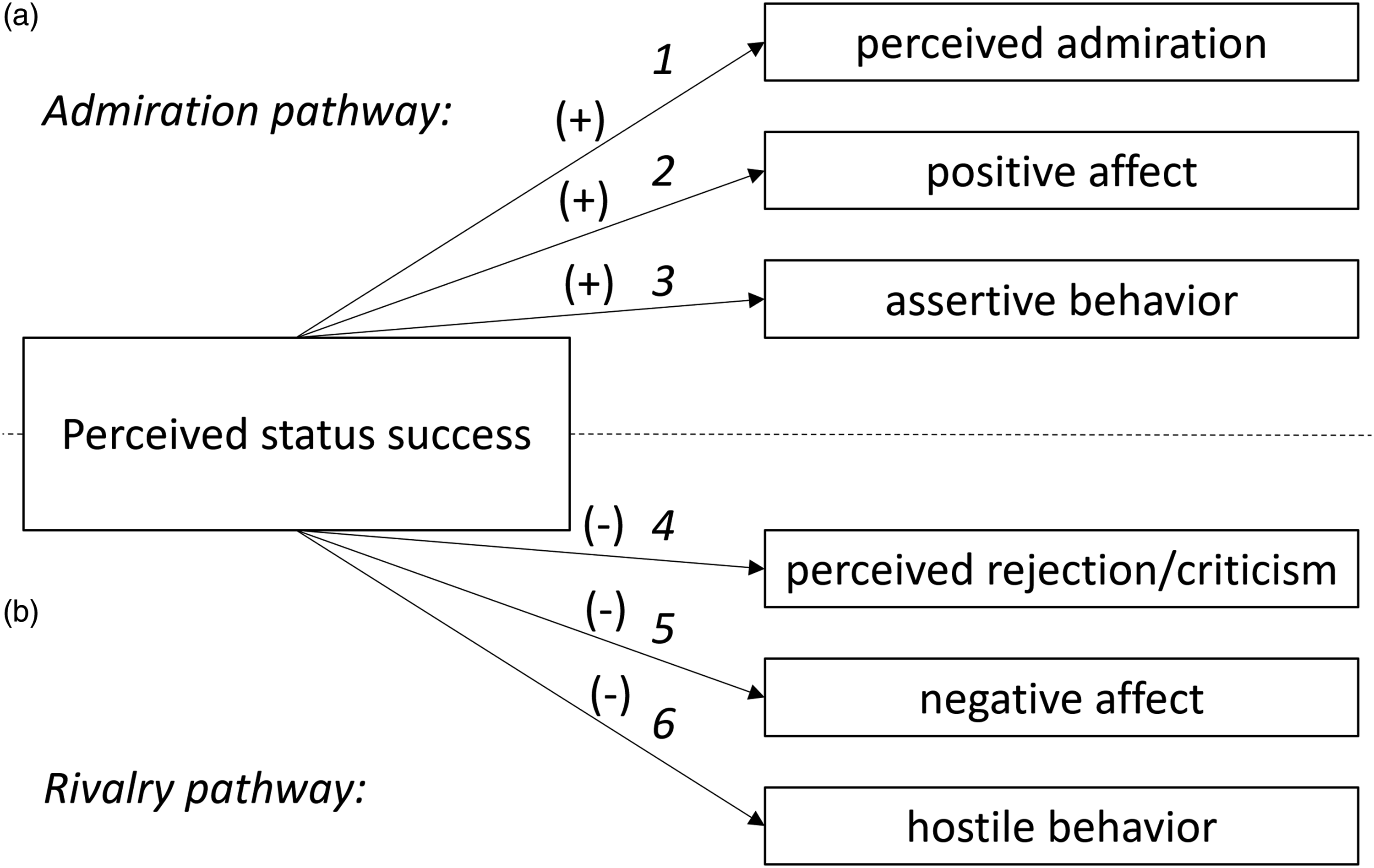
The present research
The present work expands the emerging research on state narcissism in two ways. First, relying on the NARC framework, agentic and antagonistic aspects of state grandiose narcissism (which has previously been conceptualized as unidimensional) were disentangled by examining states relevant for narcissistic admiration and rivalry in different (i.e., cognitive, affective, and behavioral) modalities. We expected reliable and stable interindividual differences in all narcissism-relevant states and medium- to large-sized associations with their corresponding questionnaire-based trait measure. Second, connecting recent accounts on narcissistic striving for status and the idea of if-then contingencies, we systematically examined contingencies between social status perceptions and agentic as well as antagonistic narcissism states (see Figure 1). We expected relevant state contingencies to show reliable and stable interindividual differences, thereby potentially serving as useful descriptors of trait narcissism. We also explored the extent to which these interindividual differences correspond to classical questionnaire-based trait measures of grandiose narcissism.
Method
We used data from two daily diary studies: The FLUX—fluctuations—Study (FLUX; henceforth referred to as Sample 1) and the Fluctuations in Personality study (FLIP; Sample 2). 3 Data collection for both studies took place in Leipzig, Germany. In the following, we only refer to the methods that are relevant to the research questions addressed in the present study. An overview of both samples with detailed information about the procedures that were used and the variables that were assessed in the respective sample can be found in the corresponding codebook in the OSF (see the Codebook folder at https://osf.io/2z47s/?view_only=a16bc58097604411a58441a937e58d5d for Sample 1 and https://osf.io/wjysp/?view_only=cb2bf9adeef14eb488d228ffe2141699 for Sample 2). By using two study samples with very similar study designs, we were able to closely replicate our findings and to substantiate the robustness of our results. All research questions and hypotheses have been preregistered (see https://bit.ly/2N5Fop0 and see Supplement 1 for an additional overview). Data collection was already completed when we formulated the specific research questions and determined analysis methods, however, no analyses were run prior to the preregistration. To be transparent, we originally pre-registered 12 contingencies (i.e., six contingencies related to social status and six contingencies unrelated to social status). During the writing process, we decided to focus on status-related contingencies in the manuscript but report all non-status related contingencies in the supplement (see Supplement 6 for results).
Sample 1
Participants
The initial sample consisted of 104 students, but six of them completed only one diary in at least one of the four measurement bursts 4 and were therefore excluded. The final sample included 98 individuals (79% women, 3% other/could not identify with either the male or female gender), who were between 18 and 38 years old (M = 23.44, SD = 3.96). The number of completed daily diaries ranged from 31 to 56 (M = 50.58, SD = 6.48), and the total number of diaries was 4957. Attrition in Sample 1 was extremely low (i.e., 5.76%; see Supplement 11, https://bit.ly/2N5Fop0). In exchange for their participation, all participants received monetary compensation.
Procedure
During four bursts of 14 days each (56 days in total), participants reported their daily status perceptions, cognitions, affect, and behaviors in a daily diary using different statements and adjectives. A break of 14 days was included between the bursts so that the complete daily diary phase lasted for 4 months. State assessments were carried out on a smartphone using an online questionnaire programmed in formR (Arslan et al., 2020). Specifically, every evening at 6 p.m., participants were sent an e-mail containing a person-specific link (with a session code) asking participants to complete the survey by 3 a.m. Each participant was given paper-and-pencil surveys, which they could use if they encountered technical problems. The paper-and-pencil surveys had to be submitted within a week. Before and after the daily diary phases, participants filled out online surveys with trait questionnaires. Participants could receive (among additional incentives) a monetary compensation of up to 50€ when all surveys were completed. Detailed information on our compensation approach can be found in Supplement 12 (https://bit.ly/2N5Fop0). The German Psychological Society’s Ethics Commission approved the study (SN072018).
Sample 2
Participants
The initial sample consisted of 102 individuals, but due to one age outlier (>40 years; as defined in the preregistration) and one individual who reported only one diary in one of the two data halfs, 4 the final sample consisted of 100 individuals (81% women). Their ages ranged from 18 to 37 years (M = 21.97, SD = 3.56). The number of daily diaries they completed ranged from 33 to 82 (M = 74.47, SD = 10.12), and the total number of diaries was 7447. Attrition in Sample 2 was extremely low (i.e., 0.99%; see Supplement 11, https://bit.ly/2N5Fop0). All participants received monetary compensation in exchange for their participation.
Procedure
The data collection process was similar to the procedure used in Study 1. Participants’ personality states were assessed via smartphone on 82 consecutive days (and on 8 additional optional days around Christmas, but these were not analyzed in the present study). Participants were asked to rate their retrospective status perceptions, cognitions, affect, and behaviors on the respective day using different statements and adjectives as described for Sample 1. Before and after the daily diary part, participants filled out an online survey that asked about demographics and personality traits. Participants could receive (among additional incentives) a monetary compensation of up to €50 when all surveys were completed. Detailed information on our compensation approach can be found in Supplement 12 (https://bit.ly/2N5Fop0). The institutional review board from the University of the University of Leipzig approved the study (331/17-ek).
Measures
Questionnaire-Based Trait Narcissism
Narcissism was measured with the 18-item Narcissistic Admiration and Rivalry Questionnaire (NARQ; Back et al., 2013). Participants rated each item on a 6-point Likert scale ranging from 1 (do not agree at all) to 6 (agree completely). An example admiration item read, “I am great,” and an example rivalry item read, “Other people are worth nothing.” The admiration subscale evidenced high internal consistencies in the Sample 1 and Sample 2 (α = .84 and .82, respectively) as did the rivalry subscale (α = .80 and .82, respectively).
State measures
Participants indicated the degree to which the respective item matched their cognitive, affective, behavioral, and status-related experiences on the given day on a 6-point Likert scale ranging from 1 (not at all) to 6 (extremely).
Perceived Status Success Versus Perceived Lack of Status Success. To capture narcissism-relevant social status perception, an item that came from The Unified Motive Scales (Schönbrodt & Gerstenberg, 2012) and was related to the power motive was rephrased. The item read, “I exerted influence on other people,” and was supposed to capture the perception of success in the pursuit of status. Accordingly, low levels on this variable can be understood as a perceived lack of status success.
Between-Person Associations Among States (Means) and Questionnaire-Based Trait Narcissism and Within-Person Associations (i.e., Repeated-Measures Correlations) for the State Variables.
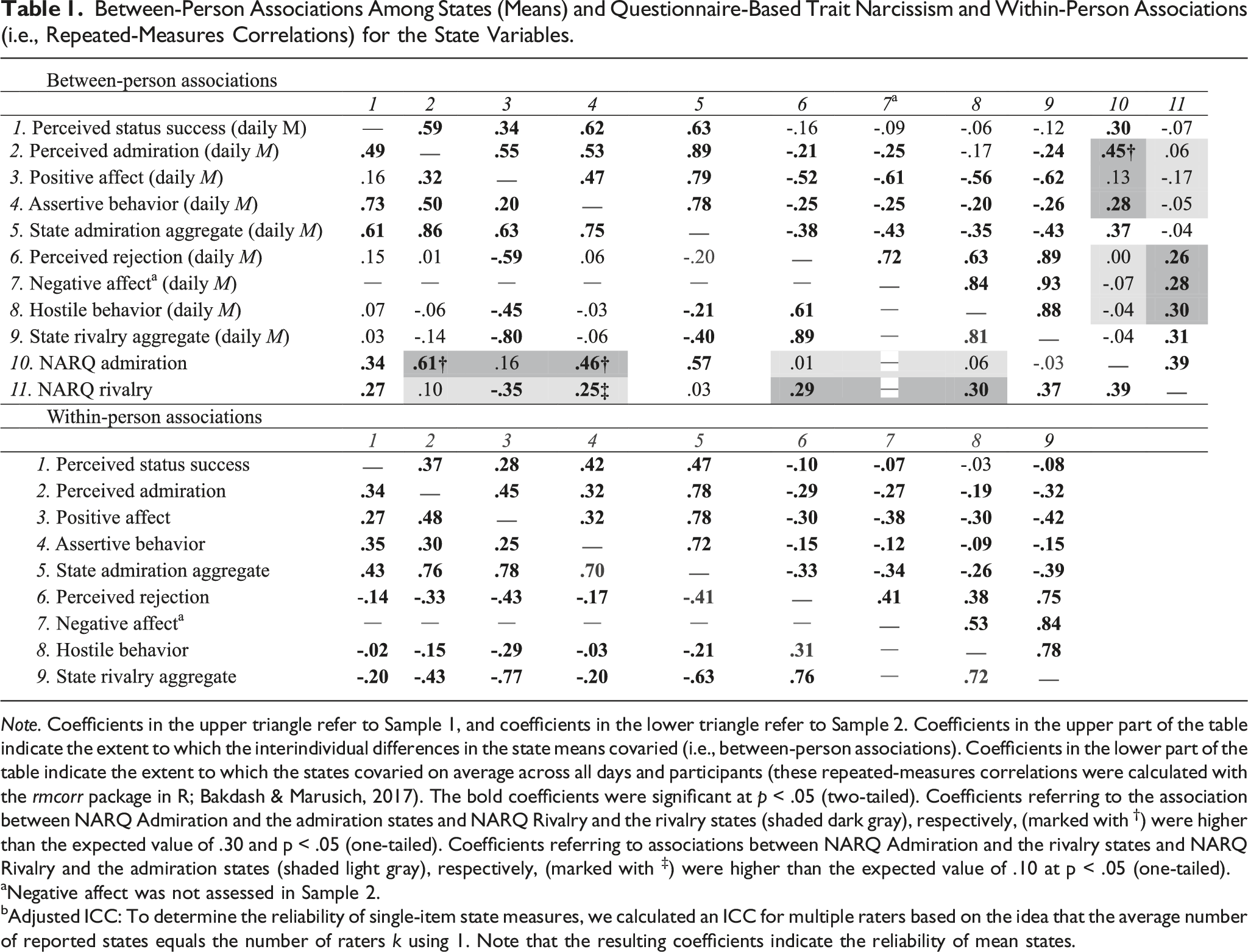
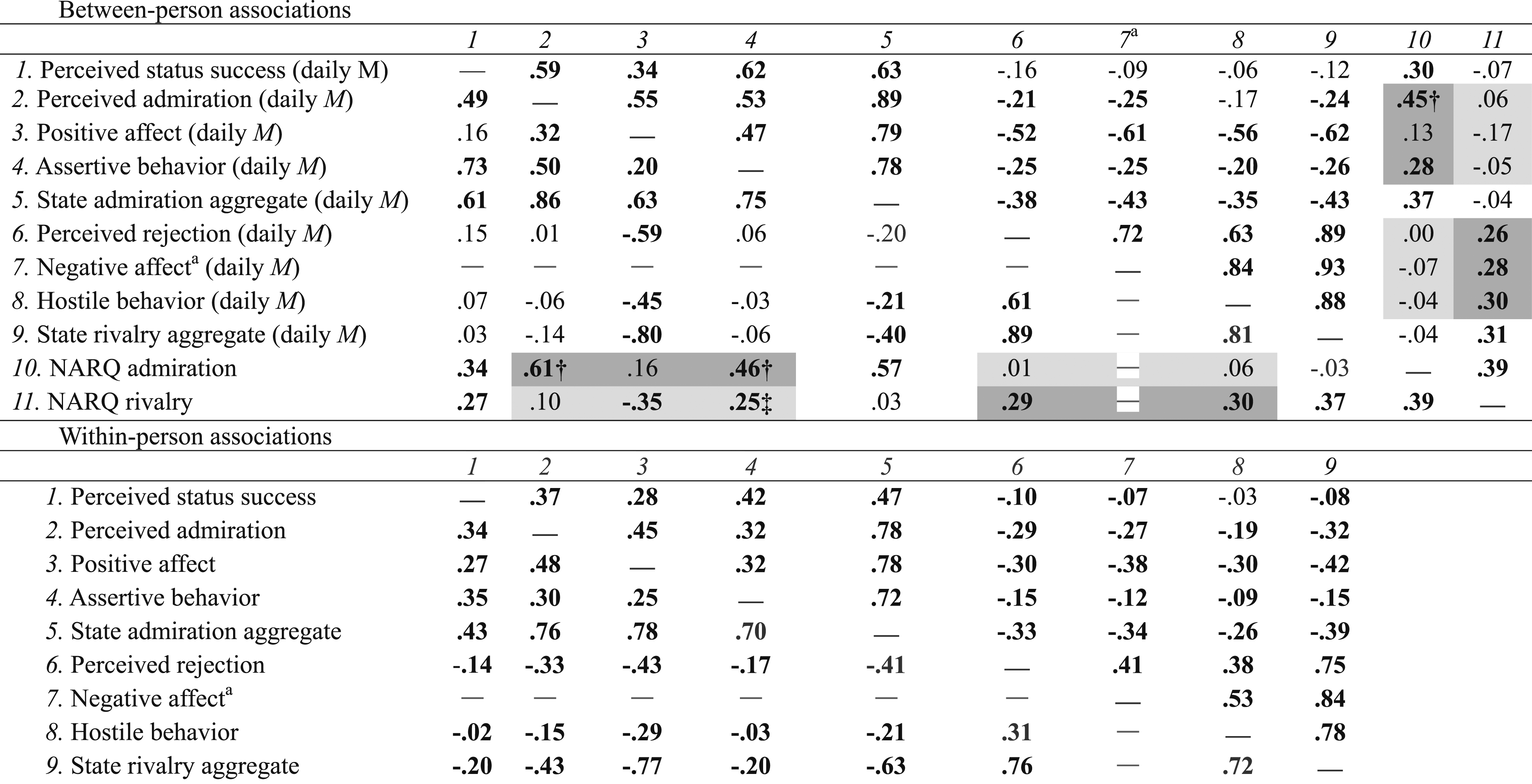
Note. Coefficients in the upper triangle refer to Sample 1, and coefficients in the lower triangle refer to Sample 2. Coefficients in the upper part of the table indicate the extent to which the interindividual differences in the state means covaried (i.e., between-person associations). Coefficients in the lower part of the table indicate the extent to which the states covaried on average across all days and participants (these repeated-measures correlations were calculated with the rmcorr package in R; Bakdash & Marusich, 2017). The bold coefficients were significant at p < .05 (two-tailed). Coefficients referring to the association between NARQ Admiration and the admiration states and NARQ Rivalry and the rivalry states (shaded dark gray), respectively, (marked with †) were higher than the expected value of .30 and p < .05 (one-tailed). Coefficients referring to associations between NARQ Admiration and the rivalry states and NARQ Rivalry and the admiration states (shaded light gray), respectively, (marked with ‡) were higher than the expected value of .10 at p < .05 (one-tailed).
aNegative affect was not assessed in Sample 2.
bAdjusted ICC: To determine the reliability of single-item state measures, we calculated an ICC for multiple raters based on the idea that the average number of reported states equals the number of raters k using 1. Note that the resulting coefficients indicate the reliability of mean states.
Rivalry States. Analogous to the assessment of admiration states, a set of cognitive, affective, and behavioral aspects relevant to the rivalry dimension were assessed. Cognitive aspects of the rivalry facet were measured with the item, “I feel unacknowledged and criticized” (perceived rejection/criticism). Affective states were again assessed differently in the two samples: In Sample 1, one adjective for assessing negative affect (“annoyed”) was administered to the study participants. In Sample 2, participants' state affect was measured with the affect grid, which ranges from negative to positive affect (on one bipolar dimension). In contrast to Sample 1, the positivity of participants’ affect was thus not recorded independently of the negativity of participants’ affect. Therefore, we defined the entire range of the affect grid variable as positive affect and then reverse-scored it to form a variable representing the negativity of participants’ affect (negative affect) for the selected analyses (i.e., structure equation modeling analyses and examination of aggregate measures). For the remainder of the analyses, results for negative affect were not reported for Sample 2 to avoid redundancies. Rivalry-relevant antagonistic behavior was assessed with the item “Today, I was hostile” (hostile behavior). Again, the three rivalry states were substantially correlated at both the between-person and within-person levels (see Table 1). As we did for the admiration states, we additionally aggregated the cognitive, affective, and behavioral rivalry states into a global rivalry state. The within-person ωs for this aggregate rivalry state measure were .71 and .61, the between-person ωs were .89 and .78 in Sample 1 and Sample 2, respectively.
Data Preparation
Due to the nested nature of the data (i.e., daily state reports nested in individuals), multilevel models were calculated to determine the amount of within-person variation and to address all research questions related to state contingencies. Prior to the analyses, all time-invariant Level 2 variables (i.e., traits), except gender, were grand-mean centered (Hoffman, 2007), and the time-varying Level 1 variable perceived status success was person-mean centered such that it represented the deviation from participants’ averaged daily levels. In some of the models, we included a time variable to account for potential developmental trends. This variable was coded 0, …, d i – 1 (where di was the number of days measured for person i). For control analyses, gender was entered as a dummy-coded variable (0 = women, 1 = men).
Power for detecting small level 1 effects (.10) or medium level 2 effects (.30) was high (i.e., ≥.80). Moreover, satisfactory power (≥.80) was given for cross-level interaction effect sizes of around .40 (i.e., medium to large cross-level effects) for both samples. Power for detecting small to medium cross-level effects (e.g., .20) was around .32 and .37 for Sample 1 and Sample 2, respectively, suggesting that the power was not optimal for the full range of cross-level interaction effect sizes (see Supplement 9 [https://bit.ly/2N5Fop0] for more information on power analyses.)
Results
The data and code necessary to reproduce the results below can be found in the OSF (https://bit.ly/2N5Fop0). The zero-order correlations between all measures used in this study are shown in Table 1.
Interindividual differences in average narcissism states
Amount of intra- and interindividual differences
Multilevel models were calculated to determine the amount of within- and between-person variation in all narcissism-relevant states. Specifically, the intraclass correlation for the state measures was calculated with a random-intercept only model. The ICC is a measure of the amount of variance that can be attributed to interindividual differences. There was a substantial amount of both within-person variation (ranging from 50.77% to 70.07% in Sample 1 and from 47.78% to 74.18% in Sample 2) and between-person variation (ranging from 29.93% to 49.23% in Sample 1 and from 25.82% to 52.22% in Sample 2). Supplement 2 (https://bit.ly/2N5Fop0) provides a more detailed overview on the amount of intra- and interindividual differences for state averages (i.e., means) as well as for further state distribution parameters (i.e., median, mode, minimum, maximum, standard deviation, skewness, kurtosis) for all state variables and separately for both samples. Importantly, regarding all examined narcissism-relevant states, the substantial amount of between-person differences indicates that people differed in the degrees to which they typically experienced narcissism-relevant states.
Reliability and Stability of Interindividual Differences in Average Narcissism States
The reliabilities for interindividual differences in the mean states (as determined via the adjusted ICC) were all greater than .95 (with MICC = .97, MinICC = .96, and MaxICC = .99). Stabilities of interindividual differences were also high for all state averages even across longer time intervals (.74 to .87 Sample 1, subsequent data blocks; .63 to .82 Sample 1, distance of two data blocks; .57 to .78 Sample 1, distance of three data blocks; .74 to .91 Sample 2). Thus, average narcissism states qualified as reliable and stable individual difference variables. Supplement 3 (https://bit.ly/2N5Fop0) provides a more detailed overview on the reliability and stability of interindividual differences in state averages and further state distribution parameters.
Average state-trait relations
To determine the average state-trait relations, we computed correlations between narcissism state means and questionnaire-based trait measures and additionally computed multilevel models to control for the day variable. Further information on the analytic approach can be found in Supplement 4 (https://bit.ly/2N5Fop0). The results showed that the means of the cognitive and behavioral admiration states were positively correlated with questionnaire-based trait admiration, and the means of the cognitive, affective, and behavioral rivalry states were positively correlated with questionnaire-based trait rivalry (see Table 1). That means that individuals high in questionnaire-based trait admiration perceived more admiration and were more assertive on average. Individuals high in questionnaire-based trait rivalry perceived more rejection, experienced more negative affect, and were more hostile on average. The coefficients were spread around the expected level of r = .30 (all ps < .05) with generally higher associations in Sample 2 than in Sample 1, albeit only the association between questionnaire-based trait admiration and perceived admiration state evidenced associations that were significantly higher than .30 across both samples. Questionnaire-based trait admiration and state positive affect were positively related in both Sample 1 (.13) and Sample 2 (.16) but did not reach statistical significance in either sample. The mean of state perceived status success was positively related to questionnaire-based trait admiration in both samples. It was also positively related to questionnaire-based trait rivalry in Sample 2, not in Sample 1. When controlling for the day variable in the multilevel models, these correlational patterns were preserved except for positive affect, the admiration states and the rivalry states as well as their aggregate measures could be predicted by their corresponding questionnaire-based trait measure; see Table S23 for the admiration states and Table S24 for the rivalry states in Supplement 4 (https://bit.ly/2N5Fop0) 5 .
Evidencing theoretically expected relations with questionnaire-based narcissism traits, these findings serve as initial support for the construct validity of the suggested interindividual differences in average narcissism states.
Interindividual differences in narcissism state contingencies
The average strength and the degree of interindividual differences in narcissism state contingencies
State Contingency Strength, Interindividual Differences, and Within-Person Coupling Reliabilities (WPCR; Neubauer et al., 2020).
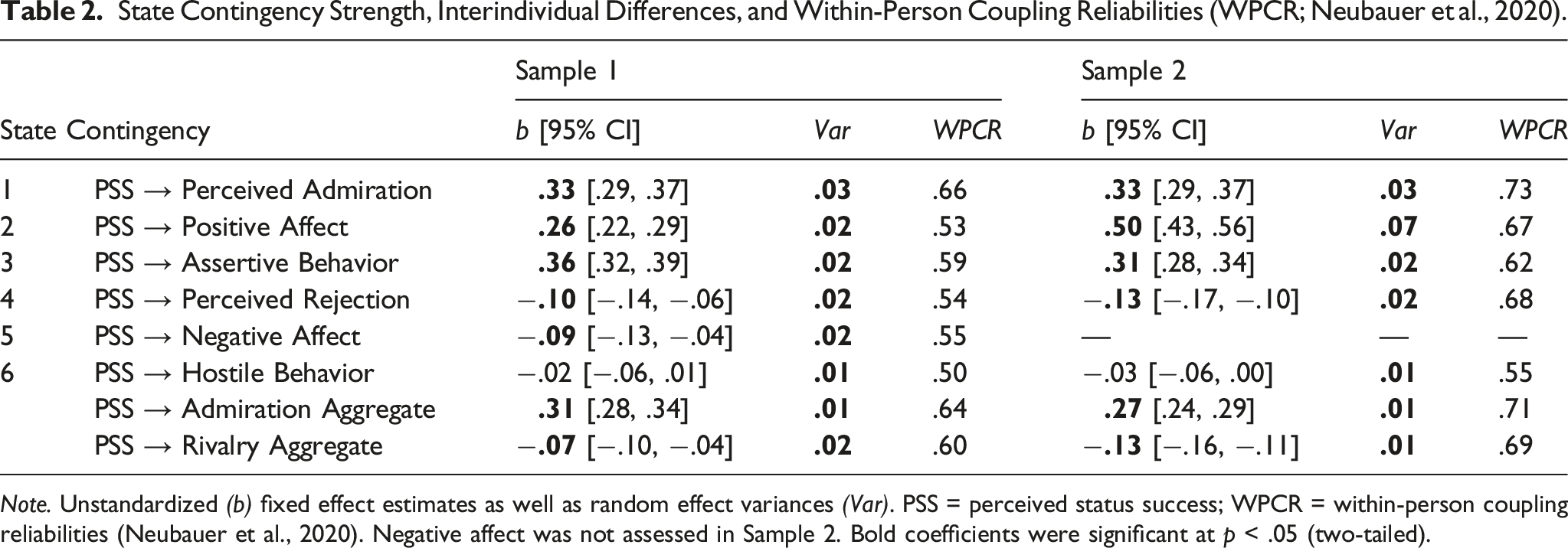
Note. Unstandardized (b) fixed effect estimates as well as random effect variances (Var). PSS = perceived status success; WPCR = within-person coupling reliabilities (Neubauer et al., 2020). Negative affect was not assessed in Sample 2. Bold coefficients were significant at p < .05 (two-tailed).
As can be seen in Table 2, five of the six preregistered within-person state contingencies between status perception and narcissism states were found in both samples. This means that a specific if (perception of status success) was indeed contingent with specific thens in different modalities such as the perception of being admired (cognition), positive affect (affect), and assertive actions (behavior). Likewise, the perception of low status success (if) was contingent with cognitions such as the perception of being rejected or criticized and negative affect (both thens). For the within-person coupling of perceived status success and hostile behavior, no associations could be found in either of the samples. In general, state contingencies seemed to be stronger for the admiration pathway (near .30) than for the rivalry pathway (near |.10|). The results pertaining to the analyses with the global admiration and rivalry state measures showed that significant associations also resulted for the contingencies related to the aggregated states and not only for the specific states.
Table 2 also shows random slope variances, which were tested for significance using the likelihood ratio test (LRT; LaHuis & Ferguson, 2009). For all preregistered state contingencies, we found significant random effect variances. This indicates that individuals varied substantially in the strength of narcissism-relevant within-person state contingencies (also see Supplement 5 [https://bit.ly/2N5Fop0] for an illustration of these contingency differences).
Reliability and stability of interindividual differences in state contingencies
Prior to analyzing the stability of the state contingencies, all participants who reported fewer than 10 states per burst (Sample 1) or data half (Sample 2) were excluded from the analyses pertaining to RQ3.2, resulting in a total sample size of 82 and 98 for Sample 1 and Sample 2, respectively. All state contingencies were computed for each participant and each data block by fitting the multilevel models that were used to determine the strength of state contingencies. For each of the six (plus two additional) contingencies, we read out participants’ random slope effects, since they reflect individuals’ contingencies. Subsequently, the stability coefficients were calculated by correlating the individual values for a state contingency of two blocks. For Sample 1, six stability correlations (rt1.t2, rt1.t3, rt1.t4, rt2.t3, rt2.t4, rt3.t4), and for Sample 2, one stability correlation (rt1.t2) resulted for each state contingency. Correlations referring to the same distance in time (i.e., Time Lag 1 as in rt1.t2, rt2.t3, and rt3.t4 or Time Lag 2 as in rt1.t3 and rt2.t4) were Fisher’s z transformed prior to averaging them. To quantify the reliability of the within-person state contingencies, we used the within-person coupling reliability (WPCR) approach described by Neubauer et al. (2020). This index captures the interindividual reliability of the individuals’ within-person state contingencies (and thereby addresses the question of whether it is possible to reliably separate individuals with strong vs. weak contingencies). This approach was not included in the preregistration.
Table 2 reports the within-person coupling reliabilities (WPCRs) for each within-person state contingency: In Sample 1, the reliabilities ranged from .50 to .66; in Sample 2, the reliabilities ranged from .55 to .73. On average, Sample 2 showed slightly higher WPCR values (WPCRmean = .65) compared with Sample 1 (WPCRmean = .56). The lowest reliability resulted for Contingency 6 (perceived status success → hostile behavior) in both samples (Sample 1: .50; Sample 2: .55).
Stabilities of State Contingencies across Different Time Intervals (from Time Lag 1 to Time Lag 3 in Sample 1 and Time Lag 1 in Sample 2).
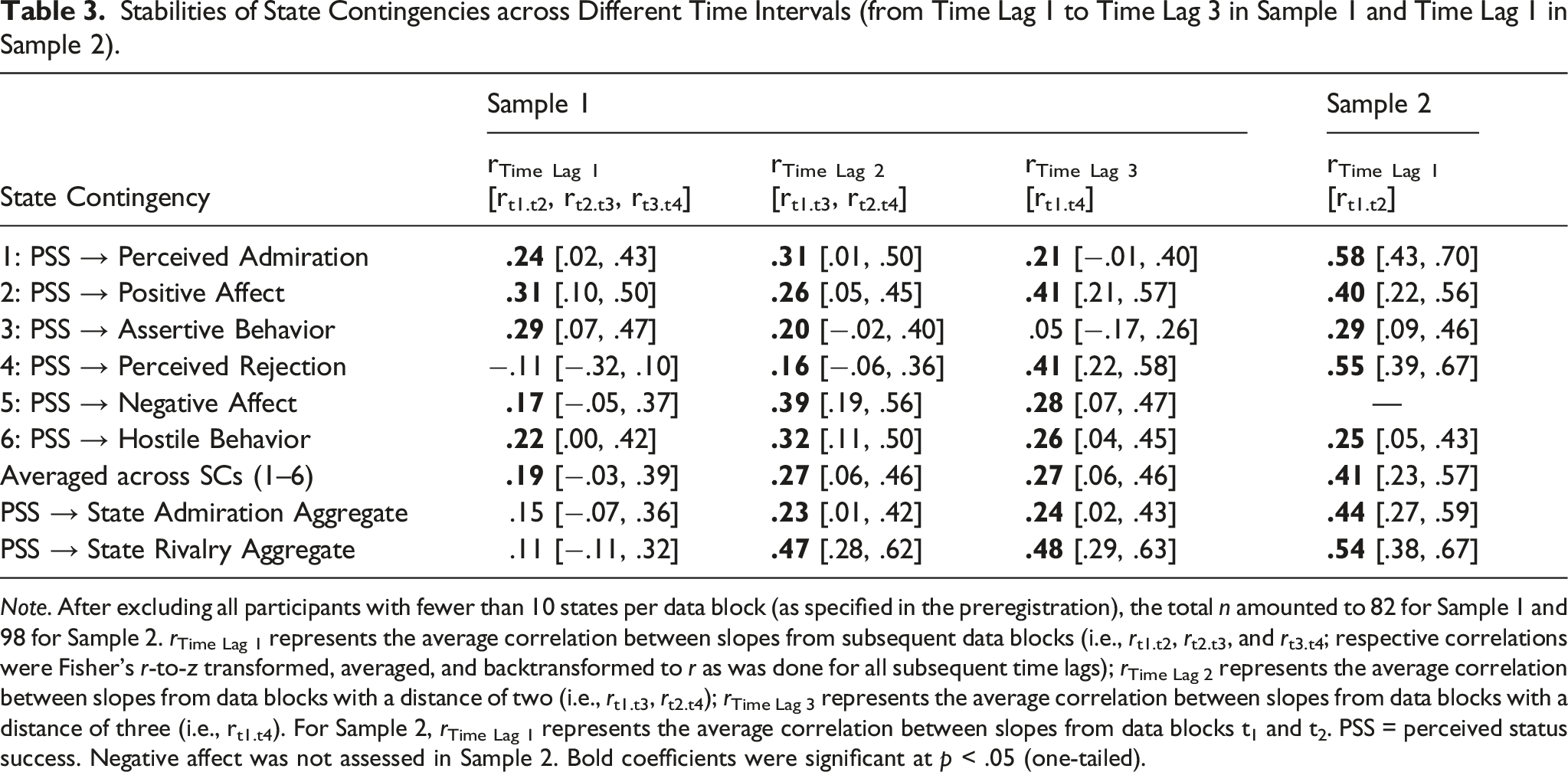
Note. After excluding all participants with fewer than 10 states per data block (as specified in the preregistration), the total n amounted to 82 for Sample 1 and 98 for Sample 2. rTime Lag 1 represents the average correlation between slopes from subsequent data blocks (i.e., rt1.t2, rt2.t3, and rt3.t4; respective correlations were Fisher’s r-to-z transformed, averaged, and backtransformed to r as was done for all subsequent time lags); rTime Lag 2 represents the average correlation between slopes from data blocks with a distance of two (i.e., rt1.t3, rt2.t4); rTime Lag 3 represents the average correlation between slopes from data blocks with a distance of three (i.e., rt1.t4). For Sample 2, rTime Lag 1 represents the average correlation between slopes from data blocks t1 and t2. PSS = perceived status success. Negative affect was not assessed in Sample 2. Bold coefficients were significant at p < .05 (one-tailed).
Associations between interindividual differences in state contingencies and questionnaire-based trait measures
Results for preregistered multilevel models that test for cross-level moderation of questionnaire-based trait narcissism on state contingencies can be found in Supplement 8 (https://bit.ly/2N5Fop0). Here, we provide results of multilevel structural equation models (MSEMs) that provide a more adequate test because they are designed to consider the unknown measurement errors embedded in each indicator permitting more accurate estimates of relationships among constructs. Furthermore, they allow for multiple dependent variables (either observed indicators or latent constructs). Results of standard multilevel models and MSEMs were very similar. In case results of multilevel models diverged from results based on MSEMs, we will highlight this below.
We calculated MSEMs using Mplus 8.4 (Muthén & Muthén, 1998-2019). For each sample, we tested one model reflecting the admiration pathway (the perception of status success was modeled as a predictor variable, and the perception of being admired, positive affect, and assertive behavior were used as criterion variables simultaneously) and one model reflecting the rivalry pathway (the perception of status success was modeled as a predictor variable, and the perception of being rejected/criticized, negative affect, and hostile behavior were used as criterion variables simultaneously). The relationship between the persons’ within-person contingency coefficients (their Level 1 slopes) and their trait values (questionnaire-based narcissistic admiration and rivalry) was modeled on the between-person level. Specifically, the within-person state contingencies 1 to 3 (perceived status success → (1) perceived admiration, (2) positive affect, (3) assertive behavior) were regressed on questionnaire-based trait admiration, and the within-person state contingencies 4 to 6 (perceived status success → (4) perceived rejection/criticism, (5) negative affect, (6) hostile behavior) were regressed on questionnaire-based trait rivalry. In all models, we also used the trait variables to predict the interindividual differences in the intercept of the modeled state variables. All models were estimated using a Bayesian approach. We used the default, noninformative prior distributions as specified in Mplus. Furthermore, the parameter estimates were based on the average of two chains with each chain having a length of 2500 iterations (of which 1250 iterations were discarded as burn-in). The results of the MSEM analyses are shown in Figure 2. Multilevel Structural Equation Modeling (MSEM) Results. Note. Models for examining the relationship between perceptions of status success and consequential cognitive (perceived admiration/perceived rejection), affective (positive affect/negative affect), and behavioral states (assertive behavior/hostile behavior) specific to narcissism on a within-person level. MSEMs on the left-hand side represent the admiration pathway; MSEMs on the right-hand side represent the rivalry pathway. At the between-person level, these models additionally examined how a person’s standing on the narcissism traits (i.e., an individual’s scores on admiration and rivalry) as measured with a classical narcissism trait questionnaire (i.e., the NARQ) was related to the associations (i.e., contingencies) between perception of status and narcissism states. These contingency-moderating effects are represented by a line ending with a small black circle on the respective contingency. Additionally, interindividual differences in the intercepts of the modeled state variables were predicted by trait narcissism (which was omitted in Figure 2 for readability). Panel A shows the results for Sample 1; Panel B for Sample 2. Standardized estimates are reported, including point estimates and 95% credibility intervals. Bold values represent those in which the credibility interval did not contain zero. Note that the negative affect variable represents the recoded version of positive affect in Sample 2.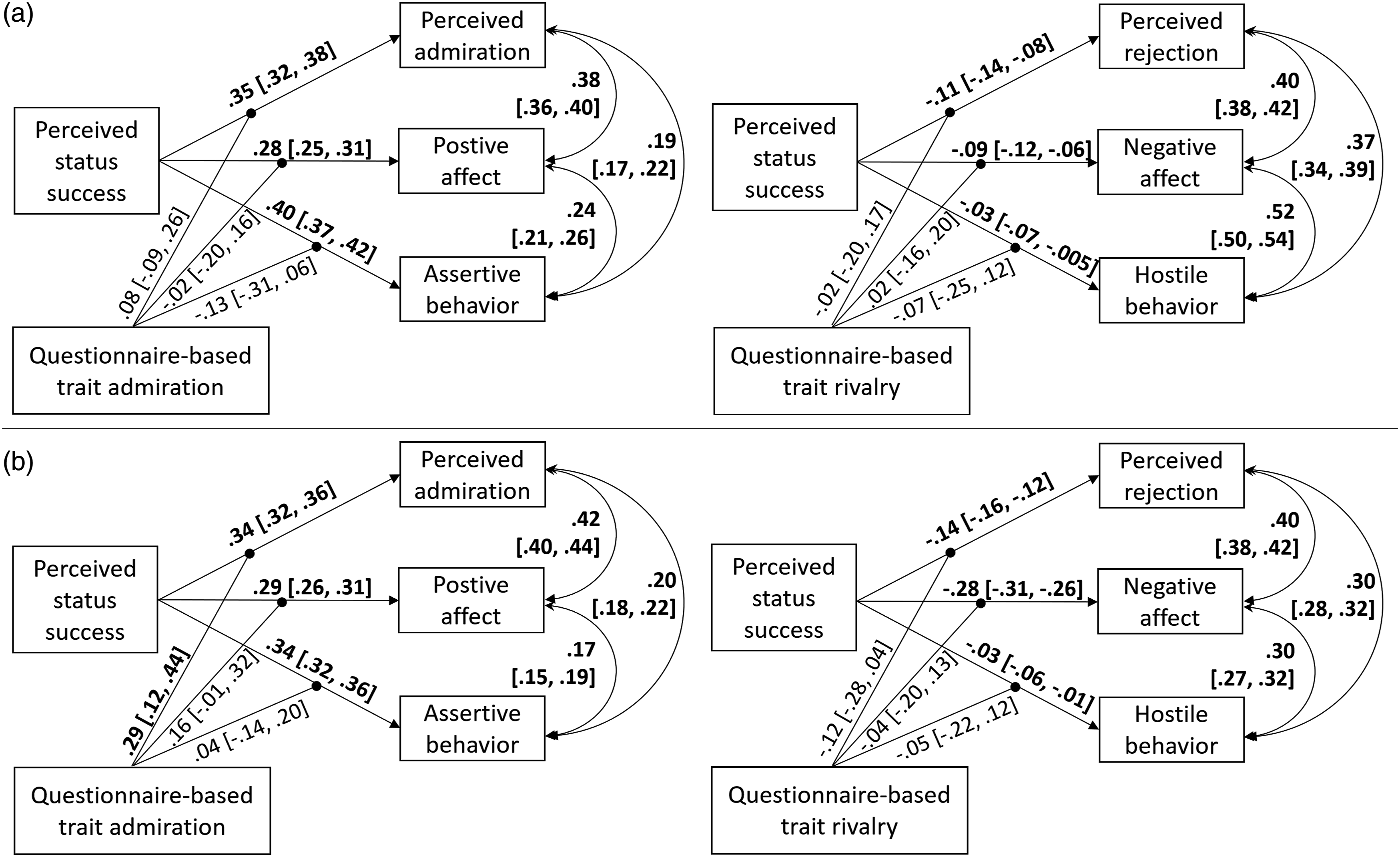
For all six within-person state contingencies, significant associations could be found on the within-person level in both samples. The associations were generally higher for the admiration pathway compared to the rivalry pathway in both samples. This matches the findings from our multilevel analyses shown in Table 2. In contrast to Table 2, however, Figure 2 shows significant, albeit small, negative correlations for within-person State Contingency 6 (perceived status success → hostile behavior). Importantly, significant associations emerged for each within-person state contingency, whereas the corresponding other contingencies of the admiration or rivalry pathways were controlled for, respectively. For the trait relations of the within-person state contingencies, the model shows that only one of the six preregistered moderations of the within-person state contingencies was significant: Questionnaire-based trait admiration positively predicted the strength of Contingency 1 (perceived status success → perception of being admired). This means that individuals high in admiration reacted more strongly to perceived status successes compared to individuals low in admiration. Analyses based on standard regression-based multilevel analysis approach revealed an additional moderating effect of questionnaire-based trait admiration concerning Contingency 2 (perceived status success → positive affect; see Supplement 8 [https://bit.ly/2N5Fop0] for details). For Sample 1, none of the within-person state contingencies was moderated by the questionnaire-based trait narcissism measures.
To sum up, the hypothesis that the strength of the within-person state contingencies would be moderated by questionnaire-based trait narcissism was supported for only one specific contingency (perceived status success → perceived admiration; moderated by questionnaire-based trait admiration) and in only one of the two samples.
Discussion
The aim of the present work was to expand the emerging research on state narcissism in two important ways. First, we differentiated between the agentic and antagonistic aspects of state grandiose narcissism and their expression on different modalities by examining cognitive, affective, and behavioral state reports of narcissistic admiration and rivalry in accordance with the NARC framework. Second, following the idea of if-then contingencies in states and recent accounts on the key role of status motivation in narcissism dynamics, we systematically examined how social status perceptions triggered agentic and antagonistic narcissism states. For both narcissism state averages and narcissism state contingencies, we tested (a) how much individuals differed (i.e., the amount of interindividual variance in state averages and state contingencies), (b) how stable these differences were, and (c) how much they converged with established questionnaire-based measures of agentic and antagonistic narcissism.
Intra- and interindividual differences in narcissism state density distribution parameters
Results revealed substantial within-person variability in all states, a finding that underlines the necessity to move toward more dynamic conceptualizations of grandiose narcissism by considering both intra- and interindividual variation. In the current samples, individuals experienced different expressions of narcissism over time that stretched across almost the full possible range within persons. The amount of within-person variability in the current samples was even higher than in previous studies (Giacomin & Jordan, 2016a; 2016b). This might partially be due to our use of concrete cognitive, affective, and behavioral manifestations as opposed to the reformulated narcissism trait items that were used in most previous examinations. That is, individuals varied substantially in narcissism-relevant cognitions, emotions, and behaviors across days. The within-person fluctuations matched the assumption of self-regulatory strivings toward a grandiose self (Edershile & Wright, 2021) and therefore supported the dynamic and contextual models of narcissism that conceptualize narcissism as a gradual and reinforcing process that is connected to situational features, especially social ones (e.g., Back et al., 2013; Morf et al., 2011; Morf & Rhodewalt, 2001).
Importantly, the large amount of within-person variability is not at odds with meaningful interindividual differences in narcissism. In fact, for all examined variables, state averages showed a substantial amount of interindividual differences. These differences were reliable and relatively stable. Finally, relations between averaged states and narcissism traits as measured with a questionnaire indicated construct validity. That is, the means of the admiration states were positively related to questionnaire-based trait admiration and the means of the rivalry states were positively related to questionnaire-based trait rivalry in both samples. Thus, interindividual differences in the typical expression of various narcissism states can be applied to assess people’s general narcissistic tendencies, and these state-based assessments converge to some degree with what classical narcissism questionnaires capture. The present findings are in accordance with assumptions about the descriptive part of WTT (Fleeson, 2012; Fleeson & Jayawickreme, 2015): The extent to which people typically embody a given trait (e.g., how narcissistic they are) can be described by the average of those everyday states that define a trait.
The results also underpin the need to distinguish agentic and antagonistic facets as well as different modalities of grandiose narcissism states as proposed by the NARC. By assessing cognitive, affective, and behavioral state aspects of both the proposed admiration and rivalry pathways (albeit still in a rough and preliminary way), it was possible to more closely mimic existing conceptual models than would be possible with generic state versions of existing trait questionnaires. Also, interindividual differences in average admiration and rivalry states were positively correlated with the respective congruent trait questionnaire scores (i.e., admiration states with questionnaire-based trait admiration and rivalry states with questionnaire-based trait rivalry).
Interindividual differences in narcissism state contingencies
Across participants, the results revealed substantial strength in most within-person state contingencies, characterizing the average association between daily perceptions of status success and narcissism-relevant states on the cognitive, affective, and behavioral levels. That is, on average across participants, cognitive, affective, and behavioral narcissism states were indeed contingent on status-related perceptions. Only the average connection between perceived status success and hostile behavior received less consistent support. This indicates that perceptions of low status success are not necessarily associated with hostile and aggressive behavior across most participants. This fits in with a number of studies that found that more extreme forms of unsuccessful status pursuit (i.e., a failure in or a loss of social status, e.g., as experienced by individuals who feel ostracized) can also trigger alternative behavioral patterns such as avoidant behavior and social withdrawal. In other words, failures in status pursuit can result in flight responses and do not necessarily trigger a fight response (Wesselmann et al., 2015). Furthermore, we found that the state associations within the admiration pathway were more pronounced than in the rivalry pathway. This could be due to the fact that rivalry states are generally shown with less intensity (the same is true for questionnaire-based rivalry traits compared with questionnaire-based admiration traits; Leckelt et al., 2018), particularly among women (who made up the majority of our samples).
Even more important than these average contingencies were findings regarding interindividual differences in these contingencies. In line with the idea that status reactivities constitute a personality-like aspect, we found substantial interindividual differences in the strengths of these contingencies, which were relatively reliable and moderately stable. Notably, stability was also observed for state contingencies for which no or only small average associations were revealed across participants. This finding shows that even opposing reaction tendencies were stable across time (i.e., some always reacted with anger to a perceived lack of status success, whereas others always reacted with avoidance and less anger to a perceived lack of status success). The levels of stability found in the present study were similar to those reported in the literature outside the narcissism field (e.g., Shoda et al., 1994; Smith et al., 2009). When comparing the two samples, slightly higher stabilities were found in Sample 2. Reasons for the higher stability in Sample 2 may be found in differences in study design: Whereas in Sample 2, the individual measurements were obtained day after day without any breaks; in Sample 1, there were 14-day breaks between the individual measurement bursts, which might explain the lower stability found for the latter study. In addition, Sample 1 had significantly lower power because it contained fewer measurement points and shorter bursts.
Having fulfilled these three fundamental conditions (interindividual differences, reliability, and stability) at least to some degree, interindividual differences in within-person state contingencies might serve as additional, more dynamic measures of trait narcissism. In accordance with WTT (Fleeson, 2012; Fleeson & Jayawickreme, 2015), they can be seen as explanatory parts of trait narcissism that include a dynamic formulation of input (perceptions of status success) and output (increases or decreases in narcissism-specific states) that accounts for state fluctuations. Although both kinds of measures were reliable and stable, the present research only provided very limited support for a convergence of state contingency and questionnaire-based assessments of narcissism. They seem to capture distinct aspects of trait narcissism. More research is needed to check the robustness of this finding and to evaluate how it can be interpreted.
Grandiose narcissism and status pursuit
Our findings also advance insights into the relation between status pursuit and narcissism (Grapsas et al., 2020; Mahadevan et al., 2016, 2020; Zeigler-Hill et al., 2019). The explicit evaluation of status success as examined in the present study, can, for example, be conceptualized as a result of the vigilance process described in the SPIN model proposed by Grapsas et al. (2020; “Is my status pursuit facilitated or hindered?”). Status success (operationalized as the exertion of influence on other people) would be an indication for an individual that status pursuit was facilitated. Accordingly, a lack of influence on others could be regarded as status failure (or a hindrance). As suggested in the SPIN model, our data also support the idea that entering the admiration pathway is related to self-promotional dynamics (i.e., more assertive behavior, positive affect, and the belief that one is admired), a pattern that researchers regard as a consolidatory dynamic (i.e., higher perceived status motivates even more status seeking; Mahadevan et al., 2020). Thus, stable interindividual differences in the tendency to react to perceived status success might indeed be a key dynamic aspect of agentic narcissism. Those who more strongly react with felt admiration to perceived status success might be those who show agentic narcissistic expressions more strongly than others.
Links between the perception of low status success and felt criticism, negative affect, and hostile behavior fit the rivalry pathway described in the SPIN model. Thus, stable interindividual differences in the tendency to react to unsuccessful status pursuit might indeed be a key dynamic aspect of antagonistic narcissism. The SPIN model can also be used to explore reasons for the existence of stable interindividual differences in the link between the perception of status success and hostile behavior in the absence of an average link across individuals (i.e., the existence of stable links in opposite directions). According to the model, before individuals show hostile behavior (e.g., other-derogation), they must first have come to the conclusion that self-promotion is a futile endeavor, and other-derogation has higher utility for gaining status. Only then might individuals apply this costlier behavioral variant. Thus, interindividual differences in either the vigilance (Is my status pursuit facilitated or hindered?) or appraisal (Will self-promotion or other-derogation grant me status?) stages might underlie differences in how much perceived lack of status success triggers hostile versus less hostile behavior. Those who react more strongly with felt criticism to perceived lack of status success and regard other-derogation as a viable alternative might be those who show antagonistic narcissistic expressions (i.e., hostile behavior) more strongly than others. By contrast, those who do not react with felt criticism but instead react with indifference or even self-doubt might react with less hostile and more neutral or withdrawn behaviors. An interesting avenue for future research would be to investigate whether those who react more strongly to perceived status failure with negative narcissistic cognitions and affect but at the same time see no utility in either self-promotion or other-derogation are the ones who could be characterized as neurotic narcissists (see Back, 2018, for a similar reasoning).
Limitations and future directions
The current investigation has three important methodological limitations that future research should address. They regard the sampling of participants, the assessment of narcissism-relevant states, and the timing of state assessments. First, a more comprehensive sampling of individuals is needed. While the present studies realized a comparatively large number of daily assessments per individual, the number of individuals was small. This particularly limited our ability to detect small cross-level interactions (i.e., associations between questionnaire-based trait narcissism and state contingencies). Thus, the present findings with regard to the lack of convergence between interindividual differences in narcissism-relevant state contingencies and questionnaire-based narcissism need to be cautiously interpreted. A higher power also on the between-person level is important to provide robust insights on the convergence of these different ways of conceptualizing and assessing trait narcissism. Future larger studies should also include more representative samples with respect to gender and age composition.
Second, more comprehensive assessments of narcissism-relevant states and status perceptions should be conducted. Whereas the states we examined were all narcissism-relevant and constitute a first attempt to disentangle agentic and antagonistic aspects of grandiose narcissism as well as distinct narcissistic modalities, they do not completely cover the entire variety of relevant admiration and rivalry states. Although it might not be possible to comprehensively analyze all kinds of states that are related to narcissism, the present selection of cognitive, affective, and behavioral states needs to be extended by adding more states and covering motivational aspects or other intrapsychic processes of admiration and rivalry (e.g., having grandiose fantasies about oneself and internally devaluating others, respectively). In addition to a global measure of affect, it also seems important to include a broader set of state measures that cover narcissistic feelings in a more specific fashion. For example, the global affect measure could be supplemented by including measures of momentary pride, envy, and shame—emotions that are closely associated with narcissism (Di Sarno et al., 2020; Lange et al., 2016; Tracy et al., 2009). Whereas the rivalry measures used in the present study represented a negative affect laden conception of this narcissistic dimension, future studies could assess state rivalry with additional items related to state feelings of entitlement, lack of concern/empathy for others, or exploitation of others. A more comprehensive capturing of narcissism states, including multiple indicators for each admiration and rivalry modality, is also needed to control for measurement error. To paint a more complete picture, future studies should also include states related to neurotic aspects of narcissism. For example, studies could examine whether avoidant behavior patterns represent an alternative way of dealing with status failure (i.e., a way that goes beyond assertiveness or hostility as suggested in Back, 2018). Furthermore, alternative measures of social status perceptions should be explored. This might include reports on more objective indicators of social status or measures that place a stronger emphasis on meta-perceptions that capture people’s perceptions of how others think about them (e.g., “I feel that people see me as an important person”; Huo et al., 2010; Mahadevan et al., 2016; Mahadevan et al., 2020). A more comprehensive assessment of status perceptions might also be applied to distinguish between perceived assignment of status, perceived status attacks, and perceived disregard for status (all of which might be uniquely relevant for an individual with high levels of narcissism) as well as between different sources giving rise to perceptions of status success (i.e., leadership, dominance, and prestige; Zeigler-Hill et al., 2021).
Third, the present study was limited in terms of temporal resolution. Specifically, in both samples, participants retrospectively judged the intensity of their experienced narcissism states and their perceived status success (vs. their lack thereof) at the end of the day. Thus, specific experiences of status success over the course of a day were not measured on a momentary basis but had to be aggregated, across the day, into an overall daily evaluation. Whereas this approach reduced the risk of participant fatigue, it did not allow us to capture more fine-grained variations across the day and more immediate reactions to status-relevant environmental cues. It will therefore be an important addition for future research to measure social status perceptions as well as narcissism states with a much higher temporal resolution. Specifically, by using experience-sampling designs, researchers could implement repeated measures across different situations within one day (e.g., Edershile & Wright, 2021). An even higher temporal resolution could be achieved by capturing specific states across moments within a situation. This could be accomplished by computer-aided analyses of videotaped status-relevant interactions in the laboratory. Sampling data with high temporal resolution would allow researchers to empirically test narcissistic specific moment-to-moment status dynamics (as proposed in the SPIN model; Grapsas et al., 2020; or interpersonal theory; Hopwood, 2018) in a comprehensive manner.
Conclusion
Research on grandiose narcissism is currently shifting from a questionnaire-based investigation of narcissism as a static trait toward a more dynamic conceptualization of narcissism as systematic interindividual differences in the within-person expression of everyday narcissism states. The current study contributed to this novel direction in narcissism research by (a) differentiating between agentic and antagonistic states of different modalities, (b) considering the key role of social status perceptions, and (c) systematically investigating the amount, stability, and questionnaire-based trait relations of both narcissism state levels and state contingencies.
Beyond describing individuals in terms of interindividual differences in questionnaire-based narcissism traits, the present study demonstrated that individuals can be reliably described in terms of interindividual differences in the extents to which they experience specific agentic and antagonistic narcissism-relevant states of different modalities and their contingencies to social status perceptions in everyday life. However, the absence of moderating effects of classical trait questionnaire measures on state contingencies points to the possibility that trait and state measures assess independent aspects of narcissism. The results further underline that grandiose narcissism needs to be distinguished into agentic and antagonistic aspects, also on the state level, as they appear to be differentially related to the perception of social status.
The results of the present study should encourage researchers in the field of narcissism to expand on their novel, more dynamically oriented research efforts. Future research should examine the dynamic nature of narcissism with high temporal resolution and strive for a better understanding of relations between narcissistic self-concept and narcissistic if-then state contingencies.
Footnotes
Author Note
Additional materials can be found on the OSF via the following link ( ). OSF materials include the preregistration, anonymous data from both samples, R and Mplus codes for the main and supplementary analyses, and the SOM. The SOM includes a detailed overview of our hypotheses (Supplement 1), additional analyses concerning state distribution parameters (Supplements 2–4), additional analyses concerning state contingencies (Supplements 5–9), visual representations of state-level data (Supplement 10), and data quality checks (Supplement 11).
Data Accessibility Statement
Declaration of conflicting interests
The author(s) declared no potential conflicts of interest with respect to the research, authorship, and/or publication of this article.
Funding
The author(s) received no financial support for the research, authorship, and/or publication of this article.