




Abstract
This study aims to fill the knowledge gap related to the role of the preference for consistency in understanding the effectiveness of sequential social influence techniques. Previous research has shown, at least in part, that these effects are moderated by the preference for consistency. For those who prefer consistency in their beliefs and behaviors, the foot-in-the-door technique will be a more effective tool of inducing compliance while people with a low preference for consistency, who value unpredictability, are more susceptible to the door-in-the-face technique. So far, there has been no research on the role of preference for consistency in the effectiveness of the third sequential request technique—low-ball. Our results suggest that, indeed, the preference for consistency is a strong moderator of the latter mentioned technique. While the low-ball technique was generally successful in inducing compliance, the strongest effect was noticed among people with a high preference for consistency.
Keywords
Despite a long tradition in social psychology of identifying social behavior as a matter of situational factors, social psychologists have become increasingly aware of the importance of individual differences in explaining the effectiveness of social influence phenomena. In our article, we present an integrative approach aimed at considering individual dispositions, such as a preference for consistency (PFC), in understanding the effectiveness of social influence techniques. The change in the way of thinking about the consistency-based mechanisms of social influence is derived from the low replication of research in that area (Burger, 1999). It took time for social psychology researchers to realize that the assumption about attitudes and the consistency of the behavior of human beings is rarely the truth in many aspects of real-life behavior (Guadagno & Cialdini, 2010). The need to consider that individuals vary in the extent to which they prefer predictability, stability, and congruity in various aspects of their existence inspired Cialdini et al. (1995) to propose the PFC as a new psychological construct to measure and assess the personal tendency to respond congruently in various but related social contexts. Those who score low on the PFC scale are inclined to change their behavior at the time and are not strongly attached to their past decisions and behaviors. On the contrary, individuals who strongly prefer consistency are committed to their past beliefs, decisions, and actions. For the past 26 years, it has been revealed that PFC is a valid psychological construct (Nail et al., 2001) and it has been proven that including PFC has enriched understanding of the consistency-based effects of social influence techniques (cf. Cantarero et al., 2017; Guadagno & Cialdini, 2010).
What is the relationship between the PFC and the effectiveness of the sequential request tactics of social influence? There are three classical techniques that have received the most attention in social psychology research: the foot-in-the-door (FITD; Freedman & Fraser, 1966), the door-in-the-face (DITF; Cialdini et al., 1975), and the low-ball (LB; Cialdini et al., 1978) technique. All three contain a sequence of two requests of increasing (FITD, LB) or decreasing (DITF) level of expectations. The target request is either part of the sequence of the escalation of demands that the requested person accepts (FITD, LB) or it is preceded by a hard-to-satisfy request that—upon rejection by the requested person—the requester modifies to an acceptable one (DITF).
So far, several suggestions of theoretical psychological mechanisms of the sequential request techniques have been formulated, the role of which has not been finally verified so far (Dolinski, 2015). In the case of the DITF technique, the most frequently cited explanations of DITF include the reciprocal concession mechanism (Cialdini et al., 1975), self-perception processes (Even-Chen et al., 1978), self-presentation mechanisms (Pendleton & Batson, 1979), guilt-based explanation (O’Keefe & Figgé, 1999), and social responsibility (Feeley et al., 2012; Tusing & Dillard, 2000). According to the literature, the field of LB technique is mainly associated with the mechanism of commitment to perform the action (Cialdini et al., 1978) and unfulfilled obligation to the requester (Burger & Petty, 1981). In the recent meta-analysis (Burger & Caputo, 2015), three mechanisms were mentioned as probably jointly responsible for the effectiveness of the technique: commitment to the task, commitment to the person, and self-perception theory. On the contrary, the FITD technique was most often considered primarily in the context of self-perception theory (Burger, 1999) although in the meta-analysis conducted by Dillard and colleagues (1984) no effect for self-perception mechanism was found.
Despite the structural similarity associated with the presence of the sequence of two requests that constitute all three techniques, the efforts of researchers to date have focused to a lesser extent on the analysis of structural similarities resulting from the specificity of the abovementioned sequential request techniques. If we assume that the sequence of presenting requests may be perceived as a set of consecutive actions, the individual PFC should play an important role in understanding the individual susceptibility for acceptance of the abovementioned techniques. In the past few years, the PFC has become one of the most promising factors that enhances understanding of the non-replication of effects in research on classical sequential techniques. In the next paragraph, we briefly characterize the most important findings in that area.
The PFC and Sequential Request Techniques
So far, research on the PFC has contributed the most to the knowledge about moderators of the FITD technique (Freedman & Fraser, 1966). The tactic introduced by Freedman and Fraser successfully induces compliance without external pressure by asking individuals to comply with a small initial request (e.g., signing a petition for safe driving) and when accepted, asking for fulfillment of the more demanding, target request (e.g., installing a big “Drive Carefully” sign on the front lawn of one’s house). Complying with the sequence of two requests seems to provide a textbook condition for testing the individual differences in consistency-based social influence. One may argue that those who meet with the first request in the sequence are required to continue with their commitment and then they are more likely to accept the second, more demanding request. It seems true, but only for individuals high in PFC (Cialdini et al., 1995; Guadagno et al., 2001). For example, the willingness to complete a 50-item questionnaire was higher as a result of previously agreeing to a smaller request (e.g., to answer three brief questions) only among high-PFC participants. At the same time, individuals low in PFC reported no effect of FITD (Cialdini et al., 1995, Experiment 2).
Further results supporting the explanation of the role of PFC in FITD were reported by Guadagno and her colleagues (2001). They enriched the knowledge on the boundary conditions of the PFC influence on the FITD technique. It was documented that participants who were high in PFC are more likely to respond positively in a FITD condition if their prior helpfulness is salient (i.e., the consistency motive has been evoked, Guadagno et al., 2001, Study 1). Even more interesting is that low-consistency individuals revealed a reverse FITD pattern of results (Guadagno et al., 2001, Study 2). Those who are low in PFC are more likely to respond positively to the target request in the control condition (i.e., without an initial commitment) compared with the high-PFC individuals; however, the pattern of results is reversed under FITD conditions. Low-PFC participants showed significantly less compliance with FITD than the control condition if their consecutive helpfulness was emphasized. In other words, people with low PFC produced the reverse FITD effect of compliance when the commitment-consistency rule has been activated.
Recent developments in the field of individual differences and consistency-based compliance tactics have been extended to the twin tactic of FITD: the DITF. In the DITF technique, the receiver is initially asked to fulfill a difficult request and, when it is rejected, a much easier target request is presented (Cialdini et al., 1975). As Cantarero et al. (2017) suggested, rejecting the initial request and agreeing to another one is supposed to be beneficial for people with low PFC. This assumption is in line with the notion that congruency versus incongruency in responses is a key element of sequential request techniques and their interplay with high versus low PFC. Cantarero and colleagues’ results strengthened and supported the abovementioned hypotheses about the role of PFC in DITF. They asked participants to spend 3 hr on market research and, after rejection, they proposed a subsequent request for completing a time-consuming survey. They found a negative correlation of DITF with PFC and they suggested that the DITF effect is stronger among those with low PFC (in contrast to those scoring high in PFC).
Further evidence that high PFC has rather a detrimental impact on DITF is provided by Henderson and Burgoon (2014), who induced the manipulation of abstract versus concrete thinking prior to exposing individuals to DITF. According to construal-level theory (Trope & Liberman, 2010), abstract thinking fosters self-consistency and enhances individuals to perceive their traits and behaviors as more coherent. In line with those expectations, Henderson and Burgoon (2014) in a series of three studies documented a reversed DITF effect among those involved in abstract thinking. Thus, the results obtained by Henderson and Burgoon may serve as another premise for the need to include PFC as a moderator of efficacy in sequential request techniques.
PFC and the LB Technique
The foregoing results raise a question about the role of PFC in explaining the effectiveness of the third classic sequential request technique, the LB procedure that was introduced by Cialdini and his colleagues in 1978. LB has been of less interest to researchers than FITD and DITF (Pascual et al., 2016) and, to the best of our knowledge, there is no published research on PFC and LB. Thus, the goal of our article is to extend the research findings about the role of PFC in the third, yet unexplored, sequential request technique.
The LB compliance gaining procedure has been recognized as a common tactic used among new car dealers (Cialdini et al., 1978). The research showed that LB is effective not only in the business context but also in typical real-life social influence situations (e.g., coming to the laboratory early in the morning; Cialdini et al., 1978, Experiment 1). More recently, Pascual et al. (2016), in turn, showed that in the original business context (e.g., product purchase), the technique is even slightly less effective than in self-interest (e.g., quitting smoking) or prosocial use (e.g., charity or helping other people). Typically, the sequence that leads to compliance includes incentives (e.g., excellent price) that incline the consumer to make an initial decision to purchase the product. Critical for this technique is removing all the advantages that prompt the customer to make the decision (e.g., being told that the price is comparable or even slightly less profitable than the competition). Once the individual has made a decision and the original reason that motivated them has simply disappeared, the customer continues to pursue the more costly option.
So far, the results of research on LB have been meta-analyzed twice. In 2015, Burger and Caputo found LB to be a clearly effective technique for gaining compliance (i.e., ϕ = .21, odds ratio = 2.41) and subsequent meta-analysis conducted by Pascual et al. (2016) confirmed these findings (i.e., r = .16, odds ratio = 2.47).
1
Thus, LB is assumed to be the most effective sequential request technique of social influence, compared with both FITD and DITF (Joule, 1987; Katzev & Brownstein, 1989). Despite the similarity of LB to the FITD technique, the mechanisms of these techniques are clearly different. Cialdini et al. (1978, p. 466) argue that LB induces a lot more personal commitment to the target request than FITD: “. . . an individual who has already decided to perform the target behavior may experience a greater sense of cognitive commitment to the performance of that behavior than would an individual who has already decided to perform a different, though related action.”
The above assumption not only seems to be accurate both in the context of the further research aimed at comparisons of the effectiveness of the LB technique and FITD (Cialdini et al., 1978; Joule, 1987), but also indicates a significant role of behavioral consistency in explaining the LB effectiveness. It also seems reasonable to assume that LB, to more of an extent than FITD and DITF, is based on a consistency-related psychology mechanism. Burger and Caputo (2015) emphasize that all the explanations of the mechanism of this technique formulated so far have an underlying assumption about consistency: commitment to the accepted action, commitment to the person, and self-presentation motives. People want to behave in a manner consistent with their previous action (commitment to action), to the person they agreed to help, and they want to stay consistent in their own eyes (self-presentation). Thus, we hypothesize that the effectiveness of LB should be strongly related to behavioral-induced consistency and we expect that the PFC will act as a moderator of that tactic.
Present Study
In our study, we aim to shed more light on the—as yet unexplored—role of PFC in explaining the effectiveness of the LB tactic. As we argue, PFC plays an important role in explaining LB efficacy, similar to the two other sequential request techniques (i.e., FITF and DIFT), considerably related to behavioral consistency. Thus, we expect that individual differences in the PFC will predict the effectiveness of the LB tactic too. To verify this assumption, we conducted a field study to see how individual differences in the PFC will predict participants’ susceptibility to complying with a request if the additional cost of the action is disclosed only after they have agreed to meet it. For this purpose, we used a self-interest campaign to encourage water drinking habits in the inhabitants of the city of Łódź in Poland. In the LB condition, after obtaining consent to participate in the action, participants were informed about an additional inconvenience related to the implementation of the obligation: moving to another place to drink water. Under the control condition, the participants were informed about this inconvenience prior to deciding to take part in the action. In the study, we measured individual differences in the PFC (as a moderator) and, as a dependent variable, we measured how many individuals complied (dichotomous index) and their involvement in the action (the amount of water drunk). We hypothesize that the higher the level of PFC, the higher the effectiveness of LB.
All data and materials are available at https://osf.io/sfwtd/?view_only=eab94312b42745159e8d87d1fd8320e6. No additional coding was used to analyze the data.
Method
Participants
As the experiment was conducted in natural settings, the participants were pedestrians walking alone near one of the squares located close to the city center of Łódź. Fifty-six people (28 women, 28 men; M = 24.29, SD = 4.19) were randomly assigned to the LB or control condition. We assumed that the effect size based on the Burger and Caputo (2015) meta-analysis on LB procedure, excluding online studies, will be appropriate for determining the sample size in our study. To calculate the a priori sample size, we used χ2 test in G*Power (Ver. 3.1.9.7, Faul et al., 2009). We established that, for the power of 0.8 to detect an effect of w = 0.45, α = .05, the expected overall sample size should be at least 39 individuals.
Procedure and Materials
PFC Scale
The PFC scale was constructed by Cialdini et al. (1995) and, according to the authors, it measures “a tendency to base one’s responses to incoming stimuli on the implications of existing (prior entry) variables, such as previous expectancies, commitments, and choices.” (Cialdini et al., 1995, p. 318). The PFC scale consists of 18 items that are evaluated by subjects on a scale ranging from 1 (strongly disagree) to 9 (strongly agree). In our study, we used a short version of the PFC scale with only nine items, which was presented by Cialdini and colleagues (1995) as an alternative to the full scale. This proved to be reliable both in Cialdini et al.’s (1995) original studies (α = .84) and in our study (α=.73, Min=2.44, Max = 8.78, M = 6.18, SD = 1.10).
Requests
In both conditions, participants were asked to drink a glass of water as a sign of support for the campaign, raising the awareness of the importance of drinking water for human health. In the control condition, participants were informed that the water station was located at a considerable distance from where the request was presented. In the LB condition, participants found out about the inconvenience after they committed to fulfilling the request.
Procedure
Participants, walking alone and passing by in the street, were approached by the experimenter (a young woman) and asked to drink a glass of water. The pedestrians were randomly assigned to the control versus experimental condition based on a research randomizer generated set (Urbaniak & Plous, 2013). The experiment was conducted on a moderately sunny day with a pleasant temperature around 21 to 22 °C. The experimenter introduced herself as a member of an independent civil group building awareness of choosing water over soft drinks among the citizens of Łódź. Then in the control condition, she asked, As I said we are promoting choosing water over soft drinks and as a part of our campaign we encourage people to drink a glass of water. Our water station is located over there, on the other side of the square. Would you agree to drink a glass of water?
If the participant refused, they were thanked and not persuaded to change their decision. If the participant agreed to fulfill the request, they were shown the directions to the water station. The water station was around 100 m away. It consisted of a small table on which a big jar of water with a tap and disposable cups were presented. If the participant reached the station, they were greeted there by the second experimenter (a young man). The second experimenter filled the cup with water, asking the participant to stop him when they were satisfied with the amount of water. After drinking the water, the participant was thanked and the experimenter wrote down the amount of water the participant decided to drink using a simplified scale to measure it (one-third, one-half, and two-third whole cup). The aim of measuring the water drunk was to obtain the second indicator of compliance (apart from simple agreement vs. refusal to comply with the request).
In the LB condition, the procedure was the same, except that, after introducing herself, the experimenter omitted the information about the location of the stand. So, she asked, As I said, we are promoting choosing water over soft drinks and as a part of our campaign we encourage people to drink a glass of water. Would you agree to drink a glass of water?
If the participant refused, she thanked them and did not persuade them to change their decision. If the participant agreed, she added information that clearly suggested an additional cost to fulfilling the declared request: Thank you, that is great. Our water station is located over there, on the other side of the square.
If after additional information the participant changed their mind, she thanked them and let them walk away. If the participant was still willing to fulfill the request, she pointed them in the right direction and the procedure followed as in the control condition.
To sum up, under the control conditions, participants were informed about the additional costs (the need to cover the additional distance to the water station) before giving consent, whereas people in the experimental condition, typical for LB, were unexpectedly faced with additional costs after agreeing to fulfill the request (i.e., commitment-then-cost).
As we wanted to ensure that the moment of measuring the level of the PFC did not influence the outcome of the additional request to fill out the PFC scale, the order of presenting the scale was counterbalanced: presented either before or after the request to drink water. In half of the cases (both the control and LB condition), the experimenter first asked participants to answer a couple of questions. If they agreed, she read the sentences from the short version of PFC scale and marked the answers on the answer sheet. 2 Regardless of whether the participant agreed to fill in the PFC scale or not, the experimenter moved on to the main request.
In other cases, the request to fill out the PFC scale was presented at the end of the procedure: after the request to drink water—after refusing the request (by the first experimenter) or after agreeing to drink the water (by the second experimenter near the water station). 3
Results
Time of Completion of the PFC Scale
To determine whether the order of completion of the PFC scale affected the PFC score, we performed the t-test analysis comparing the results of participants who completed the PFC scale before the experimental manipulation with the results of participants who completed it afterward. The outcome of the test was nonsignificant, t(49) = −.8, p = .4, showing no significant difference between the two groups. Therefore, in further analysis, we will treat both groups as equal.
Compliance With the Request
There were no gender differences in compliance, χ2(1) = 0.31, p = .58, therefore we decided to conduct further analysis jointly.
To test the hypothesis that PFC is a moderator for the effectiveness of the LB technique, we performed a logistic regression analysis, with the request as a dichotomic dependent variable. The experimental condition (LB vs. control), PFC, and the interaction between these two were used as predictors. The continuous predictor (PFC) was centered for further analysis.
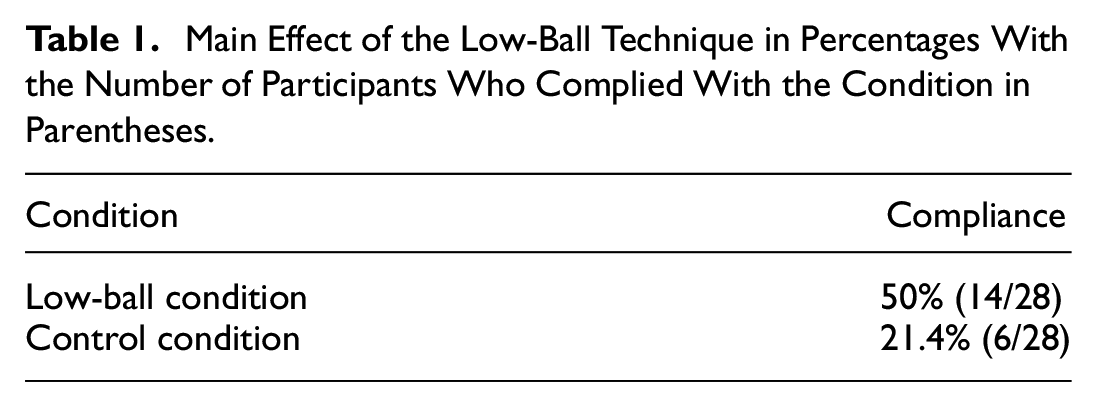
There was a main effect for the experimental condition. Participants in the LB condition more often complied with the request (50%, 14/28) than participants in the control condition (21.4%, 6/28) χ2(1) = 4.29, p = .038, R 2 = .12 (Nangelkerke; Table 1). No main effect for PFC occurred χ2(1) = 0.4, p = .5.
Main Effect of the Low-Ball Technique in Percentages With the Number of Participants Who Complied With the Condition in Parentheses.
Because we were generally interested in the interaction model, we conducted a likelihood ratio test of the full model with the effects in question against the one without the interaction model. The fitted model with interaction showed an accuracy of 74.5%. In line with our hypothesis, a significant effect of the interaction between the PFC score and the experimental condition was present, χ2(1) = 5.7, p = .017, R 2 = .26 (Nangelkerke). These results are summarized in Table 2.
Likelihood Ratio Tests.

Note. Accuracy of the model with the interaction term is 74.5%.
More detailed information about the parameter estimates with standard error, odds ratio, and confidence intervals can be found in Table 3.
Parameter Estimates.
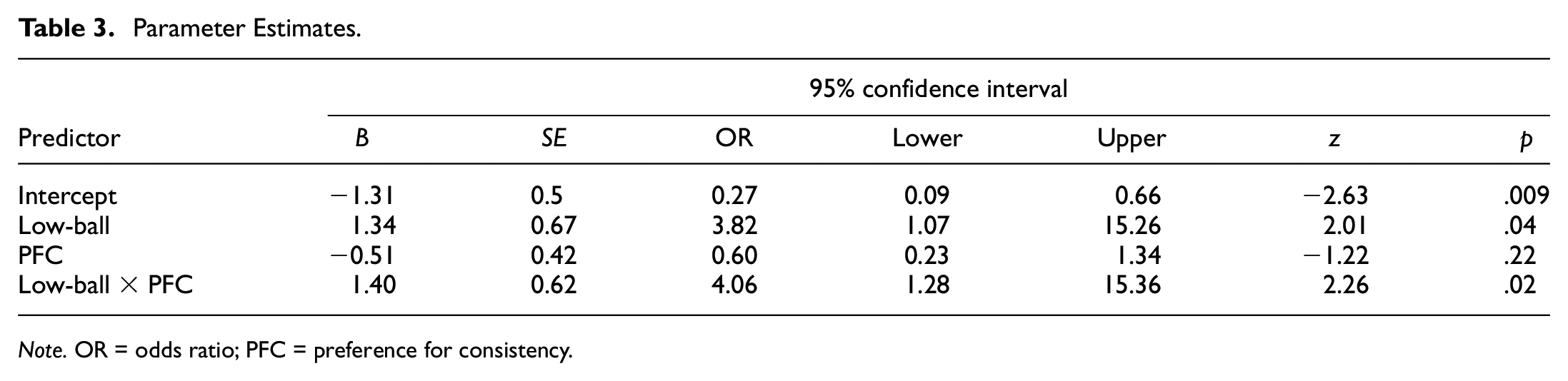
Note. OR = odds ratio; PFC = preference for consistency.
To better understand the interaction between the variables, we examined the simple effects of the experimental condition (LB technique) on different moderator levels (PFC; Figure 1). A similar approach has proven to be useful in other research in the field (e.g., Cantarero et al., 2017). The conducted analysis showed that the LB technique was most efficient when the PFC was high (+1 SD), B = 2.88 (SE = 1, p = .004), and less effective when it was at the mean (B = 1.34, SE = 0.67, p = .04). It was not effective at all at a low PFC level (–1 SD), B = 0.2 (SE = 0.9, ns). These results are summarized in Table 4.
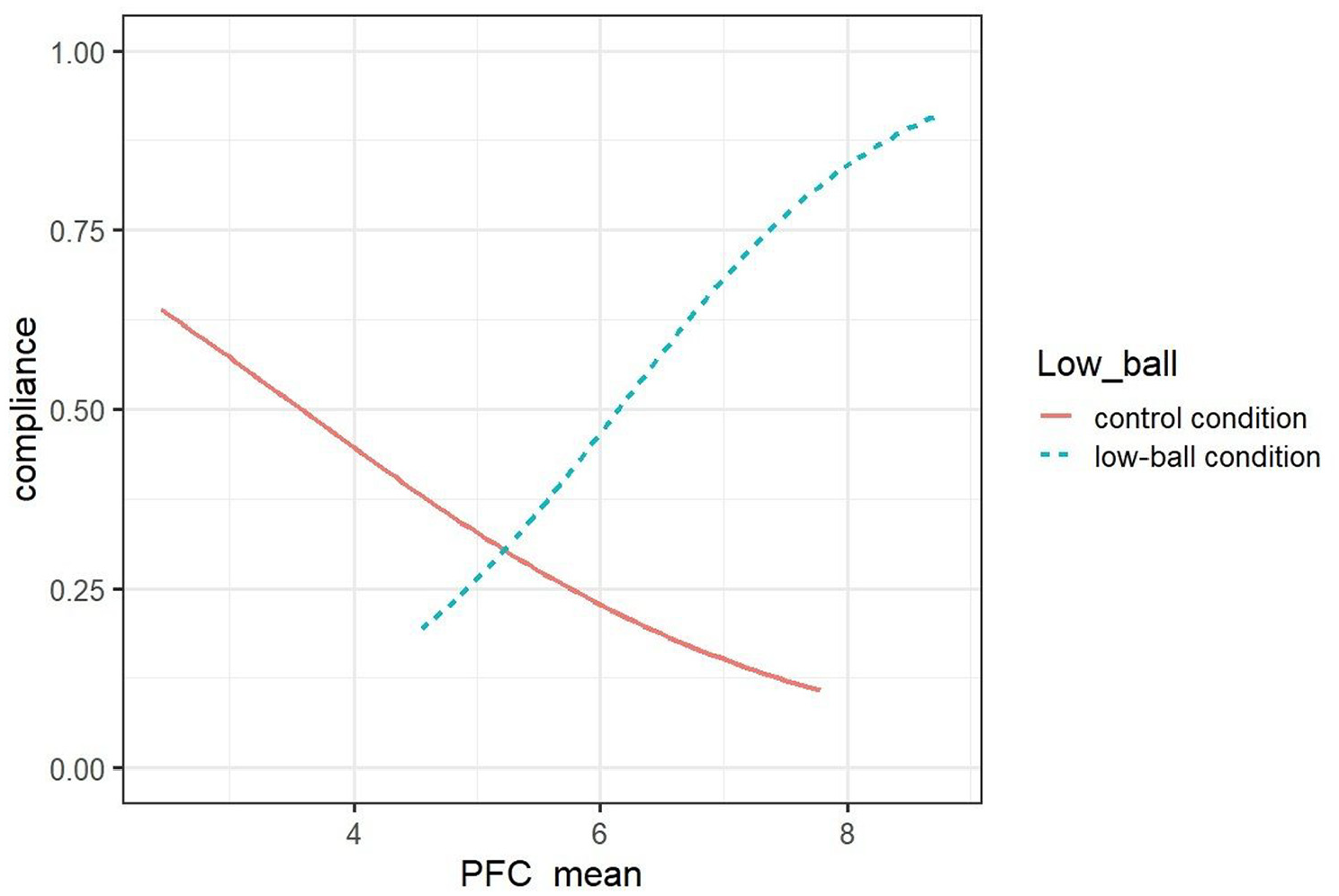
The Interaction Between the Experimental Condition and the PFC Score.
Simple Effects of the Low-Ball Technique.
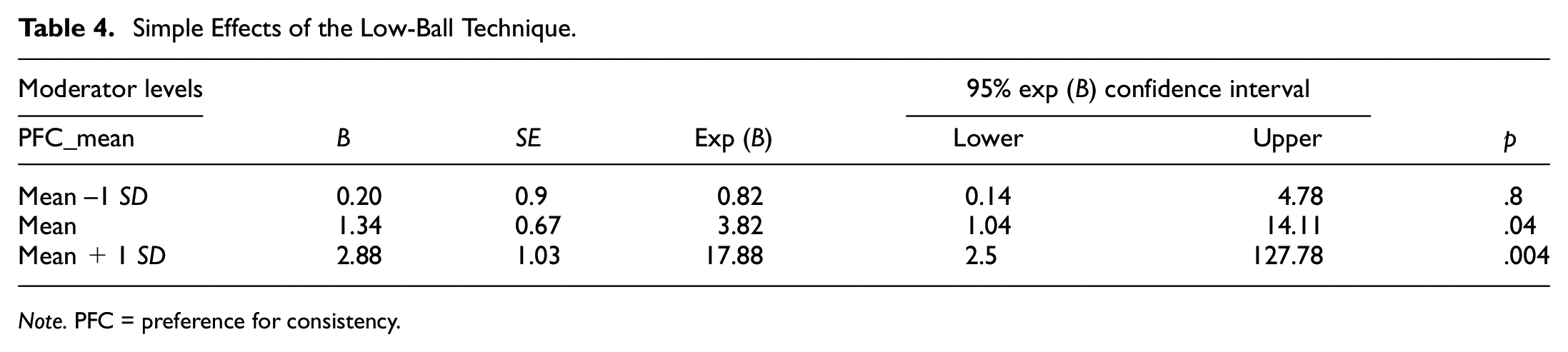
Note. PFC = preference for consistency.
Amount of Water Drunk
The outcomes for our second dependent variable, the amount of water drunk, were similar to the above results for the binominal dependent variable (drinking vs. not drinking water), therefore were once again in line with our hypothesis. During the experiment, the researcher wrote down the amount of water drunk using a simplified scale (0, one-third cup, 1/2 cup, two-third cup, whole glass). For the purposes of the analysis, these values were transformed into the corresponding volumes expressed in milliliters (Min = 0, Max = 250, M = 40.7, SD = 71.1).
We conducted linear regression analysis including the same predictors as done previously: experimental condition, PFC, and an interaction term between those two. The continuous predictor (PFC) was centered. We also converted the dependent variable (the amount of water drunk) to milliliters (originally it was coded in glass volume, for example, half a glass and one third of a glass). The results show that our model with the interaction is statistically significant (F = 3.61, p < .02, R 2 = .18). The main effect of the experimental condition was statistically significant (p = .024). Participants in the LB condition drank more water (M = 60.8, SD = 85.9) than the participants in the control condition (M = 20.6, SD = 45.7). Similar to compliance, no main effect of PFC was found for the amount of water drunk. The interaction between the experimental condition and PFC is proven to be significant (p = .04). The results are summarized in Table 5.
Results of the Linear Regression of the Experimental Condition and PFC Including the Interaction Term
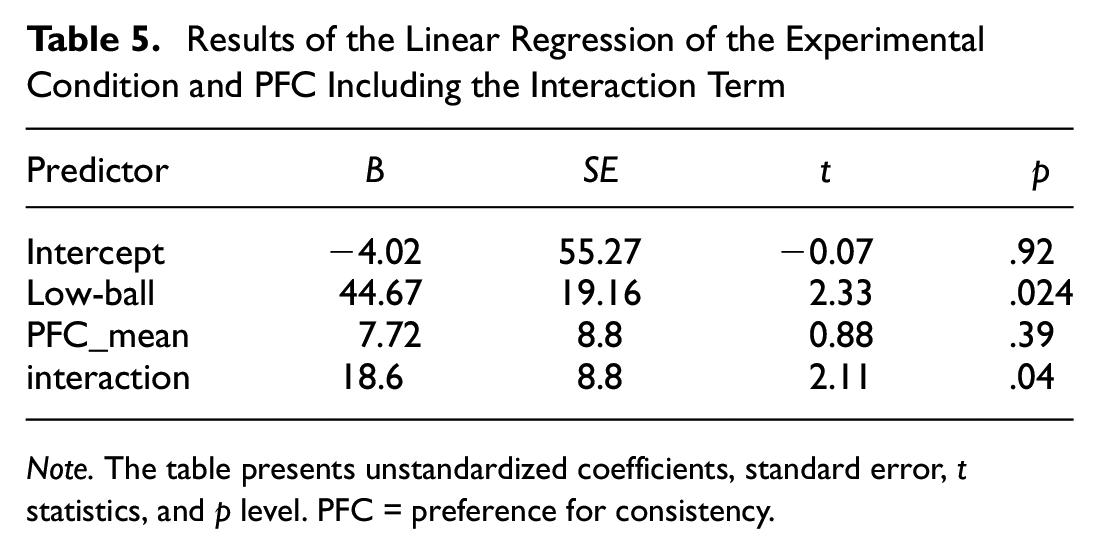
Note. The table presents unstandardized coefficients, standard error, t statistics, and p level. PFC = preference for consistency.
Again, an analysis of the simple effects of the experimental condition (LB) at different moderator levels confirms that the technique is most effective for participants with a high (+1 SD) PFC level (B = 85.62, SE = 27.2, p = .002) and not effective at all for those with a low (–1 SD) PFC (B = 3.71, SE = 27.3, p = .9). These results are summarized in Table 6. These results are also displayed in Figure 2.
Simple Effects of the Low-Ball Technique
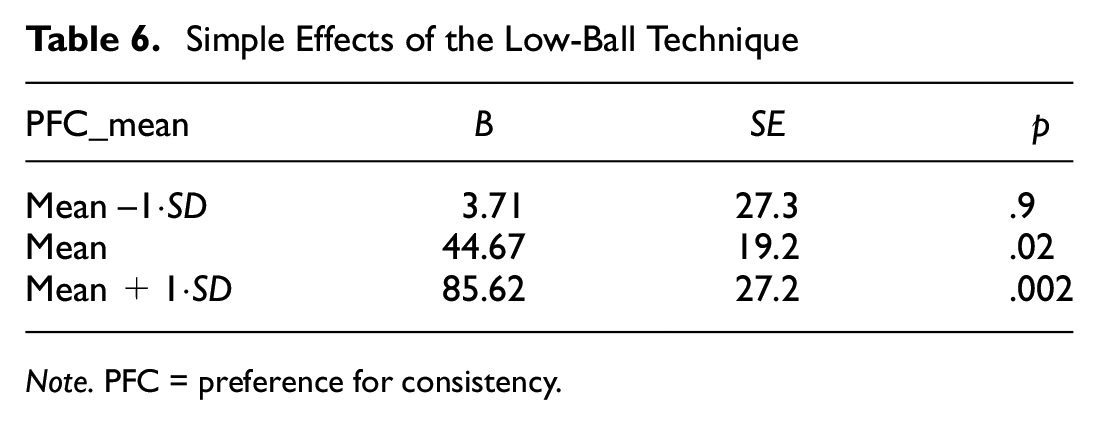
Note. PFC = preference for consistency.
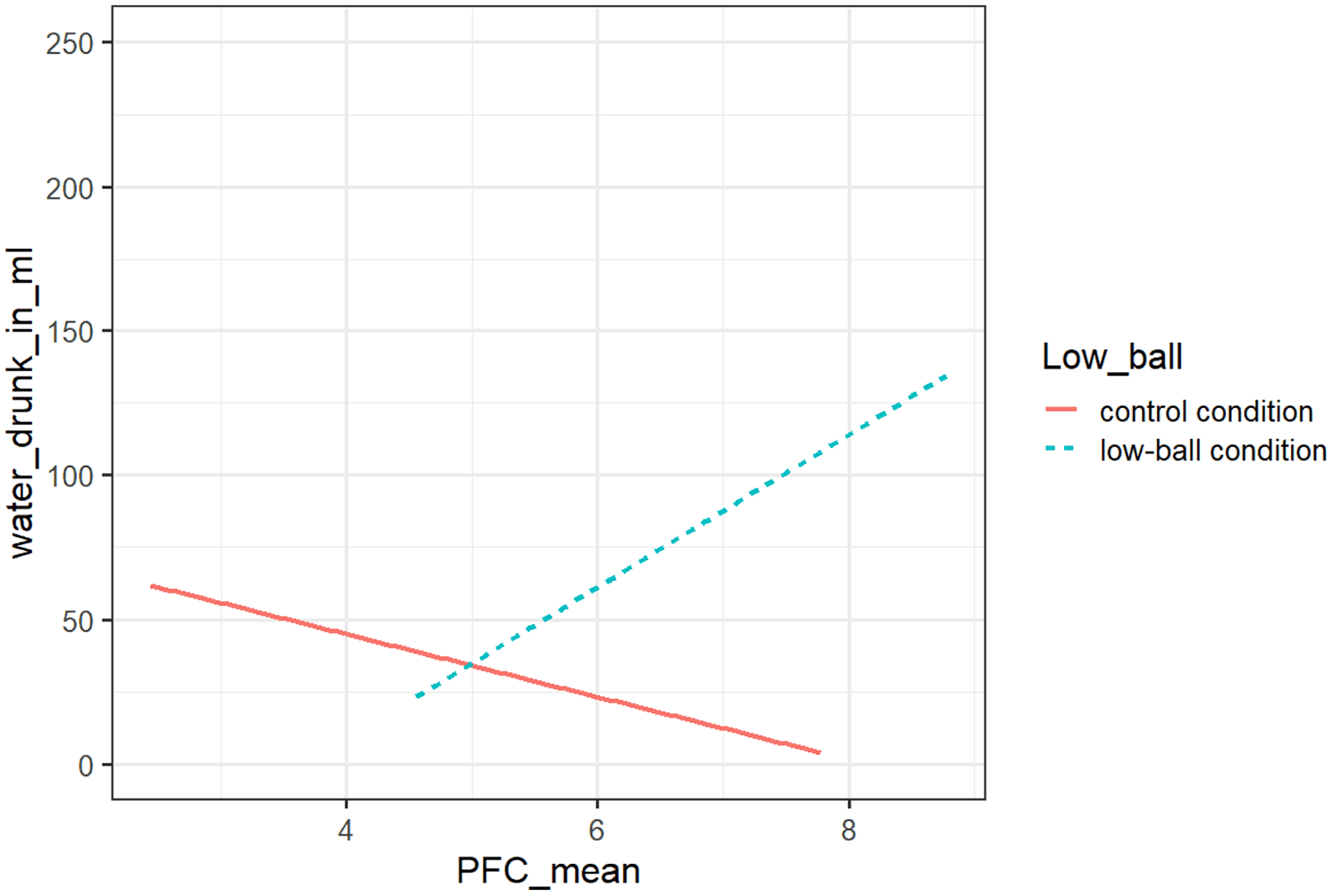
The Effectiveness of the Low-Ball Technique Depending on PFC (Dependent Variable: Water Drunk in Milliliters).
Discussion
The main goal of our study was to verify the role of individual differences in the PFC in predicting the effect of the LB tactic, as the third and last unexplored sequential technique for gaining compliance, the effectiveness of which is supposed to be determined by individual dispositions in behavioral congruity. To this end, we utilized a self-interest type of request that promotes environmentally friendly habits. In our study, in line with the meta-analysis of Pascual et al. (2016), the self-interest type of request turned out to be an effective method for producing the LB effect.
Participants agreed to drink water more often when they learned about the inconvenience after the initial consent (LB condition) rather than when they were informed about it at the very beginning (control condition). However, the analysis of PFC as a moderator of LB sheds more light on the role of this individual difference in explaining the efficacy of this technique. It was most effective for people with a high PFC, whereas it ceased to be effective for those with a low PFC.
Thus, our study confirms that taking into consideration that not all people may be naturally driven to stay consistent within their attitudes and behaviors is a valid perspective for explaining how individual differences may influence the effectiveness of sequential social influence techniques. Individuals with a high PFC, who prefer predictability and congruence in their life, upheld their decision to drink the water although the circumstances for fulfilling the request changed, whereas those scoring low on the PFC scale, who rely on spontaneous inconsistent responses, adjusted their decision to the new situation and withdrew from their commitment after becoming aware of the less favorable circumstances.
Moreover, people with a high PFC not only more willingly decided to drink the water but also drank significantly more of it than people with a low PFC. In addition, we documented that the moment of measuring the PFC (before or after the LB procedure) did not affect the results obtained on the PFC scale.
On the contrary, our study showed that a low level of PFC somewhat “protects” against submission to the LB technique. People with a low level of PFC were less likely to agree to a request to drink water when the conditions for fulfilling the request changed to their disadvantage. Perhaps the effective manipulation of the PFC level could serve as a starting point for developing a defense technique against the practitioners of social influence (for more about our ideas to manipulate PFC, see the section “Future Research Directions”).
Thus, our study fills a specific gap in the research to date on the relationships of PFC and sequential social influence techniques (Guadagno & Cialdini, 2010). We do believe that results obtained in our study are also important because of complementing the existing knowledge about the role of PFC as an individual difference characteristic that plays an important role in moderating the effectiveness of not a single social influence tactic, but rather a whole group of consistency-based sequential request techniques.
Limitations
Although our study indicates the importance of PFC in explaining the effectiveness of LB, similar to any single study, it has its own limitations.
One of the doubts that may arise in our research may be that the first experimenter was not naive to the experimental versus control conditions. However, this expectation effect can only be assigned to the first dependent variable (i.e., consent to the target request) but not to the second dependent measure, namely, the amount of water consumed (see Note 3 in “Method” section). As far as both variables show the same effect, the results obtained by us in the study cannot be attributed to the potential expectations of the first experiment, especially since our main interest was not simply to replicate the LB effect, but also to verify the PFC and LB interactions, which turned out to be positively verified for both dependent variables.
We also recognize that a more precise measurement of the second dependent variable (i.e., the amount of water drunk) could be expected. In our study, we only used a perceptual estimate of the amount of water consumed, hence the accuracy of this measurement was lower than in the case of using, for example, a measuring scale. On the contrary, the measurement we used translated into obtaining results conclusive in the interpretation, and consistent with the measurement, of the first dependent variable (i.e., consent to the target request).
Another potential limitation of the results of our research could be the relationship between the PFC and other variables that might be correlated with compliance (agreeableness, tendency to antisocial behaviors). One could argue that lower susceptibility to social influence techniques among individuals with low PFC is simply related to their more antisocial nature. In the original study conducted by Cialdini and his colleagues (1995), PFC correlated negatively with openness to new experience (r = –.38) and positively with conscientiousness (r = .20). However, no link was found between PFC and other Big 5 factors (including agreeableness), nor other features that could indicate an antisocial attitude of individuals with low PFC. In addition, in Guadagno and her colleague’s (2001) study, individuals with low PFC were more likely to comply with a request in a control condition than those with high PFC. Thus, we believe that the effect of a lower compliance rate among individuals with low PFC in the LB paradigm cannot be explained by other individual differences based on existing premises.
We used a self-interest type of request that is believed to be the most effective variant of LB techniques. Further replications are necessary to confirm the existence of such a relationship using other operationalizations of LB manipulation and various methods of measuring behavioral consistency (as dependent variables).
Similar to other field studies, we believe that our study maintains high ecological validity and allows inference about real social behavior, which is difficult to simulate in a laboratory (cf. Dolinski, 2018). However, one should not forget about the limitations of this type of research, related to the difficulty of controlling confounding variables. It is also hard to infer, based on our results, which of the factors influencing the commitment may be of key importance for the effectiveness of the technique: commitment to the requested action, commitment to the person, or self-presentation concerns (Burger & Caputo, 2015).
Settlement of the doubts raised above may be a starting point for planning further studies, taking into account PFC and LB procedures.
Future Research Directions
There are still no comparative PFC studies in which it would be possible to compare the three known sequencing techniques, that is, FITD, DITF, and LB. Although the research conducted so far indicates the importance of consistency-based individual differences, it is difficult to make relative inferences on which plays a greater or smaller role.
An interesting extension to research on PFC would be an attempt to manipulate the level of PFC instead of simply measuring it. Such a possibility would allow researchers to argue about consistency as a mechanism of sequential techniques of social influence. One idea would be to induce abstract versus concrete thinking as it has been an effective procedure in Henderson and Burgoon’s (2014) series of experiments. As abstract thinking proved to direct participants into a more coherent perception of themselves, it could perhaps induce a higher level of PFC as well. First, it should be verified whether the tasks related to abstract versus concrete thinking affect the level of PFC. If this hypothesis turns out to be true, then it would be worth conducting further research on whether the shift in PFC level affects compliance to various social influence techniques.
It is also worth noting that the pattern of results obtained in our study is close to that of Guadagno and her colleagues (2001), suggesting a greater susceptibility of people with a low PFC to requests in the control condition. This effect can be attributed to the greater openness to experience that characterizes people with low PFC and the willingness to engage in novel experiences. As argued by Guadagno and her colleagues (2001), participants with low PFC who encounter demanding solo request may feel particularly driven to respond positively to the novel situation they faced. As we were not primarily interested in confirming the relative difference between low versus high-PFC individuals responding under control condition, our sample size was not determined to document this effect. However, that effect seems interesting as extending the future exploration of boundary conditions that are important to understand the susceptibility of low PFC individuals to respond to relatively demanding requests. People with low PFC appear to be resistant to techniques requiring behavioral consistency, so learning about the conditions that enhance social influence in that particular group of people seems to be a challenge for further research in this area.
Footnotes
Handling Editor: Marlone Henderson
Declaration of Conflicting Interests
The author(s) declared no potential conflicts of interest with respect to the research, authorship, and/or publication of this article.
Funding
The author(s) disclosed receipt of the following financial support for the research, authorship, and/or publication of this article: The proofreading and the open access of the publication was funded by the Priority Research Area Society of the Future under the program “Excellence Initiative–Research University” at the Jagiellonian University in Krakow.
