




Abstract
Do people signal protest by bringing out a protest vote when they feel they have been collectively disadvantaged? Political scientists have been interested in “protest voting” yet theoretical understanding is limited. Social psychologists have studied other forms of collective protest extensively. The present study integrates insights from the political science approach to protest voting and the social psychological approach to protest behavior to study how a context of perceived collective disadvantage influences voting for protest parties. We conducted a field study with a quasi-experimental design. This allowed us to study effects of a plausibly exogenous variable—the presence versus absence of societal disadvantage (the experience of man-made earthquakes)—on both determinants of and on subsequent protest voting. Results reveal that the presence of earthquakes affects levels of protest voting via (national) trust, regional identification, and perceptions of efficacy.
People often feel collectively disadvantaged. This can be for different reasons: because they are discriminated against, because their living environment is threatened, or because they feel politically marginalized. What actions do people take to redress disadvantage? In answering this question, social psychologists have focused on protest behavior such as demonstrating and studied collective determinants of such behavior, such as identification with other group members (van Zomeren, Postmes, & Spears, 2008). In light of the rising wave of antiestablishment political sentiments on both sides of the Atlantic, political scientists have become increasingly interested in protest voting (Van der Brug & Fennema, 2007). Protest voting is considered to be support for an antiestablishment party born from lack of political trust (Bergh, 2004). The present work seeks to extend our understanding of protest voting by integrating political perspectives on protest voting with social psychological perspectives on protest behavior.
Within the social sciences, there is strong consensus that protest behavior stems from the experience of collective disadvantage (Gurr, 1970). A meta-analysis has shown that three related variables are particularly important: feelings of injustice-based anger due to the disadvantage experienced by the group, identification with one’s disadvantaged group, and the feeling it is possible to redress this collective disadvantage by protest behavior (Van Zomeren, Postmes, et al., 2008).
Among political scientists studying protest voting, the main focus has been at the individual level, on lack of political trust as an instigator of protest voting. Social psychological research on protest behavior has paid little attention to (political) trust despite reason to believe that trust may play a role in (undermining) protest behavior (Moore, 2008; Stroebe, 2013).
The present study seeks to answer to what extent both political trust and feelings of efficacy, injustice, and identification explain why voters vote for nonmainstream parties. We do so by focusing on how a context of collective disadvantage affected voting behavior during municipal elections. Specifically, we studied the impact of gas extraction and subsequent man-made earthquakes that affect 410,000 people in the North of the Netherlands, many of whom share a strong sense of injustice (Boelhouwer et al., 2016; Dutch Safety Board, 2015; Postmes et al., 2018). Importantly, we compared those who experience earthquakes to persons who are demographically similar to them but lack earthquake experiences. This means we have a plausibly exogenous injustice variable, something that is not common in research on protest behavior. While we realize that the assignment is not completely random, our study provides an important innovation: Determinants of protest behavior are generally studied within disadvantaged groups and thus lack a control group of people who are not affected by injustice.
In sum, this study is innovative for a number of reasons: First, we include (to our knowledge for the first time) not just the psychological process variables that predict protest behavior in our model but also a plausibly exogenous variable—whether or not participants experienced an event that could trigger protest behavior. This inclusion of an “exogenous” independent variable, the psychological mediators, and the reported behavioral outcome in one model represents a major improvement over traditional studies of activism. Second, by integrating social psychology and political science insights into protest behavior, we aim to develop a broader and more theorized understanding of protest voting than so far considered. Third, our work extends current social psychological research by considering protest behavior in a form that is not studied in collective action research yet may be more acceptable to members of disadvantaged groups than other forms of protest behaviors. At the same time this behavior is more general, a voting decision can be affected by many different motives apart from addressing disadvantage.
Protest Behavior and Protest Voting
Social psychology has paid little attention to protest voting, focusing more on other forms of collective protest such as demonstrating and signing petitions (van Zomeren, Postmes, et al., 2008). While voting behavior could be considered a potential form of protest against collective disadvantage, there are also indications that it is conceptually distinct from other protest behaviors (van Stekelenburg, Klandermans, & Akkerman, 2016). This means that we need to be careful in generalizing insights from research on protest behavior to voting behavior. At the same time, voting behavior, more so than other forms of protest behavior, is a relatively common form of protest behavior, thus underlining the necessity of gaining a better understanding thereof (van Stekelenburg et al., 2016). Indeed, as protest parties developed, the notion of protest voting has become more prominent within political science. According to Bergh (2004), protest voting is theoretically underdeveloped: Within the political science, protest voting is understood as “a positive effect of political distrust on support for one political party or other” (p. 377). The definition of protest voting in the political science literature is problematic because it does not see protest voting as an outcome variable, but rather a relationship between two variables. Political distrust is used to explain why some citizens vote for protest, new, third, nonmainstream, or populist parties or rather than established parties (Bélanger & Aarts, 2006; Bélanger & Nadeau, 2005; Hetherington, 1999; Hooghe, Marien, & Pauwels, 2011; Miller & Listhaug, 1990). What is actually considered a protest vote within political science depends on which party attracts low-trust voters and this depends on the party system. Populist parties, like the Flemish Interest in Belgium or populist politicians like Ross Perot, if they run in elections mobilize voters with low levels of political trust.
In order to separate cause from effect, we define protest voting not as a relationship between two variables but as casting a vote for a particular set of antiestablishment parties. In the present study, we consider voting for independent local parties in municipal elections as protest voting. Independent local parties are parties without ties to national parties that run in the municipal elections in a single municipality. They exist in addition to national party branches that compete in local elections. They are a common feature of many Northern European democracies such as Germany, Norway, Sweden, and the Netherlands (Otjes, 2018). Local parties are often formed as protest parties (Aars & Ringkjøb, 2007, p. 4; Boogers & Voerman, 2010, p. 85; Zouridis & Tops, 1994, p. 79). They mobilize voters with populist or antiestablishment rhetoric (Angenendt, 2015, p. 135; Boogers & Voerman, 2010, p. 86; Holtman, 2008, p. 13). Indeed, voters with low political distrust are more likely to vote for an independent local party (Otjes, 2018; Otjes, 2019). Moreover, in the Netherlands, these parties are on the rise and their development has been closely linked to the history of Dutch populist parties (Lucardie & Voerman, 2012). It is important to note that the main right-wing populist party (the Freedom Party) did not run in municipal elections in the North of the Netherlands, making local parties a reasonable alternative for these voters. With the exception of the Freedom Party, the full diversity of Dutch party system was on offer in the municipal elections.
In this study, we consider the extent to which protest voting as voting for an independent local party is instigated by the experience of collective disadvantage in the North of the Netherlands due to man-made earthquakes caused by the extraction of natural gas. In the earthquake-affected areas, independent local parties devoted more attention to earthquakes than most national parties. In addition, the national government is in part held responsible for the continuation of the gas extraction whereas local governments are not (Dutch Safety Board, 2015). For this reason, we expect perceptions of national rather than municipal government, for example, regarding political distrust, to be associated with voting behavior.
Determinants of Protest Voting and Protest Behavior
In line with the political science literature which, as outlined above, assumes that protest voting is directly related to political distrust, we consider the relation between collective disadvantage, political distrust, and protest voting. Interestingly, political distrust does not play a major role in the social psychological approach to protest behavior (but see Moore, 2008; Stroebe, 2013). In this study, we included measures of trust in both the national and local governments. Indeed, in a multilevel political system, it is important to think about which level of government citizens will hold responsible (De Blok & Van der Brug, 2017). Because the national government is seen as responsible for and financially dependent on gas extraction (Dutch Safety Board, 2015), we expected protest voting to be associated with distrust in the national government. We control for trust at the municipal level. Specifically, we predict that the experience of earthquakes is associated with lower levels of trust in the national government, which in turn is related to higher levels of protest voting (Trust Hypothesis).
While political scientists have focused on political distrust as the driving mechanism behind protest voting, social psychology considers a broader range of collective determinants of protest behavior—suggesting interesting new perspectives on potential determinants of protest voting: A meta-analysis of the collective action literature, including studies based on different types of groups, has identified three central determinants: group identification, perceptions of injustice, and efficacy (Van Zomeren, Postmes, et al., 2008).
Groups are important to people. People identify and feel part of the groups they are a member of, even when groups are collectively disadvantaged (Tajfel, 1981). Under such circumstances, they may seek support from and come to identify more strongly with their group (Branscombe, Schmitt, & Harvey, 1999). Group identification in turn is an important predictor of protest behavior (Major, Quinton, & Schmader, 2003; van Zomeren, Spears, & Leach, 2008). In the present study, there is a large disadvantaged group, those who live in the earthquake region and suffer from the earthquakes. We predict that the experience of earthquakes is associated with increased regional identification, which in turn is associated with higher levels of protest voting (Identification Hypothesis).
The likelihood of social protest is stronger when individuals feel that their group is treated unjustly by others (van Zomeren, Postmes, et al., 2008). In this study, the national government is seen as partially responsible for the earthquakes. Again, we control for perceptions of injustice of the municipal government. We predict that the experience of earthquakes is associated with feeling that the national government acted unjustly, which in turn is associated with higher levels of protest voting (Injustice Hypothesis).
Finally, group efficacy, a sense of control and the perceived ability to address the collective disadvantage the group faces via collective action, is the third key predictor of collective action (Drury & Reicher, 2005; Van Zomeren, Postmes, et al., 2008). Group efficacy is generally studied within groups of disadvantaged members (van Zomeren, Postmes, et al., 2008), whereas in this study, we compare responses of disadvantaged versus nondisadvantaged group members. This makes predictions for the present study somewhat exploratory from a social psychological perspective. Within political science, political efficacy is defined as “the feeling that individual political action does have, or can have, an impact on the political process” (Campbell, Gurin, & Miller, 1954, p.187). This implies that someone who feels the government needs to take a different approach to dealing with earthquakes would be more likely to vote if they feel that by voting they, and other citizens suffering from the earthquakes, can effect change. As with trust and injustice, we include measures of municipal efficacy as a control. We predict that the experience of earthquakes is associated with lower feelings of efficacy concerning the national government, which in turn are associated with higher levels of protest voting (Efficacy Hypothesis).
The Current Study
Our study takes a quasi-experimental approach to collective disadvantage, comparing voting behavior of respondents with and without an earthquake experience in the three Northern provinces of the Netherlands (Friesland, Groningen, and Drenthe). The earthquakes are man-made, being the result of gas extraction. They started in the 1980s, but they have intensified in the recent decades. These earthquakes are often felt quite locally, and whether people experience damage to their housing varies even within municipalities. This allowed us to assess voting behavior among very similar samples that differed in whether they had experienced earthquakes or damages to their housing.
Method
Participants and Procedure
In order to recruit citizens who have experienced an earthquake with those who have not, we used the Regio Noord Panel. This is an opt-in panel meant for citizens in the three Northern provinces. We sampled all respondents in the panel who lived in the area where the earthquakes had occurred and sampled 5 times as many respondents outside the earthquake area. The complete data set consisted of 3,041 respondents. The response rate was 38%. 1 The survey took place immediately after the 2014 local elections. At the time of the elections, the earthquakes were national news. The reduction gas extraction was under debate.
For our quasi-experimental design, we constructed a matching sample (McCready, 2006). We asked respondents whether they experienced an earthquake themselves in their own habitat or whether they experienced damage to their house—referred to as earthquake experiences throughout this article. Out of the 3,041 respondents, 538 participants answered at least one of these two questions affirmatively. Of these, 393 also had valid scores on all dependent measures and mediators assessed. We matched these participants with the remaining 1,862 participants without earthquake experiences who also had valid scores on all dependent measures and mediators in the study. 2 We eliminated 130 respondents in municipalities in which no local parties ran in the municipal elections, in order to ensure that the supply side, in other words the political parties one could vote for, was stable. Then, for each respondent who had an earthquake experience, we selected another comparable respondent without an earthquake experience. This meant respondents were matched on party preference in 2012, gender, education level, density of the municipality of residence, and date of birth, using MatchIt (version 3.0.2), an R package specifically meant to create a quasi-experimental data set from observational data (Stuart, King, Imai, & Ho, 2011). It seeks to identify the “nearest neighbor” for every treated respondent who is similar in terms of the aforementioned variables. This method controls for potential alternative determinants of voting behavior such as party preference or education level (as an indicator of socioeconomic status; Grusky & DiPrete, 1990; Kraus, Piff, Mendoza-Denton, Rheinschmidt, & Keltner, 2012). The advantage of this method compared to manual matching is that it is not necessary to drop data from participants who mentioned experiencing an earthquake. This matching left us with a final sample of 393 participants with an earthquake experience compared to a control group of 393 participants without this experience (see Online Appendix 1 for descriptive variables of both groups).
For this study, we assessed statistical power in two ways: First, we calculated the number of respondents necessary to achieve a power of .80 for finding a difference between two equal-sized groups: This requires a minimum total sample size of 620. Our analyses consisted of a total of 786 matched respondents, 393 of which were exposed to an earthquake. Second, we conducted post hoc power calculations with the package powerMediation (Qiu, 2017). These analyses revealed that the power for the smallest mediation effect reported below (the mediation through national justice in the social psychological model) is still adequate (at .86). The post hoc power for the larger effects is also larger. All models presented here are fully saturated. Therefore, we cannot compare the strength of the explanatory power between models.
Dependent variables
This study was part of a larger study on how citizens experienced the governance of the region (see Online Appendix 2; Otjes, 2018). Table 1 lists descriptive statistics of the measures.
Descriptive Statistics.
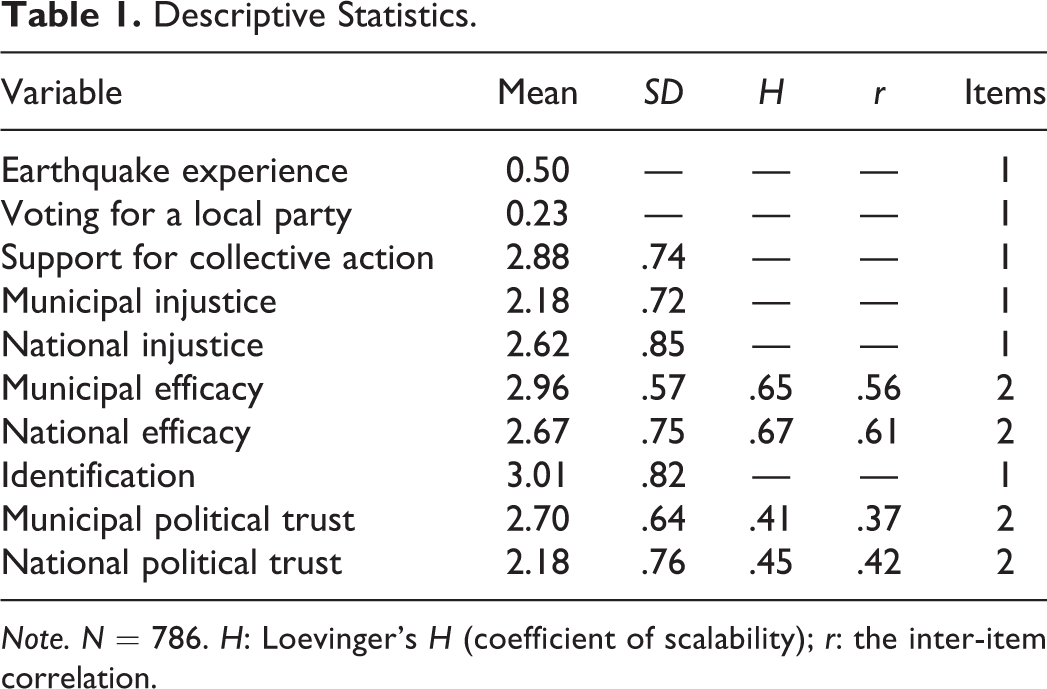
Note. N = 786. H: Loevinger’s H (coefficient of scalability); r: the inter-item correlation.
Protest voting is operationalized as voting for an independent local party in the 2014 local elections. Respondents who indicated they had voted during these elections were given a list of parties in their municipality and asked which party they had voted for. If citizens voted for an independent party, that is a party that only competed one municipality, they were given the value one, if they voted for another party they were given value zero.
To validate whether the patterns found for voting match those for traditional forms of collective action, we also asked citizens whether they supported actions and demonstrations against gas extraction (the cause of the earthquakes). They could respond on a 4-point scale ranging from 1 (completely agree) to 4 (completely disagree).
Mediators
We included two 2-item measures of political trust that measured trust in national and municipal governments (“How much trust do you have in the national/local government?” and “Members of Parliament/municipal councilors care for people like me”). In order to minimize the number of missing values, we used ordered logistic regression to impute values for the missing cases of one of the items on the basis of the other item in the scale. This reduced the cases with missing values on these variables (in the entire, prematching sample) from 324 to 41. 3 Identification was measured with a measure of regional identification (Moreno, Arriba, & Serrano, 1998). It asks respondents whether they identify as exclusively Dutch (1) or as their provincial demonym (5; as Groninger, Frisian, or Drent), or as three in-between options (equally as Dutch and their provincial demonym [3] or as more Dutch than their demonym [2] and vice versa [4]).
We also included a measure of the citizens’ perception of injustice at the national and municipal levels (“The way the national/local governments operate goes in against my values and convictions”).
Political efficacy consisted of two 2-item measures of the extent to which voters feel that they could affect politics at the national or municipal level through voting (“By voting I can influence the policy of the national/local government” and “It does not matter whom I vote for, it does not influence the national/local government”; adapted from Van Zomeren, Spears, & Leach, 2010). As for trust, we ran an ordered logistic regression to minimize the number of missing values. This reduced the cases with missing values on these variables (in the prematching entire sample) from 282 to 89. 4
Results
Before analyzing mediators of the relationship between the experience of an earthquake and protest voting, we determined whether there was a direct effect of earthquake experience on voting behavior via a logistic regression. The analysis is shown in Table 2. Note that only respondents who cast a vote were included in our sample. As expected, respondents who experienced an earthquake were significantly more likely (by 40%) to vote for an independent local party than those who did not experience an earthquake (b = .34, Wald = 4.07, p < .01).
Logistic Regression of Effect of Experiencing an Earthquake (Yes/No) on Voting for a Local Party.
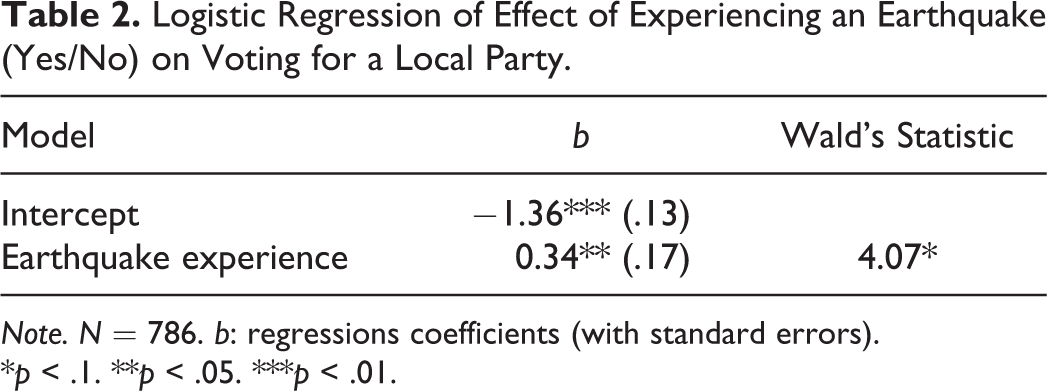
Note. N = 786. b: regressions coefficients (with standard errors).
*p < .1. **p < .05. ***p < .01.
We then examined potential mediators of protest voting via three models presented in Table 3. Model 1 tests whether social psychological variables mediate the effect of experiencing an earthquake on protest voting. Model 2 tests the political science variables. And Model 3 tests the combined effect of all variables. Data were analyzed in Lavaan (version 0.6-2) (Rosseel, 2012). This enables us to test all relevant paths and the indirect effect in one model. As we shall see, the effects of the social psychological and political variables are largely independent. For this reason, we present results of the combined model (Model 3) first. The paths from this regression analysis are visualized in Figure 1.
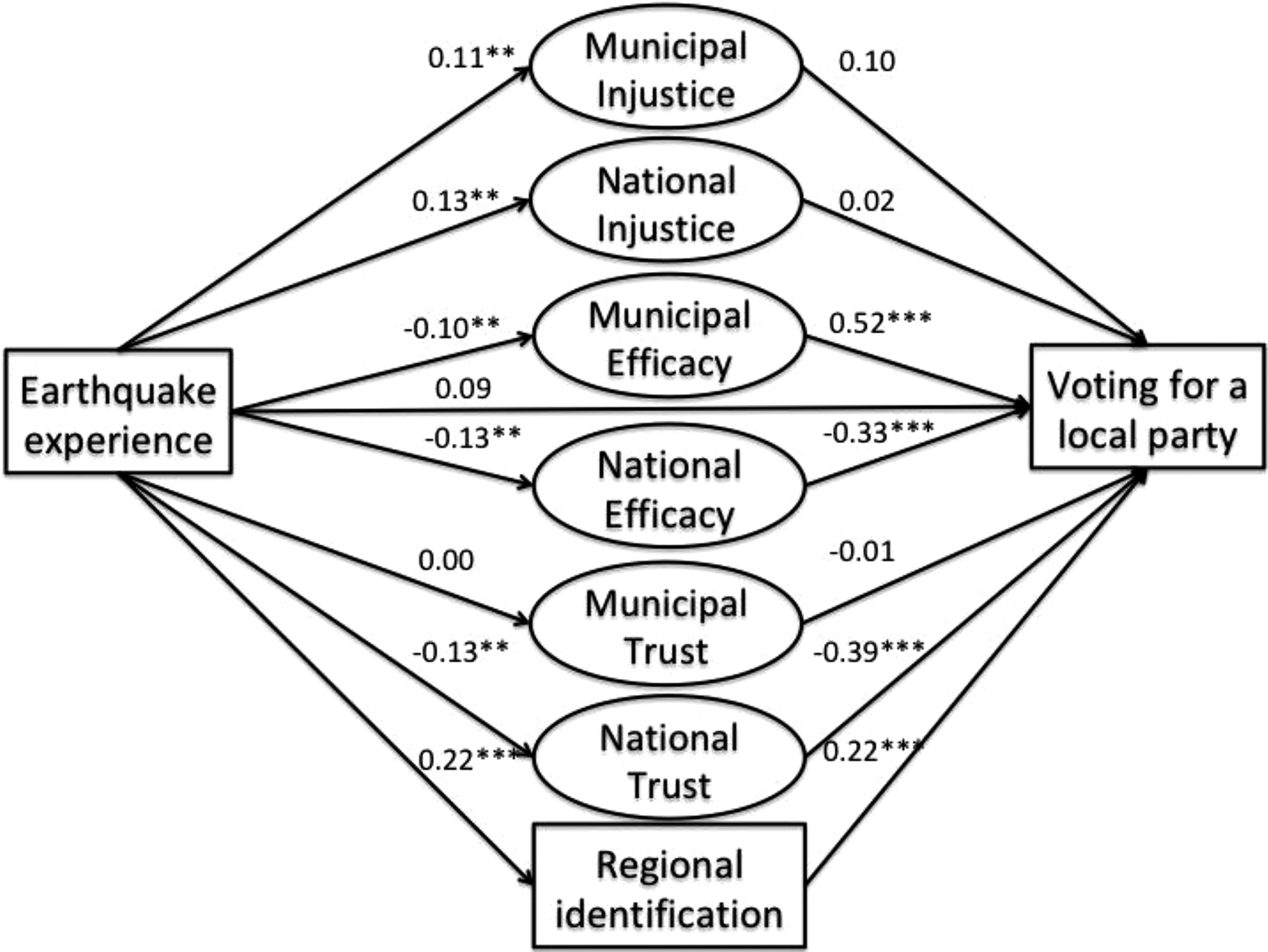
Mediation relationship visualized.
A mediation Analysis of the Relationship Between Earthquake Experience and Voting Behavior.
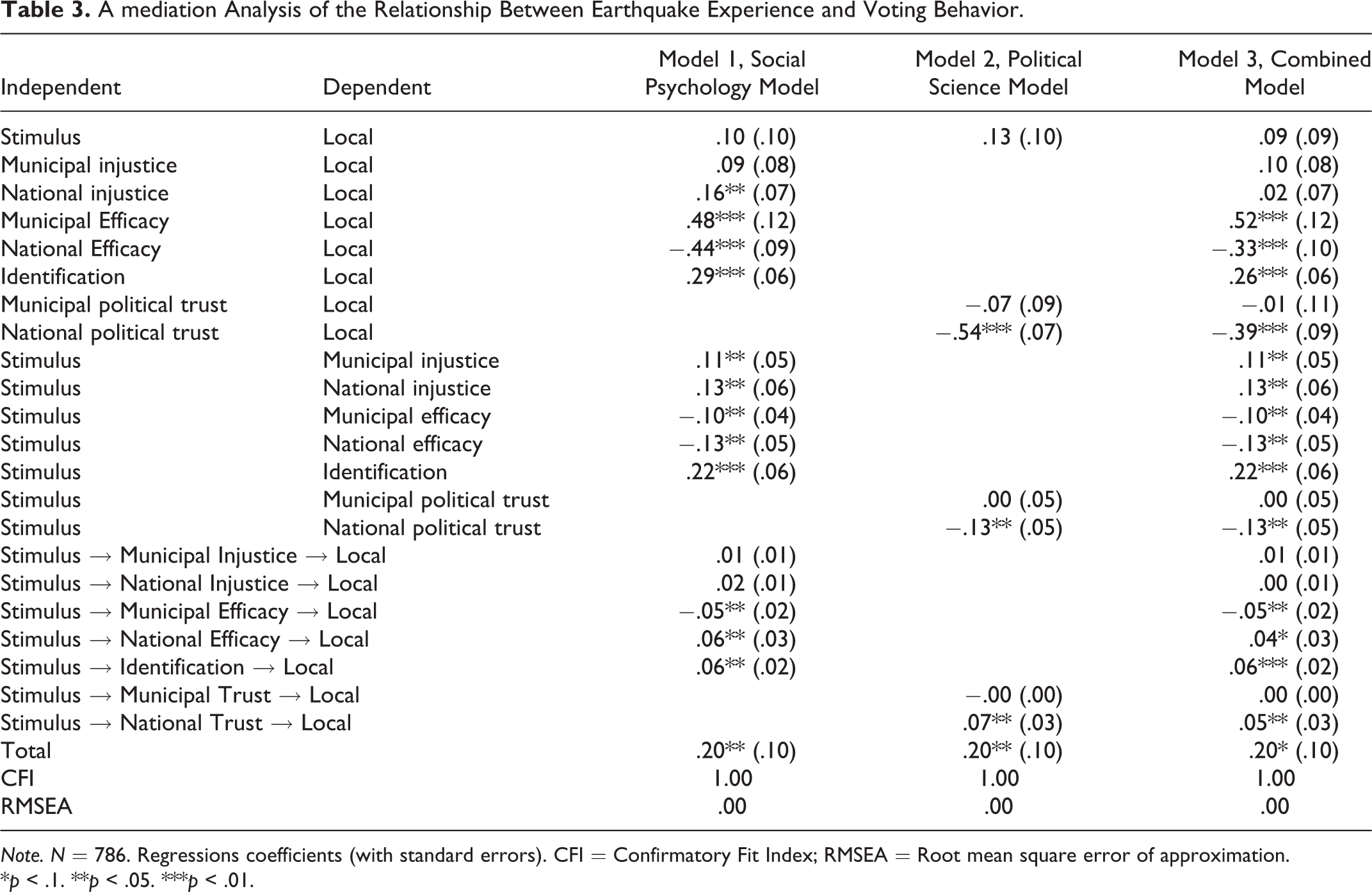
Note. N = 786. Regressions coefficients (with standard errors). CFI = Confirmatory Fit Index; RMSEA = Root mean square error of approximation.
*p < .1. **p < .05. ***p < .01.
Based on Combined Model from Table 3, analyses of Model 3 revealed a significant indirect effect for national political trust. Experiencing an earthquake decreased trust in the national government (B = −.13, SE = .05, p = .02). Trust in the national government in turn significantly increased protest voting (B = −.39, SE = .09, p = .00): A 1 standard deviation decrease in trust in the national government increased the likelihood of voting for a local party by 56%. The mediation path through trust is significant (B = .05, SE = .03, p = .04). No significant patterns were found for municipal trust: This is neither related to experiencing an earthquake (B = .00, SE = .05, p = .93) nor to voting for independent local parties (B = −.01, SE = .11, p = .94).
For regional identification, one of the three social psychological variables in this model, mediation analyses, also revealed a significant mediation effect. Experiencing an earthquake significantly increases regional identification (B = .22, SE = .06, p = .00). In turn, regional identification also increases the likelihood of voting for an independent local party (B = .26, SE = .06, p = .00): A 1 standard deviation change in regional identification increases the likelihood of voting for a local party by 20%. The mediation path was significant (B = .06, SE = .02, p < .01).
As expected, earthquake experience was positively related to both perceptions of injustice at the municipal (B = .11, SE = .05, p = .04) and national government level (B = .13, SE = .06, p = .03). Yet neither perceptions of injustice at the national (B = .10, SE = .08, p = .21) nor at the municipal government level were positively related to protest voting (B = .02 SE = .07, p = .83). Therefore, there are no significant indirect effects.
We also found significant mediations for both national and municipal efficacies, but in different ways. National efficacy undermined protest voting (B = −.33, SE = .10, p = .00): A 1 standard deviation change in national efficacy decreased the likelihood of voting for a local party by 28%. At the same time, municipal efficacy increased protest voting (B = .52, SE = .12, p < .01): A 1 standard deviation increase in municipal efficacy increased this likelihood by 31%. There is a negative relationship between experiencing an earthquake and both national (B = −.13, SE = .05, p = .02) and municipal efficacies (B = −.10, SE = .04, p = .02). Due to these significant patterns, there is a significant and positive mediation path via national efficacy (B = −.05, SE = .02, p = .03): Experiencing earthquakes undermines the sense that citizens can influence the national government, which in turn boosts the likelihood of voting for a local party. The pattern for municipal efficacy runs in the opposite direction (B = .04, SE = .03, p = .06).
As inspection of Table 3 reveals, the models that only include social psychological variables (Model 1) or the political trust variables (Model 2) are largely the same as the results of Model 3 in which both are combined. The only substantive exception is that national injustice is significantly related to voting for an independent local party (B = .16, SE = .07, p = .03). As in the combined model, there is no significant mediation path through this variable. This suggests that the effects of the social psychological variables and those of trust are largely independent.
Finally, we also considered the association of these variables on protest behavior, again we focus on the combined model (in Table 4). In line with findings for protest voting, regional identification was significantly related to supporting protest behavior (B = .10, SE = .05, p = .04) and there also is a significant mediation path through regional identification (B = .02, SE = .01, p = .07). There also are significant relationships for supporting protest behavior and municipal trust (B = .12, SE = .07, p = .07) and national trust (B = −.21, SE = .07, p < .01). Of these two, the mediation path is only significant for national trust (B = .03, SE = .02, p = .07). We find a stronger relationship between supporting protests and national injustice (B = .19, SE = .06, p < .01) and municipal injustice (B = .10, SE = .06, p = .08). For national efficacy, we find a significant path coefficient (B = .03, SE = .01, p = .07). The relationships between supporting protest behavior and national efficacy (B = −.08, SE = .07, p = .29) and municipal efficacy (B = −.07, SE = .09, p = .40) are not significant.
A Mediation Analysis of the Relationship Between Earthquake Experience and Protest Behavior.
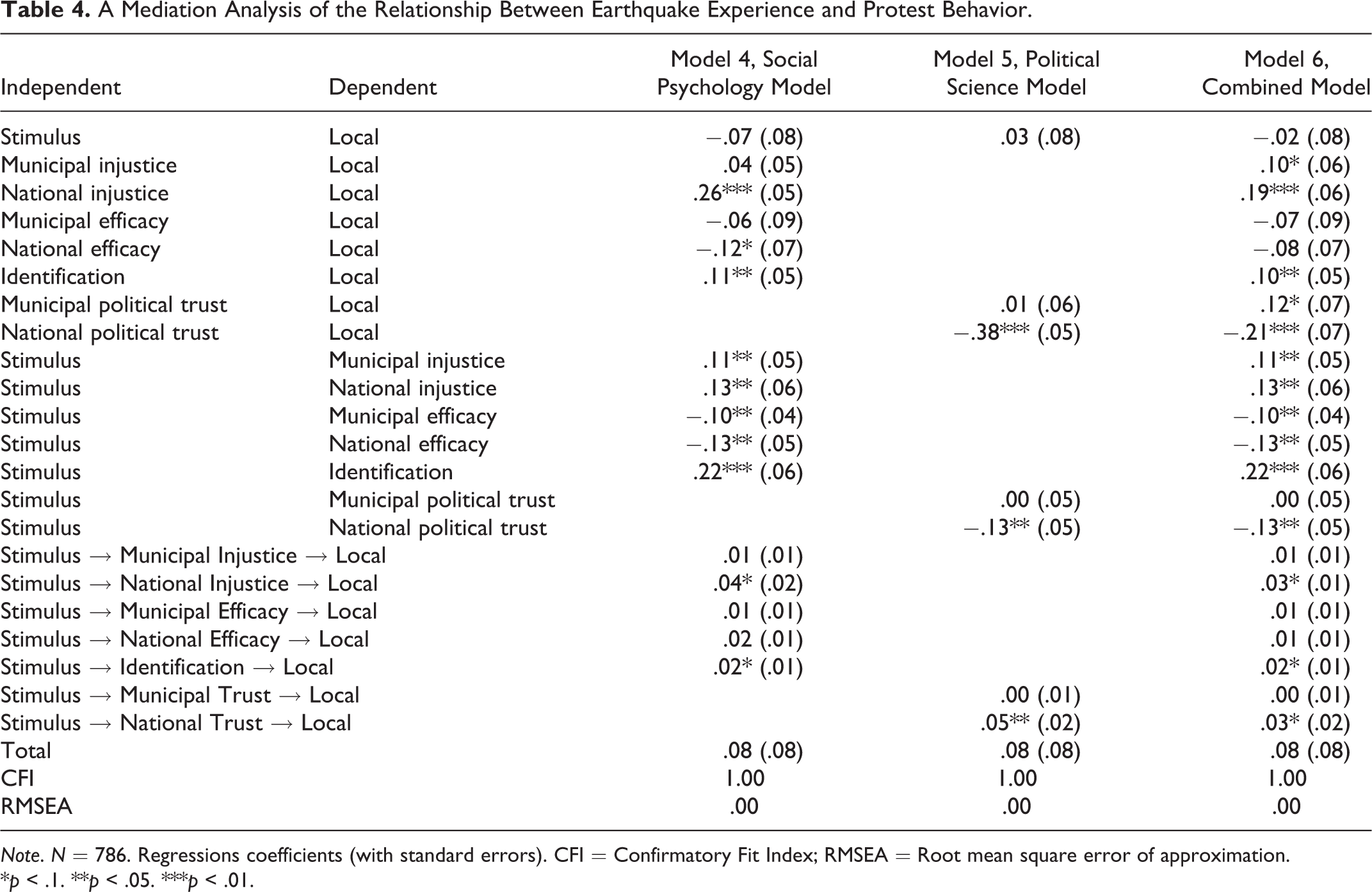
Note. N = 786. Regressions coefficients (with standard errors). CFI = Confirmatory Fit Index; RMSEA = Root mean square error of approximation.
*p < .1. **p < .05. ***p < .01.
The same variables that have significant mediation paths in the combined analysis of protest behavior (national trust, identification, and national injustice) have significant mediation paths in the separate political science and social psychology models. These models are similar, although both patterns for national trust and national injustice have stronger effects when the other variable is not included. The effect of national efficacy is also slightly stronger and therefore barely significant in the social psychology model (B = −.12, SE = .07, p = .08).
The results point in the same direction: Experiencing an earthquake increases citizens’ tendency to protest largely by lowering trust in the national government and increasing regional identification—yet, in the case of protest behavior, perceptions of injustice also play a role in instigating protest whereas efficacy plays a less central role.
Discussion
We sought to answer when and why citizens cast protest votes in response to collective disadvantage. We integrated insights from the political science approach to protest voting with social psychological insights into determinants of protest behavior to study four potential determinants of voting behavior: political trust, injustice, efficacy, and identification. Our findings stress the added value of integrating these different perspectives. This study provides important insights into both how to frame protest voting and how to study underlying determinants thereof. Moreover, it stresses the importance of studying protest voting as a form of protest behavior in response to collective disadvantage.
From a political science perspective, this study provides insights into additional determinants of protest voting, thus far not considered within this literature—which has been limited to studying the relation between political distrust and voting for a particular party (Bergh, 2004, p. 377). The work corroborates the relationship between political distrust and voting for these protest parties. We find that this is only the case for distrust of the national government and not of the municipality. In the context of the gas extraction this makes sense, it is the national government that is seen as responsible for the gas extraction (Dutch Safety Board, 2015; Postmes et al., 2018). By contrast, municipal governments are still trusted.
Moreover, this study reveals that both regional identification and feelings of efficacy are instigators of protest voting—with municipal efficacy increasing protest voting whereas national efficacy undermines it. This means that protest voting is not only the result of individual considerations and motives but also of collective experiences, such as being disadvantaged as a group and feelings of connectedness to others who experience such disadvantage. Taking this a step further, these determinants may be of added value in understanding the rise of antiestablishment politics and disenchantment with mainstream political parties that we are seeing in Europe and America.
From a collective action perspective, this study speaks to the added value of studying trust in governments both in relation to voting and protest behavior. It shows how experiencing collective disadvantage has the potential to undermine what is an important resource—the belief that the government can be trusted. This is interesting in relation to belief in a just world concept, which partly encompasses the belief that institutions are just (Lerner, 1980; Stroebe, Postmes, Tauber, Stegeman, & John, 2015). We know that such beliefs are important, for instance, for general well-being (Furnham, 2003; Hafer & Bègue, 2005). Therefore, it may be important to take different forms of trust into consideration when studying collective disadvantage.
This study also stresses the importance of moving beyond previous approaches to collective protest (e.g., signing petitions), to consider a wider range of types of behavior that may relate to feelings of collective discontent, including voting behavior. There are communalities in the determinants: In this study, political trust and identification play an important role in predicting both protest voting and protest behavior. At the same time, perceptions of injustice possibly are a stronger predictor of protest behavior than of protest voting. Previous work has suggested that different forms of protest are conceptually distinct (Van Stekelenburg et al., 2016), possibly perceptions of injustice are more strongly related to types of behavior that more visibly contest the disadvantage at hand. Future research might focus more on potential communalities and differences in determinants of protest voting and protest behavior.
Both political science and social psychology approaches to protest tend to identify one agent against which protest is directed. This study considers how the experience of disadvantage maps onto perceptions of different agents: the national and municipal governments. This provides a more dynamic perspective of protest in which we see that whereas experiencing earthquakes undermines both perceptions of national and municipal efficacies, effects on protest voting are in the opposite direction: Citizens are less likely to engage in protest voting when they feel that by voting they can influence the national government and more likely to engage in protest voting when they feel that by voting they can influence the municipal government. A more differentiated perspective on studying protest voting and protest behavior, one that considers multiple external agents in determining responses to disadvantage, is worthwhile. It may help us understand the direction of protest behavior, for example, why citizens would choose to bring out protest votes but not engage in other forms of protest behavior.
The present research has some limitations. For one, due to the necessity of keeping our questionnaire short, we were not able to administer extensive scales of our central measures. This meant that we did not measure injustice (the way the government operates goes in against my values and convictions) and identification (as a continuum from national to provincial identification) in the traditional sense. Regarding identification, it would also be interesting to focus on other relevant forms of identification (e.g., with other disadvantaged citizens). Yet this also formed a strength of our work: We find effects on both protest and voting behavior of measures that do not specifically relate to the experience of disadvantage. Rather than asking whether participants felt the earthquakes were unjust, they identified with the victims thereof, or they could influence policy regarding the earthquakes by voting, our measures were more conservative, being unrelated to the earthquakes.
A second limitation is that we rely on retrospective data: Our study only has one wave making it impossible to disentangle the precise causal relationship between determinants of protest voting and actual voting behavior. For example, it is potentially possible that people who brought out a protest vote felt more regional identification due to their voting behavior.
A third limitation is that we studied only one context, that of the earthquakes. While this context allowed us to conduct a novel semi-experimental design, one might wonder whether other forms of disadvantage affect protest voting via similar processes. There is quite some evidence that the social psychological determinants of protest behavior are strong predictors across many different types of disadvantage, ranging from incidental, such as a motorway being built in one’s vicinity, to structural forms of disadvantage, such as being a woman (van Zomeren, Postmes, et al., 2008).
Conclusion
In sum, the present study reveals that protest voting can be instigated by the presence of a collective societal disadvantage and that such disadvantage affects voting behavior by affecting feelings of efficacy, identification, and political distrust. Our work indicates that similar empirical patterns that underlie protest behavior underlie protest voting. Protest voting should be considered an important alternative in responding to collective disadvantage.
Supplemental Material
Supplemental Material, Appendix_1 - When Voting Becomes Protest: Mapping Determinants of Collective Action Onto Voting Behavior
Supplemental Material, Appendix_1 for When Voting Becomes Protest: Mapping Determinants of Collective Action Onto Voting Behavior by Simon Otjes, Katherine Stroebe and Tom Postmes in Social Psychological and Personality Science
Supplemental Material
Supplemental Material, Appendix_2 - When Voting Becomes Protest: Mapping Determinants of Collective Action Onto Voting Behavior
Supplemental Material, Appendix_2 for When Voting Becomes Protest: Mapping Determinants of Collective Action Onto Voting Behavior by Simon Otjes, Katherine Stroebe and Tom Postmes in Social Psychological and Personality Science
Supplemental Material
Supplemental Material, Appendix_3-1 - When Voting Becomes Protest: Mapping Determinants of Collective Action Onto Voting Behavior
Supplemental Material, Appendix_3-1 for When Voting Becomes Protest: Mapping Determinants of Collective Action Onto Voting Behavior by Simon Otjes, Katherine Stroebe and Tom Postmes in Social Psychological and Personality Science
Footnotes
Declaration of Conflicting Interests
The authors declared no potential conflicts of interest with respect to the research, authorship, and/or publication of this article.
Funding
The authors received financial support from the profile area Sustainable Societies of Groningen University.
Supplemental Material
The supplemental material is available in the online version of the article.
Notes
References
Supplementary Material
Please find the following supplemental material available below.
For Open Access articles published under a Creative Commons License, all supplemental material carries the same license as the article it is associated with.
For non-Open Access articles published, all supplemental material carries a non-exclusive license, and permission requests for re-use of supplemental material or any part of supplemental material shall be sent directly to the copyright owner as specified in the copyright notice associated with the article.
