




Abstract
Although cynical beliefs about human nature yield numerous adverse consequences for individuals’ life outcomes and well-being, very little is known about factors that counteract the development of cynical beliefs. Drawing from the literature on the “education effect” describing the importance of education in overcoming close-mindedness and negative views of others, we propose that education can represent an antidote to cynicism. The results of two large-scale longitudinal studies showed that education was associated with lower levels of cynicism over time spans of 4 and 9 years. Longitudinal mediation analyses underscored the role of individual differences in perceived constraints, a facet of personal control, as the psychological mechanism underlying the education effect: Higher education is associated with a reduced perception of constraints, which is in turn related to less endorsement of cynical beliefs.
Psychologists and social scientists alike have long been interested in lay beliefs about human nature (Kluckhohn, 1950; Rosenberg, 1956; Wrightsman, 1964, 1992). Are people inherently corrupt, deceptive, and motivated exclusively by self-interest or are they honest, trustworthy, and genuinely concerned about others’ well-being? Research shows that individuals differ widely in their answers to these questions and, consequently, whether they endorse an idealist or a cynical view of human nature (Bond et al., 2004; Cook & Medley, 1954; Leung et al., 2002; Wrightsman, 1964). Following recent research (Chen et al., 2016; Stavrova & Ehlebracht, 2016), we define cynical beliefs about human nature (briefly referred to as cynicism) as a dispositional construct reflecting individual differences in core evaluations of human nature as good or evil. Cynical beliefs involve a negative appraisal of other people’s intentions and motives and a tendency to view most people with suspicion and distrust.
Cynical beliefs about human nature have been shown to have negative consequences for a wide range of individuals’ life outcomes. Cynicism has been found to be one of the most important predictors of bad health, including increased likelihood of coronary heart disease, dementia, depression, and risk of mortality (Everson et al., 1997; Neuvonen et al., 2014; Smith, 1992). Negative consequences of holding cynical beliefs extend to interpersonal relationships (Baron et al., 2007; Kaplan, Bradley, & Ruscher, 2004), self-esteem, subjective well-being (Chen et al., 2015), job satisfaction (Leung, Ip, & Leung, 2010), and career success (Stavrova & Ehlebracht, 2016). Cynicism is also thought of as a source of negative outcomes for whole societies, hindering national economic growth, undermining democracy and civic engagement, and providing fertile soil for crime and corruption (Knack & Keefer, 1997; Putnam, 2000; Rothstein & Uslaner, 2005; Uslaner & Brown, 2005).
Despite cynicism’s deleterious consequences, very little is known about factors that prevent its development. Herein, we explore the role of educational attainment as an antidote to cynicism. Existing literature has promoted the idea of education as a means against close-mindedness, intolerance, and distrust of the differently minded (Coenders & Scheepers, 2003; Osborne & Sibley, 2015). In particular, education endows individuals with a sense of personal control (Lewis, Ross, & Mirowsky, 1999) and therefore might help them overcome feelings of vulnerability and suspiciousness. Although a moderate negative correlation between cynicism and education has been repeatedly reported in the literature (Carroll, Smith, Sheffield, Shipley, & Marmot, 1997; Gallo & Matthews, 2003; Stavrova & Ehlebracht, 2016), it remains to be investigated whether education is related to the development of cynical beliefs in the long run.
Theoretical Background
Education is often seen as an important factor promoting open-mindedness and tolerance. Highly educated individuals tend to score higher on measures of openness to experience (O’Connell & Sheikh, 2011; Van Eijck & De Graaf, 2004), are more likely to support minorities’ rights, and are less likely to endorse prejudice and out-group stereotypes (Coenders & Scheepers, 2003; Fingerhut, 2011; Huang, den Brink, & Groot, 2011; Jenssen & Engesbak, 1994; Kuppens & Spears, 2014; Osborne & Sibley, 2015). Education provides individuals with better access to status and power and thus might diminish the perception of vulnerability to others’ potentially malicious intentions. In addition, by developing cognitive skills, education can help individuals build a stronger sense of mastery and control over their lives (Schneeweis, Skirbekk, & Winter-Ebmer, 2014). Indeed, an increased perception of personal control represents one of the most important psychological consequences of education reported in the literature (Eshbaugh, 2009; Lewis et al., 1999; Schieman, 2001; Schieman & Plickert, 2008; Specht, Egloff, & Schmukle, 2013).
Personal control is widely recognized as a valuable personal resource, strengthening individuals’ coping ability, subjective well-being, and health (Lachman, 2006; Rotter, 1966; Turiano, Chapman, Agrigoroaei, Infurna, & Lachman, 2014). Individuals with a strong sense of control tend to believe that they hold power over what happens to them and how their life unfolds, whereas individuals with a weak sense of control tend to feel powerless and believe that their life depends much on factors beyond their control, such as chance, fate, or other people (Ross & Sastry, 1999; Rotter, 1966; Skinner, 1996). Personal control is believed to include two facets—mastery and perceived constraints (Lachman & Weaver, 1998). Mastery refers to a belief in one’s ability to achieve the desired outcomes, whereas perceived constraints describe a belief in one’s dependence on factors beyond one’s control (e.g., other people) in achieving the desired outcomes. In existing research, these facets of personal control are often combined into one scale, although in a couple of recent studies, they were analyzed separately (cf. Infurna & Mayer, 2015; Ward, 2013). Herein, we assume that a stronger sense of control (higher mastery and/or lower constraints) might help overcome feelings of vulnerability and thus reduce the use of self-protective strategies, such as suspiciousness, hostility, and distrust, which are central to cynicism (Pope, Smith, & Rhodewalt, 1990; Vranceanu, Gallo, & Bogart, 2006). Indeed, prior research has shown that feeling powerless and at others’ mercy amplifies suspicion and distrust (Ross, 2011).
In the present research, we propose that educational attainment endows individuals with a stronger sense of personal control and therefore represents an antidote to the development of cynicism. We also investigate whether obtaining a higher level of education is associated with less cynicism even if one got off to a bad start in life. Existing research suggests that economic hardship in childhood promotes the development of cynicism in adulthood (Lynch, Kaplan, & Shema, 1997). In fact, individuals raised in low socioeconomic status (SES) households are less likely to show high educational attainment. Therefore, we investigated whether obtaining a high level of education is associated with less cynicism in adulthood regardless of one’s starting conditions.
We explored these questions using a longitudinal methodology. In Study 1, we examined the role of individual differences in educational attainment in the endorsement of cynical beliefs using a two-wave longitudinal study of the American population. In Study 2, we replicated these findings in another longitudinal sample and explored the role of personal control as a potential mediator of the education effect. As differences in education are related to sociodemographic and economic characteristics, such as race or income, we included these variables as well as basic sociodemographic controls (gender and age) in the analyses in both studies.
Study 1
Method
We used the data from the American Changing Lives Study (House, 2014), a longitudinal study of the American population that started in 1986 and sampled about 3,000 individuals aged 25 and older. As cynicism was measured in Waves 4 (2002) and 5 (2011) only, we included only the data from these two waves. The final sample consisted of 1,087 individuals (mean age = 56.65, 39% 1 male). Data and materials can be accessed at the study’s website (House, 2014).
Cynicism
Cynicism was measured with 3 items of the Cook–Medley Cynical Distrust Scale (as only 3 items were included in both waves; Greenglass & Julkunen, 1989): “Most people inwardly dislike putting themselves out to help other people,” “Most people will use somewhat unfair means to gain profit or an advantage rather than lose it,” and “I think most people would lie in order to get ahead” (4-point agree–disagree scale; Cronbach’s α = .71 at baseline and .72 at follow-up, respectively).
Education
Participants were asked to report the number of years of education they had when joining the panel in 1986 (ranging from 0 to 17). As the sample included individuals aged 25 and older and the maximum number of years possible was 17, most respondents would have been able to attain the maximum level of education by the time of joining the panel (assuming that primary education for most people in the United States starts at the age of 6–7 years).
Control variables included age, gender (1 = male, 0 = female), race (1 = Caucasian, 0 = Other), and log-transformed income at Time 1 (t1; own and spouse’s joint income before taxes, in U.S. dollars, adjusted for the presence of a spouse. If the income value referred to the joint own and spouse’s income, it was divided by 2.).
Results and Discussion
Means, standard deviations, and zero-order correlations among the variables are shown in Table 1. Educational attainment was negatively correlated with cynicism in both waves (r = −.22 at t1 and r = −.18 at Time 2 [t2], p < .001).
Means, Standard Deviations, and Correlations Among the Variables: Study 1.
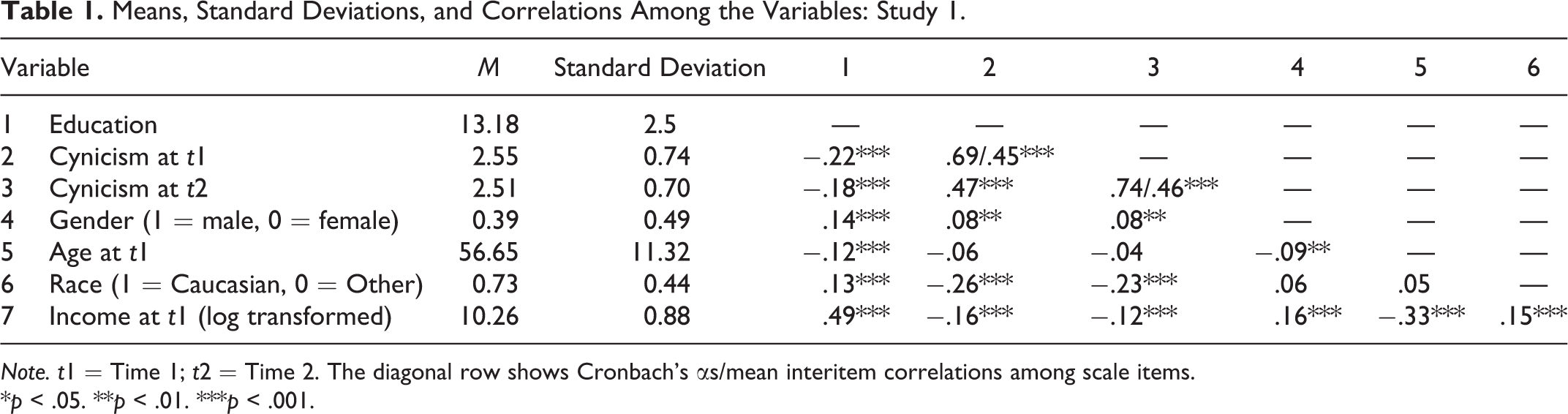
Note. t1 = Time 1; t2 = Time 2. The diagonal row shows Cronbach’s αs/mean interitem correlations among scale items.
*p < .05. **p < .01. ***p < .001.
To better account for measurement error in cynicism, we conducted a series of structural equation models (SEMs) modeling cynicism at t1 and t2 as latent constructs. We used the lavaan package of R (version 3.3.1; Rosseel, 2012). We report model-based parameter estimates along with their p values. As estimates of effect sizes, we additionally report the respective partial correlations and their 95% confidence intervals [CIs]. To evaluate model fit, we used comparative fit index (CFI ≥ .90), root mean square error of approximation (RMSEA ≤ .08), and standardized root mean square residuals (SRMR ≤ .08; Hu & Bentler, 1999; Marsh, Hau, & Grayson, 2005).
First, we assessed the measurement model by letting the three indicators of cynicism at t1 and t2 load on their respective latent constructs (that were allowed to correlate with each other). The model included longitudinal correlations between the same items measured at t1 and t2 (Cole & Maxwell, 2003). The model yielded a very good fit, χ2(5) = 20.77, p = .001, CFI = .99, RMSEA = .05, SRMR = .02. Second, we tested the measurement invariance of cynicism over time by comparing the model with free factor loadings to the constrained model in which factor loadings of the same items were fixed to be equal over time. The constrained model showed a good fit as well and did not significantly differ from the model with free factor loadings, χ2(2) = 1.25, p = .54 (for fit indices, see Supplemental Table S1), providing evidence for metric invariance of cynicism between t1 and t2 (Little, Preacher, Selig, & Card, 2007).
To examine the longitudinal effect of education on cynicism, we fitted an SEM in which cynicism at t2 was predicted by education and cynicism at t1 (Model 1, Table 2). Cynicism as t1 and t2 were modeled as latent factors. The model fits the data reasonably well, χ2(10) = 93.27, p < .001, CFI = .95, RMSEA = .088, SRMR = .06. Educational attainment negatively predicted cynicism at t2 when controlling for cynicism at t1 (b = −.01, p = .046, partial r = −.10, 95% CI [−.16, −.04]). 2 In Model 2, to examine whether the effect of education on cynicism holds when controlling for basic sociodemographic and economic characteristics, we additionally modeled age, gender, race, and income at t1 as predictors of cynicism at t2. This model showed a substantially worse fit, χ2(30) = 258.05, p < .001, CFI = .88, RMSEA = .08, SRMR = .08. Most importantly though, it showed that the effect of education was robust against controlling for these sociodemographic and economic indicators (b = −.02, p = .031, partial r = −.08, 95% CI [−.14, −.02]).
Longitudinal Effect of Educational Attainment on Cynicism: Study 1.
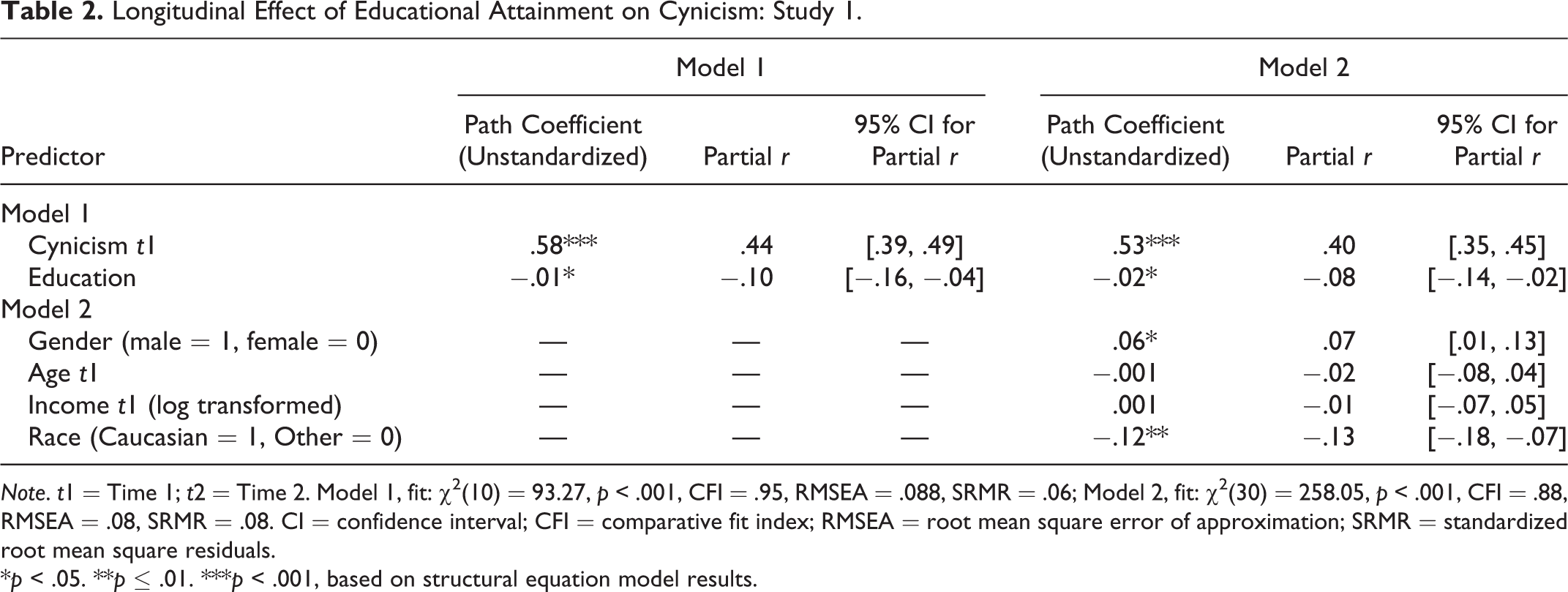
Note. t1 = Time 1; t2 = Time 2. Model 1, fit: χ2(10) = 93.27, p < .001, CFI = .95, RMSEA = .088, SRMR = .06; Model 2, fit: χ2(30) = 258.05, p < .001, CFI = .88, RMSEA = .08, SRMR = .08. CI = confidence interval; CFI = comparative fit index; RMSEA = root mean square error of approximation; SRMR = standardized root mean square residuals.
*p < .05. **p ≤ .01. ***p < .001, based on structural equation model results.
The results of Study 1 showed that educational attainment predicted a decreasing endorsement of cynicism over time. This effect was independent of participants’ sociodemographic characteristics, such as age or race, and their income, suggesting that a lack of education rather than economic disadvantage contributes to cynicism. However, experiencing economic hardship already in childhood might be more important for the development of cynicism than economic conditions later in adulthood (Lynch et al., 1997). Growing up in a financially disadvantaged household, in an underprivileged, dangerous environment might evoke a mind-set of suspiciousness and feelings of vulnerability and have a formative influence on individuals’ psychological development. Importantly, as childhood economic hardship is associated with lower educational attainment (Breen & Jonsson, 2005), it might represent a potential confounding in our analyses. In other words, could the negative effect of education demonstrated in Study 1 be explained by a confounding with childhood economic disadvantage? Or might obtaining a higher level of education inhibit the development of cynicism even if one got off to a bad start in life? To shed light on this question, in Study 2, we additionally took into account individual differences in childhood SES.
Importantly, we examined the proposed psychological mechanism of the education effect. Using a longitudinal mediation methodology (Cole & Maxwell, 2003; Preacher, 2015), we tested the role of personal control as a potential mediator of the effect of education on cynicism development.
Study 2
Method
For this study, we used the data from the Health and Retirement Study, an American nationally representative longitudinal survey of adults aged 50 and older and their spouses (Health and Retirement Study, 2012). Participants have been surveyed every 2 years since 1992. A measure of cynicism was first added to the survey in 2006 (for one half of the sample) and in 2008 (for the other half). These two subsamples were combined as our baseline assessment. The follow-up assessment was conducted in 2010 (for the 2006 subsample) and in 2012 (for the 2008 subsample), resulting in a 4-year time lag between the baseline and the follow-up for all participants. The final sample consisted of 10,072 (mean age 67.48, 40.1% male) individuals. Data and materials can be accessed at the study’s website (Health and Retirement Study, 2012).
We used the information about participants’ level of educational attainment (1 = lower than high school, 2 = generational educational development degree, 3 = high school diploma, 4 = some college, and 5 = college and above), which was collected when they joined the panel.
Cynical beliefs about human nature were measured with a 5-item version of the Cook–Medley Cynical Distrust Scale (Cook & Medley, 1954; Everson et al., 1997). Additional items to the ones used in Study 1 are: “No one cares much what happens to you” and “I commonly wonder what hidden reasons another person may have for doing something nice for me” (1 = strongly disagree to 6 = strongly agree; Cronbach’s α = .80 at baseline and .79 at follow-up).
The measure of personal control consisted of two 5-item subscales: mastery (sample item “Whether or not I am able to get what I want is in my own hands”; Cronbach’s α = .90 at t1 and .90 at t2) and perceived constraints (sample items “Other people determine most of what I can and cannot do”; Cronbach’s α = .86 at t1 and .88 at t2; Lachman & Weaver, 1998). Responses were given on a 6-point agree–disagree scale. The two-factorial structure was confirmed in a confirmatory factor analysis that modeled mastery and constraints at t1 and t2 as four latent correlated factors, χ2(154) = 6899.71, p < .001, CFI = .94, RMSEA = .07, SRMR = .03. 3
Participants provided information on the level of their father’s and mother’s education (number of years in education, ranging from 0 to 17) and their family’s financial situation during their childhood (between birth and age 16; 1 = poor, 2 = about average, 3 = pretty well off financially). Participants’ responses to these questions were standardized and combined into a measure of childhood SES (Cronbach’s α = .68).
As in Study1, the analyses included participants’ age, gender (1 = male, 0 = female), race (1 = Caucasian, 0 = Other), and log-transformed income at t1 (total annual household income in dollars).
Results and Discussion
As this study included four latent constructs (cynicism, mastery, constraints, and childhood SES), we started by examining a measurement model in which manifest variables were allowed to load on their respective latent factors and the latent factors were allowed to correlate with each other (Cole & Maxwell, 2003). This model reached an acceptable fit, χ2(459) = 10,549.69, p < .001, CFI = .94, RMSEA = .05, SRMR = .04, suggesting that the manifest variables reflect the underlying constructs they are supposed to measure.
We then proceeded to testing measurement invariance of cynicism, mastery, and constraints over time. We used the same procedure as in Study 1. Models with free and constrained loadings showed good fit (see Supplemental Table S1). A look at incremental fit indices shows that putting constraints on factor loadings did not deteriorate model fit. 4 Therefore, we concluded that cynicism, mastery, and constraints items reached the level of metric invariance between t1 and t2.
Means, standard deviations, and zero-order correlations among the variables are shown in Table 3. Replicating the findings of Study 1, educational attainment was negatively associated with cynicism at both baseline (r = −.24, p < .001) and follow-up (r = −.23, p < .001).
Means, Standard Deviations, and Correlations Among the Variables: Study 2.
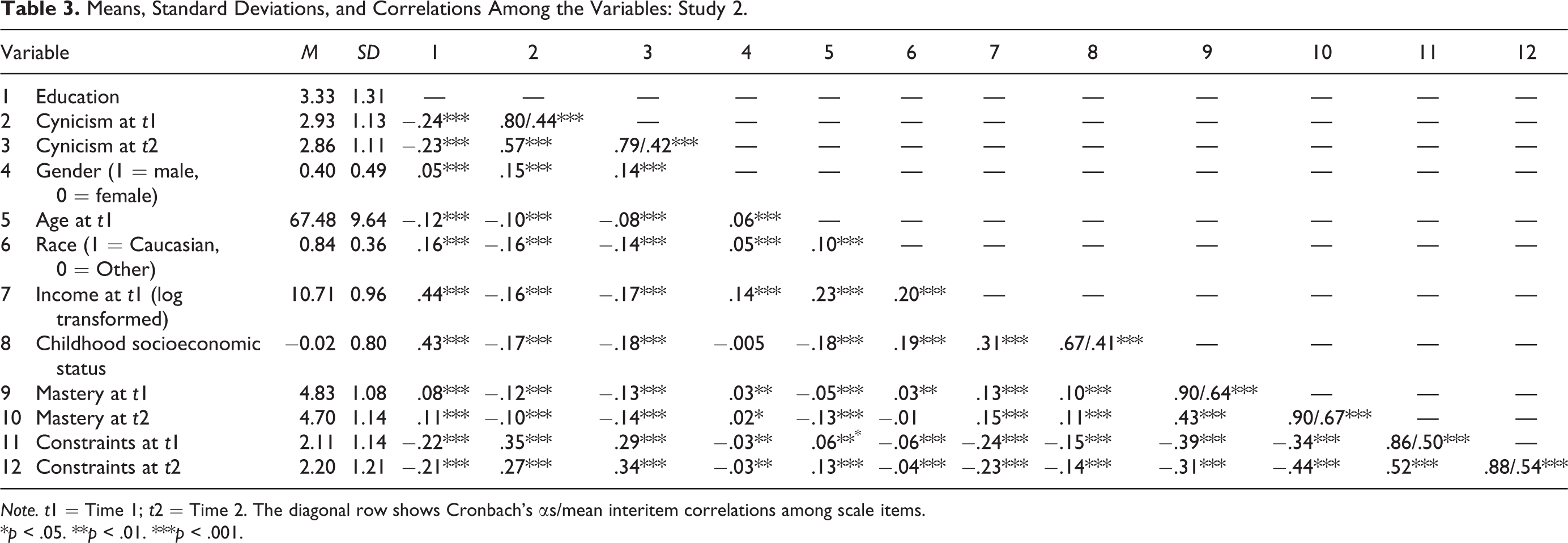
Note. t1 = Time 1; t2 = Time 2. The diagonal row shows Cronbach’s αs/mean interitem correlations among scale items.
*p < .05. **p < .01. ***p < .001.
To explore the longitudinal effect of education on cynicism, we specified an SEM in which cynicism at t2 was predicted by education and cynicism at t1 (Model 1, Table 4). Cynicism at t1 and t2 were modeled as latent constructs. The model reached a satisfactory fit, χ2(38) = 2,457.93, p < .001, CFI = .93, RMSEA = .08, SRMR = .07. Like in Study 1, education negatively predicted cynicism at t2 when controlling for cynicism at t1 (b = −.09, p < .001, partial r = −.12, 95% CI [−.14, −.10]). In Model 2, we added age, gender, race, income at t1, and childhood SES as predictors of cynicism at t2. The fit of this model was rather poor, χ2(117) = 6,419.45, p < .001, CFI = .86, RMSEA = .07, SRMR = .09. The effect of education remained significant, although it decreased compared to the model without controls (b = −.06, p < .001, partial r = −.07, 95% CI [−.09, −.05]). Additionally, to examine whether the effect of education varied depending on childhood SES, we computed an interaction effect between education and childhood SES, that did not reach significance (b = −.005, p = .56). Hence, obtaining a higher level of education is associated with less cynicism irrespective of childhood SES.
Longitudinal Effect of Educational Attainment on Cynicism: Study 2.
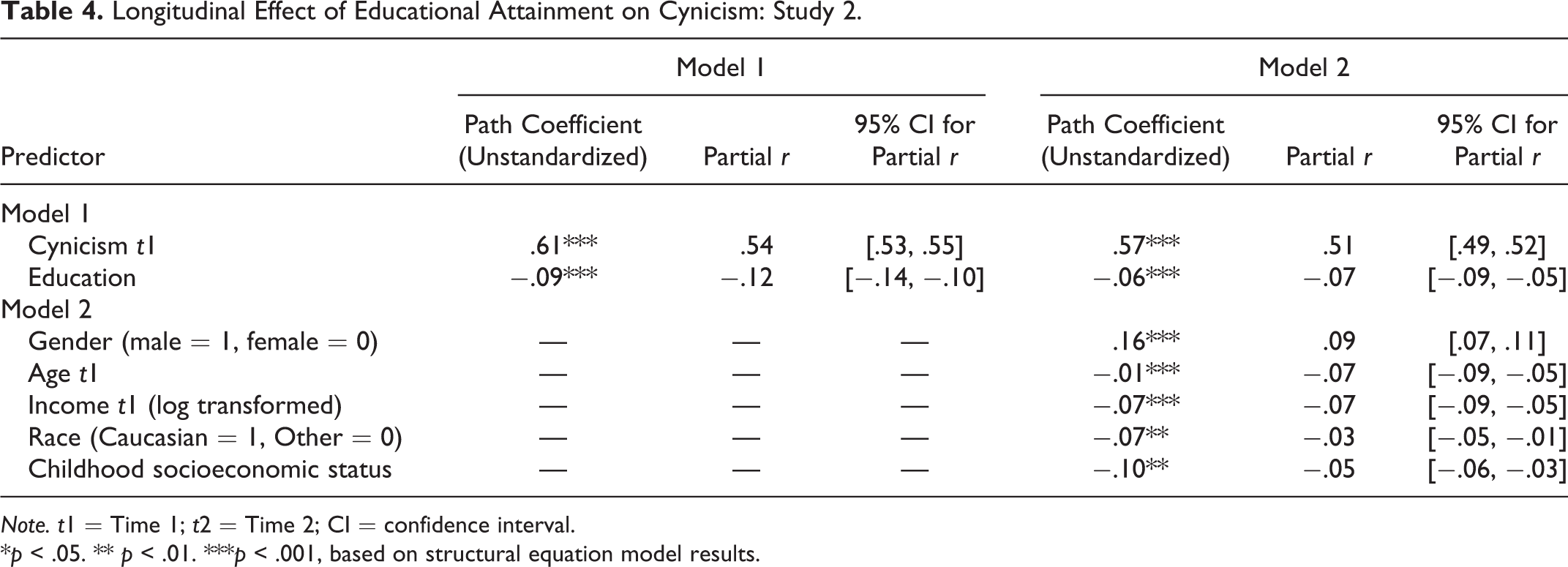
Note. t1 = Time 1; t2 = Time 2; CI = confidence interval.
*p < .05. ** p < .01. ***p < .001, based on structural equation model results.
Mediation Analyses
A look at zero-order correlations shows that highly educated individuals were more likely to report a strong sense of mastery (r = .08, p < .001 at t1 and r = .11, p < .001 at t2) and a weak sense of constraints (r = −.22, p < .001 at t1 and r = −.21, p < .001 at t2). In turn, mastery was negatively associated with cynicism (r = −.12, p < .001 at t1 and r = −.14, p < .001 at t2), whereas constraints were positively associated with cynicism (r = .35, p < .001 at t1 and r = .34, p < .001 at t2).
To examine whether the effect of education on cynicism is mediated by mastery and constraints, we conducted a longitudinal mediation analysis. We followed the recommendations by Cole and Maxwell (2003) and Preacher (2015) for two-wave longitudinal data. Their approach involves estimating the longitudinal effect of the independent variable on the mediator (Path a) and the longitudinal effect of the mediator on the dependent variable (Path b). The indirect effect is computed by multiplying Path a by Path b. Although using this approach we cannot determine what share of the total effect is accounted for by the mediator, the estimation of the indirect effect is based on longitudinal tests, making this approach the best possible way to test the underlying relations using nonexperimental methods (Cole & Maxwell, 2003).
The mediation was tested using SEM (see Figure 1). The effects of mastery and constraints were tested simultaneously. The model reached an acceptable fit, χ2(407) = 11,929.29, p < .001, CFI = .93, RMSEA = .05, SRMR = .07. Educational attainment was positively associated with mastery at t2 (b = .07, p < .001, partial r = .09, 95% CI [.07, .10]) and negatively associated with constraints at t2 (b = −.04, p < .001, partial r = −.11, 95% CI [−.13, −.09]), even when controlling for mastery and constraints at baseline, respectively. However, only constraints at t1 (but not mastery at t1) significantly predicted cynical beliefs at follow-up (b = .08, p < .001, partial r = .10, 95% CI [.08, .12]), when controlling for cynical beliefs at baseline. The indirect effect via mastery amounted to −.00 and was not significant (95% CI [−.002, .001]). The indirect effect via constraints reached −.006 and was significant (95% CI [−.008, −.003]). We repeated these analyses including age, gender, race, income at t1, and childhood SES as additional predictors of all endogenous variables (Figure 2). These analyses showed nearly identical results (see Table 5 and Figure 2), highlighting the role of constraints rather than mastery as a mediator of the effect of education on cynicism.
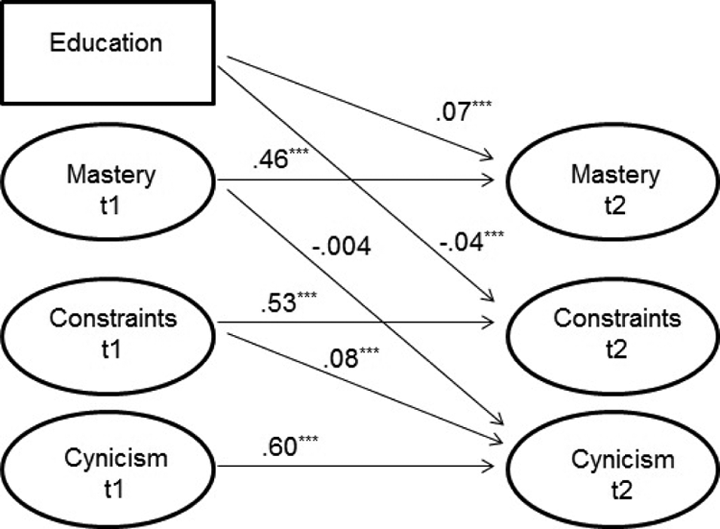
Longitudinal mediation, Study 2. Unstandardized path coefficients and their p values (from structural equation model). *p < .05. **p < .01. ***p < .001. Fit indices: χ2(407) = 11,929.29, p < .001, comparative fit index = .93, root mean square error of approximation = .05, standardized root mean square residuals = .07. Indirect effect via mastery: −.000, SE = .001, 95% CI [−.002, .001]. Indirect effect via constraints: −.006, SE = .001, 95% CI [−.008, −.003]. CI = confidence interval; SE = standard error.
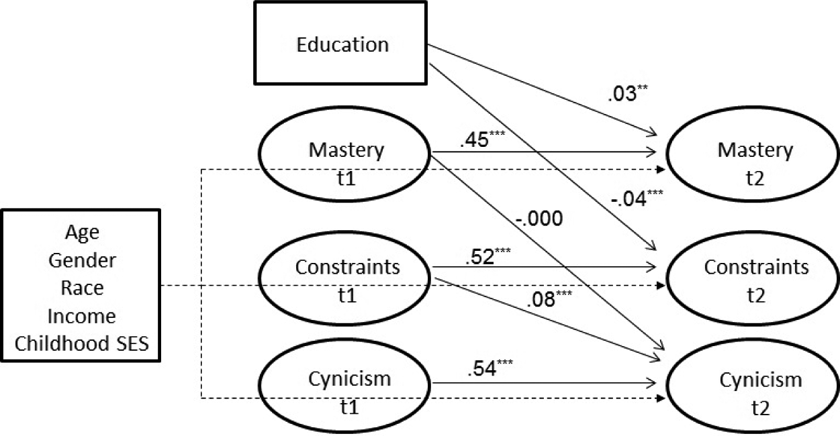
Longitudinal mediation, Study 2. Unstandardized path coefficients and their p values (from structural equation model). *p < .05. **p < .01. ***p < .001. Fit indices: χ2(614) = 16,673.66, p < .001, comparative fit index = .91, root mean square error of approximation = .05, standardized root mean square residuals = .07. Indirect effect via mastery: −.000, SE = .000, 95% CI [−.001, .001]. Indirect effect via constraints: −.003, SE = .001, 95% CI [−.005, −.001]. CI = confidence interval; SE = standard error.
Longitudinal Mediation: Study 2.
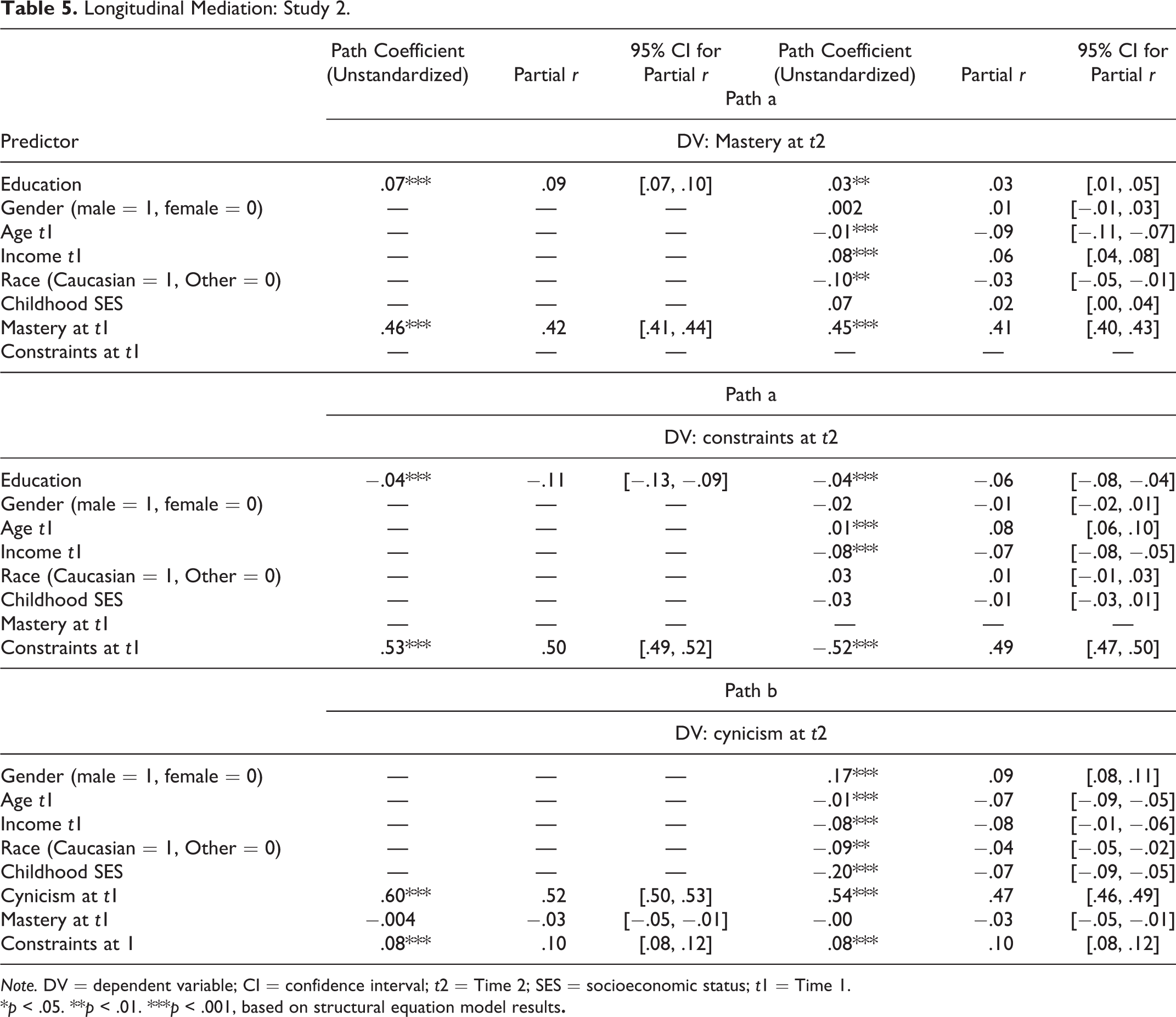
Note. DV = dependent variable; CI = confidence interval; t2 = Time 2; SES = socioeconomic status; t1 = Time 1.
*p < .05. **p < .01. ***p < .001, based on structural equation model results.
Overall, Study 2 replicated the prospective effect of education on cynicism, demonstrated in Study 1. In addition, it extended the results of Study 1 in two important ways. First, we have shown the education effect to operate regardless of individual differences in childhood SES, suggesting that higher educational attainment appears to undermine the development of cynicism even among individuals who grew up in precarious socioeconomic conditions. Second, using a longitudinal mediation analysis, we shed some light on the psychological mechanism behind this effect: Our results suggest that education is associated with a lower sense of perceived constraints, which might help averting feelings of vulnerability to others and thus undermine cynicism development.
General Discussion
Cynicism is a common social phenomenon bearing deleterious consequences for individuals (Chen et al., 2015; Critcher & Dunning, 2011; Smith, 1992; Stavrova & Ehlebracht, 2016) and societies (Knack & Keefer, 1997; Putnam, 2000). Despite its ubiquity, factors contributing to and undermining the development of cynicism have been poorly understood so far. In the present research, we explored the role of educational attainment in cynicism development. The results of two large-scale longitudinal studies showed that high educational attainment predicted lower levels of cynicism over time, acting as a sort of antidote to cynicism. We detected this effect in two different large adult samples that were followed over 9 (Study 1) and 4 (Study 2) years. High educational attainment was associated with less cynicism regardless of individuals’ sociodemographic characteristics, including income, as well as their childhood SES. That is, obtaining a higher level of education acted as an antidote to cynical beliefs about human nature even among individuals who had a difficult start in life.
How exactly can education contribute to less cynicism? Drawing on existing literature on the link between education and personal control and the potential of personal control to dampen unwarranted suspiciousness and feelings of vulnerability, we proposed that a sense of control can represent the psychological mechanism underlying the education effect. Following prior research (Lachman & Weaver, 1998), we differentiated between mastery, a belief in one’s ability to achieve the desired outcomes, and perceived constraints, a belief that external factors, such as other people or just bad luck interfere with achieving the desired outcomes. The results of the longitudinal mediation analyses (Study 2) indicated that only perceived constraints (but not mastery) acted as a mediator of the effect of education on cynicism. While higher education was associated with both a stronger perception of mastery and a weaker perception of constraints, only the latter was related to less cynicism. Perception of constraints involves a belief that one’s life is determined by external factors, including other people, and may thus give rise to a feeling of vulnerability. In turn, feeling vulnerable and at other people’s mercy are central to suspiciousness and cynical distrust (Pope et al., 1990; Ross, 2011; Vranceanu et al., 2006). These findings are generally consistent with recent research showing that mastery and constraints might have different associations with life outcomes (Infurna & Mayer, 2015; Ward, 2013).
Although here we have shown education to reduce cynicism via its positive influence on perceived constraints, it still remains to be explored how exactly this effect operates. For example, highly educated individuals might have different social experiences compared to their less educated counterparts. High educational attainment might reduce the likelihood of becoming victim to deception and exploitation and consequently counteract the perception of the social world as a hostile place. In fact, existing research suggests that a hostile childhood environment contributes to cynicism development (Meesters, Muris, & Esselink, 1995). Hence, one potentially interesting avenue for future research is to examine to what extent the education effect demonstrated here rests on individual differences in the exposure to others’ malevolence or kindness.
On a related note, education might provide individuals not only with a higher perceived control of their own lives but also with more power over others (e.g., as it can provide access to high-power positions). While we showed that perceived control over one’s own life is associated with less cynicism, power (i.e., control over others) might have the opposite effect. Studies have shown power to undermine perspective taking, increase social distance (Blader et al., 2016; Lammers, Galinsky, Gordijn, & Otten, 2012), and render individuals more sensitive to unfairness against the self (Sawaoka, Hughes, & Ambady, 2015). Most importantly, power gives one reason to doubt the purity of the intentions behind others’ kindness and thus facilitates cynical attributions for others’ generous behavior (Inesi, Gruenfeld, & Galinsky, 2012). It might be interesting to future studies to explore whether holding a position of power can fuel the development of cynicism.
The present research is not without limitations. We acknowledge that both studies are based on only two waves of data, which limits our ability to examine individual trajectories of cynicism development over time as a function of their education (Singer & Willett, 2003). Another design limitation is that the information about participants’ education was collected years before their cynicism was measured for the first time. Yet, given that we were interested in formal education which is typically completed by the age of 25–30 (National Center of Education Statistics, 2016) and both our samples were rather old (mean age over 50), we believe potential unrecorded changes in formal education throughout this time to be rather unlikely. At the same time, besides formal education, individuals might educate themselves independently of any formal institution (and highly educated individuals might be more likely to commit to lifelong learning). Such individual efforts might serve as a more proximal mechanism of the effect of formal education reported here and is worth further investigations.
Despite the longitudinal design of the current studies, suggesting that education leads to less cynicism, the reverse path of causality is possible as well. Dispositional cynicism might make one suspicious not only regarding strangers’ intentions, it might also impair one’s openness to new experiences, including willingness to absorb new information, openness to new ideas, and divergent thinking, which might undermine one’s academic achievement. We could not explore this possibility in the present study, as the majority of respondents were in late adulthood and the studies included a measure of education at just one time point. We encourage future studies to use samples of children and adolescents to examine the potential effect of cynical worldviews on educational attainment.
In a similar vein, although the longitudinal mediation used here represents a methodological improvement over widely used cross-sectional mediation designs (Cole & Maxwell, 2003), it does not allow making strong causal inferences either (Bullock, Green, & Ha, 2010) and might be even confused with mathematically equivalent phenomena, such as confounding (MacKinnon, Krull, & Lockwood, 2000). Although causal inferences regarding the effect of education are difficult, researchers can still explore the causal assumptions behind the role of control in cynicism development. For example, manipulating perceived constraints (e.g., see Stavrova & Meckel, 2017) to examine their effect on cynical beliefs might be the first step on this way.
Overall, as Western societies are increasingly plagued with suspiciousness and cynical distrust (Eisinger, 1999; Twenge, Campbell, & Carter, 2014), understanding sources of cynicism and factors undermining its development represents an important research endeavor. The present research has contributed to this by uncovering one of the antidotes to cynicism—education. Importantly, as cynicism not only is connected to multiple negative outcomes for individuals but also represents a threat for the functioning of democratic and economic institutions (Knack & Keefer, 1997; Rothstein & Uslaner, 2005), policies fostering investment in education may pave the way for a less cynical, more open and, ultimately, successful society.
Footnotes
Declaration of Conflicting Interests
The author(s) declared no potential conflicts of interest with respect to the research, authorship, and/or publication of this article.
Funding
The author(s) received no financial support for the research, authorship, and/or publication of this article.
Supplemental Material
The supplemental material is available in the online version of the article.
Notes
References
Supplementary Material
Please find the following supplemental material available below.
For Open Access articles published under a Creative Commons License, all supplemental material carries the same license as the article it is associated with.
For non-Open Access articles published, all supplemental material carries a non-exclusive license, and permission requests for re-use of supplemental material or any part of supplemental material shall be sent directly to the copyright owner as specified in the copyright notice associated with the article.
